Media Walls · 27 min read · 19 September 2026
Media wall colours and finishes: choosing white, wood or stone in the UAE
A practical guide to choosing media wall colours and finishes in the UAE: white, beige, dark wood, stone effect, laminate, lacquer and veneer — with advice on UAE lighting conditions and finish durability.
By the Al Tareeq Decor team · Contact our workshop
Key takeaways
- Finish choice is the single decision that changes how a media wall reads from across the room — white reads open, dark reads anchoring, stone reads rich, wood reads warm.
- View the finish sample in the actual room under UAE ambient light before approving it — showroom lighting and domestic lighting give very different readings of the same material.
- Laminate is the most practical and durable choice for UAE conditions; lacquer gives deeper colour; veneer gives genuine material warmth but needs slightly more care.
- Mixing finishes — a stone-effect panel behind the TV with white lacquered flanking sections — is common in UAE living rooms but needs careful detailing at material junctions.
- Matt finishes handle UAE dust and fingerprints better than high-gloss in high-traffic living areas.
On this page
- Key takeaways
- How the finish defines the wall
- White and off-white media walls
- Warm wood tones: oak, walnut and teak effect
- Dark finishes: charcoal, navy and near-black
- Stone effect and marble: when it works in a UAE living room
- Laminate: the entry finish and what it delivers
- Finish comparison — UAE media wall
- Lacquer: deep colour and a perfect flat surface
- Veneer: real wood over engineered board
- Matte versus gloss in UAE apartments
- Mixing finishes: combining materials on one wall
- How UAE light affects colour selection
- Colour for small rooms and large open-plan spaces
- Finish durability in UAE conditions
- What sits under the colour: laminate, lacquer and veneer in section
- One wall through the day: how UAE light moves a finish
- Grain direction, pattern repeat and book-matched stone effect
- Where two finishes meet: joints, shadow gaps and trims
- Pairing the wall with marble floors, porcelain and curtains
- Everyday care and cleaning by finish
- Colour choices for rented and resale homes
- How to brief the workshop on colour
- Approving the finish sample before manufacture
- Common questions
How the finish defines the wall
Before choosing a colour, decide what role you want the TV wall to play in the room. A receding wall — one that provides a backdrop rather than making a statement — typically uses a neutral that is close to the room's wall colour: warm white, pale stone or light wood. The TV floats against a quiet background and the other furnishings lead.
An anchoring wall — one that is a room's central visual feature — uses a finish with more presence: deep colour, strong grain or dramatic stone pattern. This wall leads the room and everything else responds to it. UAE living rooms with marble floors and high-spec curtains often benefit from a media wall with enough presence to hold its own against those other elements.
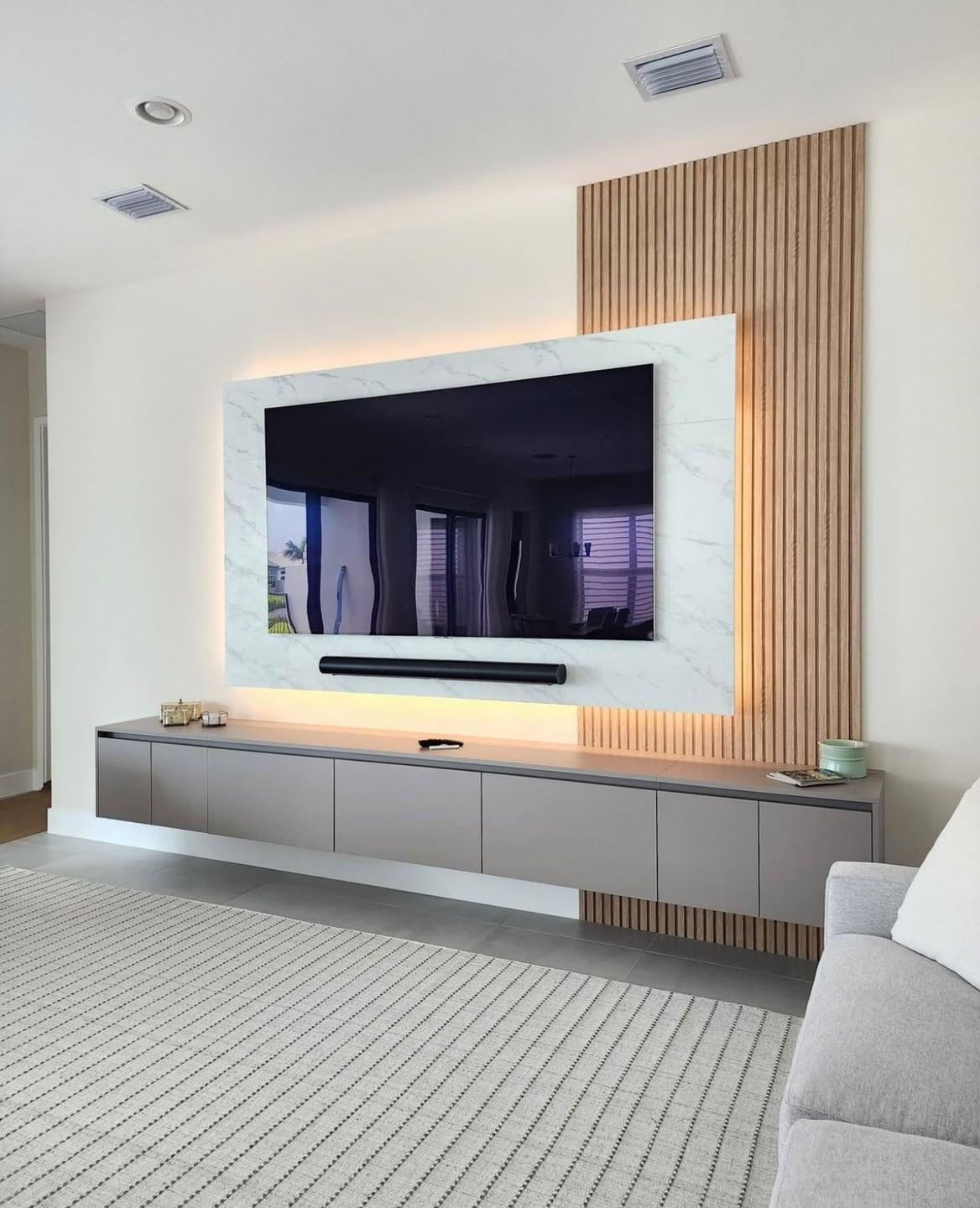
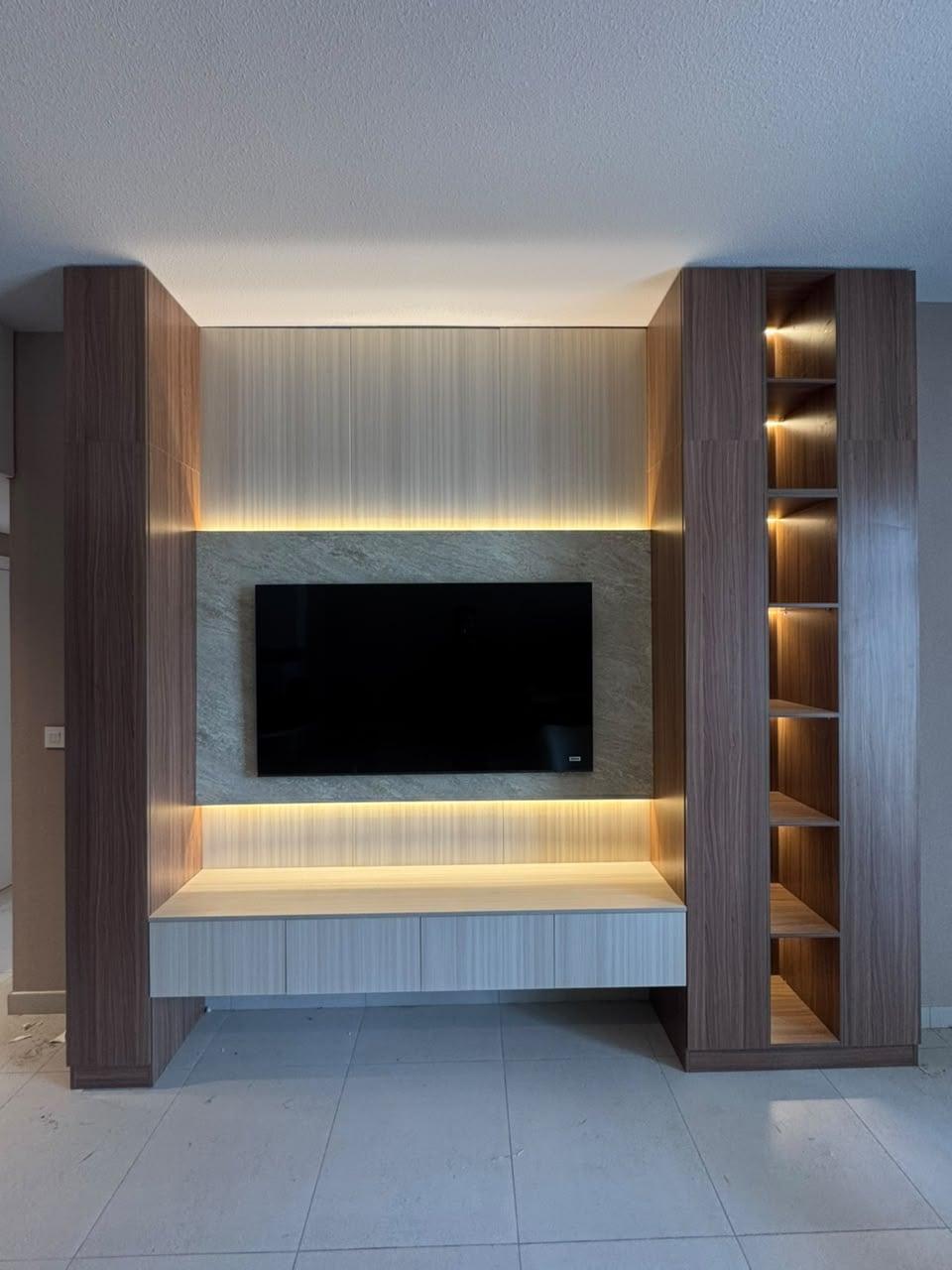
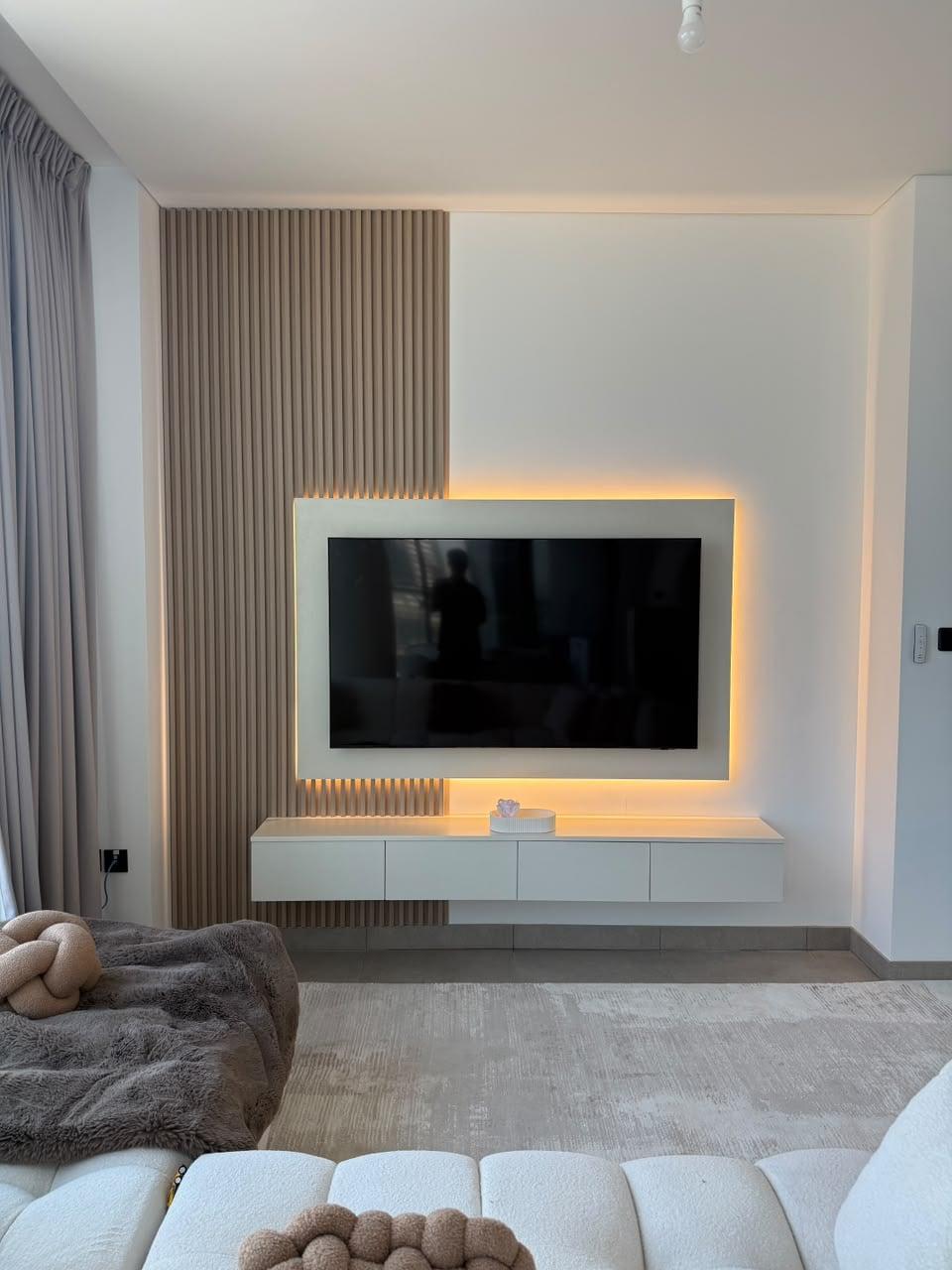
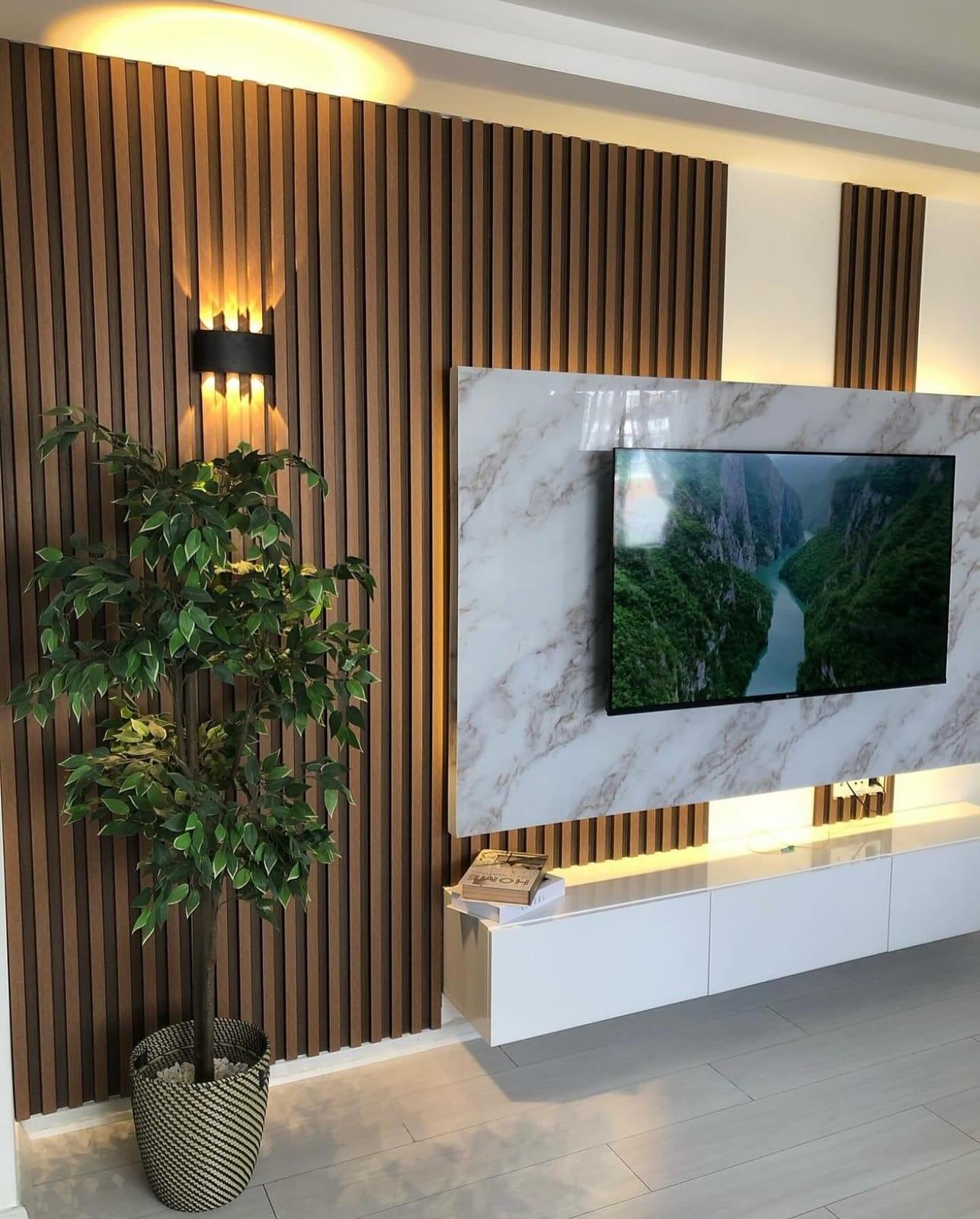
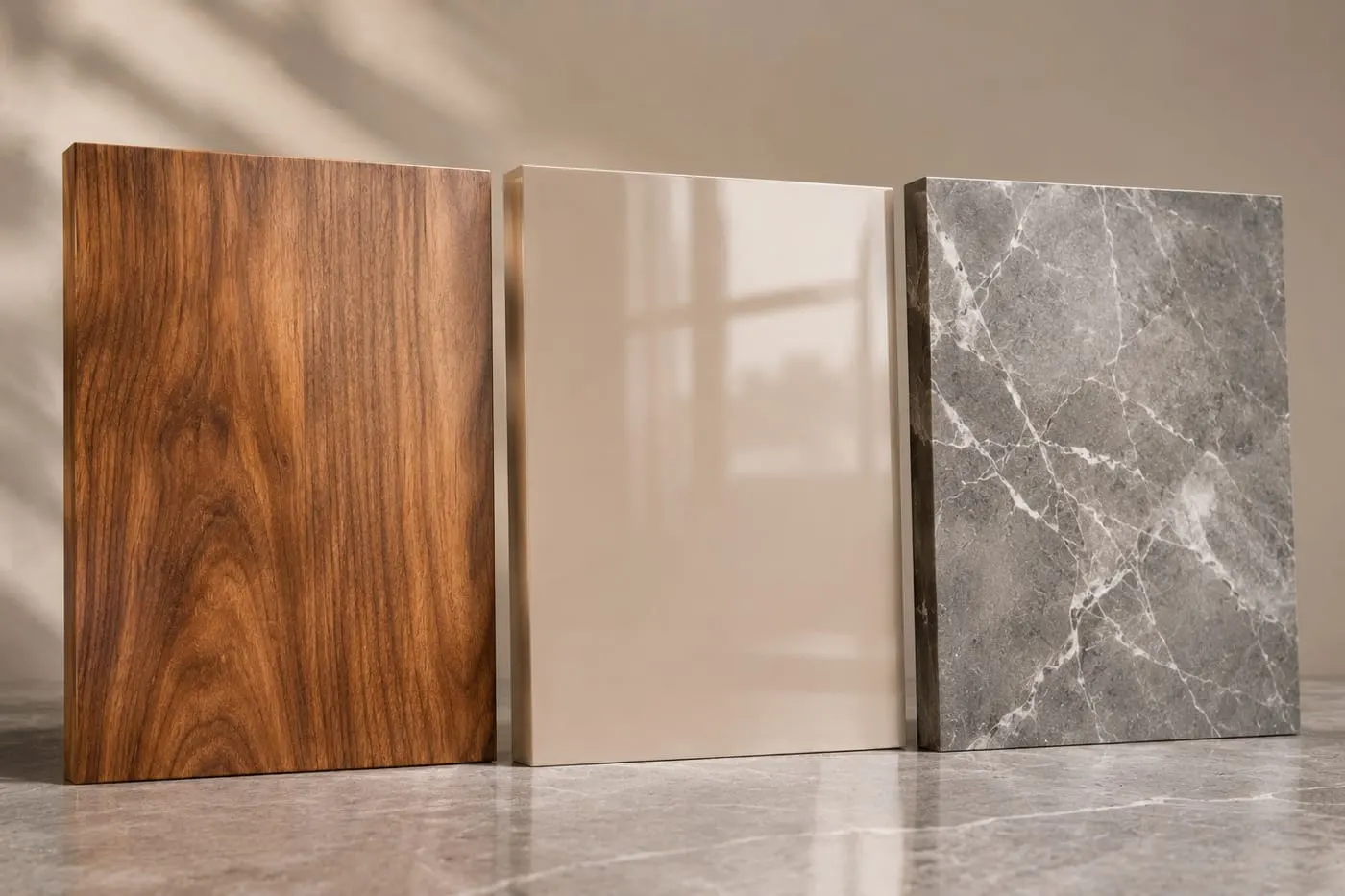
A feature-panel wall — where the TV panel uses one material and the flanking sections use another — is the most common contemporary UAE approach. The TV centre section uses a marble-effect, veneer or fluted panel; the flanking sections use white or beige laminate or lacquer. The wall reads as designed without overpowering the room.
White and off-white media walls
White and off-white media walls are the most common choice in UAE apartments. White reads clean, reflects light and does not compete with curtains, rugs or upholstery. It is the most forgiving finish when other elements of the room change over time — a new sofa, different curtains, a recoloured rug — and it looks right in almost every UAE apartment context.
The practical issue with white in a UAE living room is that bright ambient light and high dust levels require more frequent cleaning of the wall surface than a darker finish. Matt white surfaces handle fingerprints and dust better than high-gloss white; a satin or eggshell texture is the most practical balance of cleanability and appearance.
Warm white — a white with a slight cream or bone undertone — is more forgiving in UAE light than a pure bright white. Pure white with a cool blue undertone can look slightly grey or clinical in the strong afternoon sun of a west-facing UAE apartment. Specify the undertone, not just the name, when approving the finish.
Warm wood tones: oak, walnut and teak effect
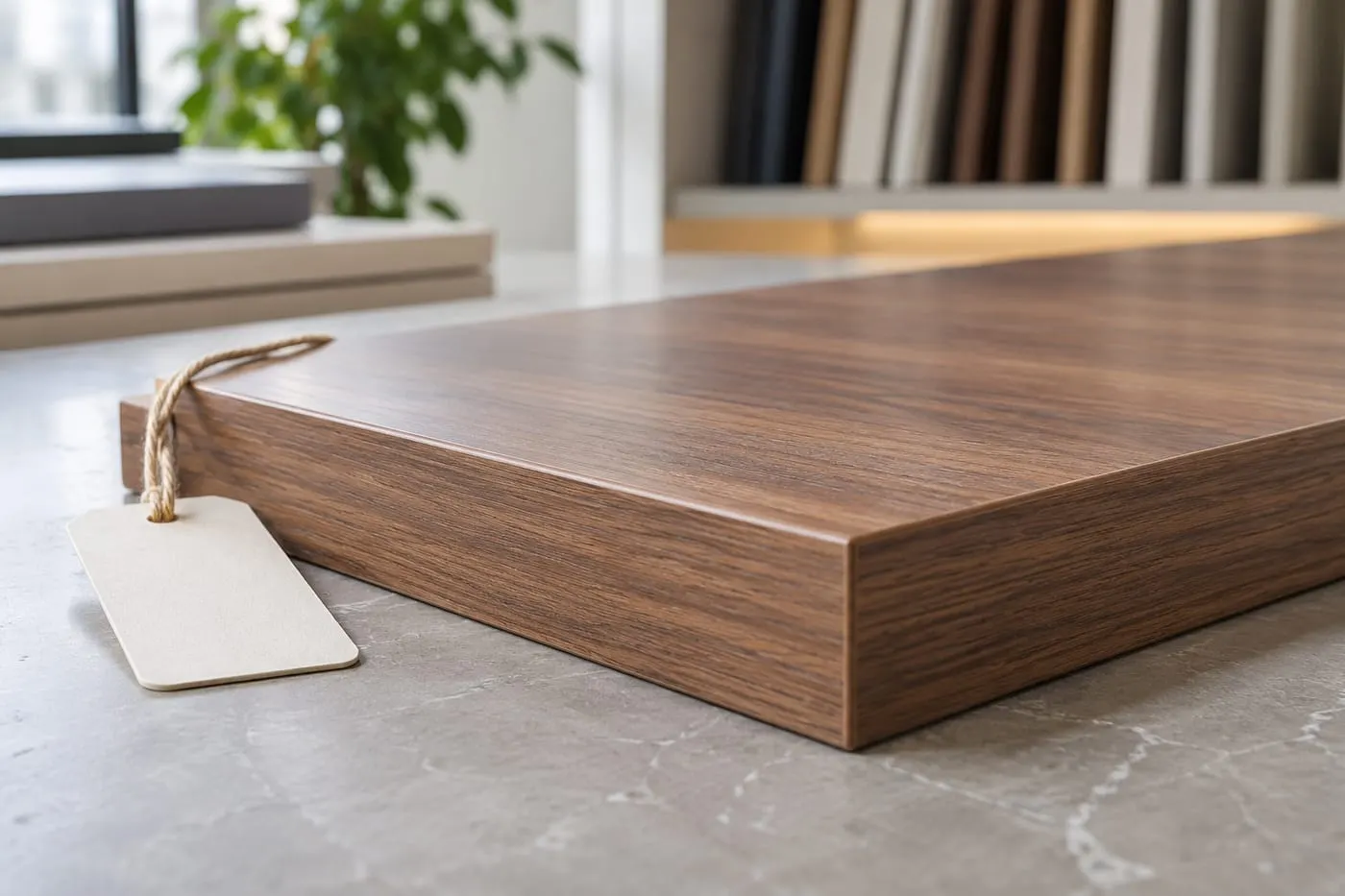
Wood-effect and wood-veneer finishes are the second most popular choice for UAE media walls. Oak — a warm pale grain with golden tones — suits contemporary UAE apartments and complements marble and stone floors well. Walnut — darker, richer and with more pronounced grain — suits larger rooms and villas where it can carry more visual weight.
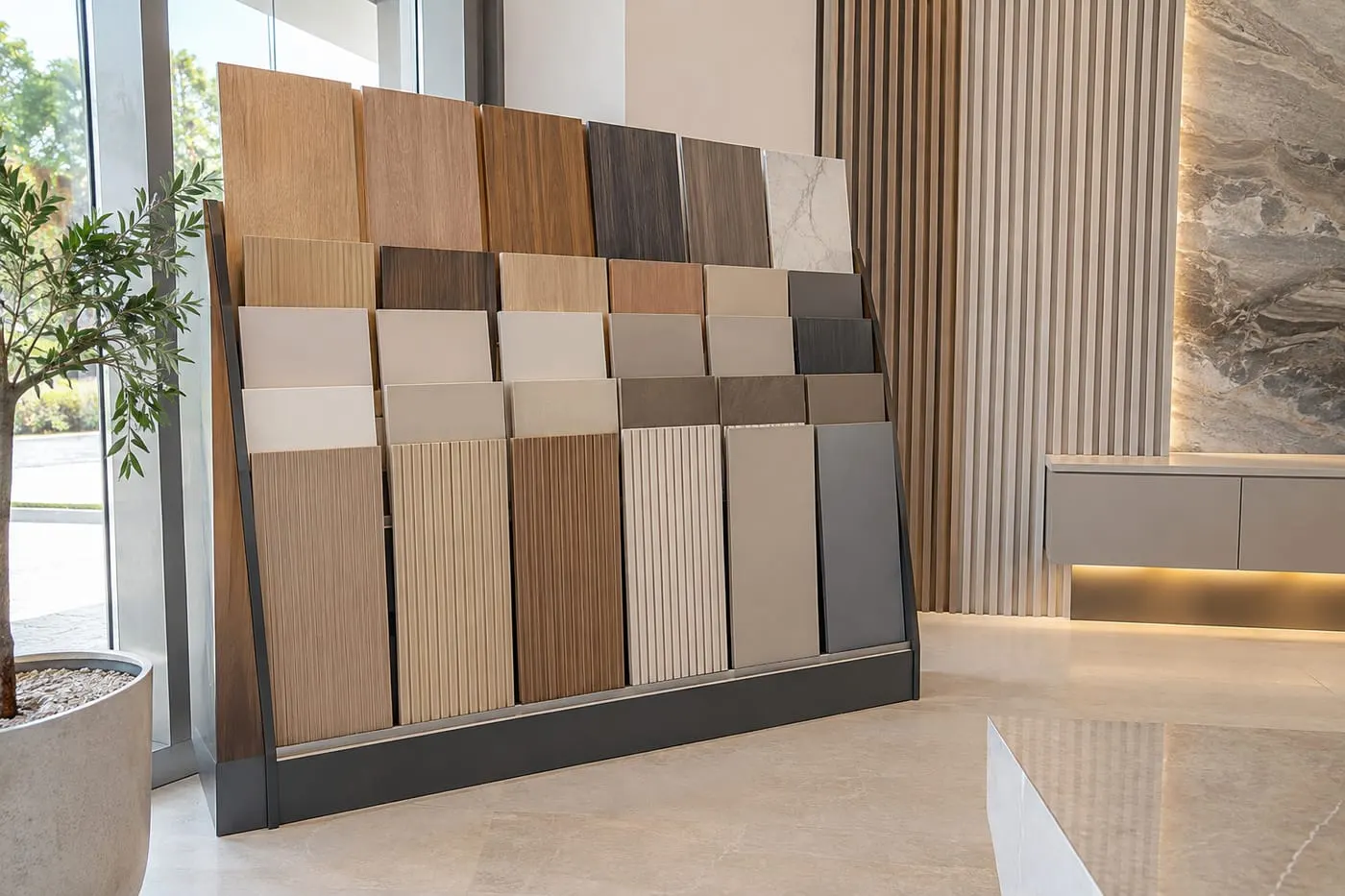
Wood finishes can be used across the full wall, but they are more commonly used for the TV panel section or as a central accent, with white or beige flanking sections. This gives the wall a focal point without making the room feel heavily timbered. Fluted wood panels — where the same wood finish is applied to a ribbed profile — have become a signature UAE contemporary look.
Teak-effect laminate suits a UAE context well — it references a material historically common in Gulf interior design without the cost or maintenance of genuine teak. It also ages less unpredictably than real wood under UAE climate conditions.
Dark finishes: charcoal, navy and near-black
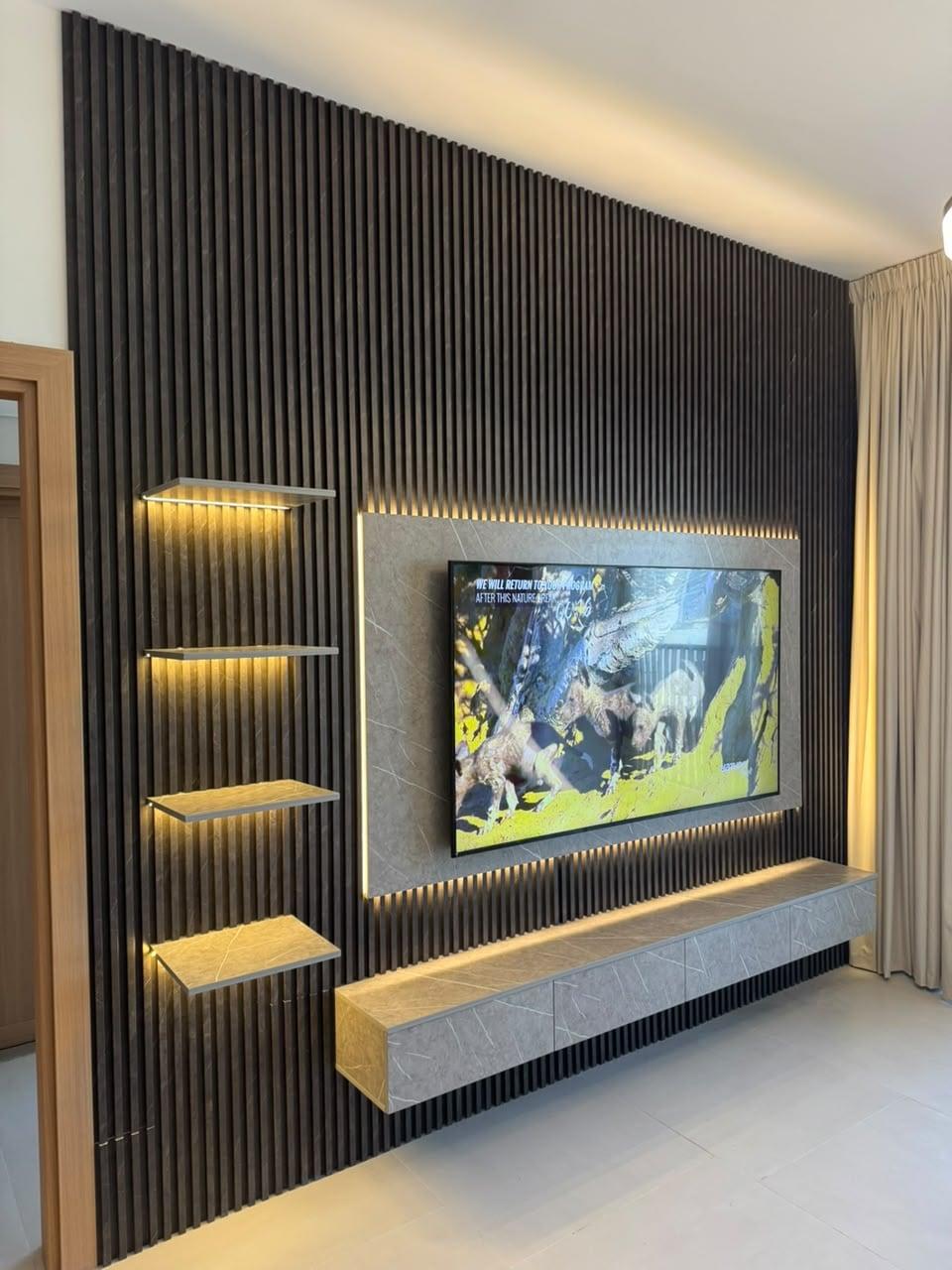
A dark media wall — charcoal, deep navy, near-black or wenge — creates a very different room from a light one. The TV screen appears sharper against a dark background; display objects in lit niches glow with more contrast; the room feels anchored and deliberate. Dark walls suit villas and larger apartments where the room is big enough to carry a dark anchor surface without feeling smaller.
In a compact UAE apartment, a dark media wall can work if the flanking sections are lighter and the room has strong natural or artificial light from other directions. A fully dark wall in a small living room with limited daylight typically feels oppressive rather than dramatic.
Dark laminate is the most practical choice for a dark UAE media wall — it handles fingerprints well in a matt finish and is straightforward to clean. Dark lacquer looks richer but shows dust more clearly and requires more care.
Stone effect and marble: when it works in a UAE living room
Stone-effect and marble laminates are widely used in UAE media walls. They complement the marble and large-format stone floors common in UAE apartments and villas, and they provide pattern and visual richness without the weight, cost or maintenance of real stone.
The most effective use of stone-effect in a UAE media wall is as a panel behind the TV — a defined section of marble or stone pattern that provides the wall's focal point while the flanking sections use a plainer, complementary finish. A stone-effect that covers the entire width of the wall can feel busy unless the room is large enough to carry the pattern at that scale.
Stone-effect laminates range from subtle vein patterns to dramatic book-matched looks. Choosing the right scale of pattern for the wall width is important — a large swirling marble pattern on a 1.0 m-wide TV panel is too compressed; on a 1.5–2.0 m-wide centre section it reads better. Take a sample and prop it against the wall at scale before approving.
Laminate: the entry finish and what it delivers
Laminate is a printed and sealed surface bonded to board. It is the entry-level finish for UAE media walls and the most widely used material for good reason: it is durable, cleanable, available in an enormous colour and texture range, and resistant to the humidity and temperature cycling of UAE apartments.
High-pressure laminate (HPL) is more durable than standard laminate and is the specification used in Al Tareeq Decor's production. It resists scratching, cleaning solvents and surface moisture better than the lower-grade laminate commonly found in imported flat-pack furniture.
Laminate cannot be refinished — if the surface is deeply scratched or the colour becomes unwanted, the panel needs to be replaced rather than repainted. This makes the initial colour choice important. It also means that a laminate media wall is typically replaced, not renovated, when tastes change — typically after 10–15 years of normal use.
Finish comparison — UAE media wall
Matt laminate
- Look
- Flat, clean colour
- Durability
- Excellent
- Cost tier
- Entry
- Best for
- High-use family rooms, rental properties
High-gloss laminate
- Look
- Reflective, vivid
- Durability
- Good (shows marks)
- Cost tier
- Entry–mid
- Best for
- Display sections, lower-use areas
Matt lacquer
- Look
- Deep, flat colour
- Durability
- Very good
- Cost tier
- Mid–high
- Best for
- Contemporary living rooms, feature sections
Gloss lacquer
- Look
- Rich, mirror-like
- Durability
- Good (shows marks)
- Cost tier
- High
- Best for
- Accent panels, low-touch areas
Wood veneer
- Look
- Real grain, warm
- Durability
- Good (needs sealing)
- Cost tier
- High
- Best for
- Feature panels, premium living rooms
Stone-effect laminate
- Look
- Pattern, visual richness
- Durability
- Excellent
- Cost tier
- Entry–mid
- Best for
- TV panel centre section, UAE villas
Cost tier is relative — all tiers are within the range of a custom joinery project. The entry tier still represents a significantly better finish than most ready-to-assemble alternatives.
Lacquer: deep colour and a perfect flat surface
Lacquered finishes are painted and sealed on the board surface. The result is a continuous colour field with no visible grain or texture variation — just pure, flat colour. This is different from both laminate (a printed and bonded surface) and veneer (a natural material with inherent variation), and it suits living rooms where a very clean, controlled look is the aim.
The colour range for lacquer is essentially unlimited — any RAL or NCS colour can be specified. This allows the media wall finish to be matched precisely to other elements in the room: an existing paint colour on the adjacent wall, a curtain fabric tone, or a ceramic tile from the adjacent kitchen.
Lacquer is applied in multiple coats and requires careful temperature and humidity control during application and curing. Al Tareeq Decor's workshop handles lacquering in a controlled environment, which is important in the UAE where on-site lacquering is affected by ambient dust levels.
Veneer: real wood over engineered board
Veneer is a thin slice of real wood — typically 0.5–1.0 mm — bonded to an engineered board core. Because the surface is real wood, it has genuine grain variation, natural colour depth and a warmth that no printed or painted surface fully replicates. It is the finish that ages best and can be lightly refinished if the surface becomes marked.
In UAE conditions, veneer needs to be sealed — either with an oil or a lacquer coat — to prevent the surface absorbing moisture from the humidity cycles that occur in an air-conditioned apartment. Without sealing, veneer can develop surface discolouration or slight movement at board edges over time.
Veneer is the right choice for a UAE media wall where the household wants a finish that feels genuine, ages gracefully and can carry a premium specification throughout the room. It costs more than laminate of a similar colour and requires slightly more care, but it is the most rewarding finish to live with.
Matte versus gloss in UAE apartments
Matt finishes are the more practical choice for UAE living room media walls. UAE ambient light — particularly in south and west-facing apartments during the afternoon — creates strong directional light that highlights every surface mark, fingerprint and dust particle on a gloss surface. A matt or satin finish absorbs this light and reads more evenly.
High-gloss finishes look extraordinary in controlled photographic lighting but reveal every imperfection in UAE domestic conditions. They also scratch more visibly than matt finishes because the scratched area's broken surface reflects differently from the intact gloss around it.
If the wall includes a gloss element — a mirrored back panel, a glass shelf or a gloss-lacquered accent section — combine it with matt surrounding sections. This contains the reflective surface to a deliberate area and prevents the whole wall from becoming a dust and mark display.
Mixing finishes: combining materials on one wall
The most common contemporary UAE media wall uses two or three finishes in one composition: a stone-effect or veneer panel behind the TV, flanking sections in white or beige lacquer or laminate, and a console in a third finish — often the same as the flanking sections or a contrasting accent.
When mixing finishes, the material junction is as important as the materials themselves. Where a marble-effect panel meets a white lacquered section, the joint line needs to be a deliberate, clean architectural line — either a gap filled with a metal trim or a precise mitred joint with no gap visible. A ragged joint suggests poor workmanship regardless of how good the individual materials are.
Limit the number of distinct materials in one composition to three. More than three distinct finishes on a single wall tends to read as lack of direction rather than designed complexity. Confirm the material layout on the drawing, with the junction details shown clearly, before manufacture.
How UAE light affects colour selection
UAE sunlight is intense and has a warm, high-UV character different from northern European daylight. Interior light in a UAE apartment also depends heavily on the glass specification and UV film applied to the windows. A colour that looks one way in a European furniture showroom can look significantly different in a UAE apartment lit by filtered afternoon sun.
East-facing rooms get strong direct morning light; west-facing rooms get strong afternoon light that often has a warm orange cast in the late afternoon before sunset. South-facing rooms get strong midday overhead light. Each of these affects how a media wall finish reads through the day.
The only reliable way to check a finish in a specific room is to view the sample in that room at the time of day when the room is most used. Take samples home — not just to the showroom. If the joiner cannot provide a sample large enough to prop against the wall, ask for a sample board that can be leant against the wall for a week before approving.
Colour for small rooms and large open-plan spaces
In a small UAE apartment living room — typically below 25 square metres — the media wall finish has an outsized effect on how large or small the room feels. A white or very pale wall finish that blends with the surrounding walls makes the TV wall appear less assertive and the room reads larger. A dark or strongly textured wall in a small room brings the wall visually forward and makes the room feel smaller.
In a large open-plan UAE living and dining space — common in villa ground floors — the media wall needs to hold its own across a much longer sight line. A subtle pale colour may read as indistinct and unfinished from across the full room. A stronger, more considered finish — a rich wood tone, a dramatic stone, or a deliberately dark background — can anchor the space and make it feel deliberate.
In connected open-plan spaces, also consider how the media wall reads from the dining area and the kitchen. A TV wall composition that looks right from the sofa at 3 m sometimes looks unexpected from the dining table at 7 m because the angles and proportions change.
Finish durability in UAE conditions
UAE climate is challenging for interior finishes. Daily air conditioning runs for 10–12 months of the year, creating cyclic humidity changes that can cause dimensional movement in board-based products and surface cracking in materials that are not properly sealed. High summer temperatures — which may reach 45–50°C on external surfaces — heat up glass and curtains adjacent to media walls.
High-pressure laminate (HPL) handles UAE conditions well: it is dimensionally stable, moisture-resistant and does not fade under UV if the room has good window tinting. Lacquer on well-prepared MDF is also stable if properly applied; thin or under-cured lacquer can yellow or crack at edges. Veneer with an oil or lacquer seal is durable but needs annual maintenance if the seal wears.
Any finish applied directly to a wall that is damp — a concrete wall with no vapour barrier or a wall adjacent to an uninsulated external surface — will fail regardless of the finish type. The wall substrate and fixing method are as important to finish durability as the surface material.
What sits under the colour: laminate, lacquer and veneer in section
Two panels can share the same colour name and behave very differently on the wall, because the colour is only the top of a stack. Looking at each finish in section explains most of the practical differences you will notice later: how it takes a scratch, how it reacts to humidity, and whether it can ever be refreshed.
High-pressure laminate is a printed decor paper sealed under a clear overlay and pressed with resin-bonded layers into a single hard sheet, which is then bonded to the board core. The colour or wood print is part of the sheet itself, so it does not chip off in flakes, but it also cannot be sanded or repainted. If a corner is badly damaged, the practical repair is a new panel.
Lacquer is built up on the board face in stages: primer and filler to level the surface, then colour coats, then a sealed topcoat that cures flat. Because the colour is sprayed, any RAL or NCS reference can be matched, and a sound lacquered surface can be re-sprayed years later. The quality of the result depends heavily on how clean and controlled the spraying is, which is why we do it in the workshop and not on site.
Veneer is a thin slice of real wood glued to the board and sealed with oil or lacquer. The grain is genuine, the seal protects it from UAE humidity swings, and a worn surface can usually be lightly sanded and re-oiled. It asks a little more care than laminate, but it is the only one of the three whose character improves with age.
The board core is the same engineered MDF in all three, so the choice of finish is really a choice of surface behaviour. Ask which stack is being quoted for each section of your wall, and whether the sections have different finishes. A wall that mixes laminate on the lower doors with veneer on the feature panel is perfectly normal, as long as the drawing says so.
One wall through the day: how UAE light moves a finish
A finish sample is judged once, usually in an office or showroom, and then lives on your wall for years under every kind of light the day produces. In the UAE that range is wide: strong, direct sun, very bright indirect light off glass and pale paving, and warm artificial light after dark. The same sample can read quite differently at each of them.
In the morning, an east-facing living room gets low, direct sun with long soft shadows, and cooler tones tend to dominate. At midday the light is high and flat, shadow nearly disappears, and surfaces can look paler and less textured than they do at any other time. In the late afternoon, a west-facing wall picks up a warm orange cast that pushes whites towards cream and deepens woods. After dark, the room is lit by your own lamps and LEDs, and that is the light you will see the wall in for most of the hours you are actually home.
That is why the evening reading matters most for a media wall. Warm white LED at 2,700–3,000 K is the usual choice for UAE living rooms, and under it wood, stone effect and warm whites tend to look richer, while cool-undertone whites can look slightly grey. If your wall is mostly used in the evening, hold the sample against the wall at night with your own lighting switched on.
Window film, tinted glass and curtains all alter the daylight reaching the wall, so a sample tested in a different room, or before curtains are fitted, is only a rough guide. Colour-rendering quality of the LEDs also matters: strips with poor colour rendering can flatten a veneer or make a stone pattern look muddy even when the finish itself is excellent.
A practical routine is to lean a full-size sample board on the wall and look at it in the morning, at midday, in the late afternoon and in the evening. If all four readings are acceptable, you have a finish that will work in the room, not just in the showroom.
Grain direction, pattern repeat and book-matched stone effect
Beyond colour, the pattern in a finish decides how a wall feels from across the room. Wood and stone-effect surfaces both carry direction, and where that direction runs, and how it repeats from one panel to the next, is part of the design even though it rarely appears in a catalogue.
Vertical grain makes a wall feel taller and is the usual choice for tall panels and fluted sections in rooms with standard ceiling heights. Horizontal grain widens the wall and suits long, low compositions such as a console run. Mixing directions on a single wall can work, but only when it is deliberate, for example a horizontal console beneath vertical flutes, and agreed on the drawing before cutting.
Printed decors repeat. On a wide wall, the same visible knot or vein can appear in two or more panels if they are cut from the same pattern repeat, and a keen eye will find it. Ask the workshop how the repeat falls across your wall, and whether adjacent sections are cut from different parts of the sheet. This is a simple check that costs nothing when asked early.
Book-matched stone effect mirrors the vein pattern across a central line so the two halves form a symmetrical figure, as seen in natural marble slabs. It is striking behind a centred TV, but it only works if the panels are made, labelled and installed in sequence. Matching is lost if sections are swapped. Ask for panel numbers on the drawing so that the installation team keeps the order.
Finally, choose pattern scale to match the panel size. A large dramatic vein reads well across a wide central section and badly on a narrow pillar, where it breaks into fragments. For narrow elements, a quieter or finer pattern keeps the wall calm.
Where two finishes meet: joints, shadow gaps and trims
On a wall that uses a stone-effect panel behind the TV, white sections either side and a wood-tone console, the places where one finish stops and the next begins are some of the most visible lines in the room. They decide whether the wall reads as designed or merely assembled.
A flush butt joint puts two edges against each other with only a hairline between them. It is the cleanest-looking option when the work is perfect, and the least forgiving when it is not, because any small misalignment, edge difference or tone change is shown straight away. It suits narrow runs and precise factory-cut boards.
A recessed shadow gap leaves a narrow channel between the two boards. The channel casts its own thin shadow, which reads as a deliberate design line and hides the small variations in height and colour that are almost unavoidable between different materials. It is a common choice where a feature panel meets a plain section.
A metal trim covers the joint with a slim profile. It gives a crisp, architectural line and can pick up a colour from elsewhere in the room, such as the LED housings or the door handles. It adds a visible element of its own, so the finish and thickness of the trim need to be agreed, not left to chance.
Corners need the same care. A mitred return wraps the finish around the edge so there is no raw board edge visible, while a butted corner leaves a joint line. Edge banding should match the face finish, not approximate it. Whichever approach you choose, agree it on the drawing with a small detail sketch, because a joint decided on site is usually the one you will not like in the finished room.
Pairing the wall with marble floors, porcelain and curtains
A media wall does not sit alone. In most UAE living rooms it faces a large expanse of floor, usually marble, polished porcelain or large-format tile, and it is framed by curtains that may be heavier and richer in colour than the wall. Choosing the wall finish in isolation is the usual reason a good material still looks slightly off in the finished room.
Start with undertone, not colour name. Floors described as beige, grey or white can lean warm or cool, and a wall finish with the opposite undertone will look dirty next to them. Hold a sample against a floor tile in daylight and ask whether the two read as the same family. Warm floors pair well with warm whites, oak and walnut; cool grey floors pair better with cool whites, grey-toned woods and charcoal.
Polished floors reflect the wall, so a very dark wall will appear to double in height and weight in a glossy floor. In a compact room, that can feel heavy. A satin or matt wall finish tones the reflection down, while a mid-tone wood or a lighter stone effect keeps the room calmer.
Curtains matter because they share the same sightline. If curtains are a strong colour or a rich pattern, a quieter wall lets them lead. If curtains are neutral, a more expressive wall finish, such as a stone effect or deep wood, gives the room a focus. The curtain fabric samples and the wall finish sample should be viewed together, ideally on the same afternoon.
If you are working with an interior designer, share the finish samples with them before the drawing is approved. A small change in the wall tone made early costs nothing, while changing it after production does.
Everyday care and cleaning by finish
A media wall is touched less than a kitchen but more than most people expect: console fronts are opened daily, lower doors are brushed against, and the face is dusted regularly. Light, correct care keeps every finish looking as it did on handover, and the right routine differs slightly by material.
Laminate is the easiest. Wipe with a soft, slightly damp cloth and dry it, using mild soap if needed. Avoid abrasive pads and powders, which dull the surface, and avoid steam cleaners, which push moisture into edges. Matt and textured laminates hide dust and fingerprints better than gloss.
Lacquer should be treated like a good piece of furniture. Use a soft microfibre cloth and a mild cleaner, and do not use solvents or strong chemicals, which can mark the topcoat. Gloss lacquer shows every fingerprint in strong light, so keep a dry cloth for quick touch-ups rather than wetting the surface repeatedly.
Veneer likes dryness and a light touch. Dust with a dry cloth and use only a lightly damp cloth for marks, drying immediately. Never leave standing water at the base, and keep plants and drinks off the top surface. If the seal begins to look worn after some years, ask the workshop about re-oiling instead of waiting for visible damage.
Across all finishes, watch the base of the wall. Floor cleaning is the most common source of moisture that reaches boards in UAE homes, so wring mops well and avoid splashing the skirting area. Near LED drivers and TV recesses, keep ventilation clear, because heat trapped behind panels is a slow cause of discolouration. Our work carries a 24-month workmanship warranty and a 5-year limited warranty on covered wood-based boards, and following these simple habits keeps it easy to stay within normal use.
Colour choices for rented and resale homes
Not every media wall is built for a forever home. Some are installed in rented apartments where the tenant will move on, and others in properties the owner expects to sell or let in the next few years. The finish decision changes when you know the wall will have to be accepted by someone other than you.
For a rental, neutrality is a strength. White, warm greige, light oak and mid-tone woods are accepted by almost everyone and make the apartment easier to furnish. Strong colours and dramatic stone patterns are an excellent choice when you are certain of your taste, but they limit the audience for a handover. Check your tenancy agreement and building rules before fixing any joinery to a rented wall, and get written permission from the landlord for anything that will be left in place.
For a home you may sell, think about what buyers will walk in and see. A clean, well-detailed wall in a timeless finish reads as quality, while an unusual colour may make a buyer imagine the cost of replacing it. If you love a bold finish, consider limiting it to the central feature panel, with neutral sections either side that can stay in place whatever happens.
Durability matters more in this context too. Laminate is the lowest-maintenance finish and ages evenly, which suits a property that will see changes of household. Veneer and lacquer can look wonderful but expect the owner to look after them.
Whatever the plan, keep the drawing, finish codes and the warranty record in a folder. When a property changes hands, a clear record of what was installed and how to care for it is useful to the next owner, and it is the kind of detail that makes a custom wall feel like part of the home rather than a leftover.
How to brief the workshop on colour
Most disappointments with colour come from the brief, not the workshop. A phrase such as light oak or modern grey means something different to each person, and a photograph taken on a phone changes colour with the screen it is viewed on. A good brief replaces adjectives with references the workshop can actually match.
Start with codes. If you have a finish in mind, note the manufacturer and the decor code from the sample; if you need a lacquer colour, give the RAL or NCS reference. If the colour must match something already in the room, such as paint on the adjacent wall, send the paint reference or bring a small painted card to the measuring visit.
Add context photographs. Send pictures of the room taken in daylight and in the evening, a close-up of the floor, and any inspiration images of walls you like. Tell us what you like about each, for example the warmth of the wood or the calm of the white, so we understand the intent rather than just the picture.
State the practical conditions: whether children or pets use the room, whether the wall is in direct sun, and whether the property is rented or owned. These affect the recommended finish as much as taste does.
Then ask for physical samples, and view them as described above. Approve one finish at a time on a signed drawing that lists the code for each section. When the drawing, the sample and the written quotation agree, production can begin, and the wall that arrives will be the one you chose. Entry projects start from AED 3,500, and the final price follows the drawing, the finish and the scope you approve. Send a WhatsApp with your room photos and finish references to start the conversation.
Approving the finish sample before manufacture
No finish should be approved from a catalogue page, a screen image or a small chip. The colour shifts with size — what looks like one colour on a 100 mm chip reads differently across a 1.5 m panel. Take the full-size sample board — or as large a sample as the supplier can provide — and place it against the wall in the room for at least one full day before approving.
Check the sample at three times: morning light, strong afternoon light and evening artificial light. A finish that works in all three is a genuinely good choice for the room. A finish that only works in one light condition will require that the room is at the right time of day to look its best.
Also confirm the sample is from the same production batch as the material that will be used for the wall. Laminate colours can vary slightly between production batches. If the sample is from a different batch, the installed wall may look slightly different from the approved sample. Ask the supplier to confirm batch consistency before the production run.
Common questions
What is the most popular media wall colour in UAE apartments?
White and off-white — typically with a warm cream or bone undertone rather than a bright cool white. White works with almost any other element in the room and reads consistently across different lighting conditions. It is the most forgiving choice for a finish that will stay in place for many years.
Is high-gloss lacquer practical for a UAE living room media wall?
High-gloss lacquer looks striking in photographs and showrooms but shows fingerprints, dust and scratches clearly under UAE ambient light. Matt or satin lacquer is more practical for a surface that is in daily use and in direct daylight. High-gloss can be reserved for accent sections or areas that are not regularly touched.
Can veneer be used in a UAE apartment with air conditioning?
Yes, with correct sealing. Veneer bonded to an engineered board core with an oil or lacquer surface seal handles UAE air-conditioning humidity cycles well. Unsealed veneer or veneer applied to a damp or inadequately prepared substrate will show movement at edges and surface discolouration over time.
How do I choose between a stone-effect panel and a fluted wood panel?
Stone-effect suits rooms with marble or stone floors — it carries the material language of the room onto the wall. Fluted wood panels suit rooms that want warmth and texture rather than pattern. Both are widely used in UAE living rooms; the choice depends on whether you want the TV wall to feel like an extension of the floor material or to introduce a contrasting texture.
Can the finish colour be changed after the wall is built?
Laminate cannot be refinished — the panel needs to be replaced. Lacquered MDF can be repainted over an existing lacquer surface if the original is in good condition, though the result is not identical to a factory-applied finish. Veneer can be lightly sanded and re-oiled if the surface has worn. Confirm with the joiner what the refinishing options are before choosing a finish.

Sources & specifications
Manufacturer information applies to the named products and systems. Sources reviewed on 10 October 2026.
Want this planned for your home?
Consultation and measurement are free. Tell us the rooms, location and what you need; we arrange a sample visit and define the measured quotation.