1. Why does one curtain layer rarely work in the Gulf?
Curtains in the UAE are asked to do more than they do almost anywhere else. Between March and October, direct sun hits most façades for the better part of the day, glazing is often large and unshaded by deep overhangs, and rooms need to stay livable through afternoons that regularly climb past 40°C. On top of that, curtains still have to do their traditional jobs: give privacy in towers and villas where neighbours are close, protect furniture and flooring from fading, and make a room feel finished.
No single fabric does all of that well at once. A fabric sheer enough to keep a room bright and airy during the day is, by definition, too thin to block heat or light at night. A fabric dense enough to black out a bedroom for proper sleep usually turns a living room dark and closed-off if it's the only layer on the window all day. The fix used across most well-specified UAE homes isn't a single "best" fabric — it's matching the right combination of layers to what each room is actually used for.
It's also worth separating two things people often lump together: how bright a room feels, and how hot it gets. A tinted or reflective window film changes how much heat comes through the glass itself, but does nothing for privacy or the finished look of a room. Curtains sit on the interior side of that equation — they can meaningfully reduce the heat that's already passed through the glass before it radiates into the room, and they're the layer that controls privacy, darkness and appearance all at once. The two approaches aren't competing; many UAE homes use both, but curtains are almost always the layer that gets specified room by room, because unlike glass treatments, curtain needs genuinely differ from one room to the next.
| Emirate | Typical summer high | Peak UV index | Humidity pattern | Main window challenge |
|---|---|---|---|---|
| Dubai | 41–46°C | Very high (10–12+) | High coastal humidity | Glare off high-rise glazing, west-facing towers |
| Abu Dhabi | 41–47°C | Very high (10–12+) | High coastal humidity | Long, low-angle afternoon sun on villas |
| Sharjah | 40–46°C | Very high (10–12+) | Moderate to high | Dense, closely-spaced buildings; privacy plus heat |
| Al Ain | 42–48°C | Very high (10–12+) | Lower, inland/dry | Intense direct heat gain, larger villa glazing |
| Ras Al Khaimah | 40–45°C | Very high (9–11) | Moderate, coastal + mountain mix | Mixed orientation from varied villa layouts |
| Fujairah | 38–43°C | High (9–11) | Higher humidity, East Coast | Morning sun off the Gulf of Oman |
2. What are sheer and voile curtains best used for?
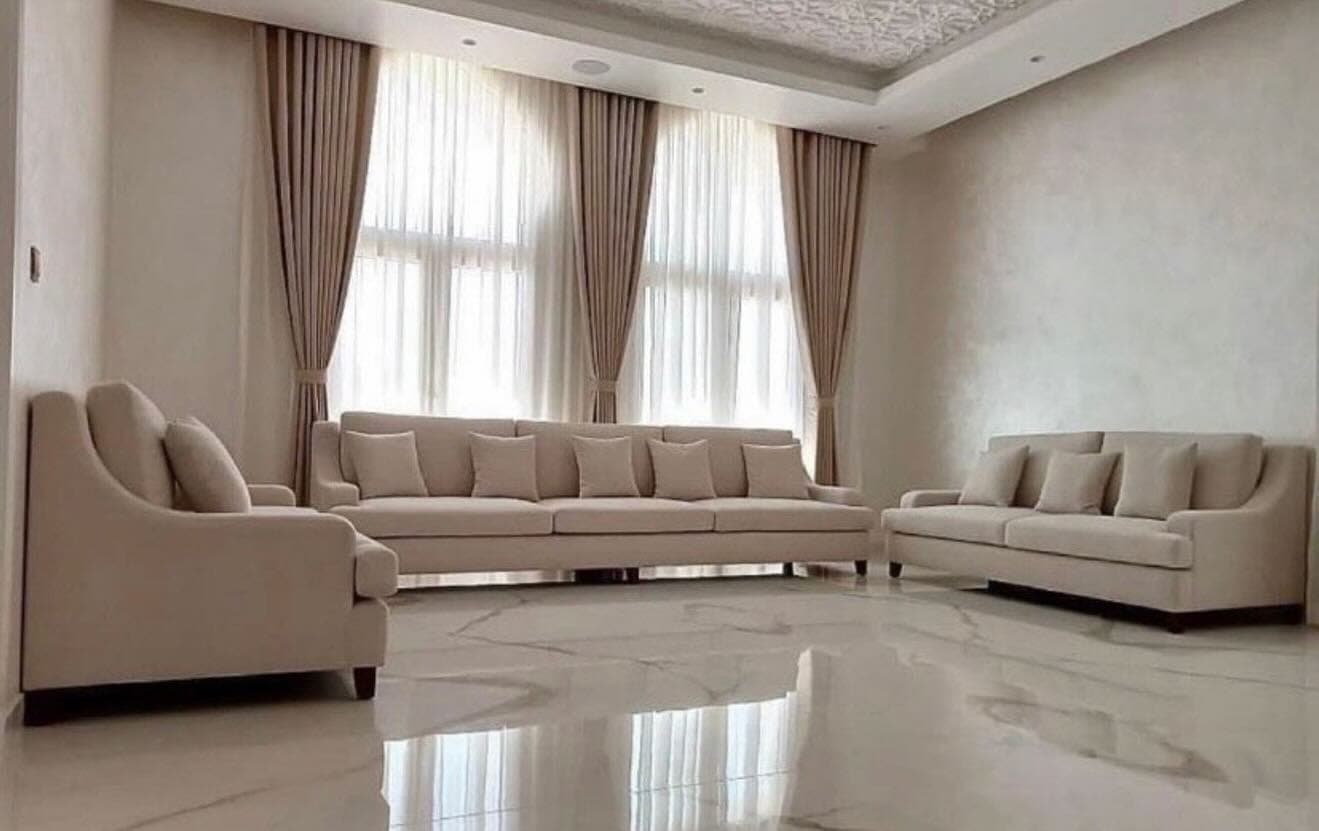
A sheer or voile curtain is a loosely woven, lightweight fabric — usually polyester, linen-look polyester, or a linen blend — that diffuses direct sunlight rather than blocking it outright. The point isn't to darken the room; it's to take the edge off harsh glare, soften strong Gulf daylight into something comfortable, and give privacy from the street or a neighbouring building without making the room feel shut in.
Sheers are usually specified by weight (grams per square metre, or GSM) and weave density, both of which affect how much light passes through and how much privacy the fabric gives once it's dark outside and lit inside. A lighter, loosely woven voile around 60–90 GSM lets in the most light and view but gives the least privacy after dark; a denser sheer around 100–150 GSM cuts more glare and holds privacy better, at the cost of a slightly heavier drape.
On their own, sheers do very little for heat or for night-time light control — they're a daytime fabric. That's exactly why they're almost never installed as the only layer in a bedroom, and almost always paired with a blackout layer in any room used after dark for sleep or rest.
| Weight class | Approx. GSM | Daylight passed through | Night privacy | Best for |
|---|---|---|---|---|
| Light voile | 60–90 gsm | Very high | Low–moderate | Rooms with a view, low overlook |
| Standard sheer | 90–120 gsm | High | Moderate | Most living rooms & majlis |
| Heavy / dimout sheer | 120–160 gsm | Moderate | Good | Ground-floor windows, overlooked plots |
Fibre content also affects how a sheer performs in a Gulf home specifically. Polyester sheers hold their shape and colour well under sun exposure and are easier to keep clean, which is why they dominate UAE installations. Natural linen sheers have a softer, more textured look that many people prefer aesthetically, but they fade and yellow faster under direct sun and need more careful cleaning — worth knowing before choosing linen for a strongly sun-facing window purely on looks.
3. How do blackout curtains and lining types differ?
A blackout curtain isn't a single fabric — it's a face fabric (the decorative outer layer you see and choose in colour and pattern) paired with a lining that does the actual work of blocking light and slowing heat transfer. The lining is where almost all of the performance difference lives, which is why two curtains that look identical from the front can perform very differently in a bedroom.
Linings are usually described by how many coated layers ("passes") are bonded to the back of the fabric. A 2-pass lining is the entry point: it blocks the large majority of direct light but can still let a soft glow through at the top, sides and where two panels meet. A 3-pass lining adds a middle coating layer that improves both light-blocking and thermal performance, and is the most common choice for UAE bedrooms. Foam-backed (foam-interlined) linings go a step further, sandwiching a thin foam layer between fabric and lining — this gets closest to full room-darkening and adds meaningful noise dampening, which matters on a street-facing bedroom or an apartment near traffic.
None of these linings are "blackout" in the sense of a photography studio — a small amount of light almost always finds its way around the edges unless the curtain is fitted wider and higher than the window and paired with a sealed pelmet or ceiling recess. Lining quality determines how dark the fabric itself gets; fit determines how dark the room gets. Both matter, and most disappointing "blackout" curtains are actually a fit problem, not a fabric problem.
| Lining type | Light blocked | Heat reduction | Noise reduction | Typical use |
|---|---|---|---|---|
| 2-pass blackout | ~90–95% | Moderate | Slight | Guest rooms, kids' rooms |
| 3-pass blackout | ~95–99% | Good | Moderate | Master bedrooms (most common pick) |
| Foam-backed / thermal | ~99%+ | Best | Noticeable | Street-facing rooms, shift-work sleepers |
It's worth asking, specifically, whether a lining is dyed black or a lighter colour underneath the face fabric. A black-backed lining generally blocks light most effectively regardless of the face fabric's own colour, since dark linings absorb rather than transmit light; a white or ivory-backed lining can be preferable where the curtain will be seen from outside (so the exterior view stays neutral) but may need an extra pass or a slightly heavier weight to match the same light-blocking performance as a black-backed equivalent.
4. Which is better: sheer, blackout or a double layer?
If you only read one table on this page, make it this one — it puts every layer option side by side against the five things UAE homeowners actually ask about.
| Layer option | Daytime light | Night darkness | Heat control | Privacy (day / night) | Relative cost |
|---|---|---|---|---|---|
| Sheer only | Excellent | Poor | Minimal | Good / Poor | $ |
| Blackout only | Poor (dark all day) | Excellent | Good | Excellent / Excellent | $$ |
| Double-track (sheer + blackout) | Excellent | Excellent | Best | Excellent / Excellent | $$$ |
| Sheer + roller blind | Good, adjustable | Good | Good | Good / Good | $$ |
5. How does a double-track curtain system work?
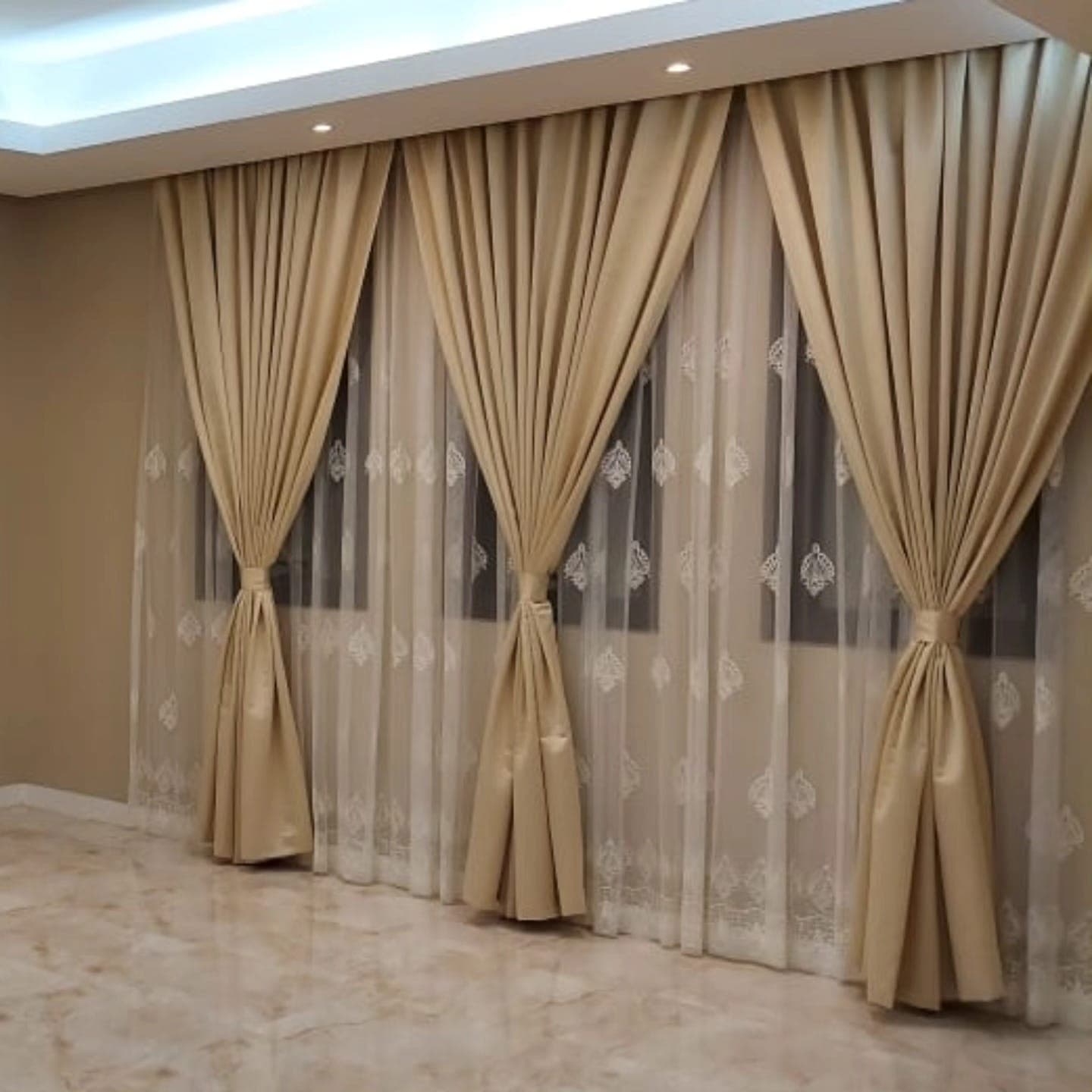
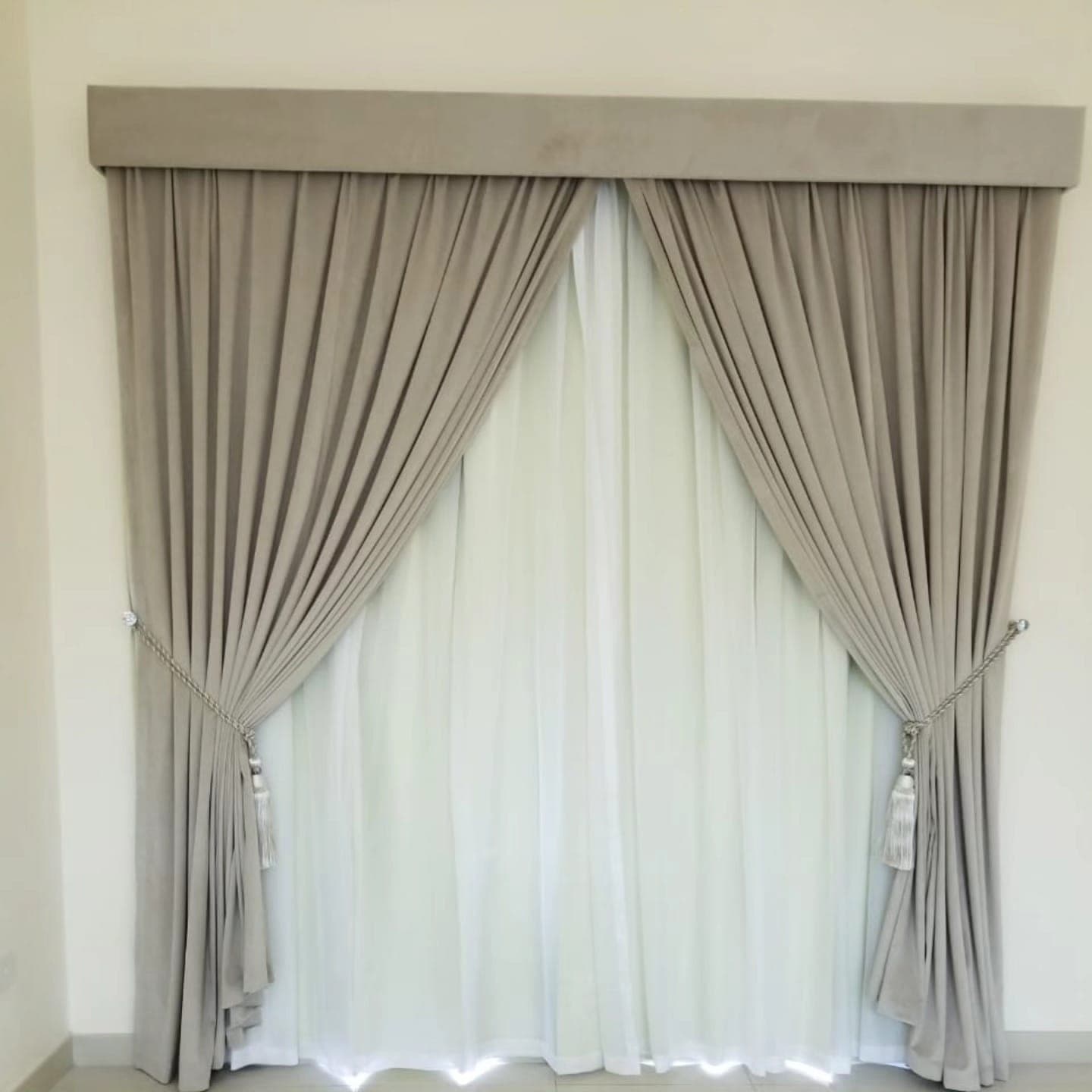
A double track puts two independent curtain runs on the same window: a sheer layer on the inner track, closer to the glass, and a blackout layer on the outer track. Each layer opens and closes on its own, so a room can be bright and airy during the day with just the sheer drawn, then fully dark at night by drawing the blackout layer across as well — without swapping curtains seasonally or between day and night use.
Two choices shape how a double-track system looks and performs: how the track is hidden, and how the fabric hangs.
Pelmet or hidden ceiling track?
An upholstered pelmet box conceals the track and adds a tailored, finished look, and it also blocks light spill over the top of the curtain — a real functional benefit in a bedroom, not just decoration. A track recessed into a ceiling channel gives a cleaner, more minimal line and works well in contemporary interiors, but needs to be planned into the ceiling design before installation rather than retrofitted.
Motorised or manual?
Motorised tracks make sense on tall or hard-to-reach windows, in majlis rooms where guests shouldn't need to operate curtains themselves, and for anyone who wants curtains on a schedule to keep heat out while a room is empty during the day. For a standard bedroom window, a well-specified manual track with a smooth glide rail is usually the more cost-effective choice and needs no maintenance beyond occasional cleaning of the rail.
Heading style
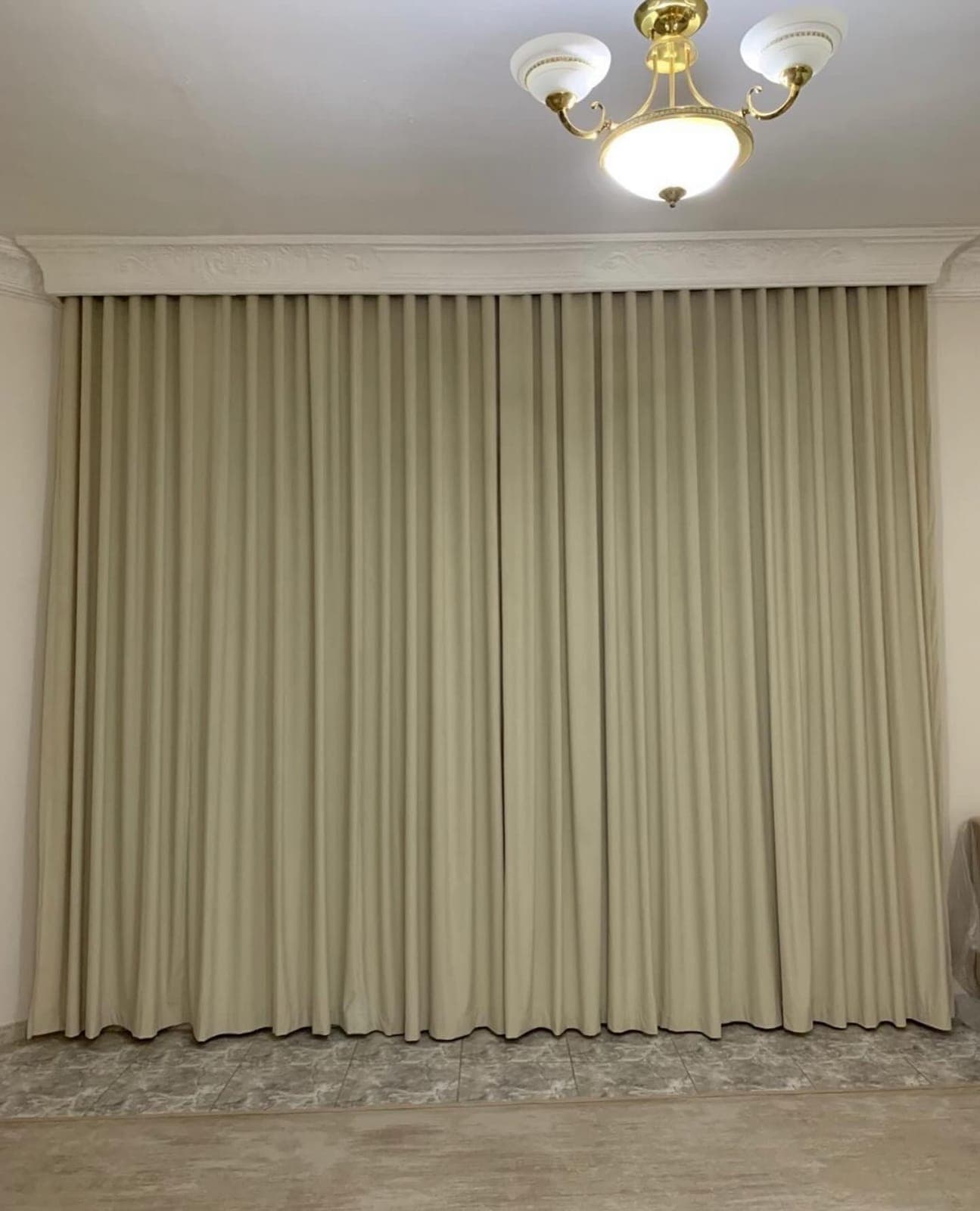
Heading style also affects how full and light-tight the curtain looks when closed. A wave-pleat heading gives a smooth, continuous fold that sits close to the track — popular in contemporary UAE interiors — while a pinch-pleat heading gives a more traditional, tailored look with deeper folds. Both can be made in blackout or sheer fabric; the heading choice is aesthetic, not functional.
One detail worth planning ahead of installation: a double track sits proud of the wall by roughly the combined depth of both runners, which changes how far a pelmet or ceiling recess needs to project to fully conceal it. It's worth deciding on single vs double track early — ideally before any ceiling or joinery work around the window is finalised — rather than retrofitting a second track once the pelmet is already built to the wrong depth.
6. Which curtain type works best in each room?
The right layer combination depends almost entirely on how a room is used, not just which way it faces. This table is the fastest way to work out what to ask for before a consultation — treat it as a starting point rather than a fixed rule, since two households can reasonably specify the same room differently depending on sleep schedules, whether anyone works from home, and how much the room is overlooked.
| Room | Primary need | Recommended layer | Lining | Notes |
|---|---|---|---|---|
| Master bedroom | Sleep, heat control | Double-track (sheer + blackout) | 3-pass or foam-backed | Pelmet or ceiling recess to stop light spill over the top |
| Living room | Daylight, glare control | Sheer, blackout optional on west-facing walls | 2-pass if added | Add blackout track only if used for evening media/TV viewing |
| Majlis | Privacy, formality, heat | Double-track, heavier sheer | 3-pass | Motorised track suits large or high-ceiling majlis rooms |
| Kids & guest rooms | Nap-time darkness, budget | Blackout only, mid-weight | 2-pass | Priority is darkness for naps, not full double-track |
| Kitchen & dining | Daylight, easy clean | Sheer, or roller blind + sheer | N/A | Wipeable blinds often paired with light sheers here |
| Office & study | Screen glare control | Dimout sheer or light-filtering blind | N/A | Full blackout usually unnecessary unless used for video calls at odd hours |
| Entrance & hallway | Privacy, first impression | Sheer or decorative panel | N/A | Often styled to match living room fabric for continuity |
7. How should window orientation and emirate affect curtain choice?
Which way a window faces changes what it needs almost as much as which room it's in. South- and west-facing windows get the most punishing sun in a UAE afternoon and are the strongest case for a heavier lining and anti-UV fabric. North-facing windows get the gentlest, most even light and can often get away with a lighter sheer alone in living areas. East-facing windows get strong but short-lived morning sun — worth a blackout layer in a bedroom if anyone sleeps past sunrise, but rarely an issue in living spaces.
Coastal cities — Dubai, Abu Dhabi, Sharjah, Fujairah — combine strong sun with high humidity, which can make foam-backed linings feel slightly heavier in the hand; inland areas like Al Ain get drier heat with less humidity but often more direct, unbroken sun exposure on larger villa windows. Neither difference changes which fabric to choose so much as how firmly it's worth insisting on a proper fit — wider, higher, sealed at the top — since fit is what actually determines how much heat and light gets through, regardless of climate.
| Window orientation | Typical challenge | Recommendation |
|---|---|---|
| South-facing | Sustained, strong sun most of the day | Anti-UV sheer + 3-pass or foam-backed blackout |
| West-facing | Intense, low-angle afternoon glare and heat | Foam-backed blackout regardless of room type |
| East-facing | Strong but brief morning sun | Blackout in bedrooms; sheer usually enough elsewhere |
| North-facing | Even, gentler daylight | Sheer alone often sufficient outside bedrooms |
8. Which curtain fabrics resist fading and UV exposure?
Every fabric fades eventually under strong, sustained UV exposure — the question is how fast, and how evenly. Untreated cotton and linen blends tend to fade fastest and can develop visible streaking where folds shield some of the fabric from the sun. Solution-dyed polyester and fabrics with an anti-UV finish hold their colour dramatically longer, because the colour is either built into the fibre itself or protected by a coating rather than sitting on the surface of the weave.
This matters most on south- and west-facing windows that get several hours of direct afternoon sun, and least on shaded or north-facing windows. It's worth asking specifically about fade resistance for any fabric going on a strong-sun window — colour and texture in a showroom sample don't tell you how a fabric will hold up after a year of direct Gulf sun, but the fabric's fibre content and finish do.
Darker, more saturated colours tend to show fading more visibly than mid-tones, simply because the contrast between faded and unfaded fabric is more obvious. That's not a reason to avoid dark colours on sunny windows — many of the richest-looking curtain installations use deep tones on exactly these windows — but it is a reason to pair a dark, statement colour with a genuinely fade-resistant fibre rather than one chosen purely for how it looks on the day of the consultation.
Fading isn't only a cosmetic issue, either. A curtain that fades unevenly (darker where folds overlap, lighter where it's fully exposed) also tends to weaken along the most exposed sections first, so a fade-resistant fabric on a hot façade typically lasts longer structurally, not just visually.
9. How should curtains be measured and installed for better performance?
Fabric choice gets most of the attention, but fit decides most of the real-world performance. Two curtains made from the exact same blackout lining can perform very differently depending on how they're sized and hung.
- Width: fabric should generally be cut to around 2 to 2.5 times the width of the track, so the curtain gathers into full pleats when closed rather than pulling flat. A curtain cut to the exact window width will always let more light through the folds.
- Track overshoot: the track should extend beyond the window frame on both sides — enough that fully open curtains stack clear of the glass and don't block any daylight when drawn back.
- Height: hanging the track higher than the top of the window frame, ideally close to the ceiling, both makes a room feel taller and closes off the gap where light typically leaks in above a curtain.
- Floor clearance: curtains that just graze the floor (a "kiss" hem) give the most tailored look; curtains with a couple of centimetres of "break" pool slightly and read as more traditional. Either works for blackout — what matters for light control is the top and sides, not the hem.
- Sealing the top: a pelmet, valance, or ceiling-recessed track closes the gap above the curtain where the track sits — this single detail often makes a bigger difference to how dark a room gets than upgrading from a 2-pass to a 3-pass lining.
This is also why laser measurement matters more than a tape-measure estimate: getting the width, overshoot and height right, on-site, against the actual wall and ceiling, is what makes the difference between curtains that look correct and curtains that genuinely block light and heat the way the fabric spec promises.
10. What do made-to-measure curtains cost in the UAE?
Curtain pricing in the UAE is almost always quoted per window after measurement, since window size, fabric grade, lining and track type all move the final number. The table below is a general guide to where each option tends to sit — the exact figure for any window follows the on-site consultation.
| Tier | Typical spec | Starting from |
|---|---|---|
| Entry | Single sheer or single blackout, manual track | AED 550 / window |
| Standard | Double-track (sheer + 3-pass blackout), manual | Quoted after measurement |
| Premium | Double-track, foam-backed lining, motorised, pelmet | Quoted after measurement |
11. How should curtains be cleaned and maintained in the UAE?
UAE homes tend to accumulate airborne dust faster than most climates, especially near sandy or coastal areas, so curtains benefit from a light vacuum with an upholstery attachment every few weeks to stop dust settling into the weave. Sheer fabrics can usually be taken down and machine-washed on a gentle cycle a couple of times a year; blackout curtains with bonded linings should generally be dry-cleaned or professionally cleaned, since machine washing can delaminate the lining from the face fabric over time.
Tracks — especially motorised ones — benefit from an occasional check that the glide channel is free of dust, since grit build-up is what usually causes a smooth-running track to start sticking. Direct sun exposure, even through a sheer, will eventually wear down cording and pull mechanisms faster than in a shaded window, so a motorised or heavy-duty manual track is worth considering on the sunniest, most-used windows in the home.
A simple habit worth adopting regardless of fabric: rotating which curtains stay fully closed during the hottest midday hours and which are left drawn open spreads out sun exposure across a home's soft furnishings over time, rather than concentrating years of UV damage on whichever curtain happens to be left open every single afternoon.
12. What curtain-buying mistakes should UAE homeowners avoid?
Most disappointing curtain outcomes trace back to one of a handful of repeat mistakes, and almost none of them are about picking the "wrong" fabric — they're about fit, sizing, or matching the layer to the wrong room.
- Sizing curtains to the window frame instead of wider and higher — this is the single biggest reason "blackout" curtains still let light in.
- Choosing one layer for the whole home rather than matching the layer to each room's actual use — a living room and a bedroom rarely need the same fabric.
- Skipping anti-UV fabric on south/west windows to save on cost, then re-ordering within a couple of years once fading shows.
- Ignoring the pelmet or ceiling recess and leaving an exposed track — this alone can undo a chunk of a blackout lining's light-blocking performance.
- Estimating measurements by tape rather than laser-measuring on site, which is where most width and overshoot mistakes come from.
- Machine-washing bonded blackout linings, which can separate the lining from the face fabric over repeated washes.
13. How can I choose curtains quickly and confidently?
If the tables above feel like a lot to hold in your head at once, this is the short version — a handful of questions that narrow the decision down fast, room by room.
- Is anyone sleeping or resting in this room? If yes, it needs a blackout layer — the only real question is which lining tier. If no, sheer is usually the starting point.
- Which way does the window face? South- and west-facing windows push you toward a heavier lining and anti-UV fabric, regardless of the room type; north-facing windows give you more flexibility to stay light.
- Is the room overlooked at night? A ground-floor window facing a street or a neighbouring building benefits from a denser sheer or an added blackout layer for evening privacy, even in a living room.
- Is noise a factor? A bedroom or home office facing a busy road is a strong case for foam-backed lining specifically for its noise-dampening effect, not just light-blocking.
- What's the budget for this window? A single-layer curtain with a good lining and correct fit will always outperform a double-track system installed with a poor fit — get the fit right before adding a second layer.
Answer those five and most windows in a home sort themselves into one of three buckets: sheer only, blackout only, or double-track — with the room-by-room table above filling in the remaining details like lining tier and heading style once you know which bucket a given window falls into.
14. What do common curtain terms mean?
- GSM (grams per square metre)
- The weight measure used for sheer and voile fabrics. Higher GSM generally means a denser weave, less daylight passing through, and better night-time privacy.
- Pass (2-pass / 3-pass)
- The number of coated layers bonded to the back of a blackout lining fabric. More passes generally mean better light-blocking and thermal performance.
- Pelmet
- A solid, upholstered box built above a window to hide the curtain track and seal the gap where light would otherwise spill in above the curtain.
- Wave pleat / pinch pleat
- Two common curtain heading styles. Wave pleat gives a smooth, continuous fold that sits close to the track; pinch pleat gives deeper, more traditional folds gathered at intervals.
- Overshoot
- The distance a curtain track extends beyond the window frame on each side, so fully open curtains stack clear of the glass instead of covering part of it.
- Dimout fabric
- A fabric weight between standard sheer and full blackout — it softens and reduces daylight noticeably without fully darkening the room, and is sometimes used on its own in offices or studies.
- Anti-UV / fade-resistant fabric
- Fabric treated or dyed to resist colour loss from sustained sun exposure, most relevant on south- and west-facing windows.
15. Frequently asked questions
Do I need blackout curtains in every room, or just the bedroom?
Not every room needs full blackout. Bedrooms and majlis rooms used for daytime sleep or prayer benefit most from blackout, since darkness and heat control matter more than daylight there. Living rooms, kitchens and home offices usually do better with sheer or a light-filtering fabric during the day, with a blackout layer added only if the window faces west or gets strong afternoon sun.
How much heat do blackout curtains actually block in a UAE summer?
A properly lined blackout curtain, sized to overlap the window frame and hung close to the glass, typically cuts a noticeable amount of radiant heat gain compared with a bare window or a sheer-only setup, because the lining reflects and absorbs solar radiation before it reaches the room. The exact reduction in room temperature depends on the window's orientation, glazing, and how well the curtain is fitted — a curtain sized to the frame with gaps at the top and sides performs far worse than one hung wider and higher with a sealed pelmet.
What's the difference between 2-pass, 3-pass and foam-backed blackout lining?
These describe how many layers of coating are applied to the back of the lining fabric. A 2-pass lining blocks most light but can still let a soft glow through at the edges. A 3-pass lining adds a middle layer that improves both light-blocking and thermal performance. Foam-backed (or foam-interlined) linings add a foam layer between the face fabric and lining for the closest thing to full room-darkening, plus extra noise dampening — useful for rooms facing a busy street.
Can I combine a sheer and a blackout curtain on one track?
Yes — this is the double-track (also called layered or duo) system, and it's the most common setup for UAE living rooms, majlis and master bedrooms. A sheer layer sits closer to the glass for daytime privacy and glare control, while a blackout layer sits on an outer track and can be drawn independently for night or nap time, without changing the curtains seasonally.
Do curtains need to be a specific width to work properly?
Yes. As a rule of thumb, curtain fabric should be roughly two to two-and-a-half times the width of the track for a proper pleated fold — a curtain cut to the exact window width will look flat and let more light through the gathers. The track itself should also extend beyond the window frame on both sides so the curtains can stack fully open without covering the glass.
Will curtains fade in direct UAE sun?
Any fabric will fade eventually under strong, sustained UV exposure, but the rate differs a lot by fabric type and treatment. Anti-UV, fade-resistant fabrics with a tighter weave and colorfast dyes hold their color far longer than untreated cotton or linen blends, and this matters most on south- and west-facing windows that get direct afternoon sun for several hours a day.
Is a motorized track worth it over a manual one?
Motorized tracks are most worth the extra cost on tall windows, hard-to-reach majlis or double-height living rooms, and for anyone who wants curtains to open and close on a schedule for heat control while away. For a standard bedroom or small window, a well-made manual track with a smooth glide is usually enough, and it's the lower-cost option.
How long does it take to get curtains made and installed in the UAE?
After the free home consultation and fabric selection, made-to-measure curtains are typically produced and installed within a few working days, with rush options available for anyone on a tighter timeline — for example, moving into a new home.
Do blackout curtains help with air conditioning bills?
A well-fitted blackout curtain reduces the amount of solar heat entering a room, which means the air conditioning has less heat to remove to keep the room cool. The effect is most noticeable on west- and south-facing rooms that get direct afternoon sun, and depends heavily on fit — a curtain with gaps at the top or sides lets warm air circulate behind it, which reduces the benefit considerably compared with a sealed, well-overlapped installation.
What's the difference between a pelmet and a valance?
Both sit above the curtain track to hide it, but a pelmet is typically a solid, upholstered box built on a wooden frame, giving a tailored, architectural look and the best light-sealing at the top of the window. A valance is a soft fabric strip that hangs and drapes rather than sitting rigid — lighter, less expensive, and slightly less effective at blocking light spill above the curtain than a boxed pelmet.
Free home consultation
Want this planned for your own windows?
Tell us the room — we visit with samples, measure by laser and send drawings and an itemised quotation. Curtains are made in our Sharjah workshop and installed by our team, anywhere in the UAE.