Curtains · 12 min read · 13 April 2026
Majlis curtains: layers, fabrics, tiebacks and pelmets
Dressing a majlis window well: sheer and drape layers, velvet and jacquard fabrics, tieback height, pelmets and gypsum coves, long window walls and care.

By Ali Haider Basra, Founder, Al Tareeq Decor · Contact our workshop
Key takeaways
- Give a majlis window two layers: a voile near the glass for daytime, and a heavier drape in front for colour and the evening.
- A street-facing majlis needs a lined or dense drape, because a sheer shows the lit room after dark.
- Hide both tracks in a gypsum cove or pelmet, run the sheer wall to wall and let the drapes stack beside the glass.
- Set tiebacks about a third of the way up, never in the middle, and use the same height on every window.
- Our curtains start from AED 550 per window; layered majlis windows are quoted line by line after a free visit.
On this page
- Key takeaways
- What makes a majlis window different
- The classic arrangement: sheer behind, drape in front
- The layers of a majlis window
- Choosing fabric for majlis curtains
- Majlis for men, majlis for women: privacy and light
- Plan the window from ceiling to floor
- Curtains for arched majlis windows
- Tiebacks, holdbacks and tassels
- Pelmets, cornices and gypsum coves
- Long walls and many windows
- Curtains and seating, chosen together
- Looking after majlis curtains
- Price, timing and how we work
- Common questions
What makes a majlis window different
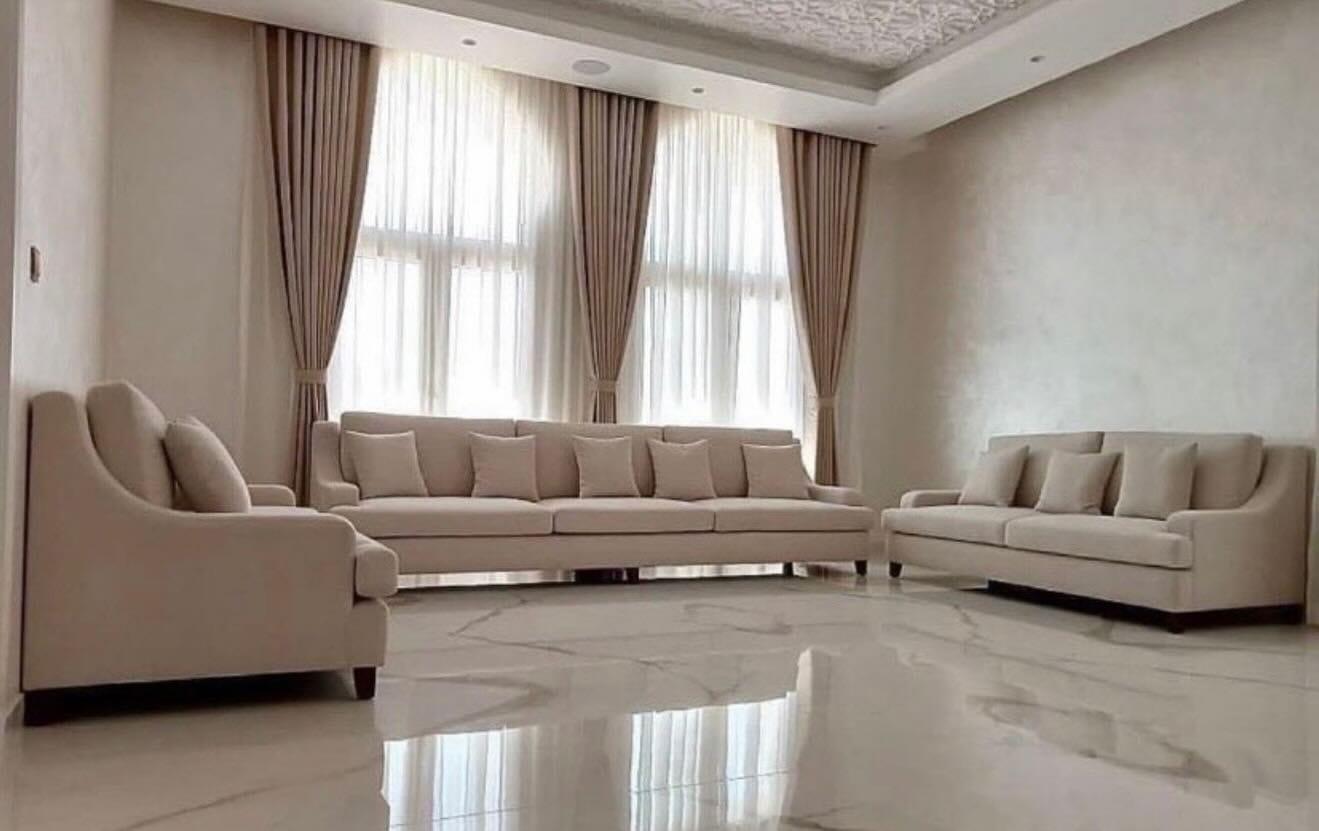
A majlis is where a family receives its guests, so its windows are judged differently from a bedroom's. The room is usually long, with seats round most of its edges, and every guest looks across at the curtains for the whole visit. A bedroom curtain is mostly about darkness. A majlis curtain is part of the welcome: how it falls, how it catches the evening light and how it frames the room count as much as privacy.
The windows themselves are often the biggest in the house. Tall openings, arched heads, several windows in one wall and ceilings with a gypsum cove are all common, and each asks something different of the curtain. A run of five windows has to look like one composition, not five separate purchases.
This guide covers the decisions that make majlis curtains work: the layers, the fabric, how the tops are hidden, where the tiebacks sit, how to handle a long window wall, and how to keep heavy fabric looking good for years.
The classic arrangement: sheer behind, drape in front
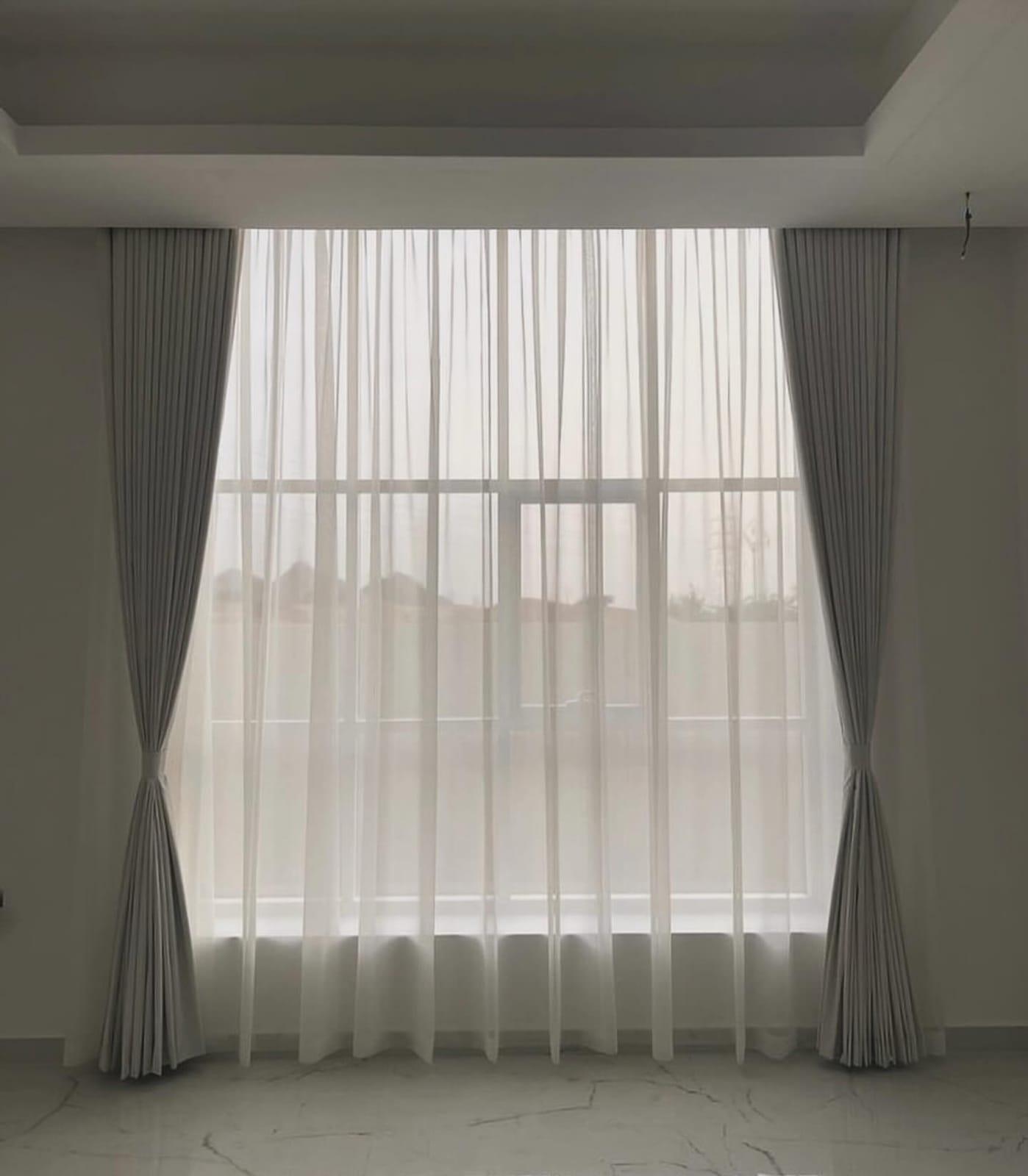
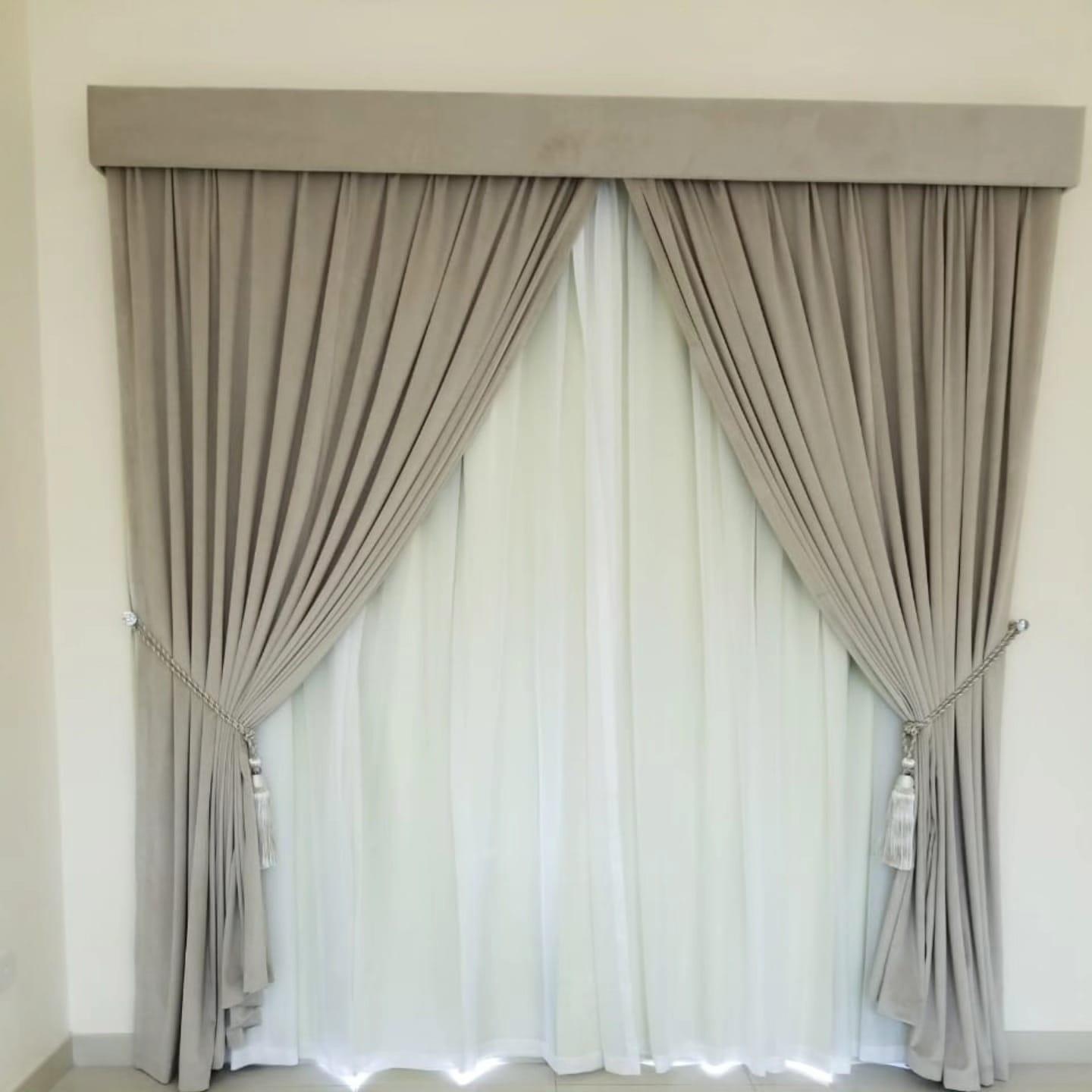
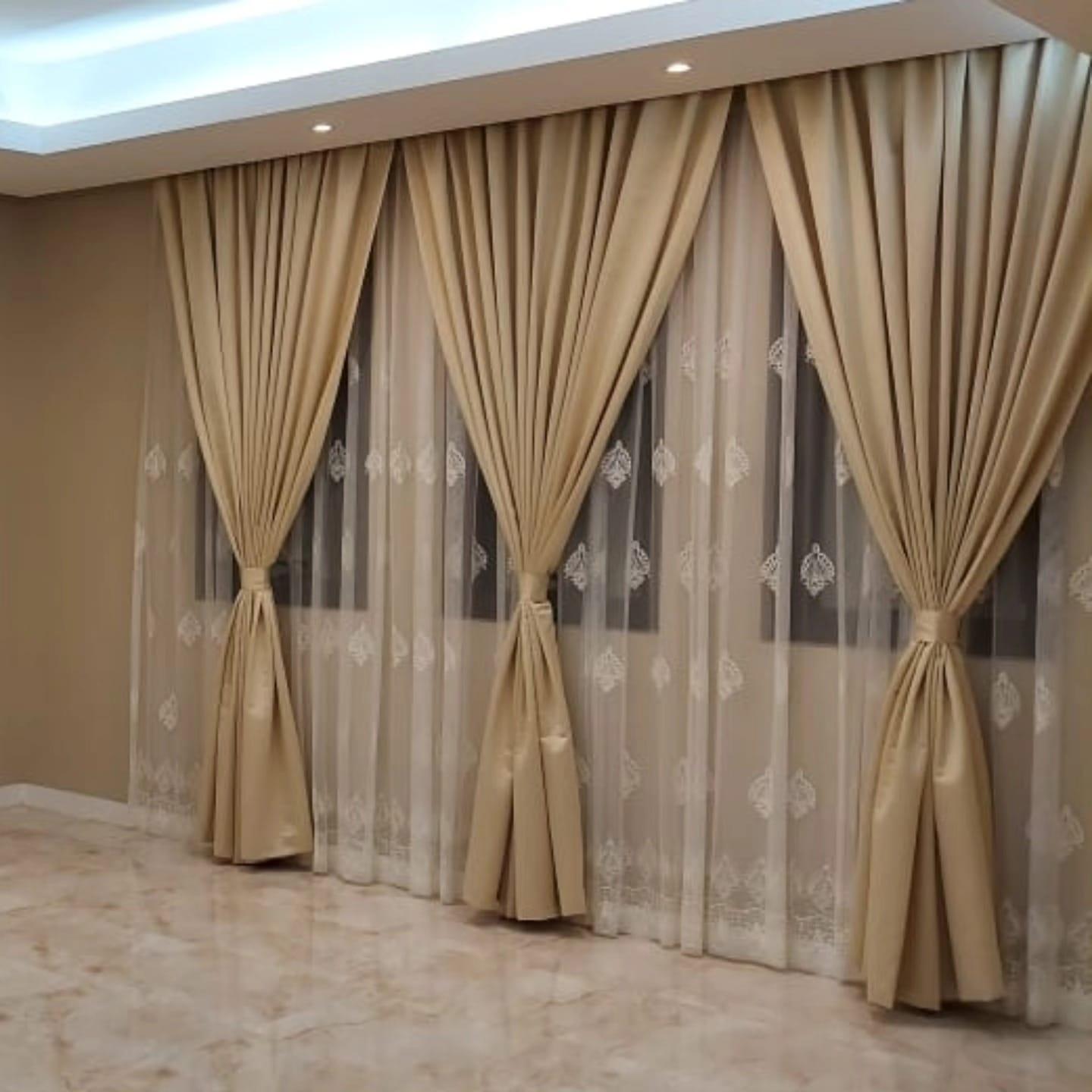
Most majlis windows are dressed in two layers on two tracks. At the back, close to the glass, hangs a sheer that stays drawn most of the day: it softens the sun, takes the glare off a polished floor and stops passers-by seeing in, yet the daylight still fills the room. In front hangs the drape, a heavier decorative curtain that is usually caught back at the sides and let down in the evening.
The two do different jobs, so choose them separately. The sheer is about light and daytime privacy; the drape is about colour, weight and closing the room after dark. Formal rooms often use an embroidered or patterned voile that is decorative in its own right, leaving the drape to carry the main colour.
Some homes add a third layer for a majlis that faces the street: a dim-out or blackout lining sewn behind the drape. It keeps the room private at night without changing how the drape looks from inside.
The layers of a majlis window
Sheer (back)
- Its job
- Daytime privacy, soft light, less glare
- Typical fabric
- Plain or embroidered voile
- Usually
- Drawn across the glass all day
Drape (front)
- Its job
- Colour, weight, privacy after dark
- Typical fabric
- Velvet, jacquard, satin-look or linen-look
- Usually
- Caught back with tiebacks by day
Lining (optional)
- Its job
- Darkness, fade protection, more body
- Typical fabric
- Dim-out or blackout lining sewn to the drape
- Usually
- Hidden behind the drape
Pelmet or cove
- Its job
- Hides both tracks and the light gap at the top
- Typical fabric
- Fabric pelmet or gypsum cove
- Usually
- Built with the ceiling
Two layers mean two tracks, so agree the depth they need while the ceiling or pelmet can still change.
Choosing fabric for majlis curtains
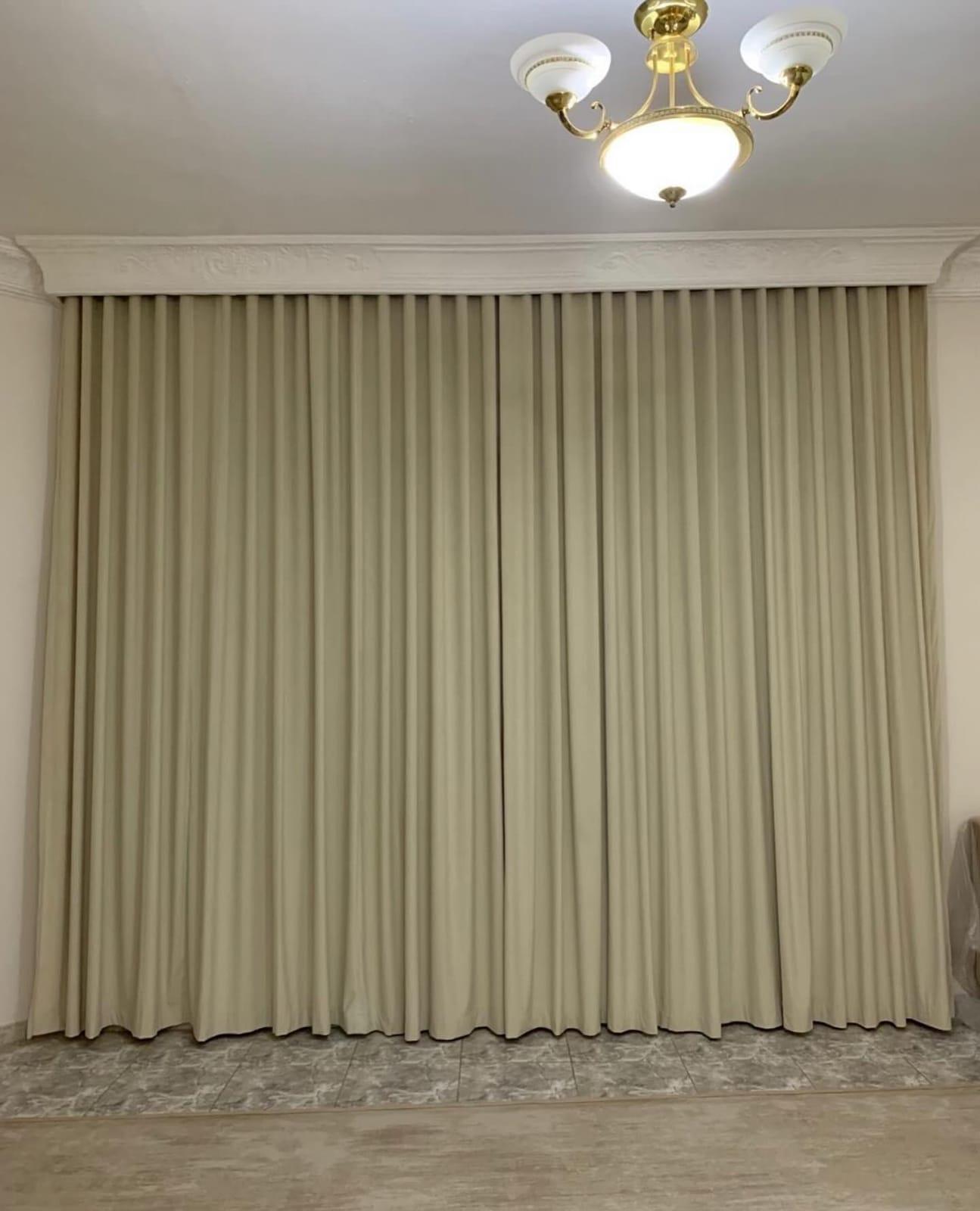
Velvet is what most families picture for a luxurious majlis. Its pile soaks up light, so colours look deep, and its weight drops into heavy, even folds that still read well from the far end of a long room. Jacquards, with the pattern woven in rather than printed, belong in classic Arabic rooms. Satin-look cloths have a sheen that flatters warm metallic schemes, and linen-look weaves suit a calmer, modern majlis.
Weight matters as much as look. A tall lined velvet drape is heavy, so the track and every fixing point have to be rated for it from the start, and so does a motor if you want one. Tell us early which cloth you like, because it changes the hardware.
Think about the sun too. Strong light fades dyes over the years, and the window side suffers most. A lining shields the decorative cloth and helps it hang. We bring samples from UAE ranges and the international houses we source from, among them JAB ANSTOETZ, Chivasso and Carlucci, to compare against the seating in the majlis itself.
Majlis for men, majlis for women: privacy and light
Many villas have more than one majlis, and the windows are rarely in the same position. A majlis near the gate or facing the street is seen from outside, often late into the evening when it is lit and full. A family or women's majlis further inside the house may look onto a garden or courtyard where privacy matters less in the day.
Dress each for where it sits. For a street-facing majlis, put a dense sheer at the back and a lined drape in front, so the room can be closed fully at night; a sheer alone shows the lit room to the street after dark. For an inner majlis, a lighter drape and a decorative sheer are usually enough.
Think about the hours the room is used. A majlis that hosts guests after sunset needs its drapes to close easily and evenly across every window, so check that the stack, the tiebacks and any furniture near the window will let them. Our guide to blackout and sheer layers explains why the evening is when privacy fails.
Plan the window from ceiling to floor
A majlis curtain looks best when it starts as high as the room allows and finishes just clear of the floor. Starting high, best of all from a ceiling recess or behind a gypsum cove, makes the window look taller and hides the tracks and the line of light that would otherwise show above them.
Run the sheer wall to wall where you can, beyond the glass on both sides, so the window wall reads as one soft surface. Let the drapes stack on the wall beside the glass rather than across it, so the window is fully open when they are caught back. The hem should finish just above the floor; a hem that drags collects dust on a stone floor and wears.
The drawing below puts these together on one arched window. On a long wall the same rules apply to every opening, which is what makes a row of windows look planned.
- 1. A gypsum cove or ceiling pocket hides both tracks and the light above them
- 2. The sheer runs wall to wall, past the glass on both sides
- 3. Tiebacks about a third of the way up from the floor give the classic low sweep
- 4. Drapes stack on the wall beside the glass, so the window stays clear
- 5. The hem finishes just above the floor, not on it
Curtains for arched majlis windows
Arched windows are part of the character of many majlis rooms, and they raise a question a square window never does: should the curtain follow the arch or hide it? For a curtain that opens and closes every day, the practical answer is to hang it from a straight track fixed above the top of the arch, high enough that the arch is fully visible when the drapes are tied back.
That way the arch is framed by day and covered at night, and the curtain still runs on an ordinary straight track that is easy to service. The sheer behind can cover the whole arch too, which keeps the curved glass soft without trying to shape fabric around it.
Fabric fixed to the curve of an arch looks striking but cannot really be opened, so we only suggest it for a fanlight above a door or a window that never needs to be uncovered. If the arch sits close to the ceiling, a recess or cove above it gives the straight track somewhere to hide. Measure from the highest point of the arch, not from its sides, when the track height is set.
Tiebacks, holdbacks and tassels
Where the tieback goes decides the outline of every drape in the room. Designers work in thirds: measure the drop, divide it by three and tie the drape at one of those points, but never halfway, where it slices the window into two equal boxes. As Hunker explains, tying high exposes more glass and adds apparent height, while tying low gives the wide, sweeping top at the cost of daylight.
The low sweep is the traditional majlis look and works where daylight is generous; a window that is already dim is better tied higher. Before anything is fixed, we pin a sample drape at a couple of heights so you can see it from where guests sit, and the height you pick is then repeated at each window along the wall.
Broad fabric ties and fringed or tasselled ones tend to sit better slightly lower than narrow ones. A heavy velvet drape wants a sturdy holdback screwed into the wall rather than a small hook; Hunker points out that metal hooks grip less cloth and can struggle with thick drapes.
Pelmets, cornices and gypsum coves
Two tracks need covering at the top of a majlis window. A padded fabric pelmet, dressed in the drape cloth or a contrasting band, gives a classic room a finished crown. A gypsum cove or recess removes the hardware from sight altogether, so the curtains appear to start inside the ceiling; add hidden lighting to the cove and the fabric glows after sunset.
Such a recess belongs on the ceiling drawing, since it must be deep enough for both tracks and stay open underneath for service. When a new gypsum ceiling is going into the majlis, draw the curtain recess on the same plan; cutting one in later means breaking finished work. Planning a curtain recess in a gypsum ceiling has the details.
Watch the split AC unit. In many majlis rooms it sits high on the window wall, right where the curtain stack goes. Keep its airflow clear of the fabric and allow for the unit when the pocket and track lengths are drawn.
Long walls and many windows
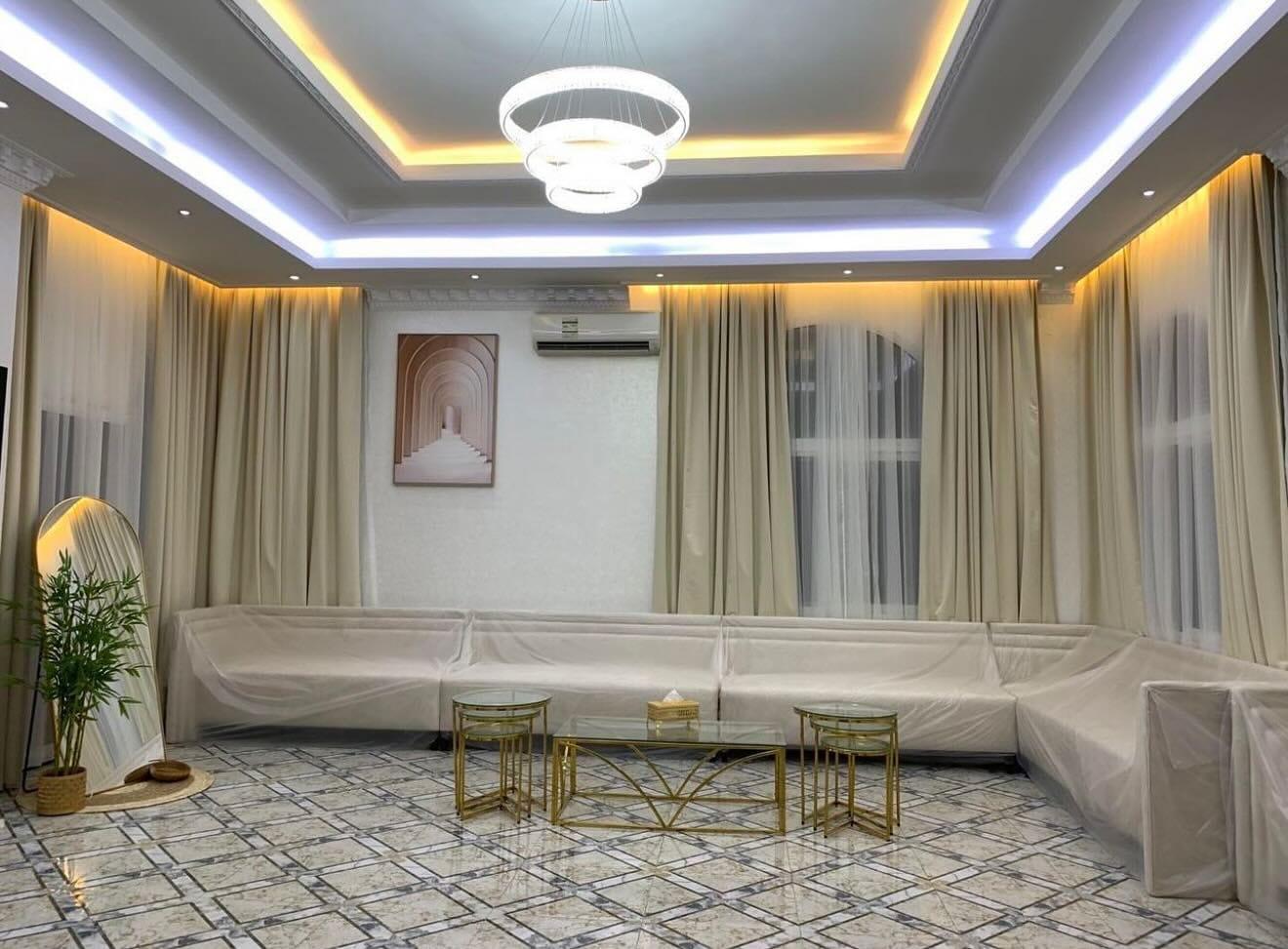
Majlis rooms often have a wall of three, four or five windows, sometimes unevenly spaced and with a door among them. Two approaches work well. One is a single continuous sheer and track across the whole wall, with drapes at the ends and between windows; it hides uneven spacing and makes the wall calm. The other dresses each window on its own, which suits evenly spaced openings with solid wall between.
Whichever you choose, keep the heights equal: the same track level, the same hem line and the same tieback height on every window. A row of curtains at slightly different heights looks careless however good the fabric is.
Count the drapes before choosing the fabric. A long wall with drapes between each window can need many panels, and a costly velvet multiplied by eight panels changes the budget. Sometimes a richer fabric on fewer panels, with a continuous sheer behind, gives the better result for the same money.
Curtains and seating, chosen together
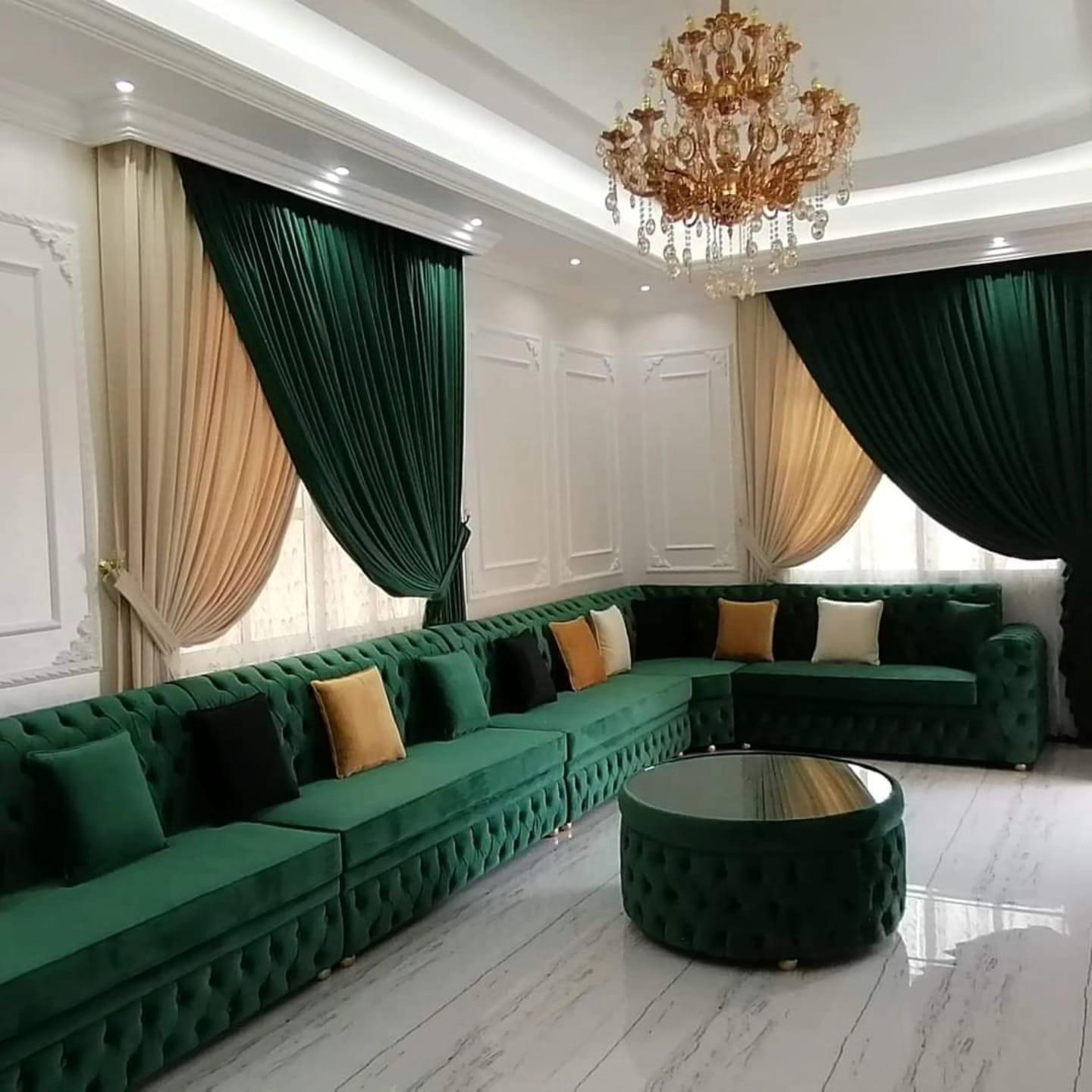
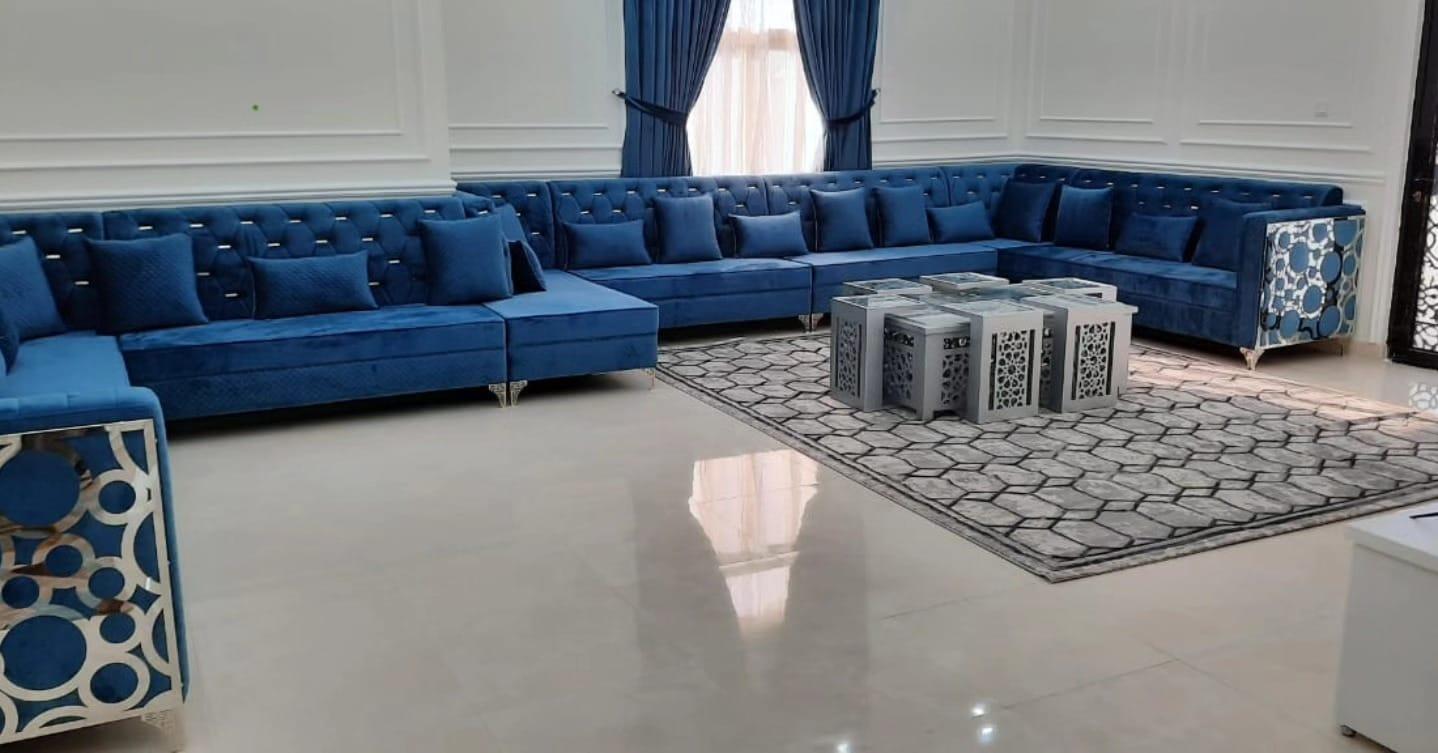
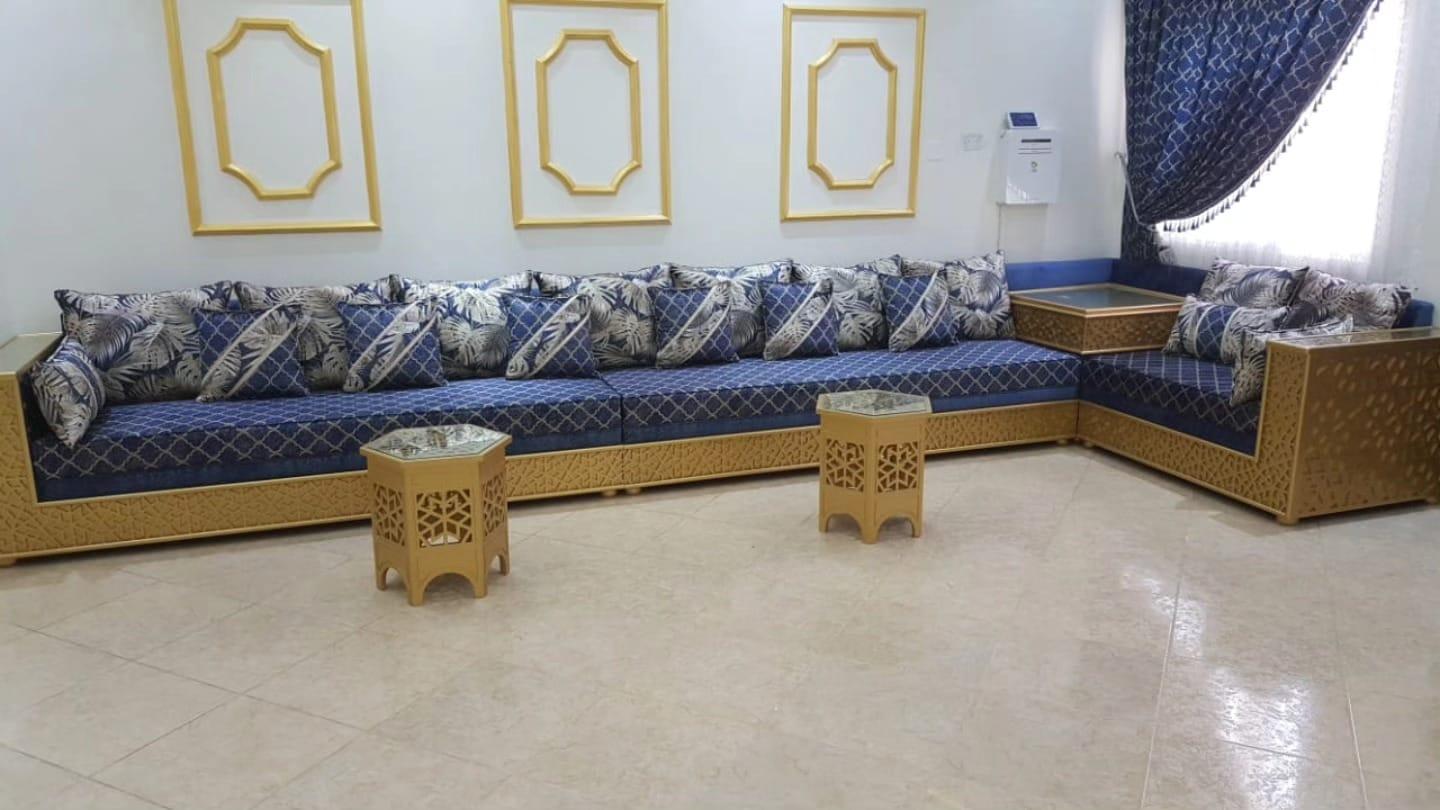
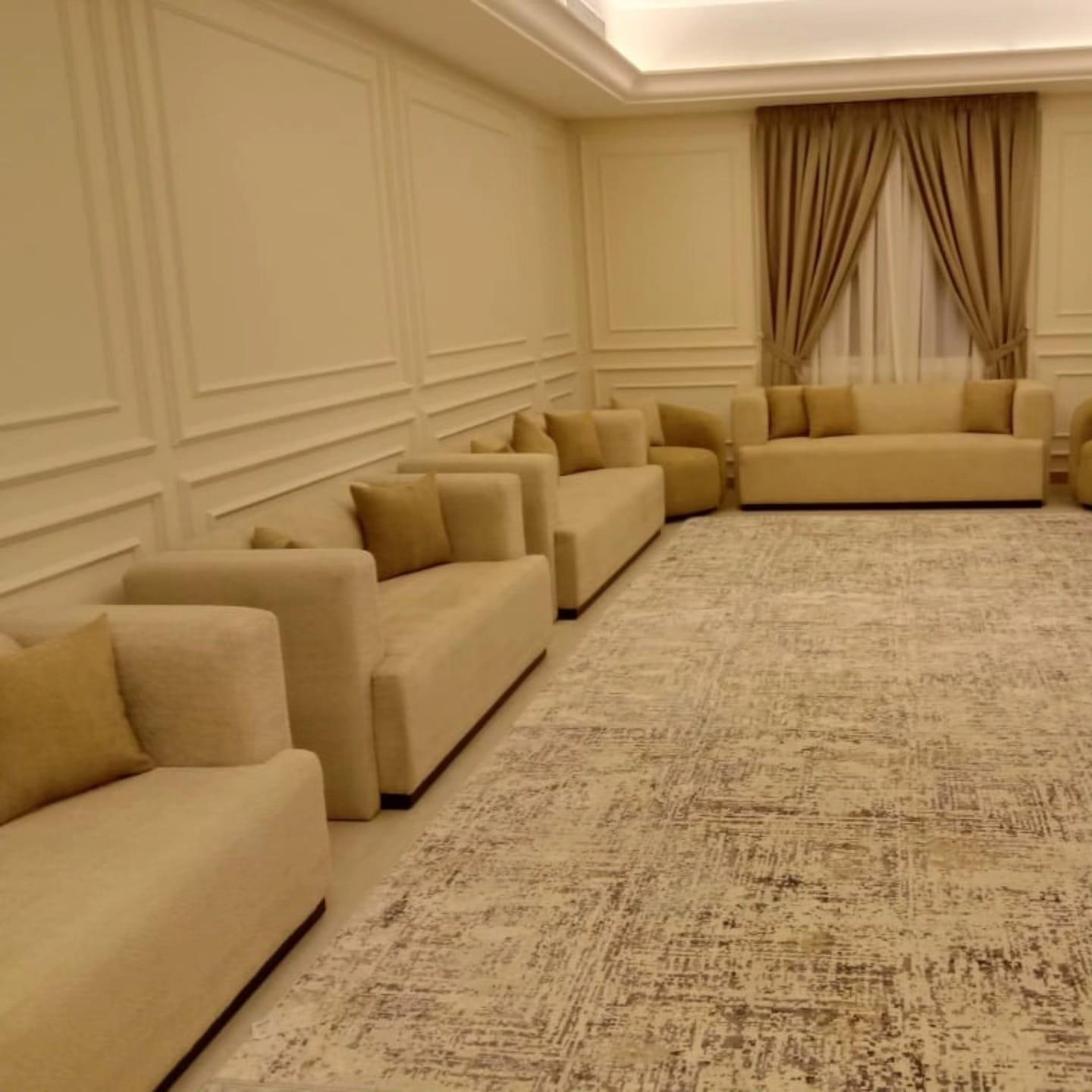
Guests take in the seating and the windows in one glance, so the two are best decided together. One approach carries a single colour through both, as the emerald room pictured at the head of this guide does. Another lets bold seating lead and keeps the drape quiet, echoing the seat colour in a narrow border, a fringe or the thread of an embroidered voile. If the opposite wall carries the TV, plan the two walls together; our media wall design ideas show finishes, from marble-effect panels to slats, that sit calmly beside a drape.
For an existing majlis, keep a cushion handy when we visit and look at the samples twice, once by day and once with the evening lights on. For a new one, decide both together: our workshop makes majlis seating as well as majlis curtains with tiebacks, so both cloths can sit next to each other on the table before anything is cut.
Looking after majlis curtains
Heavy majlis drapes collect dust in their folds, especially near a door to the garden. Vacuum them gently with a soft brush attachment every few weeks, and shake out the sheers. A light steam freshens creases on many fabrics, but check the care label first.
Velvet, lined drapes and embroidered sheers usually need professional cleaning rather than a home washing machine; the wrong wash can shrink a lining, flatten a pile or pull an embroidery. Keep the fabric names and care instructions from your quotation so the cleaner knows what they are handling. Cleaning curtains, sheers and blinds goes through each type.
Plan for taking the curtains down. Hooks and carriers that unclip easily, and a ceiling pocket that stays open underneath, make cleaning day far simpler.
Price, timing and how we work
A majlis opening is normally bigger than a bedroom one, and dressing it in two layers adds a second cloth and a second track, so it sits above our entry price. Our curtains start from AED 550 per window, covering fabric, a hand-drawn track and installation at entry level; a two-layer majlis window with a decorative drape is priced above that, item by item. How such a quotation is put together is in our curtain price guide.
The visit and the laser measurement cost nothing, and we carry the samples along so they can be seen beside the seating under the majlis's own daylight. After you approve them, everything is cut and stitched in Sharjah, then hung by our own fitting team, normally 3–5 working days later, or within 48 hours when rushed. Our 24-month written warranty applies to the workmanship.
Everything we make for windows is on the curtains and blinds service page; homes close to the workshop can also see curtains in Sharjah.
Common questions
Should majlis curtains be blackout?
Usually not fully. A sheer with a lined or dim-out drape gives daytime light and night privacy; blackout suits a majlis used for screenings. Blackout or sheer curtains.
Which curtain heading suits a formal majlis?
Pinch pleats give the tailored, classic folds most formal rooms want; wave suits a modern majlis on a ceiling track. Choosing a curtain heading.
How far should majlis curtains extend past the window?
Far enough for the drapes to stack on the wall beside the glass, so the window is fully open when they are tied back. Measuring for curtains.
Can heavy majlis curtains be motorised?
They can; the motor and its powered track are matched to the weight of a lined velvet drape. Motor and track options.
How do I clean velvet majlis curtains?
Vacuum with a soft brush regularly and have them professionally cleaned; a home wash can damage the pile and the lining. Curtain and blind care.
Can the ceiling hide the curtain tracks?
Yes. A pocket in a gypsum ceiling hides both tracks if it is built deep enough when the ceiling goes up. Curtain pockets in gypsum ceilings.

Sources & specifications
Manufacturer information applies to the named products and systems. Sources reviewed on 28 October 2026.
Want this planned for your home?
Consultation and measurement are free. Tell us the rooms, location and what you need; we arrange a sample visit and define the measured quotation.