Media Walls · 15 min read · 18 May 2026
Media wall and TV unit design ideas for UAE living rooms
Six TV wall styles on one wall: slatted, marble-effect, floating console, display shelving, lit niches and storage. Which suits your room, shown with our own photos.

By Ali Haider Basra, Founder, Al Tareeq Decor · Contact our workshop
Key takeaways
- Pick one lead idea and one supporting idea for the wall; five ideas competing around one screen look busy.
- Slats are the most requested style: choose vertical for a low ceiling, and decide before fitting whether they frame the screen or fill the wall.
- A marble-effect panel suits a formal room; check a glossy face in daylight, because it can mirror a window.
- A floating console should be clearly wider than the TV, with a clear gap to the floor and a ventilated place for devices.
- Walls start from AED 3,500 per project; most designs cost more once slats, shelving and lights are added, and are fitted in about 10 days.
On this page
- Key takeaways
- Media wall ideas: decide what the wall must do first
- Six TV wall styles on one wall
- Which style for which room
- Slatted TV wall ideas: the look people ask for first
- Marble-effect TV wall design: one calm panel behind the screen
- Floating console and TV unit design: the clean, light idea
- Display shelving and lit niches: showing things without clutter
- TV wall storage ideas: hide the many things, show the few
- Media wall ideas for small living rooms and apartments
- Colour, finish and the screen when it is switched off
- From an idea you like to a drawing and a price
- Common questions
Media wall ideas: decide what the wall must do first
Most people open a gallery of TV wall designs and pick the picture they like. That works until the wall is built and the sofa is in front of it, because a picture shows a mood and not a job. Before you look at styles, write down what the wall has to do for your family: hide a router and a games console, show a few things you love, light the room at night, keep sound from bouncing around, or simply stay quiet and out of the way.
Then choose one lead idea and one supporting idea. A slatted wall with a floating console is a lead idea with a supporting one. A slatted wall with marble, shelving, niches, a fireplace and cabinets is five lead ideas competing for the same screen. The most successful walls we fit, in villas and in compact apartments alike, have a plain rule behind them: one main surface, one place to store, and one source of light.
This guide shows the six styles we are asked for most, using our own installed walls, and says plainly which suits which room. The step-by-step process lives in planning a media wall; the pages below stay with the look itself.
Six TV wall styles on one wall
The drawing below keeps one wall, one TV and one floating console, and changes everything else. Watch what each style adds, and notice how little of the screen's surroundings you need to change before the room reads differently. The wall is a generic 5 m wide and 2.7 m high; yours is drawn from our own measurement.
A note on the numbers: the 25 cm gap under the console is a typical starting point and not a rule. Our TV height guide explains how the seats, the console and the soundbar set the final figures.
Which style for which room
Floating console
- Suits
- Small and medium living rooms, rented flats
- Watch for
- Console shorter than the TV looks mean
Slatted wall
- Suits
- Apartments and villas wanting warmth, echo control
- Watch for
- Dust in grooves, sockets cut through slats
Marble-effect panel
- Suits
- Formal living rooms and majlis
- Watch for
- Glossy faces that mirror a window
Display shelving
- Suits
- Collectors, books, family photographs
- Watch for
- Shelves that look untidy within a month
Lit niches
- Suits
- Evening rooms, villas, wide walls
- Watch for
- Glare on the screen from bare strips
Storage wall
- Suits
- Families, shared flats, gaming set-ups
- Watch for
- Doors that need room to open
Our own advice from fitting walls in UAE homes. Prices depend on the area faced, the length of console and the lighting.
- 1. Floating console: a hung unit with the floor showing beneath, the cleanest and lightest idea
- 2. Slatted wall: vertical wood-look slats from floor to ceiling, the most requested look
- 3. Marble-effect panel: one pale panel behind the screen, calm and easy to light
- 4. Display shelving: open shelves at the sides for books and objects
- 5. Lit niches: recessed boxes with a warm LED line, storage that doubles as light
- 6. Storage wall: closed cabinets either side, for families who own a lot of things
Slatted TV wall ideas: the look people ask for first
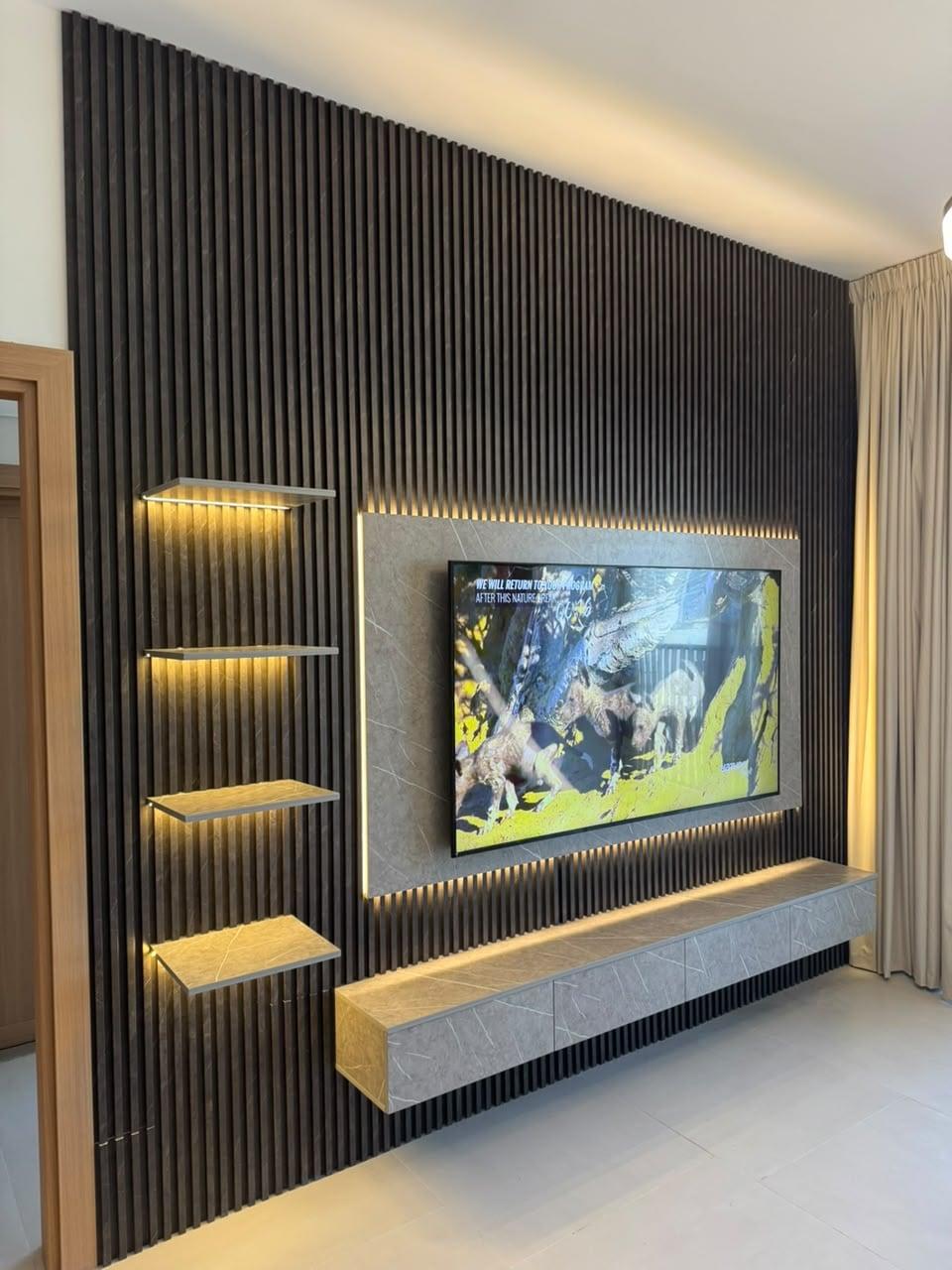
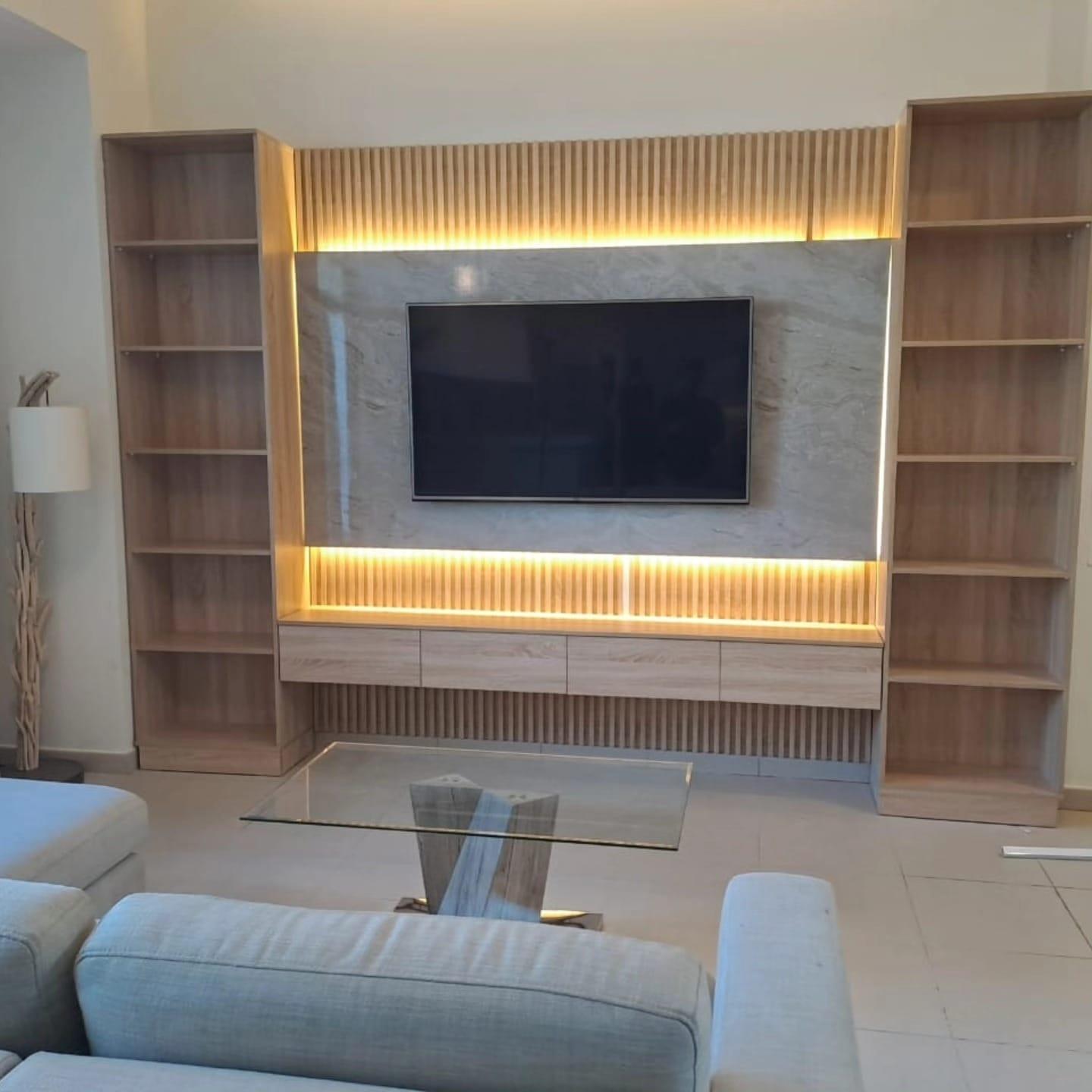
Slats are the style we are asked for most, and the reasons are practical as much as visual. A run of vertical slats gives a plain wall a rhythm, hides joints and the odd screw, and can sit on an acoustic backing to take some echo out of a hard-floored room. Vertical slats make a ceiling feel higher; horizontal ones make a narrow room feel wider. In most UAE living rooms, vertical is the right choice, because the problem is usually a low ceiling in an apartment and not a wall that needs widening. For profiles, spacing and upkeep, see the fluted panel TV wall guide.
Decide early whether the slats frame the screen or take over the wall. Slats only around the TV, in a band the width of the console plus a little more, are quicker to fit and cheaper, and they keep the remaining wall free for a painted surface or a curtain. Slats from floor to ceiling and wall to wall are the dramatic version and read as architecture. Between the two, we suggest carrying the slats well past the screen on each side and stopping them a little under the ceiling, so the wall still looks built in and not wallpapered.
Slat width and gap matter more than the colour. Broad slats with narrow gaps look heavy and formal; thin slats with wide gaps look light and Scandinavian. Choose by propping a real sample against the wall under the daylight and lamps you will actually use, as a catalogue photograph never shows how deep the shadow line falls. The finish decides upkeep as well: a stained wood-look face wipes clean with a dry microfibre cloth, while deep grooves collect the fine dust that UAE homes live with and need an occasional pass with a soft brush.
Two cautions. First, every socket, switch and the TV bracket must be placed before the slats are fitted; cutting through finished slats later never looks right. Second, if you want light in the grooves, say so at the first visit, because that is a wiring and a depth decision, not a decoration. Our media wall lighting guide covers groove light on its own. The full comparison of MDF, WPC, PVC and wood slats is in the panel materials guide, and we make the wood-effect walls shown on our wooden feature walls page.
Marble-effect TV wall design: one calm panel behind the screen
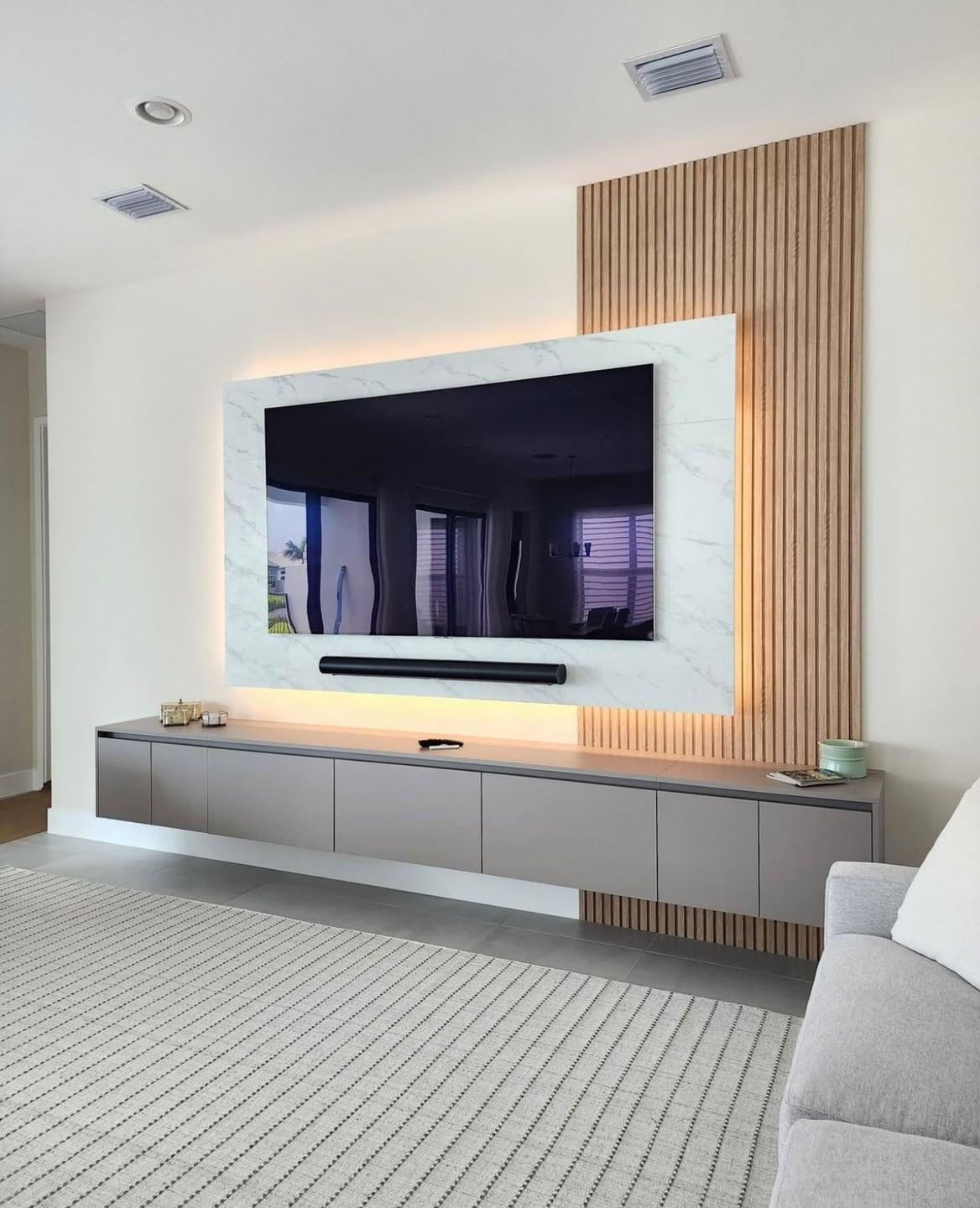
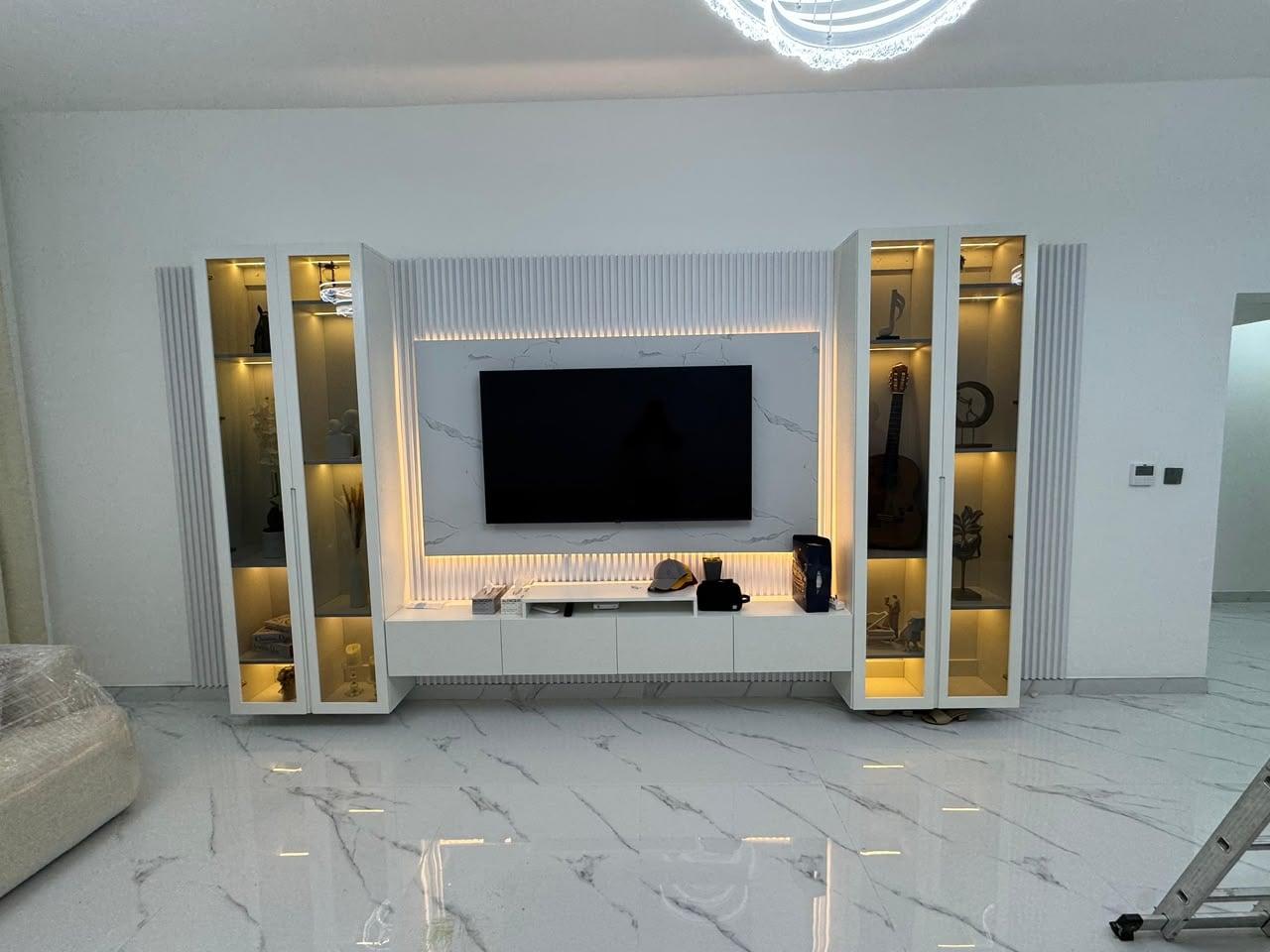
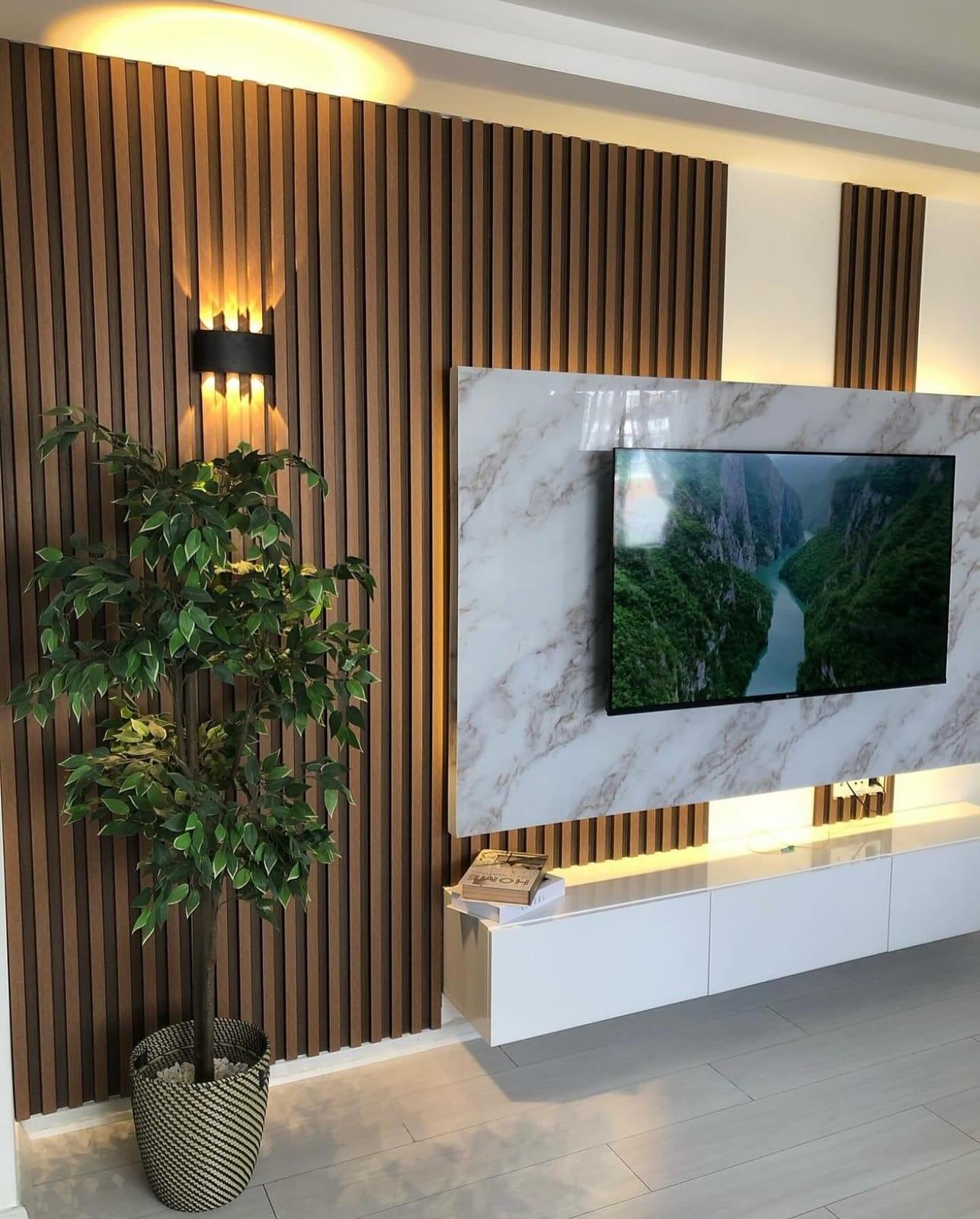
A marble-effect panel is the answer for a formal room. Instead of many lines, you get one large pale surface behind the screen, with grey and gold veining that gives the wall a quiet richness whether the TV is on or off. It is a favourite for majlis and living rooms with gold or cream fittings, and it combines well with slats at the sides, as in the photograph below: the stone-like panel is the calm centre and the wood is the warmth.
The decisions are about the face and the join. A glossy face looks wealthy in a showroom and may reflect a window or a bright ceiling light at home. A matt or satin face is calmer with a screen in front of it. Stand the sample upright next to where the TV will hang and view it while seated on the sofa, once with the curtains drawn and once without. Joints are the other point: a panel large enough to be made in one piece looks like stone; a wall joined in several places looks like tiles, so plan the panel size from the TV outwards and let the joins fall where a console or a shelf covers them.
A marble-effect panel is a surface and not stone, so we make it at the Sharjah workshop and fix it to a frame behind the TV. Real stone and porcelain slab behave differently, in weight, in joints and in price, so ask for a sample of each before you decide; our marble-effect TV backdrops show what we make, and media wall cost and materials explains how the face changes the price. Marble TV wall options weighs real stone against the lighter alternatives.
Floating console and TV unit design: the clean, light idea
A floating console is the simplest TV unit design that never goes out of date. The unit hangs from the wall, the floor runs on underneath it, and the room feels roomier because more of the floor stays in view. Its depth is modest, usually 35 to 45 cm, which is deep enough for a router, a streaming box and a soundbar if the shelf behind is planned for them. Drawers or push-to-open doors give the clutter somewhere to go without handles to spoil the line.
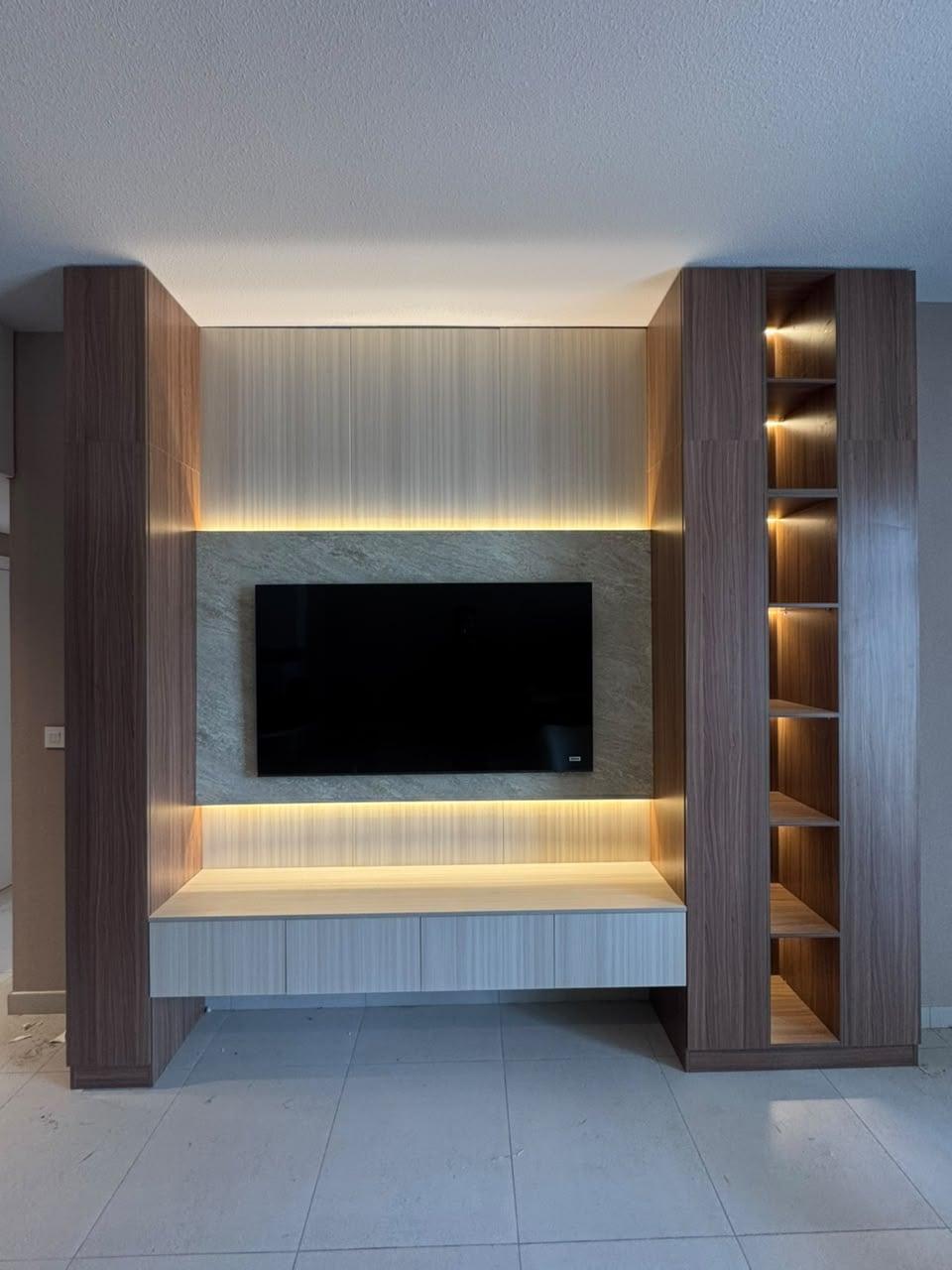
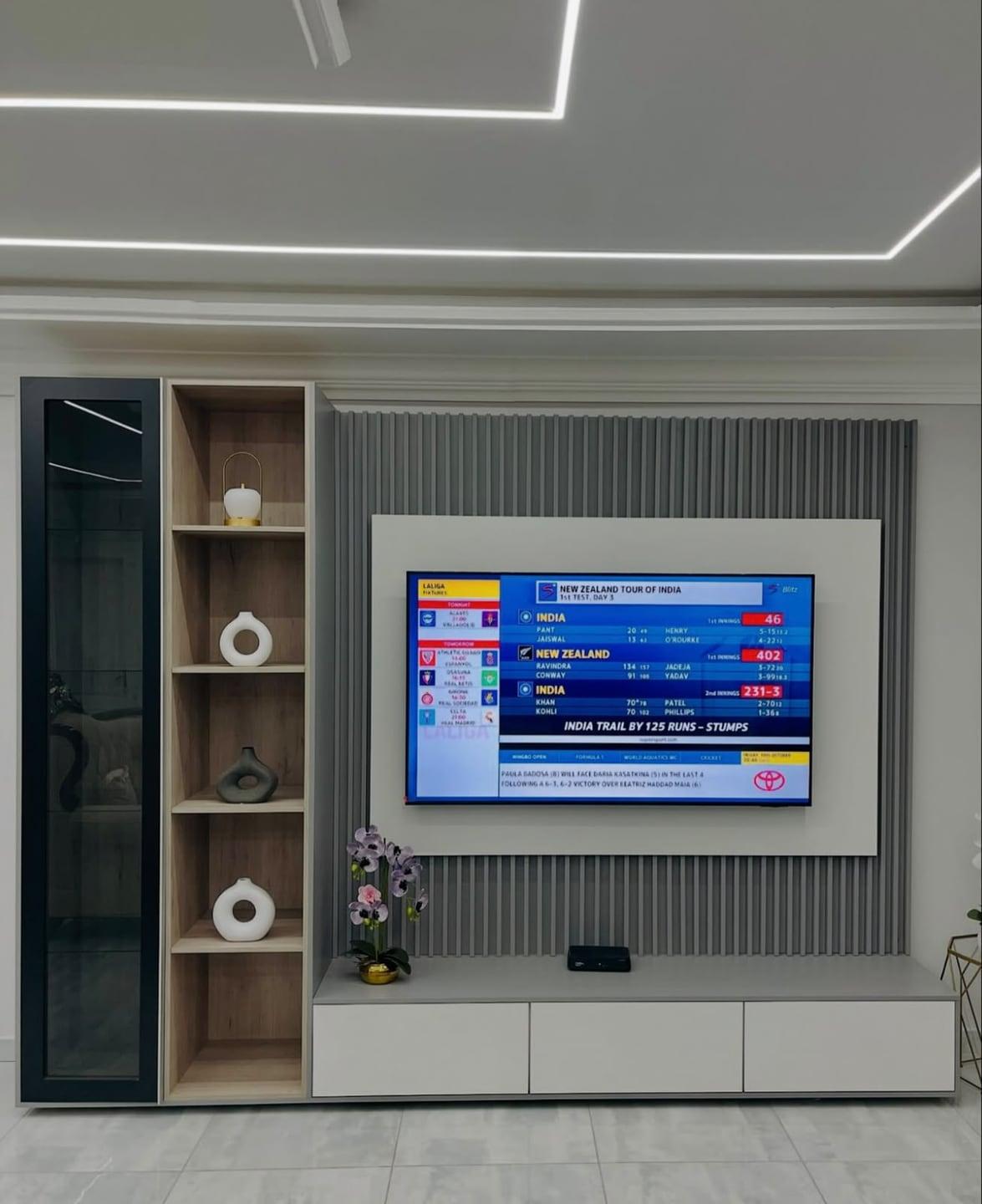
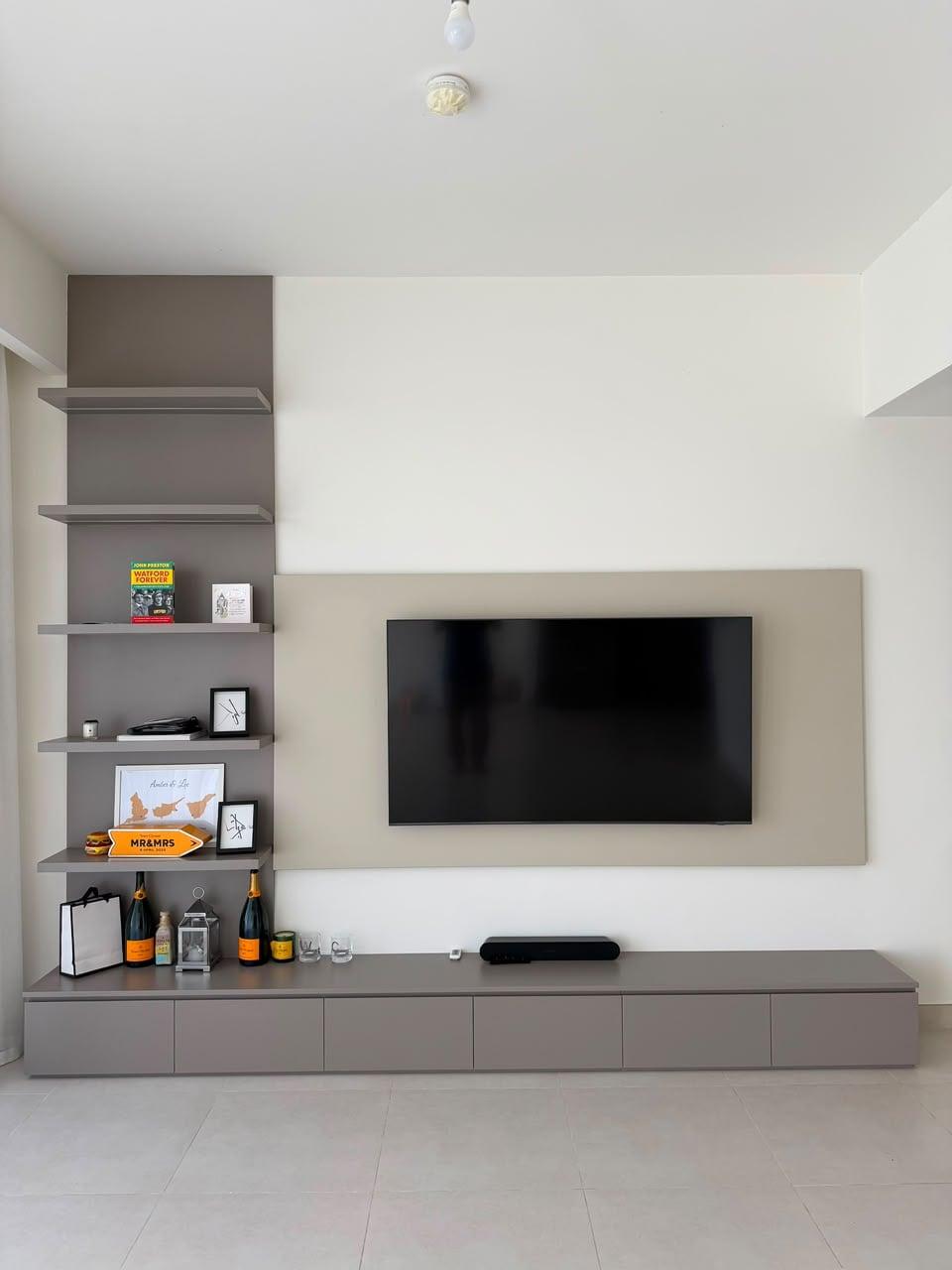
Length is the main design choice. A console shorter than the TV, or only as wide, makes the screen look like it is balancing on a shelf. As a starting point, a console at least a third wider than the TV looks settled: under a 65-inch screen, which is about 145 cm wide, a console of around 2.2 m is a comfortable proportion. Drawing the long console to match a bookcase or a tall cabinet next to it, as in the photograph below, makes the whole wall read as one piece of furniture.
Plan the gap to the floor and the gap to the TV together. The wall hung unit looks best with a clear gap of roughly 15 to 30 cm beneath it, and the TV above it needs room for a soundbar if you will have one. TV height on a media wall shows how the seats set those numbers. If you already know you will change your TV in a few years, our note on swapping the TV later explains how to build in room to grow. Our TV wall units and floating consoles are made to the length you choose.
Display shelving and lit niches: showing things without clutter
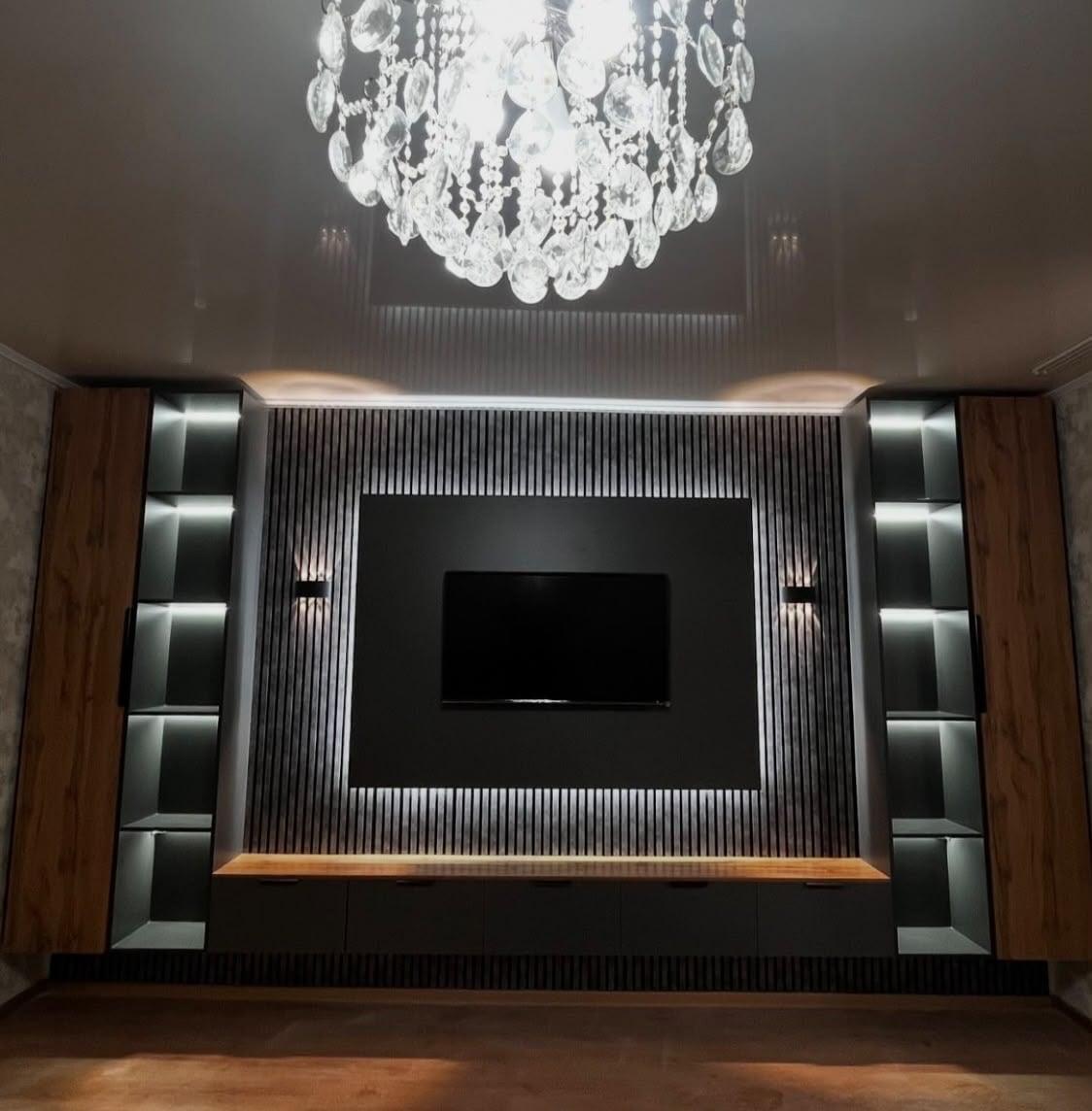
Open shelving and lit niches are for people who own things worth looking at. The risk is the opposite, that they end up showing things nobody chose. A shelf holds books, a plant and one or two objects well; it holds a router, a stack of chargers and last month's post badly. Decide what is going on show before the carpenter draws a shelf, and put every unlovely thing in a closed cabinet beneath.
Shelves should be deep enough for what they hold and no more: about 25 to 30 cm suits books and framed pictures, and narrower shelves look more elegant and take less of the room. Vary the heights, as a row of identical boxes looks like a shop. A glass door in front of a lit shelf keeps dust off ornaments, which in the UAE is worth having, and it also gives the wall a quieter face when the lights are off.
A niche is a shelf set into the wall, so it needs depth in the structure; we agree its size with the wall construction at the visit. Lit niches look fine in a villa and can feel heavy in a small apartment, where one lit niche at the side of a plain wall does more than four. A thin warm LED line, hidden in an aluminium profile, makes shelves glow without a bright dot in view. Keep the light away from the screen's face, because a bare strip next to the TV bounces light off it. Which light goes where, and why, is the subject of our media wall lighting guide.
TV wall storage ideas: hide the many things, show the few
A media wall earns its place when it stores. A modern living room has a lot to put away: a games console, a decoder, a router, a streaming box, controllers, chargers, blankets, board games, and in many families a stack of children's things. Closed cabinets flanking the screen swallow this and keep the middle of the wall calm; a low console with deep drawers takes the daily clutter.
Two rules save most walls. Devices need air: an amplifier or console shut inside a closed box with no ventilation runs hot, so ask for a ventilated section, a grille or a slot at the back of the unit. And cables need a route: sockets and a conduit planned before the cabinets are built mean a cable can be changed without opening the wall. Each has its own guide: cable and service access and sockets and power on a media wall.
Think about doors as well as boxes. Hinged doors need floor space to open into, handleless push-to-open doors keep the face clean, and drawers beat doors for low storage because you see everything at once. The short video below runs through TV cabinets and wall ideas that combine display and storage; watch it for how the open and closed parts are balanced.
Media wall ideas for small living rooms and apartments
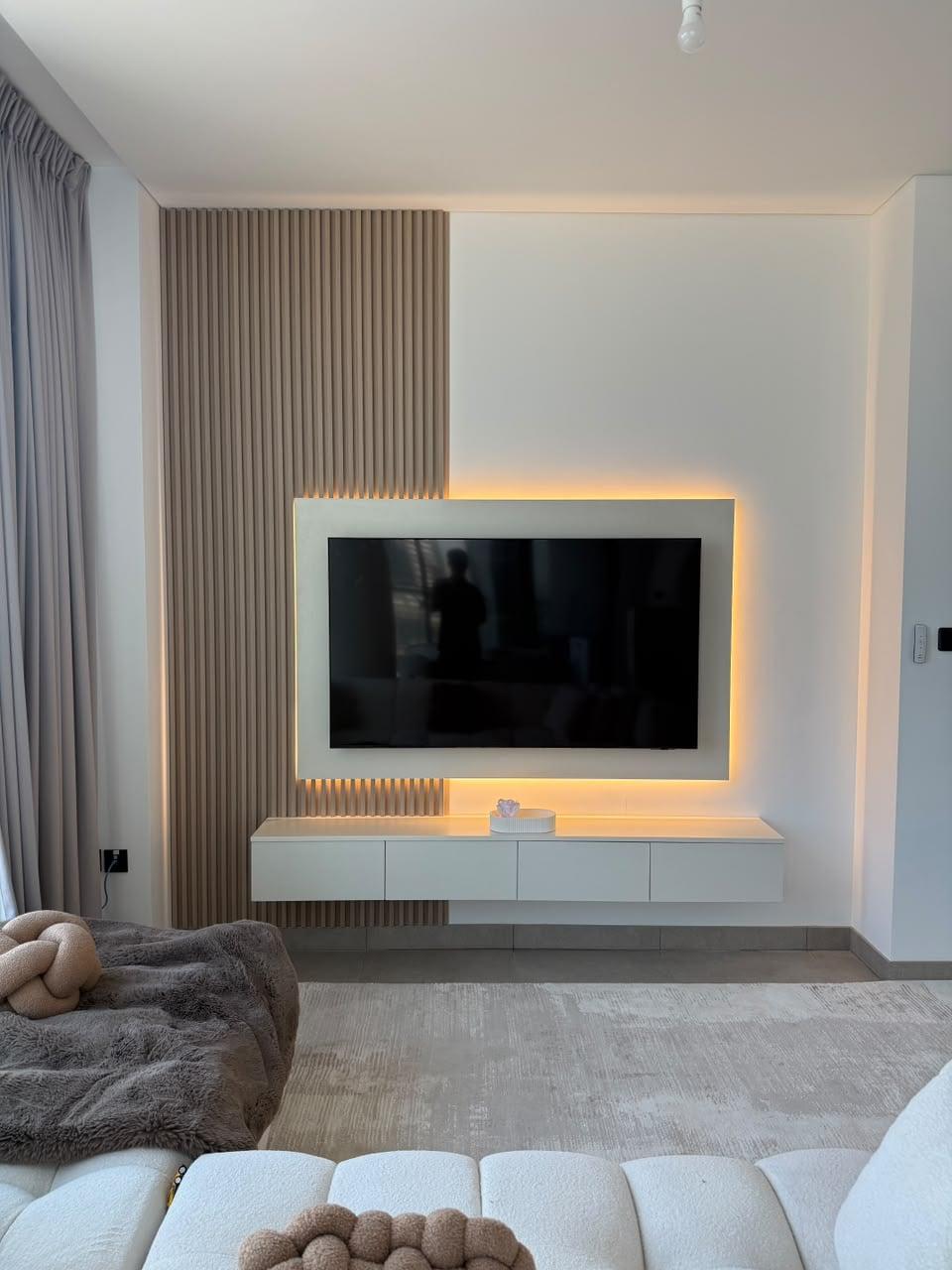
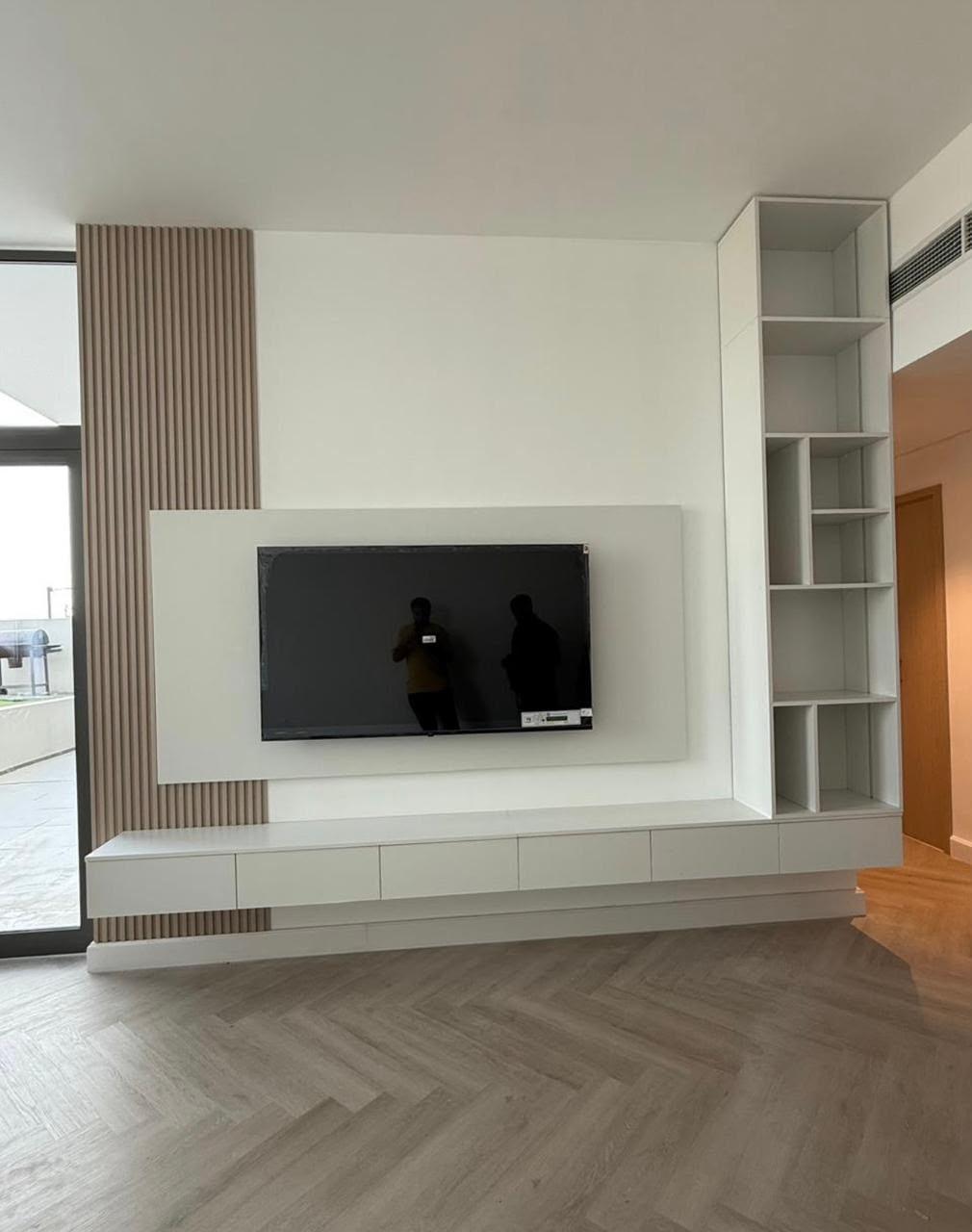
A small living room does not need a smaller idea, it needs fewer. One surface behind the screen, one console and one tall element at a side are plenty. The photograph below shows how far restraint goes: a strip of oak slats beside the window, a pale panel behind the TV, a long console with drawers, and a single column of open shelves that takes the books and the baskets, with nothing else on the wall. The same restraint works in a bedroom; see bedroom wardrobe with a built-in TV unit.
In a compact room, keep the wall shallow. A console at the shallow end of that range, around 35 cm, takes much less floor than a deep cabinet, and a floating one leaves the floor visible, which makes the room feel bigger. Pale colours reflect light and recede; a dark wall makes the TV disappear when it is off, which is a lovely effect in a room with enough daylight and a heavy one in a room with little. Use the tall element for storage and keep everything else plain.
Undecided about how much wall to build? the full-wall or compact comparison sets the two side by side on money and effect. Our entry brief, a compact panel behind the screen with a wall-hung console beneath it, starts from AED 3,500 per project; how the price grows with slats, lights and length is set out in what a media wall costs in the UAE. If you are not sure a fitted wall is right at all, what is a media wall compares it with a TV unit and a stand.
Colour, finish and the screen when it is switched off
For much of the day a TV is simply a dark rectangle, so the wall has to look right with the screen off. Dark walls, in charcoal slats or dark marble, let the black screen blend in and give a cinema feel; light walls give the screen a frame and keep the room bright. Neither is right in general. Decide by the room: strong daylight and a pale sofa suit a lighter wall; a room used mainly at night suits the darker one. Reception and boardroom screens follow the same logic; see office media wall design.
Finish is where the budget goes furthest. Matt and satin faces are calm and forgiving of fingerprints; high gloss mirrors a window, a lamp and the person on the sofa. If you love gloss, use it on a console or a niche, away from the screen's direct reflection. Warm woods sit well with cream and sand paint; grey woods need cooler light. Our guide to media wall materials and cost shows what each face costs.
Last, think about how the wall will be lit in the evening. Bright light behind or around the screen reduces eye strain, while a bare strip next to the glass can create glare. Between the ceiling, the shelves, the grooves and any backlight, plan layers on separate switches; ours are listed as an electrical line in the quotation, not a surprise on installation day.
From an idea you like to a drawing and a price
Bring the pictures that attract you, from this page or from anywhere, and tell us what you would like the wall to do. Our free home visit comes with finish samples; we laser-measure the wall, check socket and cable positions and any air-conditioning grille, and draw the elevation to your TV size. You sign off the drawing before the workshop starts, and nothing is made from a guess.
Media walls start from AED 3,500 per project, which covers a compact laminate screen panel with a wall-hung console beneath, made at our Sharjah workshop and installed by our own team. Most of the walls in this guide cost more, because slats, a longer console, a marble-effect face, shelving and LED lighting each bring a line of their own to the quotation. Fitting normally takes about 10 days from your order confirmation, and our 24-month written warranty covers the workmanship.
To start, see the media walls service, our custom media walls and, if you are near us, Sharjah media walls. Before you sign a drawing, check it against this list:
- One lead idea and one supporting idea, not five.
- The console is clearly wider than the TV, with a gap to the floor.
- Sockets, cable conduit and the TV bracket are drawn before any slats or panels.
- Devices have ventilation, and any shelf has a job and an owner.
- You have seen the finish at home, in daylight and lamplight, with the screen off.
- Light has its own switch and is kept off the glass of the screen.
Common questions
What are the most popular media wall ideas?
In UAE homes the most requested are slatted walls, marble-effect panels and floating consoles, often combined with lit shelves at the side. One lead idea plus one supporting idea is usually enough. Planning a media wall.
What is a good TV unit design for a small living room?
A shallow floating console of around 35 cm, a screen panel, and one tall column for storage. Keep the colours pale. Compact or full media wall.
Should I choose slats or a marble-effect panel?
Slats add warmth and a rhythm, and a marble-effect panel adds a calm, formal surface. Many walls use both: stone-look in the centre, slats at the sides. Media wall panel materials.
How do I add storage to a TV wall without making it heavy?
Put closed storage low, in drawers under the screen, and keep open shelves to one tall column. Ventilate the section for the devices. Cables and service access.
Can I light a media wall without causing glare on the TV?
Yes. Keep bare strips away from the screen's face, put light behind the panel or inside shelves, and dim it. Media wall lighting ideas.
What does a media wall cost in the UAE?
Ours start from AED 3,500 per project for a compact panel and a wall-hung console; slats, length, marble-effect faces and lighting add to it. Media wall cost in the UAE.

Sources & specifications
Manufacturer information applies to the named products and systems. Sources reviewed on 28 October 2026.
- VOX Furniture UAE: TV wall panels in UAE homes (slatted panels, finishes, LED strips behind panel edges, upkeep)voxfurniture.ae(opens in a new tab)
- Design Cafe: floating TV unit design ideas (console depth, floor gap, open and closed storage, cable planning)designcafe.com(opens in a new tab)
- Living etc: slat wall ideas (materials, MDF slats, acoustic backing, slats as a feature wall)livingetc.com(opens in a new tab)
Want this planned for your home?
Consultation and measurement are free. Tell us the rooms, location and what you need; we arrange a sample visit and define the measured quotation.