Media Walls · 12 min read · 8 April 2026
MDF, WPC, PVC or solid wood: which panel suits your TV wall?
MDF, WPC, PVC or solid wood for a TV wall? How each board handles water, heat, weight and fire, with published figures and which one suits which room.

By Ali Haider Basra, Founder, Al Tareeq Decor · Contact our workshop
Key takeaways
- For a dry living room, MDF is usually best: flat, stable, takes any face and holds screws well.
- Standard MDF can swell up to 12% in a 24-hour soak; moisture-resistant MDF is held to 5% or less.
- PVC absorbs under 0.5% of water but softens from about 65 °C, so keep it away from fireplace outlets.
- WPC tolerates damp, yet its wood fibres still take up water and products vary: ask for the datasheet.
- Solid wood keeps moving with humidity; use it for slats and edges, and stable boards for big panels.
On this page
- Key takeaways
- MDF, WPC, PVC or wood: the short answer
- What each board actually is
- The numbers side by side
- MDF: the smooth all-rounder that dislikes water
- WPC: damp-tolerant, but read its datasheet
- PVC: almost waterproof, but keep it from heat
- Solid wood: real grain that keeps moving
- Fluted panels and slats: which core?
- Heat from fireplaces, lights and equipment
- Fire ratings belong to products, not materials
- Weight, screws and the wall behind
- Which core for which wall
- Choosing a panel core by location
- How the core changes the price
- Choosing yours at the visit
- Common questions
MDF, WPC, PVC or wood: the short answer
For a TV wall in a dry, air-conditioned living room, MDF is usually the right core: it is flat, stable, takes every kind of face and screws hold well in it. Where a wall sees splashes or humid air, near a kitchen opening, a bathroom wall or a sea-facing balcony door, WPC or PVC copes better with water. Solid wood earns its place where you want real grain you can touch, typically in slats or shelf edges rather than whole sheets.
Those are starting points, not verdicts. The right board follows from the wall itself, the sun and heat in the room, the finish you have in mind and how much load it must carry. Our Sharjah workshop builds in all four, and each element on your drawing is labelled with its core. This guide explains how each behaves, with published figures where they exist and a plain warning where they do not.
What each board actually is
MDF, medium-density fibreboard, is wood broken down into fibres, mixed with a resin binder and pressed into flat sheets. It has no grain and no knots, which is why its face is so even. Moisture-resistant grades use a different resin and are often dyed green inside so they can be told apart.
WPC, wood-plastic composite, mixes wood flour or fibre with a plastic, typically PE, PP or PVC. Wikipedia's summary of the material puts the wood share as high as 70%, with half and half common. PVC panels come in two quite different forms: rigid PVC, which is dense and hard, and foamed PVC board, which is light and easy to cut. Solid wood is exactly that: sawn timber, here usually oak, walnut or a similar hardwood, with every piece slightly different.
The numbers side by side
The chart below puts the four cores on the three questions customers ask most: how heavy is it, what does water do to it, and what does heat do to it. Every number comes from a manufacturer's datasheet or a reference source, and the cells say so where no reliable figure exists. WPC in particular varies so much between makers that a single number would mislead.
Read the units carefully. MDF's water figure is swelling in thickness after 24 hours under water, a demanding test that a wall panel will never face; PVC's is absorption, a different measure. The point of the comparison is the order of magnitude, not a precise ranking.
- 1. Standard MDF swells up to 12% in thickness after a day under water
- 2. Moisture-resistant MDF is held to 5% or less by the same test
- 3. Rigid PVC starts to soften between 65 and 100 °C
- 4. WPC varies by maker: ask for the sheet's own datasheet
MDF: the smooth all-rounder that dislikes water
MDF is the board most media walls are built on, and the datasheets show why. Swiss Krono, a large European maker, lists its standard boards at about 750 kg/m³ in the common 12 to 19 mm thicknesses, and denser in thin sheets. That density gives a hard, even face that takes laminate, veneer and lacquer equally well, and faces into which screws bite firmly.
Its weakness is water. In the standard 24-hour soak test, the same maker's ordinary MDF can swell by up to 12% in thickness at 12 to 19 mm, while its moisture-resistant board, made to the EN 622-5 MDF.H class, is held to 5% or less. A wall will never sit under water, but a leak behind it, a wet mop against its foot or steam from a nearby bathroom find the cut edges first. So we seal the edges, keep the bottom edge off the floor, and use the moisture-resistant grade where a wall backs onto a wet room.
One more point on MDF: emissions. Boards are classed for formaldehyde, and E1 is the common European class; it is a declared emission level, not a promise that a board contains no formaldehyde at all. Ask for the class to be written on the quotation if it matters to you, as it should in a child's bedroom.
WPC: damp-tolerant, but read its datasheet
WPC's appeal is that the plastic wraps the wood fibres, so the board resists rot and copes with damp far better than MDF. It is popular for fluted wall panels because it can be extruded into ribbed profiles in one piece. But it is not a plastic sheet with no wood in it: Wikipedia's article notes that the wood fibres can still take up water, so a WPC panel is water-tolerant rather than waterproof.
Two cautions apply. First, heat and fire: the same source notes that most WPCs begin to burn at around 204 °C and can be a greater fire hazard than wood, which is one reason to keep them clear of an electric fireplace's outlet. Second, variation: WPC from one maker can differ from another's in density, stiffness and water uptake, and we found no reliable independent datasheet that covers the category. Ask for the specific product's figures rather than accept "WPC" as a description.
For long, unsupported shelves or heavily loaded parts, WPC needs closer fixing than MDF, because plastic-based boards can creep under constant load. As a face for slatted wall panels between solid supports, it is an excellent choice in rooms that see humidity.
PVC: almost waterproof, but keep it from heat
PVC barely notices water. Laird Plastics, a plastics distributor, gives foamed PVC board a 24-hour water absorption of under 0.5%, and rigid PVC absorbs very little too. That makes it the safest core next to a bathroom, a kitchen opening or anywhere a wall is wiped down often, and it does not rot.
Its limit is heat. Wikipedia's materials summary gives rigid PVC a Vicat softening range of about 65 to 100 °C, and Laird gives foamed board a softening point of 65 to 75 °C with continuous service up to about 60 °C. A wall panel in a cooled room is far from those temperatures, but the hot-air outlet of an electric fireplace or a halogen lamp pressed against it is not. Untreated PVC can also yellow in strong sunlight unless the sheet is UV-stabilised, so check that for a wall facing a large west window.
The surprise with foamed board is its weight. Laird puts a 4 × 8 ft sheet half an inch thick at 15 to 20 lb, against 65 to 85 lb for the same sheet in MDF or plywood. That makes light, large panels easy to handle on a gypsum wall, though it also means screws hold less firmly, so fixings go into the frame behind.
Solid wood: real grain that keeps moving
Of the four, only solid wood gets better with age, and only solid wood can be sanded back and refinished a decade on. It is also the one that never stops moving. The Wood Database gives white oak a density of about 755 kg/m³ and shrinkage, from freshly sawn to oven-dry, of 5.6% across the growth rings and 10.5% along them. Seasoned timber moves far less than that, but it still swells and shrinks with the air around it.
In UAE homes that matters more than it sounds: months of air-conditioning dry a room out, and a house closed up in summer or opened in a humid winter changes again. So we use wood where its movement is harmless, in slats with small gaps between them, shelf edges and frames, and keep large flat areas on a stable board with a veneer face instead. You get the grain without wide panels that cup or split.
Fluted panels and slats: which core?
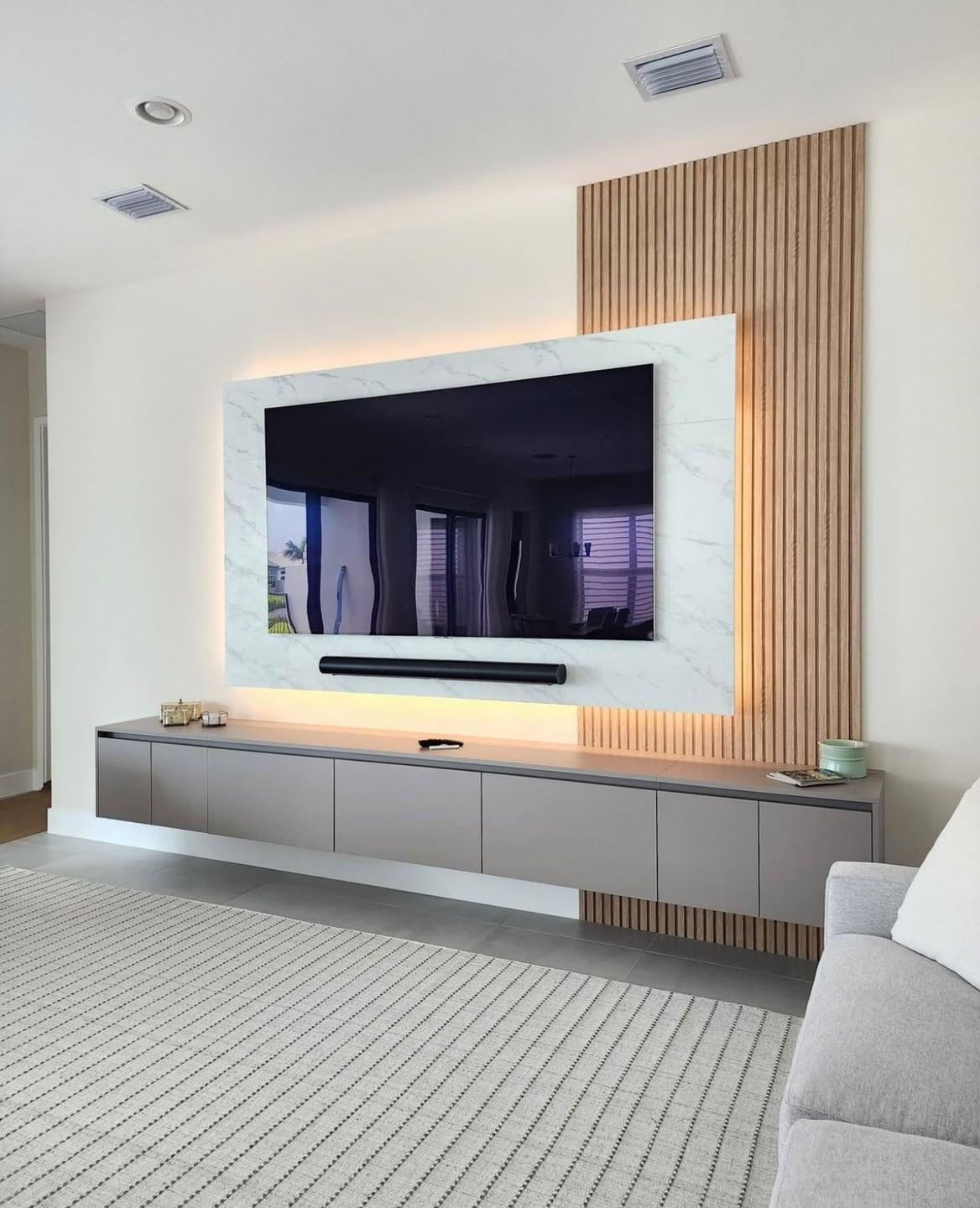
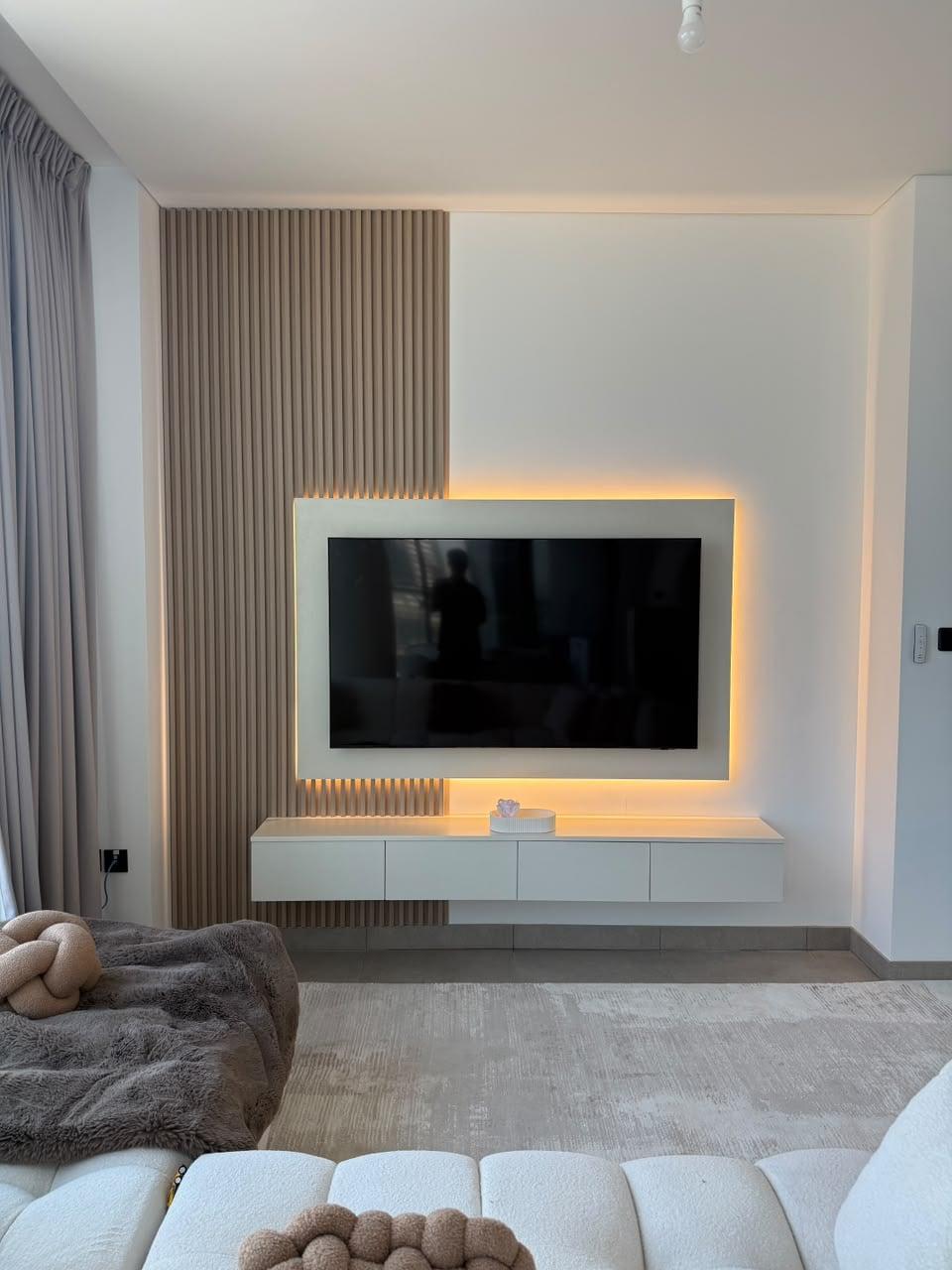
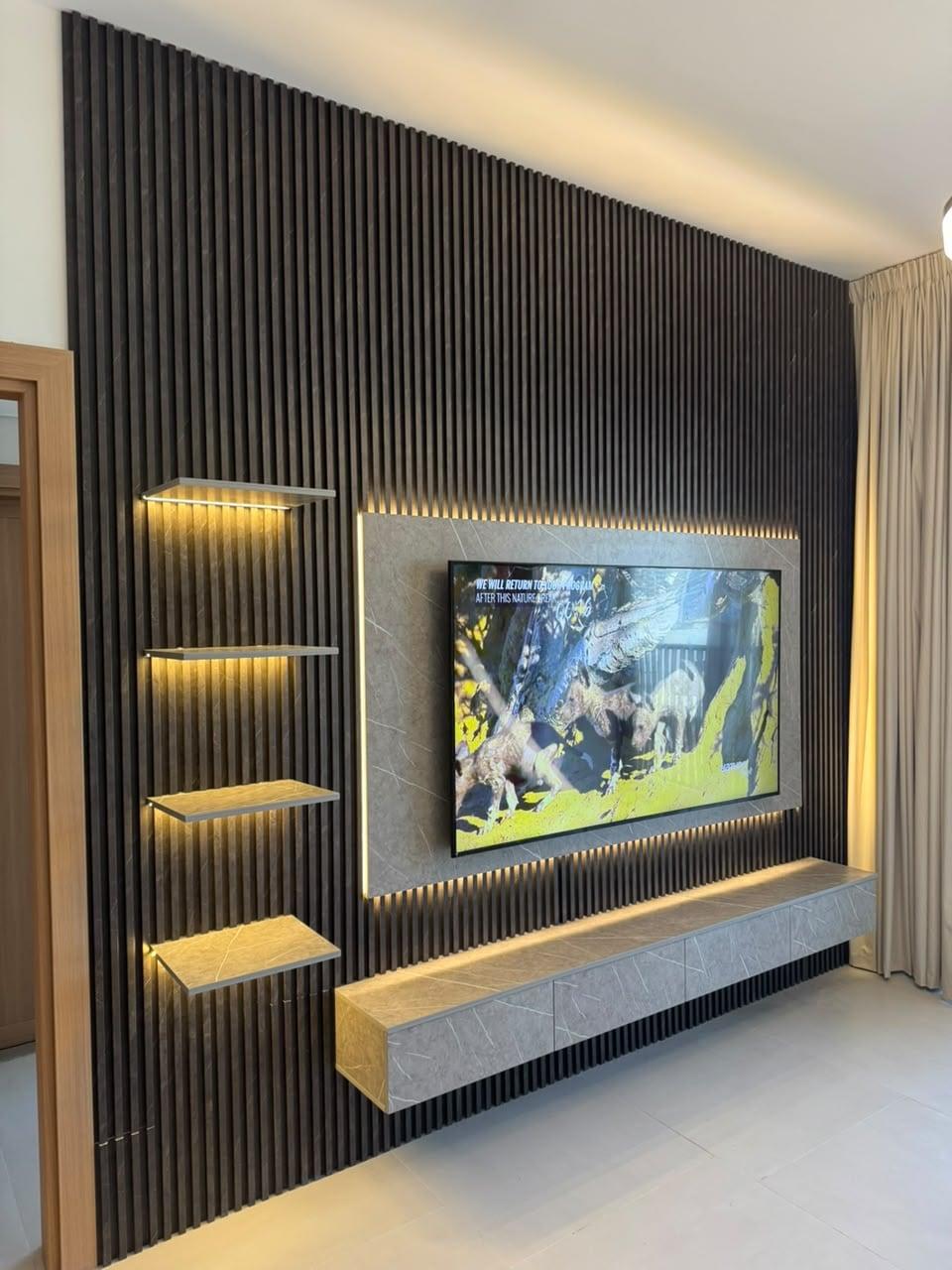
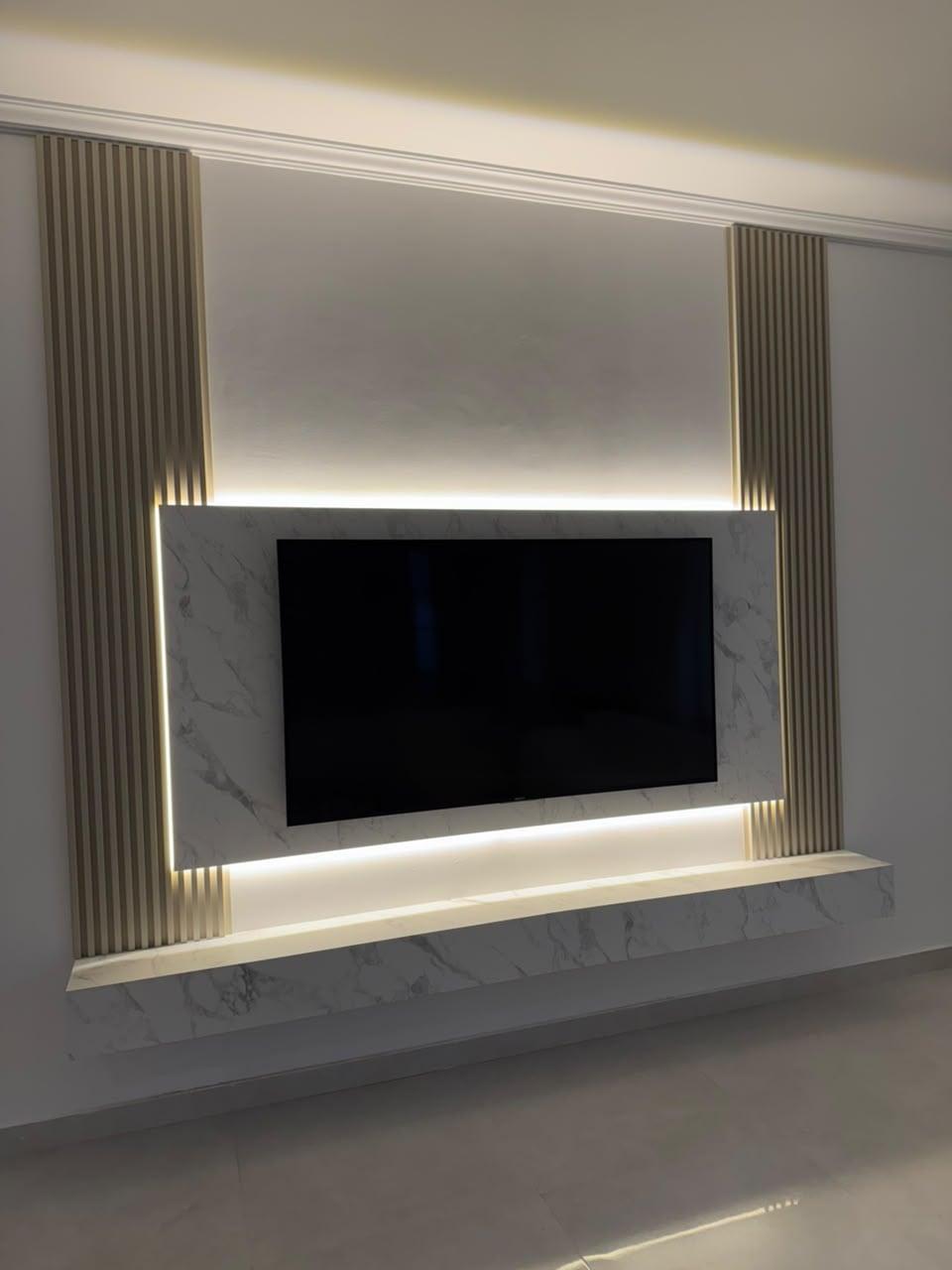
You can buy fluted or slatted panels in every one of the four cores, and the look in a photograph does not tell you which. MDF slats take a painted or laminated finish beautifully and stay straight; WPC flutes come extruded in one piece and tolerate damp; PVC versions are light and cheap to replace; real wood slats give the deepest grain and the warmest feel under light.
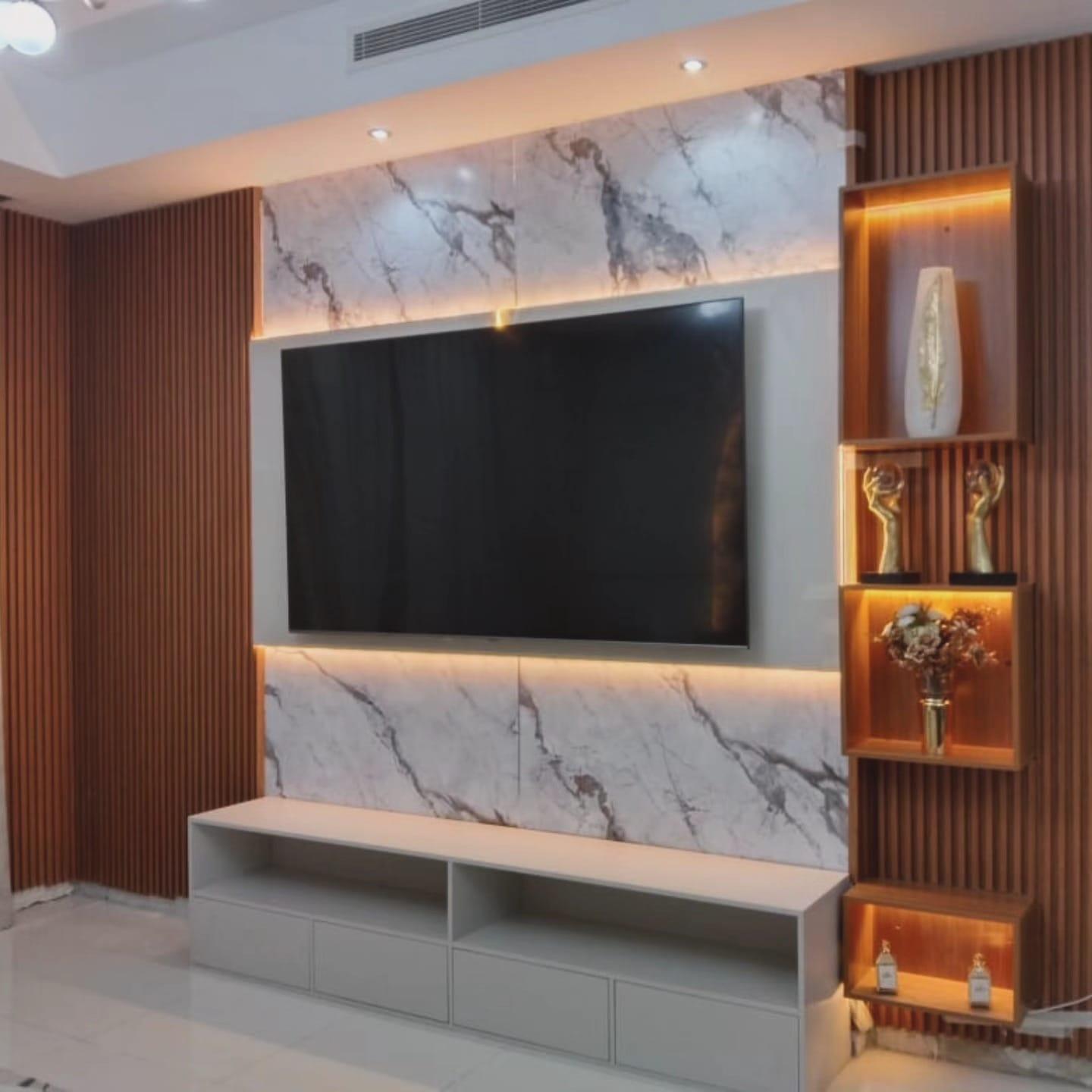
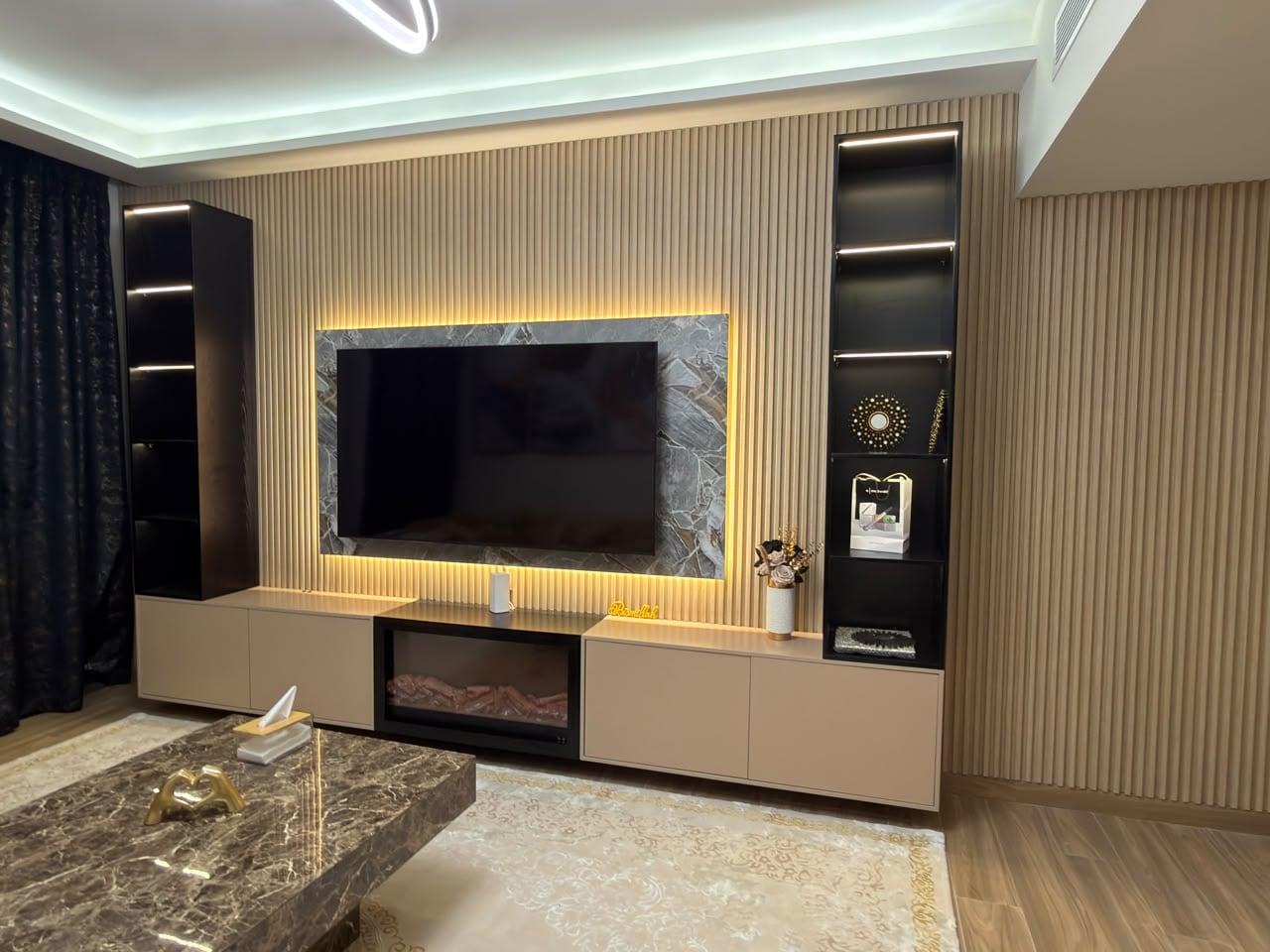
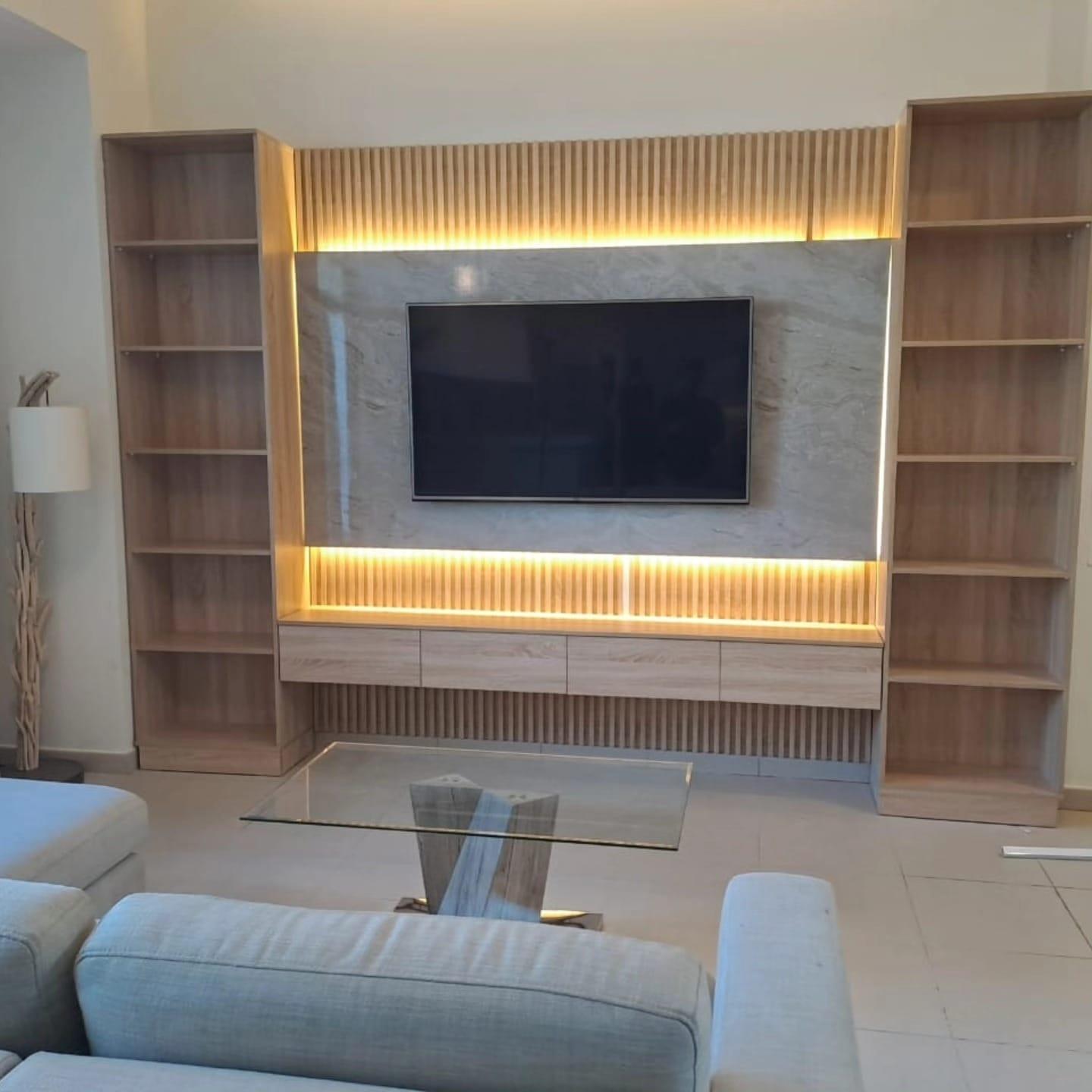
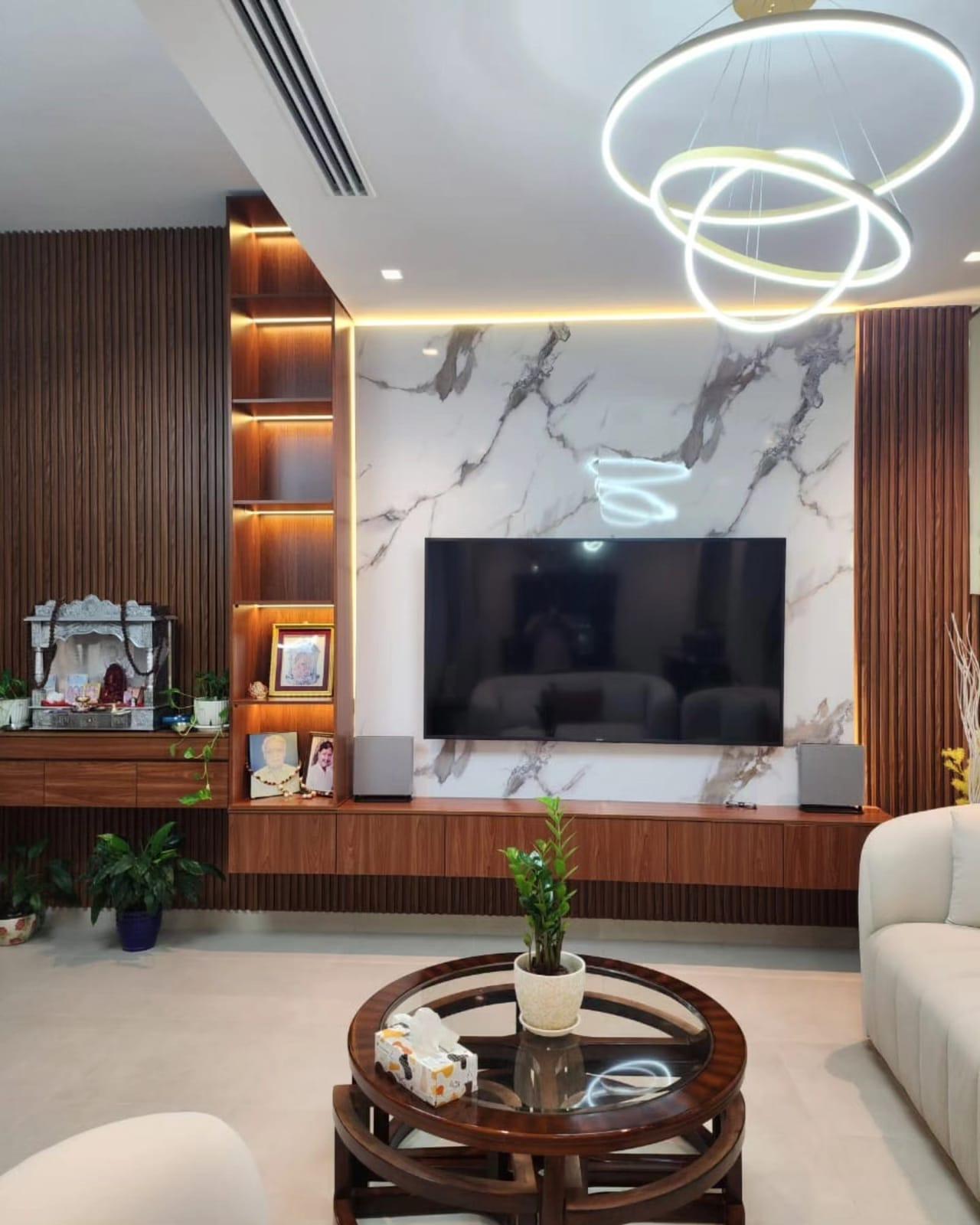
Choose by the room and by the light. Grooves collect dust, so a wall near an open kitchen is better in a wipeable WPC or PVC than in a raw-wood finish. If LED light will run along the grooves, the board must tolerate the heat of the strip and the profile, which favours MDF or wood over foamed PVC directly against the strip. Our wooden feature walls show slatted work in real installations. For slat width, gaps, lighting and cleaning, see the slat width and gap guide for fluted TV walls.
Heat from fireplaces, lights and equipment
Most of a media wall never gets warm. The exceptions are predictable: the hot-air outlet of an electric fireplace, the strip and driver of LED lighting, and the vents of a receiver or games console in a closed cabinet. Keep PVC and WPC away from all three, follow the fireplace maker's stated clearances to combustible materials, and give equipment cabinets ventilation.
Where a fireplace is part of the design, we use a heat-tolerant core and a non-plastic face for the area immediately around it, and keep plastic-based panels further out on the wall. The same thinking applies to LED drivers, which should sit somewhere ventilated and reachable rather than sealed against a plastic panel. Power and fireplace sockets are covered in how we plan sockets and power.
Fire ratings belong to products, not materials
A material's name tells you nothing certain about how it behaves in a fire. Fire-retardant MDF exists, for example Kronospan's FR board classed B-s1,d0 under the European EN 13501-1 system, and so do PVC foam boards with declared classes, such as 3A Composites' FOREX classic at C-s3,d0. Ordinary MDF, ordinary WPC and ordinary PVC are not the same as those products.
If a fire rating matters, because of a building requirement, a commercial space or simply your own peace of mind, name the exact product and its class on the quotation. Do not accept a rating inferred from the word "MDF" or "PVC" alone.
Weight, screws and the wall behind
Weight decides how a wall is fixed. Dense MDF and hardwood are heavy across a large wall; foamed PVC is light. On block or concrete that rarely matters. On a gypsum partition, heavy panels, a TV and a loaded console need a frame behind them, and every panel should be fixed into that frame rather than into the gypsum alone.
Screw holding varies too. MDF holds screws well in its face but can split if a screw is driven into its edge, so fixings are planned through the face. Foamed PVC and some WPCs hold screws less firmly, so the TV bracket and floating shelves always go into the frame. How the frame and bracket are specified is set out in the media wall materials list.
Which core for which wall
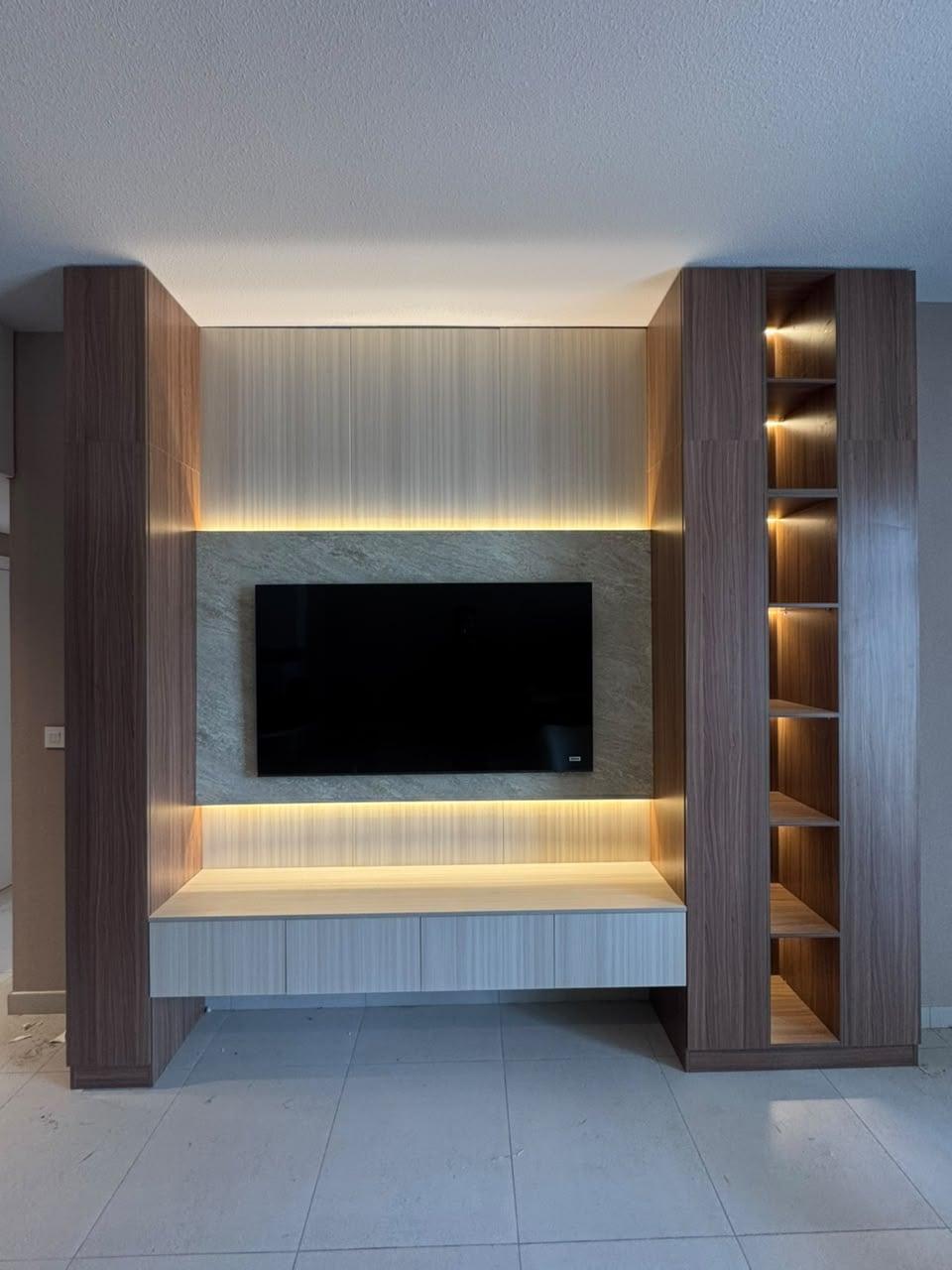
Putting it together, most walls need more than one core. A common combination is an MDF screen panel with a veneer or laminate face, framed by slats in MDF or wood, with a moisture-tolerant board only where the wall meets a wet room. The table sums up where each one fits best.
Choosing a panel core by location
Dry living room or majlis
- Our usual choice
- MDF with laminate, veneer or lacquer
- Why
- Flat, stable, takes every face, holds screws
Wall backing onto a bathroom or kitchen
- Our usual choice
- Moisture-resistant MDF, WPC or PVC
- Why
- Limits swelling if damp reaches the board
Near a fireplace outlet
- Our usual choice
- Heat-tolerant core with a non-plastic face
- Why
- PVC and WPC soften or burn at lower temperatures
Large west-facing window opposite
- Our usual choice
- MDF or UV-stabilised panels; avoid veneer in direct sun
- Why
- Sun yellows unstabilised PVC and shifts wood tone
Feature slats you touch
- Our usual choice
- Solid wood or MDF
- Why
- Real grain or a crisp painted edge
Gypsum partition, large panels
- Our usual choice
- Lighter boards on a frame
- Why
- Less load on the wall; fixings into the frame
Recommendations from our workshop practice, based on the published figures in this article. Your drawing labels the core of every element.
How the core changes the price
People often expect the core to decide the price of a media wall. In practice it is one line among several, and rarely the biggest. How much of the wall is panelled, which face goes on the board and how much lighting and storage the design carries move the total far more than the choice between MDF and WPC.
Where the core does matter is in the details. Moisture-resistant MDF costs a little more than the standard grade; solid hardwood slats cost more than MDF slats of the same profile, and take longer to finish; and a fire-rated board is a specified product with its own price. We show the core as part of each panel's line, so you can see what changing it would do before the workshop starts.
Choosing yours at the visit
Bring the question to our free home visit. We check the wall, what is behind it, where the sun and any heat sources are and what finish you want, then suggest a core for each part and show samples. Your drawing and quotation then list the board, its thickness and its face for every part.
Our media walls start from AED 3,500 per project, and the core you choose is one of the lines that moves the price; what moves a media wall's price explains the rest. Expect roughly ten days from order to fitted wall, with the panels cut in our Sharjah workshop and put up by our installers; our written workmanship warranty runs 24 months for orders agreed from 10 October 2026. To begin, send a picture of the wall via our media walls page.
Common questions
Does the panel core change the price?
It is one line among several. Our walls start from AED 3,500 per project; wider panelling, premium faces and lighting move it more than the core does. Media wall price guide.
What else should a media wall quotation name?
The backing frame, board thickness, face, edges, hardware, TV bracket, LED and electrical work, each as its own line. The media wall materials list.
Can a TV be mounted on WPC or PVC panels?
Not on the panel alone. The bracket goes through the panel into a frame or solid wall behind it. Planning a media wall.
Do you make fluted wooden feature walls?
Yes, in slats of MDF, WPC, PVC or solid timber, chosen for the room. Wooden feature walls.
How are cables run behind the panels?
In conduit hidden in the cavity, wide enough for the connectors, with a section that lifts off when a cable needs changing. Cable planning and service access.
Can I have a marble-effect panel on my TV wall?
Yes, as a screen panel on its own or framed by slats and shelving. Marble-effect TV backdrops. For real stone and porcelain alternatives, see marble TV wall options.

Sources & specifications
Manufacturer information applies to the named products and systems. Sources reviewed on 28 October 2026.
- Swiss Krono: MDF technical data (density, 24 h swelling, MR board EN 622-5)swisskrono.com(opens in a new tab)
- Polyvinyl chloride on Wikipedia (density, Vicat softening, UV)en.wikipedia.org(opens in a new tab)
- Laird Plastics: PVC foam board guide (density, water absorption, Vicat, weight)lairdplastics.com(opens in a new tab)
- Wood–plastic composite on Wikipedia (wood share, water uptake, fire)en.wikipedia.org(opens in a new tab)
- The Wood Database: white oak (density and shrinkage)wood-database.com(opens in a new tab)
- Kronospan: fire-retardant MDF, B-s1,d0kronospan.com(opens in a new tab)
- 3A Composites: FOREX classic PVC foam board, EN 13501-1 C-s3,d0display.3acomposites.com(opens in a new tab)
Want this planned for your home?
Consultation and measurement are free. Tell us the rooms, location and what you need; we arrange a sample visit and define the measured quotation.