Media Walls · 13 min read · 23 May 2026
Marble TV walls: real stone, porcelain slab or marble-effect panel?
Real marble, porcelain slab, marble-effect panel or laminate for a TV wall: weight, joints, mounting the TV, heat, glare, cleaning and what moves the price.

By Ali Haider Basra, Founder, Al Tareeq Decor · Contact our workshop
Key takeaways
- Weight splits the options: a 20 mm marble slab is about 54 kg/m², a 6 mm porcelain slab on its board about 28, and a marble-effect panel or laminate about 15.
- A 3.0 × 2.7 m wall of real marble hangs roughly 437 kg; the same wall in marble-effect panel is about 120 kg.
- Fix the TV to the frame behind, not to the stone-look face, and plan the openings and a plate that suits a bigger future screen.
- Use matt or honed around the screen and keep polished gloss to small accents, because a shiny face puts window light on the picture.
- We publish AED 3,500 per project for a compact laminate wall; marble-effect and porcelain faces are priced from the drawing, in about 10 days.
On this page
- Key takeaways
- Marble TV wall: four ways to get the same look
- Weight: the number that decides how the wall is built
- Weight and size of each marble option
- Joint lines: how many seams will you see?
- Mounting a TV on stone or a stone-look wall
- Heat behind a screen and beside a fireplace
- Glare: polished, honed or matt?
- Cleaning and everyday care
- Cost direction: what moves the price
- Marble options at a glance
- Which option for which wall
- How we build marble-look TV walls, and questions for every supplier
- Common questions
Marble TV wall: four ways to get the same look
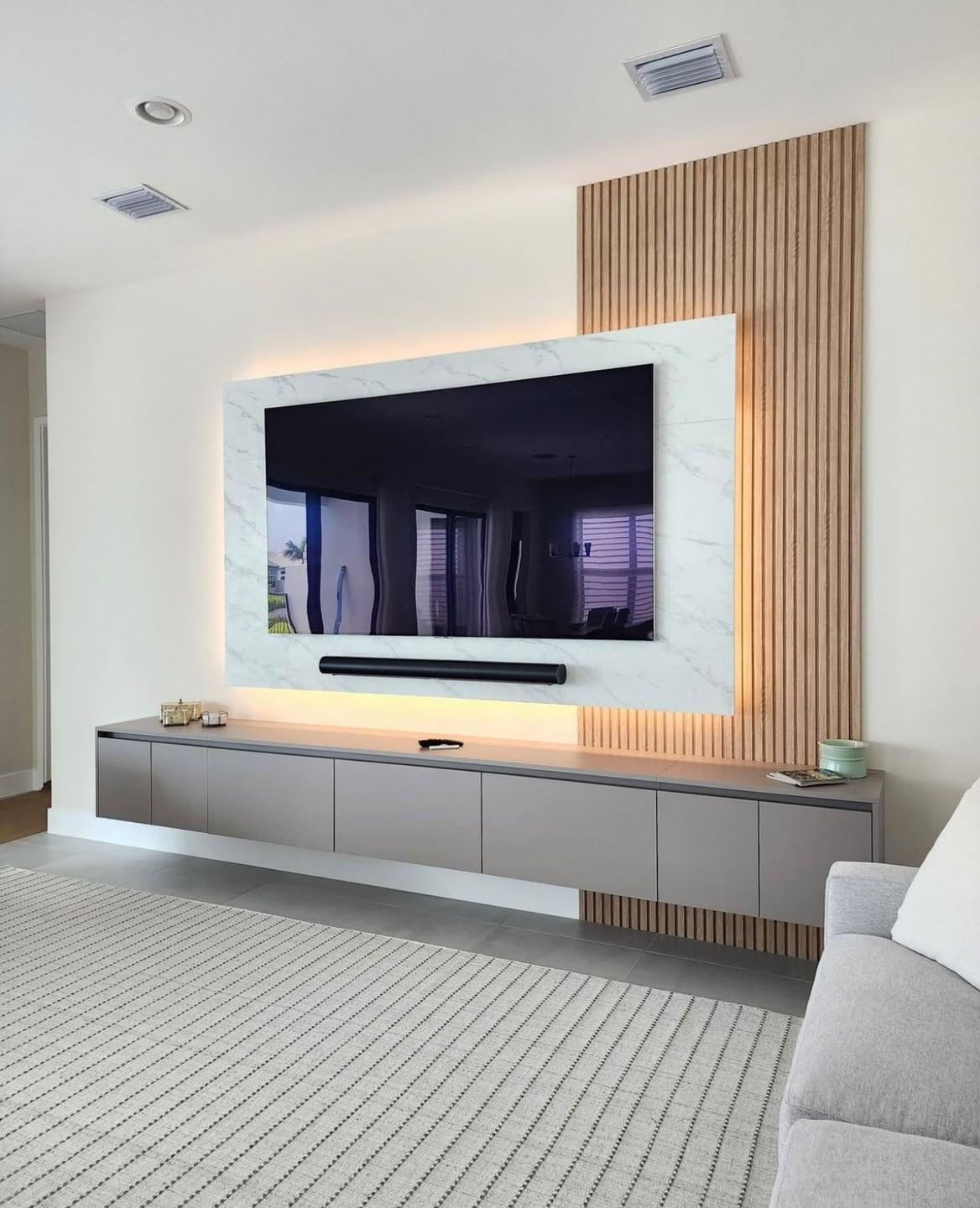
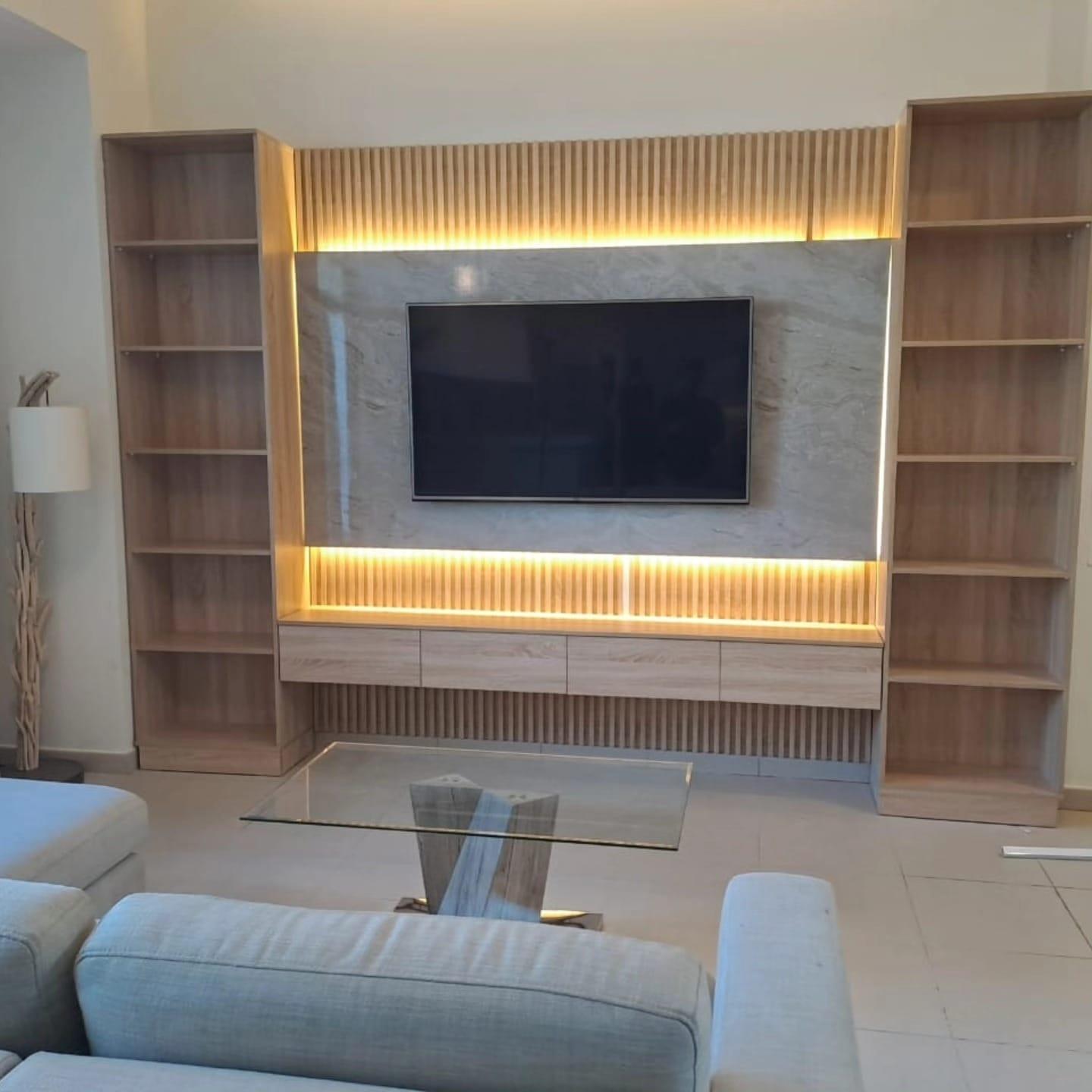
A marble TV wall is one large stone-patterned surface behind the screen, often with a shelf or console in the same pattern and a line of light round its edge. The look is one thing. The build can be any of four: a slab of real marble, a thin porcelain or sintered-stone slab, a marble-effect panel, or marble-pattern laminate on a board. Searches such as marble TV wall panel, design and price mix all four together, which is why the answers contradict each other. Not sure a fitted wall is right? What is a media wall sets out what one includes.
They are very different objects. One weighs more than 50 kg per square metre and one under 15. One has no pattern to match across a joint and another has veins that run on for metres. One etches when lemon juice touches it and another can be wiped with anything. Our published TV-wall faces are porcelain and marble-effect panels, so this guide is candid about real stone: it is a specialist stone-fixing job, and a stone fabricator is the right person to price it.
We compare the four on the six things that decide a wall: weight, joint lines, mounting the TV, heat, glare and cleaning, then on what moves the price. How the boards behind a face compare is a separate question, answered in MDF, WPC, PVC or wood panel cores, so this article does not repeat it.
Weight: the number that decides how the wall is built
Start here, because weight settles the backing, the fixings and sometimes whether the wall can be done at all. Marble weighs between 2.6 and 2.8 tonnes per cubic metre (the Engineering ToolBox gives that range), so a 20 mm slab, a common thickness for stone cladding, is about 54 kg for every square metre. On a 3.0 × 2.7 m wall, 8.1 m², that is roughly 437 kg hanging off the wall before a single bracket is counted.
Porcelain and sintered slabs get their stone look in a fraction of the thickness. Neolith, which makes them, sells wall cladding in 3 and 6 mm, and its table gives 14 kg/m² for 6 mm. Laminam, another maker, lists its versions for vertical cladding at 2.6 to 6.2 mm and does not list its 12 and 20 mm slabs for vertical cladding. A slab that thin cannot stand alone, so it is bonded flat to a rigid backing board; the board adds about 13.5 kg/m² for 18 mm of MDF at around 750 kg/m³, which brings the build to roughly 28.
A marble-effect panel and a marble-pattern laminate are both a board with a thin printed face. The board is nearly all the weight, so both come in near 15 kg/m², about a quarter of real stone. The drawing below builds each of the four layer by layer, at one thickness scale, with the weights counting up. The two thin faces are our estimates; the others come from the sources at the end.
Weight and size of each marble option
Real marble, 20 mm
- Face and backing, kg/m²
- About 54
- A 3.0 × 2.7 m wall
- About 437 kg
- Typical size to plan around
- Slabs cut to the wall; each joint breaks the veins
Porcelain or sintered slab, 6 mm, on 18 mm board
- Face and backing, kg/m²
- About 28
- A 3.0 × 2.7 m wall
- About 223 kg
- Typical size to plan around
- Slabs of 1,620 × 3,240 mm or 3,200 × 1,500 mm exist, so one joint on a 3 m wall
Marble-effect panel on 18 mm board
- Face and backing, kg/m²
- About 15
- A 3.0 × 2.7 m wall
- About 122 kg
- Typical size to plan around
- Sheet size from the maker; ask where the joints fall
Marble-pattern laminate on 18 mm board
- Face and backing, kg/m²
- About 15
- A 3.0 × 2.7 m wall
- About 117 kg
- Typical size to plan around
- Sheet size from the maker; a joint every sheet width
Real marble from the Engineering ToolBox's density range; the 6 mm slab from Neolith's table; the board at 750 kg/m³ (Swiss Krono); the two thin printed faces are our estimates (about 1.5 and 1 kg/m²). Sizes: Laminam and Neolith published slab formats.
- 1. Real marble: a 20 mm slab weighs about 54 kg/m², nearly four times a marble-effect panel
- 2. Porcelain or sintered slab: a 6 mm face, but it needs an 18 mm board behind it, so about 28 kg/m²
- 3. Marble-effect panel: a board with a stone-print sheet; the board is nearly all of the weight
- 4. Marble-pattern laminate: the same board with a thinner printed face
Joint lines: how many seams will you see?
Every seam on a marble wall is a place where the pattern stops. In real stone, veins end at each joint unless two slabs are cut from the same block and laid as a matched pair, which is a design choice you pay for. In a printed face, the pattern is repeated, so a seam can disguise itself, but only if the maker's sheets are laid in the right order.
Large slabs are the answer for people who hate seams. Laminam's formats include 1,620 × 3,240 mm and 1,200 × 3,000 mm, and Neolith's 3,200 × 1,500 mm. A 3.0 × 2.7 m wall is covered by two slabs with one joint, which you can put behind a slat, a line of light or the end of the console where it is easiest to forgive. Make the screen panel one piece, so that the area the eye rests on carries no seam at all.
Whatever you choose, ask for the drawing to show every joint and where the veins meet, as we do in our media wall specification checklist. Hiding a joint under a slat or an LED channel is often simpler than hunting for a bigger slab. The installation video below, from Daltile, is the maker's own look at setting its large porcelain panels on a wall; watch it for the preparation behind the face, because the hidden work decides whether the seams stay straight.
Mounting a TV on stone or a stone-look wall
The marble face should never carry the TV. A screen hangs from the structure, never from the decoration. Frame, fixings and bracket carry the load, and the stone-look face is only a cover, as our planning guide explains. In practice the bracket plate is fixed to a frame or the structure behind, and the face is cut around the plate or built in sections beside it.
A thin slab is the awkward case. Drilled near an edge or too close to a corner it can crack, and a crack in a 6 mm slab is hard to repair invisibly. Fix the bracket to the board behind, make the cut-out for it before the slab is laid, and make sure the plate also suits a bigger screen later. Changing the TV later explains why. Real marble is drilled with diamond tools and needs its holes planned before the slab is polished and delivered, and thin stone on a gypsum partition is a structural question, so get the fixing method in writing.
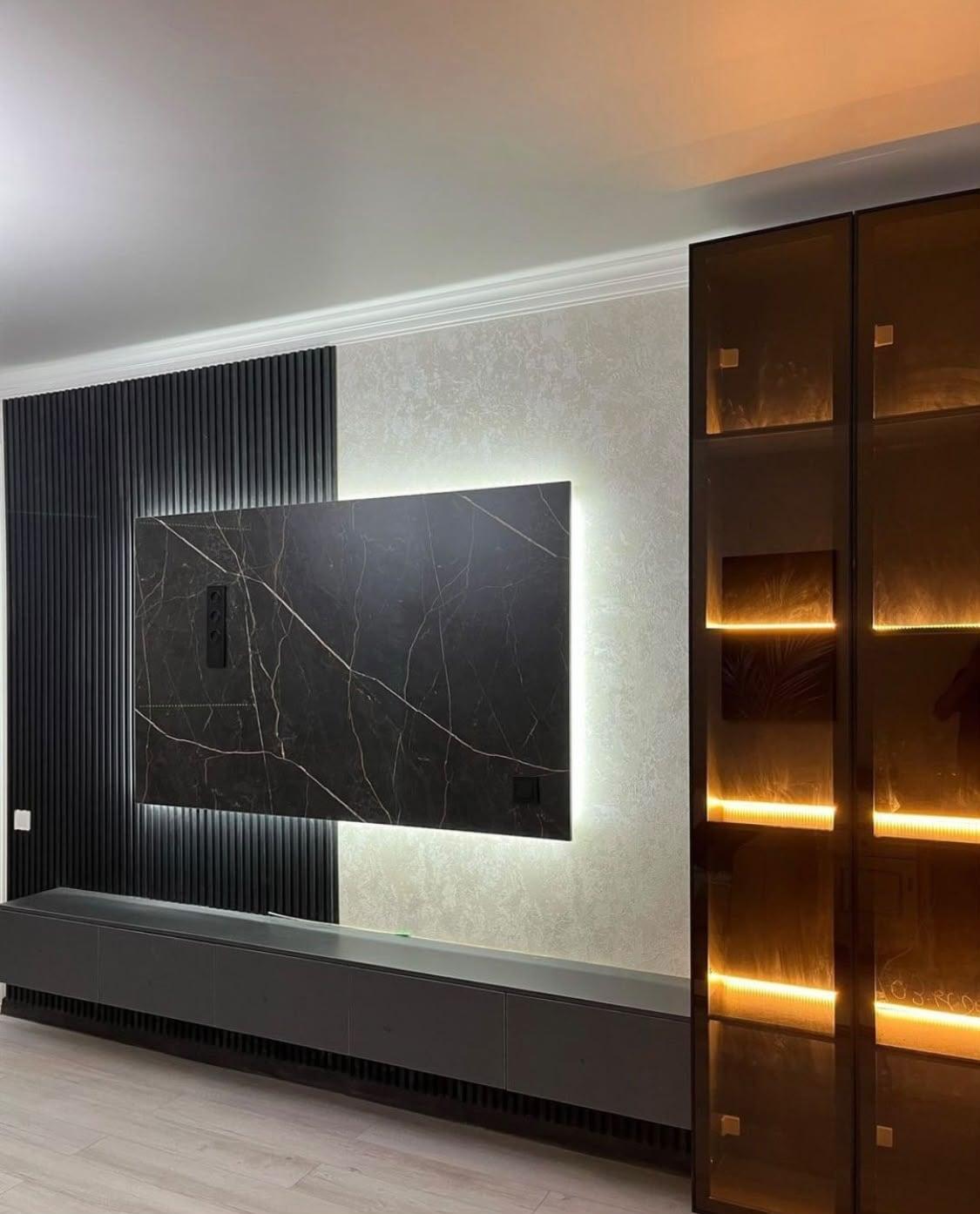
Sockets are a similar matter. The black marble panel in the photo below has its power points cut into the face and framed in black, so the leads reach the screen without a visible cable. Where the sockets and power points go covers the positions. The short video that follows shows a TV bracket being fixed to a marble and tile-faced masonry wall with a tile bit and anchors, and it makes the point that stone has to be drilled slowly with the bit kept wet.
Heat behind a screen and beside a fireplace
A TV gives off heat through vents in its back, and a wall of stone or porcelain has no trouble with that: neither melts, peels or blisters. The thing to protect is the screen. Keep the air gap behind it that the maker asks for, leave the vents clear, and do not seal a hot box into a closed recess in the same finish as the wall.
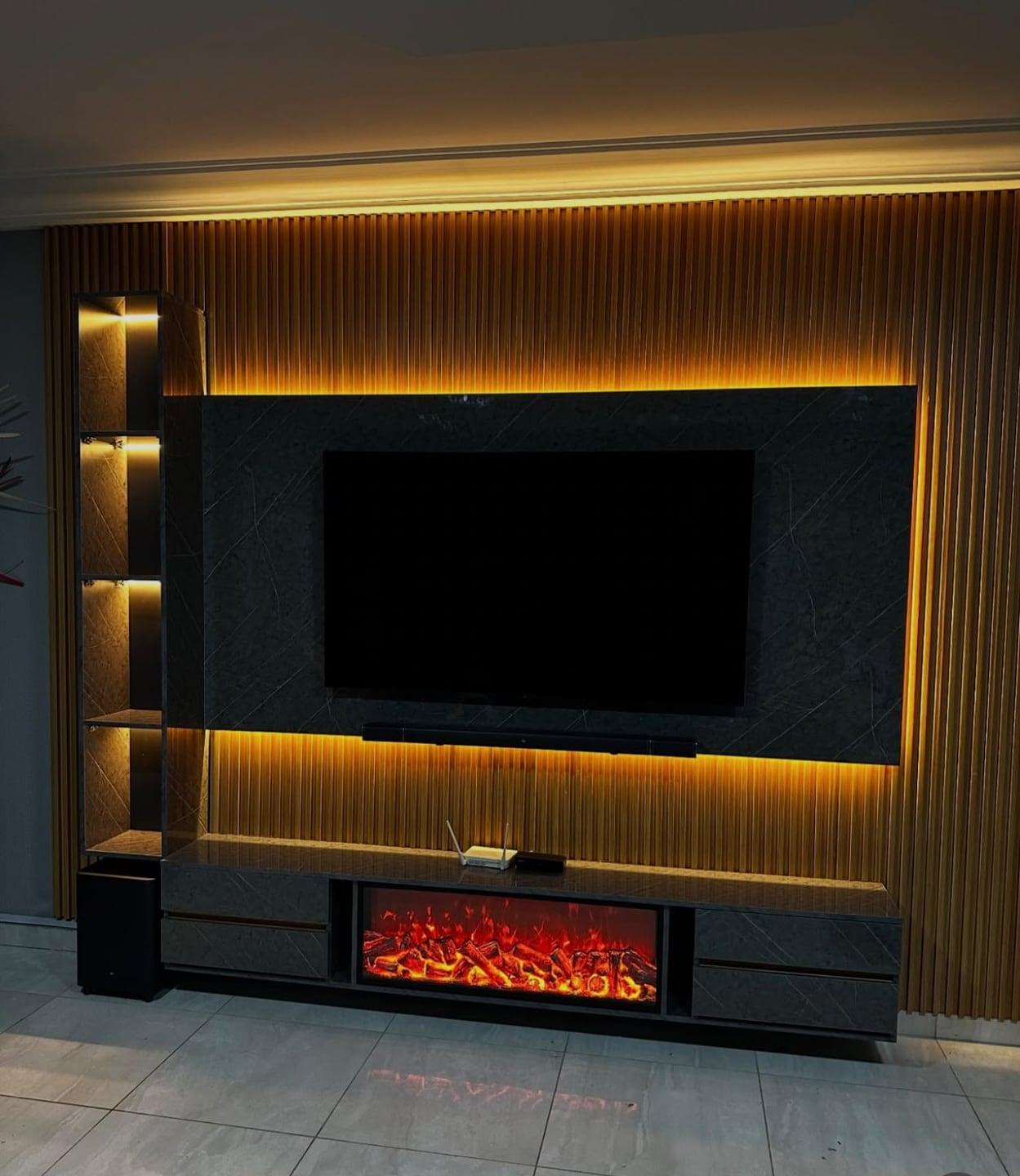
Heat matters more beside an electric fireplace, where the hot-air outlet is aimed at the wall. Follow the clearances its maker states, and keep any PVC or WPC core, which soften at modest temperatures, away from the surround; our panel comparison sets out the figures in Heat from fireplaces, lights and equipment. Near a fireplace we pick a core that tolerates heat and a face that is not plastic, as in our walls with electric fireplace.
Glare: polished, honed or matt?
A polished face is a mirror. In a bright UAE room it picks up the window, the ceiling lights and any lamp, and it throws them onto the screen as bright patches. A honed or matt finish gives the same stone pattern with a soft sheen, and the picture stays clear in daytime.
Choose by position, not by room. Put matt or honed around the screen, where reflections hurt, and keep gloss for small accents away from the glass: a shelf top, the console, a narrow side panel. Stand a sample upright beside the planned screen position, then look at it sitting down and again from the doorway, in daylight and under the evening lights; showroom lighting tells you nothing about your living room. To keep light from glancing off the face, see lighting ideas for a TV wall.
Polished stone has one more weakness: it shows damage. Slabwise, a stone guide, notes that polished marble shows etch marks clearly, and honed marble hides them better. That is a second reason to keep gloss to small areas.
Cleaning and everyday care
Real marble is calcium carbonate, so acids dissolve its surface: lemon juice, tomato, wine, vinegar and some hand soaps leave dull, rough marks called etching. A sealer slows staining but does not stop etching. Slabwise suggests resealing every 6 to 12 months and cleaning with warm water and a mild neutral soap, never vinegar, citrus or ammonia cleaners or abrasive pads. On a TV wall the exposure is small, but a console top is within reach of drinks and cleaning sprays.
Porcelain and sintered slabs are non-porous. Wiping with a damp cloth is enough, and a mild cleaner will not harm them, though a slab's maker will have its own instructions. Marble-effect panels and laminates have a printed, sealed face: wipe with a soft cloth and a gentle cleaner, avoid abrasive pads and strong solvents, and test any new product in a hidden corner first.
In Gulf homes the daily enemy is fine dust, plus fingerprints on gloss. A microfibre cloth does most of the work on every option above. If anyone in the house is likely to wipe the wall with whatever is under the sink, a porcelain slab or a printed panel is the forgiving choice.
Cost direction: what moves the price
Our one published starting figure for media walls is AED 3,500 per project (a compact laminate panel with a floating console). A marble-effect or porcelain face is added as its own quotation line, and the drawing sets it. Real marble is outside our published range, so we do not put a per-metre figure on it here. What we can describe is what moves the price in every option, so two quotations can be compared.
The area covered comes first: a full wall costs more than a single feature panel. Then the size and number of slabs or sheets, including offcuts, since a joint placed badly wastes material. Thickness and the backing board, any cut-outs for sockets and the bracket, edge details and lit grooves, and the fixing system, which for heavy stone means labour and lifting equipment. Lighting and the wall's other parts (slats, shelves, a fireplace) are separate lines. How a media wall is priced explains the lines, and what to put in a specification shows how to write the face so the quotes can be compared.
In general, expect real stone to be the most expensive per square metre because of the material, the cutting and the fixing; porcelain slabs next, because the material is dear and installation needs skill; and marble-effect panels and laminate to cost the least. Treat that as direction, not a price list. A sample and a drawing from each supplier give the real numbers.
Marble options at a glance
Real marble
- Heat behind the screen
- No problem for the stone; keep the TV's air gap
- Glare
- Polished mirrors the room; honed is calmer
- Care
- Acids etch it; reseal every 6–12 months
- Cost direction
- Highest: material, cutting, heavy fixing
Porcelain or sintered slab
- Heat behind the screen
- No problem for the slab
- Glare
- Matt and gloss both made; sample first
- Care
- Wipe clean
- Cost direction
- High: large slabs and skilled fitting
Marble-effect panel
- Heat behind the screen
- Choose the core carefully near a fireplace
- Glare
- Gloss versions reflect windows
- Care
- Soft cloth, mild cleaner
- Cost direction
- A costlier face than standard laminate
Marble-pattern laminate
- Heat behind the screen
- Fine behind a TV; keep clear of a fireplace
- Glare
- Often satin or matt
- Care
- Soft cloth, mild cleaner
- Cost direction
- Lowest: our standard laminate finish
Direction only. We publish AED 3,500 per project for a compact laminate panel and console; marble-effect and porcelain faces are priced from the drawing.
Which option for which wall
For a formal sitting room or majlis where you want the look of one great stone surface, choose a porcelain slab or a marble-effect panel. Both can give a large screen panel with few joints, and neither asks the wall to carry the weight of stone. Frame it with walnut slats or lit niches, as in our marble-effect TV backdrops, so the stone stays quiet and the timber adds the warmth. For layouts to pair with it, see media wall design ideas.
For a rented apartment or a tight budget, marble-pattern laminate or a marble-effect panel is the sensible choice: it is light, it is made to fit and it is the least expensive way to get the look. Keep the finish matt or satin around the screen, and you will not notice what it is not.
Use real marble where its weight is small and its feel is the point: a console top, a shelf, a fireplace surround. A full wall of real stone is the heaviest, costliest and most fragile version for a TV wall. If you want it anyway, have a stone fabricator price it and get a structural check on the wall before you commit.
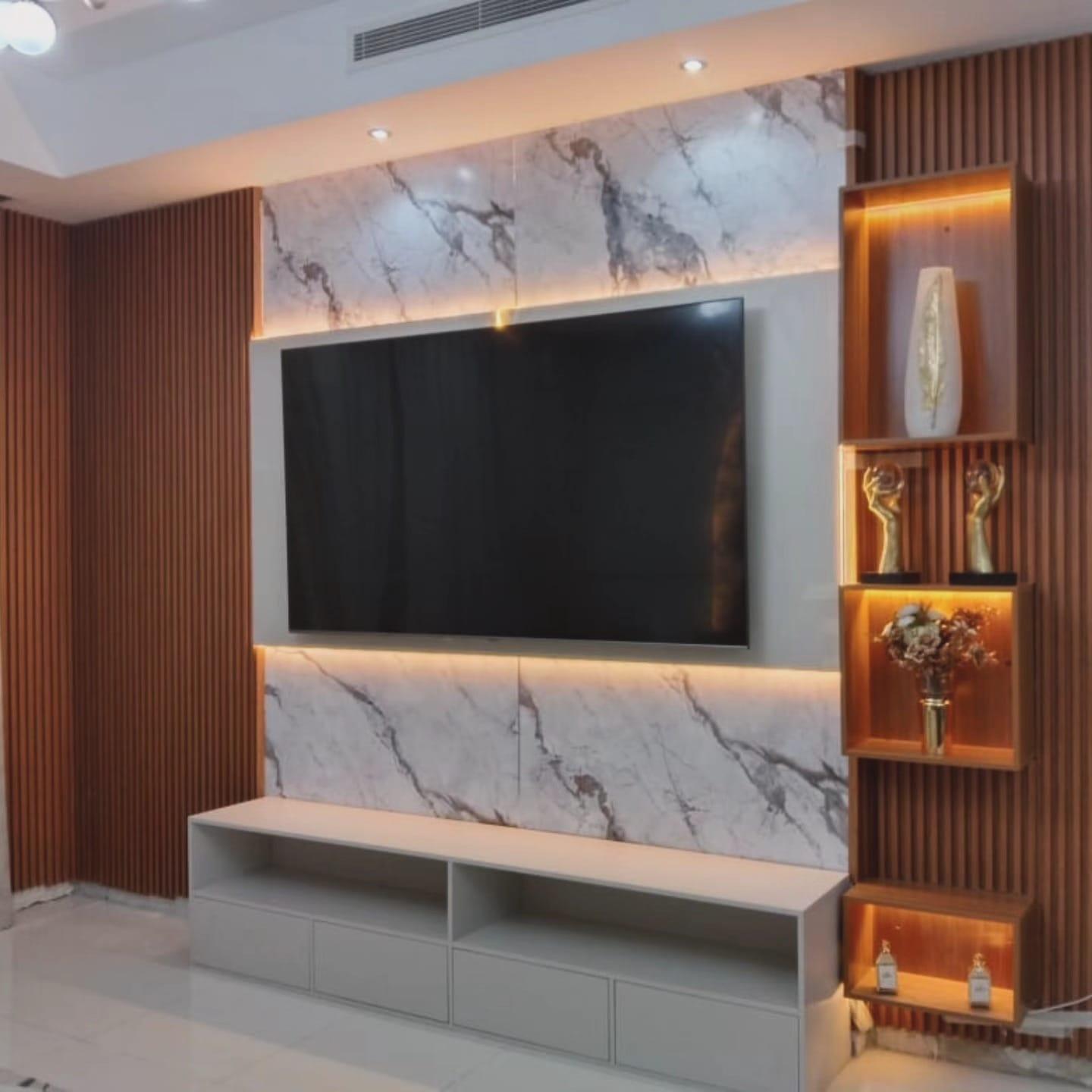
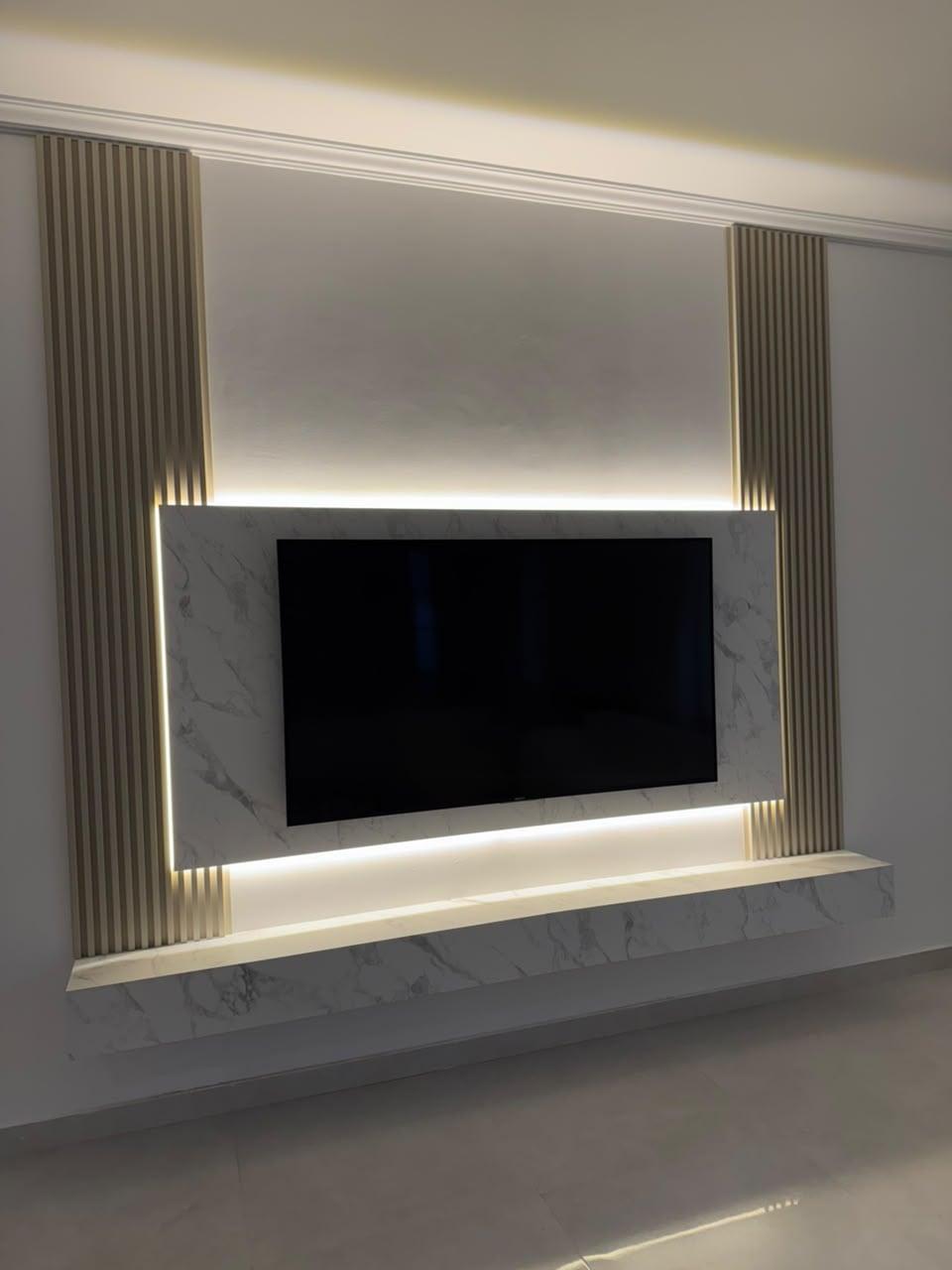
If you cannot decide, order samples of two, hold them beside the screen position, and view them from the sofa. The photograph below shows a white marble-effect panel with a matching shelf, lit at its edges, a good example of using the stone look on both the panel and a light shelf instead of the whole wall. Combining stone-look with slats? See the slat and gap guide for fluted TV walls.
How we build marble-look TV walls, and questions for every supplier
We fix the face to a frame made in our Sharjah workshop, and the openings for the sockets and the bracket are drawn on the quotation drawing before anything is cut. Then our own installers fit it across the UAE, usually about 10 days from your order confirmation. A free measuring visit comes first, with samples; the priced drawing follows, and a written 24-month workmanship warranty covers the work. Begin with our media wall service, the Sharjah media wall page or our custom media walls.
Before you approve a quotation for any marble-look wall, put these questions to every supplier and get the answers in writing:
- What is the face exactly: stone, porcelain, a printed sheet or laminate, and what is its thickness?
- What is behind it: the board or frame, and how heavy is the finished wall per m²?
- Where do the joints fall, and does the drawing show how the veins meet?
- How is the TV bracket fixed, and is it sized for the next screen?
- Is the face polished, honed or matt, and has the sample been checked beside the screen in daylight?
- What is near the fire or the vents, and what do its maker's clearances say?
- How should it be cleaned, and what must never touch it?
Common questions
Is marble a good choice for a TV wall?
Real marble is heavy, expensive and etches with acids, so it suits small features better than a whole wall. For a full wall, porcelain slab or a marble-effect panel gives the look at a fraction of the weight. Panel cores compared.
How heavy is a marble TV wall?
A 20 mm marble slab is about 54 kg per m², so a 3.0 × 2.7 m wall is roughly 437 kg. A porcelain slab on its board is about 28 kg/m² and a marble-effect panel about 15. Weight, screws and the wall behind.
Can you mount a TV on a marble wall?
Yes, but not on the face. The bracket is fixed to the frame or structure behind, and the face is cut around the plate in the workshop. Planning a media wall.
What is the difference between a marble-effect panel and real marble?
A marble-effect panel is a printed stone pattern on a board, so it is much lighter than stone and usually costs less. Ours are made at our Sharjah workshop. Marble-effect TV backdrops.
How much does a marble TV wall cost?
Our media walls start from AED 3,500 per project for a compact laminate panel and console; a marble-effect or porcelain face is a separate line from the drawing. Media wall price in the UAE.
Is polished or matt better behind a TV?
Matt or honed. A polished face mirrors windows and lights onto the screen, so keep gloss to a shelf or console top. Media wall materials and specification.

Sources & specifications
Manufacturer information applies to the named products and systems. Sources reviewed on 28 October 2026.
- Engineering ToolBox: densities of solids (marble 2,600–2,800 kg/m³)engineeringtoolbox.com(opens in a new tab)
- Neolith: slab thicknesses and weights (3, 6, 12 and 20 mm), and wall cladding in 3 and 6 mmneolith.com(opens in a new tab)
- Laminam: sizes and thicknesses (versions for vertical wall cladding, slab formats)laminam.com(opens in a new tab)
- Slabwise: how to care for marble (etching versus staining, sealing, polished versus honed)slabwise.com(opens in a new tab)
- TileBar: thin porcelain slabs (6 to 12 mm, fewer seams)tilebar.com(opens in a new tab)
Want this planned for your home?
Consultation and measurement are free. Tell us the rooms, location and what you need; we arrange a sample visit and define the measured quotation.