Media Walls · 15 min read · 24 May 2026
What is a media wall? Media wall vs TV unit vs TV stand
A media wall is a wall built around the TV, not furniture in front of it. What it is, how it differs from a TV unit or stand, and which one suits your home.

By Ali Haider Basra, Founder, Al Tareeq Decor · Contact our workshop
Key takeaways
- A media wall is a wall built around the TV, with panel, unit, lighting and storage made as one fixed piece; a TV stand is furniture that stands in front of the wall.
- Choose the stand if you rent or move often, a floating unit for a clear floor and tidy cables, and a media wall when you will stay and have a lot to store.
- The TV on a stand sits low: a 65-inch screen on a 45 cm stand has its centre at about 85–90 cm, under the 105–110 cm eye level that suits most sofas.
- Only a media wall can hide cables completely, and it must still leave a service panel so a lead can be changed without cutting the wall.
- Our media walls start from AED 3,500 per project for a compact panel and floating console, and take about 10 days from confirmation.
On this page
- Key takeaways
- What is a media wall? The short answer
- TV stand, TV unit, console, floating unit and media wall: what each name means
- The five options at a glance
- The same wall as a stand, a floating unit and a media wall
- TV on the wall or on a stand: the question under the question
- Cables and dust: what each option leaves on show
- Storage: how much each really holds
- Renting, moving house and the wall behind the TV
- What each one costs to live with
- Which one should you choose? A decision table
- Media wall, floating unit or stand: our recommendation by situation
- The middle way: a panel, a floating unit and one tall cabinet
- How to decide at the free visit, and what we need from you
- Common questions
What is a media wall? The short answer
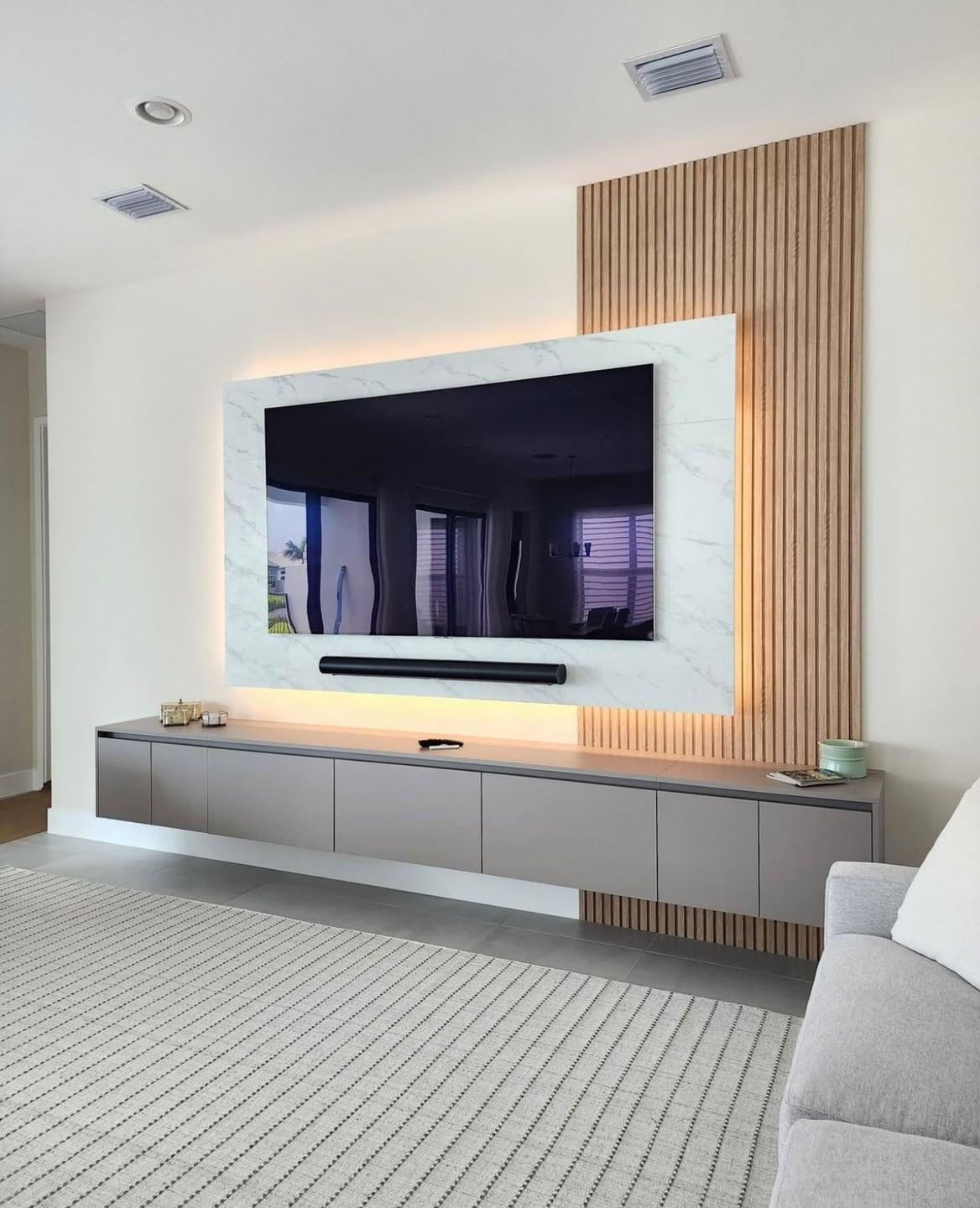
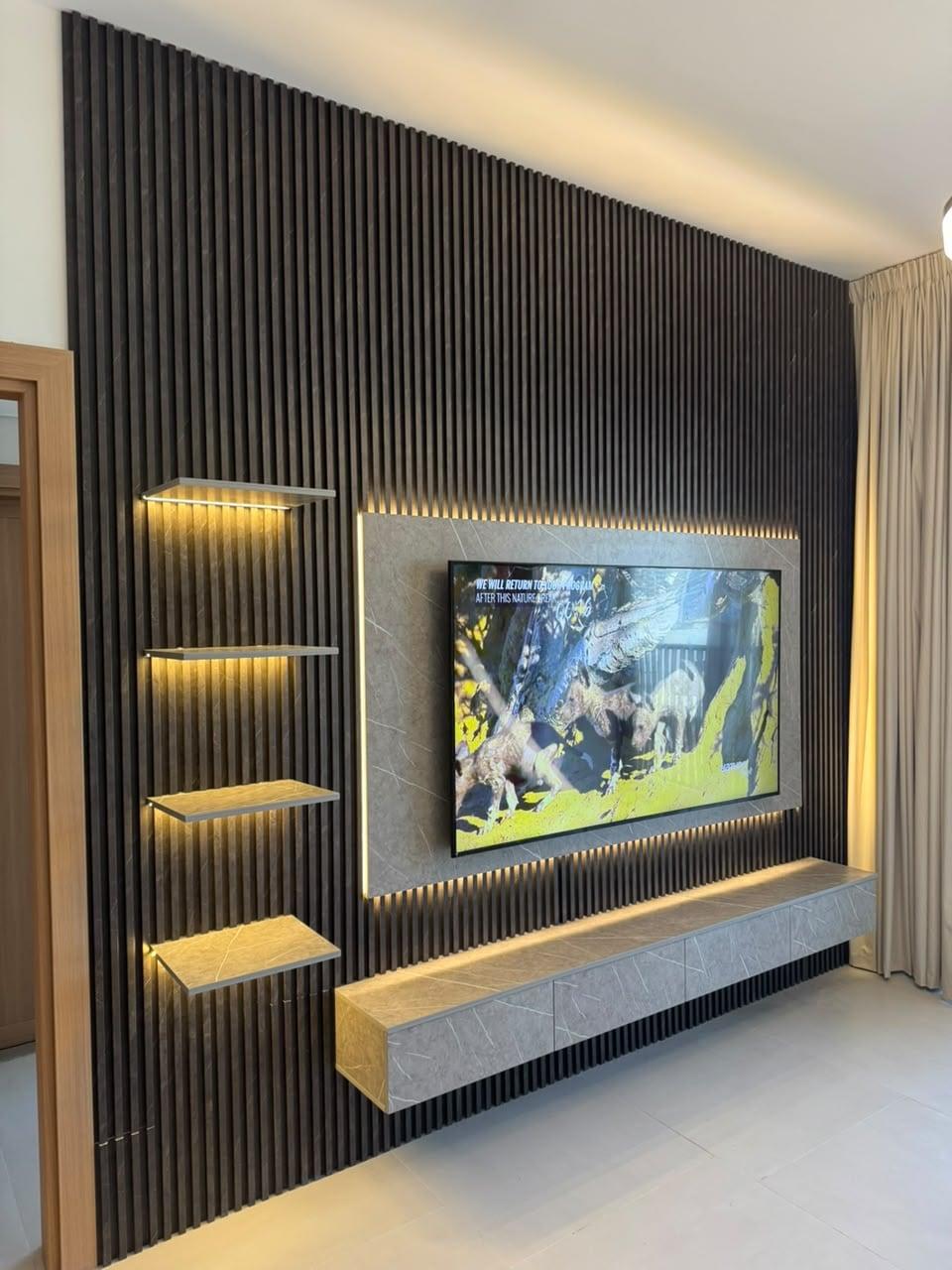
A media wall is a wall built or fitted around the television, so that the screen, its storage, its cables and usually its lighting are planned as one piece of work instead of a TV plus a piece of furniture. The panel behind the screen, the cabinet or console under it and any shelves or tall units beside it are made to the measurements of that one wall and fixed to it. A TV stand is the opposite: furniture that you buy, carry in and push against the wall. Media wall lighting ideas shows the layers of light such a wall can carry.
The word is used loosely, which is why people keep asking about it. Some shops call any wall-hung TV a media wall, and others use "media unit" for a long cabinet. Furniture guides draw the line by structure. One low unit beneath the screen is a stand or a console; a system that surrounds the screen, with a fixed opening for it and cabinets or shelves at the sides and above, is a wall unit or an entertainment centre. In this guide a media wall means that second kind: made to measure, fixed in place and built around the screen.
In our workshop it runs from a compact panel with a floating console, which starts from AED 3,500 per project, to joinery that fills a whole wall. Our guide to planning a media wall takes you through the design. This one answers the question before it: do you need a media wall at all, or would a stand or a floating unit do the job?
TV stand, TV unit, console, floating unit and media wall: what each name means
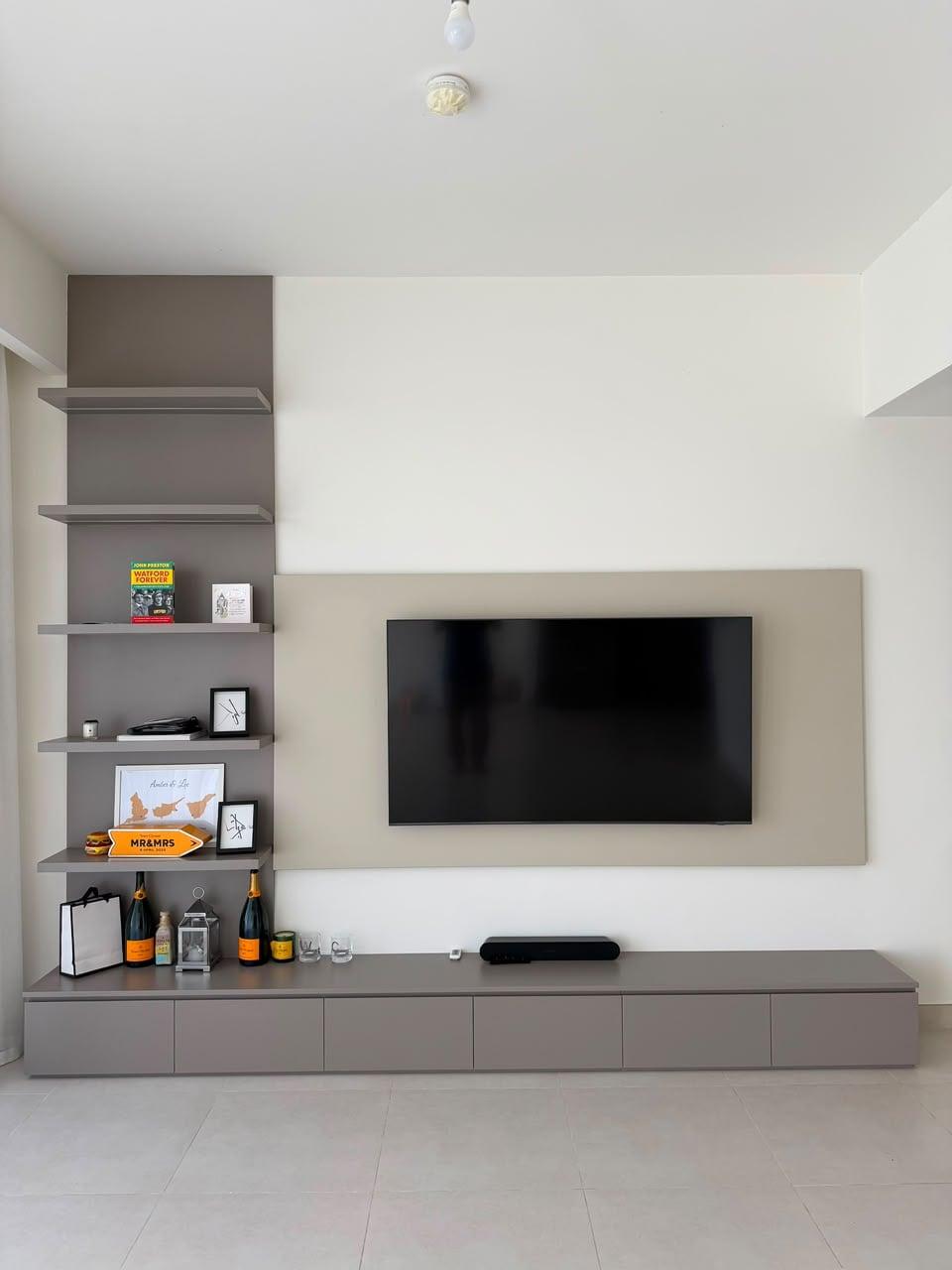
A TV stand is the simplest of the five: one low piece of furniture with the TV standing on it, or with a bracket on the wall above it. It may have open shelves, a few drawers or doors. It comes in a standard size, goes into the room in one trip, and leaves with you when you move.
A TV unit or TV cabinet usually means a stand with closed storage, doors and drawers that hide the box, the games and the cables. A media console is the same long, low shape, and shops use the two names for the same thing. When the unit is made to measure for one room, the difference from a stand is less about the name than about the fit: it takes the whole width you give it, to the millimetre.
A floating unit is hung from the wall, so the floor runs on beneath it. It is a cabinet in the same family, but it is fixed, so it behaves more like part of the room than like furniture. The media wall goes one step further: the panel, the unit, the light and the tall cabinets are all fixed, and they all belong to one drawing.
The five options at a glance
TV stand
- What it is
- One low freestanding unit, often open shelves
- Fixed to the wall?
- No (the TV may be bracketed)
- Made to measure?
- No, standard sizes
- Usually found in
- Rented flats, bedrooms, rooms that change
TV unit or cabinet
- What it is
- A stand with closed doors and drawers
- Fixed to the wall?
- No
- Made to measure?
- Sometimes
- Usually found in
- Family rooms that need things hidden
Media console
- What it is
- A long, low cabinet; the same shape as a stand
- Fixed to the wall?
- No
- Made to measure?
- Sometimes
- Usually found in
- Living rooms of any size
Floating unit
- What it is
- A cabinet hung from the wall, floor clear below
- Fixed to the wall?
- Yes
- Made to measure?
- Usually
- Usually found in
- Owned flats and villas
Media wall
- What it is
- Panel, unit, lighting and tall cabinets built as one
- Fixed to the wall?
- Yes, wall-to-wall in some cases
- Made to measure?
- Always
- Usually found in
- Homes you plan to keep
Furniture guides use these names loosely; we separate them by how they are built. Povison, a furniture maker, draws the same line between a single low unit and a system around the screen.
The same wall as a stand, a floating unit and a media wall
The drawing below puts one 65-inch TV on one 4 m living-room wall and changes only what is around it. Watch what moves: the screen rises from stand height to eye level, the leads that hang down the wall disappear, a robot vacuum passes under the floating unit, and in the last stage cabinets slide in at both sides and the LED comes on. A scoreboard refills for each option as it goes.
The scores are our own judgement, not a measurement. They come from the way these walls behave in a UAE flat or villa: cables, how much each option holds, how easily you can change it, and what it costs to build. A stand wins on flexibility and price, a media wall wins on cables and storage, and the floating unit sits between them. No option wins on everything, which is why the rest of this guide asks what you need, not which is best.
- 1. TV stand: the screen sits low, the leads show, and it is the easiest to move or replace
- 2. Floating unit: the screen at eye level, a short covered cable run and a floor that is easy to clean
- 3. Full media wall: cables hidden, storage floor to ceiling, and fixed to the wall for years
- 4. The pips: 5 is best, so a stand scores 5 for low cost while a media wall scores 5 for tidy cables and storage
TV on the wall or on a stand: the question under the question
Most people who ask "media wall or TV stand?" are really asking two separate things. The first is where the screen lives: on the wall on a bracket, or standing on a piece of furniture. The second is what surrounds it: nothing, a unit, or a whole wall of joinery. You can mix the answers. A bracket-mounted TV above a long unit is the commonest hybrid, and it is already half of a media wall.
TCL's guide to the first question lists the trade-offs plainly. A stand is easy to move and rearrange, needs no drilling and often has storage and cable management built in; but it uses floor space and fixes the viewing angle, since you cannot tilt the screen without moving the whole piece. A wall mount frees the floor, lets you set the angle and height, and holds the TV securely, which helps in homes with children or pets; but it needs drilling, and moving it later is harder.
Height is the part people underestimate. Stand a 65-inch TV on a 45 cm stand and the screen's centre lands near 85–90 cm above the floor, well under the 105–110 cm that suits most sofas. Our guide to TV height on a media wall explains the eye-level rule. If you keep the stand, tilting the picture up a little or choosing a taller unit closes some of the gap; if you want the screen exactly at eye level, the wall bracket is the cleaner answer. The short video below walks through the same trade-offs.
Cables and dust: what each option leaves on show
On a stand the leads usually hang down the wall behind the unit to a socket low on the wall. From the sofa you may not see them, but anyone walking past at an angle does, and every new device adds another loop. A stand also gives dust a long flat shelf. The fine dust of a UAE home settles on open shelves first, so the cleaning job is the shelves, the top, and the gap behind where the lead bundle gathers fluff.
A floating unit shortens the visible run. The TV bracket takes the screen off the unit, a slim cover runs from the screen to the unit's top, and the unit hides the box and the plugs. The floor underneath is open, so a mop or a robot vacuum passes straight through; leave a gap of at least 10 cm, which is what we draw as standard. Cables are tidy rather than invisible: they are still on the wall, just covered.
A media wall is the only option in which cables can leave the room's sight entirely. The leads run inside the panel in conduit from the screen to a cabinet, and they are meant to come out again: a service panel or an accessible cabinet lets you replace a lead without cutting the wall. Hidden and unreachable are different things, so media wall cable planning goes through conduit sizes, power and signal separation and where the service panel goes. Glass-fronted or closed doors on the surrounding cabinets also keep dust off what you display.
Storage: how much each really holds
Count before you choose. List what has to live near the TV: the receiver or set-top box, the games console and its controllers, a soundbar, the router, remote controls, chargers, and anything you want to display. If the list fits on one shelf, you do not need a wall of storage, and a stand or a floating unit is the honest answer. If it fills a box you currently keep in a cupboard elsewhere, a media wall pays for itself in tidiness.
A stand holds what its shelves hold, and the rest spills onto the floor or into other furniture. A floating unit gives one run of drawers, typically 35–45 cm deep, which is enough for devices and a row of everyday things. A media wall adds the tall units at the sides and the shelves above, which is where books, photographs, a speaker or a lit display piece belong. FCI London, which makes fitted joinery in Britain, advises that for screens above 60 inches the unit should run 15–20 cm past each side of the TV at least, and on a media wall that spare width comes with the design.
The video below compares an entertainment centre with a TV stand on design space, storage, flexibility, cable management and cost, which are the same five questions this guide asks. Our own answer to "how much storage?" is in full-wall or compact media wall.
Renting, moving house and the wall behind the TV
The wall's construction decides what you can do. A TV bracket and a floating unit have to be fixed into something that can carry them: a block or concrete wall takes anchors directly, while a lighter partition needs the load carried by a backing board or by fixings to the structure behind it. We agree the fixing method with you at the visit and put it in the drawing, so the weight of the TV and the unit is never left to a plug in plasterboard. If you want a stone look, marble TV wall options covers the weight each face adds to the wall.
If you rent, ask before you fix anything. Drilling, and joinery that is fixed to a wall, usually need permission from the owner or the building management, and some buildings have working-hours or access rules for fit-out. A stand needs none of this, which is why it is the sensible choice for a short lease. With a long lease and permission in writing, a floating unit or a compact media wall becomes reasonable, because you will live with it for years.
On moving day the stand goes into the van and the media wall mostly stays. A compact panel and unit can sometimes be unscrewed, but it is cut for one wall, and the fixings leave marks that need making good. Think of a media wall as part of the home, like a fitted wardrobe or a kitchen. If you own the home and expect to stay a few years or more, that is a benefit: it stays with the property. If you may leave within two years, the stand is cheaper and easier to take away. The same applies to wardrobes: fitted, built-in or freestanding wardrobes explains which stay and which go.
What each one costs to live with
The price tag is only the first number. A stand costs what the shop charges, which varies widely with size, material and brand, and we leave those figures to the shops. Add the cable covers and cable ties you buy to tidy it, the repainting if you later take a bracket down, and the replacement when you move to a room it does not fit.
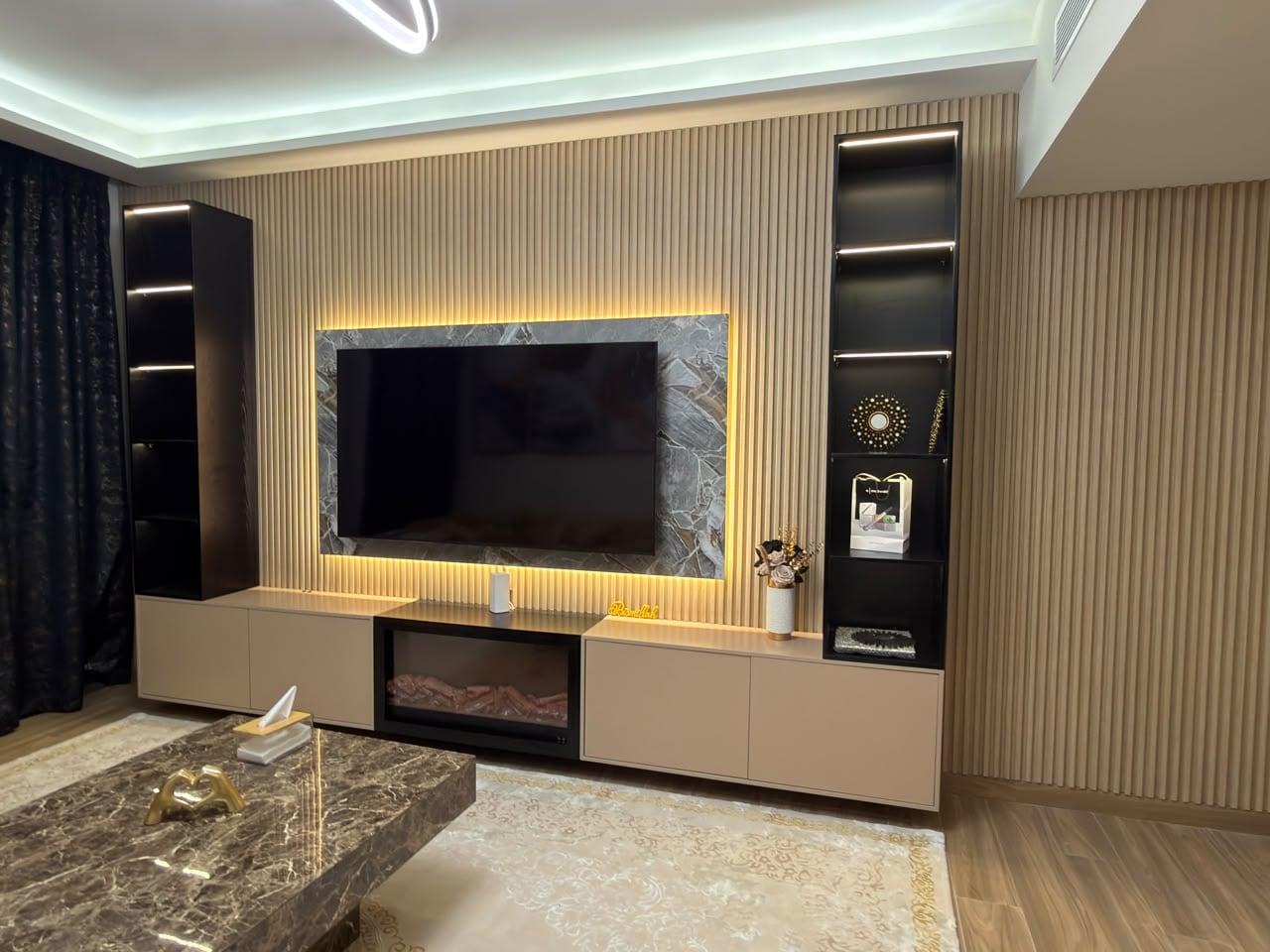
A floating unit costs more than a stand of the same size because it is a cabinet that carries its own weight on the wall, and it is usually made to measure. A media wall costs more again, because it is joinery, lighting and electrical work for one wall. Ours start from AED 3,500 per project for a compact panel with a floating console in standard laminate; larger walls, veneer or lacquer, marble-effect panels, lighting and built-in fireplaces move the figure, and the media wall price guide shows by how much. A typical wall is finished in about 10 days from your confirmation, and the workmanship is covered by our 24-month written warranty.
For a yearly cost, divide the price by the number of years you keep the piece. At the entry price, a compact media wall kept for eight years works out at about AED 440 a year, before upgrades. A stand that you replace every three years in rentals is cheaper to buy but not cheaper to keep. The comparison tips towards the media wall as the years you stay increase, and towards the stand as they shrink. The panel material also changes the bill and how the wall ages; MDF, WPC, PVC or wood compares them.
Which one should you choose? A decision table
Start from your situation, not the photograph. The table below gives a direct answer for the ten situations we hear most. If the table says "floating unit" and your wall is a light partition, settle the fixing method first. Media wall design ideas shows finished layouts for each situation.
Media wall, floating unit or stand: our recommendation by situation
Renting on a short lease
- Choose
- TV stand
- Why
- No drilling, and it leaves with you
Renting long-term, with written permission
- Choose
- Floating unit
- Why
- The floor stays clear, and little is lost if you leave
Owning a flat with a small living room
- Choose
- Compact media wall
- Why
- A framed panel and one unit keep the walking route open
Owning a villa living room
- Choose
- Full media wall
- Why
- A large wall carries more storage and lighting than a unit can
A majlis with seating on several sides
- Choose
- Compact panel, matte
- Why
- The wall must look good with the screen off
Young children or pets
- Choose
- Wall-mounted TV on a unit
- Why
- A fixed screen cannot be pulled over
You change the TV every few years
- Choose
- Panel with a margin
- Why
- A wider panel takes the next size; see the TV-change guide
A lot to store near the TV
- Choose
- Media wall with tall units
- Why
- Closed storage hides it and keeps dust off
Very little to store
- Choose
- Floating unit or stand
- Why
- A wall of storage you will not fill is wasted money
You may move within two years
- Choose
- TV stand
- Why
- Cheapest to take with you
These are our recommendations from the situations we meet; your own measured wall and the TV you buy decide the final design.
The middle way: a panel, a floating unit and one tall cabinet
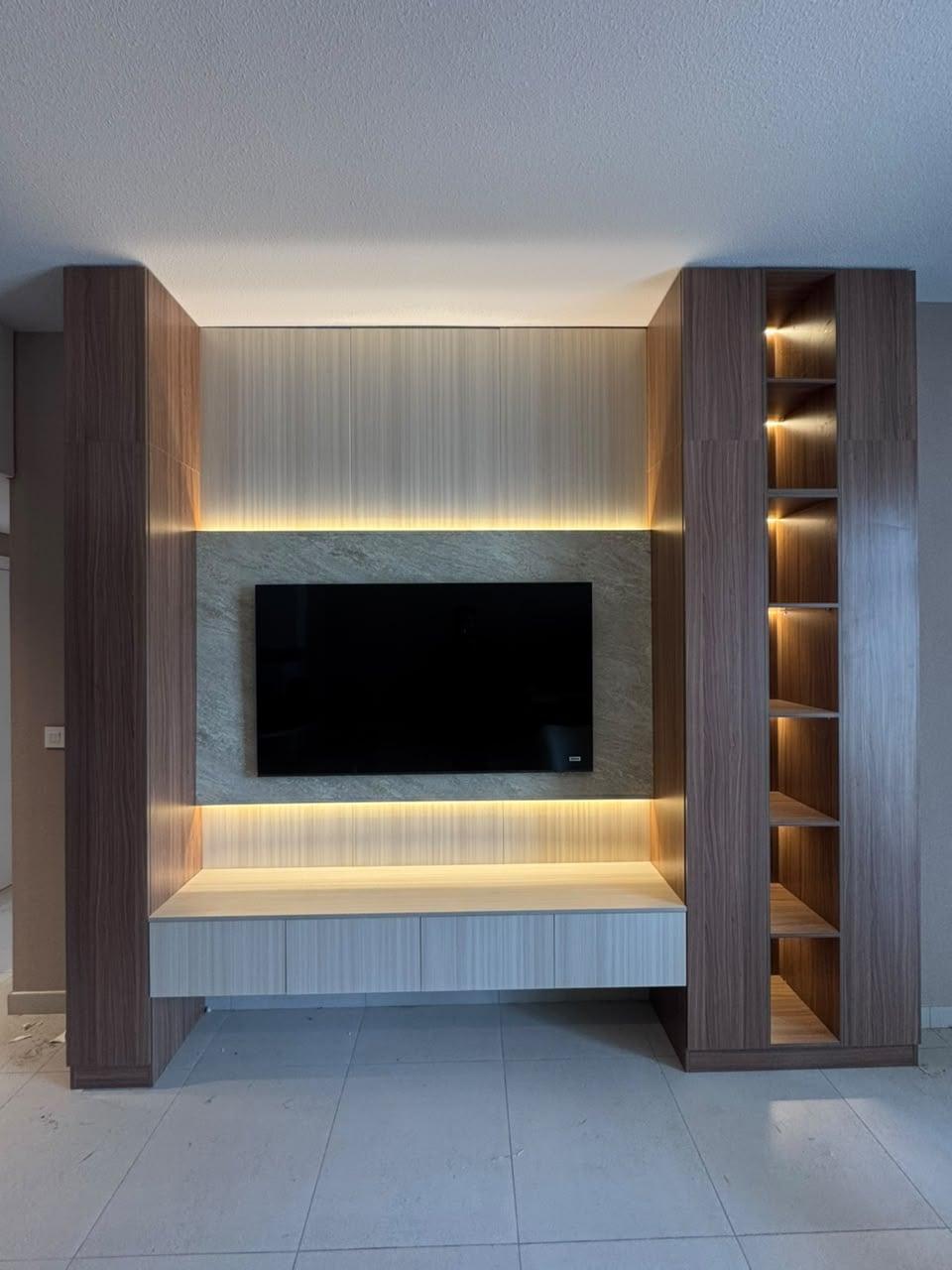
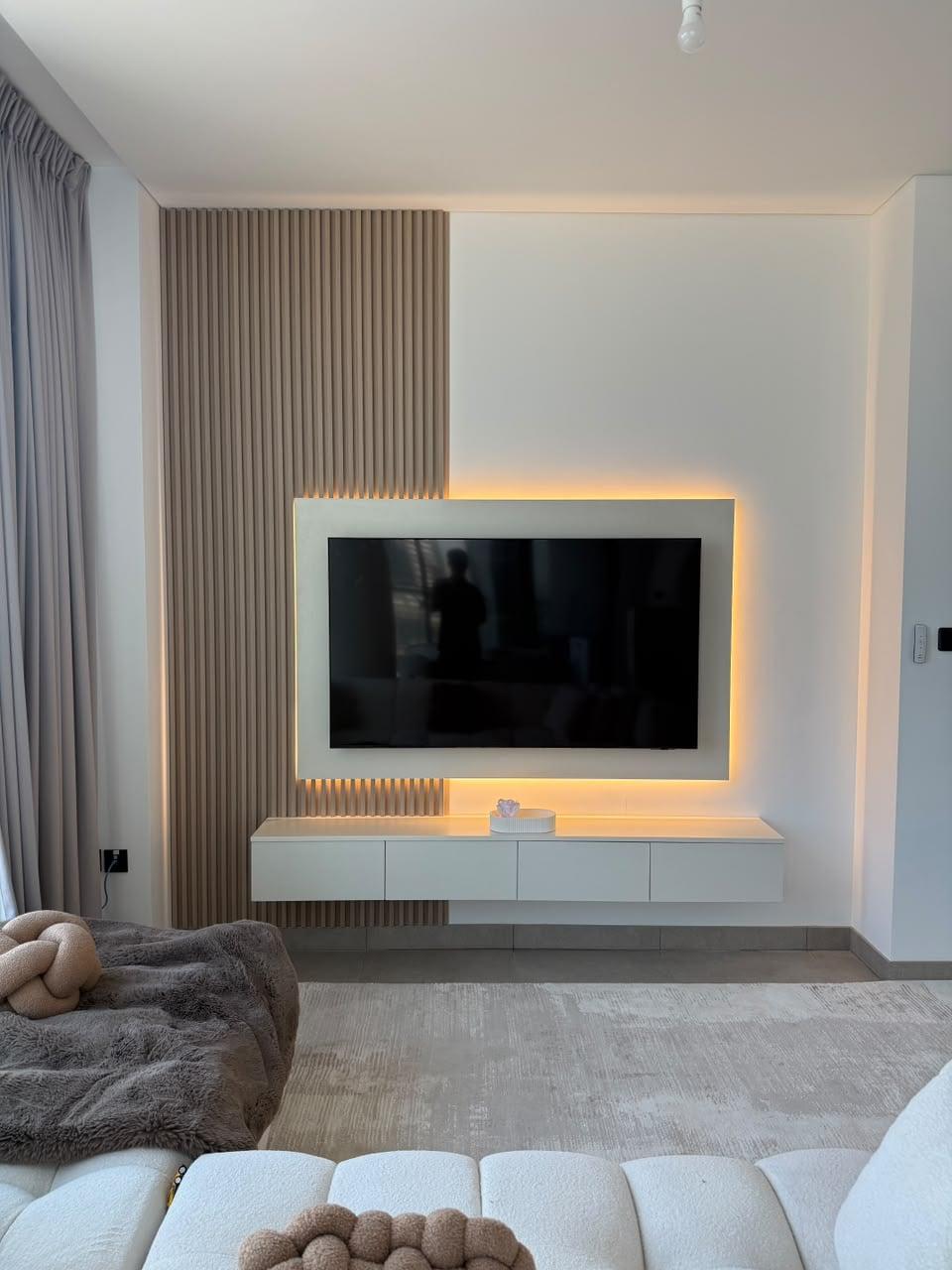
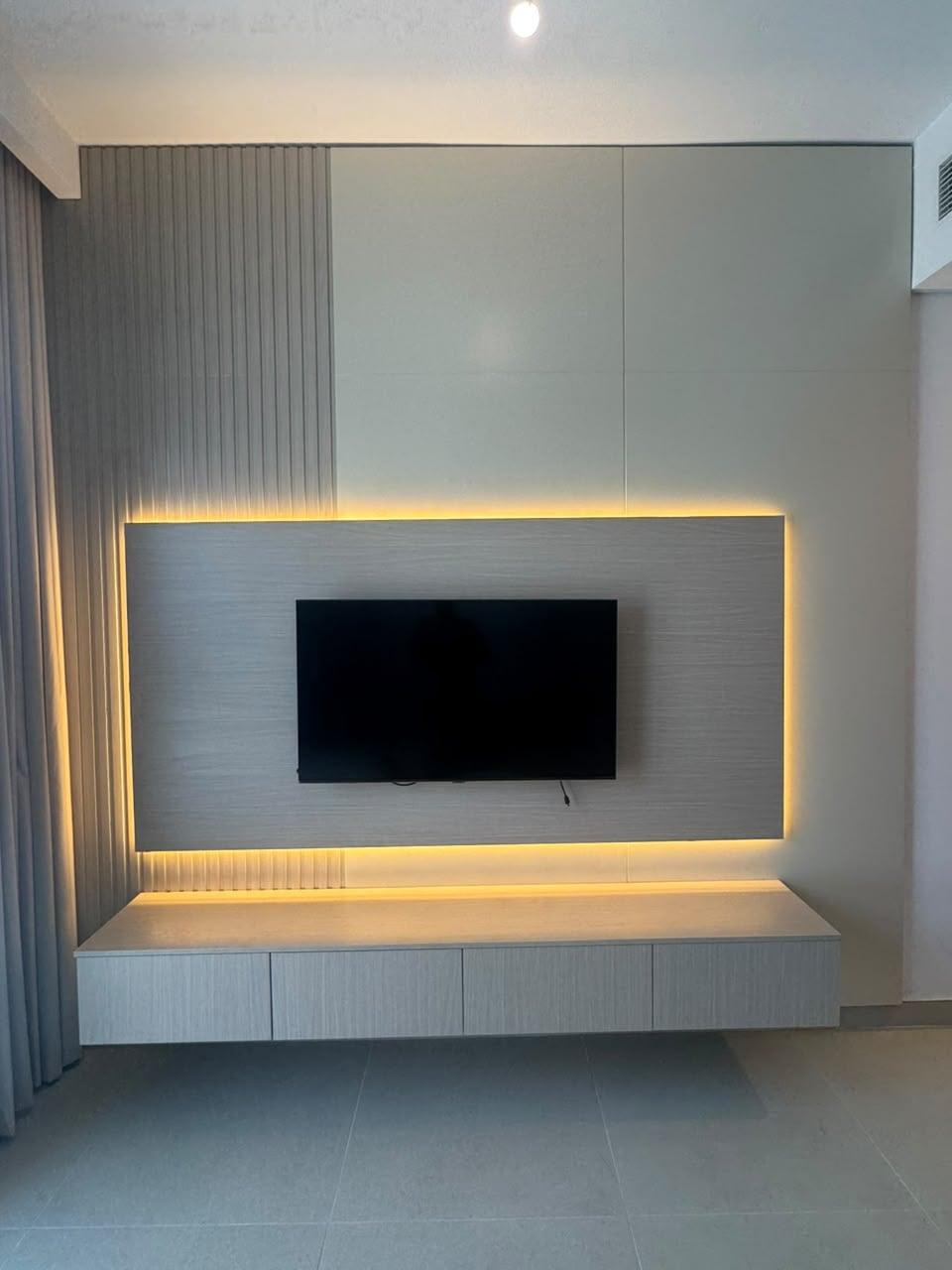
You do not have to choose the whole wall or nothing. The most common media wall we build is the middle one: a framed panel behind the screen, a floating unit under it, and a single tall cabinet or a column of shelves at one side. The panel brings a clean backdrop and hides the cable route; the unit holds the devices; the tall piece takes display and spare storage. Everything else on the wall stays plain.
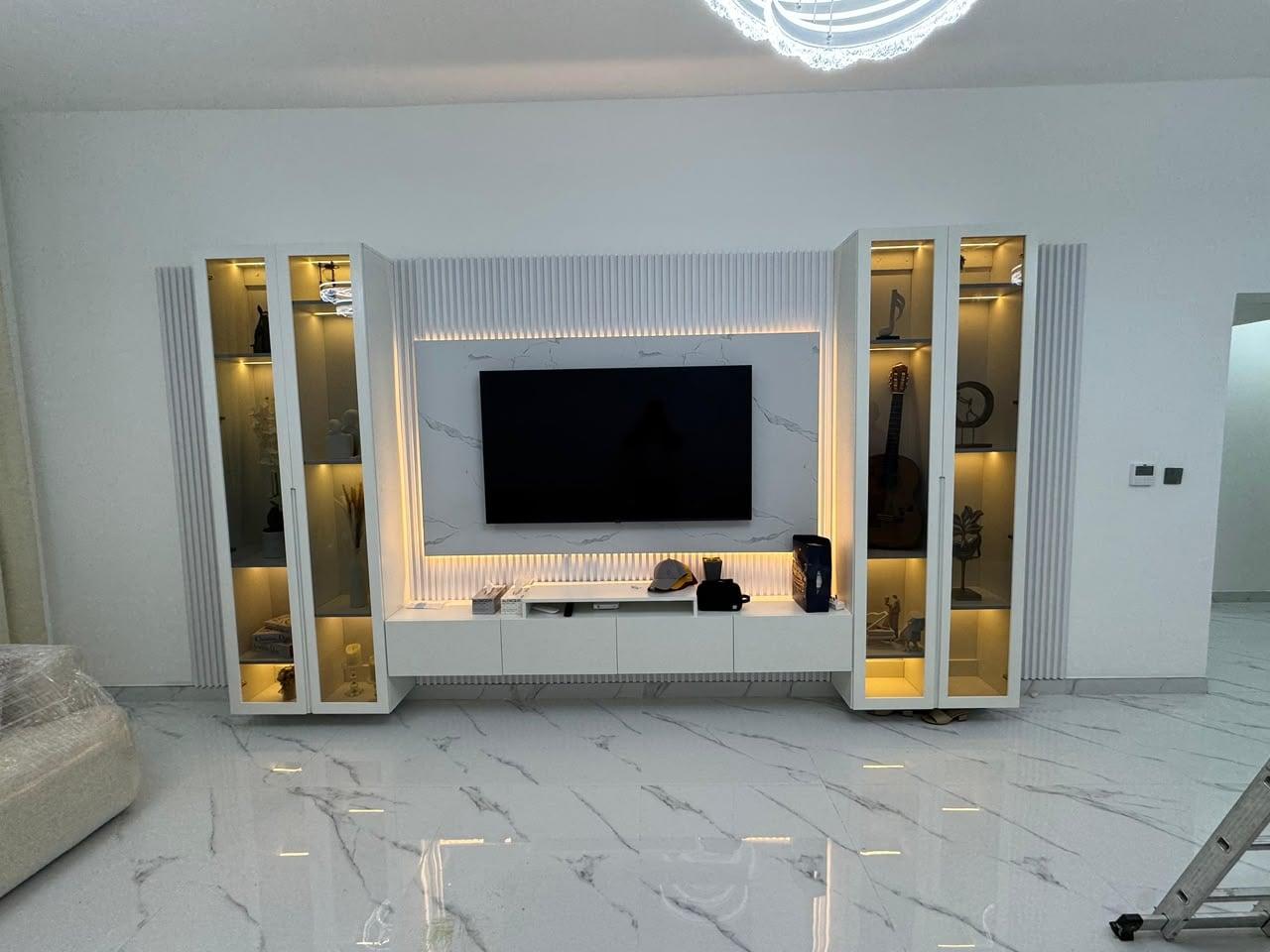
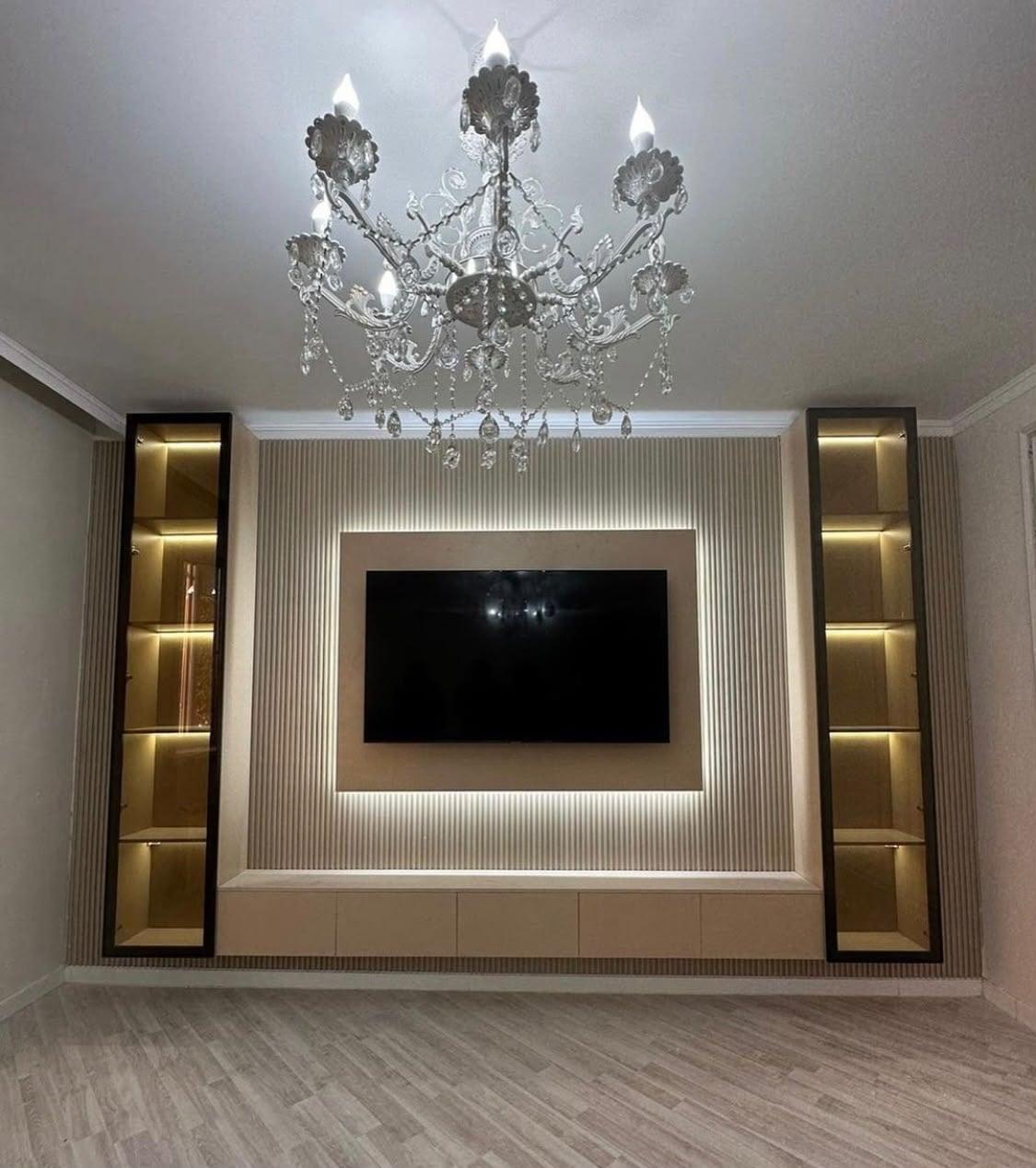
That is why our full-wall or compact media wall guide treats the middle as a design in its own right. It leaves the curtain stack and the walking route free, costs well below a wall-to-wall build, and can still hide cables and take the next TV if the panel has a margin; changing the TV later shows how much spare width to allow. In the photo below, one tall display cabinet at each side and a lit panel turn the same idea into a whole wall.
How to decide at the free visit, and what we need from you
Bring three facts to the visit: how long you expect to stay, what must live near the TV, and the size of the screen you own or will buy. The TV matters because its width, depth and mounting pattern set the panel and the bracket; our guide to buying the TV before the media wall says when to fix the model, and TV size and viewing distance helps you choose it. Sockets and power are covered in media wall sockets and power.
We then measure the wall and the room with a laser at our free home visit, check the fixing, and draw the design to your own dimensions, so you can judge the heights, the widths and the floor gap against your real wall instead of a catalogue photo. Our Sharjah workshop makes the pieces, our own team fits them, and we work across the UAE: see our media wall service, the made-to-measure TV wall units and floating consoles, the larger custom media walls, or media walls in Sharjah.
To save a visit, send photos and rough measurements first; what to send before the consultation lists them. Before you decide, check the answers to these:
- How long you expect to stay in the home, and whether you may fix things to its walls.
- A list of everything that has to live near the TV, with a rough count.
- The size of the TV you own or plan to buy, and the seat it will be watched from.
- The wall's construction, and where the sockets and the curtains are.
- Whether the wall should look good with the screen off, as in a majlis.
Common questions
What is a media wall in a house?
It is a wall built around the TV: a panel behind the screen, a unit below it and often shelves, lighting and cabinets at the sides, made to measure for that wall. The cables run inside it. Planning a media wall.
Is a media wall better than a TV stand?
Only if you will stay and need storage and tidy cables. A stand is cheaper and goes with you when you move, so it wins for rented homes and rooms that change. Full-wall or compact media wall.
What is the difference between a media wall and a TV unit?
A TV unit is one piece of furniture beneath or in front of the TV. A media wall also includes the panel, the lighting and the tall units, and all of it is fixed to the wall. TV wall units and floating consoles.
How much does a media wall cost compared with a stand?
Ours start from AED 3,500 per project for a compact panel and floating console in standard laminate, and larger walls cost more. A stand costs what the shop charges. Media wall price guide.
Can I take a media wall with me when I move?
Mostly not. It is cut for one wall and fixed to it, so it stays with the home; a stand goes with you when you leave. Think of it as fitted furniture, like a wardrobe. Our media wall service.
Should the TV go on the wall or on a stand?
On the wall if you want the centre of the screen at about 105–110 cm, the floor clear and a safe set-up around children. A stand puts the screen lower. TV height on a media wall.
Does a media wall hide all the cables?
It can, if the leads run in conduit to a service panel or cabinet you can open. Hidden should never mean unreachable. Media wall cable planning.

Sources & specifications
Manufacturer information applies to the named products and systems. Sources reviewed on 28 October 2026.
- TCL: TV stand vs wall mount, which is best for your space? (trade-offs of each, children and pets, drilling)tcl.com(opens in a new tab)
- Povison: TV stand vs entertainment centre (a single low unit compared with a system around the screen)povison.com(opens in a new tab)
- FCI London: media unit design ideas (unit width beyond the screen, cable management and ventilation)fcilondon.co.uk(opens in a new tab)
Want this planned for your home?
Consultation and measurement are free. Tell us the rooms, location and what you need; we arrange a sample visit and define the measured quotation.