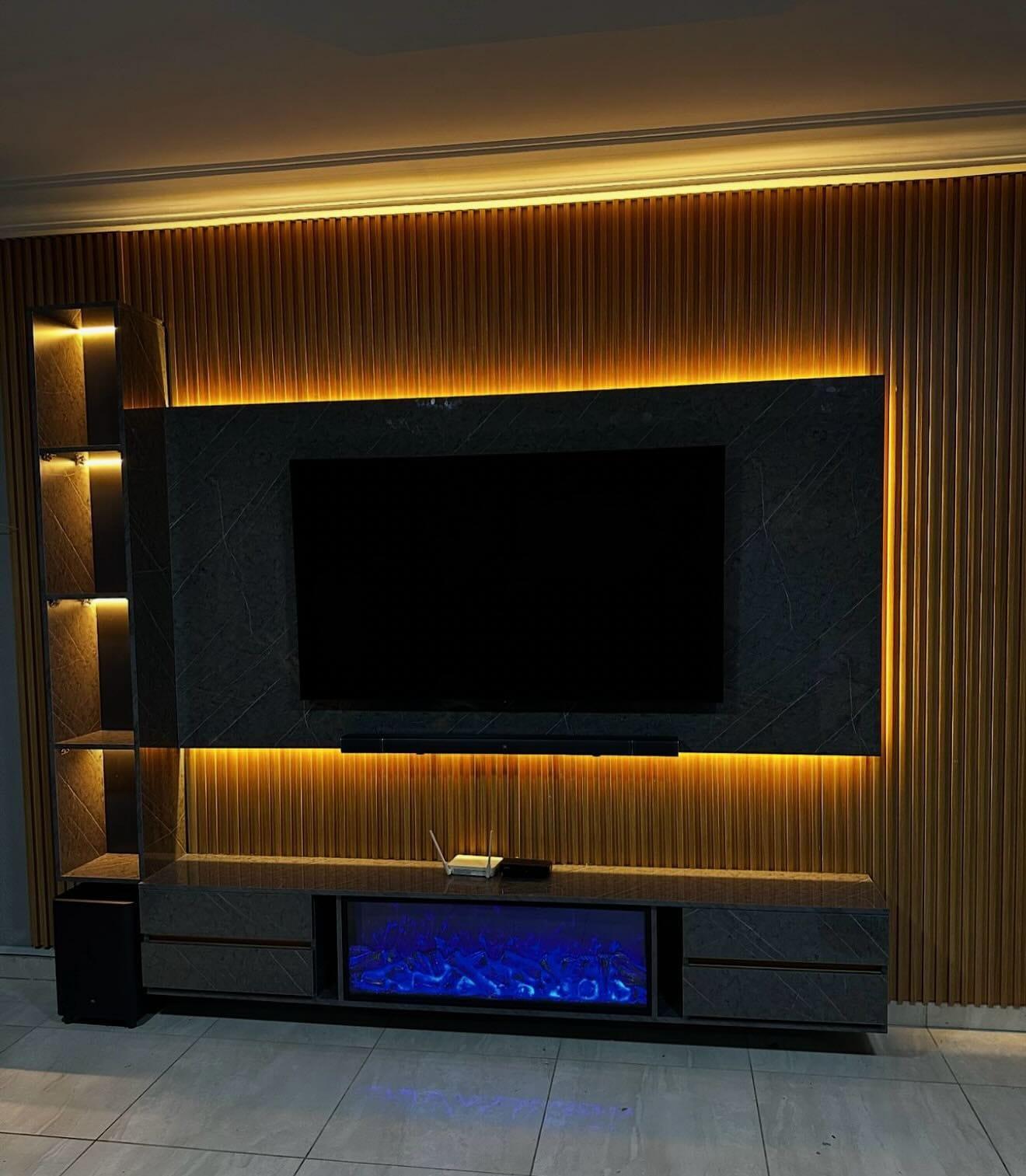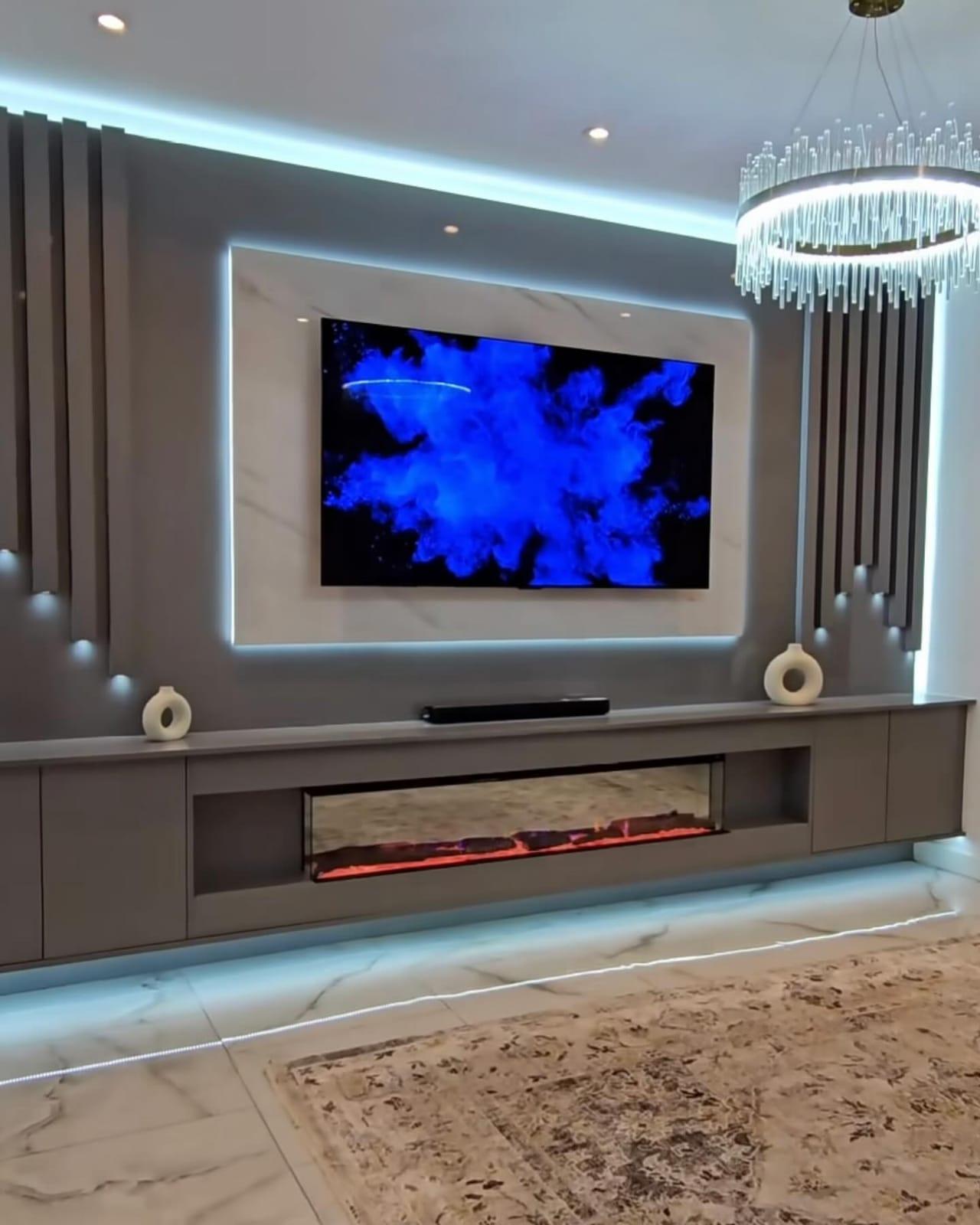
Media Walls · 15 min read · 26 March 2026
Should I buy the TV before ordering the media wall?
Yes, or at least decide the exact model. The visit and the first layout can happen without a TV, but the final drawing, the bracket position and the openings around the screen all come from one specific set.

By Ali Haider Basra, Founder, Al Tareeq Decor · Contact our workshop
Key takeaways
- Buy the TV before you approve the media wall drawing, or at least pin down its exact model number; a screen size on its own is not enough to draw from.
- Two 65-inch TVs from the same model year can differ by almost 2 cm in width, 2 cm in depth, about 6 kg in weight and in their mounting pattern.
- The free visit, measurement and first layout can go ahead before you buy; only the final drawing has to wait for the model.
- Choose the soundbar and any electric fire at the same stage, because each one sets a gap, an opening or a socket in the wall.
- Keep the new TV boxed in another room until fitting day; our own team hangs it once the panels are finished.
On this page
- Key takeaways
- The short answer
- What a model number tells the workshop
- What each line of the TV's specification decides
- Two 65-inch TVs, two different walls
- The bracket decides where the screen ends up
- Slim brackets, recesses and depth
- If you are not ready to buy yet
- When we need the TV details
- What we need from the TV, stage by stage
- Choose the soundbar and fire at the same time
- Bought early? Look after the TV until fitting day
- Fitting day: hanging the TV on the finished wall
- If the TV changes after the drawing is approved
- Where to go next
- Common questions
The short answer
Yes, if you can. Buying the television before you approve the media wall drawing is the simplest way to make the wall fit it exactly. If buying now is not practical, the next best thing is to settle on the precise model number, write it down and stick to it. What works badly is a wall drawn around 'a 65-inch TV', with the set chosen afterwards.
The reason is that a media wall is built around physical facts only a particular model can supply: its outside dimensions without the stand, its depth, its weight, the spacing and position of the holes on its back, and where its cables come out. Every one of those touches something the workshop cuts or fixes, from the board that frames the screen to the place where the wall behind it is reinforced.
The TV does not have to be in the room for the first visit, which is free; the model starts to matter at the final drawing, the version the workshop builds from.
If the TV you plan to use is already at home, you are in the best position of all. Show it to us at the visit: the model number is printed on a label on its back, and we can see its real connections and how its cables leave the casing, which no photograph of the front will tell us.
What a model number tells the workshop
A model number is shorthand for a whole page of measurements. When you send it, we look up the maker's specification and take from it the details the wall depends on. Several of them never appear in a shop's headline description, which usually stops at screen size, resolution and panel type.
Each line of that specification answers a different design question. Width and height without the stand set the size of the board or opening around the screen. Depth, together with the bracket, decides how far the screen stands off the panel. Weight decides how strong the bracket and backing must be. The mounting pattern fixes where the bracket goes, and so where the reinforcement sits. The connection layout shows which way the cables leave the set.
The figures are on the maker's own website, usually in the specifications under a heading such as dimensions or general. Look for the values given without the stand. Some retail listings quote only the measurements with the stand, which add the height of the feet and the depth of the base and are no use for a wall.
Keep the table below beside you when you compare televisions in a shop or online.
What each line of the TV's specification decides
Width and height without stand
- What it decides in the wall
- The board, frame or opening around the screen, and the border you see
- If it is only guessed
- The border looks uneven, or the set overhangs an opening cut too small
Depth without stand
- What it decides in the wall
- How far the screen sits off the panel, and whether a slim bracket is possible
- If it is only guessed
- The screen stands further out than drawn, or a plug has no room behind it
Weight without stand
- What it decides in the wall
- The bracket rating and how the backing behind the panel is built
- If it is only guessed
- Backing designed for a lighter set has to be rethought
Mounting (VESA) pattern
- What it decides in the wall
- Where the bracket fixes, and so where the reinforcement goes
- If it is only guessed
- The bracket lands where there is nothing solid behind the panel
Connection layout and any external box
- What it decides in the wall
- The cable exit point, the conduit route and space in the console
- If it is only guessed
- Cables leave on the wrong side, or a separate box has no ventilated home
Box contents
- What it decides in the wall
- Whether a wall mount comes with the TV or one must be chosen
- If it is only guessed
- A bracket is bought twice, or the supplied one is left unused
Take every figure from the maker's specification for the exact model sold in the UAE, not from a similar model or another region's listing.
Two 65-inch TVs, two different walls
To see why a size is not enough, compare two well-known 65-inch televisions from the 2024 model year using their published specifications: LG's OLED65C4 and Samsung's The Frame, model QN65LS03D. Both are sold as 65-inch sets and both have a 64.5-inch visible picture. On a quick sketch they would get the same panel.
On a workshop drawing they would not. The Samsung is 1.8 cm wider and nearly 1 cm taller than the LG, a small gap that still shows when a screen sits inside a tight frame. It is also much slimmer, 2.5 cm deep against 4.6 cm, and almost 6 kg heavier. Their bracket holes follow different VESA patterns, 300 by 200 mm on the LG and 400 by 300 mm on the Samsung, so each would fix to a different area of the wall.
The boxes differ too. Both listings include a slim wall mount from the maker, but only the Samsung comes with a separate One Connect box joined to the screen by a single thin cable, while the LG's inputs are built into the TV itself. One wall needs a ventilated place in the console for that box and a route for its lead, the other needs room behind the screen for several plugs. That is two changes to the drawing before anyone has chosen a finish.
Neither TV is better for a media wall; they simply ask for different walls. The same happens at every screen size, and even between versions of one model sold in different regions, so we ask for the full model number rather than the size.
The bracket decides where the screen ends up
The mounting pattern does more than choose the bracket. Under the VESA standard the four holes must be centred side to side on the back of the screen, but not every part of the standard requires them to be centred top to bottom. On some sets the holes sit nearer the top or bottom of the casing, so the same bracket position on the wall can leave two televisions at slightly different heights.
On a media wall that matters, because the screen's centre line is planned around your seats and the backing that carries the bracket is placed to match. If the model is unknown, the reinforcement either has to cover a large area to be safe, or it is placed for an assumed set and may not suit the one you buy. With the model known, we put the strength exactly where the bracket will fix and check the final centre line on the drawing.
Bracket makers work the same way. Vogel's, for example, matches a mount to a screen's size, width, height, depth and weight rather than its size alone, and Samsung's UAE guidance notes that even the screws change with the set, from M4 on the smallest screens to M8 on sets from 43 to 88 inches. Our separate guide explains how high to hang the screen; the point here is that the model fixes it.
Slim brackets, recesses and depth
If you want the screen to sit very close to the wall, the model decides whether that is possible. Samsung offers a No-Gap wall mount for its QLED and Frame televisions, and a Mini wall mount with a profile of about 0.7 to 1.6 inches, roughly 2 to 4 cm. A standard tilting or swivelling bracket holds the screen further out. Each choice changes how far the TV stands proud of the panel and how much room is left behind it for plugs.
A recess is more sensitive still. When the screen sits in a pocket, the pocket's width, height and depth are drawn around one set. With the model known, the workshop can cut it with exactly the clearance you want; without it, the safe option is a larger opening finished with a separate trim, which is a different look. How recessed designs cope with a future TV is a subject of its own, covered in our article on swapping the TV later.
Decide which look you want before you buy, not after. If a flush, picture-frame effect matters to you, choose a model that supports a slim mount and say so at the visit. If you would rather keep the option of tilting the screen, accept that it will sit further from the wall and let the panel allow for that.
If you are not ready to buy yet
Plenty of people order a media wall while they are still choosing the television, often because they want both finished together or are waiting for a sale or a new model year. That works, as long as the choice is made before the drawing is approved rather than after the panels are cut. While you wait, you can shortlist a style from these TV wall design ideas for UAE living rooms.
The most practical route is a first-choice model and a back-up of the same size. Send us both model numbers. We compare them and, where they differ, draw the wall to suit either: the larger outline for the panel, a backing zone covering both bracket positions and a cable exit that works for both. Whichever is in stock on the day you buy will then fit.
Waiting for a particular sale is a good reason to fix the model early rather than late. Tell us roughly when you expect to buy, so the drawing can be approved for the chosen model while you wait for the price, and the wall and the TV arrive close together.
If two sizes still appeal, tell us that as well. We can measure, talk through the layout and show both outlines, but we will ask you to settle the size before approval. Our article on choosing a screen size from your seating distance helps with that choice. A wall drawn for a size range rather than a model is possible, but it means a wider border, more backing and fewer flush details.
When we need the TV details
The model is not needed on the first day, but it is needed before the workshop starts. The table shows what each stage uses from the television, so you can see how much time you have to decide. If you are gathering photos before the visit, our checklist of what to send before a consultation lists the rest.
From your confirmation, most of our media walls are made and fitted in about 10 days, and bigger or more intricate designs need more time. The window between the final drawing and fitting day is therefore short. If you are ordering online or waiting for a delivery, buy early enough that the TV is at home when the team arrives.
What we need from the TV, stage by stage
Photos and first contact
- What we need about the TV
- The size range you have in mind, and the model if you have one
- If it is still unknown
- Fine; the conversation starts from the room
Free visit and laser measurement
- What we need about the TV
- Size range, the seats, and who uses the room and how
- If it is still unknown
- Fine; the layout can be sketched with outlines
Final drawing for approval
- What we need about the TV
- The exact model number, or two candidate models
- If it is still unknown
- Approval waits, or the wall is drawn for a range with a wider border
Workshop
- What we need about the TV
- Nothing new; the drawing already carries the model
- If it is still unknown
- A change now may mean remaking parts, agreed with you first
Fitting day
- What we need about the TV
- The TV itself, still boxed, at home
- If it is still unknown
- The wall is finished without the screen, so its fit cannot be checked on the day
Timings are typical for our media walls, counted from your confirmation; bigger or more intricate walls need longer.
Choose the soundbar and fire at the same time
The television is rarely the only thing on the wall. A soundbar, a subwoofer and an electric fire each shape the panel and the console as much as the screen does, so the same rule applies to them: choose the model, or at least the type, before the drawing is approved.
Soundbars show why. Sonos asks for its Arc Ultra to sit below the TV with a clear 10 cm or more from the bar's top edge up to the screen, wants both ends kept at least 30 cm from a wall or other obstruction, and says the bar should not be enclosed in a cabinet or a corner. Those three instructions decide the gap under the screen, the width of the clear zone and whether a recess is allowed at all. Another soundbar will have its own figures, and a wireless subwoofer still needs floor space and a socket near where it stands.
Electric fires are stricter. The opening is cut to the firebox, the heater outlet needs its clearances and the power point has to sit where the manual allows. Lumo, a fire maker, tells buyers to choose the exact appliance before construction so the installer works from its current dimensions and instructions. Our fireplace media walls follow the same order, and our article on where the sockets and power points go deals with the electrical side.
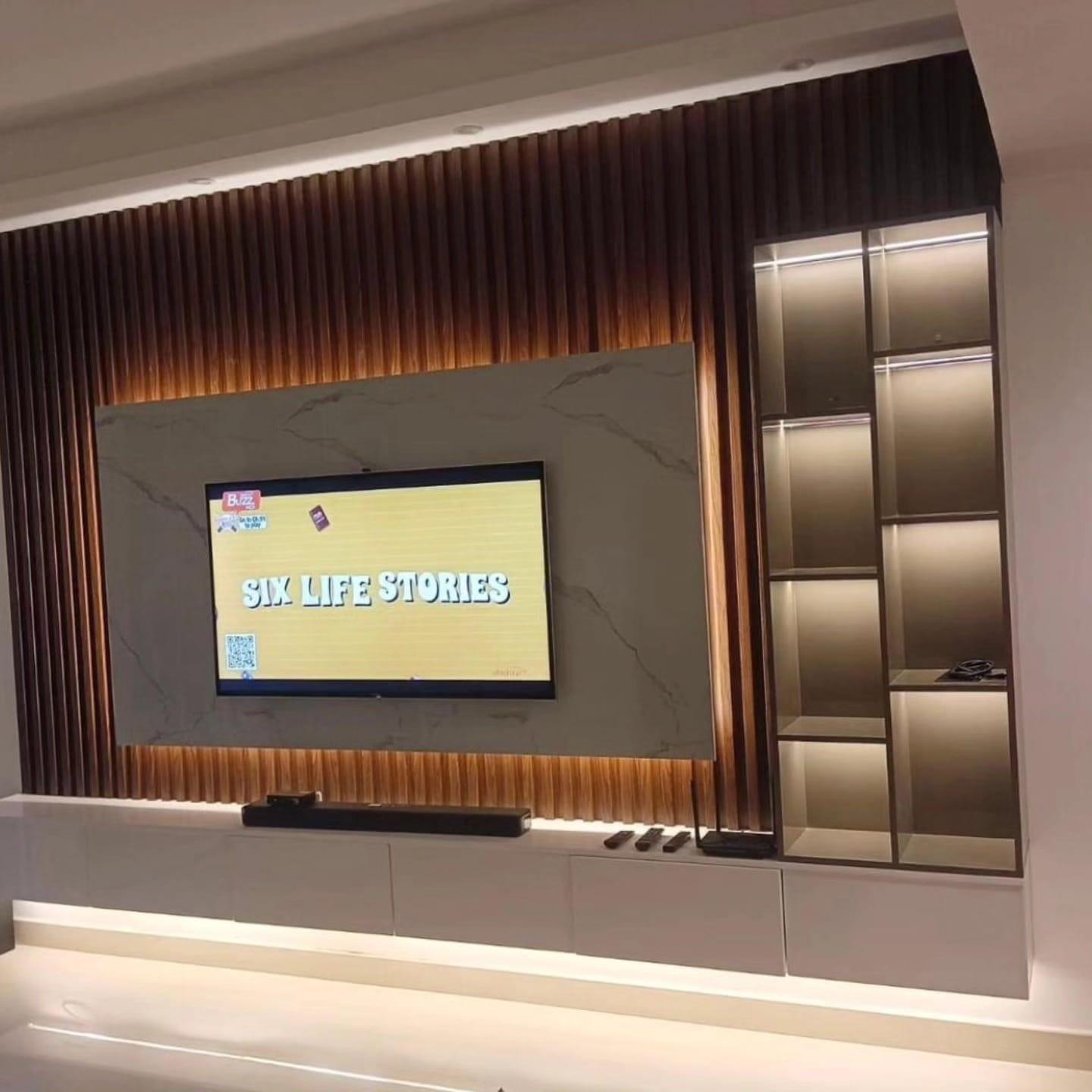
Bought early? Look after the TV until fitting day
Buying early has one small cost: the television has to wait. Leave it in its carton, standing the way the printing on the box shows, in a room away from the work. Cutting, sanding and fixing all make dust, and a large screen leaning against a wall in a busy room is easy to knock.
Resist hanging it on the bare wall in the meantime. A bracket fixed now will almost certainly be in the wrong place once the backing and panels are built, and it would have to come down before work starts. The holes it leaves behind are a minor nuisance; the real risk is moving a large screen twice.
When the TV arrives, check the model number on the carton against the one you sent us, and look at what is inside. If a wall mount, a connection box or special screws are included, keep them together and tell us before fitting day. Keep the manual as well; it holds the clearances and mounting instructions the installer will follow.
Fitting day: hanging the TV on the finished wall
Hanging the screen is the last job of our installation, done by our own team once the panels, console and lighting are in place. Because it goes on last, it is never exposed to the dust of the main work, and it is lined up against the finished panel rather than a pencil mark on bare plaster.
Before the team leaves, look at it from your usual seat. The screen should sit level, with an even border inside its frame if your design has one, and no loose cable visible between the screen and the console. Switch it on and confirm that everything agreed in the scope works, including the soundbar if it was part of the job.
File the TV's paperwork with the drawing and the care notes for the wall, and store its table stand with the empty box if you have room. If the set ever needs repair, replacement or a move to another room, those papers show which bracket was used, how the cables run and how the screen comes off safely.
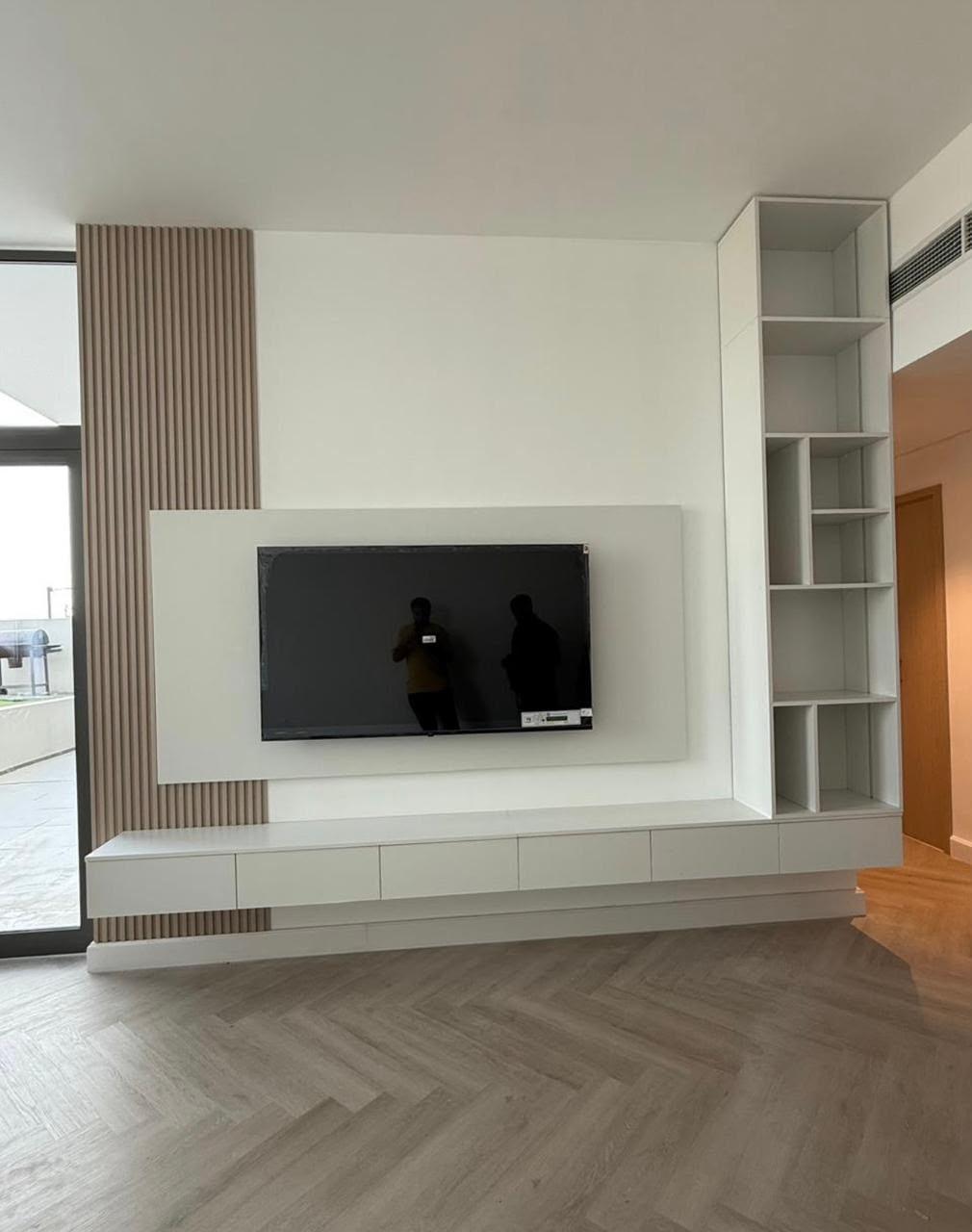
If the TV changes after the drawing is approved
Plans change: the chosen model sells out, a better offer appears, or the family decides on a bigger screen. Tell us as soon as you know, ideally before the workshop starts. Send the new model number and we will compare its dimensions, weight, mounting pattern and connections with the approved drawing.
If the new set fits the same panel and backing, nothing changes. If it does not, we explain which parts are affected and agree any change to cost and timing with you before going ahead. The later the change, the more of the wall has already been made, so a short message on the day you change your mind is worth sending.
To build in room for a set you might buy in a few years, read our guide to leaving room for the next TV.
Where to go next
The decisions around the screen, from storage to lighting, are set out in our media wall planning guide. When you are ready, book a free visit through our media wall service. Our workshop is in Sharjah, and we build media walls in Sharjah and across the other emirates.
For finished examples, see our made-to-measure media walls and floating TV units and consoles. The starting price, AED 3,500 per project, covers a small screen panel and a console fixed to the wall, finished in standard laminate, and the quotation follows the measured drawing, with your TV's model number written on it.
Common questions
Can you design the media wall before I buy the TV?
Yes, up to a point. The free visit, laser measuring and a first layout can all happen with only a size range in mind. The final drawing waits for the exact model number, because the bracket position, the backing and any opening around the screen are drawn from it.
Is the screen size enough if I have not chosen a model?
Not for the final drawing. Two 65-inch TVs from the same year can differ by almost 2 cm in width, 2 cm in depth, about 6 kg in weight and in where the bracket fixes, and each of those moves something in the wall.
Is mounting the TV part of the job?
Yes. Hanging the screen is part of our installation. Our own team fixes it to the finished wall after the panels, console and lighting are in place, and checks with you that it sits level and works before leaving.
What if my chosen TV is out of stock when I come to buy it?
Send us the replacement model number before the workshop starts. We compare it with the approved drawing; if it fits, nothing changes, and if it does not, we agree any change to cost and timing with you first.
Can I use the wall mount that came with my TV?
Often, yes. Some TVs ship with the maker's own slim mount, and it can suit a media wall well. Tell us it is in the box when you send the model number, so the backing and the depth behind the screen are drawn for that mount rather than a generic bracket.
Do I need to choose the soundbar before the drawing too?
Yes, if it will sit under the screen or on the console. Makers set gaps and clearances for their bars; Sonos, for example, wants at least 10 cm of clear space between the Arc Ultra and the TV above it, so the model shapes the space below the screen.
Does the TV need to be in the house for the first visit?
No. Tell us the size range and, if you know it, the model. What helps most at the visit is seeing the room and the seats; the model number can follow any time before the drawing is approved. A checklist of photos and details to send.

Sources & specifications
Manufacturer information applies to the named products and systems. Sources reviewed on 27 October 2026.
- DisplaySpecifications: LG OLED65C4PUA (2024), dimensions, weight, VESA and accessoriesdisplayspecifications.com(opens in a new tab)
- DisplaySpecifications: Samsung QN65LS03D, The Frame (2024), dimensions, weight, VESA and accessoriesdisplayspecifications.com(opens in a new tab)
- VESA Flat Display Mounting Interface: hole patterns and centring rulesen.wikipedia.org(opens in a new tab)
- Vogel's: VESA sizes and how a TV bracket is matched to a screenvogels.com(opens in a new tab)
- Samsung Gulf (UAE): what to know before wall mounting a Samsung TVsamsung.com(opens in a new tab)
- Sonos: Arc Ultra user guide (placement, wall mount, cables in the box)sonos.com(opens in a new tab)
- Lumo Fires: can you plug an electric fire into an extension lead?lumofires.com(opens in a new tab)
Want this planned for your home?
Consultation and measurement are free. Tell us the rooms, location and what you need; we arrange a sample visit and define the measured quotation.