Media Walls · 15 min read · 22 March 2026
How high should the TV be on a media wall?
Put the middle of the screen where your eyes are when you sit, about 105–110 cm off the floor on a normal sofa. How to measure that for your own seats, and what changes for a floor majlis, a bedroom or a wall with a fireplace.

By Ali Haider Basra, Founder, Al Tareeq Decor · Contact our workshop
Key takeaways
- Set the middle of the screen at your seated eye height, roughly 105–110 cm above the floor for most sofas.
- Measure eye height from your own seats; a floor majlis or a low lounge sofa can bring the screen down by 20 cm or more.
- If you cannot hit eye level exactly, go slightly lower rather than higher, and keep the screen's middle within about 10 cm of your eyes.
- On a media wall, set an electric fireplace low in or below the console so the TV can stay at eye level above it.
- Tape the real screen outline on the wall and watch an evening of TV before the drawing is approved.
On this page
- Key takeaways
- The short answer
- Why eye level, and what goes wrong when it is higher
- Measure your own eye height in two minutes
- Where the top and bottom of the screen land
- Screen edges with the middle of the picture at 107 cm
- The console, the soundbar and the space between
- Wall-hung or standing on the console
- Floor majlis and low seating
- Bedrooms
- Above a fireplace
- Tilting and swivel brackets
- How far above eye level is too far
- Angle up to the middle of the screen (eyes at 107 cm)
- High ceilings, low ceilings
- Common height mistakes
- Children, pets and busy family rooms
- Test it with tape, then fix it on the drawing
- How we set the height on your media wall
- Common questions
The short answer
Aim the middle of the screen at the height of your eyes when you are sitting back comfortably in the seat you use most. On an ordinary sofa that lands at roughly 105–110 cm above the floor. Home-improvement guides usually round it to 42 inches, which is about 107 cm, and measure it to the middle of the picture rather than to the bottom edge or the bracket.
That one number solves most rooms, but it is a starting point, not a law. Your sofa, the way you sit, a floor majlis, a bed or a fireplace can all move it. The rest of this guide shows how to find your own figure, what it means for the size of TV and console you choose, and how we fix it on the drawing before the workshop starts. For the wider picture, from storage to lighting, see our media wall planning guide.
Why eye level, and what goes wrong when it is higher
Watching television is a long, still activity. A film runs for two hours, a match for longer, and for that whole time your head holds whatever angle the screen demands. When the picture sits a little below or level with your eyes, your neck rests in its natural position. When it sits above, you tip your head back, and that small tilt held for an evening is what people notice as a stiff neck the next day.
Raised screens also look worse. Many panels show their best contrast and colour when viewed straight on, and the further below the screen you sit, the more the picture can wash out at the top. Reflections from ceiling lights also tend to land on a screen that has been pushed up towards them.
If you are torn between two heights, choose the lower one. A picture a few centimetres below eye level is barely noticed; the same distance above it is felt every evening. That answers one of the questions people ask most often, whether too high or too low is worse: too high is worse.
Measure your own eye height in two minutes
Generic figures are useful until you have measured your own. It takes two people, a tape measure and a couple of minutes:
- Sit in your usual seat the way you really watch: leaning back, feet on the floor or tucked up, not bolt upright.
- Ask someone to measure from the floor to the level of your eyes, with the tape held upright beside your face.
- Repeat for everyone who watches regularly, in the seats they actually use.
- Take the average for a shared room, or the main viewer's figure if one person watches far more than the others.
- Write the number down: it becomes the screen's middle height on the drawing.
Where the top and bottom of the screen land
Once the middle is fixed, the screen's own height decides where its top and bottom edges fall, and that matters more than people expect. A larger TV is not only wider; it is taller too, so its bottom edge drops closer to the floor. The table below uses the approximate screen heights RTINGS publishes, with the middle at 107 cm. Real sets add a few centimetres of frame, so check your model's dimensions without the stand.
The last column is the practical consequence. With a gap of about 10 cm between the top of a console and the bottom of the screen, the console has to stay low enough not to push the TV up. For an 85-inch screen at eye level, that means a console top no higher than about 44 cm, far lower than many standard TV units.
Screen edges with the middle of the picture at 107 cm
55 in
- Screen height (approx.)
- 68.6 cm
- Bottom edge
- about 73 cm
- Top edge
- about 141 cm
- Highest console top with a 10 cm gap
- about 63 cm
65 in
- Screen height (approx.)
- 81 cm
- Bottom edge
- about 66 cm
- Top edge
- about 148 cm
- Highest console top with a 10 cm gap
- about 56 cm
75 in
- Screen height (approx.)
- 93.5 cm
- Bottom edge
- about 60 cm
- Top edge
- about 154 cm
- Highest console top with a 10 cm gap
- about 50 cm
85 in
- Screen height (approx.)
- 105.9 cm
- Bottom edge
- about 54 cm
- Top edge
- about 160 cm
- Highest console top with a 10 cm gap
- about 44 cm
98 in
- Screen height (approx.)
- 122 cm
- Bottom edge
- about 46 cm
- Top edge
- about 168 cm
- Highest console top with a 10 cm gap
- about 36 cm
Screen heights are RTINGS' approximate figures, excluding bezels; edges are simple arithmetic around a 107 cm middle height. Use your own model's dimensions on the drawing.
The console, the soundbar and the space between
On a media wall the TV rarely floats alone. A console or floating shelf usually runs below it, and a soundbar sits on that shelf or is fixed under the screen. Each of these claims part of the space between the floor and the screen, so they have to be planned from the TV's height downwards, not the other way round.
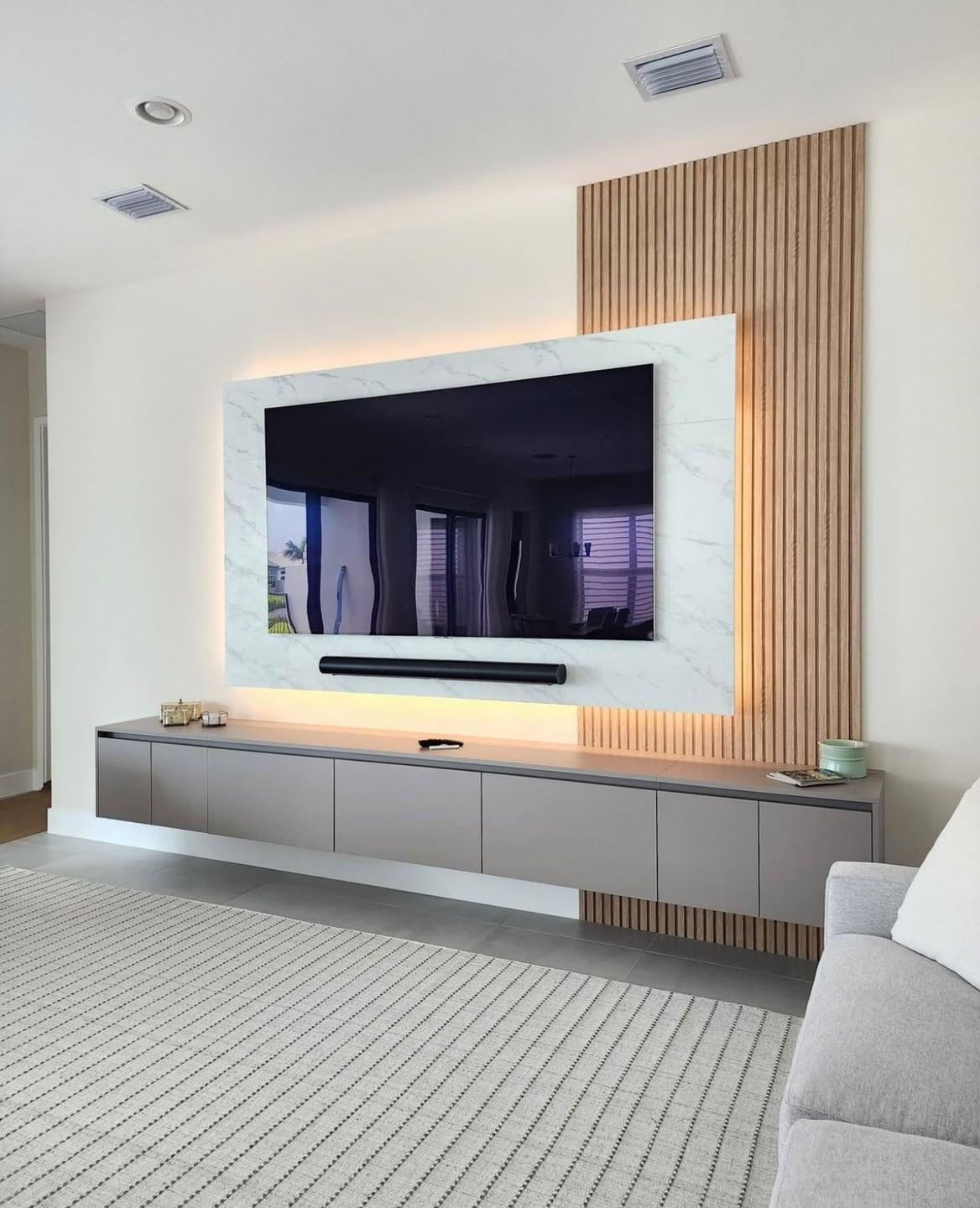
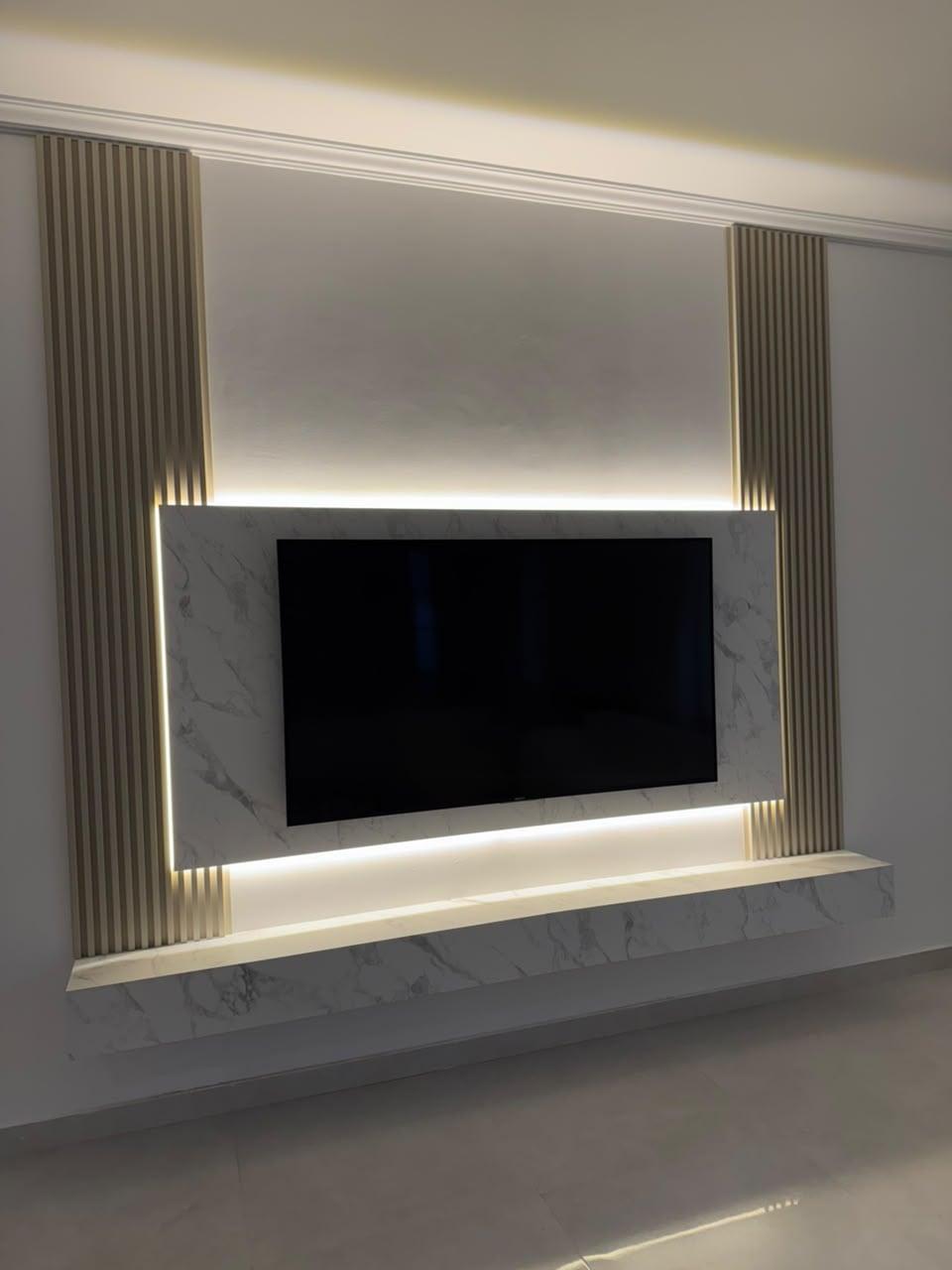
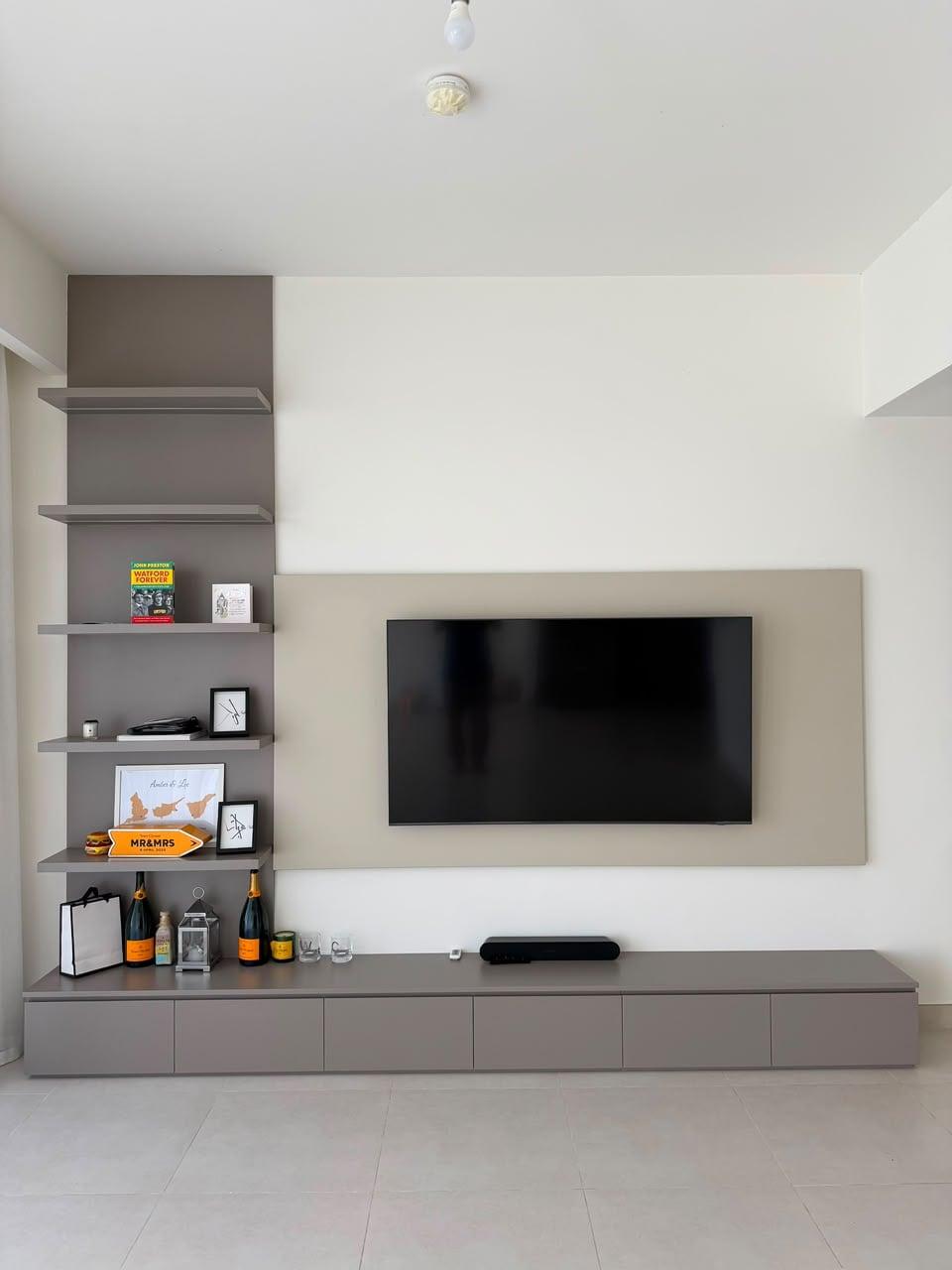
Start from the middle height, subtract half the screen height to find the bottom edge, then allow room for the soundbar if it sits on the console, and finally set the console height. If the console you want is taller than that leaves room for, choose a slimmer one or a lower floating shelf; do not lift the TV to suit the furniture. The wall in the photo below keeps a low floating marble-look shelf well under the screen for exactly this reason.
A soundbar fixed directly under the TV on its own bracket saves height compared with standing it on the console, and keeps the sound centred on the picture. Check its height in the manufacturer's dimensions, because some models are tall enough to clip the bottom of the screen if the gap is tight.
Wall-hung or standing on the console
Most media walls hang the TV on the wall, but some families prefer to stand it on its own feet on the console, ready to move. The height rule does not change: the middle of the picture still belongs at seated eye level. What changes is the arithmetic. A TV on feet adds the height of its stand to the console height, so the console has to be lower still, and the stand's footprint sets a minimum console depth.
Wall-hanging gives more freedom. The console height becomes a design choice rather than a constraint, cables can drop straight into the wall behind the screen, and the screen sits flatter against the panel. If you want the option to stand the TV later, ask for the console top to be drawn at a height that would still work with the stand.
Floor majlis and low seating
In a traditional floor majlis, guests sit on cushions on or just above the floor, and their eyes are far lower than on a sofa. The 105–110 cm rule does not apply here. Measure seated eye height on the cushions themselves, and expect it to be well below the sofa figure; in a low-seated room the screen's middle can come down by 20 cm or more.
Many majlis rooms mix seating heights: a raised majlis sofa along one wall and floor cushions along another, or chairs added for older guests. In that case set the height for the seats that face the screen most directly, then check that the lowest seats still see the whole picture without a steep upward look. A low, wide panel works better in these rooms than a tall one, and a low sideboard or no console at all keeps the screen free to come down.
Low lounge sofas, which are increasingly popular in villas, sit somewhere in between. Measure them rather than assuming; a deep, low sofa can put eye level noticeably below the usual 105 cm.
Bedrooms
In a bedroom you watch lying down or propped up on pillows, so the eye position is higher than on a sofa and further back. Measure it the same way: sit or lie as you would to watch, and have someone measure to your eyes. Then set the screen's middle at that height on the wall opposite the bed.
Two things help in bedrooms. A tilting bracket angled slightly downwards points the picture at the pillows rather than the foot of the bed. And because the bed is often closer to the TV wall than a sofa is, a slightly smaller screen can suit a bedroom better than the living-room size. If the TV sits on a dressing unit or a chest of drawers, check that the furniture height does not force the screen above the eye line. If the TV will sit inside a wardrobe run, see a TV bay in a bedroom wardrobe.
Above a fireplace
A fireplace and a TV on the same wall compete for the same height. If the fireplace sits at normal hearth level and the TV goes above it, the screen ends up far above seated eye level. Bob Vila's guide suggests leaving at least 6–12 inches, about 15–30 cm, between the mantel and the bottom of the TV, which pushes the screen higher still. Samsung's UAE guidance adds two cautions: test how much heat the fireplace actually gives off, and keep the TV where the temperature does not exceed 40°C. It also warns that mounting above a fireplace can raise the screen enough to strain your neck.
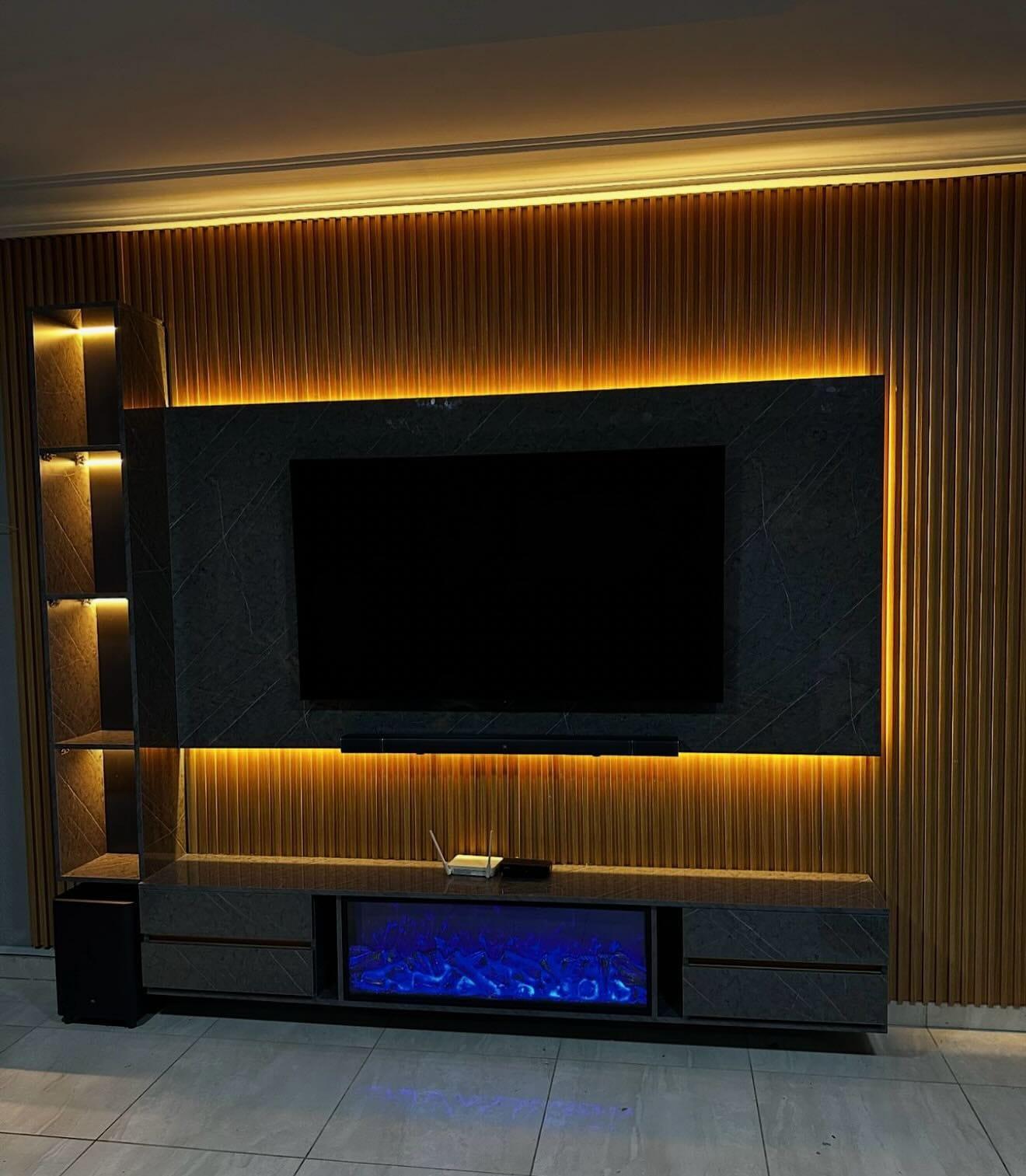
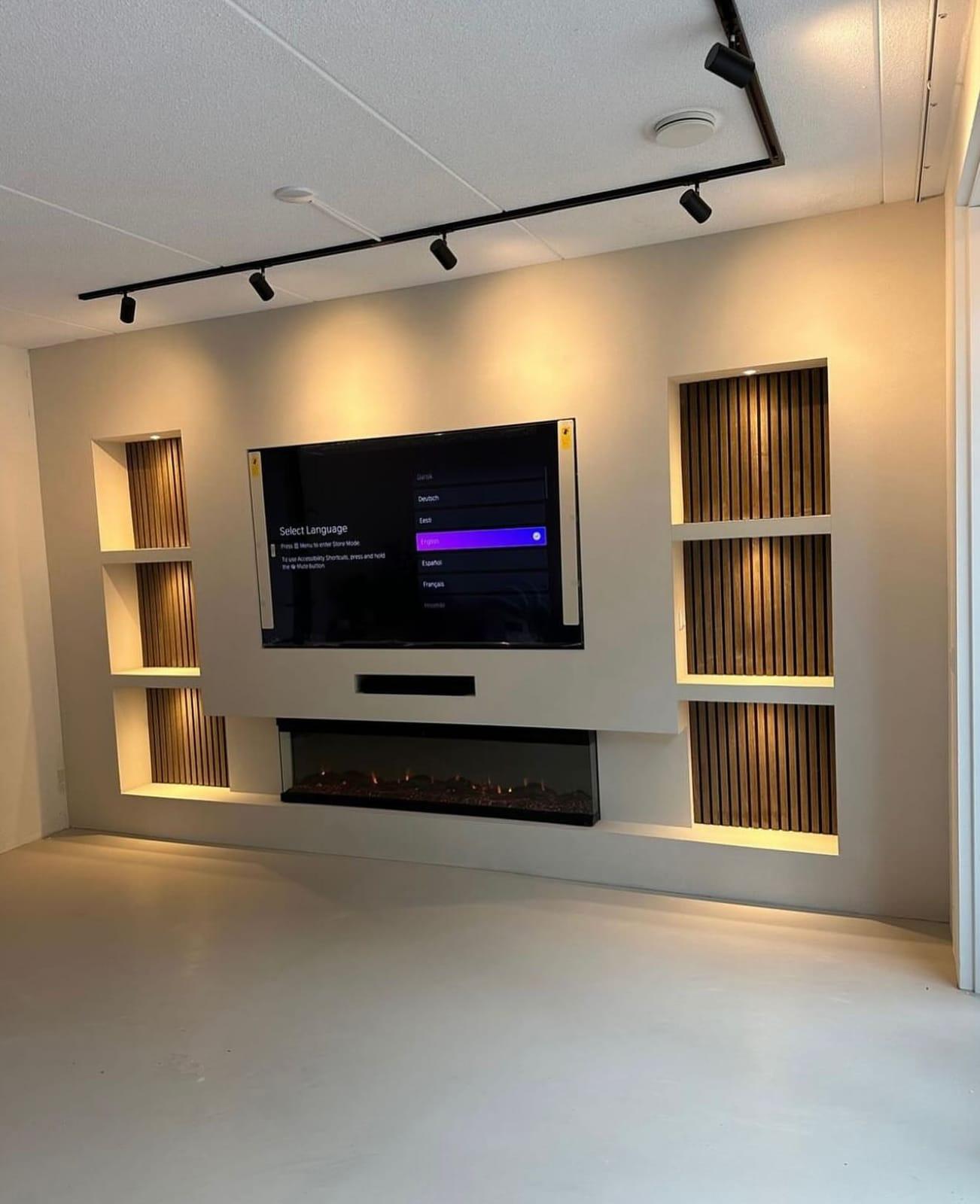
On a media wall there is a better arrangement, shown in the photo at the top of this article: put a linear electric fireplace low, set into the console or just above the floor, and keep the TV at eye level above it. The flame still forms the focal point of the wall, the screen stays comfortable to watch, and the heat is kept well away from the TV.
If a fireplace must sit higher, plan its clearances from the fireplace manufacturer's instructions and the TV's manual together, and accept a tilting bracket and a slightly smaller screen. Our media walls built around an electric fireplace are drawn with the power, the clearances and the TV position on one plan.
Tilting and swivel brackets
When a screen has to sit higher than eye level, in a bedroom, above a fireplace or over a tall piece of furniture, a tilting bracket lets you angle the picture down towards the seats. Full-motion brackets go further and swing the screen sideways, which helps in a majlis or an open-plan room where people watch from more than one place.
Both need more depth behind the screen than a flat bracket, and the media wall has to make room for that depth. A tilting TV set into a tight recess can hit the edge of the recess as it tilts. Tell us the bracket you plan to use before the panel is drawn, so its projection and movement are on the drawing.
Whatever the bracket, its rating has to match the set. Mounting holes on the back of most TVs follow the VESA standard, which defines square hole patterns for bigger screens and a weight limit for each screw size. Samsung's UAE wall-mounting page names the screw size by TV size, from M4 on small sets to M8 on larger ones. Read your own TV's manual and the bracket's rating rather than copying another installation.
How far above eye level is too far
It helps to see the height as an angle. The further the middle of the screen sits above your eyes, and the closer you sit, the further your head tips back. The table below works that angle out for a few heights, assuming your eyes are at 107 cm, at two common sofa distances.
Bob Vila cites the SMPTE guidance that viewers should not have to look up more than 35 degrees to see the top of the screen. That is an outer limit, not a target: by the time the top of the screen is anywhere near it, the picture is already well above eye level. Our recommendation is simpler. Keep the middle of the screen within about 10 cm of seated eye height, and if a design pushes it higher than that, change the design rather than the height.
Angle up to the middle of the screen (eyes at 107 cm)
107 cm
- Above eye level
- 0 cm
- Angle at 2.5 m
- 0°
- Angle at 3.5 m
- 0°
120 cm
- Above eye level
- 13 cm
- Angle at 2.5 m
- about 3°
- Angle at 3.5 m
- about 2°
135 cm
- Above eye level
- 28 cm
- Angle at 2.5 m
- about 6.4°
- Angle at 3.5 m
- about 4.6°
150 cm
- Above eye level
- 43 cm
- Angle at 2.5 m
- about 9.8°
- Angle at 3.5 m
- about 7°
165 cm
- Above eye level
- 58 cm
- Angle at 2.5 m
- about 13°
- Angle at 3.5 m
- about 9.4°
Angles are worked out from the height difference and the distance to the screen. They show how quickly the tilt grows when a TV is mounted high, especially from closer seats.
High ceilings, low ceilings
A tall villa wall tempts people to raise the TV so it looks balanced against the height of the room. Resist it. Fill the space above the screen instead: carry the panel up to the ceiling, add slats, a lit niche or a run of shelves, or simply leave a calm painted area. The composition can be centred on the wall while the screen stays at eye level within it.
Low ceilings cause the opposite problem with very large screens. An 85- or 98-inch TV at eye level has its top edge at around 160–168 cm, which leaves little room for cove lighting or a deep bulkhead above in a room with a low false ceiling. Check the ceiling height on the drawing before choosing the largest size.
Common height mistakes
These errors turn up again and again on TV walls, and each is easy to prevent on paper:
- Centring the TV on the wall from floor to ceiling, which usually puts it far too high.
- Lining the screen up with the top of tall side cabinets or shelving instead of with the viewers' eyes.
- Fixing the bracket position before the TV model, and so its height and mounting holes, is known.
- Setting the height for a standing visitor rather than for the people who sit and watch.
Children, pets and busy family rooms
In a living room used by young children, keep the TV at eye level for the adults who watch it most and make it secure rather than unreachable. A wall-mounted screen on a bracket rated for its weight, fixed into a backing that can carry it, cannot be pulled over the way a TV on a stand can. Hide the cables inside the wall and keep the console below free of anything a child could climb to reach the screen.
In a playroom or a child's bedroom, Bob Vila's guide suggests mounting high enough that children cannot reach the set. If you do raise it, add a tilting bracket so the picture still points at the seats, and choose a smaller screen so the top edge does not end up near the ceiling.
Test it with tape, then fix it on the drawing
Before anything is fixed, mark the real screen on the wall. Painter's tape or a sheet of cardboard cut to the TV's actual dimensions, frame included, shows the size and height far better than a photo or a drawing. Mark the middle point at your measured eye height and leave the outline up for a day or two.
- Watch an evening of normal TV from the main seat and from the side seats, looking at the outline.
- Try the outline 5 cm lower and 5 cm higher to see which feels most relaxed.
- Check the bottom edge against the console and soundbar you plan, and the top edge against the ceiling and any lighting.
- Look for window and lamp reflections where the screen will be, during the day and at night.
- Note the final height and send it with your photos before the site visit.
How we set the height on your media wall
At the free site visit the wall is laser-surveyed, we note where the seats are and your measured eye height, and draw the screen, panel, console and soundbar at their real sizes and heights. Sockets and the cable route are drawn behind the screen at the same time. Sockets are moved or added by our own team, so the power ends up where the drawing puts it, not where an old socket happened to be.
Prices for a media wall begin at AED 3,500 a project, and building a typical wall takes roughly ten days once the order is confirmed. Panel cores come in four materials (MDF, WPC, PVC and wood), matched to the wall and its finish. If you are still choosing the TV, read what size TV suits your viewing distance first, because the size changes where the edges land. See our media wall service, or media walls in Sharjah if you are close to our workshop.
Common questions
Is 80 cm too high for a TV?
As the height of the screen's middle, 80 cm is too low for most sofas, where eye level is about 105–110 cm, but it can suit a floor majlis or very low seating. As the height of the bottom edge, 80 cm puts the middle of a 65-inch screen at about 120 cm, slightly above eye level for most people.
How high should a 55-inch TV be mounted?
Its middle belongs at seated eye height, roughly 105–110 cm on a typical sofa. With the screen about 69 cm tall, the bottom edge then sits at about 73 cm.
How high should a 75-inch TV be mounted?
Its middle goes at the same eye height as any other size, about 105–110 cm. Because the screen is about 94 cm tall, its bottom edge drops to about 60 cm, so the console below must be low.
Is it better to have a TV too high or too low?
Too low. Looking slightly down is comfortable for hours; looking up strains the neck and can make the picture look washed out. If in doubt, choose the lower option.
How high should a TV be above a fireplace?
One home guide suggests at least 15–30 cm between the mantel and the TV, which usually puts the screen well above eye level. On a media wall, a better answer is to set an electric fireplace low and keep the TV at eye level above it.
What height should a bedroom TV be?
At your eye height while propped up on pillows in bed, measured the same way as for a sofa. A tilting bracket angled slightly down helps the picture face the bed.

Sources & specifications
Manufacturer information applies to the named products and systems. Sources reviewed on 27 October 2026.
- Bob Vila: how high to mount a TV (42 in centre, fireplace and tilt guidance)bobvila.com(opens in a new tab)
- Samsung UAE: things to consider before wall mounting your TVsamsung.com(opens in a new tab)
- VESA Flat Display Mounting Interface: patterns, screws and load limitsen.wikipedia.org(opens in a new tab)
- RTINGS: TV size to viewing distance (30°, 40° and 62° tables, screen dimensions)rtings.com(opens in a new tab)
Want this planned for your home?
Consultation and measurement are free. Tell us the rooms, location and what you need; we arrange a sample visit and define the measured quotation.