Media Walls · 13 min read · 6 April 2026
Media wall materials list: what each layer is and what your quote should name
What a media wall is made of, from the backing frame to the LED driver, and the wording a quotation needs so two quotes can be compared fairly.

By Ali Haider Basra, Founder, Al Tareeq Decor · Contact our workshop
Key takeaways
- A media wall is seven layers: wall, backing frame, board, face, LED, TV bracket and console, plus edges and hardware.
- The backing frame carries the load; a decorative panel glued to the wall is a finish, not a structure.
- Boards are usually 18 mm; name the core material and the face for every surface.
- Specify the hardware brand, the TV bracket and VESA pattern, LED run lengths and where the driver sits.
- Compare quotations layer by layer; the cheaper one often leaves out the frame, bracket or electrical work.
On this page
- Key takeaways
- What is a media wall made of?
- Seven layers, from the wall out
- The wall behind: block, concrete or gypsum
- The backing frame and its fixings
- Board cores and their thickness
- Faces: laminate, HPL, veneer, lacquer or marble-effect
- Media wall faces compared
- Edges, joints and how the pattern meets
- Hardware: hinges, runners and push-to-open
- The TV bracket and the VESA pattern
- LED strips, profiles and drivers
- Shelves, glass and display cabinets
- Turn the layers into a specification schedule
- Media wall specification: vague versus useful wording
- Comparing two quotations line by line
- Common questions
What is a media wall made of?
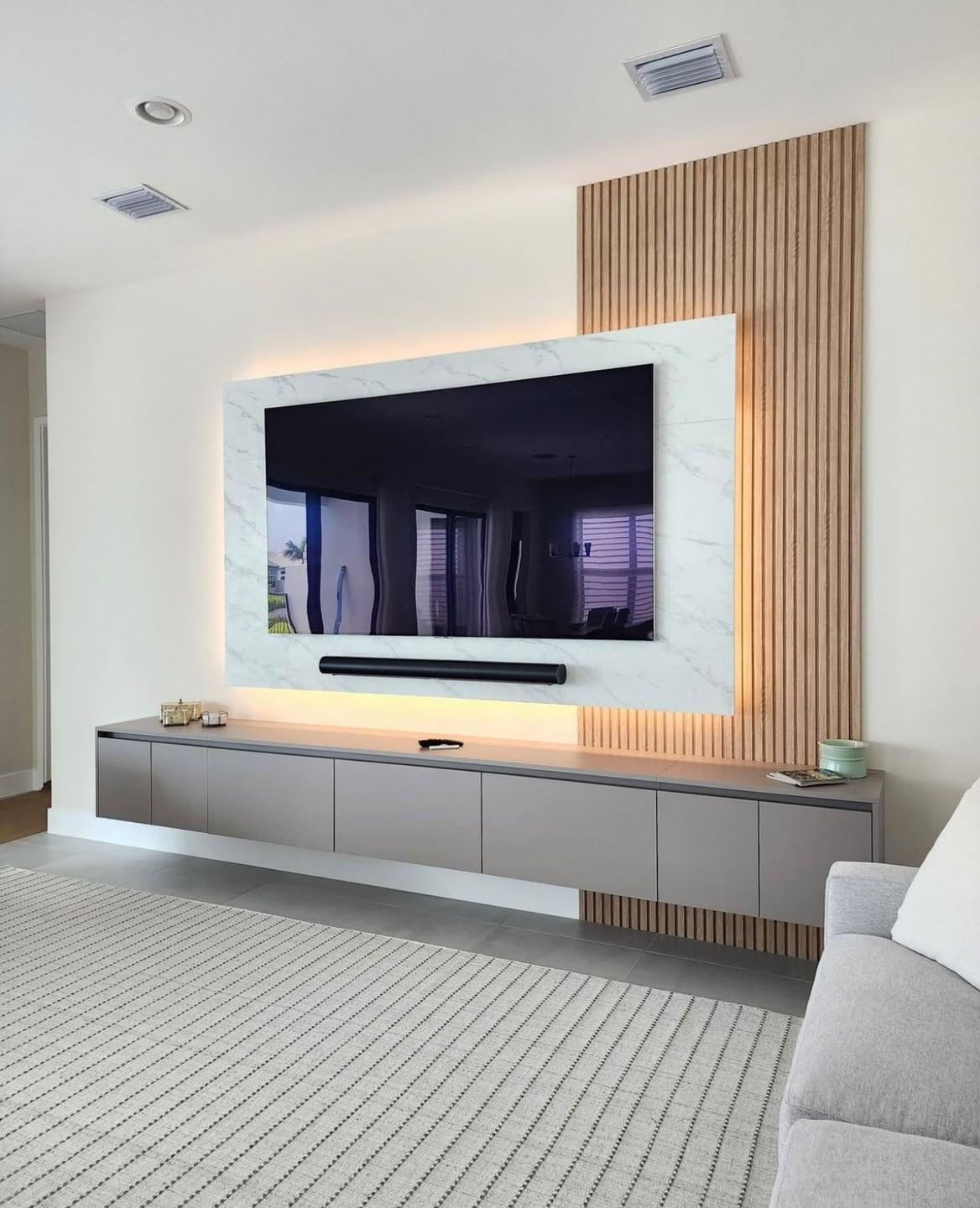
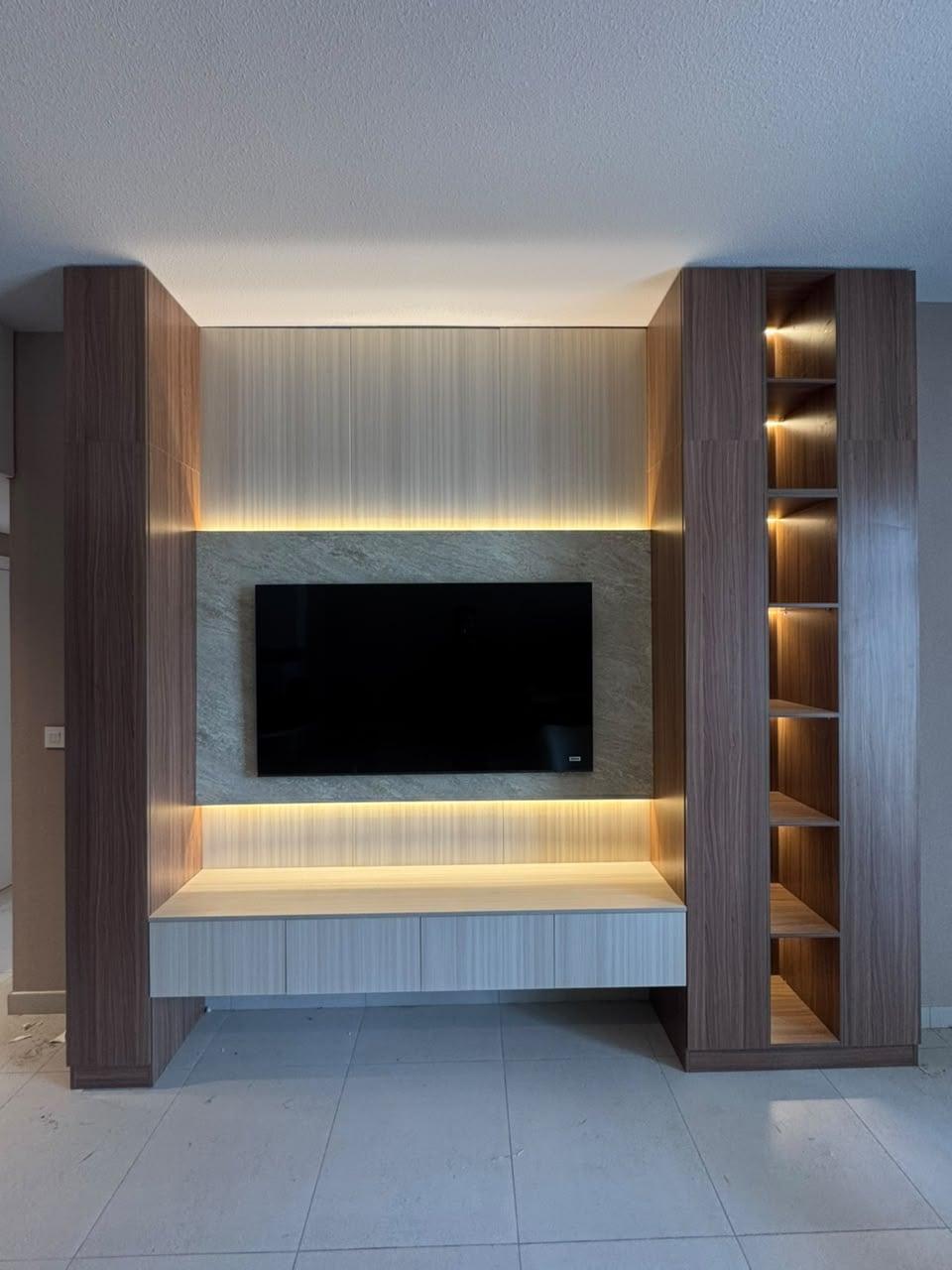
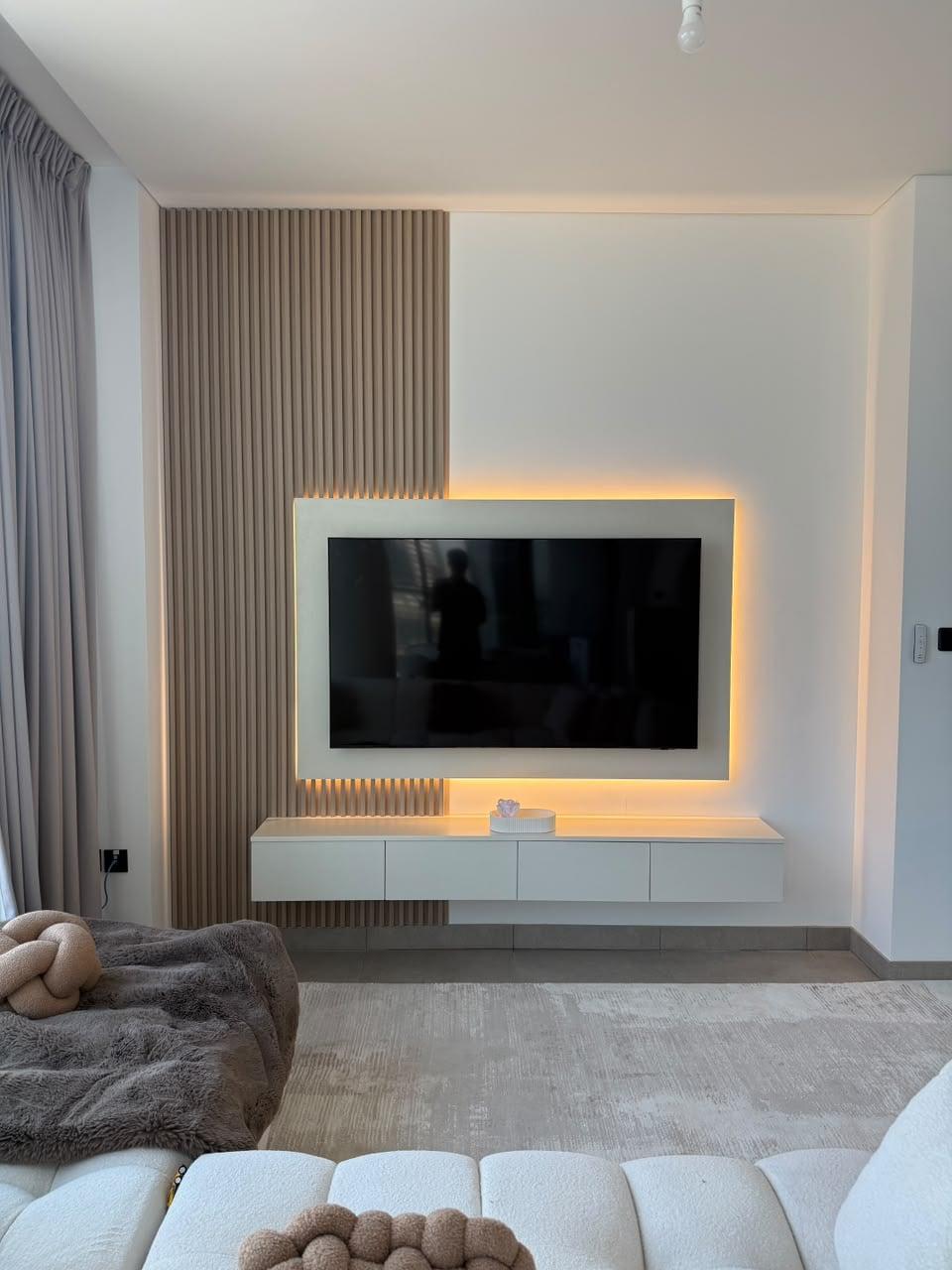
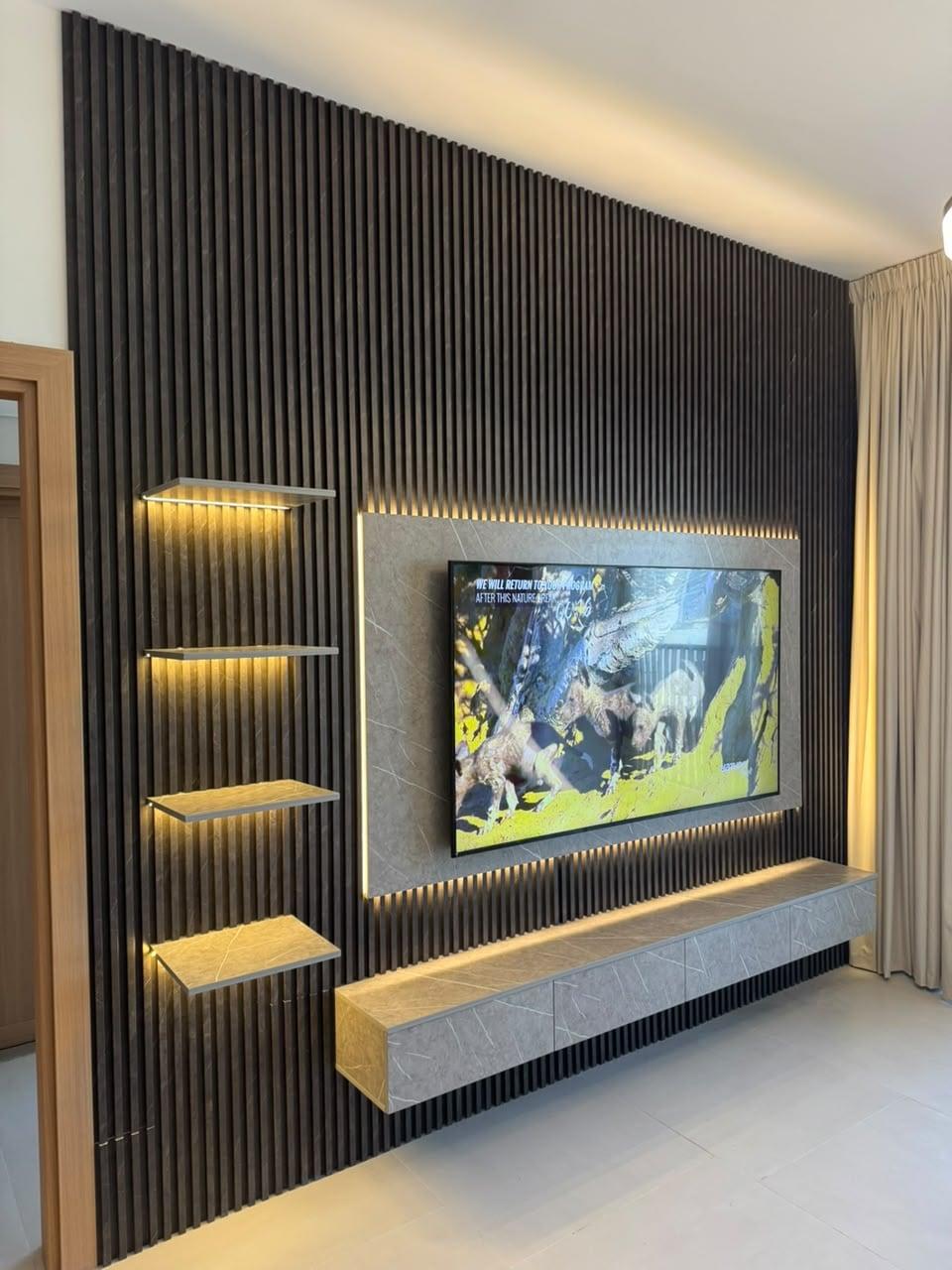
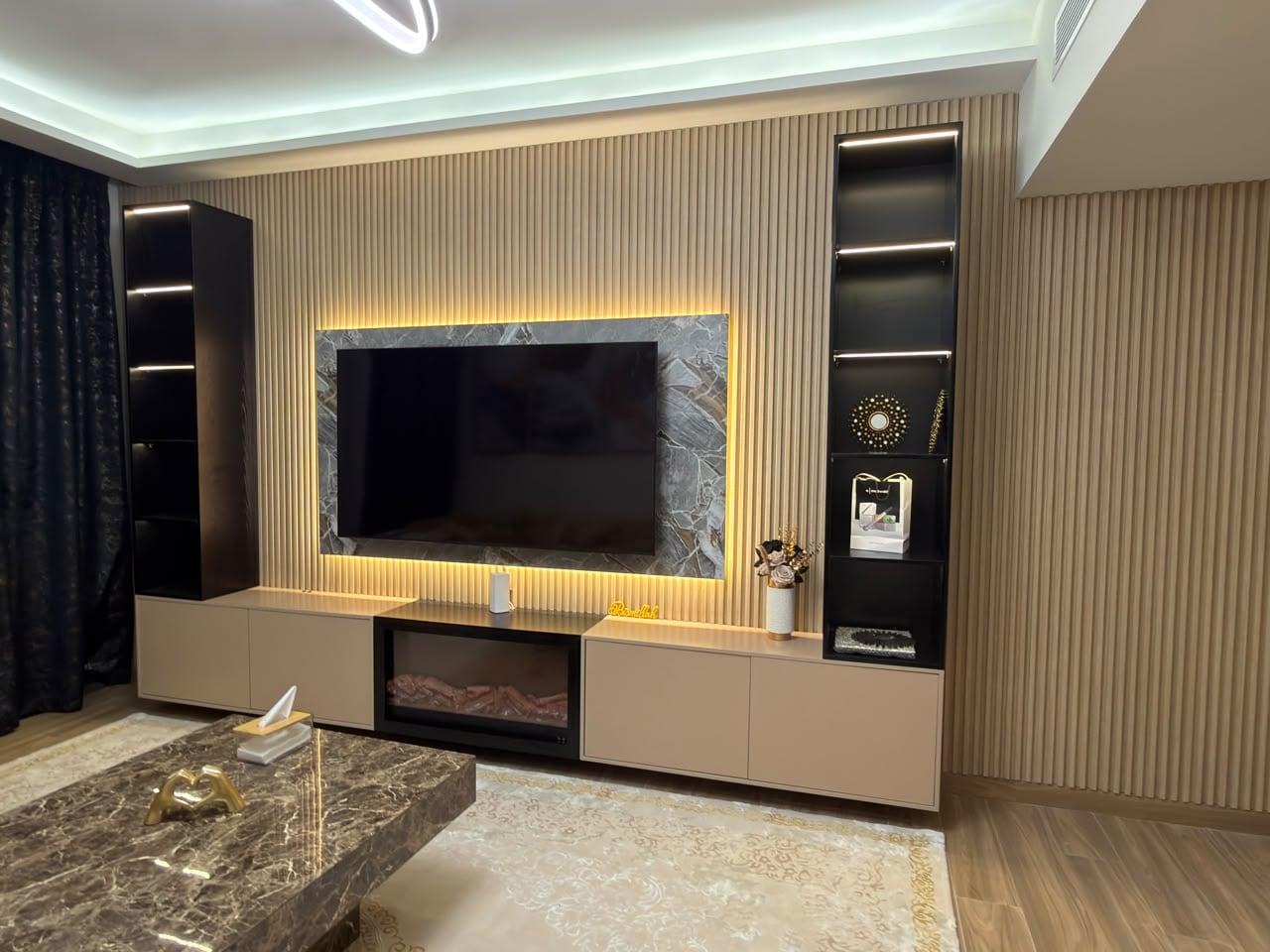
Under its slats and stone-look panels, a media wall is a stack of ordinary materials, each doing one job. Starting at the wall and working out into the room: the wall itself, a backing frame fixed to it, a board that forms the panels, the decorative face on that board, the light, the bracket that holds the TV, and the furniture below. Hardware, edges and electrics tie them together.
Knowing those layers is the quickest way to read a quotation. Two companies can describe the same-looking wall as "premium MDF with marble finish" and mean entirely different things: one an 18 mm board with a high-pressure laminate face and a timber frame behind, the other a thinner sheet stuck straight to the plaster. This guide goes through each layer, what to ask for and how to write it down, so the quotes you compare describe the same wall. For the money side, see what a media wall costs.
Seven layers, from the wall out
The section below pulls a typical wall apart so each layer can be seen. It is not to scale: a board is a couple of centimetres thick and a laminate face less than a millimetre, so the drawing spreads them out. The numbered list beside it is, in effect, the skeleton of a good specification.
Read it as a checklist. If a quotation says nothing about one of these seven, either it is not included or nobody has decided it yet. Both are worth knowing before you sign.
- 1. Wall: block, concrete or a gypsum partition, checked before anything is fixed
- 2. Backing frame: carries the screen and console, fixed into the wall
- 3. Board core: usually 18 mm, in MDF, WPC, PVC or wood
- 4. Face: laminate or HPL, veneer, lacquer, or marble-effect sheet
- 5. LED channel: strip in an aluminium profile, with its driver reachable
- 6. TV bracket: VESA pattern and load rating matched to the TV
- 7. Floating console: carcass and doors, with soft-close and push-to-open fittings
The wall behind: block, concrete or gypsum
Everything else hangs off this layer, so it is the first thing we check at the visit. Solid block and poured concrete hold heavy fixings without help and are the easiest to build on. A gypsum partition is hollow: a TV and a console full of equipment need a frame or reinforcement behind the board, or fixings that reach through to the studs, and the drawing should show which.
Note anything already in the wall: a known damp patch, cracks, old repairs or pipes and cables you know about. A new panel hides them, which is exactly why they should be dealt with first. If the wall shares a side with a bathroom or an outside face that takes the afternoon sun, say so; it affects which board we suggest.
Expect the wall to be slightly out of true. Few walls are perfectly flat or plumb over three or four metres, and a long run of slats or a large stone-look panel shows every dip. That is another reason for a frame: it is packed out and levelled first, so the face goes on straight even when the plaster behind it is not. Our laser measurement records those differences before anything is cut.
The backing frame and its fixings
Behind most panels sits a frame of timber battens or metal channel, fixed into the wall. It does three jobs: it carries the load of the screen and anything wall-hung, it creates a cavity for cables and LED drivers, and it lets the face of the wall be set dead flat even when the plaster behind is not. A decorative panel glued straight onto the wall does none of these.
On the quotation this is the line most often left vague. Ask what the frame is made of, how far apart the battens are, what fixes it to the wall and where the extra blocking for the TV bracket goes. If the answer is "the panel is strong", keep asking: a panel is a finish, and the strength lives behind it.
Board cores and their thickness
The panels themselves are cut from board. Faced boards are made as standard at 18 mm, with thinner and thicker sheets available, according to EGGER, one of the large European board makers; 18 mm is also a common thickness for cabinet carcasses, so a console and its wall panel often share a board.
Our workshop works with four cores, MDF, WPC, PVC and wood, and picks one per room: MDF for most dry living rooms, the plastic-based boards in rooms that see splashes or humid air, wood where the grain itself is the feature. The trade-offs on humidity, heat and weight are set out in the four panel cores compared. For the specification, write down the core and its thickness for each element, not one word for the whole wall.
Faces: laminate, HPL, veneer, lacquer or marble-effect
The face is what you see and touch. Laminate is a printed, resin-impregnated sheet bonded to the board; EGGER describes the common thickness as about 0.8 mm, glued to a chipboard, MDF or plywood substrate with a balancing sheet on the back so the panel stays flat. High-pressure laminate, HPL, is pressed at around 120 °C and over 70 bar and is made to the EN 438 standard, which is why it shrugs off knocks in busy family rooms. Low-pressure faces cost less and suit vertical panels that are rarely touched.
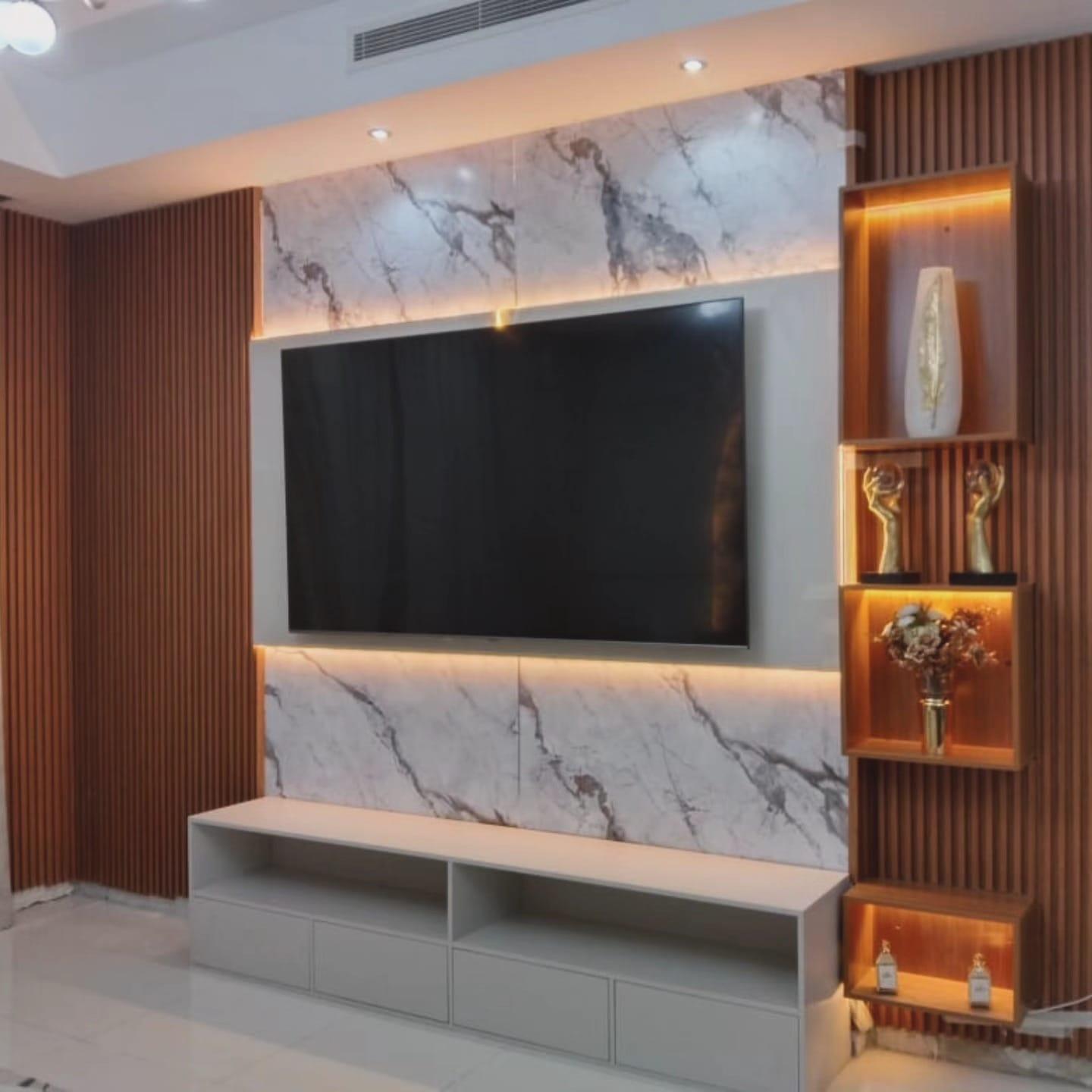
Real wood veneer is timber sliced thin, sometimes well under a millimetre, glued to MDF or particleboard; no two sheets are identical, which is its charm and the reason joints need planning. Lacquer is a sprayed paint finish, smooth and seamless in matt or gloss, and the most easily marked of the four. Marble-effect panels reproduce stone in a sheet, without stone's weight. Choose the face per surface: the screen panel and any open shelf edges deserve the toughest one.
Think too about the light each face will see. A gloss lacquer or a polished marble-effect panel opposite a window reflects it straight back towards the sofa, and veneer facing strong afternoon sun can mellow in tone over the years. In a bright UAE living room, a matt or satin face around the screen tends to be the calmer choice, with gloss kept for smaller accents away from the glass. If you want the stone look without the weight, marble TV wall options shows where a marble-effect panel earns its place.
Media wall faces compared
Laminate (low pressure)
- Look
- Plain colours, wood grains, stone looks
- Wear and care
- Wipes clean; fine on panels rarely touched
- Specify
- Decor reference and board it is pressed on
High-pressure laminate (HPL)
- Look
- Same range, crisper texture
- Wear and care
- Takes knocks and cleaning well (EN 438)
- Specify
- Decor reference, thickness, edge treatment
Wood veneer
- Look
- Real grain, each sheet unique
- Wear and care
- Can be refinished; tone can shift in strong sun
- Specify
- Species, cut, grain direction across joints
Lacquer
- Look
- Seamless matt or gloss colour
- Wear and care
- Shows fingerprints and knocks sooner
- Specify
- Colour, sheen level, number of coats
Marble-effect panel
- Look
- Stone veining without the weight
- Wear and care
- Gloss versions reflect windows
- Specify
- Pattern, sheen, how veins meet at joints
Laminate and HPL figures from EGGER and the EN 438 standard as summarised on Wikipedia; veneer from Wikipedia's article on wood veneer. Final choices follow samples seen in your own light.
Edges, joints and how the pattern meets
Every cut panel has edges, and edges are where cheap work shows first. Ask what the edges are finished with, banding in the same decor, a contrasting edge, or a mitred corner where two faces meet with no edge visible, and how thick the banding is. A thin edge on a console top chips sooner than a thicker one.
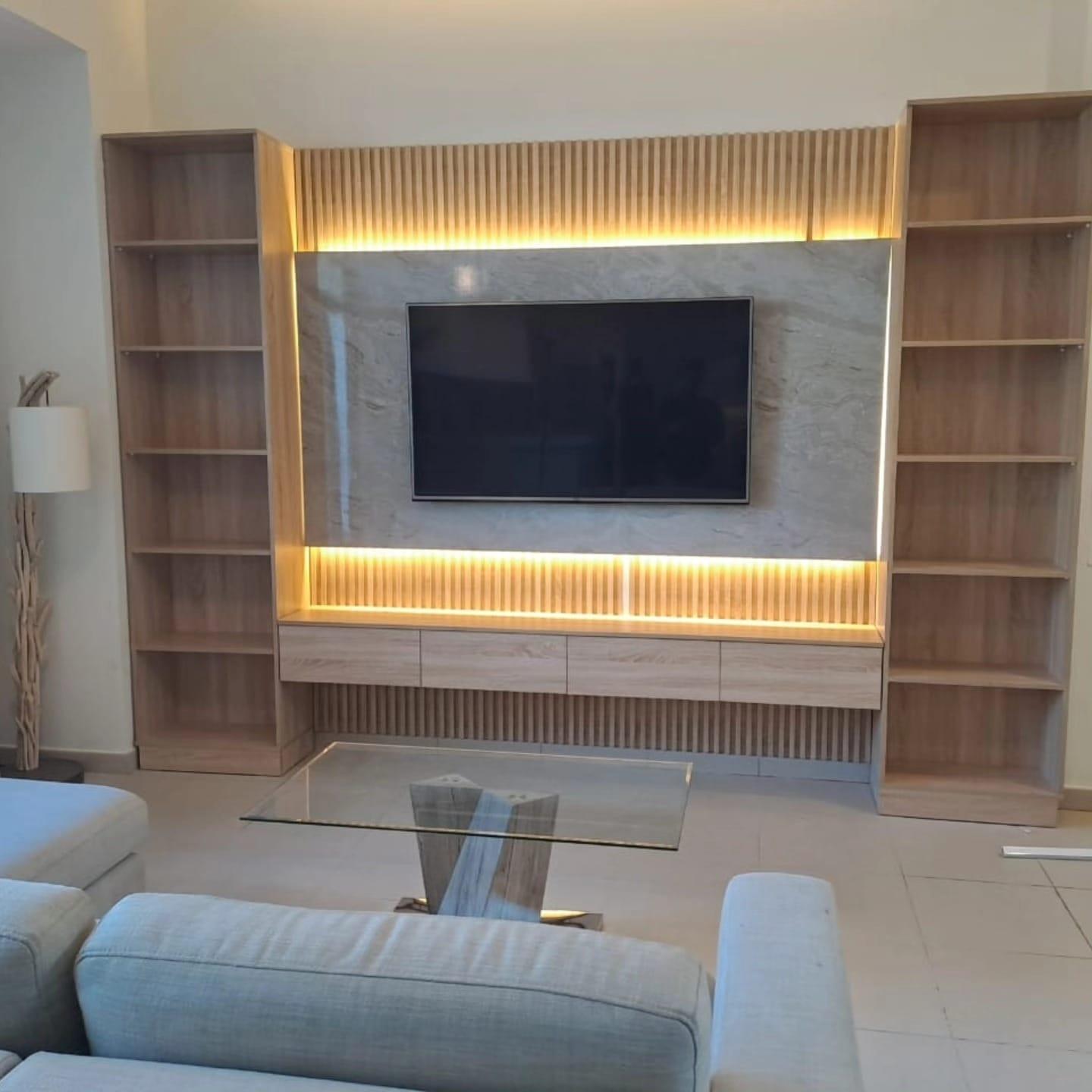
Joints matter on large walls. A run of slats, a veneer with strong grain or a marble-effect panel with bold veining all cross from one sheet to the next, and the drawing should show where those joints fall. Ask for veins and grain to be matched across the screen panel, where the eye rests, and accept a visible joint at the edges if it saves material. Slat widths, gaps and profiles are covered in our slatted TV wall guide.
Hardware: hinges, runners and push-to-open
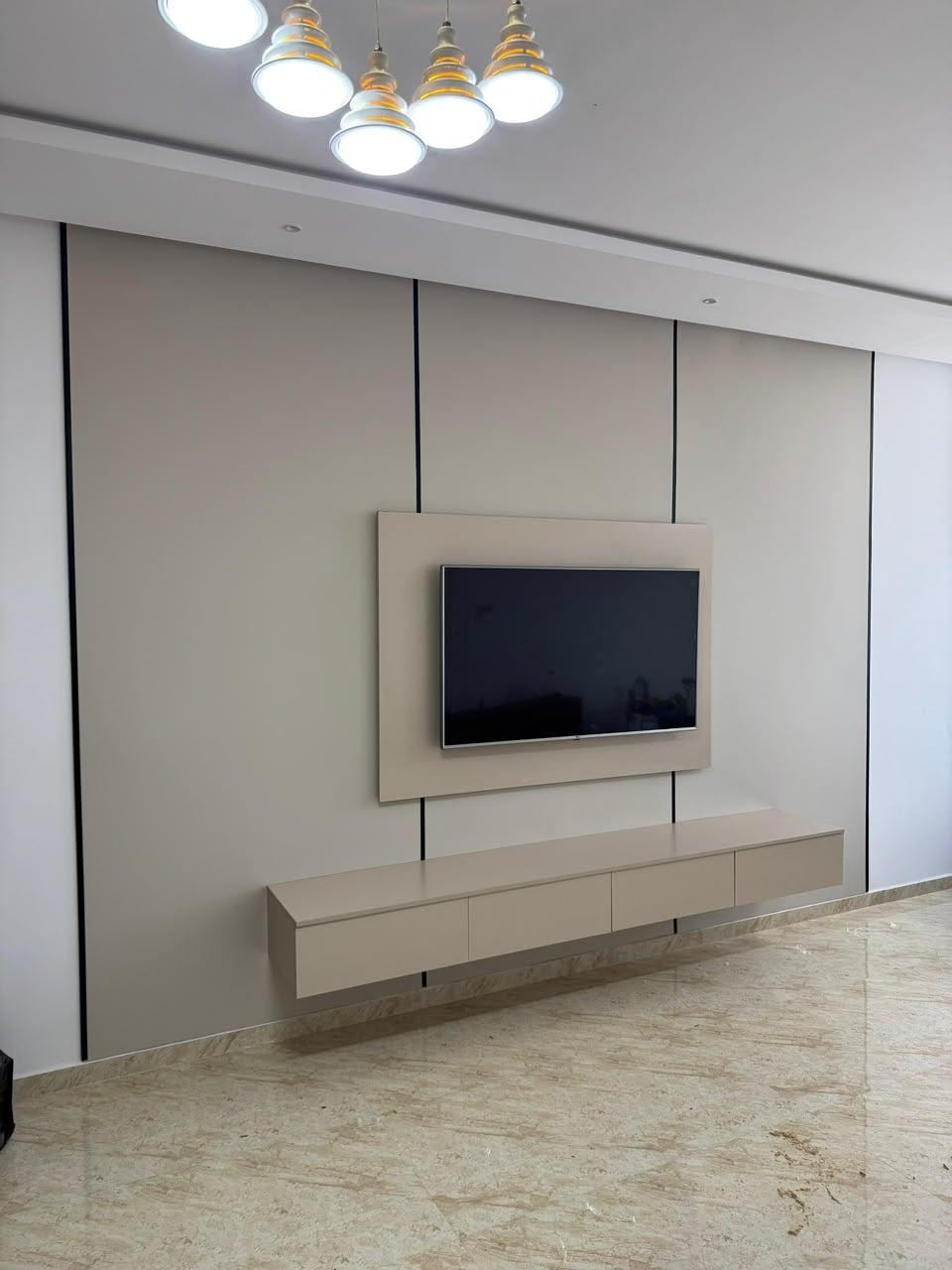
Hardware is where a console earns its keep or annoys you daily. Our consoles use soft-close hardware, with push-to-open where the design asks for it; confirm the brand and model in the quotation. To take one of Blum's ranges as an example, its CLIP top hinge opens to 110 degrees and carries the BLUMOTION soft-close damper in the hinge cup, and the catalogue notes the damper can be switched off, which matters on a handleless door paired with TIP-ON push-to-open, because that mechanism works with hinges that have no spring of their own.
On the quotation, ask for the brand and range of hinges and runners, whether drawers open fully, and which doors are push-to-open. Then think about use: a push-to-open door in a toddler's reach opens every time someone leans on it, and a soft-close drawer full of game discs still needs its runners rated for the load.
Handles are a choice as well as a fitting. Handleless fronts with push-to-open keep the wall calm and suit a slatted or marble-effect backdrop; slim profile handles suit small hands and grandparents better, and they never open by accident. Whichever you choose, write it on the drawing per door, so the console that arrives is the one you pictured.
The TV bracket and the VESA pattern
Most televisions are fixed through the VESA mounting interface: four threaded holes on the back in a square or rectangular pattern. On the published standard, the small 100 × 100 mm pattern is meant for screens up to 14 kg on M4 screws, while larger patterns from 200 × 200 mm carry up to 50 kg on M6 screws or more on M8. The bracket you choose must match both the pattern and the weight of your TV, with a margin.
Write the TV model, the bracket model and where its fixings land on the drawing. The bracket should go through the face and board into the frame or blocking behind, never into the panel alone. Our team mounts your TV as part of the installation, and our guide on when to buy the TV explains why the model should be fixed early.
LED strips, profiles and drivers
LED light on a media wall has three parts, and each belongs on the specification. The strip itself, which on our walls is 3000K warm white or 4000K neutral; the aluminium profile and diffuser it sits in, which hide the individual dots and carry the heat away; and the driver and dimmer that power it. The strip and profile are visible; the driver is not, and it is a part that may need replacing one day.
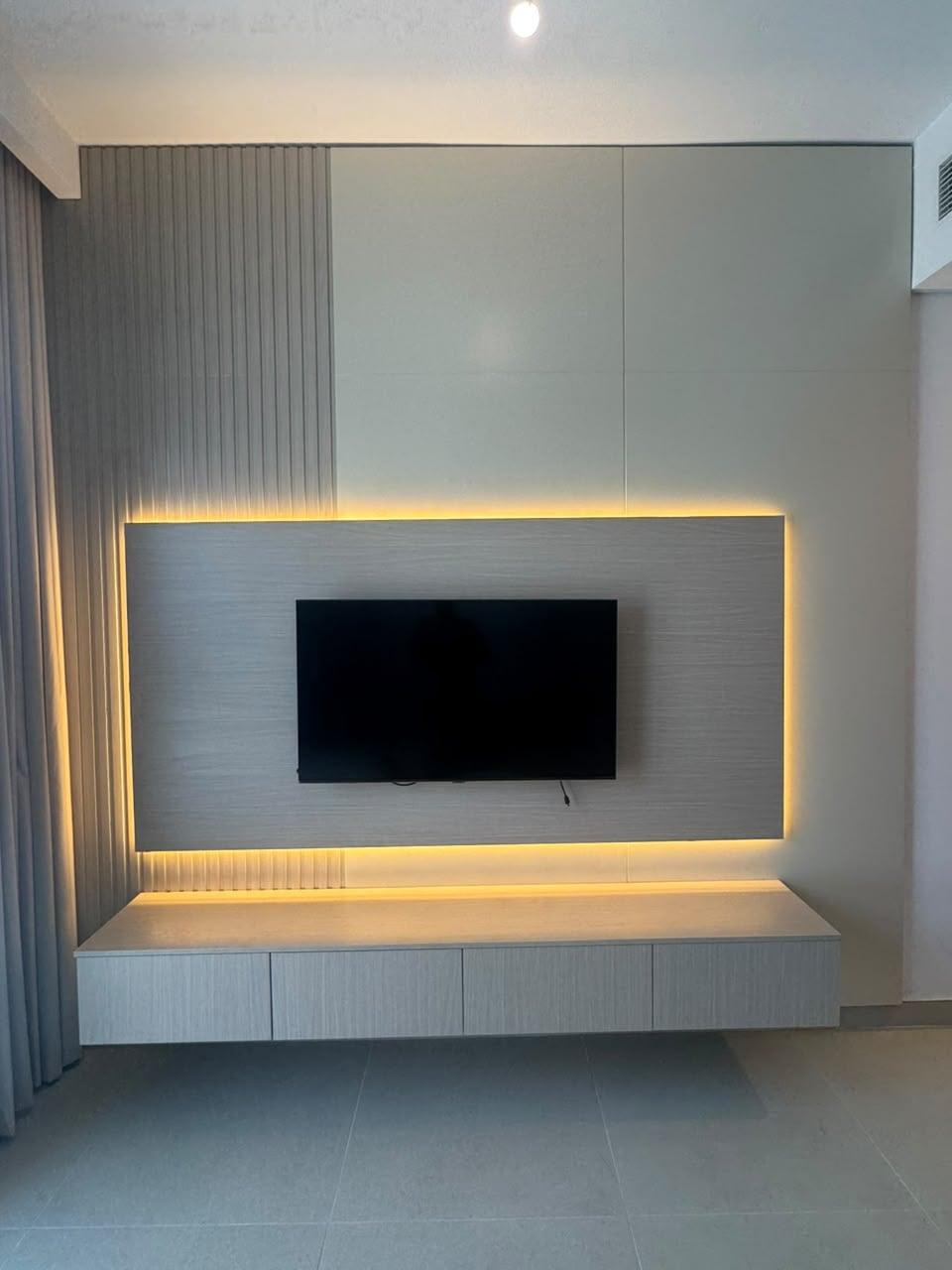
So ask where the driver goes and how you reach it. A cabinet in the console or a panel that lifts off is the right home for it; a sealed cavity is not. Ask too for the length of each run, so two quotations with "LED lighting" can be compared metre for metre. The video below shows the difference between a strip stuck straight to a surface and one fitted properly in a profile with a matched supply. Power for the lighting is covered in our guide to planning the power.
Shelves, glass and display cabinets
Open shelves and glass cabinets bring materials of their own. A shelf is a short beam: the longer the span between supports and the heavier the load, the thicker the board or the stiffer the support it needs. Ask for the span and thickness of each shelf on the drawing rather than assume a slim floating shelf will carry a row of hardback books. Floating shelves hang on concealed brackets, and those brackets need solid blocking in the frame behind, which belongs in the backing line of the quotation.
Glass doors keep dust off ornaments and let shelf lights show, and in a UAE living room that dust is a real argument for them. The glass should be toughened, and its frame and hinges matched to its weight. Glass shelves look light but show every fingerprint, and light passes straight through them, so plan whether they are lit from the side, the back or above. Name the glass type, any tint and how each shelf is lit.
Turn the layers into a specification schedule
A specification schedule is simply a list of the wall's parts with what each is made of. It does not need to be technical; it needs to be specific. The table below shows the kind of wording that makes a quotation comparable, and the kind that does not.
Media wall specification: vague versus useful wording
Backing
- Vague
- Strong frame
- Useful
- Timber battens at stated spacing, blocking behind the TV bracket
Panels
- Vague
- Premium MDF
- Useful
- 18 mm MDF, moisture-resistant grade near the window
Face
- Vague
- Marble finish
- Useful
- Marble-effect panel, named pattern, gloss or matt
Edges
- Vague
- Neat edges
- Useful
- Edge banding in the same decor, thickness stated
Console hardware
- Vague
- Soft-close
- Useful
- Soft-close hinges and runners, push-to-open on named doors; brand and model agreed in the quotation
Lighting
- Vague
- LED lighting
- Useful
- Run lengths, 3000K or 4000K, profile, driver location, dimmer
TV
- Vague
- TV mounting
- Useful
- TV and bracket models, VESA pattern, fixing into the frame
Electrical
- Vague
- Electrical work
- Useful
- Each socket moved or added, listed as its own line
The useful column is the level of detail our drawings and quotations aim for. Ask for the same from anyone you compare us with.
Comparing two quotations line by line
Put the two quotes side by side and go down the seven layers. Where one names a part and the other does not, ask the second company to fill the gap before you judge the totals. The cheaper quote is often the one that has left out the frame, the bracket, the driver access or the electrical work, all of which turn up later as extras or problems.
Check the end of the job as well: who clears packaging and offcuts, whether an old unit is taken down and removed, and whether touching up the paint around the new wall is included. They are small lines, but they decide what the room looks like the evening the fitters leave.
With us, that comparison starts at a free visit: we bring samples of faces and edges, laser-measure the wall and then send a priced drawing with every line itemised. Workmanship carries our written 24-month warranty on orders agreed from 10 October 2026, and bought-in parts such as LED drivers and hinges carry their makers' warranties. Most walls are finished around ten days after the order is placed. Start with a photo through our media walls service, or look at our marble-effect TV backdrops for finished faces.
- Same panelled area and the same board core and thickness.
- Same face for each surface, with decor or species named.
- Edges, joints and pattern matching described.
- Hardware brand and range for hinges and runners.
- TV bracket included, model named, fixing into the frame.
- LED run lengths, colour temperature and driver access.
- Electrical work listed line by line, and installation and removal stated.
Common questions
What does a basic media wall cost?
Our entry brief, a small screen panel in laminate with a console hung beneath, starts from AED 3,500 per project; faces, storage and lighting add lines. What AED 3,500 buys.
Which is better for a TV wall, MDF or WPC?
In a dry living room MDF takes laminate, veneer and paint most cleanly; where the air is damp, WPC holds up better. Which core suits which room.
How are cables hidden in a media wall?
In conduit inside the frame cavity, sized for the plugs, with a removable panel where the connections need to be reached. Cable planning and service access.
Do I need a frame behind a media wall?
On a gypsum partition, yes, to carry the TV and console. On block or concrete a frame still levels the face and leaves room for cables. Planning a media wall.
Must I choose the TV before the wall is drawn?
Yes. Its size, weight and VESA pattern set the screen panel's cut-out and the choice of bracket. When to buy the TV.
Is HPL better than ordinary laminate on a media wall?
It is denser and tougher, so it suits surfaces that are touched or knocked, such as console tops and shelf edges; ordinary laminate is fine on panels above head height. Custom media walls.
Do you make marble-effect TV walls?
Yes, with marble-effect panels behind the screen, often framed by slats or shelving. Marble-effect TV backdrops.

Sources & specifications
Manufacturer information applies to the named products and systems. Sources reviewed on 28 October 2026.
- EGGER: what laminate is and where designers specify it (0.8 mm laminate, 18 mm faced boards)egger.com(opens in a new tab)
- Decorative laminate (high-pressure laminate, EN 438) on Wikipediaen.wikipedia.org(opens in a new tab)
- Wood veneer on Wikipedia (thickness, substrates, cuts)en.wikipedia.org(opens in a new tab)
- Blum catalogue: CLIP top hinges, BLUMOTION and TIP-ONpublications.blum.com(opens in a new tab)
- Flat Display Mounting Interface (VESA patterns and load ratings) on Wikipediaen.wikipedia.org(opens in a new tab)
Want this planned for your home?
Consultation and measurement are free. Tell us the rooms, location and what you need; we arrange a sample visit and define the measured quotation.