Curtains · 12 min read · 14 April 2026
How to measure for curtains: width, length, track height and stack-back
A practical guide to measuring for curtains: where the track goes, how wide and how high, stack-back, curtain lengths, ceiling tracks and common mistakes.

By Ali Haider Basra, Founder, Al Tareeq Decor · Contact our workshop
Key takeaways
- Measure the curtain, not the glass: decide the track position first, then its width, then the drop.
- Fix the track about 10–15 cm above the frame, or at the ceiling; higher makes the window look taller.
- Run the track past the frame for the stack-back: roughly 10–15% of the width for sheers and 20–25% for lined curtains.
- Floor-length curtains finish about 1 cm above the floor; measure the drop at both ends and use the shortest.
- Our team laser-measures every window at a free visit before anything is cut, so your own sizes are only for planning.
On this page
- Key takeaways
- Why measuring decides how a curtain looks
- What you need, and the order to measure in
- Step 1: decide where the track or rod goes
- Step 2: how wide the track should be
- How far the track runs past a 2 m window
- The four sizes in one drawing
- Step 3: how long should curtains be?
- Curtain lengths and where each suits
- Curtain length for 8, 9 and 10 foot ceilings
- Step 4: measure the drop the right way
- Step 5: note everything around the window
- Ceiling-mounted tracks and curtain pockets
- Common curtain measuring mistakes
- Why our team laser-measures, and what happens on fitting day
- Common questions
Why measuring decides how a curtain looks
Most curtains that look wrong were measured wrong. A curtain that stops a few centimetres short, a track that ends at the edge of the frame so the open fabric covers half the glass, a hem that drags on the tiles: none of these is a fabric problem, and none can be fixed once the curtain is sewn.
Measuring for curtains is not the same as measuring the window. You are sizing the curtain you want: where its track sits, how far it runs past the glass, and where its hem stops. Those are decisions first and numbers second, which is why this guide works through them in the order a curtain maker does.
One thing up front: if you order from us, you do not have to get the numbers perfect. Our team laser-measures every window at a free visit before anything is cut. Your own measurements are for understanding the choices and for a first budget; the sizes we make from are our own.
What you need, and the order to measure in
Use a steel tape measure rather than a fabric one, which stretches; Dunelm's guide makes the same point. Add a step ladder, a notepad, your phone and, for anything wide or tall, a second person to hold the other end. Work in centimetres and label every window, for example "bedroom 2, left", so none is missed or counted twice.
Measure in this order: first decide where the track will go, then its width, then the drop from the track down. Doing it the other way round, starting from the glass, is how most measuring mistakes begin. Last, photograph each window from the centre of the room, showing the wall on both sides.
For a rough count and sizes to send us for a budget, our short window measuring checklist is enough. The rest of this guide is for when you want to understand the sizes properly.
Step 1: decide where the track or rod goes
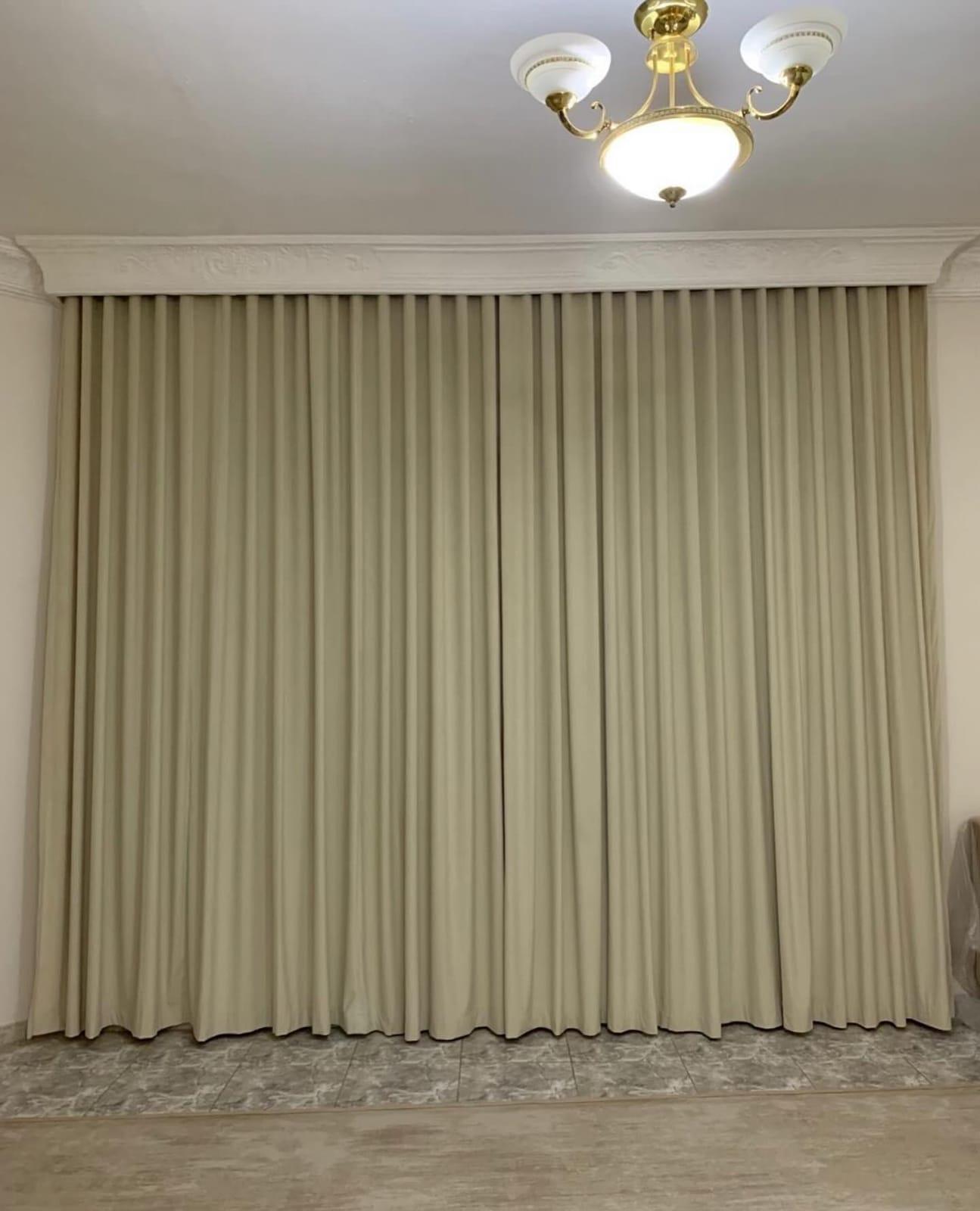
There are three places a curtain can hang from. Inside the window recess, the track sits within the opening; it is neat but covers the least, and it suits blinds better than curtains. On the wall above the window is the most common arrangement. On the ceiling, or inside a ceiling pocket, the curtain falls from the very top of the room, which lifts the eye and conceals the hardware.
On the wall, the usual guide is to fix the track about 10–15 cm above the frame; Bob Vila's guide gives 4 to 6 inches, and for very high ceilings suggests staying within about 8 inches of the window or going right up to the ceiling. Houzz's guide from a Toronto design firm goes further and recommends hanging at the ceiling line or just below a bulkhead.
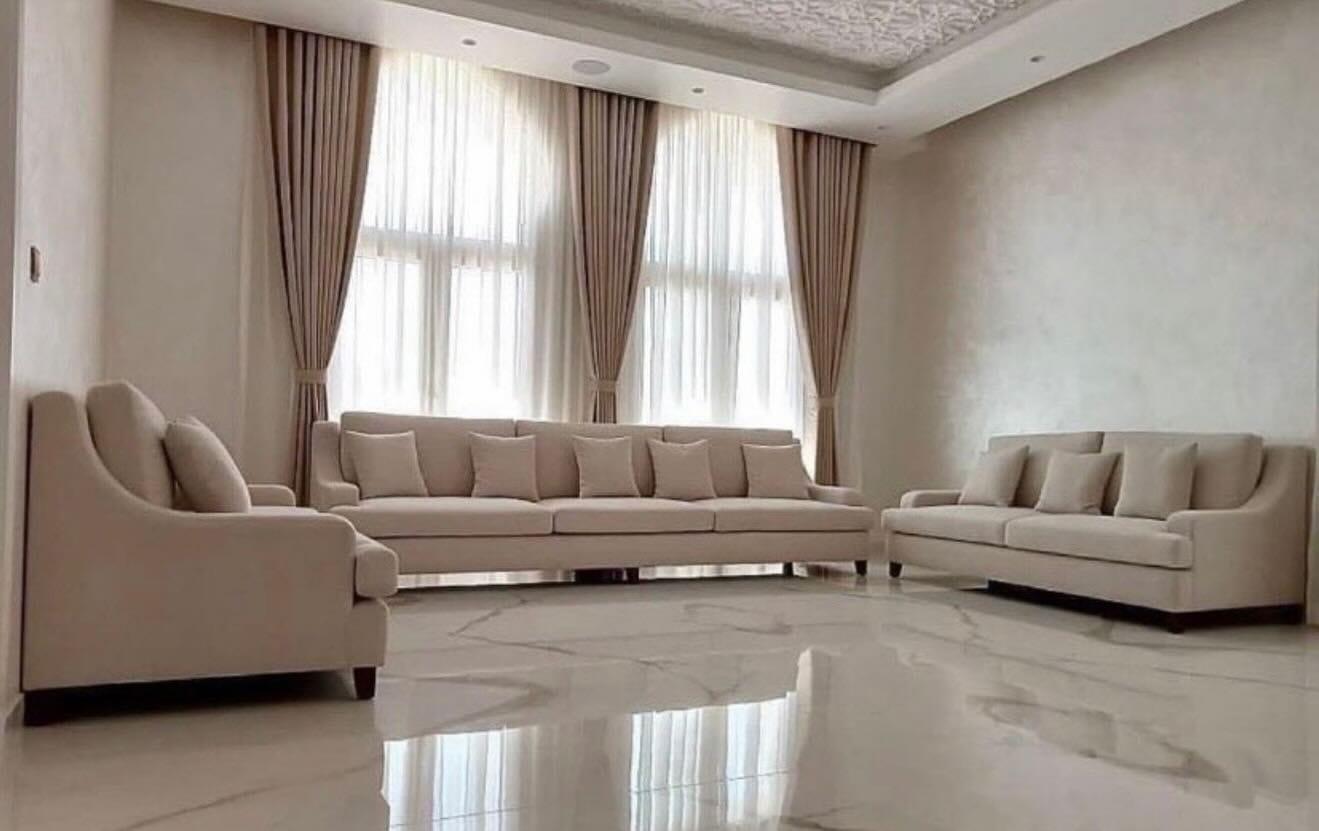
Our recommendation for most UAE homes: if there is a gypsum ceiling in the room, or one is planned, hang the curtain from the ceiling or a pocket in it. If not, fix the track high on the wall, closer to the ceiling than to the frame. A track tight against the top of the frame makes the window look shorter and lets light spill over the top.
Step 2: how wide the track should be
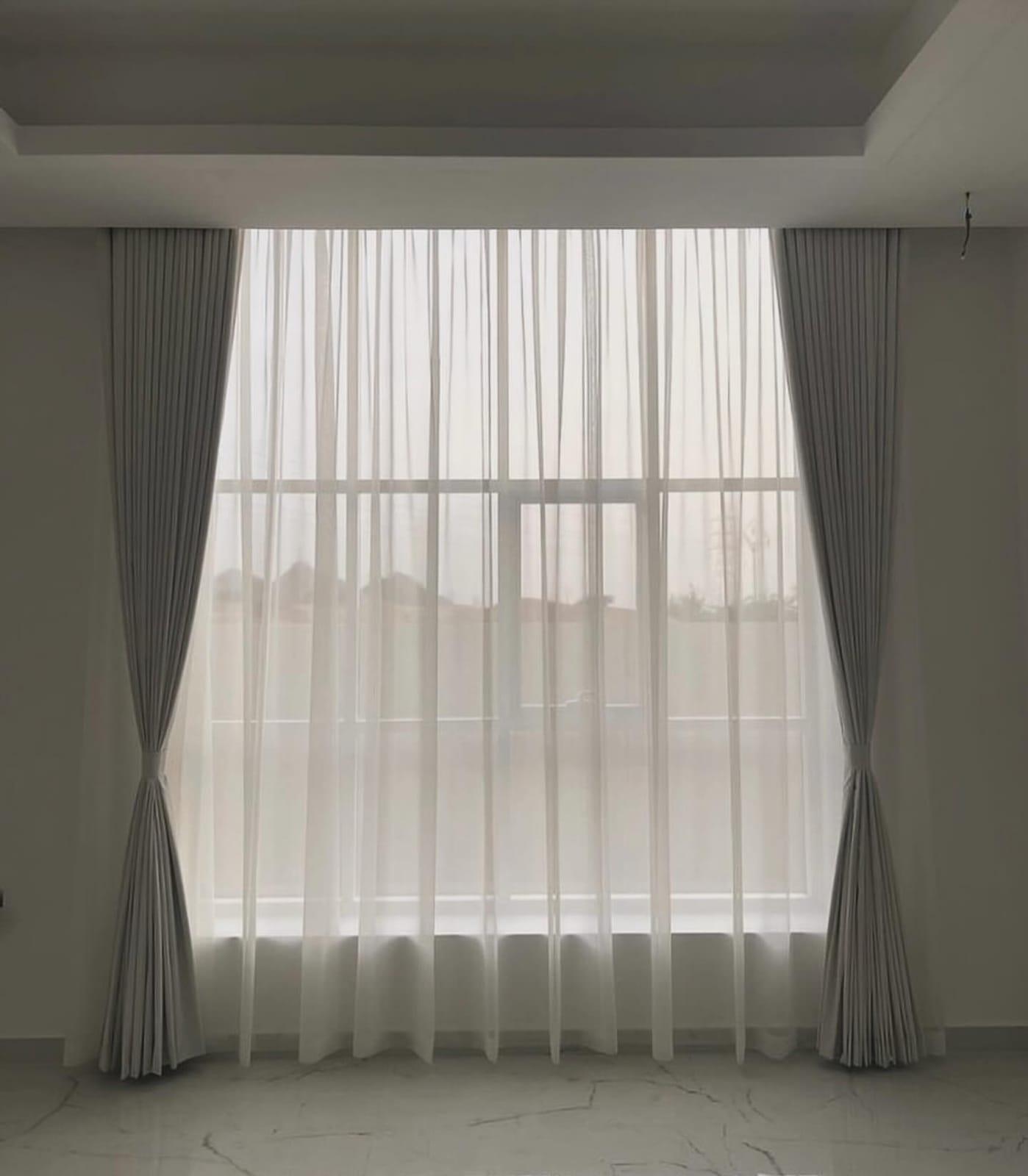
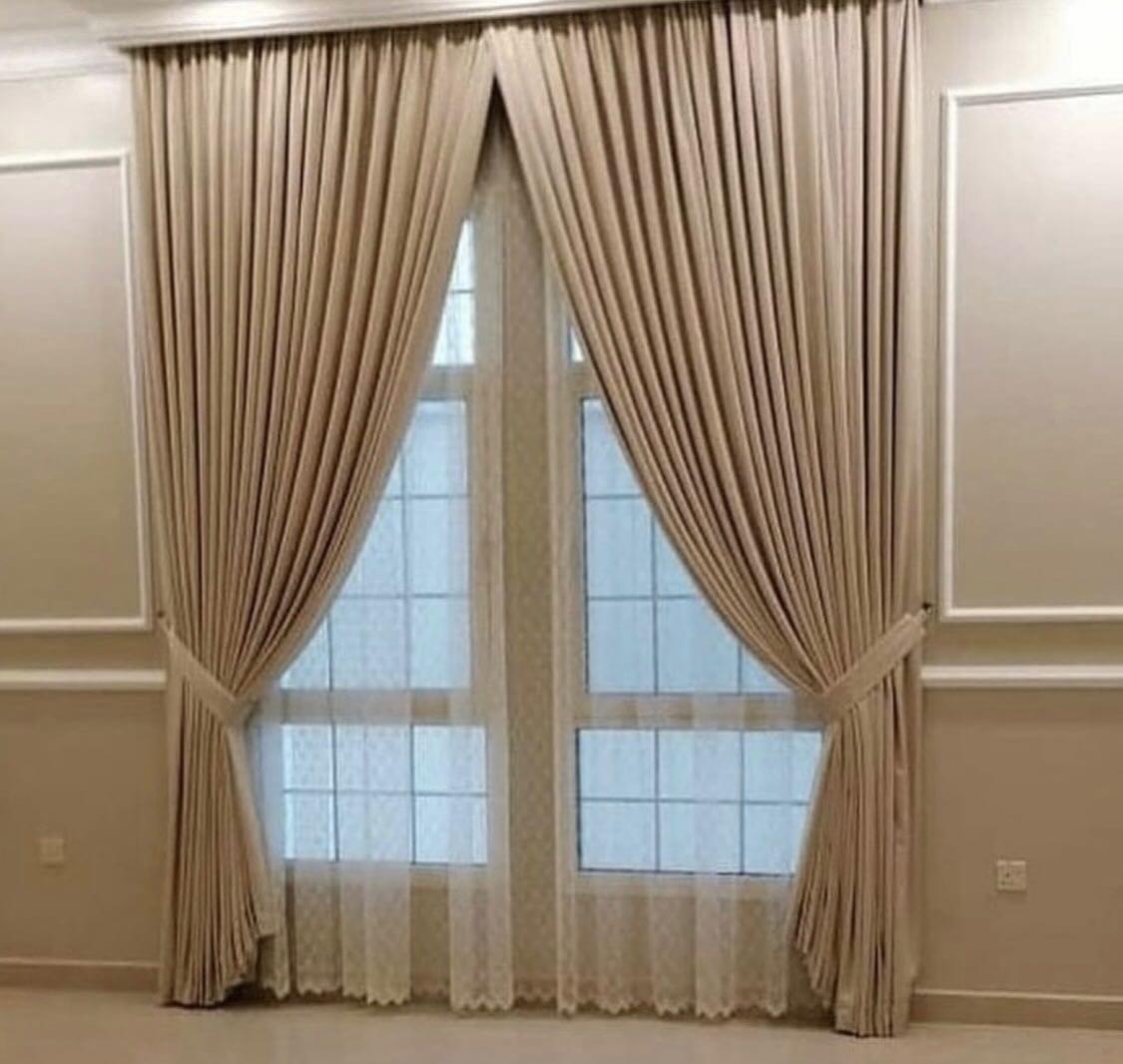
A curtain needs somewhere to go when it is open. That space beside the window is called the stack-back, and it is the reason the track carries on beyond the frame at both ends. If the track stops at the frame, the open curtain sits across the glass and blocks light and view all day.
How much space depends on the fabric and the heading. Houzz's guide puts it at 10–15% of the width for light, unlined curtains and 20–25% for heavier, lined drapes. On a 2 m window, that means roughly 10–15 cm each side for an unlined sheer and 20–25 cm each side for a lined blackout. At the very least, Dunelm adds 10 cm each side for a track fixed outside the recess.
There is an upper limit too. Bob Vila suggests a rod no more than about a third wider than the window, because every extra centimetre of track also means more fabric. Check the wall on both sides before deciding: a corner, a wardrobe or a door frame can stop the track, in which case the curtain can stack to one side only.
Check the frame's width high, halfway and low as well. Frames are seldom square, and the curtain has to cover the widest of the three readings, plus its stack-back on top.
How far the track runs past a 2 m window
Light unlined sheer or voile
- Stack-back allowance
- 10–15% of the width
- Extra track each side on a 2 m window
- About 10–15 cm
Lined curtain or blackout
- Stack-back allowance
- 20–25% of the width
- Extra track each side on a 2 m window
- About 20–25 cm
Any curtain on a track outside the recess (minimum)
- Stack-back allowance
- At least 10 cm each side
- Extra track each side on a 2 m window
- 10 cm
Upper limit for a rod
- Stack-back allowance
- About one third wider than the window
- Extra track each side on a 2 m window
- Up to about 33 cm
Allowances from Houzz (stack-back), Dunelm (minimum outside the recess) and Bob Vila (upper limit). Heavy fabrics and tight headings stack wider; we confirm the figure for your fabric on site.
The four sizes in one drawing
Every made-to-measure curtain comes down to four sizes: the height of the room, the height of the track, the width of the track, and the drop from the track to the hem. The drawing below adds them one at a time, in the order they are decided, with the things around the window that change them.
Notice that the window itself is only a reference. The track is higher and wider than the frame, and the drop runs well past the sill to the floor. That is why a list of glass sizes is not enough to make a curtain from.
- 1. We laser-measure floor to ceiling, because neither is perfectly level
- 2. The track sits about 10–15 cm above the frame, or at the ceiling
- 3. It extends beyond the frame, leaving room for the open curtain beside the glass
- 4. Drop: from the track down to about 1 cm above the floor
- 5. Sockets, switches, handles, sills and AC units are noted too
Step 3: how long should curtains be?
Decide where the hem stops before you measure the drop. Dunelm describes four lengths: just above the sill, about 1 cm clear of it; an apron length, about 15 cm below the sill; floor length, finishing about 1 cm above the floor; and a puddle, with 2–7 cm of fabric resting on the floor. Bob Vila gives similar advice, and adds that windows opened and closed often should have curtains that just touch the floor or stop within half an inch of it.
For the majority of living rooms and bedrooms here, floor length is the right answer: it looks finished, it covers the gap under the sill where light and heat leak, and it suits the tall windows here. Keep the hem about 1 cm clear of the floor so it does not collect sand and dust and does not catch a robot vacuum. Save sill and apron lengths for windows above a kitchen counter, a desk, a low AC unit or a bed headboard.
Puddled curtains photograph beautifully but suit only windows that stay closed. On a balcony door people use every day, a puddle gets trodden on and dragged.
Curtain lengths and where each suits
Sill
- Where the hem finishes
- About 1 cm above the sill
- Suits
- Kitchens, windows above a counter or desk
Apron
- Where the hem finishes
- About 15 cm below the sill
- Suits
- Windows above furniture or a low AC unit
Floor
- Where the hem finishes
- About 1 cm above the floor
- Suits
- Most bedrooms, living rooms and majlis
Puddle
- Where the hem finishes
- 2–7 cm resting on the floor
- Suits
- Formal windows that are rarely opened
Lengths as described in Dunelm's measuring guide. We set the exact clearance for your floor finish on site.
Curtain length for 8, 9 and 10 foot ceilings
People often ask this as a ceiling question, but the answer always comes from the track. Measure the drop from where the curtain will hang, down to where the hem stops. If the track is at the ceiling of a 9-foot room (about 2.74 m), a floor-length curtain is a little under that: the ceiling height, less the track's own depth, less the gap above the floor.
On an 8-foot ceiling (about 2.44 m), hanging from the ceiling is almost always worth it, because a track on the wall leaves too little room above most windows. On 10-foot ceilings (about 3.05 m) and above, ceiling-hung curtains look generous, but they are long and heavy, so the track and the fabric weight need planning, and a motor may be worth it.
Do not buy a standard ready-made length and hope. Ready-made curtains come in a handful of fixed lengths, and a ceiling height in a UAE apartment rarely matches any of them exactly.
Step 4: measure the drop the right way
Measure from the right point at the top. For a curtain on a track, the drop is taken from the top of the track or the hook line; for an eyelet curtain on a pole, from the top of the pole, as Dunelm explains. A few centimetres of difference at the top becomes a gap at the floor.
Measure at both ends of the window and in the middle. Floors and ceilings are seldom true, and across a long window the height can change by a centimetre or more. For a floor-length curtain, work from the shortest reading so the hem clears the floor everywhere.
Measure after the floor is finished. If the floor is about to get new tiles, wooden flooring or a deep rug, the curtain should be sized to the finished level, not to the screed. The same goes for skirting, cornices and a new gypsum ceiling.
If a track is already up and you are only replacing the curtains, measure the track itself from end to end, plus any overlap arm in the middle, and take the drop from its runners. Do not copy the size of the old curtain: it may have been made short, shrunk in a wash or dropped as the fabric stretched.
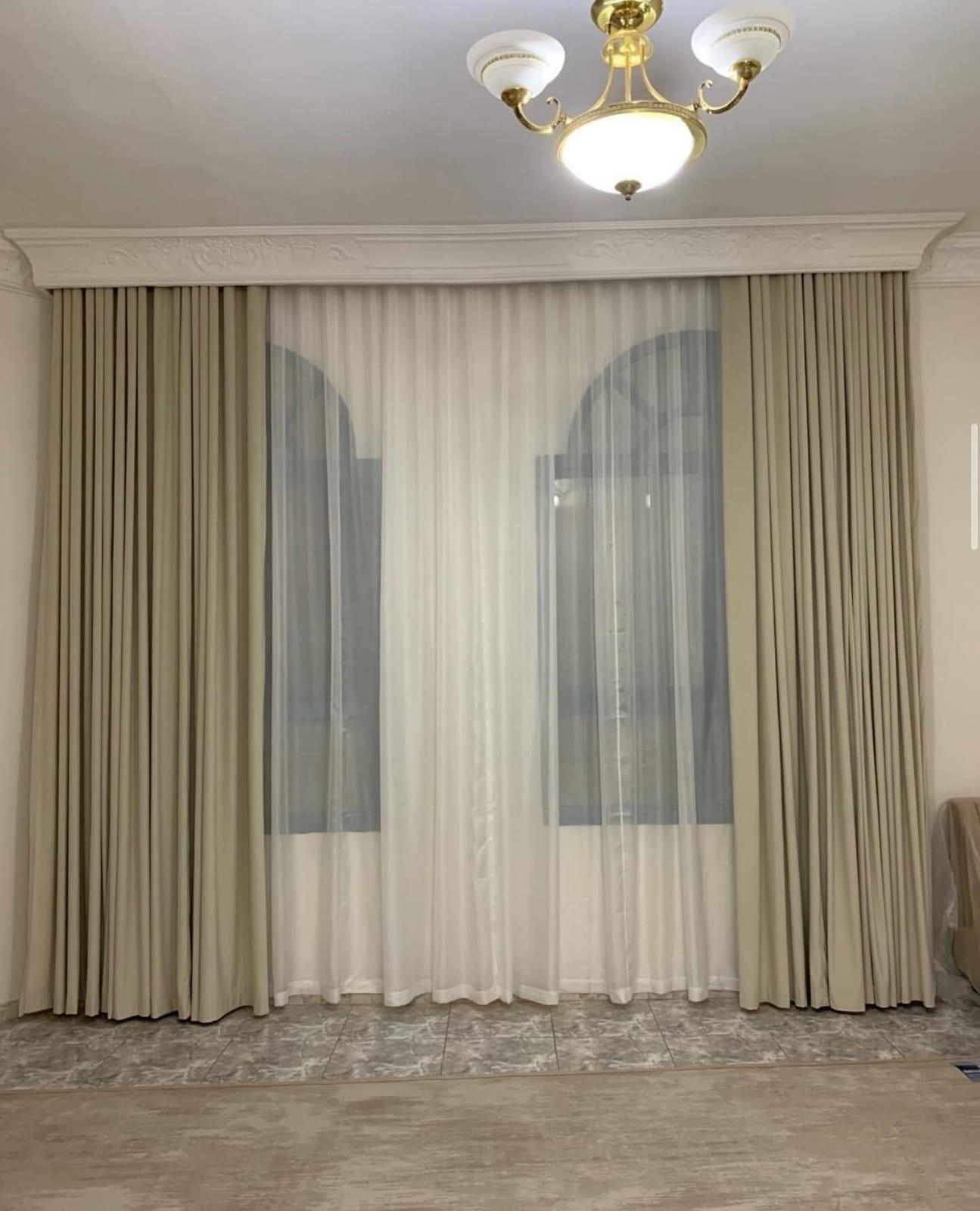
Step 5: note everything around the window
Most fitting-day problems are caused by things beside the glass. A window handle that sticks out, a deep sill, a split AC unit above the frame, a switch or socket beside it, a sliding door that is opened every day, or a wardrobe close to the wall can all change where the track goes or how the curtain stacks.
Write each one down with its distance from the frame, and photograph it. A curtain has to clear handles when it is drawn, and a track should not end where the AC blows straight into the fabric. For a balcony door, also note which side opens and where people walk; our article on balcony door curtains and blinds covers those in detail.
- Window handles, locks and deep sills or window boards.
- AC units, grilles, switches and sockets near the frame.
- Ceiling pockets, cornices and pelmets, with their depth.
- Sliding and balcony doors in daily use.
- Furniture that will stand near the window: beds, desks, sofas, wardrobes.
Ceiling-mounted tracks and curtain pockets
For a ceiling track running wall to wall, the width is measured between the walls at ceiling height, not at the window, and a little is deducted so the track ends clear of each wall. Measure it in more than one place, because walls are rarely parallel.
Where a room has a bulkhead or a step in the ceiling over the window, take the drop from the underside of whichever surface the track will be fixed to, and check that the curtain can travel past the step without catching. Bulkheads hiding AC ducts are common over UAE windows, and they are the usual reason a ceiling track has to stop short or change level.
For a curtain pocket in a gypsum ceiling, measure the width and depth of the pocket itself. One layer of curtain needs much less depth than two, and a motor head needs room at one end. If the pocket is not built yet, plan its depth with the curtains in mind; recesses for curtains in gypsum ceilings sets out how much room each arrangement needs.
Common curtain measuring mistakes
These are the mistakes we see most often when customers send their own sizes. None of them is hard to avoid once you know about it.
- Measuring the glass instead of the track: the curtain must be wider and longer than the window.
- Forgetting the stack-back, so the open curtain covers part of the glass.
- Fixing the track tight above the frame, which makes the window look short and lets light over the top.
- Using a fabric tape measure, or rounding every figure to the nearest 5 cm.
- Measuring one window and assuming the others in the room are the same.
- Measuring before the floor, skirting or ceiling is finished.
- Ignoring handles, sills and AC units until the curtain catches on them.
- Choosing a puddled length for a door or window that is opened every day.
Why our team laser-measures, and what happens on fitting day
During the free visit our team takes laser measurements of every window, checks whether the floor, ceiling and walls are level, agrees the mounting position with you, and notes every handle, socket and AC unit. You see fabric samples in your own light at the same time. The sizes on your quotation come from that survey, so you never have to stand behind your own tape measure.
Once you approve the fabric and the quotation, our Sharjah workshop cuts and sews each curtain to those sizes. Standard orders are usually fitted 3–5 working days later, and a rush order can be done in 48 hours.
On fitting day our team protects the floor, fixes the track level, hangs the curtains, sets the hooks so the hems clear the floor evenly, and checks that the panels overlap in the middle and stack clear of the glass. Before we leave, try every curtain yourself, open and shut. Workmanship carries our 24-month written warranty. To book a visit, start from our curtain installation and repair page or the curtains and blinds service.
Common questions
How much fabric goes into one curtain?
Roughly the track width multiplied by the fullness, 2 or 2.5 for most headings, and then by the drop, for each layer. Curtain prices and fabric maths.
How far past the window should blackout curtains go?
Far enough to overlap the wall on both sides, so no light shows at the edges when closed. Stopping light at the edges.
Does the heading change the measurements?
Yes. Wave, pinch pleat and eyelet take different fullness and stack differently, and eyelets are measured from the top of the pole. Curtain headings compared.
How much space do a sheer and a blackout need?
Two running paths, so more depth at the top and more stack-back at the sides than a single curtain. Two layers on two tracks.
How do I measure a sliding balcony door?
Measure the track past the side that opens and check the walking route, so the curtain stacks clear of the door. Balcony door curtains and blinds.
How is a roller blind measured instead?
A blind fits inside or outside the recess, so it is sized very differently from a curtain. Choosing between a blind and a curtain.

Sources & specifications
Manufacturer information applies to the named products and systems. Sources reviewed on 28 October 2026.
Want this planned for your home?
Consultation and measurement are free. Tell us the rooms, location and what you need; we arrange a sample visit and define the measured quotation.