Curtains · 11 min read · 28 April 2026
Blackout curtains letting light in? Where it leaks and how to stop it
Why blackout curtains leak light: the top, sides, middle and hem, fabric that glows, blind edges, and how to fix each gap, even on an existing curtain.

By Ali Haider Basra, Founder, Al Tareeq Decor · Contact our workshop
Key takeaways
- Most light reaches the room round a blackout curtain rather than through it: at the heading, the edges, the centre and the hem.
- Hang from the ceiling or a recess, and carry the track well beyond the frame so the curtain covers wall on both sides.
- Let the panels cross at the centre and stop the hem roughly a centimetre above the floor.
- If the fabric itself glows, a 3-pass blackout lining or a true blackout fabric fixes it.
- An existing curtain can often be saved with a better track, a pelmet, a lining or a blind behind it.
On this page
- Key takeaways
- Why a closed blackout curtain is not dark
- First, find where the light is coming from
- Light over the top of the curtain
- Light down the sides
- Light through the middle
- Light under the hem
- All four gaps in one drawing
- When the fabric itself lets light through
- Where the light comes from, and the fix
- Blackout blinds and their edges
- Fixing an existing curtain without starting again
- Rooms where real darkness matters
- How we plan a properly dark room
- Common questions
Why a closed blackout curtain is not dark
You bought blackout curtains, closed them, and the room is still not dark. We hear this constantly, and usually the cloth is innocent. Blackout describes the cloth: whether light passes through it. A dark room depends on the whole installation, and light is very good at finding the edges.
Light has five ways in: above the heading, along both edges, at the seam where the two panels close, beneath the hem, and occasionally through the cloth itself. Each has its own cause and its own fix, and fixing one while ignoring the others leaves the room only a little darker.
Below, each leak gets its own section, roughly from the brightest to the faintest, followed by ways to rescue a curtain you already own.
First, find where the light is coming from
Before changing anything, close the curtains on a bright morning and stand in the darkened room for a minute while your eyes adjust. Then study it. Does the fabric glow all over, or does the light gather in strips and bands at its edges?
A glow across the face of the fabric, or tiny bright dots, means light is coming through the cloth: the fabric or lining is not truly blackout, or it has pinholes or needle holes. Bright lines at the top, the sides, the middle or the floor mean the fabric is fine and the fitting is the problem.
Take a photo if it helps, but trust your eyes more; a phone camera brightens a dark room and can make the gaps look worse or better than they are. Most rooms show some of each, so note every source before deciding what to change.
Check again at night with the room lights off. Street lights, a neighbour's balcony or a lit car park can find gaps that the daytime test missed, and in a bedroom those are the ones that wake people up.
Light over the top of the curtain
The band above the heading is normally the brightest, because daylight from a high sky shines straight down past the heading. It happens when the track sits just above the frame, leaving open space between the heading and the wall or ceiling, and it is worst with eyelet curtains, whose pole sits above the fabric.
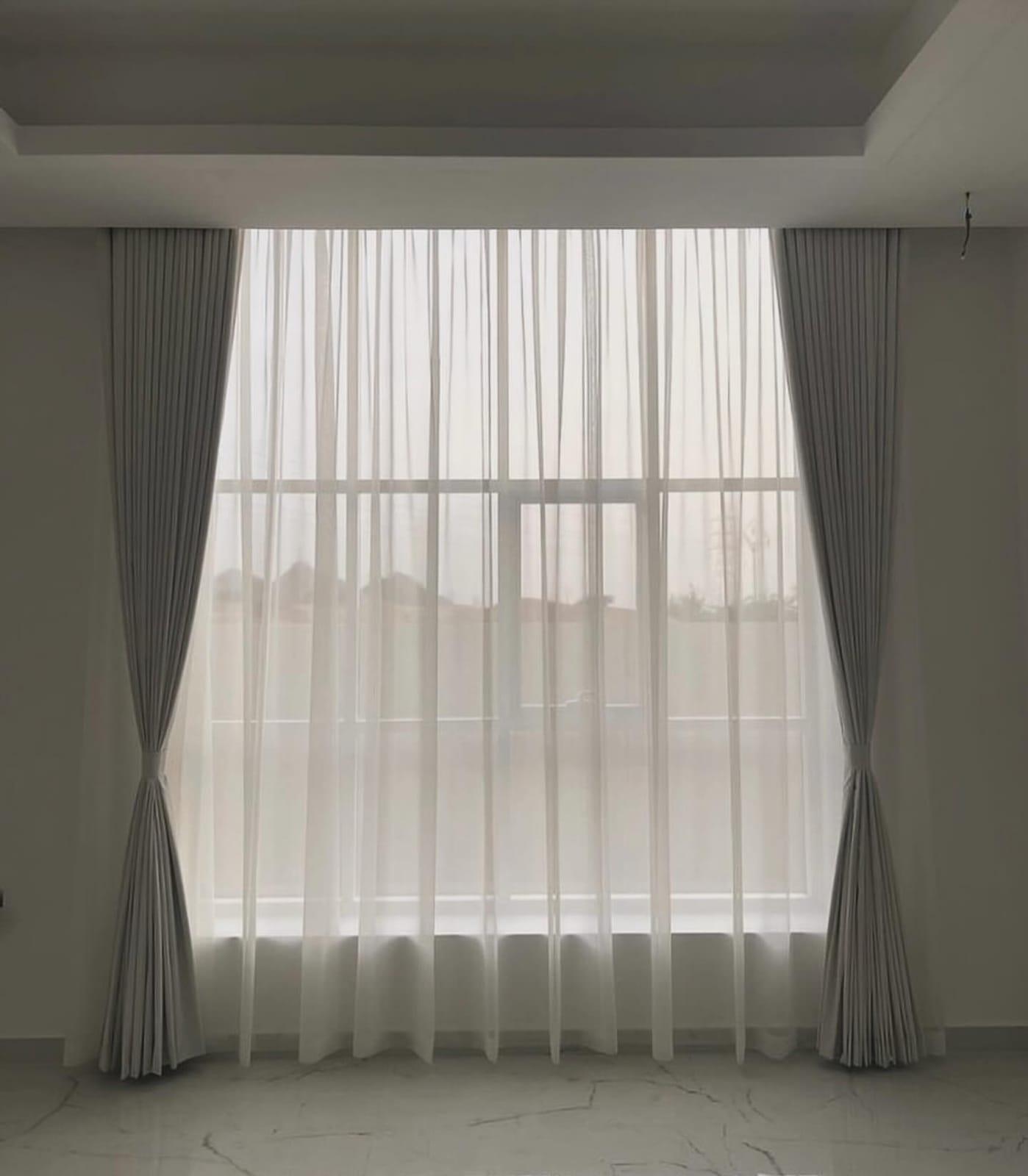
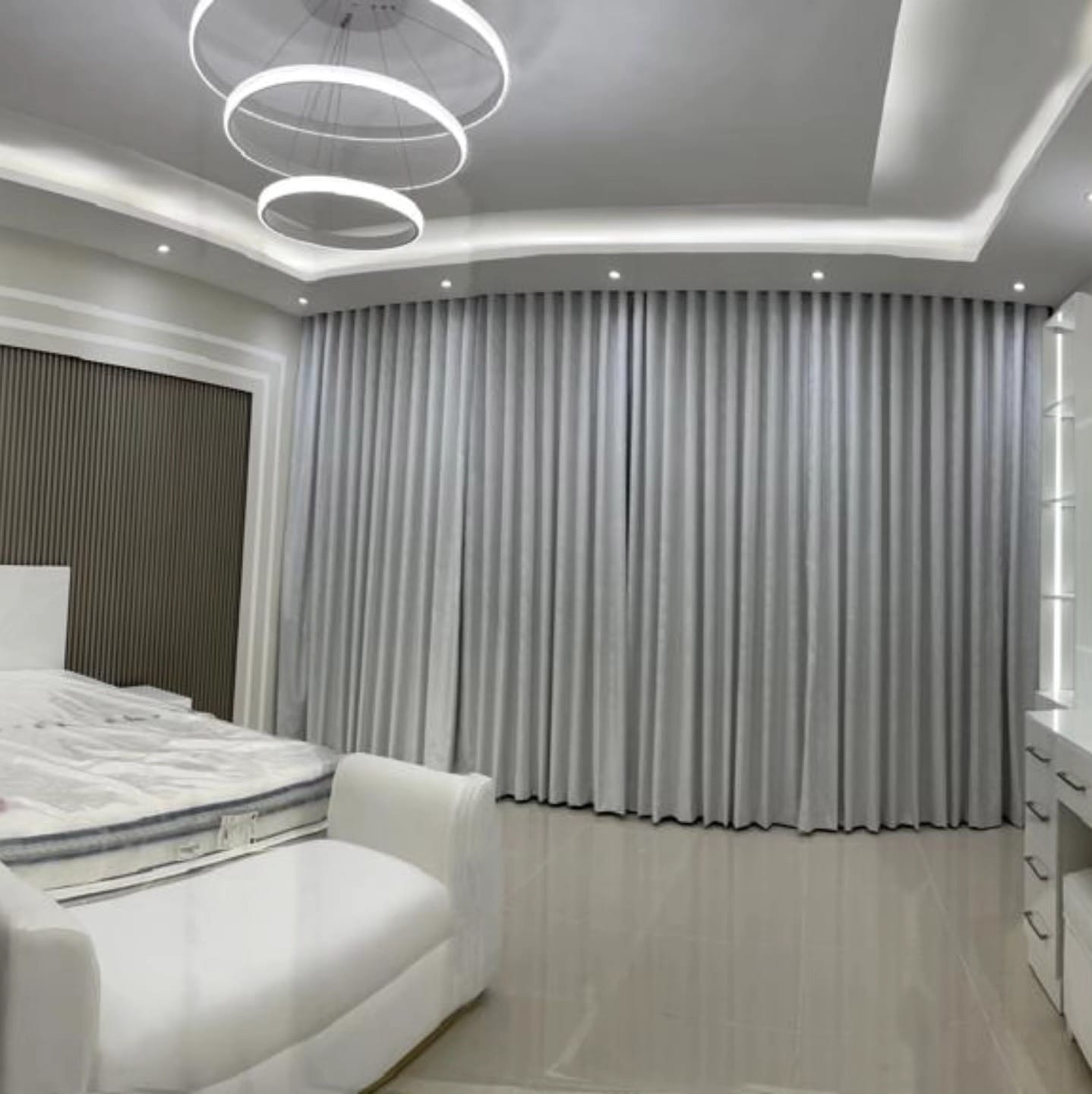
The cleanest fix is to hang the curtain from ceiling height. A ceiling-mounted track, or better still one recessed into a pocket, leaves nothing above the heading for light to pass. Where the ceiling cannot be used, a pelmet over the track closes the top, as long as it meets the wall.
If neither is possible, raise the track as high as the wall allows, well above the frame, so the light that gets over the top lands on the wall above rather than in the room. How such a pocket is formed is explained in recesses for curtains in gypsum ceilings.
Light down the sides
Edge leaks happen when the track ends at the frame or barely beyond it, so the closed curtain finishes in line with the glass rather than over the wall, and daylight spills round both sides.
Carry the track far enough beyond the frame that the shut curtain lies over the wall at each end. Dunelm's guide adds a minimum of 10 cm per side when the track goes outside the recess; for a properly dark room we usually go further, because a lined curtain also needs room to stack when open. Where the curtain runs to a wall, take the track all the way into the corner.
On a wall track, a return finishes the job: the curtain's outer edge turns back to the wall so the side is closed completely, not just overlapped. Hunter Douglas makes the same point for shades, recommending mounting outside the frame so the treatment overlaps the wall.
Watch for anything that stops the track short: a split AC unit beside the window, a wardrobe, a door frame or a light switch. Each is a common reason a track was cut to the frame in the first place. Often the track can pass above or around it, or the curtain can stack to one side only, so plan the obstruction instead of accepting the gap.
Light through the middle
Where two panels meet in the middle, they rarely meet perfectly. A curtain on a simple track leaves a thin vertical line of light where the two leading edges touch, and it opens wider every time the curtain is pulled from one side.
The answer is an overlap. Better tracks have an overlap arm, or master carriers that cross, so when the curtain shuts one leading edge sits several centimetres in front of its partner. Wave tracks can be set up the same way. On a single panel drawing one way, the problem disappears, which is one reason one-way curtains suit bedrooms.
Some people sew small magnets into the leading edges so they hold together. It helps on a light curtain, but a correctly overlapping track does the job more reliably and does not pull the fabric out of shape.
Light under the hem
A curtain ending at the sill, or a little above the floor, lets daylight out underneath and up the wall. On a tall window with sun low in the sky, that band can be surprisingly bright.
For a bedroom, take blackout curtains down to the floor. Dunelm's floor length stops roughly a centimetre clear of it, low enough to block the light without dragging. Floors are seldom level, so take the drop at several points and size from the lowest reading; measuring for curtains walks through it.
Where a sill-length curtain is unavoidable, for example above a desk or a low AC unit, a blackout blind behind it closes the window itself, and the curtain becomes decorative.
Balcony and sliding doors are a special case. The hem has to clear the door's bottom track and the threshold, so it cannot sit on the floor, and people walk through the curtain's path every day. Keep the hem a centimetre or so above the floor, run the track well past the side that opens, and if the door faces the morning sun in a bedroom, consider a blackout blind on the door frame as well.
All four gaps in one drawing
Here the identical blackout cloth appears twice, fitted in two different ways. On the left, a track the width of the frame and fixed tight above it, panels that only meet in the middle, and a hem short of the floor: light glows over the top, down both sides, through the middle and under the hem. On the right, it hangs from a ceiling recess, extends beyond the frame, crosses over at the centre and stops a fingertip above the floor.
Nothing about the fabric changed between the two. That is the point: in most rooms, darkness is a fitting question first and a fabric question second.
- 1. Over the top: a track tight above the frame leaves a bright band
- 2. Down the sides: a track no wider than the frame lets light spill round
- 3. Through the middle: panels that only meet leave a line of light
- 4. Under the hem: a curtain short of the floor lets light in below
- 5. A ceiling pocket, a wider track, an overlap and a floor-length hem close all four
When the fabric itself lets light through
Not every curtain sold as blackout is fully opaque. Some are dense dim-out fabrics, some have a light coating, and a dark colour can hide the difference in a shop. Press the real sample to a sunny pane and view it from inside: genuine blackout stays completely dark.
Coated linings vary too. James Dunlop Textiles explains that a single pass of coating makes a thermal lining that still lets some light through, while three passes make a blackout lining that stops light completely. If you want a decorative face fabric, ask for it to be lined with a 3-pass blackout lining.
Check for the small flaws too: pinholes in a coating, stitch holes along seams and hems, and the joins between fabric widths. A careful workroom positions seams where light will not show through, and a separate lining covers needle holes in the face fabric.
Where the light comes from, and the fix
Bright band over the top
- Usual cause
- Track tight above the frame; eyelet pole
- Fix
- Ceiling track or pocket, pelmet, or a higher track
Lines down the sides
- Usual cause
- Track no wider than the frame
- Fix
- Longer track, curtain overlapping the wall, returns
Line in the middle
- Usual cause
- Panels that only meet
- Fix
- Overlap arms or overlapping carriers; a one-way panel
Light under the hem
- Usual cause
- Curtain stops at the sill or short of the floor
- Fix
- Floor-length curtain, about 1 cm above the floor
Glow or dots across the fabric
- Usual cause
- Not truly blackout; pinholes; seams
- Fix
- 3-pass blackout lining or a true blackout fabric
Most rooms have more than one source. Fix them all, or the brightest remaining gap is the one you notice.
Blackout blinds and their edges
Blinds have the same problem in a different shape. A blackout roller set in the recess is cut a fraction narrower than the opening so it turns freely, so a slim bright edge appears either side, and the roll lets a little over the top. Fitted outside the recess, wider than the opening, it closes more of that.
For a truly dark room with a blind, add side channels that the fabric runs in and a cassette over the roll, or hang a curtain in front. Blinds.com's video below shows the common ways of covering a blind's edge gaps. Light-blocking strips stuck to the window frame are sold for the purpose too; they help a little, but they are a patch for a blind that was fitted inside the recess, not a substitute for fitting it outside or adding channels. Whether a blind should be used at all is weighed up in blinds compared with curtains.
Fixing an existing curtain without starting again
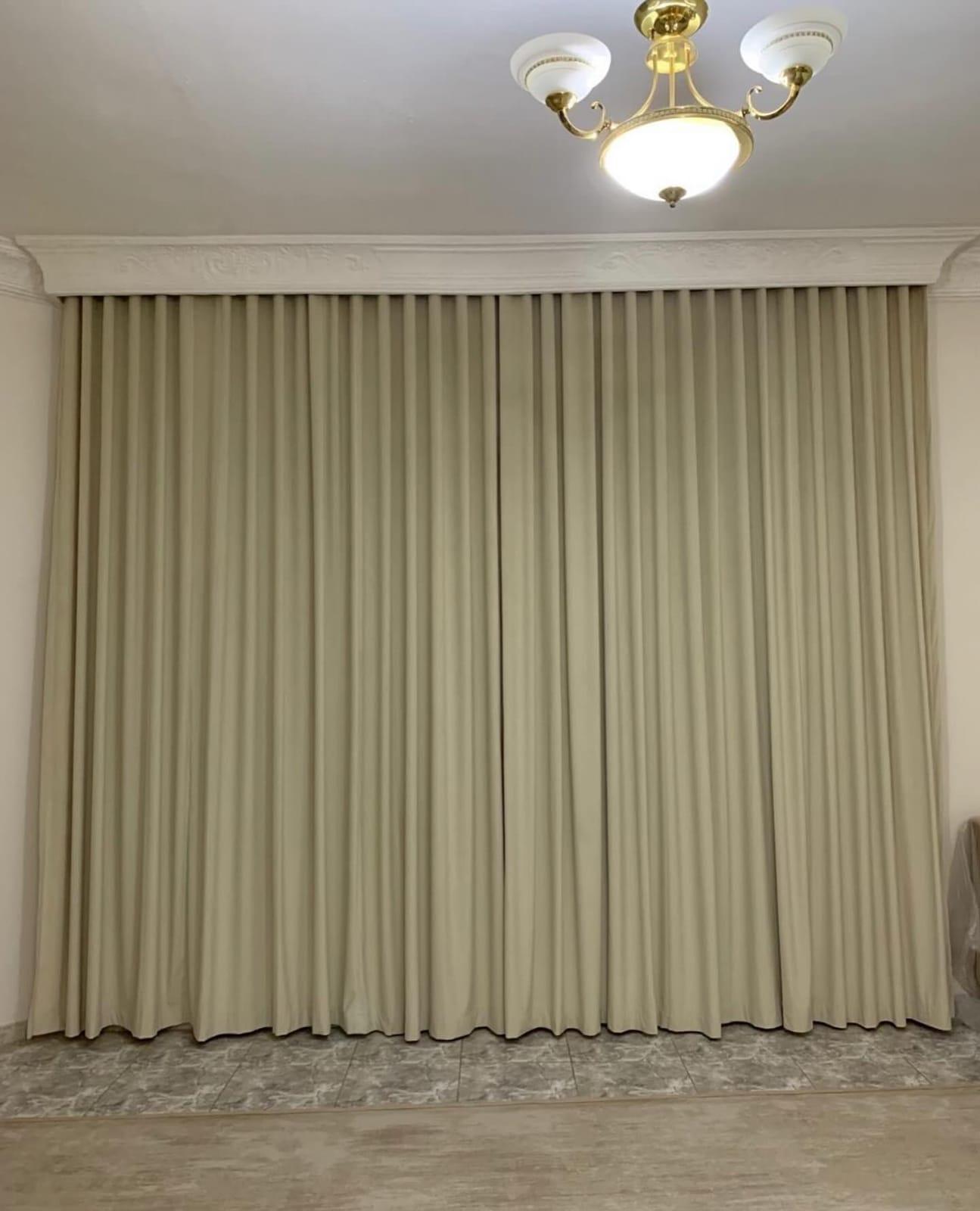
Often the curtain you already have can be kept. If the fabric passes the window test, change the fitting around it: a longer or higher track, a ceiling track instead of a wall one, a pelmet, an overlapping centre, or new hooks that bring the hem down to the floor.
If the fabric glows, a 3-pass blackout lining can usually be added behind the existing face fabric, which keeps the look you chose and makes it opaque. If the curtain is far too short or narrow, replacing it is better value than patching.
A blackout roller blind fitted behind an existing curtain is another quick fix: the blind does the darkening, the curtain does the looks, and the two together close more of the edges than either alone. The two-curtain version is covered in a sheer and a blackout on two tracks.
Rooms where real darkness matters
Not every room needs complete darkness, and sealing every edge costs more than a simple curtain. Spend the effort where it counts. In a living room, a little light at the edges is usually fine and even welcome; in a bedroom used for daytime sleep, every gap matters.
- Children's rooms, where afternoon naps and very early summer dawns both need darkness.
- Bedrooms of anyone who works nights or sleeps after a night flight.
- Master bedrooms facing east, where the sun arrives before the alarm.
- Media rooms and living rooms with a projector or a large screen.
- Guest rooms in villas with outdoor lighting or street lights nearby.
How we plan a properly dark room
Tell us which rooms must be dark and why. During the free visit we take laser measurements, look at the ceiling and wall above the window, and plan the curtain from the top down: a ceiling track or pocket where possible, a track that runs past the frame, an overlapping centre, a floor-length hem, and a true blackout fabric or 3-pass lining. We bring samples to hold against your window so you can see the difference in your own light.
Our curtains start from AED 550 per window for the entry specification; linings, pockets, longer tracks and second layers are listed separately on the quotation. Curtains are made at our Sharjah workshop and installed within 3–5 working days in most cases, or in 48 hours when the job is urgent; workmanship has a 24-month written warranty. Our curtain price guide explains the quotation.
See blackout curtains for finished work, or look through the curtains and blinds service.
Common questions
Are blackout curtains enough for a dark bedroom?
Only if they are fitted to close the edges; the fabric alone does not make the room dark. Blackout or sheer curtains.
How far should the track go past the window?
A minimum of 10 cm per side, more for lined curtains that need stacking room. Measuring for curtains.
How do I stop light over the top of my curtains?
Hang them from the ceiling or a ceiling pocket, or add a pelmet that meets the wall. Curtain pockets in gypsum ceilings.
Do two layers make a room darker?
They help, but only if the blackout layer is fitted to close its own edges. Hanging two layers together.
Which heading leaks least light?
Track-hung headings mounted at the ceiling, wave and pinch pleat; eyelets sit below a pole, so light passes above them. Wave, pinch pleat or eyelet.
Is a blackout blind darker than a curtain?
Not usually on its own, because of its side gaps; a blind behind a curtain is darkest. Roller blinds or curtains.

Sources & specifications
Manufacturer information applies to the named products and systems. Sources reviewed on 28 October 2026.
- Hunter Douglas: blackout and room darkening, and light at the edgeshunterdouglas.com(opens in a new tab)
- James Dunlop Textiles: 1-pass and 3-pass coated liningsfaq.jamesdunloptextiles.com(opens in a new tab)
- Dunelm: how to measure for curtains (track width and floor length)dunelm.com(opens in a new tab)
Want this planned for your home?
Consultation and measurement are free. Tell us the rooms, location and what you need; we arrange a sample visit and define the measured quotation.