Curtains · 11 min read · 3 May 2026
Curtain pockets in gypsum ceilings: sizing, motors and fixing
How to plan a curtain pocket in a gypsum ceiling: what it must hold, width and depth, double tracks, motors, track support, light gaps and pelmet alternatives.

By Ali Haider Basra, Founder, Al Tareeq Decor · Contact our workshop
Key takeaways
- A curtain pocket hides the track inside the gypsum ceiling; it must be planned before the ceiling is framed.
- Choose layers, heading and manual or motorised first: they decide the pocket's width and depth.
- The track needs solid support built into the frame; gypsum board alone will not hold curtains.
- A motor needs space at one end, a power point and an access route without cutting the ceiling.
- Measure the curtains from the finished pocket and finished floor, not from the drawing.
On this page
- Key takeaways
- What a curtain pocket in a gypsum ceiling is
- Choose the curtains before you size the pocket
- Sizing the pocket: width, depth and clearance
- One track or two: sheer and blackout in one pocket
- Motorised curtains in a ceiling pocket
- Fixing the track: the board is not the support
- Light over the top, at the edges and in the middle
- No false ceiling? Pelmet boxes and plaster-in tracks
- Light inside the pocket
- The order of work, and when curtains are measured
- Pocket checklist by set-up
- What a curtain pocket must hold
- Before you approve the drawing
- Common questions
What a curtain pocket in a gypsum ceiling is
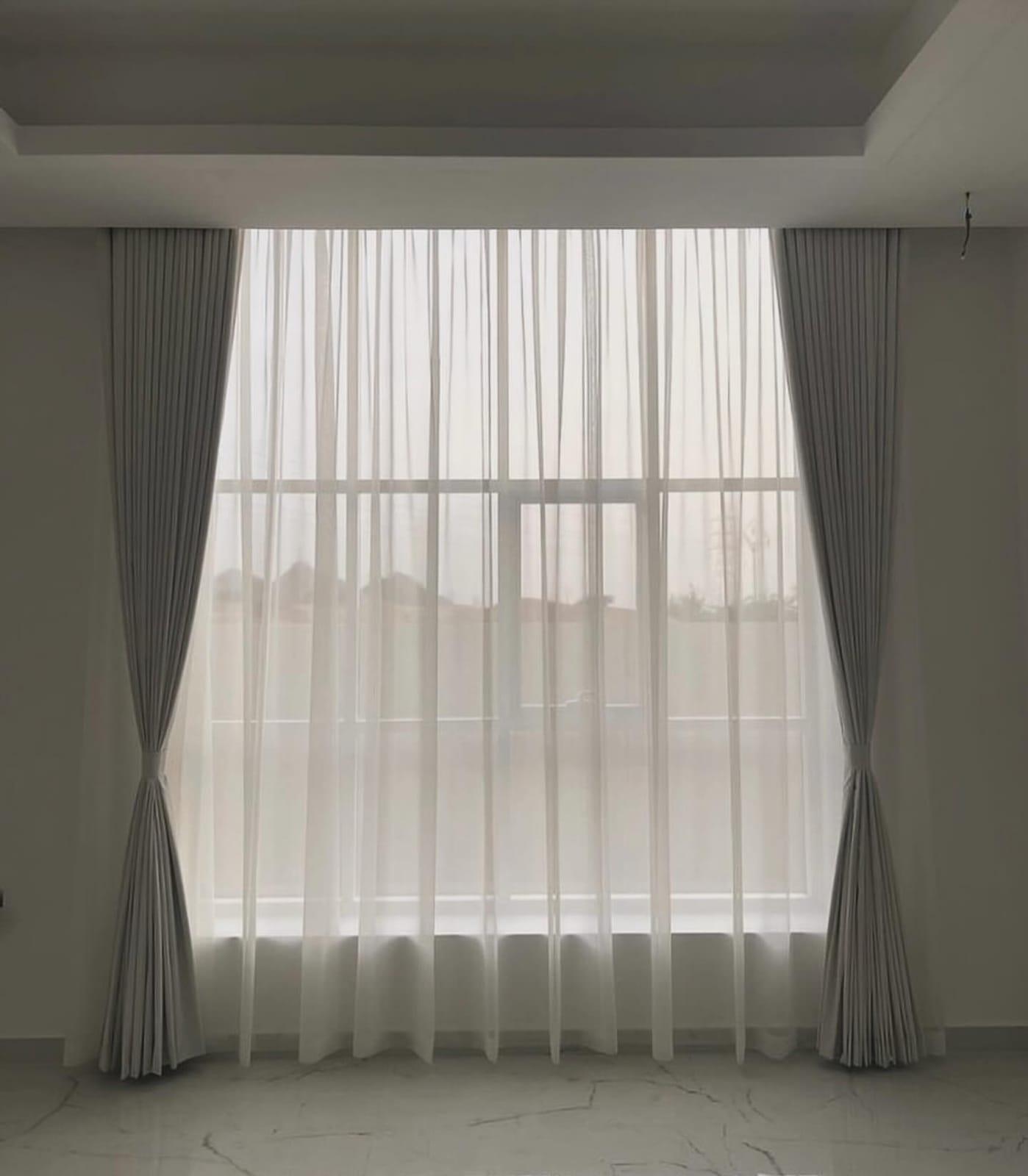
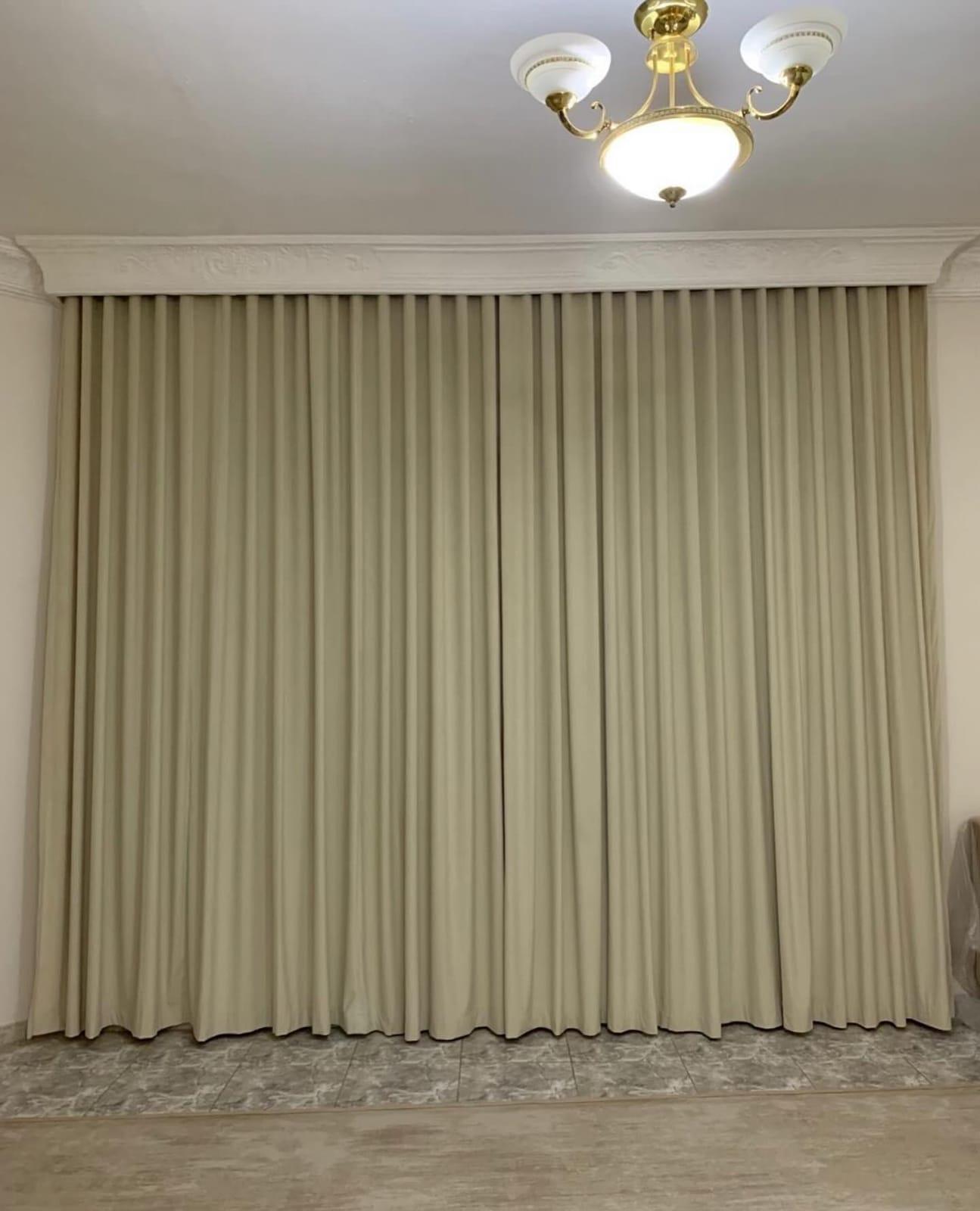
A curtain pocket means a recess formed within a gypsum false ceiling above the windows. The curtain track is fixed inside it, so from the room you see fabric rising into the ceiling with no rail, brackets or heading in sight. It is also called a curtain box in a gypsum ceiling or a hidden curtain track, and few details change how finished a room looks as much.
There are other ways to hide a track. A pelmet box is a separate box mounted on the wall or slab ahead of the track, often covered in fabric; it needs no false ceiling. A plaster-in track goes the other way: the track itself is set flush into the ceiling and skimmed in, leaving only a slot. A pocket sits between the two: it needs a false ceiling, but it hides more than a flush track and can hold two tracks and a motor.
Because a pocket is part of the ceiling, it has to be decided before the ceiling is framed. Adding one later means opening the ceiling along the whole window wall.
Choose the curtains before you size the pocket
The pocket exists to hold a particular set of curtains, so start with them. How many layers will hang there: one curtain, or a sheer behind a blackout? Which heading: a wave heading needs its own track and carriers, pinch pleats sit differently, and eyelets need a pole rather than a track, which makes them a poor fit for a pocket. Will the curtains be drawn by hand or by a motor?
Each answer changes the space the pocket must give. A single manual track needs the least; a double track with a motor at one end needs the most. Then think about where the fabric ends up once the curtains are open. Gathered curtains need somewhere to stack, usually beside the window rather than across the glass, so the pocket often has to run past the window frame at one or both ends. A pocket that stops exactly at the window edges leaves the open curtains blocking part of the view and the daylight. Agree the stack position on the drawing, and the pocket length follows from it. Copying a pocket size from a picture of someone else's room, with different curtains, is how pockets end up too narrow for the second track or too shallow to hide the heading. Heading choices are compared in wave, pinch pleat or eyelet curtains.
Sizing the pocket: width, depth and clearance
The drawing shows a pocket cut through at the window, with a sheer near the glass and a main curtain in front. Three measurements decide whether it works.
Width runs from the window wall to the inner face of the pocket. It must take every track, with room between them so the two fabrics can move past each other without rubbing, and room ahead of the main curtain so its folds do not catch the pocket edge. Depth runs from the pocket's top down to the ceiling line. It should be enough that the track, the runners and the curtain heading sit above the ceiling line, out of sight from the room.
Clearance is about the window itself. The sheer must hang clear of the glass, the window frame, and any handles or locks, or it will snag every time it moves. We size each pocket from the chosen track system's own data and the curtain heading, measured on site, rather than from a single standard figure. A size that suits one track can be wrong for another.
Corners and bay windows need extra care. Many tracks can be bent or joined to follow a corner or a curve, but the pocket must follow the same line with enough room on the inside of each bend. Where two windows meet at a corner, decide whether one curtain turns the corner or two curtains meet there, because that changes both the track and the pocket. These are drawn individually rather than taken from a straight-run detail.
- 1. Width: room for every track, and for both fabrics to move freely
- 2. Depth: the track, runners and heading sit above the ceiling line
- 3. Clearance: the sheer hangs clear of the glass, frame and handles
- 4. Motor: reachable for service without breaking the ceiling
- 5. The fabric rises into the pocket, so less light escapes over the top
One track or two: sheer and blackout in one pocket
Many UAE bedrooms and living rooms use two layers: a sheer that softens the sun and gives daytime privacy, plus a heavier blackout layer for evenings and sleep. In a pocket, the sheer usually goes on the track nearer the glass and the main curtain in front, so the sheer can stay closed while the heavier layer is opened.
Two tracks need a wider pocket and a little more thought about where each layer stacks when it is open. If both stacks gather at the same end, they compete for the same space in the pocket. The way the two layers are planned is set out in sheer and blackout double-track curtains.
Motorised curtains in a ceiling pocket
A motor usually sits at one end of the rail, so the pocket must be long enough and deep enough there to hold it, and its shape must let the motor come out for service. The motor also needs power: a socket or a fused connection inside the void near that end, planned on the drawing. Our team does small electrical jobs like this as part of the work, shown as its own line.
Think about the day the motor needs attention. If the pocket is open along its underside, the motor can be reached from below; if the end is boxed in, a removable panel or a short open section gives access without cutting the ceiling. Motor makers' instructions describe how their units mount and come off, and those instructions decide the space.
Which motor to choose, how it is controlled and how it links to a smart home are covered in motorised curtains in the UAE. For the pocket, what matters is the motor's size, its power point and the route to reach it.
Fixing the track: the board is not the support
Curtains are heavy, especially lined blackout curtains across a wide villa window, and they are pulled every day. A track screwed only into gypsum board will eventually loosen. The track needs solid support: a timber or steel member built into the ceiling frame at the right line, or a fixing back to the slab, placed before the pocket is boarded.
That support is easy to forget because two trades share it. The ceiling team builds the pocket; the curtain team fixes the track. Agree who provides the backing and at what line, and put it on the drawing. When we build both the ceiling and the curtains, we plan that line once.
Watch the AC as well. A linear slot diffuser right in front of the pocket blows straight down the face of the curtains, which makes them sway and can carry dust onto the fabric. Place the supply slot a little way into the room, or angle its blades away from the window, and agree that position with the AC contractor before the ceiling closes.
Light over the top, at the edges and in the middle
One quiet benefit of a pocket is that the fabric starts above the ceiling line, so light cannot leak over the top of the curtain as it does with a bracket-mounted track. For bedrooms where people sleep in daylight, that matters.
A pocket does not seal the sides or the meeting point in the middle, though. Light still escapes where the curtain ends beside the window and where two panels meet, and those gaps are solved with returns, overlaps and enough fabric width, not by the ceiling. The causes and fixes are covered in blackout curtain light gaps.
No false ceiling? Pelmet boxes and plaster-in tracks
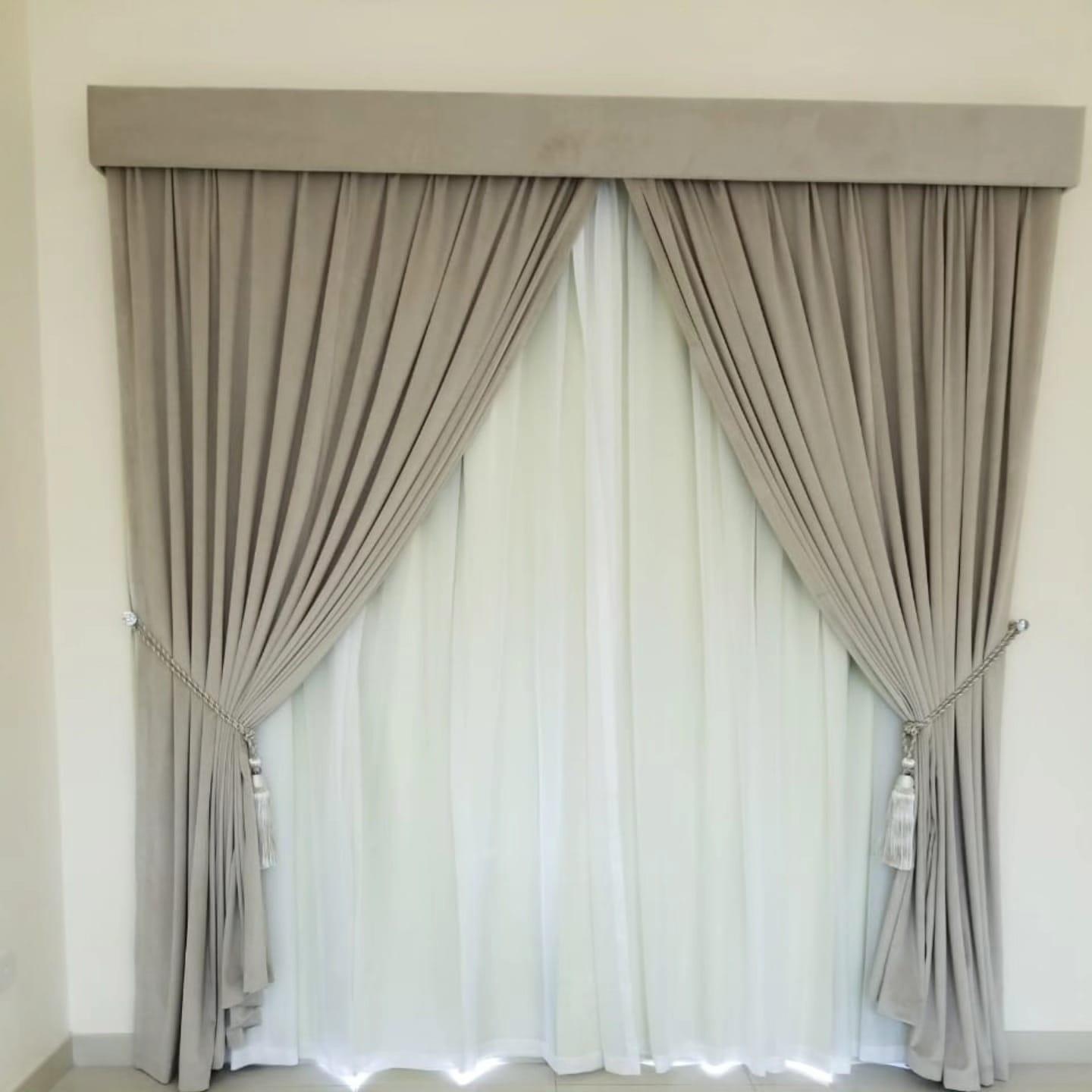
People often search for a curtain pelmet without a false ceiling, because a full ceiling is more work than they want. There are two good routes. A pelmet box, fixed to the wall or the slab above the window and often upholstered to match the curtains, hides the track and heading and needs no gypsum work at all.
The second route is a plaster-in recessed track. Blindspace, for example, makes trims that let Somfy, Silent Gliss and Lutron curtain tracks be plastered in flush with the ceiling, powder-coated to match, forming what it calls a mini pocket. That needs a ceiling being plastered or boarded anyway, but not a full lowered band. The short video below shows how the trim is installed.
Light inside the pocket
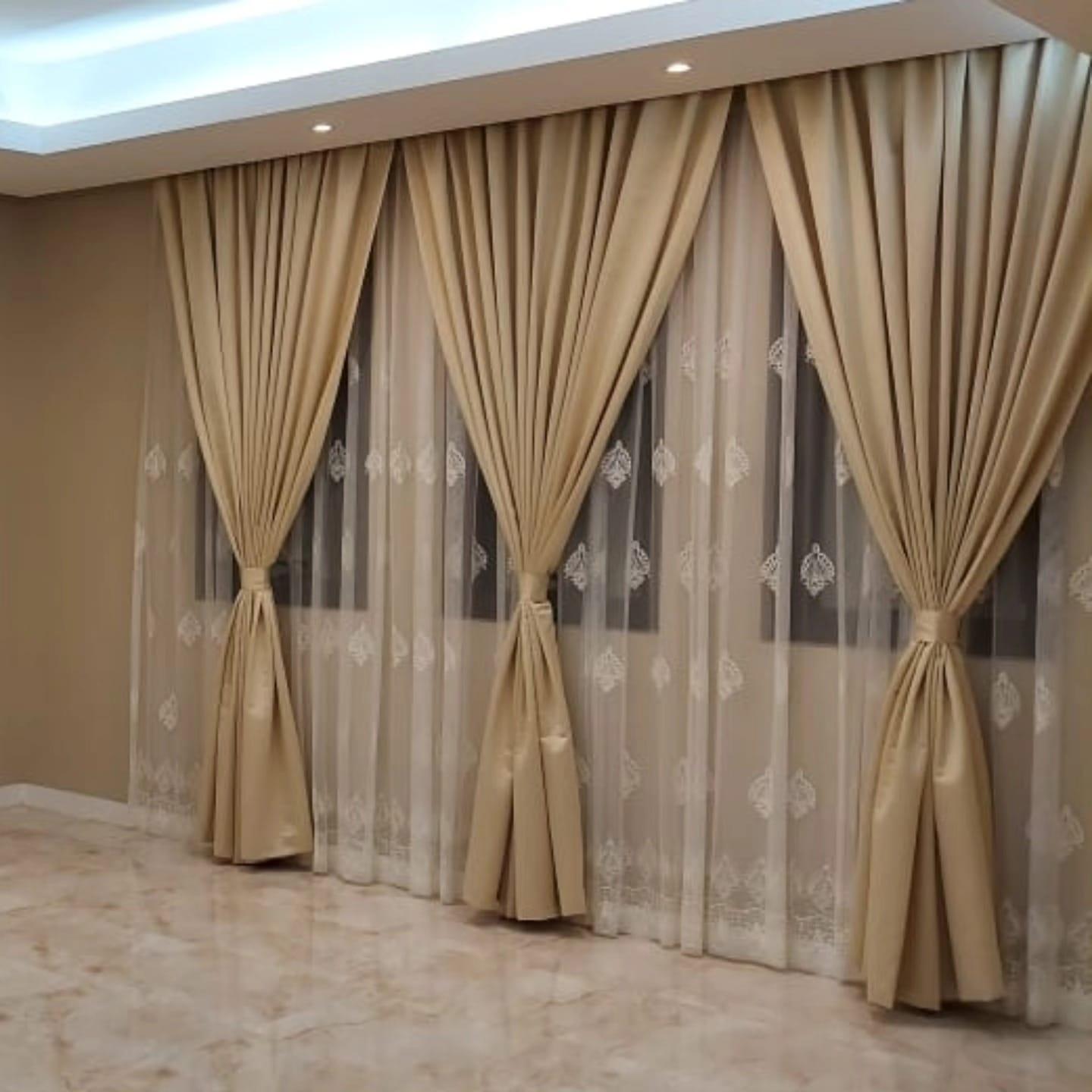
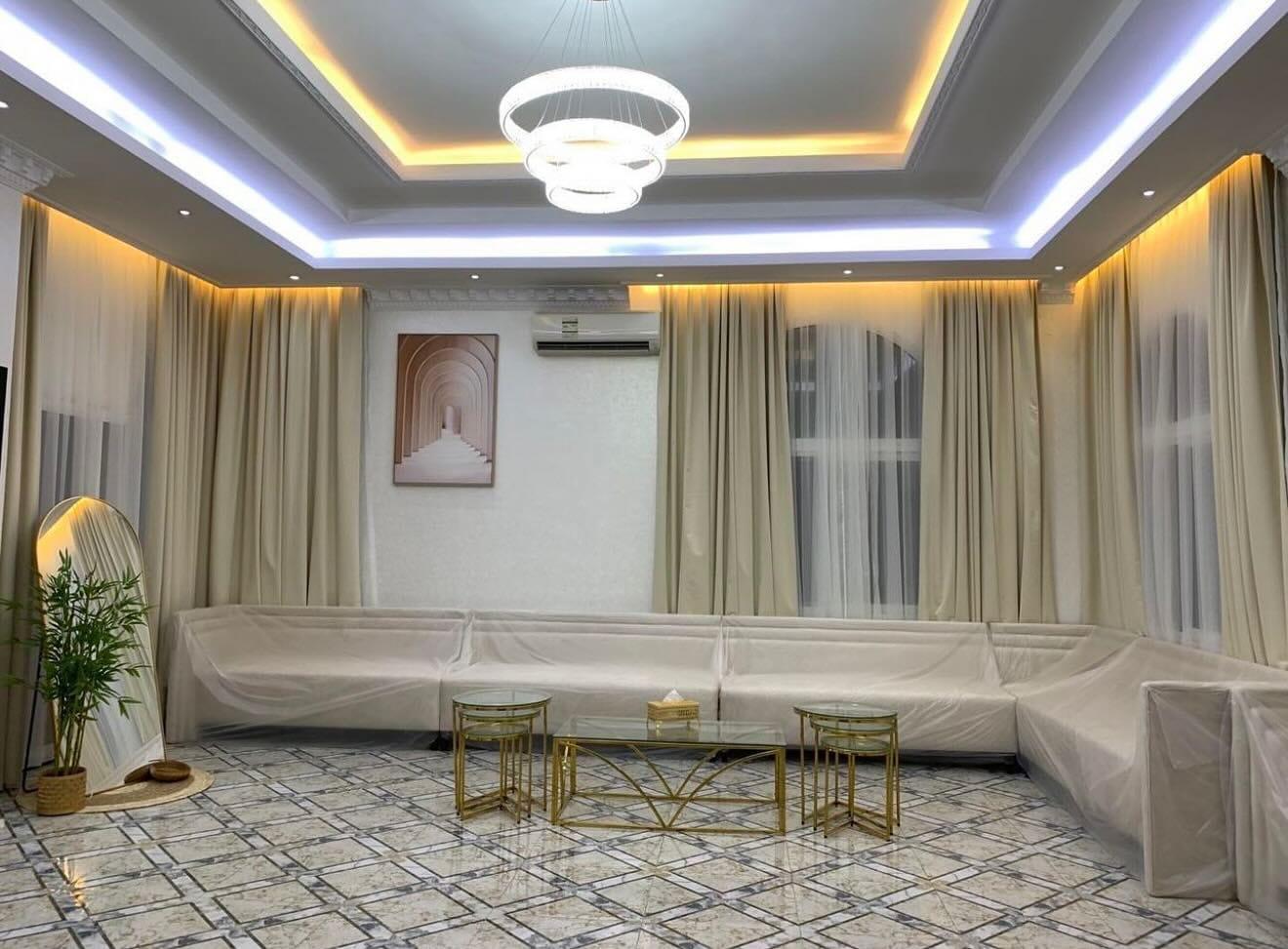
A warm LED strip in the pocket, washing down the face of the curtains, is a lovely evening effect, especially in a majlis where curtains run the length of a wall. The majlis below uses exactly that, with curtains vanishing into a glowing recess under a two-level ceiling.
Plan it the same way as a cove: the strip goes where people cannot see it directly, the light falls on the fabric rather than into eyes, and the driver sits somewhere reachable; the white, dimming and driver rules in our media wall lighting ideas apply when the pocket and a TV wall share one room. Keep the strip clear of the fabric's path so the curtains do not rub it every time they move.
The order of work, and when curtains are measured
Pockets only work when the trades follow each other in the right order. First the curtain choice is settled and the pocket drawn. Then the ceiling is framed with the pocket and its track support, boarded, jointed and painted; our gypsum work runs to roughly two days per ordinary room. Then the curtains are measured from the finished pocket, because the final drop depends on the real ceiling and the finished floor, not on the drawing.
Our standard curtains are ready in three to five working days after measuring and fabric selection, and the track and curtains are fitted by our own team. If tiles or marble are still to go down, wait for the finished floor before the final measurement, or the curtains will hang at the wrong length.
Pocket checklist by set-up
The table sums up what the pocket must take for the most common set-ups. Use it with the drawing at the design visit; the exact width and depth come from the chosen track and heading.
What a curtain pocket must hold
One manual curtain
- The pocket must take
- One track, its runners and the heading
- Watch for
- Handles and window frames close to the fabric
Sheer and curtain, manual
- The pocket must take
- Two tracks with space for both fabrics to move
- Watch for
- Where each layer stacks when open
Sheer and curtain, motorised
- The pocket must take
- Two tracks, the motor at one end, a power point
- Watch for
- Access to the motor without cutting the ceiling
Pocket with a light strip
- The pocket must take
- Tracks plus a strip and driver out of the fabric's path
- Watch for
- Glare, and reaching the driver later
No false ceiling
- The pocket must take
- A pelmet box or a plaster-in recessed track instead
- Watch for
- Fixing to solid wall or slab
A planning summary. We size each pocket from the selected track system and the measured window.
Before you approve the drawing
Our curtains start at AED 550 per window for the entry specification (manual track, fabric and installation), and a flat gypsum ceiling starts at AED 70 per m²; the pocket, track support, motor power and any light strip are lines of their own. The ceiling side is explained in false ceiling designs for living rooms and majlis, and our curtain work in curtains and blinds. Before you sign off, check that the drawing shows:
- The curtains chosen: layers, heading and manual or motorised
- Pocket width and depth taken from the chosen track and heading
- Clearance from glass, frames and handles
- Solid track support built into the frame, and who provides it
- A power point and service access for any motor
- Final curtain measurement after the ceiling and floor are finished
Common questions
How deep should a curtain pocket be?
Deep enough that the track, runners and heading sit above the ceiling line; the figure comes from the chosen track and heading. Curtain measurement and installation.
Can motorised curtains go in a ceiling pocket?
Yes, if the pocket has room for the motor at one end, a power point in the void and an access route for service. Motorised curtains in the UAE.
Which track goes nearer the window?
Usually the sheer, so it can stay closed while the heavier curtain in front is opened. Sheer and blackout double-track curtains.
Does a curtain pocket stop light gaps?
It stops light over the top, but the sides and the middle still need returns and overlaps. Blackout curtain light gaps.
Can I have a hidden track without a false ceiling?
It can be done: a pelmet box on the wall, or a track plastered in flush with the ceiling, hides it. False ceiling designs for living rooms and majlis.
Can I add a pocket to a ceiling that is already built?
Yes, by opening the ceiling along the window or adding a lowered band there, then repainting. It is ceiling work with its own price. False ceiling cost per m².

Sources & specifications
Manufacturer information applies to the named products and systems. Sources reviewed on 28 October 2026.
- Architecture & Design: Blindspace plaster-in recessed curtain tracks for Somfy, Silent Gliss and Lutronarchitectureanddesign.com.au(opens in a new tab)
- Knauf UAE: KC 001 suspended ceiling system (ceiling hung below the slab, services in the void)knauf.com(opens in a new tab)
- Knauf UAE: access panels for reaching equipment above a ceilingknauf.com(opens in a new tab)
Want this planned for your home?
Consultation and measurement are free. Tell us the rooms, location and what you need; we arrange a sample visit and define the measured quotation.