Curtains · 11 min read · 9 May 2026
How to clean curtains and blinds: sheers, blackout, Roman and roller blinds
How to clean curtains and blinds in UAE homes: reading the care label, cleaning in place, washing sheers, blackout curtains, velvet, roller and Roman blinds, motors and mould.

By Ali Haider Basra, Founder, Al Tareeq Decor · Contact our workshop

Key takeaways
- The care label decides: it shows the most a fabric can take, from water temperature to ironing.
- Vacuum curtains in place with a soft brush on low suction every few weeks; most never need washing often.
- Wash sheers on a gentle, cool cycle if the label allows, and hang them back while still damp.
- Never tumble-dry or iron a blackout coating; when unsure, vacuum and spot-clean only.
- Keep water away from blind motors and dry blinds fully before rolling them up.
On this page
- Key takeaways
- Why curtains in UAE homes need regular care
- Read the care label before anything else
- A simple care routine
- Our suggested care routine for curtains and blinds
- How to clean curtains without taking them down
- How to wash sheer curtains
- Can blackout curtains be washed?
- Velvet, embroidered and lined curtains
- How to clean roller and Roman blinds
- Motorised curtains and blinds
- Mould, condensation and sun
- Taking curtains down, re-hanging them and getting help
- Common questions
Why curtains in UAE homes need regular care
Curtains in the Emirates work harder than in most places. Fine desert dust settles on every fold, even with the windows shut, and sand rides in on the wind through balcony doors. Afternoon sun beats on the fabric for hours. The AC keeps the room dry, but on humid summer mornings the glass behind the curtain can run with condensation, and the hem of a lining that touches it stays damp. In open-plan flats, cooking adds a thin film of grease to the curtains nearest the kitchen.
None of this means curtains should be washed often. Too much washing shortens their life faster than dust does. The goal is a light routine that stops dirt building up, plus the right deep clean, done the right way, when it is really needed. This guide covers both, fabric by fabric, and starts with the one thing that decides everything else: the label sewn into the curtain.
Read the care label before anything else
Every made-to-measure curtain has a fabric with its own care rules, and the label or the fabric reference on your order is the final word. GINETEX, the international association behind the familiar care symbols, describes them as information on the maximum permitted treatment for a textile. In practice that means: a wash tub shows the item can be washed, and the number in it is the highest water temperature in degrees Celsius; a hand in the tub means hand wash only; a circle means professional cleaning; a square shows the drying rules; and an iron with dots shows the heat allowed. A cross through any symbol means do not.
A made-to-measure curtain is several materials sewn together: the face fabric, any lining, the heading tape, sometimes trims. Each can respond in its own way to water and heat, so the label of the finished curtain counts more than what you know about the fabric alone. If the label is missing or unreadable, find the fabric reference on your order, or send us a photo before cleaning. The decision path below covers the usual cases.
- 1. The care label: the maximum treatment the fabric can take
- 2. Blackout coatings: vacuum and spot-clean; no dryer, no iron on the coating
- 3. Sheers and light washable fabrics: gentle, cool cycle, then hang
- 4. Velvet, silk, embroidery or dry-clean only: a professional cleaner
- 5. Blinds and motors: never soaked; vacuumed and wiped
A simple care routine
Most of the work is light and regular. Dust removed every few weeks never gets the chance to bind into the fibres, and a spill dealt with on the day rarely becomes a stain. The deep clean then only needs to happen when a curtain actually looks grey or dull, not on a fixed calendar.
The table gives our suggested routine for a typical UAE home. Adjust it to your rooms: a curtain beside a balcony door or near the kitchen needs more attention than one in a guest bedroom that is rarely used. If a curtain still looks dull after vacuuming, that is the sign a deep clean is due, whatever the calendar says.
Our suggested care routine for curtains and blinds
Vacuum curtains and Roman blinds
- How often (our suggestion)
- Every two to four weeks
- How
- Soft brush attachment, low suction, top to bottom
Dust roller and Venetian blinds
- How often (our suggestion)
- Every two to four weeks
- How
- Brush attachment or a dry microfibre cloth
Spot-clean marks
- How often (our suggestion)
- As soon as they happen
- How
- Blot with a damp cloth; test hidden first
Check hems at the glass
- How often (our suggestion)
- Monthly in summer
- How
- Look for damp or dark spots on the lining
Wash sheers
- How often (our suggestion)
- When they look grey
- How
- Gentle cool cycle if the label allows
Deep clean blackout or velvet
- How often (our suggestion)
- Only when needed
- How
- Spot-clean or a professional cleaner
Suggestions for a typical home, not a rule; the care label of each fabric comes first.
How to clean curtains without taking them down
Most curtains never need to come off the track for routine cleaning. Close them fully so the fabric hangs flat, then vacuum from the top down with the soft brush attachment on a low setting, paying attention to the heading and the tops of the folds where dust collects. The blackout maker Sleepout recommends a soft-bristle brush, a lint roller or a vacuum's brush head on low, and that suits most fabrics.
For a mark, blot rather than rub: a clean white cloth, a little water or a drop of mild detergent, working from the outside of the mark inwards, then blot dry. Always try it first on a hidden spot, such as the back of the hem or the edge that sits in the stack. Handheld steamers are popular for freshening curtains in place, but steam can leave watermarks on some fabrics, shrink others and damage blackout coatings, so use it only where the label allows ironing and only on the face fabric.
How to wash sheer curtains
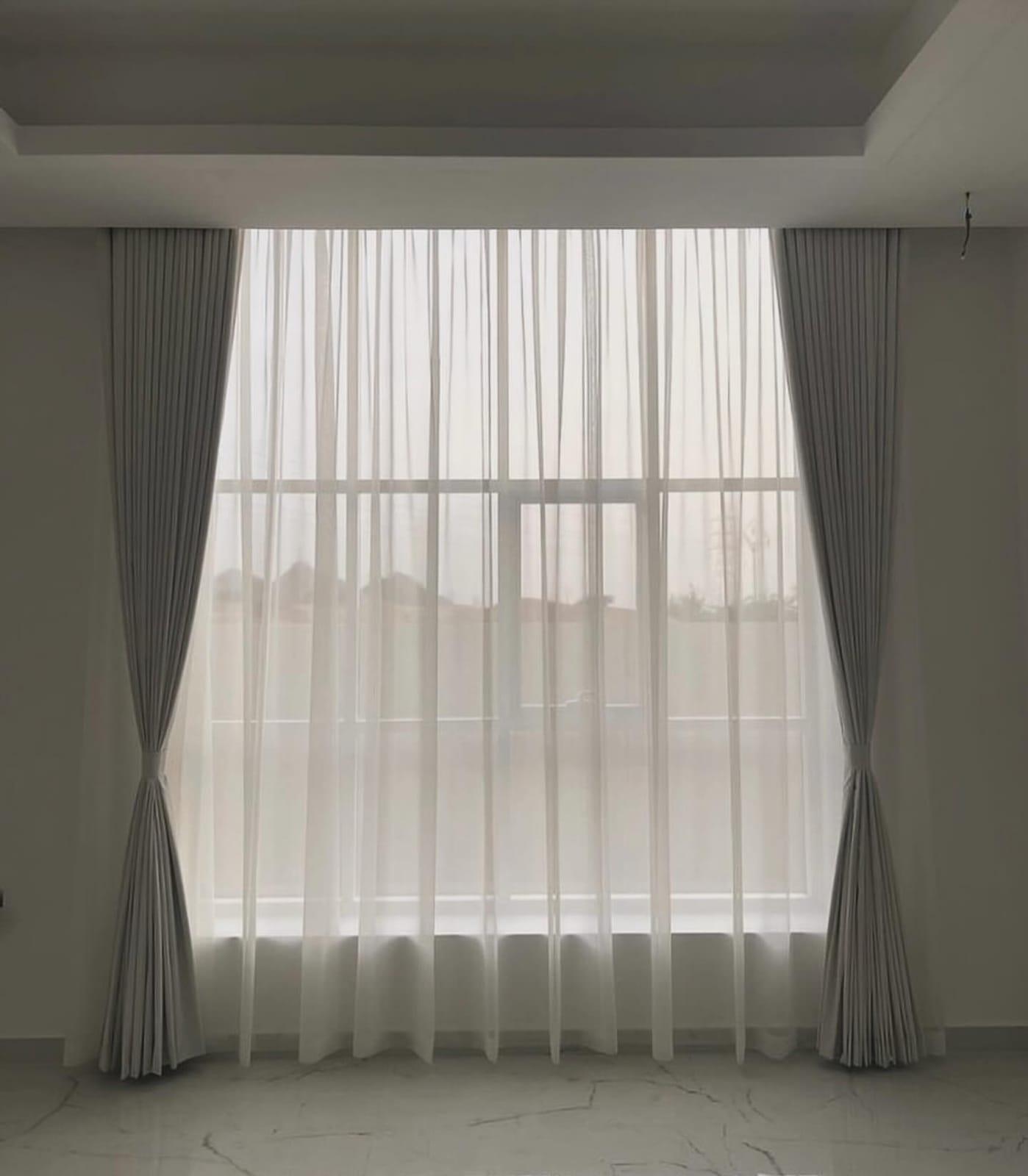
Sheers are the curtains most often washed, because they sit closest to the glass and show dust and city haze quickly. Where the label shows a wash tub, take them down, remove every hook or glider, and wash them on a gentle or delicates cycle in cool water with a mild detergent. A large mesh laundry bag protects the fine weave, and a half-empty drum lets the fabric move freely, so creases do not set.
Skip the spin if you can, and never wring a sheer. The easiest way to dry it is to hang it back on its track while still damp, with the window closed and the AC running: the weight of the fabric pulls most creases out as it dries. Avoid chlorine bleach unless the label shows the plain triangle that allows it. Embroidered, beaded or metallic sheers are a different case and usually need professional care.

Can blackout curtains be washed?
This is the question people search most, and the honest answer is: it depends on how the blackout is made. A blackout curtain usually gets its darkness from a coating, a layer of foam or acrylic bonded to the back of the fabric, or from a separate blackout lining sewn behind the face fabric. Coatings are the delicate part. Sleepout, which makes blackout fabric, allows a gentle cycle in cool or lukewarm water with a mild, non-bleaching detergent for its own product, but says never to use a clothes dryer, because heat can melt or permanently damage the coating, and never to iron the coating directly.
Other makers are stricter. Russell's, a New Zealand curtain retailer, advises against washing its curtains at all, even dry cleaning, and recommends spot cleaning instead. That contrast is the point: two blackout curtains that look the same can need very different care. For blackout curtains we make, follow the label or ask us with your order details before washing. When in doubt, vacuum and spot-clean only; a cracked or peeling coating cannot be repaired, and the curtain stops being a blackout.
Velvet, embroidered and lined curtains
Heavy, decorative and lined curtains are where home washing does the most damage. Velvet crushes and marks when wet, embroidery and beading snag, and a lined curtain combines two fabrics that may shrink by different amounts, so a curtain that went into the machine straight can come out with a puckered hem or a lining that pulls the face out of shape. Many of these fabrics carry a circle on the label for professional cleaning.
For these, keep to vacuuming and spot cleaning at home, and use a professional cleaner for a deep clean. Tell the cleaner what the curtain is made of and show them the label; ask whether they will clean the curtain flat or hung, and how they protect the heading. Take the hooks or gliders out yourself and note which curtain came from which window, so they go back in the right place.
How to clean roller and Roman blinds
Roller blinds are the easiest to keep clean. Lower the blind fully, vacuum it with the soft brush from top to bottom, then wipe it with a cloth that is damp, not wet, and treat marks gently. Hillarys, a British blinds company, shows the routine in the short video below, and stresses letting the fabric dry completely before rolling it up, so moisture is not trapped in the roll. Never soak a roller blind or take its fabric off the tube to wash it; the stiffening finish that keeps it flat can be lost.
Roman blinds hide dust in their folds, so lower them fully before vacuuming. Their rods, rings and cords are sewn into the fabric, which makes washing at home a poor idea; spot-clean them and use a professional for anything more. Venetian blinds are wiped slat by slat with a dry or barely damp microfibre cloth, with the slats tilted one way and then the other. On any blind, check the cord or chain is tensioned and anchored to the wall afterwards, out of children's reach.
Motorised curtains and blinds
A motorised curtain or blind is cleaned the same way as a manual one, with one extra rule: keep water and cleaning sprays well away from the motor, the battery pack, the receiver and any cables. Switch the motor off at its isolator, or set the system so it will not move while you work, so a family member with the remote does not close a blind on your hands or the vacuum.
Do not drag a motorised curtain along its track by hand unless the system is designed for it; some motors allow a gentle pull to start them, others can be strained by it. Battery motors need charging now and then, so note where the charging point is when the blinds are fitted. If a motor hesitates or stops after cleaning, check that nothing has caught in the track before calling for help. The motorised curtains guide describes the systems we fit.
Mould, condensation and sun
Dark spots along the bottom of a lining usually mean the hem has been touching cold, wet glass. According to the US Environmental Protection Agency, damp materials should be dried within 24 to 48 hours to stop mould growing, and indoor humidity kept below 60%. For curtains, that means wiping condensation off the glass on humid mornings, leaving a small gap between the hem and the window, and letting the curtain dry fully if it gets wet. Once mould has grown into a lining, it is often a sign that the lining needs replacing rather than another wash.
Sun is the slower enemy. Fabrics facing west fade along their leading edges, the part that stays in the sun when the curtain is open. A sheer in front of the main curtain takes much of that sun, and drawing the main curtain fully into its stack during the hottest hours protects it. No fabric is fade-proof in UAE sun, so expect some change over the years and choose colours with that in mind; our guide to blackout or sheer curtains helps with the choice.
Taking curtains down, re-hanging them and getting help
If you take curtains down to clean them, label each one with its room and window, keep the hooks or gliders in a bag with it, and note which side of a pair it was. Wave and pinch-pleat headings rely on the gliders sitting in the right order, so re-hang them the way they came off. On a ceiling track, use a stable step and a second person; a heavy lined curtain is awkward to lift.
If something is not right after cleaning, or a track or motor needs adjusting, contact us with your order number or the address where we fitted, plus a photo. Workmanship on new orders carries our 24-month cover, while motors and other bought-in parts follow their makers' terms; cleaning damage from washing against the label is not a workmanship fault, which is one more reason to check the label first. For new curtains and blinds, see our made-to-measure curtains and blinds.
Common questions
Can blackout curtains be washed?
Some can, gently and cool, if the label allows; many are better spot-cleaned. Never tumble-dry or iron the coating, which heat can damage. Washing blackout curtains.
How do you wash sheer curtains?
Remove the hooks, use a gentle cool cycle with mild detergent, skip the hard spin and hang them back damp so creases drop out. Washing sheers.
How do I clean curtains without taking them down?
Close them, vacuum top to bottom with a soft brush on low suction, and blot marks with a damp cloth after a hidden test. Cleaning curtains in place.
How do you clean roller blinds?
Lower fully, vacuum with a soft brush, wipe with a barely damp cloth, and let it dry completely before rolling it up. Never soak it. Cleaning blinds.
Why are there black spots on the bottom of my curtains?
Usually mould, where the hem touches cold, wet glass. Wipe condensation, leave a gap at the glass and dry wet fabric quickly. Mould and condensation.
Are sheer or blackout curtains better for UAE homes?
Often both: a sheer for daytime privacy and sun, a blackout or lined curtain for sleep and night privacy. Blackout or sheer curtains.

Sources & specifications
Manufacturer information applies to the named products and systems. Sources reviewed on 28 October 2026.
- GINETEX: care labelling, symbols that show the maximum permitted treatmentginetex.net(opens in a new tab)
- Sleepout: blackout curtains care guide (gentle cool wash, no dryer, never iron the coating)sleepoutcurtains.com(opens in a new tab)
- Russell's Curtains: care advice (spot cleaning rather than washing)russellscurtains.co.nz(opens in a new tab)
- US EPA guide to mould and moisture at home (dry damp items within 24–48 hours)epa.gov(opens in a new tab)
Want this planned for your home?
Consultation and measurement are free. Tell us the rooms, location and what you need; we arrange a sample visit and define the measured quotation.