Curtains · 12 min read · 25 April 2026
Roman blinds in the UAE: folds, fabric, fitting and safety
Roman blinds for UAE homes: where they work, fold styles, the stack and fixing height, fabric and lining, recess or wall fixing, safety, motors and price.

By Ali Haider Basra, Founder, Al Tareeq Decor · Contact our workshop
Key takeaways
- A Roman blind brings curtain fabric to windows where curtains would be in the way: kitchens, studies, children's rooms and small bedrooms.
- The raised folds form a stack; fix the blind high enough, around 225 mm above the glass, so the stack clears the window.
- Inside the recess needs about 50–60 mm of clear depth; outside the recess overlaps the frame and closes the edges better.
- A lining protects the fabric and sets the light; blackout darkens the fabric but light still shows at the edges.
- Choose cordless or motorised Roman blinds in any room a young child uses.
On this page
- Key takeaways
- What a Roman blind is, and where it fits
- Roman blind or roller blind?
- Rooms where Roman blinds work best
- Fold styles, valances and trims
- How the folds and the stack work
- Fabric, lining and pattern
- Roman blind linings and what each does
- Inside or outside the recess
- Wide windows, bays and several blinds
- Light, darkness and privacy
- Kitchens, bathrooms and humid rooms
- Cords, chains and child safety
- Motorised Roman blinds
- Price and how we make Roman blinds
- Common questions
What a Roman blind is, and where it fits
Think of a Roman blind as a single sheet of curtain fabric that rises in layered horizontal pleats and drops back down to cover the glass smoothly. Behind the fabric, thin rods or battens set at even intervals give each fold its shape, and a cord, chain or motor gathers them up from the bottom.
It sits halfway between a roller blind and a curtain. Like a roller, it moves up and down, so it needs no wall beside the window and sits close to the glass. Like a curtain, it is made from soft furnishing fabric, so it can carry colour, texture and pattern, and the folded fabric stays on show at the top instead of disappearing into a tube.
That makes it the natural choice for windows where full curtains would be in the way but a roller blind would feel too plain: kitchens, studies, children's rooms, small bedrooms and windows behind furniture. This guide explains how to choose and fit one well.
Roman blind or roller blind?
Both are blinds, both move up and down, and both suit tight spaces, so the choice is mostly about look and practicality. A Roman blind is softer and warmer, takes almost any curtain fabric and looks finished in a living space. A roller blind is flatter, slimmer and easier to wipe, and its fabrics include sunscreens that cut glare yet keep the view.
On cost, the roller is usually lower. On the Curtains Express price list in Dubai, a roller blind costs AED 90 and a Roman blind AED 180 for each square metre, with minimum charges of 2 m² and 2.5 m² respectively.
Our view: a Roman blind for a room people live in, a roller blind for a room people work or cook in. Our article on roller blinds or curtains covers the roller side in more detail.
Rooms where Roman blinds work best
Roman blinds earn their place wherever the space below or beside a window has to stay clear, or where a room wants softness without the bulk of curtains.
- Kitchens: a window over the sink or counter, in a fabric that copes with steam, kept well away from the hob.
- Studies and home offices: half-lowered, it shades the monitor and still admits daylight over the top.
- Children's rooms: a blackout-lined Roman blind for naps, cordless or motorised.
- Small bedrooms: soft fabric at the window without a curtain stack crowding the bed or a wardrobe.
- Windows with a bed, a sofa or a desk pushed up below them, where curtains would get crushed.
- Runs of small windows in corridors and stairwells, where curtains would fill the wall between them.
- Bay windows, with one blind per pane so each moves on its own.
Fold styles, valances and trims
The spacing of the rods behind the fabric sets the size of each fold, and it is worked out from the drop, so the folds come out even and the stack stays neat. That is part of why a Roman blind is made for one window and rarely moves well to another.
The most common style is the flat or classic fold: the blind lies smooth when down and stacks in crisp, even pleats when raised. It suits plain fabrics, stripes and geometric patterns, and it is the cleanest look in a modern room.
Softer styles, sometimes called relaxed or cascade folds, leave gentle swags of fabric showing on the blind's face at every height, lowered or not. They suit traditional and more formal rooms, and they forgive a fabric that does not lie perfectly flat.
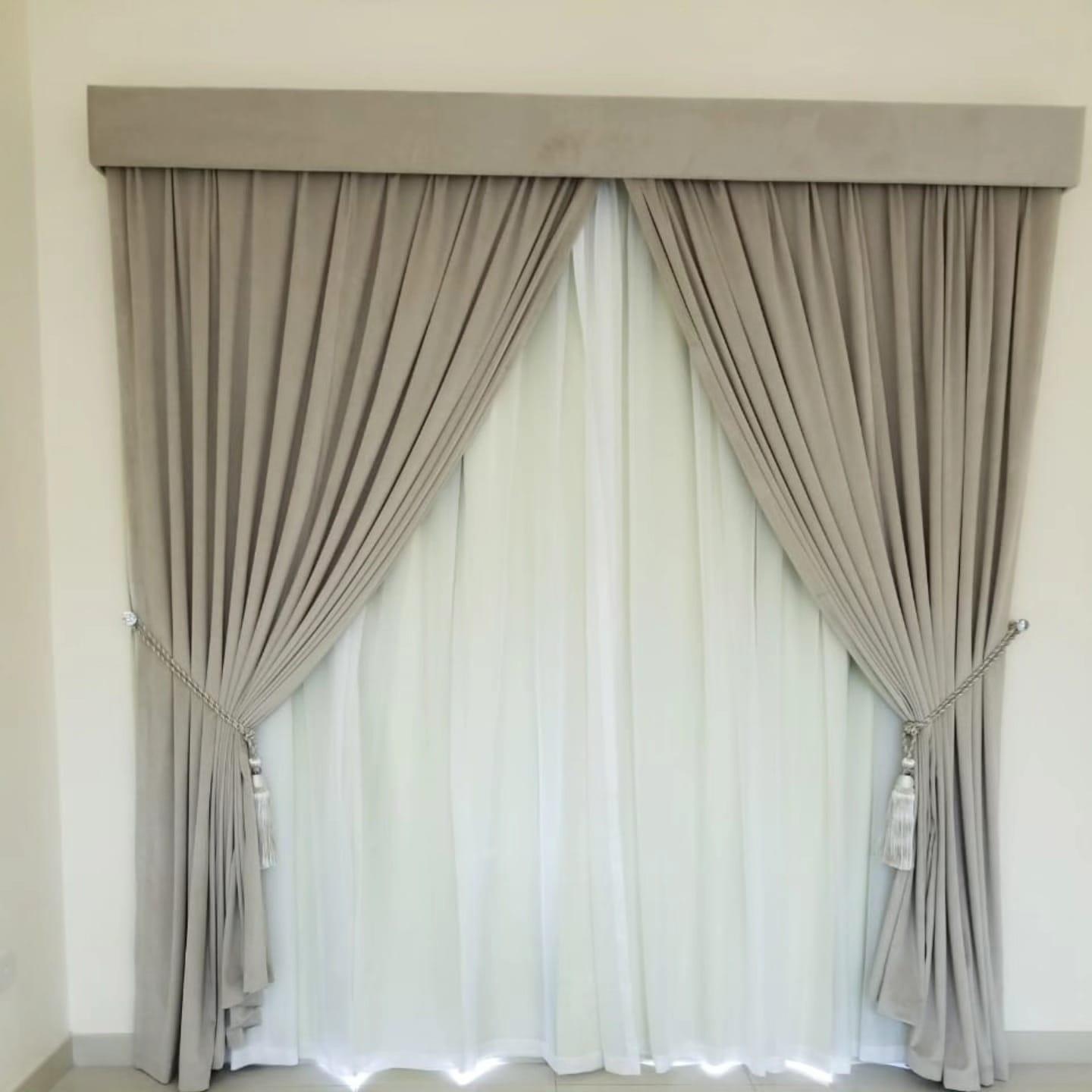
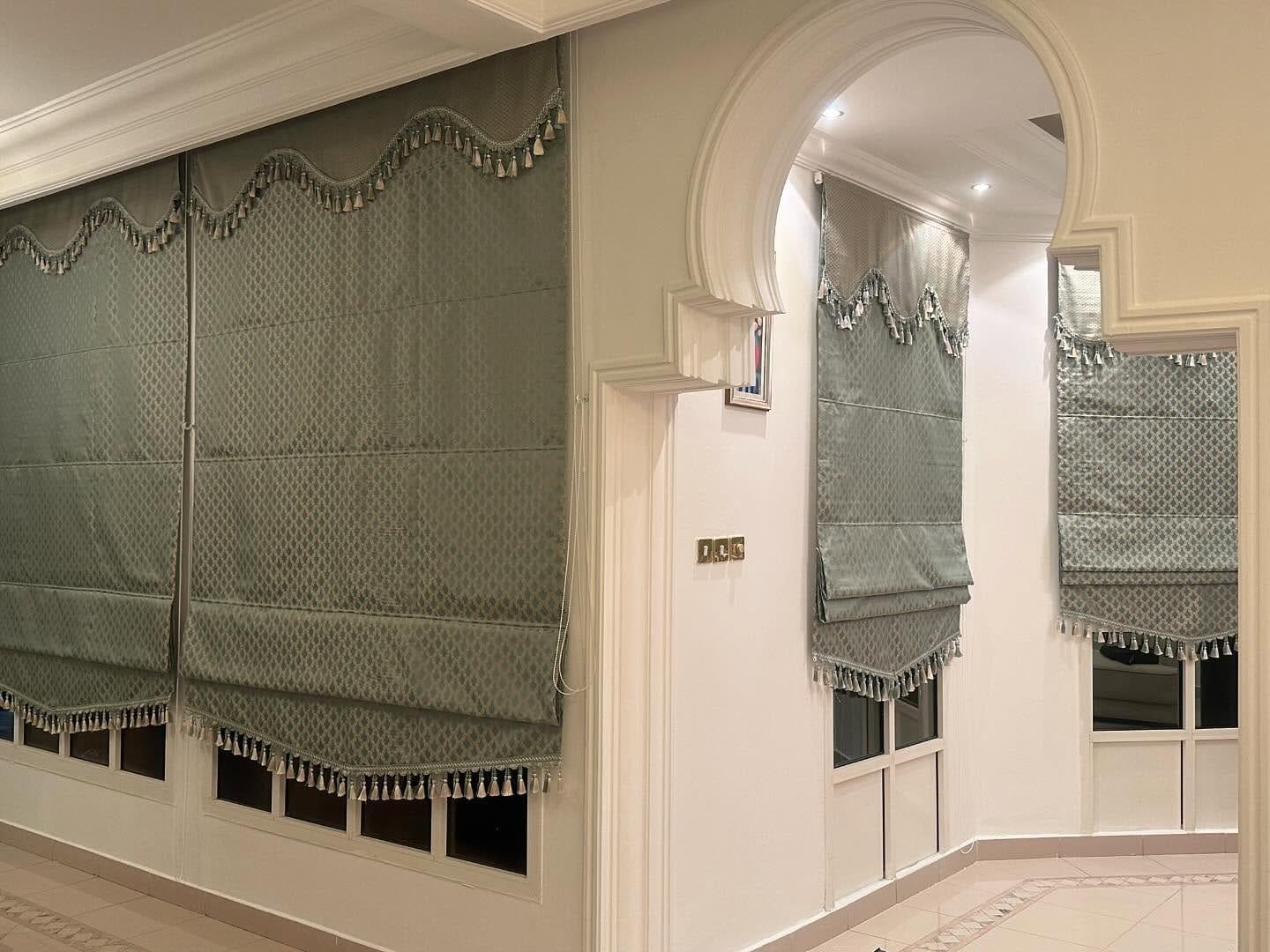
A valance, a short shaped or straight panel across the top, can hide the headrail and the stack and add trim such as tassels or braid, as in the blinds in our main photograph. A contrast border down the sides or along the bottom edge is another way to tie a blind to the rest of the room.
How the folds and the stack work
When a Roman blind is raised, its folds gather into a stack at the top. That stack does not disappear: it hangs below the headrail and covers part of the window unless the blind is fixed high enough above the glass. Bargain Blinds' measuring guide, for example, tells customers to measure 225 mm up from the glass and fix the top of the blind there, so the raised stack sits above the window rather than in front of it.
That is the most common Roman blind mistake: fitting the headrail tight to the top of the frame, so the window loses a strip of daylight every time the blind is up. On a short window it matters even more. Fix the blind higher, outside the recess, wherever the wall allows.
The drawing below shows the same blind down, half way and up, with the stack clear of the glass.
- 1. Down, the blind lies flat and the fabric's pattern shows in full
- 2. Raised part way, it gathers into even folds from the bottom up
- 3. Fully up, the folds sit as a stack under the headrail
- 4. Fixed about 225 mm above the glass, the stack clears the window
- 5. Fitted outside the recess, it overlaps the frame on both sides
Fabric, lining and pattern
Almost any curtain cloth can become a Roman blind, and that freedom is the big advantage over a roller. Medium-weight cottons, linens and blends fold most crisply. Very heavy fabrics make a deep, bulky stack; very light ones fold loosely and need a lining to hold their shape.
A lining does three jobs: it protects the face fabric from strong UAE sun on the glass, gives the folds body, and controls the light. A standard lining softens light, a dim-out lining darkens the room, and a blackout lining stops light through the fabric. Curtains Express prices a blackout lining behind a dim-out or sheer Roman blind as an extra, at AED 45 per square metre, which shows it is a separate layer.
Think about pattern carefully: each time the blind is raised, the pleats chop the design into strips. Small repeats and all-over patterns read well at any height; a large motif should be centred so it falls in the flat part of the blind when it is down.
Roman blind linings and what each does
Unlined
- Light
- Soft, filtered
- Best for
- Kitchens and rooms where light matters more than privacy
- Trade-off
- Little privacy after dark; fabric exposed to sun
Standard lining
- Light
- Softened
- Best for
- Living rooms, studies
- Trade-off
- Not dark enough for sleep
Dim-out lining
- Light
- Mostly dark
- Best for
- Bedrooms used at night only
- Trade-off
- Some light at the edges and through the fabric
Blackout lining
- Light
- Dark through the fabric
- Best for
- Children's rooms, day sleepers, media rooms
- Trade-off
- Heavier, deeper stack; light still at the edges
However dark the lining, light still shows around a blind's edges; fixing outside the recess or adding a curtain closes more of it.
Inside or outside the recess
Fitted within the recess, the blind tucks into the window opening and the surrounding wall stays bare. It needs enough depth: Bargain Blinds asks for at least 50 mm of clear depth for a cord-operated Roman and 60 mm for a chain-operated one, measured from the front of the recess to the first obstruction, such as a handle or the glass. Take the width high, halfway and low, and work from the narrowest figure.
Outside the recess, the blind is fixed to the wall above the window and is made wider than the opening. The same guide adds 50 mm each side. Outside fixing covers more, closes the edges better, lets the stack sit above the glass and makes a modest window appear larger.
Our usual recommendation is outside the recess for bedrooms and small windows, inside the recess for deep window reveals where the blind can still clear the handles. The final call is made on site, once the depth and what the screws go into have been checked.
Wide windows, bays and several blinds
One Roman blind has practical size limits. As it gets wider, its folds grow heavier and the stack gets deeper, and a very wide blind becomes hard to raise evenly by hand. A long window or a run of glass is usually better split into two or three blinds of equal width, side by side, which also lets you raise one and leave the others down.
Match the blinds carefully when you do. The fold lines should sit at the same heights on every blind, the fabric pattern should line up across the gaps, and the headrails should be fixed level with each other, so the row reads as one design when everything is lowered.
Bay windows suit Roman blinds well, with a separate blind on each face of the bay. Each one can be raised on its own to follow the sun round the room, and nothing has to bend round a corner the way a curtain track does.
Light, darkness and privacy
Because the blind hangs right by the window, light creeps round its edges, more so inside the recess, where it is made slightly narrower than the opening so it can move. A blackout lining darkens the fabric itself but cannot close those gaps.
For a bedroom that must be dark, mount it on the wall face, wider than the opening on both sides, or pair it with a curtain in front. A blind and curtain together give darkness at the glass and softness in the room. Each gap is explained in where blackout curtains leak light.
For privacy, an unlined or voile Roman blind works like a voile curtain: screened in daylight, revealing at night once the lamps are lit. Use a lined fabric where neighbours can see in after dark.
Kitchens, bathrooms and humid rooms
Kitchens and bathrooms are where Roman blinds are most useful and where fabric choice matters most. Steam, cooking oil and splashes mark fabric quickly, so choose a fabric that tolerates being cleaned, with a lining that does not mind humidity, and keep the blind well away from the hob.
In a bathroom, make sure the room is well ventilated so the blind dries between showers. A Roman blind in a kitchen is best above a sink or a counter, where it can be raised clear of splashes during cooking and lowered for privacy in the evening.
If a window gets very wet, a roller in a fabric you can wipe down is the more sensible pick. Cleaning each type is covered in looking after curtains and blinds.
Cords, chains and child safety
A corded Roman blind has lifting cords threaded up its back, plus a pull cord or chain at one side, and small children can become tangled in either. The US Consumer Product Safety Commission's position is plain: only cordless coverings remove the strangulation risk, while add-on safety devices merely lower it.
For a nursery or any spot a toddler could get to, pick a cordless or motorised Roman blind. Any chain in other rooms should be held taut by a wall-fixed tensioner placed high, and beds, cots and furniture should be kept away from the window so a child cannot climb up to it.
Before ordering, check how the mechanism deals with the lifting cords at the back, and not just the one at the side.
Motorised Roman blinds
A Roman blind can be motorised, with a motor inside the headrail lifting the folds. It removes the cords from reach, which makes it the best answer for children's rooms, and it makes high or hard-to-reach windows practical, such as those above a kitchen counter or in a stairwell.
The motor has to be rated for the blind's weight, and a wide blind with a blackout lining weighs more than people expect. Mains or battery power and the controls are planned in the same way as for curtains; the options are explained in motors for curtains and blinds, and the same remote or hub can run curtains and blinds together.
Price and how we make Roman blinds
Roman blinds are priced on the area of the blind, with the fabric, the lining, the operation and any valance or trim each changing the figure. As a market reference, Curtains Express in Dubai publishes Roman blinds at AED 180 per square metre, in blackout, dim-out or sheer, with a 2.5 m² minimum of AED 450, and a blackout lining behind a dim-out or sheer blind at AED 45 per square metre extra.
When you compare quotations, check what each one includes: the fabric name, the lining, cord, chain or motor, a cassette or valance, and fitting. Two Roman blinds in the same cloth can differ a lot in price because of what is behind the fabric and what lifts it.
We quote each Roman blind after measuring, because the fabric and the mechanism vary so much. During the free visit we take laser measurements, check the recess depth and the wall above, and bring fabrics and linings to see in your light. Workmanship carries our 24-month written warranty.
Finished examples are on Roman and roller blinds; our curtain price guide if you are comparing blinds with curtains, or browse the curtains and blinds service.
Common questions
Roman blind or curtains?
A Roman blind suits windows with furniture below or little wall beside them; curtains suit large windows and darker bedrooms. Roller blinds or curtains.
Can Roman blinds be blackout?
They can, given a blackout lining, though light still shows at the edges unless the blind is fitted outside the recess. Blackout or sheer curtains.
Why does light come in around my Roman blind?
It sits close to the glass and, inside the recess, must be narrower than the opening. Outside fixing or a curtain closes the gaps. Blackout light gaps.
Can Roman blinds be motorised?
Yes. A motor in the headrail removes cords from reach and suits high windows. Motorised options.
How do I clean a Roman blind?
Dust or vacuum gently; many need professional cleaning because the rods and lining are sewn in. Curtain and blind care.
Is a Roman blind good for a balcony door?
Seldom: its folded stack hangs in the doorway and has to be pulled right up for each trip outside. Balcony door curtains and blinds.

Sources & specifications
Manufacturer information applies to the named products and systems. Sources reviewed on 28 October 2026.
- Bargain Blinds: how to measure Roman blinds (stack, depth and overlap)bargainblinds.co.nz(opens in a new tab)
- Curtains Express: Roman and roller blind prices in Dubaicurtainsexpress.ae(opens in a new tab)
- US Consumer Product Safety Commission: go cordless with window coveringscpsc.gov(opens in a new tab)
Want this planned for your home?
Consultation and measurement are free. Tell us the rooms, location and what you need; we arrange a sample visit and define the measured quotation.