Media Walls · 26 min read · 18 September 2026
TV wall with shelves and display niches in UAE homes
How to design a TV wall with built-in shelves, open niches and display areas in a UAE apartment or villa: shelf depth, lighting, finish, what each type holds and what to agree before manufacture.
By the Al Tareeq Decor team · Contact our workshop
Key takeaways
- Open shelves add display area but require styling; closed cabinets keep storage invisible but need handles or push-to-open hardware.
- Shelf depth in a TV wall is typically 250–350 mm — deep enough for books and objects but shallow enough to avoid dominating the wall projection.
- LED lighting inside display niches and on shelf undersides is what turns a joinery wall into a finished interior — plan the lighting circuits before manufacture, not after.
- Glass shelves look lighter and work for display objects; wood or lacquered shelves carry more load and are more practical for books and heavier items.
- Niche dimensions need to be sized for what will go into them — confirm planned contents before the drawing is finalised so the joiner can design around real objects.
On this page
- Key takeaways
- Why shelves change a media wall
- Open shelves versus closed cabinets: the right balance
- Shelf depth: what works in a UAE TV wall
- Display niches versus floating shelves
- LED lighting for shelves and niches
- What shelves hold: weight, depth and content planning
- Shelf lighting as a structural decision
- Corner shelves and return shelves
- Finish matching across shelves, panel and console
- Glass shelves, wood shelves and lacquered MDF compared
- Shelf material comparison — living room TV wall
- Access to cables and power behind shelving
- Styling the shelves: composition and balance
- Living room versus bedroom shelf walls
- How far a shelf can span before it sags
- Where to place the LED strip on each shelf
- Matching shelf height to what lives on it
- Dust and cleaning on an open shelf wall in the UAE
- Clearances around the TV when shelves sit beside it
- Sunlight, heat and what is safe on open shelves
- Adjustable or fixed shelves: planning for change
- Reading the shelf drawing before you approve it
- Shelf wall drawing: what to check before you sign
- What to agree before the shelf drawing is finalised
- Common questions
Why shelves change a media wall
A TV wall without shelves has one job: house the screen and the AV equipment. With shelves, it has a second job: display what the household chooses to show publicly. This changes how the wall reads in the room — from a functional panel to a surface that carries personality, pattern and life.
Open shelves also change the wall's visual weight. A solid panel reads as a block. A panel with open niches and floating shelves has negative space — gaps where the original wall or a backlit panel shows through — which makes the same width feel lighter and more considered.
The practical consequence is that open shelves need to be styled. What goes on them, how it is arranged and what changes over time all affect how the wall looks. This is not a reason to avoid them, but it is worth acknowledging at the planning stage.
Open shelves versus closed cabinets: the right balance
Most living room TV walls combine open shelves or niches with some closed cabinet storage. The balance depends on what needs to be accessible but hidden — AV equipment, game controllers, cables — versus what can be on show permanently.
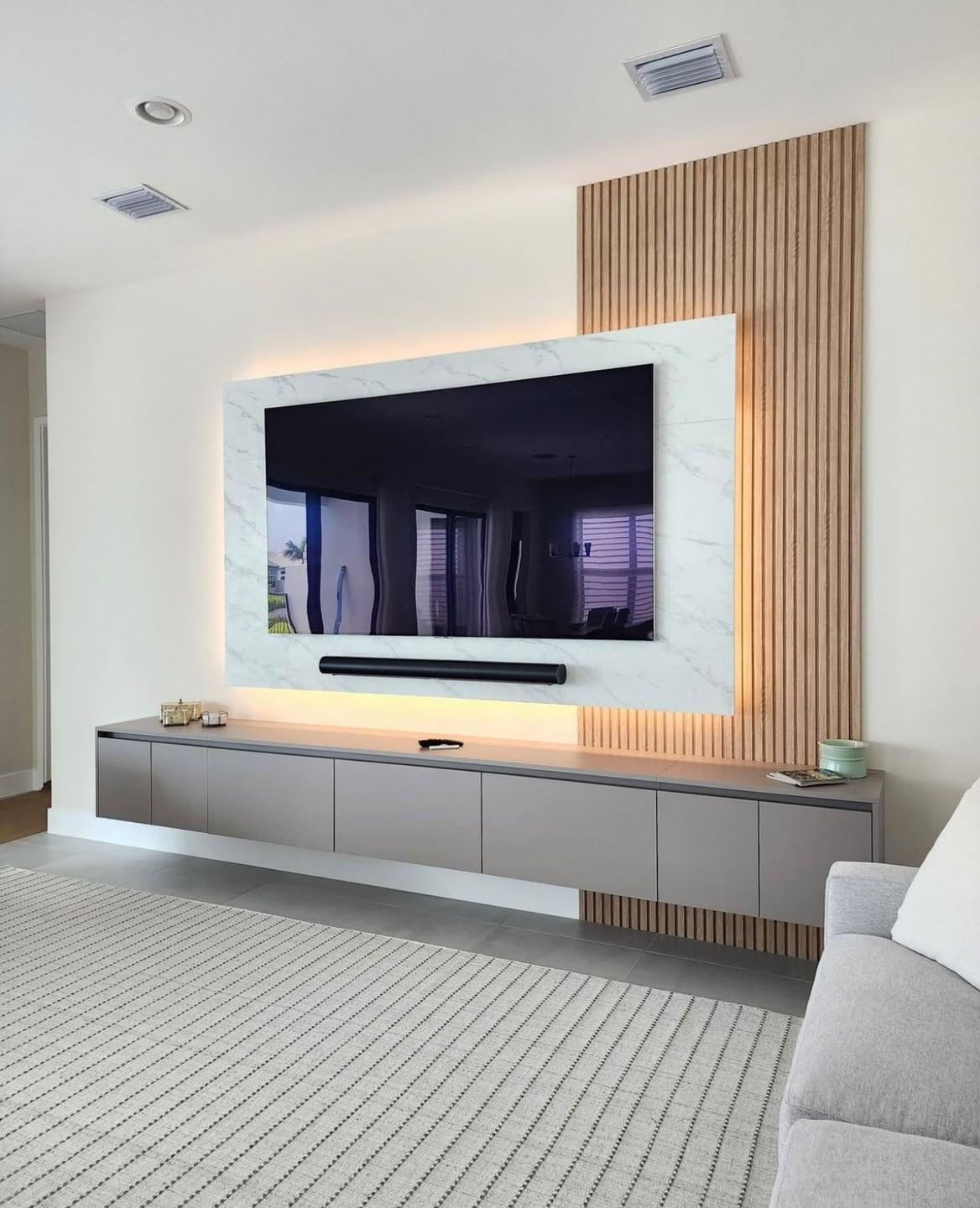
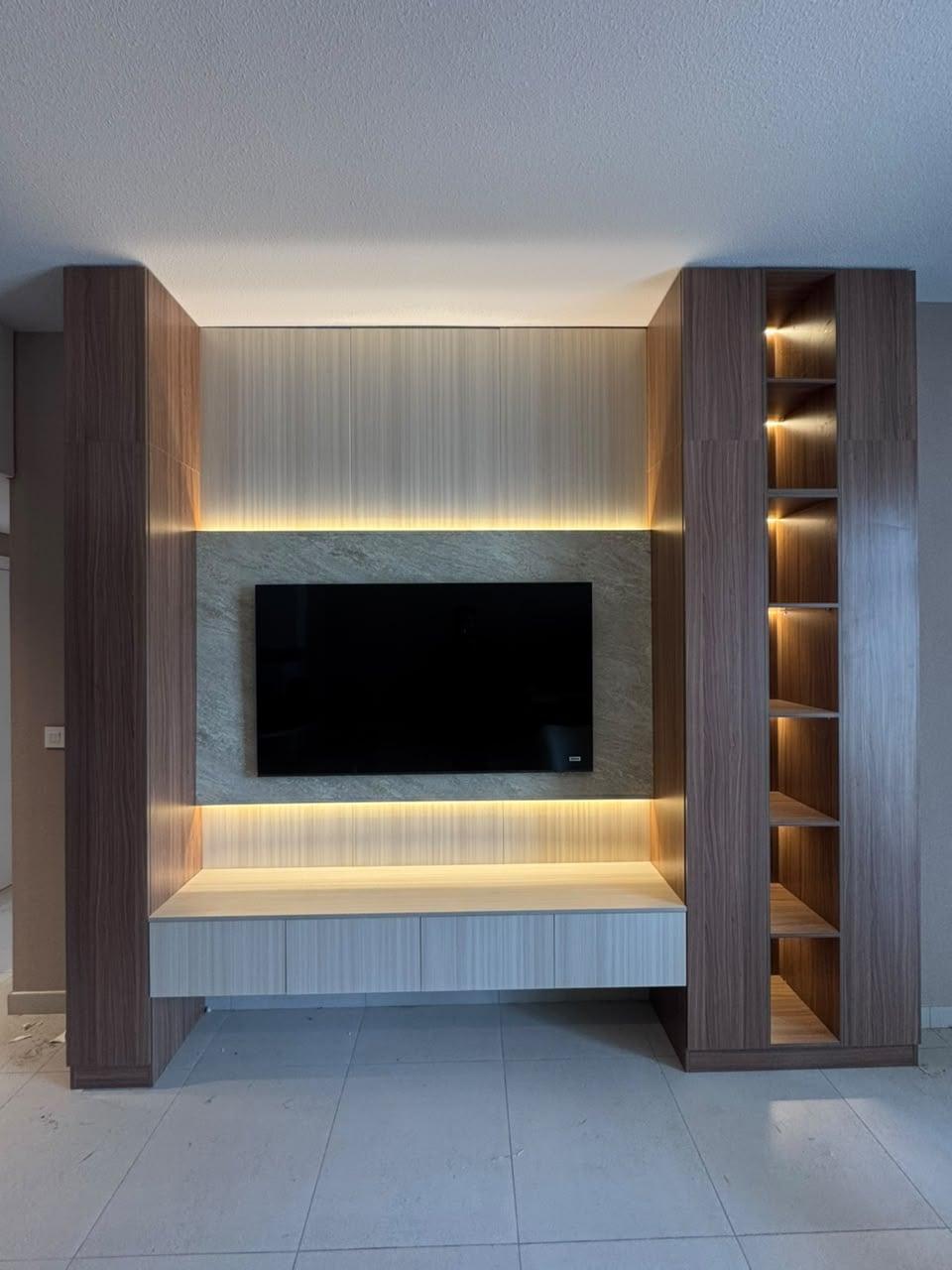
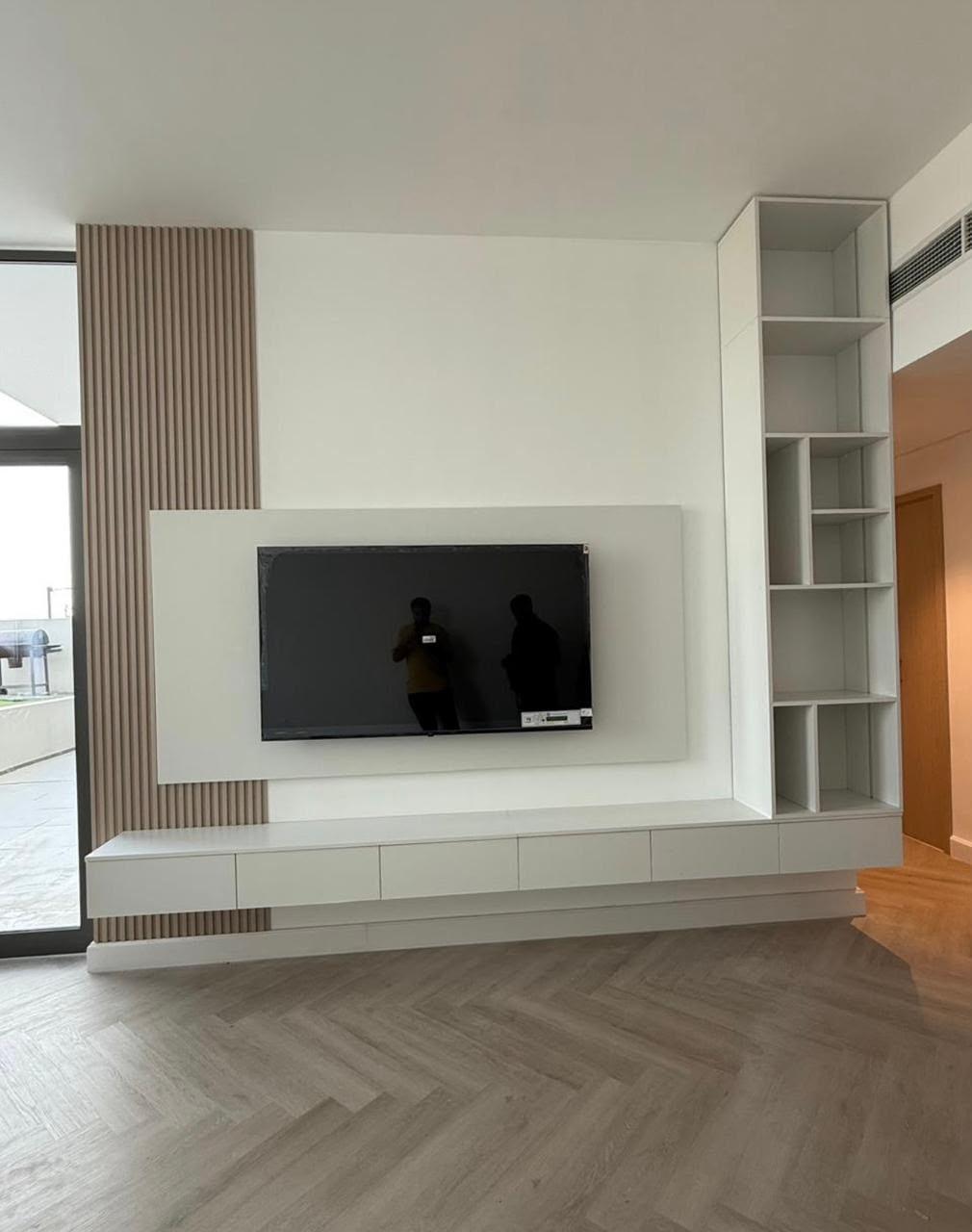
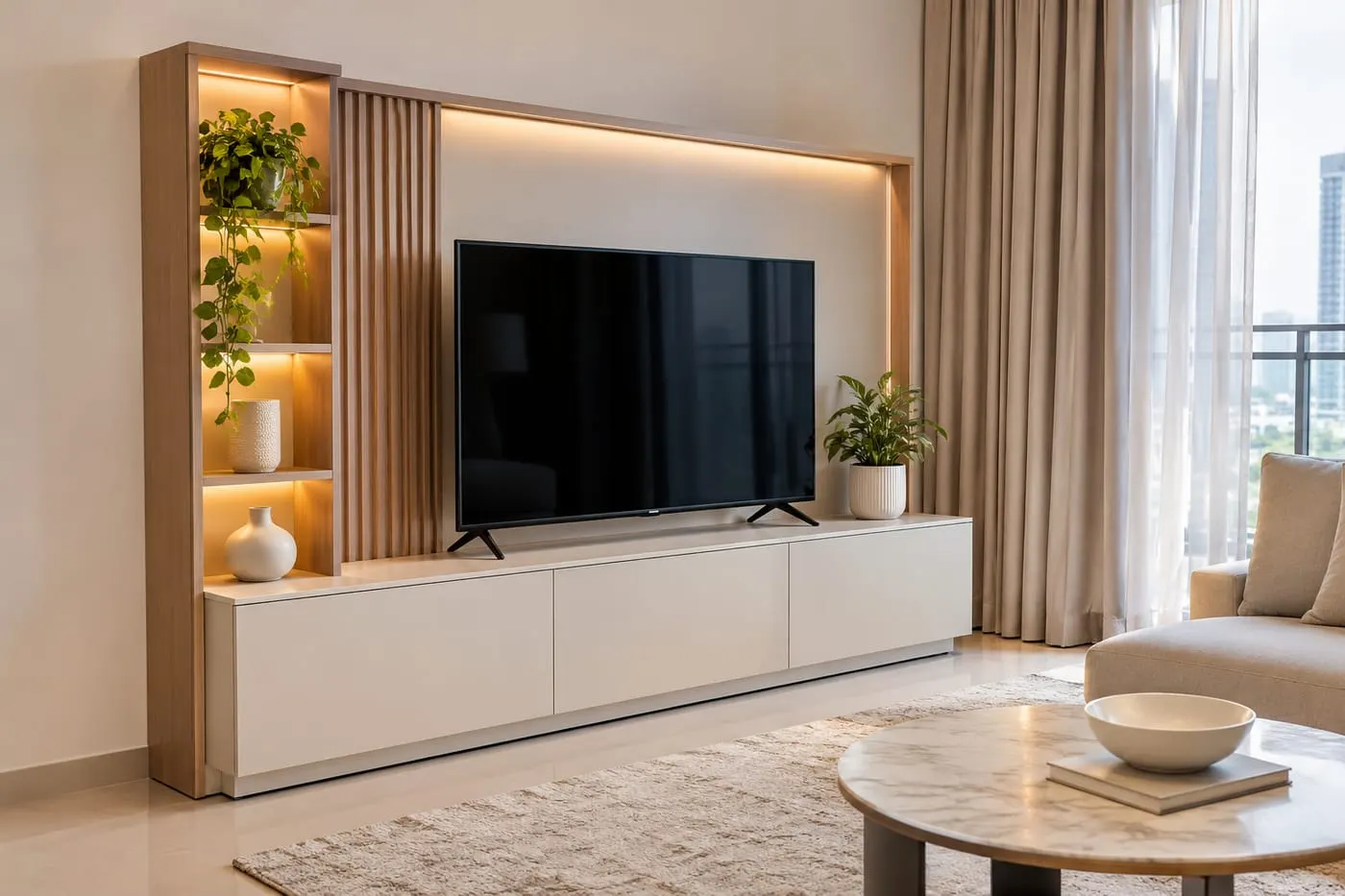
A common approach is closed cabinets below the TV console (hiding AV equipment and cables) with open shelves or display niches in the flanking sections. This keeps the lower half of the wall tidy and puts the display area in the upper section where it is seen at eye level from the sofa.
Full open-shelf walls — where everything is visible — work well in households that keep their display surfaces organised. Full closed-cabinet walls — where everything is behind doors — work better in households with children or where the living room is also a family room with high traffic through it.
Shelf depth: what works in a UAE TV wall
Shelf depth in a TV wall is a practical constraint. The wall has a finished face — the panel behind the TV — and the shelves project forward from that face. If the shelves project too far, they start to look like free-standing furniture rather than a built-in composition. If they project too little, they cannot hold anything useful.
For display shelves — objects, plants, framed photos, small books — a depth of 200–280 mm is usually sufficient. For a bookshelf carrying standard paperbacks or hardbacks, 250–300 mm is the minimum. For a shelf that will hold AV equipment or large-format books, 300–350 mm is more appropriate.
In a TV wall where the main panel sits at a fixed depth from the original wall, the shelves are usually at the same depth as the panel face or slightly shallower. If the shelves project further than the panel, the composition starts to look crowded. The drawing should show the shelf depth in section, not just on the elevation.
Display niches versus floating shelves
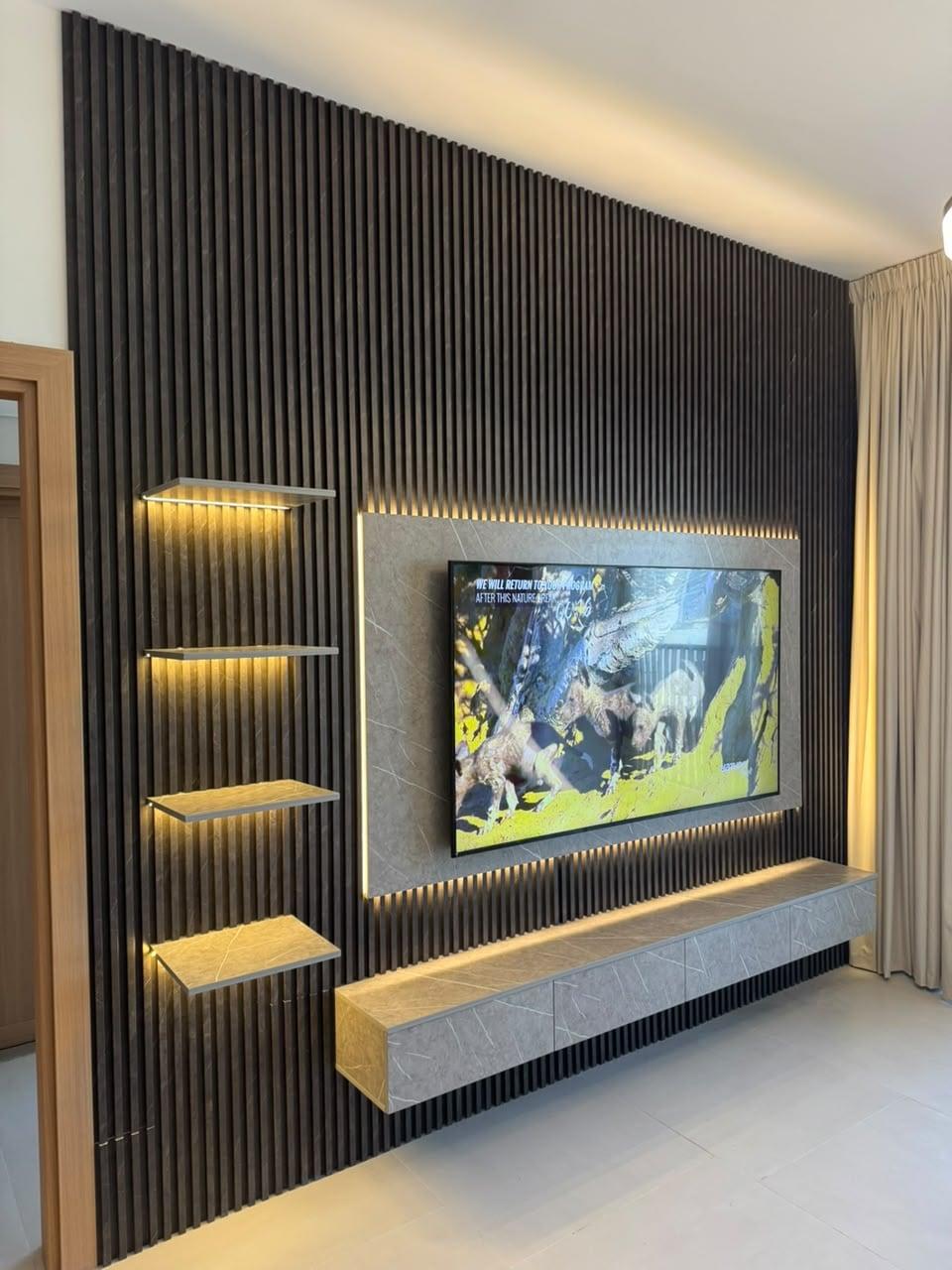
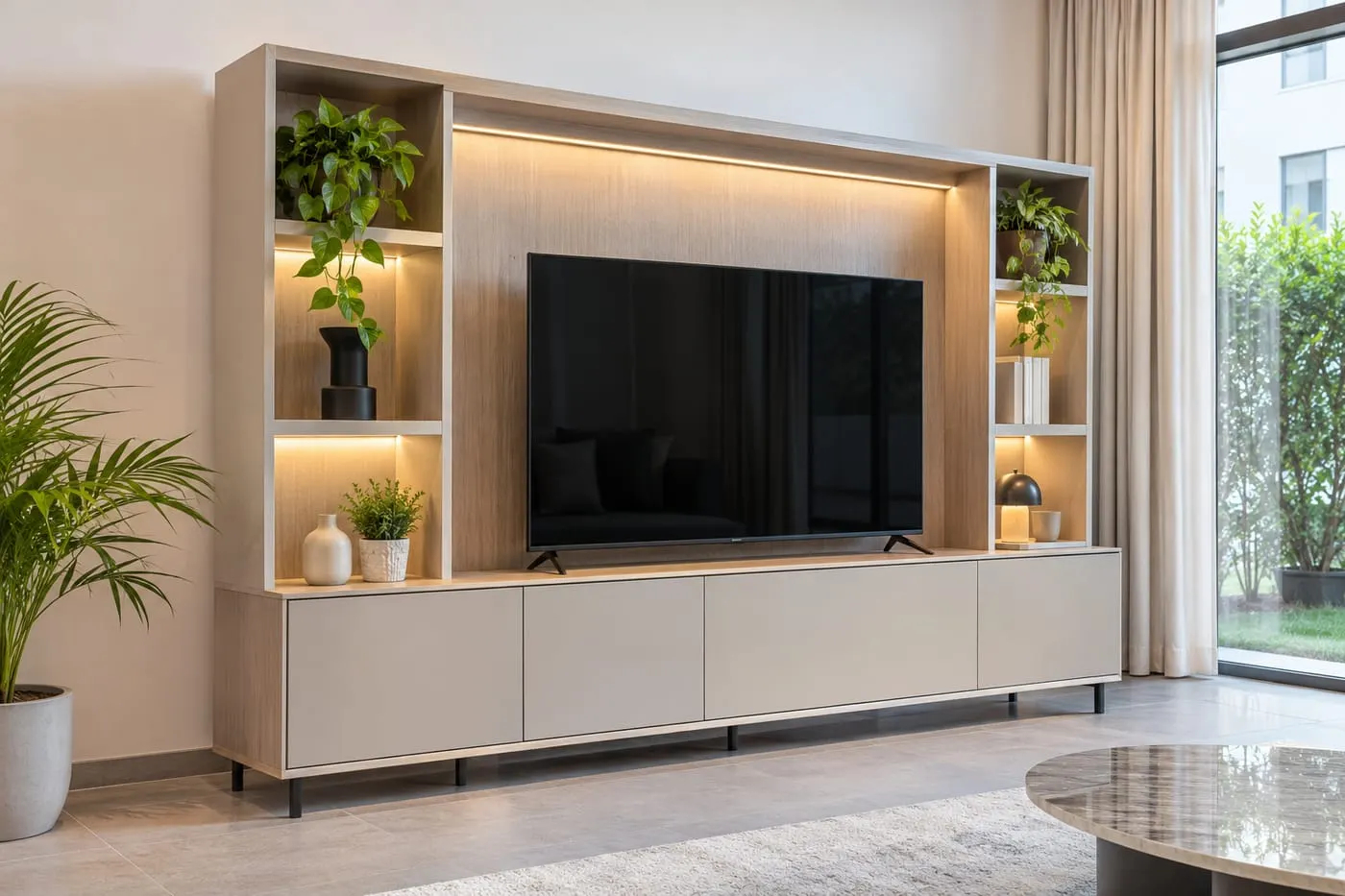
A display niche is a contained box within the wall — it has a back, two sides and a base, and the object sits inside it rather than on a surface that extends past it. This contains the display and gives each object a defined stage. A floating shelf is an open-ended surface — objects sit on it, but there is no framing beyond the shelf plane itself.
Niches suit sculptural objects, vases, candles and anything that benefits from being surrounded by a contained space. Floating shelves suit a mix of object types and work better for items that change frequently. A composition that uses niches for the focal display objects and floating shelves for books and everyday items often reads better than either type alone.
Niche depth — from the wall face to the back of the niche — determines what can sit inside it. A 150 mm-deep niche suits a small vase or candle. A 300 mm-deep niche will hold a medium sculpture or a potted plant. Agree the niche dimensions from your actual intended contents before the drawing is finalised.
LED lighting for shelves and niches
Lighting is what makes a shelf wall work in the evening. The standard approach is an LED strip on the underside of each shelf — this lights the shelf below without illuminating the light source directly. For display niches, an LED strip at the back or along the top edge of the niche throws light into the space without visible glare.
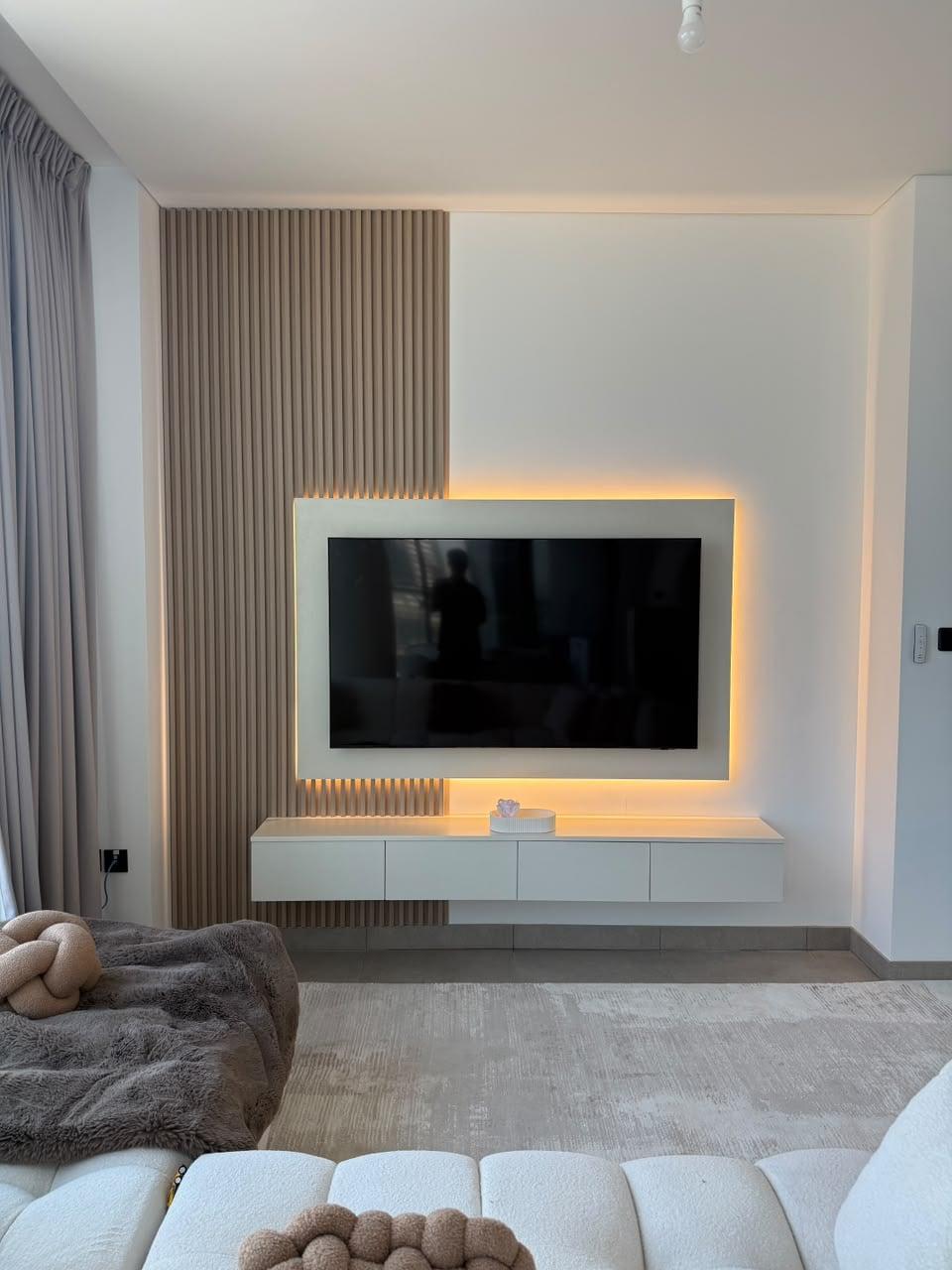
Shelf and niche lighting should be on a separate circuit from the TV backlight. This allows the shelves to be lit for general room use without the TV being on, and allows the TV backlight to be used for viewing without the shelf display needing to be active. For a living room media wall, three separate circuits — TV backlight, shelf lighting, ambient cove — give the most flexibility.
LED strip colour temperature for shelves and niches should match the room's main lighting. Warm white (2,700–3,000 K) suits residential interiors in the UAE; it makes natural materials — wood, stone, plants — look richer and warmer than cooler temperatures.
What shelves hold: weight, depth and content planning
Before the shelf specification is finalised, list what will actually go on the shelves. This sounds like an interior-design exercise rather than a joinery planning step, but it has direct structural implications. A shelf holding ceramic objects weighing 2–3 kg per item needs different fixing than a shelf holding paperbacks, and both are different from a shelf holding a large-screen monitor or AV equipment.
MDF and board shelves with correct fixing to the wall substrate can typically carry 10–25 kg per shelf depending on span and bracket spacing. A span of more than 600 mm without a central support starts to show visible bow over time, particularly in UAE humidity where board cores absorb some moisture even in a conditioned room.
Glass shelves — toughened, typically 10–12 mm for display use — look lighter and suit decorative objects well. They are not appropriate for heavy books, AV equipment or anything that is frequently moved. Confirm toughened glass specification with the joiner; standard glass is not suitable for shelf use.
Shelf lighting as a structural decision
LED strip wiring for shelves needs to be planned before manufacture, not afterwards. The cable channels, junction boxes and driver housing all need to be built into the wall structure. Adding LED lighting to a finished wall requires surface-mounted conduit or destructive work to open channels — both visible compromises compared to built-in wiring.
A simple approach is to route a low-voltage cable channel along the inside back edge of each shelf at manufacture, with a junction point at the wall panel where all circuits meet. The LED strips are then clipped in at installation and connected to their respective drivers.
Drivers and dimmers for shelf LEDs should be sized correctly at specification stage. An undersized driver causes visible flicker; an oversized driver wastes cost. The installer should provide a circuit map showing which driver serves which shelves, so the household can operate them correctly and any future maintenance is straightforward.
Corner shelves and return shelves
In a living room where the TV wall meets a side wall at a right angle, a return shelf — continuing from the main wall onto the side wall for a short distance — can extend the composition and provide additional display area. This suits living rooms that are deeper than they are wide, where the side walls are also visible from the main seating position.
Corner shelves at the junction between the TV wall and a return wall need careful detailing. The inside corner is easy to handle with a mitred joint or a filler panel; the outside corner needs an edge detail that is consistent with the rest of the wall's finish.
Return shelves are most effective when they are at the same height as the main wall's display shelves and carry the same design language — depth, material, lighting — as the main composition. A return shelf that is visually different from the main wall tends to read as an addition rather than part of the original design.
Finish matching across shelves, panel and console
In a TV wall that uses more than one material — a wood-veneer panel behind the TV with white lacquered shelves, for example — the material junction needs to be carefully drawn and carefully made. Where one material meets another, the joint line is visible from across the room. A clean, deliberate joint reads as a design decision; a ragged or inconsistent joint reads as an error.
The console finish is usually the same as the lower cabinet finish, with the TV panel behind using the feature material — marble effect, veneer or fluted panels. Shelves flanking the TV can either match the console finish (consistent) or use the same material as the TV panel (wrapping the feature material around the composition). Both approaches work; the choice depends on whether you want the feature material to be contained or to extend.
If the wall uses three or more materials — which is common in UAE living rooms with marble, wood and white lacquer — agree the material boundaries on the drawing before manufacture. Changes to material layouts after manufacture are costly and often visible even after correction.
Glass shelves, wood shelves and lacquered MDF compared
Glass shelves are the lightest-looking choice. They suit a living room wall where the display content — ornaments, vases, plants — benefits from being seen from multiple angles. The shelf does not compete with what is on it. Glass also shows less dust in a UAE apartment than a solid-colour surface does. The disadvantage is that glass chips and scratches over time and is not suitable for heavy objects.
Wood and veneer shelves add warmth and material richness. An oak-veneered shelf carrying a row of books reads completely differently from a white lacquered shelf with the same books. Wood shelves age and can develop slight surface marks, which many find acceptable as natural character. Specification should include an oil or lacquer seal to protect the veneer in UAE humidity.
Lacquered MDF shelves give the flattest, most consistent colour surface. High-gloss lacquer shows fingerprints and scratches more clearly; matt lacquer is more practical for UAE domestic use. Lacquered shelves can be repainted if the colour ever needs to change — a flexibility that glass and veneer do not offer.
Shelf material comparison — living room TV wall
Toughened glass (10 mm)
- Looks
- Lightest, most transparent
- Load capacity
- Moderate — no heavy loads
- UAE practical note
- Chips at edges; clean with glass cleaner
Oak or walnut veneer
- Looks
- Warm, natural grain
- Load capacity
- High with correct fixing
- UAE practical note
- Seal with oil or lacquer; avoid standing water
Matt lacquered MDF
- Looks
- Flat, even colour
- Load capacity
- High with correct fixing
- UAE practical note
- Practical; can be repainted; avoids fingerprints vs gloss
High-gloss lacquered MDF
- Looks
- Rich, reflective surface
- Load capacity
- High with correct fixing
- UAE practical note
- Shows fingerprints; best for display-only sections
All shelf types require correct wall fixing to the substrate — not just to the panel face of the wall.
Access to cables and power behind shelving
Shelves built into a TV wall need cable access planned from the start. The TV cables, the LED strip wiring, any AV equipment power and any network cables all need to reach their destinations through the wall structure. Routing these cables through the shelf sections — rather than externally — requires cable channels at manufacture.
A common problem in retrofitted shelving is that cables run outside the shelves in conduit, visibly breaking the clean wall composition. Building the cable routes in at manufacture is straightforward; adding them later is expensive and usually visible.
For a UAE living room wall, plan at least: one HDMI and one power point accessible to the TV position; one power point per section of AV cabinet; and a data point if the TV or any equipment needs wired network access rather than WiFi. These points can be in-panel flush sockets rather than surface-mounted boxes.
Styling the shelves: composition and balance
A joinery wall with shelves is finished at installation but it is not complete until the shelves are styled. Styling is not part of the joinery scope, but the design of the shelves affects what styling is possible. A niche sized for a specific vase will not look right with a different object; a shelf at an odd height will not carry standard-format books cleanly.
The simplest approach to styling is to plan the shelf content at the design stage — not to the detail of choosing specific objects, but to the type and approximate size of what will go there. This allows the joiner to size the shelves, niches and lighting to suit the actual use rather than a generic grid.
In UAE living rooms, common shelf display items include: potted plants (trailing and upright), ceramic vases, framed family photographs, books (both vertical and horizontal), candles and candleholders, and decorative sculptural pieces. Each of these has different height, depth and lighting requirements.
Living room versus bedroom shelf walls
A bedroom shelf wall and a living room shelf wall serve different functions. A bedroom shelf wall is seen mainly by the household — it is a private surface that can carry personal items, clothing accessories and bedside reading. A living room shelf wall is a public surface — it carries what you are comfortable showing to guests and what represents the household's public identity.
This difference affects what goes on the shelves, how it is organised, how much it changes and how important it is that it looks consistently good. A living room shelf wall benefits from a fixed composition that changes slowly; a bedroom shelf wall can be more practical and variable.
The structural and finish choices are similar in both rooms, but the living room wall tends to get better materials and more careful LED specification because it is on permanent public display. If budget requires a trade-off, spending more on the living room wall and less on the bedroom is usually the right priority.
How far a shelf can span before it sags
A shelf is a beam that stays loaded for years. Over a short span the board stays flat. Stretch it too far and it bends slowly under the same weight, and the bend is easiest to see against the straight edge of the console below it. In a UAE apartment, where air conditioning keeps cycling the humidity inside the board, that slow bend can show earlier than it would in a dry climate.
The working rule in joinery planning is to keep a loaded shelf to about 600 mm between supports and to add a vertical divider when the opening is wider. The diagram shows the same board at four spans. At 400 mm and 600 mm it holds a straight line. At 900 mm with no support it bows under a steady load of books. With a centre divider, the same 900 mm opening becomes two short spans and the board is flat again.
The divider is not a compromise. In a good composition it is drawn as part of the rhythm of the wall: a thin vertical that lines up with a panel seam or the edge of a niche. Placed on purpose, it reads as design. Added on site after the shelf has already started to bend, it reads as a repair.
Thickness and material matter as much as span. A thicker board, or a board with a deeper front edge, carries a wider opening than a thin one. A toughened glass shelf behaves differently again: it does not bow slowly, so its span is limited by the supports and by the load you are allowed to put on it. Ask the joiner to state the span, thickness and material of every shelf on the drawing, so the number is agreed before cutting rather than discovered after installation.
Where to place the LED strip on each shelf
On a lit shelf wall, the position of the strip changes the result more than its brightness does. The same shelf, with the same object on the lower board, looks very different depending on where the light starts. The diagram compares three positions in section.
A strip on the front underside of the upper shelf is the simplest to build. It throws a bright hotspot onto the front half of the board below, and because it sits at the front edge, it is visible from a low seated angle. That is the position most likely to cause glare from the sofa, so it suits shelves that are mostly seen from standing height.
A strip set at the back of the shelf and hidden behind a small front lip gives an even wash down the wall and across the board. From the sofa you see the light but not the source. This is the cleanest look for a living room, and it is the position we would normally propose first for open shelves above a console.
A strip in a recess at the top of a niche lights the back wall and leaves the objects in silhouette. It suits sculptural pieces and vases, and it works well where the back of the niche is a contrasting finish. It needs a deeper niche to hide the recess, so it has to be decided before the niche depth is fixed.
Whichever position is chosen, the cable channel, the driver location and the junction point must be built in at manufacture. Warm white in the 2,700 to 3,000 K range suits UAE living rooms, and the shelf lighting should sit on its own dimmable circuit, separate from the TV backlight.
Matching shelf height to what lives on it
A shelf wall works when each height does the job it is suited to. Heavy things belong low, daily-use things at reach, the best things at eye level, and light things up high. A wall that ignores this looks fine on the day of handover and then slowly turns into a mismatch between where things sit and how the household lives.
The diagram shows typical planning bands on a 2,700 mm wall. Up to about 450 mm is the console zone: closed storage, AV equipment and cables, which are heavy and should be hidden and easy to clean. From 450 to 1,200 mm is the reach zone, where books, baskets, remotes and games live and where the heaviest open shelf loads belong. From 1,200 to 1,800 mm is the eye-level band, the display zone, where niche lighting works hardest. Above that, keep to light and rarely moved items such as trailing plants and ornaments.
These are starting bands, not fixed numbers. A household with young children may want the reach zone lower, and a villa with a 3.5 m ceiling will stretch the upper band. What matters is that the contents are listed first and the shelf heights are fixed second, not the other way round.
It also helps to place the TV before the shelves. The screen sits roughly in the middle of the eye-level and reach bands, so the shelves beside it should line up with its top and bottom edges rather than ending at arbitrary heights. Shelf lines that continue across the wall at consistent heights read as calm. Shelves that step up and down beside the screen read as busy.
Dust and cleaning on an open shelf wall in the UAE
Open shelves collect dust, and UAE homes collect more of it than most. Fine desert dust finds its way through balcony doors and air conditioning returns, and an open shelf has nothing in front of it. This is not a reason to avoid open shelving, but it is a reason to plan for how the shelves will be cleaned.
Start with the surface. A matt laminate or matt lacquer shelf wipes clean with a damp cloth and hides light dust well. A high-gloss shelf shows every particle and every wipe mark in raking daylight. A glass shelf looks clean until the afternoon sun crosses it, then shows dust clearly. Wood veneer needs a sealed surface so that cleaning does not push moisture into the grain.
Then consider reach. Shelves above about 1,800 mm are hard to wipe without steps, so the upper band should hold things that can sit untouched for months, and the household should accept that the top shelf will be cleaned less often. Deep niches with tight corners collect dust that a cloth cannot reach, so rounded or generously sized niche corners are easier to live with.
Finally, consider what sits where. Books on open shelves will dust over faster than objects behind glass. If the household wants to display many books, a closed or glazed section for the most valued ones and open shelves for everyday ones is a common compromise. Lighting also matters: a strong shelf light makes dust more visible, so a softer, indirect wash is kinder to a surface that will not be dusted daily.
None of this changes the structure of the wall. It changes the finish, the depth and the corner details, which are exactly the choices that cost nothing at the drawing stage and a great deal after manufacture.
Clearances around the TV when shelves sit beside it
When open shelves flank the TV, the gap between the screen and the shelf edge becomes a design decision. A shelf that ends a few millimetres from the screen looks cramped and can trap heat. A gap that is too generous makes the screen look as though it is floating in a hole. The right margin depends on the screen, the bracket and the finish of the panel behind it.
Start with ventilation. A TV needs air around it, and the manufacturer's installation guide states the space it expects at the back and sides. Shelves and niches that sit tight against the screen reduce that air, particularly in a recess. Check the guide for the model you plan to buy before the drawing fixes the opening, and leave a margin that allows air to move even if the household later swaps to a different brand.
Then consider the screen size. The shelf layout should be drawn around the largest screen the household might plausibly fit in the same opening, not only the one being bought today. A wall drawn tightly around a 65 inch screen cannot take a 75 inch one without losing a shelf. If the TV is likely to be upgraded, plan the TV section a little wider and let the flanking shelves absorb the difference.
Finally, consider sightlines and speakers. Soundbars, centre speakers and cable boxes need somewhere to live, and a shelf directly under the screen is the usual place. Make sure the shelf is deep enough and the opening tall enough for the real equipment, and that the sound can leave the opening without being blocked by a shelf edge or a door.
A short conversation with the joiner about the TV model, the bracket and the equipment turns all of this into dimensions on the drawing.
Sunlight, heat and what is safe on open shelves
Not everything that looks good on a shelf is safe to leave there for years. UAE sunlight is strong, and a shelf wall facing a large window or a glazed balcony door will see direct light for part of the day. Over time that light fades fabrics, bleaches printed spines and can warm thin shelf boards on the sunny side.
Plan the wall with the sun in mind. If one side of the wall gets stronger light, put objects that are not sensitive to fading there and keep prints, textiles and photographs in the shadier sections. Closed doors on the sunniest bay protect what is behind them. UV film on the glass is a separate decision for the window, but it affects what the shelf wall can safely hold.
Plants are popular on shelves, and they add life to a wall. They also add water, humidity and sometimes drips. A pot placed directly on a veneer or laminate shelf can leave a ring or swell an edge over time. Use trays, and keep trailing plants away from the board edge where watering is hardest to control. Artificial plants avoid the problem entirely.
Candles and decorative heat sources deserve care near LED strips, cable channels and lacquered surfaces. Keep open flames away from the wall and treat scented candles as a cleaning problem as much as a safety one, because soot marks light finishes. An electric or LED alternative gives the same warm light without the residue.
The best shelf walls are drawn with the household's real habits in mind. A short list of what will sit where, and in which light, turns into a better wall than a generic grid of equal boxes.
Adjustable or fixed shelves: planning for change
A shelf wall is built once and lived with for years, and what the household wants to put on it will change. Children grow, collections expand and a screen gets replaced. The question at the drawing stage is how much of the wall can adapt without being rebuilt.
Fixed shelves, built into the carcass, give the cleanest look and the strongest structure. They suit display niches and the sections around the TV, where the proportions are part of the design. Adjustable shelves, held on pins or rails, suit sections for books and everyday storage, where heights need to change. Pin holes are small and neat when well made, and a rail system is more visible but more flexible.
A good compromise is to fix the shelves that define the composition, such as the lines that align with the TV, and to make the shelves in the reach zone adjustable. The wall then keeps its rhythm while the household keeps its flexibility. It is worth asking how many adjustment positions the pins allow and whether spare shelves are cut to the same depth and finish.
In a rented apartment the logic changes. A tenant who may move in two or three years should avoid anything that cannot be taken apart, and a landlord's consent is needed for any wall-fixed joinery. A freestanding unit or a shelf wall made in sections, fixed lightly and designed to be removed, is easier to move than a fully built-in one. Raise this at the consultation so the construction method matches your plans.
For a family home that expects to stay, build the wall to last and keep the changeable parts changeable. That is where the budget works hardest.
Reading the shelf drawing before you approve it
The drawing is the last cheap moment to change anything. Once production starts, every change costs time and material. A shelf wall drawing carries more information than most, and a methodical read of it catches the problems that are expensive later.
Start with the elevation and check that the widths add up to the wall you measured, and that the shelf lines align with the TV and with each other. Then read the sections: shelf depth, board thickness, LED channel position and the depth of any niche should all be dimensioned, not implied. Look for the spans and for any divider where an opening is wide.
Then read the notes. Finishes should be named, edges described, and the shelf material stated for each section. The LED positions, drivers and switch location should be shown, and the power and data points for the TV and equipment should appear on the drawing, not be left to the site.
Finally, hold the drawing against how you live. Walk through where each object will go, which shelf the books take, where the router and consoles sit, and how the wall will be cleaned. If something does not fit on paper, it will not fit on the wall.
Shelf wall drawing: what to check before you sign
Spans
- What to look for
- Loaded openings near 600 mm or less, or a divider shown
- Why it matters
- Stops visible bow under books
Shelf depth
- What to look for
- Dimensioned in section for every shelf
- Why it matters
- Matches what the shelf will hold
LED
- What to look for
- Strip position, driver and circuit shown
- Why it matters
- Cable channels are built in at manufacture
Heights
- What to look for
- Shelf lines aligned with the TV edges
- Why it matters
- Keeps the wall calm to look at
TV opening
- What to look for
- Margin for ventilation and a larger screen
- Why it matters
- Avoids heat build-up and rebuilds
Finish
- What to look for
- Named for panel, shelves and console
- Why it matters
- Prevents mismatched samples
Entry prices start from AED 3,500 for a compact panel. The final figure follows the approved drawing and specification.
What to agree before the shelf drawing is finalised
Before the joiner finalises the drawing for a shelf TV wall, agree: the shelf depths for each section; the niche dimensions and what will fill them; the shelf material (glass, veneer, lacquered MDF); the LED specification for each shelf section; the number and position of power points inside the wall; and whether any shelves will carry unusual loads (monitors, speakers, aquariums) that need non-standard fixing.
Also confirm whether push-to-open hardware or visible handles are preferred for any closed cabinet sections. Push-to-open mechanisms are cleaner but add cost and have a service life; visible handles are simpler and can be replaced if the style changes. This decision affects the face of every cabinet door in the composition and is easier to make at the drawing stage than to change at installation.
Al Tareeq Decor's workshop handles all these decisions at the drawing stage. The measuring visit includes a conversation about what the shelves will carry and how they will be used, so the structural and finish decisions are made before the first cut.
Common questions
How deep should shelves be on a TV wall?
For display objects and plants: 200–250 mm. For books: 250–300 mm. For AV equipment: 300–350 mm. The shelf depth should be drawn in section, not just on the elevation, so both the visual composition and the practical depth are confirmed before manufacture.
Can LED lighting be added to shelves after the wall is built?
It can, but it requires surface-mounted conduit or destructive work to open channels for the cable — both visible compromises. Plan the LED wiring at the design stage so it is built into the wall structure at manufacture.
What is the difference between a display niche and a floating shelf?
A niche is a contained box — object sits inside it, surrounded on three sides. A floating shelf is an open surface — the object sits on it with no framing. Niches suit sculptural objects; shelves suit a mix of items. Many walls use both.
How much weight can a wall shelf hold?
With correct fixing to the wall substrate, a standard MDF shelf can carry 10–25 kg depending on span and support. Spans over 600 mm need a central support bracket to prevent visible sagging. Glass shelves carry less and are not suitable for heavy books or AV equipment.
Should shelf lighting be warm white or cool white?
Warm white (2,700–3,000 K) suits UAE residential living rooms. It makes natural materials — wood, plants, ceramics — look richer and warmer. Cool white (4,000 K+) feels clinical in a domestic setting and is better reserved for kitchens and bathrooms.

Sources & specifications
Manufacturer information applies to the named products and systems. Sources reviewed on 10 October 2026.
Want this planned for your home?
Consultation and measurement are free. Tell us the rooms, location and what you need; we arrange a sample visit and define the measured quotation.