Upholstery · 12 min read · 16 April 2026
Sofa upholstery cost: fabric, foam, repairs and what drives the price
What sofa upholstery costs depends on fabric metres, foam, frame repairs, labour and collection. How each is priced and what to send for a firm UAE price.

By Ali Haider Basra, Founder, Al Tareeq Decor · Contact our workshop
Key takeaways
- We quote upholstery only after a free look at the piece, since frame, springs and foam differ every time.
- Every quote is built from fabric, foam, repairs, workshop labour, and collection and return.
- A three-seater takes about 14–18 m of 140 cm plain fabric; patterns and velvet take more.
- Seat foam comes in D35, D40 or D45, backed by an anti-sagging guarantee of roughly five years.
- Most pieces are collected, rebuilt and returned within roughly eight days of confirmation.
On this page
- Key takeaways
- Sofa upholstery cost in the UAE: why we look before we price
- What an upholstery quotation is made of
- How much fabric does a sofa take?
- Fabric needed by piece (140 cm plain fabric)
- Fabric: the line that moves most
- Foam: replace all of it, some of it, or none
- Frame, webbing and spring repairs
- Labour: why style matters more than size
- Majlis seating: priced by the run
- Dining chairs, headboards and sets
- New cover only, or full reupholstery?
- Leather and faux leather: priced differently
- Cushions, piping and the small extras
- Ways to keep the cost down
- Collection, workshop time and return
- Getting a firm upholstery price
- Common questions
Sofa upholstery cost in the UAE: why we look before we price
People ask for a sofa upholstery price list, which is a reasonable thing to want. The honest answer is that two three-seaters can cost very different amounts to redo, because the work hides inside them: one needs only a new cover, the other new foam, a re-glued frame and fresh webbing. That is why we do not publish a fixed rate for upholstery. Instead, we inspect free of charge, and the quotation that follows lists exactly what your piece needs.
What we can do is show you how that quotation is built, so a figure never comes as a surprise. This guide goes through the parts one by one: the fabric and how much of it a piece takes, the foam, the frame and springs, the workshop time, and collection and return. It ends with what to send for a quick, accurate quote.
What an upholstery quotation is made of
Every quote we write for upholstery is built from the same five parts. Fabric, measured in metres for your piece and the material you choose. Foam, if the seats or backs need it, in the grade you pick. Repairs to the frame, springs or webbing, if the inspection finds any. Workshop labour, which depends on the style of the piece more than its size. And collecting the furniture and bringing it back.
Not every job has all five. If frame and foam are both healthy, fabric and labour may be all it needs; a majlis that sags in the middle may need foam and webbing but keep its cover. Seeing the parts separately lets you choose: new foam now and fabric later, or the other way round.
How much fabric does a sofa take?
Fabric is usually the largest single line, and the quantity is easy to underestimate. Kothea, a UK fabric house, publishes a guide for 140 cm wide plain fabric: about 1.5 to 2 m for a dining chair seat and back, 5 to 7 m for an armchair, 10 to 14 m for a two-seater, 14 to 18 m for a three-seater and 18 to 25 m for a large or corner sofa. Loome Fabrics' estimator gives similar figures, about 14 m for a two-seater and 16 to 18 m for a three-seater.
Those are plain fabrics. A pattern has to be matched across cushions and backs, so Kothea adds one full pattern repeat per cut, and velvet and other pile fabrics take more because the pile must run the same way on every panel. Revolution Fabrics, a US maker, adds about 1.5 yards for every extra loose cushion and 2 yards for a skirt or tufting.
Fabric needed by piece (140 cm plain fabric)
Dining chair, seat only
- Metres (Kothea)
- 0.5–0.75 m
- What adds to it
- A patterned seat matched across a set
Dining chair, seat and back
- Metres (Kothea)
- 1.5–2 m
- What adds to it
- Piping, a buttoned back
Armchair
- Metres (Kothea)
- 5–7 m
- What adds to it
- Loose seat and back cushions
Two-seater sofa
- Metres (Kothea)
- 10–14 m
- What adds to it
- Each extra loose cushion, a skirt
Three-seater sofa
- Metres (Kothea)
- 14–18 m
- What adds to it
- Pattern repeat, velvet pile direction
Large or corner sofa
- Metres (Kothea)
- 18–25 m
- What adds to it
- Chaise ends, many back cushions
Quantities from Kothea's fabric guide, with Loome Fabrics and Revolution Fabrics for the extras. We measure your piece at the inspection.
- 1. A dining chair takes about 1.5–2 m; an armchair 5–7 m
- 2. A three-seater takes 14–18 m; a corner sofa up to 25 m
- 3. Patterned fabric adds a repeat per cut; velvet and pile need more
- 4. Every quote is built from fabric, foam, repairs, labour and collection
Fabric: the line that moves most
Two things set the fabric line: how many metres the piece needs, and the price of each metre. The metres follow from the chart above and the style of the piece. The price per metre is your choice, from practical woven fabrics to velvet, faux leather and genuine Italian leather. We carry over 2,000 upholstery fabrics, among them stain-resistant, water-repellent and pet-friendly weaves, so the same sofa can land at quite different figures.
Choosing well matters more than choosing expensively. A family sofa used every evening needs a hard-wearing, cleanable fabric; a formal majlis that sees guests twice a month can carry a delicate velvet. Our guide to fabric for a family sofa helps you decide; for the cost, simply remember that a plain fabric uses fewer metres than a bold pattern of the same price.
Foam: replace all of it, some of it, or none
Foam is the second big line, and the most negotiable. Where the seats feel flat and lifeless, new foam makes the sofa feel new again; if the backs are fine, they can keep their filling. Our seat foam comes in three high-density grades, D35, D40 and D45, backed by an anti-sagging guarantee of roughly five years. The grade is written on the quotation for each part, seats and backs separately.
Denser foam costs more and lasts longer, but density and firmness are not the same thing, so choose the feel first and the grade second. Which grade suits which seat is explained in sofa foam density: D35, D40 and D45. On the price, the number and size of cushions matters as much as the grade: a corner sofa with seven seat cushions is a very different foam line from a two-seater with two.
Frame, webbing and spring repairs
These are the costs nobody sees in a photo. A loosened joint, a cracked rail, sagging webbing or broken springs all show up when the old cover comes off. We reinforce hardwood frames, re-joint loose corners and replace webbing and springs, and each repair is listed separately with the reason it is needed.
If a frame is badly damaged, or made of a board that will not hold new fixings, the repair can cost more than the sofa is worth. Bob Vila's US guide puts frame repair and seat spring replacement as separate items on top of fabric and labour, which matches how we quote. Whether a repair is worth it at all is covered in repair or replace?.
Labour: why style matters more than size
Workshop time depends on what the piece looks like more than how big it is. A plain sofa with loose cushions and straight arms goes quickly. Deep buttoning, channel tufting, piping on every edge, scrolled arms and fitted backs all take hours of hand work. Bob Vila's guide estimates that tufting alone adds around 30% to a US reupholstery job and puts typical labour at 5 to 25 hours, a range that reflects exactly this difference in style.
If you are keeping the existing style, the workshop already knows the shape. If you want to change it, say from a buttoned back to a plain one, tell us at the inspection: changing the design sometimes saves labour and sometimes adds it.
Majlis seating: priced by the run
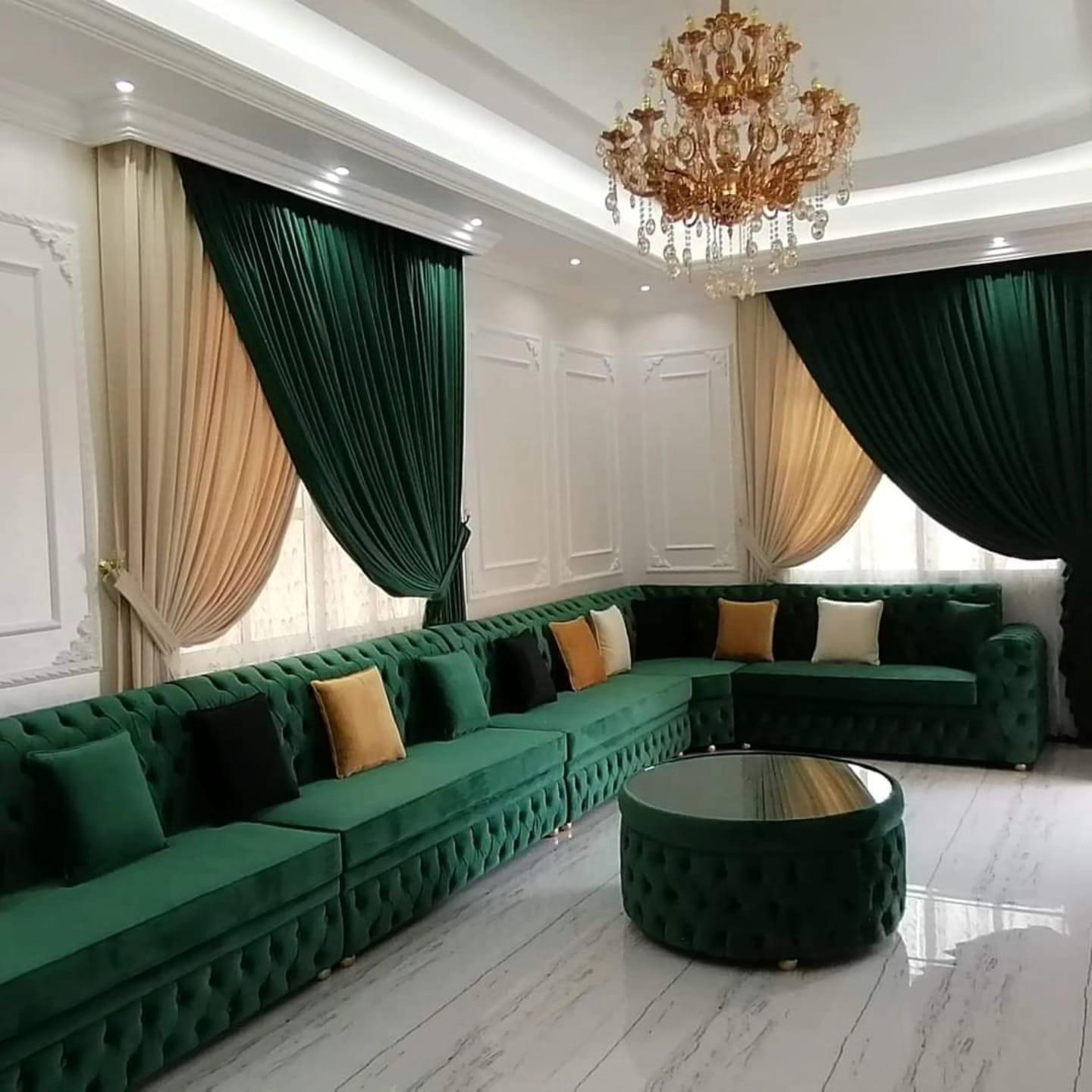
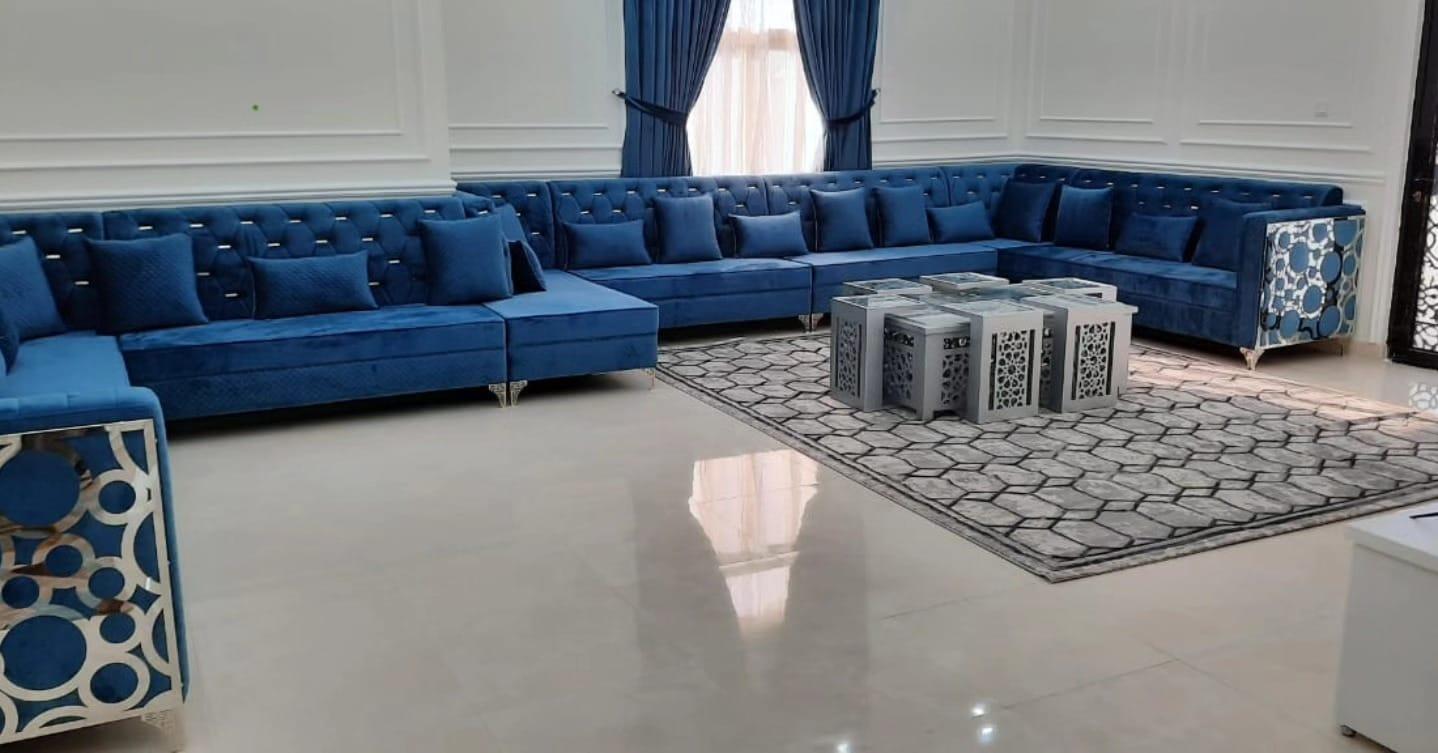
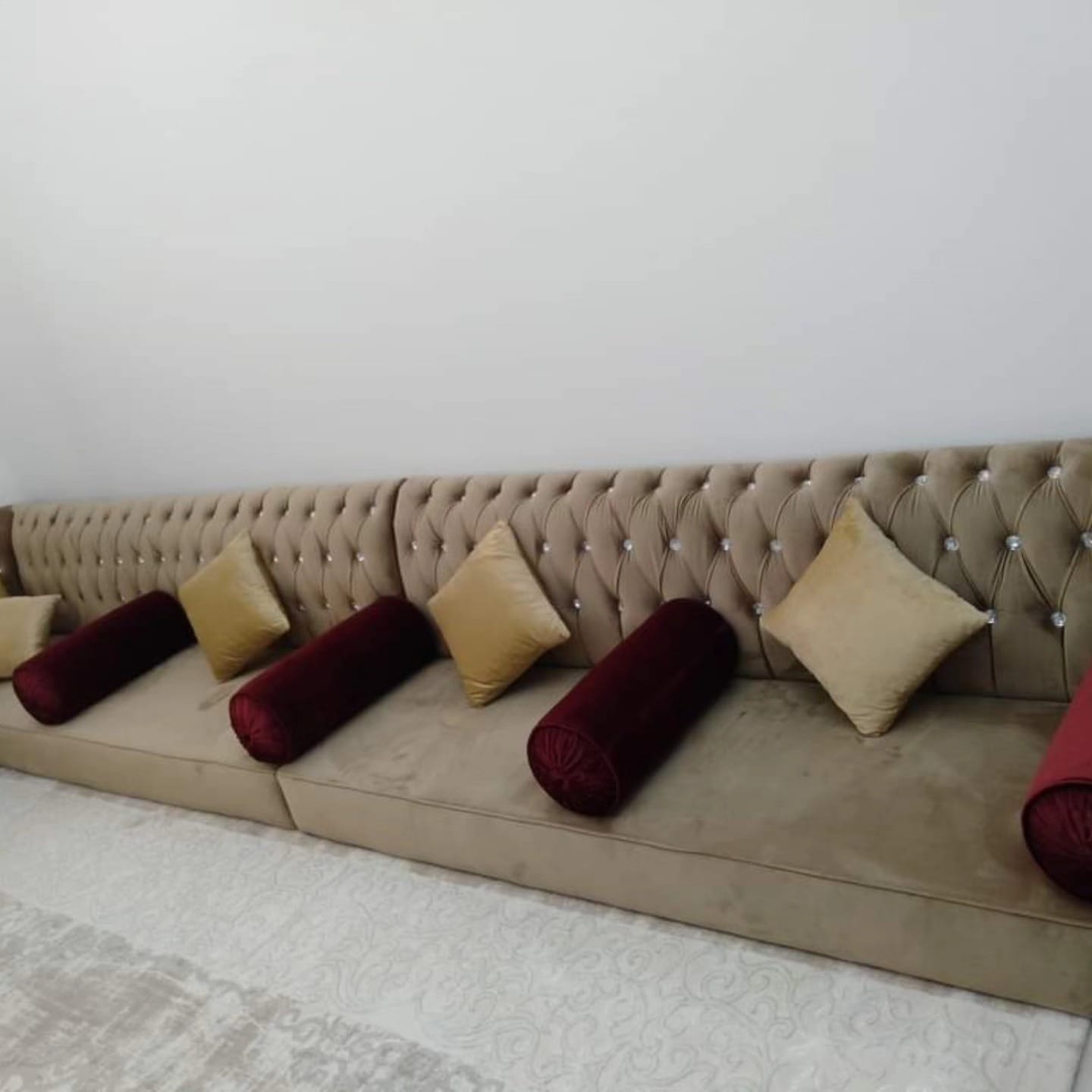
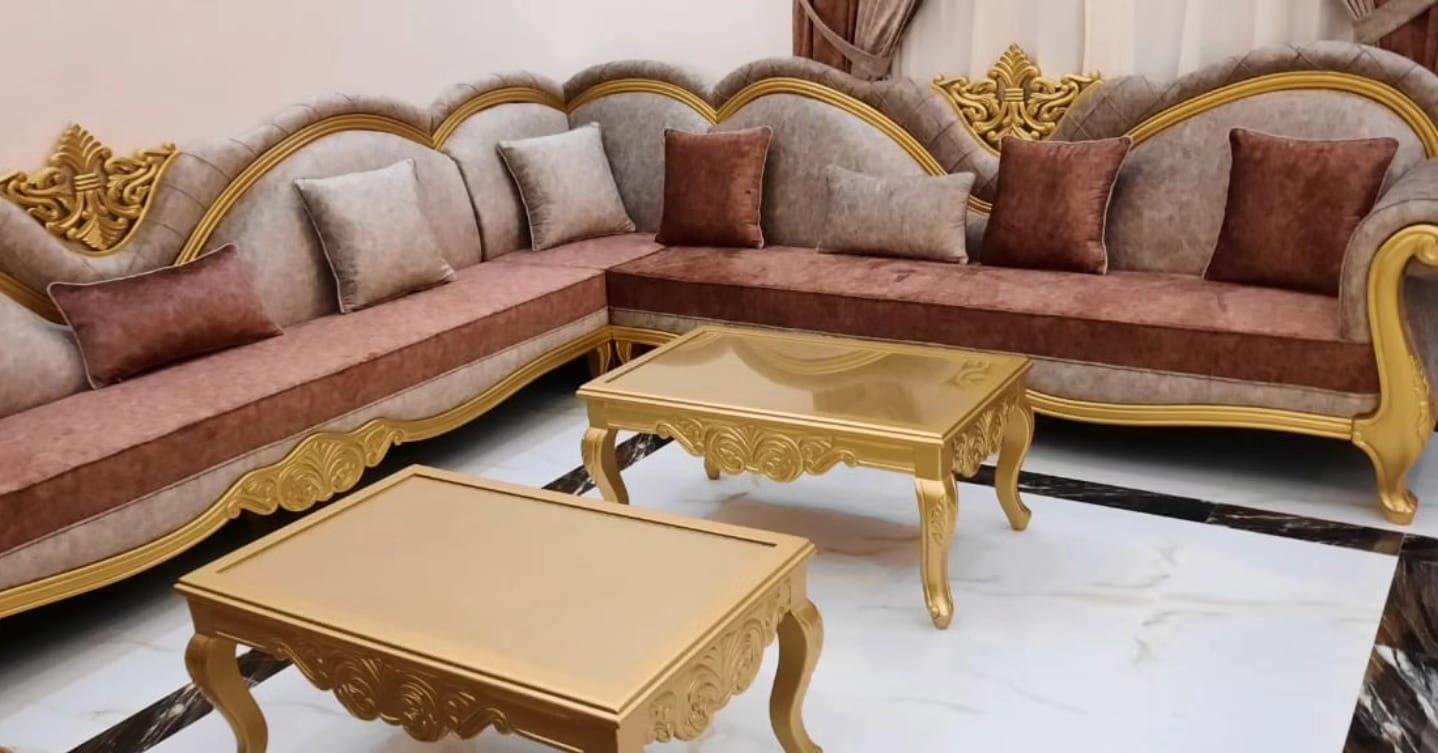
A majlis is the largest upholstery job in most UAE homes: long runs of floor or low seating along two or three walls, with many back cushions and armrests. The fabric line is large because the runs are long, and foam is often the main work, since seats used nightly for years are the first to flatten.
We price a majlis by its runs and cushions after measuring them, and you can ask at the inspection whether the work can be split, for example new seat foam now and a new cover later. Our majlis upholstery page shows the kind of seating we redo, from traditional floor majlis to modern L-shaped runs.
When we measure a majlis, we record the length of every run, the depth of the seat, the height of the back and the number of back cushions and armrests, and we note whether the base is a wooden frame or a solid platform. Those few numbers give the fabric and foam quantities directly, which is why a majlis can be quoted precisely once it has been seen, and why a photo alone only gives a rough idea. If some runs are used far more than others, say so: the worn seats can be done first and the runs still in good shape left for later, spreading the cost over two stages.
Dining chairs, headboards and sets
Dining chairs are quick individually and add up as a set. Seat-only work needs half a metre to three quarters of a metre of fabric per chair on Kothea's figures; seat and back about twice that or more. We take dining chairs as sets rather than single chairs, which keeps the fabric matched and the work worthwhile.
Upholstered headboards and bed bases follow the same logic: fabric by area, foam or padding, and the labour of the style. If you are refreshing a bedroom, quoting the headboard and the bedroom chairs together in one fabric often costs less than doing them separately.
New cover only, or full reupholstery?
Not every sofa needs everything. A fabric change alone, keeping the foam and frame, is the lighter job and suits a sofa that is comfortable but tired-looking. New foam and cushions alone suits a sofa whose cover is fine but whose seats have sunk. Full reupholstery, with fabric, foam and repairs, suits a well-made frame that needs everything renewed.
We offer all three, and the inspection tells you which applies. See sofa fabric replacement for a cover change and foam and cushion replacement for new seats.
Leather and faux leather: priced differently
Leather is bought by the hide, not by the metre, and each hide has marks and thin areas that must be cut around, so a leather sofa uses more material than its fabric equivalent and takes more careful cutting. Genuine Italian leather sits at the top of our range; faux leather looks similar, costs less and wipes clean, but it does not breathe like real hide and can feel warm in a room where the AC is off.
Both are quoted the same way as fabric: material, any foam and repairs, labour and collection. If you are unsure, ask to see both at the inspection, beside your curtains and floor, and try sitting on each before you choose.
Cushions, piping and the small extras
Scatter cushions, bolsters and piping are small items that add up. Each loose cushion needs its own fabric, a zip and a filling; piping along every seam takes extra fabric cut on the bias and extra sewing time. None of them is essential, and each can be priced separately.
A common way to refresh a room for less is to reupholster the main seating in a durable plain fabric and make the scatter cushions in a more expensive pattern or velvet. You get the colour and texture where it shows, without paying for twenty metres of the costly fabric.
Ways to keep the cost down
Choose a plain fabric or a small pattern, which wastes less in matching. Keep the existing style rather than adding buttoning or channels. Replace foam only where it has failed, usually the seats, and keep backs that are still firm. Do the dining chairs as one set in one fabric, and ask whether loose cushion covers can be made removable so they can be cleaned instead of redone in a few years.
Do not save on what you cannot see. A new cover over a broken spring or a loose joint will fail first at exactly that spot, and the money spent on the cover is lost with it. The inspection is where we tell you which repairs the piece really needs and which it does not.
Timing helps too. If the sofa is still usable, plan the work for a week when the room is less in demand, rather than the week before guests arrive. A job that can follow the normal workshop schedule is easier to fit in than an urgent one, and you will have time to choose the fabric properly from samples rather than in a hurry.
Collection, workshop time and return
Upholstery is workshop work. After the inspection and your approval, we pick the pieces up, rebuild them at our Sharjah workshop and deliver them home; most pieces return roughly eight days after you confirm. Collection and delivery appear on the quotation as their own line.
Small repairs can sometimes be done at home, but only in nearby areas and and a visit and delivery fee applies, so ask at the inspection whether your job qualifies. Workmanship carries our 24-month written warranty on orders agreed from 10 October 2026; ordinary wear, accidental stains and damage are not defects, and supplied fabrics carry their own terms.
Getting a firm upholstery price
A few photos on WhatsApp get the conversation started: the piece from the front and side, close-ups of any sagging, tears or loose joints, and the label if it has one. Add rough sizes, how many seats and cushions, and what you would like: new fabric, new foam, repairs or all three. If you have a fabric in mind, send a picture of it or of a sofa you like.
The firm price follows the free inspection, where we check the frame, springs and foam and you see fabric and foam samples. When you compare quotes, check that each lists the same metres of fabric, the same foam grade for seats and backs, the same repairs and whether collection is included. A lower total that leaves out the foam or the webbing is not cheaper. Start through our sofa upholstery and repair service.
- Fabric: the material named, and the metres for your piece.
- Foam: grade for the seats, grade for the backs, and which cushions are new.
- Repairs: each frame, webbing or spring repair listed.
- Style: buttoning, piping or channels that add workshop time.
- Collection and return, and the expected time.
Common questions
Should I redo my old sofa or buy a new one?
If the frame is solid hardwood and still square, usually yes; a weak or broken frame changes the sums. Repair or replace?.
Which foam density is best for sofa seats?
Denser grades last longer on seats used every day; backs can be softer. Choose the feel first, then the grade. Sofa foam density: D35, D40 and D45.
Which fabric survives children and pets?
A tightly woven, cleanable fabric with a good rub rating, rather than loose weaves or delicate pile. Choosing fabric for a family sofa.
Can I change only the sofa fabric?
Yes, if the foam and frame are sound; it is the lighter job. Sofa fabric replacement.
Can a whole majlis be reupholstered?
Yes, floor and low majlis runs as well as sofas, priced by the runs and cushions. Majlis upholstery.
Do you upholster dining chairs?
Yes, as sets rather than single chairs, so the fabric stays matched across the table. Sofa reupholstery.
Can the sofa be repaired at home?
Small repairs sometimes, in nearby areas and with a visit charge; most work is done in our Sharjah workshop. Sofa repair and frame restoration.

Sources & specifications
Manufacturer information applies to the named products and systems. Sources reviewed on 28 October 2026.
- Kothea: how much fabric to upholster a chair, sofa or headboard (140 cm plain fabric)kothea.com(opens in a new tab)
- Loome Fabrics: sofa fabric estimatorloomefabrics.co.uk(opens in a new tab)
- Revolution Fabrics: how much upholstery fabric a couch needs (extras for cushions, skirts, patterns)revolutionfabrics.com(opens in a new tab)
- Bob Vila: how much it costs to reupholster a couch (US cost structure)bobvila.com(opens in a new tab)
Want this planned for your home?
Consultation and measurement are free. Tell us the rooms, location and what you need; we arrange a sample visit and define the measured quotation.