Upholstery · 14 min read · Updated 28 October 2026
Best sofa fabric for kids and pets: weave, rub count and cleaning code
Pick sofa fabric for children and pets by problem: weave for claws, finish for stains, rub counts, cleaning codes, colour, leather and a home test for samples.

By Ali Haider Basra, Founder, Al Tareeq Decor · Contact our workshop
Key takeaways
- Choose by problem: spills need a wipe-clean finish, claws need a tight weave with no loops, sun needs a lightfastness grade, and sitting needs a high rub count.
- A Martindale rub count measures flat abrasion only; as a starting point, aim for 25,000 or more for a busy family sofa, and do not pay for ratings above about 50,000.
- No rub count predicts claws, stains, fading or seam strength, so ask about the weave, the finish, the lightfastness and the cleaning code separately.
- Mid-tone greys, taupes and beiges, with a subtle woven texture, hide hair and wear better than white or very dark plain fabrics.
- Test a large sample at home, and ask for the cleaning code in writing: W or WS suits children, X asks for a professional.
On this page
- Key takeaways
- Choose the sofa fabric for the household, not the showroom
- Six household problems and what each asks of a fabric
- Household problems, and what to look for
- Weave and texture decide more than the fibre name
- What a Martindale rub count says, and what it does not
- Claws, pilling, fading and stains: the four gaps in the number
- Stain resistance and cleaning codes
- What the common cleaning codes mean
- Colour, pattern and finish: the cheapest protection there is
- Leather and faux leather with children and pets
- Throws, loose covers and the cushions beneath
- Heat, sun and the UAE living room
- A home test you can do before you decide
- How the choice is made with us
- Common questions
Choose the sofa fabric for the household, not the showroom
A cover that looks right in a swatch book can fail in a house with a toddler and a cat, and the reverse is also true. So begin with an honest description of what the sofa goes through. Does a child eat, draw or jump on it? Does a dog sleep on it, or a cat sharpen its claws at the arm? Does the afternoon sun fall on it? Is it the family's main seat, or a formal sofa that guests use and no one else?
Each answer points to a different property. Spilled juice is a question of surface and cleaning. Cat claws are a question of weave. Sun is a question of fading. Years of sitting is a question of abrasion. No single fabric wins on all of them, which is why a label such as “family friendly” tells you little. What you want is the fabric whose weakness is the one your household is least likely to test.
This guide takes the problems one at a time and then shows how to read the numbers on a fabric card. It does not discuss what the fabric costs or how many metres a sofa takes; that is in our guide to sofa upholstery costs.
Six household problems and what each asks of a fabric
Children and pets make the same demands in different ways, and the table below sets them side by side. The right-hand column is a starting point for the fabric conversation; you will not need to avoid everything in it, only to know what you are trading.
Household problems, and what to look for
Spills and sticky hands
- What it asks of the fabric
- A surface that wipes clean and does not hold a stain
- Look for
- Tight weave, a stated stain-resistant or water-repellent finish, a clear cleaning code
- Be careful with
- Delicate natural fibres such as silk and linen, which stain and wear faster
Pet hair
- What it asks of the fabric
- Hair that brushes or vacuums off, not into the weave
- Look for
- Tight, smooth weaves; a tone close to the animal's coat
- Be careful with
- Heavily textured fabrics, where hair settles deep
Claws and snagging
- What it asks of the fabric
- A weave with no loops to hook
- Look for
- Dense, flat weaves and microfibre; leather for dogs
- Be careful with
- Bouclé, chenille and other looped or raised yarns
Daily sitting
- What it asks of the fabric
- Abrasion resistance suited to heavy use
- Look for
- A rub count in the heavy-domestic range or above
- Be careful with
- A decorative-grade fabric, even if it feels soft
Sun and heat
- What it asks of the fabric
- Colour that holds, a surface that is comfortable on bare skin
- Look for
- A fabric card with a lightfastness grade; sit on a large sample
- Be careful with
- Judging only by a swatch seen indoors
Cleaning at home
- What it asks of the fabric
- A routine you will really follow
- Look for
- A W or WS code, or a cover you can remove
- Be careful with
- An X code, which asks for a professional
Based on Bellona's guide to sofa fabric for pets, Kothea's guide to the Martindale method and American Leather's explanation of cleaning codes. What suits your household is settled on a sample, not on a table.
Weave and texture decide more than the fibre name
Fabric names mislead because the same word covers very different constructions. What counts for a household with animals is what the surface does to a claw. A tightly woven, flat surface gives a claw little to hold; a looped or raised one gives it plenty. Bellona, a furniture brand, lists microfibre and tightly woven synthetic blends among the practical choices for homes with pets, and warns that bouclé, chenille and heavily textured fabrics snag, with fur settling deep into the pile.
Velvet deserves a careful word, since it is a favourite in Gulf majlis and living rooms, and one we work in. The same guide notes that velvet shows pressure marks, paw traces and directional shading, and that modern velvets made with durable synthetic fibres perform better. That does not make velvet unsuitable for a family, but it does mean you should see a large sample in your own light and brush it both ways before you choose.
Treat the strongest claims about any fabric with caution. Retailers describe velvet, linen and microfibre in very different terms, and most of what is written is opinion rather than test data. The published tests, discussed below, measure only some of the ways a cover can fail.
What a Martindale rub count says, and what it does not
The number on most European fabric cards is a Martindale rub count. In the test, a circular sample is mounted over foam and rubbed by a worsted wool disc under a load of 12 kPa, which stands in for a seated person, along a figure-of-eight path. It is inspected every 5,000 rubs and stops when two yarns break or the surface visibly changes. The standard is BS EN ISO 12947, so results always come in multiples of 5,000.
Kothea, a fabric guide, sorts the results into ranges, shown on the chart below: under 10,000 is decorative, 10,000 to 15,000 light domestic, 15,000 to 25,000 general domestic, 25,000 to 40,000 heavy domestic or light contract, and 40,000 and above contract, which is fabric for hotels, offices and bars. Wikipedia's entry on the method adds that the German national textile institute sets minimums for private use of 10,000 over soft padding and 15,000 over hard padding.
For a sofa that children and pets use daily, our starting point is the heavy-domestic range, 25,000 rubs or more, a judgement rather than a rule. Guides disagree at the margins, and the more important limit is at the top: Kothea says results above about 50,000 add little practical life in a home, so paying for a fabric rated at 100,000 is rarely the best use of a budget.
- 1. Under 15,000: cushions, throws and occasional furniture in a low-traffic room
- 2. 15,000–25,000: general domestic, the everyday living-room sofa
- 3. The dashed line at 25,000 is our starting point for children and pets
- 4. 40,000 and over is contract fabric, made for hotels, offices and bars
- 5. The red chips are the things a rub count does not measure
Claws, pilling, fading and stains: the four gaps in the number
A rub count measures one thing, flat abrasion, and a household has four other ways of damaging a fabric. Kothea is plain about this. Animal claws tear and snag with forces unlike the Martindale machine's flat rubbing, so no rub count predicts claw resistance. Pilling is assessed separately and a fabric can pill at a low count without breaking a yarn. The test does not measure sun fading, staining or liquid resistance, seam strength or damage from cleaning agents, or the effect of the padding beneath.
In practice, use the number to rule fabrics out, not in. A rating below the heavy-domestic range is a warning for a busy family sofa. A rating above it is not a promise: you then have to ask about the weave for claws, the finish for stains, the lightfastness for the window wall, and the seams and padding for the sofa as built. The one-and-a-half-minute video below explains the two standard abrasion tests, Martindale and Wyzenbeek, and is useful when a card quotes a different test from the one you expect.
Stain resistance and cleaning codes
A stain-resistant finish helps against the conditions it was designed for, though it cannot make a sofa proof against everything. Ask for the finish's care instructions, and ask what the manufacturer says about spills that are left for hours. A quick response should follow those instructions, not become an aggressive scrub with a household chemical that the finish was never tested against.
The most useful label for the person who will actually clean the sofa is the cleaning code, which many fabric cards carry. American Leather's explanation is the clearest we found. W means water-based cleaners and mild detergents are safe. S means only water-free solvent cleaners, because water can leave rings. SW or WS means either is safe. X means do not clean it yourself: vacuum only, or hire a professional.
For a household with children, a W or WS fabric is the practical choice, because the first response to a spill is almost always water. A fabric coded S or X can look wonderful and be a daily worry. We keep more than 2,000 stain-resistant, water-repellent and pet-friendly fabrics in our library, so ask us for the cleaning code of any fabric you like before you commit.
What the common cleaning codes mean
W
- What you can use
- Water-based cleaners and mild detergents
- In a family home
- The easiest: blot with a soft cloth and mild soap
S
- What you can use
- Water-free solvent cleaners only; water can leave rings
- In a family home
- A worry with children, since a spill is nearly always a wet one
SW or WS
- What you can use
- Either water-based or solvent cleaners
- In a family home
- Flexible; test on a hidden spot first
X
- What you can use
- Vacuum only, or a professional cleaner
- In a family home
- Best kept for a room where no one eats or plays
Source: American Leather, “Explaining fabric cleaning codes”. Always test a cleaner on an inconspicuous area before using it on the sofa.
Colour, pattern and finish: the cheapest protection there is
You can do more with colour than with almost anything else, and it costs nothing. Bellona's pet guide recommends mid-tone greys, taupes, warm beiges and mixed neutrals for hiding fur and wear, and notes that white or very dark sofas show fur, dust and lint. A subtle tonal texture or a woven variation hides more than a flat solid colour, and a matte finish disguises smudges better than a shiny one.
For cats, the same guide suggests choosing a colour close to the cat's coat, which helps between vacuumings. For dogs the priorities are stain resistance and cleaning, and for large dogs it adds a point that is easy to miss: check how well the cushions recover, because a seat can collapse under daily use. That is a foam question, not a fabric one, and our guide to sofa foam density explains which grade holds up.
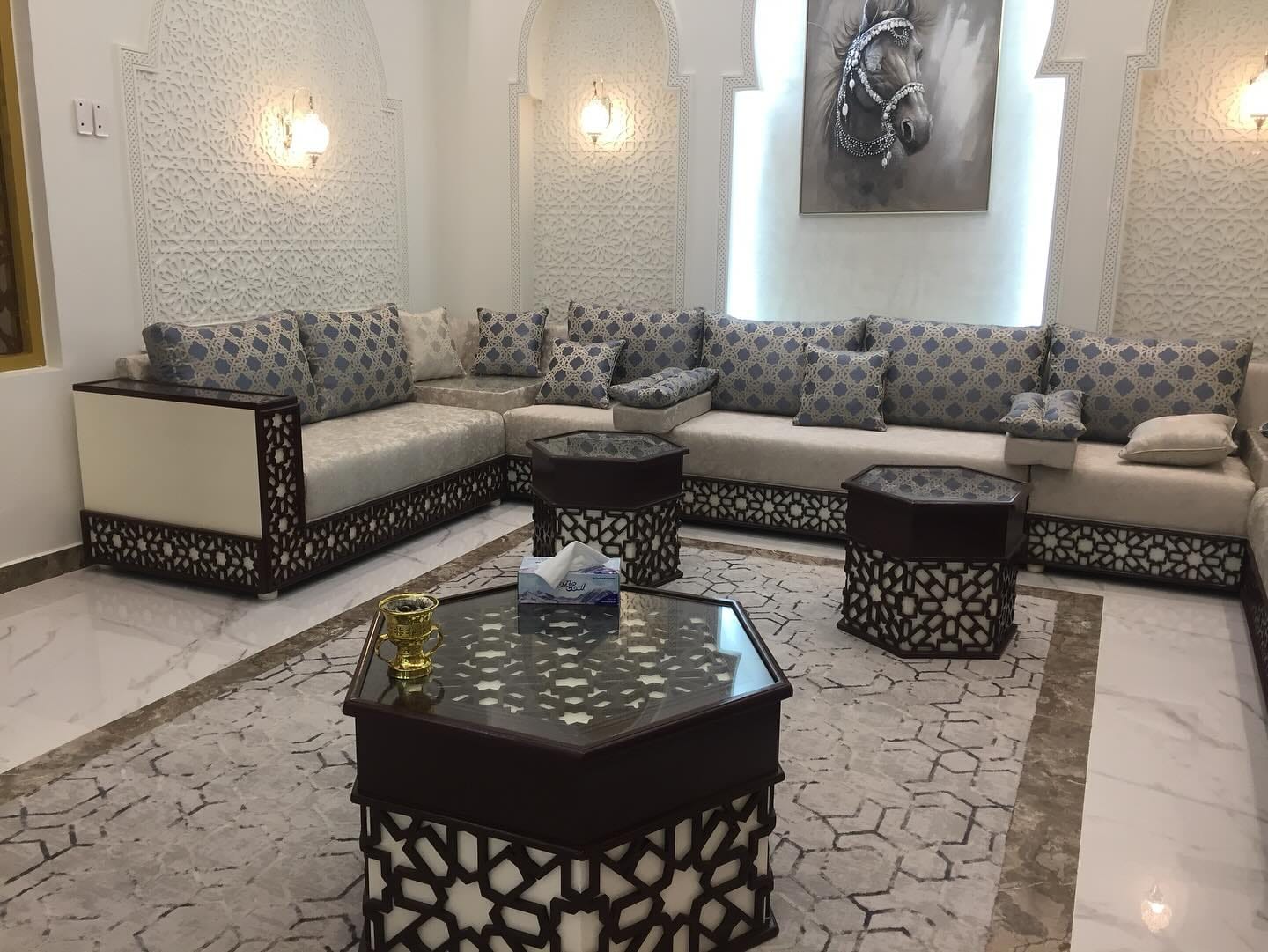
Pattern is the other tool. A woven pattern in two or three tones, like the grey and cream cover in the photograph below, forgives crumbs, hair and the odd mark in a way that a plain light colour never does. In a majlis that welcomes many guests, it is often the more sensible choice for that reason alone.
Leather and faux leather with children and pets
Leather is the other answer people reach for, and it is a good one with some limits. Fur does not cling to it and cleaning is usually simple. But Bellona's guide warns that cat claws can puncture or scratch it, and that large dogs can leave visible marks over time. Faux leather costs less but, as the same guide says, can peel or crack with long, heavy use.
The short video below puts leather and fabric side by side for pet owners, with a section on each and a look at which stands up better to claws. It is a retailer's view and fairly brief, so take it as a prompt for questions rather than a verdict. Our workshop handles genuine Italian leather, faux leather and velvet, and we would sooner talk through the trade-offs with you than steer you to a single answer.
One more point about faux leather. If it has already started to peel on a sofa whose frame is sound, a new cover is the repair, and the decision about whether that is worth doing is covered in reupholster or replace a sofa.
Throws, loose covers and the cushions beneath
Some of the protection a family sofa needs does not have to be built into the cover. A throw over the favourite seat takes the hair, the crumbs and the first scratches, and can be washed in a way the upholstery cannot. Pets that always climb onto the same spot are the clearest case: one protected seat does more than an expensive fabric over the whole sofa.
A removable cover is a different matter, and not always the answer it appears to be. A cover that comes off is not automatically machine-washable; the fabric, its backing, the seams and any shrinkage all decide whether it survives the wash, so ask for the washing instructions of the exact article, not of the fabric type. Many fixed covers on a majlis or a corner sofa cannot be taken off at all, because the cloth is cut to follow the shape.
Under the cover, the cushion decides how the sofa ages. A seat that has sagged looks worn whatever the fabric, and a cover stretched over tired foam creases and wears at the front edge sooner. In a house with children who jump on the sofa and dogs that climb it, the denser foam grades are the sensible choice for the seats, and the backs can be lighter. Which grade to choose is set out in sofa foam density explained.
Heat, sun and the UAE living room
Searchers in the Gulf ask for the best sofa fabric for hot weather, and it is a fair question, but a swatch cannot answer it. How a fabric feels against bare arms in summer depends on the construction and on how cold your air conditioning keeps the room, and we have no published test to quote. The honest advice is to sit on a large sample, with bare forearms, for five minutes in the room it is meant for.
Sun is more predictable. A sofa near a west-facing window takes hours of direct light a day, and colour will fade. The test for this is lightfastness, a separate figure on a good fabric card, and one that is not covered by the rub count. Ask for it for any seat on the window wall, and consider curtains that cut the glare: our majlis curtains guide deals with the window side.
A last practical point for homes that are shut up in summer: sun and heat reach the cover first, but they reach the foam beneath too, and both age faster in a hot room. That is one more reason to choose both together.
A home test you can do before you decide
Standard tests tell you something, and a sample in your own house tells you more. Ask for a piece larger than a swatch, ideally a few hundred square centimetres, and treat it as a trial before you spend. None of these is a standardised test; they are cheap ways of finding the problem before it is on the sofa.
- Run a fingernail firmly across the surface and then rub the sample against your sleeve: does it pull a thread or fuzz?
- Brush it both ways in good light. Do pressure marks or shading appear, as they can on velvet?
- Put a drop of water on it. Does it bead, spread or soak in?
- Stroke an animal's coat across it, or rub a hairy jumper on it, then see how easily the hair lifts off.
- Leave it in the sunniest spot for a week and compare it with an untouched piece.
- Sit on it for five minutes with bare arms, in the room where it will live.
- Ask for the cleaning code, the rub count and the lightfastness figure in writing.
How the choice is made with us
Upholstery with us starts with a free inspection. Tell us at that visit who lives with the sofa: how many children, which pets, where it sits in relation to the sun, and how the household cleans. We then suggest suitable fabrics from our library, and you make the choice.
A typical job takes about eight days from order confirmation. We collect the sofa, rebuild it in the Sharjah workshop with new foam, and return it with the cover you have chosen. The foam carries an anti-sagging guarantee of about five years, with a separate 24-month written warranty on our workmanship. A lone chair is below the size of job we take. Our full range is on sofa fabric replacement and the main page for sofa upholstery and repair, and the local page for sofa upholstery in Sharjah covers the area we serve.
Common questions
What is the best sofa fabric for kids and pets?
A tightly woven, flat fabric with a W or WS cleaning code and a rub count of 25,000 or more suits most families; leather is the other option. Weave, rub count and cleaning code.
What is the best sofa fabric to resist cat claws?
A dense, smooth weave such as microfibre gives claws little to hook, while bouclé, chenille and other looped yarns snag. No rub count predicts claw damage. Weave and texture.
What does a Martindale rub test of 25,000 mean?
The fabric survived 25,000 rubs in a lab before two yarns broke, which puts it at the start of the heavy-domestic range. It says nothing about claws or stains. What a rub count says.
Is velvet a good sofa fabric for children and pets?
It can be, but it shows pressure marks and shading, and looped or low-quality pile snags. Choose a modern hard-wearing velvet and view a large sample. Weave and texture.
What does the cleaning code X mean on sofa fabric?
X means do not clean it yourself: vacuum only or hire a professional. W means water-based cleaners are safe, and S means solvent cleaners only. Cleaning codes explained.
Can you recover a sofa whose faux leather is peeling?
Yes: with a sound frame, a new cover is the repair, because a peeling surface is normally replaced, not patched. Reupholster or replace a sofa.
What is the best sofa fabric for hot weather in the UAE?
No published test settles it, so sit on a large sample with bare arms in the room itself, and check lightfastness for seats near a window. Heat and sun in the fabric guide.

Sources & specifications
Manufacturer information applies to the named products and systems. Sources reviewed on 28 October 2026.
- Kothea: Martindale rub test guide (ranges, how the test works, what it does not measure)kothea.com(opens in a new tab)
- Wikipedia: Martindale method (standard, 5,000-cycle intervals, minimums for upholstery)en.wikipedia.org(opens in a new tab)
- American Leather: explaining fabric cleaning codes (W, S, SW or WS, X)americanleather.com(opens in a new tab)
- Bellona: how to choose sofa fabric for pets (microfibre, velvet, leather, colour and texture)bellonausa.com(opens in a new tab)
Want this planned for your home?
Consultation and measurement are free. Tell us the rooms, location and what you need; we arrange a sample visit and define the measured quotation.