Upholstery · 14 min read · Updated 28 October 2026
Sofa foam density explained: what D35, D40 and D45 mean
What D35, D40 and D45 sofa foam means: density against firmness, which grade for seats and backs, HR and memory foam, thickness, and how to check a density claim.

By Ali Haider Basra, Founder, Al Tareeq Decor · Contact our workshop
Key takeaways
- D35, D40 and D45 are trade labels, generally read as foam density in kg/m³, and all three sit in the 35–45 band that suits a daily-use seat.
- Density is how long a foam keeps its character; firmness is how it feels on first sitting. The two are independent, so ask for both.
- Use the denser grade for the seats that carry the most, such as a majlis corner or a heavier sitter; backs and arms can take a lighter one.
- Thin seats need a denser foam than thick ones, so ask for each seat's thickness as well as its grade.
- Published lifespans are indications, not promises; ours is an anti-sagging guarantee of about five years on the foam, written on the quotation.
On this page
- Key takeaways
- What a foam grade like D40 actually tells you
- Density and firmness are two different questions
- Four measures that describe a foam, and what each one tells you
- D35, D40 and D45 on one scale
- A UK supplier's sofa grades, side by side
- Why two guides give different lifespans
- Which grade goes where in the sofa
- Who sits matters as much as how often
- HR, standard and memory foam: what the names mean
- Thickness changes the grade you need
- How to check a density claim for yourself
- Five foam mistakes to avoid
- What to put on the quotation, and what we do
- Common questions
What a foam grade like D40 actually tells you
Ask an upholsterer in the Gulf what foam is going into your sofa and the answer is usually a letter and a number: D35, D40 or D45. It sounds like a standard, but it is a trade habit. The number is generally read as the foam's density in kilograms per cubic metre, so D40 means roughly 40 kg/m³, and the letter stands for density. No single standards body defines the label, so what one supplier calls D40 is a statement about that supplier's foam rather than a certified figure.
Density itself is simple. It is the weight of a block of foam divided by its volume: how much material is packed into the space. The Polyurethane Foam Association (PFA), the US trade body, says density is given in pounds per cubic foot or in kg/m³, and that a specification should quote the polymer density, meaning the foam chemistry on its own, without fillers added to make a block heavier. One pound per cubic foot is about 16 kg/m³.
What density buys is staying power. According to the PFA, a higher polymer density generally helps a foam hold its original character and support better. A denser seat is not necessarily harder to sit on. It is the one that is likelier to feel the same in year six as it did in week one, which is why the grade matters most for the seat you use every day.
Density and firmness are two different questions
The commonest mistake is to treat a denser foam as a firmer one. They are measured separately. Firmness, in the PFA's definition, is the force needed to push a sample in by 25% of its thickness, a measurement called indentation force deflection, or IFD, and the association states that it is independent of density: a high-density foam can be soft, and a low-density one can be firm.
The two together make up a seat. Firmness is the feel the moment you sit; density is how long the foam goes on giving it. Kings Canapé, a French sofa maker, puts it as a split between comfort and quality: firmness is a preference, and density is an indicator of durability. It also warns that a seat that is too soft, below about 2 kPa of firmness in its measure, can leave you slouched, while one that is too hard creates pressure points under the thighs.
Two further PFA measures complete the picture. The support factor divides the force needed to compress the foam by 65% by the force at 25%, and typical values run from about 1.5 to 2.6; a higher figure means the seat resists bottoming out better, and in general denser foam has the better factor. Resilience is a ball-rebound test, with flexible foams rebounding between roughly 20% and 80%, and viscoelastic memory foam very little. A specification that names only a D grade has told you about one of these four.
Four measures that describe a foam, and what each one tells you
Density
- What it is
- Weight of foam in a given volume
- What it tells you
- How well the foam holds its character over the years
- How it is written
- kg/m³, or pounds per cubic foot; trade grades such as D40
Firmness (IFD)
- What it is
- Force to press the foam down a quarter of its height
- What it tells you
- How hard the seat feels when you first sit
- How it is written
- Newtons or kilopascals; a descriptive word such as soft or firm
Support factor
- What it is
- Force at 65% compression divided by the force at 25%
- What it tells you
- How well it resists bottoming out under body weight
- How it is written
- A ratio, typically about 1.5 to 2.6; higher is better
Resilience
- What it is
- How far a dropped steel ball rebounds
- What it tells you
- How springy the foam feels
- How it is written
- A percentage, from about 20% to 80% for flexible foams
Source: Polyurethane Foam Association, “Foam performance”. Density and firmness are independent properties; a quotation that names only one has described only half of the seat.
D35, D40 and D45 on one scale
It helps to see where the three grades sit among all the densities in use. The chart below draws one published guide to density and an indicative life for each band, with the D35, D40 and D45 lines marked on the same axis, and gives a UK foam supplier's three most common sofa grades alongside for comparison. All three D grades sit in the same band: the one Kings Canapé calls high-resilience foam for a daily-use seat, 35 to 45 kg/m³.
That tells you what the grades are for. Below that band come foams that its guide places in backs and arms only, at 20 to 25 kg/m³, and entry-level seats at 28 to 30. Above it, at 50 and over, are the dense foams for the heaviest use. The three grades we work with are therefore three steps inside the good middle of the range, and the choice between them is a fine adjustment for who sits and how often, not a choice between good and bad.
A UK supplier's sofa grades, side by side
SF33 medium
- Density
- 31–34 kg/m³
- Firmness
- 100–130 N
- Indicative life
- 4–6 years
- Suggested use
- Seat cushions 5 in or thicker, often as an inner core
SF38 high firm
- Density
- 38–40 kg/m³
- Firmness
- 180–220 N
- Indicative life
- 5–8 years
- Suggested use
- Sofa and armchair cushions of 3–5 in; the supplier's default
Reflex400 medium
- Density
- 40 kg/m³
- Firmness
- 130 N
- Indicative life
- 5–8 years
- Suggested use
- Armchair and settee cushions
SF50 very firm
- Density
- 48–52 kg/m³
- Firmness
- 225–265 N
- Indicative life
- 8–12 years
- Suggested use
- Seating under 3 in
SF50M memory
- Density
- 50 kg/m³
- Firmness
- 90 N
- Indicative life
- 5–8 years
- Suggested use
- Toppers; pair with a firmer base
Source: eFoam (UK), “Foam grades and types”. Its lifespans are indicative values for normal UK domestic use and not guarantees. These are that supplier's grades, not Al Tareeq Decor's.
- 1. 20–25 kg/m³: backs and arms only, an indicative 1 to 3 years
- 2. 28–30 kg/m³: an entry-level seat, an indicative 3 to 5 years
- 3. 35–45 kg/m³: a daily-use seat, 7 to 10 years or more; every D grade sits here
- 4. 50 kg/m³ and over: the heaviest use, 10 years or more
- 5. The dashed lines mark D35, D40 and D45 on the same scale
- 6. The black bars are a UK supplier's three common sofa grades, for comparison
Why two guides give different lifespans
Read the chart carefully and you will notice that the two sources do not agree. Kings Canapé gives 7 to 10 years or more for the 35 to 45 band; the UK supplier gives 5 to 8 years for its 38 to 40 grade and 4 to 6 for its 31 to 34 grade. Neither is wrong, because neither is a measurement. Each is a maker's indication, written for its own customers and conditions, and the UK supplier says plainly that actual life depends on user weight, how often the seat is used, temperature, humidity, sunlight and care.
For a UAE living room two of those factors matter more than people expect. Seats that are sat on every evening by the whole household age faster than a formal room that is opened for guests, and a sofa near a sunny window or in a hot, poorly cooled room is under more stress than one that is not. So take the lifespans as an order of magnitude and a way of comparing the grades with each other. A denser foam outlasts a lighter one under the same use, and that is what is dependable here.
That is also why we do not promise an exact number of years for foam. What we put in writing is an anti-sagging guarantee of about five years on the foam we fit, and the terms of it go on your quotation.
Which grade goes where in the sofa
A sofa is not one piece of foam. The seat, the back, the arms and any loose scatter cushions carry very different loads, and fitting the same grade everywhere either wastes money in the back or shortens the life of the seat. Sheela Foam, an Indian manufacturer, puts its own densities for a corner sofa at 35 kg/m³ for the main seat, 28 to 30 for the lounging area and 20 to 25 for the backrest, and says that these figures are not an industry benchmark. They are in line with Kings Canapé's bands.
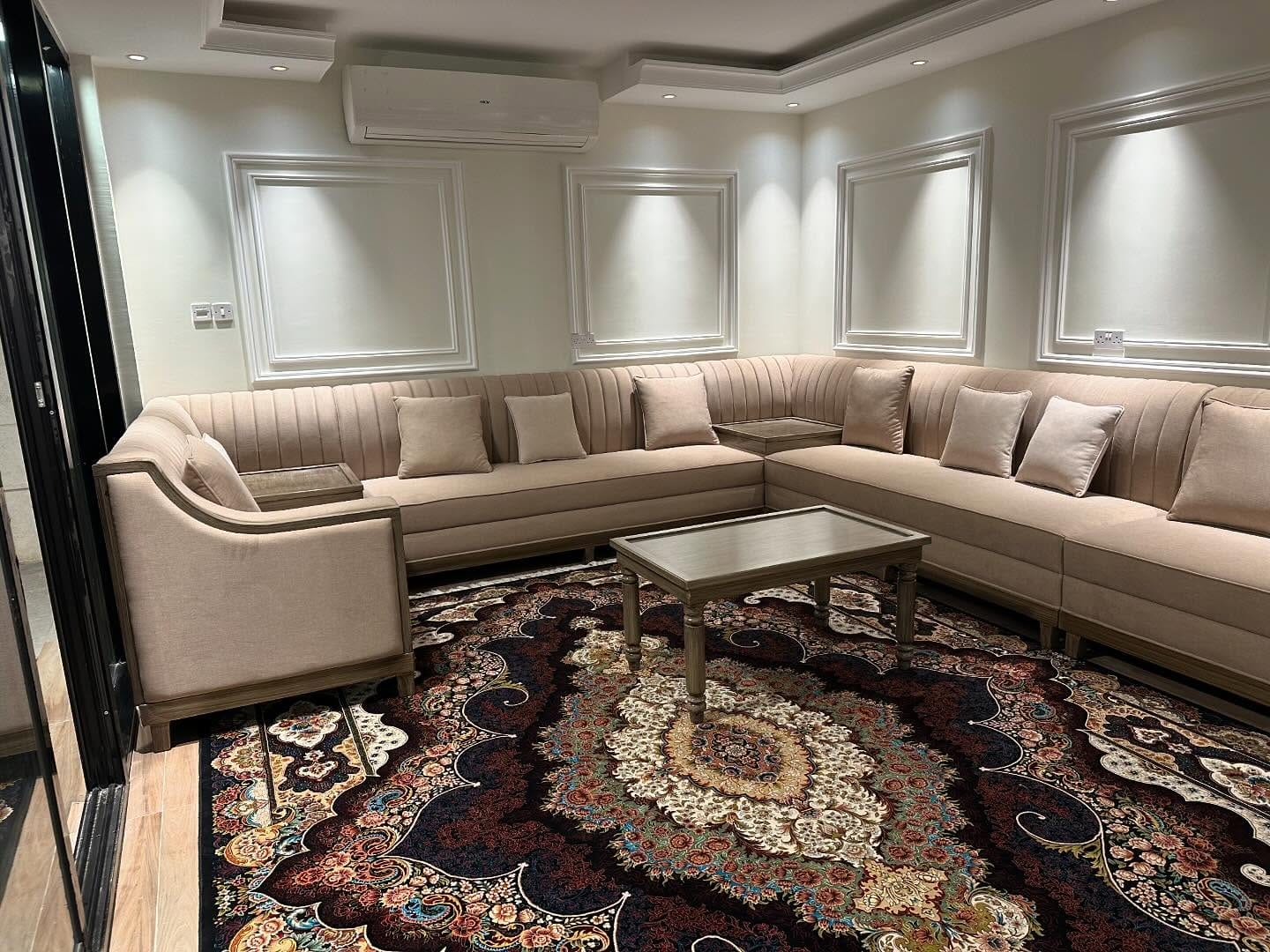
Put the published bands together with how a UAE household actually sits, and a sensible reading follows. D35 is the lower end of the daily-use band, and suits seats that are used moderately and backs and arm cushions that carry little. D40 is the middle of the band, and the sound choice for the main seats of a family sofa. D45 is the upper end, for the seats that take the heaviest daily use, such as the corner of a majlis, the seat the whole family fights for, or sitters who are heavier than average.
Backs are where you can save without harm. They carry far less load than seats, and they are meant to be softer, so a lighter foam is the normal choice there. Keep the budget for the seat, where the foam does the work, and ask for the seats and the backs to be written as separate lines.
Who sits matters as much as how often
Body weight is the factor people forget, and the published guides do address it. Kings Canapé suggests that for people under 70 kg a density of 30 to 35 kg/m³ is generally enough, and that anyone over 80 kg should aim for at least 35, ideally 40. It also recommends at least 30 kg/m³ for any seat used daily. Nothing is given for the range between, so treat them as signposts, not as limits.
Use that as a tiebreaker between our grades. In a household where several adults share the main seats, or where one person sits in the same place every evening, D40 or D45 for the seat is the safer choice. In a room mainly used by guests, or a second sitting room where the load is lighter, D35 is a reasonable seat and the saving can go on the cover.
Think also about who gets up. The Kings Canapé guide advises a firmer seat for someone who sits to talk or to work, because it makes standing easier and keeps the back straight, and a softer one backed by a high density for those who lounge for hours. This is the part of the decision that a number cannot make for you, which is why we ask you to sit on a sample, and ideally to bring whoever sits on it most.

HR, standard and memory foam: what the names mean
Alongside the D grades you will hear foam types named: standard polyurethane, HR and memory. They are not rivals to the density scale, they are descriptions of how a foam behaves. Standard polyether foam at 20 to 25 kg/m³ is the low-density material Kings Canapé confines to backs and arms. HR stands for high resilience, a foam with a faster, springier recovery; the same guide places HR in the 35 to 45 kg/m³ band, and the UK supplier lists a 40 kg/m³ grade it calls Reflex.
Memory foam is a different material altogether. Its resilience is very low, as the PFA's rebound test shows, because it moulds to the body and recovers slowly. The UK supplier sells a 50 kg/m³ memory foam at 90 N firmness and recommends it as a topper pair with a firmer base, not as the whole seat. That is sound advice for a sofa: a thin memory layer over a dense resilient core can feel soft on top without losing support, but the supplier does not recommend memory foam on its own.
So when you are offered a foam by type, ask for its density and firmness as well. HR is a promise of springiness, and neither a density nor a firmness. The short video below explains how the common foam types differ and where each is used.
Thickness changes the grade you need
Density is not chosen in isolation from how thick the cushion is. The UK supplier's guidance links the two: its medium grade is for seat cushions of 5 inches (about 13 cm) or more, often as an inner core; its high-firm grade for cushions of 3 to 5 inches; and its densest very-firm grade for seating under 3 inches. A thin slab has little height to absorb your weight, so it needs a denser, firmer foam to avoid bottoming out.
For a sofa that means two things. A thick, deep seat can use a medium or high-resilience foam and still feel generous, while a slim majlis seat or a dining chair needs the denser foam to do the same job in less height. And if you want a softer feel, it is better to add thickness than to drop to a light foam. The extra height lets a good foam compress gently without hitting the base.
Ask your upholsterer for the foam thickness of each seat as well as its grade. A seat that has been thinned to fit a low frame has had its grade quietly cancelled out.
How to check a density claim for yourself
You do not have to take a grade on trust, because density is easy to test. Weigh a piece of foam and measure it, then divide. A block of 50 cm by 50 cm by 10 cm is 0.025 cubic metres; at 40 kg/m³ it should weigh about one kilogram, and at 30 kg/m³ about 750 grams. Cut a clean offcut from a larger block, measure all three sides carefully and weigh it on kitchen scales, and you have a good estimate.
The video below has chapters on how to measure density and on density testing for upholstery foam, and goes on to compare low, medium and high density foam, scrims, closed-cell foam and Dacron padding. It comes from a trade upholsterer rather than a laboratory, so use it as a demonstration, not as a spec.
The rest of a foam check is done by hand. Press a thumb into the middle of the seat and then at the front edge; the two should feel alike. Sit for a few minutes in your normal position rather than for a few seconds. And look at the cut edge of a sample: it should have an even, fine cell structure without large voids or crumbling.
Five foam mistakes to avoid
The first is assuming that dense means hard. Density and firmness vary independently, so ask for both, and sit on a sample before it is cut. The second is the reverse: assuming a soft seat is a low-quality one. A soft, high-density foam can outlast a firm, light one.
The third is spending evenly. A top grade in the backs and a cheaper one in the seats is the wrong way round, and the right way costs less. The fourth is renewing foam on a tired base. If the dip in your seat stays in the same place when you swap the cushions, the support beneath is the problem, and new foam over failed webbing or springs will sag again within months; our guide on whether to reupholster or replace a sofa explains the check.
The fifth is judging a sample by its first impression. A fresh cushion usually feels firmer than it will after the first weeks, so judge it by how it supports you, not by how plush it feels at once.
What to put on the quotation, and what we do
Before you agree a price, make sure the quotation names the foam. Ask for the grade of each part written separately, the thickness of each seat, whether the seats are one block or layered, and whether the foam is wrapped. We price upholstery once a free inspection has shown what each piece needs, and the grade for each part goes on the quote.
Our foam comes in D35, D40 and D45, all high density, with an anti-sagging guarantee of about five years on the foam, alongside our 24-month written warranty on workmanship. A typical sofa takes about eight days: we collect it from your home, work on it in the Sharjah workshop and bring it back. One chair on its own is below the size of job we take. The cost of each part of a job is set out in our guide to sofa upholstery costs, and what we do to seating is on our sofa foam and cushion replacement page, with the full service at sofa upholstery and repair.
Take this list to the inspection:
- The grade proposed for the seats, the grade for the backs and arms, and the reason.
- The thickness of each seat cushion, and whether it is one block or layered.
- Whether the webbing or springs underneath are being renewed, or only the foam.
- Who sits there most, and for how many hours a day.
- What the anti-sagging guarantee covers and its written terms.
Common questions
What is the best foam density for a sofa?
For a seat used daily, 35 to 45 kg/m³, which is the band our D35, D40 and D45 grades sit in; backs and arms can use less. Which grade goes where.
What does D40 foam mean?
D40 is a trade label generally read as a density of about 40 kg/m³. It describes how much foam is in a given volume, not how firm it feels. D35, D40 and D45 on one scale.
Is higher density foam firmer?
No. The Polyurethane Foam Association says firmness is independent of density, so a dense foam can be soft and a light one firm. Ask for both. Density and firmness explained.
What is the difference between HR foam and standard foam?
HR means high resilience: it springs back faster and is usually denser, around 35 to 45 kg/m³, while standard foam at 20 to 25 suits backs only. HR, standard and memory foam.
How long does sofa foam last?
Published guides give roughly 7 to 10 years or more for a daily-use grade, and a supplier's 5 to 8 for a similar one; they are indications, not promises. Why the lifespans differ.
Can you replace just the foam in a sofa?
Yes, if the frame and the support beneath are sound; if the dip stays put when you swap cushions, the springs or webbing need work too. Reupholster or replace a sofa.
How much does it cost to replace sofa foam?
We price after a free inspection, because each piece differs; the grade, thickness and number of seats all count. What a sofa upholstery quotation covers.

Sources & specifications
Manufacturer information applies to the named products and systems. Sources reviewed on 28 October 2026.
- Polyurethane Foam Association: foam performance (density, IFD, support factor, resilience)pfa.org(opens in a new tab)
- eFoam (UK): foam grades and types (density, firmness, indicative lifespans)efoam.co.uk(opens in a new tab)
- Kings Canapé: density versus firmness, a comfort guide (bands, lifespans, body weight)kingscanape.com(opens in a new tab)
- Sheela Foam: how to choose the right sofa foam density (seat, back and lounge densities)sheelafoam.com(opens in a new tab)
Want this planned for your home?
Consultation and measurement are free. Tell us the rooms, location and what you need; we arrange a sample visit and define the measured quotation.