Curtains · 11 min read · 8 May 2026
Choosing a curtain maker or curtain shop in Sharjah: a buyer's checklist
A checklist for choosing a curtain shop or maker in Sharjah: who measures and sews, samples at home, reading the quotation, timing, handover, invoices and red flags.

By Ali Haider Basra, Founder, Al Tareeq Decor · Contact our workshop

Key takeaways
- Find out whether you are dealing with a fabric counter, an agent or a workshop that measures, sews and fits.
- Made to measure pays off on tall, wide or unusual windows and ceiling-height tracks.
- See samples in your own room's light, and let the maker take the cutting sizes.
- Compare quotations window by window: fabric, lining, heading, track, motor, installation and timing.
- Ask which day the delivery time counts from, get the workmanship cover in writing, and keep a dated Arabic invoice.
On this page
- Key takeaways
- Curtain shop or curtain maker: know which one you are visiting
- Ready-made or made to measure: which do you need?
- Questions worth asking on the first call
- Visit the workshop and look at the sewing
- Samples should come to your home
- The maker should measure, not you
- How to read a curtain quotation
- What each line of a curtain quotation should tell you
- When does the clock start?
- Handover: what to check before the fitters leave
- Invoices, warranties and your rights in the UAE
- Red flags when choosing a curtain shop
- Is a workshop the right choice for your job?
- Common questions
Curtain shop or curtain maker: know which one you are visiting
Search for a curtain shop in Sharjah and you will find dozens, from Rolla and Al Nahda to Muwaileh and the industrial areas. They are not all the same kind of business. Some are fabric counters: they sell cloth by the metre and ready-made panels, and pass any sewing to a tailor nearby. Some are agents who take your order and send it to a workshop elsewhere. And some are workshops that measure, sew and fit with their own people.
Any of the three can give you good curtains, but they answer differently when something goes wrong. If the fabric is right and the hem is crooked, or the hem is right and the track sags, you want one business that owns the whole result. Ask early which kind you are dealing with. This checklist is written by a workshop, so apply it to us as firmly as to anyone else.
Those three answers reveal more about a curtain business than any showroom does. Listen for one name in all of them. When a salesperson takes the sizes, a tailor in another district sews, and a freelance fitter puts up the track, an error at any step turns into an argument about who caused it.
In our case the answer is one team from start to finish. The measuring visit and consultation cost nothing and are handled by our staff; every curtain is stitched in our workshop in Al Shuwaiheen, Sharjah; and it is hung by our own fitters. Other arrangements can work well, but this is the one that leaves a single business responsible for the finished window.
Ready-made or made to measure: which do you need?
Off-the-shelf panels are sold in a few fixed widths and lengths. They cost less, you can carry them home the same afternoon, and in a rented flat with ordinary windows they can be enough. Their weakness is anything out of the ordinary: a window wider than the biggest panel, a track at ceiling height in a villa, a curtain meant to end exactly at the floor, or a heading that wants more gathered fabric than a flat panel holds. Hunker's sizing guide puts a well-gathered curtain at 1.5 to 2 times the width it covers, which standard panels rarely reach on a wide window.
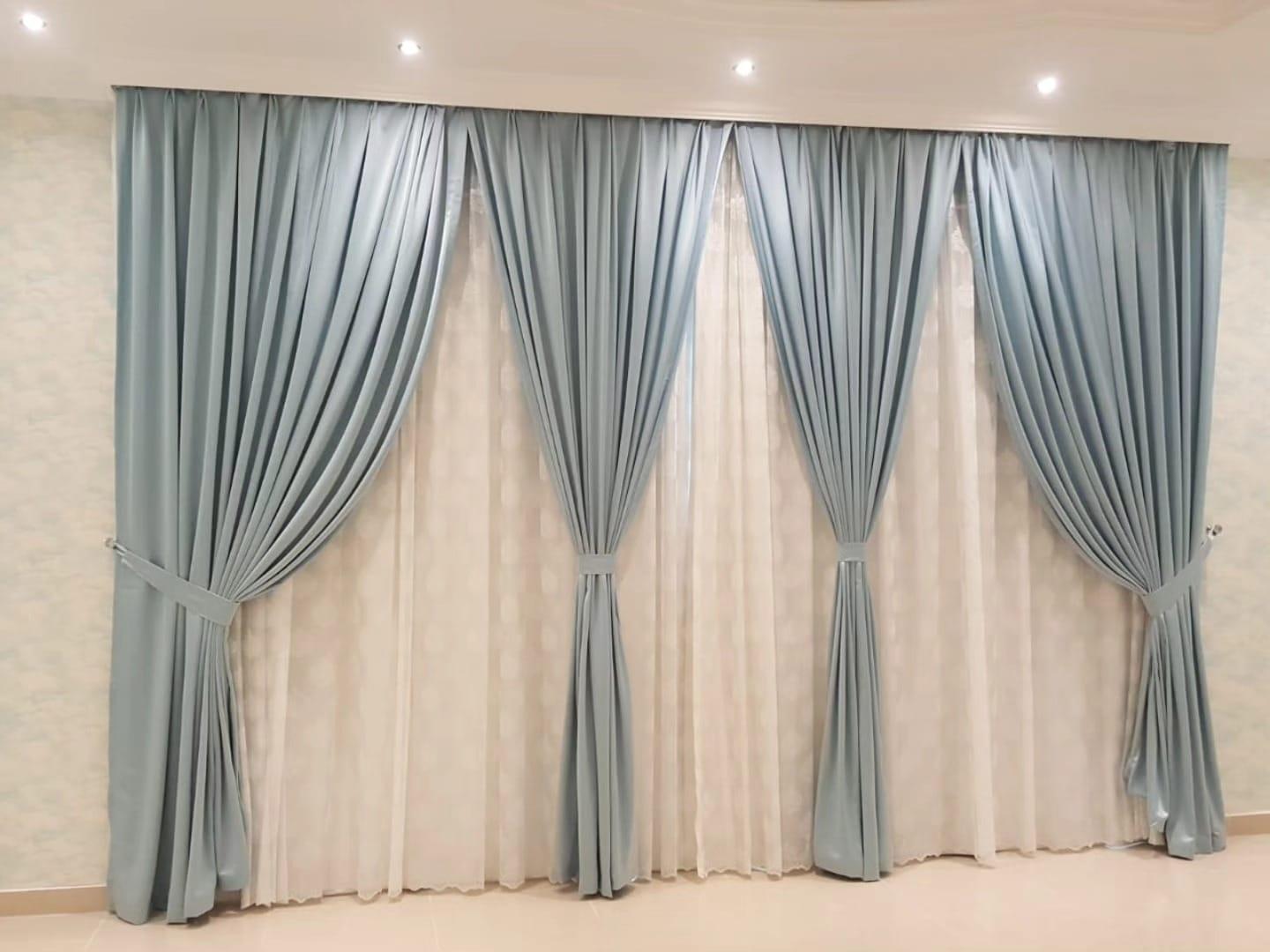
Bespoke curtains are made for a single opening. Their width is set by the folds the heading needs, their length by where you want the hem, and you choose the face fabric and the lining separately, which counts for a lot under UAE sun. A simple test helps: if a shop panel would have to be shortened, joined to another or hung from a different rod to fit, its saving has usually disappeared, and having the curtain made is the better buy.
Questions worth asking on the first call
A five-minute phone call or WhatsApp exchange saves a wasted visit. Describe the rooms, snap each window from the middle of the floor, and give rough sizes. Then ask a few direct questions: do you come to measure, and is that visit charged? Do you bring fabric samples? Where is the sewing done? Who puts them up? How long does an order take, and from which day is that counted? A curtain maker who answers clearly on the phone usually works clearly on site.
Mention anything unusual at this stage, too: a double-height window, a curved bay, a balcony door used every day, a ceiling that is not built yet or a wish for motorised tracks. These change the visit, the samples worth bringing and sometimes the timing, and a good maker will tell you so before arriving rather than after.
Visit the workshop and look at the sewing
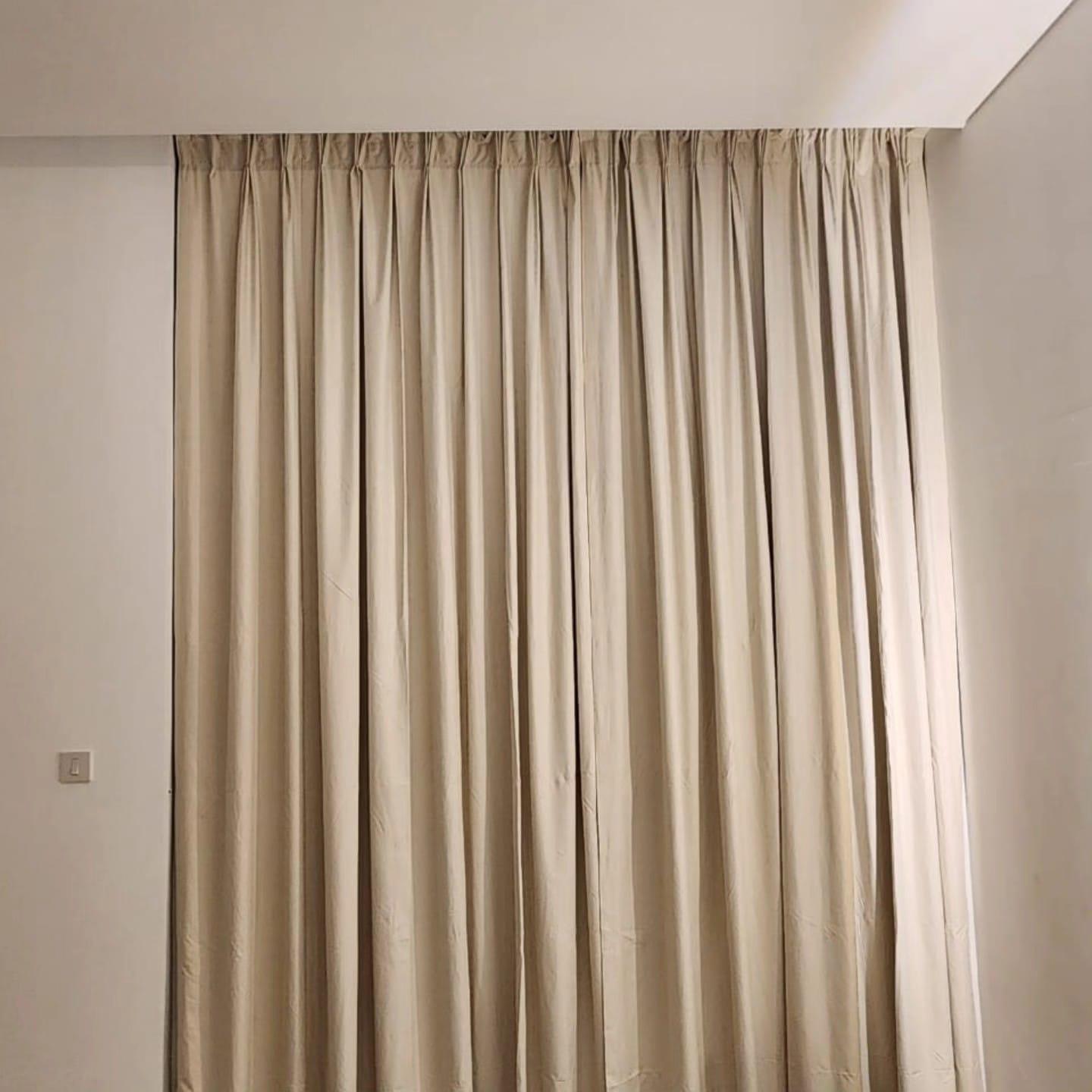
Ten minutes inside a workshop is worth an hour of browsing photos. Ask to see orders waiting for delivery rather than the showroom pieces. The hems should be straight and level, without puckering along the stitching. Where two widths of fabric meet, a pattern should continue across the join. The heading should be evenly spaced, so the folds fall regularly when the curtain is drawn. On lined curtains, the lining should sit smoothly behind the face fabric rather than dragging it out of shape.
Look at the fabric books near a window, not under spotlights that flatter some colours and flatten others. A capable maker will also show how a sheer, a dim-out and a blackout behave when held against daylight, and explain what each will do in your room, instead of selling on colour alone.
Samples should come to your home
Curtain colour depends on the light it hangs in. A beige that looks warm in a showroom can turn grey in a north-facing bedroom, and a west-facing majlis window will bleach and brighten everything the afternoon sun touches. So the fabric decision belongs at home, against your own walls, floor and sofa, in the hours when that room sees most use.
Expect a curtain maker to bring physical samples to the measuring visit. We bring ours, including sheers, dim-outs and blackouts, so you can hold a blackout sample against the glass and see how much light gets through. If a shop can show colours only on a phone, ask for cuttings to keep for a day before you decide.
The maker should measure, not you
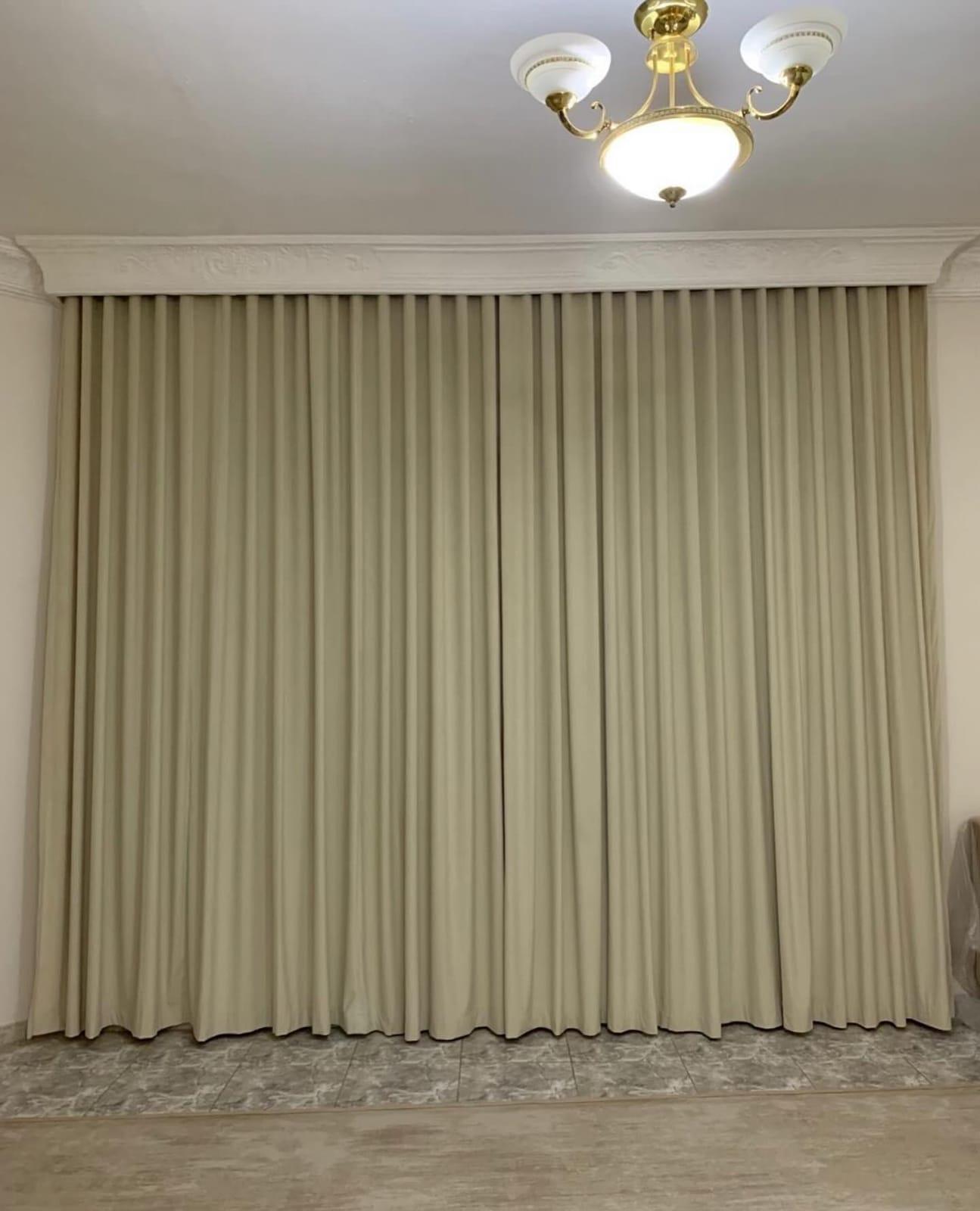
Your own sizes are fine for a first price, but the sizes used for cutting should come from whoever makes and hangs the curtain. The finished dimensions depend on choices only they can make: how far beyond the frame the track extends, whether it is screwed into the ceiling or into the wall, the depth of any ceiling pocket, and how much space the fabric needs when drawn back. Lutron, the American shading maker, puts it firmly in its measuring guide: never base final measurements on the dimensions in a drawing or plan, and measure on site once finishing work is complete.
That is why we laser-measure every window at the free visit and record handles, sills, AC units and anything else the curtain must clear. If you supplied the sizes and the curtains arrive short, the cost tends to be yours; if the maker measured, it is theirs. The visit is described in detail in our measuring and fitting guide.
How to read a curtain quotation
Curtain makers in Sharjah quote in different ways: per window, per metre of track, per metre of fabric, or as a single total for the house. None is wrong, but two quotations can only be compared once they describe the same curtains. Ask each one to break the price down window by window, using the lines in the table, and the real differences appear quickly.
As a reference point, our made-to-measure curtains begin at AED 550 a window in the entry specification, which includes the fabric, a manual track and fitting. An extra-tall or extra-wide opening, an upgraded fabric, a sheer behind a blackout or a motor takes a window above that, and each addition appears as its own line. The lines are explained further in how curtain quotations are priced.
What each line of a curtain quotation should tell you
Fabric
- What to look for
- Name or reference for each layer: sheer, curtain, lining
Fullness and heading
- What to look for
- Wave, pinch pleat, American fold or eyelet, and how full
Lining
- What to look for
- None, standard, dim-out or blackout; sewn in or separate
Track or rod
- What to look for
- Brand or type, single or double, manual or motorised
Motor and controls
- What to look for
- The model, power, remote or app, and who installs the power point
Installation
- What to look for
- Included, plus any pelmet, ceiling pocket or removal of old tracks
Timing
- What to look for
- Working days counted from fabric approval, not from the first visit
Total
- What to look for
- Everything payable, written down before work starts
A checklist for comparing quotations; not every window needs every line.
When does the clock start?
Ask every curtain maker exactly which day the delivery time is counted from. "Ready in five days" means little if those days begin at the first phone call and the fabric has not been chosen yet. Most of the waiting usually happens before the clock starts anyway: deciding on fabric, a sample that has to come in, or a ceiling that is still being built.
Our standard curtains are sewn and fitted 3 to 5 working days after fabric choice and final sizes, and a 48-hour rush can be arranged when a date matters. A big villa with many rooms is a different scale of job and can run to about 15 to 25 days, depending on the materials and on whether the rooms are ready; the quotation spells out the programme. The timeline shows how the steps fit together.
- 1. Call or WhatsApp with photos and rough sizes
- 2. The free visit: samples in your light, laser measuring
- 3. Fabric chosen and sizes confirmed: the working-day clock starts
- 4. Standard orders sewn and fitted in 3 to 5 working days
- 5. Handover: every curtain opened, closed and checked
Handover: what to check before the fitters leave
Run every curtain yourself before the team packs up. Each one should glide without snagging, meet neatly where the two halves join, and end at the agreed height, either just clear of the floor or touching it. Look along the track to see that it is straight and firmly fixed, especially on a gypsum ceiling, and on a double track check that the sheer and the heavier layer move on their own. If there is a motor, try the remote, the wall switch and the app, and ask how the curtain opens during a power cut.
Ask for the care details of each fabric before the team leaves, because washing a blackout lining the wrong way is the quickest way to spoil it; the care guide for curtains and blinds explains what each fabric needs. Anything not right is easier to put right on the day than a week later.
Invoices, warranties and your rights in the UAE
Under the UAE government's consumer protection guidance, a supplier has to give you a dated invoice that names its business, its address and what was supplied, written in Arabic, though a second language may be added. File it with the quotation, since the two together record what was agreed. The underlying rules are in Federal Law No. 15 of 2020 on Consumer Protection.
Ask each maker to put its workmanship cover in writing. Ours runs for 24 months from installation on new orders agreed from 10 October 2026; bought-in items like motors are covered by their makers' warranties. Should a disagreement not be resolved, the same government guidance points consumers to the Ministry of Economy (800 1222) and to the Department of Economic Development in each emirate, Sharjah included, where complaints are received.
Red flags when choosing a curtain shop
Most curtain businesses in Sharjah are honest and capable, but a few warning signs are worth knowing. None of them proves a problem on its own; two or three together are a good reason to keep looking.
- A price given over the phone for curtains nobody has measured
- No fabric reference on the quotation, only a colour or "imported"
- A delivery time with no stated starting day
- Measuring left entirely to you, for made-to-measure curtains
- No clear answer about who sews and who fits
- Nothing in writing about workmanship cover
- A total that changes on fitting day for "extras"
Is a workshop the right choice for your job?
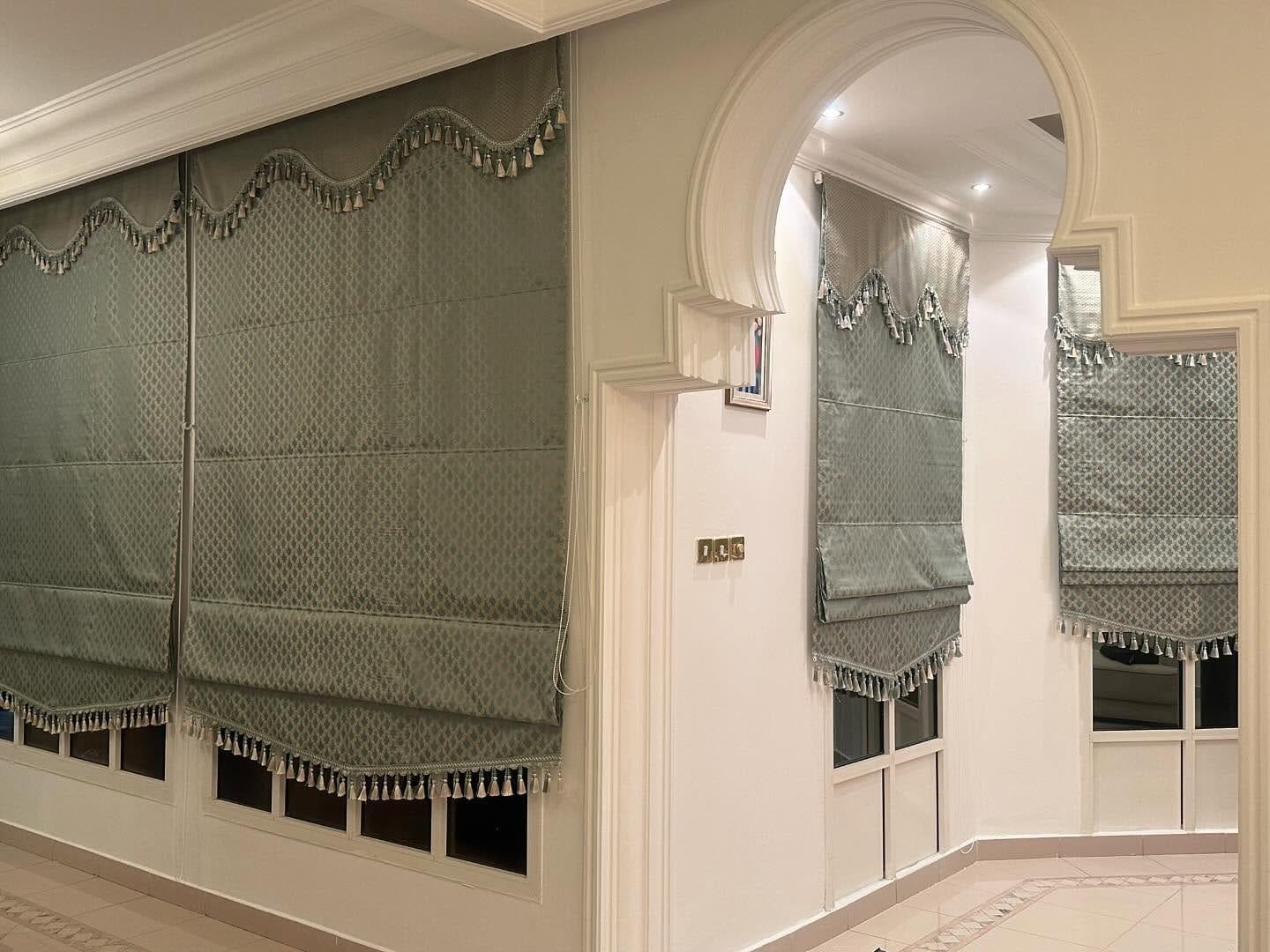
The size of the job matters. As a workshop we take on rooms and complete homes, not one window by itself, so for a single small curtain a local shop may be faster and a better fit. For a bedroom, a majlis, a living room with sheers and blackouts, or a villa with motorised tracks, a business that measures, sews and fits is generally the safer choice.
You can visit our showroom and workshop in Al Shuwaiheen, Sharjah, from 9 am to 11 pm Saturday to Thursday and from 5 pm to 11 pm on Friday; our installers work across Sharjah and the other emirates. A WhatsApp photo is a good first step, and our curtains and blinds page and Sharjah curtains page cover the rest before you book the free visit.
Common questions
How do I choose a good curtain maker?
Ask who measures, who sews and who fits, see the sewing and the samples, and compare itemised quotations window by window. Choosing a curtain maker.
Are made-to-measure curtains worth it?
On tall, wide or unusual windows, usually yes: they fit exactly and you choose fabric and lining. On standard windows in a rental, ready-made may do. Bespoke or off the shelf.
How long do custom curtains take in Sharjah?
With us, 3 to 5 working days after fabric and sizes are agreed, or 48 hours on rush. Large homes follow their quotation. When the clock starts.
How much are made-to-measure curtains?
With us, prices begin at AED 550 a window for fabric, a manual track and fitting. Size, fabric, extra layers and motors raise it. How curtain quotes are priced.
Should I measure my own windows for curtains?
For a first price, yes; for cutting, let the maker measure, since the finished size depends on the fixing. Measuring and installing curtains.
Which curtain heading should I choose?
Wave for a modern, even fold; pinch pleat for a tailored look; eyelet for simple rods. The room and the track decide. Wave, pinch pleat or eyelet.

Sources & specifications
Manufacturer information applies to the named products and systems. Sources reviewed on 28 October 2026.
- UAE government portal: consumer protection (Arabic dated invoices, Ministry of Economy 800 1222, emirate DEDs, Federal Law No. 15 of 2020)u.ae(opens in a new tab)
- Lutron app note 598: measure shades on site after finishing work, never from drawingssupport.lutron.com(opens in a new tab)
- Hunker: how wide and long drapes should be (fullness of 1.5 to 2 times)hunker.com(opens in a new tab)
Want this planned for your home?
Consultation and measurement are free. Tell us the rooms, location and what you need; we arrange a sample visit and define the measured quotation.