Dressing Units · 13 min read · 9 April 2026
Dressing mirror lighting: the right light for make-up and grooming
How to light a dressing or make-up mirror: side, front and backlit options, warm or cool light, CRI, brightness in lux, glare, controls and wiring.

By Ali Haider Basra, Founder, Al Tareeq Decor · Contact our workshop
Key takeaways
- Light the face, not the mirror: side lights at face height give even light, overhead light alone casts shadows.
- A backlit halo mirror is a mood light; for make-up choose front-lit, or add light that reaches the face.
- Aim for about 3000–4000K, or an adjustable mirror, with a colour rendering index of 90 or more.
- About 325 lux at the face suits make-up, more for older eyes, with a dimmer for the evening.
- Keep controls reachable from the seat and the LED driver reachable for service.
On this page
- Key takeaways
- Light your face, not the mirror
- Three ways to light a mirror, compared
- Why overhead light alone casts shadows
- Side lights at face height
- Front-lit or backlit LED mirror?
- Front-lit and backlit LED mirrors compared
- Warm or cool light for make-up?
- Colour rendering: why CRI 90 matters
- How bright should a make-up mirror be?
- Glare, reflections and the rest of the room
- Controls, sockets and the driver behind the mirror
- Lighting for photos, videos and calls
- Adding light to a dressing table you already have
- Lighting a mirror in a walk-in or dressing room
- Choosing and checking your mirror light
- Common questions
Light your face, not the mirror
A lit mirror can look finished in a photograph and still leave you squinting at your own reflection. The reason is simple: the mirror is not what you need to see. You need light falling on your face, evenly, from the direction you are looking, in a colour that shows foundation and lipstick as they will look outside. Most disappointing dressing tables get one of those three things wrong.
This guide covers each of them: where the light should come from, which colour and how bright, how to choose between a front-lit and a backlit LED mirror, and the wiring and controls behind it. For the mirror's size and hanging height, see how to size a dressing table; this guide stays with the light. For the look of the whole piece around the mirror, see dressing table styles.
Three ways to light a mirror, compared
The drawing shows the same face under the three arrangements we see most. A single light overhead is the most common, because a ceiling downlight is already there; it lights the top of the head and casts shadows down the face. A halo of light behind the glass, the look of most backlit mirrors, makes a beautiful glow on the wall but sends little light forward onto you. Lights at each side of the mirror, at face height, fill the face from both directions and are what make-up artists' mirrors have always used.
That does not rule out a backlit mirror; it means a backlit mirror on its own is a mood light. Pair it with light that reaches the face, or choose a front-lit design whose light shines outward through the glass. The bottom of the drawing shows the two numbers that settle the rest: colour temperature and brightness.
- 1. Overhead only: shadows fall under the brow, nose and chin
- 2. Halo behind the glass: a lovely glow on the wall, little light on the face
- 3. Lights at each side at face height: even light across the face
- 4. Colour: about 3000–4000K, with a colour rendering index of 90 or more
- 5. Brightness at the face: about 325 lux for grooming and make-up
Why overhead light alone casts shadows
Light from above lands on the forehead, the top of the nose and the cheekbones, and leaves everything below them in shade: the eye sockets, the area under the nose and the line of the jaw. Golden Lighting, an American lighting maker, describes exactly that pattern in its guide to vanity lights, and Philips gives the same advice in its bathroom guide: put light above and to the sides of the mirror to reduce shadows on the face.
In a bedroom that usually means the ceiling downlight stays as general light and the dressing table gets its own source. If the room is being redesigned with a gypsum ceiling, a downlight can be placed in front of the seat rather than behind it, which helps, but it still will not replace light from the sides.
Side lights at face height
Lights on both sides of the mirror, at about the height of your face, are the arrangement every make-up artist's station uses. Golden Lighting suggests centring side fixtures about 60 inches, roughly 152 cm, above the floor for a standing vanity and then adjusting to the user's eye level, with the pair about 36 to 40 inches apart and fixtures 18 to 24 inches tall. At a seated dressing table that centre drops to the user's eyes when sitting, and the drawing records it.
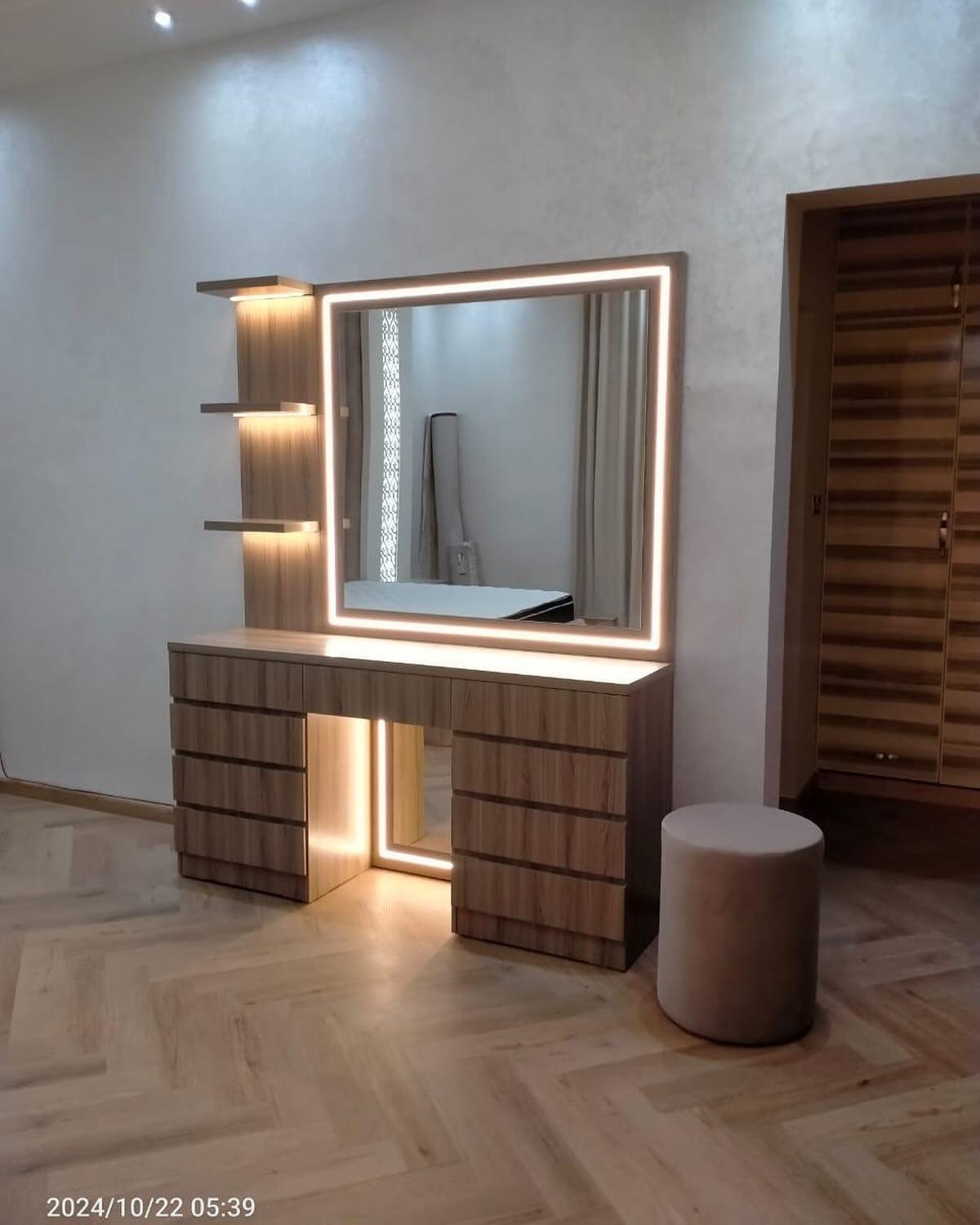
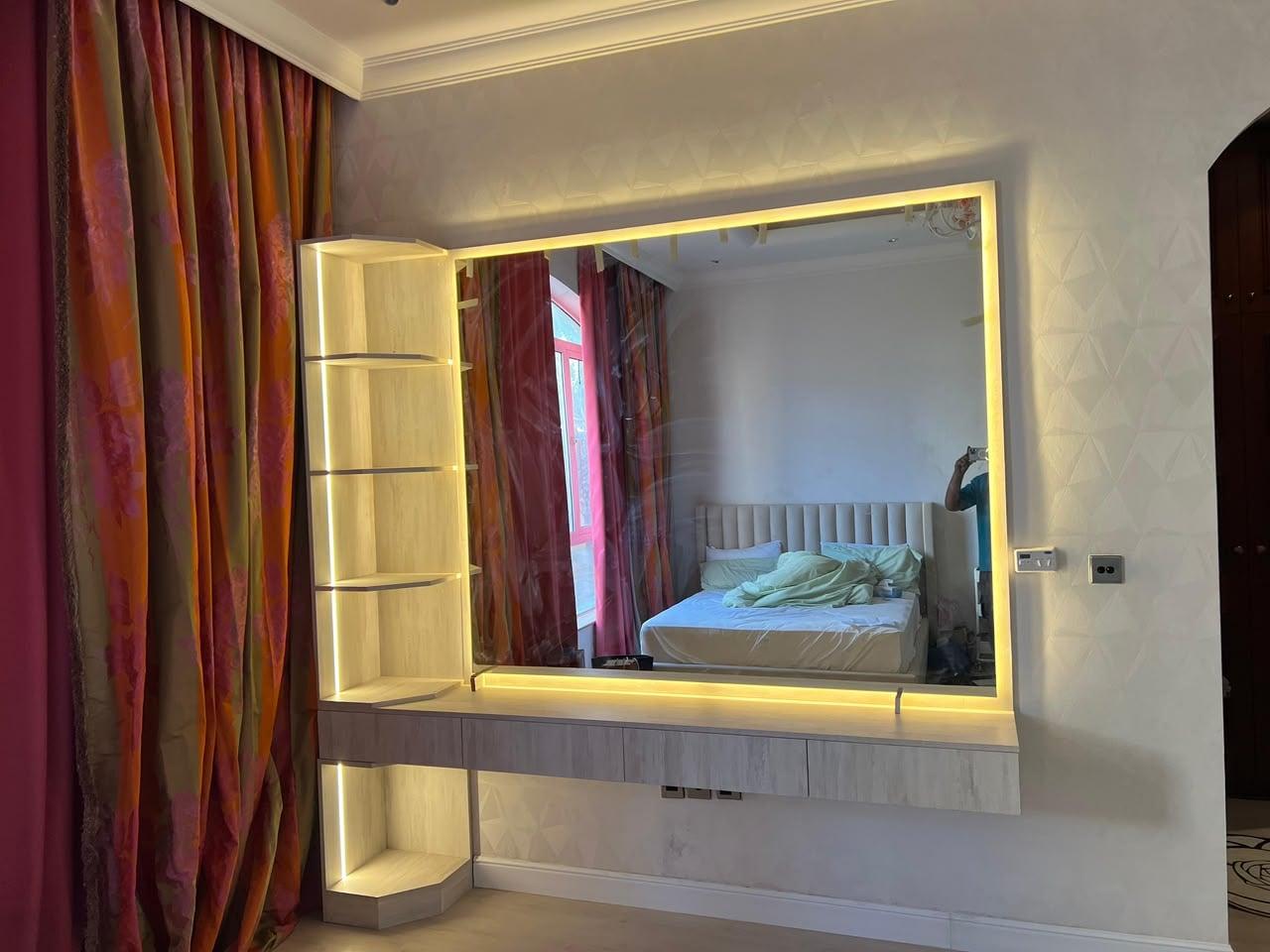
Side light can come from wall lights, from vertical LED strips built into the mirror's frame, or from vertical lit panels in the joinery either side. Diffused light is kinder than bare points: a frosted lens or an opal diffuser over the LEDs spreads the light and avoids the glare of looking straight at bright dots.
Front-lit or backlit LED mirror?
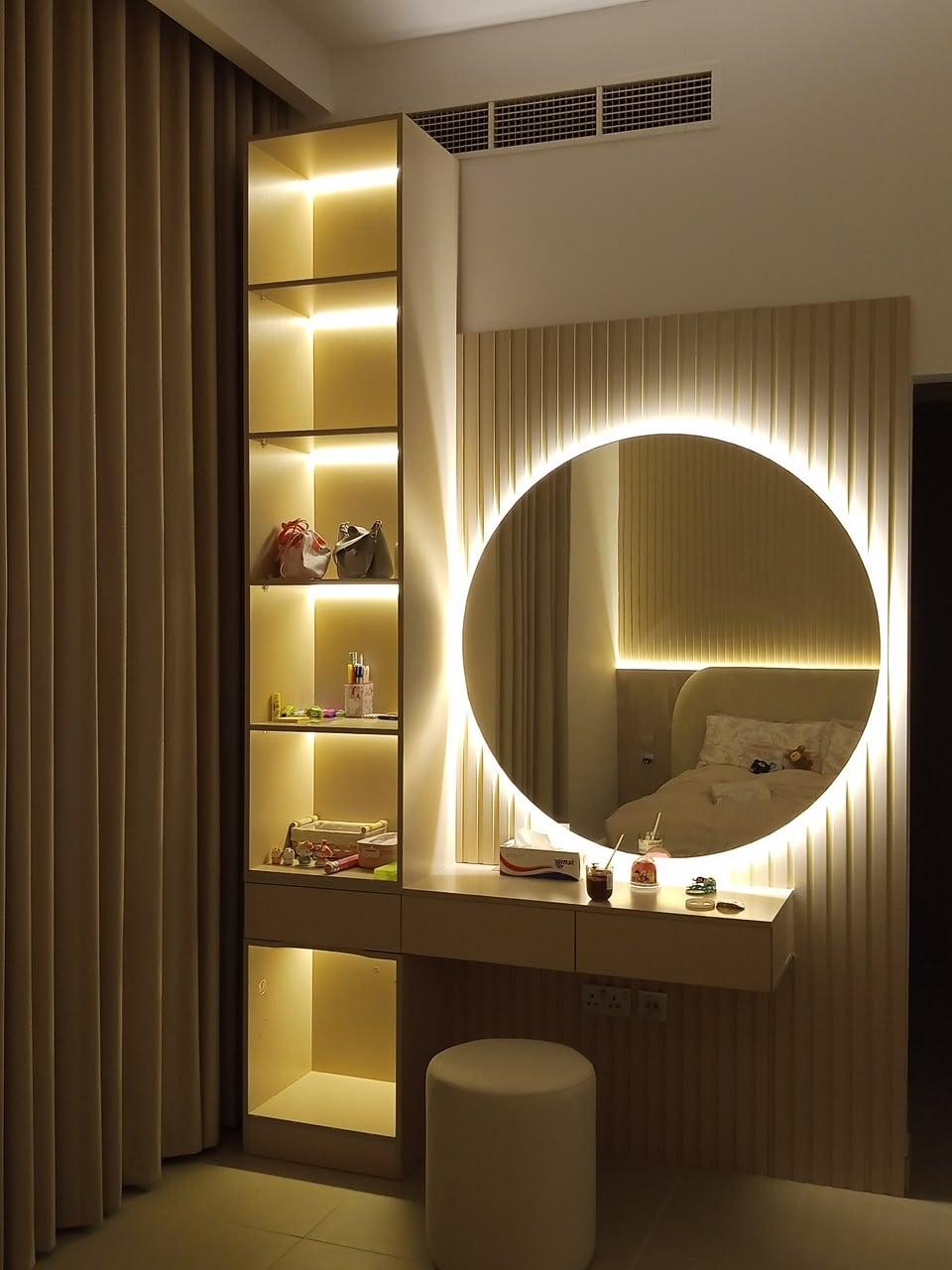
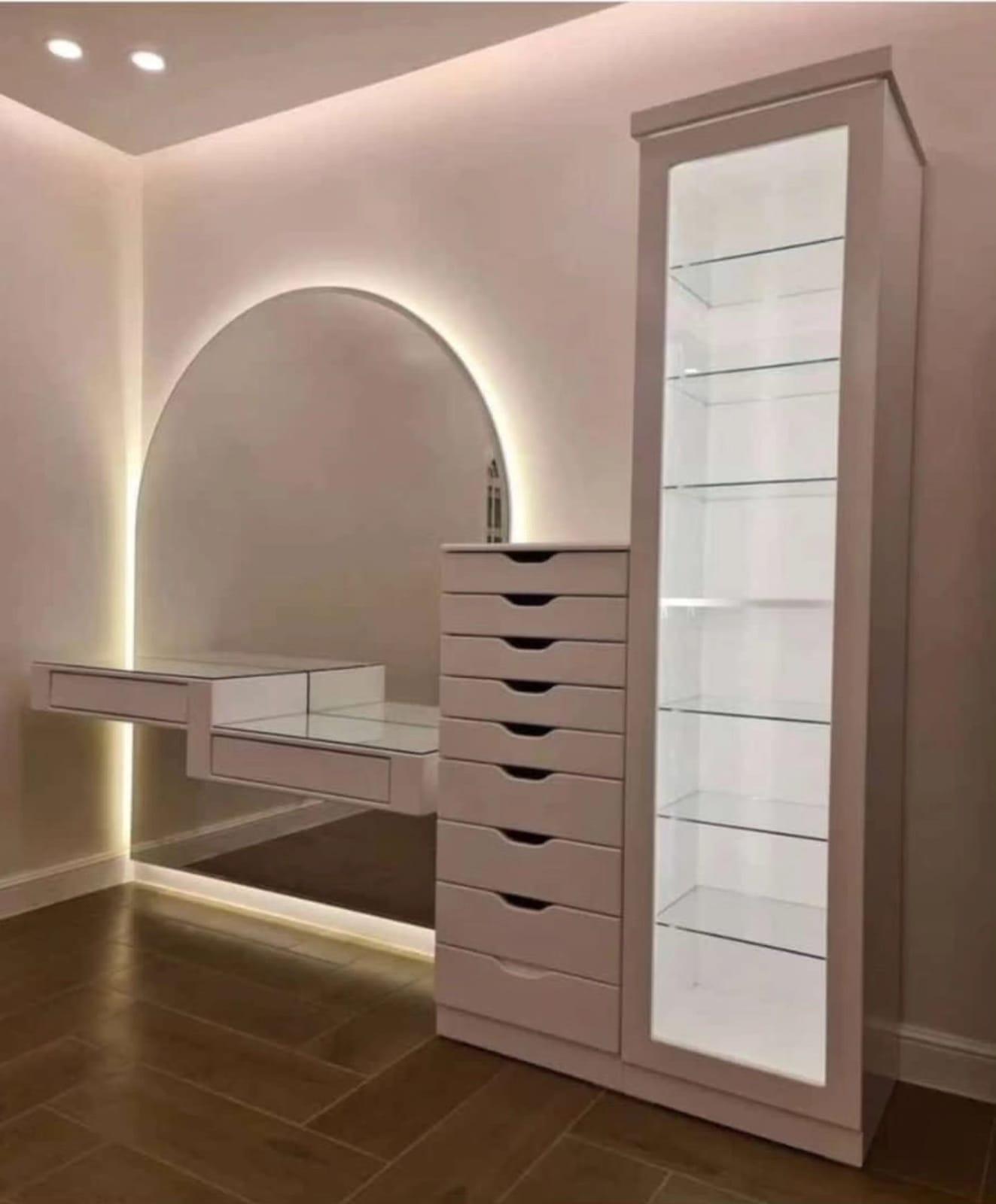
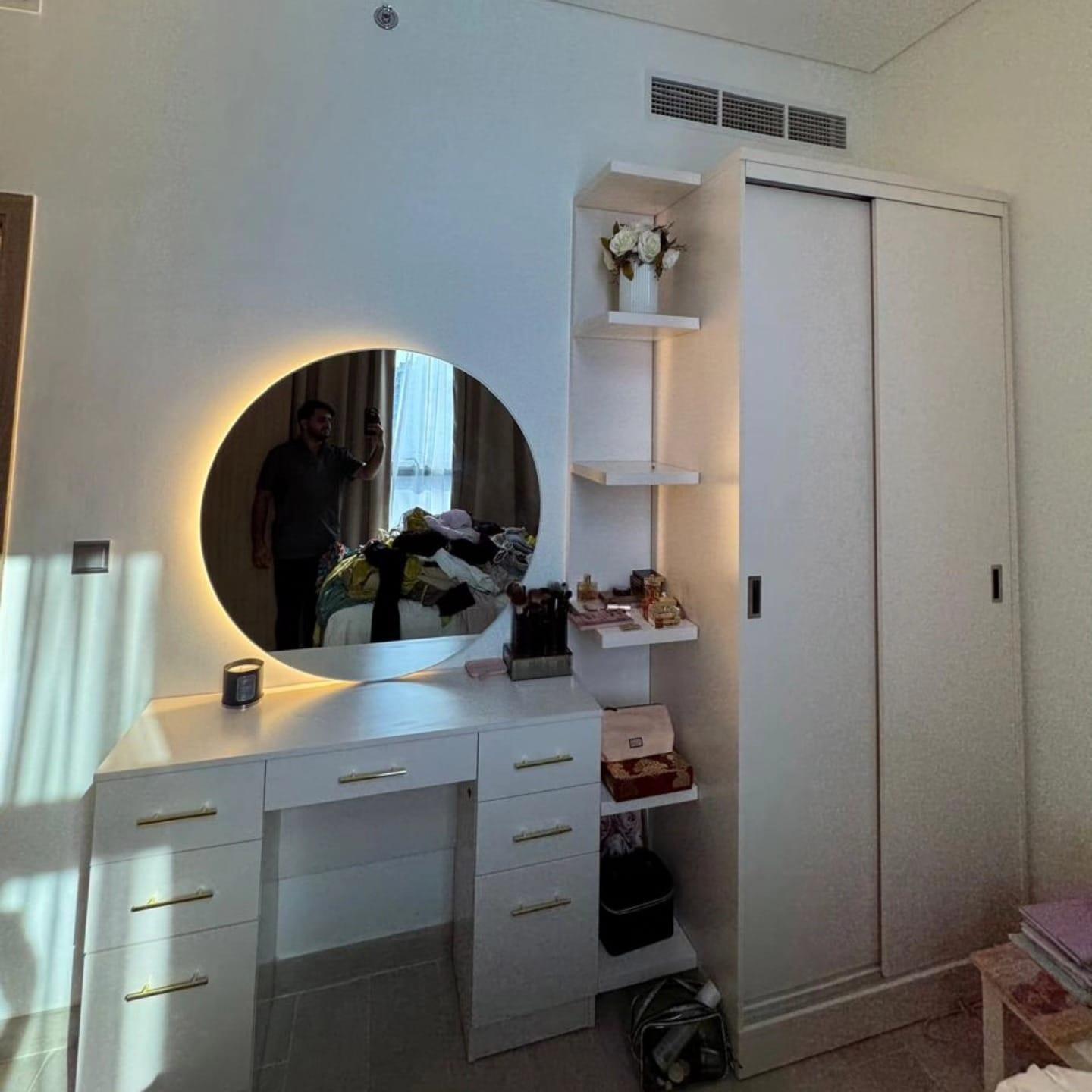
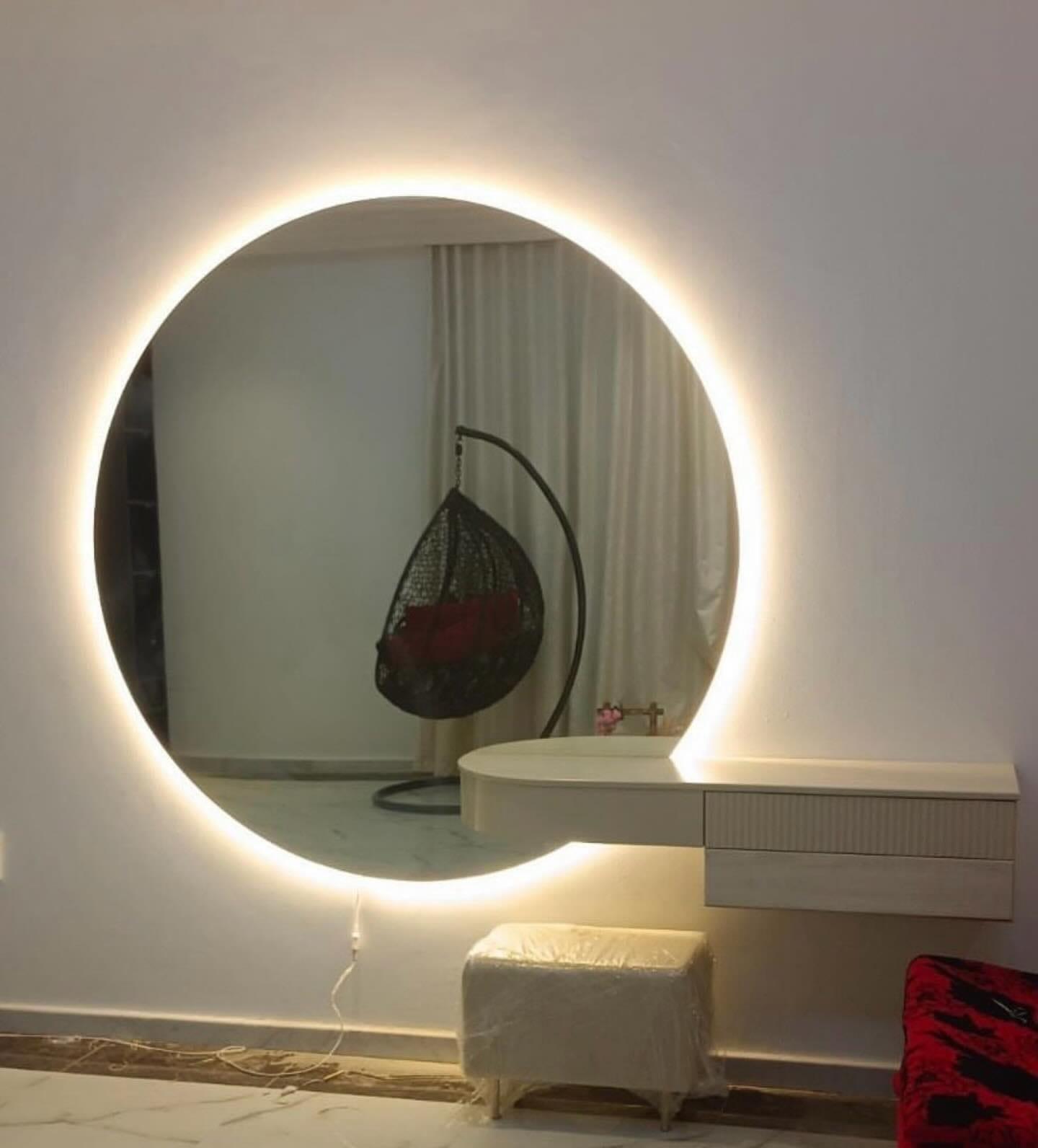
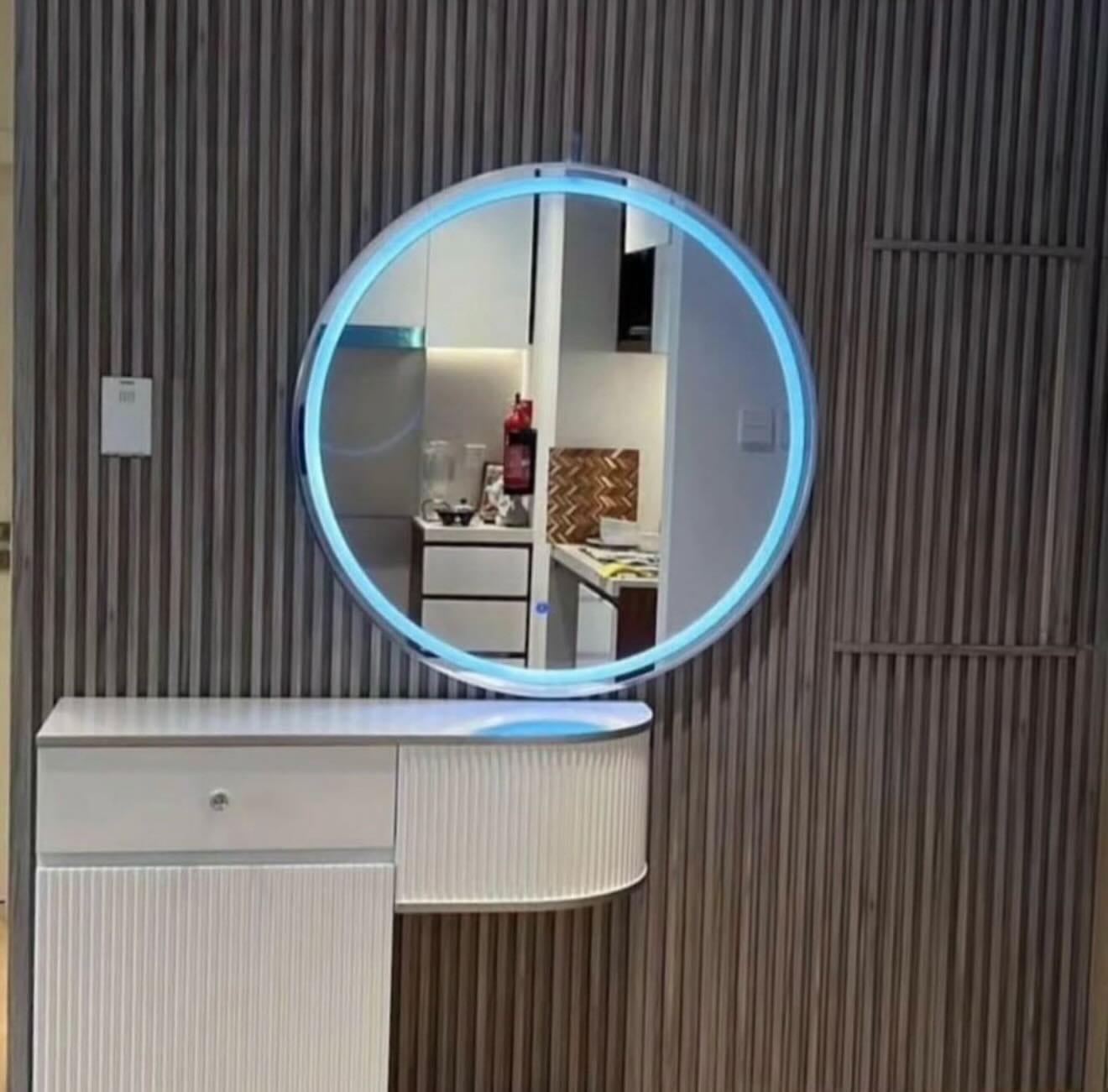
Most LED mirrors fall into two families. A front-lit mirror has a frosted band or panel in the glass itself, with the LEDs behind it shining outward towards you; it puts useful light on the face. A backlit mirror has its LEDs behind the glass pointing at the wall, so the light spreads out as a halo around the edge; it is atmospheric and flattering in a dim room, but on its own it lights the wall more than the person.
Our dressing units can carry touch-dimming smart LED mirrors in either form. For a mirror you will do make-up at, we suggest front-lit, or a backlit mirror combined with side lights in the joinery. For a hallway mirror, an entrance console or a mirror used for a last glance, backlit is perfectly good and often the more beautiful choice.
Front-lit and backlit LED mirrors compared
Where the light goes
- Front-lit
- Out through the glass, onto your face
- Backlit (halo)
- Onto the wall around the mirror
Best for
- Front-lit
- Make-up, shaving, close grooming
- Backlit (halo)
- Mood, entrances, a final check
Shadows on the face
- Front-lit
- Few, if the band surrounds the glass
- Backlit (halo)
- Depends on other lights in the room
Glare
- Front-lit
- Needs a good diffuser band
- Backlit (halo)
- Low; the source is hidden
Pair it with
- Front-lit
- Nothing else needed at the mirror
- Backlit (halo)
- Side lights or a front-lit band
General guidance for LED mirrors; check the light output and colour rendering of the specific model.
Warm or cool light for make-up?
Warm or cool is the question people ask most, and the published guides do not agree. Golden Lighting recommends 2700 to 3000K, up to about 3500K, a warm white close to household lamps; Simple Lighting, a UK retailer, recommends 4000 to 5000K, a neutral to cool white closer to daylight. Both have a point: warm light flatters and matches the evening, cooler light shows colour more like a sunny room.
Our recommendation sits between them: about 3000 to 4000K at a make-up mirror, and if you can, a mirror whose colour can be adjusted, so you can check foundation in a neutral light before going out in the day and switch to warm in the evening. Whatever you choose, keep the dressing table's light the same colour as the room's other lights near it, or your reflection will change as you move.
Colour rendering: why CRI 90 matters
Colour temperature says whether light looks warm or cool; colour rendering says how truthfully it shows other colours. The measure is the colour rendering index, CRI, scored up to 100. Wikipedia's summary of the standard puts a typical standard LED around 83, a high-CRI LED around 95 and an old incandescent bulb at 100. The general score averages eight test colours and leaves out saturated red, R9, which is exactly the colour of lips and blush.
Both Golden Lighting and Simple Lighting ask for CRI 90 or more at a make-up mirror, and so do we. A low-CRI strip can make two foundation shades look identical that are clearly different outdoors. When you compare mirrors or strips, ask for the CRI figure, and for R9 if it is listed; a product that does not state CRI usually has a reason.
How bright should a make-up mirror be?
Brightness at the face is measured in lux. Golden Lighting gives three working levels at about a metre from the light: around 20 foot-candles, roughly 215 lux, for casual use; around 30 foot-candles, roughly 325 lux, for grooming and make-up; and around 40 foot-candles, roughly 430 lux, for older eyes, which need more light to see the same detail. Simple Lighting expresses it differently, as about 500 to 800 lumens from each side of the mirror.
Because needs change through the day, dimming matters as much as the maximum. Full brightness for applying make-up in the morning, a lower level in the evening when the room is lit for relaxing. A touch dimmer on the mirror itself, or a dimmer for the side lights, gives you both from the seat.
If you want a number for your own table, a light-meter app on a phone gives a rough reading: hold the phone where your face would be, facing the mirror, with the room as you normally have it. It will not be laboratory-accurate, but it tells you quickly whether you are near 300 lux or nearer 100, and whether turning on the side lights makes the difference you expected.
Glare, reflections and the rest of the room
Bright light in the wrong place is worse than too little. Avoid bare LED dots visible in the mirror's edge, a spotlight behind your head reflecting straight back at you, and a glossy lacquer top that bounces light up from below. Diffused light beside the face, with matt surfaces nearby, gives the most comfortable result.
Think about daylight too. Facing a window, a dressing table gets excellent, even light by day; turned away from it, you sit in your own silhouette. In the evening the window becomes a dark mirror of its own, so a sheer or a blind helps. If your bedroom also has a lit headboard wall or cove lighting, check that its colour matches the mirror's.
Controls, sockets and the driver behind the mirror
Plan the controls for where you sit. A touch button on the mirror is easy to reach when you are close; a wall switch for the side lights should be beside the table, not by the door. If the mirror can change colour, check that it remembers your last setting, or you will be resetting it every morning.
Every LED mirror and strip needs power and, usually, a driver. Our own team wires the mirror and any side lights and moves or adds the socket for hair tools, all listed separately on the quotation. Ask where the driver will sit and how it is reached: a drawer or a lift-off panel is fine, fixed joinery that has to be broken open is not. Bathroom-grade mirrors carry an IP rating for moisture, as Philips explains for bathrooms; in a dry dressing room that matters less, but in a dressing area off a bathroom it does.
Lighting for photos, videos and calls
Many dressing tables now double as the place where make-up tutorials are filmed, selfies are taken and video calls are answered. A camera is less forgiving than the eye: it exaggerates shadows under the eyes and turns mixed light into odd colour casts. The rules above still apply, only more strictly: light from the front and sides, one colour temperature throughout, and no bright window behind you.
A ring light on a stand is the usual add-on, and it works because it is a front light around the lens. If you use one daily, plan a socket and a place to park it at the side of the table, and choose its colour to match the mirror. Better still, a front-lit mirror with an adjustable colour can do most of the ring light's job without a stand in the way.
Adding light to a dressing table you already have
Not every dressing table needs replacing to fix its light. Often the simplest change is a pair of slim wall lights either side of the existing mirror, at seated face height, or swapping the mirror for a front-lit one of the same size. Both need power at the right place, so the question is whether a socket or a cable can reach there neatly.
Where the table is built in, light can sometimes be added in a side panel or under the cupboards above the mirror. Show us photos and the mirror's size when we visit, and we will say whether adding light makes sense or whether the money is better spent on a new unit. When two people use one wall, our guide to a shared wardrobe for a couple explains how to split hanging length fairly.
Lighting a mirror in a walk-in or dressing room
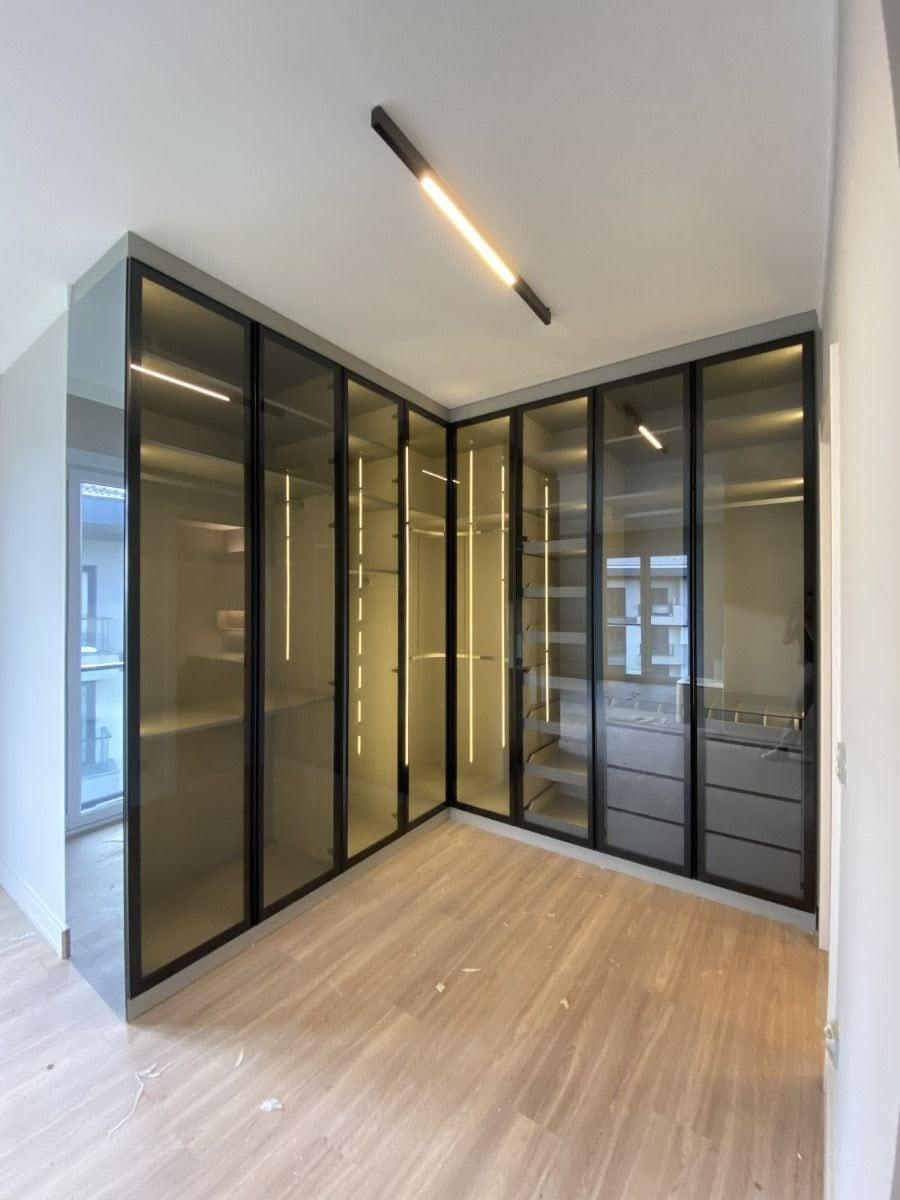
In a walk-in closet the mirror light is one of three layers with the ceiling and the light inside the wardrobes, and the dressing table's mirror is usually the one used for make-up. Keep its light separate from the ceiling's switch, so the room can be dim while the mirror is bright. A full-length mirror elsewhere in the room needs even light from the front or sides too, so you can check an outfit's colour. A mirror fitted as a wardrobe door is covered in our mirror wardrobe doors guide.
Keep the wardrobe strips and the mirror light close in colour as well. If the shelves glow cool white and the mirror is warm, a jacket will look one colour when you take it out and another when you hold it up to the mirror. For the strips and sensors inside the units, see wardrobe lighting ideas.
How to plan all three layers, and where the dressing table sits in the room, is set out in designing a dressing room.
Choosing and checking your mirror light
At our free home visit we note where the table will go, the window and the existing lights, and bring samples of finishes; the drawing then shows the mirror, the light sources, switches, sockets and where the driver sits. Our made-to-measure units start at AED 1,800, which covers the compact version with a plain mirror and simple drawers, and a lit mirror is added as a separate item; see dressing table cost and layouts. Expect fitting around ten days from confirmation.
When the unit is installed, sit down, switch everything on and check it against this list before the installer leaves. Lit mirrors and drivers carry their makers' warranties; a written 24-month warranty covers our workmanship on any order agreed from 10 October 2026. Share a picture of the wall through our dressing units page, or see our vanities with backlit LED mirrors. Warm or neutral light, strip or profile: our wardrobe LED lighting comparison goes through the choices.
- Light reaches your face from the front or both sides, not only from above.
- Colour around 3000–4000K, or adjustable, with CRI 90 or more.
- Enough brightness for make-up, with a dimmer for the evening.
- No bare LED dots or spotlights reflecting into your eyes.
- Controls reachable while seated; the driver reachable for service.
Common questions
How high should a dressing table mirror hang?
Start the glass roughly 13–15 cm clear of the worktop and centre it on your eyes when seated. How to size a dressing table.
What does a dressing table with an LED mirror cost?
The unit begins at AED 1,800; a touch-dimming LED mirror is added as a separate item. Dressing table cost and layouts.
What lighting does a walk-in need besides the mirror?
A ceiling layer and light inside the wardrobes, each switched separately from the mirror. Designing a dressing room.
Can my dressing unit have a backlit mirror?
Yes, backlit or front-lit, with touch dimming, built into the dressing unit. Vanities with backlit LED mirrors.
Can the light be added to a gypsum ceiling above the table?
Yes. A downlight placed in front of the seat helps, though it does not replace side light. Gypsum ceiling lighting basics.
Will a lit mirror work with my ring light?
Yes, if both are set to the same colour temperature; otherwise your face picks up two different tints on camera. Vanities with backlit LED mirrors.
Can a lit mirror go in a table that sits inside a wardrobe run?
Yes, with the cable route and driver planned inside the carcass before it is made. Dressing tables built into wardrobes.

Sources & specifications
Manufacturer information applies to the named products and systems. Sources reviewed on 28 October 2026.
- Golden Lighting: vanity lights on the side of the mirror (placement, 2700–3500K, CRI 90+, foot-candles)goldenlighting.com(opens in a new tab)
- Philips Lighting: bathroom lighting (lights above and to the sides of the mirror, IP ratings)usa.lighting.philips.com(opens in a new tab)
- Colour rendering index on Wikipedia (Ra, R9, typical LED values)en.wikipedia.org(opens in a new tab)
- Simple Lighting: bathroom mirror and vanity lighting tips (lumens per side, 4000–5000K, CRI 90+)simplelighting.co.uk(opens in a new tab)
Want this planned for your home?
Consultation and measurement are free. Tell us the rooms, location and what you need; we arrange a sample visit and define the measured quotation.