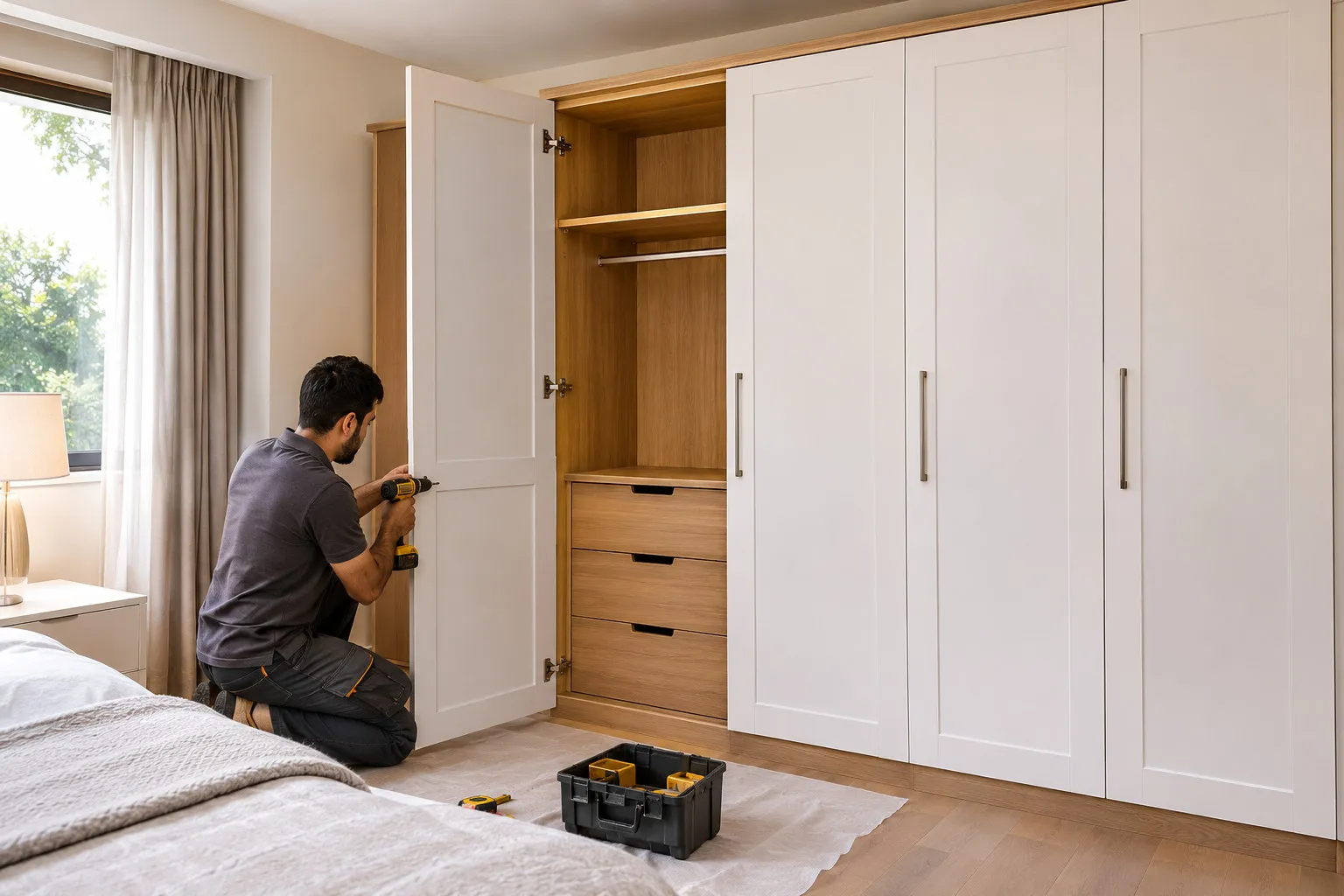
Wardrobes · 22 min read · 30 June 2026
Mirror wardrobe doors: weight, safety, light and care
A mirror wardrobe door is heavy glass with a silver coat and protective layers behind it: about 10 kg per square metre at 4 mm, so the hinges or track must be chosen for it. Ask for the glass type, thickness and safety backing in writing, and keep the edges dry when you clean it.

By Ali Haider Basra, Founder, Al Tareeq Decor · Contact our workshop
Key takeaways
- A mirror door is glass with a silver coat and protective layers on its back, and it is heavy: about 10 kg per square metre at 4 mm, before the frame, backing and handle.
- Weight sets the hardware. For its own hinges Blum gives 2 hinges for 4 to 6 kg and 3 for 6 to 12 kg on doors up to 600 mm wide; heavier doors need more, and height matters too.
- Ask for the glass type, thickness, safety backing and edge finish in writing: a film, a coating, toughened or laminated glass are different safety measures; for doors that should stay see-through, wardrobe glass doors and privacy compares the four types.
- A mirror bounces window light into the room, but it also reflects the bed and the sun; put it where you dress, not opposite the bed.
- Clean it with a damp cloth and dry the edges, because moisture at the edge is what causes black edge. Mirror or glass doors raise the AED 550 per sqm entry price and appear as their own line.
On this page
- Key takeaways
- Mirror wardrobe doors: the short answer
- What a mirror wardrobe door is made of
- How heavy is a mirror wardrobe door?
- Weight of the glass alone in two example doors
- Hinged mirror doors: what the weight does to the hinges
- Sliding mirror doors: the track, the leaf and the weight limit
- Is a mirror wardrobe door safe? Safety glass, backing film and edges
- Mirror doors, light and the look of a small bedroom
- Mirror, tinted glass or laminate: which door suits you?
- Mirror, tinted glass and laminate doors compared
- Cleaning a mirror wardrobe door and keeping its edges dry
- What to ask on the quotation for mirror doors
- Mirror door questions for a wardrobe quotation
- What we do about mirror doors
- Common questions
Mirror wardrobe doors: the short answer
A mirror wardrobe door is a sheet of glass with a silver coat and protective layers on its back, held in a frame or a door leaf. It is heavy, so the hinges or the track have to be chosen for its real weight; it is only as safe as the glass type and backing behind it, so you should ask for both in writing; it bounces window light back into the room; and its edges, where moisture does its damage, need to be kept dry. Which board sits behind a mirror door, and what its label means, is explained in moisture-resistant wardrobe boards.
The weight is the part people forget. At 4 mm thick, glass weighs about 10 kg per square metre, so a single 60 cm × 2.2 m mirror door carries about 13 kg of glass before the frame, the backing and the handle are counted. Blum, a hinge maker, steps up from two hinges to three between its 4 to 6 kg and 6 to 12 kg bands, and a heavier door is read off the maker's own chart, so a door that looks like its board neighbour can need more hardware.
This page owns the mirror door itself: what it is made of, what it weighs, what makes it safe, what it does to light, how to clean it and what to ask on a quotation. Tinted glass fronts with lit interiors are covered on our lit glass-front wardrobes page, and the choice between hinged and sliding is in the hinged versus sliding door guide. The drawing below puts the build-up, the light and the hinge count on one sheet.
If the wardrobe turns a corner, read corner and L-shaped wardrobe design first, because a mirror in the corner changes how the doors open. If the doors are still undecided, the wardrobe layout guide shows what goes behind them.
- 1. Glass and silver: the glass is the front of the door, and a thin silver coat behind it is what makes the reflection
- 2. Protective layers: a metal layer and paint go over the silver to protect it, and a safety film can be added on the back of a filmed mirror
- 3. Light: window light reaches the glass and bounces back into the room, which is why a mirror door can make a room feel brighter
- 4. Hinge count: for its own hinges on doors up to 600 mm wide, Blum gives 2 hinges for 4 to 6 kg and 3 for 6 to 12 kg; a heavier door is checked against the maker's own chart
- 5. Height matters too: Blum's chart relates the count to the height of the door as well as its weight, so a tall door needs more than a short one of the same weight
- 6. So ask for the weight of the door with its handle, and for the hinge count or track rating that weight was checked against
What a mirror wardrobe door is made of
Every mirror starts as a flat sheet of glass. A silver coat is applied to one side, and that coat is what actually creates the reflection. Because bare silver tarnishes, it is covered by a protective layer of metal and then by paint, which seals the back. Mirror suppliers describe a copper layer under the paint to protect the silver from moisture, and some describe a second paint coat on mirrors meant for steamy rooms. A musty smell inside a wardrobe is a separate question, covered in why a wardrobe smells musty.
Two things sit on top of that basic build-up, and they are the ones worth asking about. The first is a safety backing: either an adhesive film on the back that holds the glass together if it breaks, or, on some mirrors, a factory-applied resin that does the same job without a film. The second is the door itself. A mirror either goes into an aluminium frame, onto a board leaf, or is fixed to the face of a door, and what holds it decides how its edges are protected.
Our own work covers all of this in the ordinary way for a made-to-measure wardrobe: mirror doors are part of the joinery we make and fit, and our sliding wardrobes are shown with mirror or tinted glass leaves. What we do not publish is the exact mirror type, thickness or backing we use, so the right question for any quotation, ours included, is the one at the end of this guide.
The short factory video below follows a sheet of float glass through cutting, edge polishing, washing, the silver coat, the protective metal and paint layers and the final film and packing. It is a general factory run-through, not a wardrobe-door workshop, so use it to see the sequence of layers, not to judge a wardrobe door.
How heavy is a mirror wardrobe door?
Heavier than it looks, and much heavier than a board door of the same size. Our wardrobe service page warns that glass and mirror leaves outweigh laminate panels of the same area by a wide margin. The glass alone is easy to estimate. Bendheim, an architectural glass supplier, lists glass at about 10 kg per square metre at 4 mm, 12 kg at 5 mm, 14.5 kg at 6 mm, 19.5 kg at 8 mm and 24.5 kg at 10 mm. The other door finishes are compared in wardrobe door finishes compared. Whether the whole wardrobe is worth keeping is decided in our old wardrobe renovate-or-replace guide, symptom by symptom.
Multiply that by the area of the door and you have the glass. The table works it through for two doors we see often: a hinged door 60 cm wide and 2.2 m high (1.32 square metres), and a sliding leaf 1.2 m wide and 2.4 m high (2.88 square metres). It is arithmetic on a distributor's figures, for the glass alone: the frame, the backing, the handle and the door's own fittings are extra, and the real weight comes from the supplier's specification for your door. What a wardrobe warranty should say in writing, and how to read a lifetime claim, is explained in our wardrobe warranty guide.
Weight of the glass alone in two example doors
4 mm
- Weight per m² (Bendheim)
- 10 kg
- Hinged door 0.6 × 2.2 m (1.32 m²)
- 13.2 kg
- Sliding leaf 1.2 × 2.4 m (2.88 m²)
- 28.8 kg
5 mm
- Weight per m² (Bendheim)
- 12 kg
- Hinged door 0.6 × 2.2 m (1.32 m²)
- 15.8 kg
- Sliding leaf 1.2 × 2.4 m (2.88 m²)
- 34.6 kg
6 mm
- Weight per m² (Bendheim)
- 14.5 kg
- Hinged door 0.6 × 2.2 m (1.32 m²)
- 19.1 kg
- Sliding leaf 1.2 × 2.4 m (2.88 m²)
- 41.8 kg
8 mm
- Weight per m² (Bendheim)
- 19.5 kg
- Hinged door 0.6 × 2.2 m (1.32 m²)
- 25.7 kg
- Sliding leaf 1.2 × 2.4 m (2.88 m²)
- 56.2 kg
Planning arithmetic on Bendheim's rounded weights (checked 3 Nov 2026). Glass only: add the frame, any film or backing and the handle. Your door's weight is the figure on the supplier's data sheet.
Hinged mirror doors: what the weight does to the hinges
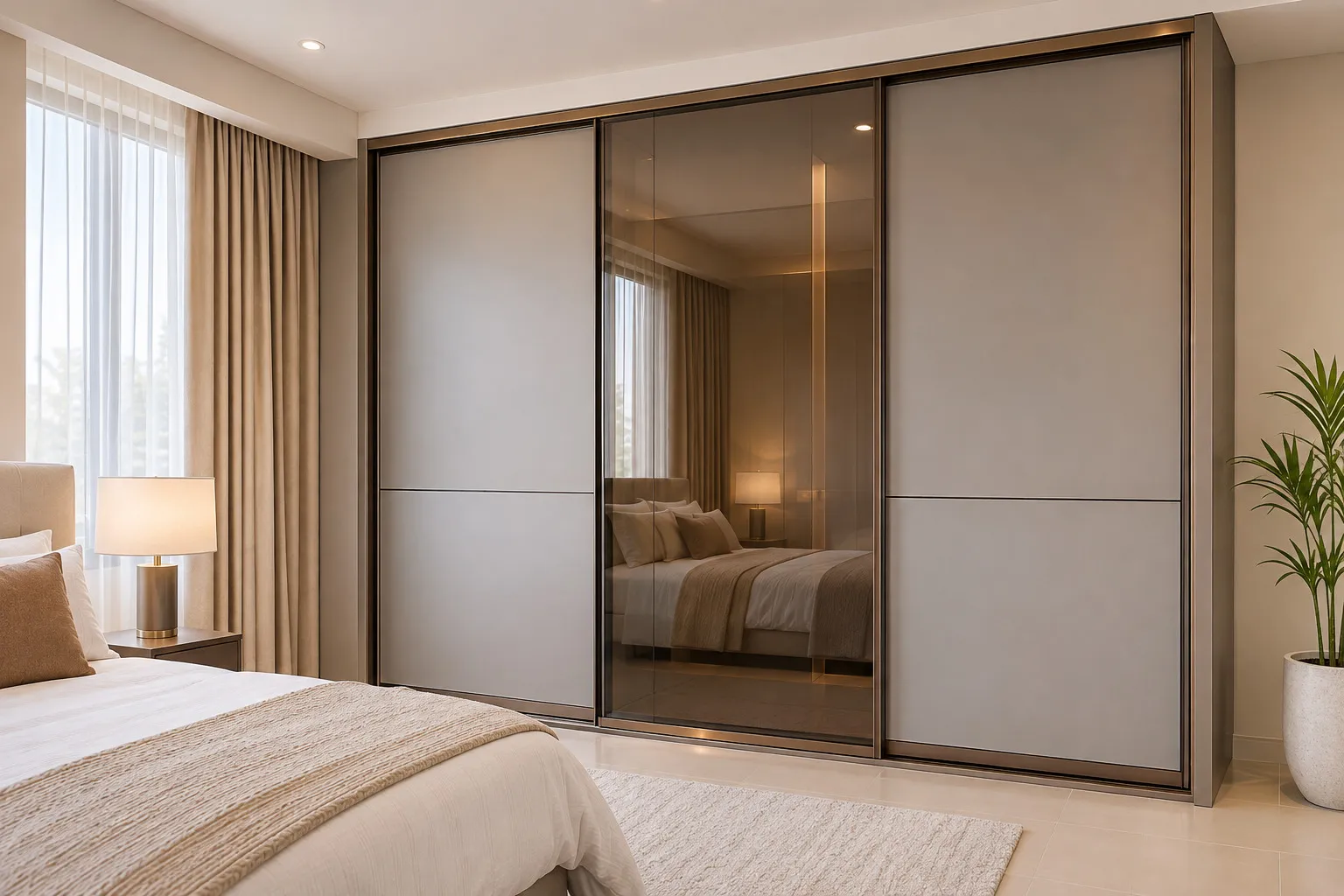
On a hinged door, weight decides how many hinges carry it. Blum's own page links the number to how heavy the door is, with the handle and any other add-ons counted, and says its values hold for doors up to 600 mm wide. The lightest band, 4 to 6 kg, takes two hinges; 6 to 12 kg takes three. A door as wide as 650 mm gets one extra, and a slim tall door hangs steadier on three even when its weight alone would not call for it. A heavier door needs more hinges again, and the maker's catalogue chart reads that count against the door's height too, so take it from the chart for the hinge actually fitted.
Put that against the table above. A 4 mm mirror door 60 cm wide and 2.2 m high is already about 13 kg of glass, past the 6 to 12 kg band on Blum's page before the frame and handle are added; at 6 mm it is about 19 kg of glass. A full-height mirror door therefore asks for more hinges than a board door, and because height counts too, a tall door sits towards the demanding end.
Two cautions. These are Blum's figures for its own hinges and they are guidance, not a rule for every make; another maker publishes its own tables. And for a door heavier than the bands above, the count has to be looked up with the maker's own calculator or catalogue. What to do with that: ask how many hinges each door carries and ask what weight that was checked against. The wardrobe quotation checklist shows where that line sits in a quote, and wardrobe door replacement explains what changes when a board door is swapped for a mirror one. For hinge counts by door weight, soft-close and adjustment, see wardrobe door hinges. If a heavy door already rubs or sags, the guide on fixing a wardrobe door that is sticking or sagging has the first checks.
If you like handle-free fronts, remember that a mirror shows fingerprints at once, and that a grip pressed into the glass is a poor idea. A better place for a grip is the frame or the edge of the door, which is what our handleless wardrobe guide recommends, and the wardrobe handles guide covers handle types, height and finishes. For a wardrobe that runs the full height of the wall, see how to plan a floor-to-ceiling wardrobe.
Sliding mirror doors: the track, the leaf and the weight limit
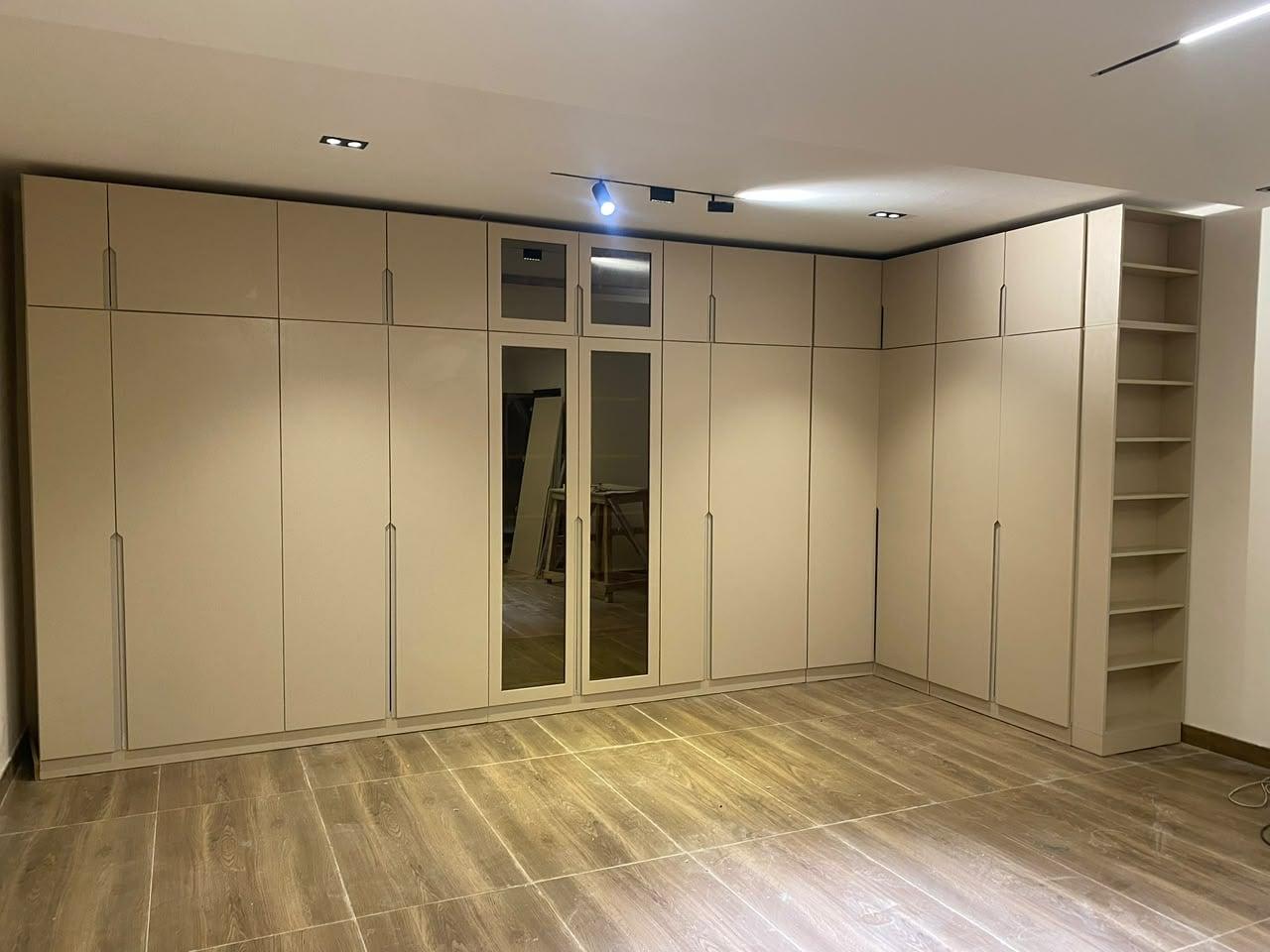
A sliding mirror leaf gives you a floor-to-ceiling looking glass without taking up a wall, which is why it is so popular in small bedrooms. It also carries its whole weight on the track and the wheels, so the limit is a property of the sliding system, not of the mirror. Every system publishes its own, and our sliding wardrobe door systems guide goes through tracks, rollers and limits in detail.
Take one maker as an example. In Hettich's June 2022 sliding and folding catalogue, as read in our research file, the TopLine L kit carries 50 kg a door, up to 2,600 mm high, in widths from 550 to 1,500 mm for a pair; other TopLine sets are rated higher, at 60, 80 or 100 kg. These are Hettich's own figures for those kits. They say nothing about any other system, and they are not what any particular wardrobe uses.
Now use the table. A 1.2 m × 2.4 m leaf of 6 mm glass is about 41.8 kg of glass, leaving only about 8 kg of that 50 kg for the frame, the backing and the handle; the same leaf in 8 mm glass is about 56 kg of glass, over the limit before anything else is added. So a wider or thicker mirror leaf means a stronger system, not just a bigger sheet, and the quotation should name the system and its rating.
Sliding mirror doors also ask for ordinary care. Grit in the bottom track makes a heavy leaf run rough, so vacuum the track now and then, as our wardrobe service guide advises. If a leaf starts to jump, drag or rattle, tell us rather than forcing it. Our sliding door wardrobes page shows the finished systems, and the hinged versus sliding guide compares depth and floor space. Depth decides how much room the doors and track take, and our guide on how deep a wardrobe should be covers hanging, shelf and sliding-door depths.
Is a mirror wardrobe door safe? Safety glass, backing film and edges
Nobody can honestly call a glass door risk-free, and no source we opened does. What you can do is ask which of the known safety measures your door has. There are three worth knowing.
The first is the glass itself. Pilkington's guidance on safety glass, published on GlassOnline in February 2022, describes toughened glass as getting its strength from high surface stresses, so that when it breaks it tends to fracture into small, relatively harmless fragments, and laminated glass as two panes with a PVB layer between them, where the interlayer holds the fragments in place. Saint-Gobain adds that laminated glass is no stronger than ordinary glass; its benefit is that a broken pane stays together.
The second is the backing. A traditional safety mirror carries an adhesive film on the back to hold the glass together if it breaks. Saint-Gobain Glass launched a mirror in 2024 that gets the same result without a film: its anti-shatter resin is applied at the factory and, it says, retains 98 percent of splinters in the event of breakage, on a mirror designed for homes. That is one maker's product, not the market, but it shows that a safety backing can be a film or a coating, and that a mirror with neither is not equivalent to a mirror with one.
The third is the edge. Kärcher calls the edge area the most fragile part of a mirror, and mirror makers polish the edges at the factory. Ask whether the edge of your door is polished or covered by a frame, because it is both the part that gets knocked and the part that moisture reaches first.
Where does that leave you? Ask for the glass type and thickness, the safety backing and the edge finish in the quotation. We do not publish which mirror type our wardrobes use, so we would rather you ask than assume; our published glass fronts use tempered glass in anodised aluminium frames, and the answer for a mirror door is written into your quotation. If a mirror door will be used by children (our kids wardrobe design guide covers that room), or stands where people brush past it, say so at the measuring visit and ask what the backing is. Mirror durability is covered by the European mirror standard EN 1036-1, which the Saint-Gobain launch article names, and a supplier can tell you which products it applies to. For fitted, modular and freestanding options from a tenant's side, see wardrobes in a rented apartment in the UAE.
Mirror doors, light and the look of a small bedroom
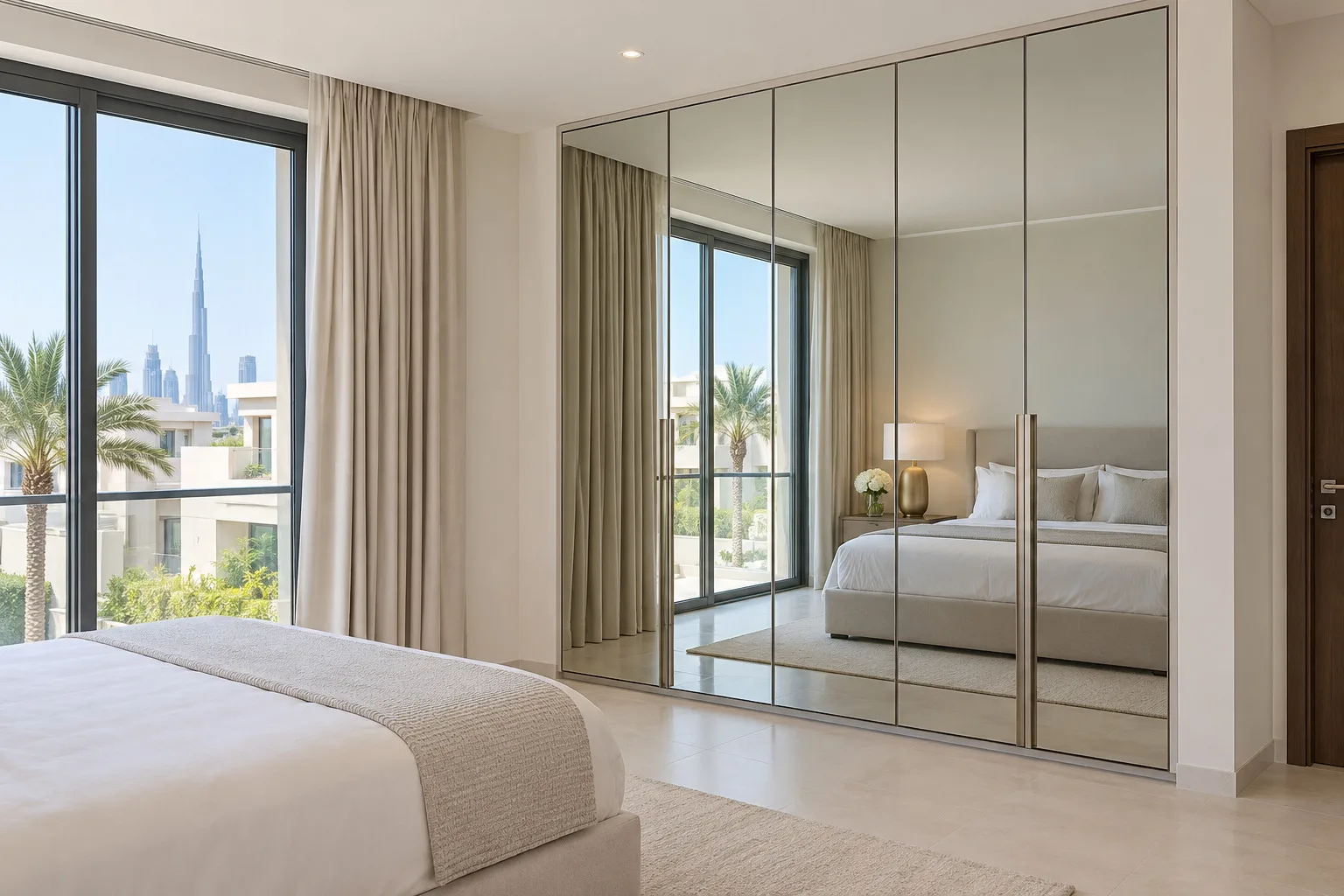
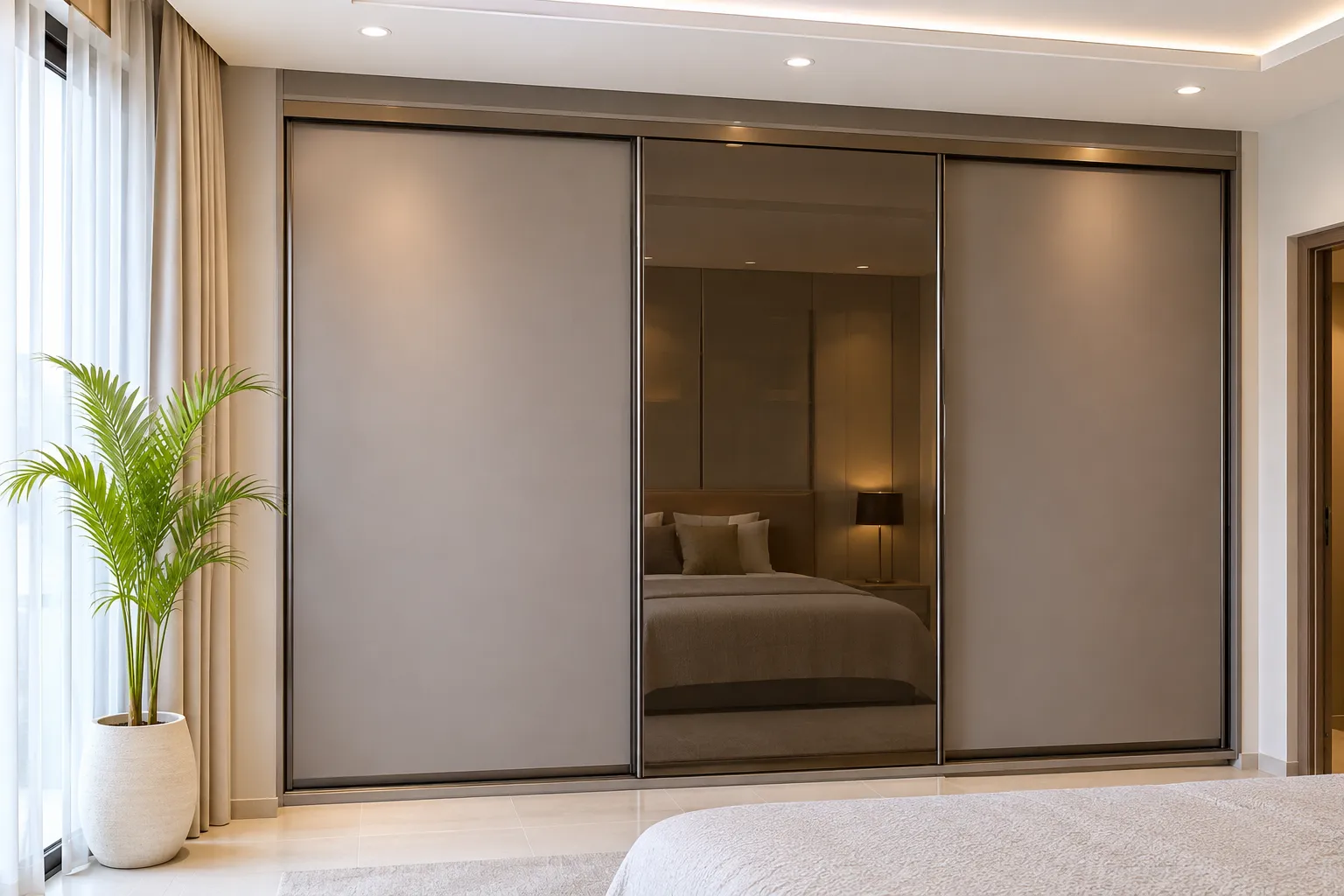
A mirror door sends light back into the room; our wardrobe service page makes the same point about a mirrored sliding door in a tight apartment bedroom. The effect is strongest when the mirror faces a window or a light source, because the glass then returns daylight to the far side of the room. Our mirrored sliding panels are made in silver or bronze-tinted mirror, and a leaf in either also does the work of a separate full-length mirror, which frees the wall you would have hung it on.
We do not give a figure for how much bigger a room looks, because it depends on the room, the window and the hour. What we can say is practical. Place the mirror where you get dressed rather than facing the bed, which it shows back to you at night. Mirror every leaf only if a wall of glass is what you want; one mirrored leaf among solid ones does the job with less dazzle. Remember, too, what a mirror picks up: a switched-off television opposite becomes a dark reflection of its own, and our bedroom wardrobe with a TV unit guide shows how to place the two, and the media wall lighting ideas show what a lit screen wall adds to the reflections.
Direct sun is the thing to watch. A mirror throws a bright patch of sunlight across the room or into your eyes at the wrong hour, so look at the wall opposite the window at the measuring visit and ask where the patch will land. Interior lighting works through a mirror too, since the lit hanging rail shows in it; see wardrobe lighting ideas for the options. For a mirror in a dressing bay, with its own lamps, read lighting a dressing mirror.
A curtain or blind on the window is the simplest way to tame that patch. Our guides to roller blinds versus curtains and blackout or sheer curtains explain what each does to daylight.
The lamps overhead show in the glass as well, and our ceiling lighting basics explain how a lit ceiling is planned.
For a small room, the wider plan matters more than the mirror. Our small bedroom wardrobe ideas set out the layouts, and wardrobe dimensions gives the depth that a sliding system needs. The guide to wardrobe hanging heights covers where each rail sits for shirts, dresses and long garments. If you are still deciding between a wall of doors and a room you step into, our reach-in versus walk-in wardrobe guide compares what each costs in floor space. If the doors are for a hall cabinet rather than a bedroom, the shoe wardrobe design guide covers pairs per shelf, depth and ventilation.
Mirror, tinted glass or laminate: which door suits you?
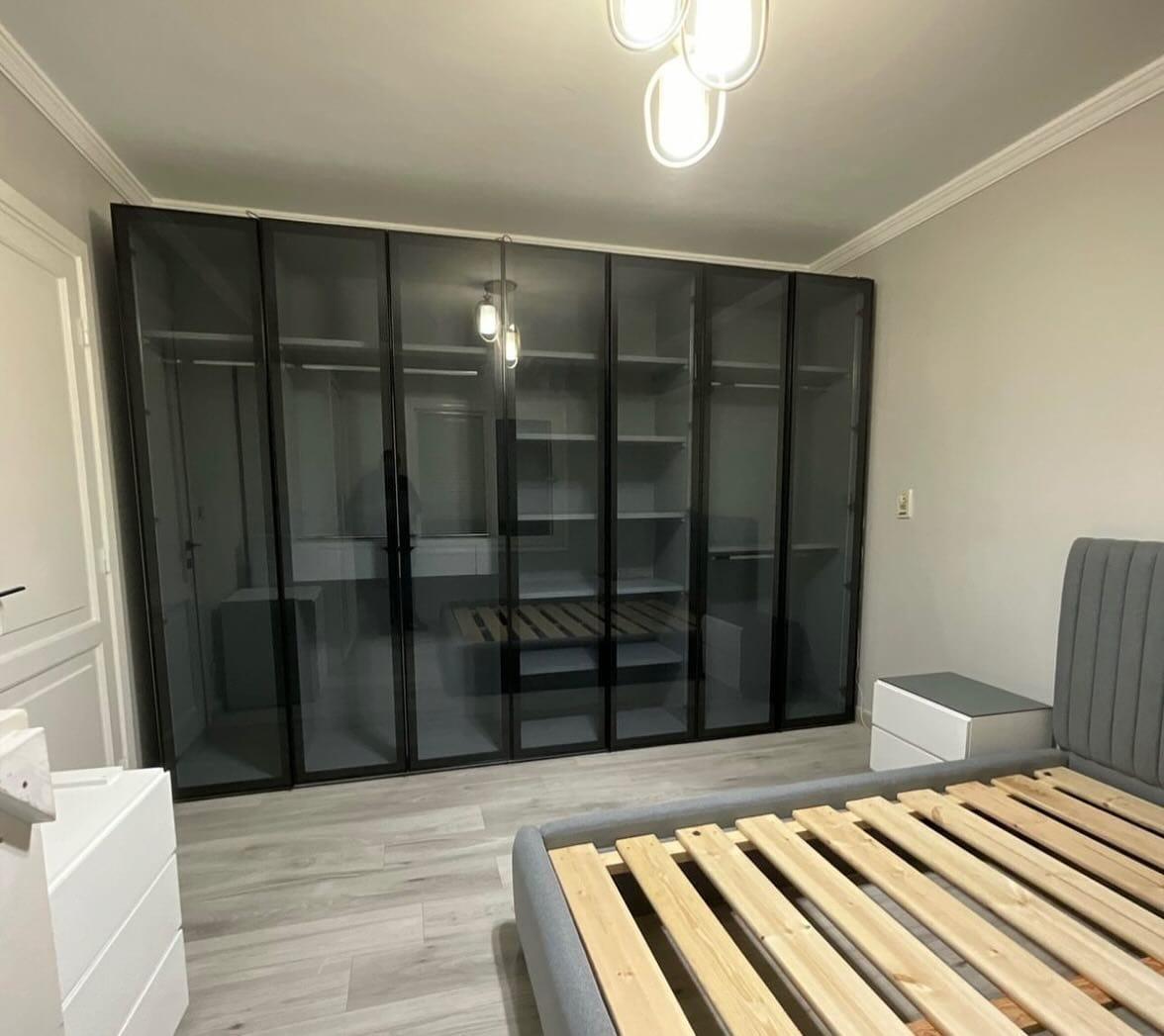
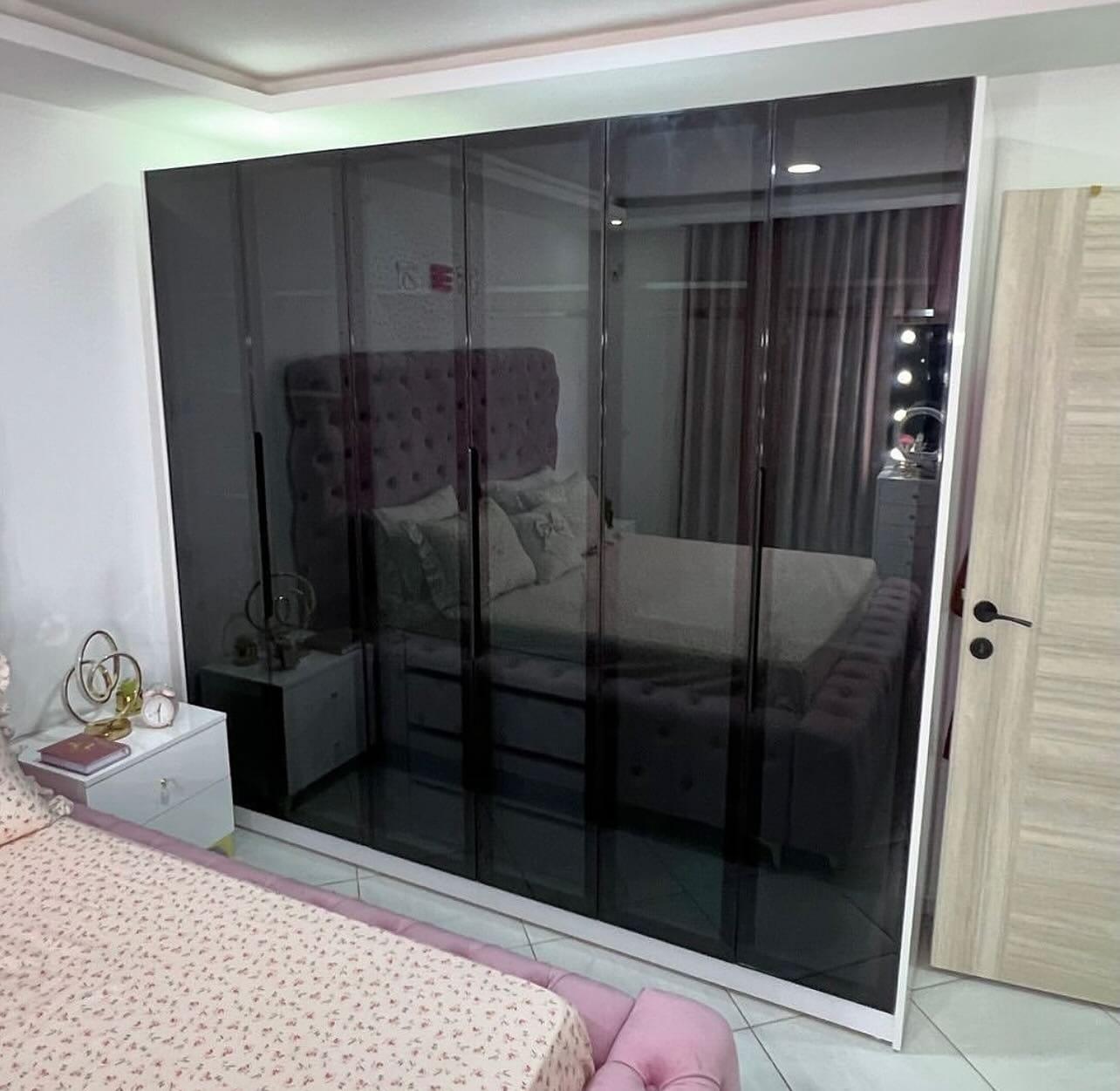
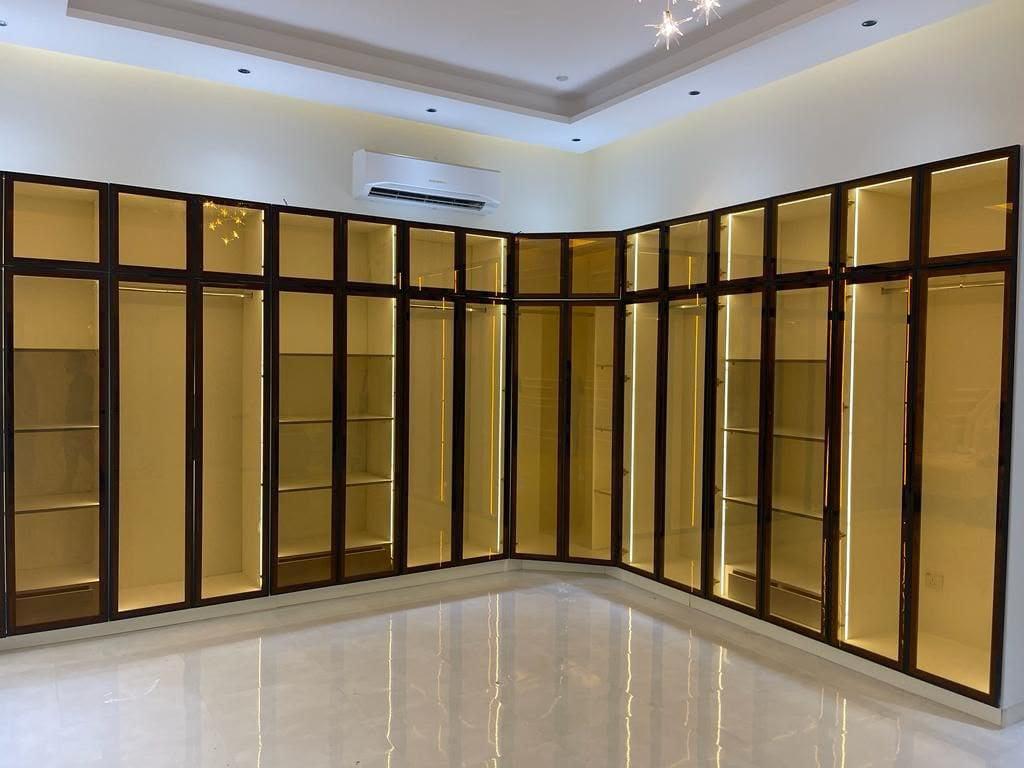
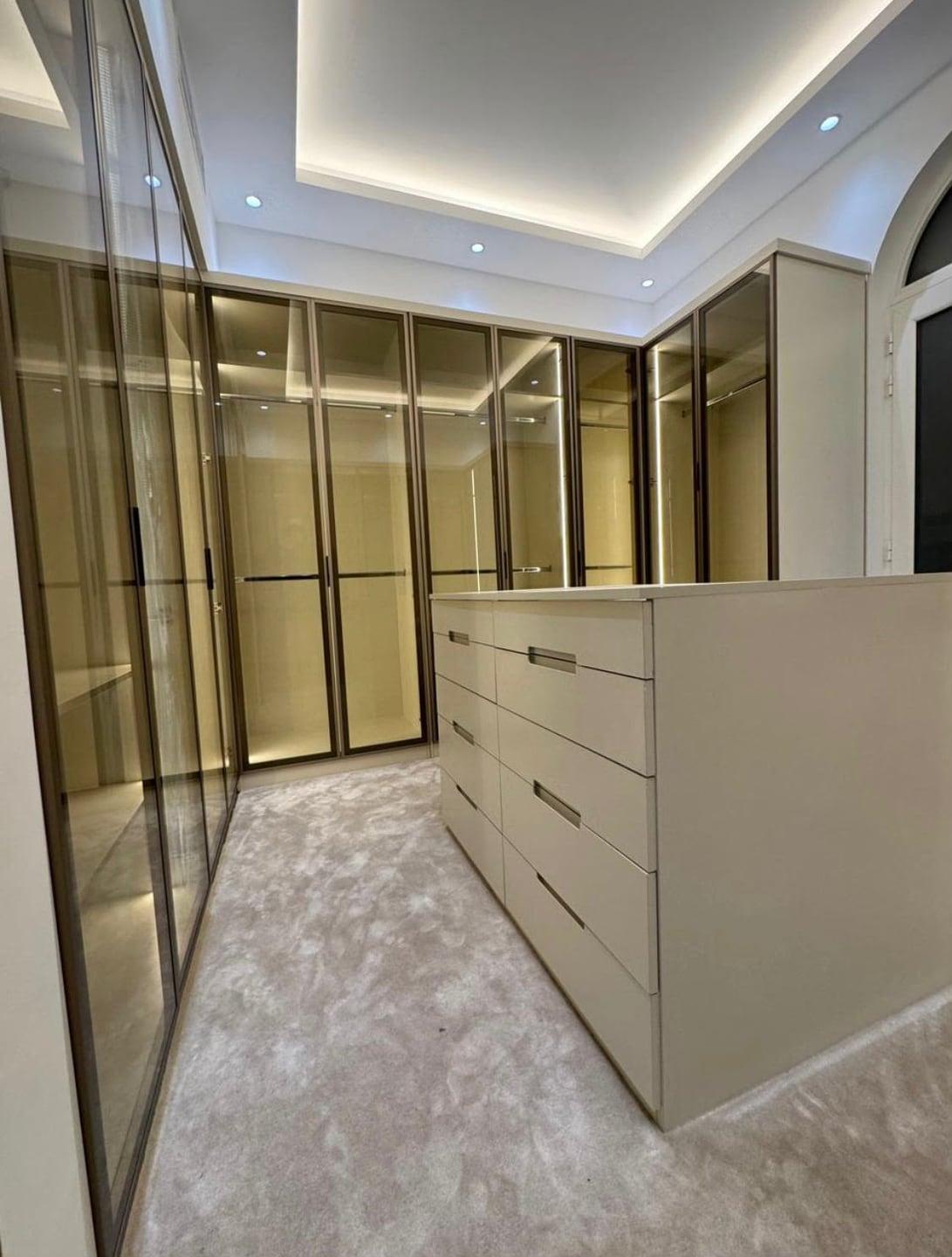
Use the table to choose. It compares the three door types we make on weight, light, privacy and care, using only what is sourced on this page or published on our own pages. Tinted glass in a slim aluminium frame is the middle path: it shows a lit interior, which is what our glass-front wardrobes with LED lighting are about, while a mirror hides everything and a laminate door is plain; open wardrobe or closed doors weighs the opposite choice, leaving a section with no door.
A recommendation, since you will ask: choose a mirror door where you actually dress, in one leaf or one pair, and keep the rest as laminate or tinted glass. That limits the weight on the hardware, the number of edges to keep dry and the amount of reflection, and leaves the price of the glass on the doors that earn it. Our custom wardrobes service lists the door options side by side, and if you are still choosing between made-to-measure and off-the-shelf, see custom or ready-made wardrobe: where each wins.
The natural home for a mirror door is a dressing area. The guides to dressing room design and to a dressing table inside the wardrobe show where a mirrored section earns its place. For a main bedroom shared by two people, see master bedroom wardrobe design. If a sliding door ever jumps out of its guide, our page on a sliding wardrobe door that has come off its track lists the safe first checks and when to stop and call someone.
Mirror, tinted glass and laminate doors compared
Mirror door
- Weight
- Heavy: glass alone is about 10 to 14.5 kg per m² at 4 to 6 mm
- Light
- Reflects window light back into the room
- Privacy
- Hides the contents completely
- Care
- Wipe with a damp cloth, keep the edges dry; fingerprints show
Tinted glass door in an aluminium frame
- Weight
- Also glass, so heavy; the frame adds to it
- Light
- Lets a lit interior show and reflects the room, depending on the tint
- Privacy
- Shows the contents, softened by the tint
- Care
- Wipe like glass; fingerprints show
Laminate door
- Weight
- Lighter than glass of the same size
- Light
- Absorbs light and does not reflect
- Privacy
- Fully closed
- Care
- Soft cloth and a mild cleaner
Weights from Bendheim's published figures; the laminate and care rows follow our own wardrobe service page. A decision aid, not a measurement of your door.
Cleaning a mirror wardrobe door and keeping its edges dry
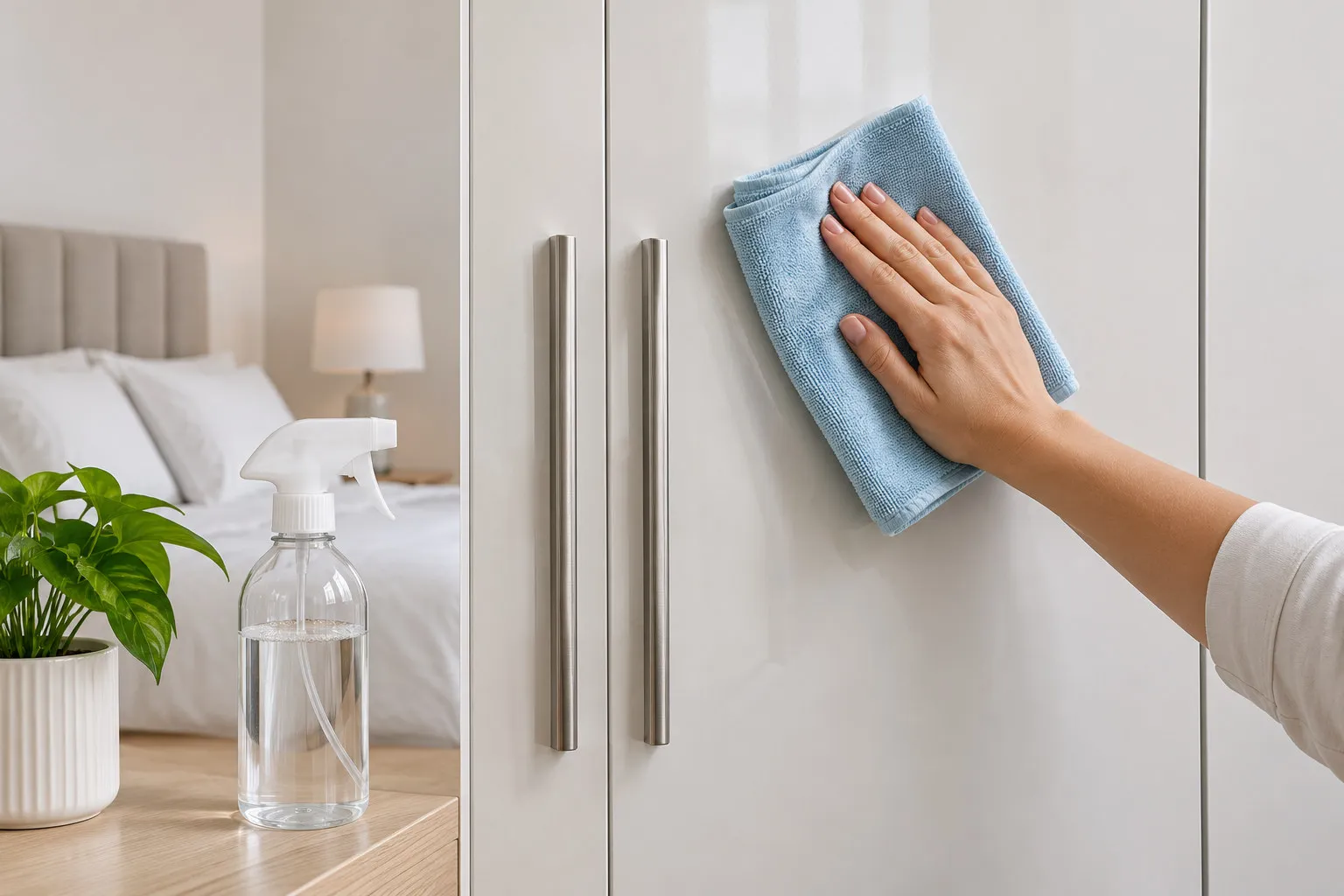
Our own care advice is short: a soft cloth, a mild cleaner and a dry finish. And the maker advice that follows adds one habit to it: look after the edges. The damage called black edge is the silver coat oxidising from the edge inwards, and the pages we opened agree on the cause. Moisture gets in at the edge, cleaning liquid runs down to it, or an acidic adhesive attacks the protective layers; an Australian wardrobe and screen maker, Civic, describes exactly this, and notes that the answer is to spray the cleaner onto the cloth, not onto the mirror; fluted fronts, whose grooves hold dust, ask for a little more, as fluted wardrobe doors explains.
Kärcher's cleaning guide says the same from the other side: the edge area is the most fragile part of a mirror, you should leave the edges out where possible or rub them dry afterwards, the surface should be damp and not too wet, and the best option omits detergent entirely, since water and simple household remedies are usually enough. A mirror-frame supplier, Frost Products, adds that cleaners should be mild, without ammonia, vinegar, bleach or solvents, and should not be sprayed directly onto the mirror.
In short: dampen a soft cloth, wipe the glass, dry it with a second cloth and dry the edges by hand. Do it on the sliding leaves, too, and vacuum the bottom track now and then. We have not found a maker page we could read in full that gives a cleaning schedule, so we do not give one.
Humid positions are where the edges suffer first. If the wardrobe stands against a bathroom wall, say so at the measuring visit: our wardrobe service page says the carcass switches to a moisture-resistant grade where the position needs one, and our wardrobe materials guide explains what such a board does and does not do. Such a board is built for damp air, not for water coming through a wall, so a leak has to be found and stopped before anything is fitted against it. Our guide on fitting a wardrobe against a bathroom or outside wall covers what to check first. Aftercare, and what the warranty covers, is set out in our warranty and aftercare guide.
Damp air matters on other surfaces too. If the room is getting more than a wardrobe, the wallpaper in humid climates guide and our interior lighting ideas are the next reads. If you want light inside, LED strip versus profile for wardrobe lighting explains the difference before you ask for a quotation.
What to ask on the quotation for mirror doors
Ask each supplier the questions below, and keep the replies in writing. A quotation that says only "mirror doors" has not told you what you are buying. The checklist below belongs with the general one in our wardrobe quotation checklist, which covers the rest of the line items. Before you settle on hinged leaves, see how far a wardrobe door opens into the room.
Mirror door questions for a wardrobe quotation
Glass type and thickness
- Why it matters
- Sets the weight and, with the backing, how it breaks
- A clear answer looks like
- A named glass and a thickness in millimetres
Safety backing
- Why it matters
- A film, a coating, toughened or laminated glass, or none, are different things
- A clear answer looks like
- The type is named; "none" is also an answer
Edge finish
- Why it matters
- Edges are the fragile part and where moisture starts
- A clear answer looks like
- Polished, or covered by a frame, stated
Door weight, handle included
- Why it matters
- The hinge count or track rating follows it
- A clear answer looks like
- A weight in kilograms for each door size
Hinges per door, or the track and its rating
- Why it matters
- A heavy door needs hardware chosen for it
- A clear answer looks like
- A number per door, or a system name with its rating
Position and moisture
- Why it matters
- A wardrobe on a bathroom wall is a humid position
- A clear answer looks like
- The board grade and the edge protection are stated
Price line
- Why it matters
- Mirror is an upgrade, not part of the entry build
- A clear answer looks like
- A separate line you can keep or drop
Who guarantees what
- Why it matters
- Workmanship and supplied glass have different terms
- A clear answer looks like
- Workmanship terms in writing, and the glass supplier's own terms named
Our entry price of AED 550 per sqm is for MDF laminate with hinged doors, installed. Mirror or glass doors raise it and appear as their own lines in the quotation.
What we do about mirror doors
Mirror doors are part of the wardrobe work we do, and the way we handle them is the way we handle the rest of a made-to-measure wardrobe. The measuring visit is free, and we bring laminate, veneer and glass samples to the room so you can compare them in your own light. We measure the room with a laser and send you a drawing of each door and what sits behind it, with an itemised price. We make nothing before you have signed off the drawing and the price, and a mirror or glass door has its own price line, so a quotation can be cut back without a new drawing.
What we publish and what we do not. Our entry price is from AED 550 per sqm of wardrobe front, installed, for MDF laminate with hinged doors; mirror or glass doors raise it, and the figure for your wall is set after measurement. After you confirm, our Sharjah workshop builds the wardrobe and our own team installs it up to about 10 days later, depending on size and design; the workmanship carries a 24-month written warranty. Separately, the wood-based boards carry a 5-year limited warranty, subject to terms; hinges, tracks, runners, rollers and other moving hardware are not covered, and the final terms are in the written warranty. We do not publish which mirror type, thickness, backing or hardware we use, so please ask for the glass type, thickness and safety backing in the quotation, and ask the same of anyone else you compare us with.
Start with the free wardrobe measuring visit guide to see what to prepare, then book through the consultation form. A mirror leaf also helps in one-room homes, as in a wardrobe for a studio apartment; for the inside, see abaya and kandura storage, luggage and seasonal storage and wardrobe drawers and organisers.
Finished runs are on our built-in wardrobes page, and the pricing guide walks through building a quotation.
For how a measured wall becomes a number, read the wardrobe price guide.
Installation covers the whole UAE. The Sharjah page gives the workshop address, and the Dubai page covers visits there. Couples dividing one run can use our shared couple wardrobe guide to settle the split on paper first.
Mirror doors are one finish among many; our index of every wardrobe guide links the guides for the other doors and finishes.
Common questions
Are mirror wardrobe doors safe?
A mirror door is as safe as its glass type, backing and edges, so ask for all three in the quotation; for a room that two children share, see a wardrobe for two children sharing a bedroom. A film on the back, a factory coating, toughened glass and laminated glass each hold or break glass differently, and a mirror with none of them is not in the same class. See our wardrobe quotation checklist.
How heavy is a mirror wardrobe door?
Glass weighs about 10 kg per square metre at 4 mm and 14.5 kg at 6 mm, so a 60 cm × 2.2 m door has about 13 to 19 kg of glass before the frame and handle. Your door's real weight is on the supplier's data sheet. See hinged versus sliding wardrobe doors.
How many hinges does a mirror wardrobe door need?
It follows the door's weight with the handle and its height. For its own hinges on doors up to 600 mm wide Blum gives 2 hinges for 4 to 6 kg and 3 for 6 to 12 kg; a heavier door is checked against the maker's chart. See wardrobe door replacement.
Do mirror wardrobe doors make a small bedroom look bigger?
They bounce window light back into the room and replace a wall mirror, which helps in a tight bedroom, but we give no figure for how much bigger it looks; a wardrobe for a narrow room or corridor looks at which doors suit that kind of room. Put the mirror where you dress, not opposite the bed. See small bedroom wardrobe ideas.
How do I clean mirror wardrobe doors without damaging the edges?
Dampen a soft cloth with water or a mild cleaner, wipe the glass, dry it with a second cloth and dry the edges by hand; do not spray the mirror, and avoid ammonia, vinegar, bleach and solvents. Moisture at the edge causes black edge. See our warranty and aftercare guide.
Should I choose mirror sliding doors or mirror hinged doors?
Sliding leaves save floor space and give a full-length mirror, but the track and wheels must be rated for the leaf's weight; hinged doors need swing room and enough hinges. One mirrored leaf is usually enough. See our sliding door wardrobes.
How much do mirror wardrobe doors cost in the UAE?
Our entry price is from AED 550 per sqm of wardrobe front, installed, for MDF laminate with hinged doors; mirror or glass doors raise it and appear as their own line. The figure for your wall is set after the free measuring visit. See our pricing guide.

Sources & specifications
Manufacturer information applies to the named products and systems. Sources reviewed on 3 November 2026.
- Pilkington, Specifying safety and security glass (GlassOnline, 28 February 2022): toughened glass fractures into small, relatively harmless fragments; in laminated glass a PVB interlayer holds the fragments in placeglassonline.com(opens in a new tab)
- Saint-Gobain, What is laminated glass? (16 November 2019): the interlayer holds the whole piece in place and the glass is no stronger than ordinary glasssaint-gobain.com.cn(opens in a new tab)
- GlassTimes, Saint-Gobain launches shatterproof mirror (23 July 2024): resin that retains 98% of splinters, no safety film needed, durability above EN 1036-1glasstimes.co.uk(opens in a new tab)
- GlassOnline, Saint-Gobain Glass mirror for homes (7 December 2023): contrasts it with a traditional safety-backed filmed mirrorglassonline.com(opens in a new tab)
- Bendheim: How heavy is glass in relation to its thickness? (weights from about 10 kg per m² at 4 mm to 24.5 kg per m² at 10 mm)bendheim.com(opens in a new tab)
- Blum: Number of hinges per door (2 hinges for 4 to 6 kg, 3 for 6 to 12 kg, handles counted, values for doors up to 600 mm wide, one more hinge up to 650 mm)ea.blum.com(opens in a new tab)
- Blum catalogue (Vietnam), page 17: the number of hinges depends on door weight and front heightpublications.blum.com(opens in a new tab)
- Hettich, Sliding & Folding Systems catalogue (June 2022), TopLine L 50 kg per door; figures from our research file, text recovered 3 November 2026web.hettich.com(opens in a new tab)
- Kärcher, Cleaning mirrors (the edge area is the most fragile part; leave edges out or dry them; damp, not wet)karcher.com(opens in a new tab)
- Civic Shower Screens & Wardrobes, Mirror edge creep (moisture and cleaners reaching the edge; spray the cloth, not the mirror)civicscreens.com.au(opens in a new tab)
- Frost Products, mirror care note (mild cleaners, no ammonia, vinegar, bleach or solvents; do not spray directly on the mirror)frostproductsltd.com(opens in a new tab)
- Bathroom Mountain, How are mirrors made? (glass, silver coat, copper layer, paint lacquer)bathroommountain.co.uk(opens in a new tab)
- Process Planet 360 on YouTube: How Is a Mirror Made? Inside a Mirror Factory (2026)youtube.com(opens in a new tab)
Want this planned for your home?
Consultation and measurement are free. Tell us the rooms, location and what you need; we arrange a sample visit and define the measured quotation.