Wardrobes · 20 min read · 1 July 2026
Moisture-resistant boards for wardrobes: what P2, P3, MDF.H and "MR" really mean
"MR" on a wardrobe quotation means a moisture-resistant board grade, not a waterproof one: makers describe it for damp air or higher humidity for limited periods. Ask for the board type, grade and thickness in writing, and fix any damp wall before choosing a board.

By Ali Haider Basra, Founder, Al Tareeq Decor · Contact our workshop
Key takeaways
- "MR" means moisture resistant. It is a board grade for damp air, not a waterproof promise: one maker says wetting the panel should be avoided and that its board is not intended for prolonged water exposure.
- Particleboard has a dry class (P2) and a humid one (P3); MDF has its own humid classes, sold as MDF.H, MDF.HLS and MDF.H1 by different makers. "MR" can sit over any of them, so ask for the class as the maker writes it.
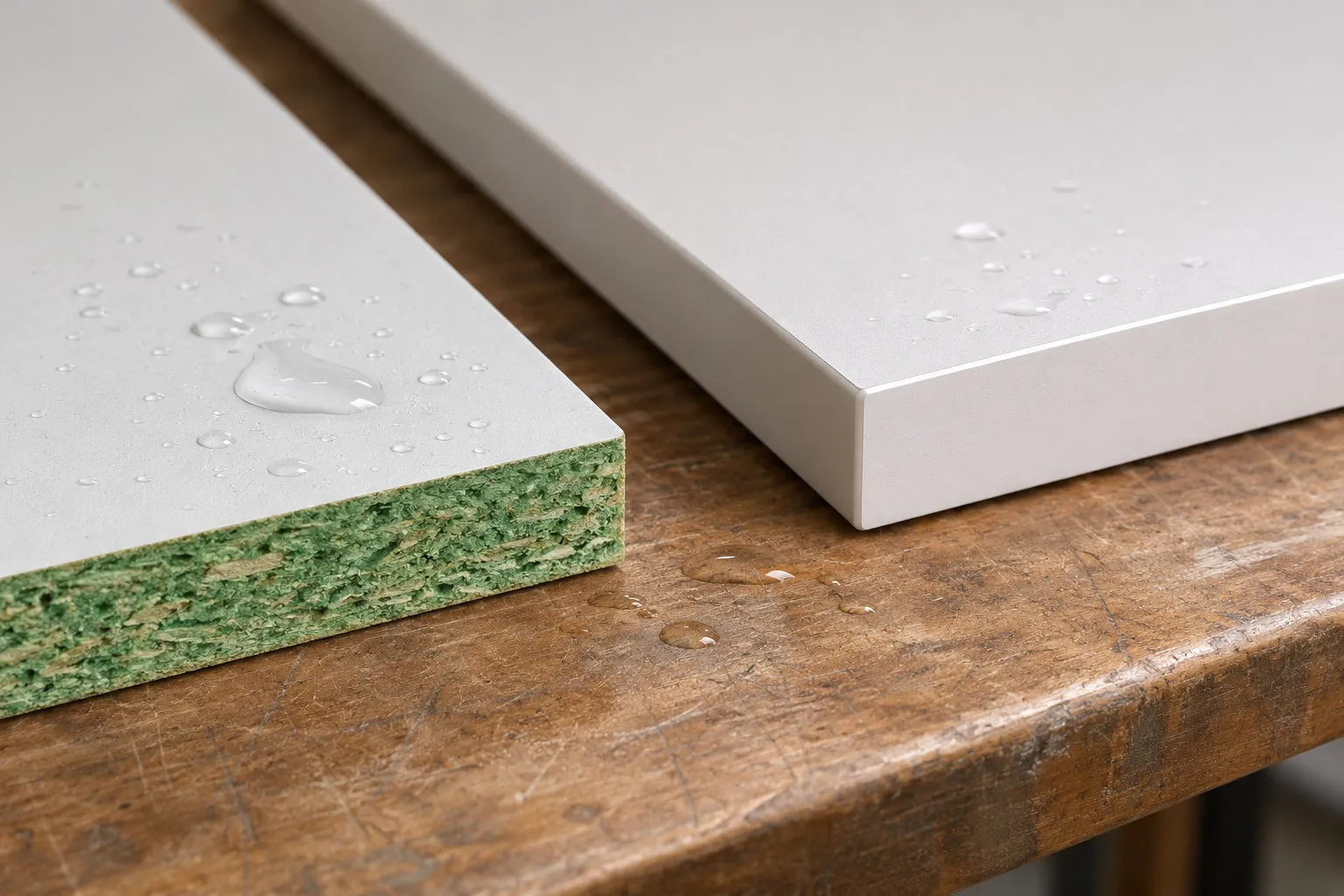
- Green colour is an identification dye at some makers; MEDITE says it does not affect performance. A laminated board hides its core, so the quotation is your only evidence.
- A board never cures a damp wall. Find and stop the source first, then choose the board; a moisture-resistant grade is for walls next to a bathroom or similarly exposed, and for a suite whose dressing area leads to the bathroom see the villa master suite guide.
- Ask for the board type, grade and thickness in the quotation. Our entry price is from AED 550 per sqm, installed, for MDF laminate with hinged doors, and framed painted doors are covered in classic and shaker-style wardrobes.
On this page
- Key takeaways
- MR board on a wardrobe quotation: what it means and what it does not
- P2 and P3: the two particleboard classes under EN 312
- MDF.MR, MDF.H and MDF.HLS: what the labels point to
- Green MDF: does the colour mean waterproof?
- HDF and the back panel: a dry-use board
- Decision table: what each board's maker says it is for
- Board classes and what their makers say
- Edges: a moisture-resistant core still has a cut edge
- A board never cures a damp wall
- E1 on the label: what it does and does not tell you
- What the quotation should say about the board
- Board questions to put to each supplier
- What we do about boards
- Common questions
MR board on a wardrobe quotation: what it means and what it does not
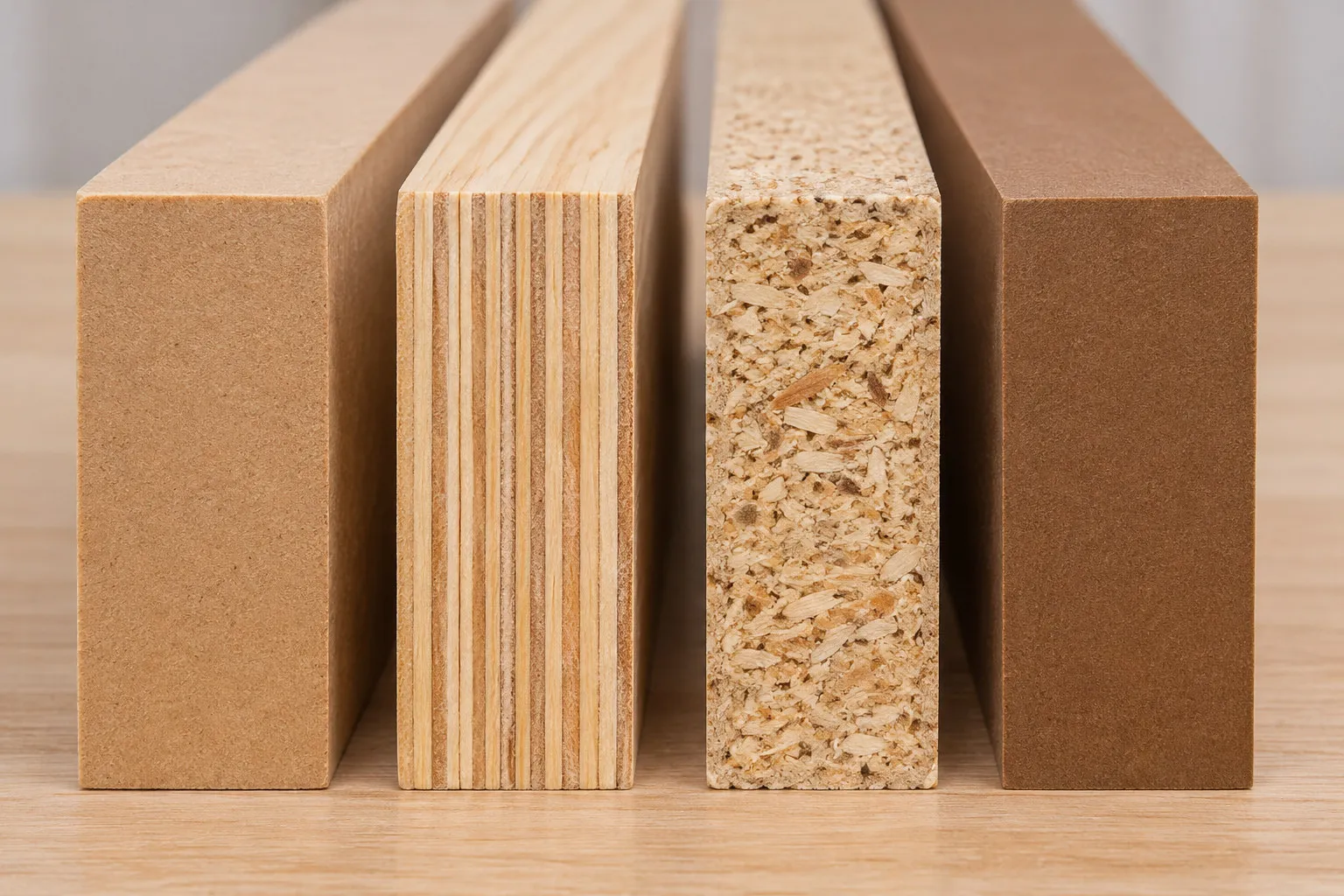
"MR" means moisture resistant, and it is a board grade, not a waterproof promise. On the board makers' own pages, a moisture-resistant board is for interior humid conditions, or for higher humidity for limited periods, and one maker adds in plain words that wetting the panel should be avoided. So an MR board copes with damp air better than a standard board. It does not cope with a leak, a wet wall or water standing against it (the wardrobe board types guide covers the four boards in general terms).
That is the gap this page fills. Searches such as "is moisture resistant MDF waterproof", "is all MDF moisture resistant" and "what colour is moisture resistant MDF" are the questions people actually type, and a quotation that says only "MR board" answers none of them. It does not name the core, the class, the maker or the thickness. What a wardrobe should be built from across the board is set out in our wardrobe materials and hardware guide, and the board line of the quote sheet is in the wardrobe quotation checklist. Here we take only the humidity side, label by label.
The drawing below puts the makers' wording on one ladder, from dry to humid, and then shows the order that matters when a wall is damp: find the source, stop it, and only then choose the board. The ladder is a reading order of different makers' sentences, not a test ranking, because the products and the standards behind them are not the same.
- 1. The ladder climbs from dry to humid: Kronospan words its P2 particleboard and its HDF as interior use in dry conditions, its P3 as dry and humid conditions, Pfleiderer's MDF.MR as higher humidity for limited periods and Sonae Arauco's MDF HYDRO X as intermittent high humidity levels
- 2. The dashed top rung is a limit, not a class: MEDITE says its MR board is not intended for prolonged water exposure, so no rung on the ladder is for standing water
- 3. Find the damp source: a leak, a wet wall or a dripping pipe has to be located before any board is chosen
- 4. Stop it at the source: the pipe, the leak or the wet wall is repaired, by the right trade, and the wall is allowed to dry
- 5. Then choose the board: a humid-conditions grade copes with damp air, and the drawing and quotation record which one goes where
- 6. Ask for the board type, grade and thickness in the quotation, so "MR" is written as a name you can check
P2 and P3: the two particleboard classes under EN 312
Particleboard, which many people call chipboard, is made by pressing wood chips with resin. The European standard for it, EN 312, is listed by BSI as "Particleboards. Specifications", published on 30 November 2010. Its contents headings name a type for interior fitments, furniture included, for use in dry conditions (Type P2), and a type for non load-bearing boards for use in humid conditions (Type P3). The standard itself is paywalled and we have not read it, so we do not quote what it says "dry" or "humid" means in numbers. What we can quote are the makers' own sentences about their boards.
Kronospan's P2 page says: "Particleboard P2 is non-load-bearing panel for interior use in dry conditions with high dimensional stability and stiffness." Its P3 page says: "Particleboard P3 is non-load-bearing panel for use in dry and humid conditions with high dimensional stability and stiffness." The P3 page lists "Increased resistance to humid conditions" among its characteristics and "Bathroom and kitchen furniture" among its applications, and both pages give the emission class as E1. Neither page says waterproof, and neither gives a humidity figure.
EGGER, another large maker, describes its melamine-faced P3 board in its own way: the standard board "for vertical and horizontal applications in furniture and interior design in humid conditions", with "Moisture-resistant gluing for improved swelling behaviour". Its page cites EN 14322, the standard for decorative boards, not EN 312, and gives no numerical moisture limit. That is a reminder that a faced board and a raw particleboard are different products with different paperwork, so ask which one the quotation means.
In practice this means a P3 wardrobe board is a humid-conditions particleboard, a P2 one is not, and the two can look identical once they are laminated. If a quotation says "particleboard" and nothing else, you cannot tell which you have. The same question matters in a kitchen, where the humidity is steam and splashes; our kitchen joinery guide explains how the cabinet body is chosen there, and the dressing table materials guide shows the same EN 312 and EN 622-5 labels on another piece of furniture. Sharing changes the plan, so our guide to a wardrobe shared by two is worth reading before the drawing.
MDF.MR, MDF.H and MDF.HLS: what the labels point to
MDF is a different family from particleboard. It is pressed from fine wood fibres, not chips, and its humidity grades are described under the fibreboard standard EN 622-5. This is where the confusion starts, because the makers do not all use the same label. Kronospan's MR page says its boards are "manufactured in compliance with EN 622-5 as MDF.HLS type". Swiss Krono's technical data says its MR front board "complies with the requirements of the standard EN 622-5, Tab.4 (MDF.H)". MEDITE says its MR "achieves the European Standard for interior humid conditions (type MDF.H1)". Sonae Arauco's page calls its board "MDF for use in humid conditions (EN 622-5)". Four makers, four different strings; why standard MDF suits fluted doors poorly near a bathroom or outside wall is covered in fluted wardrobe doors.
We have not read EN 622-5, so we do not explain how HLS, H and H1 differ from each other. What the pages do show is that "MR" is a trade shorthand sitting over differently named classes, and that the safe way to read a quotation is to ask for the class exactly as the maker writes it. Do not treat MDF.H as the same thing as a P3 particleboard: they are different cores under different standards. Wider joinery such as doors and partitions is built on the same boards, as our architectural joinery guide explains.
What each maker says in words is more useful than the label. Pfleiderer's StyleBoard MDF.MR page calls it "the right choice for exposure to higher humidity exposure for limited periods" and says its recipe gives "very low volume swell characteristics". Sonae Arauco says MDF Hydro X is "the right choice for rooms with intermittent high humidity levels, such as bathrooms or kitchens". Kronospan says its MDF MR boards are "for load-bearing use in dry and humid conditions", then adds that in humid conditions that is "for instantaneous or short-term periods of load only". That last limit is about load, not about wetness, but it shows how carefully a maker words what its board may do.
There are numbers too, from one maker, for the raw board. Swiss Krono's table of thickness swelling after 24 hours, a test the page labels EN 317, lists 12 percent for its standard MDF at more than 12 up to 19 mm and 10 percent at more than 19 up to 30 mm, against 5 percent or less listed for its MR front board at 16 to 19 mm and 19 to 25 mm. A laboratory figure for a raw board is not a wardrobe in a room, and it belongs to that maker's product, but it explains why a moisture-resistant core is worth having where the air is damp. For what boards do on media walls, see our media wall panels guide.
Green MDF: does the colour mean waterproof?
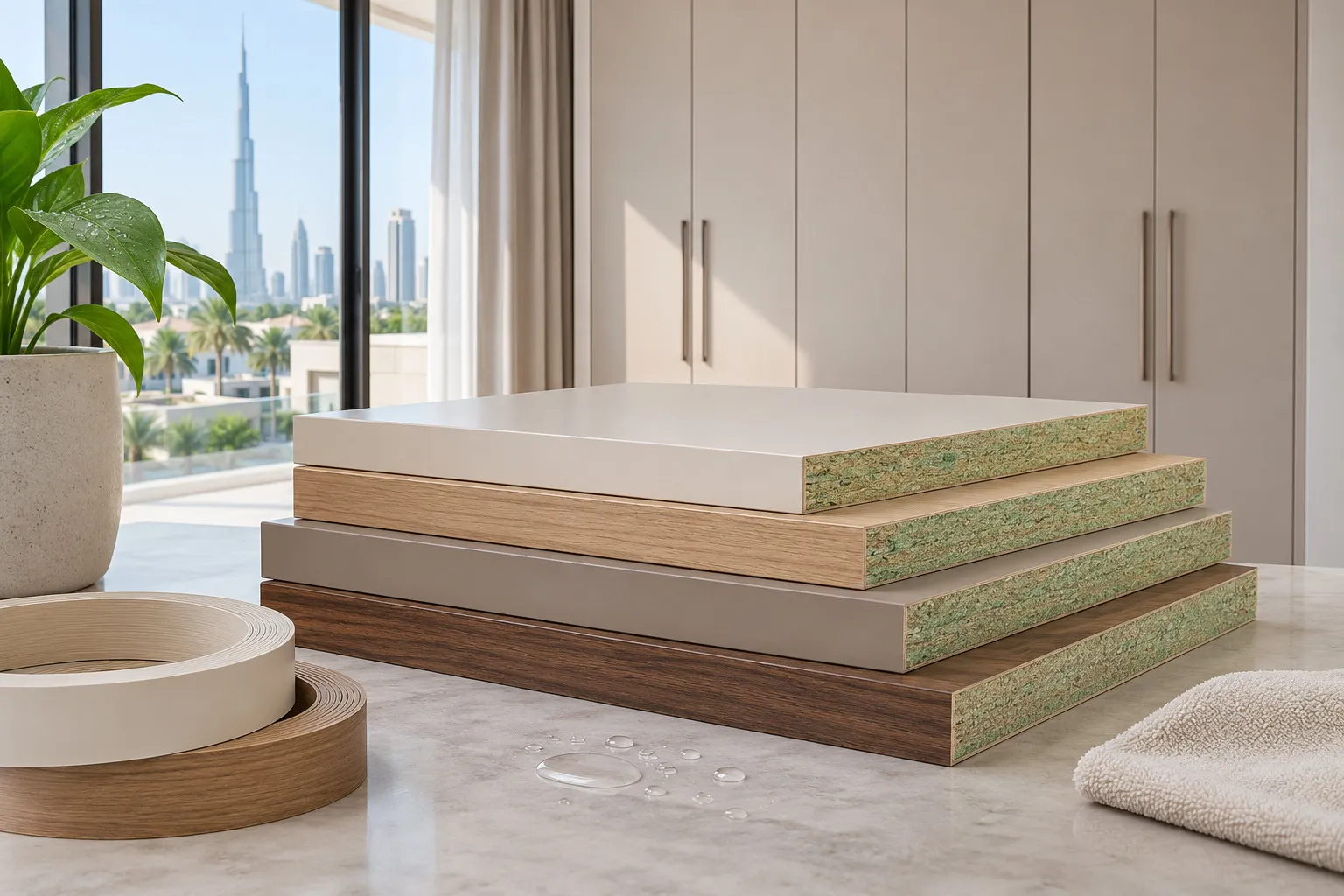
Many moisture-resistant MDF boards are green, and that is why the search "what colour is moisture resistant MDF" exists. Kronospan writes "Boards are produced with green-colored fiber as standard" for its MR board, and Pfleiderer calls its board "the green coloured StyleBoard MDF MR". So green is a real marker at some makers.
But the colour is a label, not a performance. MEDITE's FAQ says: "Green dye is added during the manufacturing process of MEDITE MR for product identification." It adds that "The green dye does not affect the performance of the panel" and that on one of its lines the dye goes only into the core. In other words, the green tells a workshop which pile the board came from; it does not tell you how much water the board will take. Nothing in the maker pages we read says that colour is the test.
Two practical points follow. First, MEDITE has one line that is green all through and one that is green only in its core, and both are its MR board, so do not judge by a cut edge. Second, when a laminated door or carcass is finished, you cannot see the core at all. The only evidence you will ever have is what the quotation says in writing. Our wardrobe door replacement guide shows what a swollen door looks like at the edge, if you are already dealing with one, and the choosing materials guide compares finishes across the home. Ask what the warranty on a wardrobe actually covers before you sign; that guide lists the questions to put in writing.
HDF and the back panel: a dry-use board
HDF, high-density fibreboard, is the thinner, harder cousin of MDF. Kronospan describes it as "an engineered board produced from resin bonded wood fibers under high pressure and heat" and, about its use, says: "HDF is a non-load-bearing product for interior use in dry conditions." Its list of applications includes cupboard backs, doors and partitions, its standards are EN 316 and EN 622-1, and its emission class is E1. The stock item it shows is 3 mm thick.
The point for a wardrobe is the back. A thin back panel is the part that faces the wall, and on that maker's page HDF is a dry-conditions product. That does not make every HDF back unsuitable, since other makers and other grades exist, and we do not claim it does. It means that if your quotation names HDF for the carcass or the back, the right question is whether the maker rates that grade for humid conditions where the wardrobe stands on a wall next to a bathroom or an outside wall.
People often ask whether HDF is better than MDF, and whether "MR" beats "HDF". They are not opposites. HDF describes how dense the fibreboard is, and MR describes a humidity grade of MDF. A board can be dense and dry-use, or less dense and humid-rated. This is why the quotation should name both the core and the grade rather than one word. How the inside of the wardrobe is laid out, behind the doors, is covered by our wardrobe layout guide. What goes on the face of the board, laminate, veneer or lacquer, is compared in our wardrobe door finishes guide. If the plan runs up to the slab, our guide to a floor-to-ceiling wardrobe explains how to measure the ceiling and close the gap at the top.
Decision table: what each board's maker says it is for
The table below sets the maker pages side by side. The middle column is what the maker says the board is for. The last column is what the page we read does not claim, which is where most disappointments hide. Every cell comes from the pages listed under Sources, read on 3 November 2026. It applies to the named products only and is not a ranking. A rented apartment wardrobe has a different checklist: permission, what can be taken apart and a move-out routine.
Board classes and what their makers say
P2 particleboard (Kronospan)
- What the maker says it is for
- Interior use in dry conditions
- What the page does not claim
- Humid conditions; it is the dry class
P3 particleboard (Kronospan)
- What the maker says it is for
- Dry and humid conditions; bathroom and kitchen furniture
- What the page does not claim
- Waterproofing; no humidity figure on the page
P3 faced particleboard (EGGER)
- What the maker says it is for
- Furniture and interior design in humid conditions
- What the page does not claim
- No numerical moisture limit on the page
MDF.HLS, "MDF MR" (Kronospan)
- What the maker says it is for
- Dry and humid conditions; humid load only short-term
- What the page does not claim
- Lasting wet load; the limit is on load
MDF.MR (Pfleiderer)
- What the maker says it is for
- Higher humidity exposure for limited periods
- What the page does not claim
- How long a "limited period" is
MDF HYDRO X (Sonae Arauco)
- What the maker says it is for
- Rooms with intermittent high humidity, such as bathrooms or kitchens
- What the page does not claim
- A humidity figure or a duration
MR board, type MDF.H1 (MEDITE)
- What the maker says it is for
- Interior humid conditions such as kitchens and bathrooms
- What the page does not claim
- Waterproof; wetting is to be avoided; not for external use
HDF (Kronospan)
- What the maker says it is for
- Interior use in dry conditions; cupboard backs
- What the page does not claim
- Humid conditions; load-bearing use
Wording from the maker pages read on 3 Nov 2026 (Sources below). Product-specific: another product of the same maker, or another maker's board with the same label, can differ. Not a ranking, and not a statement of what any wardrobe of ours is built from.
Edges: a moisture-resistant core still has a cut edge
Each panel is sawn from a larger sheet, and the saw cut leaves the core open. A moisture-resistant core is slower to take on humidity, but the edge is still where it can, which is why edge banding is part of the board conversation. MEDITE puts it in one line on its MR page: "Correct sealing, finishing and installation practices remain essential." Grade and edge work together, and a good grade with a poor edge is the case that surprises people.
Edge-banding makers describe their own products in the same careful way. REHAU, for example, says its RAUKANTEX pro edgeband is, "Depending on the requirements, also highly resistant to heat, moisture and water vapour", and describes a layer that "guarantees resistance against water vapour". That is one product line, fused to the board by a specific process, and the words "depending on the requirements" are doing real work. We make no ranking of PVC, ABS, PUR or laser-fused edges here, because we found no neutral test that compares them, and we do not say what our workshop uses.
What you can ask is simple and checkable: which edge banding material, how thick, how it is applied, and on which edges. The bottom edges of doors, drawer fronts and the plinth sit closest to a mopped floor and are the first place to ask about. How edges look on a door that has no handle at all is in our handleless wardrobe guide, and glass doors raise the same edge question in our mirror wardrobe doors guide. Which light to put in the wardrobe, a bare strip or one in a profile, is the subject of wardrobe LED strip or profile. If a door already sticks or rubs, how to fix a wardrobe door that is sticking, rubbing or sagging has the first checks.
A board never cures a damp wall
This is the rule the whole page rests on. A board graded for humid conditions is meant for damp air. It is not meant to sit against a soaked wall, a leaking pipe or a floor with water on it. MEDITE's blog says it is "not intended for prolonged water exposure or fully external use", and calls the belief that MR MDF is "completely waterproof" one of the most common misconceptions. The same is true of any board that comes from the humid column of the table above.
So the order is: find the source, stop it, then choose the board. A stain on the paint, bubbling or a smell near the wardrobe wall is a cue to inspect the wall; it is no cue to swap the board. We do not diagnose walls and we do not give humidity figures, because no official UAE humidity dataset turned up in our research. A plumber or a building surveyor is the right person to find a leak, and if you rent, read your tenancy contract and put your question to the landlord in writing before anyone opens or changes a wall. If the problem is a smell rather than a stain, our musty wardrobe smell guide goes through the likely causes. If you are weighing an old wardrobe, renovate or replace an old wardrobe is a decision guide by symptom.
Once the wall is dry, the board question becomes sensible. A wardrobe backing onto a bathroom, or standing on any other exposed wall, is the case for a moisture-resistant grade, because the room next door sends steam and spray onto that wall. Our guide on what to check first for a wardrobe against a bathroom or outside wall covers that position in more detail. A dressing room tucked beside the bathroom is the usual example, and our dressing room design guide shows how such rooms are planned. For tight bedrooms where the wardrobe has few wall choices, our small bedroom wardrobe ideas has plans for them.
The humid-wall side of wallpaper is in our guide to wallpaper in humid climates, and the wall preparation guide explains why a wall has to be dry before anything is fixed to it.
When our team visits to measure your made-to-measure wardrobes, tell them about any damp history of the wall. It costs nothing, it is written on the drawing, and it changes which board goes where. What happens at that visit is in our wardrobe measuring visit guide. The boards also carry what you store, so see luggage and seasonal storage for loft shelves, wardrobe drawers and organisers for drawers, abaya and kandura storage for long-hang columns and a studio apartment wardrobe for one-room plans. To set each rail from your own longest garment, see wardrobe hanging heights. For a large bedroom shared by two people, see master bedroom wardrobe design. Whether a walk-in wardrobe or a reach-in wall suits the room is a choice that comes before most details, and that guide gives a simple floor test for it.
E1 on the label: what it does and does not tell you
Data sheets carry a second label that is easy to confuse with the humidity class: the emission class. Kronospan lists E1 (EN ISO 12460-5) on its P2, P3, MDF MR and HDF pages. Pfleiderer's page lists "E1 E05" and "TSCA Title VI", and Sonae Arauco's product name carries E05/CARB2. EGGER's page says its board is "Compliant with the requirements for formaldehyde emissions according to the European REACH Regulation" and the US TSCA regulation.
Two things to keep straight. First, an emission class is a class with a limit, not a promise of zero emissions, so E1 does not mean "formaldehyde-free", and we do not use that phrase. Second, an emission class and a humidity class are separate lines on a data sheet: a board can be E1 and dry-use, like the P2 and HDF pages above, or E1 and humid-rated, like P3. Neither tells you the other.
For context only, the US Environmental Protection Agency's rule for composite wood covers hardwood plywood, medium-density fibreboard and particleboard, and applies to products sold, supplied or imported in the United States. Its limits, in 40 CFR 770.10, are 0.05 parts per million of formaldehyde for hardwood plywood, 0.09 for particleboard, 0.11 for medium-density fibreboard and 0.13 for thin medium-density fibreboard. That is a US rule. It is not proof that a board sold in the UAE meets it, and we draw no health conclusion from the numbers. Ask for the declared emission class of the board in your quotation, and read the kids wardrobe design guide if the wardrobe is for a child's room. For a sliding door that has slipped its rail, see what to do when a wardrobe door comes off its track.
What the quotation should say about the board
Use the table as a list of questions, and keep the answers in writing. They are the board-side part of the wider wardrobe quotation checklist, and they are worth asking of every supplier you compare, including us. The sizes of the wardrobe itself, as opposed to its boards, are in our wardrobe dimensions guide. How much floor a swinging leaf needs is worked through in our wardrobe door clearance guide, with a masking-tape test you can do before ordering.
Board questions to put to each supplier
Which core: particleboard, MDF, HDF or plywood?
- Why it matters
- They behave differently with humidity and screws
- A good answer
- The core named for the carcass, shelves, back and doors
Which class or grade, as the maker writes it?
- Why it matters
- "MR" sits over P3, MDF.H, MDF.HLS and others
- A good answer
- A class name such as P3 or MDF.H, not only "MR"
Which maker and product, and is there a data sheet?
- Why it matters
- Limits belong to one product, not to a label
- A good answer
- A maker and product named; the data sheet on request
Which parts get the humid grade?
- Why it matters
- Not every panel needs it, and the drawing should state which
- A good answer
- Panels on a bathroom or exposed wall marked on the drawing
What thickness for each part?
- Why it matters
- Thickness sets stiffness and screw holding
- A good answer
- A millimetre figure per part, written down
Which edge banding, and on which edges?
- Why it matters
- The cut edge is where the core is open
- A good answer
- Material and thickness named; bottom edges included
What emission class is declared?
- Why it matters
- Emission and humidity are separate labels
- A good answer
- The class as the data sheet writes it, not "formaldehyde-free"
Is the wall dry and has it ever leaked?
- Why it matters
- Boards do not repair damp walls
- A good answer
- A note on the drawing; any repair done first, by the right trade
A quotation that cannot answer the first three rows cannot say what you are getting. We do not publish which brand, grade or thickness we use, so ask for these in the quotation, ours included.
What we do about boards
The carcass of our custom-made wardrobes is built from low-emission HDF/MDF, and moisture-resistant grades are selected for the application, including walls beside a bathroom or otherwise exposed. That is what we publish. We do not publish the brand, the grade or the thickness, so we ask you to ask for the board type, grade and thickness in the quotation, from us and from any other supplier you shortlist. A named board in writing is easier to check than a label. If you are still weighing a made-to-measure wardrobe against a ready-made one, custom or ready-made wardrobe: where each wins in the UAE compares the two.
The way we work puts the board where you can see it. Measuring is free, and we bring laminate, veneer and glass samples to the room. We send a drawing and an itemised price; production starts only after you approve both. Prices start from AED 550 per sqm of wardrobe front, installed, for MDF laminate with hinged doors; sliding doors, glass, lighting and other options are their own lines, and the price for your wall is fixed after measurement. After you confirm, the Sharjah workshop builds the wardrobe and our team installs it in up to about 10 days, depending on size and design. The workmanship carries a 24-month written warranty, set out in our warranty and aftercare guide. Separately, the wood-based boards carry a 5-year limited warranty, subject to terms; hinges, tracks, runners, rollers and other moving hardware are not covered, and the final terms are in the written warranty.
Take any quotation that says "MR board" along to the visit, and we will go through it line by line. Start with our custom wardrobes service, then book through the consultation form.
Finished runs are shown on our built-in wardrobes page and our walk-in closets and dressing rooms page.
The pricing guide walks through building a quotation, and the wardrobe price guide shows how a measured wall ends up as a quoted price.
If your wardrobe wraps around a corner, corner and L-shaped wardrobe design comes first, and for the doors themselves see the sliding door systems guide.
The choice between hinged and sliding doors has a guide of its own, and finished sliding runs are on our sliding door wardrobes page. How many hinges a door needs, and what soft-close adds, is covered in the wardrobe hinges guide, and the types, height and finishes of handles are in our wardrobe handles guide.
A wardrobe with a TV unit and a dressing table inside the wardrobe are built on the same boards and raise the same quotation questions. For a hall cabinet, the shoe wardrobe design guide covers pairs per shelf, depth and ventilation.
Installation covers the whole UAE. The Sharjah custom wardrobes page gives the workshop location, and the Dubai page covers visits there. Before you fix the depth, read what we say about the right wardrobe depth for hanging clothes, since it changes how much floor is left in front.
The board is the last of the five planning steps; the step-by-step wardrobe guide shows what to decide before it.
Common questions
Is moisture-resistant MDF waterproof?
No. MEDITE answers the question with "No, MEDITE MR is a moisture resistant MDF which can be used in interior humid conditions", and adds that wetting the panel should be avoided. It copes with damp air, not with a leak or standing water. See our wardrobe materials guide.
What is the difference between P2 and P3 particleboard?
Under EN 312 as BSI lists it, P2 is a type for interior fitments in dry conditions and P3 a type for non load-bearing boards in humid conditions. Kronospan words P3 as "dry and humid conditions" and lists bathroom and kitchen furniture. See our kitchen joinery guide.
Is green MDF better for a wardrobe?
Not because of the colour. Kronospan and Pfleiderer make green moisture-resistant boards, but MEDITE says its green dye is for identification and does not affect performance. Ask for the class and maker instead. See our media wall panels guide.
Do I need a moisture-resistant board for a wardrobe against a bathroom wall?
That is the position a moisture-resistant grade is selected for, but only after any leak is stopped, since no board repairs a damp wall. Tell us about the wall at the free visit and it goes on the drawing. See our wardrobe measuring visit guide.
Will a moisture-resistant board stop damp or mould in my wardrobe?
No. A board graded for humid conditions copes with damp air; it will not fix a leak, a wet wall or poor airflow. Find the source first, with a plumber or surveyor if needed, then choose the board. See our guide to wallpaper in humid climates.
What should a wardrobe quotation say about the board?
It should name the core, the class as the maker writes it, the maker or product, the thickness of each part, the edge banding and the declared emission class. "MR board" alone is not an answer. See our wardrobe quote sheet guide.
Does a moisture-resistant board cost more?
We do not publish a separate price for board grades. Our entry price is from AED 550 per sqm of wardrobe front, installed, for MDF laminate with hinged doors, and your wall's figure follows the measurement. Ask for the board as its own line. See our wardrobe price guide.

Sources & specifications
Manufacturer information applies to the named products and systems. Sources reviewed on 3 November 2026.
- Kronospan, Particleboard P2: "non-load-bearing panel for interior use in dry conditions"; EN 312 type P2; emission class E1 (EN ISO 12460-5)kronospan.com(opens in a new tab)
- Kronospan, Particleboard P3: "for use in dry and humid conditions"; bathroom and kitchen furniture; EN 312 type P3; E1kronospan.com(opens in a new tab)
- Kronospan, Moisture resistant MDF (MDF MR): EN 622-5 type MDF.HLS; humid conditions for instantaneous or short-term periods of load only; green fibre as standard; E1kronospan.com(opens in a new tab)
- Kronospan, High Density Fiberboard (HDF): "non-load-bearing product for interior use in dry conditions"; cupboard backs; EN 316, EN 622-1; E1kronospan.com(opens in a new tab)
- Pfleiderer, StyleBoard MDF.MR: "exposure to higher humidity exposure for limited periods"; green coloured; E1 E05, TSCA Title VIpfleiderer.com(opens in a new tab)
- Sonae Arauco, MDF HYDRO X E05/CARB2: "MDF for use in humid conditions (EN 622-5)"; rooms with intermittent high humidity levelssonaearauco.com(opens in a new tab)
- EGGER, Decorative particleboards E1E05 TSCA P3: furniture and interior design in humid conditions; moisture-resistant gluing; no numerical moisture limit givenegger.com(opens in a new tab)
- Swiss Krono, MDF technical data: swelling after 24 hours (EN 317) for MDF and the MR front board (EN 622-5, Tab. 4, MDF.H)swisskrono.com(opens in a new tab)
- MEDITE SMARTPLY, FAQs MEDITE MR: not waterproof; type MDF.H1; wetting to be avoided; green dye for identificationmdfosb.com(opens in a new tab)
- MEDITE SMARTPLY, Understanding Moisture Resistant MDF (12 June 2026): not intended for prolonged water exposure; sealing and finishing remain essentialmdfosb.com(opens in a new tab)
- BSI Knowledge, BS EN 312:2010 Particleboards. Specifications (published 30 November 2010): contents headings for Type P2 (dry) and Type P3 (humid); standard text not readknowledge.bsigroup.com(opens in a new tab)
- REHAU, RAUKANTEX pro edgeband: "Depending on the requirements, also highly resistant to heat, moisture and water vapour"interior.rehau.com(opens in a new tab)
- US EPA, Formaldehyde Emission Standards for Composite Wood Products (page updated 28 October 2026): scope hardwood plywood, MDF and particleboardepa.gov(opens in a new tab)
- 40 CFR 770.10 (Cornell LII): emission limits in ppm, hardwood plywood 0.05, particleboard 0.09, MDF 0.11, thin MDF 0.13law.cornell.edu(opens in a new tab)
Want this planned for your home?
Consultation and measurement are free. Tell us the rooms, location and what you need; we arrange a sample visit and define the measured quotation.