Wardrobes · 15 min read · Updated 28 October 2026
Custom wardrobe prices in the UAE: how a quote is worked out
How a built-in wardrobe's price is worked out from its front area, what the entry rate includes, sums for typical rooms, the upgrades that raise it and when ready-made is cheaper.

By Ali Haider Basra, Founder, Al Tareeq Decor · Contact our workshop
Key takeaways
- A fitted wardrobe's price is set per square metre of its front, width times height; ours begin at AED 550 per m², fitted, in laminated MDF with hinged doors.
- At that entry rate a 2.4 m bedroom wall of about 6 m² is AED 3,300, and a small walk-in of about 16 m² is AED 8,800.
- Sliding or glass doors, veneer or lacquer, lighting and inside fittings each add a line; removal and electrical work are lines too.
- A ready-made IKEA PAX can cost less per m², but it stops at 236 cm and comes without fitting; a built-in uses the whole wall.
- Compare quotations on the same area, door system, face, named hardware and warranty, not on the totals alone.
On this page
- Key takeaways
- The short answer: from AED 550 per m² of front
- Width × height: how the area is measured
- Worked examples by room
- Wardrobe prices at the entry rate, by room
- What adds to the price, and what each line buys
- What the entry rate already covers
- Built-in or ready-made: which costs less?
- Is a fitted wardrobe worth it?
- Walk-in closets: the same rate, more walls
- How to keep the cost down without a worse wardrobe
- Comparing two quotations fairly
- From a photo to a fitted wardrobe
- Common questions
The short answer: from AED 550 per m² of front
A made-to-measure wardrobe from our workshop is priced on one measurement: how many square metres its front covers. Our entry rate stands at AED 550 per m², and fitting is already in it. That rate pays for the entry build, with carcass and doors in laminated MDF, opening on hinges, made to fit your wall and put in by our own fitters. What the board behind that price is, and what a label such as MR means, is explained in moisture-resistant wardrobe boards.
Anything beyond that build is priced as a line of its own: sliding doors, glass, a veneer or lacquer face, lighting and the fittings inside. So is work around the wardrobe, such as moving a socket or taking out the old unit. The quotation then shows what each choice adds, and a line can be dropped without the whole design being drawn again.
Treat the entry rate as the floor of your budget, not a forecast of the final figure. This guide shows how to turn your own wall into that floor, what moves it up, how it compares with buying ready-made, and how to read two quotations side by side.
Width × height: how the area is measured
The front is what you would see with every door shut. Width times height gives its area, so a wardrobe 2.4 m wide and 2.5 m tall has a front of 6 m². How big the bedroom is plays no part in the sum; only the stretch of wall the wardrobe covers counts.
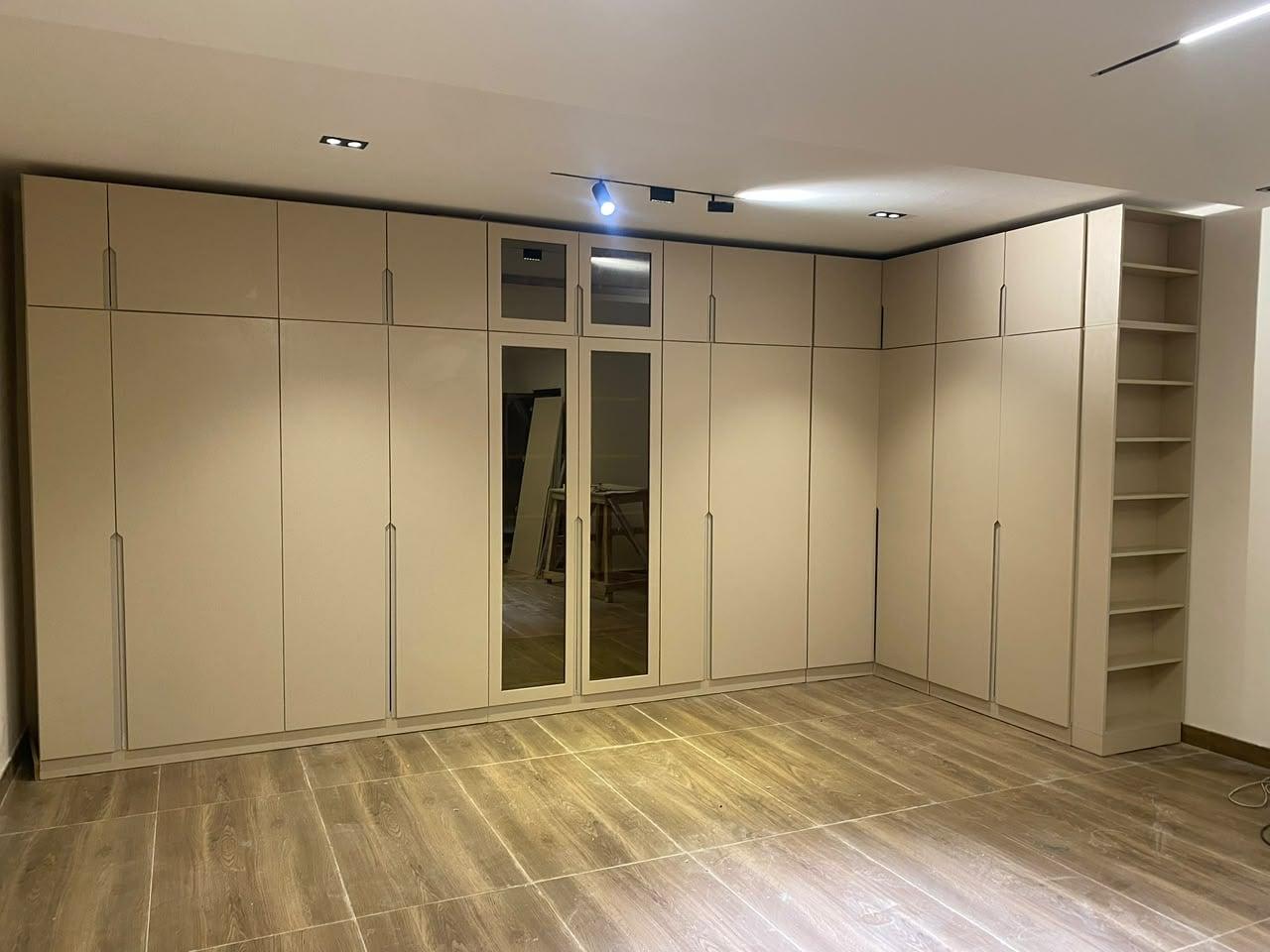
Height means the height you build to. Ours go right up to the ceiling, leaving no dusty gap above, so take the height from floor level right up to the ceiling, not to the door-head line. Under a 2.7 m ceiling the same 2.4 m run becomes 6.48 m², or AED 3,564 at the entry rate, against AED 3,300 under a 2.5 m ceiling.
A run that turns a corner, in an L or a U, is several fronts added together. Measure along each wall it covers, add the widths and multiply by the height. Where two runs meet in a corner, ask how the corner is counted, because makers treat it differently; the worked example in our L-shaped wardrobe price guide shows the sum. If you are not sure how to take the measurements themselves, the wardrobe dimensions guide explains it.
- 1. Measure the front: its width times its height, up to the ceiling
- 2. Multiply that area by AED 550 per m² for the entry build, fitted
- 3. Larger runs follow the same rate in a straight line
- 4. Upgrades and extra work are added as separate, named lines
Worked examples by room
The table turns some typical walls into figures at the entry rate. The first four rows are the presets in the estimator on our custom wardrobes service page; the last is an L-shaped run worked out the same way. They are sums, not quotations, and they are not records of past jobs.
Find the row nearest to your room and plan for at least its figure. Then write down the upgrades you already know you want, so that the free visit prices them as lines and you are not left guessing what the extras might come to.
Wardrobe prices at the entry rate, by room
Single 1.2 m wardrobe in a guest or child's room
- Front area
- 3 m²
- At AED 550 per m², fitted
- AED 1,650
- Worth weighing up
- Hinged doors suit a narrow run; add only the fittings it will really use
2.4 m bedroom wall
- Front area
- 6 m²
- At AED 550 per m², fitted
- AED 3,300
- Worth weighing up
- Sliding doors if the bed stands less than about 90 cm away
3.6 m master bedroom wall
- Front area
- 9.5 m²
- At AED 550 per m², fitted
- AED 5,225
- Worth weighing up
- Lighting in the deeper sections, a pull-out for trousers
Small walk-in closet
- Front area
- 16 m²
- At AED 550 per m², fitted
- AED 8,800
- Worth weighing up
- Glass fronts only on the sections opened every day
L-shaped run, 4 m + 2 m, 2.7 m ceiling
- Front area
- 16.2 m²
- At AED 550 per m², fitted
- AED 8,910
- Worth weighing up
- Ask how the corner is counted and what goes in it
Front area × AED 550. The first four areas are the presets of the estimator on our service page. Upgrades, removing an old wardrobe and electrical work are priced on top.
What adds to the price, and what each line buys
The door system is usually the biggest step up. Sliding doors hang from a track system, with heavy-duty systems available (ask for the load rating in your quotation), and the carcass behind them is made deeper than a hinged one, so they cost more to make and to fit. That pattern is not ours alone: FCI London, a London firm supplying Italian-made wardrobes, gives 2026 starting figures of £4,500 for a hinged built-in and £6,000 for a sliding one, though its sliding range also covers longer runs. Which door is right for you turns on the floor space in front more than on money; the hinged versus sliding doors guide works through that choice.
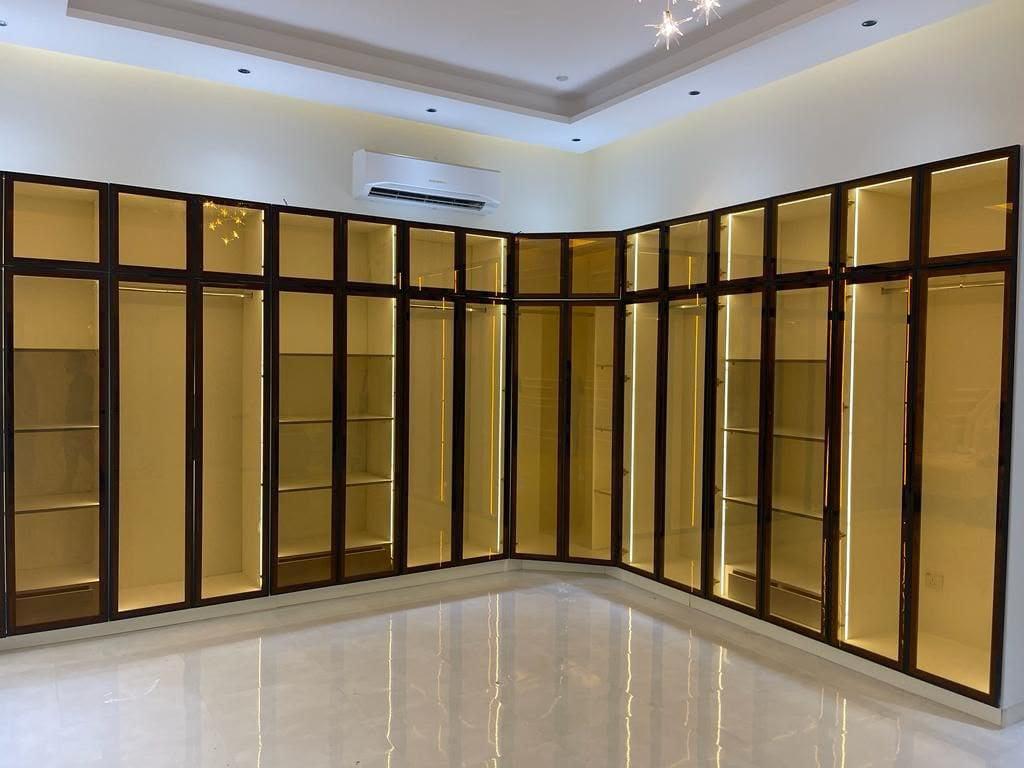
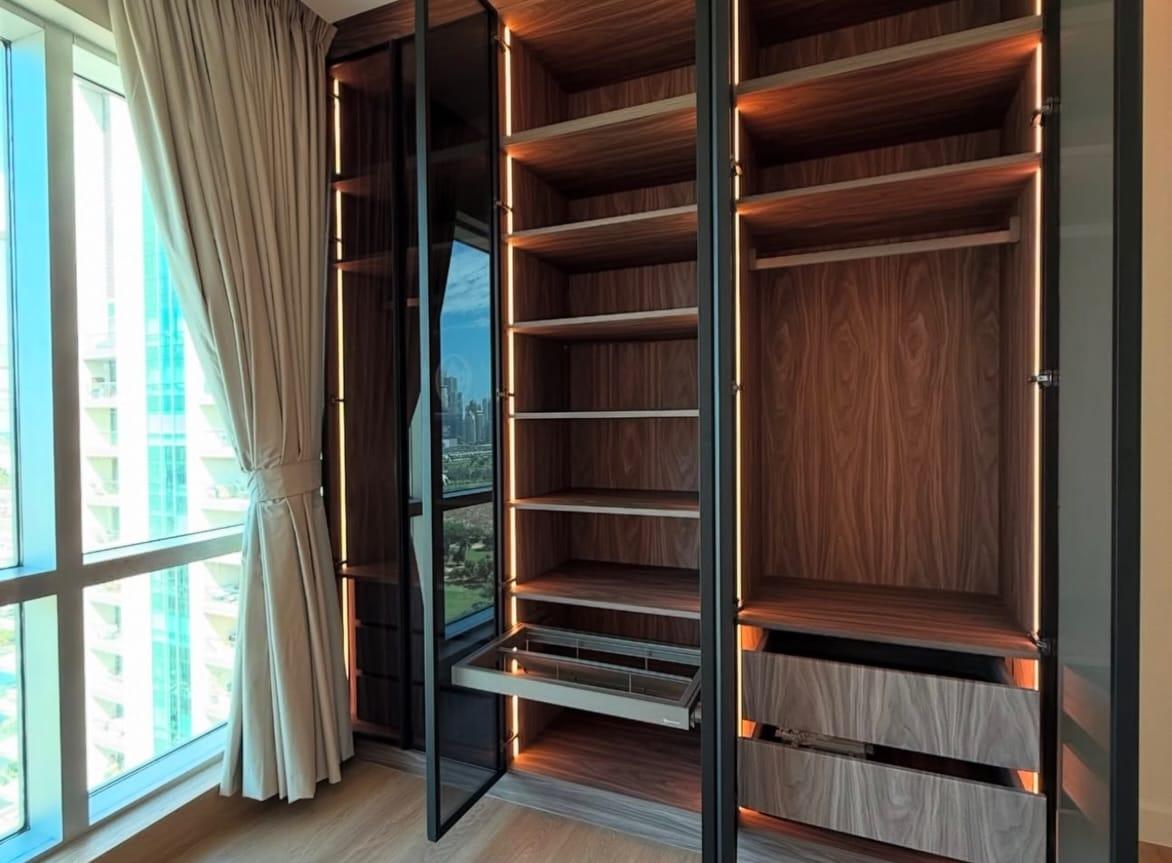
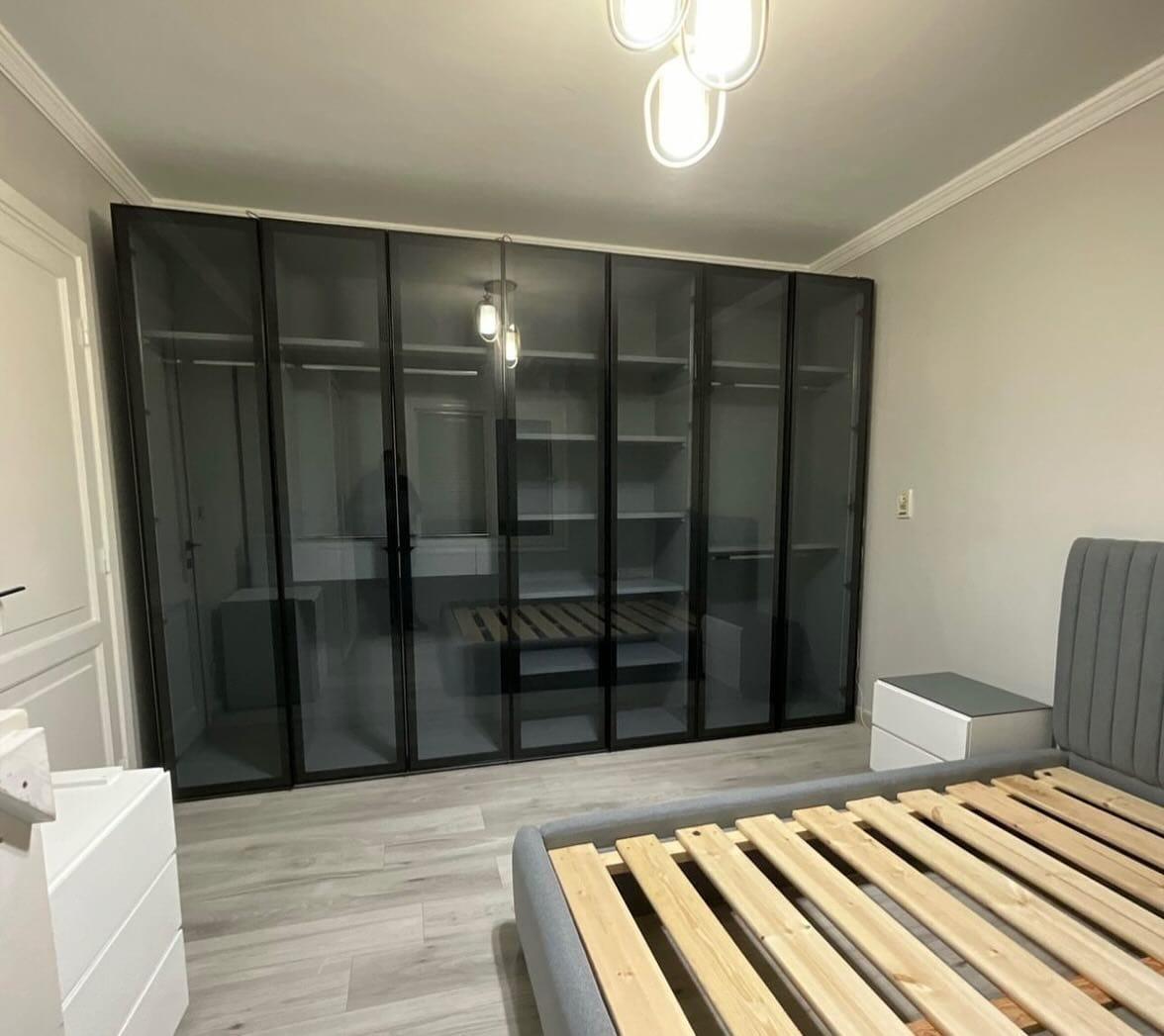
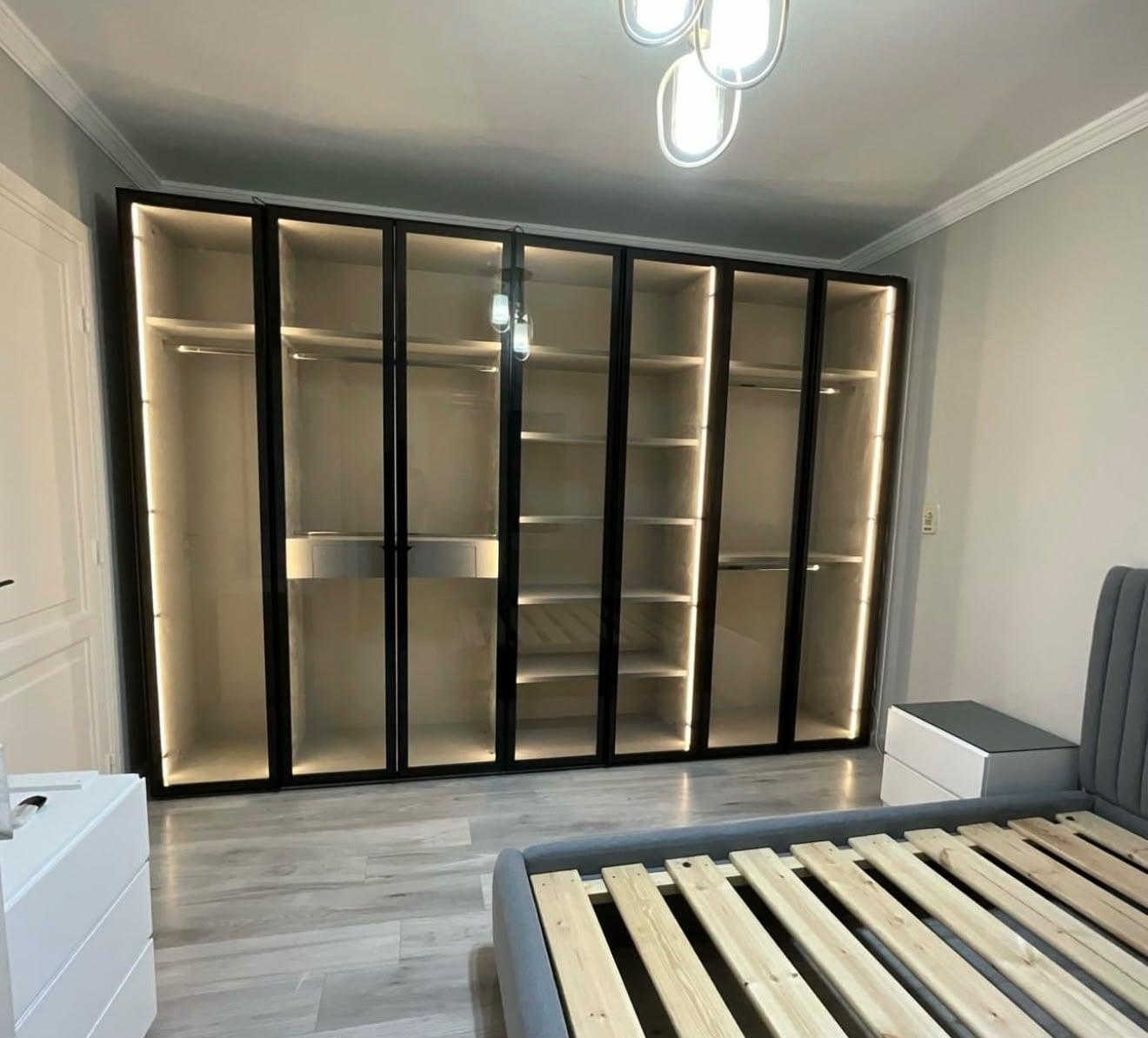
Glass fronts come next. Ours are tempered glass with a grey or bronze tint, in anodised aluminium frames: they show what is inside and keep the dust out, at a higher price than a laminate door. A veneer face brings real timber grain and lacquer an even painted colour; both cost more than laminate and ask for more care in the workshop and on site. What each face is made of is covered in wardrobe materials and hardware. The faces are compared one by one in wardrobe door finishes compared.
Inside, every fitting is priced by the piece: motion-sensor LED rails, racks for shoes, organisers for ties, trouser pull-outs and velvet jewellery drawers. They are easy to over-order. Choose them by counting what you actually own, the way our guide to wardrobe interiors sets out, and leave the rest out.
Two kinds of work sit outside the wardrobe itself. When a socket or switch would end up behind the new run, our team moves it as a small electrical job, shown on its own line. Taking out an existing wardrobe is priced separately as well, and if its cabinet is still sound you may only need new doors, as wardrobe door replacement explains. Ask for both to be named on every quotation you collect; a lower total that simply leaves them out is not a lower price.
If money is tight, spend it first on what is hard to change once the wardrobe is in: the door system, and any lighting that needs wiring, which our wardrobe lighting ideas explain layer by layer. Most inside fittings can be added to a sound carcass later. Turning a hinged wardrobe into a sliding one usually cannot be done, because the sliding version is built deeper; the sliding wardrobe door systems guide shows what the extra depth is for.
What the entry rate already covers
The rate per square metre is not a bare-board price. Before anything is made, a member of our team visits free of charge, measures the room with a laser and brings samples of laminate, veneer and glass to judge in your own light. You then receive a drawing to approve, and no board is cut before you sign it off; how matt and gloss samples differ in light and marks is covered in matt versus gloss wardrobe doors.
Fitting is part of the rate. The workshop in Sharjah cuts and assembles every panel, and the people who install them are on our staff, not subcontracted. Carcasses are cut from low-emission HDF or MDF board, and the drawing states where a moisture-resistant grade is used. Whatever the build, the hinges we fit are soft-closing ones; confirm the brand and model in the quotation.
Our written workmanship warranty then runs for 24 months on orders agreed since 10 October 2026, while hinges and tracks carry their makers' own terms. Separately, the wood-based boards carry a 5-year limited warranty, subject to terms; hinges, tracks, runners, rollers and other moving hardware are not covered, and the final terms are in the written warranty. When you set our figure against another, check that the other one also includes measuring, a drawing, fitting and a warranty on paper. A price without them is for a different job.
Built-in or ready-made: which costs less?
It depends on the wall, and a real comparison shows why. On 28 October 2026, IKEA's UAE website listed a PAX/FORSAND wardrobe in white, 200 cm wide, 60 cm deep and 236 cm high with hinged doors, at Dhs 2,300 including VAT. Its front is 2.0 × 2.36 m, or 4.72 m², which is about AED 487 per m². IKEA states that interior accessories and handles are sold separately, and delivery and assembly are booked as services of their own.
Built to the same 2 m width under a 2.6 m ceiling, our entry wardrobe has a front of 5.2 m², or AED 2,860, fitted. The ready-made unit costs less per square metre. The fitted one fills the 24 cm a 236 cm frame leaves under that ceiling, is made to the exact wall instead of stock widths, and is installed within the price.
So the honest answer is a rule of thumb. If your wall is close to a stock width under a standard ceiling, and you may move within a year or two, a ready-made system is the economical choice, and it goes with you. If the wall is long, the ceiling high, or the room has a column, a sloping ceiling or a window near the corner, the gaps around stock units waste space, and a fitted wardrobe earns its premium.
Building one yourself is a third route. It saves the labour only if you can cut large boards cleanly and scribe them to walls that are rarely square; otherwise offcuts, tools and remade panels swallow the saving. If the wardrobe already stands and only parts of it have failed, renovate or replace the wardrobe shows how to decide whether to keep it.
Is a fitted wardrobe worth it?
For a main bedroom in a home you plan to stay in, usually yes. A fitted run uses the wall end to end and floor to ceiling, which lets the same footprint hold more than a freestanding wardrobe of equal width. The overhead section takes suitcases and out-of-season clothes, and there is no top to gather dust.
How long it lasts comes down to its parts more than its style. A wardrobe built on good board with named hinges and runners can be adjusted for years; a cheap one tends to be replaced when a door sags or an edge swells. That is where a fitted wardrobe's extra cost should go.
The case is weaker in a rented flat you expect to leave soon, because a built-in wardrobe stays with the wall. Ask the landlord before anything is fixed, and weigh the cost against the months you will actually use it. Our guide to fitted, built-in and freestanding wardrobes sets out what each wastes on one example wall and what the tenancy law says.
Nor do fitted wardrobes go out of fashion by themselves. What makes one feel tired is a front nobody likes any more, or an inside that no longer suits the clothes. Plain fronts in a calm colour and one adjustable section are cheap insurance against both.
Walk-in closets: the same rate, more walls
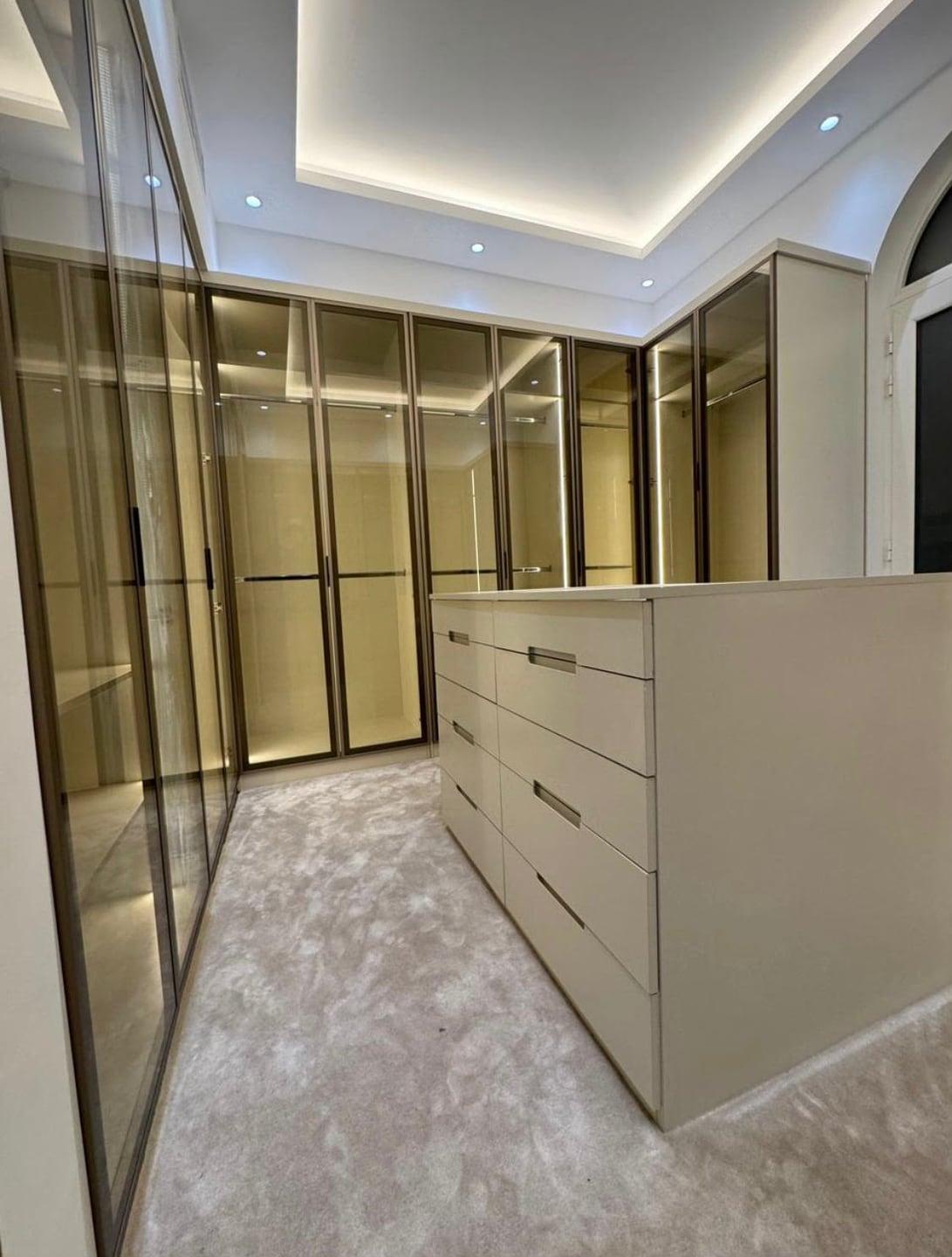
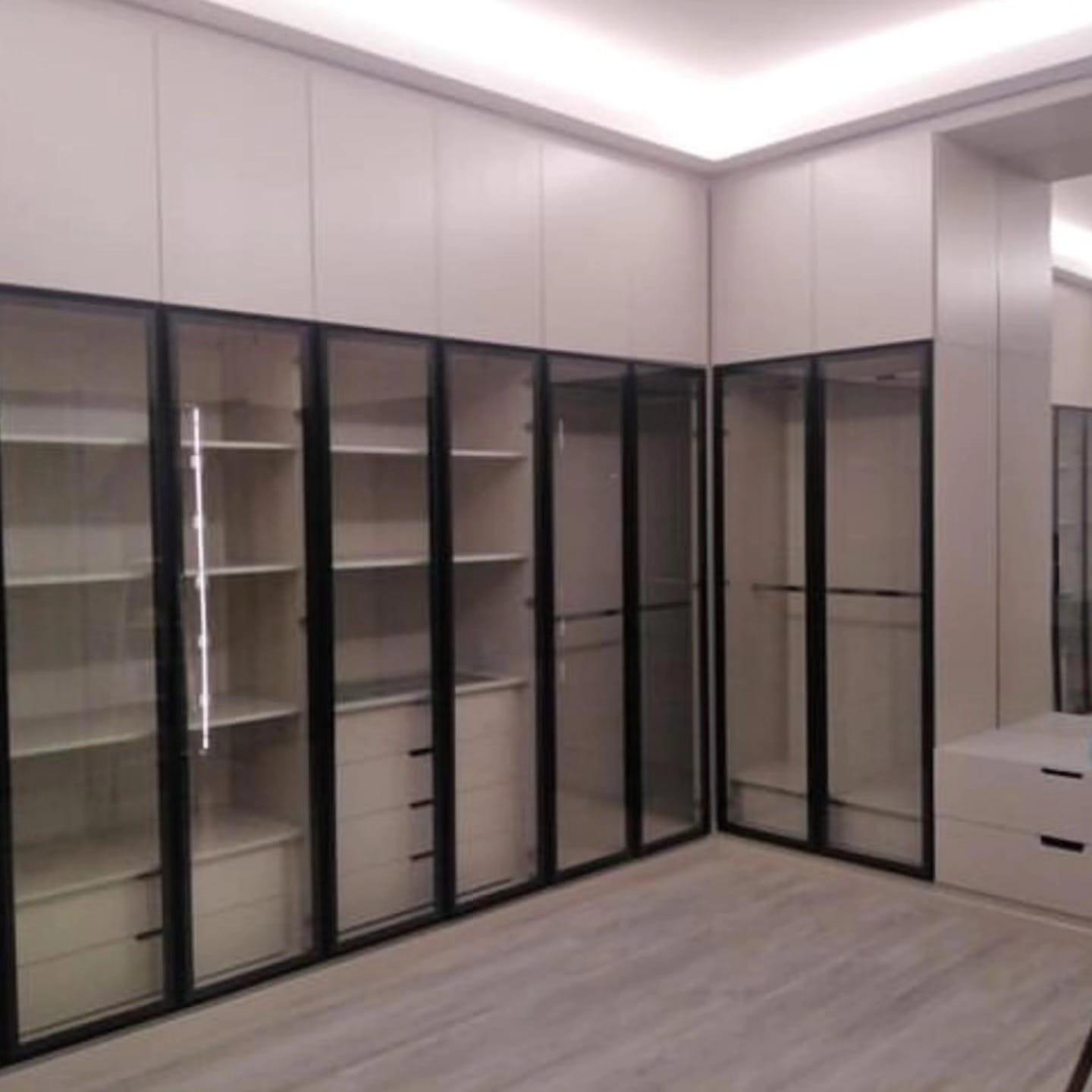
A walk-in closet is priced in the same way, by the fronts on every wall that holds storage. A small room lined on three sides adds up quickly: the small walk-in in our estimator is 16 m² of fronts, which the entry rate prices at AED 8,800 before any glass, lighting or fittings.
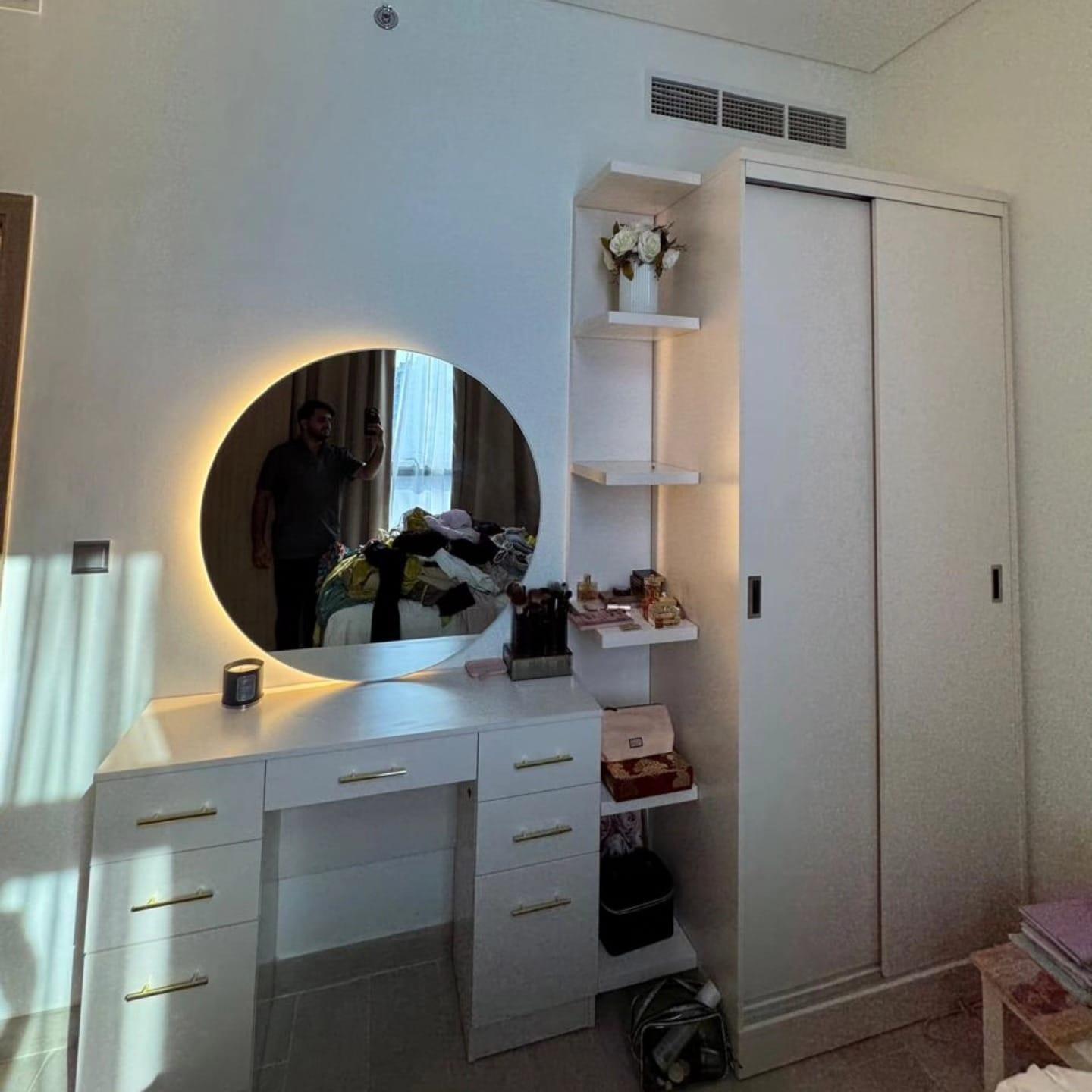
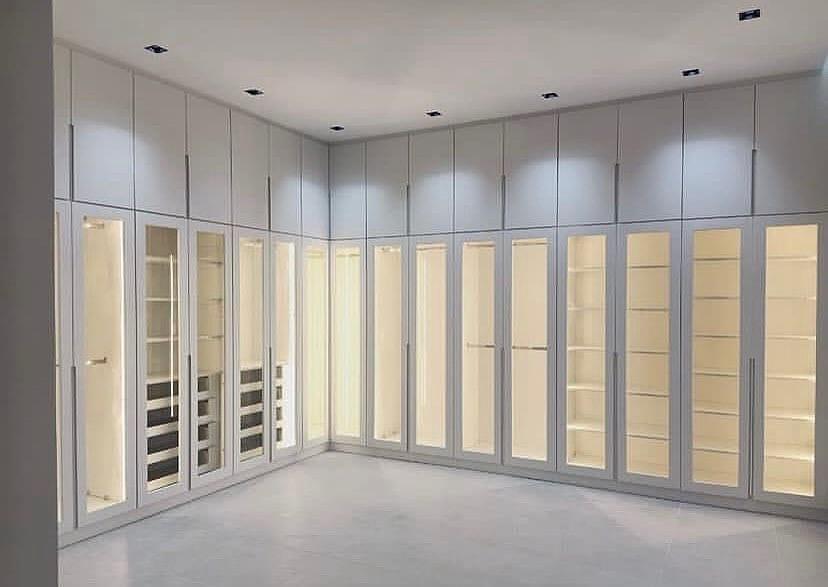
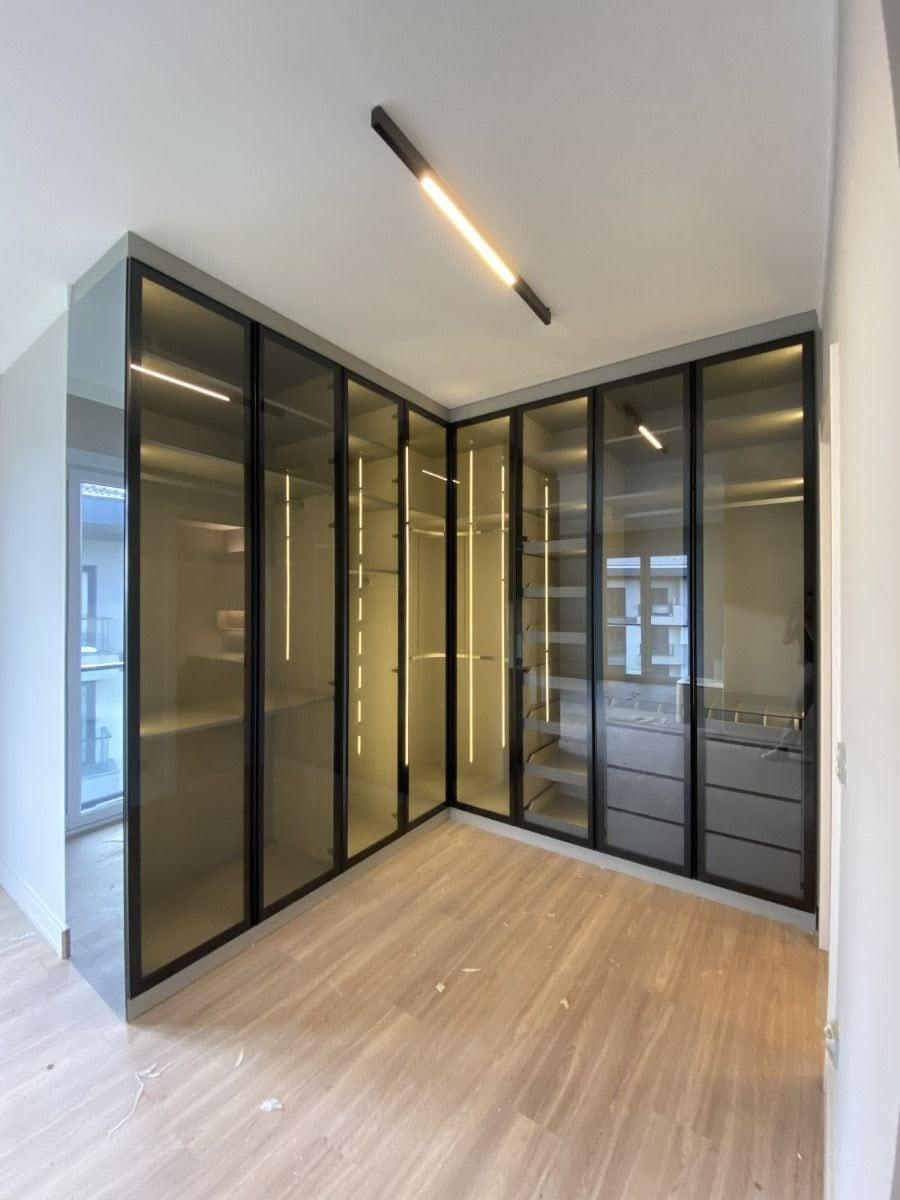
Two things take a walk-in further. Lit glass fronts are popular because everything is on show at once, and the glass and the light are both upgrade lines. A drawer island in the centre, or a dressing table set into the wardrobe run, gets its own drawing and price, while planning a U-shaped walk-in shows when an island fits. FCI London's 2026 figures show the same climb: a straight walk-in from £8,500, an L or U shape from £14,000.
Price the walls first and add an island only if the walkway allows it. Whether a room is big enough to walk into, and which layout suits it, is a planning question that our dressing room design guide answers; finished examples are on walk-in closets and dressing rooms. If you are still deciding between a wall of doors and a room you step into, our reach-in versus walk-in wardrobe guide compares what each costs in floor space.
How to keep the cost down without a worse wardrobe
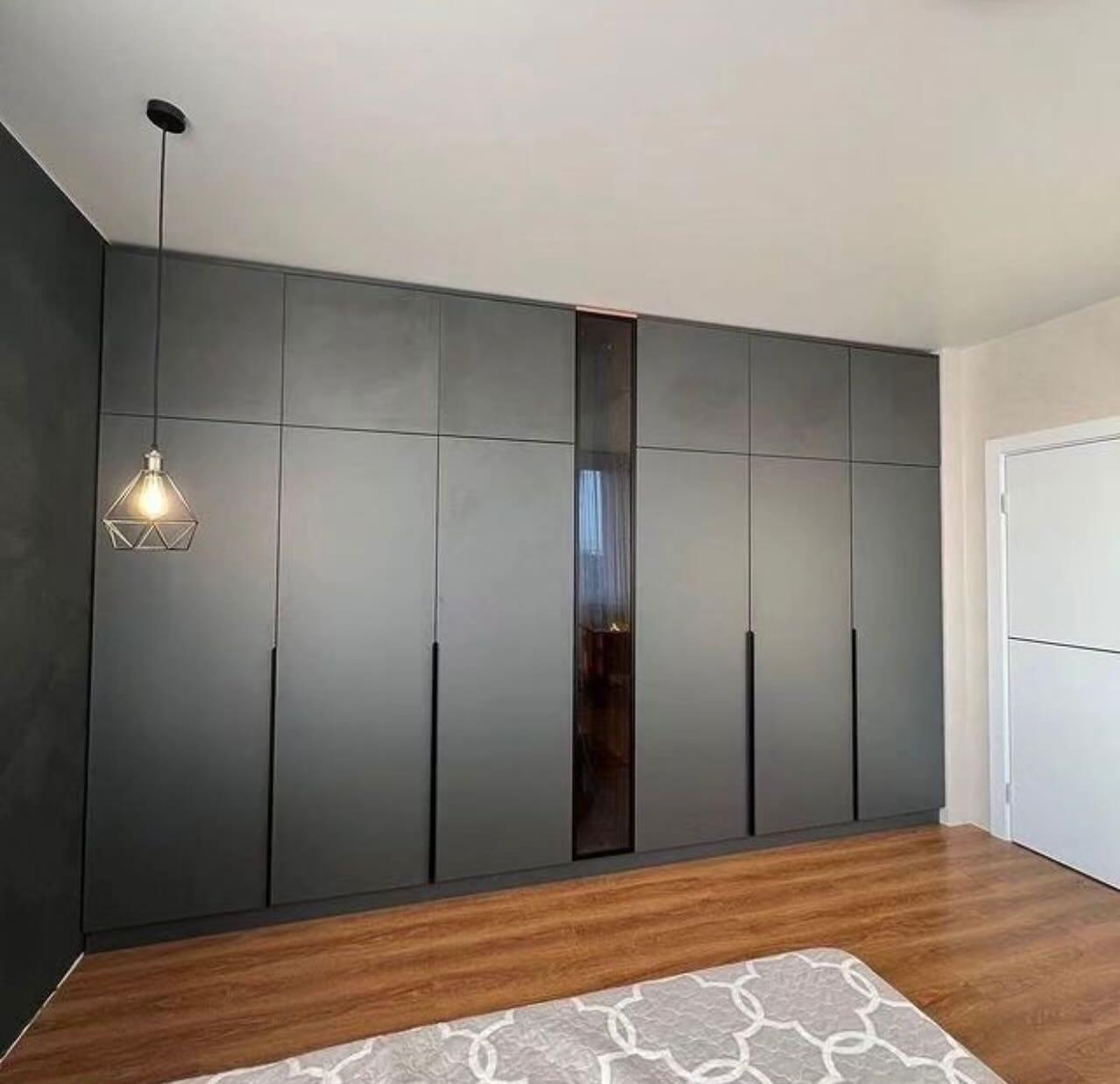
The cheapest square metre is the one with the plainest front. Laminate on hinged doors is our entry build for good reason: it wears well, wipes clean and costs least (our guide to cleaning wardrobe surfaces covers laminate and the other faces). Most of the saving comes from using it where no one will notice, inside a walk-in or in a guest room, and spending more on the run you open every morning.
Fewer, wider doors mean fewer hinges and handles, within the roughly 60 cm a hinged door carries well. A simpler interior, with shelves and rails where you might have chosen specialised fittings, costs less and is easier to change later. One finish across the whole run avoids the extra work of mixing materials.
Do not save on the parts that wear. Soft-close hinges and runners, sealed edges and the right board beside a bathroom cost little next to the price of rehanging a sagging door or replacing a swollen panel. The video below adds a carpenter's own list of savings, some of which suit UAE homes better than others.
Comparing two quotations fairly
Two totals say little until you know what each one covers. The simplest fix is to ask every maker, us included, to price your measured area at their basic specification and then each upgrade as a separate line. Laid out that way, a quote that looks dearer often turns out to include more, and you choose the upgrades rather than having them chosen for you. Our wardrobe quotation checklist turns this into ten lines to ask for in writing.
Before you set two quotations side by side, make sure they price the same wardrobe: What a wardrobe warranty should say in writing, and how to read a lifetime claim, is explained in our wardrobe warranty guide.
- The same front area, measured to the same height, with corners counted the same way
- The same door system, hinged or sliding, with the make of hinge or track named
- The same face, laminate, veneer, lacquer or glass, from a sample you have seen
- The inside listed section by section, not as "standard fittings"
- Fitting included, with removal of the old wardrobe and any electrical work as their own lines
- Whether VAT is included in each figure
- A written warranty, and what it covers
- A completion date, and the day it is counted from
From a photo to a fitted wardrobe
For a first figure, send us each wall's width, how high the ceiling is, plus a photo in which the sockets, switches and AC grilles can be seen. That is enough to work out the entry figure and to book the free visit, where we laser-measure, bring samples and talk through doors and fittings with you. What to prepare before we come is in the guide to the free wardrobe measuring visit.
When the drawing is approved and the order confirmed, our Sharjah workshop builds the wardrobe and our team fits it, up to about 10 days later; larger runs take longer. The starting point is our custom wardrobes service, and local details are on our pages for custom wardrobes in Sharjah and wardrobes in Dubai. Finished work is on built-in wardrobes, sliding-door wardrobes and lit glass-front wardrobes.
Common questions
How do you calculate the cost of a wardrobe?
Multiply the front's width by its height to get square metres, then multiply by the rate; for our entry build that is AED 550 per m² including fitting. Measure up to the ceiling if the wardrobe will reach it. How to measure for a wardrobe.
How much does a 10x10 wardrobe cost?
A room of about 3 × 3 m is a walk-in, so the price follows the fronts on every wall you fill, not the floor area. Our small walk-in example, 16 m² of fronts, costs AED 8,800 at our entry rate, before glass, lighting or an island. Walk-in closet layouts.
Which is better for wardrobes, sliding doors or hinged doors?
Sliding doors suit a room where the bed sits near the wardrobe, because they never swing out; hinged doors open every section at once and need a shallower carcass, and a wardrobe for a narrow room or corridor looks at the doors that fit. Sliding systems are usually the dearer of the two. Choosing hinged or sliding doors.
What is the best material to use for a custom closet?
For a dry bedroom, laminate-faced MDF or HDF is a sound, affordable standard, and it is what our entry rate is built on. Veneer and lacquer cost more, and a wall next to a bathroom calls for a moisture-resistant board, and sprayed wardrobe doors explains what a sprayed front is made of. Wardrobe materials and hardware.
Are fitted wardrobes outdated?
The idea is not; what dates is an inside that no longer fits your clothes. Leave one section adjustable, with movable shelves or a spare rail, so the layout can change as your needs do. Wardrobe interior layout guide.
Do built-in wardrobes cause damp?
Not on their own, but one set against a wall it shares with a bathroom, or below an AC line that drips, can hold moisture. Fix any leak first, then ask for moisture-resistant board with sealed edges on the panels that face it. Moisture-resistant wardrobe boards.

Sources & specifications
Manufacturer information applies to the named products and systems. Sources reviewed on 28 October 2026.
- IKEA UAE: PAX/FORSAND wardrobe, 200 × 60 × 236 cm, Dhs 2,300 incl. VAT; interior accessories and handles sold separately (read 28 Oct 2026)ikea.com(opens in a new tab)
- IKEA UAE: PAX wardrobe system, frame heights of 201 and 236 cm and pricesikea.com(opens in a new tab)
- IKEA UAE: assembly service, booked separately from the furnitureikea.com(opens in a new tab)
- FCI London: wardrobe depth guide, with 2026 indicative prices (hinged from £4,500, sliding from £6,000, walk-ins from £8,500)fcilondon.co.uk(opens in a new tab)
Want this planned for your home?
Consultation and measurement are free. Tell us the rooms, location and what you need; we arrange a sample visit and define the measured quotation.