Wardrobes · 9 min read · 23 August 2026
Wardrobe price per square metre, per metre or per item: what it means
How wardrobe prices are quoted: per square metre of front, per linear metre or per door. How to measure the front area, why two quotes differ, and a worked example with illustrative dimensions and no total.

By Ali Haider Basra, Founder, Al Tareeq Decor · Contact our workshop
Key takeaways
- A square metre of wardrobe front is its width multiplied by its height; a linear metre is length only; a price per door counts doors. They are three ways of measuring one wall.
- Our published entry specification is from AED 550 per sqm: MDF laminate, hinged doors, installed. Other options raise the figure, and the figure for your wall is set after measurement.
- Two quotes in the same unit can still differ: door type, board, finish, hardware, lighting, interior fittings, mirror and glass and the complexity of the wall all change the rate.
- Before comparing, ask each supplier for the area, the height they measured to and the specification written beside the rate.
- Prices depend on measurements, materials, finishes, doors, hardware, lighting and complexity: ask for a quotation for your wall.
On this page
- Key takeaways
- Three ways to quote the same wardrobe
- The three units you will meet in quotations
- Price per square metre: what is being measured
- A worked example, with illustrative dimensions only
- Price per linear metre and per item
- Why two quotes for the same wall can differ
- What moves a wardrobe rate up or down
- How to compare two quotations fairly
- What we do about it
- Common questions
Three ways to quote the same wardrobe
Ask three joiners for a price and you can get three different kinds of number back: a rate per square metre, a rate per linear metre, or a price per door or per unit. They are not three prices for one thing. They are three ways of measuring the same wall, and a number in one unit cannot be set beside a number in another until the wall has been turned into the same measure. This page explains the units and how to read them. It does not give a total for any wardrobe, because the figure for your wall is set after measurement.
Al Tareeq Decor publishes its entry specification per square metre of wardrobe front: from AED 550 per sqm for an MDF laminate wardrobe with hinged doors, installed. Other options raise the figure, and the figure for your wall is set after measurement. That sentence is about a specification, not a promise that it fits every wardrobe: prices depend on the measurements, the materials, the finishes, the doors, the hardware, the lighting and how complicated the wall is. To see a number for your wall, ask for a quotation.
The three units you will meet in quotations
Per square metre (sqm)
- What it measures
- The area of the wardrobe front: width multiplied by height
- What to ask when you see it
- Which height was used (to the ceiling or to the top of the doors), and what the rate is for
Per linear metre
- What it measures
- Only the length of the run along the wall, with no height in it
- What to ask when you see it
- What height, depth and door type the rate assumes
Per door or per item
- What it measures
- A count of doors, units or fittings
- What to ask when you see it
- How wide and tall each door is, and what is added on top
A rate in one unit says nothing about a rate in another until each is turned into the same measure for the same wall. Ask for the specification written beside every rate.
Price per square metre: what is being measured
A square metre is the area of a square with sides one metre long. For a wardrobe front, the area is the width of the run multiplied by its height. A front is flat and rectangular, so the arithmetic is the same as for a wall or a window: measure across, measure up, multiply.
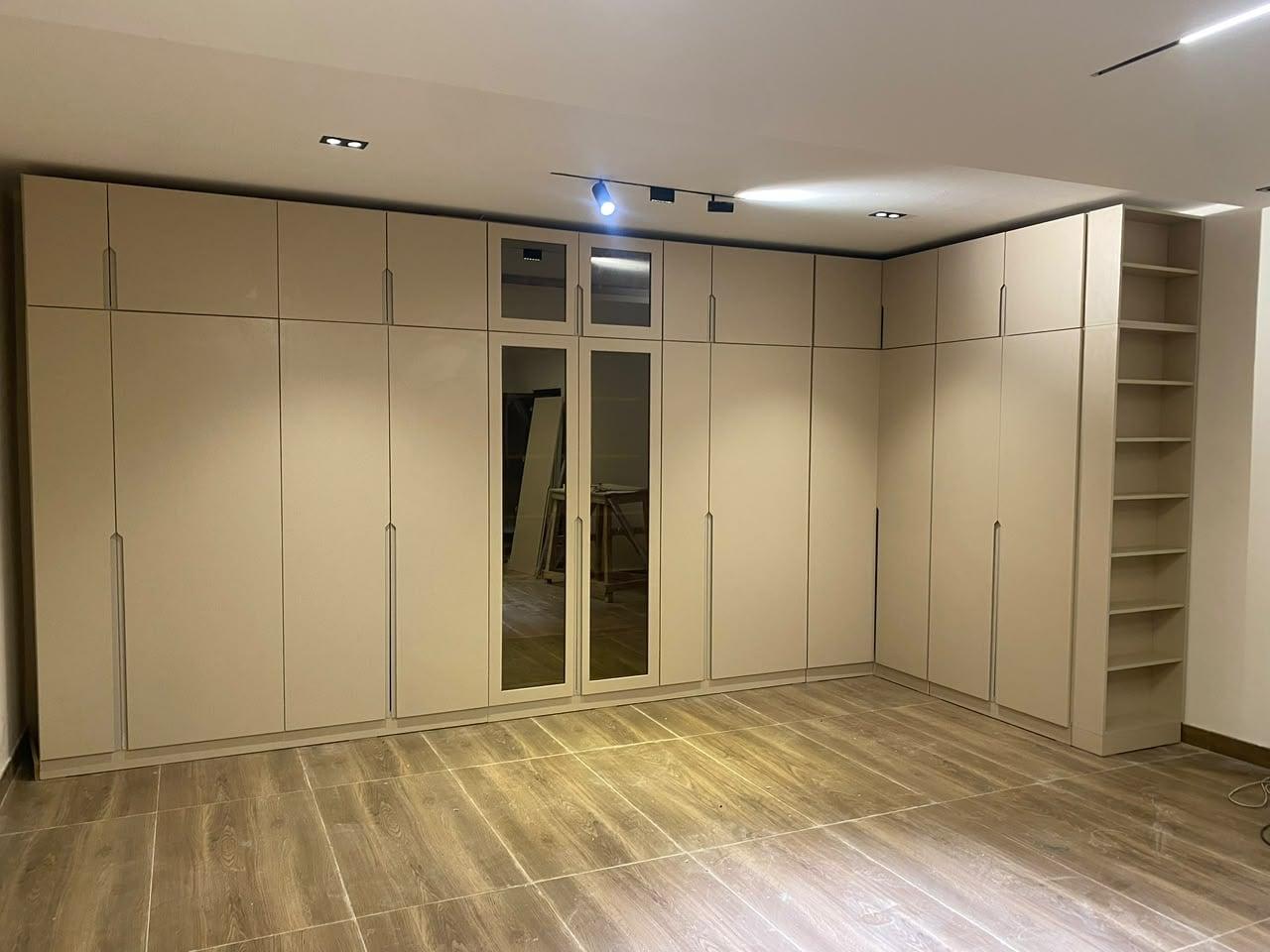
The only judgement is which height. Some wardrobes stop at the top of the doors; others run to the ceiling with top boxes above. A floor-to-ceiling wardrobe measures to the ceiling, so the height is the room height at that wall, taken at more than one point because ceilings and floors are rarely level. If two quotations give different areas for the same wall, the first thing to check is which height each one used.
The area is read from the face of the wardrobe, not from the inside. The depth, the number of shelves and the position of the rails do not enter the arithmetic; they affect the specification that the rate is for. That is why a per-sqm rate always needs its specification beside it.
- 1. Width: measured along the wall where the wardrobe will stand (illustrative 2.4 m)
- 2. Height: measured up the face, to the top of the doors or to the ceiling (illustrative 2.6 m)
- 3. Area: width multiplied by height, 6.24 sqm for these illustrative dimensions
A worked example, with illustrative dimensions only
Take an imaginary wall, 2.4 m wide, with a wardrobe that runs 2.6 m high. The front area is 2.4 multiplied by 2.6, which is 6.24 sqm. These are invented dimensions chosen to show the method; yours will differ, and we do not turn this area into a price, because a price needs the specification, and the specification is only fixed after measurement.
The same imaginary wardrobe, described the other way, is 2.4 linear metres long. Described a third way, it might be a four-door wardrobe. All three descriptions are true at once. One describes area, one describes length and one counts doors. A quotation that leads with only one of them has left out the other two facts you would need to compare it with another quotation.
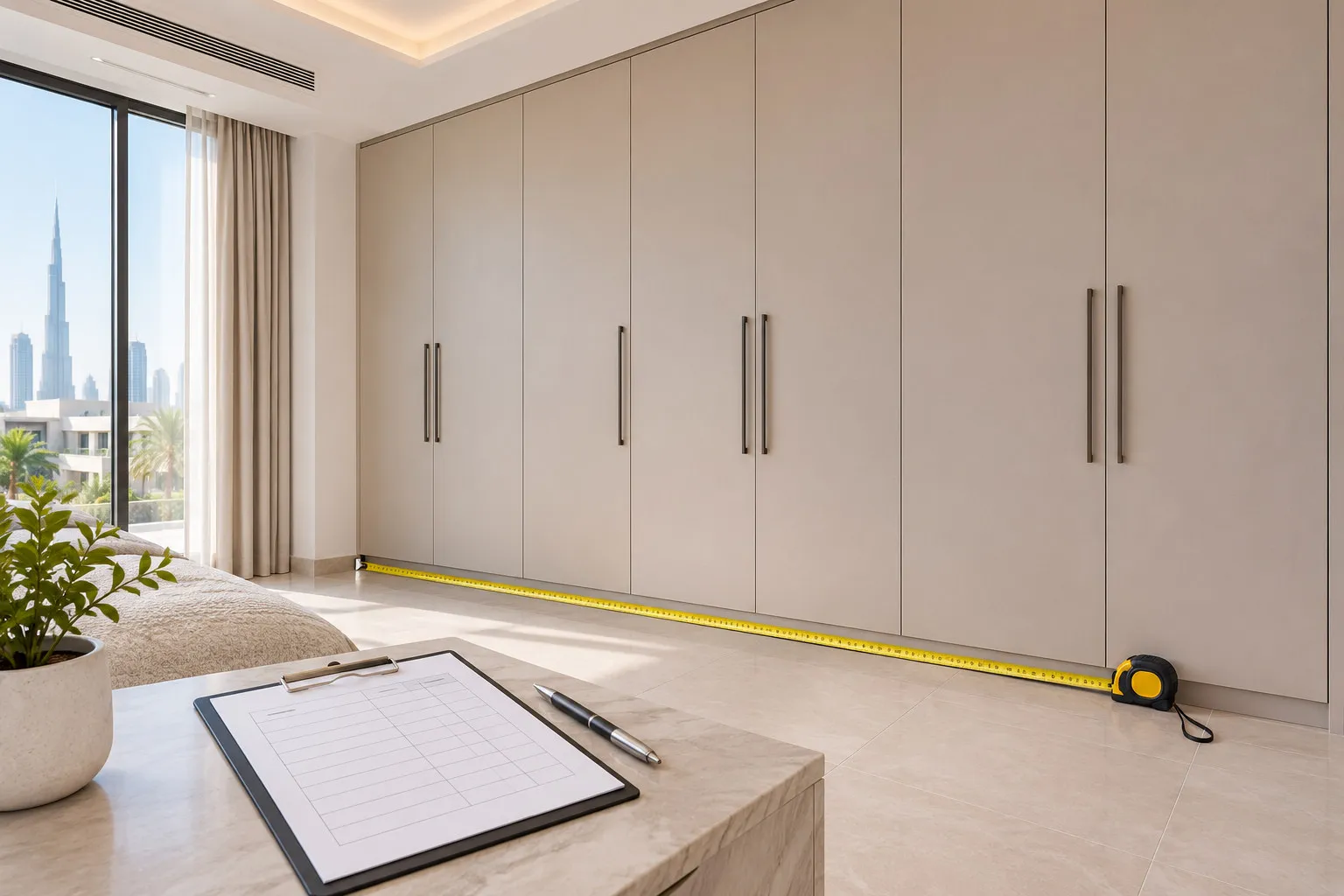
When you measure your own wall for a first idea, take the width at the top, middle and bottom and the height at both ends, then write down the smallest and largest. The wardrobe measuring visit guide shows what is checked on the day and how the measurements are recorded. For the maths behind a price, our pricing guide shows how a measured wall becomes a quotation.
Price per linear metre and per item
A linear metre, also called a running metre, is length only. One UK trade page, Trade2Base, describes quoting a rate per metre of run length and multiplying by the wardrobe width, and calls per-metre pricing the industry standard for made-to-measure and bespoke work there. That is a UK trade page, not a UAE rule, but it shows why you will meet the unit. It is simple to say and it hides the height. A wardrobe 2.4 m long and 2.1 m high and one 2.4 m long and 2.8 m high have the same length, but they are not the same amount of wardrobe.
A price per door or per item has the opposite weakness: it hides the width and height of each door. A narrow door and a wide one both count as one. Counting doors is useful for a quick first comparison, but only when the doors are the same size and type and the rest of the specification is the same.
None of the three units is wrong. Each one leaves out something, and the missing piece is where two quotations drift apart. The wardrobe quotation checklist lists the lines to ask each supplier for, so that the answers can be laid side by side.
Why two quotes for the same wall can differ
Suppose two quotations are in the same unit and use the same area. They can still differ, because the rate belongs to a specification, and the specification has many parts. FCI London, a UK maker of fitted wardrobes, says the cost depends on materials, design, labour and additional work, and that specialised lighting or intricate details raise the cost of elaborate designs. Trade2Base adds that a sprayed finish, soft-close hardware and a better grade of door material change a job. Both are UK businesses and neither speaks for the UAE; they are useful because they name the same kinds of difference.
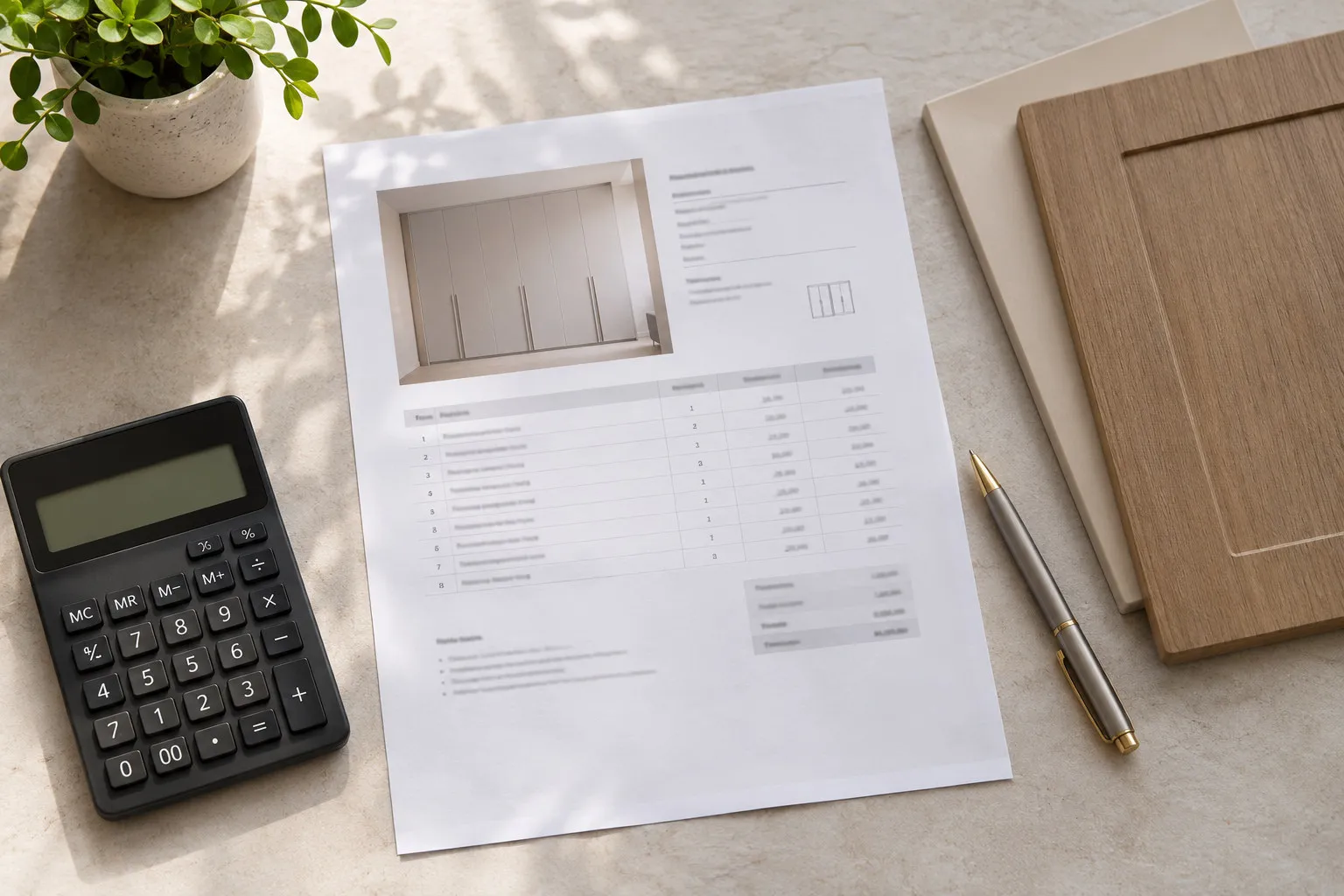
The table below sets out the differences we see most, with what to ask for in writing. It is a list of questions, not a list of what any particular price contains: for the specification of ours, see the quotation for your wall.
What moves a wardrobe rate up or down
Door type
- Why the figure changes
- Hinged, sliding and handleless fronts need different parts and different work
- Guide to read
- Hinged or sliding doors; sliding systems
Board
- Why the figure changes
- The core and thickness of the carcass and fronts differ, and moisture-resistant grades are chosen for some walls
- Guide to read
- Wardrobe board types; moisture-resistant boards
Finish
- Why the figure changes
- Laminate, veneer, lacquer or a matt or gloss surface are different materials and processes
- Guide to read
- Door finishes compared
Hardware
- Why the figure changes
- Hinges, tracks and runners vary in kind and in how many are fitted
- Guide to read
- Hinges guide
Lighting
- Why the figure changes
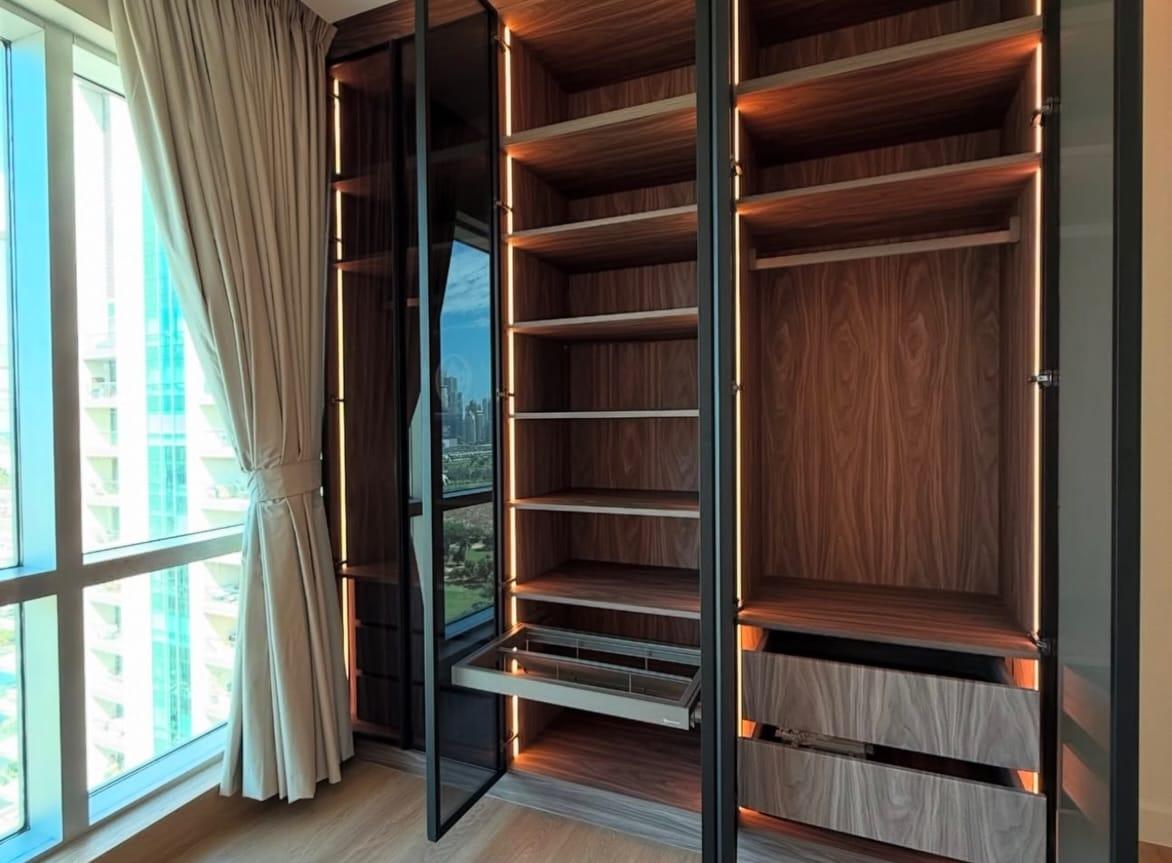
- Internal LED lighting adds parts and work
- Guide to read
- LED strip or profile
Interior fittings
- Why the figure changes
- Drawers, pull-outs and shelves change what is inside the same front
- Guide to read
- Drawers and organisers
Mirror and glass
- Why the figure changes
- Mirror and glass fronts are different materials with different handling
- Guide to read
- Mirror wardrobe doors
Wall complexity
- Why the figure changes
- Corners, alcoves, uneven walls and sloping ceilings need more fitting work
- Guide to read
- Corner and L-shaped wardrobes
A question list, not a statement of what any price contains. Ask for the specification in writing, line by line.
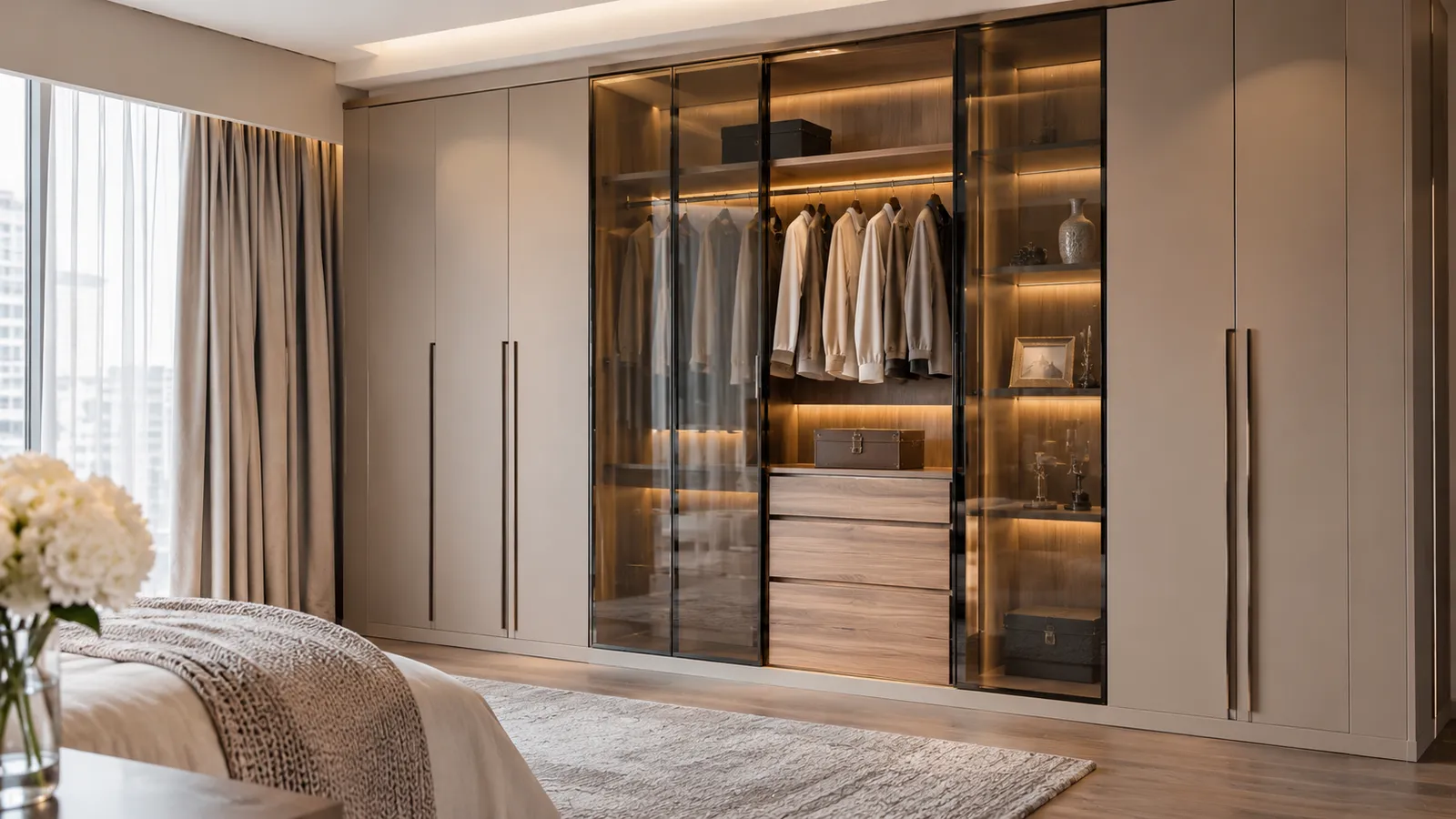
How to compare two quotations fairly
Turn each quotation into the same measure before you compare. Ask each supplier for the front area they used, the height they measured to and the door type, board and finish named in the specification. If one gives only a rate per metre, ask what height it assumes. If one gives a price per door, ask for the width and height of each door.
Then compare line by line, not by the bottom figure alone. A rate that looks lower may describe a plainer specification, and one that looks higher may describe more. The wardrobe materials and hardware guide explains what separates one board and one set of hardware from another, and the older wardrobe price guide looks at pricing from the budget side.
It also helps to know whether you are comparing a made-to-measure wardrobe with a ready-made one. The two are priced differently because one is cut for the wall and the other is not, and our custom or ready-made wardrobe guide sets the difference out. Whatever you choose, get the drawing and the itemised price in writing before anything is made, and keep the warranty terms next to them; the wardrobe warranty guide lists the questions to ask.
What we do about it
We publish our entry specification per square metre of front: from AED 550 per sqm, MDF laminate, hinged doors, installed. Other options raise the figure, and the figure for your wall is set after measurement. At the free measuring visit we bring samples to the room and measure the wall, then we send a drawing and an itemised price, and nothing is made until you approve them. Prices depend on the measurements, materials, finishes, doors, hardware, lighting and complexity, so we ask you to request a quotation rather than quote a number from a page.
After the measurements and details are agreed, a 60% advance is paid and production starts once it is received; the remaining stage is agreed with you. Our Sharjah workshop builds the wardrobe and our own team installs it, usually up to about 10 days from confirmation, depending on size and design. Our custom wardrobes service page shows what we make, and the built-in wardrobes page shows finished runs.
Installation covers the whole UAE from the Sharjah workshop. If you are weighing a sliding wardrobe, the sliding door wardrobes page shows the kind we build, and our custom wardrobes category page links the rest of the range.
Price follows the design, so plan your wardrobe step by step before you compare figures.
Common questions
What does price per square metre mean for a wardrobe?
It means a rate applied to the area of the wardrobe front, which is its width multiplied by its height. The rate belongs to a specification, so ask what it covers. Ours is published as from AED 550 per sqm for MDF laminate with hinged doors, installed; other options raise it. See our wardrobe quotation checklist.
How do I measure the area of my wardrobe front?
Measure the width of the wall where it will stand and the height you want, to the top of the doors or to the ceiling, then multiply. Measure in several places and note the smallest and largest. See the wardrobe measuring visit guide.
Is a price per linear metre the same as a price per square metre?
No. A linear metre counts length only and leaves out the height, so the same rate can describe a short wardrobe or a tall one. Ask what height and door type it assumes. See our pricing guide.
Why are two quotes for the same wardrobe so different?
The rate belongs to a specification. Door type, board, finish, hardware, lighting, interior fittings, mirror and glass, and the wall's complexity all change it, and so can the height each supplier measured to. See our wardrobe materials and hardware guide.
Can I work out my total from the AED 550 per sqm figure?
No, and we do not give a total on a page. The figure is an entry specification; other options raise it and the figure for your wall is set after measurement. Ask for a quotation. See our older wardrobe price guide.
Does the area include the inside of the wardrobe?
No. The area is read from the front, as width multiplied by height. Depth, shelves, drawers and rails change the specification the rate is for, not the arithmetic. See our drawers and organisers guide.
How do I get a quotation for my wall?
Book the free measuring visit. We measure the wall, bring samples, and send a drawing and an itemised price that you approve before production. See our custom wardrobes service.

Sources & specifications
Manufacturer information applies to the named products and systems. Sources reviewed on 4 November 2026.
- Trade2Base, wardrobe fitting costs UK (14 June 2026): wardrobes quoted per metre of run length; sloping ceilings, alcoves, material grade, soft-close hardware, internal lighting and sprayed finishes change a jobtrade2base.com(opens in a new tab)
- FCI London, understanding the cost breakdown of a fitted wardrobe quote (24 April 2023, updated 17 October 2026): cost depends on materials, design, labour and additional work; lighting and intricate details raise costfcilondon.co.uk(opens in a new tab)
- Wikipedia, square metre: the area of a square with sides one metre in lengthen.wikipedia.org(opens in a new tab)
Want this planned for your home?
Consultation and measurement are free. Tell us the rooms, location and what you need; we arrange a sample visit and define the measured quotation.