Wardrobes · 18 min read · 26 June 2026
Wardrobe quotation checklist: how to compare two quotes like for like
Two wardrobe quotes can be compared only when they name the same area, board, door system, hinges, inside fittings, fitting work, VAT, timeline and warranty. Ten lines to get in writing, plus a sheet to fill in.

By Ali Haider Basra, Founder, Al Tareeq Decor · Contact our workshop

Key takeaways
- A wardrobe price means little until you know the front area it covers, the board, the door system and the hardware behind it. Ask for ten lines in writing from every supplier.
- Check how each price is counted: per sqm of front, per metre of run, per door or as a lump sum. They are not the same number.
- The board, the door system with its sliding rating and the hinges per door are the three lines most often missing; a humid-conditions board copes with higher humidity but does not fix a leak.
- Hinge counts follow door weight, width and height, and sliding ratings belong to a specific kit, so ask for the brand, the number and the rating.
- A smaller total is a saving only when the specification behind it matches. Our starting rate is AED 550 per sqm of front, installed, and each upgrade appears on its own line.
On this page
- Key takeaways
- Wardrobe quotation checklist: how to compare two quotes line by line
- Why two wardrobe quotes are rarely the same job
- Four ways a wardrobe price can be counted
- The ten lines to ask for in writing
- The ten quotation lines and what to ask for on each
- Lines 3 and 4: reading the door system and the hinges per door
- Blum's published hinge counts for doors up to 600 mm wide
- Line 3 again: what a door is made of, and how the face changes the weight
- Line 2: reading the board line
- Board names you may meet on a wardrobe quotation
- Line 3 for sliding doors: reading the rating and the depth
- Lines 5 to 8: finish, inside fittings, lighting, fitting and removal
- Lines 9 and 10: VAT, timeline and warranty
- Worked example: turning two thin quotes into ten lines
- Two illustrative quotes read against the ten lines
- What an Al Tareeq Decor quotation looks like
- How to use the sheet, and what to send us
- Common questions
Wardrobe quotation checklist: how to compare two quotes line by line
Two wardrobe quotations can be compared only when they describe the same job: the same area of front, the same board, the same door system, the same hardware, the same fittings inside, the same fitting work and the same warranty. Ask every supplier to write ten lines down, then set the answers side by side. A single figure followed by the words "wardrobe, soft-close, fitted" is not enough to judge.
At Al Tareeq Decor the published starting figure is from AED 550 per sqm of wardrobe front, entry specification, installed. That is where our quotation begins, not where it ends: the figure for your wall depends on a laser measurement, the doors, finish and fittings you pick, and the drawing you approve. This guide shows how to read any quotation, ours included. For room-by-room examples of how a wall becomes a number, start with our wardrobe price guide; this page is for the step after that, when two or three quotations are on your table.
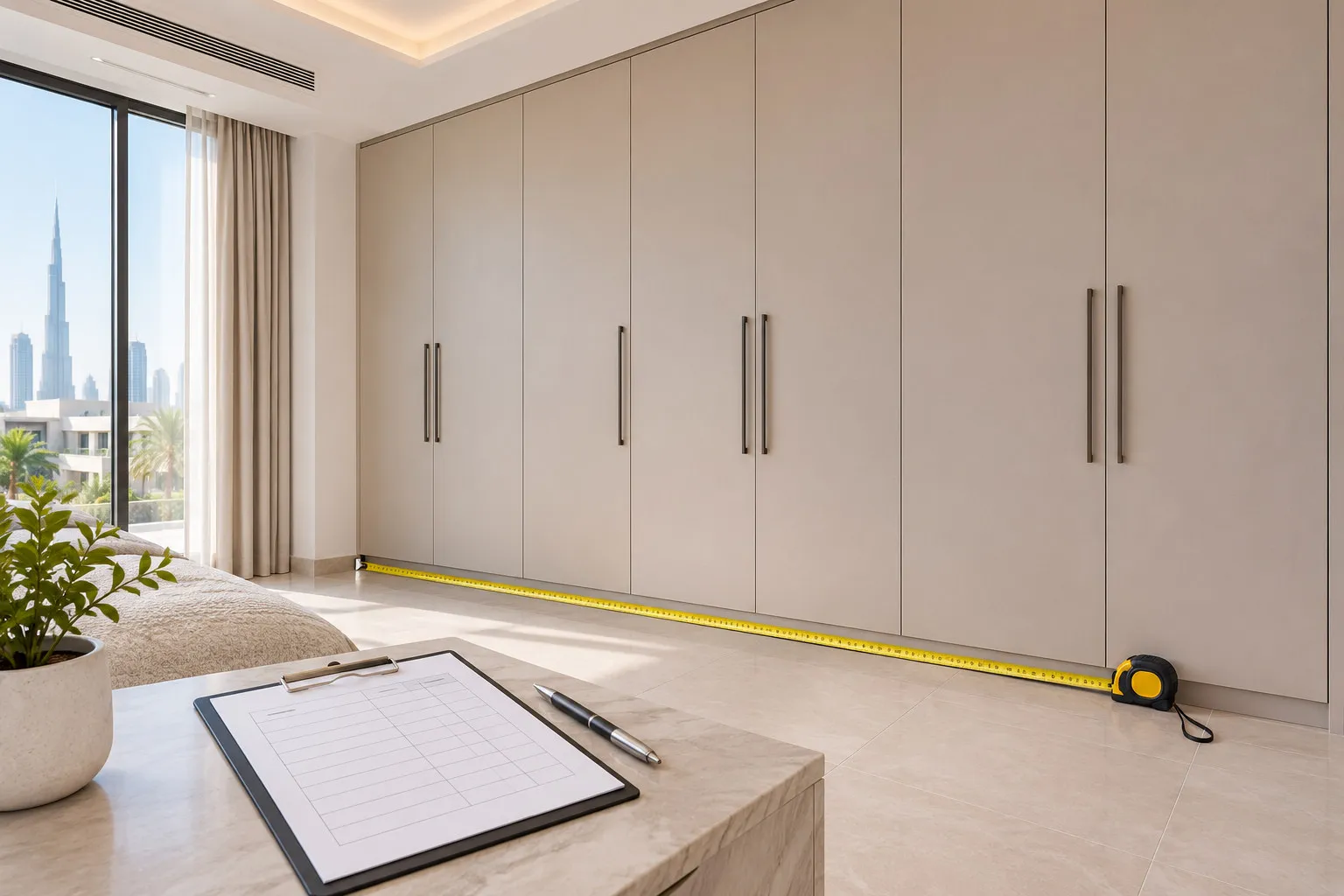
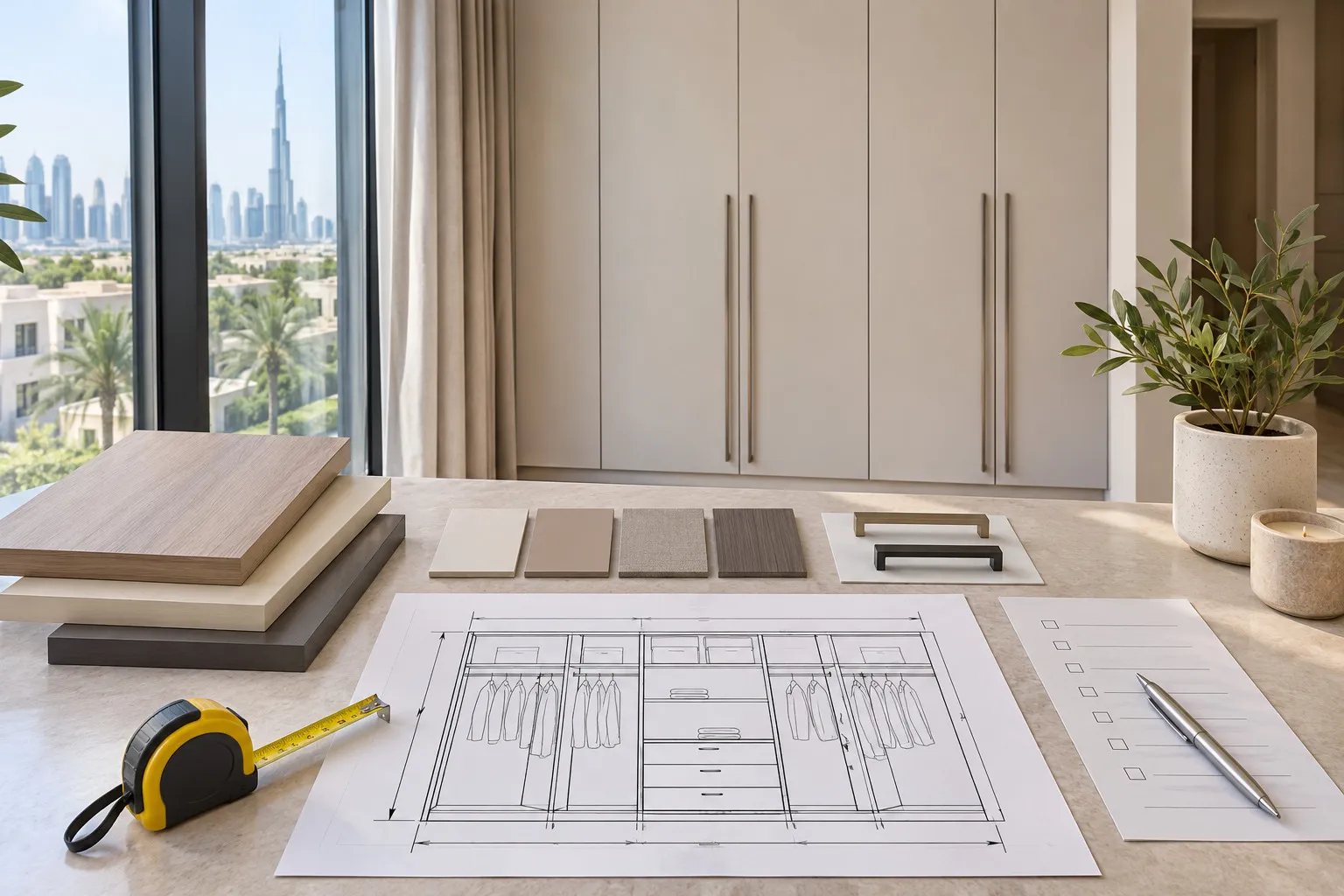
The sheet below is the whole method in one picture: ten lines, two quotes, filled in one line at a time. Three lines are the ones most often missing, so ask for them in writing before you decide anything else.
- 1. Ten numbered lines run down the side: use the same ten for every quote you collect
- 2. Each quote fills its own column, one line at a time; a cell you cannot fill from the paper is a question for the supplier
- 3. Board, door system with its sliding rating, and hinges per door: ask for these three in writing
- 4. A dashed empty cell means that quote is not ready to compare yet, whatever its total says
Why two wardrobe quotes are rarely the same job
Wardrobe prices are counted in different ways, and the unit changes what the number means. Before you compare a single figure, find out which of the four ways each supplier used, and ask for the measured width and height they worked from. If one quote counts the face of the wardrobe and another counts something else, the numbers cannot sit side by side. If one quote is for a made-to-measure wardrobe and another for a shop-bought unit, custom or ready-made wardrobe shows where each wins in the UAE.
Our own method is per square metre of front, worked out after measuring: the run's width times its height. A run 3.4 m wide and 2.6 m high gives 3.4 × 2.6 = 8.84 sqm. A per-metre price on that run counts only the 3.4 m, so a floor-to-ceiling wardrobe and a waist-high unit would carry the same per-metre number. The wardrobe dimensions guide explains which heights are normal and how the top of a run is planned. The guide to wardrobe hanging heights covers where each rail sits for shirts, dresses and long garments.
Four ways a wardrobe price can be counted
Per sqm of front
- What it counts
- Run width times run height, measured on the closed face
- Example on a 3.4 m wide, 2.6 m high run
- 3.4 × 2.6 = 8.84 sqm
- What to ask
- What height was used, and does it reach the ceiling or stop below it?
Per metre of run
- What it counts
- Width only, whatever the height
- Example on a 3.4 m wide, 2.6 m high run
- 3.4 metres
- What to ask
- What height does the price assume, and what is inside that height?
Per door or per leaf
- What it counts
- The doors, often without the body or the inside
- Example on a 3.4 m wide, 2.6 m high run
- A number of doors
- What to ask
- Does the figure include the carcass, the fittings inside and the fitting?
A lump sum
- What it counts
- One figure for the wall
- Example on a 3.4 m wide, 2.6 m high run
- One figure
- What to ask
- Which lines are listed inside it? A total you cannot take apart cannot be compared.
Whichever way a supplier counts, ask for the width, the height and the area they used.
The ten lines to ask for in writing
A wardrobe has three layers: the body (the carcass), the doors or fronts, and the inside. A quote can cover all three or only some of them, so a low figure for "doors" next to a higher one for "wardrobe" is two different scopes, not a saving. Should you be torn between a run built to the walls and a freestanding piece, the comparison of built-in versus freestanding wardrobes shows which parts each one covers.
The ten lines below cover all three layers plus the work around them. They are the lines that most often make two quotes of the same price into two different wardrobes. What a wardrobe warranty should say in writing, and how to read a lifetime claim, is explained in our wardrobe warranty guide.
The ten quotation lines and what to ask for on each
1
- Line
- Measured size and area
- What to ask for in writing
- Width and height of each run, and how the area was worked out
- Why it matters
- It sets the price, and an error here carries through every other line
2
- Line
- Board
- What to ask for in writing
- Type (MDF, particleboard, plywood), grade (standard or humid-conditions) and thickness
- Why it matters
- It is the body of the wardrobe and what every fitting is screwed into
3
- Line
- Door system
- What to ask for in writing
- Hinged, sliding or other; for sliding, the named system and its rated door weight and size
- Why it matters
- The rating belongs to a specific kit, not to sliding doors in general
4
- Line
- Hinges and runners
- What to ask for in writing
- Brand, number of hinges per door, soft-close or not, and the runner type for drawers
- Why it matters
- Door weight and size set how many hinges a door needs
5
- Line
- Finish
- What to ask for in writing
- Laminate, veneer, lacquer, glass or mirror, and the frame colour, with a reference
- Why it matters
- Each has a different weight, care routine and cost
6
- Line
- Inside
- What to ask for in writing
- Rails, shelves, drawers, pull-outs, shoe racks and jewellery drawers, each counted
- Why it matters
- Interiors are where two quotes of the same price differ most
7
- Line
- Lighting
- What to ask for in writing
- What lighting is included, what powers it and who connects it
- Why it matters
- Lighting is part of the wardrobe job and needs a feed
8
- Line
- Fitting and removal
- What to ask for in writing
- Fitting, clean-up and whether an old wardrobe is taken out
- Why it matters
- These are often left out or added later as extras
9
- Line
- VAT and timeline
- What to ask for in writing
- Whether VAT is included, when the work is ready, and which day the count starts from
- Why it matters
- A quote without them is a guess
10
- Line
- Warranty
- What to ask for in writing
- Period, what it covers and who covers the products supplied
- Why it matters
- Workmanship and supplied products are different things
Copy these ten lines into a note and fill in one column per quote. Where a cell is empty, ask the supplier to complete it before you decide.
Lines 3 and 4: reading the door system and the hinges per door
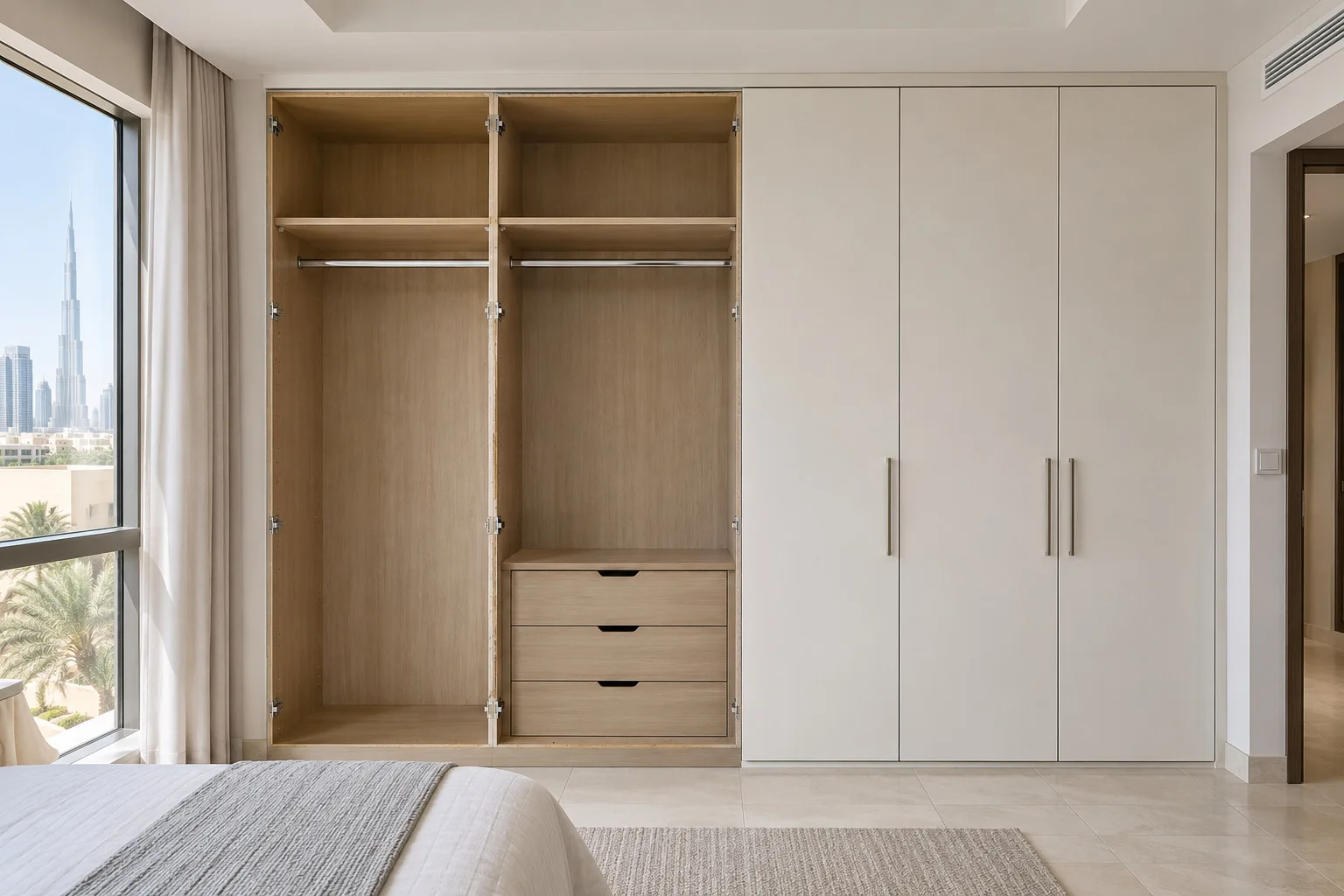
How many hinges a door carries is not decided by taste. The hinge maker Blum publishes guidance for its CLIP top hinges: on doors no wider than 600 mm it calls 2 hinges optimal for door weights of 4 to 6 kg and 3 hinges for 6 to 12 kg, with the handle's weight counted in. Heavier doors need more hinges, and Blum's regional catalogue charts relate the count to the height of the door as well, with the height limits drawn on a chart rather than given as exact figures. Its web page also asks for one more hinge on doors as wide as 650 mm, and notes that a tall, narrow door can be steadier with an extra hinge even when its weight alone would not require it (see how tall a wardrobe door can be).
That guidance is for Blum hinges and Blum's regional catalogues differ in detail. Other makers publish their own tables. What it means for a quote: a line that says only "soft-close hinges" does not tell you how many each door carries. Ask for the brand and the number per door, and ask how the weight of a glass or mirror door was allowed for, because those doors are heavier than a plain panel of the same size. Doors that already rub or sag on a wardrobe you own are covered in fixing a wardrobe door that sticks or sags.
Blum's published hinge counts for doors up to 600 mm wide
4 to 6 kg
- Hinges
- 2
- Where it comes from
- Blum web page, "Number of hinges"
6 to 12 kg
- Hinges
- 3
- Where it comes from
- Blum web page, "Number of hinges"
Heavier than 12 kg
- Hinges
- More
- Where it comes from
- Read off the maker's own chart for that hinge; door height also counts
Figures are for Blum CLIP top hinges only. Per Blum's web page, a door as wide as 650 mm gets one more hinge. Another maker's hinge, or a sliding door, follows its own table.
Line 3 again: what a door is made of, and how the face changes the weight
A door is more than its face. Ask what it is made of and how thick it is, because a heavier door asks more of the hinges, the track and the body it hangs from. A quote that prices a light door and shows a heavy door in the photograph is not describing the same wardrobe. Glass and mirror fronts in particular carry more weight than laminate, so the hardware behind them deserves its own line; see our mirror wardrobe doors guide for what to ask about a mirror.
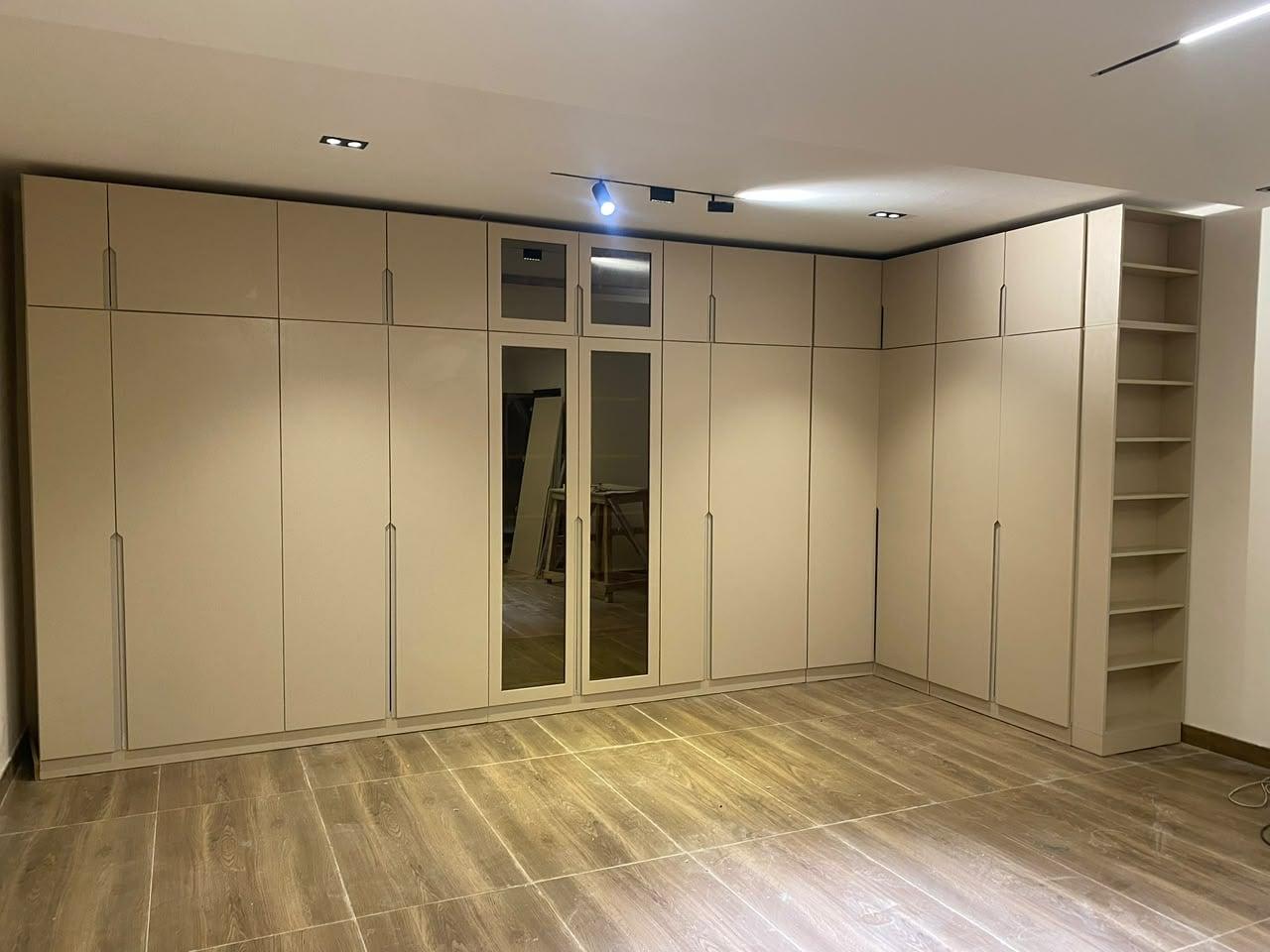
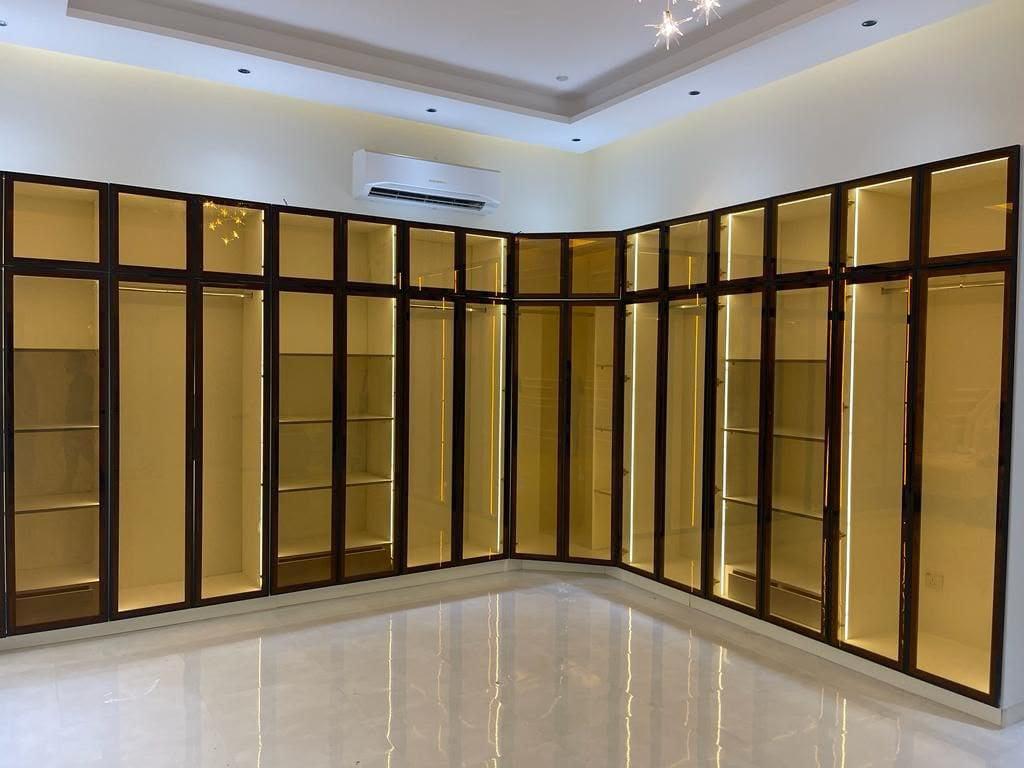
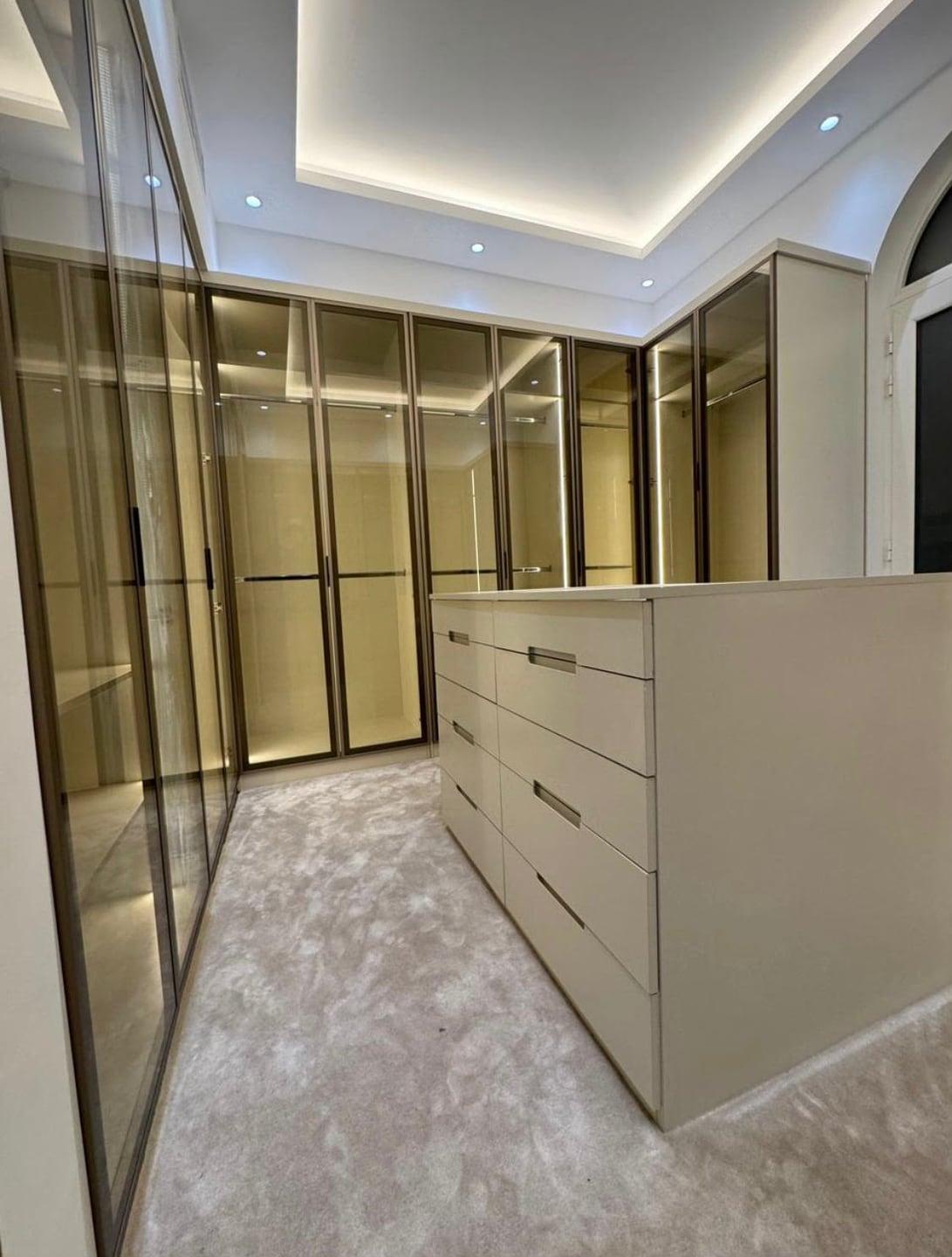
The photograph below shows a corner run of tall glass fronts in dark frames, with lit shelving behind them. Those three parts are separate lines on paper, which is why a glass-front wardrobe and a plain laminate one cannot be compared by their totals alone. Our page on lit glass-front wardrobes shows more work of this kind, and our corner and L-shaped wardrobe design guide explains how such a run is priced.
If you are choosing between handles and handleless fronts, remember that in Blum's guidance the weight of the handle counts towards the door weight, so ask the supplier to say what weight was assumed. The guide to handleless wardrobes sets the two styles side by side, and our wardrobe handles guide covers types, height and finishes for the handle line. Before you settle on hinged leaves, see how far a wardrobe door opens into the room.
Line 2: reading the board line
Particleboard is classified in the European standard EN 312 by where it may be used: a P2 board is intended for interior fitments, including furniture, in dry conditions, and a P3 board is a non-load-bearing board for humid conditions (the wardrobe board types guide sets particleboard beside MDF, plywood and HDF). Medium-density fibreboard has its own classes under EN 622-5, and MDF.H is the class for humid conditions. Manufacturers such as EGGER list melamine-faced boards with a P3 core for furniture in humid conditions, and its product page gives no numeric humidity limit. Our guide to moisture-resistant wardrobe boards goes through these board classes.
What this means for a quote: the type of board and its grade should be written down. "MR board" on its own is a label, not a specification, and a brand name tells you who made the board but not which grade or thickness you are getting. Compare thickness for thickness and grade for grade.
A humid-conditions grade is made for air that carries more moisture. It is no repair for a leak or a damp wall. If a wall is damp, the cause must be traced and dealt with before anything is built against it. Tell every supplier which walls the wardrobe will stand against, because a wardrobe on an outside wall, or on a wall adjoining a bathroom, is a different case from one on a dry interior wall; what to check before placing a wardrobe against a bathroom wall goes through it. For the board types themselves, read wardrobe materials and hardware, and the choosing materials tool helps when you are weighing finishes. The finishes themselves are compared in wardrobe door finishes compared, and a wardrobe that already smells musty is covered in why a wardrobe smells musty. For a wardrobe that runs the full height of the wall, see how to plan a floor-to-ceiling wardrobe.
Board names you may meet on a wardrobe quotation
P2 particleboard (EN 312)
- What the standard or the maker says
- Board for interior fitments, including furniture, in dry conditions
- What to ask
- Is the carcass P2 or P3, and how thick?
P3 particleboard (EN 312)
- What the standard or the maker says
- Non-load-bearing board for humid conditions
- What to ask
- Which panels use it, and against which walls?
MDF.H (EN 622-5)
- What the standard or the maker says
- The MDF class for humid conditions
- What to ask
- Which panels use it, and how thick are they?
"MR board" and nothing else
- What the standard or the maker says
- A trade label, not a class in the standard
- What to ask
- Which class, which brand and what thickness?
A brand name and nothing else
- What the standard or the maker says
- Names the maker, not the grade or the thickness
- What to ask
- Which grade and which thickness of that brand?
EN 312 and EN 622-5 describe the board, not the whole wardrobe. A humid-conditions grade does not cure a leak.
Line 3 for sliding doors: reading the rating and the depth
If one quote offers sliding doors, the system and its rating matter. Sliding-door makers publish limits for each system, and the limits belong to the system and the kit. As an example, Hettich's sliding-door catalogue lists its TopLine L system at 50 kg per door, with a height up to 2,600 mm and widths from 550 to 1,500 mm for two doors, and its TopLine XL K2 system in sets for 60, 80 and 100 kg depending on the door thickness the set is made for. The catalogue also shows that the largest figure belongs to a specific set, not to every kit of that system. Our wardrobe sliding door systems guide goes through the system types.
For a quote, that means three things. The system should be named, not described as "heavy-duty sliding". The rated door weight and door size should be shown for the kit that is actually supplied, and the door you are paying for should sit inside them. And a statement such as "up to 100 kg" is a maximum for one set, so ask which set and which door.
Sliding doors also need depth. FCI London, a fitted-furniture retailer in the UK, suggests as a planning figure 66 cm for the box and around 5 cm more for the track, 71 cm in total, against 60 cm for hinged doors. Whichever system you pick comes with a specification of its own, and that document overrules any rule of thumb. Our hinged versus sliding guide compares the two choices in detail, and our page on sliding-door wardrobes shows what we make. For hinge counts by door weight, soft-close and adjustment, see wardrobe door hinges. Depth decides how much room the doors and track take, and our guide on how deep a wardrobe should be covers hanging, shelf and sliding-door depths.
Lines 5 to 8: finish, inside fittings, lighting, fitting and removal
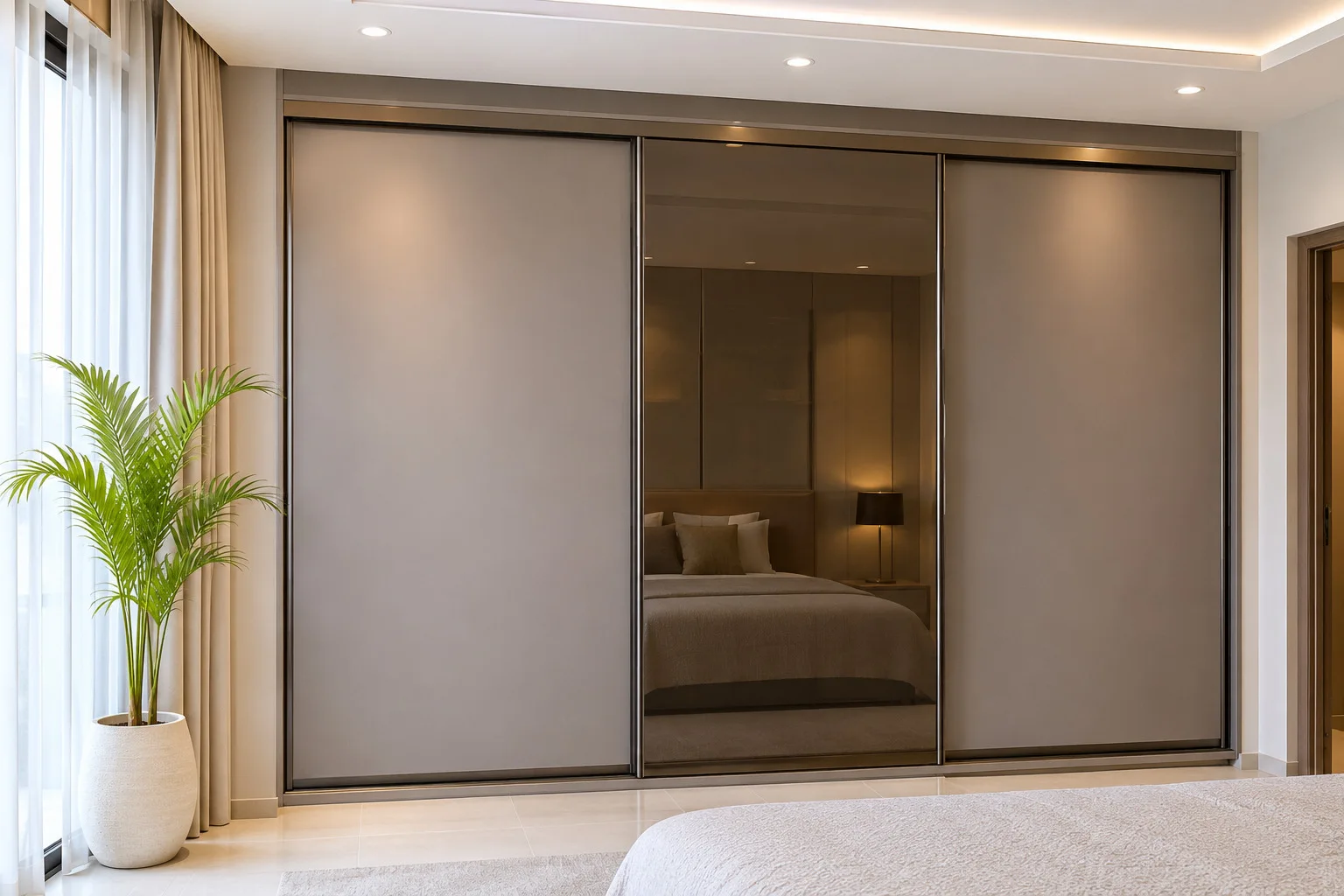
Finish: laminate, veneer, lacquer, glass and mirror each have a different weight, care routine and price, so the quote should say which one and give a reference you have seen as a sample, and a matt and a gloss sample can look quite different in your own room's light, which matt versus gloss wardrobe doors looks at. Ask for the frame colour too if the doors are glass.
Inside: this is where two quotes of the same price can differ most. List what is in each one: how many hanging rails, how many shelves, how many drawers, whether the drawers have soft-close runners, and whether there are pull-out racks, shoe racks, jewellery drawers or tie organisers. Count them. A price that looks lower may simply contain fewer. For the shoe racks, shoe wardrobe design covers pairs per shelf, depth, tilted shelves and ventilation.
For long garments such as abayas, kanduras and evening dresses, do not take a catalogue figure on trust. Put your longest garment on its hanger, measure from the hook to the bottom edge of the hem, add some clearance, and pass that figure to the supplier so the rail is set to it. Bob Vila's closet guide, for instance, suggests one rod at 66 inches (roughly 1.68 m) above the floor, or two rods at about 208 and 103 cm; treat those as suggestions and test them against your own clothes. The wardrobe layout guide sets out how the inside is divided up, and abaya and kandura storage shows the rail-height arithmetic. For the drawer lines, see wardrobe drawers and organisers; for a loft, luggage and seasonal storage; for a one-room flat, a studio apartment wardrobe.
Lighting: if lighting is part of the wardrobe, the quote should say what is included, what powers it and who connects it to the home supply. With us lighting belongs to the wardrobe job: our own team installs the lighting inside a wardrobe we build. When a socket or feed point would be hidden by the new run, say so at the visit so it is settled before the drawing is approved; we do not take lighting or socket work as a job by itself. For ways of planning the light itself, see wardrobe lighting ideas.
Fitting and removal: ask whether fitting is included in the figure, whether an old wardrobe is taken out, and whether clearing up afterwards is included. With us, taking out the old wardrobe is an optional extra, and the quotation prices it separately. If the body of the wardrobe is sound and only the doors are the problem, the wardrobe door replacement guide covers that case on its own. Whether the whole wardrobe is worth keeping is decided in our old wardrobe renovate-or-replace guide, symptom by symptom. If you want light inside, LED strip versus profile for wardrobe lighting explains the difference before you ask for a quotation.
Lines 9 and 10: VAT, timeline and warranty
VAT: ask whether the figure includes it or adds it. A quote that does not say is incomplete, and two quotes treated differently are not comparable. We make no claim here about how any supplier treats VAT; the sensible approach is to have the wording written on every quotation.
Timeline: a date alone is not enough. Ask when the wardrobe will be ready and fitted, and which day the count starts from: the order, the approved drawing or the measuring visit. Once the order is confirmed, a wardrobe with us normally takes up to about 10 days to finish and install, and its size is what moves that figure.
Warranty: ask for the period, what it covers and who covers the products that were supplied. Workmanship and products are different things, and a warranty that only says "guaranteed" says too little. Our workmanship sits under a written warranty of 24 months, while supplied hardware is covered by whatever written terms its maker gives. Separately, the wood-based boards carry a 5-year limited warranty, subject to terms; hinges, tracks, runners, rollers and other moving hardware are not covered, and the final terms are in the written warranty. Full terms sit in the warranty and aftercare guide. For fitted, modular and freestanding options from a tenant's side, see wardrobes in a rented apartment in the UAE.
Worked example: turning two thin quotes into ten lines
The two quotations below are illustrations written for this guide, not real quotations, and they carry no prices on purpose. The point is how many of the ten lines a quote answers. Quote A is the kind of short wording that arrives by message; Quote B is the kind that lets you compare.
The first thing you will notice is that Quote A may well come with the lower total, and you still cannot tell whether it is cheaper, because most of its lines are silent or vague. That is not a criticism of any supplier. It is the reason to send each of them the same ten questions and wait for the same ten answers. Couples dividing one run can use our shared couple wardrobe guide to settle the split on paper first.
Two illustrative quotes read against the ten lines
1 Size and area
- Quote A says
- 3.4 m run
- Quote B says
- 3.4 m × 2.6 m, 8.84 sqm of front
- What to ask Quote A
- What height, and what area?
2 Board
- Quote A says
- MR board
- Quote B says
- Particleboard, P3 grade, thickness stated
- What to ask Quote A
- Which class, brand and thickness?
3 Door system
- Quote A says
- Doors
- Quote B says
- Hinged, door thickness stated
- What to ask Quote A
- Hinged or sliding, and for sliding which system and rating?
4 Hinges and runners
- Quote A says
- Soft-close
- Quote B says
- Brand and hinges per door stated
- What to ask Quote A
- Which brand, how many per door?
5 Finish
- Quote A says
- White
- Quote B says
- Laminate, reference given
- What to ask Quote A
- Which material, and which reference?
6 Inside
- Quote A says
- Standard fittings
- Quote B says
- Rails, shelves and drawers counted
- What to ask Quote A
- How many of each?
7 Lighting
- Quote A says
- Not mentioned
- Quote B says
- Not included
- What to ask Quote A
- Is lighting wanted, and who connects it?
8 Fitting and removal
- Quote A says
- Installed
- Quote B says
- Installed; old wardrobe removal as its own line
- What to ask Quote A
- Is removal and clean-up included?
9 VAT and timeline
- Quote A says
- Not mentioned
- Quote B says
- VAT wording, ready date and start day stated
- What to ask Quote A
- Is VAT included, and when is it ready?
10 Warranty
- Quote A says
- Guaranteed
- Quote B says
- Period and cover stated
- What to ask Quote A
- How long, and what does it cover?
Illustrations only. Use the same ten lines on every real quotation you receive.
What an Al Tareeq Decor quotation looks like
This is what our site publishes about how we quote, and nothing more. We do not claim here which board, which hinge brand or which VAT treatment applies to your job; those are lines to ask any supplier, us included, and to see written on the quotation. If a sliding door ever jumps out of its guide, our page on a sliding wardrobe door that has come off its track lists the safe first checks and when to stop and call someone.
- Pricing is per square metre of front, after measurement. The entry specification, MDF laminate and hinged doors with installation included, starts from AED 550 per sqm.
- Before any figure, there is a free measuring visit: the team brings samples and measures the room by laser.
- A drawing and a line-by-line price reach you first, and production begins only once you have approved both.
- Anything above the entry specification, whether a sliding track, glass fronts, veneer, lacquer, lights or extra inside fittings, appears as a separate line, which lets you drop an extra without redrawing anything; if you choose sliding doors, top-hung or bottom-running sliding wardrobe doors explains what each track asks of your floor, ceiling and wardrobe.
- Up to about 10 days after the order is confirmed, depending on size and design; bigger runs take longer.
- Taking out the old wardrobe is an optional extra with its own price, and lighting inside the wardrobe is shown as its own line.
- The written warranty runs 24 months and applies to our workmanship, while supplied products carry their makers' written terms.
How to use the sheet, and what to send us
Use the sheet in three steps. First, ask every supplier for the same ten lines, in writing, on the same wall measurements. Second, fill one column per quote and mark every empty cell. Third, send the empty cells back as questions and wait for the answers before you compare totals. Pay particular attention to the board, the door system with its rating, and the hinges per door, which are the lines that are easiest to leave out and hardest to change after the wardrobe is made.
If you would like us to quote against another quotation, send it with the width and height of the wall and a photo, or book a free measuring visit. To see what happens when the room is measured, read our wardrobe measuring visit guide. We measure by laser, show samples, and hand you a drawing with a line-by-line price to approve before work starts. Our custom wardrobes service page has the starting figure and the process, and the pricing guide puts it beside our other services. For the wardrobes themselves, see our built-in wardrobes; and for those based in the northern emirates, our team builds in a Sharjah workshop and installs across the UAE, as our Sharjah page explains.
If the wardrobe is one part of a larger bedroom plan, the same ten-line habit works for a bedroom wardrobe and TV unit plan or a small bedroom wardrobe: count the area, name the board, name the door system, and ask for the rest in writing. For a main bedroom shared by two people, see master bedroom wardrobe design. If you are still deciding between a wall of doors and a room you step into, our reach-in versus walk-in wardrobe guide compares what each costs in floor space.
Before you ask for quotes, our wardrobe planning guide helps you fix the layout, doors and finish, so every supplier prices the same wardrobe.
Common questions
What should a wardrobe quotation include in the UAE?
It should list the measured size and area, the board type, grade and thickness, the door system, the hinges per door, the finish, the inside fittings, any lighting, fitting and removal, VAT and timeline, and the warranty. If a line is missing, ask for it in writing before you compare totals. Wardrobe price guide.
What does "front area" mean when a wardrobe is priced per square metre?
It is the area of the closed face of the wardrobe: the run's width times its height, in square metres. A 3.4 m by 2.6 m run measures 8.84 sqm, whatever the size of the bedroom floor. Wardrobe dimensions guide.
Does AED 550 per sqm include installation?
Yes, installation is inside the entry figure of from AED 550 per sqm of front, which covers MDF laminate and hinged doors. Anything above that, for example a sliding track, glass fronts, veneer, lacquer, lights or extra inside fittings, gets its own line; for a lacquer line, sprayed wardrobe doors lists the colour reference and touch-up questions to ask. Custom wardrobes service.
How many hinges should a wardrobe door have?
That follows the door: its weight including the handle, its width and its height. Blum's published guidance for its CLIP top hinges gives 2 hinges for 4 to 6 kg and 3 for 6 to 12 kg on doors no wider than 600 mm, with more for heavier, wider or taller ones. Ask the supplier for the brand and the number per door. Hinged versus sliding doors.
Should a wardrobe quote name the board?
Yes: type, grade and thickness. A humid-conditions board such as a P3 particleboard copes with higher air humidity, but it is no remedy for a leak or a damp wall. Wardrobe materials and hardware.
Is the lowest wardrobe quotation the best one?
Not necessarily, and not necessarily the worst. A smaller total saves nothing unless the board, doors, hardware, fittings and warranty behind it match, so fill in the ten lines for each quote first. We can fill them in against another quotation if you send it to us. Free measuring visit.
What warranty should a wardrobe quotation state?
It should state the period, what it covers and who covers the products that were supplied. Ours runs 24 months, in writing, on workmanship, and supplied hardware carries its maker's written terms. Warranty and aftercare guide.

Sources & specifications
Manufacturer information applies to the named products and systems. Sources reviewed on 3 November 2026.
- Blum: CLIP top BLUMOTION, number of hinges (2 hinges for 4-6 kg, 3 for 6-12 kg, handle included; extra hinge up to 650 mm)ea.blum.com(opens in a new tab)
- Blum regional catalogue, hinge-count chart (count depends on door weight and door height)shop-sg.blum.com(opens in a new tab)
- BSI: BS EN 312:2010 Particleboards. Specifications (P2 dry conditions, P3 humid conditions)knowledge.bsigroup.com(opens in a new tab)
- EGGER: decorative boards P3 for furniture in humid conditionsegger.com(opens in a new tab)
- Sonae Arauco: technical brochure (EN 622-5 MDF.H, MDF for humid conditions)sonaearauco.com(opens in a new tab)
- Hettich: Sliding and Folding Systems catalogue, June 2022 (TopLine L 50 kg per door; TopLine XL K2 sets 60, 80 and 100 kg)web.hettich.com(opens in a new tab)
- FCI London: How deep should built-in wardrobes be? (60 cm hinged; 66 cm plus 5 cm track for sliding)fcilondon.co.uk(opens in a new tab)
- Bob Vila: closet rod height (single rod 66 in; double rods 81.75 in and 40.5 in)bobvila.com(opens in a new tab)
Want this planned for your home?
Consultation and measurement are free. Tell us the rooms, location and what you need; we arrange a sample visit and define the measured quotation.