Wardrobes · 16 min read · 10 July 2026
Wardrobe door hinges: how many, soft-close and adjustment
A wardrobe door needs 2 hinges at 4 to 6 kg and 3 at 6 to 12 kg on Blum's table for its own hinges, more for heavier doors (ask for the maker's table), one more up to 650 mm wide, and height counting too. Sagging comes from too few hinges, a leaf that is too wide or a worn screw hole; ask for soft-close in the quotation.

By Ali Haider Basra, Founder, Al Tareeq Decor · Contact our workshop
Key takeaways
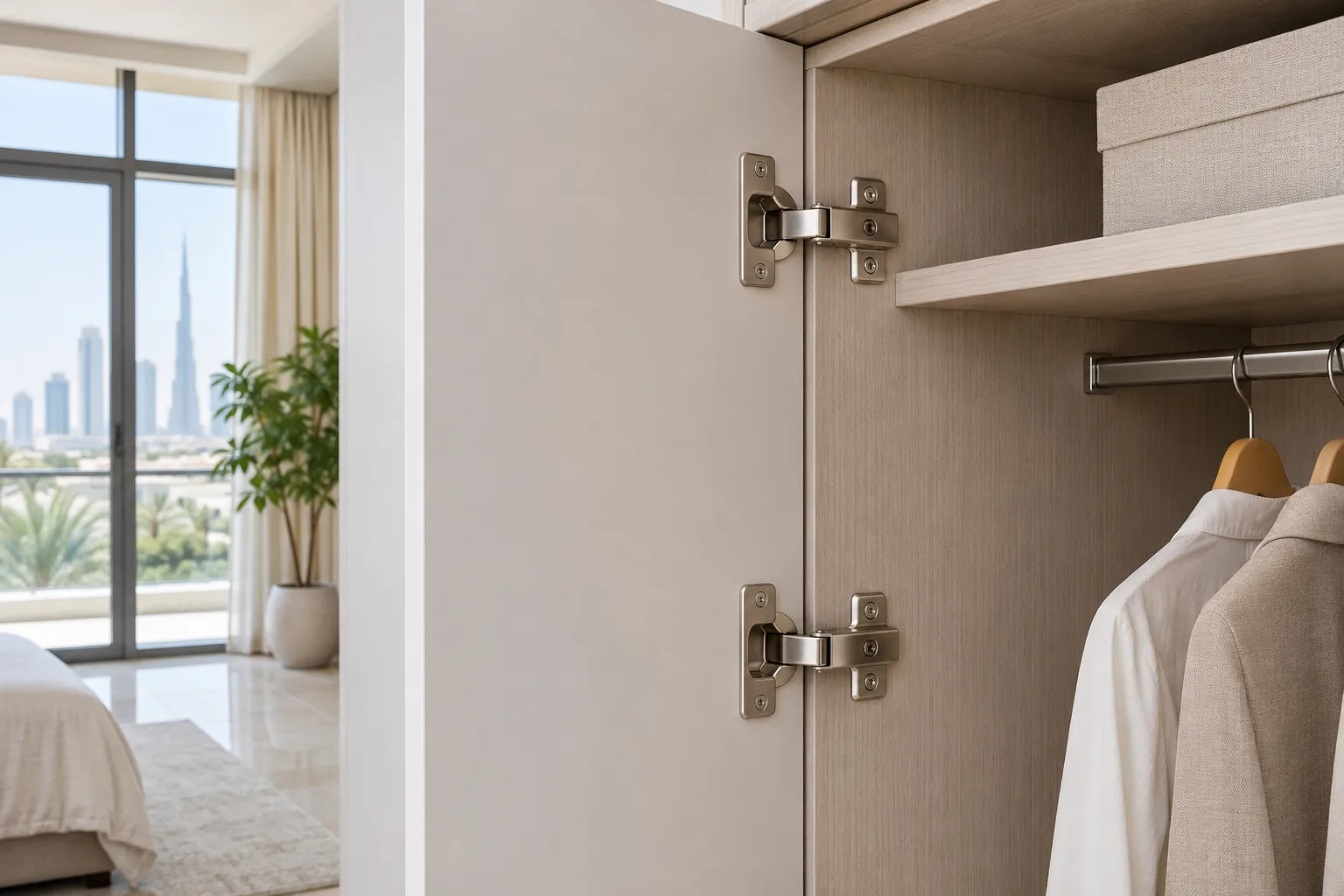
- The hinge count follows the weight of the door with its handle, its height and its width. For its own hinges Blum gives 2 hinges for 4 to 6 kg and 3 for 6 to 12 kg on doors up to 600 mm wide; for heavier doors, ask for the maker's table.
- Width matters as much as weight: Blum's table is written for doors up to 600 mm, and its EA page adds one hinge up to 650 mm. A wider leaf is better split in two.
- A sagging door usually has too few hinges, a leaf too wide for its hinges, stripped screw holes or a carcass out of square. Adjustment can correct settling; it cannot add a hinge.
- A 3D-adjustable hinge moves the door up and down, left and right and in and out after fitting. Ask for the range of the hinge you are quoted.
- Soft-close is not confirmed as standard, so ask for it in the quotation as its own line, with the hinges or dampers per door.
On this page
- Key takeaways
- How many hinges does a wardrobe door need?
- Weight, height and width: what each one does to the count
- Hinges per door by door weight, Blum's published guidance
- Why wardrobe doors sag, stick or will not close
- Wardrobe door problems and what to check
- What causes each problem, and where the hinge is not the cause
- What a 3D-adjustable hinge lets you change
- Soft-close hinges: what to ask for
- Hinges in different wardrobes: corners, kids, studios and dressing rooms
- What to ask on the quotation about hinges
- Hinge questions for a wardrobe quotation
- What we do about hinges
- Common questions
How many hinges does a wardrobe door need?
It depends on three things together: the weight of the door with its handle, the height of the door and its width. For its own hinges, and for doors up to 600 mm wide, Blum gives 2 hinges for a door of 4 to 6 kg and 3 hinges for 6 to 12 kg. We have not been able to confirm the counts for heavier doors on a Blum page we could open, so we do not quote them: for a door above 12 kg, ask the supplier for the maker's table. Blum says in the same breath that height also sets the count, and that a door up to 650 mm wide needs one more hinge. That is one maker's guidance for one hinge range, so it is a way to read a quotation, not a rule for every hardware brand.
If you only want the answer for your own wardrobe, ask the supplier two questions: what does each door weigh with its handle, and how many hinges per door has that weight been checked against? A tall door and a glass door are the cases where the answer is rarely two; our guide to tall wardrobe doors and when to split them goes through why. The drawing below shows Blum's table as one door gaining hinges band by band. The full line-by-line list of what else to ask sits in our wardrobe quotation checklist.
This page covers the hinge. Whether to replace the doors at all is in wardrobe door replacement, which also holds Blum's weight table in the form a replacement quotation needs, and the choice between hinged and sliding doors is in the hinged versus sliding guide.
- 1. The door: one leaf up to 600 mm wide, the width the maker's table is written for
- 2. 4 to 6 kg: Blum gives 2 hinges, at the top and the bottom of the door
- 3. 6 to 12 kg: 3 hinges, the new one in the middle
- 4. The conditions: the weight includes the handle, height counts too, and Blum adds one more hinge for doors up to 650 mm wide
- 5. Ask for the door's weight with its handle, and for the hinges per door that weight was checked against; above 12 kg, ask for the maker's table
Weight, height and width: what each one does to the count
Blum's EA page opens with weight: as a rule, it says, the door weight is key in deciding how many hinges are needed, and the weight should include handles and other additions. The catalogue pages say the same in a table form, that the number of hinges depends on the front weight and the front height. A heavier door pulls harder on the top hinge and pushes harder on the bottom one; a taller door lengthens the lever between them. Neither of those is a matter of opinion, which is why a maker publishes a chart rather than a rule of thumb.
Height comes in through the same chart. The weights run along one axis and the door height along the other, and we do not quote height limits here because the catalogue draws them only as a graph. What the EA page does say in words is practical: a high, narrow door may be best given three hinges for extra stability even at 6 kg, where two would be enough on weight alone, and a door should in principle be taller than it is wide. Our wardrobe dimensions guide lists the door and wardrobe sizes that follow from this.
Width is the limit people overlook. Blum's table is written for doors up to 600 mm wide, and its EA page adds one hinge for a door up to 650 mm; the catalogue pages still describe the data as relating to a 600 mm front width, so the region and the catalogue edition matter. FCI London, a UK maker of fitted wardrobes, gives the same idea as planning advice: each door should not be wider than 60 cm, or the hinges will be overloaded. A very wide hinged door is better split into two leaves, a point we use again in the wardrobe layout guide.
Spacing is the last of the four. Blum says the further apart the hinges are placed, the more securely the door hangs on the cabinet, and its catalogue repeats it: distances between hinges should be as large as possible. So a third hinge is not squeezed in beside the first two; it sits between them, as the middle mark of the drawing does. Doors that stick or leave the rail are covered in fixing a sliding wardrobe door off its track, including what not to do.
Hinges per door by door weight, Blum's published guidance
4 to 6 kg
- Hinges
- 2 hinges
- Condition from the maker
- Doors up to 600 mm wide; height also counts
6 to 12 kg
- Hinges
- 3 hinges
- Condition from the maker
- Doors up to 600 mm wide; three can also suit a high, narrow door at a lower weight
Above 12 kg
- Hinges
- Ask the supplier
- Condition from the maker
- Heavier doors need more hinges; we could not confirm Blum's counts on a page we opened, so ask for the maker's table
Door 600 to 650 mm wide
- Hinges
- One more hinge
- Condition from the maker
- From Blum's EA page; its catalogue data still states a 600 mm front width
Any door
- Hinges
- Space them far apart
- Condition from the maker
- Blum: the further apart, the more securely the door hangs
Source: Blum (EA page and catalogue), its own hinge range only. Another maker's table governs that maker's hinges, and Blum's can differ by region.
Why wardrobe doors sag, stick or will not close
A door that droops at its free corner, catches its neighbour or springs open is telling you that the hanging has changed, and there are only a handful of reasons. We list them from the easiest to check to the hardest to fix, and the first three are things you can see from the room. When two people use one wall, our guide to a shared wardrobe for a couple explains how to split hanging length fairly. Our guide on what to do when a wardrobe door is sticking, rubbing or sagging has the first checks you can make yourself.
Wardrobe door problems and what to check
Door droops at the handle side
- Likely cause
- Too few hinges for its weight and height, or the leaf is wider than the maker's table allows
- What to do
- Check the hinge count against the maker's table; a heavier finish or a glass panel may call for another hinge
Gap at the top is wider than at the bottom, or the reverse
- Likely cause
- The door has dropped and the height setting has moved, or the hinges are close together
- What to do
- Re-set the height adjustment first; if it will not hold, the count or the spacing is the question
Door rubs its neighbour or the frame
- Likely cause
- The side or depth adjustment has drifted, or the carcass is out of square
- What to do
- Re-adjust within the hinge's range; if the gap keeps changing, ask for the carcass to be checked
Hinge screws pull out of the panel
- Likely cause
- Holes worn or stripped by repeated loosening, or by a door that was always too heavy for its hinges
- What to do
- Have the holes repaired or the panel replaced; a hinge cannot hold in a hole with no grip
Door will not stay shut
- Likely cause
- A hinge has lost its spring or is out of adjustment, or the door is bowed
- What to do
- Replace the hinge and re-check the adjustment; a bowed door may need replacing
Door swells and sticks in damp weather
- Likely cause
- The board has taken up moisture
- What to do
- Read the board grade and the damp position first; new hinges will not fix it
The first three rows follow from Blum's weight, height and width table; the hinge-hole and board rows follow our own door-replacement checks. Always confirm on site.
What causes each problem, and where the hinge is not the cause
The count is the cause most often left unchecked. A door gets heavier in small ways: a thicker finish, a mirror or glass panel in place of a board, a long handle, a rack screwed to the inside of the leaf. Each addition moves the door from one of Blum's weight bands into the next, and the hinges that suited the first door no longer suit the second. Mirror wardrobe doors and the heavier fronts in the wardrobe door finishes comparison are the usual cases. The wardrobe handles guide covers handle types, height and finishes if you are choosing a handle for the door.
The hole in the panel is the second. A concealed hinge has a cup set into the door and a mounting plate screwed to the side of the cabinet; if either has been taken out and put back a few times, or if a door of the wrong weight has been hanging off it for years, the board around the screw loses its grip. We look at hinge-cup holes panel by panel when we survey a wardrobe, and our door replacement guide explains how that is stated on the quotation.
The carcass and the wall are the third. If the wardrobe is not level or the side has bowed, no hinge adjustment will make the gaps even for long. That is why the wardrobe measuring visit checks level and squareness before a door is drawn. A door that swells in damp air points to the board, not the hinge, so read moisture-resistant wardrobe boards before you blame the hardware.
Humid rooms are worth a note of their own. If the wardrobe also smells of damp, read why a wardrobe smells musty; the wallpaper in humid climates guide is about another finish, but the same damp lifts a wallpaper seam. If the wardrobe stands against a bathroom wall, what to check first on a wardrobe against a bathroom or outside wall is worth reading before you blame the hardware. Taking the wardrobe to the ceiling brings its own checks, listed in floor-to-ceiling wardrobes in the UAE.
What a 3D-adjustable hinge lets you change
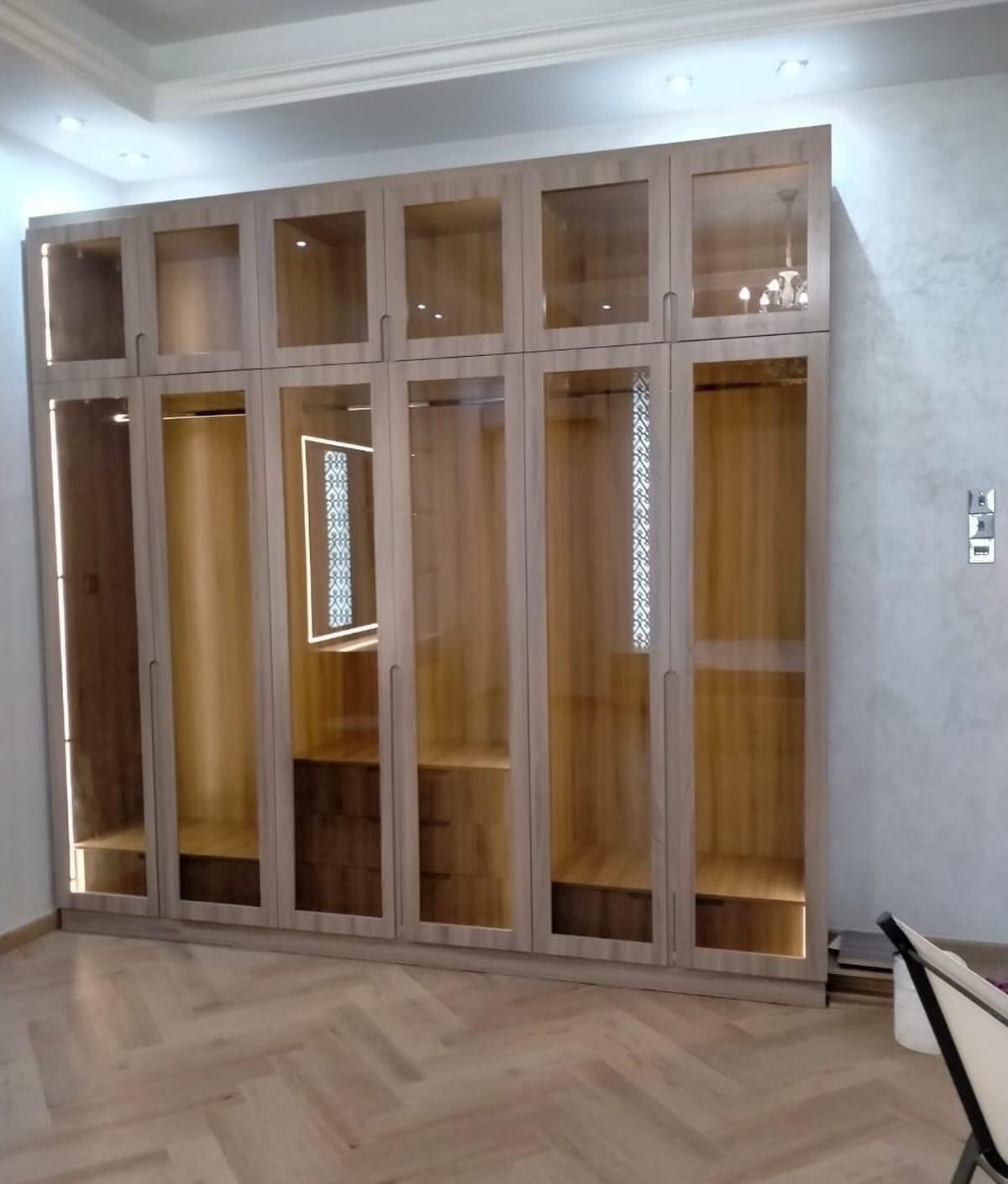
Blum names the feature "3-dimensional front adjustment" in its catalogue, with a "spiral-tech" screw for depth, and its CLIP top BLUMOTION page describes easy three-dimensional and cam adjustments. In plain terms the door can be moved in three directions after it is hung: up and down, to the left and right, and in and out against the frame. That is what lets a fitter even the gaps between doors on a wall that is not perfectly flat, and what lets you correct a door that has settled.
Adjustment is measured in millimetres on the maker's data sheet, so ask for the range of the hinge you are quoted rather than assuming a number. We have not confirmed which axis each screw controls on every hinge, so we do not describe the screws on the site; the maker's instruction sheet for the exact hinge shows it.
What adjustment cannot do is just as useful to know. It cannot add a missing hinge, widen a hole that has lost its grip, make a door narrower than it is, or square a carcass that is out of true. If the door sags again a week after you adjust it, go back to the table above: the count, the width and the holes are the next checks. The inside of the wardrobe matters too, because a door that carries a rack or a mirror weighs more; the drawers and organisers guide and our notes on abaya and kandura storage describe fittings that load the door. For the depth figures behind this, see our wardrobe depth guide.
Soft-close hinges: what to ask for
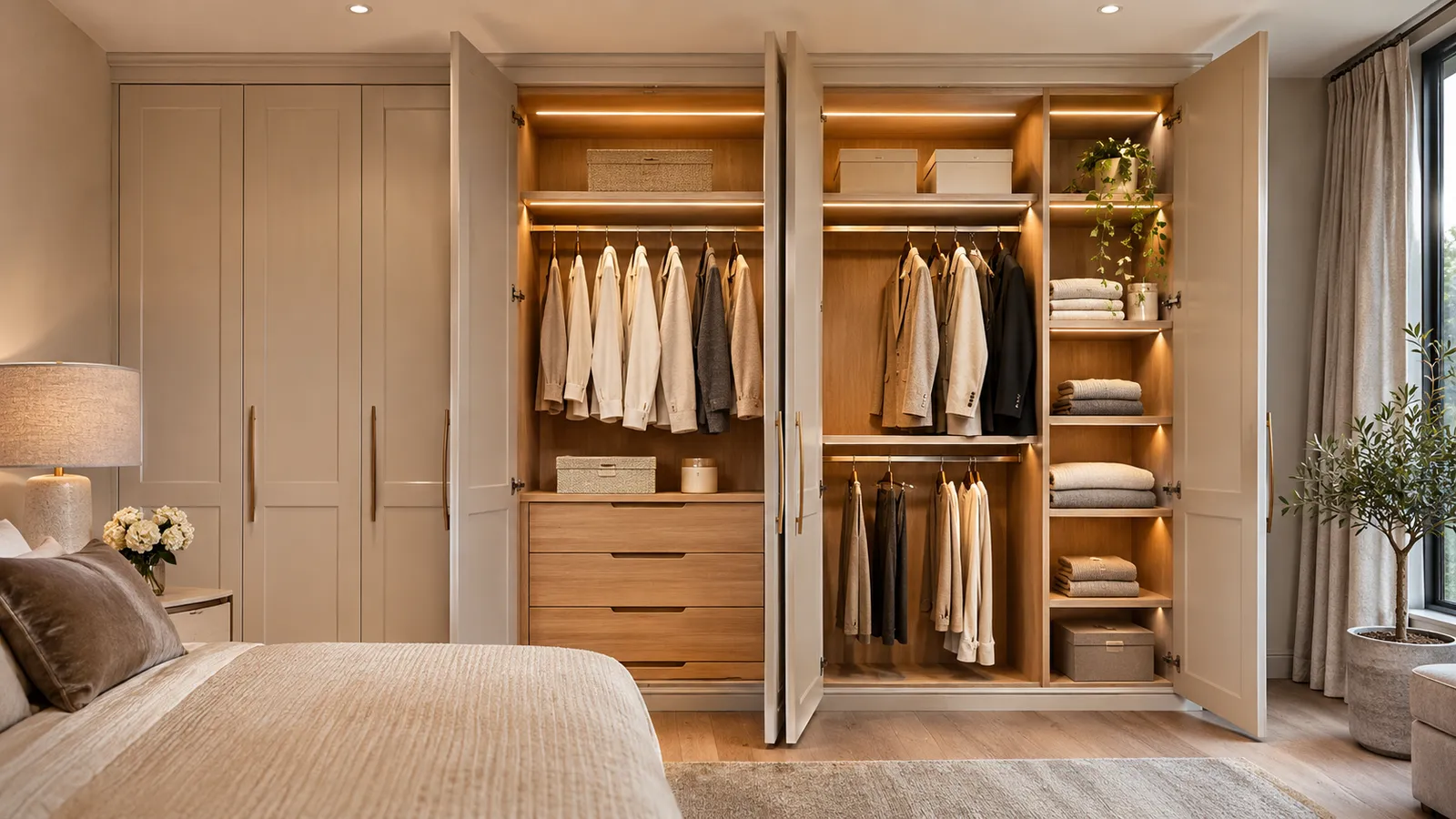
A soft-close hinge slows the last stretch of the door's swing so it settles instead of slamming. Blum builds the damper into the hinge cup in its CLIP top BLUMOTION range and says it can be switched off on one or both hinges, which is useful for a door you want to close with a click. Blum's catalogue also describes an add-on damper for plain hinges: normally one per front is sufficient, and a second may be needed for high front weights or unstable fronts.
We do not state that soft-close is part of our standard specification, because we have not published that it is. If you want it, ask for it in the quotation: it should be a separate line, with the number of hinges or dampers per door written next to it, so you can compare two quotations on the same footing. The upgrade is a simple one for an existing wardrobe, as the door replacement guide says, and compatibility is confirmed at the visit.
A soft-close hinge does not make a door lighter and does not change the count. The weight table still decides how many hinges the door gets; soft-close is something you add to those, not instead of them. The same applies to doors you open by a push, as in handleless wardrobes against handles, where a door that is out of line is more obvious because there is no handle to hide it. Tenants have their own questions, covered in our guide to a wardrobe for a rented apartment, including what to ask the landlord in writing.
Hinges in different wardrobes: corners, kids, studios and dressing rooms
A corner wardrobe turns the run through ninety degrees, and the doors on each side of the turn have to open past each other without hitting; that is a layout question first, covered in corner and L-shaped wardrobe design, and the hinge count follows once the leaves are drawn. A studio apartment wardrobe often chooses sliding doors because the bed is close, and then the question changes from hinges to track rating, as the sliding door systems guide explains.
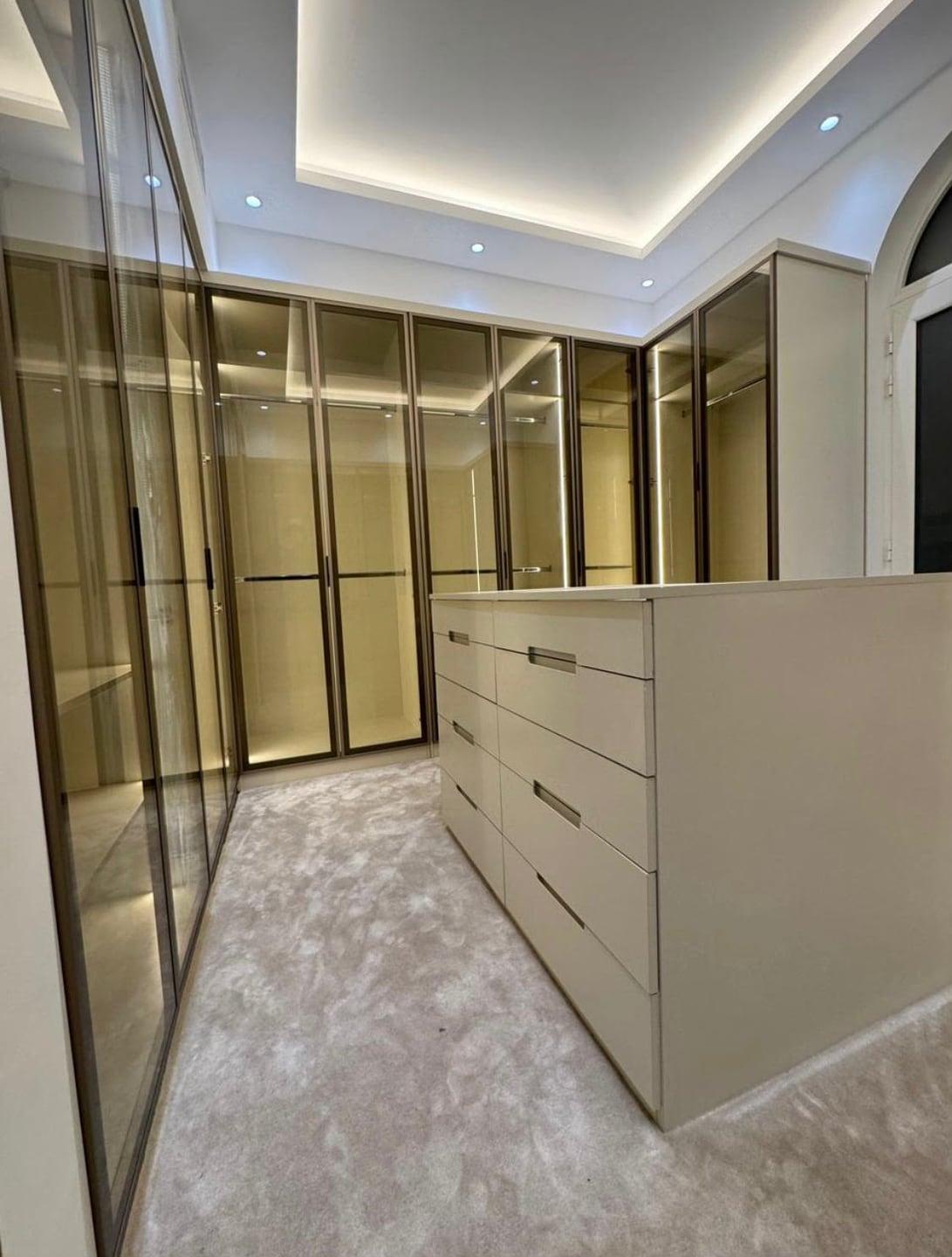
A wardrobe for children is opened roughly and often. The kids wardrobe design guide covers how the doors and the inside change as they grow; ask whether a damper is offered, since doors there are closed in a hurry. In a dressing room the doors can be tall and glazed, which is the case where the weight band matters most.
Tall doors also change what hangs behind them: the wardrobe hanging heights guide shows where the rails go, and the master bedroom wardrobe design page shows how a full run of doors comes together.
In a bedroom with little floor, the small bedroom wardrobe ideas page explains why the swing of the door is part of the plan, not an afterthought, and the bedroom wardrobe with TV unit page shows how a wardrobe and a screen share one wall.
Hinges carry other cabinetry in a home too. The principle is the same for a kitchen cabinet door or a door in architectural joinery, doors and partitions: count the hinges from the door's weight and size, not from habit. The same goes for a shoe cabinet or a bedside unit; for the hall, the shoe wardrobe design guide covers pairs per shelf, depth and ventilation. Whether your room can afford a walk-in wardrobe instead of a reach-in run is worth settling before the layout is fixed.
What to ask on the quotation about hinges
Hinges are a small part of the price and a large part of how a wardrobe feels to use, so give them a line of their own. Ask each supplier the questions below and keep the replies in writing; a quotation that says only "hinged doors" has not told you what you are buying. The general checklist belongs with it in the wardrobe quotation checklist, and the pricing guide shows how a quotation is built. Warm or neutral light, strip or profile: our wardrobe LED lighting comparison goes through the choices.
Hinge questions for a wardrobe quotation
Hinge brand and range
- Why it matters
- Each maker has its own count table and its own adjustment
- A clear answer looks like
- A named brand and range, or "not specified" in writing
Door weight, handle included
- Why it matters
- The count follows the weight band
- A clear answer looks like
- A weight in kilograms for each door size
Hinges per door
- Why it matters
- Too few is the main cause of sagging
- A clear answer looks like
- A number for each door, higher for tall or glazed doors
Door width
- Why it matters
- Makers write their tables for a maximum width
- A clear answer looks like
- No leaf wider than the maker's width, or a split into two leaves
Soft-close
- Why it matters
- A damper is an extra, not a given
- A clear answer looks like
- A separate line, with hinges or dampers per door
Adjustment
- Why it matters
- Lets the doors be re-aligned after fitting
- A clear answer looks like
- The hinges are adjustable in three directions, with the range
Aftercare
- Why it matters
- Hinges settle in the first months
- A clear answer looks like
- A written warranty and who to call to re-adjust
Our entry price of AED 550 per sqm is for MDF laminate with hinged doors, installed. Hinge brand and soft-close are not part of the published price: ask for them in the quotation.
What we do about hinges
The hinges on a wardrobe come from the same visit and drawing as everything else. The measuring visit is free, and we bring laminate, veneer and glass samples to the room. We measure with a laser, then send you a drawing and an itemised price that you approve before anything is made. The door sizes are on that drawing, and the hinge count is a line you can ask us to state. If you are still deciding between the two routes, custom or ready-made wardrobe compares where each wins in the UAE.
What we publish and what we do not. Our entry price is from AED 550 per sqm of wardrobe front, installed, for MDF laminate with hinged doors; other options raise it and the figure for your wall is set after measurement. After you confirm, our Sharjah workshop builds the wardrobe and our own team installs it up to about 10 days later, depending on size and design, with a 24-month written workmanship warranty (supplied products follow their own terms). Separately, the wood-based boards carry a 5-year limited warranty, subject to terms; hinges, tracks, runners, rollers and other moving hardware are not covered, and the final terms are in the written warranty. We have not published the hinge brand or whether soft-close is standard, so ask for both in the quotation and we will put them in writing.
Start with the free wardrobe measuring visit guide to see what to prepare, then book through the consultation form.
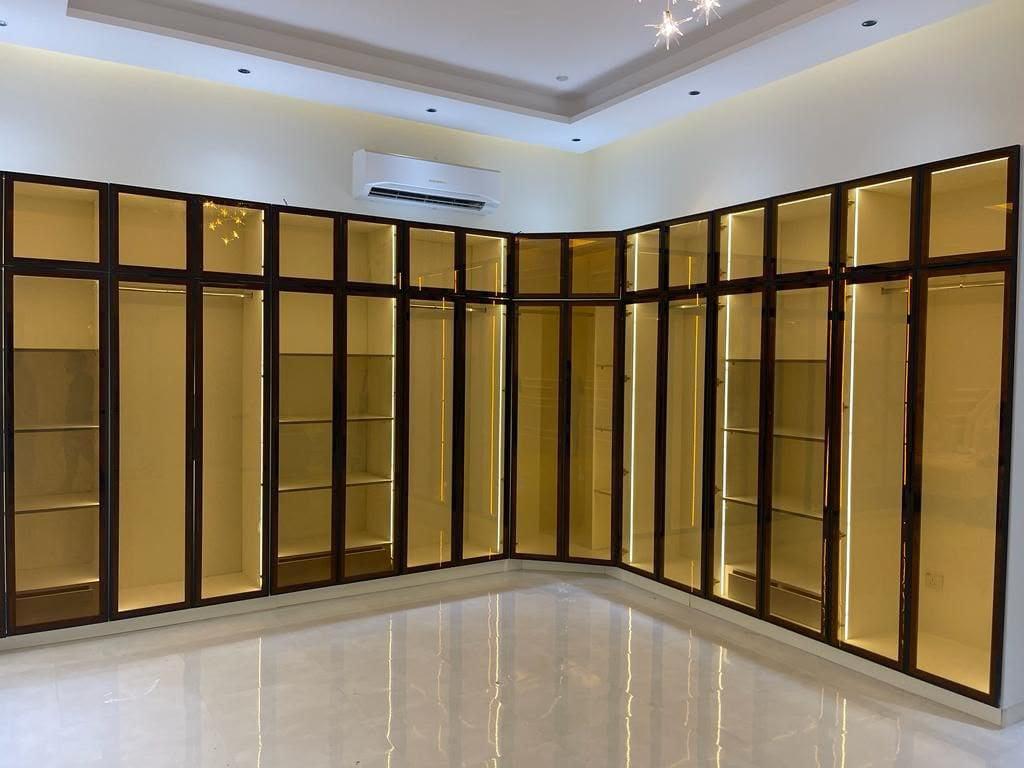
Our custom wardrobes service page lists what we make, and the built-in wardrobes page shows finished runs. If the doors will be glass, see lit glass-front wardrobes; if you would rather avoid hinges, the sliding door wardrobes page covers the other kind of door.
For how a measured wall becomes a number, read the wardrobe price guide and the wardrobe materials and hardware guide. Care afterwards is in our warranty and aftercare guide, and for a wardrobe lit inside, interior lighting ideas shows the options.
Installation covers the whole UAE. The Sharjah page gives the workshop address, and the Dubai page covers visits there. Tall top cabinets have small doors that need hinges too; the luggage and seasonal storage guide shows them.
If you are weighing a repair against new doors, our wardrobe door replacement guide walks through it, and renovate or replace a wardrobe helps you decide whether the whole wardrobe is worth keeping.
A fitted, built-in or freestanding wardrobe comparison explains where each type carries its weight, and you can browse every custom wardrobe we make. Check that the doors have room to open too: our guide on how much room a wardrobe door needs covers the swing against beds, desks and corners. Our page on wardrobe warranty in the UAE separates the board warranty from the workmanship warranty and explains the usual exclusions.
Hinges are one choice inside step three; the complete list of our wardrobe guides covers the steps before and after.
Common questions
How many hinges does a wardrobe door need?
It follows the door's weight with its handle, its height and its width. For its own hinges on doors up to 600 mm wide Blum gives 2 hinges for 4 to 6 kg and 3 for 6 to 12 kg; for heavier doors, ask for the maker's table. See our wardrobe door replacement guide.
Why is my wardrobe door sagging?
The usual causes are too few hinges for the door's weight and height, a leaf wider than the maker's table allows, screw holes that have lost their grip, or a carcass that is out of square. Re-setting the adjustment can correct settling, but not a missing hinge. See our wardrobe measuring visit guide.
Can I adjust a wardrobe door hinge myself?
Many concealed hinges are made to be adjusted after fitting: Blum describes its CLIP top range as three-dimensional, so a door can be moved up and down, side to side and in and out. Use the maker's instruction sheet for your hinge, and if the door will not hold its setting, the count is the next check. See our wardrobe quotation checklist.
Are soft-close hinges worth asking for?
They slow the end of the door's swing so it does not slam, and in Blum's CLIP top BLUMOTION range the damper is built into the hinge cup and can be switched off, and where there is little room to swing, see a wardrobe for a narrow room or corridor. We do not state that soft-close is standard, so ask for it as a separate line in the quotation. See our custom wardrobes service.
How wide can a hinged wardrobe door be?
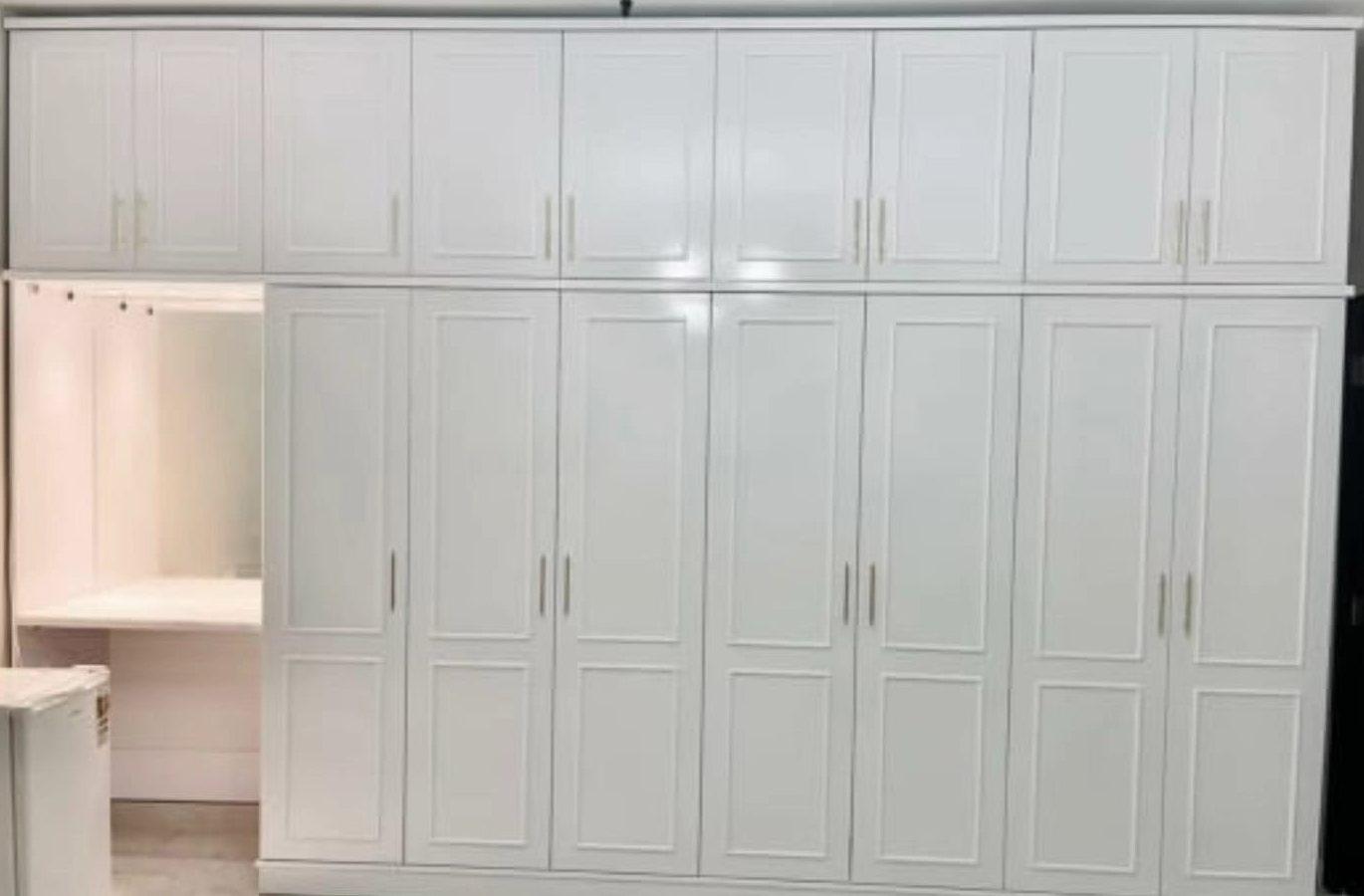
Blum's table is written for doors up to 600 mm wide and its EA page adds one hinge up to 650 mm, while FCI London advises that each door should not be wider than 60 cm. A wider opening is better split into two leaves. See our hinged versus sliding wardrobe doors guide.
Does a glass or mirror door need more hinges?
It is heavier than a board door of the same size, so it can sit in a higher weight band and need more hinges. Ask for the door's weight with its handle and the hinges per door that weight was checked against. See our mirror wardrobe doors guide.
What should a quotation say about hinges?
It should name the hinge brand and range or say none is specified, give the door weight, state the hinges per door, say whether soft-close is included as its own line, and give the warranty. Our entry price of AED 550 per sqm covers MDF laminate with hinged doors, installed. See our pricing guide.

Sources & specifications
Manufacturer information applies to the named products and systems. Sources reviewed on 3 November 2026.
- Blum, CLIP top BLUMOTION: number of hinges (2 hinges for 4 to 6 kg, 3 for 6 to 12 kg, handles counted, values for doors up to 600 mm wide, one more hinge up to 650 mm; height also affects the count; hinges placed further apart hold the door more securely)ea.blum.com(opens in a new tab)
- Blum catalogue (Vietnam), page 17: the number of hinges depends on door weight and front height; front widths max 600 mm; the weight chart's values could not be read, so only the stated rules are usedpublications.blum.com(opens in a new tab)
- Blum catalogue and technical manual 2022, page 73: the number of hinges depends on front weight and front height; load and height data relate to front widths of 600 mmpublications.blum.com(opens in a new tab)
- Blum catalogue and technical manual 2022, page 132: CLIP top BLUMOTION with 3-dimensional front adjustment and spiral-tech depth adjustmentpublications.blum.com(opens in a new tab)
- Blum catalogue and technical manual 2022, page 167: normally one BLUMOTION per front is sufficient; a second may be needed for high front weights or unstable frontspublications.blum.com(opens in a new tab)
- Blum US, CLIP top BLUMOTION: soft-close built into the hinge cup, can be deactivated on one or both hinges; three-dimensional and cam adjustmentsblum.com(opens in a new tab)
- FCI London, How deep should built-in wardrobes be? (11 May 2026, updated 17 August 2026): each door should not be wider than 60 cm, or the hinges will be overloadedfcilondon.co.uk(opens in a new tab)
Want this planned for your home?
Consultation and measurement are free. Tell us the rooms, location and what you need; we arrange a sample visit and define the measured quotation.