Wardrobes · 17 min read · 25 July 2026
A wardrobe against a bathroom or outside wall: what to check first
Before a wardrobe goes against a bathroom or outside wall, check the wall for stains, blisters, salt marks and what is behind it. The wall decides the construction: any gap, ventilation and board depend on the site, and a gap alone does not cure a leak or damp.

By Ali Haider Basra, Founder, Al Tareeq Decor · Contact our workshop
Key takeaways
- Look at the wall before the wardrobe: stains, blistered or flaking paint, white salt marks, a bathroom behind it, and any AC unit or drain line on or above it.
- The wall decides the construction. Whether a gap, concealed openings, a grille or other measures are needed, and which board suits, depends on the actual site; there is no single gap for every wardrobe.
- A gap alone does not cure a leak or damp that is already in the wall. If the wall is wet, it is repaired first by the right trade; we do not offer to cure damp.
- A humid-grade board is chosen for the wall in front of it and is not a repair. Ask for the board type in the quotation.
- Bring photographs, the bathroom's position and any repair history to the free measuring visit; a dressing area between bedroom and bathroom is covered in the villa master suite wardrobe guide. Our entry price is from AED 550 per sqm, installed, for MDF laminate with hinged doors.
On this page
- Key takeaways
- A wardrobe on a bathroom or outside wall: the short answer
- What to check on the wall before anything is built
- What to look for on the wall behind a future wardrobe
- A bathroom on the other side of the wall
- Outside walls and air-conditioning
- Why the wall condition decides the construction
- From what the wall shows to what we decide
- The gap: what it can do and what it cannot
- Ventilation provisions are options, not a recipe
- Choosing the board for that wall
- If there is a leak or damp now: repair first
- What to bring to the measuring visit
- What to tell us about the wall at the visit
- What we do about a wardrobe on a bathroom or outside wall
- Common questions
A wardrobe on a bathroom or outside wall: the short answer
Before a wardrobe is built against a bathroom wall or an outside wall, look at the wall itself: stains, paint that has blistered or flaked, white salt marks, what is on the other side, and anything that drips or blows cold air onto it. What you find decides how the wardrobe is built, so the wall comes first and the wardrobe second.
How much room to leave behind the wardrobe, whether it needs concealed openings or a grille, and which board suits are decisions we make for the actual site. There is no one gap that suits every wardrobe, and a gap on its own does not cure a leak or damp that is already in the wall. If the wall is wet now, it is repaired first, by the right trade, before anything is fitted against it. We do not offer to cure damp.
This page is the checklist for that first look and the reasoning behind it. If a wardrobe already smells musty, start with why a wardrobe smells musty; for what board labels mean, see moisture-resistant wardrobe boards. Our custom wardrobes service starts from your measured wall.
- 1. The wall: stains, blisters, salt marks and a wet room behind it are looked at first
- 2. The gap: set by the site; a gap alone does not cure damp
- 3. Ventilation: an air gap, hidden openings or grilles, chosen for the site
- 4. The board: chosen to suit that wall, never one grade for every wardrobe
What to check on the wall before anything is built
Stand in front of the wall with a torch, once in daylight and once at night, and look low as well as high. Photograph anything odd with a coin or a ruler beside it, so the size is clear. You are not diagnosing anything; you are collecting what the person who inspects the wall, and the person who builds against it, will ask for.
England's guidance on damp for housing providers lists visible damp or staining and peeling wallpaper among the things to check, and names low points on walls behind sofas and wardrobes as typical places where condensation damp settles. Paint manufacturers add one more sign: a white, crusty deposit on masonry. Dulux's technical advice for painters explains it as salts that moisture carries to the surface and leaves behind when the water evaporates, and says the growing crystals can push a paint film until it cracks, flakes or peels. So a blister or a white crust is a sign that moisture has been moving through the wall, not only a paint fault. Our guide to wallpaper problems and fixes lists the same signs on a papered wall.
None of these marks says how much water, from where, or whether it is still happening. The table lists what to look for and the next step. It is our own planning list, not a damp survey.
What to look for on the wall behind a future wardrobe
A stain or a tide mark, brown or yellow
- What it may point to
- Water has reached the wall at some point
- Next step
- Note the position and whether it grows; find the source
Paint blisters, flaking or peeling
- What it may point to
- Moisture behind the paint film, or salts pushing it off
- Next step
- Do not repaint over it; find the source first
White crust or powder on the surface
- What it may point to
- Salts brought to the surface by moving moisture
- Next step
- Note it; the moisture still needs a source and a fix
A cold or damp patch to the touch
- What it may point to
- Condensation on a cold surface, or water coming in
- Next step
- Check the other side of the wall and any pipes or AC lines nearby
A bathroom or kitchen on the other side
- What it may point to
- Steam and splashes reach the wall from behind
- Next step
- Check the extractor fan and the tiling on that side
An AC unit, pipe or drain line on or above the wall
- What it may point to
- A drip or a cold surface above the wardrobe
- Next step
- Look for marks below it; tell us where the line runs
Wallpaper that bubbles or lifts
- What it may point to
- Moisture behind the paper
- Next step
- Same as a blister: find the source before covering it
A musty smell in the room or an old wardrobe
- What it may point to
- Air that stays damp, or hidden moisture
- Next step
- Read the musty-smell guide and look behind the old unit
Our own planning list. It does not replace an inspection of the wall by the right trade.
A bathroom on the other side of the wall
A wardrobe against a bathroom wall has the shower, the basin and the toilet on the other side of the same wall. Steam and splashes reach that wall from behind, which is why the same wardrobe on a dry inner wall is a different job. The US EPA's moisture guide advises using exhaust fans in bathrooms and kitchens to move moisture to the outside, and England's guidance asks housing providers whether bathroom extractor fans are fully operational. A fan that is broken, blocked or never switched on is the first thing to check. For the bedroom wardrobe itself, master bedroom wardrobe design: a planning order sets out the order from the wall to the inside.
Walk to the bathroom and answer five questions before you speak to us: where is the shower in relation to the wardrobe wall, does the fan work and does it run long enough, is the wall tiled on the bathroom side up to a height, is there any pipe running inside that wall, and has anyone repaired a leak there before. A wardrobe in a dressing room that sits between a bedroom and an en-suite is the classic case, and our dressing room design guide shows how those rooms are planned. Whether a room has the floor for a walk-in at all is covered in reach-in vs walk-in wardrobe: how much floor you need.
If the room is rented, none of this is yours to open or repair. Tell the landlord or building management in writing what you can see, and keep the reply; a wardrobe for a rented flat explains why that written answer matters before anything is fixed to a wall. In a small rented room, wardrobe for a studio apartment: zoning one room covers where a full-height wardrobe can go.
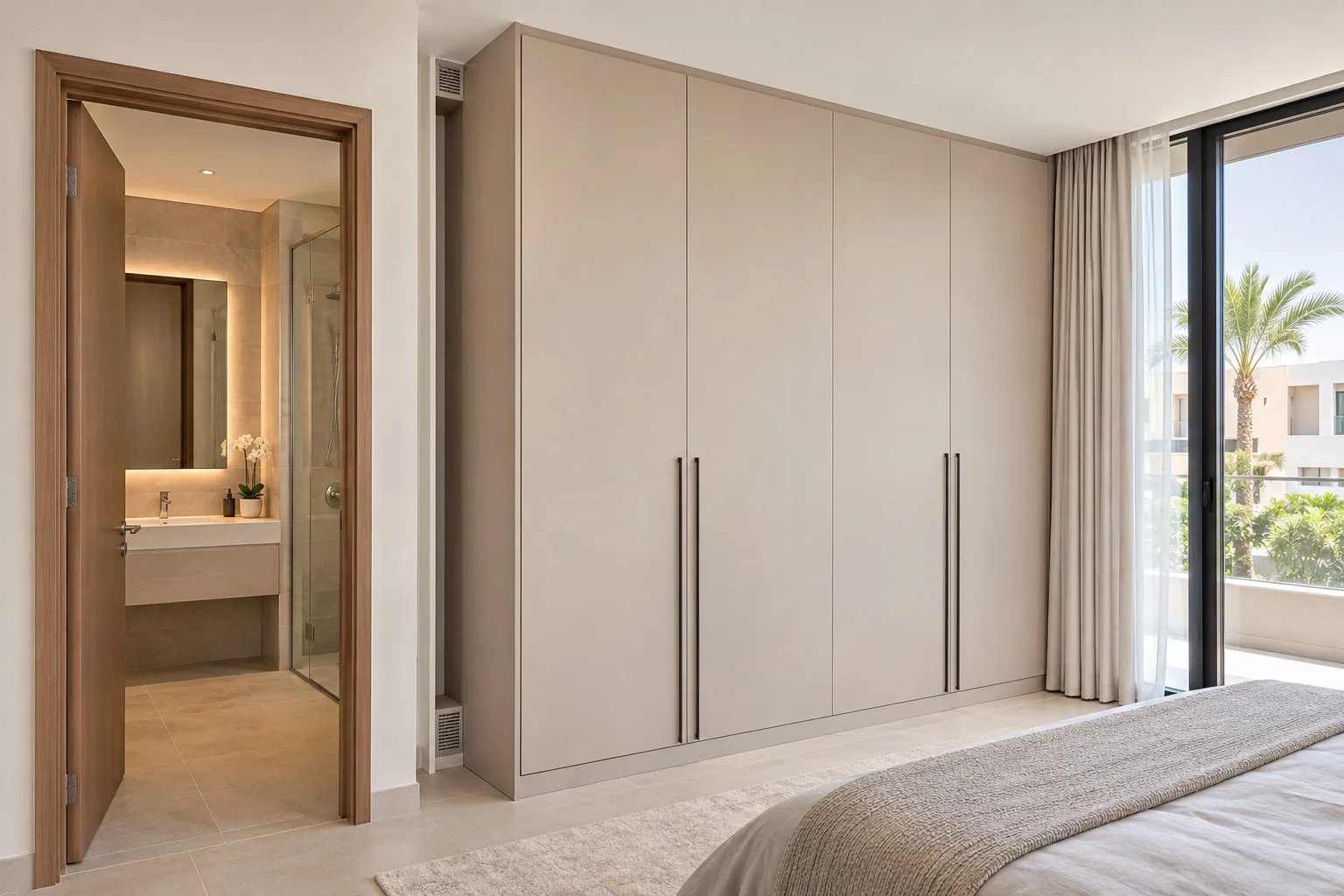
Outside walls and air-conditioning
An outside wall is a different case from a bathroom wall because the moisture can come from the room, from outside or from a drip. The mechanism is the same one everywhere: cooler air holds less moisture, so in the EPA's words moisture condenses on cold surfaces. In a UAE home the cool surface can be the inside face of an outside wall in an air-conditioned room. We give no climate figures, because we found no official UAE dataset to quote. Our guide to wallpaper in humid climates explains the same principle for a wall covering, and preparing walls names the wall beside an AC unit and under its drain pipe as a place where trouble starts.
So on an outside wall, look for three things: marks that run down from a window, a balcony door or a wall-mounted unit; any pipe or drain line on or above the wall; and whether the wall feels colder than the ones next to it on a cooled room. An AC drain that drips down the wall is a leak to repair, not a condensation problem to ventilate away. The EPA's page does not mention AC drain lines, so that point is ours, from what the wall shows you.
Outside walls also decide a practical thing: a wardrobe against one is usually a long run across a cold face, which is where floor-to-ceiling wardrobes and corner and L-shaped runs need the most care at the edges and at the corner.
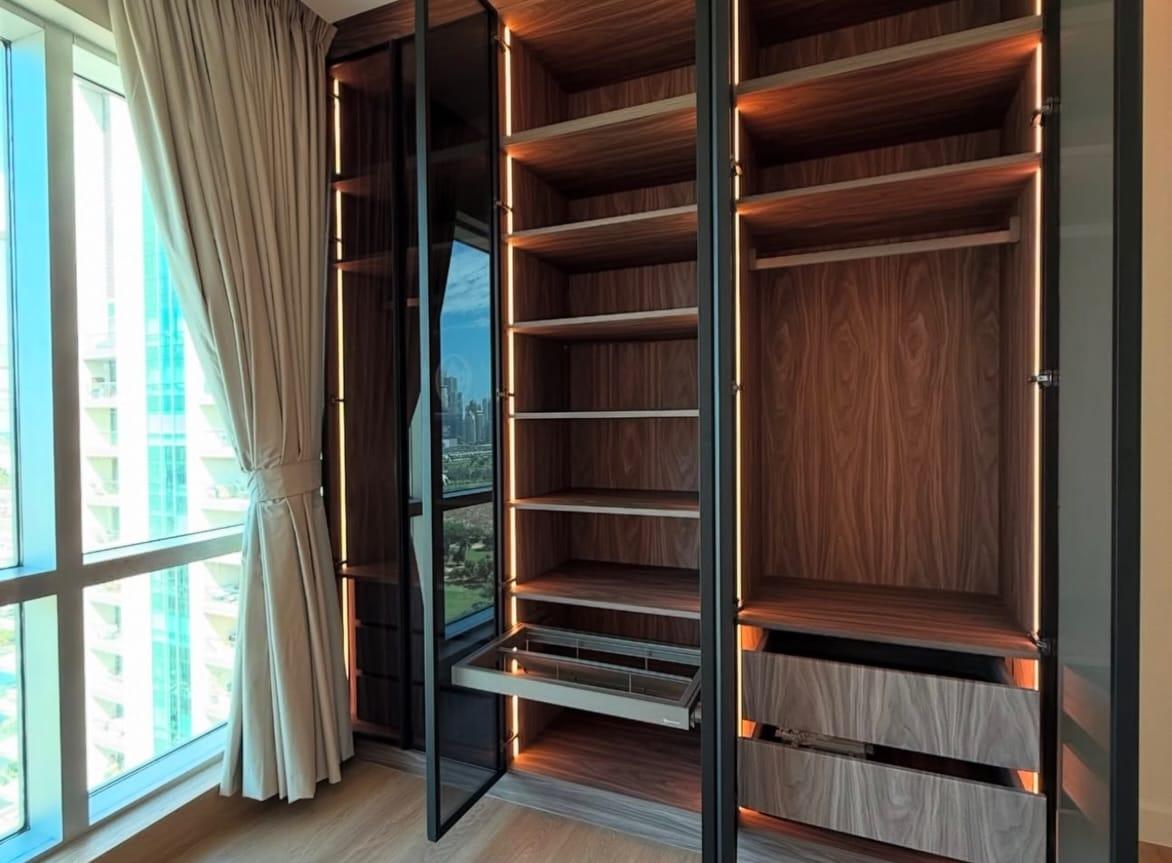
Why the wall condition decides the construction
A wardrobe is not one thing. The same width and height can be built tight to the wall or set off it, with a solid back or with openings in it, in one board or another, with the doors sealed or ventilated. Each of those choices is cheap on the drawing and expensive to change after the wardrobe is made, which is why the wall has to be read first. The inside is a separate set of choices, covered in wardrobe drawers and organisers.
Our approach is the same on every site, but the answers are not. We assess the wall, how exposed it is to moisture, the space available and what the installation needs. Then the provisions for that site may include an appropriate air gap, concealed ventilation openings, ventilation grilles or other practical design measures. We do not publish one gap, because the gap that suits a deep alcove on a dry inner wall is not the one that suits a long run on a cold outside wall, and we never say every wardrobe needs the same. If two people will share a long run, sharing one wardrobe as a couple shows how to split it.
The table shows how a finding changes the question. The right-hand column matters as much as the middle one: in two of the rows the first move is not ours.
From what the wall shows to what we decide
Dry inner wall, nothing odd
- What it changes in the build
- A normal build; board chosen for the room
- Who acts first
- We assess and draw
Bathroom on the other side, wall sound
- What it changes in the build
- More thought for the back, the base and the board grade
- Who acts first
- We assess; you fix a failed fan
Outside wall, no marks
- What it changes in the build
- Room behind the wardrobe and ventilation provisions are considered
- Who acts first
- We assess and propose
Stain or blisters, source known and fixed
- What it changes in the build
- Build only after the wall has dried and been made good
- Who acts first
- The trade that fixed it, then us
Stain, blisters or salts, source unknown
- What it changes in the build
- Nothing is built yet
- Who acts first
- An inspection by the right trade
An active leak or damp patch
- What it changes in the build
- No fitting against the wall; the visit and the order wait
- Who acts first
- The right trade, then a new look
Our own decision table. We do not diagnose walls and we do not offer to cure damp; the construction and the board are confirmed in the quotation.
The gap: what it can do and what it cannot
Leaving a gap between furniture and an outside wall is common advice. England's guidance for housing providers tells them to talk to tenants about leaving a gap between furniture and external walls, and the EPA says to open doors to closets that may be colder than the room, to keep air moving. Both are written for a loose wardrobe in a UK or US home, and neither gives a figure for the UAE. For a fitted wardrobe, the same idea is a design question: how much room, where, and how air reaches it.
What a gap can do is let air move behind or around the carcass so the back is not a sealed, cold pocket. What it cannot do is stop water. England's guidance says that removing surface mould alone will not prevent the damp from coming back, and the same is true of a gap: it gives wet air somewhere to go, but it does not close a leak or dry a wall. A gap beside a wall with a dripping pipe behind it is a gap beside a leak.
There is also a cost to a gap, which is why we weigh it. It takes depth out of the room and out of the wardrobe; a wardrobe that loses depth to a gap may no longer hold a standard hanger, and our wardrobe depth guide shows how much depth a rail needs. In a small room that trade-off can decide the whole layout; see small bedroom wardrobe ideas and the wardrobe dimensions guide. Hinged doors also need floor in front of them, which wardrobe door clearance: how much space doors need to open sets out.
If your wardrobe is freestanding, a gap is easier: you can move it. If it is fitted, the gap is in the drawing, so the fitted, built-in and freestanding wardrobes guide is worth reading before you decide which you want.
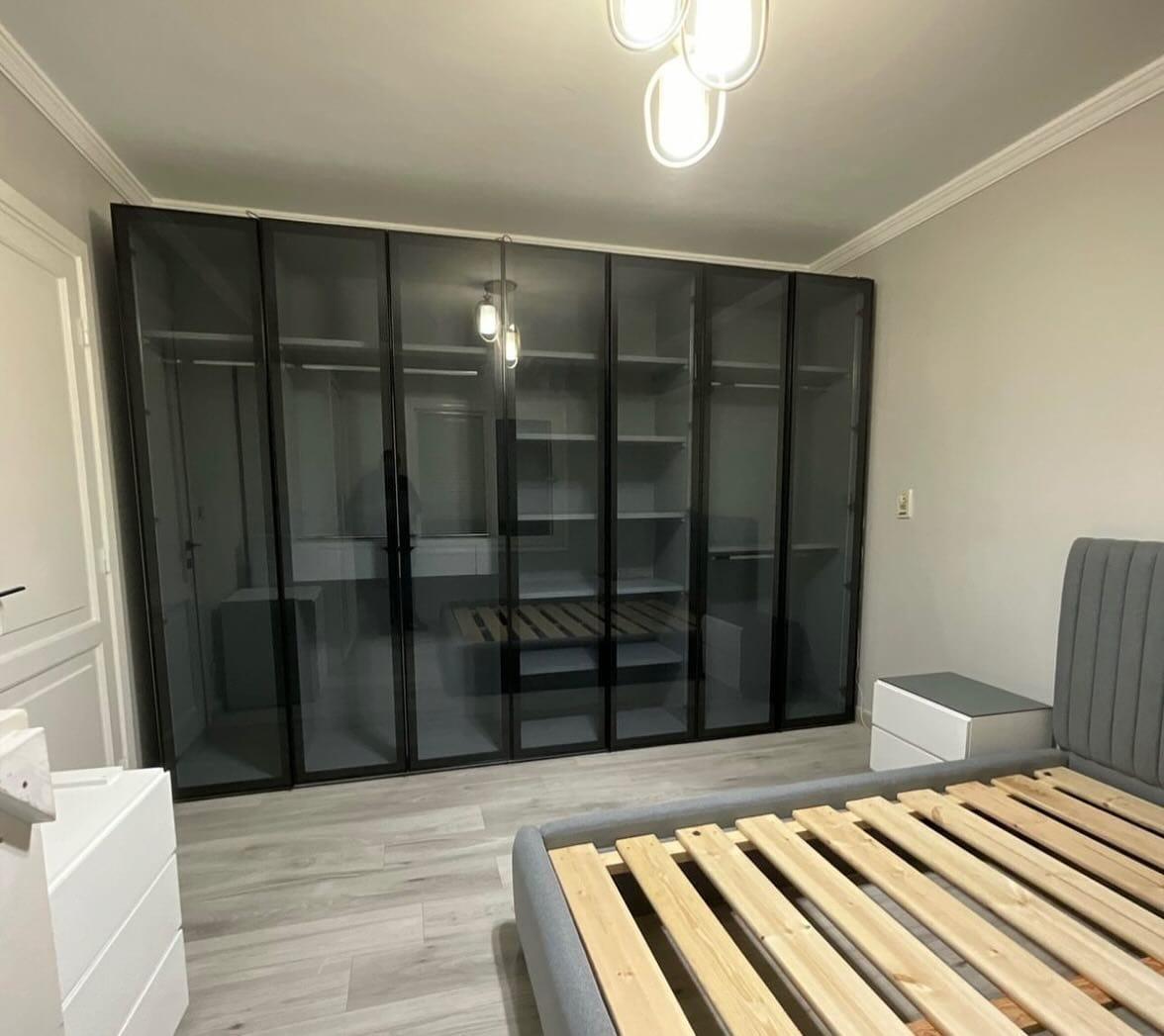
Ventilation provisions are options, not a recipe
The measures we may propose are an appropriate air gap, concealed ventilation openings, ventilation grilles, or other practical design measures. They are options chosen for the site, not a list that every wardrobe gets, and not a promise that a particular wall will stay dry. Which of them is used, and whether any is, depends on the wall, the exposure, the space and the installation. We do not publish construction details of how an opening is made; ask for what applies to your wardrobe in the quotation. If shoes will be stored in the wardrobe, shoe wardrobe design: pairs per shelf, depth and ventilation covers the shoe zone separately.
From the room side, ventilation shows up in practical places: a wardrobe that is not packed to the doors, a rail with space between garments, and doors that are opened on a dry day. The EPA's advice on circulation and our guide to packed clothes and shut doors go into that. Rails and shelves are planned in the wardrobe layout guide, and the hanging lengths in wardrobe hanging heights, so that nothing has to be jammed. For long garments, storing abayas, kanduras and long garments in a wardrobe shows how to size the long-hang rail.
The door type changes how air moves too. Glass-fronted wardrobes, mirror runs and sliding doors close differently; read wardrobe sliding door systems and mirror wardrobe doors before you choose, and say at the visit if the wall is an outside or bathroom one. Light inside a wardrobe is a separate choice, compared in wardrobe LED strip or aluminium profile.
Choosing the board for that wall
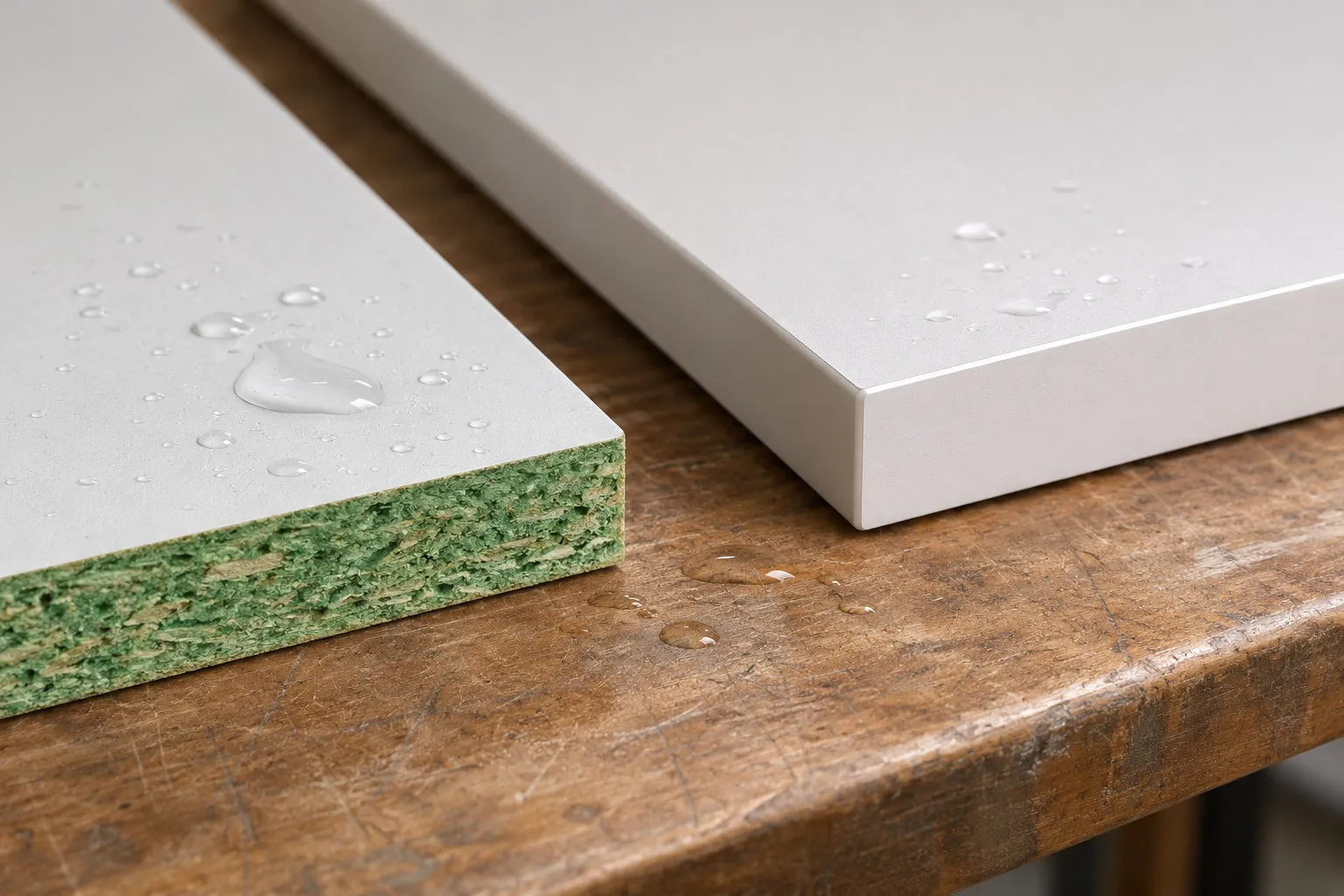
Once the wall is known and sound, the board becomes a sensible question, and the answer follows the wall. A board graded for humid conditions is meant for damper air than an ordinary one; the maker EGGER, for example, presents its melamine-faced P3 particleboard for furniture and interior fittings used in humid rooms, and mentions a glue chosen to limit swelling. That is one maker's product page, it gives no humidity figure, and it does not make a wall dry. Kitchens are the other room where steam is the issue; see kitchen joinery and cabinets for how a cabinet body is chosen there. Our moisture-resistant wardrobe boards guide goes through P2, P3 and the MDF labels; we do not repeat it here.
What we add is the principle: the board is chosen for the wall in front of it, and a humid-grade board is not a repair. We use MDF, plywood and other wood-based boards, chosen by budget, design, site and finish, and the standard structural board is 18 mm; special designs may differ. Ask for the board type to be written in the quotation, as the quotation checklist sets out, and see wardrobe materials and cost for how board choice moves a price. The finish on the doors is a separate choice, compared in door finishes. Handle finishes are a separate question, covered in the wardrobe handles guide.
If there is a leak or damp now: repair first
If there is an active leak, a damp patch that is growing, or salts and blisters with no known cause, the wall is repaired before a wardrobe goes near it. Dulux's technical advice is blunt about it: find and stop the moisture source before repainting, because otherwise the salts keep returning and damage the new paint. England's guidance says a damp surveyor can carry out a survey and identify the root cause. A plumber, a building contractor, a damp specialist or the building management is the right person, depending on what you find. We are a joinery maker; we do not offer to cure damp.
That is not a refusal to help. It is the order that protects your money: repair, let the wall dry, make it good, then build. If you tell us at the first call, we can plan the measuring visit for after the repair, or take the measurements now and hold the order. The wardrobe measuring visit guide explains the visit, and a rented flat adds the landlord's written permission.
If the wardrobe is old and you are deciding whether to keep it, renovate or replace a wardrobe is the guide for that decision, and wardrobe door replacement shows what can change on the doors alone. A new carcass built against a damp wall will meet the same wall. If doors on a wardrobe already stick or rub, see why a wardrobe door sticks; and if you are weighing a made-to-measure build against a ready-made unit for a difficult wall, custom or ready-made sets the two side by side.
What to bring to the measuring visit
The more you tell us about the wall, the less is guessed. You do not need a report; photographs, the bathroom's position and the history are enough. If the wall has had a repair, a receipt or a message from the trade that did it is worth more than a description. If the room is lived in while we work, occupied home installation preparation explains how to ready it, and hinged or sliding doors helps you decide the door type before the visit. If a sliding door already jumps its track, sliding wardrobe door off its track: what to check has the first checks.
What to tell us about the wall at the visit
Which wall is outside, and which has a bathroom behind it
- Why we ask
- It decides how exposed the wall is
Photographs of any stain, blister or white crust, with a ruler
- Why we ask
- Shows what the wall looks like today
Where the shower, the pipes and the extractor fan are on the other side
- Why we ask
- Steam and pipes reach the wall from behind
Where the AC unit and its drain line run
- Why we ask
- A drip above the wardrobe is a leak, not condensation
Any past leak, repair or repainting of that wall, with dates
- Why we ask
- A repaired wall is treated differently from an unknown one
Who owns or manages the flat, and what they have agreed in writing
- Why we ask
- The wall may not be yours to change
What you plan to store, and whether you want sliding or hinged doors
- Why we ask
- Door type and load change how the wardrobe is built
Our own list for the free measuring visit; we do not claim a moisture test at the visit.
What we do about a wardrobe on a bathroom or outside wall
We make custom wardrobes, and the free measuring visit comes with samples. On a bathroom or outside wall we assess the wall, the moisture exposure, the space and the installation requirements first, and the drawing and the itemised price you approve before production show the result. The board type is written in the quotation (the wardrobe board types guide explains the common boards), and if provisions such as an air gap, concealed openings or a grille apply, they are on the drawing. If the wall has an active leak or damp, we ask for it to be repaired first, by the right trade. If you also want a loft or top cabinets above the doors, loft boxes and top cabinets for luggage and seasonal storage lists what to put in writing.
The published entry specification is from AED 550 per sqm, installed, for MDF laminate with hinged doors; other options raise the figure and we give no number for them. After measurements and details are agreed, a 60% advance is paid and production starts once it is received; the remaining stage is agreed with you. Our Sharjah workshop in Al Shuwaiheen builds the wardrobe, up to about 10 days depending on size and design, and the workmanship carries a 24-month written workmanship warranty; wood-based boards carry a separate 5-year limited warranty that does not cover hinges, tracks, runners, rollers or other moving hardware, labour, misuse or accidental or deliberate damage, and the wardrobe warranty guide explains both; for how many hinges a door needs and what soft-close means, see wardrobe door hinges: how many, soft-close and adjustment. We serve the UAE, and our Sharjah, Dubai and Abu Dhabi wardrobe pages show where.
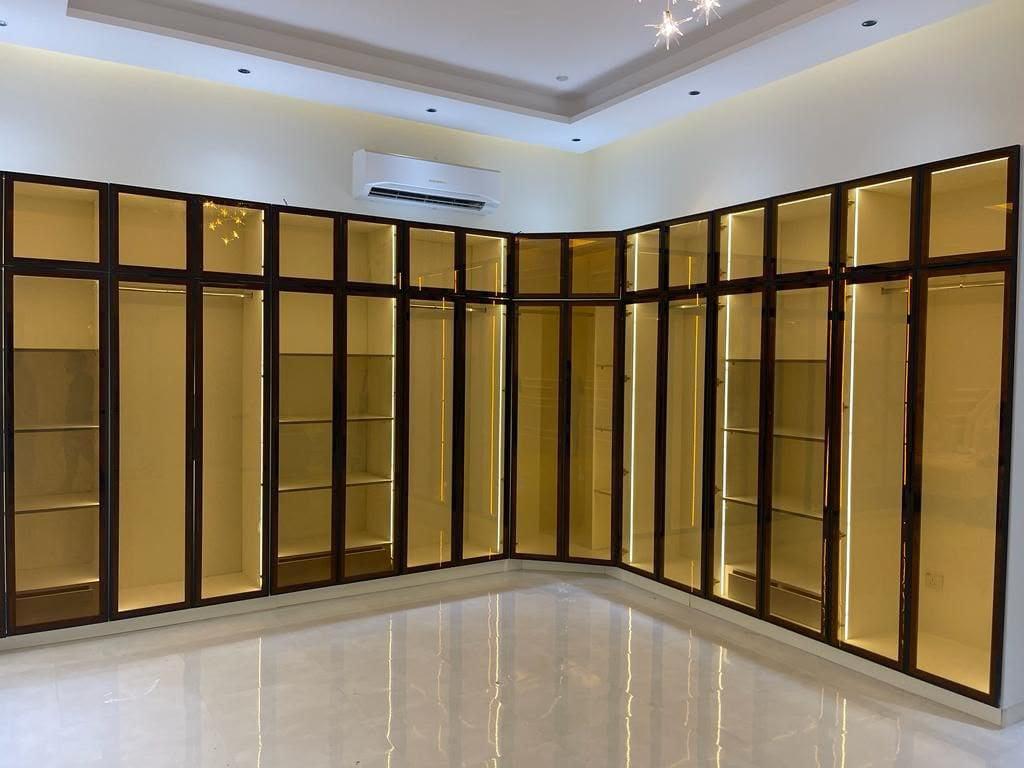
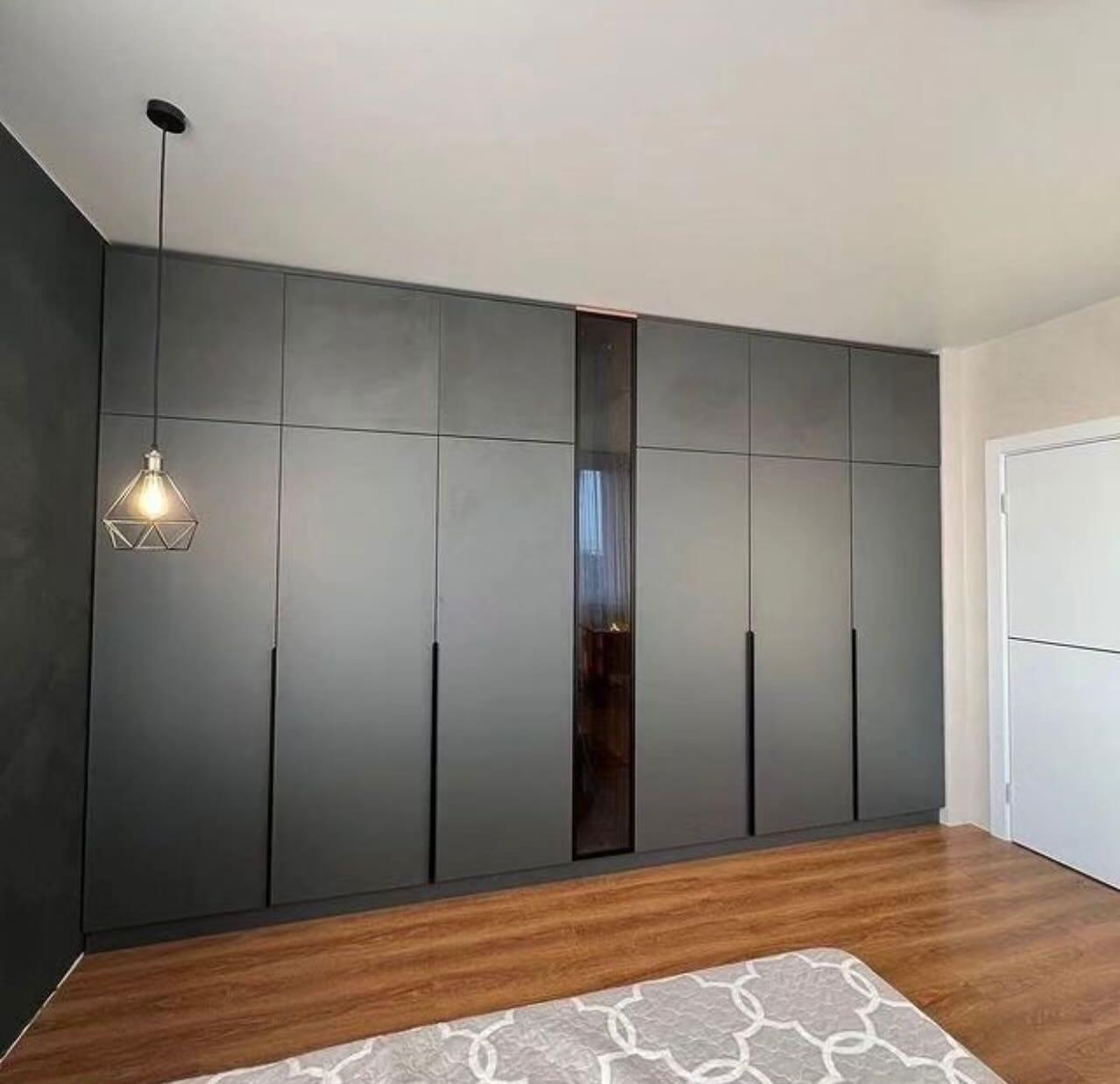
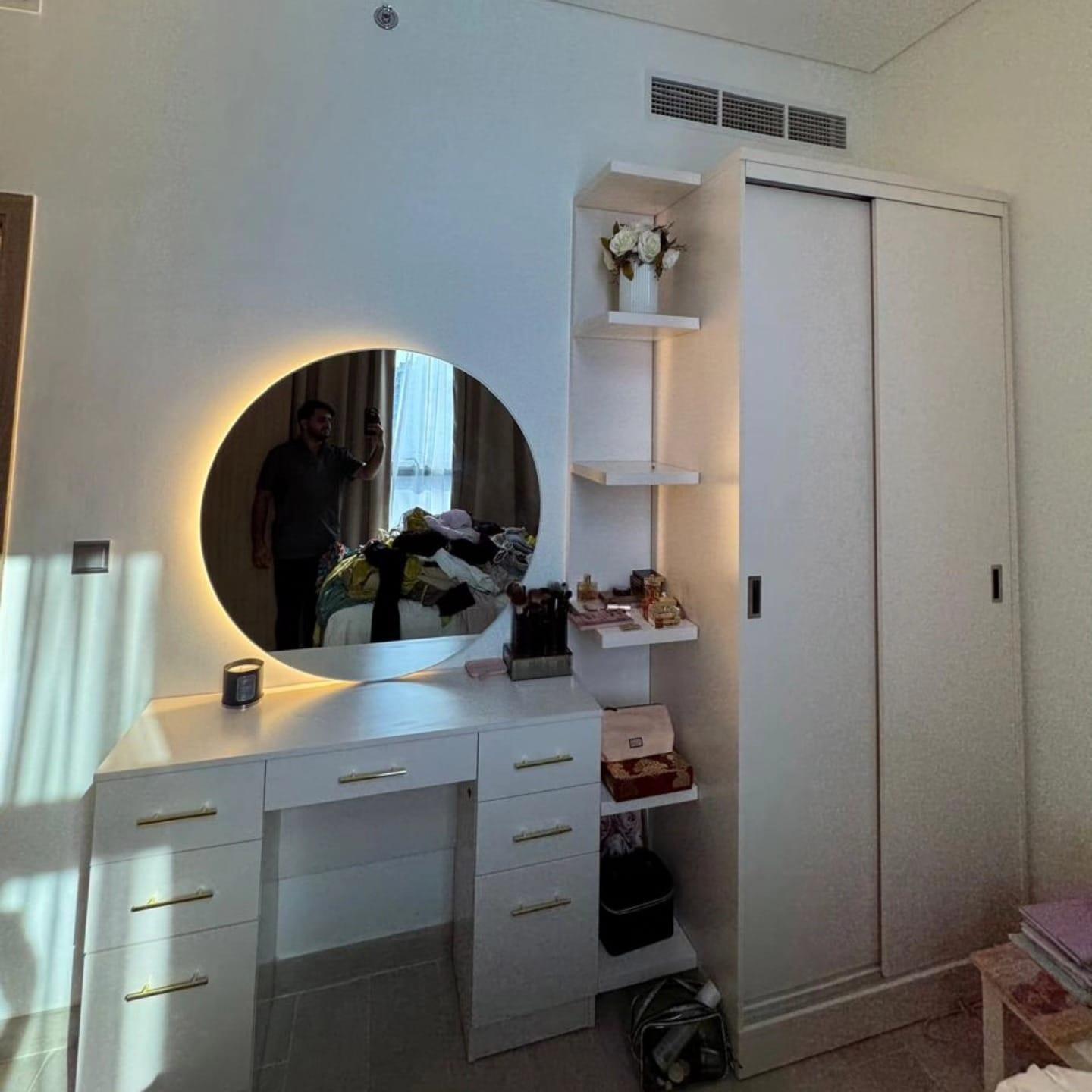
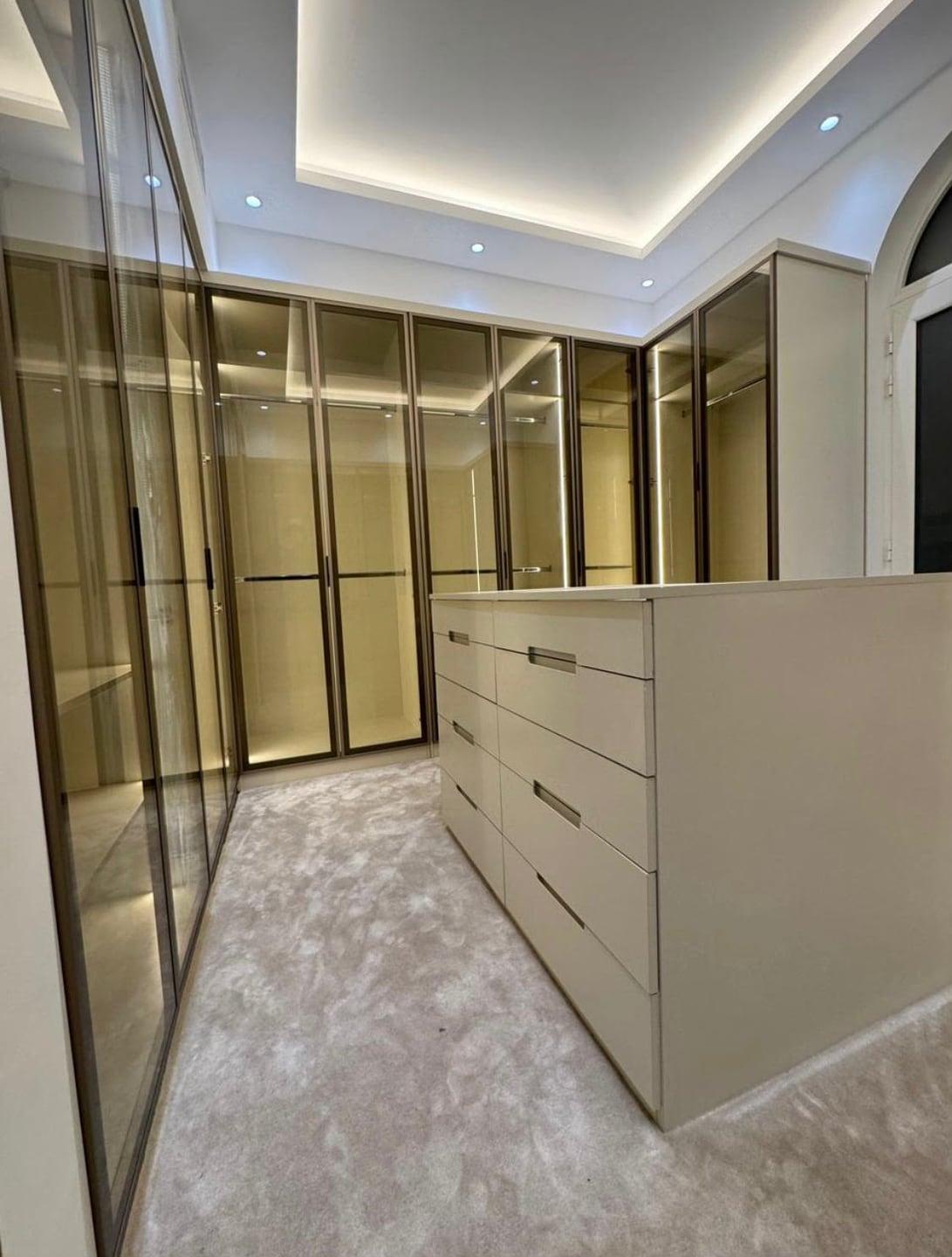
Finished examples are on the built-in wardrobes, lit glass-front wardrobes and sliding door wardrobes pages. To talk it through, book a free measuring visit or start from the custom wardrobes page; the pricing guide helps with a budget, and the wardrobe price guide shows what moves a price.
Once the wall is sorted, our UAE wardrobe planning guide covers layout, doors, interior and finish.
Common questions
Can I put a wardrobe against a bathroom wall in the UAE?
Yes, if the wall is sound and dry. We check the wall, the moisture exposure and the space first, then choose the construction and board for that site; if the wall has a leak or damp it is repaired first. See our moisture-resistant wardrobe boards guide.
Do I need a gap behind a wardrobe on an outside wall?
It depends on the site. A gap, concealed openings or a grille may be part of the design, but there is no one gap for every wardrobe, and a gap alone does not cure damp. See our guide to why a wardrobe smells musty.
Is a moisture-resistant board enough for a wardrobe against a bathroom wall?
No. A humid-grade board is chosen for damper air, but it does not repair a leak or dry a wall, so the wall is sorted first and the board chosen for that wall. See our wardrobe materials and cost guide.
What should I do if the wall behind my wardrobe has stains or paint blisters?
Photograph it, find the source, and have the right trade inspect and repair it before anything is built; do not paint over it. Rented flats also need the landlord informed in writing. See our rented apartment wardrobe guide.
Can a wardrobe maker fix a damp wall?
No. We make and fit joinery and do not offer to cure damp; a plumber, building contractor or damp specialist does that, and we build once the wall is dry and made good. See our renovate or replace a wardrobe guide.
Can an AC drain or cold wall cause damp behind a wardrobe?
A cool wall can collect condensation, and a dripping AC drain line is a leak to repair, not something ventilation fixes. Tell us where the unit and its drain run. See our wall preparation guide.
What should I tell the wardrobe maker about my wall?
Which walls are outside or have a bathroom behind them, photographs of any marks, where the pipes, fan and AC line run, and any past repair. Bring them to the free visit. See our wardrobe measuring visit guide.

Sources & specifications
Manufacturer information applies to the named products and systems. Sources reviewed on 4 November 2026.
- GOV.UK, Understanding and addressing the health risks of damp and mould in the home (updated 1 April 2026, England): signs of damp including staining and peeling wallpaper; low points behind wardrobes; a gap between furniture and external walls; working bathroom extractor fans; a damp surveyor identifies the root causegov.uk(opens in a new tab)
- US EPA, What are the main ways to control moisture in your home? (last updated 18 February 2026): moisture condenses on cold surfaces; exhaust fans in bathrooms; open closet doors for circulation; leaks give growth a placeepa.gov(opens in a new tab)
- Dulux Trade Australia, Efflorescence (technical advice): salts carried to a masonry surface by moisture; crystals can crack, flake or peel paint; stop the moisture source before repaintingduluxtrade.com.au(opens in a new tab)
- EGGER, Decorative Particleboards E1E05 TSCA P3 (product page): standard board for furniture and interior design in humid conditions; moisture-resistant gluing; no humidity figureegger.com(opens in a new tab)
Want this planned for your home?
Consultation and measurement are free. Tell us the rooms, location and what you need; we arrange a sample visit and define the measured quotation.