Wardrobes · 12 min read · 22 August 2026
Wardrobe board types: MDF, plywood, particleboard and HDF compared
What MDF, plywood, particleboard and HDF are, where each is strong or weak, how they take screws and edges, what an 18 mm structure means, and which board goes in the carcass, doors, shelves and back of a wardrobe.

By Ali Haider Basra, Founder, Al Tareeq Decor · Contact our workshop
Key takeaways
- MDF, plywood, particleboard (chipboard) and HDF are four different boards, not four grades: fibre, crosswise veneers, chips and denser fibre.
- MDF is the usual base for laminated, veneered or painted doors; HDF suits a thin back panel; plywood suits spans and stiffness; particleboard needs its type (P2 or P3) named.
- We make wardrobes in MDF, plywood and other suitable wood-based materials chosen by budget, design, site and finish. Our standard structure uses 18 mm boards, but special designs may use other thicknesses.
- No board is waterproof, and the maker pages we opened say so for dry-use boards. Board grades for damp rooms are in the moisture guide.
- Ask for the board, grade, thickness and back-panel material in the quotation: we have not published a brand or the back-panel thickness.
On this page
- Key takeaways
- The four boards in one paragraph each
- MDF, plywood, particleboard and HDF side by side
- MDF: the board most wardrobe doors start from
- Plywood: layers glued crosswise
- Particleboard and chipboard: one board, two names, two grades
- HDF: why it is the back of the wardrobe
- Weight, screws and edges
- Moisture, in general terms
- What an 18 mm structure means
- Which board goes where in a wardrobe
- Parts of a wardrobe and the boards they commonly use
- Choosing between them for your wardrobe
- What we do about boards
- Common questions
The four boards in one paragraph each
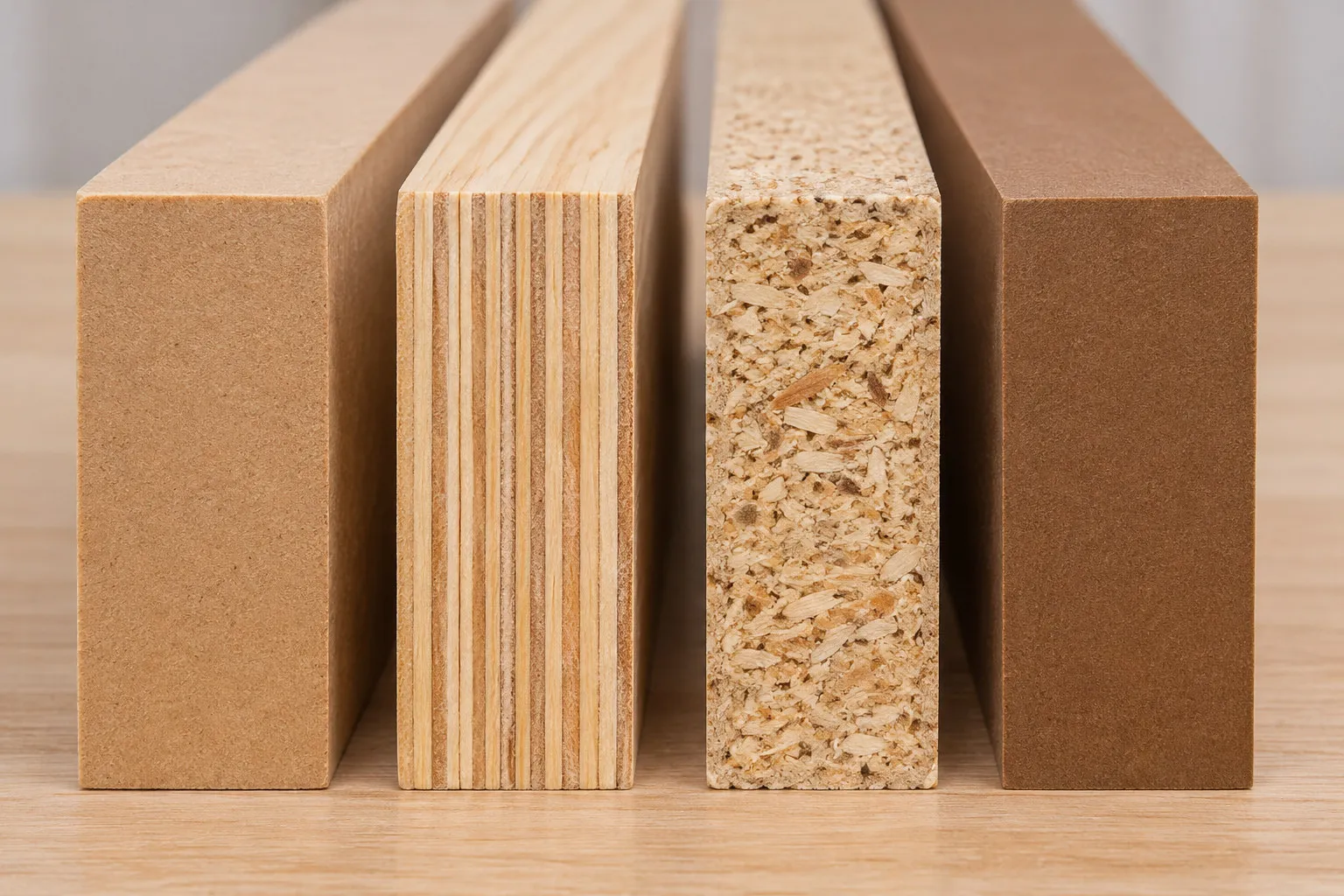
A wardrobe is mostly flat boards, and four families cover nearly all of them: MDF, plywood, particleboard (also called chipboard) and HDF. They are not four grades of the same thing. MDF and HDF are made from wood fibre pressed with resin, particleboard from wood chips, and plywood from thin sheets of veneer glued with the grain turned at right angles. That difference in how they are made decides how they cut, hold a screw, take an edge and react to water.
We make wardrobes in MDF, plywood and other suitable wood-based materials, chosen by budget, design, site and finish. Our standard structure uses 18 mm boards, and special designs may use other thicknesses. We do not publish a board brand, so a quotation is where the exact board is written down. The sections below explain what each family is so that you can read that line; the grades that matter for damp rooms are in a separate guide on moisture-resistant wardrobe boards. The cost side of materials is in the older wardrobe materials and hardware guide.
MDF, plywood, particleboard and HDF side by side
MDF
- What it is
- Wood fibre and resin pressed into an even board
- Strength
- Smooth faces and edges that take laminate, veneer or paint; good screw retention in face and edge, per the European Panel Federation
- Weak point
- Not for load-bearing use in the standard grade; cut edges and faces must be sealed or covered
- Where it goes in a wardrobe
- Doors, drawer fronts, carcass sides and shelves, where a flat finished face matters
Plywood
- What it is
- Thin veneers glued with each layer's grain at right angles to its neighbour
- Strength
- Natural Resources Canada credits the layering with stable dimensions and strength in two directions
- Weak point
- A layered edge shows unless banded; quality varies with the veneer and glue, so ask what is supplied
- Where it goes in a wardrobe
- Carcass, shelves and shapes that carry weight; designs that want a plain timber-like edge
Particleboard (chipboard)
- What it is
- Wood chips and resin pressed in layers
- Strength
- Common furniture board; EN 312 Type P2 is written for interior fitments, including furniture, in dry conditions
- Weak point
- Chips are coarser inside than fibre, so edges and repeated screw fixing need care; P3 exists for humid conditions
- Where it goes in a wardrobe
- Carcass and shelves in budget builds, when the maker names the type and grade
HDF
- What it is
- A denser fibreboard
- Strength
- Kronospan describes it as 'increased density'
- Weak point
- Kronospan calls it non-load-bearing, for interior use in dry conditions
- Where it goes in a wardrobe
- The back panel and drawer bottoms, where it is thin and fixed
The strengths and weak points above are quoted from the makers and standards pages listed under the article; they describe those products and are not a claim about every board of the same name. Ask for the exact board and grade in the quotation.
MDF: the board most wardrobe doors start from
MDF, medium density fibreboard, is wood fibre and resin pressed into a board with no visible grain. Because the core is the same throughout, a routed groove, a rounded edge or a flat painted face all behave the same way, which is why it is the usual starting point for doors that are laminated, veneered or sprayed. Kronospan lists its standard MDF as suitable for 'laminating, painting, varnishing and veneering', and our guide to wardrobe door finishes shows how those finishes differ on the front.
The same maker says MDF is non-load-bearing and for interior use in dry conditions (EN 622-5), which is how a wardrobe is used: boards that carry clothes, not a roof. The weak point is the cut edge and any face left uncovered, because that is where the fibre meets air and spilled liquid. A covered edge or a sealed face is part of the board, not an extra, and wardrobe edge banding explains the options. MDF is also where the moisture-resistant versions come from, such as the board Sonae Arauco describes as 'MDF for use in humid conditions (EN 622-5)'; what that label does and does not promise is the subject of the moisture guide.
Plywood: layers glued crosswise
Plywood is built from thin veneers glued so that the grain of each layer is perpendicular to the layer beside it. Natural Resources Canada, describing plywood in general (largely the structural softwood kind), says this gives 'superior dimensional stability, two-way strength and stiffness properties'. In our reading, that is why plywood is considered for shelves and sides that carry weight; it is a statement about the construction, not a measured comparison, and the quality of a given sheet depends on its veneers and glue.
The trade-off is the edge. A plywood edge shows its layers, so it is either banded or deliberately left as a visible edge in a design. Whether plywood is used is a decision of budget and design: we choose boards by budget, design, site and finish, and the price effect is set in the quotation. BSI's page for EN 636 notes that plywood standards cover dry, humid and exterior conditions, which is why a quotation should say what the plywood is intended for rather than only 'plywood'.
Particleboard and chipboard: one board, two names, two grades
Particleboard and chipboard are the same board: wood chips and resin pressed in layers. It is widely used for furniture. The European standard EN 312 separates two types that matter here: BSI lists Type P2 as boards for interior fitments, including furniture, in dry conditions, and Type P3 as non-load-bearing boards for humid conditions. Kronospan's P2 page says 'for interior use in dry conditions' and lists furniture components among its uses; EGGER's decorative P3 board is described as for 'furniture and interior design in humid conditions' with 'moisture-resistant gluing for improved swelling behaviour'.
Two cautions follow. First, the word 'chipboard' on a quotation says nothing about P2 or P3, so ask which. Second, edges and screws need care because the core is chips rather than fibre or veneer; the board is covered in melamine or laminate at the factory, and any cut or drilled place is where the core is open. The grade questions, and why a P3 board still needs a covered edge, are in the moisture guide, which we link here instead of repeating.
HDF: why it is the back of the wardrobe
HDF, high density fibreboard, is MDF pressed harder. Kronospan lists its HDF with 'increased density', calls it 'a non-load-bearing product for interior use in dry conditions' (EN 316, EN 622-1), and names 'cupboard backs' as an application. That is exactly its job in a wardrobe: a thin sheet that squares the box and keeps the dust out, fixed to the carcass, never carrying a shelf.
We have not published the thickness or material of the back panel for our wardrobes, so ask for it in the quotation, together with how it is fixed. The back panel also decides how the box sits against a wall that may sweat; that question, and how air moves behind the wardrobe, is covered in wardrobe humidity. See also airflow behind a wardrobe against a bathroom or outside wall.
Weight, screws and edges
Weight matters twice: when the wardrobe is carried up to a flat, and when a hinged door hangs from a carcass side. We found no maker or standards page that gives comparable weights for all four boards, so we do not quote any. The datasheet for the chosen board is where the real number is; ask for it if the wardrobe will be carried by stairs. The weight of a door also matters to the hinge count, which our hinges guide covers.
Screws are the second difference. The European Panel Federation, writing about MDF, says it 'has good screw retention strength both in the faces and edges', and gives the rules that keep it that way: a pilot hole of 85 to 95% of the screw's core diameter, and screws in the face not closer than 12 mm to the board edge. The page compares nothing with particleboard or plywood, so we do not rank the boards on screw holding. What follows is practical: any wardrobe board fails first where a fixing is repeated, so a good joint uses the right screw and pilot hole, and a drawer or hinge position that will be moved should be discussed in the drawers and organisers guide before the carcass is built.
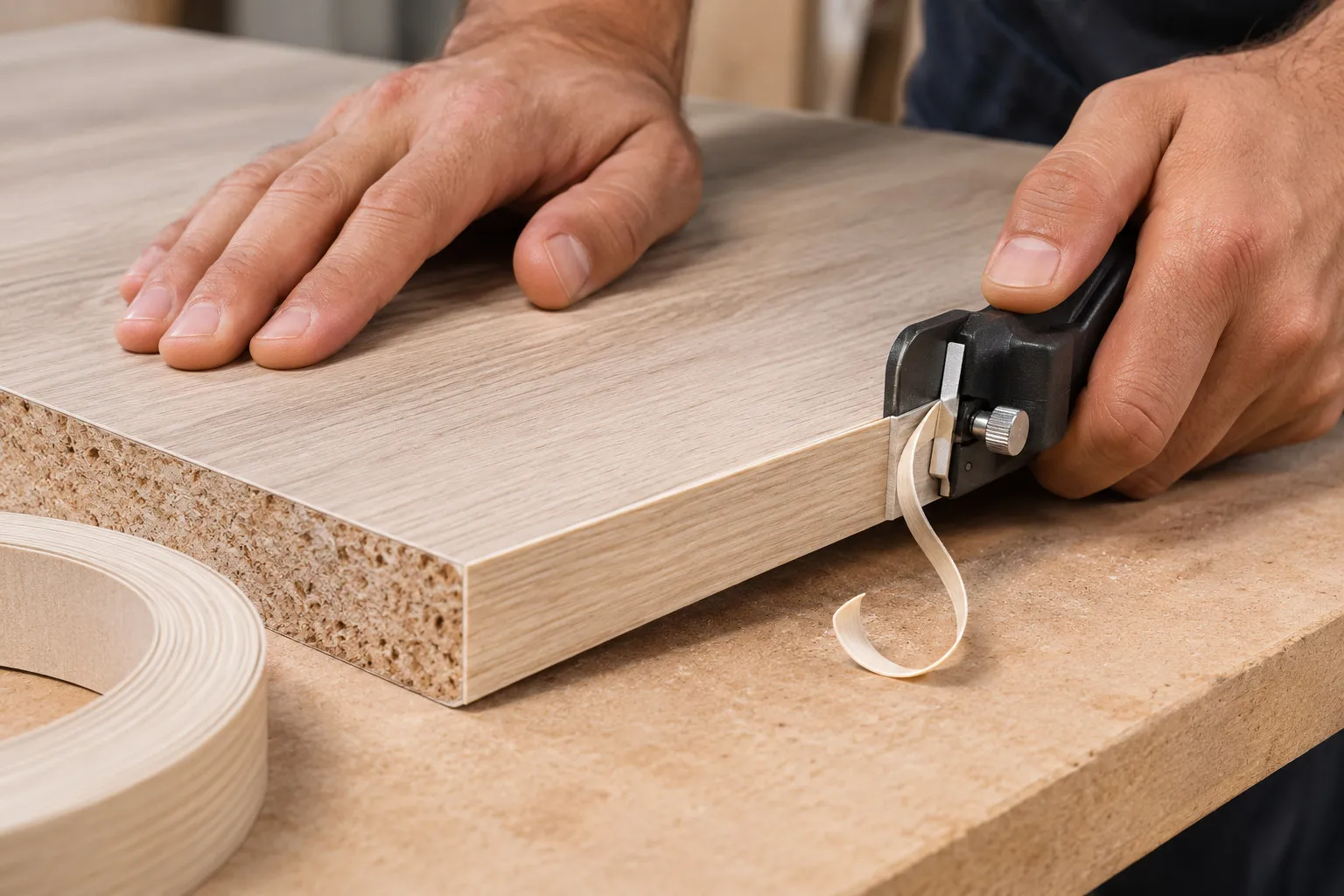
Edges are the third. MDF and particleboard have no grain on the cut, so they take a band cleanly. Plywood shows its layers. Every cut edge, whatever the board, is either covered by a band or left visible by design, and a wardrobe edge band is a separate item on the quotation.
Moisture, in general terms
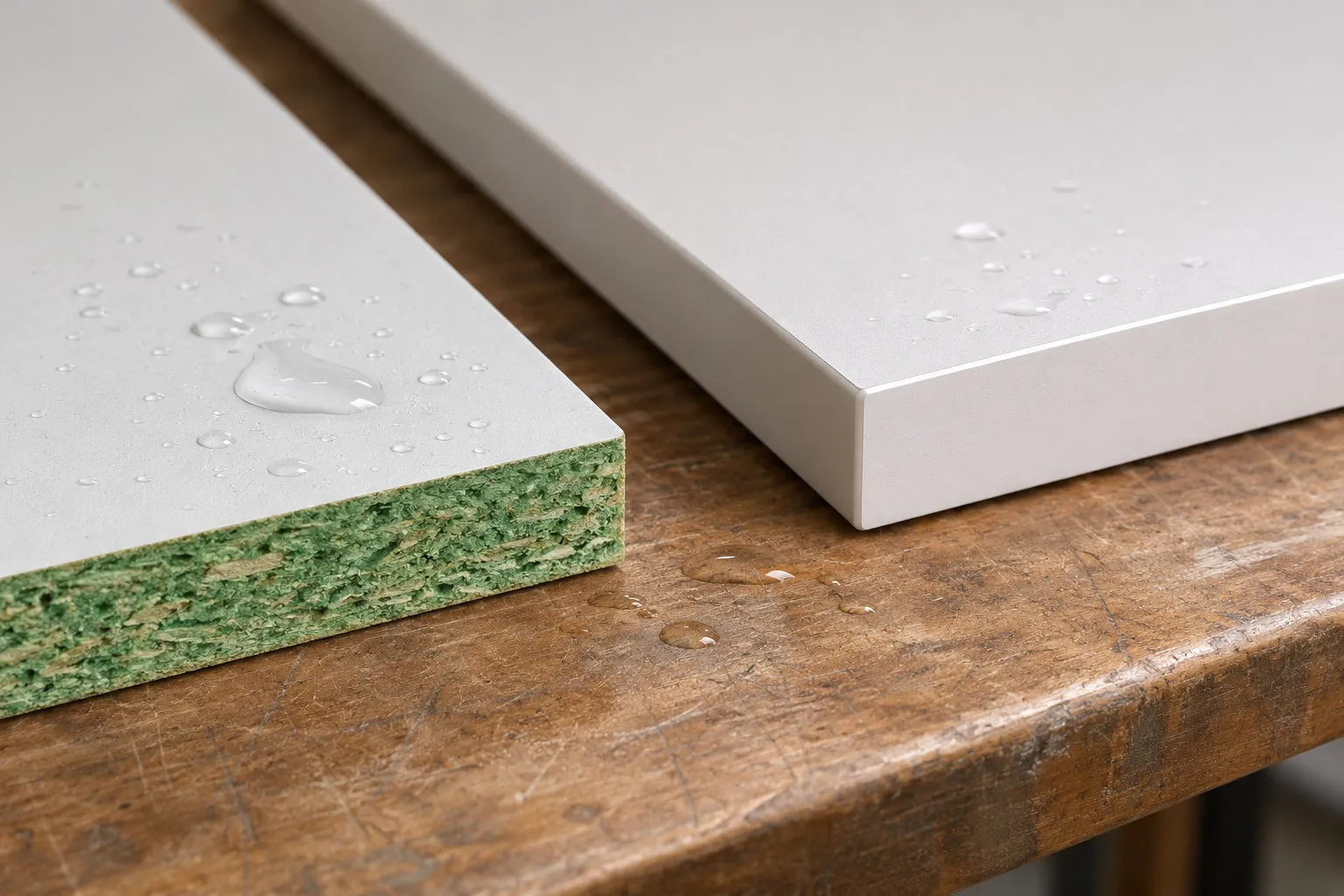
All four boards are wood-based, and wood-based boards swell when they take up water. The standards separate boards for dry use from boards for humid use (P2 and P3 for particleboard, a humid-use type of MDF under EN 622-5, dry, humid and exterior classes for plywood), and every maker we opened says its dry-use board is for dry conditions. None of the pages we opened promises that any board is waterproof, and we do not either.
In a bedroom wardrobe the realistic risks are a wet exterior wall, a bathroom wall, a leak, or a closed box that never airs. A board choice does not fix any of them. If the wall is the problem, read wardrobe against a bathroom or outside wall first. If the wardrobe already smells, why a wardrobe smells musty starts from the cause.
What an 18 mm structure means
Our standard structure uses 18 mm boards for the structural boards of the carcass, the box that carries the wardrobe. Eighteen millimetres is a common furniture thickness, and the Kronospan MDF and particleboard pages we opened list 18 among the sizes they sell. That is the only claim we make about thickness. Special designs may use other thicknesses, so we do not say that every part of every wardrobe is 18 mm.
Parts that are not the standard structure are the usual exceptions: a thin back panel, drawer bottoms, a thicker shelf for a long span, or a door that is built up for a profile. If the thickness of a part matters to you, such as a long shelf or a heavy shelf of folded clothes, ask for it on the drawing. The long-span question is also part of wardrobe dimensions.
Which board goes where in a wardrobe
The table is a reading aid for a quotation, not a specification for our work. We choose the board by budget, design, site and finish, and the exact board and grade for your wall is written in the quotation.
Parts of a wardrobe and the boards they commonly use
Carcass (sides, top, bottom)
- What the part needs
- Stiffness, a good screw hold, a covered edge
- Boards that suit it
- MDF, plywood or particleboard
- What to ask for
- Board, grade and thickness; 18 mm is our standard structure
Doors
- What the part needs
- A flat, stable face for the finish
- Boards that suit it
- MDF is the usual base for laminate, veneer or paint
- What to ask for
- Board under the finish and how the edge is covered
Shelves
- What the part needs
- Resistance to sagging over the span
- Boards that suit it
- Plywood or a thicker board for long spans
- What to ask for
- Span and thickness on the drawing
Drawers
- What the part needs
- Runner fixing, a covered front edge
- Boards that suit it
- Same board family as the carcass, with a thin back and base
- What to ask for
- Drawer-runner and box material, ask in the quotation
Back panel
- What the part needs
- Squares the box, closes the back
- Boards that suit it
- HDF or a thin fibreboard
- What to ask for
- Material and thickness: not published by us, ask
This is a reading aid. Our actual choice depends on the design and the site, and no board brand is stated here.
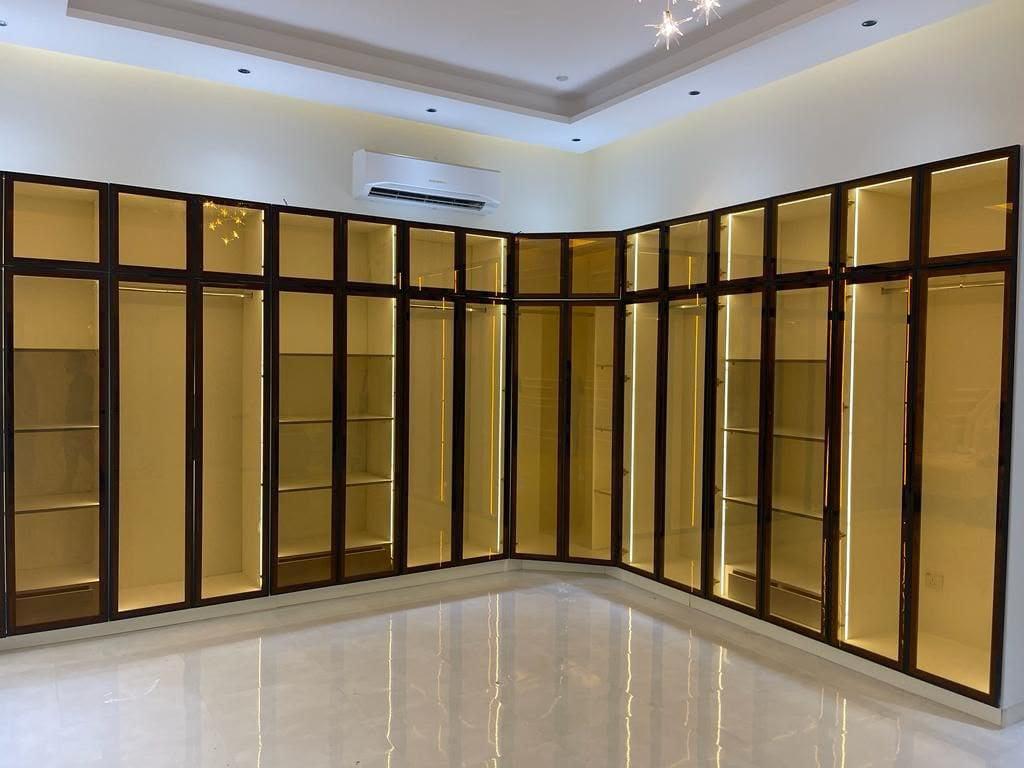
- 1. MDF: an even fibre core with no visible grain, so the edge and the face take a finish the same way
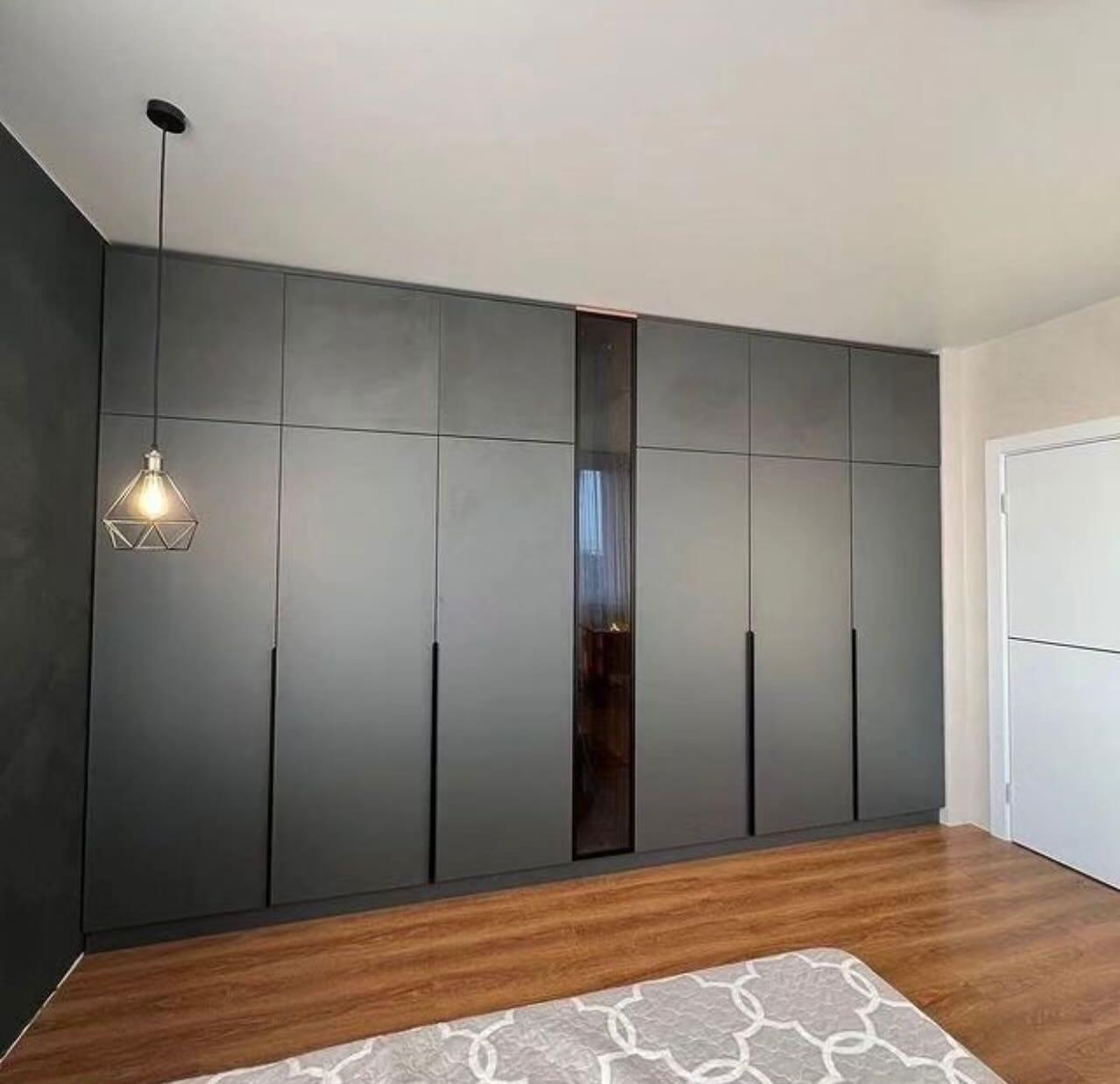
- 2. Plywood: thin layers with the grain turned at right angles, which is where its edge pattern comes from
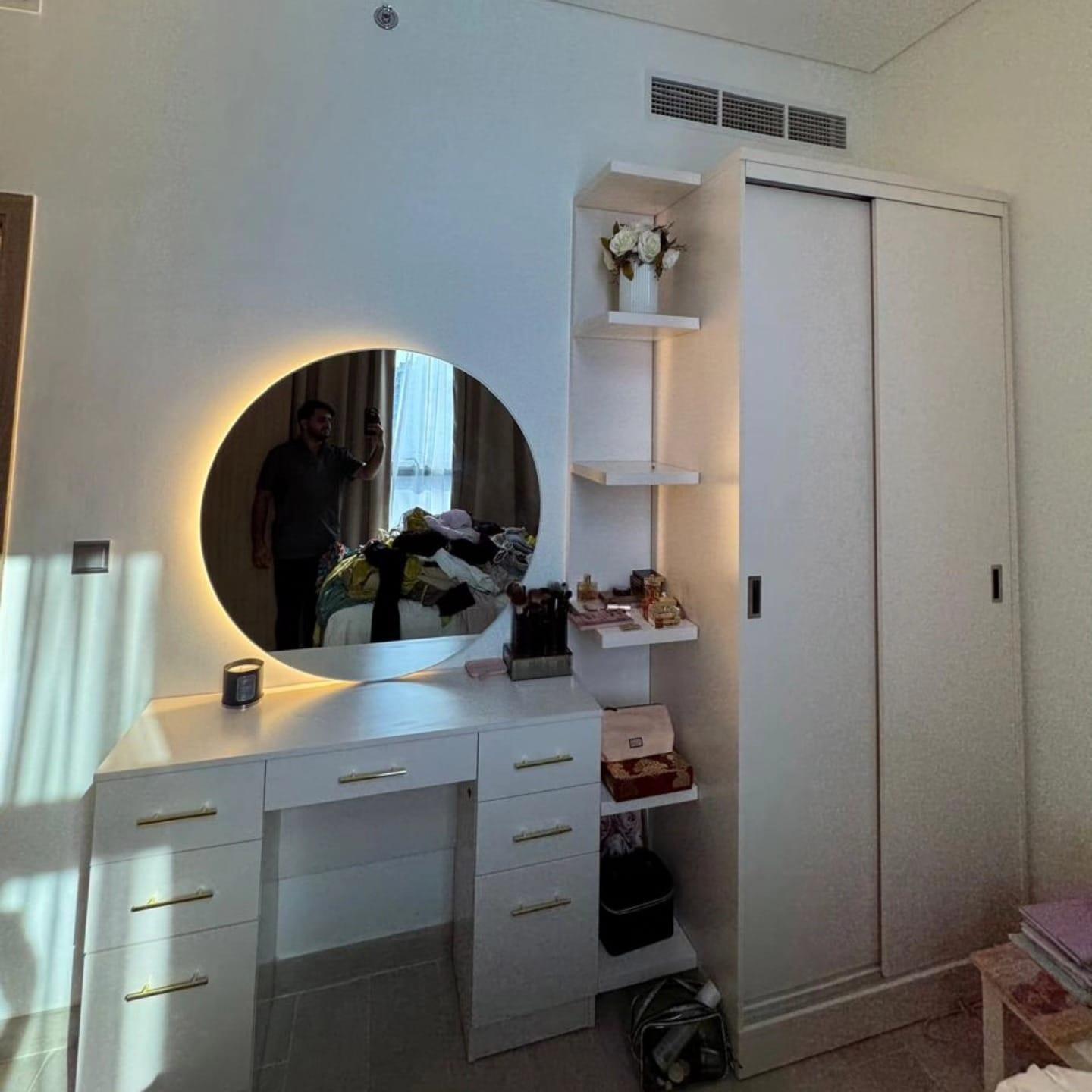
- 3. Particleboard: coarser wood chips in layers, covered at the factory and needing a covered edge
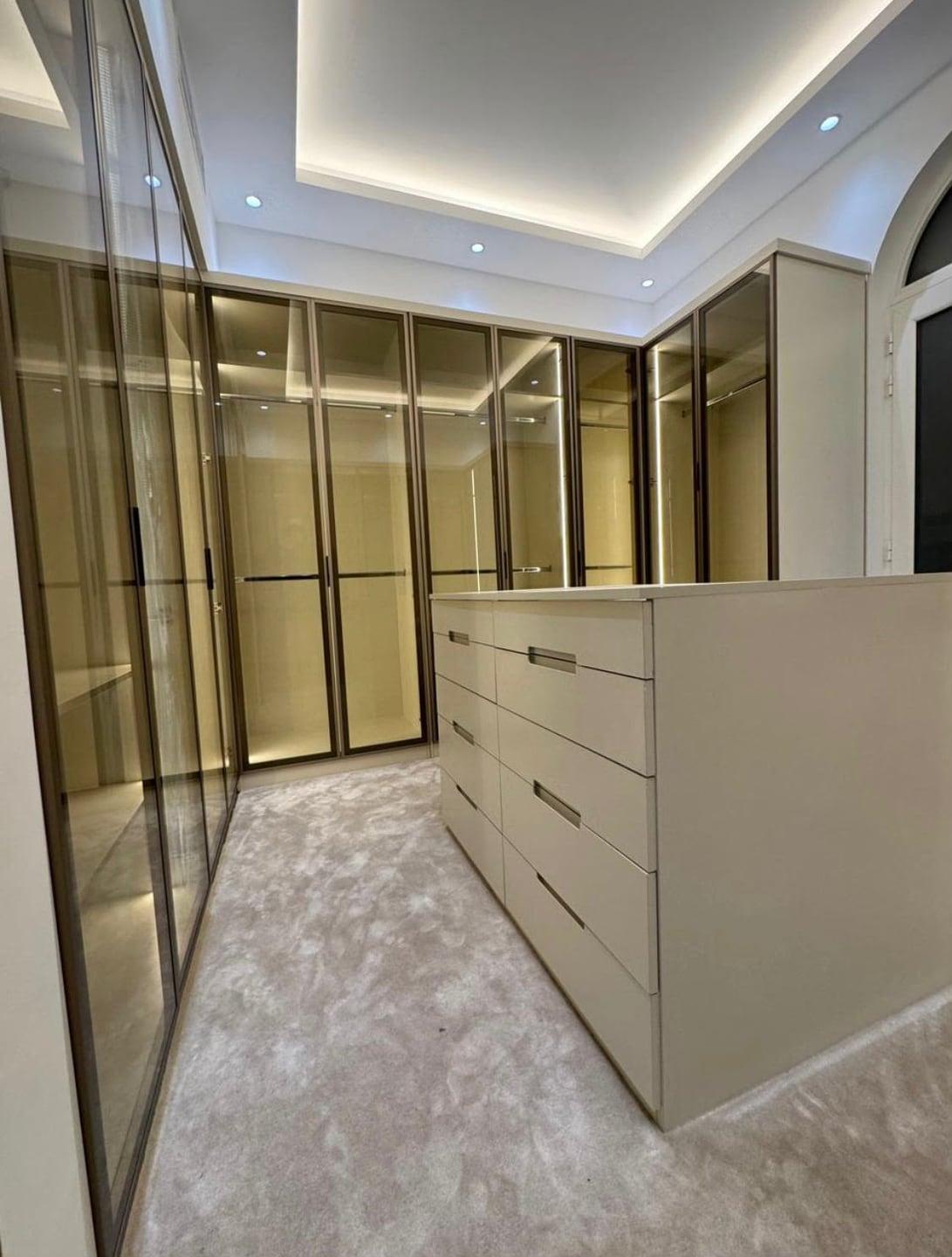
- 4. A neutral comparison: none of the three is best, each suits a part of the wardrobe
Choosing between them for your wardrobe
Start with the room, not the board. A wardrobe in a dry bedroom, a small bedroom or a kids' room puts little stress on any of these boards, and the finish and the layout decide more of the outcome. A wardrobe on an exterior wall, next to a bathroom, in a ground-floor room or at a studio apartment with little ventilation needs the wall checked before the board.
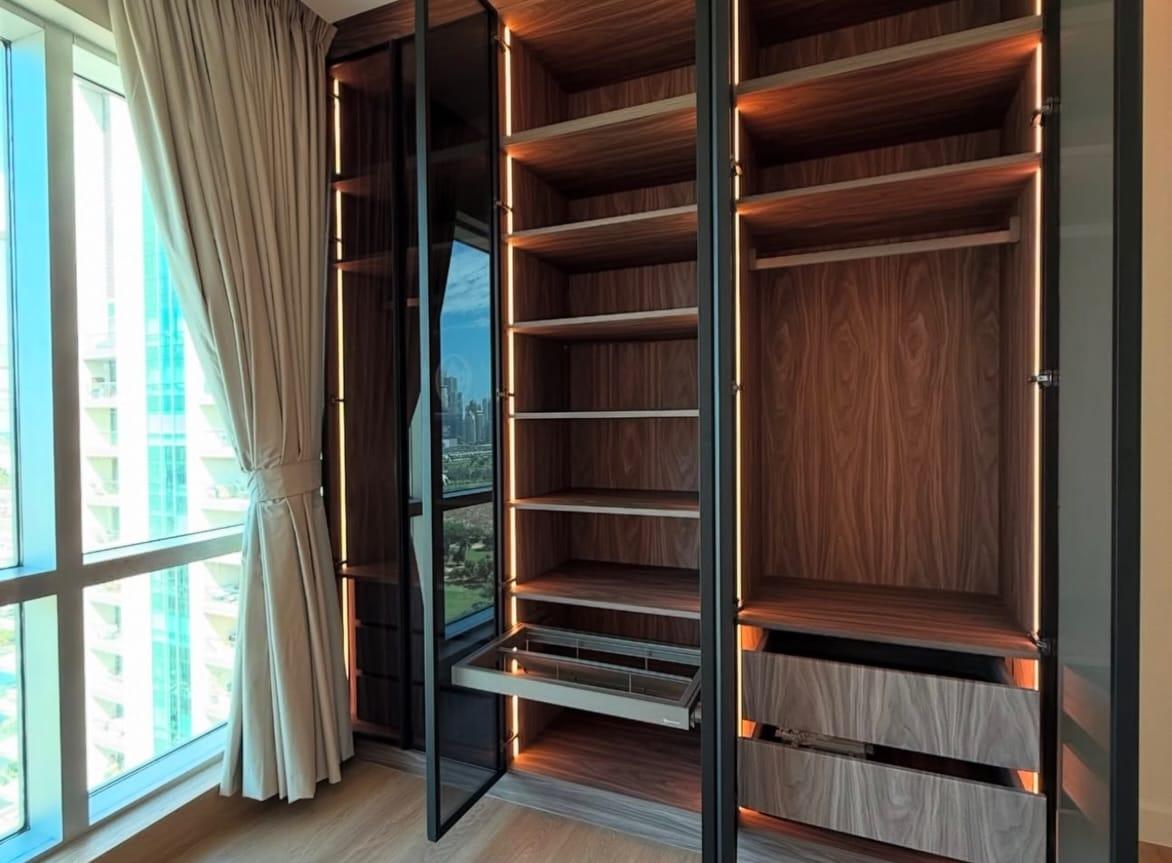
Then the design. A floor-to-ceiling wardrobe with tall doors asks for a stable door board, a sliding system adds weight to the top, and a long hanging span asks for a stiff shelf. A glass-fronted wardrobe puts the carcass on show behind the glass. Renovate or replace is the question when the boards already exist and only the doors are tired.
Last, the budget. Board choice moves the price; our entry price is from AED 550 per sqm for an MDF laminate specification with hinged doors, installed, and other options raise it. The wardrobe quotation checklist lists what to ask each supplier, including the board line, and the wardrobe design approval guide shows what to confirm on the drawing before production.
What we do about boards
At the free measuring visit we bring samples to the room and measure the wall. We then send a drawing and an itemised price, and nothing is made until you approve them. The board for each part is written there, so you can compare it with this page before anything is cut.
We make wardrobes in MDF, plywood and other suitable wood-based materials, chosen by budget, design, site and finish. The standard structure uses 18 mm boards; special designs may use other thicknesses. We have not published a board brand or the back-panel thickness, so ask for them in the quotation. Our entry price is from AED 550 per sqm, installed, for MDF laminate with hinged doors; other options raise it, and the figure for your wall is set after measurement. After you confirm the details, a 60% advance is paid and production starts once it is received; delivery and installation take up to about 10 days, depending on size and design, from our Sharjah workshop, with a 24-month written workmanship warranty (supplied products follow their own terms). The wood-based boards carry a 5-year limited warranty, subject to terms; hinges, tracks, runners, rollers and other moving hardware are not covered.
Start with the free wardrobe measuring visit, then book through the consultation form. Our custom wardrobes service page lists what we make, the built-in wardrobes page shows finished runs, and the wardrobe price guide explains how a measured wall becomes a number. What the written warranty covers is in the wardrobe warranty guide and the warranty and aftercare guide. The Sharjah page gives the workshop address and the pricing tool shows how a quotation is built.
To plan everything around the board, from layout to doors, use our guide to every wardrobe decision in the UAE.
Common questions
Which is better for a wardrobe, MDF or plywood?
Neither wins for every part. MDF gives a flat, even face that takes laminate, veneer or paint, so it is the usual base for doors. Plywood's crosswise layers are credited with stable dimensions and two-way strength, so it suits shelves and spans. We choose by budget, design, site and finish. See our wardrobe materials guide.
Is chipboard the same as particleboard?
Yes, they are two names for the same board: wood chips and resin pressed in layers. The grade is what differs: EN 312 Type P2 is for interior fitments, including furniture, in dry conditions, and Type P3 for non-load-bearing use in humid conditions. Ask which one is quoted. See our moisture-resistant boards guide.
What is HDF used for in a wardrobe?
Mainly the back panel and thin parts. Kronospan describes its HDF as a non-load-bearing product for interior use in dry conditions, with cupboard backs among its applications. We have not published our back-panel thickness, so ask for it. See our wardrobe quotation checklist.
Is every part of your wardrobe 18 mm?
No. 18 mm boards are our standard structure, but special designs may use other thicknesses, and parts such as the back panel can differ. Ask for the thickness of any part that matters to you on the drawing. See our wardrobe dimensions guide.
Which board holds screws best?
We found no page that compares all four, so we do not rank them. The European Panel Federation says MDF has good screw retention in faces and edges, with pilot holes of 85 to 95% of the screw core diameter. Hinges and runners follow their own instructions. See our wardrobe hinges guide.
Is any wardrobe board waterproof?
No board we opened is described as waterproof. Boards for humid use exist, but a covered edge and a dry wall still matter. See our guide to a wardrobe against a bathroom or outside wall.
Which board does the AED 550 per sqm price use?
Our entry price is from AED 550 per sqm for an MDF laminate specification with hinged doors, installed. Other options raise it, and the figure for your wall is set after measurement. See our price guide.

Sources & specifications
Manufacturer information applies to the named products and systems. Sources reviewed on 4 November 2026.
- Kronospan, Medium Density Fibreboard (MDF): non-load-bearing, interior use in dry conditions; EN 622-5; suitable for laminating, painting, varnishing and veneering; thicknesses include 18kronospan.com(opens in a new tab)
- Kronospan, Particleboard P2: interior use in dry conditions; EN 312 type P2; furniture components; thicknesses include 18kronospan.com(opens in a new tab)
- Kronospan, High Density Fiberboard (HDF): non-load-bearing, interior use in dry conditions; cupboard backs; EN 316, EN 622-1; increased densitykronospan.com(opens in a new tab)
- Sonae Arauco, MDF HYDRO X: MDF for use in humid conditions (EN 622-5); rooms with intermittent high humiditysonaearauco.com(opens in a new tab)
- EGGER, Decorative particleboards E1E05 TSCA P3: furniture and interior design in humid conditions; moisture-resistant gluingegger.com(opens in a new tab)
- BSI, BS EN 312:2010 Particleboards. Specifications: contents list Type P2 (interior fitments including furniture, dry conditions) and Type P3 (non load-bearing, humid conditions); standard text not readknowledge.bsigroup.com(opens in a new tab)
- BSI, BS EN 636 Plywood. Specifications: general-purpose and structural plywood for dry, humid or exterior conditionsshop-checkout.bsigroup.com(opens in a new tab)
- Natural Resources Canada, Plywood (modified 4 September 2025): layers of thin veneers, grain of each layer perpendicular to the adjacent layers; dimensional stability and two-way strength (general plywood, mostly structural)natural-resources.canada.ca(opens in a new tab)
- European Panel Federation, MDF screwing: good screw retention in faces and edges; pilot hole 85 to 95% of screw core diameter; face screws not closer than 12 mm to the edgemdf-info.eu(opens in a new tab)
Want this planned for your home?
Consultation and measurement are free. Tell us the rooms, location and what you need; we arrange a sample visit and define the measured quotation.