Wardrobes · 19 min read · 28 June 2026
Sliding wardrobe door systems explained: weight and size limits per door, depth, soft-close and what to ask for
A sliding wardrobe door system is rated per door: top-hung or bottom-running, every system has a weight limit and a size limit of its own. Ask for the system, the rated weight per door and your door size in writing.

By Ali Haider Basra, Founder, Al Tareeq Decor · Contact our workshop
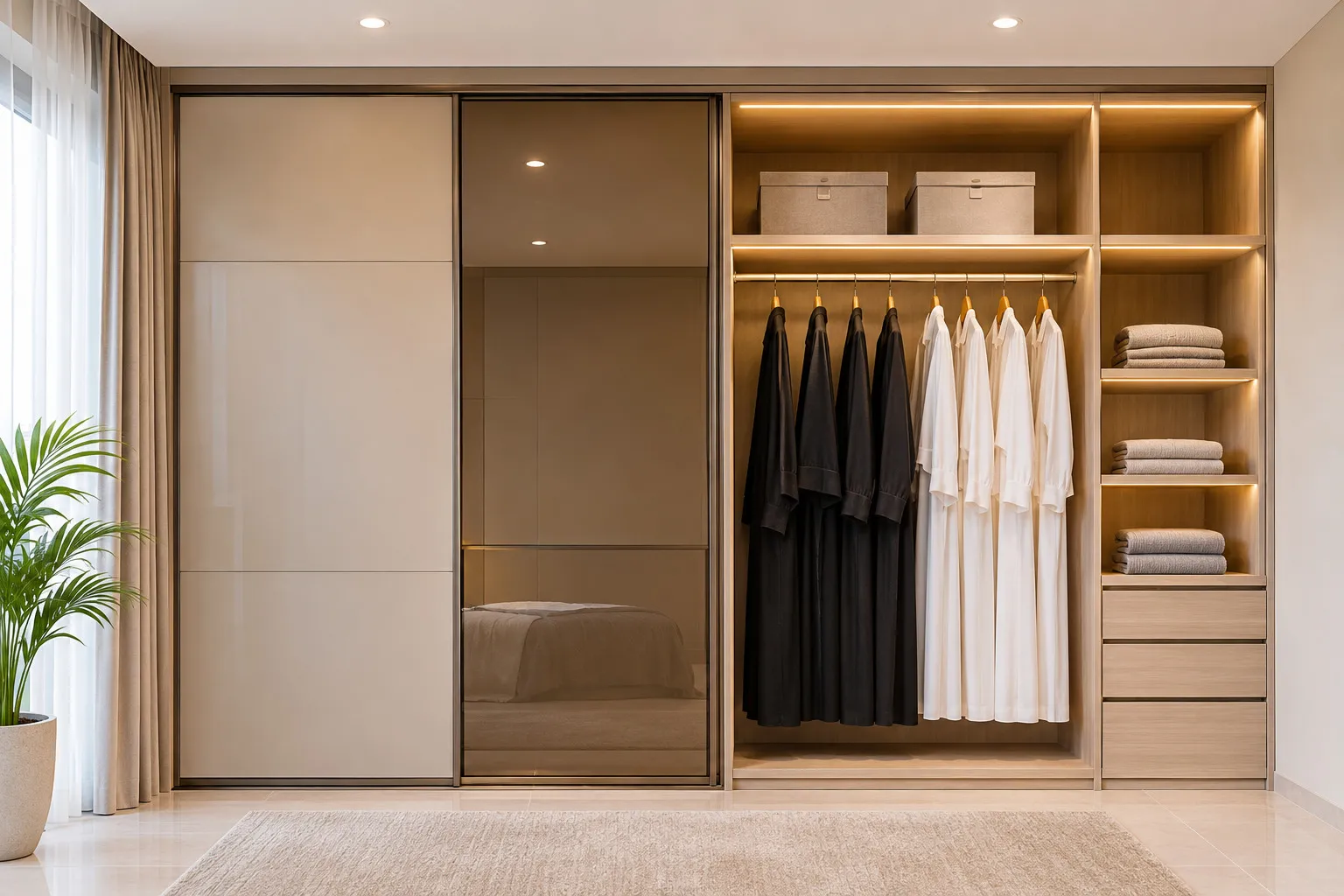
Key takeaways
- Top-hung (top-running) systems carry the leaf on a track above it; bottom-running systems carry it on rollers at the floor. Choose by the rating and the written specification, not by the label.
- A weight limit belongs to a system and a set, per door. Hettich lists TopLine L at up to 50 kg per door and its XL K2 sets at 60, 80 and 100 kg, so "up to 100 kg" describes one set, not every kit.
- Size limits work together with weight: for TopLine L the catalogue gives up to 2,600 mm high and 550 to 1,500 mm wide for two doors, so check your leaf against the kit supplied.
- A sliding unit stands further out than a hinged one: about 66 cm for the box plus about 5 cm for the track, one retailer's planning figure.
- A sliding-door quotation should name three things: the system, the rated weight per door and the door size.
On this page
- Key takeaways
- Sliding wardrobe door systems: the short answer
- Top-hung or bottom-running: how each system carries the door
- Top-hung vs bottom-running vs framed leaves: a decision table
- Top-hung, bottom-running and framed sliding leaves
- Sliding wardrobe door weight limit: why the rating belongs to the system
- Rated door weights in Hettich's published lists
- Sliding wardrobe door size: width, height and thickness limits
- Size limits published for two Hettich top-running systems
- Depth, the track and the ceiling: what a sliding system asks of the wardrobe
- Soft-close sliding doors: what the damper does and what to ask
- Adjustment, noise and care: what a sliding wardrobe asks of you
- What to ask for on the quotation: system, rated weight per door and door size
- Sliding-door lines to see in writing
- What we do about it: from visit to fitted doors
- Where we work, and what to send
- Common questions
Sliding wardrobe door systems: the short answer
A sliding wardrobe door system is the set of tracks, rollers, guides and dampers that carries each leaf, and the one fact worth taking from this page is that it is rated by the weight and the size of a single door (how height changes the limits is in our guide to tall wardrobe doors). Top-hung systems, which makers call top-running, carry the leaf on a track above it. Bottom-running systems carry it on rollers at the floor. Neither is better in every wardrobe; the right one depends on how heavy your leaves are, how large, how deep the unit is and what sits above and below the doors.
Do not accept the word "heavy-duty" as a rating. Ask the supplier to write down three things on the quotation: the maker and model of the system, the rated weight per door, and the size of your doors. Hettich's own lists show why. One of its top-running systems is rated for doors of up to 50 kg, while the largest system in the same range is sold as separate sets rated for 60, 80 or 100 kg, depending on the thickness of the door.
This page covers the hardware: system types, weight and size limits, depth, soft-close, adjustment and care. Still choosing between swinging and sliding doors? Start with our hinged or sliding wardrobe door guide, and to see what we build, open our sliding-door wardrobes page. For the pulls and grips on the leaves, see our wardrobe handles guide, which covers types, height and finishes. The drawing below is a side section with the three things a quotation must name.
If your wardrobe turns a corner or shares its wall with a dressing area, read our corner and L-shaped wardrobe guide and our dressing room design guide as well, because the door system has to suit the whole run and not only one wall. If you are also weighing a shop-bought unit against a made-to-measure run, custom or ready-made wardrobe shows where each wins in the UAE.
- 1. Top track: in a top-running system the leaf hangs from it
- 2. Floor guide or floor track: in a top-running system it only steadies the leaf, in a bottom-running one it carries the weight
- 3. Overlap: the leaves pass each other on separate runs, so one leaf always covers part of the opening
- 4. Depth stack: about 66 cm for the box plus about 5 cm for the track, 71 cm in all (one UK retailer's planning advice)
- 5. System: the maker and the model, not "heavy-duty sliding"
- 6. Rated weight per door: in kilograms, for the kit supplied
- 7. Door size: width, height and thickness of each leaf, to check against the system's limits
Top-hung or bottom-running: how each system carries the door
The two names describe where the weight of the leaf goes. In a top-hung system the leaf is suspended from runners in a track fixed above it. A part at the floor still exists, but it is a guide: it keeps the bottom edge from swinging, and does not carry the leaf. Hettich lists its TopLine range under the name top-running sliding door systems, and on its TopLine XL page it describes the floor guide as a profile recessed beneath the base panel, so it is almost hidden; what each track asks of the floor, ceiling and wardrobe body is set out in top-hung or bottom-running sliding wardrobe doors.
A bottom-running system turns this around. Hettich's own short film for its SlideLine range says the doors glide inside the cabinet body, supported by bottom rollers, and its page for the range lists systems for inset door positions, one of them for bottom-running glass doors. In plain terms the leaf stands on its rollers, and the part at the top keeps it upright.
What this means in a wardrobe is mostly a matter of what you will live with. A top-hung leaf puts the load on the top track and the panel it is fixed to, so that panel has to be strong and level. A bottom-running leaf puts the load on a floor track, which has to be level and has to stay clean. Our advice is to choose by the rating, the size limits and the written specification, not by the label "top" or "bottom". Ask which type you are being offered, and ask for the type in writing. If you want fronts without handles, the handleless wardrobe guide sets out the options.
The short animated film below is a maker's installation video for Hettich's TopLine L, a top-running system. It shows the parts of one system going together, so a runner, a guide and a soft-closing unit stop being abstract words.
Top-hung vs bottom-running vs framed leaves: a decision table
Framed leaves belong in this comparison because they are a different kind of choice. A frame, usually slim aluminium around glass or a mirror, describes how the leaf is built, not how it runs, so a framed leaf can hang from a top track or roll on a bottom one. What it changes is the weight the system must be rated for. The table keeps the three side by side, and every cell is either a figure from the source list below or planning advice. Mirror-faced leaves are a case of their own, and our mirror wardrobe doors guide goes through them. Whether your room can afford a walk-in wardrobe instead of a reach-in run is worth settling before the layout is fixed.
Top-hung, bottom-running and framed sliding leaves
Where the weight is carried
- Top-hung (top-running)
- On the top track; the floor part is a guide
- Bottom-running
- On rollers at the bottom, inside the cabinet
- Framed leaf (door build)
- Hangs or rolls, depending on the system chosen
What it asks of the floor
- Top-hung (top-running)
- No loaded track; a guide that can sit recessed (TopLine XL page)
- Bottom-running
- A track or roller path that must be level and kept clear (planning)
- Framed leaf (door build)
- The same as the system chosen
What it asks of the top panel
- Top-hung (top-running)
- Must be strong and level enough to carry the track (planning)
- Bottom-running
- Mainly guides the leaf (planning)
- Framed leaf (door build)
- A heavier leaf loads the panel more if the system is top-hung
Weight bands in Hettich's list
- Top-hung (top-running)
- TopLine L: up to 50 kg per door. TopLine XL: sets for 60, 80 and 100 kg
- Bottom-running
- SlideLine range: 10 to 50 kg door weight
- Framed leaf (door build)
- Glass and mirror add weight; ask for the rated weight of the finished leaf
Adjustment published
- Top-hung (top-running)
- TopLine L: height ±3 mm. TopLine XL K2: height ±3 mm, overlay ±10 mm
- Bottom-running
- Pending: ask for the maker's sheet for the kit
- Framed leaf (door build)
- The same as the system chosen
Our planning advice
- Top-hung (top-running)
- Choose when you want a clear floor line and the top panel can take the load
- Bottom-running
- Choose when the top cannot be loaded; keep the track clean
- Framed leaf (door build)
- Ask for the weight of one finished leaf before anything else
Figures are Hettich's own, for the named systems only; another maker's or an older kit's will differ. Rows marked planning are advice, not published limits. We do not name the system we fit here; ask us which one, and what rating it carries.
Sliding wardrobe door weight limit: why the rating belongs to the system
A weight limit does not belong to a wardrobe or to a type of door. It belongs to a system and, in some ranges, to one set of that system. Makers publish it per door, because the track and the rollers carry each leaf on its own. The question to put to a supplier is therefore not "how much can the wardrobe hold" but "what is the rated weight per door of the kit you are fitting, and what does my leaf weigh".
Hettich's figures show a wide spread. On its UAE page TopLine L is described as stable for a maximum of 50 kg door weight, SlideLine for small and medium-sized doors from 10 to 50 kg, and TopLine XL carries a load capacity of 100 kg at most. That last figure is the ceiling of the family, not a promise for every kit in it. The catalogue sells the XL K2 system in sets, one rated for 60 kg for doors from 18 to 30 mm thick, one for 80 kg for 22 to 30 mm, and one for 100 kg for 32 to 40 mm. A thick, heavy leaf needs the heavy set.
So treat a bare "up to 100 kg" on a leaflet as the strongest set of one system, and ask which set, and for which of your doors. And remember the weight of the leaf is something the supplier can state: glass and mirror weigh more than a board leaf of the same size, so tall glass fronts are exactly where the rating must be checked, not assumed. The board of the leaf and the fittings that go with it are covered in the wardrobe materials and hardware guide. What the labels on the board itself mean is in moisture-resistant wardrobe boards. Our page on wardrobe warranty in the UAE separates the board warranty from the workmanship warranty and explains the usual exclusions.
Rated door weights in Hettich's published lists
TopLine L
- Type
- Top-running
- Rated weight
- Up to 50 kg per door
- What the figure covers
- The L system, for its listed door sizes
TopLine XL K2
- Type
- Top-running
- Rated weight
- Sets for 60, 80 and 100 kg
- What the figure covers
- 60 kg: doors 18 to 30 mm thick. 80 kg: 22 to 30 mm. 100 kg: 32 to 40 mm
TopLine XL (range page)
- Type
- Top-running
- Rated weight
- 100 kg at most
- What the figure covers
- The family maximum, for specific sets only
SlideLine range
- Type
- Bottom-running
- Rated weight
- 10 to 50 kg door weight
- What the figure covers
- Small and medium-sized doors, per the range page
One maker's figures from its UAE page and its June 2022 catalogue. They are not a rule for other makers, and they do not say what any particular wardrobe uses.
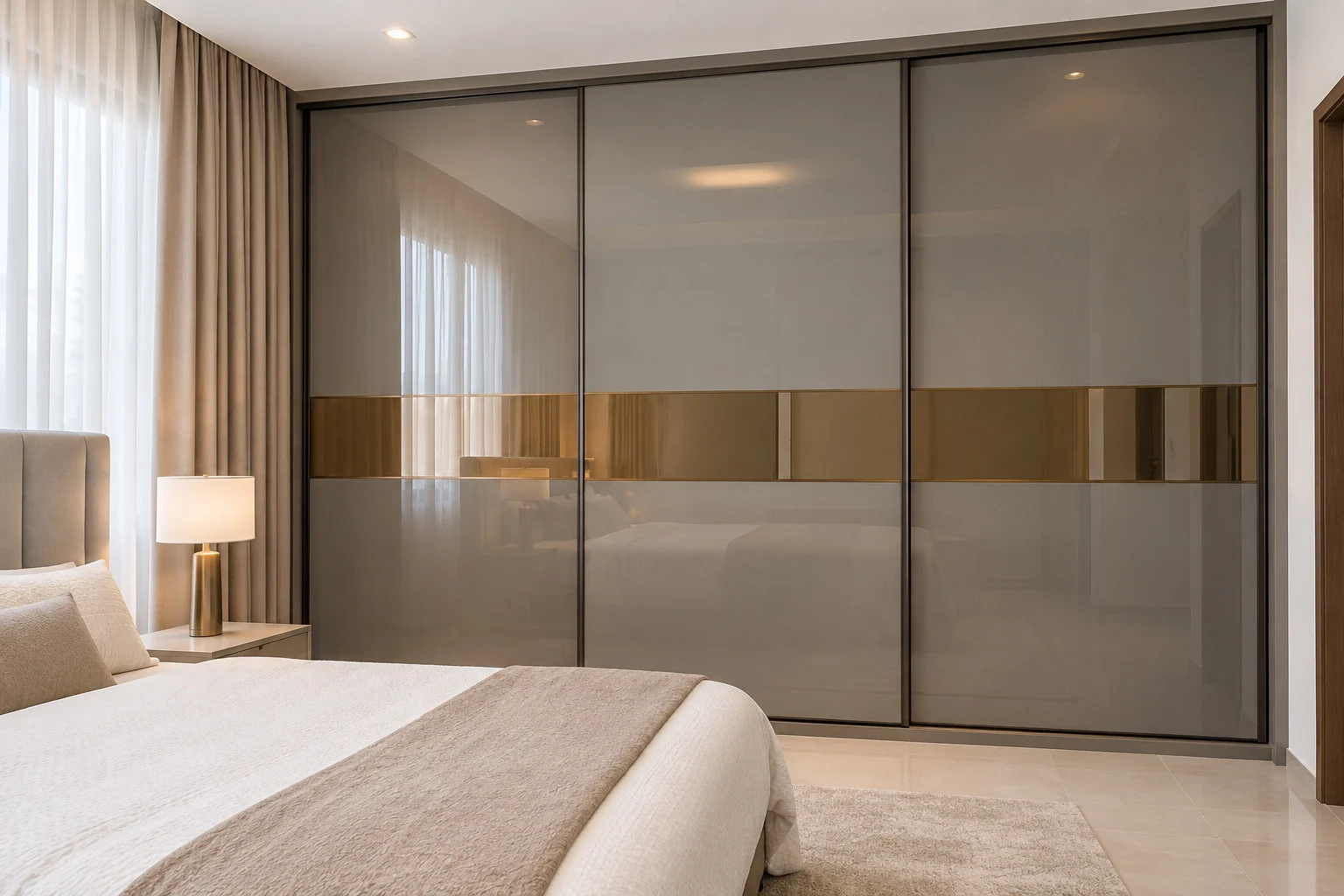
Sliding wardrobe door size: width, height and thickness limits
Weight is only one of the limits. A system also has an envelope for the width, the height and the thickness of the leaf, and these work together. The catalogue does not say that a door at the maximum width and the maximum height may also be at the maximum weight. The honest reading is that the figures are limits for the kit, and that the exact combination for your own door has to be checked against the kit you are buying.
For TopLine L the catalogue gives a height of up to 2,600 mm, widths from 550 to 1,500 mm for a two-door set and 550 to 1,350 mm for a three-door set, and thicknesses from 18 to 50 mm. TopLine XL K2 goes up to 3,000 mm in height and from 600 to 2,000 mm in width. Even within one maker the numbers move: an older XL planning sheet lists narrower widths for the same family, which is why the rating must come from the sheet for the kit that goes into your wardrobe.
Two practical points follow. A wardrobe that reaches the ceiling needs tall leaves, so the height limit of the system has to be set against the ceiling height we measure at your home. And a long wall is better served by more leaves than by wider ones; the three-door width limit above is smaller than the two-door one, so adding a leaf does not simply widen the allowance. A TV on the same wall changes the usable width once more; read wardrobe and TV unit planning. For a main bedroom shared by two people, see master bedroom wardrobe design.
You will also meet rules of thumb in retailer guides. FCI London, a UK fitted-wardrobe retailer, advises a sliding run of at least 210 cm and a panel of no more than 120 cm. That is advice from one retailer, not a limit from a track maker, and the specification of the system governs. Our wardrobe dimensions guide shows how widths and heights are planned, and the measuring visit guide explains how we record them. The guide to wardrobe hanging heights covers where each rail sits for shirts, dresses and long garments. Taking the wardrobe to the ceiling brings its own checks, listed in floor-to-ceiling wardrobes in the UAE.
Size limits published for two Hettich top-running systems
Door height up to
- TopLine L
- 2,600 mm
- TopLine XL K2
- 3,000 mm
Door width
- TopLine L
- 550 to 1,500 mm (2 doors); 550 to 1,350 mm (3 doors)
- TopLine XL K2
- 600 to 2,000 mm
Door thickness
- TopLine L
- 18 to 50 mm
- TopLine XL K2
- Set for 18 to 30, 22 to 30 or 32 to 40 mm
Rated weight
- TopLine L
- 50 kg per door
- TopLine XL K2
- 60, 80 or 100 kg, by set
Height adjustment
- TopLine L
- ±3 mm
- TopLine XL K2
- ±3 mm (overlay ±10 mm)
From Hettich's June 2022 catalogue of sliding and folding systems. Maximums are for specific sets, and the catalogue does not state that every maximum is allowed at once.
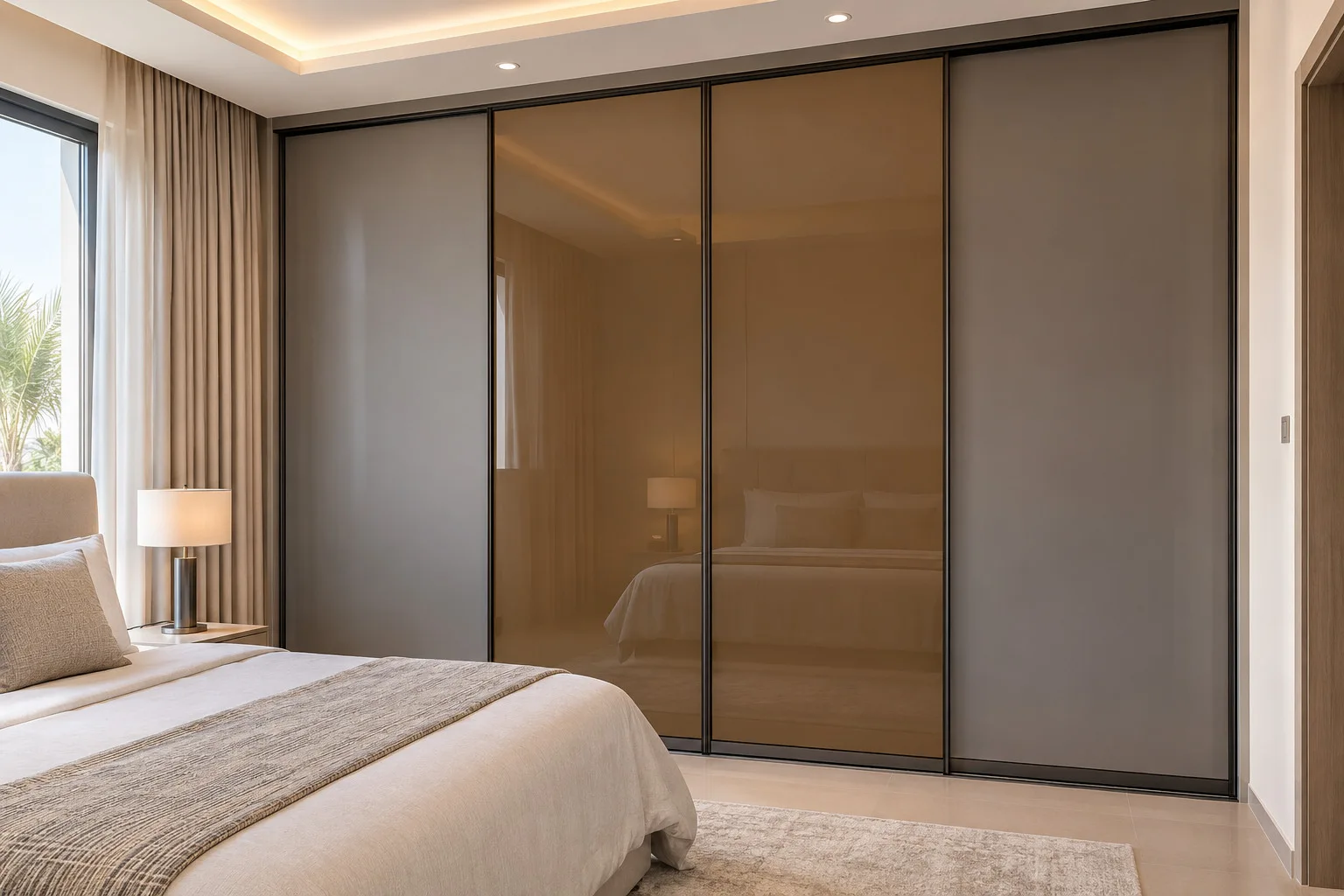
Depth, the track and the ceiling: what a sliding system asks of the wardrobe
Sliding leaves run in front of the box, so the unit stands further out from the wall than a hinged one. FCI London gives about 66 cm for the box plus about 5 cm for the track, 71 cm in all, against 60 cm for a hinged unit. Treat those as planning figures from one retailer. Whatever system is chosen is covered by its own specification, and a tight room may make a slim hinged run the more spacious choice; the plans in our small bedroom wardrobe ideas set the two side by side.
The leaves also overlap, so one of them always hides part of the interior, and drawers belong behind a leaf that can slide clear of them. With part of the interior covered at any moment, lighting inside the wardrobe earns its place. That overlap is what separates sliding from swinging doors, and it is set out in the hinged or sliding guide, so it is not repeated here. For hinge counts by door weight, soft-close and adjustment, see wardrobe door hinges. A run that includes footwear is covered in shoe wardrobe design, with pairs per shelf, depth, tilted shelves and ventilation.
What this page adds is the line the system draws on your room. The top track has to run straight and level along the whole wall, and a floor guide or floor track has to do the same, so we check the ceiling and the floor along the full run when we measure, not only at the corners. Beams, a lowered ceiling section and skirting boards are noted too, and the drawing sets the track line and the leaf heights to suit them; our false ceiling designs guide shows how such lowered sections are formed. Planning to convert an existing wardrobe from swinging to sliding? Remember the new depth: a wardrobe that is too shallow for a track cannot simply be given new leaves. The finishes for new leaves are compared in wardrobe door finishes compared, and what new doors can and cannot change about a musty smell is in why a wardrobe smells musty; for a run against a bathroom or outside wall, see what to check first for a wardrobe against a bathroom wall. Tenants have their own questions, covered in our guide to a wardrobe for a rented apartment, including what to ask the landlord in writing.
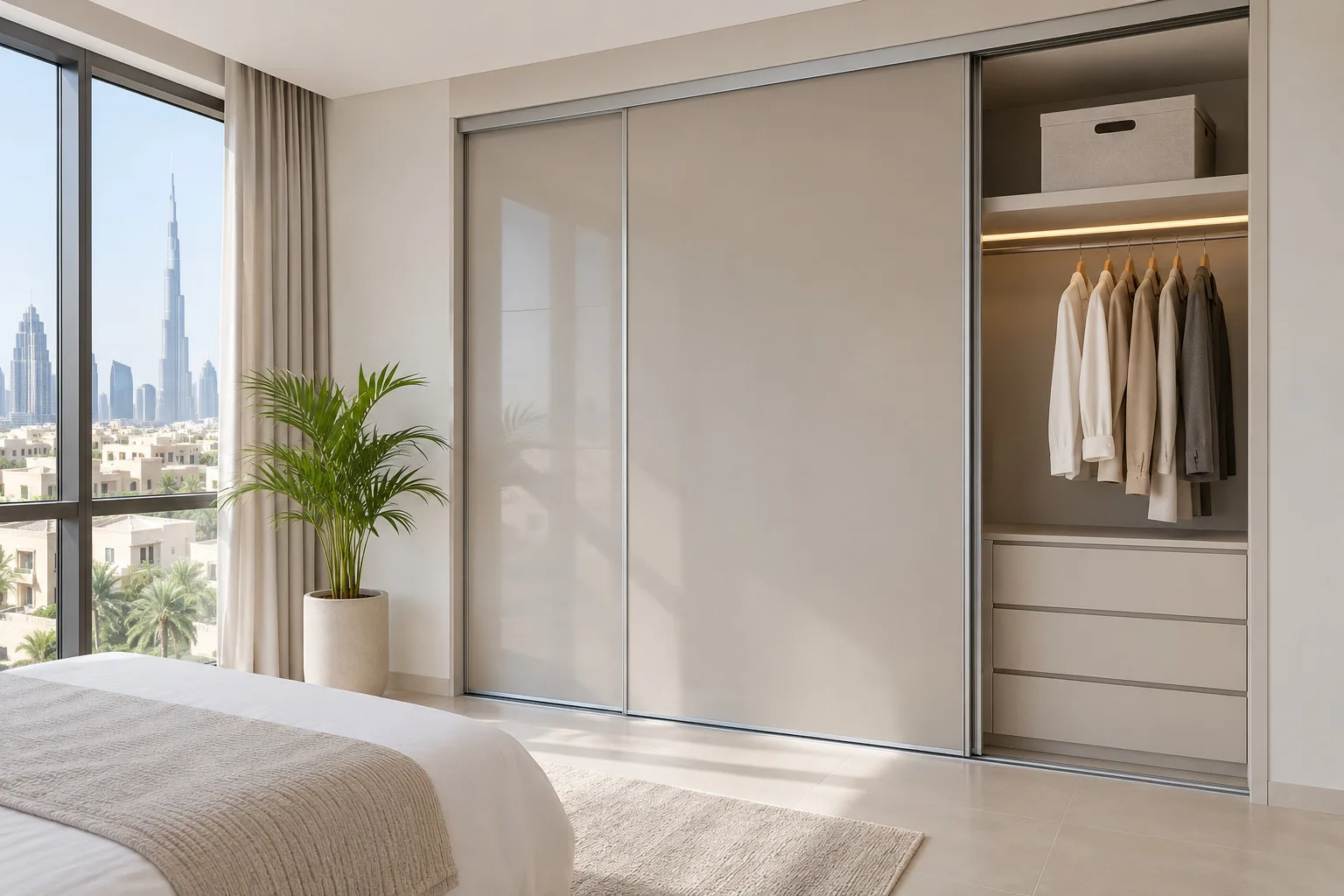
Soft-close sliding doors: what the damper does and what to ask
Soft-close on a sliding door is a damper that slows the leaf near the end of its travel so that it does not bounce off the end stop. In Hettich's range it is called the Silent System. On its TopLine XL page the damper slows the doors gently as they near the end, needs no activation, and starts working automatically after the first closing. For SlideLine the page describes damping in the opening, closing and collision directions, built into the running component.
Two things follow for a quotation. A damper is a fitted part, so it should be named as a line, and not hidden in the words "soft-close". And the direction matters: ask which of the movements the damper in your quotation covers. The benefit is practical rather than grand: no banging, less wear on the stops, and a gentler touch for children's hands, which is why it is worth having in a child's room; the guide to a kids' wardrobe covers that room.
A damper does not make a system heavier-rated and does not replace the rating. A leaf that is too heavy for its kit will be a problem with or without a damper, so read the weight line first and the soft-close line second. The habit travels to other rooms: a motor on a curtain track is chosen together with the track and the weight it must carry, as our motorised curtains guide explains. Doors that stick or leave the rail are covered in fixing a sliding wardrobe door off its track, including what not to do.
Adjustment, noise and care: what a sliding wardrobe asks of you
A sliding leaf is not fixed once and forgotten. Good systems let the leaf be adjusted, and the published figures are small, which is a sign of how fine the work is: TopLine L allows ±3 mm of height adjustment, and TopLine XL K2 ±3 mm of height and ±10 mm of overlay. Hettich's TopLine XL page says the height is adjusted from the front, so the gap can be checked at once, and the overlay can be changed with the door closed and without tools. Its Technical Assistant site for TopLine L offers videos for overlay and height adjustment.
That is why a leaf that drags, leaves an uneven gap or sits out of line is usually a case for adjustment, not replacement, as long as the system has an adjustment range. For other systems, ask for the adjustment method of your kit when you receive it; we do not publish a universal procedure because makers differ, and we would rather you tell us than force a leaf. For doors that stick, rub or sag, our guide on how to fix a wardrobe door that is sticking covers the first checks.
Care is plain and short. If your wardrobe has a floor track, vacuum it from time to time so that grit does not make the leaves run rough, and keep the guide clear. Do not slam the leaves against the stops. Ask for the maker's care sheet for the system named on your quotation, because cleaning and lubrication advice differs between makers and we do not give a general one here.
If a track or its rollers have worn out in an existing wardrobe, they can be replaced without a new wardrobe; see wardrobe door replacement for when that applies. For what our written warranty covers, see the warranty and aftercare guide. Whether the whole wardrobe is worth keeping is decided in our old wardrobe renovate-or-replace guide, symptom by symptom. For the depth figures behind this, see our wardrobe depth guide.
What to ask for on the quotation: system, rated weight per door and door size
If you are comparing two sliding-door quotations, you cannot compare them until each of them says the same few things. A line that reads "sliding doors, soft-close" tells you almost nothing, and a lower price may simply describe a lighter system. Our wardrobe quotation checklist covers the whole quote line by line; this table is its sliding-door extension, and it is the one to take to any supplier, including us.
The wardrobe price guide and the pricing guide show what a whole wardrobe costs and how the entry price is built.
The same line-by-line reading works for other quotations too; our guide to custom curtain prices applies it to curtains. Check that the doors have room to open too: our guide on how much room a wardrobe door needs covers the swing against beds, desks and corners.
Sliding-door lines to see in writing
System
- What it should say
- Maker and model, and whether it is top-running or bottom-running
- Why it matters
- Limits are set per system, so "heavy-duty sliding" cannot be checked
Rated weight per door
- What it should say
- The kilograms for the kit supplied, and for which set if the system has several
- Why it matters
- A leaf must sit under the rating, and glass or mirror leaves weigh more
Door size
- What it should say
- Width, height and thickness of every leaf
- Why it matters
- They must fall inside the system's size limits for that kit
Number of leaves and runs
- What it should say
- Leaves per run, and how many runs
- Why it matters
- Width limits can differ between a two-door and a three-door set
Soft-close
- What it should say
- Whether a damper is fitted and which movements it covers
- Why it matters
- It is a part with its own cost, not a word
Depth
- What it should say
- Box depth and track depth, as drawn
- Why it matters
- The unit must stand deep enough for the track
Adjustment and spare parts
- What it should say
- How the leaf is adjusted, and the model named for later parts
- Why it matters
- A named model lets a replacement part be found years later
Sliding doors are priced above the entry specification and show as their own line in a quotation.
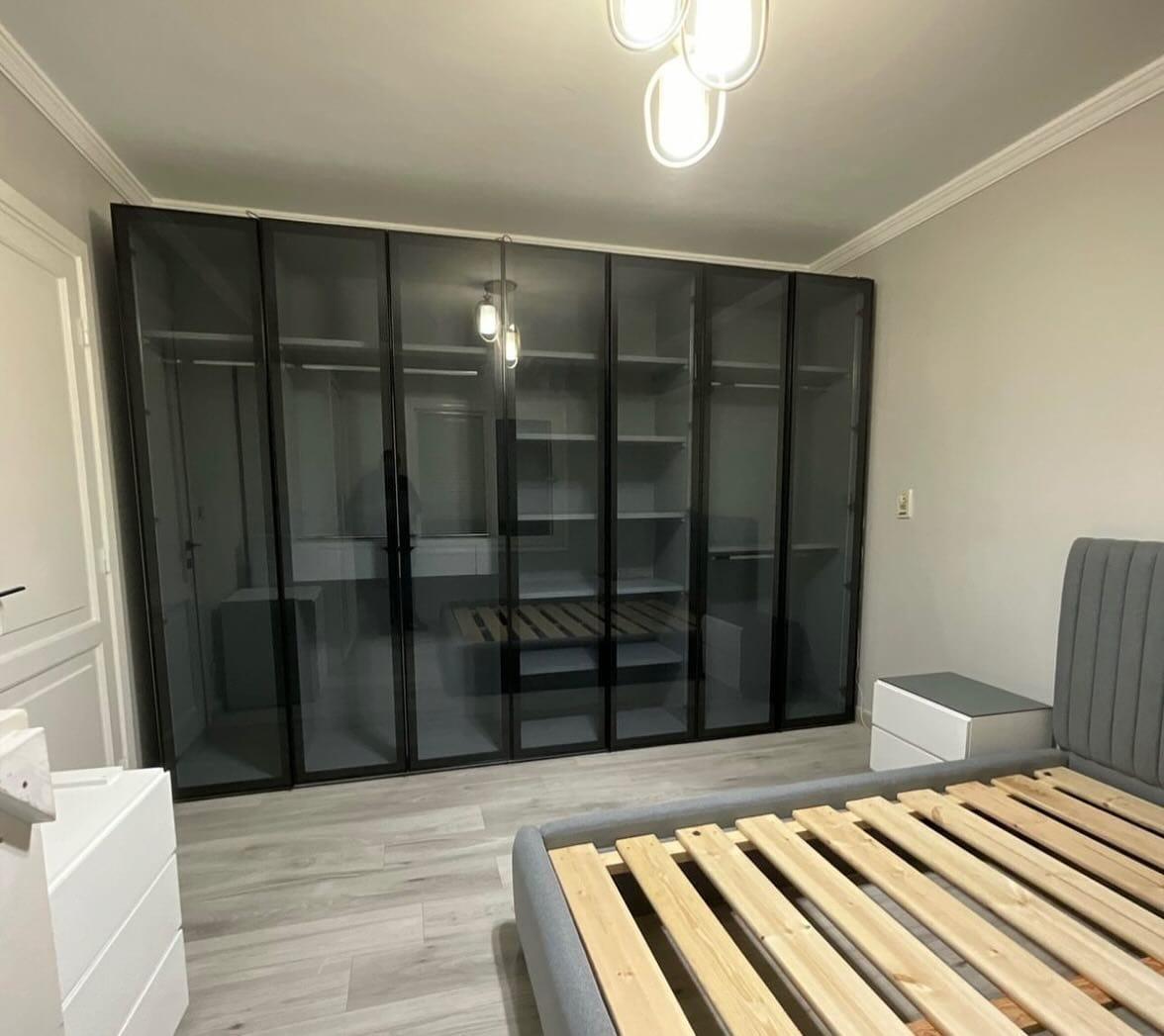
What we do about it: from visit to fitted doors
This section lists only what we publish about working on a wardrobe with sliding doors. Which system a particular job uses is not claimed in this guide. Ask us which system and what rating it carries, as you would ask any supplier, and ask for it in writing.
The visit is free. We bring laminate, veneer and glass samples, go through what each person stores, and measure the room with a laser, including the floor in front of the wall and the ceiling line. After that you receive a drawing, which draws each door both shut and open, and an itemised price. Our entry specification starts from AED 550 per sqm of wardrobe front, installed, for MDF laminate with hinged doors; sliding doors raise that figure and appear as their own line, and nothing is made until you approve the drawing and the price.
The wardrobe is made in our workshop in Sharjah and fitted by our own installers, up to about 10 days after you confirm the order, depending on size and design. Our written workmanship warranty runs for 24 months, while supplied products follow their makers' written terms. Separately, the wood-based boards carry a 5-year limited warranty, subject to terms; hinges, tracks, runners, rollers and other moving hardware are not covered, and the final terms are in the written warranty. See our custom wardrobes service and the free measuring visit to start.
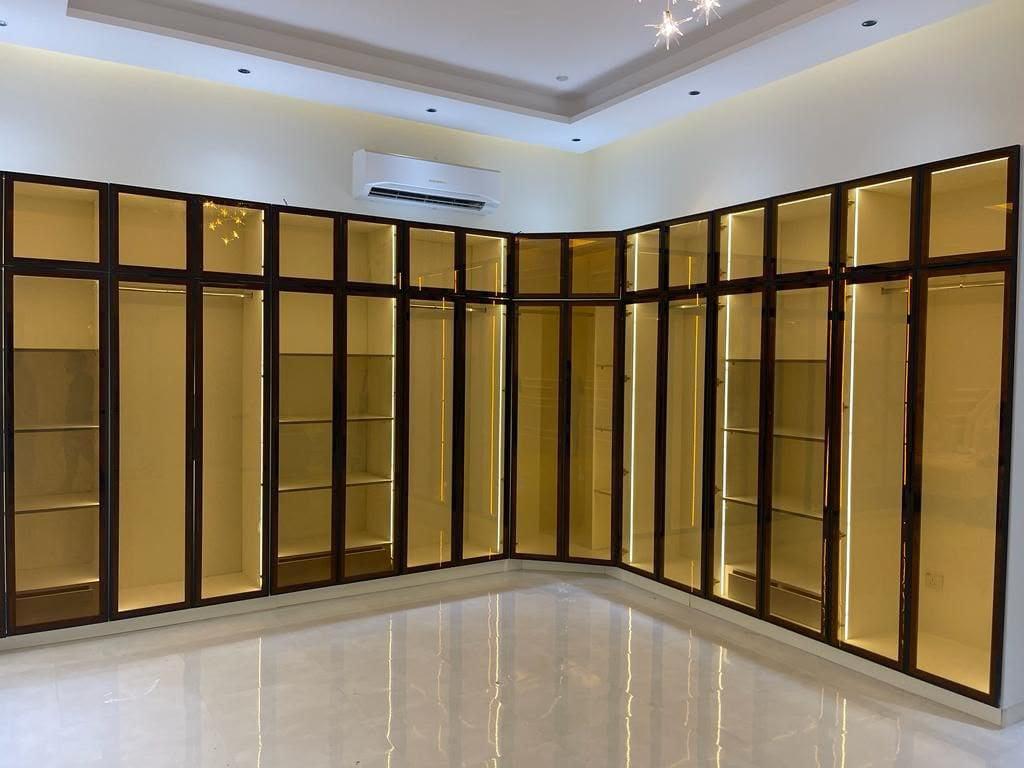
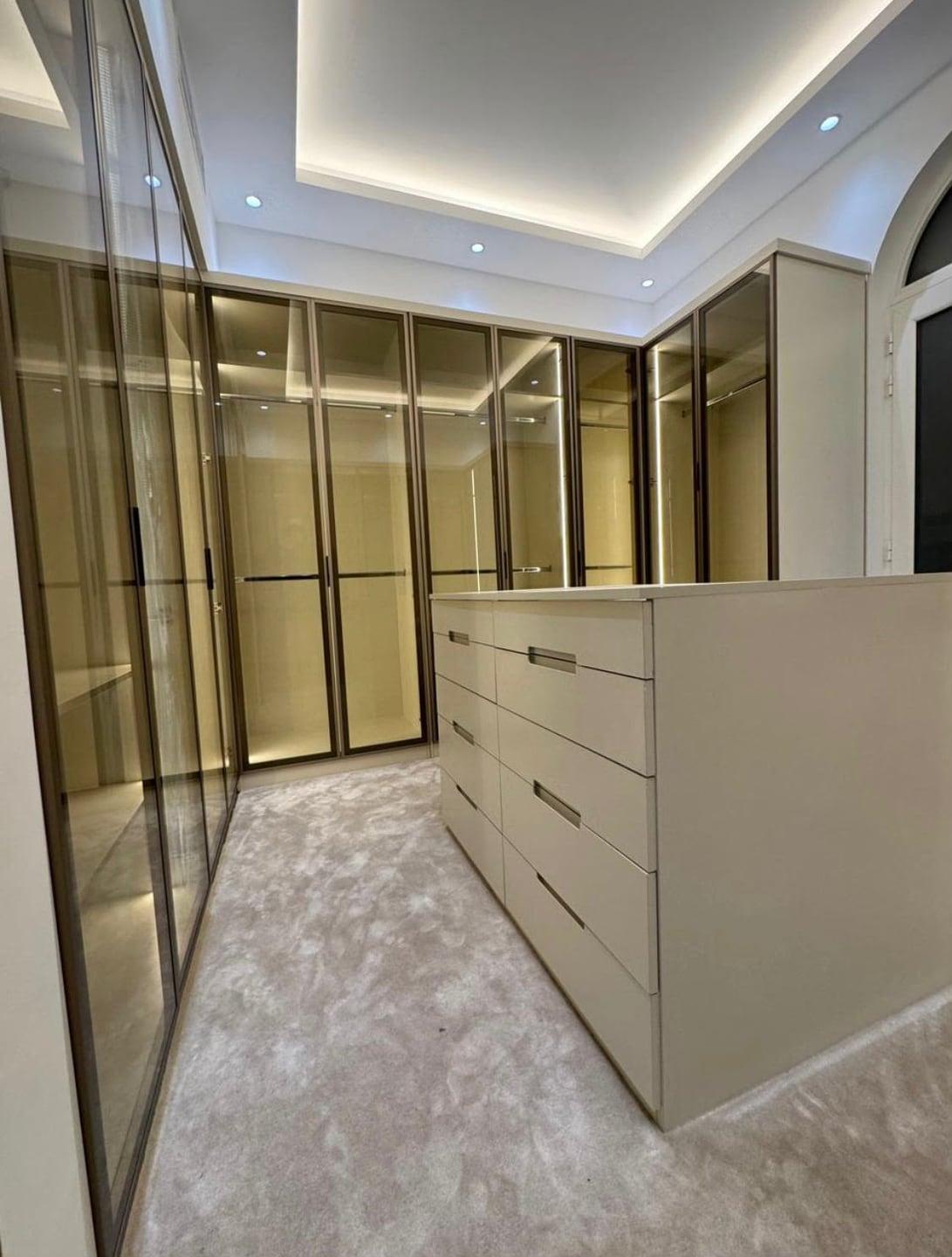
Our built-in wardrobes show the other door type on finished work, and our lit glass-front wardrobes show framed glass leaves with lighting behind them. When two people use one wall, our guide to a shared wardrobe for a couple explains how to split hanging length fairly.
Doors are step three of five; the complete wardrobe guide covers the steps before and after them.
Where we work, and what to send
Our workshop and showroom are in Al Shuwaiheen, Sharjah, open every evening: Saturday to Thursday from 9:00 AM to 11:00 PM, and on Friday from 5:00 PM to 11:00 PM. The Sharjah page has the address. Warm or neutral light, strip or profile: our wardrobe LED lighting comparison goes through the choices.
- Ajman: our workshop is less than 10 km from areas such as Al Nuaimiya, and visits are scheduled ahead. See wardrobes and joinery in Ajman.
- Abu Dhabi: visits are booked ahead, and a large job is measured and drawn on one trip. See Abu Dhabi.
- Dubai and the other emirates: say which area you are in when you message us and we confirm the visit. See Dubai and our wardrobe design and fitting service.
- To prepare, a rough width for each wall, the ceiling height and one photo of the wall are enough. The wardrobe measuring visit guide lists the rest, and the wardrobe interior layout guide helps you plan what sits behind each leaf. Sliding leaves suit a room where the bed is close, as in a wardrobe for a studio apartment; behind them, see abaya and kandura storage, luggage and seasonal storage and wardrobe drawers and organisers.
Common questions
What is the difference between top-hung and bottom-running sliding wardrobe doors?
In a top-hung system the leaf hangs from a track above and a floor guide only keeps it steady; in a bottom-running system the leaf rolls on rollers at the floor and the top keeps it upright. Makers rate both per door, so ask for the system and its rating. See the hinged or sliding wardrobe door guide.
How much weight can a sliding wardrobe door hold?
It depends on the system and the set, not the wardrobe. Hettich lists TopLine L at up to 50 kg per door and its XL K2 sets at 60, 80 and 100 kg by door thickness, so ask for the rated weight of your kit. See the wardrobe quotation checklist.
How wide and how tall can a sliding wardrobe door be?
Each system has its own limits. For TopLine L the catalogue gives up to 2,600 mm high and 550 to 1,500 mm wide for a two-door set, and 550 to 1,350 mm for three doors, so check your own leaf against the kit supplied. See the wardrobe dimensions guide.
How deep does a wardrobe with sliding doors need to be?
One UK retailer advises about 66 cm for the box plus about 5 cm for the track, 71 cm in all, against 60 cm for hinged doors; the system's own sheet overrules a rule of thumb. We confirm the depth in the drawing after measuring. More on tight rooms: small bedroom wardrobe ideas.
Are soft-close sliding wardrobe doors worth it?
A damper slows the leaf near the end of its travel so it does not bounce off the stop, and it is gentler on children's hands, and the shared kids bedroom wardrobe guide looks at doors in a room two children use. It does not raise the weight rating, so read the weight line first. See our sliding-door wardrobes.
Why is my sliding wardrobe door stiff or coming off its track?
Grit in a floor track, a leaf out of adjustment or a worn roller is the usual suspect, and many systems have an adjustment range, so tell us rather than force the leaf. A worn track can be replaced without a new wardrobe. See our wardrobe door replacement guide.
What should a sliding wardrobe quotation say about the doors?
It should name the system by maker and model, the rated weight per door for the kit supplied, and the size of every leaf, plus the soft-close and the depth. A line that only says "heavy-duty sliding" cannot be checked. See the measuring visit guide.

Sources & specifications
Manufacturer information applies to the named products and systems. Sources reviewed on 3 November 2026.
- Hettich UAE: sliding door systems (TopLine XL "100 kg max", TopLine L "max. 50 kg door weight", SlideLine bottom-running from 10 to 50 kg door weight)hettich.com(opens in a new tab)
- Hettich UAE: TopLine XL top-running sliding door system (Silent System, height and overlay adjustment, recessed bottom guide)hettich.com(opens in a new tab)
- Hettich UAE: TopLine L sliding door system (doors up to 50 kg, adjustable reveal)hettich.com(opens in a new tab)
- Hettich UAE: SlideLine bottom-running systems (inset door positions, damping in three directions)hettich.com(opens in a new tab)
- Hettich Technical Assistant: TopLine L (overlay and height adjustment videos, assembly instructions for 2-door and 3-door sets)hta.hettich.com(opens in a new tab)
- Hettich sliding and folding systems catalogue of June 2022 (load, size and adjustment figures for TopLine L and XL K2)web.hettich.com(opens in a new tab)
- FCI London, wardrobe depth guide (one UK retailer's planning advice: 66 cm plus a 5 cm track, a run of at least 210 cm, panels up to 120 cm)fcilondon.co.uk(opens in a new tab)
- Hettich India on YouTube: Bottom Running Sliding System, SlideLine M (bottom rollers inside the cabinet body)youtube.com(opens in a new tab)
- Hettich Group on YouTube: Installation highlights, sliding door system TopLine L (2021)youtube.com(opens in a new tab)
Want this planned for your home?
Consultation and measurement are free. Tell us the rooms, location and what you need; we arrange a sample visit and define the measured quotation.