Wardrobes · 15 min read · 22 July 2026
Wardrobe handles: types, height, finishes and what to ask for
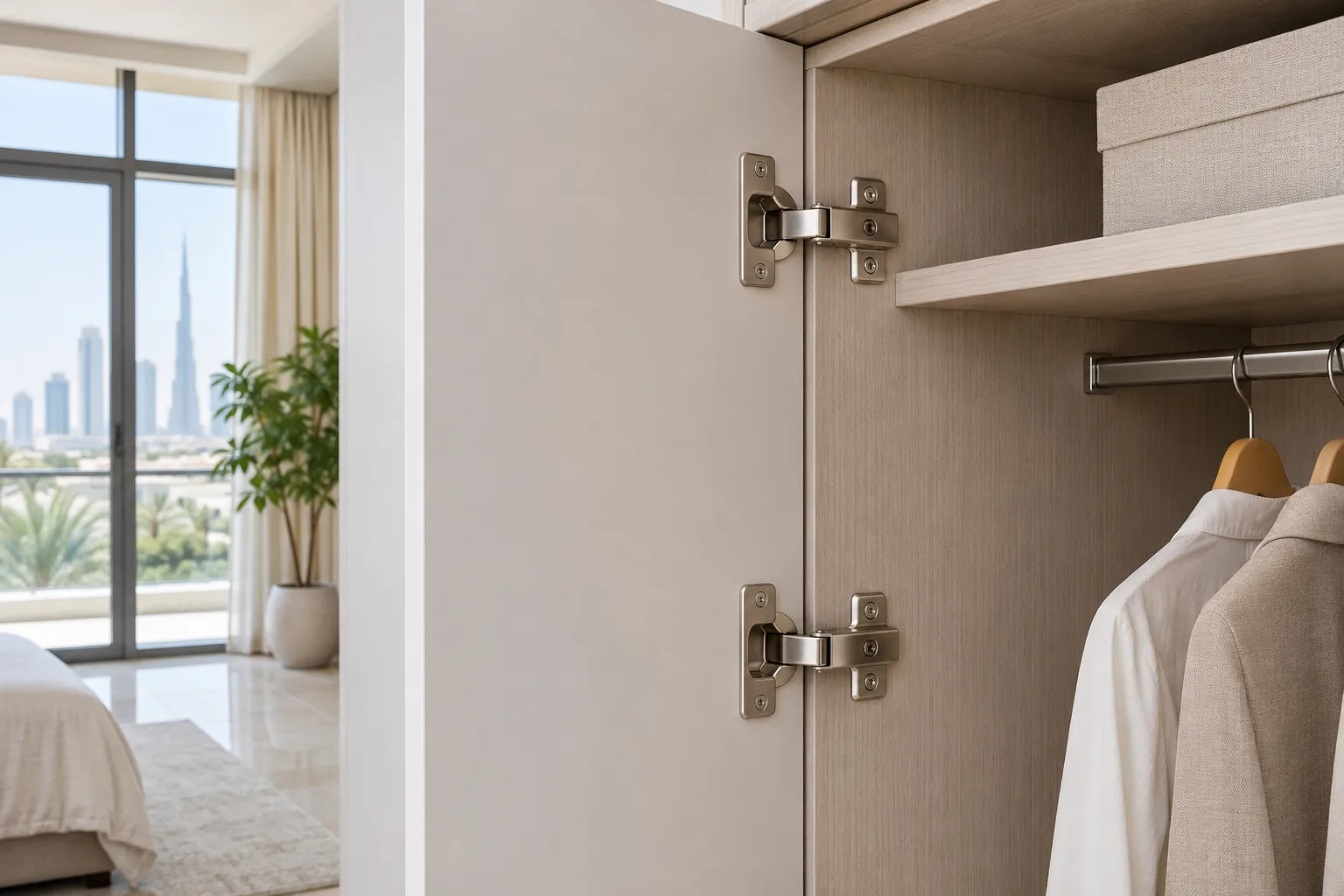
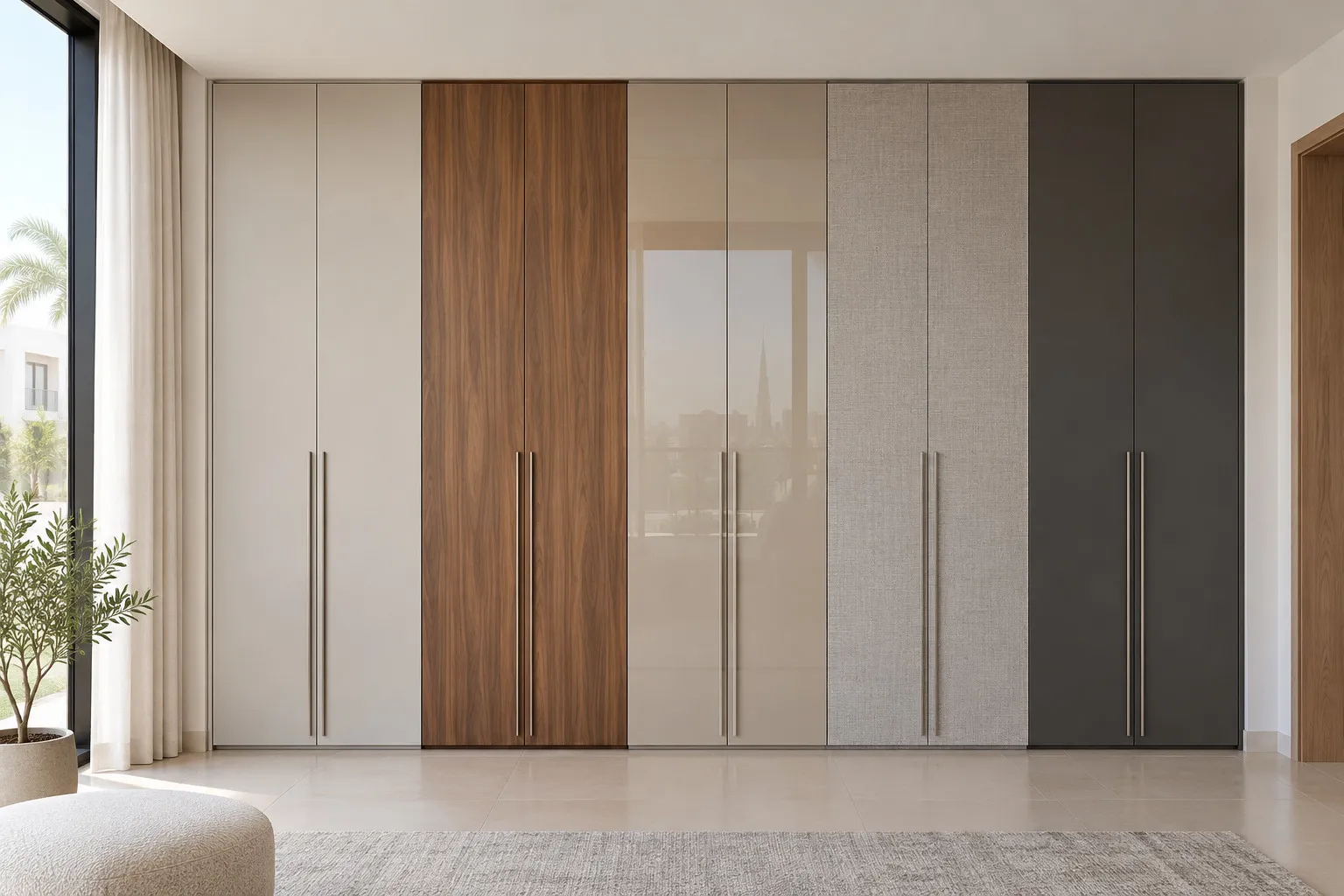
Wardrobe handles come as bars, knobs, edge pulls, recessed pulls, finger grooves and push-to-open latches. Plan adult handles at about 900 to 1100 mm, vertical on doors and horizontal on drawers; choose a finish you can wipe and dry, and ask for each handle's type, size, height and finish on the quotation.

By Ali Haider Basra, Founder, Al Tareeq Decor · Contact our workshop
Key takeaways
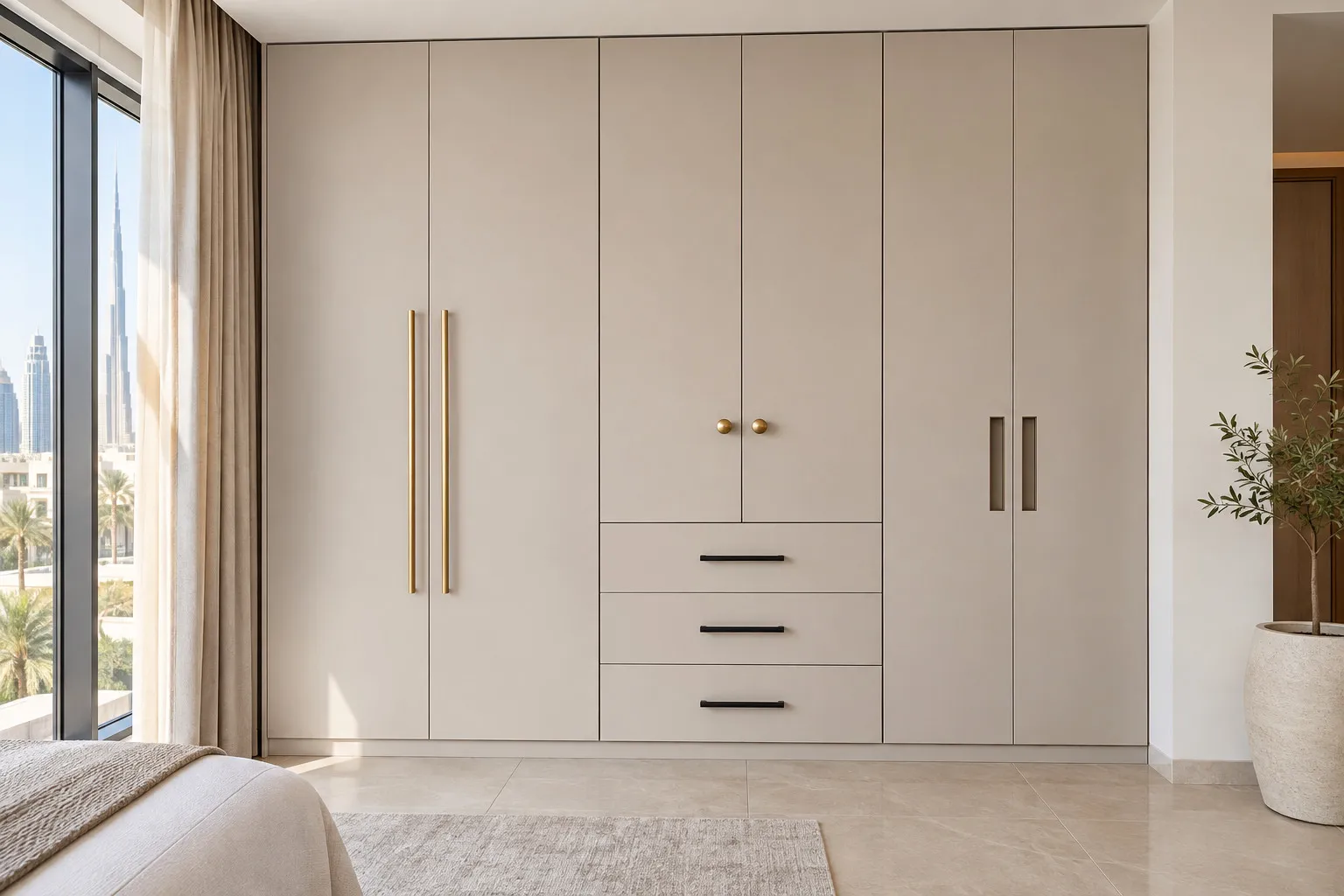
- Six shapes cover wardrobe handles: bar or long pull, knob, edge pull, recessed pull, finger groove or profile, and push-to-open. Choose by door: recessed or edge pulls for sliding doors, long vertical pulls for tall hinged doors.
- Dowsing & Reynolds gives 900 to 1100 mm from the floor for most wardrobes, 750 to 900 mm for children and 1100 to 1200 mm for tall users, and a wardrobe for two children sharing a bedroom looks at how two heights share one run. It is one supplier's planning range; tape the handles up before drilling.
- Run pulls vertically on doors and horizontally on drawers, on the side away from the hinge. The 2.5 to 5 cm edge distance is the same supplier's kitchen guidance, not a wardrobe rule.
- Finishes wear in different ways: lacquered brass must not be polished, and once a black or powder coat has worn through, cleaning will not restore it; the handle colour against the door is covered in wardrobe colour combinations. Ask what the finish is made of.
- We offer both modern handleless and traditional designs, and for framed traditional doors see classic and shaker-style wardrobes. Handle brand and finish are not in the published price: ask for them as lines in the quotation.
On this page
- Key takeaways
- Wardrobe handles in short: types, height and finish
- Wardrobe handle types and where each one suits
- Handle types compared by door and drawer
- Handle height and position: what the sources say
- Which handle for which door
- Handle choices by door and drawer type
- Modern handleless fronts and traditional doors with handles
- Finishes that wear: brass tone, black and chrome
- Handle finishes and their care, from the sources opened
- Cleaning handles and keeping them hygienic
- Handles in kids' rooms, shared wardrobes and rentals
- What to ask for on the quotation
- Handle questions for a wardrobe quotation
- What we do about handles
- Common questions
Wardrobe handles in short: types, height and finish
Six handle shapes cover almost every wardrobe: a bar or long pull, a knob, an edge pull, a recessed pull, a finger groove or edge profile, and a push-to-open latch with no handle at all. Fix adult handles around 900 to 1100 mm from the floor, which is the range Dowsing & Reynolds, a UK door-furniture supplier, gives for most wardrobes; run pulls vertically on doors and horizontally on drawers; and choose a finish you are willing to wipe and dry.
This page is the handle itself. If you are still deciding between handles and a handleless front, our handleless wardrobe against handles guide compares the opening methods, finger safety and cost direction; read it first if that is your question. Here we assume a handle is on the table and look at the types, where each suits, the height and position, how finishes wear, cleaning, and what to write on a quotation.
The handle is a small line on a quotation and the part your hand touches every day, so it is worth settling before the doors are cut. The hinges behind it are covered in our wardrobe hinges guide, and the general checklist is in the wardrobe quotation checklist.
Wardrobe handle types and where each one suits
The names overlap between makers, so we use plain descriptions and say what each shape does. The table sets them side by side by the door or drawer they suit. Where a maker is the source for a shape, we say so, and we do not claim that one maker's product speaks for the whole type.
Two points sit under the table. A long vertical pull gives the whole hand a grip on a full-height door, which is why it is common on tall doors, and on a very long door it also lets different family members each hold it at their own height. Knobs are small, so Dowsing & Reynolds suggests pulls for the wardrobe and knobs for the drawers, and says larger wardrobes benefit from pulls because they give more surface to grip.
Handle types compared by door and drawer
Bar or long pull
- What it is
- A bar fixed at both ends, standing off the door face
- Suits
- Hinged doors, drawers, upper cabinets
- Watch for
- Size it to the door: a small handle on a large door is harder to use
Long vertical pull
- What it is
- A bar run along the height of the door edge
- Suits
- Tall hinged doors, glass-panel doors
- Watch for
- Keep the grip zone inside the comfortable height band, not at the top or bottom
Knob
- What it is
- A single small grip, round or square
- Suits
- Drawers, small upper doors
- Watch for
- Less to hold on a heavy or tall door
Edge pull
- What it is
- A grip fixed to the edge of the door or drawer, giving a lip to hold when it is shut (Sugatsune)
- Suits
- Drawers, doors with a slim, flush look
- Watch for
- Needs fingers to reach behind the edge; check it on a sample
Recessed pull
- What it is
- A cup or channel set back into the panel (Sugatsune)
- Suits
- Sliding doors, where a standing handle would catch the other leaf
- Watch for
- Needs a cut-out in the panel and precise fitting
Finger groove or edge profile
- What it is
- A cut or an aluminium channel in the door edge: gola profiles (Emuca) open doors "by means of a system of grooves"
- Suits
- Flat modern fronts on hinged doors and drawers
- Watch for
- The door is cut for it, so it cannot be swapped later
Push-to-open
- What it is
- A latch, with no grip; Blum's TIP-ON is "touch to open" and works mechanically
- Suits
- Short flat doors and drawers, where a press is natural
- Watch for
- Needs the matching hardware and a clean front gap; ask who supplies it
Types and wording from Sugatsune, Emuca and Blum product pages and Dowsing & Reynolds, opened 4 Nov 2026. We do not publish a handle brand; ask for it in the quotation.
Handle height and position: what the sources say
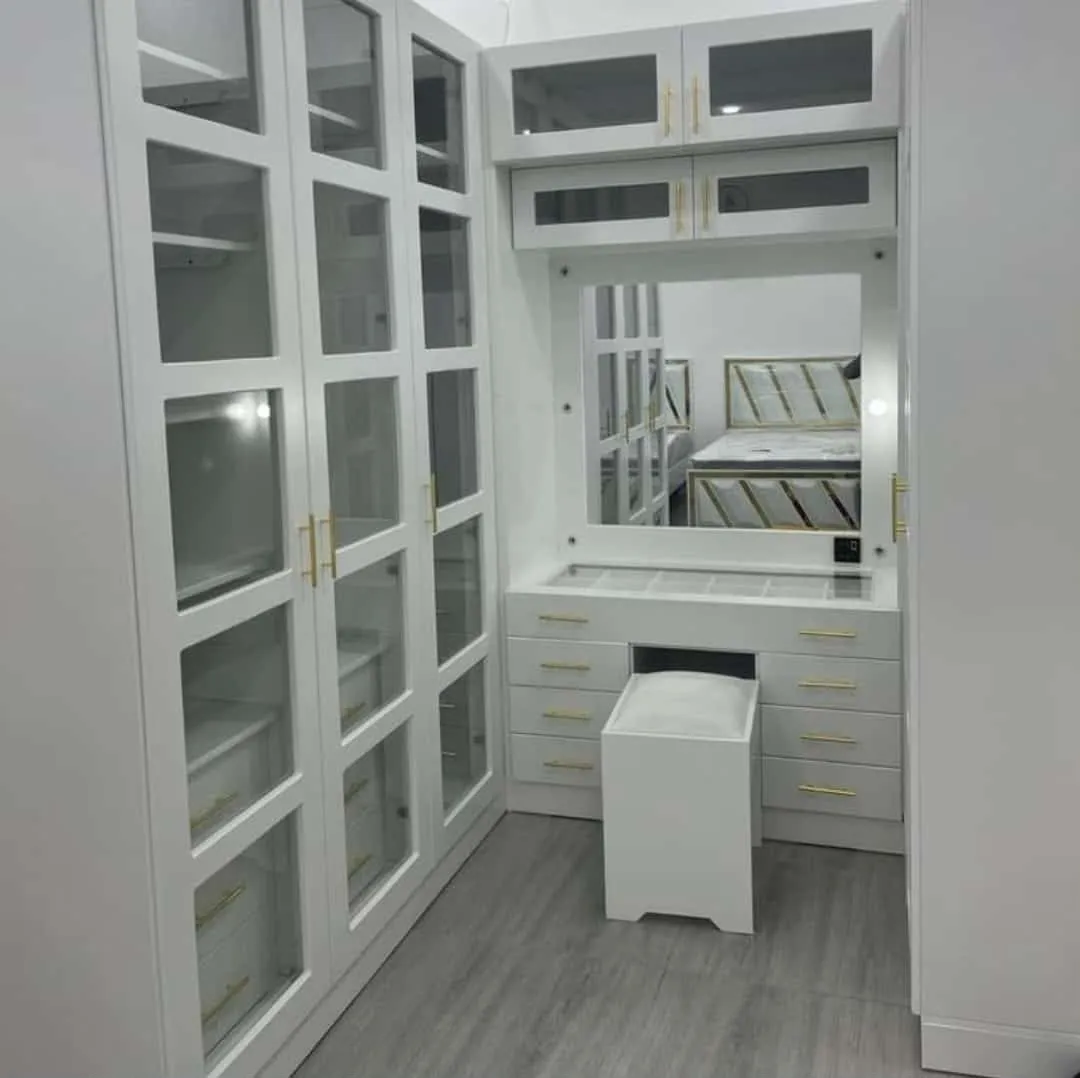
Dowsing & Reynolds says wardrobe handles are generally installed around 900 to 1100 mm from the floor, a little lower for a child's wardrobe, around 750 to 900 mm, and a little higher for a tall user, around 1100 to 1200 mm. That is one supplier's planning range, not a standard, and it is what the drawing below shows. The same supplier says to line the handles up across a run with a spirit level or a template, and to tape them in place before drilling.
For position on the door, the supplier's kitchen guide gives three rules that carry over in spirit: put the handle on the side away from the hinge for the best leverage, run pulls vertically on doors and horizontally on drawers, and centre a single drawer pull on a drawer less than 24 inches wide, using two handles or one longer one on a wider drawer. It also puts handles about 2.5 to 5 cm in from the door edge. That is kitchen guidance, written for cabinet doors that are not full height, so use it for the distance from the edge and not for the height.
What to do with a 2.4 m door is our own planning view: set the grip, not the end of the handle, inside the comfortable band, and let a long vertical pull run above and below it. The numbers on the drawing, 2400 mm for the wall and the sizes of the doors and the pull, are illustrative and not sourced.
The visit is where this is settled. We bring the room's real heights into the drawing, and the wardrobe measuring visit guide shows what is checked. If the rail height matters too, see the wardrobe hanging heights guide; the overall sizes are in the wardrobe dimensions guide.
- 1. The wall: a front view with a ruler from the floor, 2400 mm high here for illustration
- 2. Doors: long vertical pulls on the side away from the hinges
- 3. Adults: the 900 to 1100 mm band from the floor, with a horizontal bar centred on each drawer
- 4. Children 750 to 900 mm and tall users 1100 to 1200 mm: the lower and upper bands
- 5. Tape the handles in place at the visit before anything is drilled
Which handle for which door
The door decides the handle more than taste does. A sliding door's panels pass each other, so a handle that stands out can catch the other leaf; Sugatsune says its recessed pulls suit sliding doors because the panels slide past each other without catching on the handles. Our sliding door systems guide covers the track side, and if a door leaves its rail, see fixing a sliding wardrobe door off its track. The depth a sliding track adds is covered in how deep a wardrobe should be.
A hinged door can carry any shape, so the choice is the look and the reach. Long doors suit long vertical pulls; short upper doors suit a short bar or a knob. For the swing, check the room: the wardrobe door clearance guide shows what a handle adds to the space a door needs, and the choice between hinged and sliding is in hinged or sliding wardrobe doors.
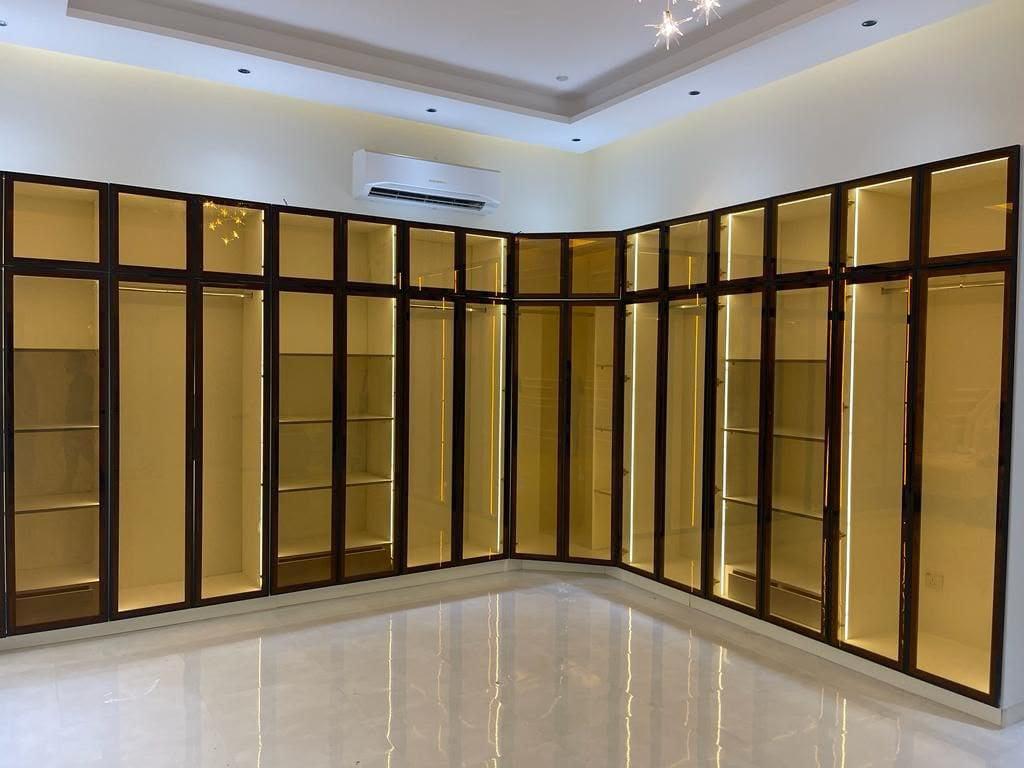
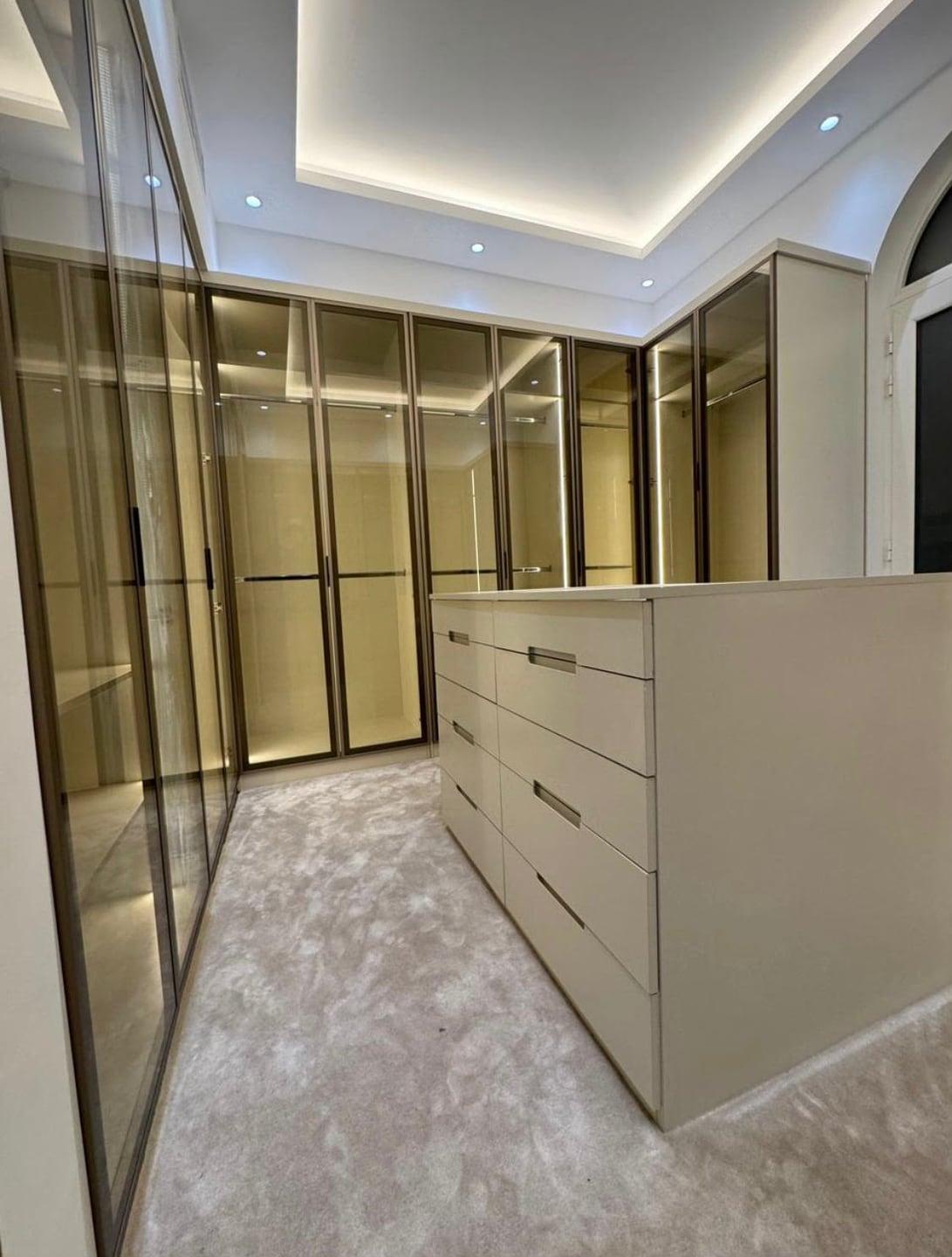
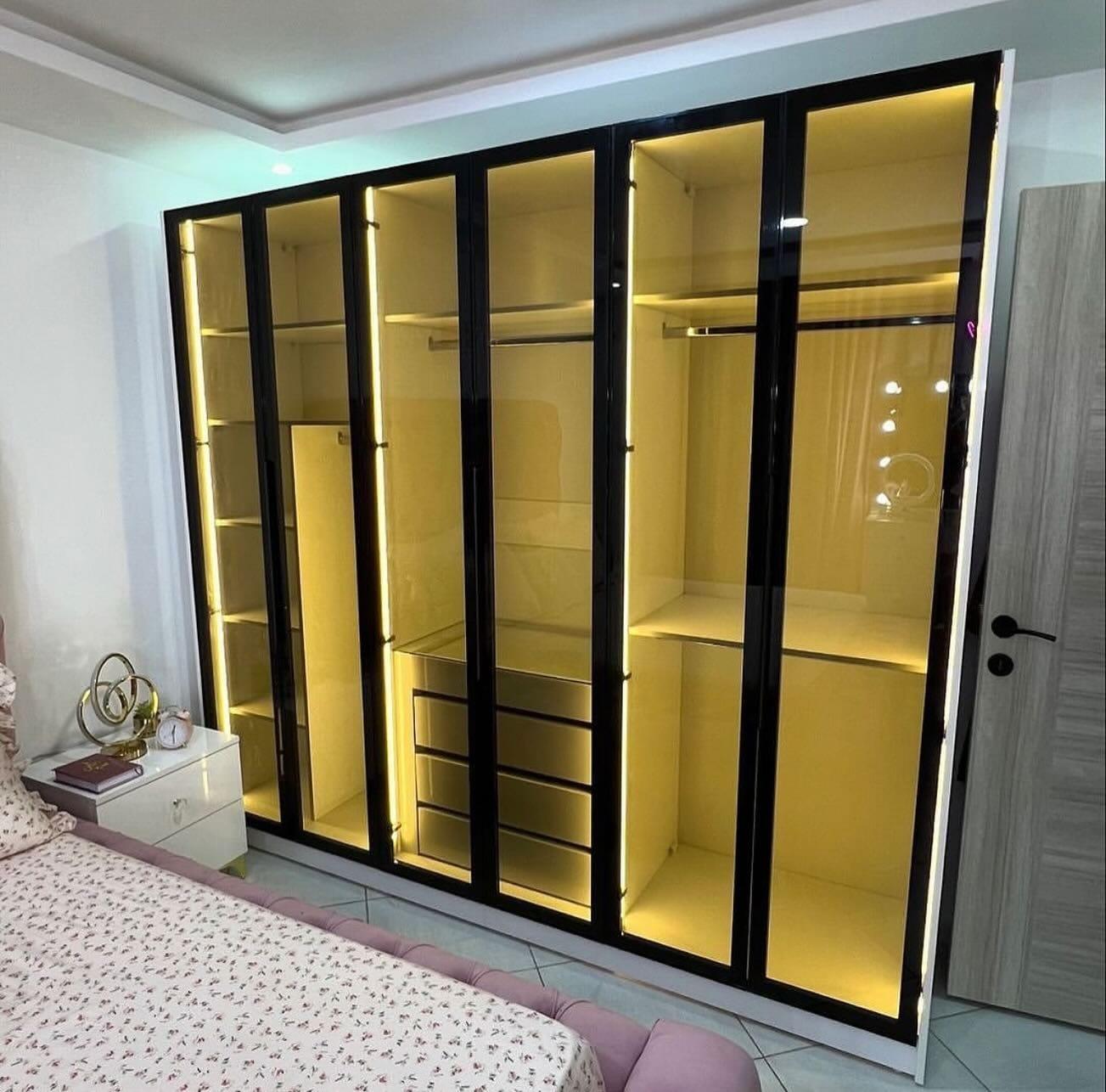
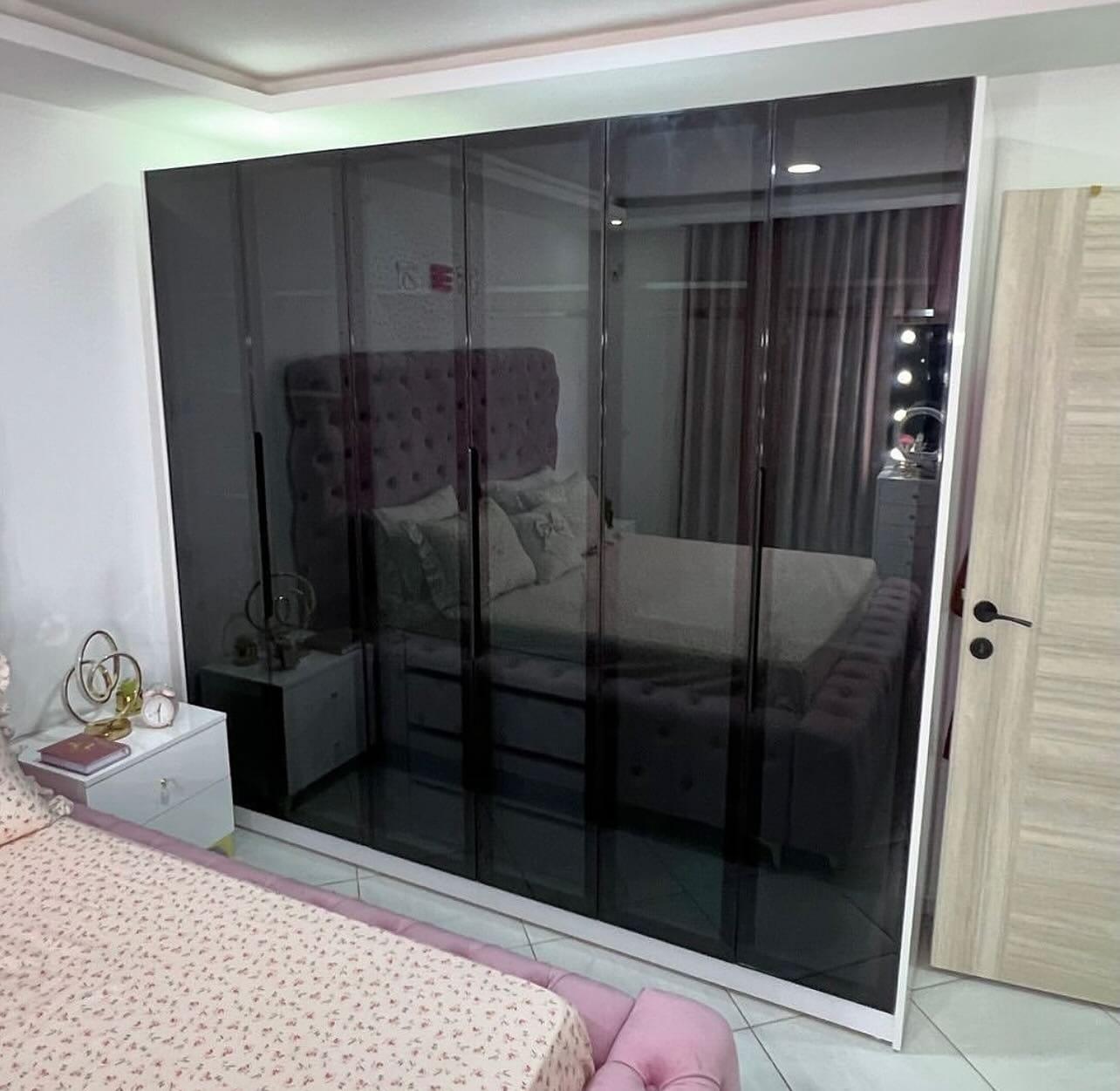
Mirror and glass doors need one extra thought: a handle on a mirror is seen in the mirror, and a finger-mark on dark glass shows. A slim vertical bar in a dark finish disappears against smoked glass, and a gold tone shows up on it. Our mirror wardrobe doors guide deals with glass weight and fixing, which the handle adds to.
Handle choices by door and drawer type
Tall hinged door
- Handles that usually fit
- Long vertical pull or a bar
- Position to plan
- Grip inside the height band, on the side away from the hinge
- Ask the supplier
- The length and the fixing centres
Sliding door
- Handles that usually fit
- Recessed pull or edge pull, or a finger channel
- Position to plan
- Within reach on the leading edge, below shoulder height
- Ask the supplier
- Whether the pull sits flush and clears the other leaf
Mirror or glass door
- Handles that usually fit
- Slim bar or recessed pull
- Position to plan
- Same band as the other doors
- Ask the supplier
- How it is fixed to the glass or frame
Drawer
- Handles that usually fit
- Horizontal bar, knob or edge pull
- Position to plan
- Centred; two handles or a longer one on a wide drawer
- Ask the supplier
- Whether the pull is on the front or the top edge
Upper cabinet
- Handles that usually fit
- Short bar or knob
- Position to plan
- Near the lower corner, away from the hinge
- Ask the supplier
- Whether it can be reached from the floor
Handleless front
- Handles that usually fit
- Groove, profile or push-to-open
- Position to plan
- Cut into the door, so decide before production
- Ask the supplier
- The profile finish and the matching hardware
A planning guide drawn from the supplier pages listed under Sources and our own visit practice. Confirm every choice on a full-size sample.
Modern handleless fronts and traditional doors with handles
Both directions are part of our work: we build modern handleless designs, with grooves and edge profiles, and traditional or decorative doors with handles. Neither is the safer choice on its own, and the handle should follow the door; fluted door faces, with their own profile and joins, are covered in fluted wardrobe doors.
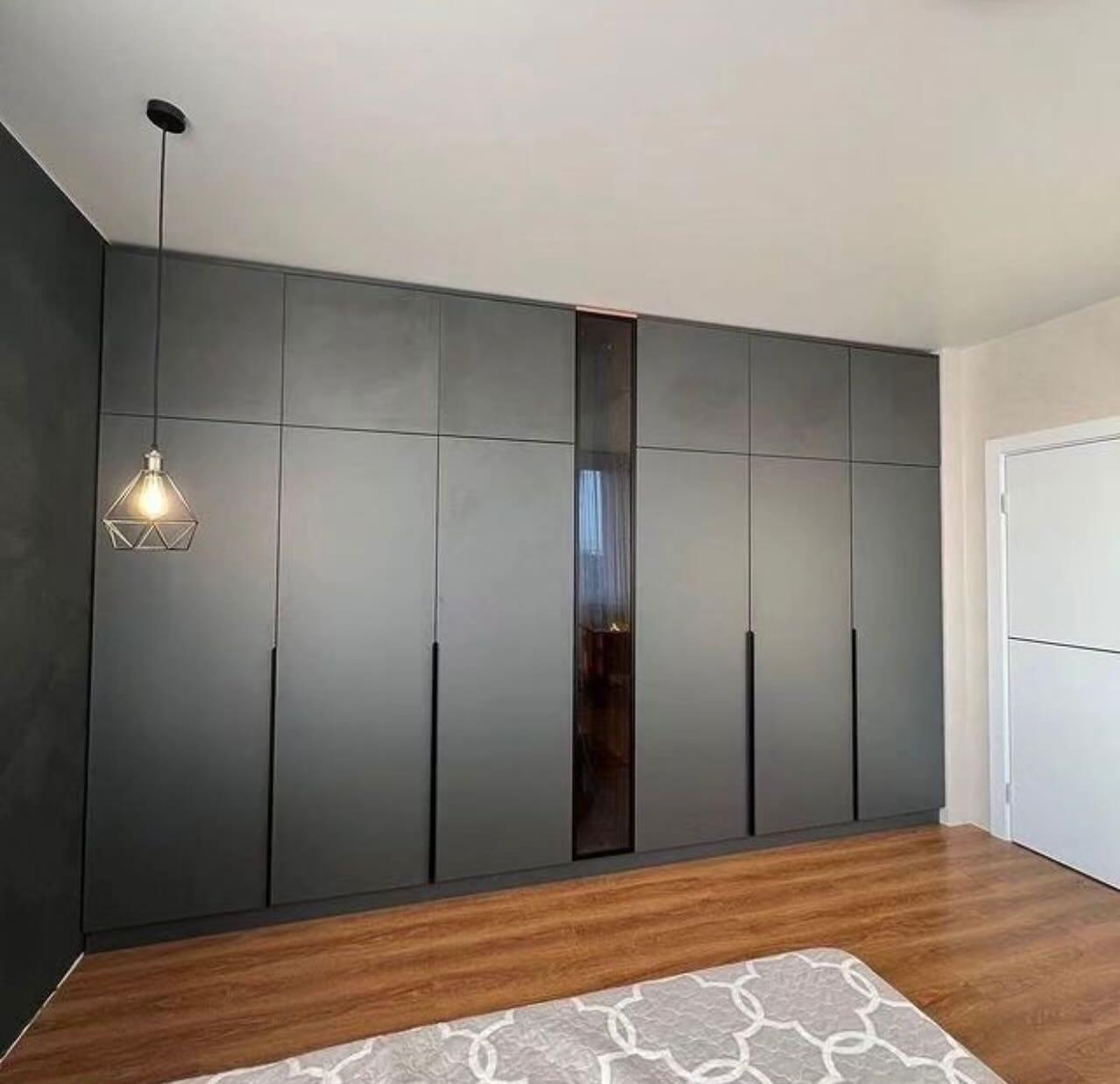
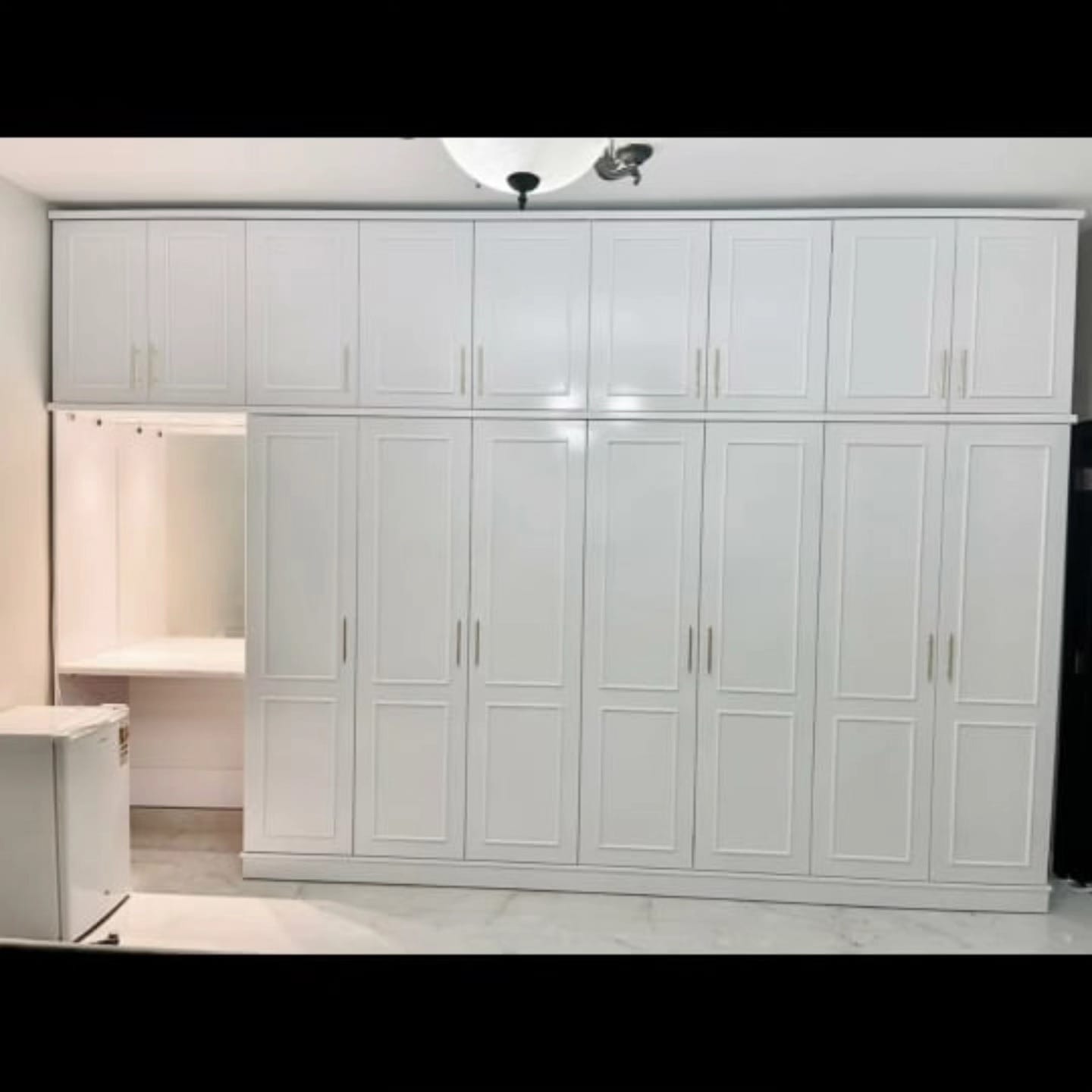
A framed or shaker-style door has panel lines and mouldings, and a slim bar in a brass or gold tone sits comfortably on it, as in the white framed wardrobe in our portfolio. A flat, plain door in matt laminate looks cleaner with a long vertical pull in black or with no handle at all, as in the charcoal wardrobe below. If you want to go flat, the opening methods, finger safety and cost direction are set out in handleless wardrobe against handles and the finishes themselves in the wardrobe door finishes compared guide.
A handle is the easy part to change later and a groove is not, so settle the opening method first and the handle's finish second. For doors that are already built, replacing the doors is a separate question.
Finishes that wear: brass tone, black and chrome
Gold and black are the two finishes people search for most, and brass tone and chrome are close behind. We cannot give a lifespan for any of them, because the coating, the base metal and the care all differ by product, and we do not publish a handle brand or a finish standard. What we can do is say how each kind of finish is described by the people who make and sell it, and what to avoid.
Brass and gold tones come in two kinds, as Arciform's care guide explains. Unlacquered brass can generally be polished with an appropriate brass polish; lacquered brass must not be: metal polish can damage or remove the protective coating. A gold-tone handle may be solid brass or a coated finish, so ask which one you are quoted and clean it accordingly. Casson Hardware adds to dry brass right away to avoid water-spotting.
Matt black hardware is usually painted, powder-coated or similarly coated. Arciform's guide says that once the coating has worn through, cleaning will not restore the original finish, so a black handle that is rubbed with an abrasive pad is the one you cannot rescue. Chrome is plated, and Arciform says that if chrome starts peeling, blistering or showing another metal underneath, the plating has failed. PVD, a hard coating some makers use on brass and black, is cleaned with soap and water, dried at once, and kept away from steel wool and scouring pads, says Casson.
Our practical view for a wardrobe: choose the finish that matches the other metal you can see, such as the frames of glass doors or the light fittings, and keep one family of finishes across the wardrobe. Smooth dark finishes show fingerprints more, a point we make for fronts in the wardrobe materials and hardware guide. Hold a sample against the wall at home before you commit. The choosing materials guide helps you compare, and the warm-or-cool light question is in the wardrobe LED lighting comparison.
Handle finishes and their care, from the sources opened
Unlacquered brass
- What the sources say
- Can generally be polished with a brass polish (Arciform); dry it at once (Casson)
- What to avoid
- Leaving it wet
- What to ask
- Is it solid brass or a plated finish?
Lacquered brass
- What the sources say
- Clean gently with a soft cloth and mild soap and water (Arciform)
- What to avoid
- Brass polish, abrasive pads, hard rubbing
- What to ask
- Whether the gold tone is lacquered
Black, painted or powder-coated
- What the sources say
- Once the coating has worn through, cleaning will not restore it (Arciform)
- What to avoid
- Abrasive cleaners, scouring pads, solvents
- What to ask
- What the coating is and what touch-up exists
Chrome
- What the sources say
- Plated; dry it to reduce water spotting (Arciform)
- What to avoid
- Steel wool, abrasive pads, scouring powders
- What to ask
- Whether it is chrome or a chrome look
PVD-coated
- What the sources say
- Mild non-abrasive soap and water, dried immediately (Casson)
- What to avoid
- Steel wool, scouring pads, acidic or harsh cleaners
- What to ask
- Which maker's PVD, and its care sheet
Care wording from the Arciform and Casson Hardware pages opened 4 Nov 2026. One maker's care advice does not describe every product of that finish; ask for the care sheet of the handle you are quoted.
Cleaning handles and keeping them hygienic
Cleaning a handle is the same job for every finish: a soft cloth, mild soap and water, then dry it. The care pages we opened agree on that, and on avoiding abrasive pads, steel wool, scouring powders and harsh chemicals, which wear coatings and plating. We make no health claim about handles; this is about appearance and keeping fingerprints off.
Wipe the top edge of a bar handle when you dust the wardrobe, because dust settles there. Touched drawer edges and any groove or profile channel can take a barely damp cloth; keep water off the cut edge of an MDF door. We do not set a cleaning frequency; do it when you dust, and sooner if a finish looks marked; our guide to cleaning wardrobe surfaces covers each surface.
If a wardrobe is in a damp room, the handle is the least of it: see why a wardrobe smells musty and moisture-resistant wardrobe boards for the board and airflow side, and our care and maintenance page for finished joinery in general.
- Soft cloth, mild soap and water, then dry at once.
- No steel wool, scouring pads, scouring powders, solvents or acidic cleaners.
- Brass polish only on unlacquered brass, and only if you want it bright.
- Wipe the top of bar handles and the inside of grooves when you dust.
Handles in kids' rooms, shared wardrobes and rentals
Heights change with who uses the wardrobe. A child's wardrobe takes the lower band, and the kids wardrobe design guide shows how the doors change as the child grows; a couple sharing a wall may want a different height on each side, and the shared couple wardrobe guide shows how the wall splits. In a rented apartment wardrobe, a simple surface-fixed handle is the least permanent choice; check your tenancy contract and ask in writing.
Drawers have their own rules: drawers and organisers covers the inside, and the handle on the front is chosen from the table above. A long garment bay, as in abaya and kandura storage, has the tallest doors, where a long vertical pull matters most. For the top cabinets above the doors, see loft boxes and top cabinets for luggage and seasonal storage.
For other rooms, the same ideas apply to a dressing room, a master bedroom wardrobe, a floor-to-ceiling wardrobe and a studio apartment wardrobe, and to a kitchen cabinet or a shoe cabinet. A corner or L-shaped wardrobe needs handles that do not collide at the turn. Whether a room suits a walk-in at all is covered in reach-in vs walk-in wardrobe: how much floor you need.
A door that rubs or sticks is a fit problem, not a handle problem, and why wardrobe doors stick explains the checks. For a shoe wardrobe the handles sit at hand height on tall doors, and a wardrobe on a bathroom-side wall makes the finish and the drying advice above matter more. If you are comparing a built-to-measure wardrobe with a boxed one, custom against ready-made wardrobes sets out the trade-offs, including who chooses the handle.
What to ask for on the quotation
Handles are cheap to specify and annoying to change, so give them their own lines. A quotation that says only "handles included" has not told you the shape, the size, the finish or the position. The full checklist is in our wardrobe quotation checklist, and the pricing guide shows how a quotation is built.
Handle questions for a wardrobe quotation
Handle type per door and drawer
- Why it matters
- The shapes behave differently by door
- A clear answer looks like
- Bar, pull, knob, recessed, groove or push-to-open, written for each
Size and fixing centres
- Why it matters
- Too small is hard to use; too large overpowers
- A clear answer looks like
- Length and centres in mm for each door size
Height from the floor
- Why it matters
- The reach changes with who uses it
- A clear answer looks like
- A mm figure for doors and for drawers, taped up at the visit
Finish and what it is made of
- Why it matters
- Wear and care depend on the finish
- A clear answer looks like
- Brass, black, chrome or other, with the base and the coating named
Handleless parts
- Why it matters
- The door is cut for it
- A clear answer looks like
- Groove or profile type and finish, with the matching hardware named
Care sheet
- Why it matters
- Wrong cleaning wears coatings
- A clear answer looks like
- The maker's care wording for the handle quoted
Warranty
- Why it matters
- Moving hardware is excluded from the board warranty
- A clear answer looks like
- Written terms for the handles and fixings
Our entry price of AED 550 per sqm is for MDF laminate with hinged doors, installed. Handle brand and finish are not part of the published price: ask for them in the quotation.
What we do about handles
Handles are settled at the same visit and in the same drawing as everything else. The measuring visit is free, and we bring laminate, veneer and glass samples to the room. We measure, then send a drawing and an itemised price that you approve before anything is made, and the handle type, finish and height are lines you can ask us to state on it.
What we publish and what we do not. Our entry price is from AED 550 per sqm of wardrobe front, installed, for MDF laminate with hinged doors; other options raise it and the figure for your wall is set after measurement. After you confirm the drawing and the details, a 60% advance is paid and production starts once it is received; the remaining stage is agreed with you. Our Sharjah workshop then builds the wardrobe and our own team installs it, up to about 10 days depending on size and design, with a 24-month written workmanship warranty (supplied products follow their own terms). Separately, the wood-based boards carry a 5-year limited warranty, subject to terms; hinges, tracks, runners, rollers and other moving hardware are not covered, and the final terms are in the written warranty. We have not published a handle brand, so ask for it in the quotation and we will put it in writing.
Start with the free wardrobe measuring visit guide, then book through the consultation form. Our custom wardrobes service page lists what we make, and the built-in wardrobes, lit glass-front wardrobes and sliding door wardrobes pages show finished work.
For how a measured wall becomes a number, read the wardrobe price guide. The wardrobe warranty guide separates the board warranty from the workmanship warranty, and warranty and aftercare covers care afterwards. Installation covers the whole UAE: the Sharjah page gives the workshop address and the Dubai page covers visits there.
Tired handles alone rarely justify new doors, but if the doors themselves are worn, wardrobe door replacement and renovate or replace a wardrobe help you judge. Before the doors are drawn, the fitted, built-in or freestanding comparison and the wardrobe layout guide set the frame, and our custom wardrobes page shows the range.
Handles are the last detail on the doors; the wardrobe planning guide, from wall to finish shows the earlier steps.
Common questions
How high should wardrobe handles be?
Dowsing & Reynolds says wardrobe handles are generally installed around 900 to 1100 mm from the floor, 750 to 900 mm for children and 1100 to 1200 mm for tall users. That is one supplier's planning range; tape the handles up before drilling. See our wardrobe hanging heights guide.
Should wardrobe handles be vertical or horizontal?
Dowsing & Reynolds's kitchen guide puts pull handles vertically on doors and horizontally on drawers, on the side away from the hinge. That is kitchen guidance used as a planning rule; check your own doors on a sample. See our wardrobe door clearance guide.
What handles suit sliding wardrobe doors?
A handle that stands out can catch the other leaf. Sugatsune says its recessed pulls suit sliding doors because panels slide past each other without catching, and edge pulls give a lip to hold. Ask the supplier how the pull clears the other door. See our sliding door systems guide.
Is gold or black better for wardrobe handles?
Neither is better on its own: match the finish to the other metal in the room and the door style, and look at a sample in your own light. Ask whether a gold tone is lacquered brass and what a black finish is coated with, because care differs. See our wardrobe door finishes compared guide.
How do I clean wardrobe handles?
Use a soft cloth, mild soap and water, then dry at once, and avoid abrasive pads, steel wool and harsh chemicals; do not polish lacquered brass. Wipe the top of bar handles and the inside of grooves when you dust. See our care and maintenance page.
Do you make handleless wardrobes as well as ones with handles?
Yes. We offer modern handleless designs and traditional or decorative designs with handles. The decision between them is set out in our handleless wardrobe against handles guide, and each is specified in the quotation.
What should a quotation say about wardrobe handles?
It should give the type for each door and drawer, size and fixing centres, height from the floor, the finish and what it is made of, and the care sheet. Handle brand and finish are not in our published entry price of AED 550 per sqm, so ask for them. See our wardrobe quotation checklist.

Sources & specifications
Manufacturer information applies to the named products and systems. Sources reviewed on 4 November 2026.
- Dowsing & Reynolds, How high should wardrobe handles be (900 to 1100 mm adults, 750 to 900 mm children, 1100 to 1200 mm tall users; pulls for large wardrobes; template or tape before drilling)dowsingandreynolds.com(opens in a new tab)
- Dowsing & Reynolds, where to put knobs and handles on kitchen cabinets (vertical on doors, horizontal on drawers, opposite the hinge, 2.5 to 5 cm from the edge; kitchen guidance)dowsingandreynolds.com(opens in a new tab)
- Sugatsune, handles, pulls and knobs (recessed pulls suit sliding doors; edge pulls give a lip to hold when closed; finishes from stainless steel to brass)sugatsune.com(opens in a new tab)
- Emuca, gola profiles (aluminium groove system that opens doors and drawers without visible handles; usable in wardrobes; listed finishes)emuca.com(opens in a new tab)
- Blum, TIP-ON BLUMOTION (touch to open; purely mechanical; front gap of 2.5 mm)blum.com(opens in a new tab)
- Arciform, metal finishes care guide (lacquered and unlacquered brass, powder-coated and black hardware, chrome plating)arciform.com(opens in a new tab)
- Casson Hardware, care and maintenance (brass, chrome and PVD cleaning; dry at once; avoid abrasives)cassonhardware.com(opens in a new tab)
Want this planned for your home?
Consultation and measurement are free. Tell us the rooms, location and what you need; we arrange a sample visit and define the measured quotation.