Wardrobes · 14 min read · 14 August 2026
A nursery wardrobe that grows from baby to toddler: what to plan
A nursery wardrobe is best planned in three stages on one carcass: short hanging, shallow drawers and a changing-friendly top for the baby, a low rail for the toddler, and drawers converted to hanging for the child. Safety is planning-level only; ventilation is site-dependent.

By Ali Haider Basra, Founder, Al Tareeq Decor · Contact our workshop
Key takeaways
- Plan three stages with one carcass: a baby stage (short hanging, shallow drawers, a changing-friendly top), a toddler stage (a low rail the child can reach) and a child stage (drawers converted to hanging).
- Agree the changes before production: a resettable rail, adjustable shelves and a drawer bay that can be swapped are customisations, and how they are built is confirmed in the quotation.
- Safety is planning-level only: ask how the tall unit is fixed to the wall, how edges are finished, where fingers can be trapped and whether soft-close is an option. We give no safety guarantee.
- Our carcass is specified low-emission HDF/MDF with moisture-resistant grades selected for the application; ventilation depends on the site (the wardrobe humidity guide explains why), so ask us about it at the visit.
- Our entry price is from AED 550 per sqm, installed, for MDF laminate with hinged doors; a changing top, drawers and extra rails are priced in the quotation.
On this page
- Key takeaways
- A nursery wardrobe: the short answer
- What a baby's wardrobe has to hold
- A nursery wardrobe by stage
- A changing-friendly top: what to ask for
- Growing with the child: shelves, rails and drawers that convert
- Where the heights come from at each stage
- Safe design basics, at planning level
- Planning questions to put in the quotation
- Doors for a nursery: simple, calm and no sharp pinch points
- Boards and air in a nursery
- Finishes that wipe clean, and colours that last
- Fitting it into a small nursery
- What we do about a nursery wardrobe
- Common questions
A nursery wardrobe: the short answer
Plan a nursery wardrobe for three stages, not one: a baby stage with a short hanging bay, shallow drawers and a top you can change on; a toddler stage with a low rail the child can reach; and a child stage where the drawers convert to hanging. Build the carcass once, plan the rails, shelves and drawer bays so they can be reset, and fix a tall unit to the wall. Our custom wardrobes are made to your measured wall, so the plan is drawn into the first order rather than bought again in two years.
This page covers the first years, from a newborn to a child who walks to the wardrobe on their own. When the child is old enough for a school uniform and a desk, kids wardrobe design takes over with rail and shelf heights by age. For two children in one room, see a shared kids bedroom wardrobe.
Safety is covered here only at planning level: what to ask for and what to ask us about. We are joiners, not child-safety specialists, we make no safety guarantee and no medical or legal claim, and nothing in a wardrobe replaces watching a small child.
What a baby's wardrobe has to hold
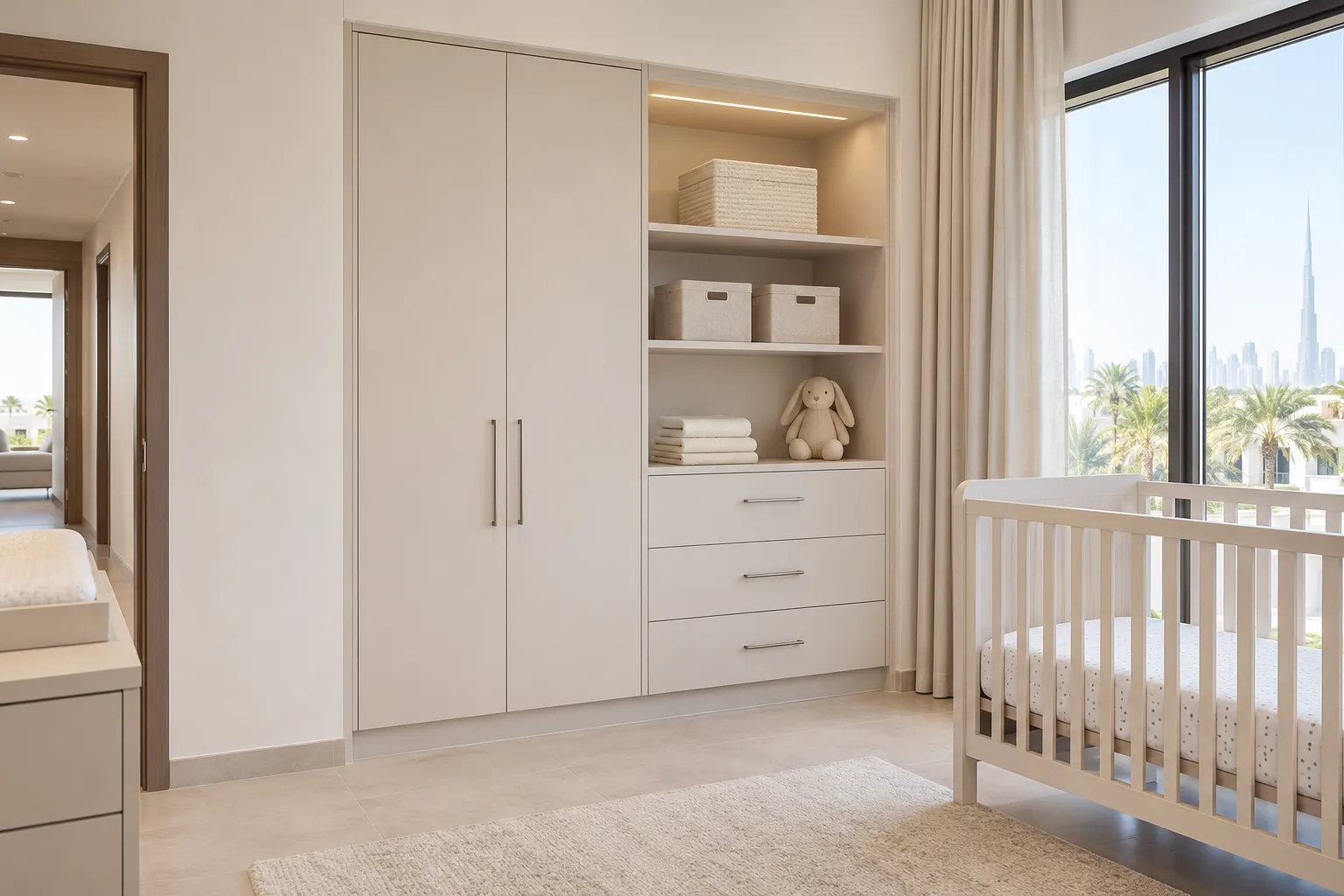
Baby clothes are small and most of them fold. A short hanging bay is enough for the few things that hang, such as coats, dresses and special outfits; the rest goes in shallow drawers, where a whole drawer can be seen at once and nothing is buried. Shelves above hold the spare sizes, blankets and boxes that are not used every day. For the rail itself, wardrobe hanging heights explains how a rail height is chosen, and a short bay leaves room below it for a drawer stack or a basket.
Because a baby's wardrobe is opened many times a day, often with one hand, plan the daily things at the height of the adult's waist and chest and keep the rarely needed things up high. What goes in which drawer is a personal choice; wardrobe drawers and organisers shows how drawers are divided and filled.
A nursery wardrobe by stage
Baby
- Hanging
- A short bay for the few hanging pieces
- Drawers and shelves
- Shallow drawers for folded clothes, a shelf for spares
- Top
- A changing-friendly surface
- What converts next
- The top becomes a shelf; the rail moves up
Toddler
- Hanging
- A low rail the child can reach, a spare shelf above
- Drawers and shelves
- Two drawers and open bins the child can use
- Top
- A shelf or a box for spares
- What converts next
- The lower drawers are swapped for a second rail
Child
- Hanging
- Rail raised, a second rail where a drawer bay was
- Drawers and shelves
- One or two drawers, shelves reset
- Top
- Storage for luggage and bedding
- What converts next
- The same carcass is reset again later
Our own planning view; the heights are set for your child and your room on site, so no numbers are shown.
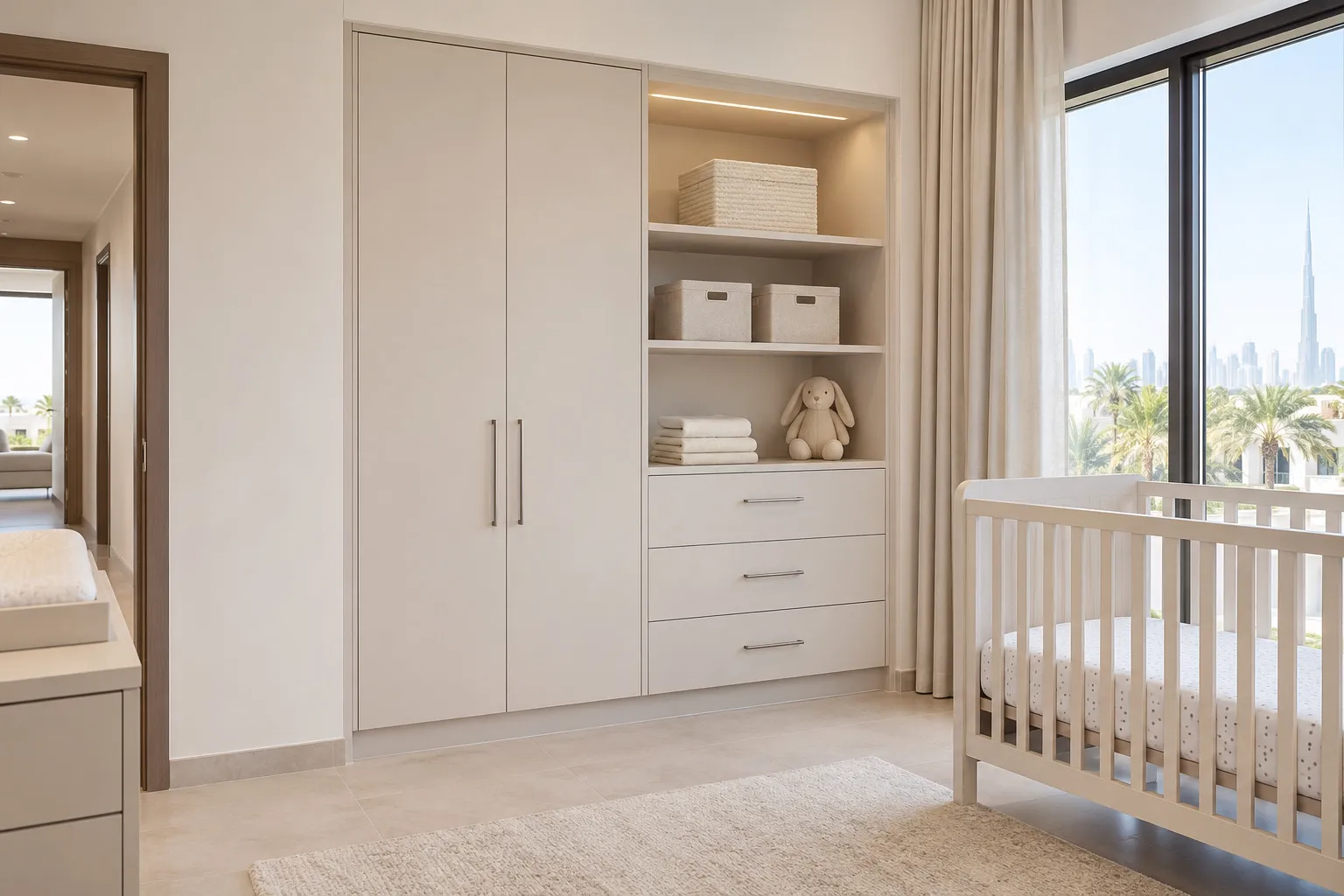
A changing-friendly top: what to ask for
A low wardrobe or a drawer stack with a flat top can double as a place to change a baby, and many parents want exactly that. Plan it as a surface and not as a product: a top of the right depth for a changing pad, at a height that suits the adult who will stand there, with drawers underneath that reach the supplies without leaving the child. The page of the American Academy of Pediatrics says to keep diapering supplies "within your reach—but out of your child's reach", which is a good reason to put the daily drawer within the adult's arm and the creams and wipes on a shelf the child cannot get to.
The same page says a changing table should have a 2-inch (5 cm) guardrail on all four sides, that the strap should not be the only protection, and that a child must never be left unattended on the surface even for a moment. That page was last updated in 2009 and is American; we use it only as a reminder of what to ask. We publish no test or certification for a changing top and do not describe our joinery as a changing table. If you want a purpose-made changing product, buy it and let us plan the wardrobe around it, and ask us whether a raised edge or a lip can be added to the top at the quotation stage.
When the child outgrows changing, the same top is a shelf or a surface for a basket, a lamp or a bag. For the sizes of that top and the depth it needs, wardrobe depth explains how depth is chosen and what it does to the room.
Growing with the child: shelves, rails and drawers that convert
The cheapest way to keep a wardrobe useful for years is to plan its changes before it is built. The drawing below follows one wardrobe through three stages. The carcass, the wall fixing and the doors stay. The parts that change are the top, the rail and the drawer bay: a changing top becomes a shelf, the rail moves up, and a stack of drawers is swapped for a second rail when the clothes get longer.
That is a customisation, and we can carry it out when it is agreed before production. How the shelves, the rail and the drawer bay are held so that they can be reset is a construction detail we do not publish, so ask for it in the quotation and ask for it to be on the drawing. The wardrobe quotation checklist shows what to compare between quotations.
- 1. Baby: a short hanging bay, shallow drawers and a changing-friendly top
- 2. Toddler: a low rail the child can reach, a spare shelf above, open bins and two drawers
- 3. Child: the rail goes up and the lower drawers are swapped for a second rail
- 4. The carcass and the wall fixing stay the same at every stage; plan the changes before production
Where the heights come from at each stage
We do not give a rail height for a baby, because there is no standard that we can point to and a rail that fits one family does not fit the next. Set it with a tape: at the baby stage the adult is the one reaching in, so the bay is set to the adult's chest height and the hanging pieces are short; at the toddler stage the height is the child's own reach with the arm raised, which you can measure when it is time. The guide for older children gives published rail heights; for a younger child, settle the height on a tape against your own child and put it in the drawing.
A wardrobe that is built to move up as the child grows needs enough height in the carcass to let it. A tall carcass with the rail low and a spare shelf above it is the simplest way. Where the room is small, small bedroom wardrobe ideas shows how to fit height and depth into a tight plan. A recess beside the door suits a wardrobe built into it, and narrow room wardrobes covers a room that is long and thin.
Safe design basics, at planning level
Four things are worth settling in the drawing: anchoring a tall unit to the wall, how the edges are finished, where small fingers can get trapped, and how doors and drawers close. None of them is a guarantee, and a wardrobe is never a substitute for watching the child.
On anchoring, the US Consumer Product Safety Commission's Anchor It! pages remind "home owners and renters" to anchor furniture to the wall and say that US makers and retailers had to comply with new furniture safety standards from 1 September 2023. That is a US rule, not a UAE one. A fitted wardrobe is built to the wall; a freestanding or modular one needs a fixing to be stable, and the NHS page we opened in Devon lists anti-tip furniture straps among its home-safety items. In a rented home, ask the landlord in writing before anything is drilled; a wardrobe for a rented apartment explains what to put in that message. If you are comparing kinds of wardrobe, fitted, built-in and freestanding wardrobes sets out the difference.
On edges and fingers, ask how the edges and corners are finished and whether the corners can be rounded; we do not publish a radius or an edge type, so ask for both in the quotation. The Devon page also lists finger guards on doors, "completely covering the area between door and the hinge" when the door is open; a guard is an accessory to ask about for a hinged door, and soft-close or slow-close hardware is an option to ask about as well. We do not say that it removes the risk of trapped fingers.
Planning questions to put in the quotation
Wall fixing
- What to ask
- How will the tall unit be fixed to the wall, and does the quotation say so?
- Why
- A tall unit can tip if a child climbs or pulls it
Rented home
- What to ask
- Has the landlord agreed in writing to any fixing?
- Why
- Settles it before the drawing is approved
Edges and corners
- What to ask
- How are edges finished, and can corners be rounded?
- Why
- Fewer sharp points at toddler height
Door hinge side
- What to ask
- Is a finger guard or a different door type an option?
- Why
- The hinge side is where fingers can be trapped
Soft-close
- What to ask
- Is soft-close or slow-close available for doors and drawers, and what does it add?
- Why
- An option to price, not a promise
Handles
- What to ask
- Are the pulls shaped so they cannot catch clothing or fingers?
- Why
- Smooth, simple shapes at child height
Our own planning questions. No part of a wardrobe makes a child safe; supervision does.
Doors for a nursery: simple, calm and no sharp pinch points
Hinged doors open a whole bay at once and are the simplest to understand. A door that opens wide can reach a cot or a changing mat, so measure the swing before choosing, as wardrobe door clearance shows. Sliding doors do not swing into the room, which helps where the cot is close, but they have a closing edge of their own, so ask about the same softening for them. Sliding door systems explains the options.
Open bins and open shelves are useful in the toddler stage because there is no door to catch a finger or to open, as open or closed wardrobe explains. A wardrobe with a door over the hanging bay and open bins or drawers at child height is a common middle path. For pulls, the wardrobe handles guide covers shapes and heights; we would avoid sharp-edged profiles in a room where a child pulls themselves up on the furniture.
Boards and air in a nursery
Our carcasses use specified low-emission HDF/MDF, with moisture-resistant grades selected for the application. That is the site's own published wording and it is all we say about the board: we publish no emission figure, no test report and no certificate, so if you need one, ask in writing and we will tell you what we can provide. We make no health claim for any board or finish. For how moisture-resistant grades are chosen, see moisture-resistant wardrobe boards.
Ventilation is a question for your site, so ask us about it. A nursery is often a bedroom on an outside wall or next to a bathroom, and our approach applies: the gap behind a wardrobe depends on the site, we look at the wall and its moisture first, and the options include an air gap, concealed openings or grilles. We never say every wardrobe needs the same gap, and a gap alone does not fix a leak or damp that is already there. A wardrobe on a bathroom or outside wall sets out the order of checks. If a cupboard already smells, why a wardrobe smells musty helps.
Finishes that wipe clean, and colours that last
A smooth, hard-wearing surface is easier to wipe than a textured or open-grained one, and the finishes we publish are laminate, veneer, lacquer, mirror and tinted glass. In a nursery the surfaces that get touched most are the drawer fronts, the lower edges of the doors and the top, so choose those first. A gloss surface shows fingerprints more than a matt one, as matt versus gloss doors explains. Door finishes compared sets the finishes side by side. Always follow the care instructions for the finish you choose, and we make no claim about any cleaning product.
Choose a calm base colour that will still suit the room when the child is five, and put the colour in things that are cheap to change: bins, handles, curtains, a painted wall. Wardrobe colour combinations shows pairings that work. Kids' room wallpaper is a quick way to give the room a character without touching the joinery. A small internal light can help in a dark corner, and our own team installs internal LED lighting in the wardrobe.
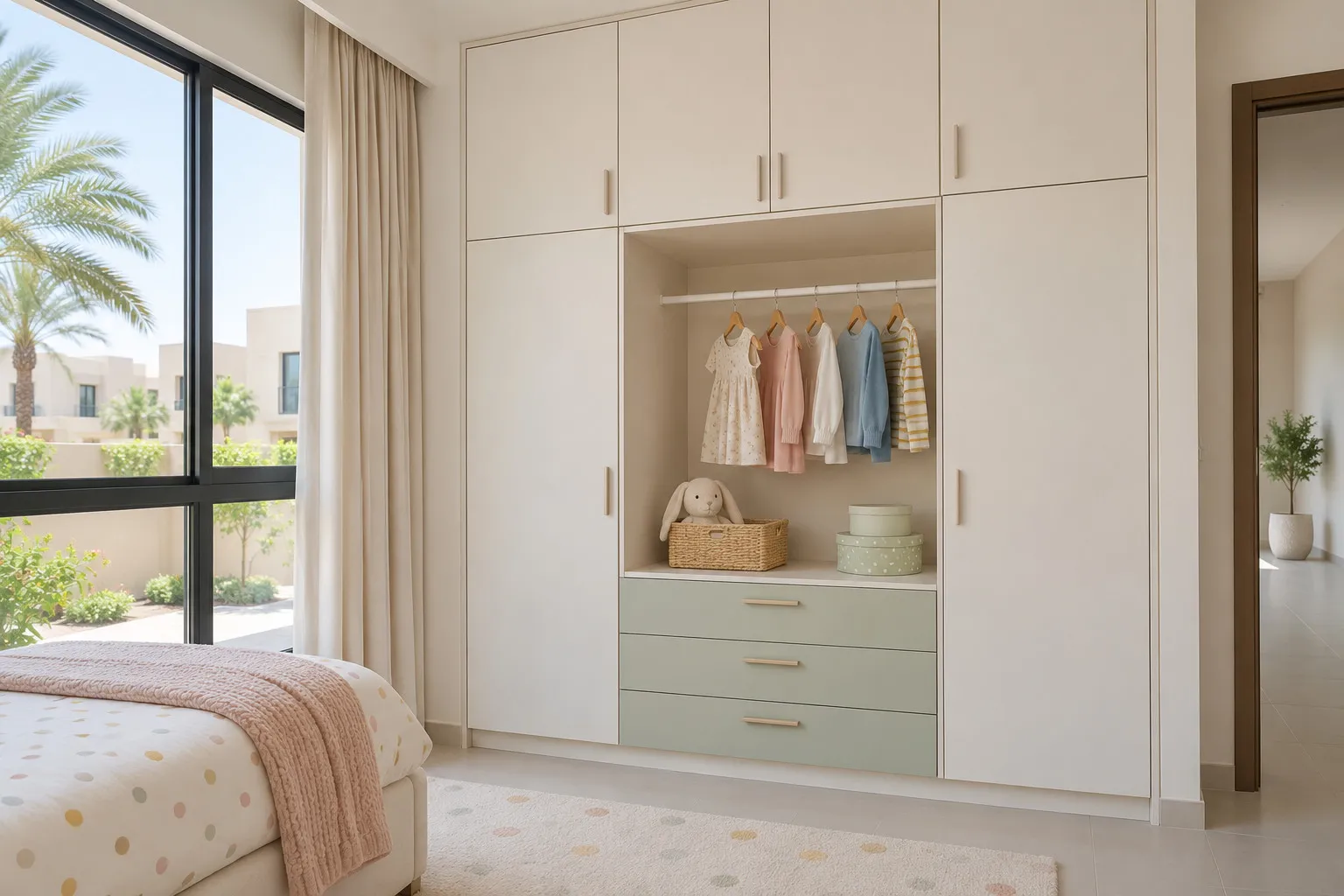
Fitting it into a small nursery
A nursery is usually a smaller room than the master bedroom, with a cot, a chair and a door to keep clear. Mark the cot and the chair on the floor with tape, then check the door swing and the depth of the wardrobe against them before you choose; if the room is tight, a shallower wardrobe or sliding doors may be the answer. Planning a whole flat? Apartment wardrobe ideas shows how wardrobes are distributed between rooms. Custom or ready-made wardrobe helps if you are weighing a shop-bought nursery set against a made-to-measure one.
If the wardrobe will also hold the parents' things for a while, use the top shelves and a separate hanging bay for them, and keep the low bays for the baby. The older wardrobe layout guide explains how the inside of a wardrobe is divided into zones, which is the same idea in a nursery.
What we do about a nursery wardrobe
We make children's wardrobes as custom pieces, with customised interiors: hanging, shelves, drawers and compartments, doors and finishes chosen for your room. The free measuring visit comes with samples, and we send a drawing and an itemised price that you approve before production. Tell us at the first call if you have a due date, so that the visit and the drawing can be planned around it; we give no fixed timeline beyond the published "up to about 10 days, depending on size and design". The measuring visit guide explains what we check on site.
The published entry specification is from AED 550 per sqm, installed, for MDF laminate with hinged doors; a changing top, drawers, extra rails, glass, mirror and lighting can change the figure, and we give no number for them: ask for a quotation after the visit. After measurements and details are agreed, a 60% advance is paid and production starts once it is received; the remaining stage is agreed with you. Our Sharjah workshop in Al Shuwaiheen builds the wardrobe, and the workmanship carries a 24-month written workmanship warranty. Wood-based boards carry a separate 5-year limited warranty that does not cover hinges, tracks, runners, rollers or other moving hardware, labour, misuse or accidental or deliberate damage; the wardrobe warranty guide explains the two. The wardrobe price guide shows what moves a price.
We serve the UAE, and the Sharjah and Dubai wardrobe pages show where.
The built-in wardrobes and sliding door wardrobes pages show finished examples.
To talk it through, book a free measuring visit or start from the custom wardrobes page.
The pricing guide helps you plan a budget before the visit, and glass and mirror fronts are shown on the lit glass-front wardrobes page.
When the child's room changes again, our wardrobe guides for every age and room are grouped on one page.
Common questions
What should a nursery wardrobe include?
A short hanging bay, shallow drawers for folded clothes, a shelf for spare sizes and a flat top that can serve as a changing surface. Plan it so the rail and shelves can be reset as the child grows. See our kids wardrobe design guide.
Can I use a wardrobe top as a changing table?
Many parents do, but we publish no test or certification for a changing top. Ask for the right depth and for a raised edge, never leave a baby alone on any changing surface, and plan the daily drawer within the adult's reach. See our wardrobe depth guide.
How do I make a nursery wardrobe last until my child is older?
Build one carcass and plan the changes before production: a top that becomes a shelf, a rail that moves up and drawers that are swapped for a second rail. Ask the quotation to show how they are held. See our shared kids bedroom wardrobe guide.
Does a tall nursery wardrobe need to be fixed to the wall?
A tall unit can tip if a child climbs or pulls on it, so ask how yours is fixed. In a rented home, ask the landlord in writing first. See our rented apartment wardrobe guide.
Are sliding or hinged doors better in a nursery?
Sliding doors do not swing into the room, which helps near a cot, but both types have a closing edge, so ask about soft-close and finger guards for either. See our sliding door systems guide.
Do you use low-emission boards for a nursery wardrobe?
Our carcasses use specified low-emission HDF/MDF, with moisture-resistant grades selected for the application. We make no health claim and publish no emission figure; ask us about ventilation for your site. See our moisture-resistant boards guide.
How much does a nursery wardrobe cost in the UAE?
Our entry price is from AED 550 per sqm, installed, for MDF laminate with hinged doors; a changing top, drawers, glass and lighting change it, so ask for a quotation after the free visit. See our wardrobe price guide.

Sources & specifications
Manufacturer information applies to the named products and systems. Sources reviewed on 4 November 2026.
- HealthyChildren.org (American Academy of Pediatrics), Changing Table Safety (page last updated 2009: supplies within the adult's reach, guardrail on all four sides, never leave a child unattended)healthychildren.org(opens in a new tab)
- Anchor It! (US Consumer Product Safety Commission), resources (reminder to anchor furniture to the wall; US furniture standards from 1 September 2023)anchorit.gov(opens in a new tab)
- Children and Family Health Devon (NHS), Ways to make your home safer for your children (anti-tip furniture straps; finger guards on doors)childrenandfamilyhealthdevon.nhs.uk(opens in a new tab)
Want this planned for your home?
Consultation and measurement are free. Tell us the rooms, location and what you need; we arrange a sample visit and define the measured quotation.