Wardrobes · 15 min read · 8 July 2026
Wardrobe hanging heights: rail positions for shirts, dresses and long garments
Measure your longest garment, hook to hem, and set each rail from that number. Bob Vila's starting points are 167.6 cm for a single rod and 207.6 and 102.9 cm for a double hang, measured to the bottom of the rod; write the reference point on the drawing.

By Ali Haider Basra, Founder, Al Tareeq Decor · Contact our workshop
Key takeaways
- Set each rail from your own longest garment, hook to hem plus clearance; catalogue heights are only an opening guess.
- Bob Vila's published rods are 167.6 cm single, 207.6 cm and 102.9 cm double, and 76.2 cm for a small child, all measured to the bottom of the rod.
- Another guide measures to the centre of the rod, so write the reference point next to every height on the drawing.
- A double hang leaves 104.8 cm between Bob Vila's rods; subtract the height of your own lower hanger to see what the upper tier can hold, and double hanging or long hanging explains when to choose and mix them.
- Reach decides the daily rails: the upper rod of a double hang is far above the 38 to 122 cm range, and a child's rail needs to move as they grow, and the shared kids bedroom wardrobe guide applies that to two children of different ages.
On this page
- Key takeaways
- Wardrobe hanging heights: the short answer
- Bottom, centre or top of the rod: ask which one
- What each source says about rail heights
- Shirts, blouses and trousers: how a double hang works
- Long garments: kandura, abaya, gowns and coats
- How to measure your own longest garment
- Your measure sheet: what to write down
- The shelf above the rod and the space beneath it
- Reach limits: who can use which rail
- Which hanging layout suits which household
- Fixing the heights on paper before anything is built
- What we do about hanging heights
- Common questions
Wardrobe hanging heights: the short answer
Measure your own longest garment, hook to hem, and set each rail from that number. The published starting points are a single rod at 167.6 cm (66 inches), a double hang with rods at 207.6 cm and 102.9 cm (81¾ and 40½ inches), and a small child's rod at 76.2 cm (30 inches), all from Bob Vila's rod-height guide, and all measured to the bottom of the rod. They are written for ordinary shirts, trousers and dresses, so an abaya, a kandura or a long gown usually asks for a taller long-hang bay than any of them.
Two things trip people up. The first is the reference point: one guide measures to the bottom of the rod and another to its centre, so the same rail can be quoted a few centimetres apart. The second is that a catalogue number is only an opening guess: the drawing you approve should carry heights worked out from your clothes and your household. This page is the one place on our site that treats the height question as a whole, and it sends you to the right guide for each special case, such as the abaya and kandura storage guide for long garments. How to mix two short rails with one long drop is in double hanging or long hanging.
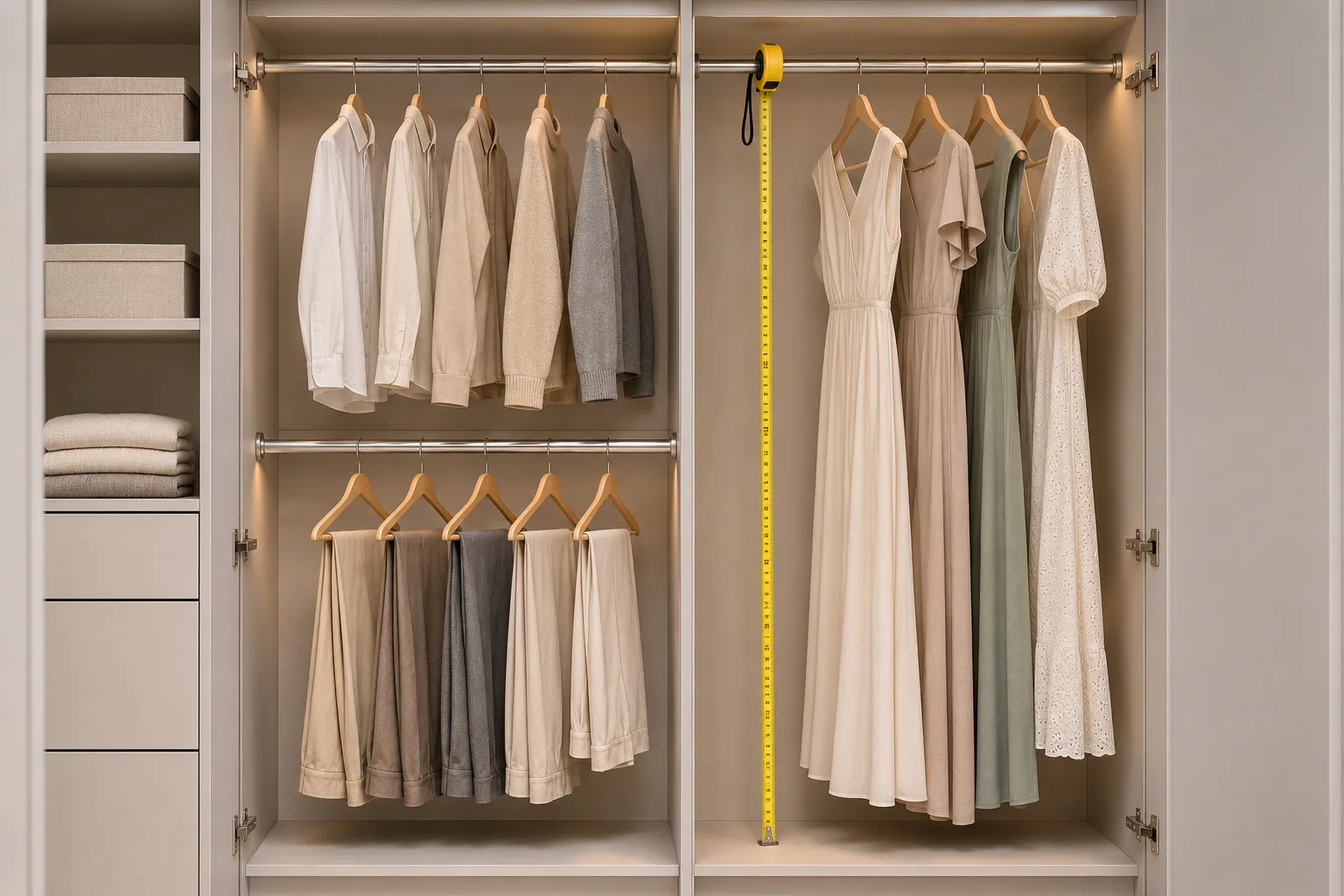
The drawing below puts the three rail types and a reach range on one scale. Every height on it is converted from inches and labelled; the garment shapes are generic and are not drawn to a length.
- 1. Single rod: Bob Vila's 66 inches (167.6 cm), the opening guess for ordinary clothes
- 2. Double hang: the upper rod at 81¾ inches (207.6 cm) and the lower at 40½ inches (102.9 cm), which leaves 104.8 cm between them
- 3. Small child: a lower rod at 30 inches (76.2 cm), the one rail on the page set for a child, and the first to move as they grow
- 4. Reach range: the US Access Board's 15 to 48 inches (38 to 122 cm) for unobstructed reach, context only: the upper rod of a double hang sits far above it
- 5. So measure your own garments and your household's reach, then give those numbers to the surveyor
Bottom, centre or top of the rod: ask which one
A rail height means nothing until you know what it was measured to. Bob Vila's guide says to align the bottom of the rod with the 66 inch mark. TaskRabbit's guide, a second home-improvement source we opened, says the top rod of a double hang is usually set at about 80 inches (203.2 cm) from the floor to the centre of the rod, and the lower at about 40 inches (101.6 cm), also to the centre. The two sets of numbers look close, yet they describe different points on the rod.
On a wardrobe drawing the difference is small in centimetres but it decides whether a hem touches the base, so write the reference point on the drawing next to every rail: "to bottom of rod" or "to centre of rod". When you compare two quotations, ask the same question of both, using the habit set out in our wardrobe quotation checklist. FCI London, a UK fitted-furniture maker, gives its single-rail heights as 1750, 1800 and 1900 mm without saying which point it means, which is a fair example of why the question is worth asking.
The quantity you actually care about is the drop: how far the garment can hang below the rod before it meets something. That depends on the hook, the hanger and the hem, which is why the measuring method further down starts with your own hanger and not with any table. For a wardrobe that runs the full height of the wall, see how to plan a floor-to-ceiling wardrobe.
What each source says about rail heights
Bob Vila, closet rod height
- Single rod
- 167.6 cm (66 in)
- Double hang
- 207.6 cm and 102.9 cm (81¾ and 40½ in); small child's lower rod 76.2 cm (30 in)
- Measured to
- Bottom of the rod
TaskRabbit, closet rod height
- Single rod
- About 168 to 178 cm (66 to 70 in) for bulky coats in an entry closet
- Double hang
- About 203 cm and 102 cm (80 and 40 in); kids 76 to 91 cm at 3 to 6 years and 102 to 122 cm at 7 to 12 years
- Measured to
- Centre of the rod
FCI London, fitted wardrobes
- Single rod
- 175 / 180 / 190 cm (minimum, recommended, luxury)
- Double hang
- Lower rail 85 / 90 / 95 cm; upper rail not stated
- Measured to
- Not stated
Sources opened 3 Nov 2026; centimetres are inches x 2.54. They are retailer and advice-site planning figures from the US and UK, not UAE standards, and the numbers differ because the reference point and the clothes in mind differ.
Shirts, blouses and trousers: how a double hang works
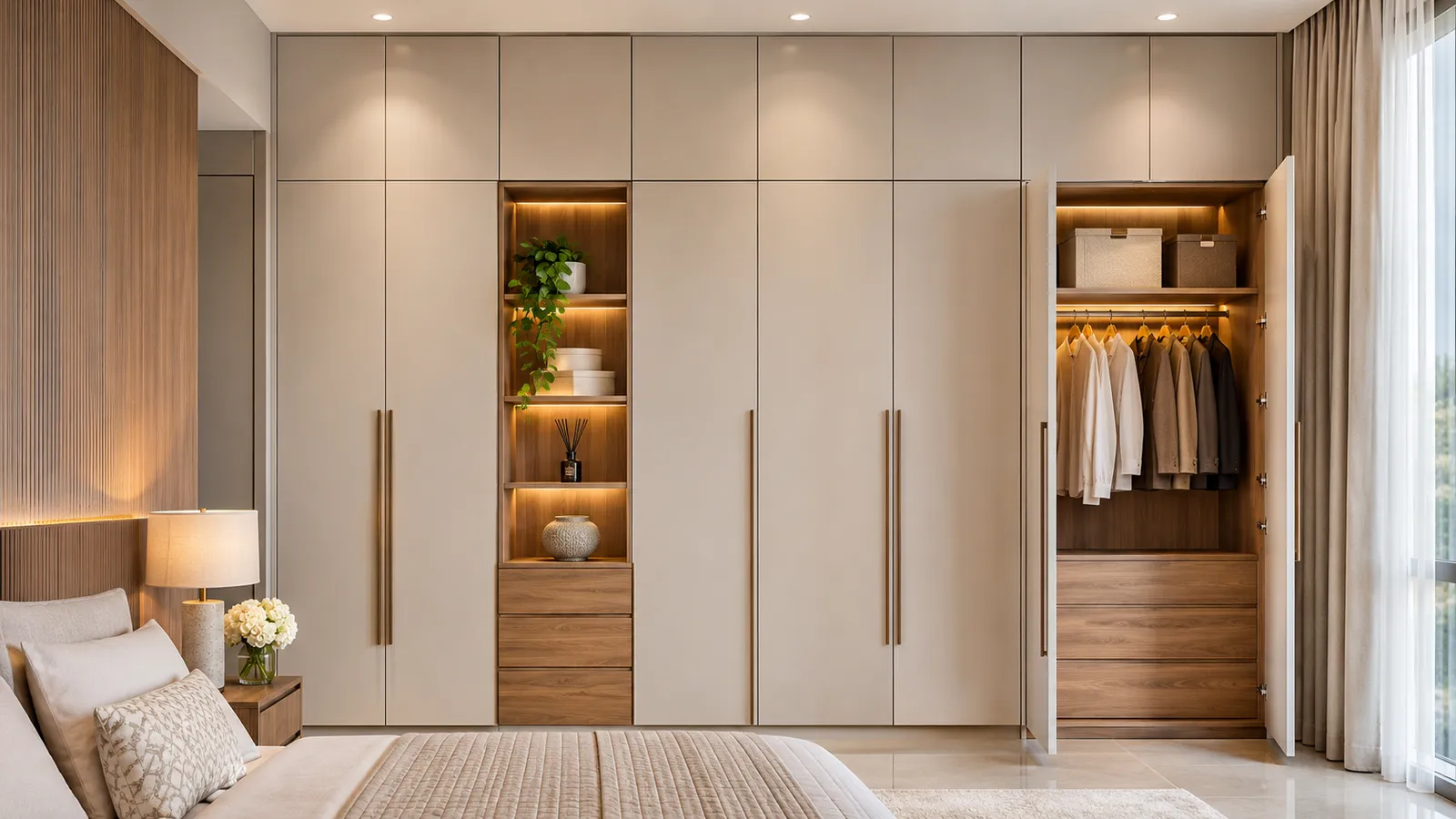
A double hang stacks two short rods so that shirts, blouses, jackets and folded trousers share one column. Bob Vila puts the rods at 207.6 cm and 102.9 cm, which leaves 104.8 cm between them, and our wardrobe layout guide explains why, in a custom wardrobe, a double-hang column holds roughly twice as much per width of rail as a single one. TaskRabbit describes short items such as shirts, blouses and folded pants as needing 36 to 40 inches (91 to 102 cm) of hanging space, and long items such as dresses and coats as needing 60 to 70 inches (152 to 178 cm).
Those two figures explain the logic in one line: the upper rod must be high enough for the lower tier to fit below it, and the lower rod must be high enough for its own garments to clear the base. If a piece is longer than the space the lower tier leaves, it does not belong in a double hang; it belongs in a long-hang bay.
Here is the check we suggest. Hang your longest shirt or jacket on its normal hanger and measure from the top of the hook to the hem. Then stand a lower-tier hanger on the lower rod and measure how far its top rises above the rod. The upper garment's drop must be smaller than the gap between the rods, minus that hanger height, with a few centimetres spare. With Bob Vila's rods the gap is 104.8 cm, so what you subtract is your own hanger, and the answer is yours, not a catalogue's.
Trousers can hang folded over the lower rod or live on a pull-out rack; the choice is explained in the layout guide, and the drawers and trays that sit beside a double hang are in our wardrobe drawers and organisers guide. Finished walk-ins with rails at several heights are on our walk-in closets and dressing rooms page. For fitted, modular and freestanding options from a tenant's side, see wardrobes in a rented apartment in the UAE.
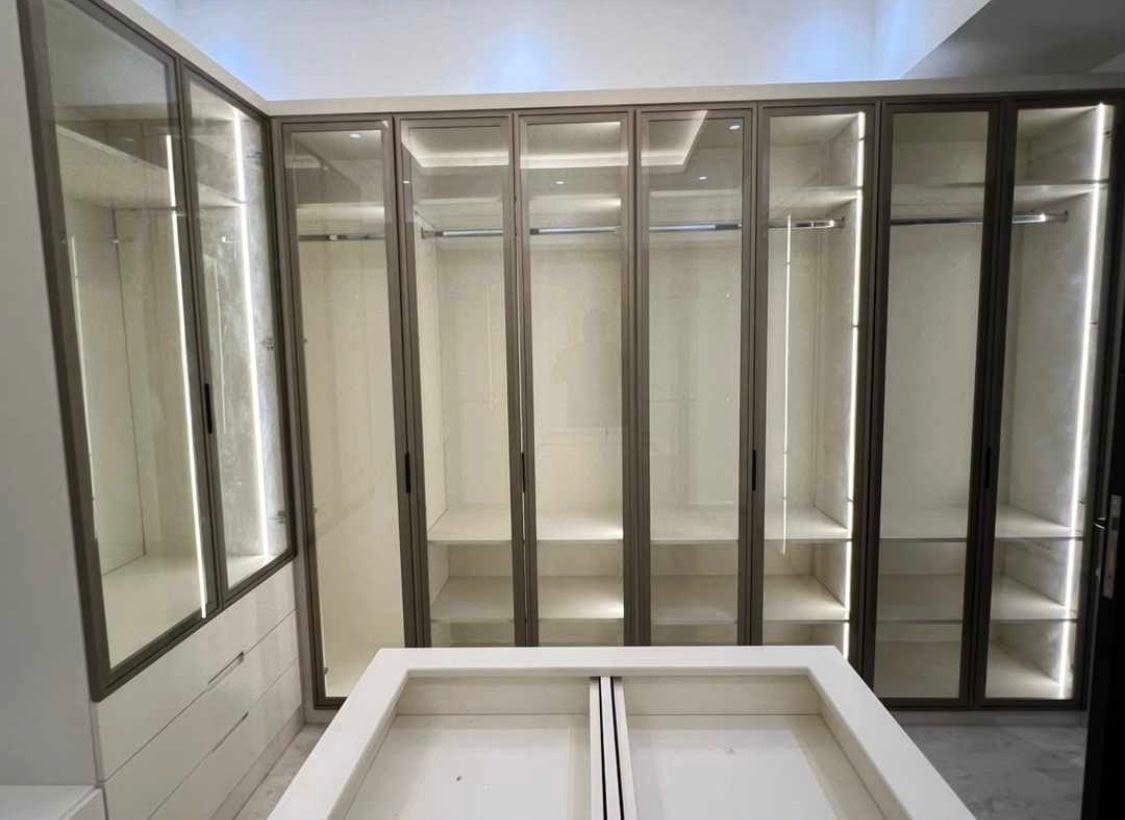
Long garments: kandura, abaya, gowns and coats
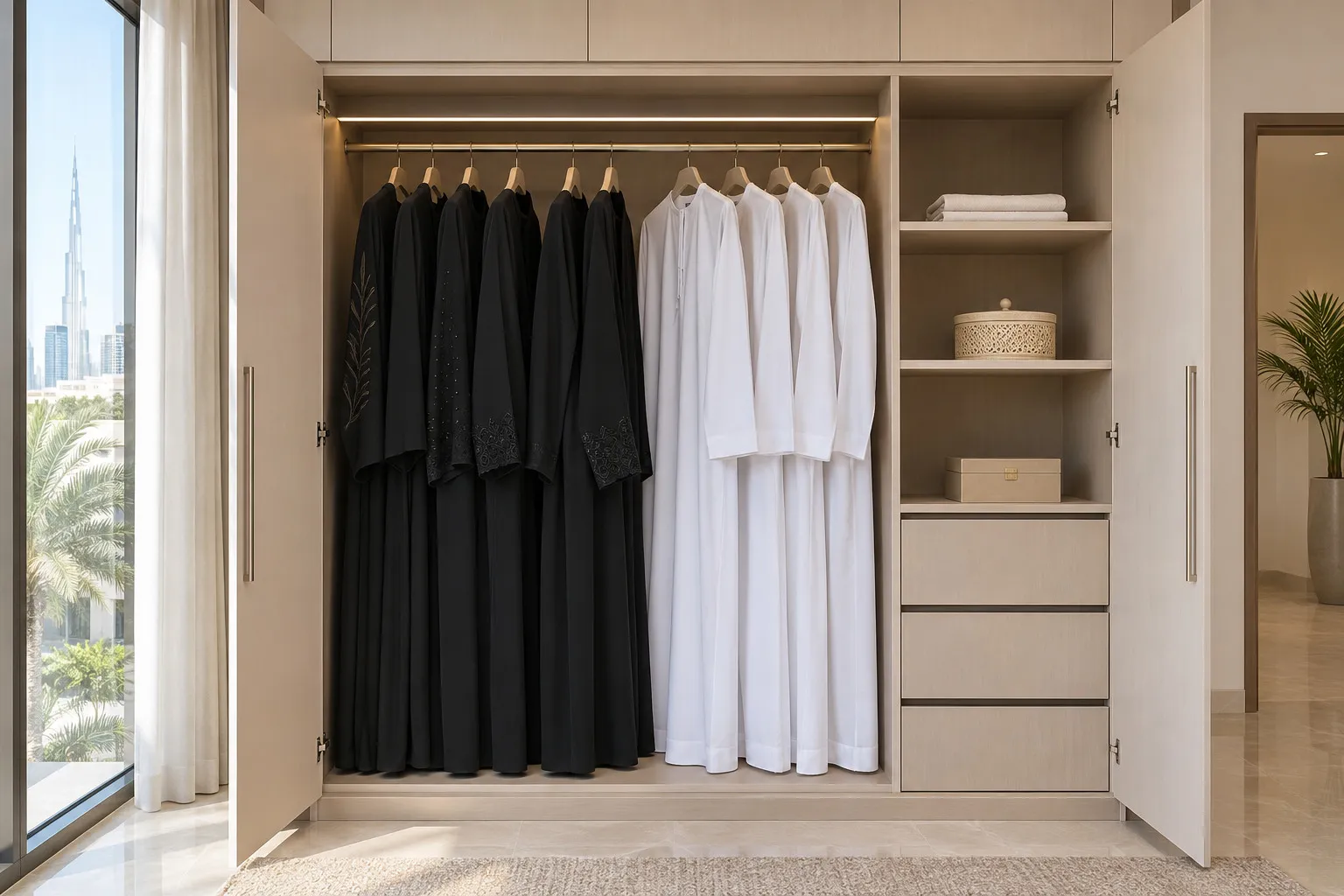
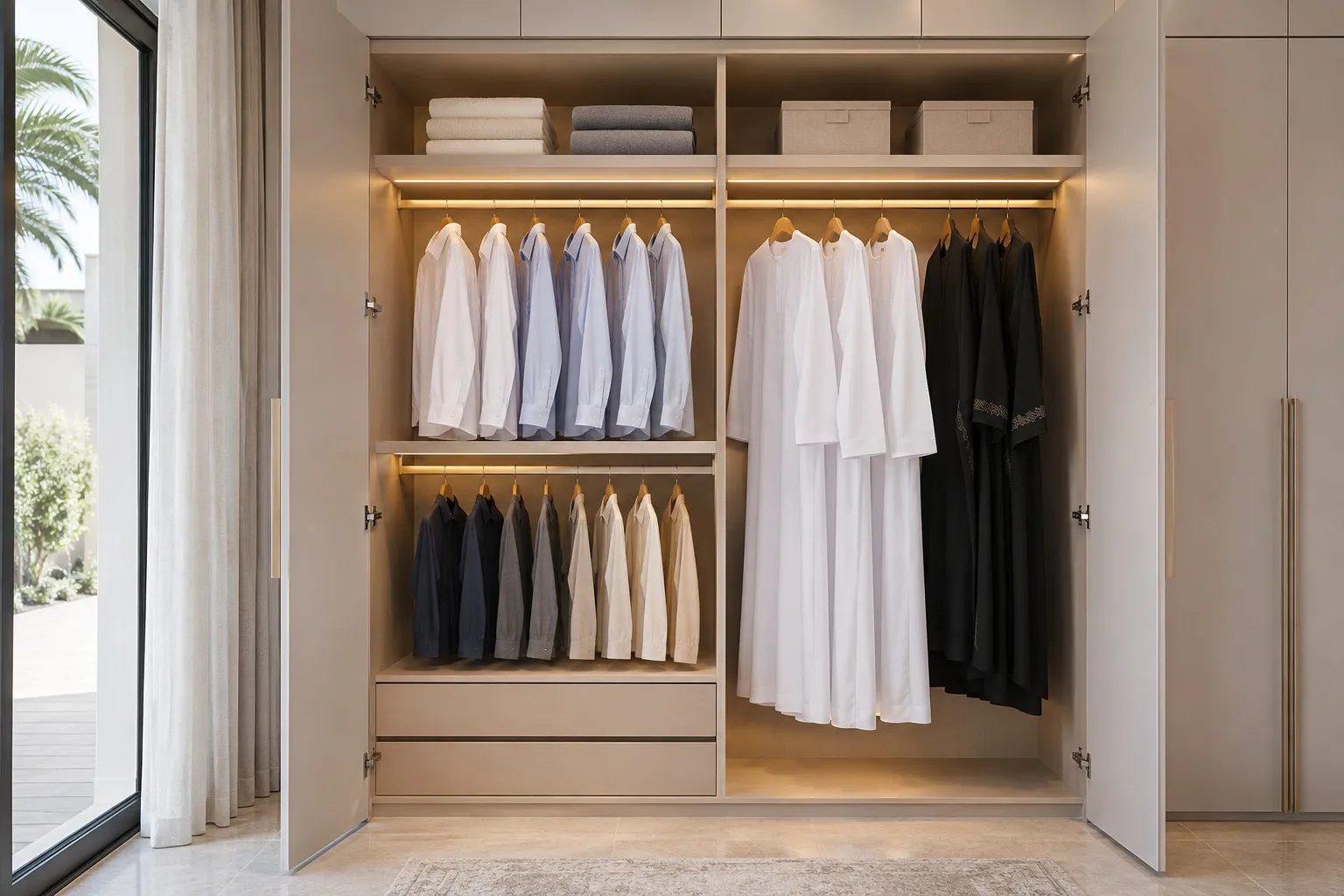
A kandura, an abaya or an evening gown usually needs more drop than the 167.6 cm single rod gives, so it takes its own bay with one rail and nothing hanging beneath it. TaskRabbit says dresses and coats require 60 to 70 inches of hanging space, which is 152 to 178 cm and is the nearest published range for a long bay, but it is written for Western dresses and coats and is not a number for a kandura.
Do not guess the figure. Our abaya and kandura storage guide shows the full method with the retailer garment lengths, and the short version is the one on the measure sheet below: longest garment on its own hanger, hook to hem, plus clearance. Where the long bay sits in the wardrobe, and how tall the unit is, belongs to the wardrobe dimensions guide.
One practical point for houses with several people: a household with kanduras and abayas in the same wardrobe as shirts usually needs both bays, one tall column and one double hang, rather than one compromise rail. The corner and L-shaped wardrobe guide shows how a second run can take the long bay when a single wall is too short, and luggage and seasonal storage shows what to put in the loft above the rail. If you want light inside, LED strip versus profile for wardrobe lighting explains the difference before you ask for a quotation.
How to measure your own longest garment
Take a tape measure and the hangers you really use. Hang one garment of each kind from a high hook so it falls straight, then run the tape down from the top of the hanger's hook to the lowest edge of the hem, and note the figure against that kind of garment. Decide how much air you want under the hem, above the wardrobe base, a shoe bay or a drawer, and add it. The sum is the least height the rod can have over whatever lies beneath.
A worked example, illustrative only: if your longest piece measures 150 cm hook to hem and you want 10 cm clear, the rod sits at least 160 cm above the base. The numbers are made up to show the sum; yours will differ. Do the same for the double hang, the shortest category of the household and each person's reach, and put all of it on one sheet for the surveyor. The same sheet is what the wardrobe measuring visit guide asks you to prepare. Depth decides how much room the doors and track take, and our guide on how deep a wardrobe should be covers hanging, shelf and sliding-door depths.
Your measure sheet: what to write down
Longest long garment
- How
- On its own hanger, top of hook to lowest hem
- Used for
- Height of the long-hang rod, plus your clearance
Longest shirt or jacket
- How
- Same method
- Used for
- Whether it fits the upper rod of a double hang
Height of a lower-tier hanger above its rod
- How
- Hang one and measure from rod to top
- Used for
- What to subtract from the gap between the rods
Clearance you want below the hem
- How
- Your choice, a few centimetres
- Used for
- Added to every drop
Shortest and tallest user
- How
- Standing reach with one arm raised
- Used for
- Highest rail each person will use daily
Reference point
- How
- Bottom or centre of the rod
- Used for
- Written next to every height on the drawing
Our own checklist. The free measuring visit takes the room measurements; the garment numbers are yours.
The shelf above the rod and the space beneath it
Above the rod you need a gap and a depth. Bob Vila keeps 2 inches (5.1 cm) or more between the top of the rod and the shelf over it, so a hanger lifts off without catching, and sets the rod 12 inches (30.5 cm) or more out from the back wall. FCI London gives 60 cm as the minimum inside depth for hanging in a hinged wardrobe, and 66 cm plus about 5 cm of track for sliding doors, which is why door type feeds back into the rail depth; the hinged versus sliding comparison and the sliding door systems guide cover that. How many hinges each hinged leaf then carries is covered in the wardrobe hinges guide. If a hinged leaf later rubs or sags, fixing a wardrobe door that is sticking explains the usual causes.
Below the clothes, decide what the space is for before you set the rod. For folded clothes, FCI London's shelf spacing is 300 mm at the minimum, 350 to 400 mm recommended and 400 to 450 mm in the luxury range, the pitch to use for shelves of folded clothes beside a rail. For shoes, measure your own tallest pair: no source we opened gives a shoe-bay height, so we do not invent one. If long garments hang over a shoe bay, our wardrobe drawers and organisers guide and the shoe storage cabinet guide show how to keep the two apart. Our shoe wardrobe design guide goes deeper on shelf depth and ventilation for shoes.
Lighting along the rail is planned together with the drawing; the options are in our wardrobe lighting ideas page. If a sliding door ever jumps out of its guide, our page on a sliding wardrobe door that has come off its track lists the safe first checks and when to stop and call someone.
Reach limits: who can use which rail
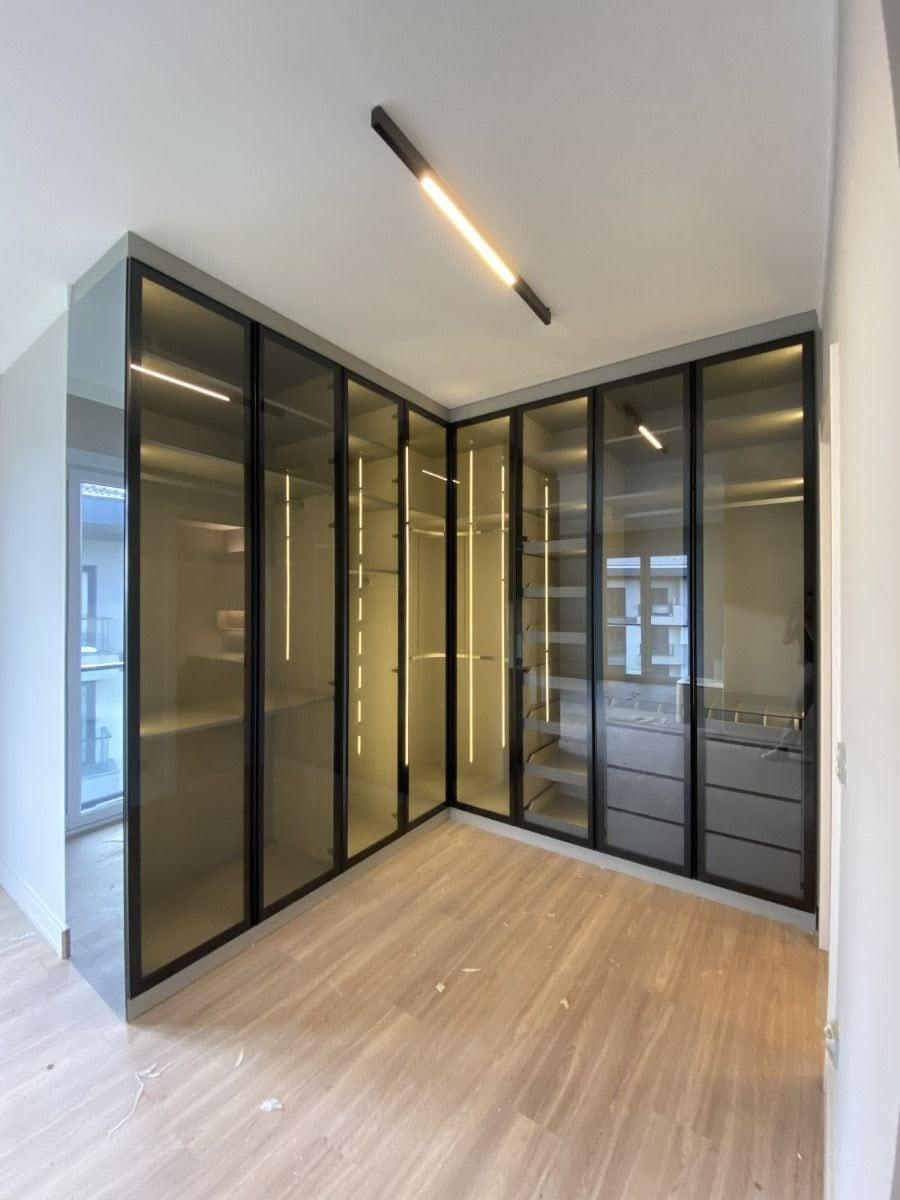
A rail is only useful if the person it is for can reach it, so set the daily rails by reach. The US Access Board's guide to the ADA Standards gives an unobstructed reach range of 15 to 48 inches, which is 38 to 122 cm, for parts people operate. It is an accessibility rule for public buildings and not a home standard, so we use it only as context: the upper rod of a double hang at 207.6 cm is well above it, which means anyone who is short, or who uses a chair, needs that tier lowered or left unused.
For children, TaskRabbit suggests 30 to 36 inches (76 to 91 cm) for ages 3 to 6 and 40 to 48 inches (102 to 122 cm) for ages 7 to 12, and Bob Vila uses 30 inches for a small child. Both advise a rail that can move as the child grows, which is the idea behind the growth plan in our kids wardrobe design guide. Whether a rail in a made-to-measure wardrobe can be moved later, and how, is a question to ask in the quotation, because we have not published it as a standard feature.
Shared wardrobes work best when each person has a column at their own height. In a master suite that is often two sides, as the master bedroom wardrobe design guide lays out.
The dressing room design guide shows how a walk-in can give each person a wall, and the small bedroom wardrobe ideas page shows how to do it when there is only one run. Before you settle on hinged leaves, see how far a wardrobe door opens into the room. Handle types, heights and finishes are in our wardrobe handles guide.
Which hanging layout suits which household
Mostly shirts, trousers and jackets
- Layout to ask for
- Double hang, with a short run of long hang
- What to measure first
- Longest shirt and a lower-tier hanger
Kandura, abaya or gown in the mix
- Layout to ask for
- Tall long-hang bay, plus a double hang for shorter items
- What to measure first
- Longest long garment, hook to hem
Young children
- Layout to ask for
- A low rod that can be raised later; ask how
- What to measure first
- Child's reach today
One short or seated user
- Layout to ask for
- Lower rod set to their reach; upper tier left for storage
- What to measure first
- Highest comfortable reach
Small or shared room
- Layout to ask for
- One long bay, one double hang and a shelf column
- What to measure first
- Wall length and bed gap
Our own planning advice from the sources on this page, not a measured rule.
Fixing the heights on paper before anything is built
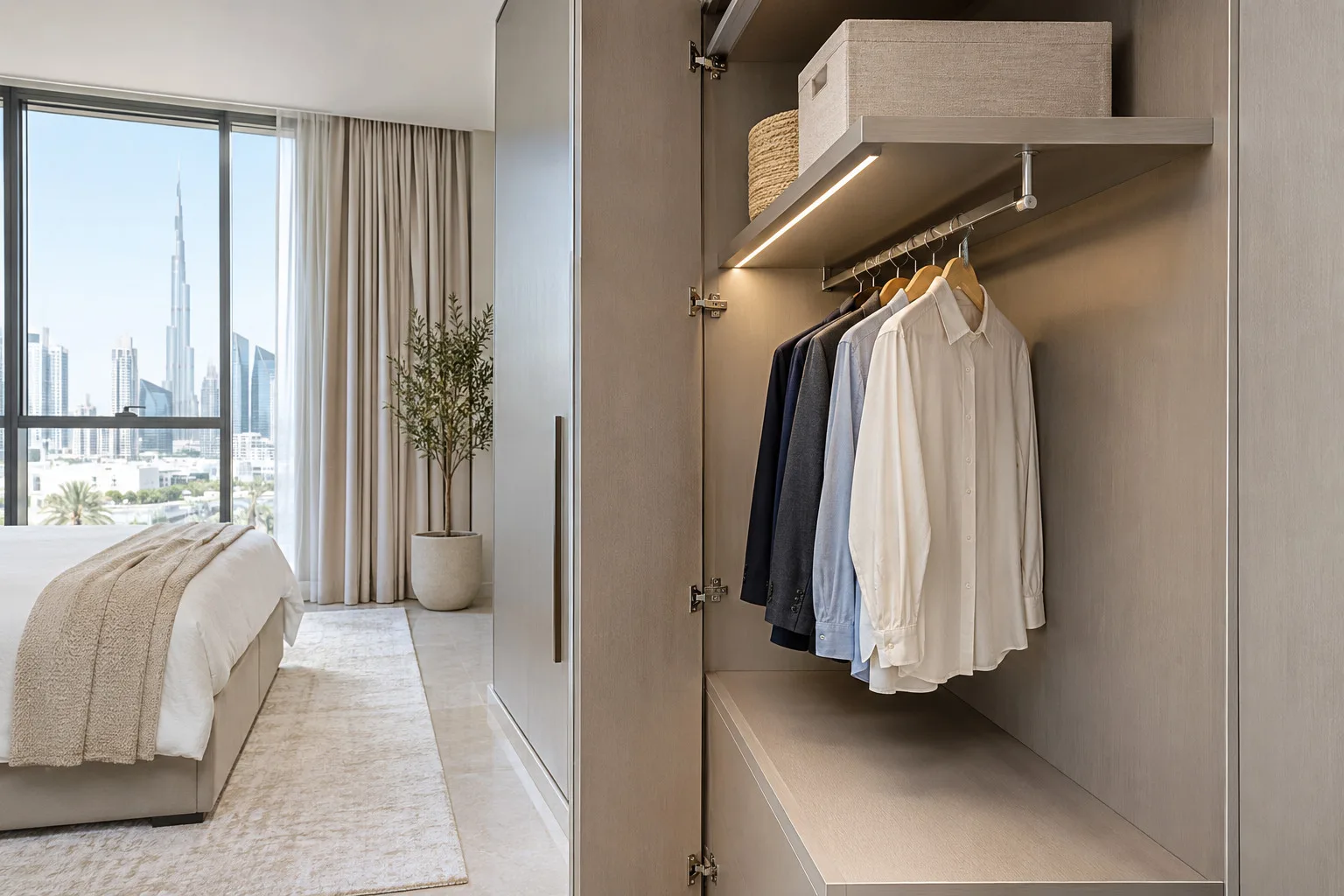
In a made-to-measure wardrobe the rails are part of the drawing, so settle them before you approve it, not after fitting. Our drawing shows each column with its rails, shelves and drawers; check every height against your sheet and ask for the reference point to be written beside it. The wardrobe quotation checklist lists what else the written quote should show, and the wardrobe door replacement guide is worth reading if you are keeping an existing carcass, because changing doors does not change the rails inside.
If a rail in your current wardrobe is wrong, you may not need a whole new unit, and renovate or replace a wardrobe helps you decide. Whether the inside can be altered depends on how the carcass is built, so ask the supplier in the quotation; our fitted, built-in and freestanding wardrobe guide sets out what each type allows. For a buying view, custom or ready-made wardrobe compares where each wins in the UAE.
The inside of a wardrobe also depends on the board and finish you choose, and the wardrobe materials and cost guide and the door finishes comparison show what each choice changes.
If the wardrobe stands on an outside wall or beside a bathroom, read moisture-resistant wardrobe boards and why a wardrobe smells musty before you settle how low the hems hang. Couples dividing one run can use our shared couple wardrobe guide to settle the split on paper first. The first checks for this position are in a wardrobe against a bathroom wall.
What we do about hanging heights
At our free measuring visit the surveyor confirms the rail height from the longest garment you have measured. We bring laminate, veneer and glass samples, measure the wall, and send you a drawing and an itemised price. The drawing shows every rail, shelf and drawer; we make nothing until you approve both. Bring the measure sheet above, and ask for any numbers you cannot find on the drawing to be written onto it.
Our entry price is from AED 550 per sqm, installed, for MDF laminate with hinged doors; sliding, mirror and glass options raise it, and the figure for your wall is set after the visit. After you confirm, our Sharjah workshop builds the wardrobe and our own team fits it in up to about 10 days, depending on size and design, with a 24-month written warranty on the workmanship. Separately, the wood-based boards carry a 5-year limited warranty, subject to terms; hinges, tracks, runners, rollers and other moving hardware are not covered, and the final terms are in the written warranty. Details are on the custom wardrobes page, and finished examples are on our built-in wardrobes page.
We do not publish a standard rail height or a rail hardware brand, so ask for both in the quotation. You can book a free measuring visit and compare prices with the pricing guide.
Our Sharjah wardrobe page and Dubai page show where we fit.
If you live in the flat while we work, occupied home installation preparation explains how to ready the room. If you are still deciding between a wall of doors and a room you step into, our reach-in versus walk-in wardrobe guide compares what each costs in floor space. What a wardrobe warranty should say in writing, and how to read a lifetime claim, is explained in our wardrobe warranty guide. If a mirror leaf is on the plan, our guide to mirror wardrobe doors covers the weight, the glass and the edges. In a one-room home the wardrobe has more jobs to do, as our guide to a studio apartment wardrobe explains.
Rail heights come after the room, layout and doors are fixed; our planning guide for wardrobes sets out that order.
Common questions
How high should a hanging rail be in a wardrobe?
Bob Vila puts a single rod at 167.6 cm (66 inches) to the bottom of the rod, but long garments need more, so set it from your longest piece, hook to hem, plus clearance. See our wardrobe dimensions guide.
What is the right height for a double hanging rail?
Bob Vila gives 207.6 cm for the upper rod and 102.9 cm for the lower, to the bottom of the rod, leaving 104.8 cm between them. Check your longest shirt against that gap. See our wardrobe layout guide.
How much hanging space do I need for kandura or abaya?
There is no published standard, so measure your longest garment on its hanger, hook to hem, and add clearance. TaskRabbit's range for dresses and coats is 152 to 178 cm. See our abaya and kandura storage guide.
How far above the rod should the shelf be?
Bob Vila asks for at least 2 inches (5.1 cm) from the underside of the shelf to the top of the rod, so hangers lift off cleanly. See our wardrobe quotation checklist.
How high should a child's wardrobe rail be?
Bob Vila suggests 30 inches (76.2 cm) for a small child; TaskRabbit gives 76 to 91 cm for ages 3 to 6 and 102 to 122 cm for ages 7 to 12. Ask whether the rail can move as they grow. See our kids wardrobe design guide.
Is the rail height measured to the top, centre or bottom of the rod?
It depends on the source: Bob Vila measures to the bottom and TaskRabbit to the centre. Ask for the reference point to be written next to every height on your drawing. See our wardrobe measuring visit guide.
What do you need from me to set the rail heights?
Your longest garments measured hook to hem, a lower-tier hanger height and each user's reach; the surveyor confirms the rail height from them at the free visit. See our custom wardrobes service.

Sources & specifications
Manufacturer information applies to the named products and systems. Sources reviewed on 3 November 2026.
- Bob Vila, Closet rod height (single rod 66 in; double 81¾ in and 40½ in; small child's lower rod 30 in; shelf at least 2 in above the rod; rod at least 12 in from the back wall; measured to the bottom of the rod)bobvila.com(opens in a new tab)
- TaskRabbit, Closet rod height (double rods about 80 in and 40 in to the centre of the rod; dresses and coats 60 to 70 in of hanging space; kids 30 to 36 in at 3 to 6 years and 40 to 48 in at 7 to 12 years)taskrabbit.com(opens in a new tab)
- FCI London, How deep should built-in wardrobes be (single rail 1,750 / 1,800 / 1,900 mm; lower rail of a double 850 / 900 / 950 mm; shelf spacing 300 / 350 to 400 / 400 to 450 mm; 60 cm minimum depth for hanging)fcilondon.co.uk(opens in a new tab)
- US Access Board, Guide to the ADA Standards, chapter 3: unobstructed reach range of 15 to 48 inches (context only, not a home standard)access-board.gov(opens in a new tab)
Want this planned for your home?
Consultation and measurement are free. Tell us the rooms, location and what you need; we arrange a sample visit and define the measured quotation.