Wardrobes · 14 min read · 21 July 2026
Wardrobe door sticking, rubbing or sagging: how to fix it
A hinged wardrobe door that sticks or sags has usually drifted, and Blum describes side, height and depth adjustment on its CLIP top hinges to correct that. When the board edge is damaged or swollen, or the hole has lost its grip, repair or replace the door instead.

By Ali Haider Basra, Founder, Al Tareeq Decor · Contact our workshop
Key takeaways
- A hinged wardrobe door sticks, rubs or sags for six common reasons: swollen board, loose screws, sag from weight, wall or floor out of level, a worn hinge or a door too heavy for its hinges. Read the symptom first.
- Blum describes side, height and depth adjustment on its CLIP top hinges, so a drifted door can often be moved sideways, up or down and in or out without taking it off. We quote no range in millimetres: it is on the instruction sheet for your hinge.
- Make the safe checks first and adjust one thing at a time. Do not take the weight of a glass or mirror door alone, and do not keep turning a screw that has stopped biting.
- Adjusting is no longer enough for a crumbling or soft board edge at the hinge, a swollen or bowed door, or a carcass out of square. Then repair the panel, replace the hinge or door, or look at the whole wardrobe.
- We assess before we promise: door replacement and hinge or hardware repair, with no repair prices or timelines stated here and the work confirmed in writing.
On this page
- Key takeaways
- Why a wardrobe door sticks, and what usually fixes it
- The six causes, and how to tell them apart
- Sticking, rubbing and sagging doors: cause, first check and where the fix ends
- What an adjustable hinge can correct
- Safe checks before you touch a screw
- Humidity and swelling: when the board is the problem
- Swelling after 24 hours in a soaking test, from one board maker's data
- When adjusting is no longer enough
- When to adjust, repair or replace
- Repair the hardware, replace the door, or replace the wardrobe
- Where doors stick most: corners, tall doors, kids and rentals
- What we do about it
- Common questions
Why a wardrobe door sticks, and what usually fixes it
A hinged wardrobe door that rubs its neighbour, catches the frame or will not close flush has moved, and there are six common reasons: the board has taken up moisture and swollen, hinge screws have loosened, the door has sagged under its own weight, the wall or floor behind the wardrobe is out of level, a hinge has worn, or the door was too heavy for its hinges from the start. When the cause is drift or settling, the fix is usually an adjustment of the hinge, because a concealed hinge is made to be moved a little after fitting. When the cause is damage to the board, no adjustment will hold.
This page is the fix-it order for a hinged door: read the symptom, make the safe checks, adjust one thing at a time, and know when to stop. How many hinges a door should have, and the width and weight rules behind it, are in our wardrobe door hinges guide, so we do not repeat them here. Sliding doors that jump or drag have their own page, fixing a sliding wardrobe door off its track, and replacing doors altogether is covered in wardrobe door replacement.
The six causes, and how to tell them apart
Look at the door for a minute before you pick up a screwdriver. Where it rubs, where the gap is wide and whether the problem comes and goes with the weather tell you most of what you need. The table below sets each symptom against its likely cause, the first thing to check, and where the fix ends. Wardrobes that carry heavy glass or a mirror drift more easily, as our mirror wardrobe doors guide explains.
Sticking, rubbing and sagging doors: cause, first check and where the fix ends
Door sticks only on humid days
- Likely cause
- The board has taken up moisture and swollen
- First safe check
- Does it ease in dry, air-conditioned weather? Look along the edges for a raised or soft area
- Where it ends
- Adjustment can give a little room; a swollen board needs the board dealt with
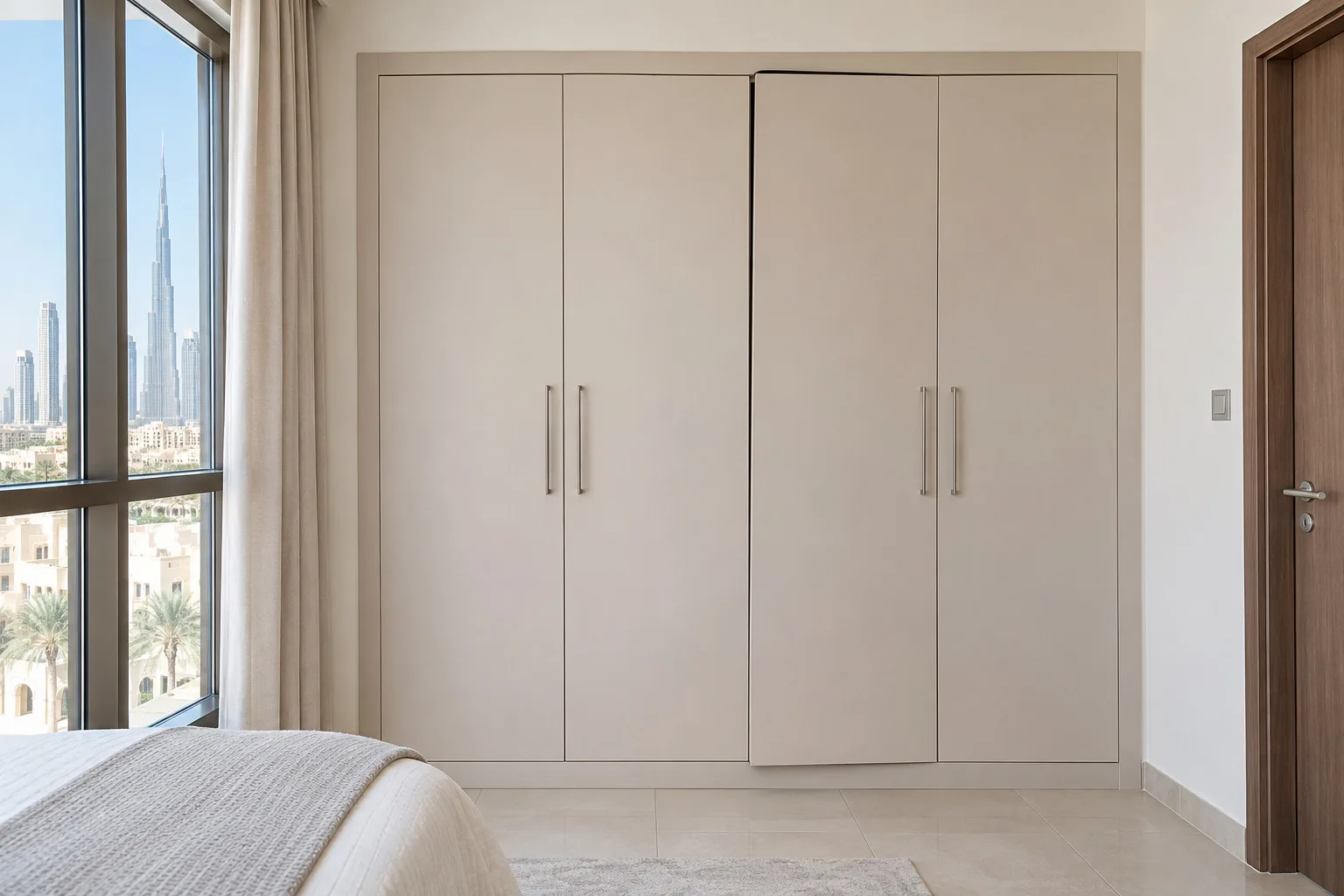
Door droops at the handle side, gap wider at the top
- Likely cause
- Settling or sag from the door's weight
- First safe check
- Is the gap different top and bottom? Is the door heavy with glass, a mirror or a rack?
- Where it ends
- Height adjustment can lift it; if it drops again, the hinge count or the weight is the question
Door rubs the neighbour or the frame at the side
- Likely cause
- Side setting has drifted, or a screw is loose
- First safe check
- Tighten the visible hinge screws gently, then see if the gap has changed
- Where it ends
- Side adjustment can re-centre it; if it keeps moving, a hole has lost its grip
Door stands proud of its neighbour or will not close flush
- Likely cause
- The depth setting has moved
- First safe check
- Close both doors and sight along the fronts
- Where it ends
- Depth adjustment brings the fronts into line, within the hinge's range
Gaps change from one door to the next along the wall
- Likely cause
- Wall or floor out of level, or the carcass out of square
- First safe check
- Place a level on the floor and against the side panel
- Where it ends
- No hinge setting will hold; the carcass or the base needs attention
Door will not stay shut, or bounces open
- Likely cause
- A worn hinge, or a door that is bowed
- First safe check
- Open and close slowly; feel for a hinge that moves loosely
- Where it ends
- Replace the hinge, or the door if it is bowed
The adjustment rows follow Blum's description of side, height and depth adjustment; the moisture and carcass rows follow our own door-replacement checks. Always confirm on site.
What an adjustable hinge can correct
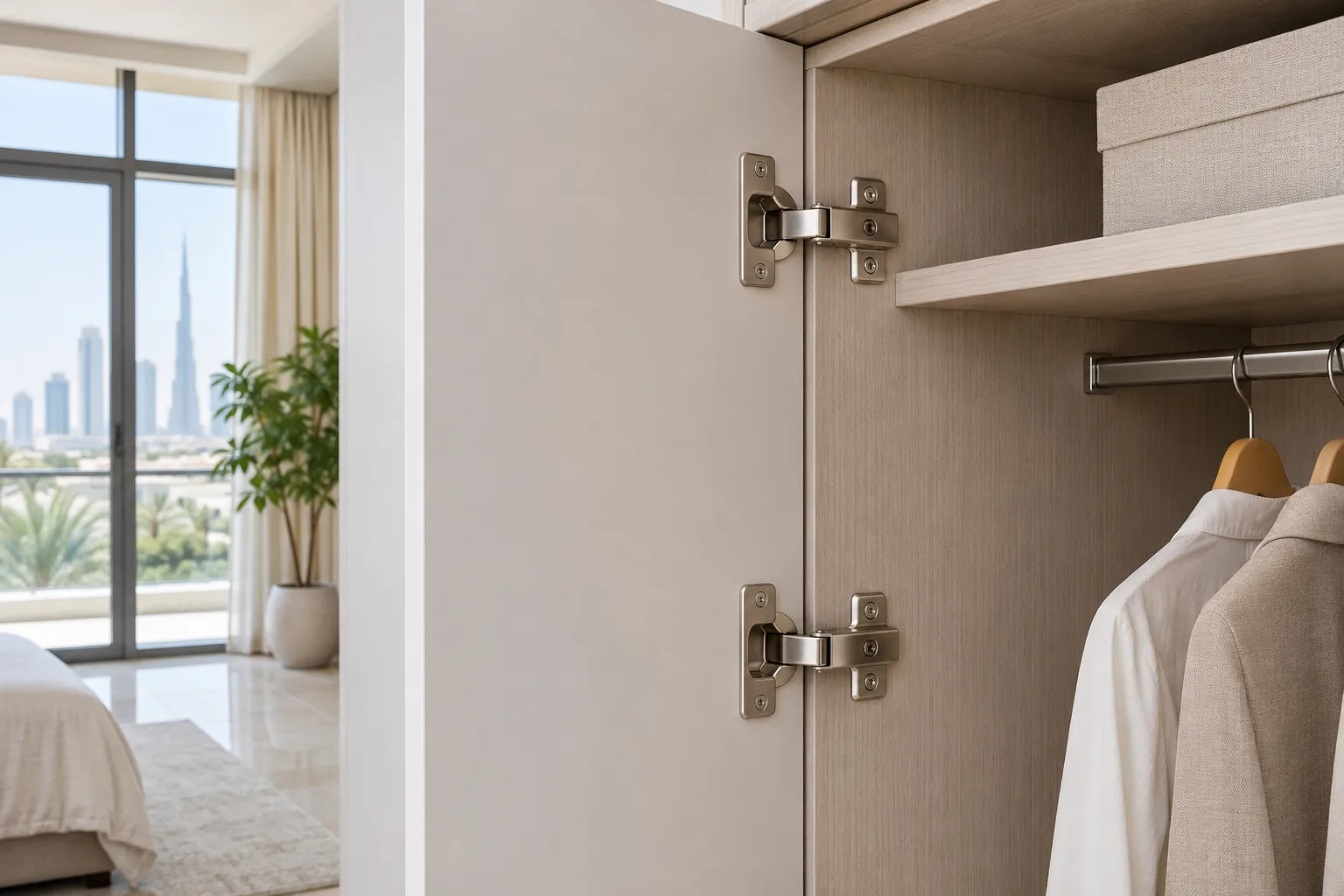
Blum, the hinge maker whose pages we read, says its CLIP top hinges give side, height and variable depth adjustment, with a spiral screw for depth, and describes the feature as three-dimensional adjustment. Its catalogue names the same two ideas, "3-dimensional front adjustment" and "spiral-tech depth adjustment", and adds that several mounting plates also have cam height adjustment. In plain terms, a door that has been hung can be moved sideways in its opening, up or down, and in or out against its neighbour, without taking it off.
That is why a drifted door often comes right. A door that rubs the frame at the side wants the side adjustment; a door whose top gap has opened wants the height adjustment; a door that stands out from the doors beside it wants the depth adjustment. We take them one at a time, in the order the maker lists them, so you can see which screw changed which gap and undo a move that did not help. The drawing below shows one drifted door gaining the three corrections in turn.
Two cautions come from the same pages. First, we are not quoting how far each adjustment goes, because the maker's pages we could open give no figure in millimetres; the range is on the instruction sheet for your exact hinge, and it differs from one hinge and mounting plate to another. Second, the maker's own pages show that some applications need the mounting plate moved from the standard fixing positions, which is a fitter's job and not a screw turn. Our hinges guide and the wardrobe quotation checklist show how to ask for the range of the hinge you are being quoted.
- 1. A door that has drifted: it rubs, sits low or sticks out from its neighbour
- 2. Side: the door moves left or right in its opening
- 3. Height: several of Blum's mounting plates have cam height adjustment
- 4. Depth: a spiral screw brings the fronts into one line
- 5. No screw fixes a missing hinge, a stripped hole or a swollen board
Safe checks before you touch a screw
These are checks, not repairs, and each can be made in a few minutes without removing a door. Do them in this order and stop at the first that explains the problem. If the door is a heavy glass or mirror panel, do not take its weight on your own: ask a second person to hold it, or stop and ask for help, because a panel that drops can injure you and break.
First, open and close the door slowly and watch the gap: where does it rub, and is the gap even top to bottom? Second, press lightly on the visible hinge parts and look for a hinge that moves or a screw head that stands proud. Third, tighten any loose screw gently with the right driver; if it turns and never tightens, the hole has lost its grip and you should stop there. Fourth, check the wardrobe itself with a level against the side panel and the floor in front of it. Fifth, look along the door and board edges for a raised, soft or flaking area, particularly around the hinge cups.
Only then try one adjustment, a small turn at a time, and check the gap after each. Never force a door that is jammed, never keep turning a screw that has stopped biting, and do not remove a mirror or glass door yourself. If you also notice a damp smell, read why a wardrobe smells musty before you decide this is only a hinge problem.
Humidity and swelling: when the board is the problem
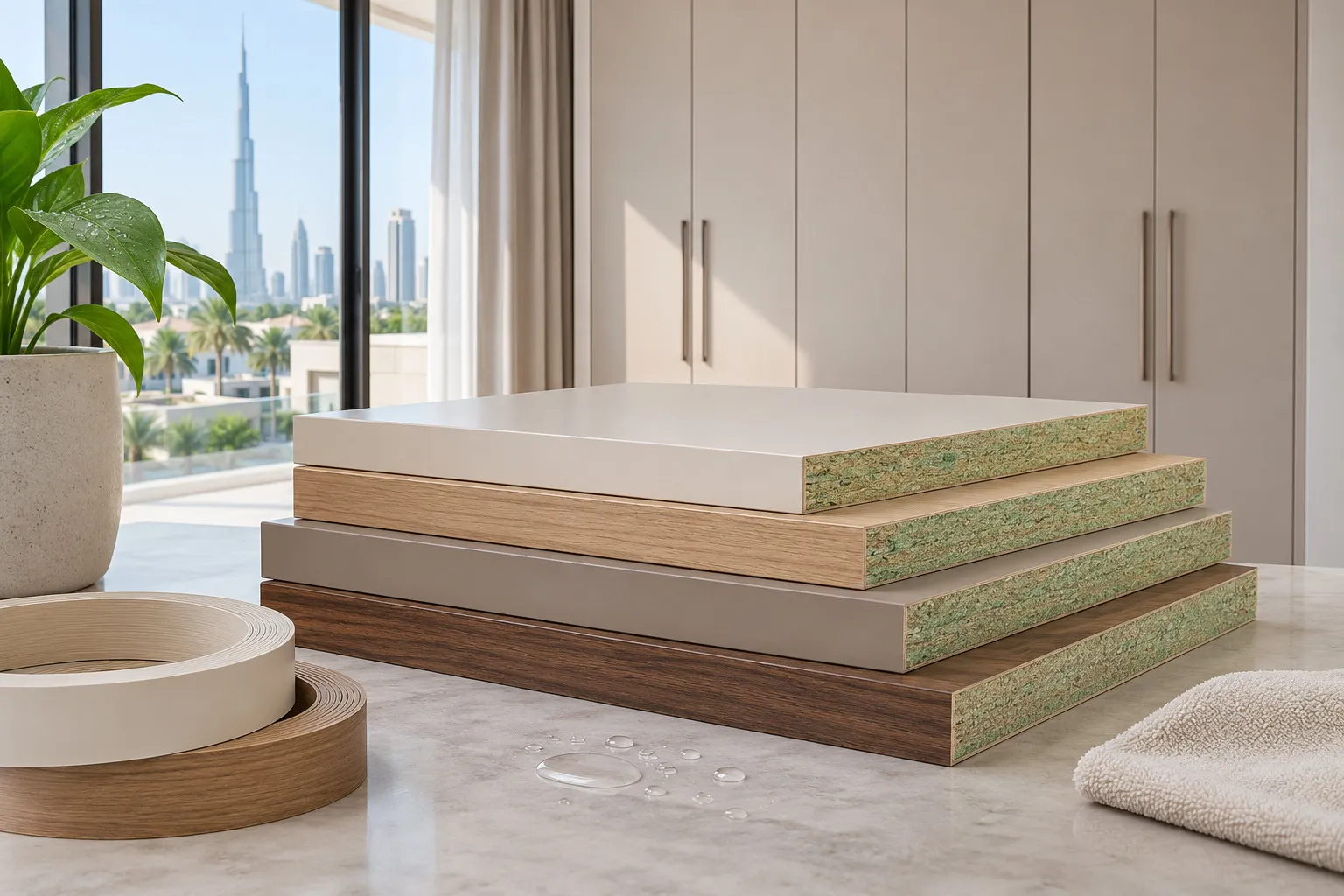
A door that sticks on some days and frees on others usually points to the board. Wood-based boards take up water and swell, and the edges swell first because that is where the cut board is open. We do not have a UAE figure for how much a wardrobe door swells in a humid room, and we will not invent one. What a board maker does publish is a test: SwissKrono's technical data for its standard MDF lists "Swelling after 24h" to EN 317, with 12% at 12 to 19 mm thickness and 10% at 19 to 30 mm, and 5% or less for its moisture-resistant MR FRONT board at 16 to 25 mm. That is a 24-hour soaking test, not a damp bedroom, so read it as a comparison between grades and not a prediction for your door; a bowed door shows more on a grooved front, as the fluted wardrobe door guide explains.
What it does show is that the grade matters, which is why a door in a bathroom-side or ground-floor wardrobe is worth specifying with care. Our guide to moisture-resistant wardrobe boards explains what the grades mean, and the wallpaper in humid climates guide shows the same damp lifting a different finish. Hinge adjustment can give a swollen door a little room, but it is not a cure, and it should not be used to hide a board that is still taking up water. If the wardrobe stands against a bathroom or outside wall, what to check on a bathroom or outside wall before fitting a wardrobe covers the wall itself.
If the door sticks only in the humid months, give the room some air first (the wardrobe humidity guide lists the habits that help): ventilation, and a wardrobe that is not packed to the doors, are free. If an edge is visibly raised or soft, or the sticking returns each season, the board needs attention. Finishes and edges differ in how they cope, and the wardrobe door finishes comparison sets them side by side.
Swelling after 24 hours in a soaking test, from one board maker's data
SwissKrono standard MDF
- Thickness
- More than 12 to 19 mm
- Swelling after 24 hours
- 12%
SwissKrono standard MDF
- Thickness
- More than 19 to 30 mm
- Swelling after 24 hours
- 10%
SwissKrono MR FRONT (moisture-resistant)
- Thickness
- 16 to 25 mm
- Swelling after 24 hours
- 5% or less
Source: SwissKrono MDF technical data, tested to EN 317. A soaking test is not a damp room, and other makers' boards have their own figures.
When adjusting is no longer enough
Adjustment moves a good door on good boards. It cannot restore a hinge hole that has crumbled, a board that has swollen, a carcass that is out of square or a hinge that has worn. When one of these is the cause, adjusting only moves the problem for a week or two, and the repeated turning widens the damage. The decision table below sets out the signs and what comes next.
The order of the options is simple. A loose or stripped hole at the hinge is a repair of the panel or its replacement. A worn hinge is a hinge replacement. A swollen or bowed door is a door replacement. A carcass that is out of square, or a wall that is wet, is a matter for the whole wardrobe, as renovate or replace a wardrobe explains. The measuring visit checks level and squareness before anything is drawn, and tall runs are covered in floor-to-ceiling wardrobes in the UAE.
When to adjust, repair or replace
Screw turns but never tightens
- What it means
- The hole in the panel has lost its grip
- Better than adjusting
- Repair the hole or replace the panel
Board edge at the hinge is crumbling, raised or soft
- What it means
- The board is damaged at the point that carries the door
- Better than adjusting
- Replace the door or the panel
Door has swollen and stays swollen
- What it means
- The board has taken up moisture
- Better than adjusting
- Deal with the damp, then replace the door; see the board grades
Hinge moves loosely or will not hold its setting
- What it means
- The hinge has worn
- Better than adjusting
- Replace the hinge and re-adjust
Door is bowed along its length
- What it means
- The door itself has warped
- Better than adjusting
- Replace the door
Every door on the wall is off by a different amount
- What it means
- The carcass, floor or wall is out of true
- Better than adjusting
- Check the wardrobe as a whole; a door fix will not last
These are our usual checks for a hinged wardrobe, not a guarantee for any one door. Always confirm on site.
Repair the hardware, replace the door, or replace the wardrobe
The cheapest correct answer is the smallest one that will last. If the board is sound and only the hinge is worn or out of adjustment, replace or re-set the hinge. If the hinge hole or door has failed but the carcass is sound, replace the door, and let the new door be drawn for the real opening; wardrobe door replacement walks through how that is quoted. If the carcass is out of square, soft with damp or too old to carry a new door, a new wardrobe is the better spend, and the wardrobe price guide and the wardrobe materials and hardware guide show how that is built up. If you are weighing a new wardrobe against keeping the old one, custom or ready-made wardrobe: where each wins sets out the choice.
A repair is worth one thing more: ask what was wrong. A door re-set without a reason will drift again, and the reason, whether weight, damp, a worn hole or an uneven wall, decides whether it is worth doing twice. For doors that carry racks or mirrors on the inside, see wardrobe drawers and organisers and abaya and kandura storage, because what hangs on a door adds to the load. If shoes are part of the plan, our shoe wardrobe design guide covers pairs per shelf, depth and ventilation.
Where doors stick most: corners, tall doors, kids and rentals
Corner runs are the usual place for doors that rub, because two doors meet the turn and must clear each other; see corner and L-shaped wardrobe design and our guide on how much room a wardrobe door needs for the swing. Tall doors are heavy and long, so small drift shows quickly; the wardrobe hanging heights guide and wardrobe depth guide explain the sizes that follow. If a loft is planned above tall doors, our guide to loft boxes and top cabinets for luggage and seasonal storage covers the height sum.
A wardrobe used by children is opened roughly, and doors drift sooner; the kids wardrobe design guide covers how to plan for it. In a studio apartment or a small bedroom the door swing is tight, so a door that stands proud catches the bed. If you share the wall, a shared wardrobe for a couple helps divide the doors sensibly.
If you rent, check your tenancy contract and ask the landlord in writing before anyone changes hinges or doors; wardrobe options for a rented apartment covers what to ask. If you would rather not have hinged doors at all, hinged versus sliding doors and wardrobe sliding door systems compare the two. A handleless wardrobe shows misalignment more, because there is no handle to hide it. If you are choosing handles at the same time, our wardrobe handles guide covers the types, heights and finishes.
What we do about it
We assess before we promise anything. Tell us what you see through the consultation form: which door, where it rubs, how long it has been happening and whether it changes with the weather, and send a photo if you can. We can replace doors and we repair hinges and other moving hardware, by assessment, because what the right answer is depends on the board and the hinge. We state no repair prices and no repair timelines here, since those depend on what we find, and we confirm the work and its cost in writing before we start.
For new work the process is the published one: a free measuring visit with samples, a drawing and an itemised price you approve before anything is made, our Sharjah workshop, our own installers across the UAE, and up to about 10 days from order confirmation depending on size and design. Our entry price for a new wardrobe is from AED 550 per sqm of front, MDF laminate with hinged doors, installed; other options raise it, and the figure for your wall is set after measurement. After you confirm the quotation and details, a 60% advance is paid and production starts once it is received.
Warranty is stated in two places, and they are different. Our written workmanship warranty covers our own work for 24 months, with supplied products following their own terms. Separately the wood-based boards carry a 5-year limited warranty, subject to terms; hinges, tracks, runners, rollers and other moving hardware, labour, misuse and damage are not covered. Our wardrobe warranty guide sets the two side by side, and the warranty and aftercare guide covers care afterwards.
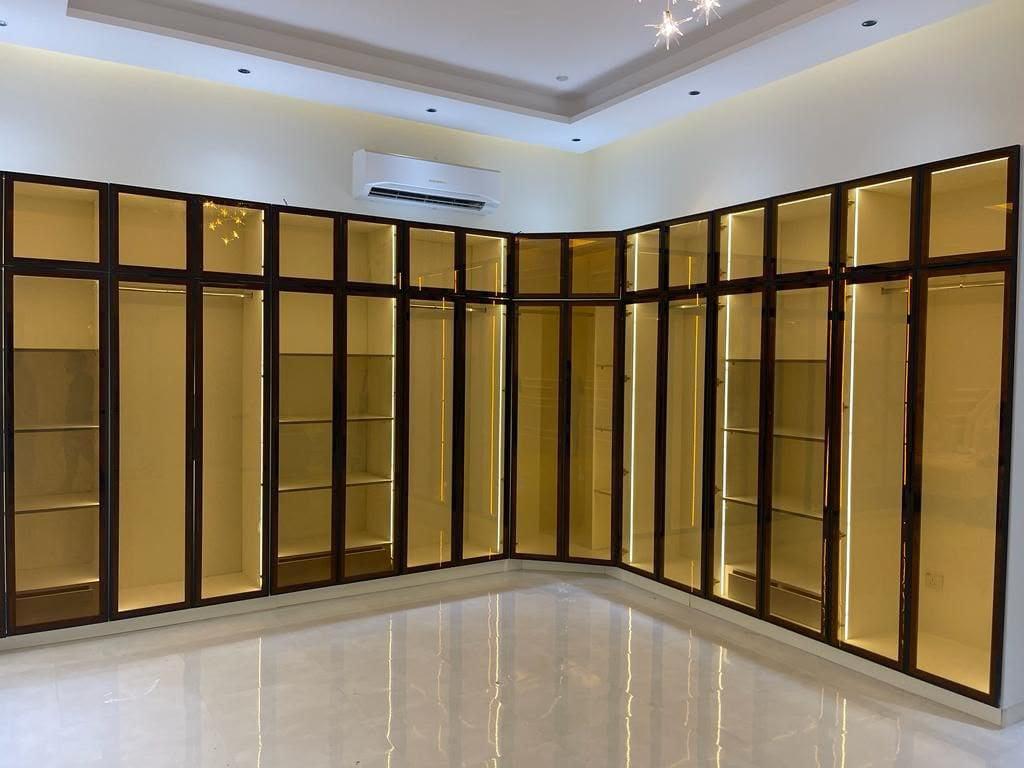
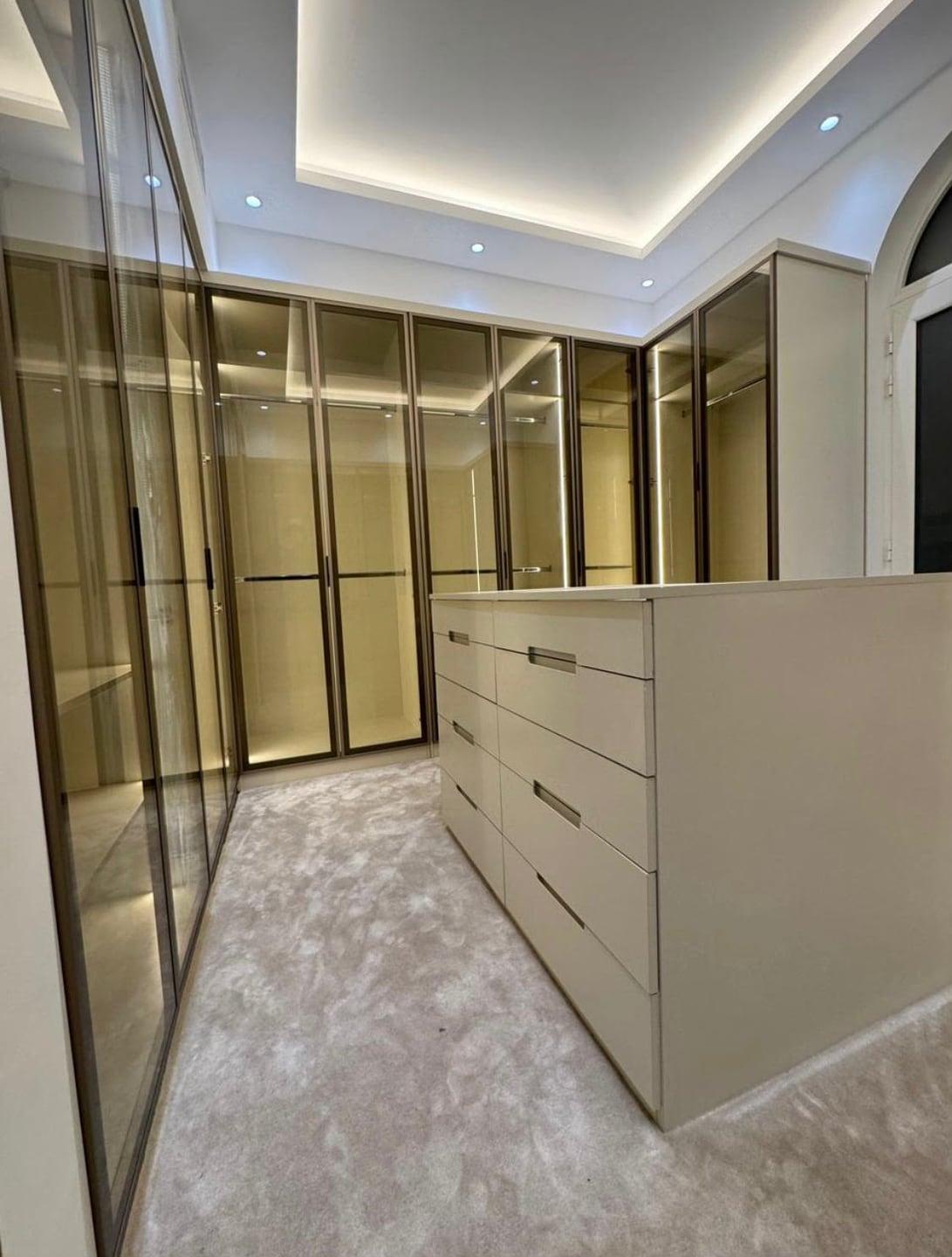
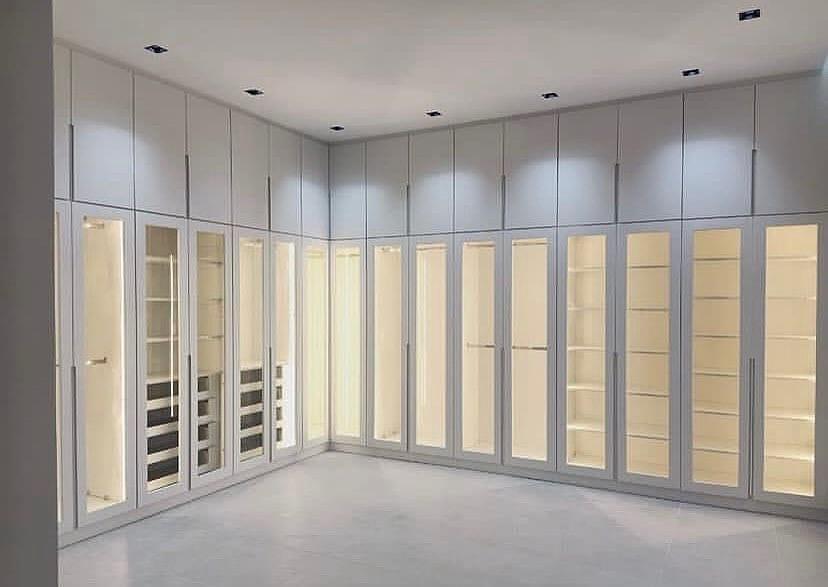
See our custom wardrobes service for what we make, the built-in wardrobes page for finished runs, and lit glass-front wardrobes if the doors are glass. If you want to avoid hinges, the sliding door wardrobes page covers the other kind. Visits across the UAE are arranged from our Sharjah workshop, and the Dubai page covers visits there.
For the cost side of a new wardrobe, our pricing guide shows how a quotation is built, the wardrobe layout guide and wardrobe dimensions guide help you plan, and you can browse every custom wardrobe we make. A master bedroom wardrobe, a dressing room and a walk-in or reach-in choice each change how many doors you have, and a lit wardrobe is explained in LED strip or profile lighting. Joinery doors elsewhere in the home are in kitchen joinery and cabinets and architectural joinery, doors and partitions.
If repair is not worth it, our guide to planning a new wardrobe step by step helps you start again in the right order.
Common questions
Why is my wardrobe door sticking?
Usually the board has swollen in damp air, a hinge screw has loosened, the door has sagged under its weight, or the wall or floor is out of level. If it sticks only on humid days, suspect the board. See our moisture-resistant wardrobe boards guide.
How do I fix a wardrobe door that will not close flush?
A concealed hinge can usually be adjusted in depth so the fronts line up, and in side and height if the gaps are uneven. Turn one screw a little at a time and check the gap, using the maker's sheet for your hinge. See our wardrobe door hinges guide.
Can I adjust a wardrobe hinge myself?
Often yes: Blum describes side, height and depth adjustment on its CLIP top hinges. Do not take the weight of a glass or mirror door alone, and stop if a screw will not tighten. See our mirror wardrobe doors guide.
Why does my wardrobe door keep dropping after I adjust it?
Adjustment cannot fix a hinge hole that has lost its grip, a worn hinge, too many kilograms for the hinges, or a carcass out of square. If it drops again within weeks, look at those next. See our wardrobe door replacement guide.
When should I replace the wardrobe door instead of repairing it?
When the board edge at the hinge is crumbling or soft, the door is swollen or bowed, or the hinge holes cannot hold a screw. If the carcass is also damaged, compare a new wardrobe. See our guide to renovating or replacing a wardrobe.
Do you repair wardrobe doors and hinges in the UAE?
Yes, by assessment: we replace doors and repair hinges and other moving hardware, and we confirm the work and its cost in writing before we start. We publish no repair prices or timelines. See our custom wardrobes service.
Does the board warranty cover a door that sticks?
The 5-year limited warranty is for the wood-based boards only and excludes hinges and other moving hardware, labour and misuse, so a drifting hinge is not covered by it. Read the written terms. See our wardrobe warranty guide.

Sources & specifications
Manufacturer information applies to the named products and systems. Sources reviewed on 4 November 2026.
- Blum US, CLIP top assembly: 3-dimensional adjustment; side, height and variable depth adjustment with a spiral screw; several mounting plates also have cam height adjustment (no millimetre ranges on the page)blum.com(opens in a new tab)
- Blum US, CLIP top: all Blum hinges come with side, depth and height adjustment, giving a precise gap layoutblum.com(opens in a new tab)
- Blum US, CLIP top BLUMOTION programme: doors snap on and off, with easy three-dimensional and cam adjustmentsblum.com(opens in a new tab)
- Blum catalogue and technical manual 2022, page 132: 3-dimensional front adjustment and spiral-tech depth adjustment; some applications require the mounting plate to be moved from the standard fixing positionspublications.blum.com(opens in a new tab)
- Blum catalogue and technical manual 2022, page 74: 3-dimensional front adjustment and spiral-tech depth adjustment (no adjustment values in millimetres)publications.blum.com(opens in a new tab)
- SwissKrono, MDF technical data: swelling after 24 hours to EN 317 (standard MDF 12% at 12 to 19 mm and 10% at 19 to 30 mm; MR FRONT 5% or less at 16 to 25 mm), a soaking test, not a damp roomswisskrono.com(opens in a new tab)
Want this planned for your home?
Consultation and measurement are free. Tell us the rooms, location and what you need; we arrange a sample visit and define the measured quotation.