Wardrobes · 19 min read · 27 May 2026
Handleless wardrobe doors: grooves, gola profiles and push-to-open against handles
How a wardrobe door opens: standard handles, finger grooves, gola edge profiles and push-to-open, with grip height, finishes, finger safety, cleaning and cost, and an animated comparison.

By Ali Haider Basra, Founder, Al Tareeq Decor · Contact our workshop
Key takeaways
- For a hinged bedroom wardrobe, choose an edge profile or a finger groove: the face stays flat and neither adds a moving part.
- Use standard handles in a child's wardrobe, on heavy or very tall doors and with classic shaker fronts; set them 900 to 1100 mm from the floor for adults; a wardrobe for two children sharing a bedroom plans a wardrobe that two children use.
- Push-to-open needs a matched hinge without a damper and an even gap as small as 2.5 mm; keep it for short doors, overhead cabinets and drawers.
- A groove is shallow because the board is only 18 mm thick: try a full-size sample with your own fingers before the doors are cut.
- Wardrobe fronts start from AED 550 per m²; grooves, profiles and openers are priced lines from the drawing, and the opening method should be named for every door.
On this page
- Key takeaways
- Handles or handleless: the short answer
- Five ways to open a wardrobe door
- Four ways to open a hinged door
- Standard handles: size, height and finish
- Finger grooves: the simplest handleless option
- Edge profiles (gola): a deeper grip and a metal line
- Push-to-open: why it needs the right hinge
- Finger safety and who opens the doors
- Finishes: gold, black, matt anodised or none at all
- Cost direction: what handleless adds
- Glass doors, mirrors and drawers: grips on the rest of the wardrobe
- Cleaning handles, grooves and profiles
- Mistakes to catch before the doors are cut
- Which opening method for which door
- Our recommendation by door
- From idea to fitted wardrobe
- Common questions
Handles or handleless: the short answer
A wardrobe door has to open somehow, and there are only five ways to arrange it: a standard handle, a groove cut in the door's edge, a profile fixed to the edge, a push-to-open latch, or, on sliding doors, a recessed pull. Everything else is finish and colour. Choosing between them is a question about who opens the doors, how often, and how much of a mark your hands leave behind; fluted fronts, which add grooves of their own to the door face, are covered in fluted wardrobe doors.
Our recommendation for a bedroom wardrobe with hinged doors is an edge profile or a finger groove: the face of the door stays flat, so a long wall reads as one calm surface, and neither adds a moving part. Use standard handles when the wardrobe is for children, when the doors are heavy or very tall, or when the budget is tight and the look is classic. Keep push-to-open for short doors, overhead cabinets and drawers, where it works best. The rest of this guide explains why. If you have already settled on handles, their types, heights and finishes are covered in our wardrobe handles guide.
It does not repeat the board, hinge-count and runner advice in wardrobe materials and hardware, nor the choice between swinging and sliding in hinged or sliding wardrobe doors. Here we look only at the grip. For how many hinges a door needs, see the wardrobe hinges guide.
Five ways to open a wardrobe door
The drawing below shows four of them as close-ups of the door's edge from above, drawn to one scale. Watch what each does: a fingertip arrives, the depth it has to work with measures itself, and the door comes out. The bar handle and the groove need a finger to pull; the profile gives it a deep channel to hook; and push-to-open needs no grip at all, only a press. The ruler at the bottom adds the one measurement all four share, the height at which the grip should sit.
The fifth way, a recessed pull cup, belongs to sliding doors, where a handle that stands out would catch the other leaf; its trade-offs are in our guide to sliding systems. For hinged doors, the four in the drawing are the real choices, and the table puts them side by side.
Four ways to open a hinged door
Standard handle
- How it works
- A bar or knob you grip
- Look
- Classic; gold, brass or black
- Best for
- Children's rooms, heavy or tall doors, shaker fronts
- Watch for
- Stands out; sleeves can catch
Finger groove
- How it works
- A notch cut in the door edge
- Look
- Flat face, slim edge detail
- Best for
- Adults' bedroom wardrobes, a modern wall
- Watch for
- Shallow grip; edge shows fingerprints
Edge profile (gola)
- How it works
- An aluminium channel the fingers hook
- Look
- Flat face, a thin metal line
- Best for
- Full-height doors and long runs
- Watch for
- A metal line in view; cost of the profile
Push-to-open
- How it works
- A press releases a catch
- Look
- Cleanest: nothing in view
- Best for
- Short doors, overhead cabinets, drawers
- Watch for
- Needs a matched hinge and an accurate gap
Our own summary of how each method works and where it suits; the final choice follows the door size and who uses the wardrobe, which we ask at your visit.
- 1. Standard bar handle: the grip stands about 30 mm off the door
- 2. Finger groove: the grip is the cut, here 8 mm deep in the edge
- 3. Edge profile (gola): an aluminium channel, 18 mm for the fingers to hook
- 4. Push-to-open: a latch in the carcass and a 2.5 mm gap, no grip at all
- 5. Grip height: 900 to 1100 mm from the floor for most adults
Standard handles: size, height and finish
A handle is the simplest answer and the most forgiving: any hand can use it, any door can carry it, and it can be changed in ten minutes if you tire of it. The things to get right are its size, its height and its finish.
For size, keep it in proportion to the door. Dowsing & Reynolds, a UK door-furniture supplier, says the same in other words: small handles look out of place on large wardrobes and are harder to use, while oversized ones overpower a small cupboard. On a full-height door, choose a bar rather than a knob, because it gives the whole hand something to hold.
For height, the same maker puts handles at about 900 to 1100 mm from the floor for most adults, 750 to 900 mm for a child's wardrobe and 1100 to 1200 mm for tall users, and it advises taping the handles in place before drilling. The ruler in the drawing above shows those bands. On a hinged door, put the handle on the edge away from the hinge, and line every handle up across a run.
Finish is where people search most, and gold and black are the two you will see in the UAE results. Brass and gold tones suit shaker fronts, warm woods and a traditional bedroom; matt black suits a modern grey or charcoal wall. Choose the finish against the room's other metal, such as the frames of glass doors, a light fitting or the hinges you can see, and look at a real sample in your own light, because a gold that looks refined on a screen can look yellow on a wall. Our guide to choosing materials and finishes helps with that comparison.
Finger grooves: the simplest handleless option
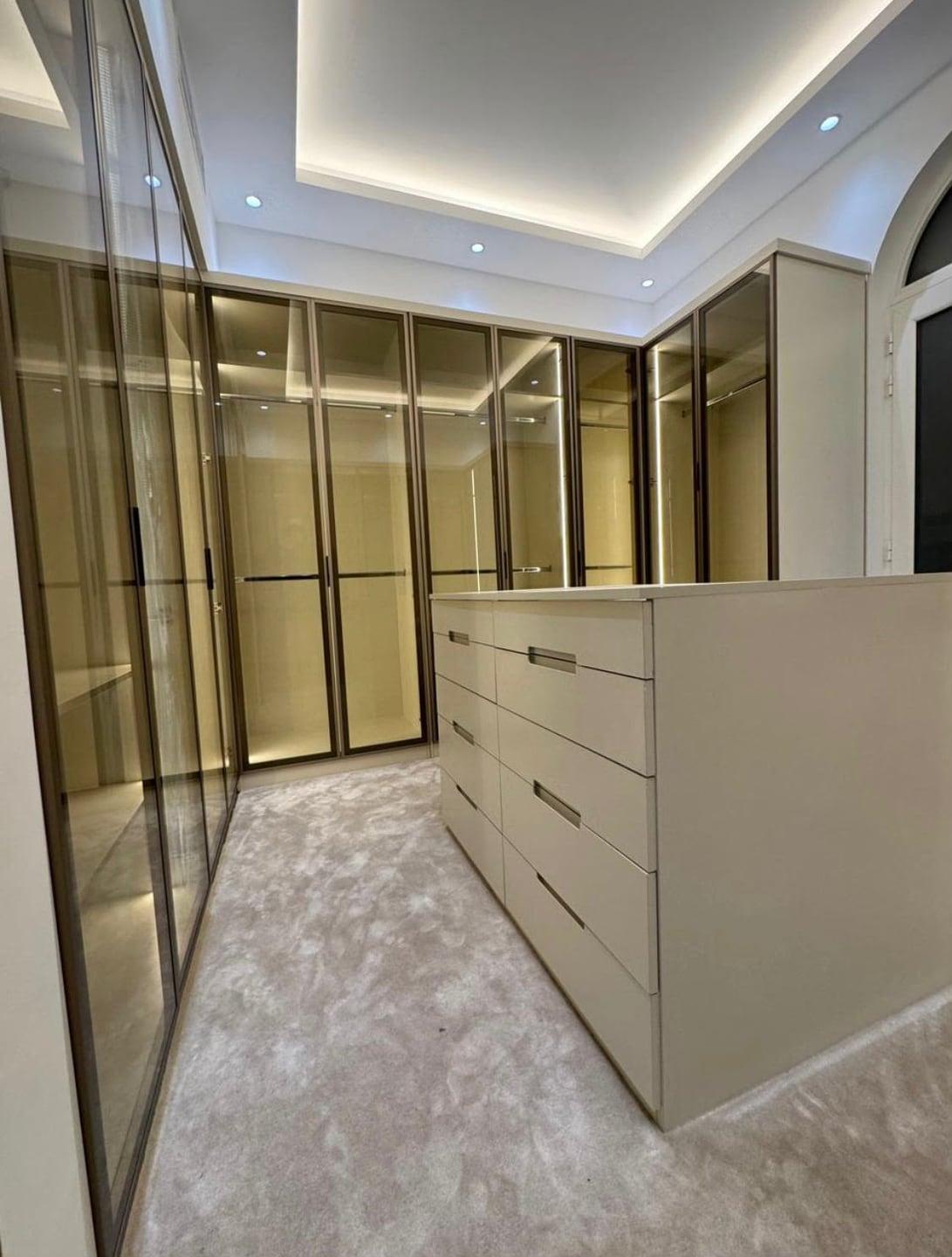
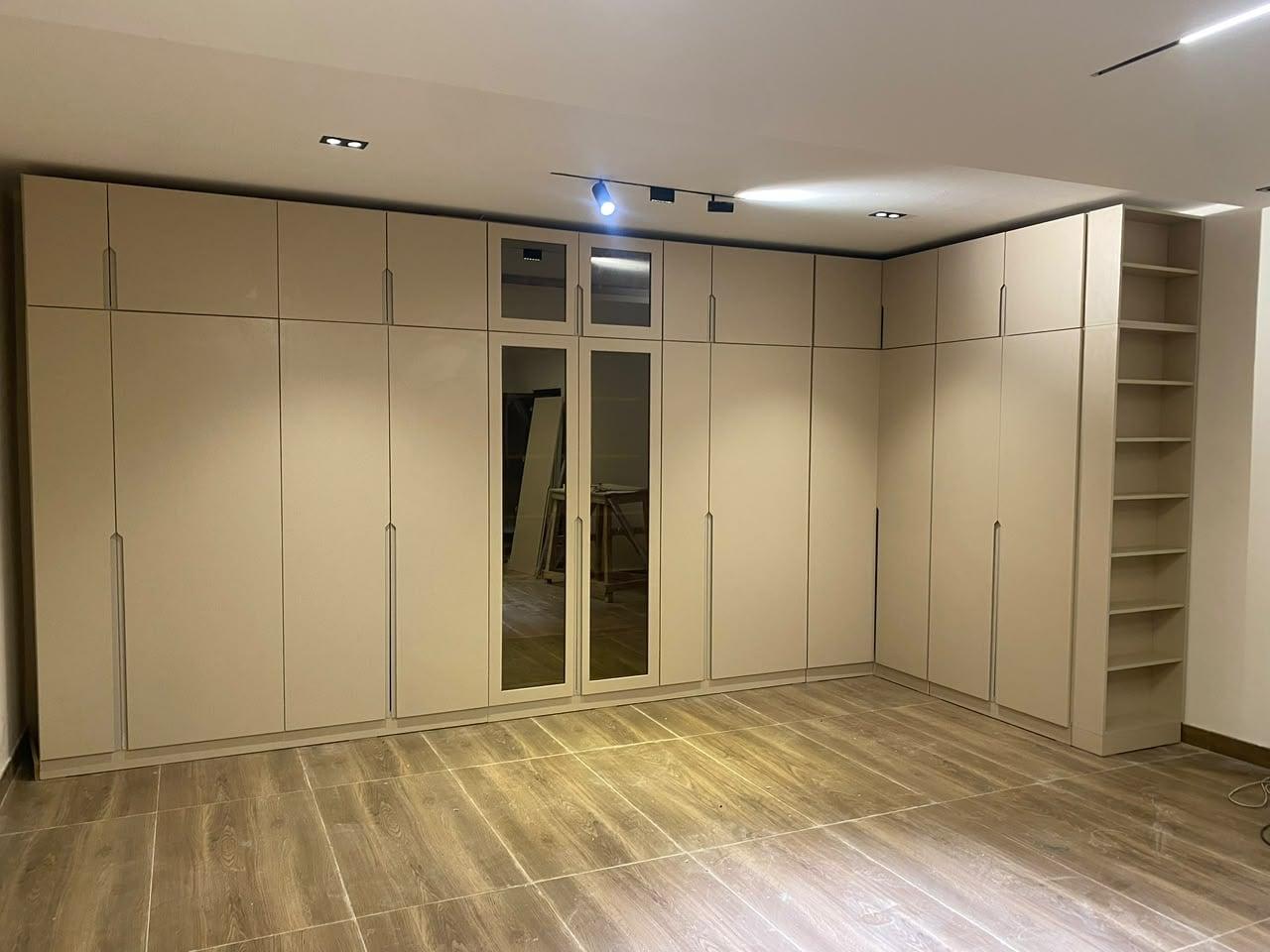
A finger groove, sometimes called a cut-in grip or finger pull, is a notch milled into the edge of the door so that a fingertip can get behind it. It adds no part, no metal and almost nothing to the price, and the face of the door stays flat and clean. In the beige run in the photograph below, each door has one, and the wall reads as a single plane.
The weakness is depth. The grip is only as deep as the cut, and a door board is only 16 to 19 mm thick (the range Emuca lists), so a groove is shallow by nature: fine for an adult opening a door gently, tiring for a child or for anyone with long nails. And because fingers go exactly where the cut is, that edge is where marks and wear appear first, so a matt laminate is a better partner than a gloss or a dark finish, a trade-off set out in matt versus gloss wardrobe doors. Ask to try a full-size sample, because 8 mm on a drawing feels very different under your fingertip. Our comparison of wardrobe door finishes compared shows how matt, gloss and anti-fingerprint claims differ.
Place the groove where a hand falls naturally, at the same height as a handle would be and always on the edge away from the hinge. Cut every groove in the same place along the run. A good workshop does this on a CNC machine so that every groove is identical; a hand-cut one shows.
Edge profiles (gola): a deeper grip and a metal line
A gola profile is an aluminium section fixed into the furniture so that doors open by fingers hooking into a channel. Emuca, a Spanish supplier of the system, describes the profiles as elements that let doors and drawers open by means of a system of grooves, fixed directly to the furniture's structure, in vertical and horizontal versions, and says they are ideal for kitchen furniture but can also be used in wardrobes. The channel is deeper than a milled groove, so the grip is firmer, and it runs the full height of the door, so the hand can catch it anywhere.
That is why we like it for tall doors. A floor-to-ceiling door has a lot of face, and a pull that runs its whole length means nobody has to find a particular spot. The cost of the system is a thin metal line down the edge of every door; if you want the cleanest wall, a groove or a latch hides more. Emuca lists twelve finishes, among them matt anodised, black, gold and champagne anodised and white, so the line can disappear against a light door, or be a deliberate accent on a dark one.
The profiles are fixed to the carcass, so the carcass has to be accurate: any error shows in the width of the channel. Have the profile's make and finish noted in the quotation, because it is a part you may need to replace. If you are changing the doors of a wardrobe you already own, our wardrobe door replacement guide explains what we check on the existing cabinet first. The video below, from Citylink Achievers, shows a gola profile being fitted in a kitchen; the fitting steps are the same in a wardrobe, and it makes the way the profile sits behind the door edge easy to understand.
Push-to-open: why it needs the right hinge
Push-to-open removes the grip altogether. A latch fixed inside the carcass releases when you press the front of the door, and the door springs out far enough for you to get your fingers behind it. Blum, whose TIP-ON system is the one most fitters use, describes it as a purely mechanical opening system, with no electronics, for doors and lift systems: touch to open, and press shut to close. Nothing shows, which is why it gives the cleanest wall of the four.
The catch is the hinge. A normal soft-close hinge has a damper built in, which tends to resist a door that is being pushed open by a latch. Blum's own door video says TIP-ON is combined with an unsprung CLIP top hinge, one without a damper in the hinge, so the door can move freely when released. In practice a push-to-open door gives up the hinge's own soft-close, and you close it with a firm push, not a gentle nudge. Choose the opener and the hinge together and have the pair named on the quotation.
Two more details decide how well it lives. The gap between fronts has to be even and small, as little as 2.5 mm in Blum's own figures for the drawer version, so the carcass and the doors must be made accurately; a crooked gap shows on a handleless wall far more than on one with handles. And a push-to-open door opens when anything presses it, whether a vacuum cleaner or a child, so it is a poor fit for a wardrobe in a nursery. It suits a small cupboard better than a floor-to-ceiling door: Blum's pages do not state limits for tall doors, so confirm with the maker before specifying one, and our advice for full-height fronts is a profile or groove. The one-minute video below, from Hettich, shows the press, the release and the door ready to open.
Finger safety and who opens the doors
A handleless door is neither safer nor less safe in itself, but three details deserve thought, especially in a home with children. The first is the hinge. A hinged door can trap fingers at its hinge edge, which is one more reason soft-close hinges earn their place, since the damper slows the last part of the swing. A push-to-open door gives up that damper, so it suits an adult's room better than a child's.
The second is the edge itself. A groove or a profile channel has to be finished well: sanded and sealed on the board, and deburred on the metal, so nothing sharp meets a small finger. Run your own hand along a sample before you approve it. The third is reach. Children cannot use a groove at adult height, and a latch opens at the slightest touch, so in a child's wardrobe use standard handles at 750 to 900 mm, as the height guidance above suggests, and change them later. Our kids' wardrobe design guide covers soft-close, wall fixing and the drawers a child can manage.
If a wardrobe will be used by older relatives, think about grip strength. A long pull or a deep channel is easier on stiff hands than a shallow groove, and the time to learn that is at the design stage, not after the doors are cut.
Finishes: gold, black, matt anodised or none at all
Handles and profiles are the metal in the room, and they should look chosen. Match them to the other metal you can see, whether the frames of glass doors, the light fittings or the shaker door's panel lines, and keep to one family of colours across the wardrobe; our wardrobe lighting ideas show how the light colour sits beside the metal. A black profile on a white door gives a graphic line; a champagne or gold anodised profile on a warm wood gives a soft edge that almost vanishes; matt anodised silver goes with nearly everything.
Think about marks as well. Smooth dark finishes show every fingerprint, and a matt, textured laminate hides them: the point is made in our wardrobe materials guide about faces, and it applies even more to a door with no handle, where all the touching happens along one edge. If marks bother you, choose a lighter or matt finish for the door, and keep the strong colour for the profile.
A last point on cost of change. A handle can be changed in minutes; a groove or a profile cannot, because the door was cut for it. So take your time over that choice, and look at a full-size sample in your own light before the workshop starts.
Cost direction: what handleless adds
Our wardrobe fronts start from AED 550 per m², fitted, for MDF laminate with hinged doors, and every handle, groove, profile or opener appears as a separate line in the quotation. A finger groove adds a machining step but no part. A profile adds a priced line for the metal and for fitting it precisely, and push-to-open adds a priced line for the openers and the matched hinges. We do not publish a price per handle or per metre of profile; each is set from the drawing, because the number of doors and their height change it.
What does cost more, across all handleless options, is accuracy. With no handle to draw the eye, the lines between doors become the pattern, so every gap and every edge has to be straight. That is workshop time rather than a material, and it is why we ask to measure the wall with a laser before drawing it. How wardrobe prices are built explains how the whole quotation is built, with room-by-room sums.
To compare quotations fairly, ask each supplier to name the opening method for every door, the make and finish of any profile, and the hinge and opener pair. A quotation that says only handleless wardrobe cannot be compared with another.
Glass doors, mirrors and drawers: grips on the rest of the wardrobe
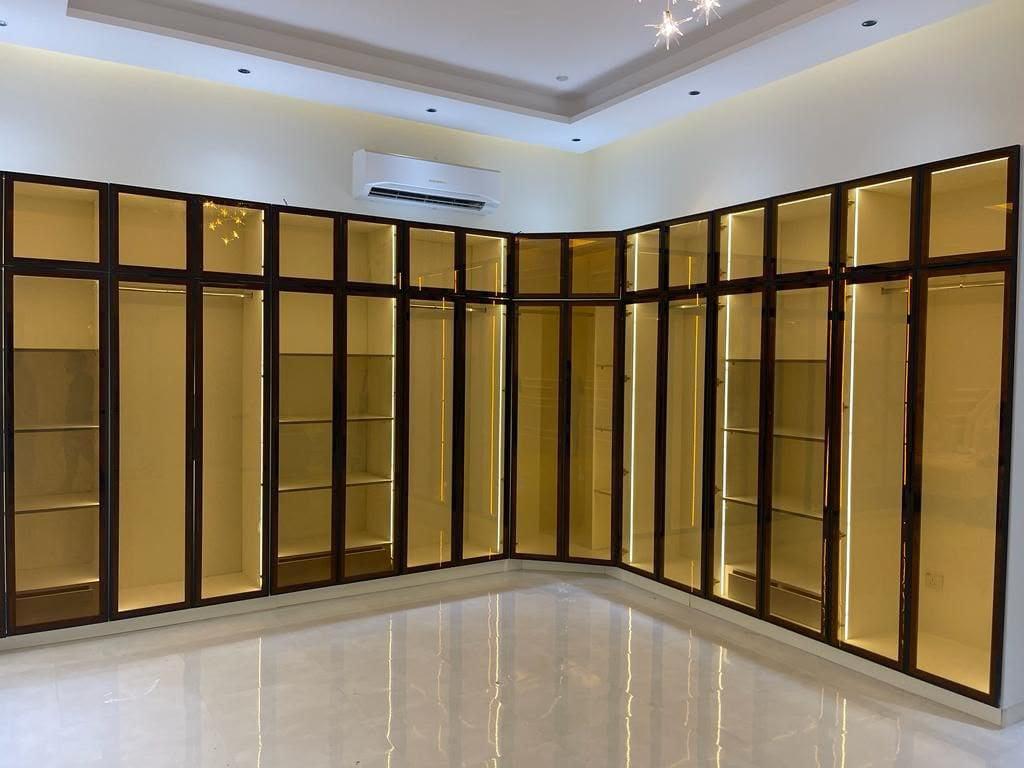
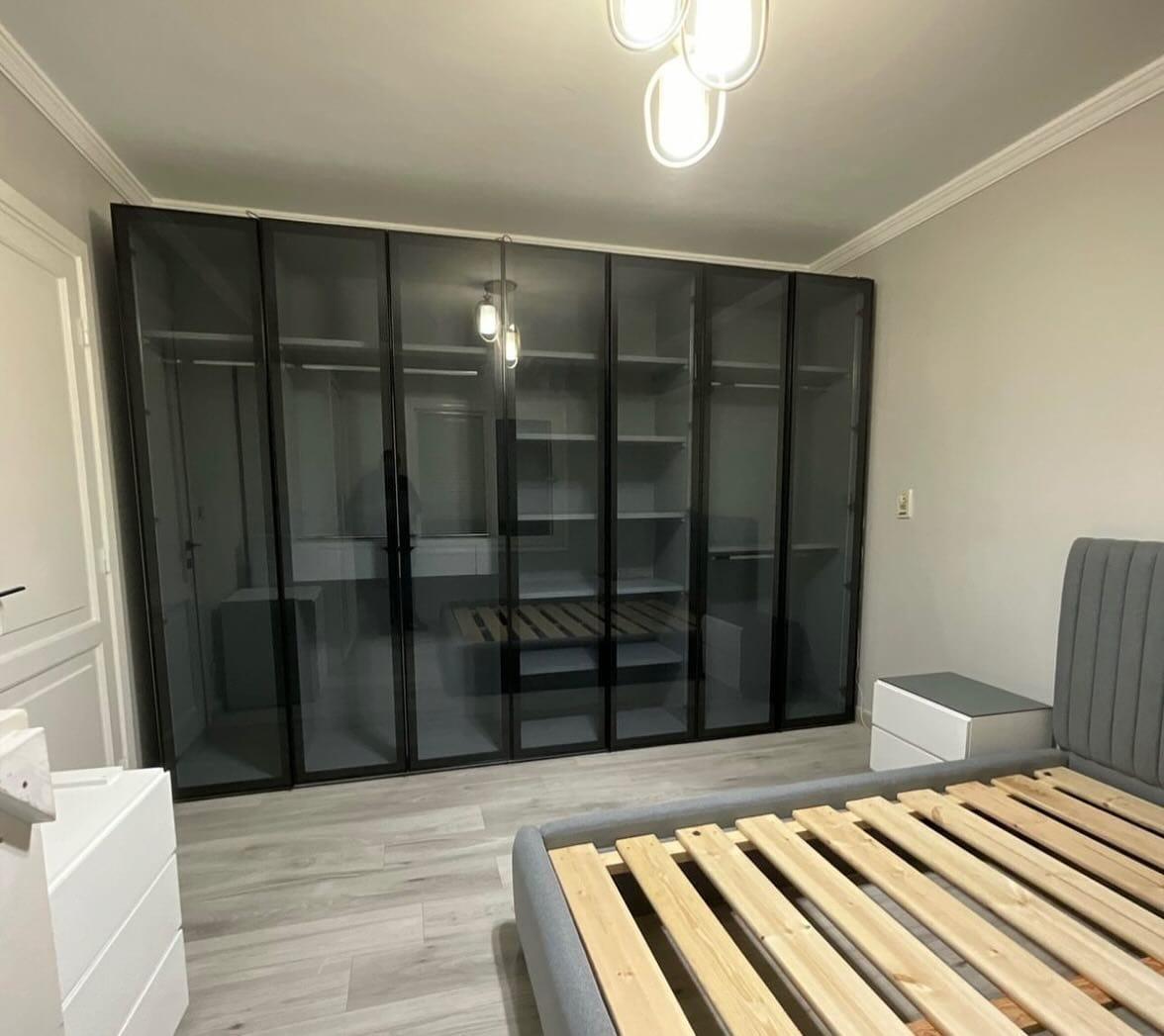
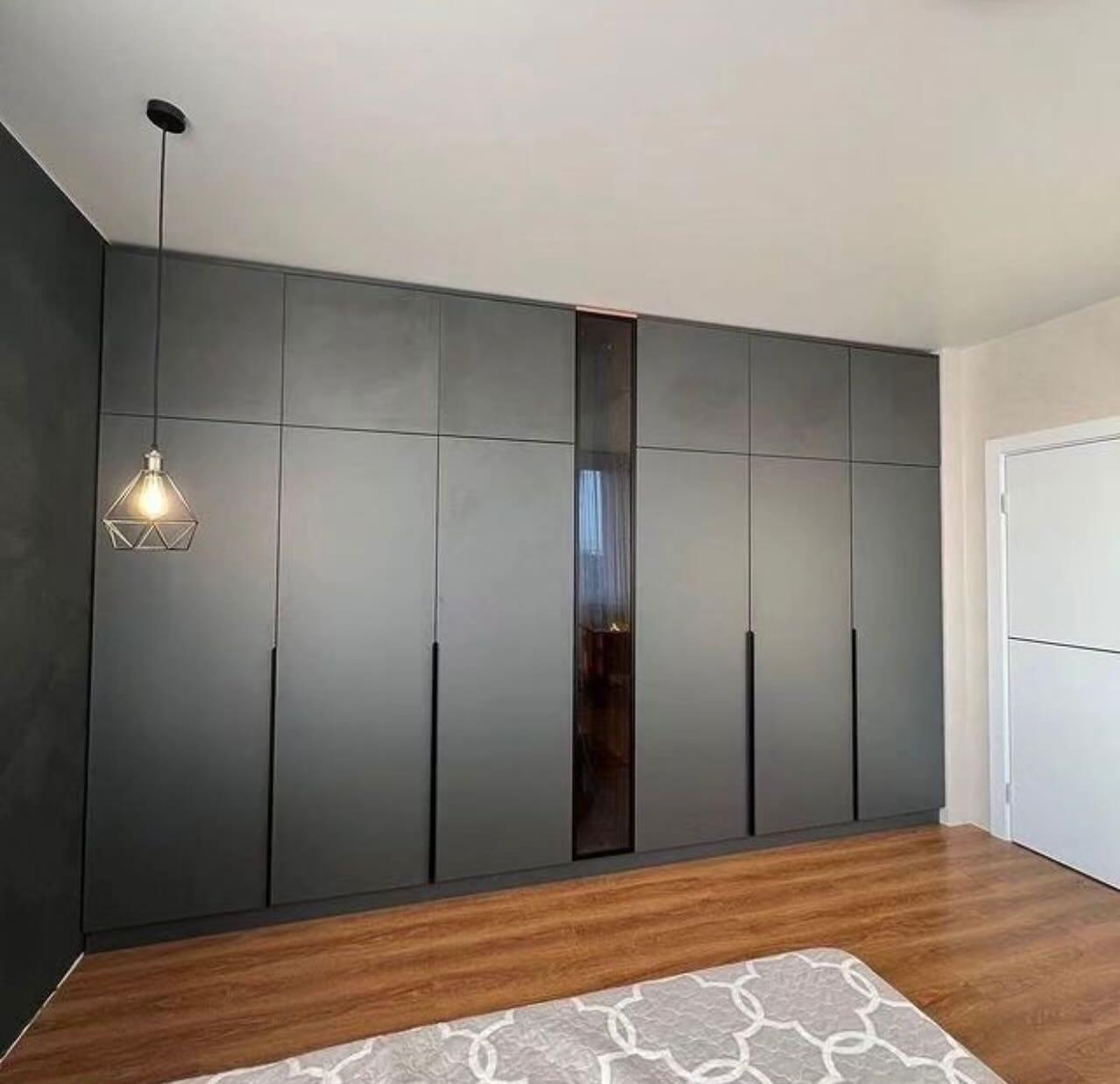
A wardrobe is rarely all plain doors. Glass fronts, mirror panels and drawers each change which grip works, and they are where handleless choices most often go wrong. On a framed glass door, the aluminium frame is slim, so there is no thickness to cut a groove into; the sensible choices are a slim pull fixed to the frame, or a profile in the same colour as the frame, so the grip looks like part of it. A thin vertical pull is visible on one of the doors in the photograph at the top of this page.
A mirror wardrobe door has a different problem: the glass shows every fingerprint, so a grip that makes people press on the mirror is a poor choice. Put the grip on the frame or the edge, away from the glass. Inside the wardrobe, drawers behind doors can use push-to-open, since they are opened by a firm touch and there is no door swing to manage, and the drawers of a dressing unit in the same run should match the doors, so the whole wall opens the same way.
Finally, think about what a person does with their hands when they reach a drawer: they are usually carrying clothes. A shallow groove that needs a careful fingertip is annoying in a drawer you open ten times a day, and a push-to-open drawer, or a profile along its top edge, is easier to use with a stack of folded laundry in one arm. For a sliding door that has slipped its rail, see what to do when a wardrobe door comes off its track.
Cleaning handles, grooves and profiles
Handles are the easiest: a soft cloth with mild soapy water, dried at once, and no abrasive pads on brass-tone or black finishes, which can wear through. Bar handles collect dust on their top edge, so wipe it when you dust the wardrobe.
Grooves and profile channels are where a handleless wardrobe collects its dirt, because they are the part your fingers touch. A soft brush or the narrow nozzle of a vacuum clears dust from the channel, and a damp, well-wrung cloth takes the oils off the edge (our guide to cleaning wardrobe surfaces covers the other surfaces). Do not soak the door edge: MDF swells if water gets in, and a groove is a place where it can. Matt laminate wipes clean more easily than gloss.
Push-to-open fronts have the least to clean, since the face is untouched, but be gentle when you wipe them, because a firm press releases the catch. For looking after finished joinery in the UAE climate, see our care and maintenance page.
- Weekly: dust the door faces and the top of any bar handle with a soft cloth.
- Monthly: brush or vacuum along each groove or profile channel.
- Every few months: wipe the touched edges with a damp, well-wrung cloth and mild soap, then dry.
- Avoid abrasive pads, strong cleaners and wet cloths on door edges.
Mistakes to catch before the doors are cut
Most disappointments with handleless wardrobes are decided on paper, before a board is cut, and they are easy to avoid if you know where to look. The commonest is choosing a method from a photograph. A photograph shows the look and hides the feel: the depth of a groove, the edge of a profile and the force a latch needs are things only a hand can judge.
The second is mixing methods without a reason. A run with a profile on some doors, a groove on others and a handle on one looks accidental, even if each choice made sense alone. Decide by door type, as in the table below, and keep each type consistent across the wall. The third is forgetting what stands beside the wardrobe. A door that opens onto a bed, a bathroom door or a corner needs its grip on the side that gives the hand room, and a push-to-open door that springs out into a narrow passage needs that clearance too, which is easy to miss on a plan.
The fourth is leaving the metal until last. Profiles, handles and hinges are chosen together, so the colour of each should be settled on paper at the outset. And the fifth is saving a few dirhams on the carcass. On a flat, handleless wall every gap is visible, so a wardrobe that stands a few millimetres off square looks crooked on every door. Accurate measuring is the cheapest insurance, which is why we measure walls by laser at the free visit.
Which opening method for which door
Put the decision into a table and the answer is rarely in doubt. What decides it is the door itself: its height, its width, who uses it and what stands next to it. Use this as a first pass and confirm it at the visit.
Our recommendation by door
Floor-to-ceiling bedroom door
- Our first choice
- Edge profile (gola)
- Second choice
- Finger groove
- Avoid
- Push-to-open
Short overhead cupboard
- Our first choice
- Push-to-open
- Second choice
- Finger groove
- Avoid
- A tall bar that sticks out
Children's wardrobe
- Our first choice
- Standard handle at 750–900 mm
- Second choice
- Edge profile
- Avoid
- Push-to-open
Classic shaker wardrobe
- Our first choice
- Brass-tone or black bar handles
- Second choice
- Edge profile
- Avoid
- Finger groove
Walk-in with glass doors
- Our first choice
- Edge profile in a frame colour
- Second choice
- Standard handle
- Avoid
- Deep grooves on thin frames
Sliding wardrobe
- Our first choice
- Recessed pull cup
- Second choice
- Edge pull
- Avoid
- A bar handle that stands out
A first-pass recommendation from our workshop; the final choice follows the door size and who uses it.
From idea to fitted wardrobe
It starts with the free home consultation, when we bring samples of finishes and glass, take laser measurements of the room, ask who will open the doors, and draw each wall with the opening method for every door written on it. Ask to hold a full-size sample of any groove, profile or latch you are considering before you approve the drawing; production begins only after you do. In a tight room, our small bedroom wardrobe ideas show where a handle-free front earns its place.
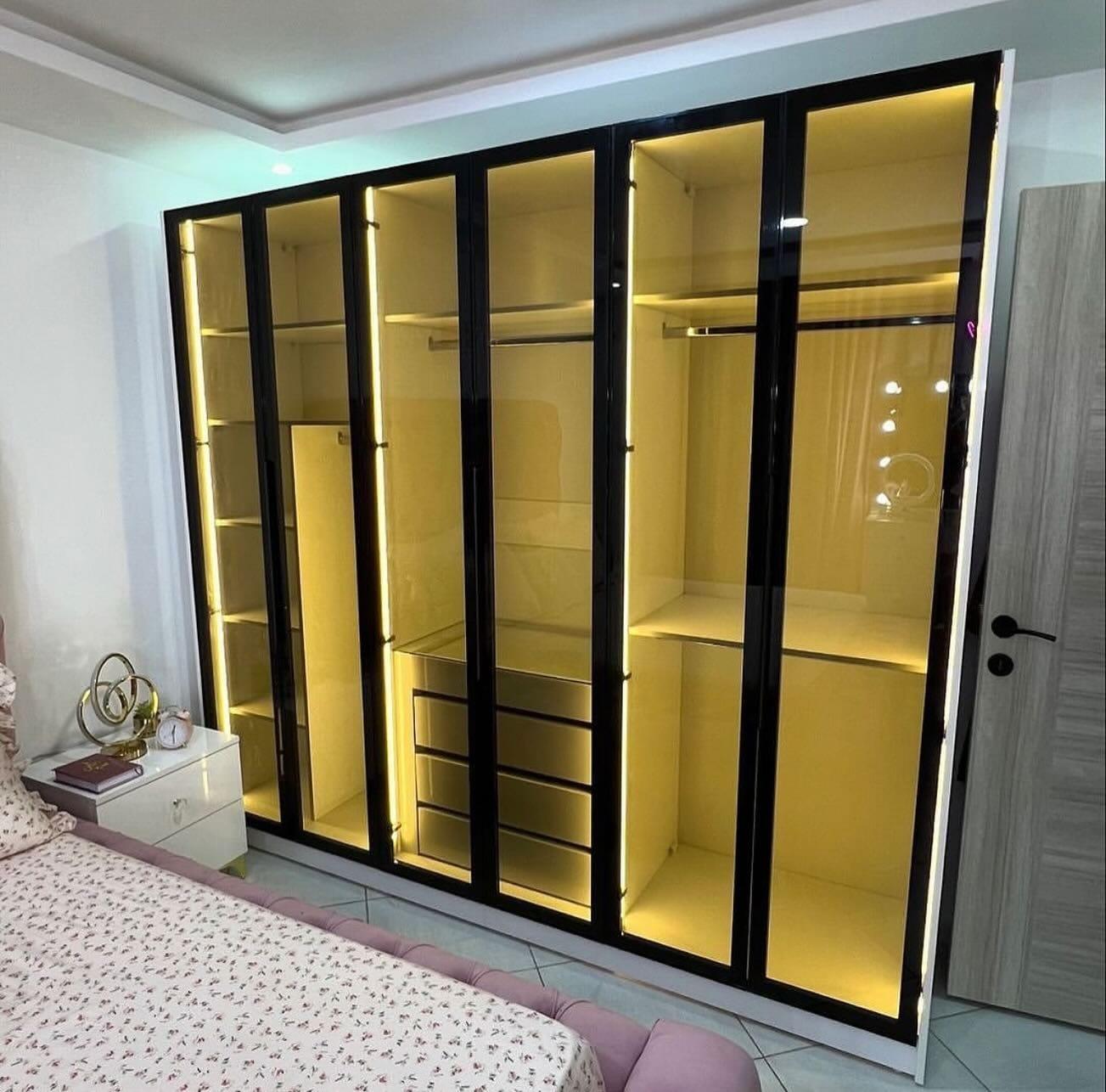
Doors and carcasses are made in our Sharjah workshop and fitted by our own installers across the UAE, usually up to about 10 days after confirmation, depending on size and design. A 24-month written workmanship warranty covers the work. Separately, the wood-based boards carry a 5-year limited warranty, subject to terms; hinges, tracks, runners, rollers and other moving hardware are not covered, and the final terms are in the written warranty. For what we build, see custom wardrobes, built-in wardrobes and glass-front wardrobes with lighting, or the Sharjah wardrobe page for local fitting. Run down this list on your drawing before approving it: Ask what the warranty on a wardrobe actually covers before you sign; that guide lists the questions to put in writing.
- The opening method is written next to every door, not just once for the wardrobe.
- Any groove or profile has been tried on a full-size sample, with your own fingers.
- A push-to-open door has the opener and the hinge named as a pair, with a gap shown.
- Handle height is drawn: about 900 to 1100 mm for adults, lower for children.
- The finish of every handle or profile is named, and seen against the door in your own light.
- Children's wardrobes use standard handles, not latches.
Common questions
What is a handleless wardrobe?
A wardrobe with no handle standing out from the door: a groove cut in the edge, an aluminium profile along it, or a push-to-open latch. The door face stays flat. Built-in wardrobes.
How do handleless wardrobe doors open?
By fingers hooking into a groove or a profile channel, or by pressing the door so a latch releases it. Hinged doors suit all three; sliding doors use recessed pulls. Hinged or sliding doors.
Are handleless wardrobes more expensive than ones with handles?
Usually a little, because a profile or opener is an extra priced line and the doors must be made more accurately. A finger groove adds very little. Wardrobe prices in the UAE.
Is push-to-open a good idea on a wardrobe?
On short doors and overhead cupboards, yes. It needs a matched hinge without a damper, gives up that hinge's soft close and opens at a touch, so keep it off a child's wardrobe. Wardrobe hardware.
How high should wardrobe handles be?
About 900 to 1100 mm from the floor for most adults, 750 to 900 mm for children and 1100 to 1200 mm for tall users. Tape them in place first. Wardrobe dimensions.
Which handle finish is best, gold or black?
Gold or brass tones suit shaker fronts and warm woods; matt black suits modern grey and charcoal walls; the framed door itself is described in classic and shaker-style wardrobes. Match the other metal in the room and check a sample in your own light. Choosing materials.
How do you clean handleless wardrobe doors?
Brush or vacuum the groove or channel, wipe the edges with a damp, well-wrung cloth and mild soap, and dry at once. Avoid soaking the edge and abrasive pads. Care and maintenance.

Sources & specifications
Manufacturer information applies to the named products and systems. Sources reviewed on 28 October 2026.
- Blum: TIP-ON BLUMOTION overview (mechanical push-to-open with soft close; front gap of just 2.5 mm; drawer systems)blum.com(opens in a new tab)
- Blum: hinge systems overview (TIP-ON as the mechanical opening system for doors and lift systems; handleless fronts open with a gentle press)blum.com(opens in a new tab)
- Emuca: gola profiles (aluminium handleless opening system for doors and drawers; twelve finishes; for kitchens and wardrobes)emuca.com(opens in a new tab)
- Blum: TIP-ON for doors, mechanical opening system for handleless doors (video; combined with the unsprung CLIP top hinge)youtube.com(opens in a new tab)
- Dowsing & Reynolds: how high should wardrobe handles be (900–1100 mm adults, 750–900 mm children, 1100–1200 mm tall users)dowsingandreynolds.com(opens in a new tab)
Want this planned for your home?
Consultation and measurement are free. Tell us the rooms, location and what you need; we arrange a sample visit and define the measured quotation.