Wardrobes · 16 min read · 29 May 2026
Kids' wardrobes that grow from toddler to teen
Rail and shelf heights for ages 3, 8 and 14, wall fixing and anti-tip, soft-close and finger safety, shared rooms, a built-in desk and finishes that wipe clean.

By Ali Haider Basra, Founder, Al Tareeq Decor · Contact our workshop
Key takeaways
- Build the carcass once, at full height, and reset the rail and shelves as the child grows: about 80 cm at age 3, 110 cm at 8 and 168 cm at 14, and for two children in one room see a wardrobe for two children sharing a bedroom.
- Fix every wardrobe to the wall. In the US, 199 of 234 clothing-storage tip-over deaths between 2000 and 2022 were children.
- Soft-close hinges and runners, rounded edges and pulls a child can grip prevent most finger injuries.
- In a shared room give each child a column and a door; set a desk bay for the child you will have in three years.
- Matte laminate fronts wipe clean (see how to clean each wardrobe surface) and fitted fronts start at AED 550 per m², normally fitted up to about 10 days.
On this page
- Key takeaways
- A kids' wardrobe is a ten-year plan, not a nursery purchase
- Rail and shelf heights from age 3 to age 14
- Wardrobe settings by age
- Plan it adjustable from day one
- Wall fixing and anti-tip: the part you never skip
- Soft-close hinges and finger safety
- Handles, drawers and doors a child can manage
- Shared rooms: two children, one run
- A desk built into the wardrobe run
- Easy-clean finishes that survive children
- A kids' wardrobe for a small room
- What a kids' wardrobe costs and how we make it
- Common questions
A kids' wardrobe is a ten-year plan, not a nursery purchase
Most wardrobes in children's rooms are bought for the child who lives there today and outgrown within three years. A toddler hangs clothes at the height of the bed rail. By eight the same child has a school uniform, sports kit and a pile of folded things that need shelves, and at fourteen wants a full-length rail and a place to study. Buy for the toddler and you will be rebuilding the room twice.
The better plan is to build the carcass once, at full height, and treat the rail and the shelves inside it as parts you reset. What follows takes that plan in order: heights for each age, how to fix the wardrobe to the wall, how to make doors and drawers safe for small hands, how two children share one run, how a desk fits into it, and which finishes survive years of use. Our wardrobe interior layout guide covers the thinking for an adult wardrobe; this one is about what changes when the user is a child.
Rail and shelf heights from age 3 to age 14
The drawing shows one wardrobe at three ages. The carcass, the drawers at the bottom and the spare box at the top never move. The hanging rail, the spare shelf above it and two shelves for folded clothes slide to new heights, while the silhouette grows from a typical three-year-old to a typical fourteen-year-old. The green band is the zone a child can reach without a stool, from hip to shoulder.
Published guides agree on the pattern even where their numbers differ. TaskRabbit gives about 30 to 36 inches (76 to 91 cm) for a rail at ages three to six and 40 to 48 inches (102 to 122 cm) for seven to twelve; Homestyler gives 90 to 110 cm for four to seven and 110 to 130 cm for eight to twelve. We settle on 80 cm for a three-year-old and 110 cm for an eight-year-old, both inside both ranges. At fourteen, the wardrobe becomes an adult one, with a single rod at about 168 cm (66 inches) or double rods at about 102 and 203 cm. The wardrobe hanging heights guide compares how published sources measure adult rail heights.
Wardrobe settings by age
3
- Typical height
- About 95 cm
- Rail height
- 80 cm (guides: 76–91 cm)
- Shelves in easy reach
- 52 and 74 cm
- What the rail is for
- Tops and dresses the child can hang alone
8
- Typical height
- About 128 cm
- Rail height
- 110 cm (guides: 102–130 cm)
- Shelves in easy reach
- 70 and 100 cm
- What the rail is for
- Uniform, school jacket, sports kit
14
- Typical height
- About 162 cm
- Rail height
- 168 cm (adult single rod)
- Shelves in easy reach
- 90 and 128 cm
- What the rail is for
- Full-length hanging; a second rail returns at 102 and 203 cm
Median heights are from the CDC growth-chart data (boys and girls average, rounded). Rail heights are to the rod's centre; the shelf heights are our own, inside the hip-to-shoulder band.
- 1. Rail: 80 cm at age 3, 110 cm at age 8 and 168 cm for a teenager, reset on pre-drilled holes
- 2. Shelves for folded clothes stay between the child's hip and shoulder, so they move up with each stage
- 3. The drawers below and the spare box above never move: bedding and luggage up top, heavy folded clothes low
- 4. The silhouette grows from 95 cm to 162 cm (CDC medians); the green band is what the child reaches without a stool
Plan it adjustable from day one
An adjustable wardrobe is not a special product; it is a normal carcass with its holes drilled in advance. Homestyler recommends shelves that can be repositioned in 32 mm steps, which is the spacing of the standard system holes that cabinet makers drill down the side panels, and advises that rail positions are pre-drilled so a change takes minutes. Ask for those holes on the drawing at the start; drilling them afterwards means dismantling the carcass.
What you reset is small: the rail brackets and the shelf supports. What you keep is everything that cost money, the doors, the drawers, the side panels and the fixing to the wall. For a toddler, begin with the rail low and a spare shelf above it that you use for out-of-season clothes. For a child of six or seven, lift the rail and let the shelf go up with it. When the child reaches the teens, remove the spare shelf and bring the second rail back. Our interior guide explains how to give each column one job, and wardrobe drawers and organisers covers what the drawer runners can carry.
Leave one section unplanned. Children change faster than any drawing: a sport takes over, a musical instrument arrives, a brother moves in. A tall open section with spare holes costs almost nothing now and absorbs the surprise; the case for and against open sections more generally is in open wardrobe or closed doors.
Wall fixing and anti-tip: the part you never skip
A tall wardrobe is the item in a child's room most likely to hurt a child if it falls. The US Consumer Product Safety Commission counted 234 deaths from clothing-storage tip-overs between January 2000 and April 2022, 199 of them children, and estimated 84,100 emergency-room injuries from tip-overs in 2006 to 2021. Those are American figures, but a toddler pulling open a drawer to climb is the same in any country. The CPSC's mandatory standard, ASTM F2057-23, which took effect on 1 September 2023, covers wardrobes and armoires as well as dressers, and its tests simulate children up to 60 pounds. Even so, the CPSC still advises that you anchor any such unit to the wall.
Installation fixes a fitted wardrobe to the room, a point in its favour for a child's bedroom; we compare it with the freestanding kind in fitted, built-in or freestanding wardrobes. A freestanding one needs a tip-restraint bracket screwed into the wall, with a fixing that suits the wall type, such as block, poured concrete or plasterboard. IKEA's own kids' wardrobe page carries the same warning about anchoring.
Do it on the day it arrives, before the first drawer is loaded. The short video below shows the steps with a bracket and a strap.
Soft-close hinges and finger safety
The hinge side is where small fingers get trapped. A door pushed shut by a sibling closes on the hand that is holding the edge. Soft-close hinges slow the last stretch, so the door arrives gently and a hand has time to move. Homestyler recommends soft-close hardware throughout a child's wardrobe, IKEA's SMÅSTAD kids' wardrobe has soft-closing hinges, and we specify soft-close hinges and drawer runners, with the brand and model agreed in the quotation. How many hinges each door needs is covered in the wardrobe hinges guide.
Door size matters as much as the hinge. A light, narrow door is easier for a small child to open and shut without swinging it. Homestyler suggests soft-close hinges that open between 110° and 155°, wide enough that the door is out of the way but not so wide that it hits the bed. If the bed is only a short step from the wardrobe, sliding doors may suit better, because they never swing into the room; hinged or sliding wardrobe doors compares them. A sliding door on a child's wardrobe needs a stable track and a soft-close damper, so that it does not run into the end stop. If the wardrobe is already built and only the doors, hinges or track no longer suit a growing child, wardrobe door replacement explains what can be changed.
A hybrid works well in many rooms: sliding doors over the hanging section and hinged doors over the open bins and low drawers the child uses all day. For soft-close sliding doors, our wardrobe sliding door systems guide explains what to ask for.
Handles, drawers and doors a child can manage
Put the child's own things where the child can reach them: drawers between about 20 and 70 cm for a younger child, with the heavy folded clothes lowest. The things only you need, bedding, the winter set and luggage, go high. Every handle in reach should be round or flat to the touch. Homestyler asks for edges with a radius of at least 2 to 3 mm, and D-shaped or finger pulls with gentle contours, because a sharp corner at forehead height is the one hazard a child will find. Our handleless wardrobes versus handles guide compares grooves, profiles and push-to-open door by door.
Oversized handles suit younger children, who grip with the whole hand, and a picture label or a coloured sticker on each drawer helps one who cannot read yet. We would not choose push-to-open for a toddler's drawers: a child who cannot find a handle pulls at the door edge. A groove cut into the door, as in the photo on our fitted wardrobe guide, is fine from about school age.
Add felt-lined trays for small things such as hair ties, socks and cards. They keep the clatter down and stop a drawer opening onto a spill. How much floor a swinging leaf needs is worked through in our wardrobe door clearance guide, with a masking-tape test you can do before ordering.
Shared rooms: two children, one run
When two children share a room, the wardrobe becomes a negotiation, so build the boundary in. Give each child a column, or a pair of columns, with the same layout from the start: one rail section, one shelf section and a set of drawers. Homestyler recommends colour-coded bins and name labels to show whose is whose, and clear lines of that kind cut the morning disputes. Do not split a section down the middle of a rail; the arguments start at the join.
Because each setting is made on pre-drilled holes, the two columns can run at different heights. The ten-year-old's rail sits at 110 cm while the five-year-old's sits at 90 cm in the next column, and each moves on its own. Keep the doors separate too, one door per section, so that one child standing at an open door does not block the other. If the age gap is wide, put the older child's column on the side nearer the bed they will use longer.
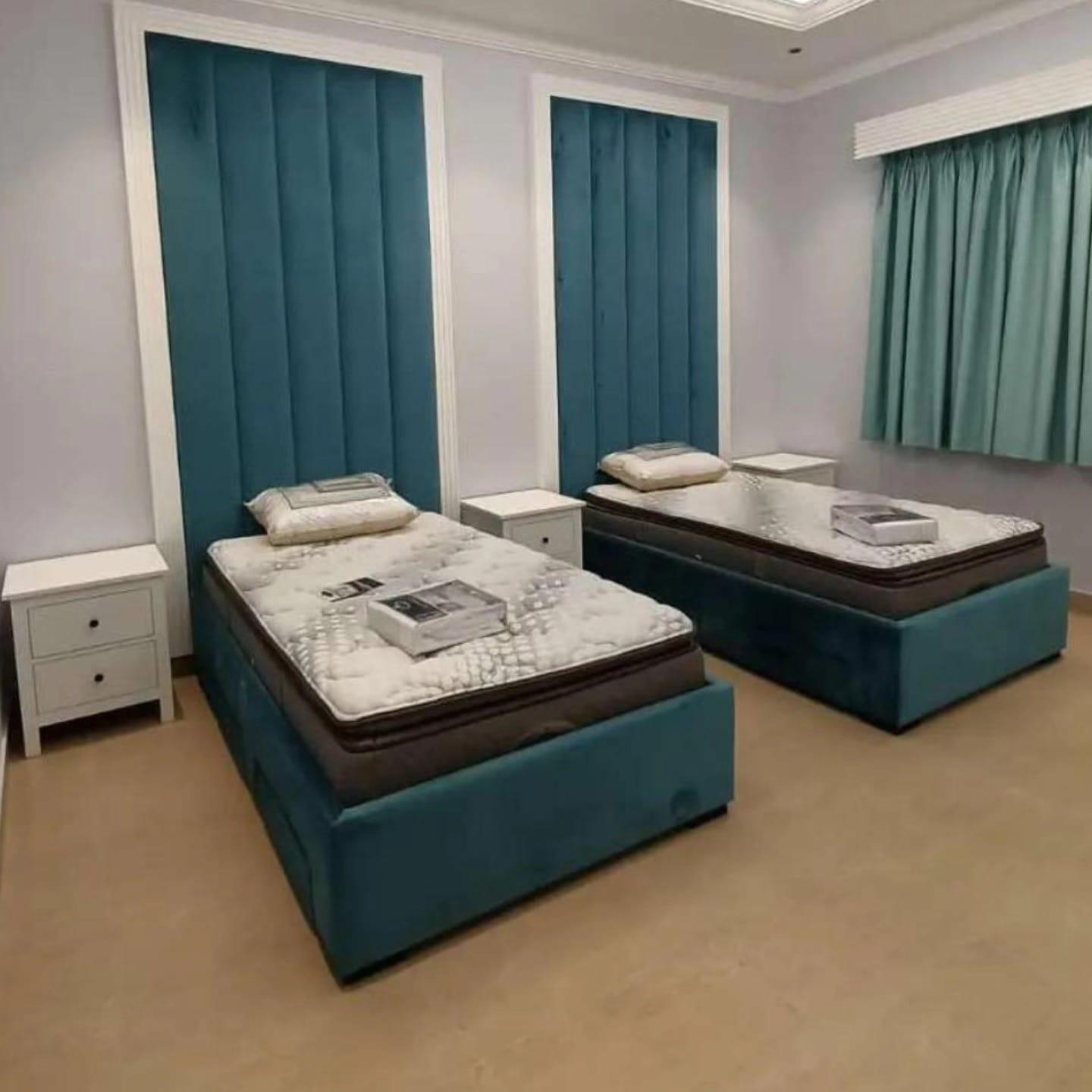
Allow for a third person. Children's rooms double as guest rooms, and a spare column of plain shelves and a rail adjusted for an adult is the cheapest way to make that work. The room in the photo has two beds, each with a tall upholstered headboard, and a clear wall opposite. Sharing changes the plan, so our guide to a wardrobe shared by two is worth reading before the drawing.
A desk built into the wardrobe run
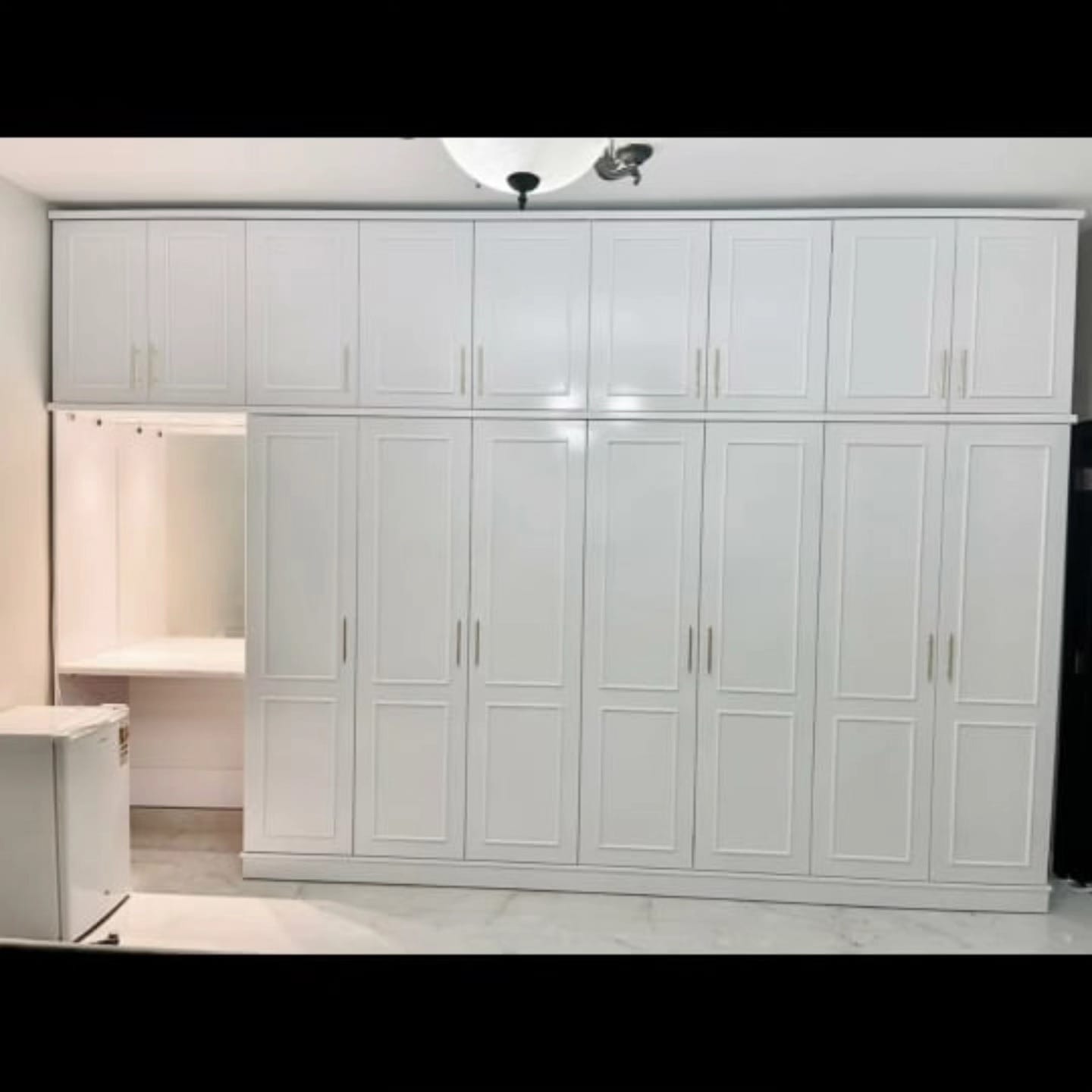
A desk at the end of a wardrobe run solves two problems: it uses the awkward width left over beside the doors, and it gives homework a fixed place. The hero photo of this guide shows the idea, a lit niche with a counter at the left end of a white shaker run. Done well it looks like part of the furniture and costs less than a freestanding desk and a second wardrobe.
The catch is that a desk is the one part of the run you cannot reset in minutes. Mega Furniture, a furniture retailer, says a desk that is just 5 cm too high makes a child raise the shoulders, with neck strain over time, and that the elbows should sit at about 90 degrees with feet flat. Its advice for growing children is to choose for the size they will be in about three years, then use an adjustable chair, which typically ranges from 38 to 52 cm in height, and add a footrest while they are small. Follow that: set the desktop for the child you will have in three years, supply the chair and footrest, and do not build a desk bay at all for a child under about six.
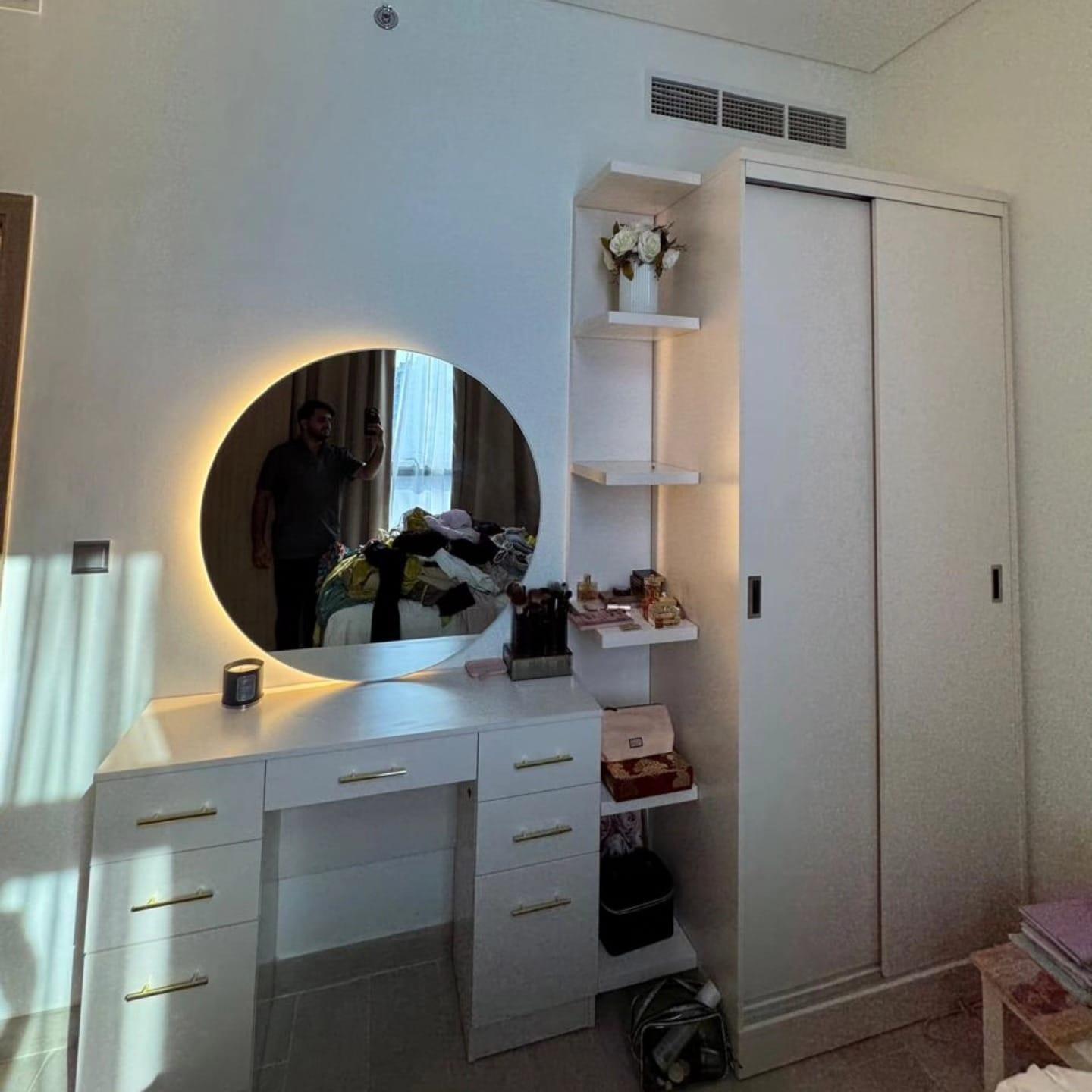
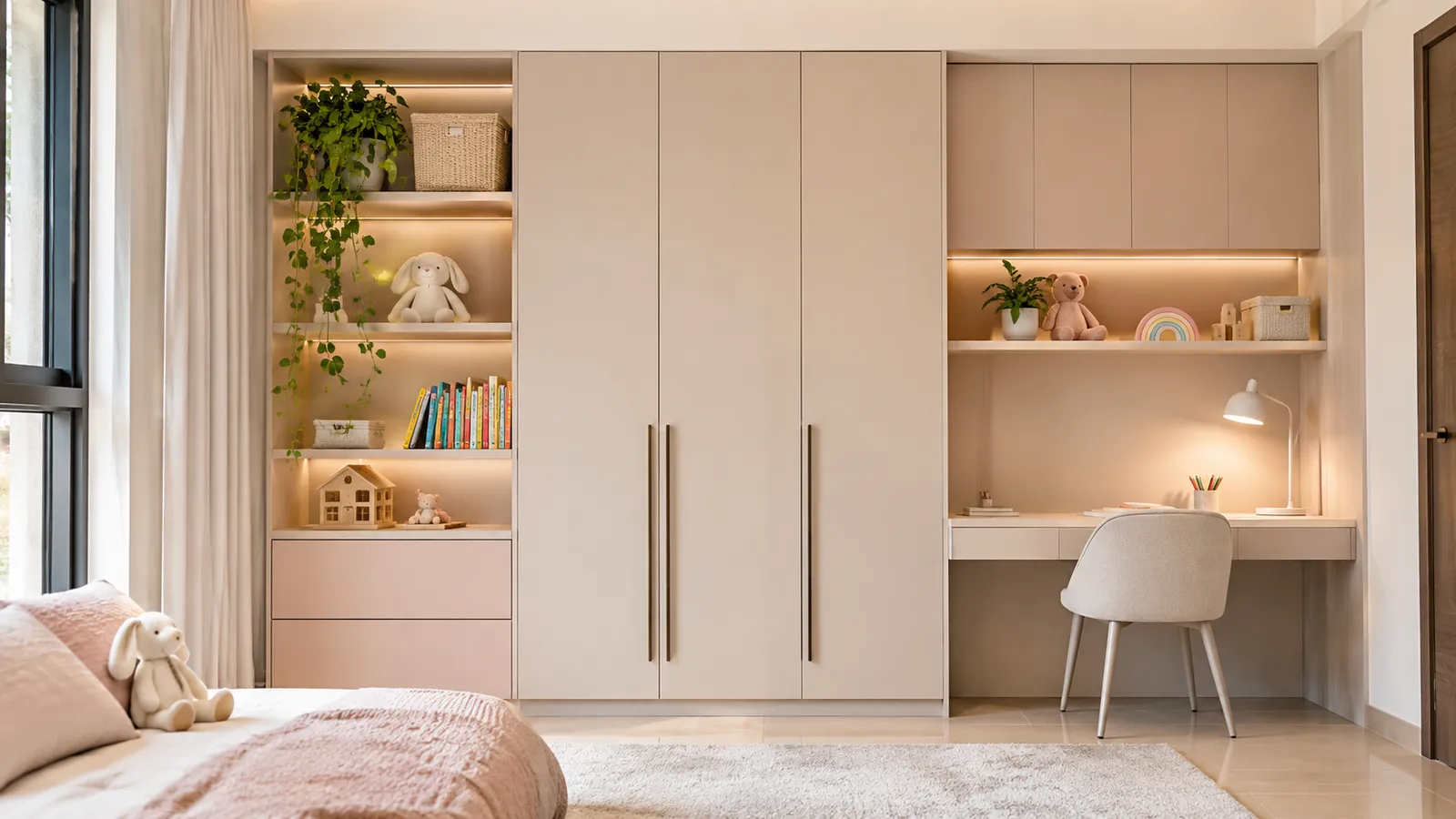
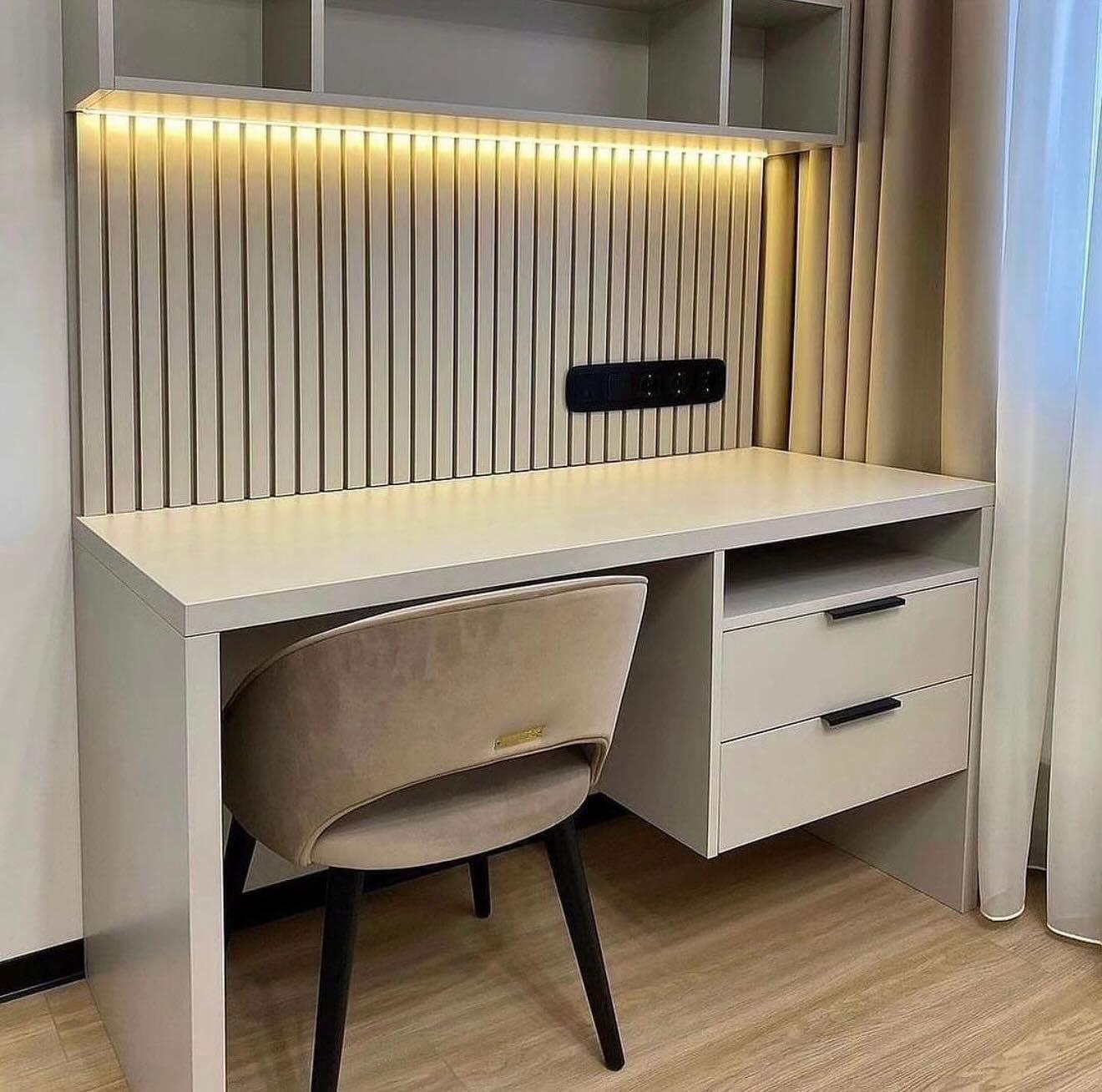
Plan the three things a desk needs: light on the page from the side opposite the writing hand, sockets above the worktop, and a cable route behind it. The study desk below shows the shape: a fixed top, two drawers on one side, a lit shelf above and slatted panels behind the sockets.
Easy-clean finishes that survive children
Choose the surface for what it will meet: crayon, marker, bag corners and a daily wipe with a damp cloth. Homestyler recommends high-pressure or standard laminate on the fronts and melamine-faced board inside, both of which wipe clean, with low-VOC finishes and a low-gloss surface that reduces glare under LED lights. That is also the logic of our entry specification, MDF laminate with hinged doors. Matte hides fingerprints better than gloss, which is why we suggest matte or a soft sheen for children's rooms; the reasoning on boards and laminates is in wardrobe materials and hardware. For laminate, veneer, lacquer and glass side by side, see wardrobe door finishes compared.
Edges are where a child's wardrobe wears first, because a door gets knocked or kicked at its lower corner. Ask for glued, sealed edges, and for a plinth or kick strip at the bottom, which takes the damage the door would. Add a few louvre or vent slots in the sports-kit section; Homestyler notes that they help to stop odours after sport, something the UAE's humidity and warm rooms make more important. If a musty smell has already set in, why a wardrobe smells musty explains the usual causes.
Keep the colour easy to live with. A neutral run in white, oatmeal or pale wood lasts from toddler to teen. Add colour in small things that change cheaply: handles, a painted back panel, bins, the curtains, or the wall around the wardrobe (see kids' room wallpaper). Our care and maintenance tool lists how to clean each surface.
A kids' wardrobe for a small room
In a small bedroom every centimetre of the wall has to work. A fitted run from corner to corner and up to the ceiling holds more than freestanding units of the same footprint, because there are no gaps and the top is used. The upper tier is where seasonal things live, out of the child's reach, so the child's own hanging and folded space can stay low. This is the practical case for fitting rather than buying, set out in our fitted, built-in and freestanding comparison.
Mind the depth. The usual hanging depth is 60 cm, as in our wardrobe dimensions guide, and a teenager will need all of it, so do not shave it to save a little floor now. If floor is the real limit, use sliding doors, which need no swing room, and put the bed's side to the wardrobe rather than its foot. A drawer unit under the window is worth more than a bench at the end of the bed in a small room.
Use one wall for everything. Wardrobe, desk bay and open shelves in a single run leave the rest of the floor to play, which is what a child's room is for. Our small bedroom wardrobe ideas try three layouts in one tight room.
What a kids' wardrobe costs and how we make it
The price follows the front area, not the child's age: wardrobe fronts start at AED 550 per m², fitted, in our entry specification of MDF laminate with hinged doors. Sliding doors, lighting and extras such as the desk bay are added as separate lines, listed on the quotation. For worked examples by room, see the guide to wardrobe prices.
It begins with the free home consultation: our team laser-measures the wall, notes the doors, windows and sockets, and talks through the child's age, the room and who else will use it; the free wardrobe measuring visit guide lists what to prepare. We then draw the run and the inside, with the drilled holes and the wall fixings marked. The panels are made at our Sharjah workshop and fitted by our own team, normally up to about 10 days after your confirmation, and our 24-month written warranty applies to the workmanship. Separately, the wood-based boards carry a 5-year limited warranty, subject to terms; hinges, tracks, runners, rollers and other moving hardware are not covered, and the final terms are in the written warranty. To start, send a picture of the room to our custom wardrobes team. Local examples are on the Sharjah wardrobes page, and the custom wardrobe cabinets and organisers show the inside fittings we make. Check the drawing against this list before you approve it: Before you fix the depth, read what we say about the right wardrobe depth for hanging clothes, since it changes how much floor is left in front.
- The carcass is full height, with drilled holes for the rail and shelves.
- The rail starts at about 80 cm for a toddler, with a spare shelf above.
- The wardrobe is fixed to the wall, and any freestanding unit has a tip-restraint bracket.
- Soft-close hinges and runners; rounded edges; pulls a child can grip.
- One column per child in a shared room, with its own door.
- A desk bay, if any, is set for the child you will have in three years.
- Matte laminate fronts and sealed edges.
Common questions
What height should a child's closet rod be?
Published guides give about 76 to 91 cm at ages three to six and 102 to 122 cm at seven to twelve; we set 80 cm for a three-year-old and 110 cm at eight, then an adult 168 cm, and double hanging or long hanging shows how a second tier is mixed in. Pre-drill so it can move. Rail heights and dimensions.
How do you make a kids' wardrobe that grows with your child?
Build a full-height carcass with holes drilled down its sides, and reset the rail and shelves at each stage. Keep one section open for the surprises. Wardrobe interior layout guide.
Do kids' wardrobes need to be fixed to the wall?
Yes. Any tall unit can tip when a child climbs or pulls out a drawer, and the US safety agency still advises anchoring even a unit that meets its standard. A fitted wardrobe is fixed already. Fitted or freestanding wardrobes.
Are sliding or hinged doors safer for children?
Either is safe with soft-close hardware. Sliding doors never swing into the room, which helps a small one, while hinged doors open an entire section. Hinged or sliding wardrobe doors.
How can two children share a wardrobe?
Give each child a column with its own door, the same layout and a labelled bin, so the boundary is built in. Each column can then be reset to its own child's height. Custom wardrobe cabinets and organisers.
What finish is easiest to clean in a child's room?
Laminate on the fronts, melamine inside and sealed edges. Matte hides fingerprints better than gloss; matt versus gloss doors goes through the wider choice. Wardrobe materials and hardware.
How much does a custom kids' wardrobe cost?
The price follows front area, from AED 550 per m², fitted, in MDF laminate with hinged doors; sliding doors, lights and a desk bay are separate lines. Custom closet and wardrobe prices.

Sources & specifications
Manufacturer information applies to the named products and systems. Sources reviewed on 28 October 2026.
- TaskRabbit: closet rod height (30–36 in at ages 3–6, 40–48 in at 7–12, adult single rod 66 in)taskrabbit.com(opens in a new tab)
- Homestyler: designing children's wardrobes (32 mm adjustment, rail heights, handles, soft close, finishes)homestyler.com(opens in a new tab)
- US CPSC: final safety standard to prevent tip-overs of dressers and other clothing storage units (ASTM F2057-23)cpsc.gov(opens in a new tab)
- CDC growth charts: stature-for-age data files, 2 to 20 years (median height at 3, 8 and 14)cdc.gov(opens in a new tab)
- IKEA UAE: SMÅSTAD kids' wardrobe (child-height design, anchoring warning, soft-closing hinges)ikea.com(opens in a new tab)
- Mega Furniture: kids' desk mistakes (elbow at 90 degrees, buy for size in three years, chairs 38–52 cm)megafurniture.sg(opens in a new tab)
Want this planned for your home?
Consultation and measurement are free. Tell us the rooms, location and what you need; we arrange a sample visit and define the measured quotation.