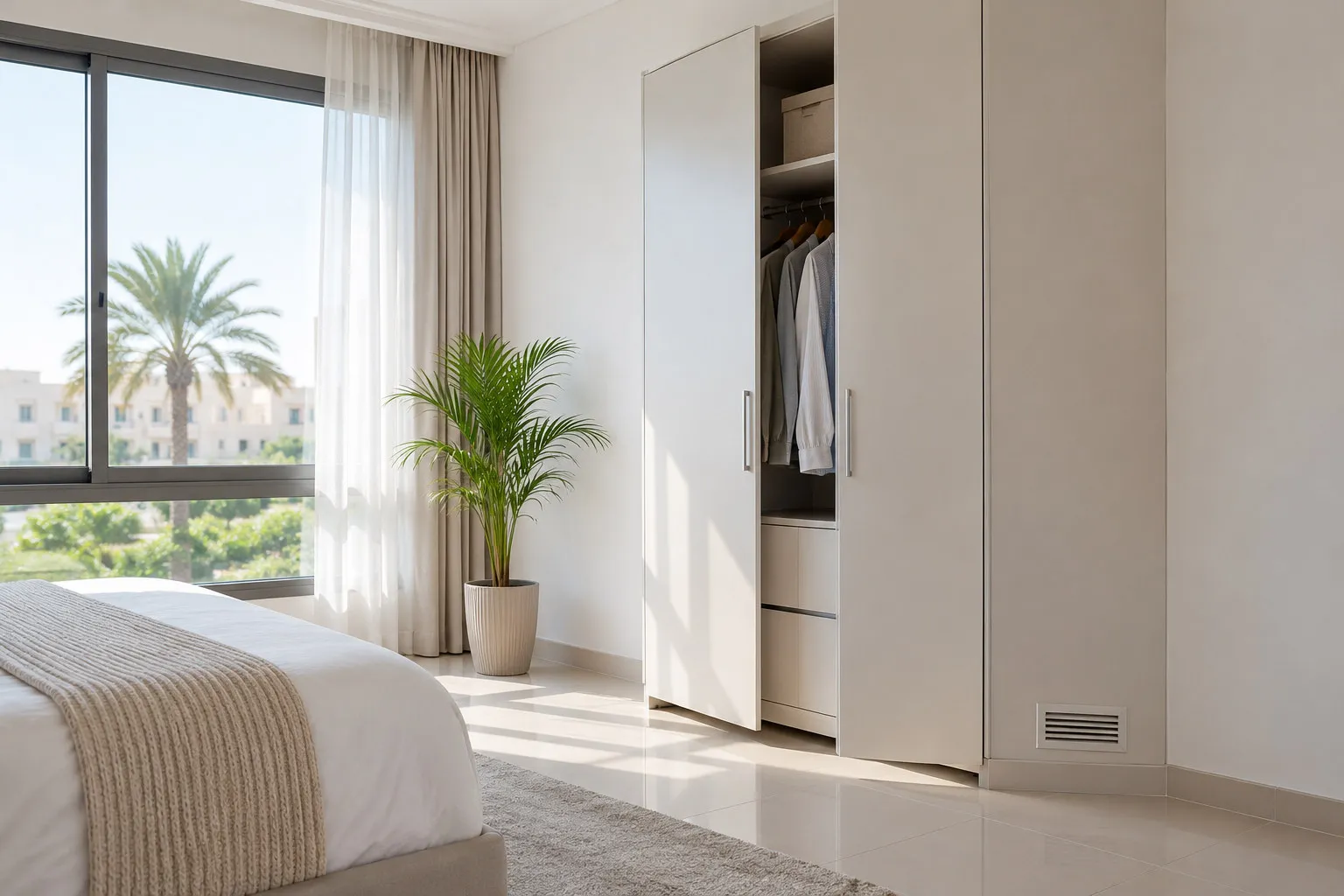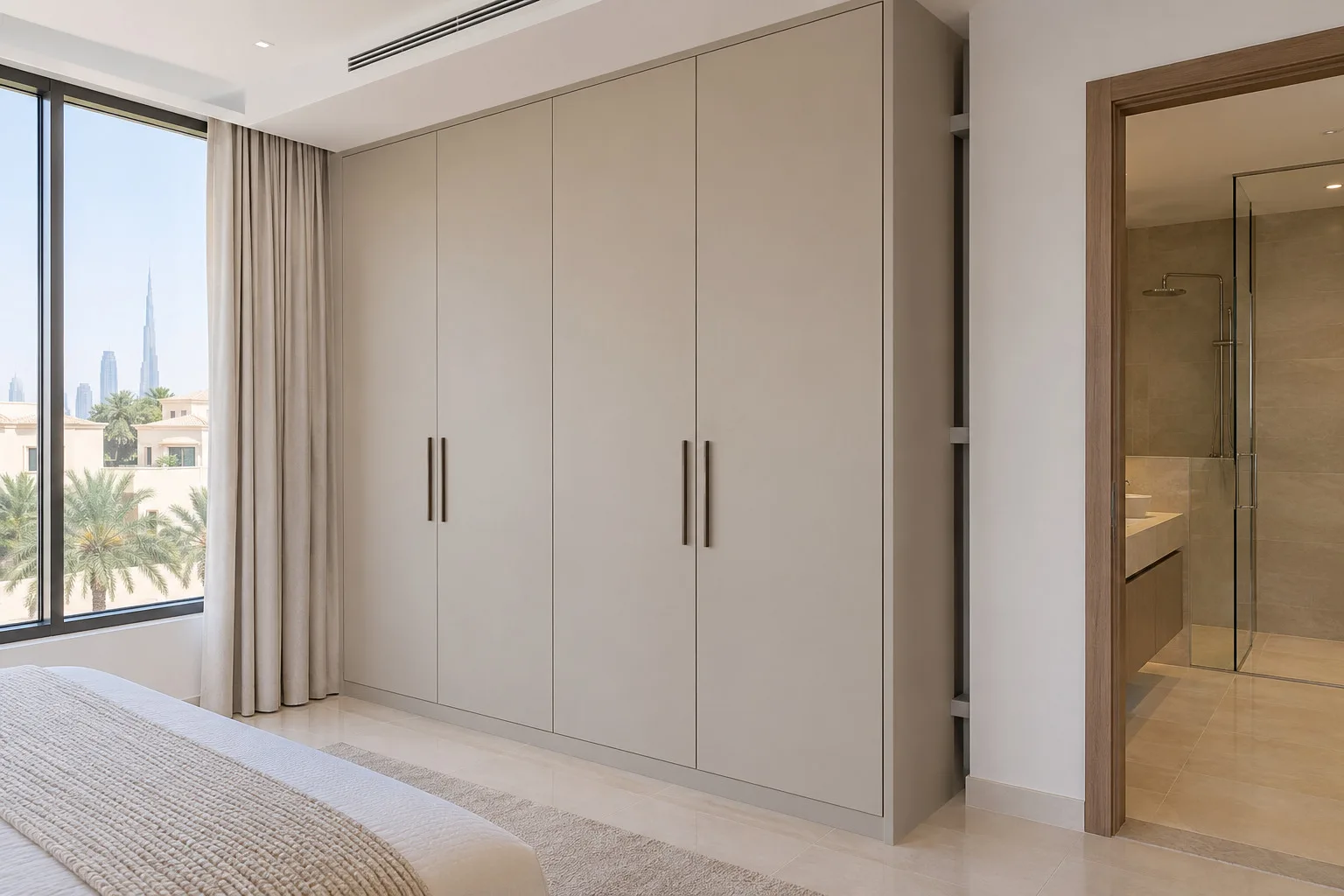
Wardrobes · 12 min read · 20 August 2026
Humidity and wardrobes in UAE homes: causes and habits
Why indoor humidity swings in a UAE home, what it does to boards and clothes at a general level, the air habits that help, what a wardrobe can do and when it is a building problem, with each source named.

By Ali Haider Basra, Founder, Al Tareeq Decor · Contact our workshop
Key takeaways
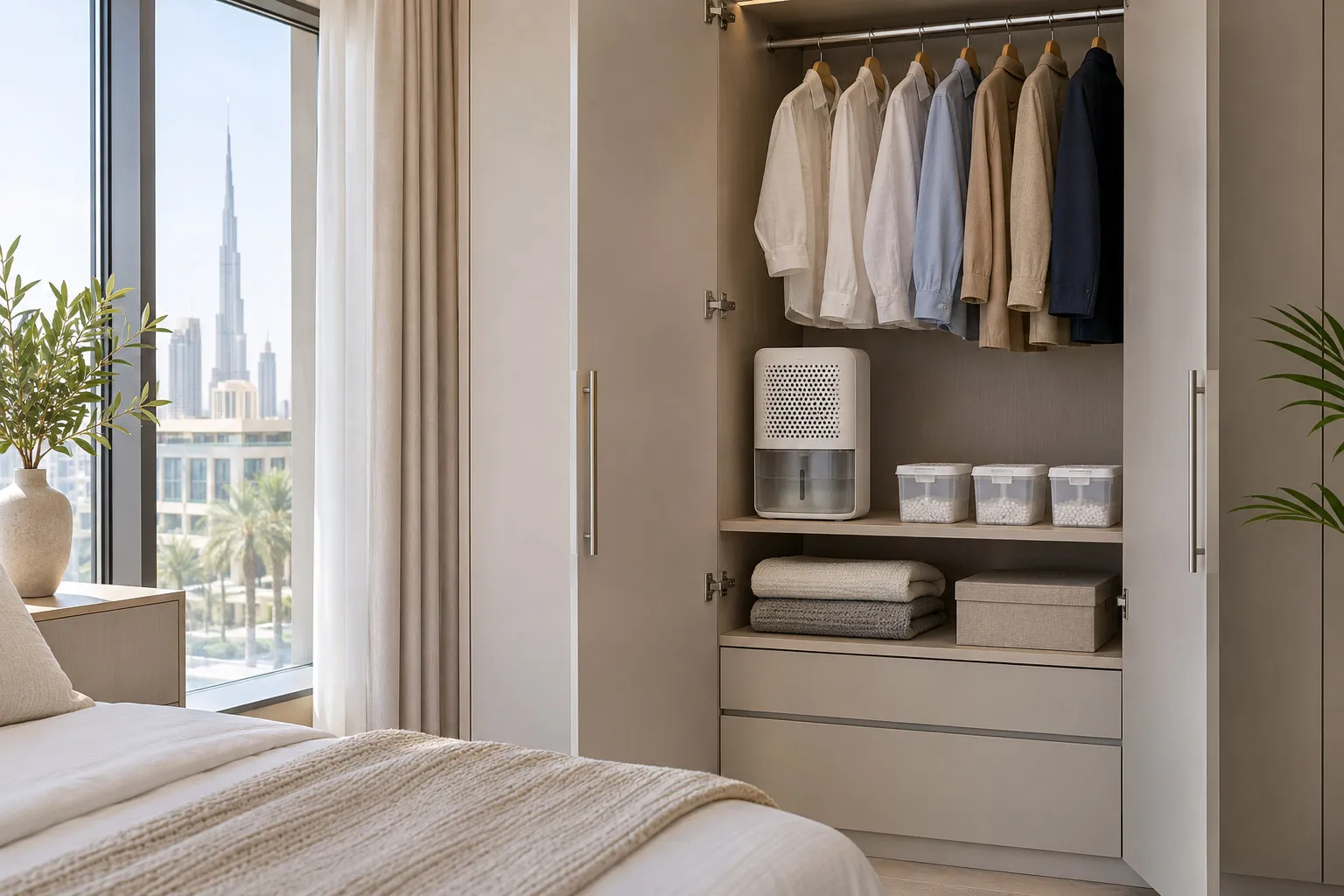
- Wardrobe humidity follows room humidity: wet rooms, cooking, drying laundry, an AC left off and cold walls all feed it, according to the EPA and council guidance.
- Boards tend to come to equilibrium with the humidity of the air, so a wardrobe moves a little with the seasons, slowly.
- The cheap habits are air habits: do not pack the rail tight, keep off cold walls, run the AC, ventilate wet rooms, and, as our suggestion, leave doors slightly ajar when the AC is off.
- The wardrobe can leave room for air (the provisions depend on the site) but it never prevents damp; leaks and damp walls need the right trade.
- We found no official UAE humidity dataset, so this page quotes no UAE figures; the EPA's 60 percent and 30 to 50 percent are US guidance.
On this page
- Key takeaways
- Humidity in a wardrobe: the short version
- Humidity and a wardrobe at a glance
- Why indoor humidity swings in a UAE home
- What humidity does to boards, hardware and clothes
- Habits that help, in order of effort
- Habits, why they help and what backs them
- What the wardrobe construction can do
- When it is a building problem
- Moisture-resistant boards: where they fit
- What we do about it
- Common questions
Humidity in a wardrobe: the short version
A wardrobe is a closed box in a room, so the air inside follows the air in the room, only more slowly. When the room is damp, the box is damp, and clothes packed tightly keep that air from moving. Most wardrobe damp problems begin there: not a fault in the cupboard, but humid room air sitting still. For a wardrobe that already smells, start with why a wardrobe smells musty; this page is the wider picture, where the humidity comes from and which habits keep it in check.
We found no official UAE humidity dataset to quote, so this page gives no UAE averages. What it does give is what public health and building sources say about humid homes in general, with the source named each time, and a clear line between what a wardrobe can do and what only a building repair can.
Humidity and a wardrobe at a glance
Where does the moisture come from?
- Short answer
- Wet rooms, cooking, drying laundry, a cold surface, a leak
- Where it is covered
- Next section
Does it matter for boards and clothes?
- Short answer
- Wood tends to follow the humidity of the surrounding air
- Where it is covered
- The section on boards, hardware and clothes
What can I do myself?
- Short answer
- Move air, do not pack tight, run the AC, watch cold walls
- Where it is covered
- The habits section
What can the wardrobe do?
- Short answer
- Leave room for air; the provisions depend on the site
- Where it is covered
- The construction section
When is it the building?
- Short answer
- Leaks, damp walls, condensation that keeps returning
- Where it is covered
- Call the right trade first
Sources are named in the text and under the article. The EPA figure quoted later is US guidance for homes in general, not a UAE standard.
Why indoor humidity swings in a UAE home
Indoor humidity is not one number that stays put. It moves with what the people and the building do. Public guidance lists the same everyday causes again and again. The US EPA says cooking and showering add to indoor humidity, and a London council's damp guidance lists moisture from daily actions such as taking a bath, cooking or drying clothes. A bedroom next to a bathroom, or a wardrobe in a dressing area beside an en-suite, shares that moisture through the wall and the door.
The air conditioner matters too. The EPA says one function of a building's air-conditioning system is to remove moisture from the air, and in its example of a building cleaned with the system off, the humidity may rise greatly. A flat whose AC is switched off for days while the family is away is that example in a bedroom: the unit has stopped drying the air, and the wardrobe door has been shut the whole time. The EPA's brief guide also names air conditioners and dehumidifiers as the tools to use when needed, and asks that air-conditioning drip pans stay clean and the drain lines unobstructed; a blocked drain is a leak in waiting, and we cover where to look in a wardrobe against a bathroom or outside wall.
Laundry is the third source. Drying clothes indoors puts moisture into the room, and the council guidance says opening the window slightly or running an extractor fan will help clothes dry quicker. Coastal air is a situation many UAE readers ask about; we opened no source on it, so we do not put a number on it. If your home is near the sea, the signs are the same as anywhere: windows that mist, a cold wall that sweats, and clothes that feel soft in the cupboard.
Lastly, a cold surface. The EPA says that when warm, humid air contacts a cold surface, condensation may form, and that mould is frequently found on walls in cold corners behind furniture where condensation forms. In an air-conditioned flat the cold surface is often an outside wall or the wall behind a wardrobe pushed hard against it. The diagram below puts these four in order, then shows the path the air takes towards the wardrobe, what the wardrobe can offer and where the building starts. It has no numbers because we use none we cannot source.
- 1. Where it comes from: a wet room next door, drying laundry, an AC left off while away, a cold surface
- 2. How air moves: clothes not packed tight, and doors left ajar when the AC is off (our suggestion)
- 3. What the wardrobe offers: an air gap, concealed openings or grilles, set for each site
- 4. When it is the building: a leak or a damp wall needs the right trade, not a wardrobe
What humidity does to boards, hardware and clothes
Wood and wood-based boards take up moisture from the air and give it back. A chapter of the US Forest Service's Wood Handbook says the moisture remaining in wood tends to come to equilibrium with the relative humidity of the surrounding air, and that keeping moisture content within reasonable limits usually avoids major dimensional-change problems. In plain terms: boards follow the room's humidity, slowly, and a cupboard that sees humid weeks and dry weeks is asked to move a little with them. That is the reason doors that fit in one season can rub in another; our guide to a wardrobe door that is sticking, rubbing or sagging lists the first checks.
Hardware is the part we found least published on. We opened no source that gives a corrosion figure for hinges, tracks or runners at a given humidity, so we make no claim about it. What can be said without a number is practical: moving parts in a damp, shut box are the ones to look at first if a door starts to drag, and our hinges guide and sliding-door off-track guide say what to check.
Clothes are the plainest sign. The signs people notice are a damp feel, a musty smell, or mould spots on leather, shoes or fabric stored in the dark. The EPA's line is the one to keep: the key to mould control is moisture control, and if mould is a problem you should clean it up promptly and fix the water problem. We make no health claim here; if mould is on the clothes or the walls, treat it as a moisture problem first and a cleaning job second.
Habits that help, in order of effort
The cheapest steps are habits, and the sources support their direction. The EPA's list asks you to increase ventilation or air movement by opening doors and windows when practical, to use air conditioners or dehumidifiers when needed, and to use exhaust fans when cooking or showering. None of that is specific to a wardrobe, and none of it costs a joiner.
For the wardrobe itself, the habits are about air. Do not pack clothes so tightly that no air passes between them; leave a hand's width of space at the end of a rail if you can. Keep the wardrobe a little off an outside wall or a wet-room wall rather than hard against it, because that is the cold corner the EPA describes. When the AC will be off for days, one suggestion of ours, not a quoted source, is to leave the wardrobe doors slightly open so the box is not sealed with damp air; if you will be away for a long time, take out anything you would hate to find spotted. A hanging-clothes layout that leaves space between garments is covered in wardrobe hanging heights.
On measuring: the EPA says a moisture or humidity meter can be used, and gives indoor guidance of keeping humidity below 60 percent, ideally between 30 and 50 percent, if possible. That is US guidance for homes in general. We found no UAE standard to compare it with, so treat it as a rule of thumb from one authority and not a promise about your wardrobe. We do not sell or recommend a particular meter or product here.
Habits, why they help and what backs them
Run the AC while you are in
- Why it helps
- The system removes moisture from the air
- Backing
- EPA mold course: HVAC removes moisture
Fan on in the bathroom and kitchen
- Why it helps
- Less steam reaches the bedroom
- Backing
- EPA brief guide: exhaust fans for cooking and showers
Dry laundry with a window open or a fan on
- Why it helps
- Less moisture stays in the room
- Backing
- Waltham Forest: window slightly open or extractor fan
Do not pack the rail tight; keep off cold walls
- Why it helps
- Air can move; fewer cold corners behind furniture
- Backing
- EPA mold course: condensation in cold corners behind furniture
Doors slightly ajar when the AC is off for days
- Why it helps
- The box does not hold still air
- Backing
- Our suggestion, not a quoted source
Check the humidity with a meter
- Why it helps
- You see the room, not a guess
- Backing
- EPA brief guide: a humidity meter; below 60%, ideally 30 to 50%
The EPA figures are US guidance, not a UAE standard. Nothing here is a health claim.
What the wardrobe construction can do
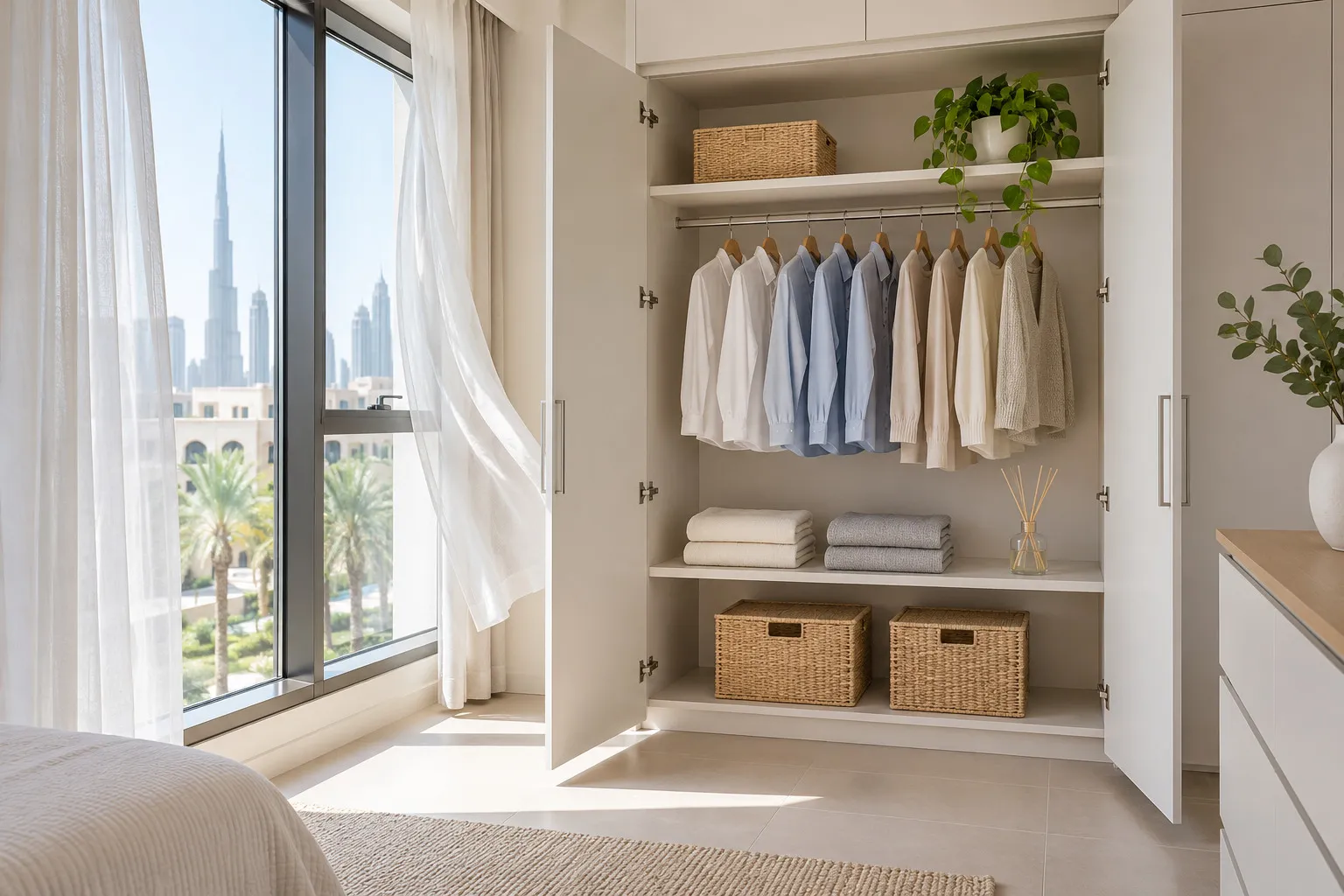
A wardrobe can be built to let air move; it cannot make a damp wall dry. Our approach is that the ventilation depends on the site: we look at the wall, the moisture it is exposed to, the space and the installation first, and the provisions may then include an appropriate air gap, concealed ventilation openings, ventilation grilles or other practical design measures. What those are for your wardrobe is set after we see the wall and is written on the drawing; we publish no gap size, and we never claim that a wardrobe prevents damp.
A gap or an opening helps air pass, and that is all it does. It does not stop a leak, and it does not treat condensation that comes from a cold wall. The wall-side checks, with the questions to ask, are in a wardrobe against a bathroom or outside wall. If a wardrobe is replacing an old one, renovate or replace shows how the old box and the wall are judged first, and a floor-to-ceiling run leaves different gaps at the top, explained in floor-to-ceiling wardrobes.
Open storage is one more way to move air, and its trade-off is dust and a less tidy look; open or closed wardrobe compares them. A shoe wardrobe has its own ventilation question because shoes bring moisture in.
When it is a building problem
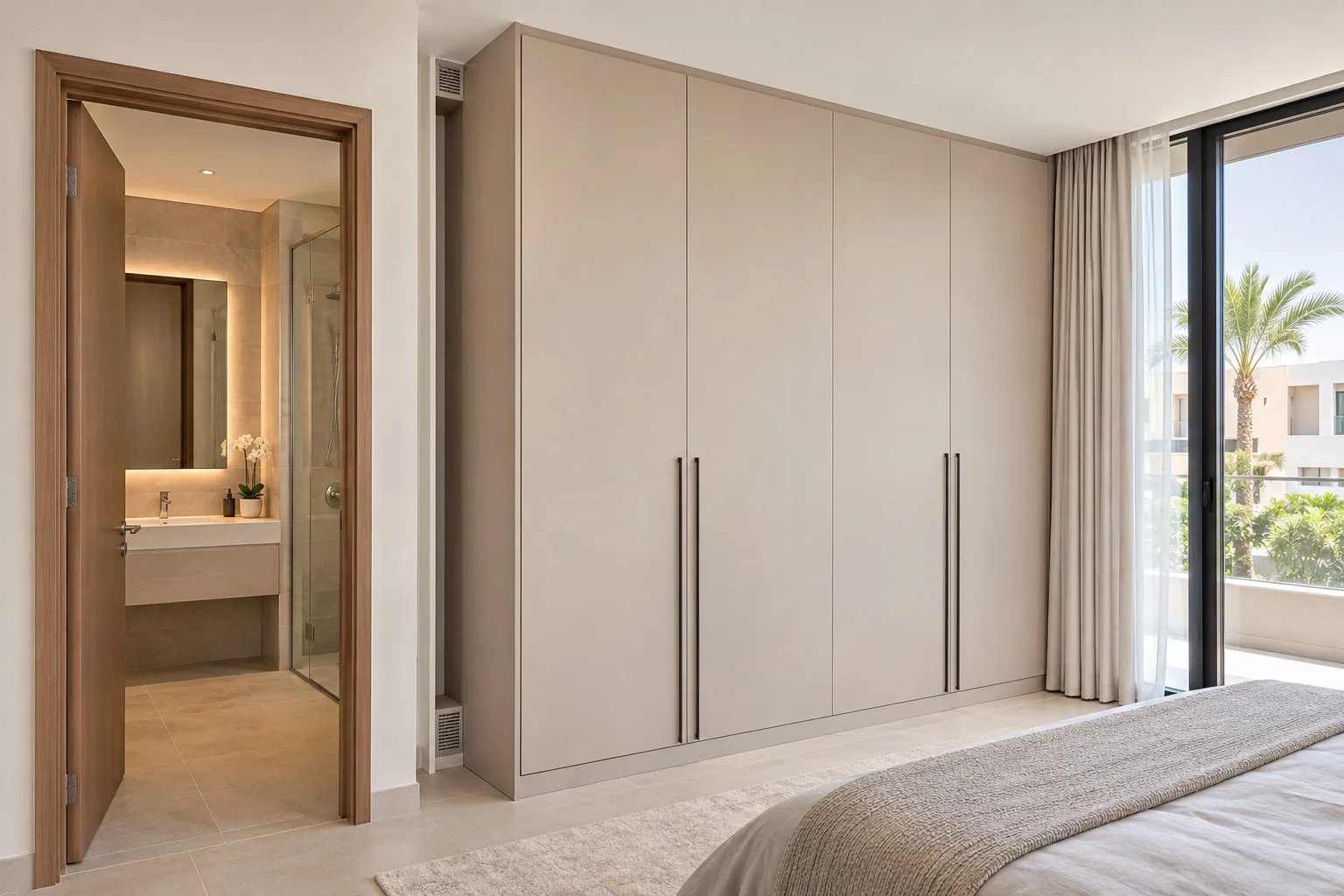
Some humidity cannot be solved with habits or with joinery. If a wall has stains, blisters, white salt marks or a wet patch, if a pipe or an AC drain is leaking, or if condensation returns after you have ventilated, the cause is in the building. The council guidance lists overdue repair work such as broken pipes as a cause of damp; the EPA says to fix the water problem; and for mould that may be damaging the structure it says to consult a structural engineer or another professional with the right expertise.
The right trade depends on the cause: a plumber for a leaking pipe, an AC technician for a blocked drain or a unit that does not run properly, a waterproofing or building contractor for a damp wall, the landlord or the building management in a rented flat (check your tenancy contract and ask in writing). We are joiners: we do not cure damp, and we say so at the visit, so that a new wardrobe is not built over a wall that is still wet. Our measuring visit guide shows what we look at, and a rented apartment wardrobe has its own checklist.
Moisture-resistant boards: where they fit
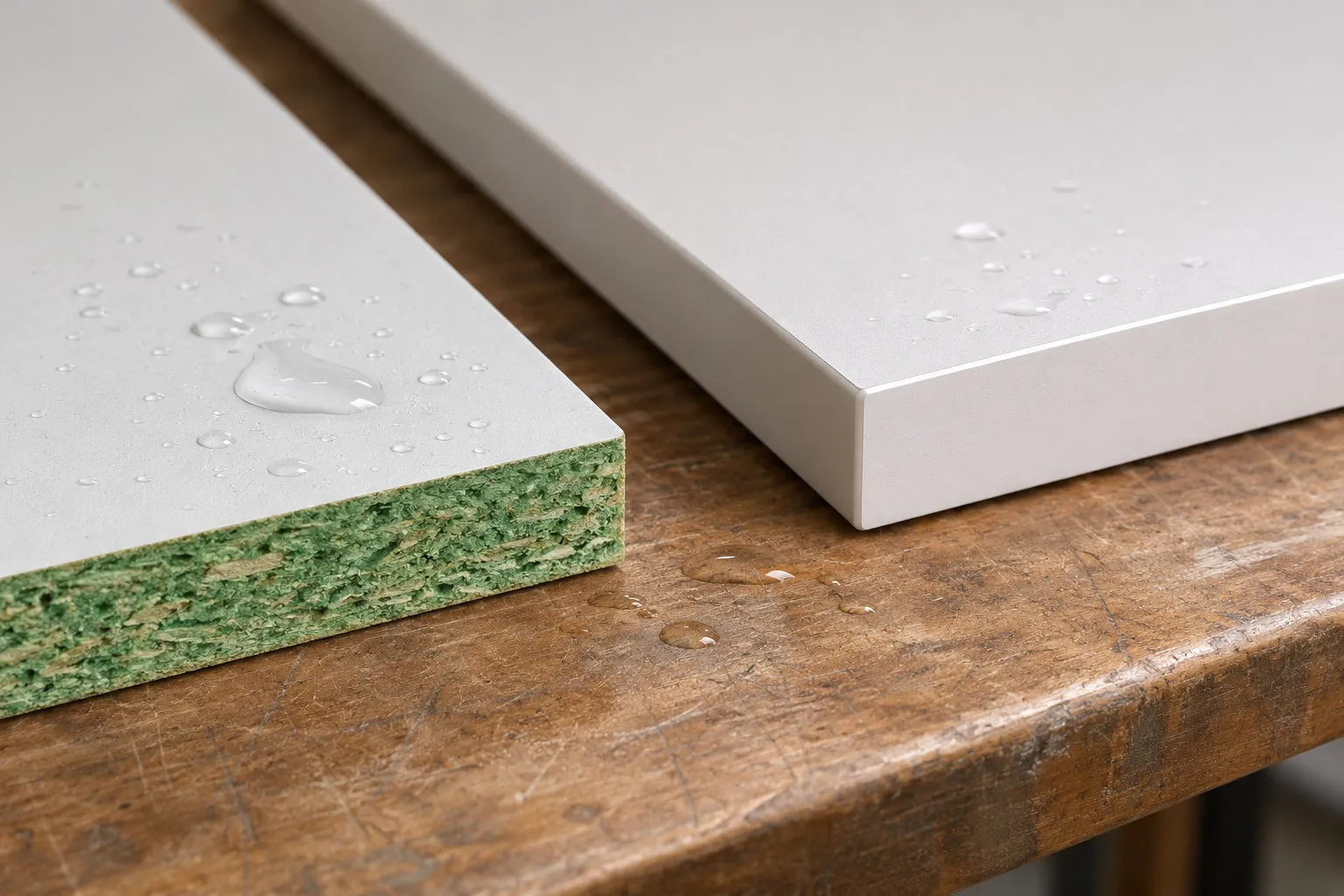
A board graded for humid conditions is made for damper air than an ordinary one, and is a reasonable choice for a wardrobe on a bathroom wall, in a kitchen run or beside an en-suite. It does not make a damp wall dry and it does not make the wardrobe immune to the room: the wood still follows the humidity, as the Forest Service chapter says. How the grades differ, and what we confirm about the boards we use, is in moisture-resistant wardrobe boards; the finishes on top are compared in wardrobe door finishes. Our boards come with a 5-year limited warranty on the wood-based boards only; hinges, tracks, runners, rollers and other moving hardware are not covered, and the written warranty has the terms (see what a wardrobe warranty covers).
What we do about it
At the free measuring visit we bring samples, look at the wall the wardrobe will stand against, and measure. We send a drawing and an itemised price, and nothing is made until you approve them. If the wall shows signs of damp or a leak, we tell you to have it dealt with first; the ventilation provisions for your wardrobe depend on the site and are written on the drawing.
Our entry price is from AED 550 per sqm, installed, for MDF laminate with hinged doors; other options raise it, and the figure for your wall is set after measurement. After you confirm the details and pay the advance, production starts, and our Sharjah workshop builds the wardrobe and our own team installs it in up to about 10 days, depending on size and design, with a 24-month written workmanship warranty (supplied products follow their own terms). See custom wardrobes, the built-in wardrobes page and the wardrobe quotation checklist; the Sharjah page gives the workshop address, our Fujairah wardrobes page covers homes on the east coast, and the wardrobe price guide shows how a measured wall becomes a number. To plan a quotation, use the pricing guide, or book through the consultation form.
If you are planning a new wardrobe, how to plan one in the right order puts the wall and damp checks at the start.
Common questions
Why does my wardrobe feel damp when the flat is empty?
With the AC off, nothing dries the room's air, and a shut wardrobe holds still air. The EPA says one function of an air-conditioning system is to remove moisture, and that with it off humidity may rise greatly. See our guide to musty-smelling wardrobes.
Should I leave the wardrobe doors open?
Slightly ajar when the AC will be off for days is our practical suggestion, not a quoted rule, so the box is not sealed with damp air. In normal use the main habit is not packing clothes tight. See the wardrobe door sticking guide if doors rub.
What humidity should a wardrobe room have?
The EPA says to keep indoor humidity below 60 percent, ideally between 30 and 50 percent, if possible. That is US guidance for homes, not a UAE standard, and we found none for the UAE. A meter shows your room. See our moisture-resistant boards guide.
Does the wardrobe have a gap or vents against humidity?
Ventilation provisions depend on the site: they may include an air gap, concealed ventilation openings, grilles or other practical measures, written on the drawing. A wardrobe never prevents damp. See a wardrobe on a bathroom or outside wall.
Is a moisture-resistant board enough for a humid room?
A graded board suits damper air than an ordinary one, but boards still follow the humidity of the air and no board dries a wet wall. Fix leaks first. See moisture-resistant wardrobe boards.
When is it a building problem and not a wardrobe problem?
Stains, blisters, salt marks, a leaking pipe or AC drain, or condensation that keeps returning after ventilating. Call a plumber, an AC technician or a building contractor, or the landlord in a rented flat. We do not cure damp. See our wardrobe measuring visit guide.
What does Al Tareeq do about humidity?
We look at the wall at the free visit, tell you if it needs repair first, and write the ventilation provisions for the site on the drawing. Our entry price is from AED 550 per sqm, installed. See our wardrobe quotation checklist.

Sources & specifications
Manufacturer information applies to the named products and systems. Sources reviewed on 4 November 2026.
- US EPA, A Brief Guide to Mold, Moisture and Your Home (updated 18 February 2026): keep indoor humidity below 60 percent, ideally 30 to 50; increase ventilation; use air conditioners or dehumidifiers when needed; condensation can be a sign of high humidity; fix the water problemepa.gov(opens in a new tab)
- US EPA, Mold Course chapter 2, Why and Where Mold Grows: HVAC removes moisture; humidity may rise greatly with the system off; condensation on cold surfaces; cold corners behind furniture; consult a professionalepa.gov(opens in a new tab)
- London Borough of Waltham Forest, damp and mould for landlords and tenants: moisture from bathing, cooking, drying clothes; poor ventilation; cold surfaces; overdue repairs such as broken pipes; window slightly open or extractor fanwalthamforest.gov.uk(opens in a new tab)
- USDA Forest Service, Wood Handbook chapter 13 (Bergman, 2021), abstract: wood moisture tends to come to equilibrium with the relative humidity of the surrounding airresearch.fs.usda.gov(opens in a new tab)
Want this planned for your home?
Consultation and measurement are free. Tell us the rooms, location and what you need; we arrange a sample visit and define the measured quotation.