Wardrobes · 16 min read · 9 July 2026
Renovate or replace an old wardrobe: a decision guide by symptom
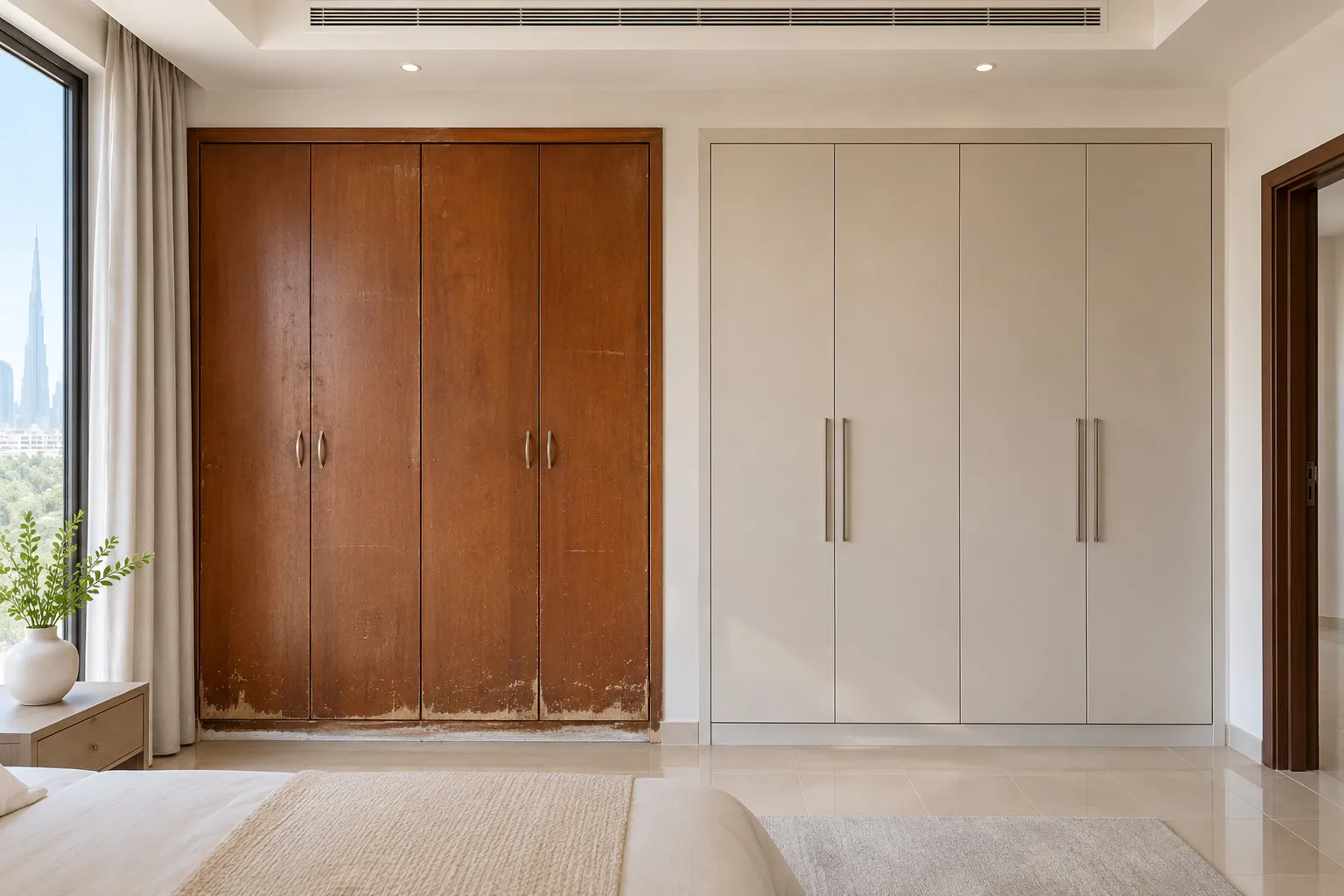
Renovate an old wardrobe when the box is sound: the wall behind it dry, the boards firm and the carcass square and the right size. Replace it if any of those fails. New doors, track, interior or finish cannot fix a swollen, racked or wrong-size box.

By Ali Haider Basra, Founder, Al Tareeq Decor · Contact our workshop
Key takeaways
- Renovate when the box is sound; replace when it is not. Ask three questions in order: is the wall behind it dry, do the boards still hold, is the box square and the right size.
- Four jobs can renew a sound box: new doors, a new track, a rebuilt interior and, by quotation only, a new finish. Where the structure is sound we replace damaged doors, tracks, hinges or drawers and reconfigure interior compartments.
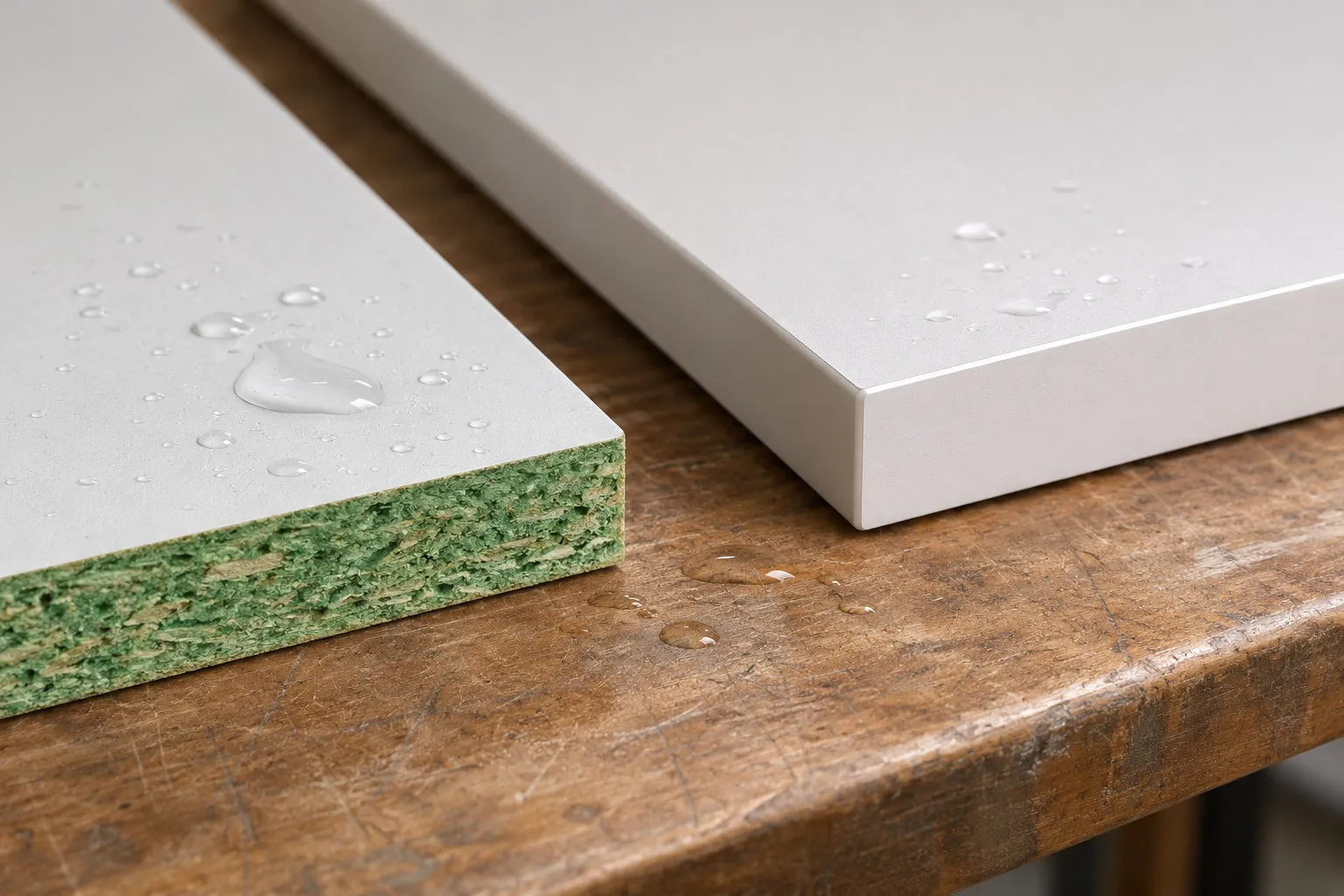
- A swollen base is a replace verdict: the Composite Panel Association says swelling beyond a panel's original size is not fully recovered on drying. Find and stop the damp source first.
- A sagging shelf is often a long span, not a bad board: a support can fix it. Shelves that sag on short spans, or soft boards in several places, point to replacing.
- A wrong depth, height or position cannot be renovated away. Ask for both options priced from the same free visit; our entry price is from AED 550 per sqm for a new wardrobe, with no published price for a renovation.
On this page
- Key takeaways
- Renovate or replace an old wardrobe: the short answer
- What renovating a wardrobe really means
- Decision table by symptom: sagging shelves, damaged boards, a swollen base, dated doors, a wrong layout
- Renovate or replace: the usual answer by symptom
- How to judge the board condition yourself
- A ten-minute board check you can do before the visit
- Damp: when it is a reason to replace
- What can and cannot be reused
- Reuse or replace: the parts of an old wardrobe
- Doors, track, interior or finish: which job fits which problem
- When the layout is wrong, a new wardrobe usually wins
- Comparing a renovation quotation with a new-wardrobe quotation
- Renting, and living in the flat while it is done
- What we do about it
- Common questions
Renovate or replace an old wardrobe: the short answer
Renovate when the box is sound and replace when it is not. Keep the wardrobe if the wall behind it is dry, the boards still hold a screw and sit flat, and the carcass is square and the right size for the room. Then new doors, a new track, a rebuilt interior or a new finish can bring it up to date. Replace it if any one of those three fails, because new fronts do not fix what is behind them.
We use three questions, in this order: is the wall behind it dry, do the boards still hold, is the box square and the right size. They are our planning order, not a standard, and the drawing below walks through them. The only numbers on it are the three questions themselves: it has no costs. Final advice comes after a free measuring visit, and it can be to renovate one part, replace one part, or build new.
The detail of the door jobs lives on the wardrobe door replacement page, so this guide stays on the wider decision. If you decide to build new, the custom wardrobes service page shows how we work, and the wardrobe price guide shows what moves the figure.
- 1. Gate 1, the wall: if the wall behind the wardrobe is damp, the answer is to replace, after the source is found and fixed
- 2. Gate 2, the boards: firm edges and level shelves mean the boards still hold; if one part is damaged replace the part, and if the damage is widespread replace the wardrobe
- 3. Gate 3, the box: equal diagonals and a depth and height that work mean new fronts can hang straight; a racked or wrong-size box is a reason to replace
- 4. Yes to all three: the wardrobe can be renovated rather than replaced
- 5. Four things can be renewed on a sound box: doors, track, interior and, only by quotation, the finish
- 6. The final answer comes after the free measuring visit, not from a drawing
What renovating a wardrobe really means
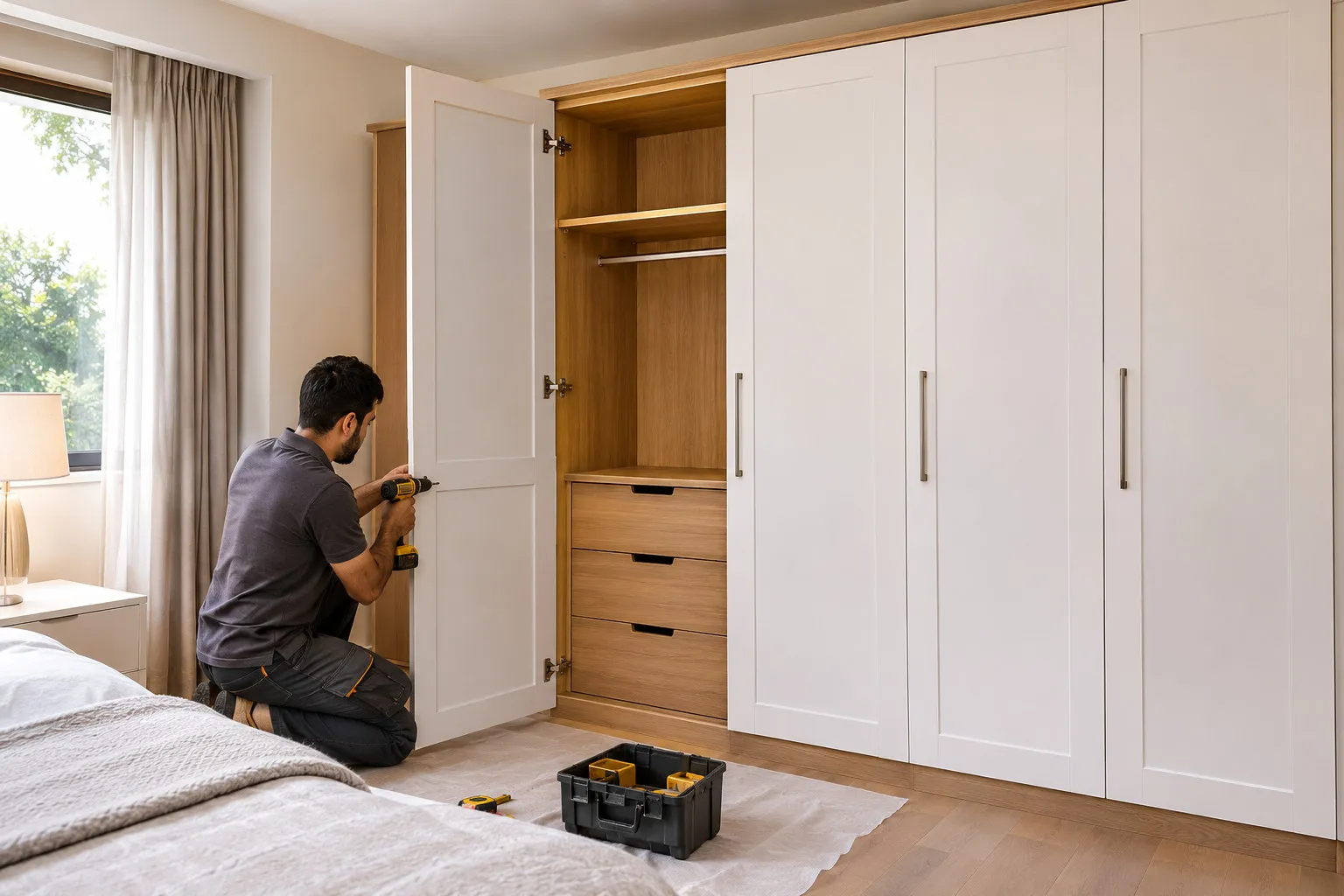
Renovating does not mean changing everything; it means keeping the box and renewing the parts that wear out or date. There are four jobs, and they can be done one at a time or together. New doors change the look and, if you want, the way the wardrobe opens. A new sliding track and rollers fix doors that stick or jump. A rebuilt interior swaps old shelves for drawers, extra rails or a better hanging height. And a new finish changes the colour or texture of what you see. If you rebuild the interior, wardrobe hanging heights shows how to set the rails.
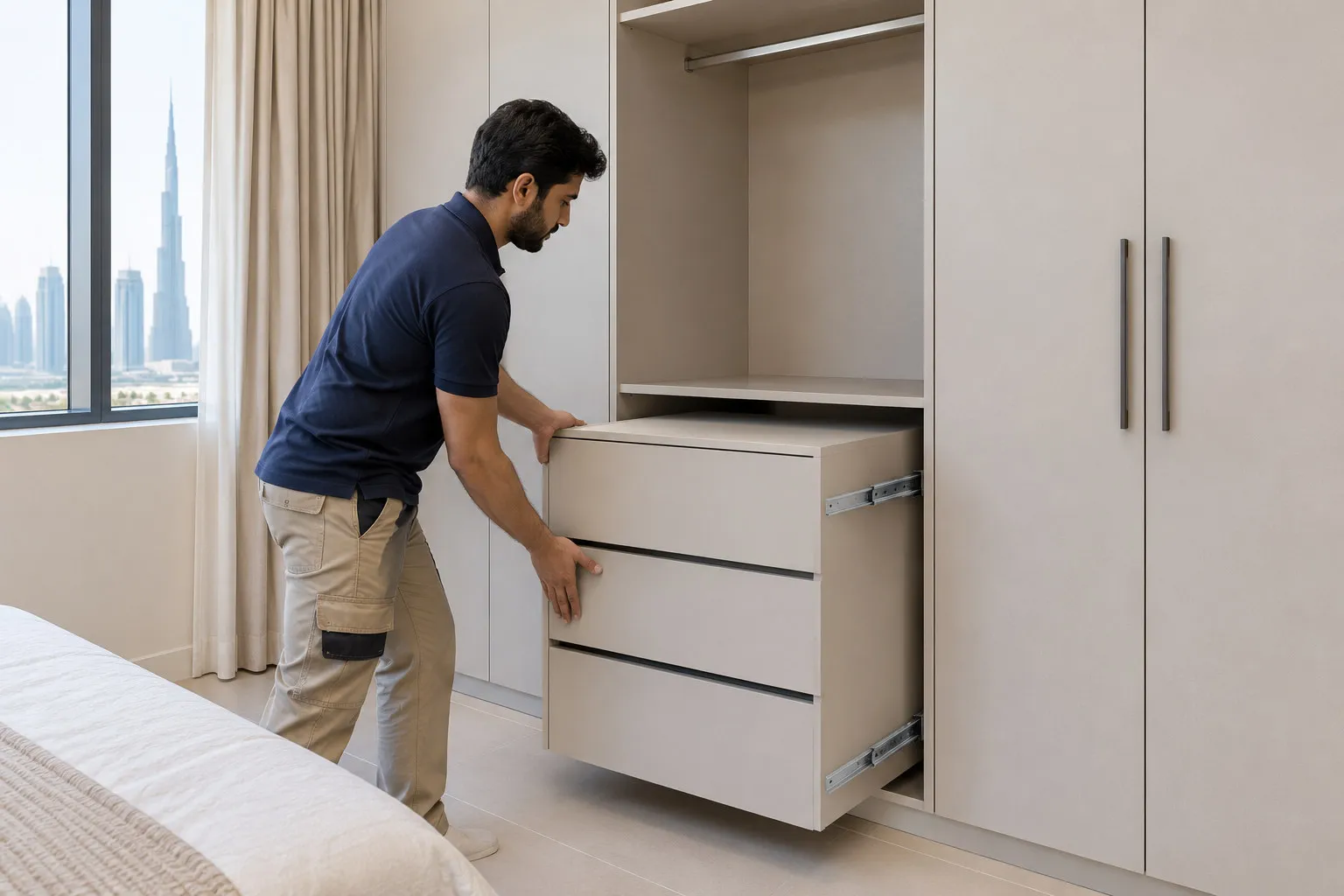
Here is what the repo confirms for us. Where an existing wardrobe structure is sound, we replace damaged doors, tracks, hinges or drawers, and we can reconfigure interior compartments without a full tear-out; the choice between refurbishing and replacing is made after the existing structure is checked. A new finish on an existing box is not something we have published, so ask for it in the quotation. For doors specifically, wardrobe door replacement goes through hinged doors, sliding track and drawers.
Because the box stays, the job is limited by it. Depth, height, width and the position of the walls do not change when the doors do. If you need a different depth or a floor-to-ceiling run, that is a new, made-to-measure fitted wardrobe, covered later on this page.
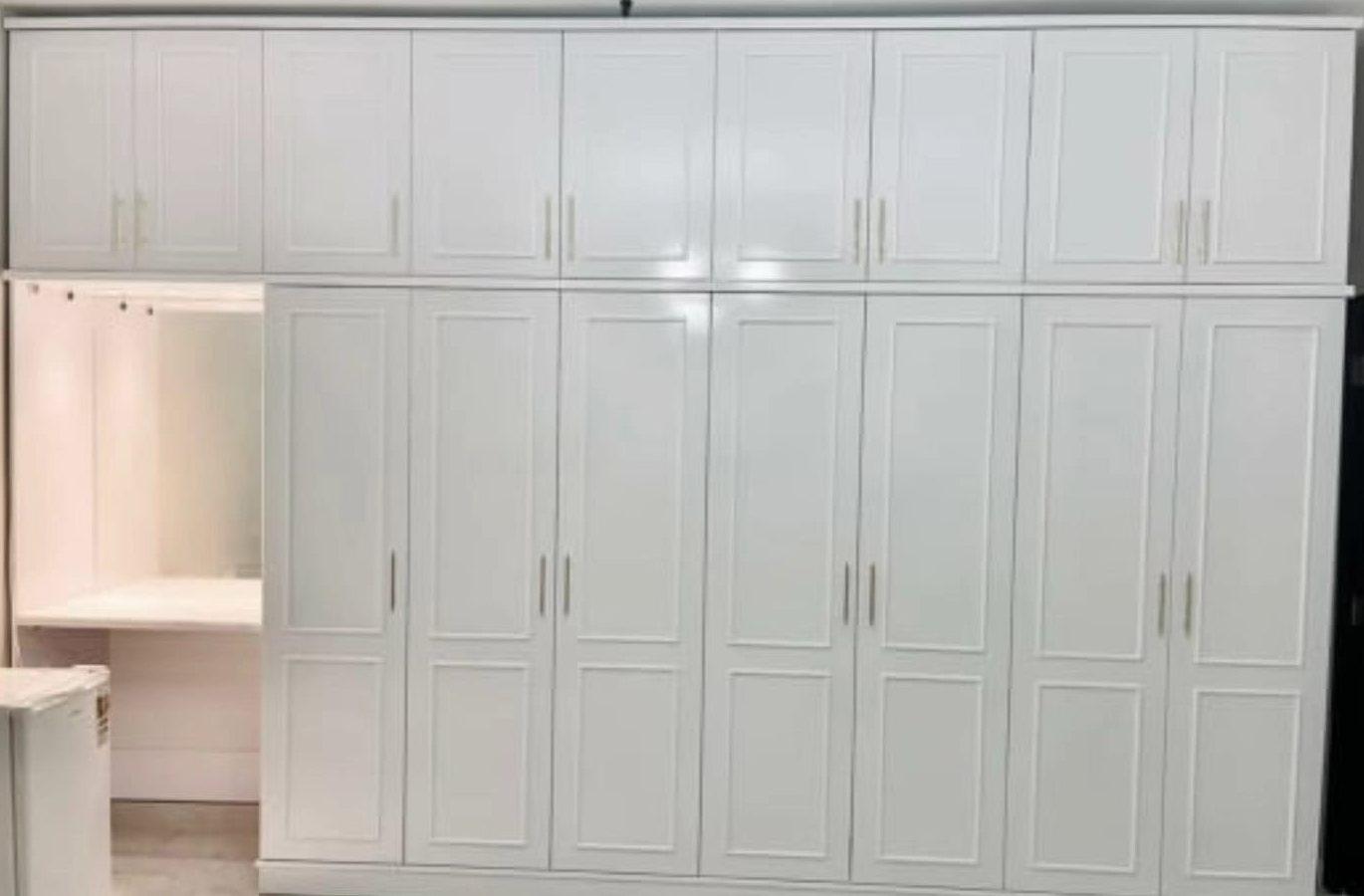
Decision table by symptom: sagging shelves, damaged boards, a swollen base, dated doors, a wrong layout
Start from what you can see. The table puts the five symptoms people most often mention next to the usual answer, the check that decides it and the point where we would stop and replace. It is our planning guide: the visit settles the answer for your wardrobe.
Two things apply to every row. The board the wardrobe is made from is the first thing to look at, and the next section shows how. And if the wardrobe also smells musty, read why a wardrobe smells musty before you decide, because the smell and the damage often have one cause. Sharing changes the plan, so our guide to a wardrobe shared by two is worth reading before the drawing.
Renovate or replace: the usual answer by symptom
Sagging shelves
- What it usually means
- A long span, a heavy load, or boards that have gone soft
- Renovate when
- The rest of the boards are firm: add a support or fit a new shelf
- Replace when
- Shelves sag at short spans, or several boards are soft
Damaged board (chipped, split, peeling)
- What it usually means
- An impact, or moisture reaching the board
- Renovate when
- One panel is damaged and the rest hold: replace that panel
- Replace when
- The damage runs across several panels or at the base
Swollen base
- What it usually means
- Water has reached the bottom edge
- Renovate when
- Almost never: swelling does not fully reverse
- Replace when
- Always, once the water source has been found and stopped
Dated doors
- What it usually means
- Style, scratches or a worn finish; the box is fine
- Renovate when
- The box passes all three gates: fit new doors
- Replace when
- The box also fails a gate, or you want a different depth
Wrong layout
- What it usually means
- The inside does not match what you own, or the box is too shallow or too short
- Renovate when
- The box is square and its size works: rebuild the interior
- Replace when
- Depth, height or width is the problem, not the fittings
Our own planning guide, not a measured rule. A swollen panel is explained by the Composite Panel Association, which says swelling beyond a panel's original size is not fully recovered when it dries.
How to judge the board condition yourself
You can learn a lot in ten minutes with a tape, a straight edge and a thumb. Empty the wardrobe, take out the lowest shelf if it lifts out, and look at the lowest ten centimetres of every side panel and the base. That strip is where water arrives first, from a mopped floor, a leak or damp rising from the wall (the wardrobe humidity guide explains when the cause is the building). The check list below covers what to look for.
A soft, spongy or crumbling edge is the clearest sign. Particleboard and MDF are made of wood particles and fibres pressed together, and the Composite Panel Association explains that panels like these swell more than solid wood when they meet humidity or water, and that swelling beyond the original size is not fully recovered when the board dries. That is why a swollen base is a replace verdict and not a repair. Our moisture-resistant wardrobe boards guide explains the board grades, and what a better grade can and cannot do.
For sagging, look at the span before the board. A woodworking table from Woodbin, which is a blog table and not a board standard, gives about 26 inches (66 cm) as the span a 3/4-inch particleboard shelf carries under a bookshelf load before it sags, 32 inches (81 cm) for plywood of the same thickness, and 42 inches (107 cm) for plywood with one support cleat. Read it as a guide to why long shelves bow, not as a limit for your wardrobe, which we measure at the visit. If the sagging shelf is a long one, a support in the middle is the fix; Family Handyman describes reinforcing a sagging shelf with a metal flat bar glued into a channel under it. If the sag is on a short shelf, the board has probably softened.
Screws are the last check. If a hinge screw spins without biting, the hole is stripped. One stripped hole is a repair, and many of them along the same panel mean the board is crumbling around the fixing. Wardrobe door replacement covers hinge holes and the squareness check in more detail, and the wardrobe measuring visit guide shows what we measure on site. How many hinges a door should carry is set out in the wardrobe hinges guide. Ask what the warranty on a wardrobe actually covers before you sign; that guide lists the questions to put in writing.
A ten-minute board check you can do before the visit
Base and lowest 10 cm of the sides
- How
- Look for darker, raised or crumbling edges; press with a thumb
- What it points to
- Soft or swollen: the wall or floor has been wet; lean to replace
Shelf sag
- How
- Lay a straight edge or a long ruler along the shelf and look for a gap
- What it points to
- Long shelf: add a support. Short shelf: the board may be soft
Diagonals
- How
- Measure corner to opposite corner of a bay, twice; the two should match
- What it points to
- Unequal: the box has racked, so new fronts will not hang straight
Hinge screws
- How
- Gently try a loose screw; see if it grips
- What it points to
- Spins freely on many panels: the board is failing at the fixings
Surface
- How
- Look for peeling, bubbling or lifted edging
- What it points to
- One panel: replace the panel. Many: the finish is failing, usually from moisture
Wall behind and the smell
- How
- Look for stains at the base; note any musty smell
- What it points to
- A damp wall is gate one: fix the source first
Our own homeowner checklist. It does not replace the check we make at the measuring visit.
Damp: when it is a reason to replace
Damp is the one cause that makes the choice for you. A wardrobe that has taken in water will keep taking it in if the source is still there, and new doors hung on a wet box are wasted. So the order is the same every time: find the source, stop it, and only then decide what the wardrobe needs. A leaking pipe, a wet wall on an outside face, a bathroom on the other side or a mopped floor all leave the same marks at the base. Our guide to a wardrobe against a bathroom wall covers what to check first.
Once boards have swollen, replacing the panel is the honest answer. Swelling that goes beyond a panel's original size does not fully go back as the board dries, which is the Composite Panel Association's finding for particleboard and MDF. The swollen strip also tends to loosen the fixings, so the problem spreads as the hinges and shelf supports lose their grip. A moisture-resistant grade of board is made for damper air and helps on a wall shared with a bathroom, but it does not repair a leak, so the wall comes first. Our wardrobe musty smell guide covers the smell, and the moisture-resistant boards guide covers the grades.
Do not paper over it. A new finish on a damp board hides the swelling for a season, then lifts. Point out any stain, soft edge or smell at the measuring visit and ask for it to be written into the quotation: for example, whether a panel is to be replaced and what the new board will be. We do not publish a damp test, so ask for what is being done in writing. Our Sharjah page shows where the workshop is and how visits are arranged, and the guide to wallpaper in humid climates covers the same wall-moisture problem from the wallpaper side. For a sliding door that has slipped its rail, see what to do when a wardrobe door comes off its track.
What can and cannot be reused
A renovation reuses the box. The table lists the usual parts of an old fitted wardrobe and what we would expect to do with each, so you can see what is being kept before anything is ordered. Whether a given part is kept is decided at the visit, and the quotation should say so for each one. Handle types and finishes are covered in our wardrobe handles guide.
The reuse question is also a money question, because every part you keep is a part you do not pay to make again. But a part is worth keeping only if it will still work in five years. We do not publish a price for a renovation, so ask for the replace and renovate options to be priced from the same visit, which our quotation checklist shows how to compare. If the plan runs up to the slab, our guide to a floor-to-ceiling wardrobe explains how to measure the ceiling and close the gap at the top.
Reuse or replace: the parts of an old wardrobe
Sides, top and base (the carcass)
- Usually reused when
- Dry, firm, flat and square
- Replaced when
- Swollen, soft, racked or the wrong size
Back panel
- Usually reused when
- Intact and dry
- Replaced when
- Swollen, split or showing damp marks
Fixed shelves
- Usually reused when
- Level and firm
- Replaced when
- Sagging on short spans, or soft
Doors
- Usually reused when
- Finish and fit are fine and the style is not changing
- Replaced when
- Scratched, peeling, sagging, or you want a new look
Hinges and hinge holes
- Usually reused when
- The holes are sound for new hinges
- Replaced when
- Holes stripped across a panel: replace the panel
Sliding track and rollers
- Usually reused when
- Straight and sound, and the new doors suit it
- Replaced when
- Worn, bent or the wrong type for the new doors
Drawers and runners
- Usually reused when
- Boxes sound; only fronts or runners worn
- Replaced when
- Boxes soft or out of square
Mirror or glass panels
- Usually reused when
- Undamaged, if the same doors stay
- Replaced when
- Chipped, cracked or part of a style change
Our own guide. What is reused on your wardrobe is decided at the measuring visit and written in the quotation.
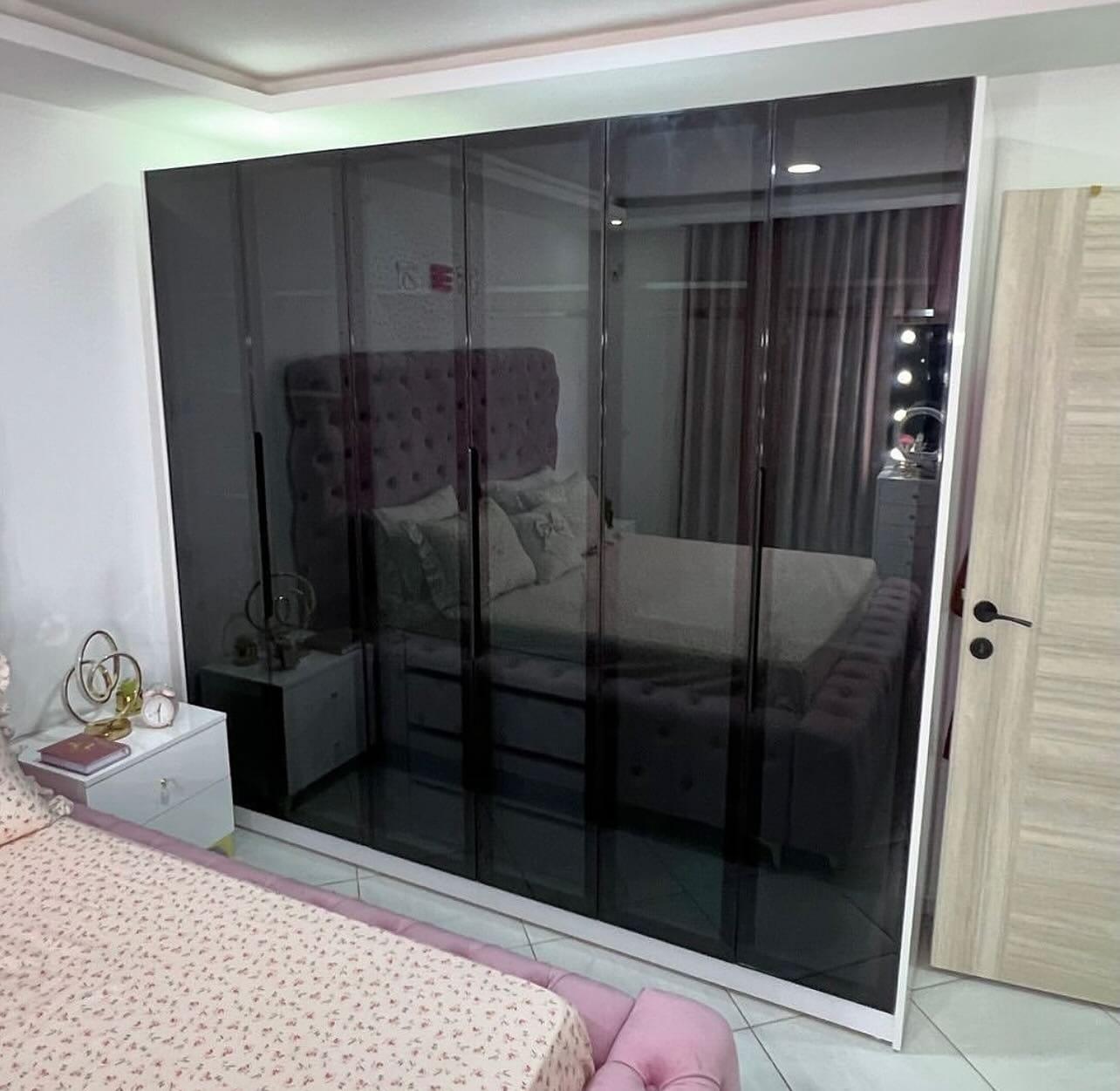
Doors, track, interior or finish: which job fits which problem
Match the job to the symptom, and do not buy more than the symptom asks for. If the doors scratch, drop or no longer close, new doors and hinges are the job; our guide to wardrobe door finishes compared shows the surfaces we make, and hinged or sliding doors shows how to choose between them. If you want the wardrobe to look different, mirror wardrobe doors and handleless doors are the two changes people ask for most. For a wardrobe in a large main bedroom, master bedroom wardrobe design covers the wider plan. For doors that rub or sag, fixing a sticking wardrobe door explains the usual causes.
If sliding doors stick, jump or scrape, the problem is the track, and the wardrobe sliding door systems guide explains what a track and rollers do. Sliding doors also need depth, so check that before you choose them; the wardrobe dimensions guide lists the numbers. Our sliding door wardrobes page shows finished systems.
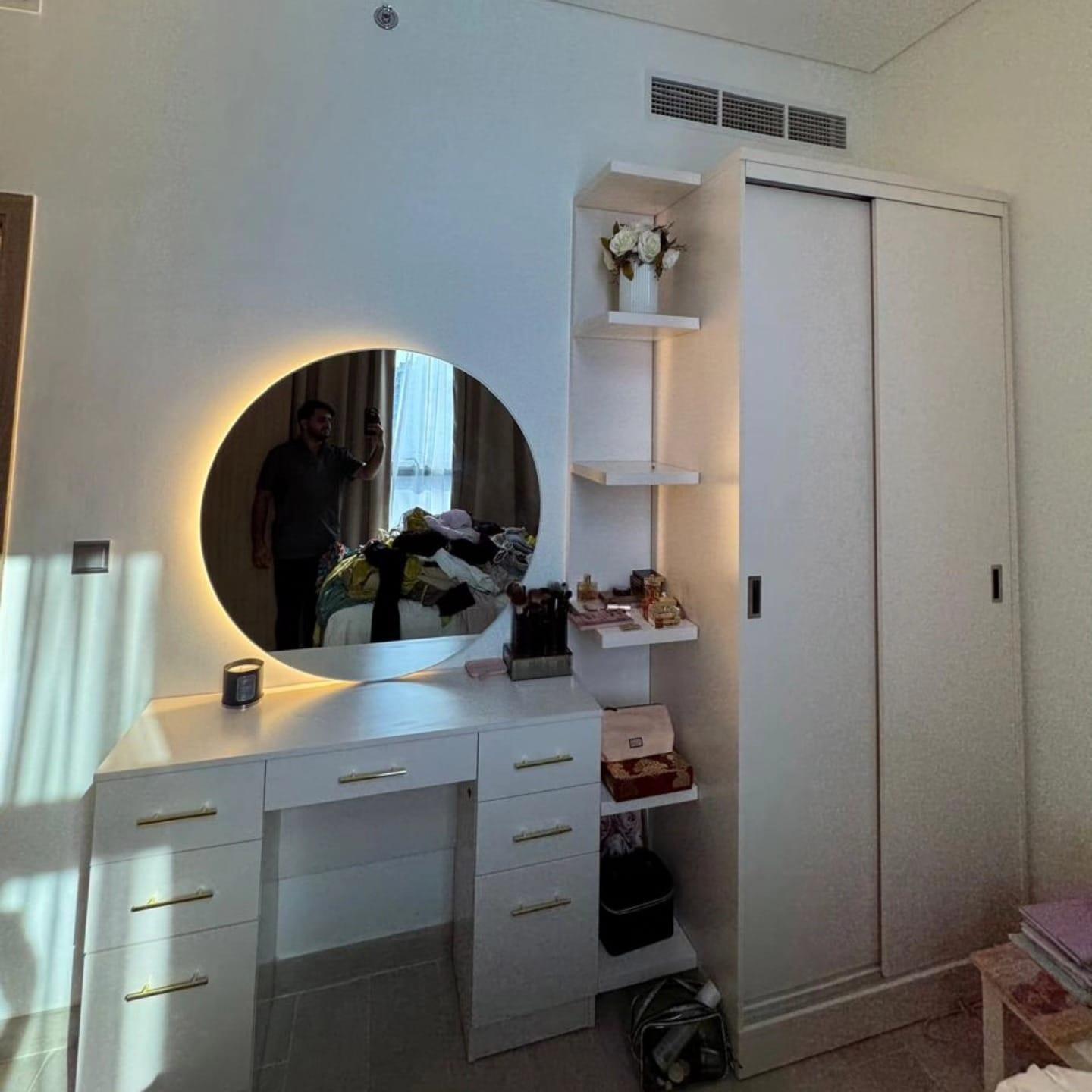
If the inside no longer suits you, rebuild it before you replace it. The shelves and rails can be reconfigured inside the box: wardrobe drawers and organisers shows what goes where, abaya and kandura storage covers long hanging, and luggage and seasonal storage covers the high shelf. A mirror and a shelf can also turn one bay into a dressing corner, as in a dressing table inside the wardrobe. Before you fix the depth, read what we say about the right wardrobe depth for hanging clothes, since it changes how much floor is left in front. If shoes drive the change, shoe wardrobe design covers pairs per shelf and ventilation.
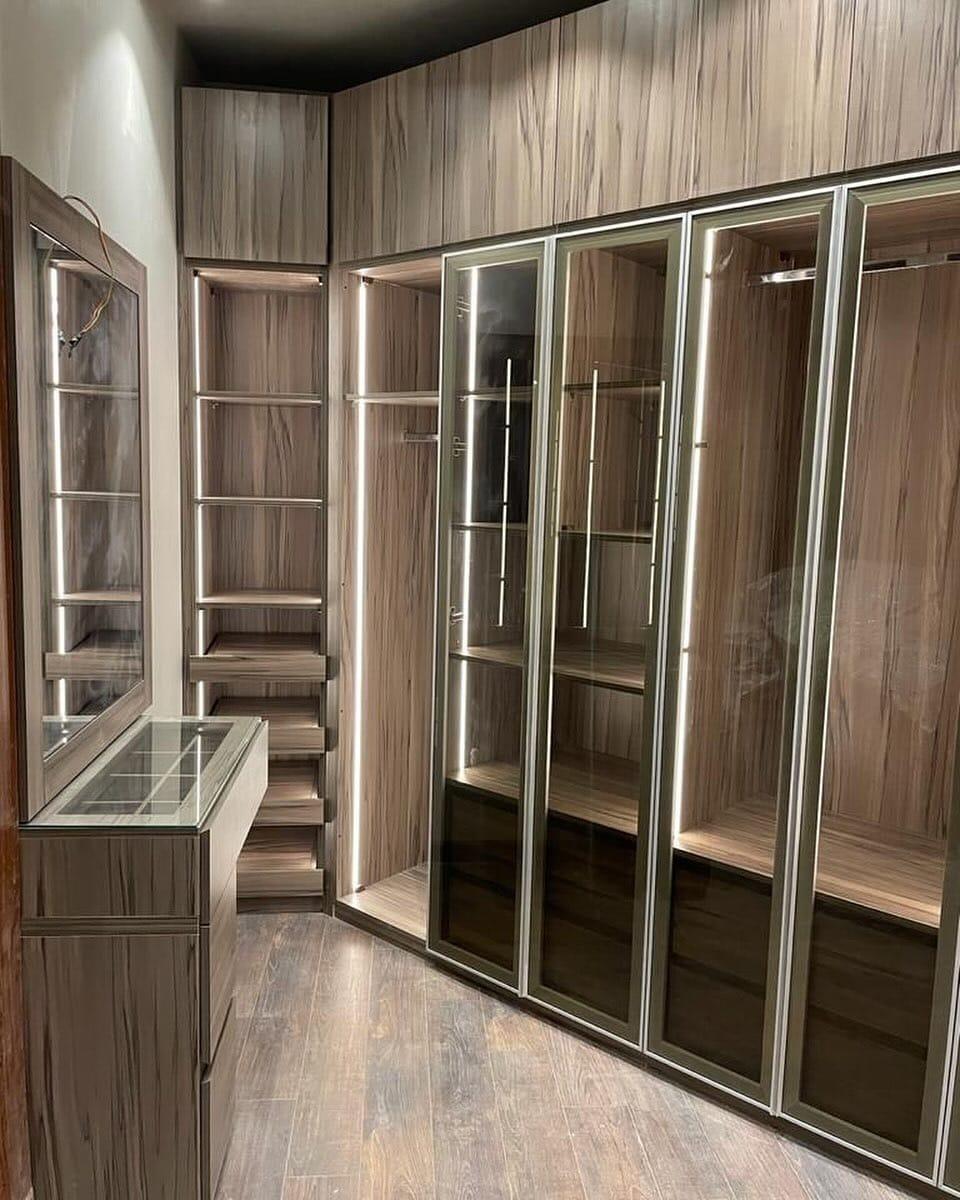
When the layout is wrong, a new wardrobe usually wins
A renovation cannot change the walls of the box. If the wardrobe is too shallow for the doors you want, stops well short of the ceiling or sits on the wrong wall, a rebuilt interior will not solve it. That is the case for a new wardrobe from our wardrobe service, drawn to the wall you have now. Our wardrobe layout guide shows how a run is planned, and the wardrobe dimensions guide gives the depth and aisle figures.
A few situations point the same way. A small bedroom may gain far more from a different run than from new fronts, as in small bedroom wardrobe ideas and wardrobe for a studio apartment. A corner can double the usable length, which is what corner and L-shaped wardrobe design explains. A child's wardrobe that no longer fits is covered in kids wardrobe design. And moving to a dressing room is a different project, set out in the dressing room design guide. If the new run also has to share its wall with a desk, an entrance cabinet or a bedside piece, the study desk and home office joinery guide, the shoe storage and entrance cabinet guide and the sideboard and bedside storage guide show how those pieces are planned, and small apartment interior ideas covers a compact flat as a whole.
Whether to buy built-in or freestanding next time is also worth a thought; fitted, built-in and freestanding wardrobes sets out what each means. If a television is on the same wall, a bedroom wardrobe with a TV unit shows how the two sit together. Whether a walk-in wardrobe or a reach-in wall suits the room is a choice that comes before most details, and that guide gives a simple floor test for it.
Comparing a renovation quotation with a new-wardrobe quotation
Ask for both from the same measuring visit, and ask for them itemised. Our entry price for a new wardrobe is from AED 550 per sqm of wardrobe front, installed, for MDF laminate with hinged doors; sliding, glass, mirror and other options raise it, and the figure for your wall is set after measuring. That is a new-wardrobe figure. We do not publish a price or a timeline for a renovation, so ask for both in the quotation.
Put the two quotations side by side and check four things: what is kept, what is new, what board and hardware go in, and what the warranty covers. Our workmanship warranty is 24 months in writing; products we supply follow their own terms, which is why the quotation should name them. Separately, the wood-based boards carry a 5-year limited warranty, subject to terms; hinges, tracks, runners, rollers and other moving hardware are not covered, and the final terms are in the written warranty. The wardrobe quotation checklist lists the lines to compare, the wardrobe materials and cost guide shows what changes the figure, and our pricing guide helps you compare.
If the cost of renovating comes close to the cost of replacing, the new wardrobe is usually the better buy, because you get a new box as well as new fronts. If the box is sound and the renovation is clearly smaller, renovate. That is our judgment from how the work is built, not a rule with a percentage. A rented apartment wardrobe has a different checklist: permission, what can be taken apart and a move-out routine. When weighing a new unit, custom or ready-made wardrobe shows where each wins in the UAE.
Renting, and living in the flat while it is done
If you rent, read your tenancy contract and ask the landlord or property manager in writing before anything is removed or fixed, and keep the reply. We do not give legal advice. A renovation that leaves the box in place is sometimes easier to agree than a new wardrobe, but that depends on your contract, so ask first.
If you stay in the home during the work, occupied home installation preparation explains how to ready the room, and our other room guides, such as the guide to curtain repair or reupholster or replace a sofa, are written the same way. Which light to put in the wardrobe, a bare strip or one in a profile, is the subject of wardrobe LED strip or profile.
What we do about it
The measuring visit is free, and we bring laminate, veneer and glass samples. We look at the existing wardrobe, and we tell you whether the box is worth keeping; point out any stain, soft edge or smell so it is written into the quotation. Where the structure is sound we can replace damaged doors, tracks, hinges or drawers or reconfigure the interior without a full tear-out; where it is not, we price a new wardrobe, and you can compare the two from the same visit. A drawing and an itemised price come first, and nothing is made before you approve both.
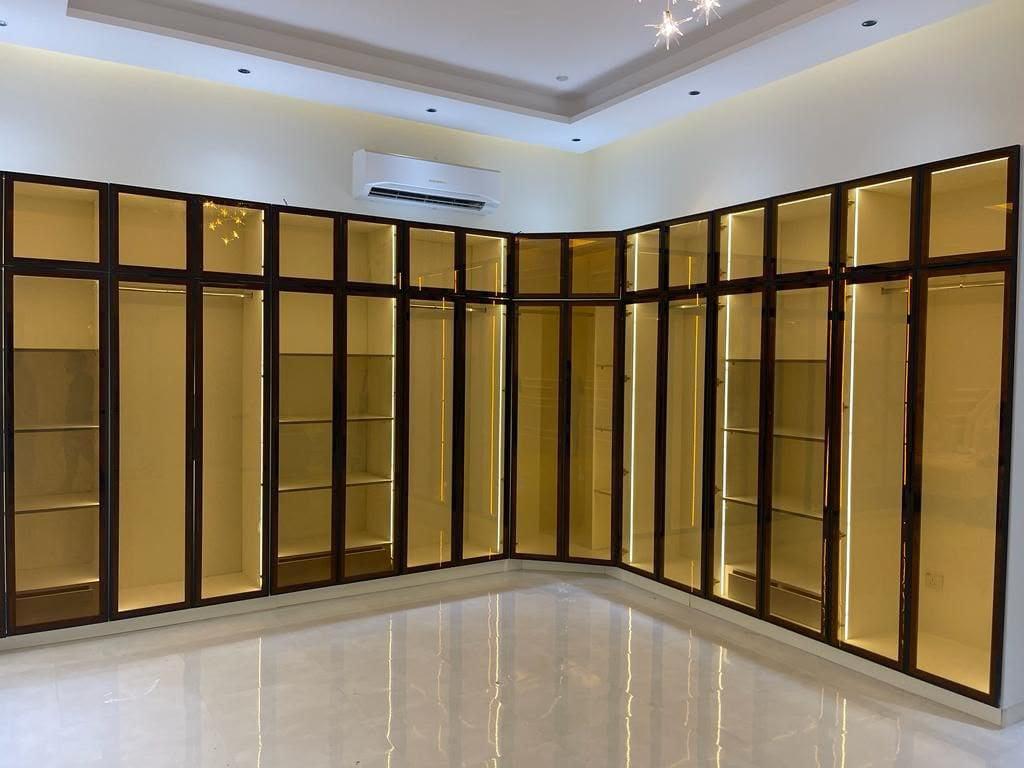
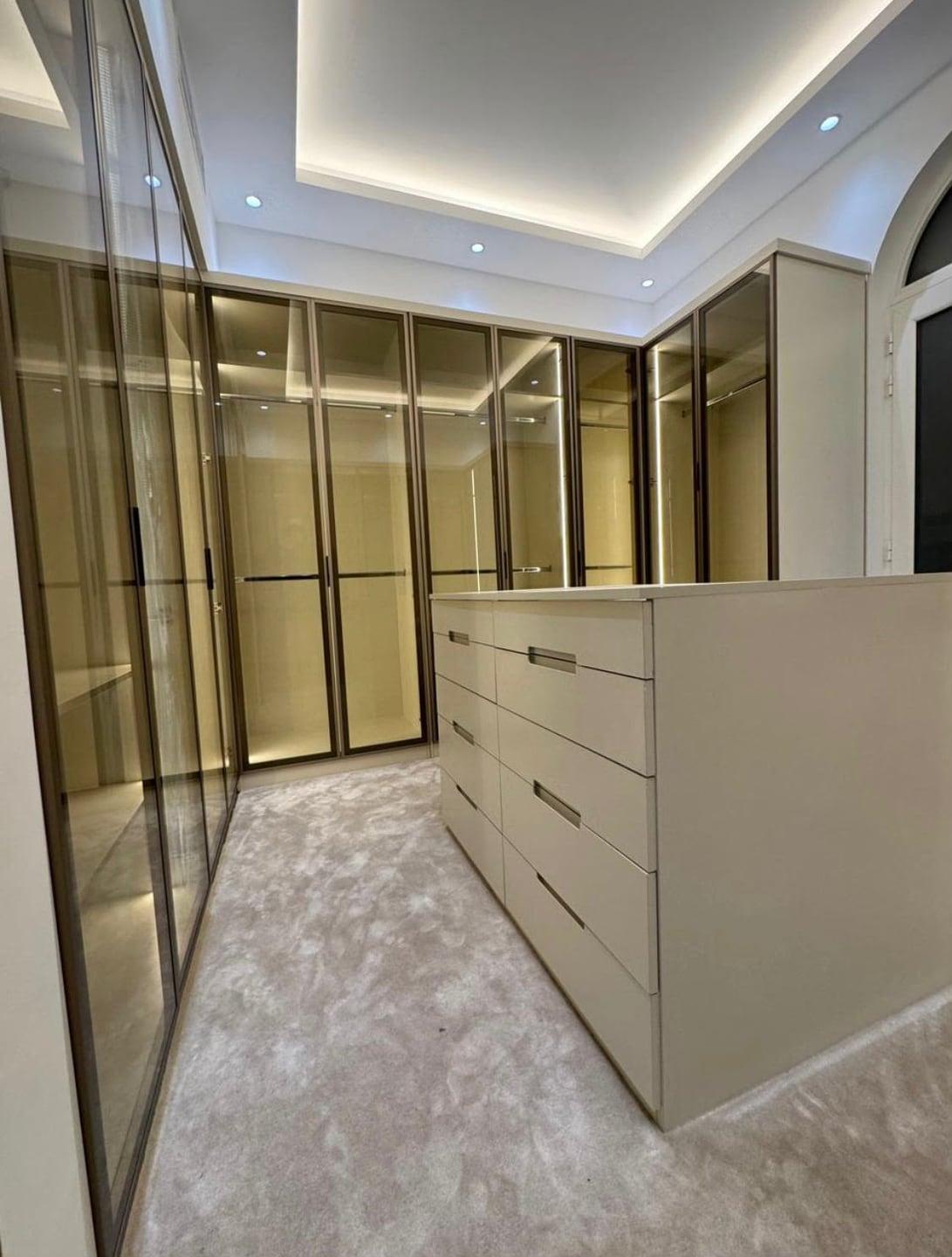
A new wardrobe starts from AED 550 per sqm of wardrobe front, installed, for MDF laminate with hinged doors. It is built in our Sharjah workshop and fitted by our own team in up to about 10 days from order confirmation, depending on size and design, with a 24-month written workmanship warranty. For a renovation we do not publish a price or a timeline, so ask for both in the quotation, together with the finish on an existing box. Our built-in wardrobes page and glass-front wardrobes page show what a new run looks like, and you can book a free measuring visit. How much floor a swinging leaf needs is worked through in our wardrobe door clearance guide, with a masking-tape test you can do before ordering.
If you decide to replace, plan the new wardrobe in five steps before asking for quotations.
Common questions
Is it worth renovating an old wardrobe?
Yes, if the wall behind it is dry, the boards are firm and the box is square and the right size; then new doors, a new track or a rebuilt interior are enough. If any of those fails, replacing is the better buy. See our wardrobe door replacement guide.
Can I keep my old wardrobe and just change the doors?
Often, yes. Where the existing structure is sound we replace damaged doors, tracks, hinges or drawers. The visit checks the box first. See our wardrobe door replacement guide.
What should I do if the bottom of my wardrobe is swollen?
Treat it as a sign of water: find and stop the source, then plan to replace the swollen panels or the wardrobe, because swelling beyond the original size is not fully recovered when a particleboard or MDF panel dries. See our moisture-resistant wardrobe boards guide.
Why are my wardrobe shelves sagging?
Usually because the shelf is long for its board and load, or the board has gone soft. A support in the middle fixes a long span; sagging on a short span points to a soft board. See our wardrobe drawers and organisers guide.
Can a damp wardrobe be saved?
Only after the damp source is fixed, and only if the boards still hold. Swollen or soft boards are replaced, not dried. See our guide to why a wardrobe smells musty.
Do you price renovation and a new wardrobe from the same visit?
Yes, you can ask for both from the free measuring visit. A new wardrobe starts from AED 550 per sqm of front, installed; we do not publish a renovation price, so ask for it in the quotation. See our wardrobe quotation checklist.
Can I renovate a wardrobe in a rented flat?
Check your tenancy contract and ask the landlord in writing before anything is removed or fixed. Keeping the existing box is sometimes easier to agree than a new wardrobe. See our custom wardrobes service.

Sources & specifications
Manufacturer information applies to the named products and systems. Sources reviewed on 3 November 2026.
- Composite Panel Association, Dimensional stability of particleboard and MDF technical bulletin (28 April 2026): swelling beyond original dimensions is not fully recovered on re-dryingforestsource.io(opens in a new tab)
- Woodbin, Shelf design guidelines: span table for 10-inch shelves (3/4-inch particleboard 26 in, plywood 32 in, one cleat 42 in); a woodworking-blog table, not a board standardwoodbin.com(opens in a new tab)
- Family Handyman, How to fix sagging cabinet shelves (updated 3 October 2024): reinforcing a shelf with a metal flat barfamilyhandyman.com(opens in a new tab)
Want this planned for your home?
Consultation and measurement are free. Tell us the rooms, location and what you need; we arrange a sample visit and define the measured quotation.