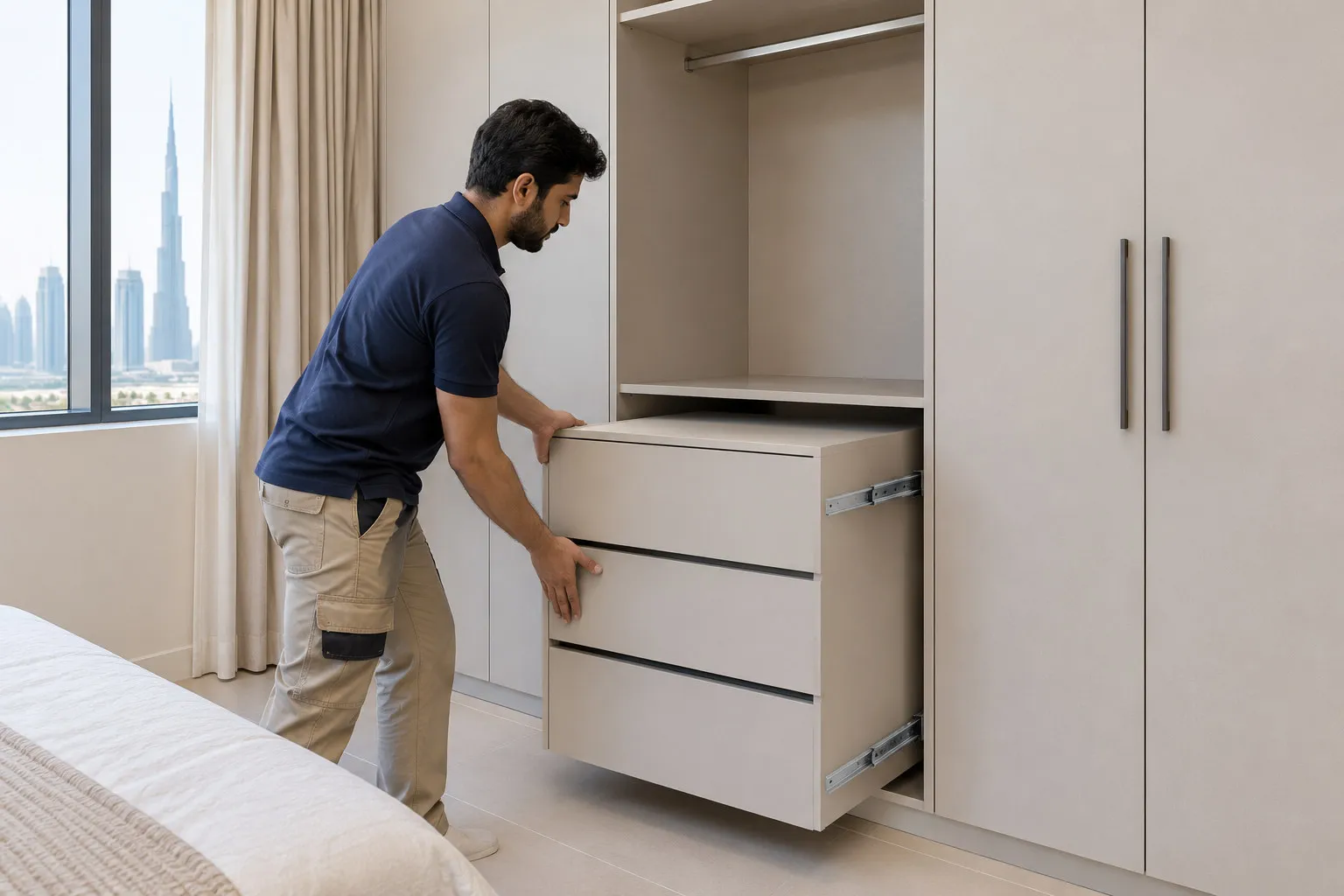
Wardrobes · 17 min read · 25 June 2026
Wardrobe door replacement in the UAE: what you can change and how it works
Yes, you can replace the doors, sliding track, hinges or drawers of a wardrobe without replacing the whole thing, if the cabinet is sound, square and dry. What we check first, what changes and how the job works.

By Ali Haider Basra, Founder, Al Tareeq Decor · Contact our workshop
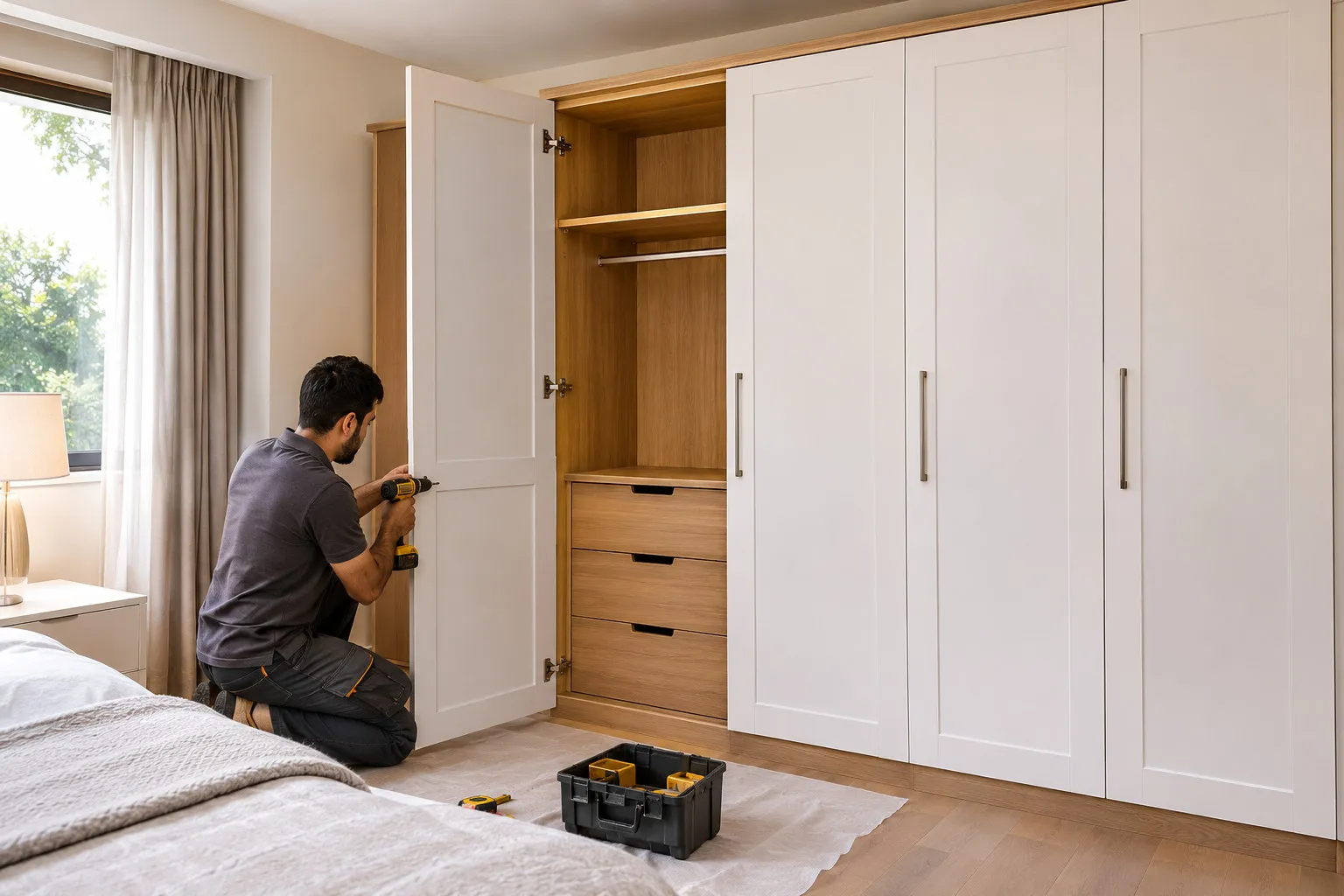
Key takeaways
- If the cabinet is sound, square and dry, the doors, sliding track and rollers, hinges and drawer fronts and runners can be replaced without a new wardrobe.
- Check first: measure both diagonals of each bay, and find out whether damp is reaching the wardrobe, because new doors cannot fix a racked cabinet or a wet wall.
- The hinge maker's guidance sets the number of hinges from the door's weight, handle included, so the count is worked out from the real door, not guessed.
- A replacement quotation should list board, door system, hinge or track brand, hinge count, soft-close, fitting and removal, VAT, timeline and warranty line by line.
- When the cabinet is damaged, too shallow or the layout is wrong, a new wardrobe, from AED 550 per sqm of front, is the better answer.
On this page
- Key takeaways
- Can you replace just the doors on a wardrobe? The short answer
- When replacing only the doors makes sense
- What we check first: squareness, damp, hinge holes and level
- What we check on an existing wardrobe before we quote
- Replacing hinged doors and hinges
- Replacing a sliding track, rollers and sliding doors
- Replacing drawer fronts, drawer boxes and runners
- Choosing the new door: hinged or sliding, glass, finish and handles
- Hinge counts: how many hinges a wardrobe door gets by weight
- Hinges per door by door weight, Blum's published guidance
- What a replacement quotation should list
- A checklist for comparing wardrobe door replacement quotations
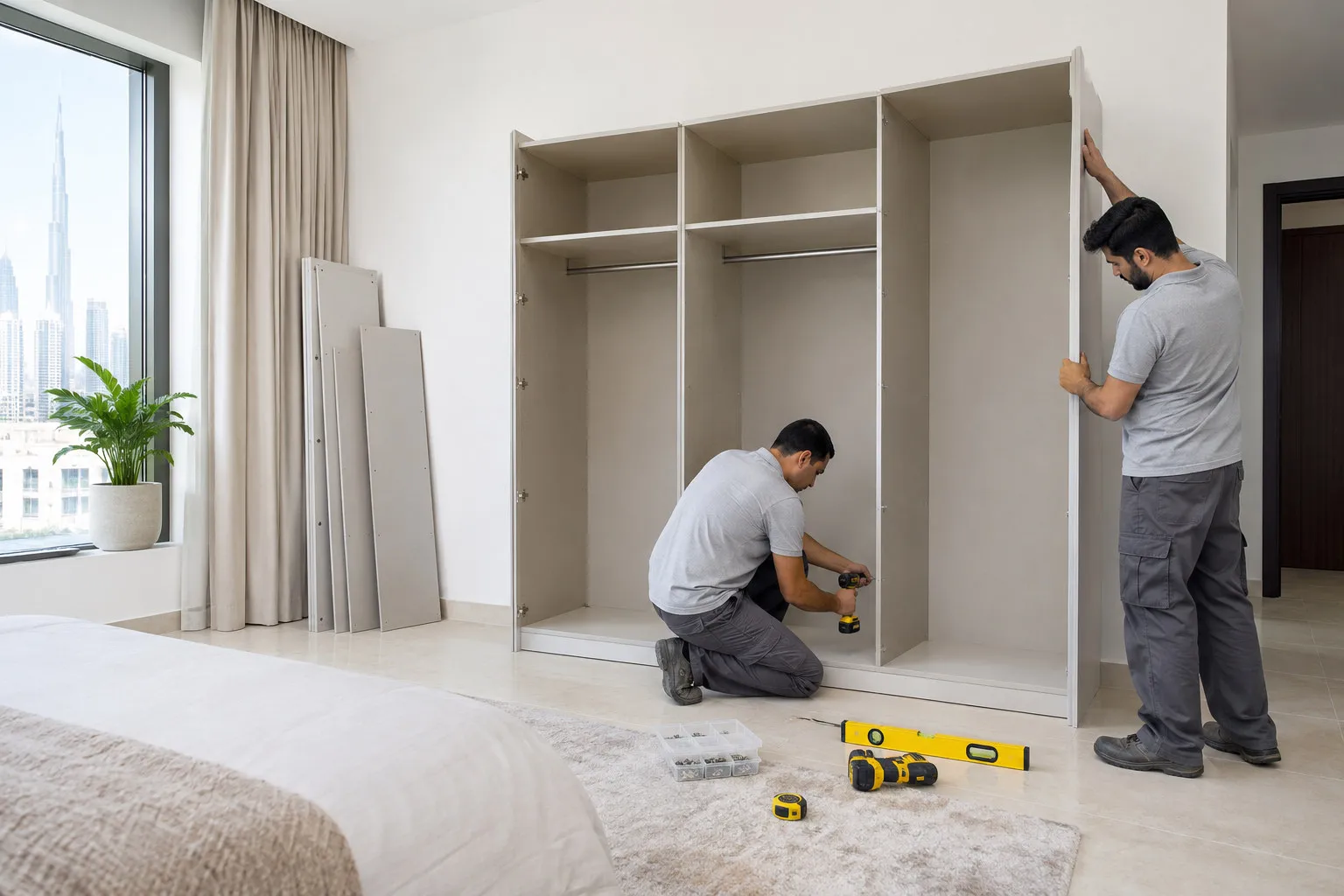
- What we do about it: how a door replacement job runs
- Door swap or new wardrobe? How to decide
- Replace the doors or build a new wardrobe?
- Common questions
Can you replace just the doors on a wardrobe? The short answer
Yes. If the cabinet body of the wardrobe, meaning its sides, top, base, shelves and back panel, is sound, square and dry, you can replace the doors, the sliding track and rollers, the hinges, or the drawer fronts and runners without taking the whole wardrobe out. Al Tareeq Decor replaces wardrobe doors, tracks, hinges and drawers, and the free measuring visit is where we decide whether your wardrobe can take new ones.
Three things settle it: the condition of the existing cabinet body, the size and weight of the doors you want, and the room around the wardrobe. A rigid body, level shelves and a dry wall behind it mean the doors can be changed on their own (the same checks apply when you add drawers to an existing wardrobe). A twisted body, soft boards or a wet wall mean the problem is not the doors, and the honest answer is repair first or build a new wardrobe. If the boards are soft, moisture-resistant wardrobe boards explains what a replacement board should say on the quotation.
The drawing below shows which parts of an existing wardrobe can be replaced and which stay, together with the two checks that come before any quotation.
- 1. Door leaf: the visible front panel, hinged or sliding, can be replaced in a new material, colour or finish
- 2. Sliding track and rollers: the top track, bottom guide, rollers and dampers wear and can be renewed as a set
- 3. Hinges: concealed cup hinges are the most replaced hardware, and their count follows the door's weight
- 4. Drawer front and runners: the face, the box and the runner hardware can be replaced without touching the cabinet
- 5. What stays: carcass sides (A), top and base (B), shelves (C) and the back panel (D) are kept if they pass the checks
- 6. Two checks first: measure both diagonals of each bay, and find out whether damp is reaching the back panel
When replacing only the doors makes sense
Changing the doors is a good answer when the cabinet is the part of the wardrobe that still works. People usually ask about it for one of a few reasons, and each reason lands on its own line of the quotation.
- The cabinet body is sound, but the doors are scratched, delaminated, sagging or broken.
- The doors no longer close flush because the hinge holes have worn out.
- You want to change from hinged to sliding doors, or the other way round, and the depth of the wardrobe allows it.
- The look has dated, and you would like glass or mirror fronts in place of opaque ones; our mirror wardrobe doors guide explains how a mirror door is built.
- The drawer runners have failed, but the drawer openings in the cabinet are still solid.
What we check first: squareness, damp, hinge holes and level
Before quoting for new doors we look at the existing wardrobe and at the wall behind it, because each of these decides whether replacement is practical and what kind of door will work. The checks are simple, and you can do the first two yourself with a tape measure and a hand on the boards before we visit; our measuring visit guide shows what we measure on site. If you are unsure whether the box deserves new doors at all, renovate or replace an old wardrobe sets out the decision by symptom.
Squareness comes first. A cabinet that has racked, with its front edges no longer in one plane, will not hold new doors straight. Measure the diagonal of each bay from top corner to opposite bottom corner: the two should match. If they do not, the box needs correcting or replacing before doors go on. Next is damp. Boards that have swollen, gone soft or started to delaminate are a sign that moisture has been reaching the wardrobe. A humid-conditions board (EN 312 calls this particleboard type P3) is made for damper air, yet it does nothing for a leaking pipe or a soaked wall. If you find damp, trace where it comes from and stop it before any new work starts, since doors hung on a cabinet that keeps absorbing moisture are doors wasted. If the wardrobe stands against a bathroom or outside wall, what to check first for a wardrobe against a bathroom wall explains the checks. If the cabinet also smells musty, why a wardrobe smells musty explains what to check before any new work.
The remaining checks are made at the visit. Hinge-cup holes may be stripped, oversized or in the wrong position for a new hinge, so we look at them panel by panel, and the quotation states whether a panel is repaired or replaced. For sliding doors, the track needs a straight run, so we read the floor and ceiling level and decide in the drawing what that means. A wardrobe that runs wall to wall also depends on a consistent ceiling line; steps under a beam or bulkhead may mean the existing run cannot take a new door type without changes. For a run that turns a corner, our corner and L-shaped wardrobe design guide shows where the doors of the two walls meet. Warranty wording differs from quote to quote, so how to read a wardrobe warranty is worth reading next.
What we check on an existing wardrobe before we quote
Diagonals of each bay
- What it tells us
- Whether the cabinet is square or has racked
- What happens next
- Equal diagonals: new doors can go on straight. Unequal: the box is corrected or replaced first.
Wall behind the wardrobe and the base boards
- What it tells us
- Whether moisture is reaching the wardrobe
- What happens next
- The source is found and stopped before any new door is fitted.
Board edges, shelves and base
- What it tells us
- Whether boards are swollen, soft or delaminated
- What happens next
- Affected panels are repaired or replaced; widespread damage points to a new wardrobe.
Hinge-cup holes
- What it tells us
- Whether holes are stripped, oversized or in the wrong place
- What happens next
- Checked at the visit; the quotation states whether a panel is repaired or replaced.
Track line and guide position (sliding)
- What it tells us
- Whether a new track can sit straight
- What happens next
- Decided in the drawing after the level is measured.
Floor and ceiling level
- What it tells us
- Steps, beams or bulkheads along the run
- What happens next
- Measured at the visit; larger steps may limit which door type can be fitted.
Checks are made at the free measuring visit. A damp wall needs its source fixed first, whichever board is used.
Replacing hinged doors and hinges
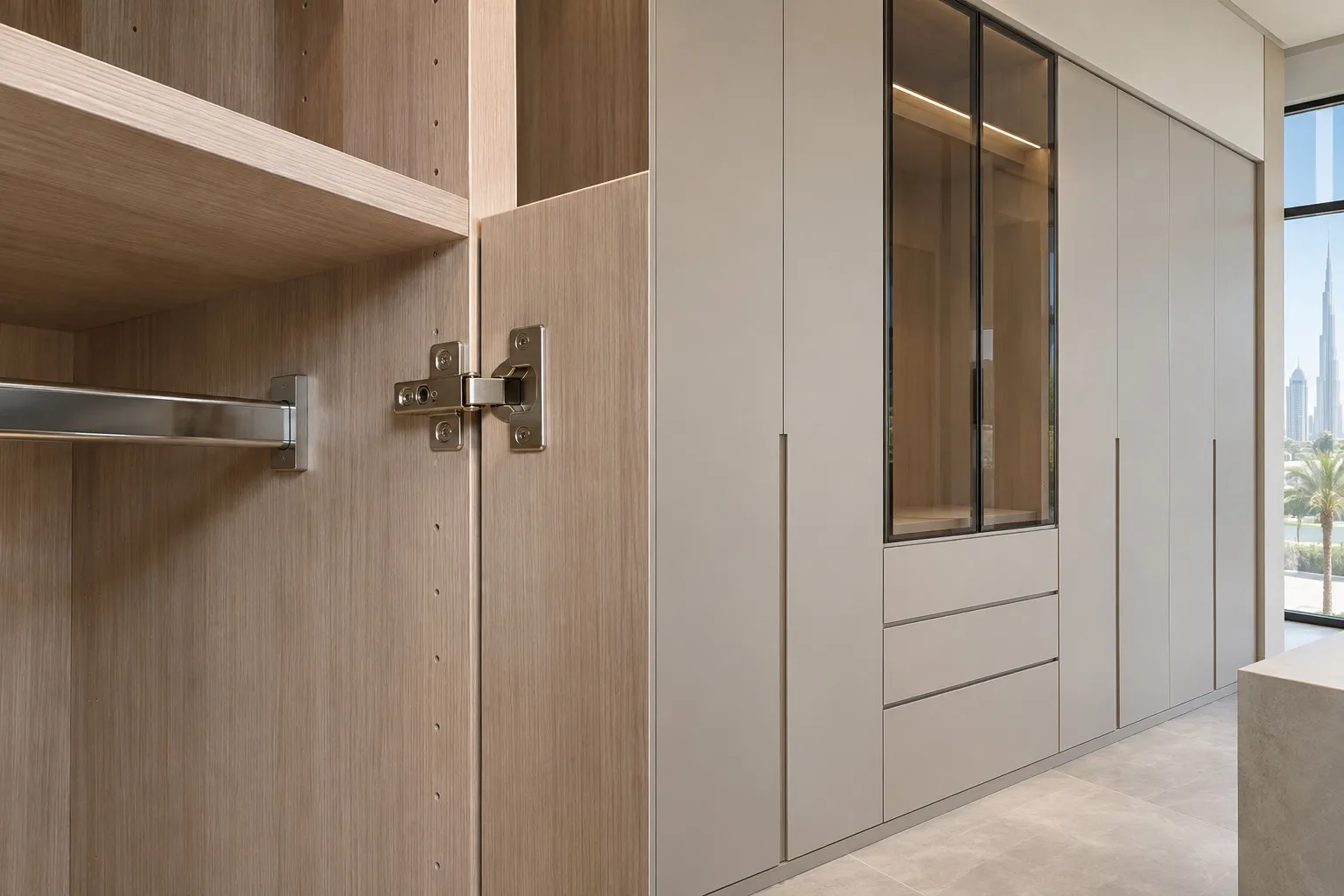
Hinged doors are individual panels carried on concealed cup hinges screwed to the cabinet side. They can be replaced in a different material, colour or finish, as long as the cabinet can carry the weight and the opening is the right size. What changes is the door leaf, its edge finish and usually the handle or the handleless profile. The finishes on offer are compared in wardrobe door finishes compared. How many hinges a door needs, and what soft-close and adjustment involve, is in our wardrobe door hinges guide.
Hinges themselves are the most replaced hardware item on a wardrobe. A hinge that has lost its spring, no longer holds its adjustment or has torn out of a stripped screw hole makes the door sag, catch or swing open. What we confirm at the visit is the current hinge type (overlay, half-overlay or inset), the cup size, the thickness of the cabinet side, and whether the screw holes are sound. For European concealed hinges of the kind Blum describes, the cup bore is 35 mm. If the doors only rub or stick, our guide on how to fix a wardrobe door that is sticking, rubbing or sagging covers what to try before replacing anything.
Soft-close hinges damp the final stretch of closing so the door does not slam shut. If your wardrobe has plain hinges, soft-close is one of the simplest upgrades, and compatibility is confirmed at the visit. See our custom wardrobes service page; for a replacement, ask for the brand and model to appear on your quotation. How tall a door can be, and what fills the gap above it, is covered in a wardrobe up to the ceiling.
Replacing a sliding track, rollers and sliding doors
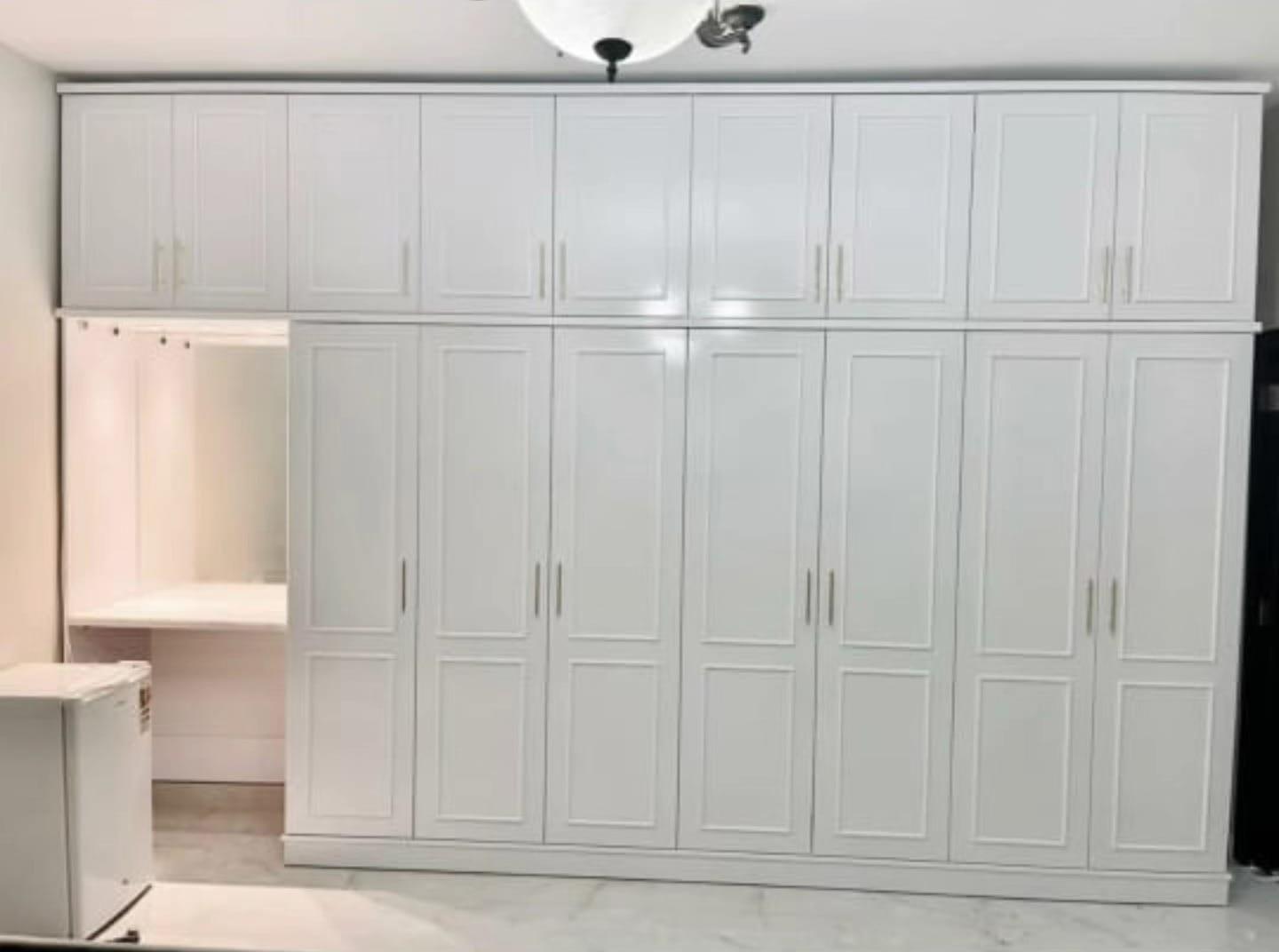
A sliding wardrobe hangs its doors from a top track and steadies them in a bottom guide. Over the years the rollers can flatten, the track can be bent if something hit it, and the soft-close dampers can lose their cushioning. Replacing the track system restores the smooth, quiet glide you see on new sliding-door wardrobes, and it is usually done together with the door panels when those are being changed too; which track suits the new doors is covered in sliding wardrobe track types.
What changes is the top track, the bottom guide, the rollers, the dampers if fitted, and sometimes the vertical profiles on the door edges. What we confirm at the visit is the opening width and height, the clearance above and below, the weight of the doors, and whether the top panel of the cabinet is strong enough to carry the new track. Sliding-system makers publish load and size limits for each kit, so the limit that applies is the one in the chosen system's own data sheet; our wardrobe sliding door systems guide compares the types and limits.
The short video below shows a sliding track and door panels being fitted from scratch. It is a branded fitting video for one UK system, and it shows a fresh installation rather than a replacement, but the steps of fixing the track, lifting the panels into it and adjusting the rollers are the same ones that follow once an old track is taken out. If the flat is rented, read a wardrobe for a rented flat before anything is fixed to a wall.
Replacing drawer fronts, drawer boxes and runners
Drawer boxes that have split at the joints, fronts that are chipped, or runners that no longer extend smoothly can all be replaced. Full-extension runners let the drawer open its whole depth, and soft-close runners pull it shut gently, which is why they are a common upgrade even when nothing is broken. If the drawers are meant for footwear, the shoe wardrobe design guide covers pairs per shelf, depth, tilted shelves and ventilation.
What changes is the drawer box, the front, the runners and their clips. At the visit we confirm how wide and how deep the opening is, how much room there is at each side (that sets the runner size), and whether the cabinet panels holding the runners are still solid. If you also want to change what the wardrobe holds, we rebuild the internal layout of existing wardrobes too; our guides to wardrobe layout and wardrobe organisers show the options. For what to plan in the drawers themselves, read wardrobe drawers and organisers; for long garments, abaya and kandura storage; for a loft, luggage and seasonal storage; and for one-room homes, a wardrobe for a studio apartment. For lighting inside the wardrobe, our guide to LED strip or profile in a wardrobe compares a bare strip with a profile and shows where the light can go.

Choosing the new door: hinged or sliding, glass, finish and handles
Once the cabinet checks out, the next question is the door itself. A hinged pair exposes the whole interior in one go. Sliding panels leave the floor in front free because nothing swings out, though one panel always hides part of what is behind. Hinged and sliding wardrobe doors are compared in more detail in a guide of ours. In a large bedroom, the master bedroom wardrobe design guide gives a planning order from the wall to the doors to the inside.
Moving from one to the other comes down to depth. The UK retailer FCI London suggests around 60 cm for hinged doors and, for sliding doors, 66 cm inside with a track of roughly 5 cm on top, which makes about 71 cm of total depth; our wardrobe dimensions guide explains those figures. It is one retailer's planning advice, not a track maker's limit, so the chosen system's own sheet governs. A cabinet that is too shallow or too deep for the new system is not a simple door swap and may need new side panels or a front frame. For the rail heights themselves, the wardrobe hanging heights guide shows how to measure your longest garment and set each rail from it.
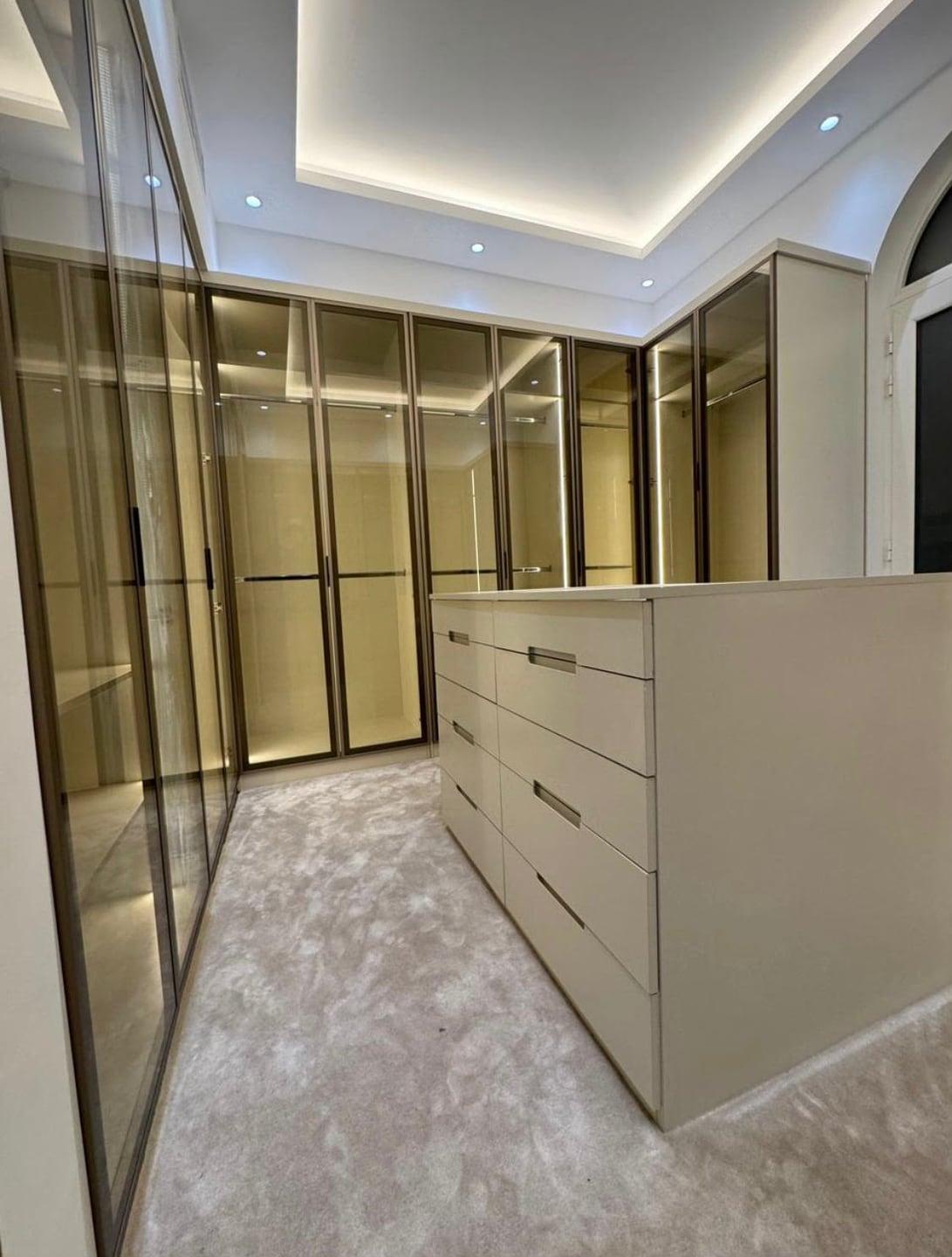
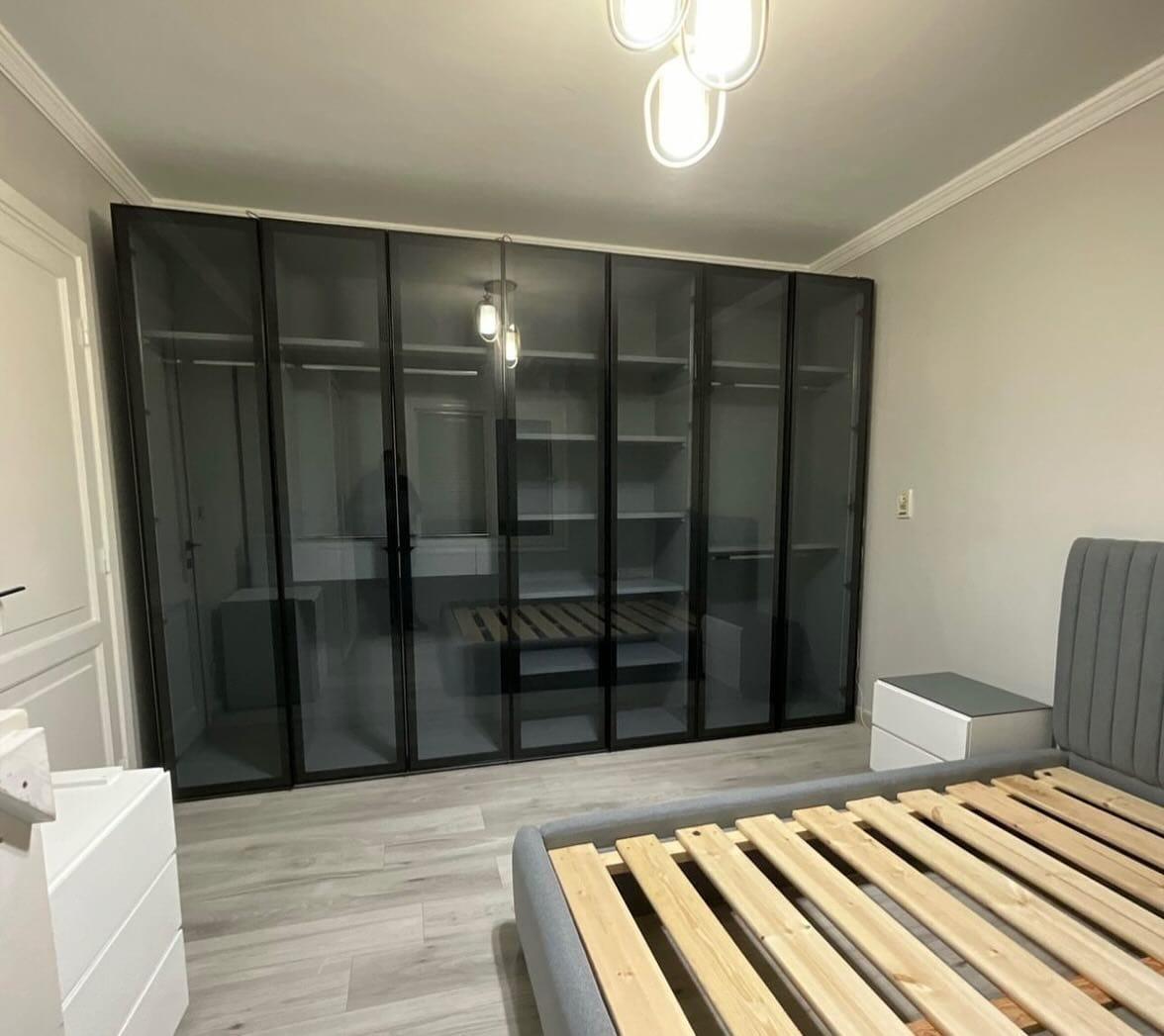
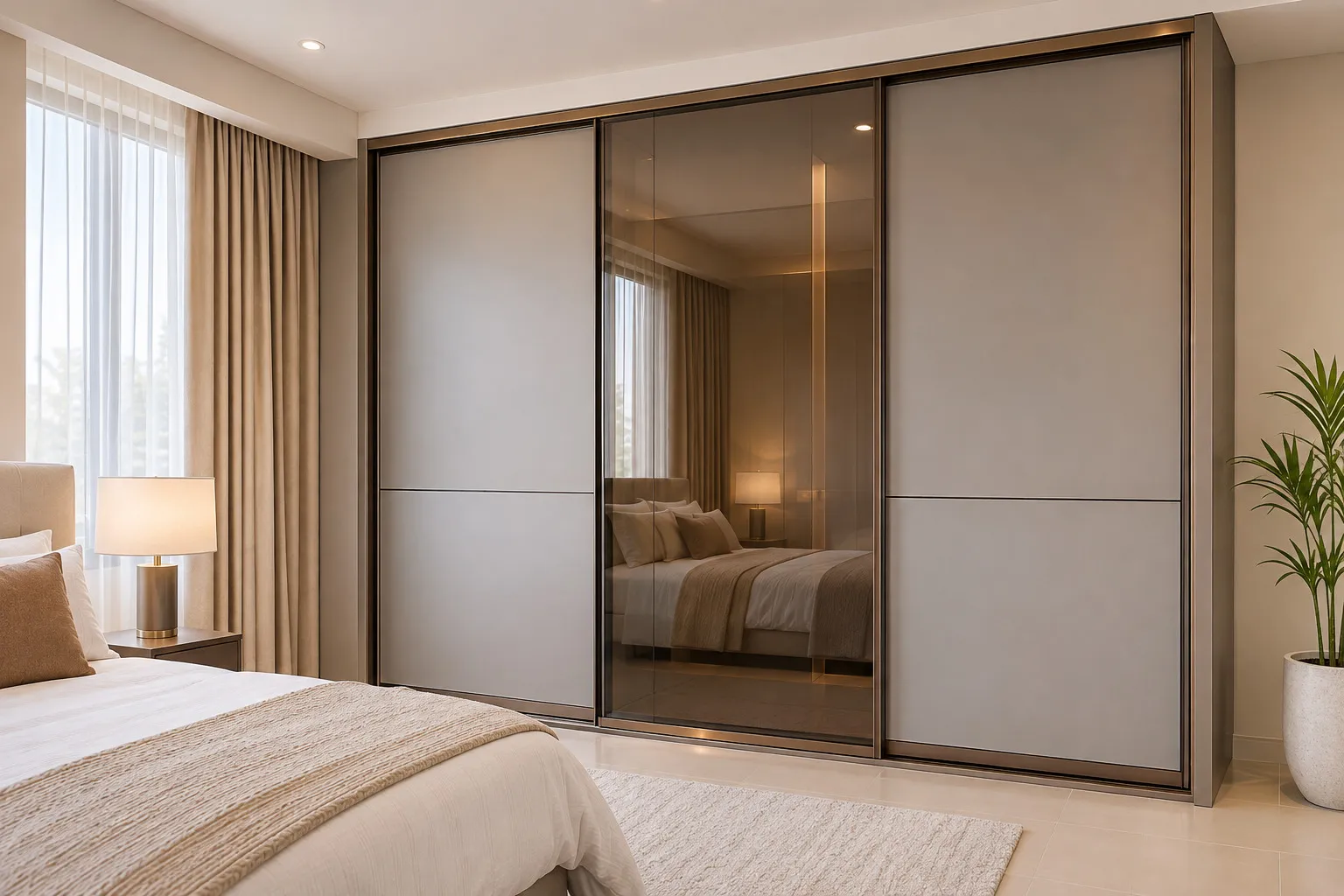
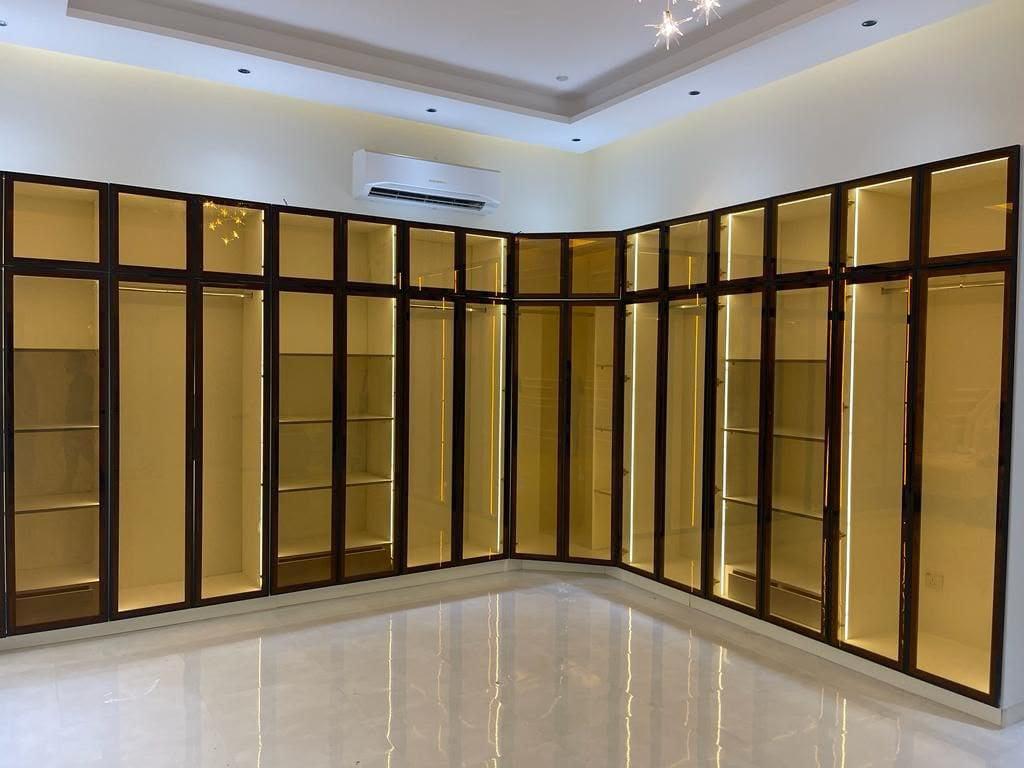
A glass or mirror front weighs more than a board front of the same size, so the track, or the hinge count, is chosen for the higher weight. A mirrored sliding leaf can stand in for a wall-hung full-length mirror, and tinted glazing in a thin aluminium frame lets light in while still half-hiding the contents; see our lit glass-front wardrobes for examples.
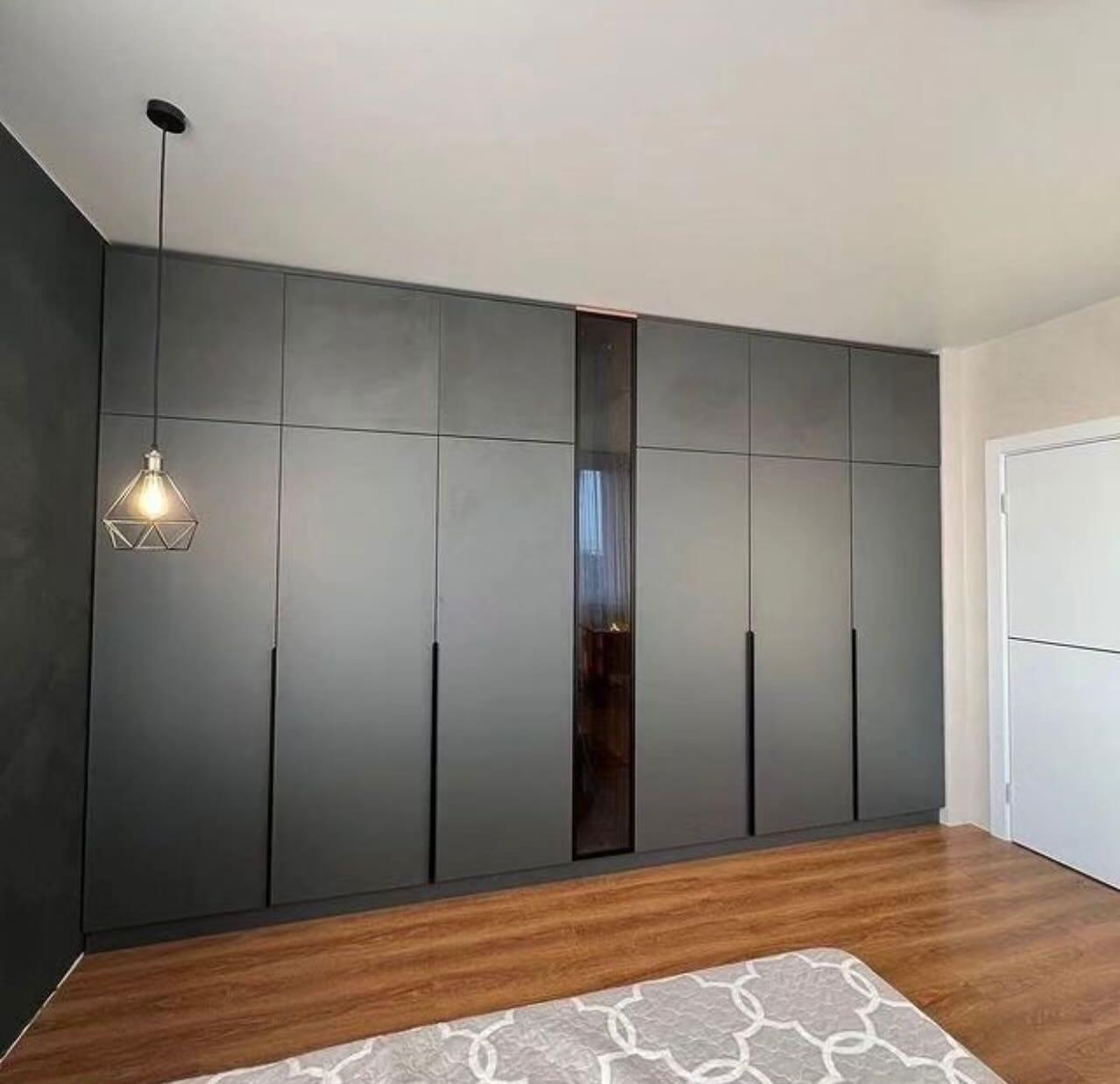
Our wardrobe pages list four finishes: MDF laminate, veneer, lacquer, and anodised aluminium frames holding tempered glass in a grey or bronze tint. Each has a different weight, cleaning need and price, and the quotation names the finish line by line. A handleless wardrobe swaps visible handles for a recessed grip or push-to-open mechanism; remember that a handle counts in the door's weight. Our wardrobe handles guide covers types, height and finishes if you are choosing new ones. How deep the box should be, and why, is set out in our guide to wardrobe depth.
Hinge counts: how many hinges a wardrobe door gets by weight
How many hinges a door gets comes from its weight, handle included, and not from habit. Too few and the door sags, rubs the one beside it, or drags its screws out of the cabinet side. Blum, the hinge maker, publishes counts for its CLIP top range, and the bands in the table follow them.
Two cautions apply. First, the weight bands assume a door no wider than 600 mm; Blum's EA page adds a hinge once the door reaches 650 mm, while its Vietnam catalogue still states a 600 mm front width, so regional catalogues differ. Second, Blum's chart ties the count to door height as well as weight and draws the height limits only as a graph, so we do not quote exact heights here. Blum also notes that three hinges give a tall, narrow door extra stability at a lighter weight.
This is the maker's guidance, not a general rule, and other hinge brands follow their own tables; the materials and hardware guide lists what else to ask about the fittings. When we measure for replacement doors we work out or weigh the real door, panel, edge finish, any glass and the handle, and choose the count from the maker's data for the hinge system being used. The final count is written into the quotation. The swing of a hinged leaf against the bed or the room door is covered in wardrobe door clearance.
Hinges per door by door weight, Blum's published guidance
4 to 6 kg
- Hinges
- 2 hinges
- What to remember
- Blum's EA page ties this count to doors no wider than 600 mm.
6 to 12 kg
- Hinges
- 3 hinges
- What to remember
- Blum notes three can suit a tall, narrow door even at a lower weight.
Heavier than 12 kg
- Hinges
- More hinges
- What to remember
- Read the count off the maker's own chart for that hinge; height also sets the count.
Door 600 to 650 mm wide
- Hinges
- One more hinge
- What to remember
- From Blum's EA page; its Vietnam catalogue states 600 mm, so the region matters.
Source: Blum (EA page and regional catalogue). Blum CLIP top range only; each other maker's table governs its own hinges.
What a replacement quotation should list
A quotation for replacement doors that you can compare with another should state each item below on its own line. If something is missing, ask before you sign. A lower total is no saving if the specification beneath it differs: a quotation that drops soft-close, fits a lighter track, counts fewer hinges or equips the interior more thinly describes a different, cheaper job.
Ask for removal of the old doors and clear-up to be stated as a line on the quotation too, so that you know whether it is included or extra. Our own quotations are itemised line by line, and our wardrobe quotation checklist and pricing guide explain how to read one. A door that has already come off is a different problem from choosing one, and what to do when a sliding wardrobe door is off its track has the first checks.
A checklist for comparing wardrobe door replacement quotations
Board type and thickness
- What to look for
- A named board (MDF, particleboard, plywood), its thickness in mm, and whether it is a standard or humid-conditions grade.
Door system
- What to look for
- Hinged or sliding; if sliding, the track brand and model.
Hinge or track brand
- What to look for
- A named brand and model, not just "soft-close hinges".
Hinges per door
- What to look for
- The count and how it was worked out from the door's weight and width.
Soft-close
- What to look for
- Whether it is on every hinge, door and drawer, or only on some.
Internal fittings
- What to look for
- What is included inside, such as shelves, rails and drawers, and what is not.
Fitting, removal and clear-up
- What to look for
- Whether fitting, removal of the old doors and clear-up are included or extra.
VAT and timeline
- What to look for
- Whether VAT is included, and when the work will be ready and fitted.
Warranty
- What to look for
- The workmanship warranty period, and the makers' terms for hardware and glass.
A replacement quotation is itemised the same way as a new-wardrobe one.
What we do about it: how a door replacement job runs
These are the steps we follow for wardrobe work, as published on our site. We do not give a replacement price or timeline in an article, because both depend on what the visit finds and the quotation states them.
First, call or WhatsApp us, tell us what you have and what you want to change, and send a few photos. Then comes the free measuring visit. We come to your home, check the existing cabinet as described above, laser-measure the openings, and bring samples so you can look at finishes and handles in your own light. Next you receive a drawing showing the new doors on your existing cabinet, with every item priced on a separate line, and we make nothing until you have signed off both the drawing and the price.
The new doors, drawer fronts and any new hardware are made in our workshop in Al Shuwaiheen, Sharjah, and our own team fits them (the installation day guide says what to expect); it is not handed to a subcontractor. A written 24-month warranty applies to our own workmanship, while hinges, tracks, runners and glass follow their makers' own written terms; the details are in our warranty and aftercare guide. Separately, the wood-based boards carry a 5-year limited warranty, subject to terms; hinges, tracks, runners, rollers and other moving hardware are not covered, and the final terms are in the written warranty. Visits are booked across the UAE, and our Sharjah page shows how the workshop serves the emirate.
To find out whether your wardrobe can take new doors, book a free measuring visit or message us on WhatsApp. Our guide to reach-in or walk-in wardrobes shows when a walk-in earns its floor area and when a wall of doors is the smarter use of it.
If the doors are only one part of a bigger change, the full wardrobe planning guide for UAE homes shows where door choices sit among the other decisions.
Door swap or new wardrobe? How to decide
Sometimes new doors are not enough. A new wardrobe is the better answer when the cabinet itself is the problem, and the table below sets out the usual decisions. If you cannot tell which side you are on, ask us to price both options from the same visit.
A new run built to the wall removes every limit of the old one, such as depth, height and internal layout. Our guide to custom closet and wardrobe prices explains what drives the cost, which starts from AED 550 per square metre of front for a new MDF-laminate wardrobe with hinged doors, fitted. That figure is for new wardrobes only. If you are weighing a new build against a shop-bought unit, custom or ready-made wardrobe shows where each wins in the UAE. For ideas on a new layout, see small bedroom wardrobe ideas, fitted versus built-in versus freestanding choices, and our built-in wardrobes page. If the wardrobe is shared, planning one wardrobe for two people shows how zones, reach heights and doors can be divided so nobody queues.
Replace the doors or build a new wardrobe?
Cabinet square, shelves level, boards dry and firm
- Usual answer
- Replace the doors, track, hinges or drawers
- Why
- What wears out is the hardware and the fronts, not the cabinet.
Doors scratched or style outdated, cabinet sound
- Usual answer
- Replace the doors
- Why
- A new finish or a glass front changes the room without a new body.
Hinge holes worn out
- Usual answer
- Replace the hinges and check the panel
- Why
- The quotation states whether the panel is repaired or replaced.
Cabinet racked or out of square
- Usual answer
- Correct it first, or build new
- Why
- New doors will not hang straight on a twisted box.
Boards soft, swollen or delaminated
- Usual answer
- Find the damp source first; usually build new
- Why
- Moisture damage in the boards does not reverse.
Too shallow for the door type you want
- Usual answer
- Build new, or keep the door type you have
- Why
- One retailer puts a sliding system at about 71 cm of total depth.
You want a completely different interior or a floor-to-ceiling run
- Usual answer
- Build new
- Why
- The old dividers and height stay where they are.
Final advice follows the measuring visit. New-wardrobe pricing starts from AED 550 per square metre of front; there is no published replacement price.
Common questions
Can I change only the doors on my wardrobe without replacing the whole thing?
Yes, if the cabinet body is sound and square. The doors, tracks, hinges and drawers are separate parts that can be replaced on their own, and we check the cabinet first at the free visit. Book a free measuring visit.
Is my wardrobe cabinet still good enough for new doors?
Measure both diagonals of each bay and compare them, check that the shelves sit flat, and press the boards: they should feel firm and dry. Soft, swollen or delaminated boards point to moisture. What happens at the measuring visit.
Can I switch from hinged doors to sliding doors on an existing wardrobe?
That comes down to depth. A UK retailer suggests around 60 cm for hinged doors and about 71 cm of total depth for sliding ones, and the chosen system's own sheet governs. We check this at the visit. Hinged and sliding wardrobe doors compared.
How many hinges will my replacement wardrobe door get?
It follows the door's weight, handle included. Blum's published counts run from two hinges (a 4 to 6 kg door) to three (6 to 12 kg), then four and five for heavier ones, and height and width also play a part. We work it out from the real door. Wardrobe materials and hardware.
What if there is damp on the wall behind my wardrobe?
Trace the source and fix it first. A humid-conditions board is made for damper air, not for curing a leaking pipe or a soaked wall, and no new door will keep moisture out of the cabinet. Wardrobe materials and boards.
Is it cheaper to replace the doors or the whole wardrobe?
It depends on the cabinet and on what you want to change, so we do not publish a replacement price. Ask for both options on the quotation. New wardrobes start from AED 550 per sqm of front. Custom wardrobe prices.
Do you replace wardrobe drawers and runners as well?
Yes. Drawer boxes, fronts and runners are separate from the doors and can be replaced on their own or together, and full-extension soft-close runners are a common upgrade. Wardrobe cabinets and organisers.

Sources & specifications
Manufacturer information applies to the named products and systems. Sources reviewed on 3 November 2026.
- Blum: Number of hinges (counts by door-weight band, an extra hinge for width up to 650 mm, handles included in the weight)ea.blum.com(opens in a new tab)
- Blum Vietnam catalogue, p.17: hinge count depends on door weight and height; front width 600 mmpublications.blum.com(opens in a new tab)
- FCI London: How deep should built-in wardrobes be? (hinged 60 cm; sliding 66 cm plus about 5 cm track; one retailer's planning advice)fcilondon.co.uk(opens in a new tab)
- BSI: BS EN 312 Particleboards, Specifications (type P2 for dry conditions, type P3 for humid conditions)knowledge.bsigroup.com(opens in a new tab)
- Bedrooms Plus: How to fit Sliding Wardrobe Doors (branded Space Pro fitting video, YouTube)youtube.com(opens in a new tab)
Want this planned for your home?
Consultation and measurement are free. Tell us the rooms, location and what you need; we arrange a sample visit and define the measured quotation.