Wardrobes · 22 min read · 3 July 2026
Wardrobe door finishes compared: laminate, veneer, lacquer, acrylic, glass and mirror
A wardrobe door finish is the surface you see and touch: laminate, veneer, lacquer, acrylic, glass or mirror. No source ranks them under UAE conditions, so ask the same five questions of each sample: sunlight, scratches, fingerprints, cleaning and weight.

By Ali Haider Basra, Founder, Al Tareeq Decor · Contact our workshop
Key takeaways
- No finish is the winner: we found no test of laminate, veneer, lacquer, acrylic, glass and mirror under the same UAE conditions, so this page ranks nothing and treats every maker claim as true of that product only.
- Ask the same five questions of every sample, and get the answers in writing for your exact product: sunlight, scratches, fingerprints, cleaning and weight.
- Sunlight changes surfaces: a furniture maker says direct sun causes permanent colour differences in veneer, and a cabinet maker says strong sun can discolour gloss lacquer; plan the window treatment with the finish; sprayed wardrobe doors covers the paint layers and the colour record that matter for a lacquered finish.
- Glass and mirror are far heavier than laminate, so the hinge count or track rating follows the door weight; handles, fingerprints and edges are separate checks, and clear, tinted, frosted or reeded glass is compared for privacy separately.
- MDF laminate is our entry specification from AED 550 per sqm installed; veneer, lacquer, glass and mirror doors raise it as separate lines you can keep or drop, and samples come to the free measuring visit; fluted fronts, a profile rather than a material, are covered in fluted wardrobe doors.
On this page
- Key takeaways
- Wardrobe door finishes: the short answer
- What a door finish covers, and where its job ends
- Laminate: the entry finish and what to check on a sample
- Veneer: real timber that keeps changing
- Lacquer: one smooth colour, matt or gloss
- Acrylic and PET sheet fronts: what makers say, and why we do not claim them
- Matt, gloss and anti-fingerprint claims
- Glass and mirror doors: weight and edges come first
- Sunlight, heat and cleaning: the questions every finish shares
- Wardrobe door finishes side by side
- Laminate, veneer, lacquer, acrylic, PET, glass and mirror doors
- How the finish changes your quotation
- What we do about it
- Common questions
Wardrobe door finishes: the short answer
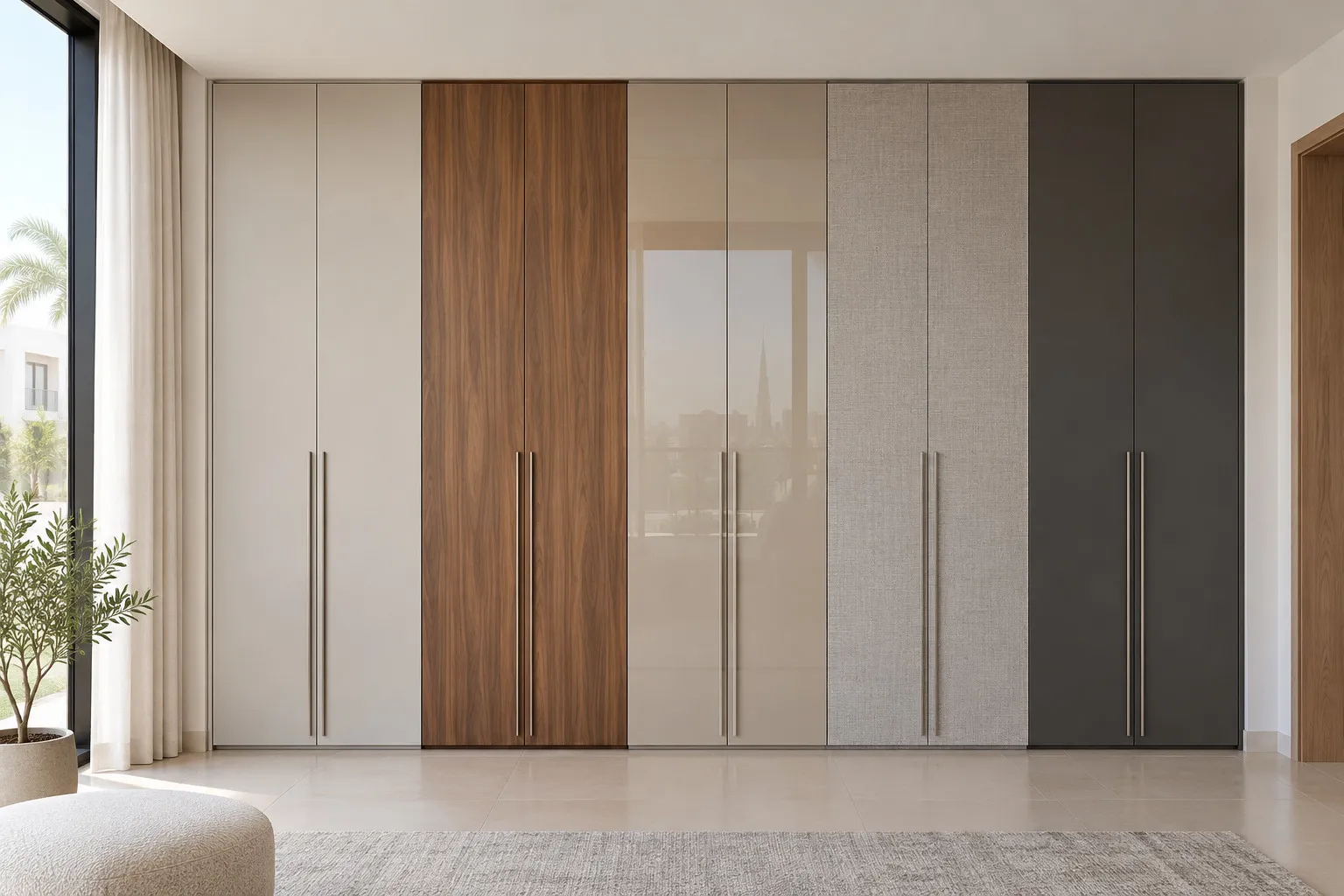
The finish is the surface you see and touch on a wardrobe door: laminate, veneer, lacquer, acrylic, glass or mirror. No finish is the winner. We looked for a test that puts these surfaces through the same heat, sun, humidity and wear and could not find one, so we do not rank them, and every claim quoted on this page belongs to one named maker's product, not to a whole family of finishes. Painted fronts have a page of their own, sprayed wardrobe doors, on layers, colour and touch-ups. What clear, tinted, frosted and reeded glass each show is set out in glass wardrobe doors and privacy.
What works is the same five questions asked of every sample: what does sunlight do to it, how does a scratch get repaired, what does a fingerprint look like, how is it cleaned and how much does the door weigh. For the matt-or-gloss choice alone, matt versus gloss wardrobe doors compares how each behaves in strong light and under cleaning. Get the answers in writing for the exact product on your quotation. In our own work MDF laminate is the entry specification, from AED 550 per sqm installed, and veneer, lacquer, glass and mirror doors raise that figure.
The drawing below puts the sample board and the five questions on one sheet. The core board and the hardware behind the finish are covered in our wardrobe materials guide, and this page stays on the surface. Grooved fronts, with their light, dust and joins, are covered in fluted wardrobe doors.
- 1. The sample board: six finishes arrive as swatches, in no order of merit
- 2. The five questions: sunlight, scratches, fingerprints, cleaning and weight arrive one row at a time
- 3. A question mark for each finish: every question applies to every swatch, and the answer is product-specific
- 4. No score at the end: the closing line sends you to the maker's data for your exact product, in writing
What a door finish covers, and where its job ends
A wardrobe door has three parts that matter here: the core board, the face and the edge. The finish is the face, with the way its edges are closed. It decides how the door looks, how it is touched, how it ages in your light and how it is cleaned. It does not decide how the board copes with damp air, and it cannot rescue a wall that is wet; boards and moisture are in the materials guide and in our guide to moisture-resistant wardrobe boards, and a wardrobe on a bathroom wall is a case for telling us at the visit.
Each finish name covers more than one product. "Laminate" can mean a decorative paper pressed onto a board at the factory or a thicker pressed sheet, and furniture makers' care pages put laminate and high-pressure laminate side by side. "Lacquer" can be a matt or a gloss spray coat with a different chemistry from one workshop to the next. "Acrylic" can be a sheet bonded over the board. So the useful thing to hold on to is not the name but the maker's name and the reference number of the sample.
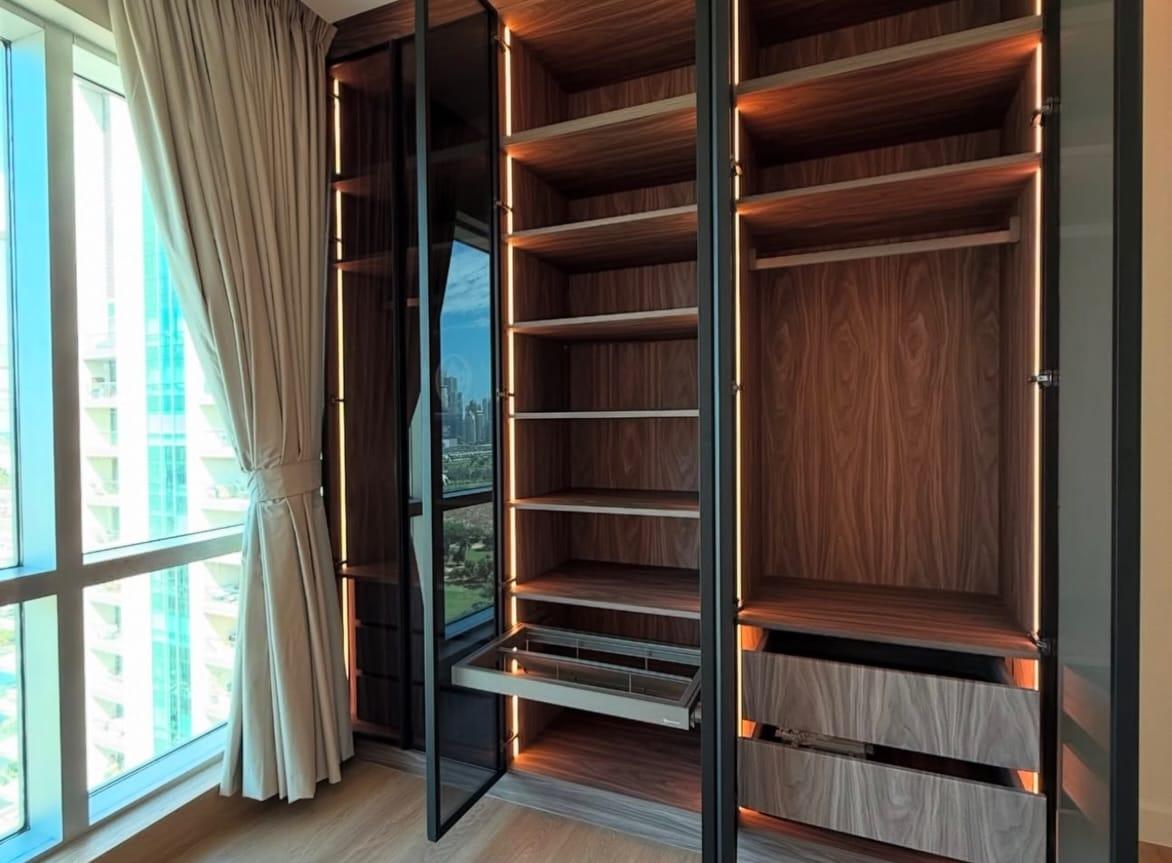
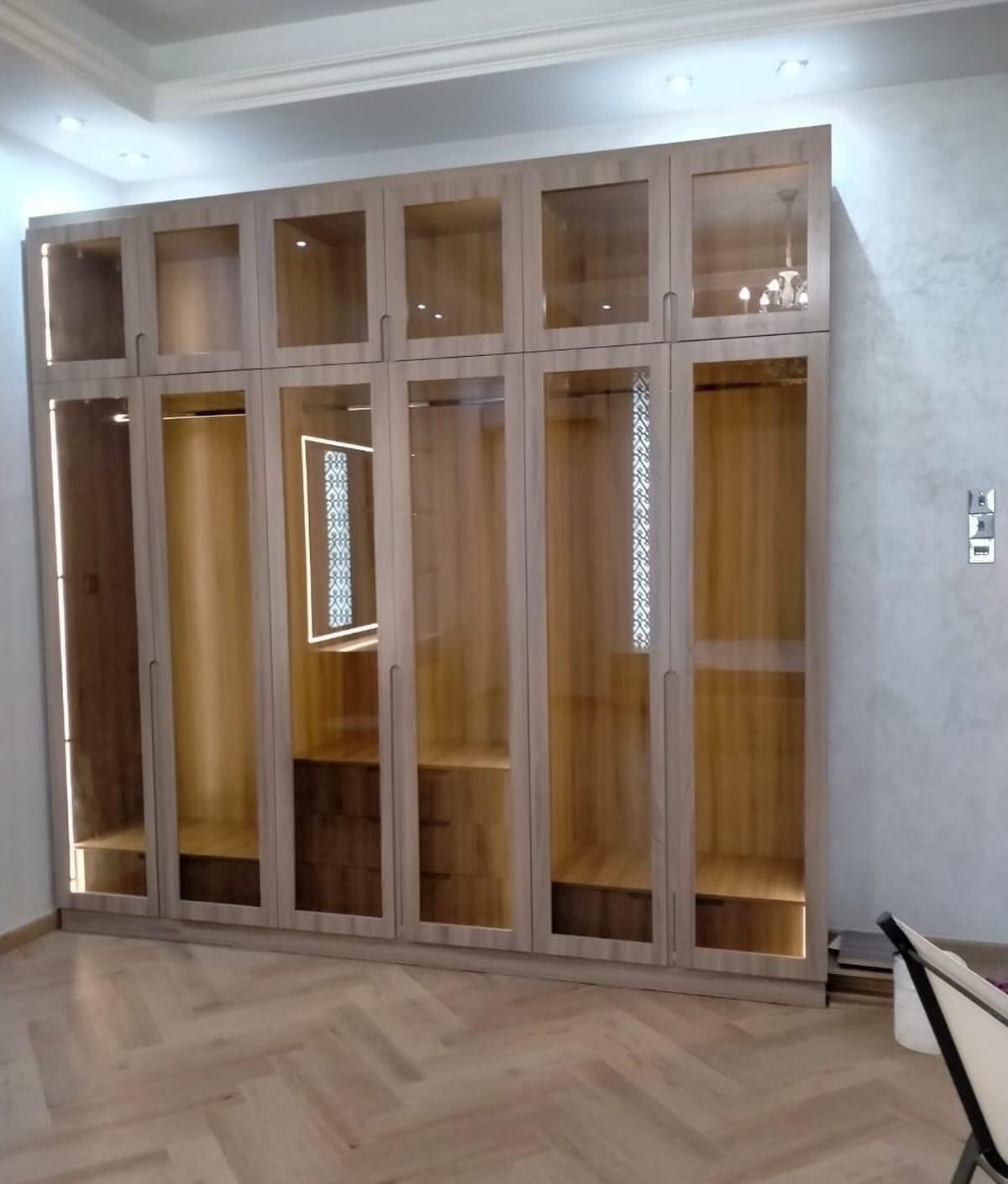
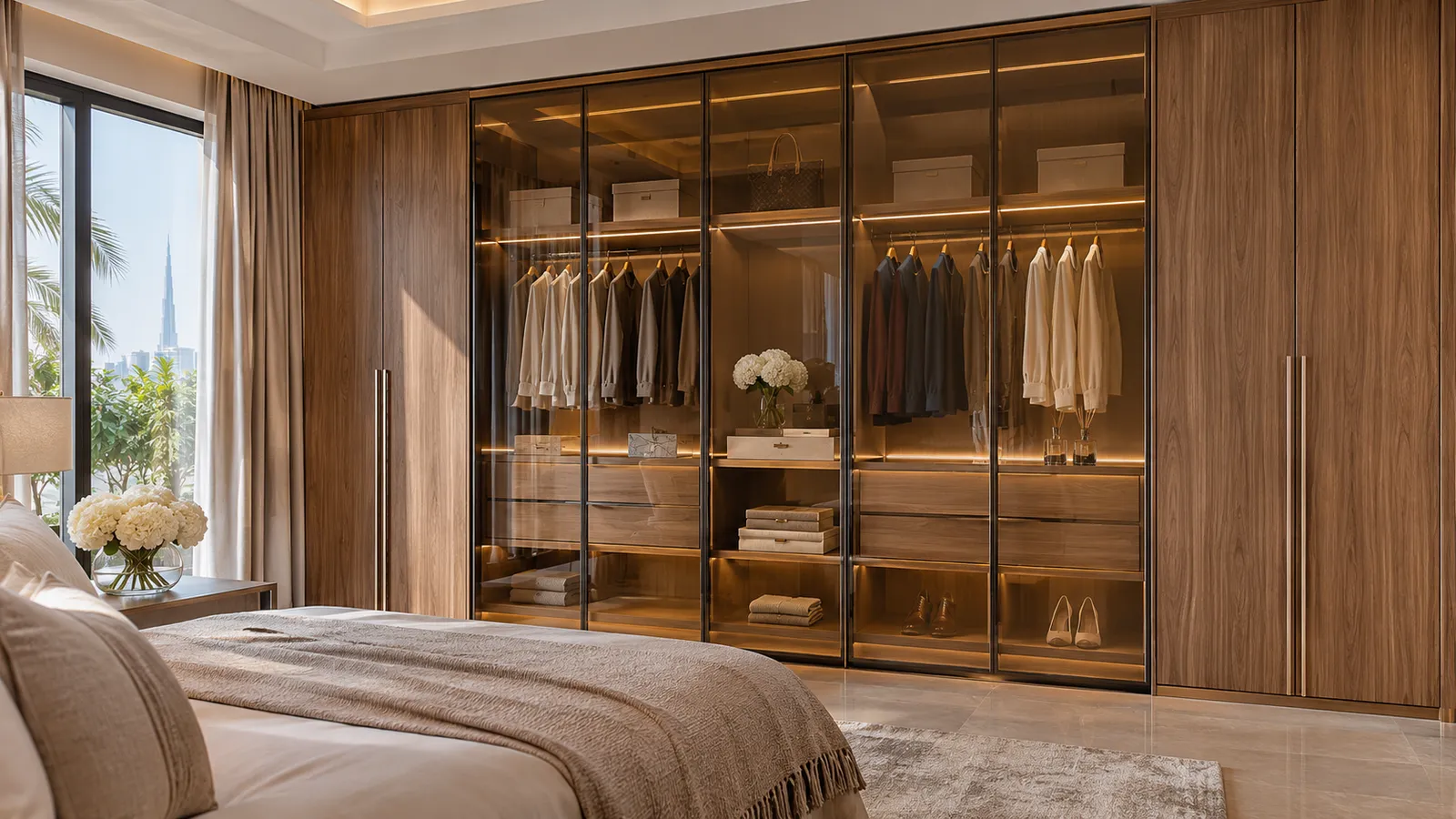
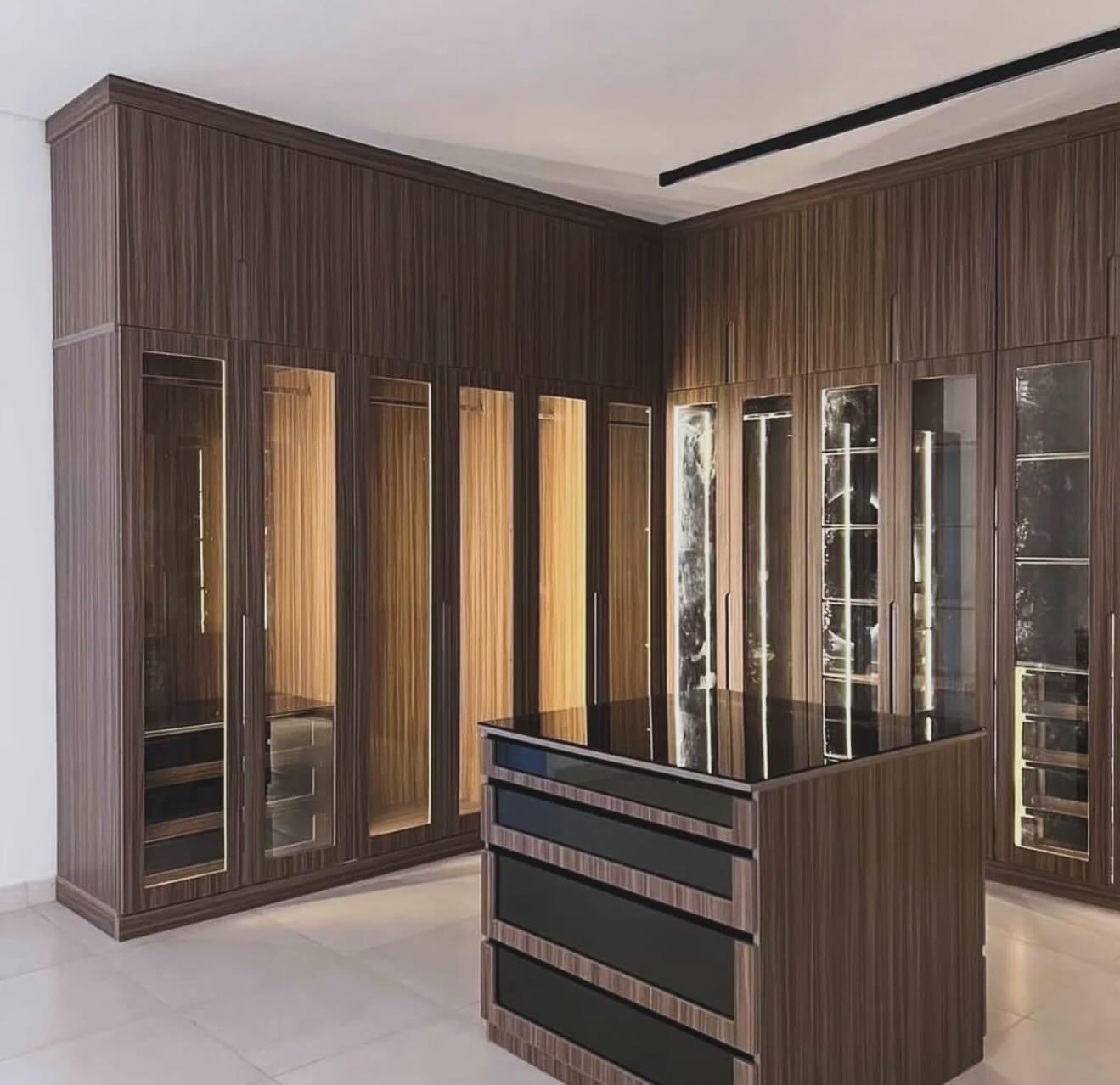
That is also why a photograph cannot settle the question. The doors in the picture below are wood-grain with glass panels, and you cannot tell from a photograph whether a wood-grain door is laminate or veneer. Ask, and ask to see the sample that matches the reference. If you are comparing quotations line by line, the wardrobe quotation checklist shows where the finish line sits among the other nine.
Laminate: the entry finish and what to check on a sample
Laminate is a printed or coloured decorative layer sealed under a hard surface and bonded to the board. It is the finish in our entry specification, MDF laminate with hinged doors, so most of the wardrobes we price start here. Our custom wardrobes service lists it first, and it is the hard-wearing choice we suggest for children's and guest rooms, which the kids wardrobe design guide explains.
What a maker says, for one product family: Kronospan, a board manufacturer, describes its melamine-faced particleboard as a standard board for furniture and interior design, used for interior fronts and tops, offered in gloss, matt, lightly textured and wood-grain finishes, with UV stability, ease of maintenance and stain resistance among its listed features. The same page makes no moisture claim for the standard board (the wardrobe board types guide sets out the common boards) and offers separate boards with improved moisture resistance for special uses. It gives no figure for how a surface ages in UAE sun, and neither do we.
What to check on a sample is practical and does not need a laboratory. Look at the colour where the wardrobe will stand, by day and under your lamps, because a swatch under shop lights can read differently. Run a finger along the cut edge and the corner, where the face meets the edge band. Ask whether the grain of a wood-effect decor repeats across the door, so that neighbouring doors do not look identical. And ask for the maker and the reference of the decor, so a repair or an extra door years later can be matched.
Care is plain. Kinnarps, a furniture maker, advises dusting with a soft cloth, cleaning with mild soap or washing-up liquid in lukewarm water, avoiding aggressive cleaners, solvents and abrasives, and testing in a hidden spot first. Our own wardrobe advice is the same in a line: soft cloth, mild cleaner, dry finish. Our built-in wardrobes page shows laminate runs as finished.
Veneer: real timber that keeps changing
Veneer is real timber cut very thin and laid over a board, so each door carries its own grain and no two panels match exactly. That is the appeal, and it is also the first thing to plan for. Ask whether the doors of one run are cut from the same flitch, and look at the sample as a sign of the character, not a promise of the exact grain on your doors. It is one of the finishes that raises the AED 550 entry figure, and it is shown to you as a sample at the measuring visit.
Light is the second thing. Kinnarps says direct sunlight causes permanent colour and light differences in wood and veneer, and advises exposing the whole surface evenly to light, and that wood reacts to the seasons, heat and humidity. Symphony Group, a cabinet maker in the UK, says veneered doors change in tone over time under ultraviolet light. Neither gives a figure for the UAE, so we do not either. What it means for a real wall is that a door in the sun and a door in the shade can age at different speeds.
Look at where the sun falls on the wardrobe wall at the hour you are home, and look at what shades the window. A blind or a curtain is the simple fix, and our guides to blackout or sheer curtains and roller blinds versus curtains explain what each does to daylight.
In a dressing room, where the wardrobe is on show, the dressing room design guide explains how to plan the walls around the light.
To clean veneer, Kinnarps advises a soft cloth, a mild soap solution in lukewarm water, a wipe with clean water and a dry cloth; abrasives, solvents and strong cleaners are out. Do not let a wet cloth lie on the door. If the wardrobe shares a wall with a bathroom, say so at the visit, because wood moves with humidity. A smell is a different problem, covered in musty smell in a wardrobe, and the wallpaper in humid climates guide shows how much damp air matters on any surface. Warranty wording differs from quote to quote, so how to read a wardrobe warranty is worth reading next.
Lacquer: one smooth colour, matt or gloss
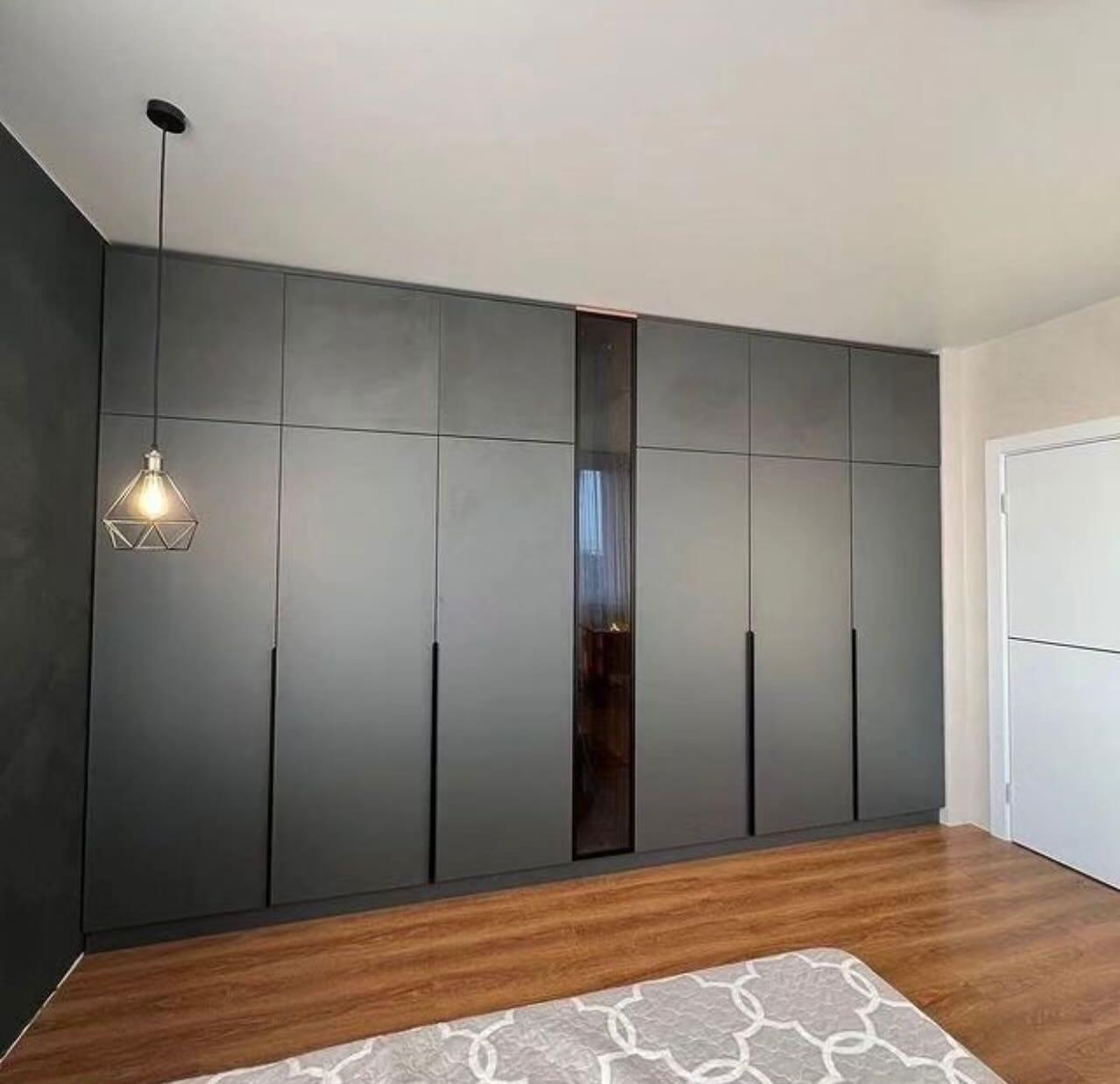
Lacquer is a sprayed coating that gives a door one smooth, even colour with no printed pattern, in almost any shade, matt or gloss. It is one of the finishes that raises our entry figure. The European Panel Federation, a trade body for wood-based panels, says pigmented lacquers are widely used for strong single-colour effects, that polyurethane or acid-catalysed finishes are the usual choice for it, and that a high gloss can now be sprayed without a separate polishing step.
The same page makes a point that buyers rarely hear: the surface of MDF and its machined edges need to be smooth, stable and well compacted for a lacquer to succeed, and edges soak up more coating, so a heavier coat may be needed there. So ask about the edges of a lacquered door, not only the face, because the edge is where a coating is hardest to get right and where a knock shows first. Our handleless wardrobe guide explains why edge profiles matter when there are no handles.
Light and cleaning: Symphony Group says strong direct sun on a gloss surface can discolour it, and that gloss lacquered surfaces mellow in colour over time; it advises against abrasive cleaners and strong chemicals such as vinegar and says spills should be dried straight away. Our own care pages say to wipe lacquer with a soft cloth wrung almost dry, buff it dry, and keep abrasive pads, strong solvents and nail-polish remover away from it.
We do not publish which lacquer system or gloss levels we use, so the question for any quotation, ours included, is the one at the end of the table below. The dressing table materials guide covers tops, where a lacquered edge meets a stone or glass surface. How tall a door can be, and what fills the gap above it, is covered in a wardrobe up to the ceiling.
Acrylic and PET sheet fronts: what makers say, and why we do not claim them
You will see acrylic and PET fronts in showrooms and on search results, and some people ask about them. We have not published either as part of our work, so treat this section as reading about finish types, not as an offer. If you want one, say so at the visit and do not assume it is on the quotation.
Here is what two makers say, for their own products. Kronospan's acrylic boards are MDF with a 0.7 mm layer of lacquered acrylic bonded to the front and a thin impact-resistant film on the back; it describes a scratch-resistant lacquered coating called TopX, claims market-leading durability, lists high UV stability and excellent chemical resistance for the gloss version, and says the matt version has improved anti-fingerprint properties. Its Ultra Matt PET board is MDF faced with a matt PET foil, aimed at cabinet doors, with UV stability, scrub resistance, a soft touch and easy cleaning among its features, to be cleaned with non-abrasive cleaners for plastics.
Read those lines for what they are: a maker's description of its own product, in its own words, without a test standard or a lifetime and without UAE conditions. "Improved" is a comparison with something that is not named. Another maker's acrylic or PET may behave differently, so never carry one product's claim to the whole category. Ask for the data sheet that names the test method for any property that matters to you.
Our materials guide already mentions acrylic among the faces a buyer may meet, and the custom closet price guide shows how any extra line moves a wardrobe quotation. If the flat is rented, read a wardrobe for a rented flat before anything is fixed to a wall.
Matt, gloss and anti-fingerprint claims
Fingerprints are the question we hear most about glossy doors, and the straight answer is that it varies with the product, the colour and the light. A dark glossy door and a pale matt one show marks very differently, and you cannot judge either from a catalogue image. Touch the sample, then tilt it under a lamp at the angle you will see it from.
Makers do claim help. Ekinex, which sells FENIX NTM, describes it as extremely matt with low light reflectivity, anti-fingerprint, soft to touch, and says small scratches can be removed with heat; it adds that slight colour differences between production batches are normal. Kronospan says its matt acrylic board has improved anti-fingerprint properties. Both are product claims. "Anti-fingerprint" does not mean a fingerprint is impossible, and heat repair is for fine surface marks, not deep cuts or chips. We do not publish an anti-fingerprint or super-matt finish, so these are examples of what the label means, not part of our work.
Our own older guide says matt hides marks better than gloss; read that as a rule of thumb and not a guarantee, and check the sample. If you want a handleless wardrobe, the marks collect at the grip, and the handleless wardrobe guide shows where a grip belongs, and the wardrobe handles guide covers handle types, height and finishes. For a room that sees a lot of hands, such as a child's wardrobe, choose by the sample you have wiped, not by the word on the label. For lighting inside the wardrobe, our guide to LED strip or profile in a wardrobe compares a bare strip with a profile and shows where the light can go.
Glass and mirror doors: weight and edges come first
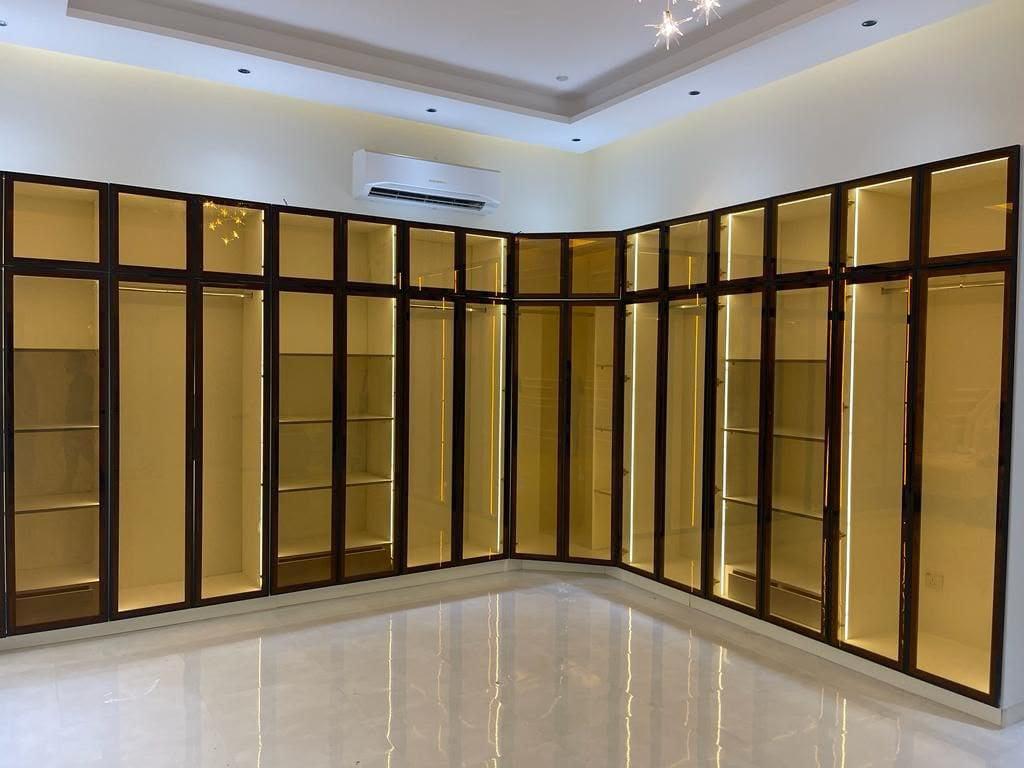
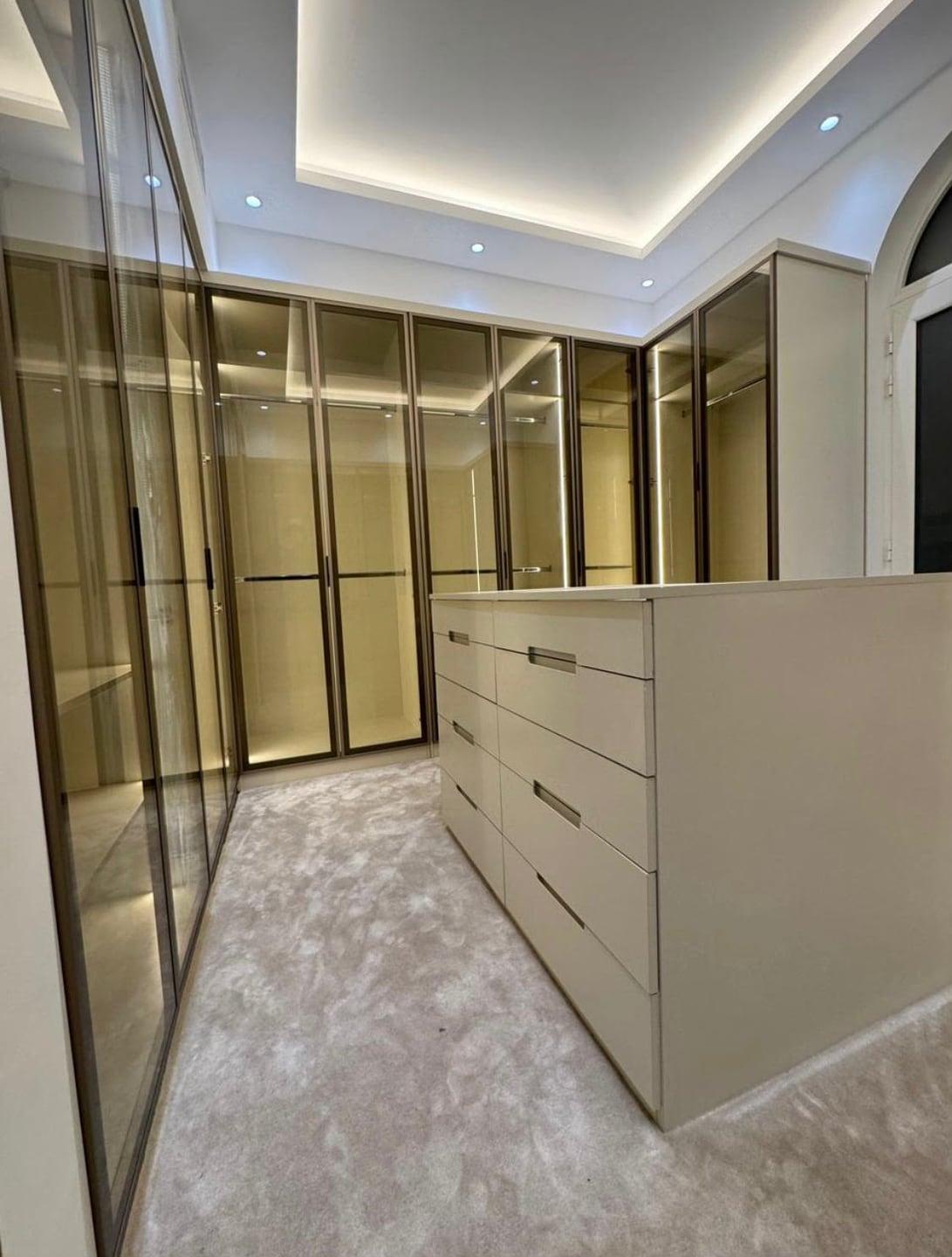
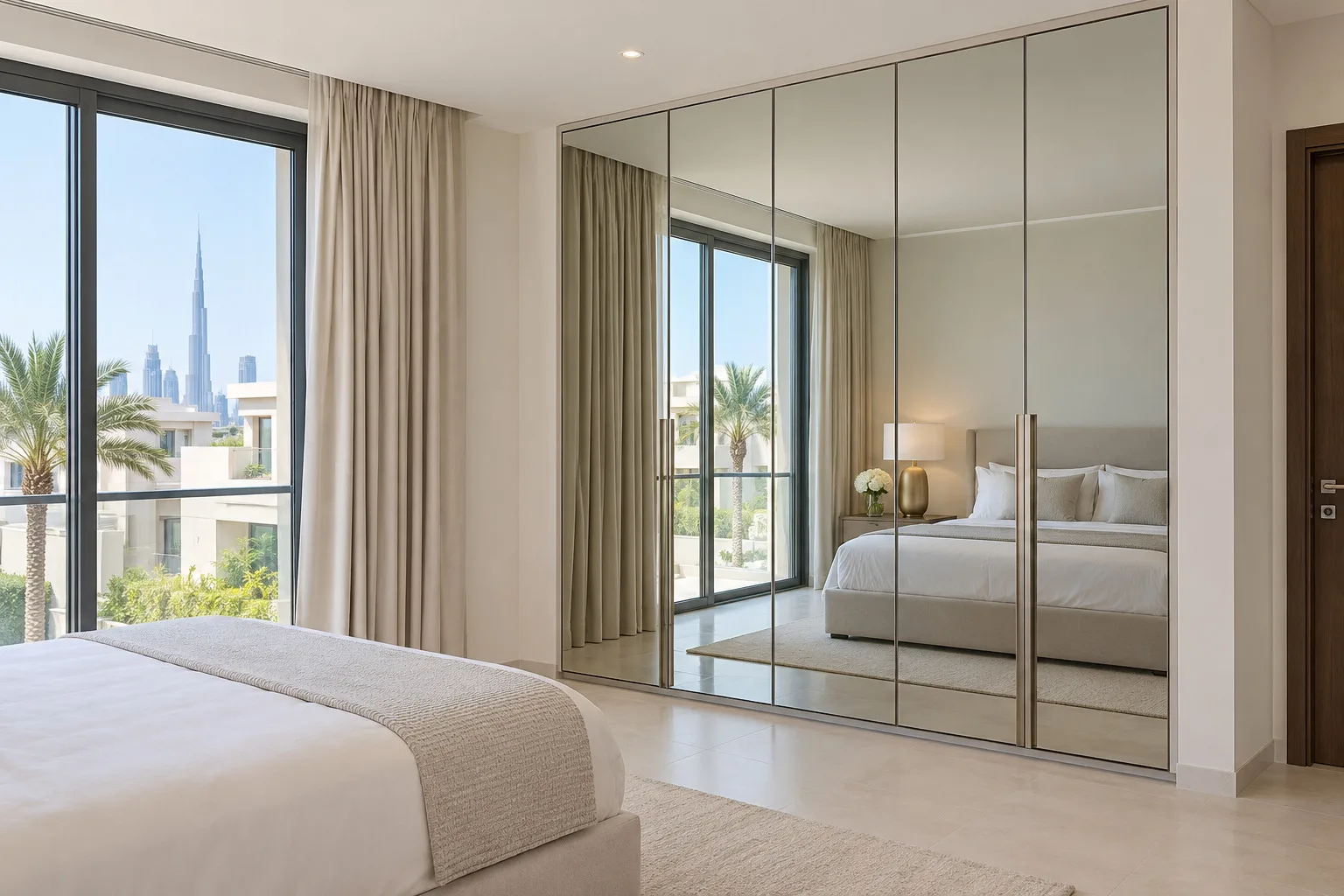
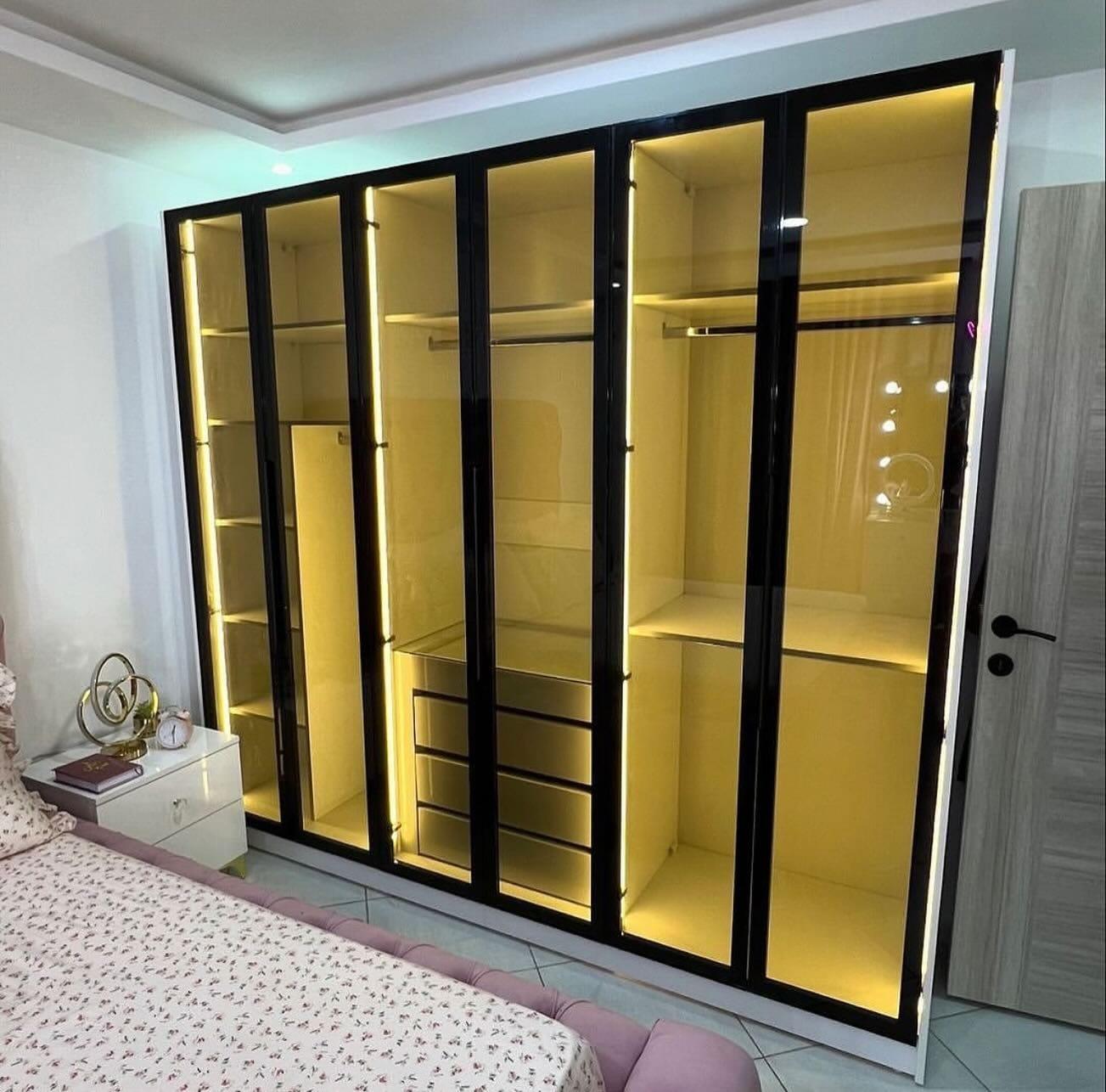
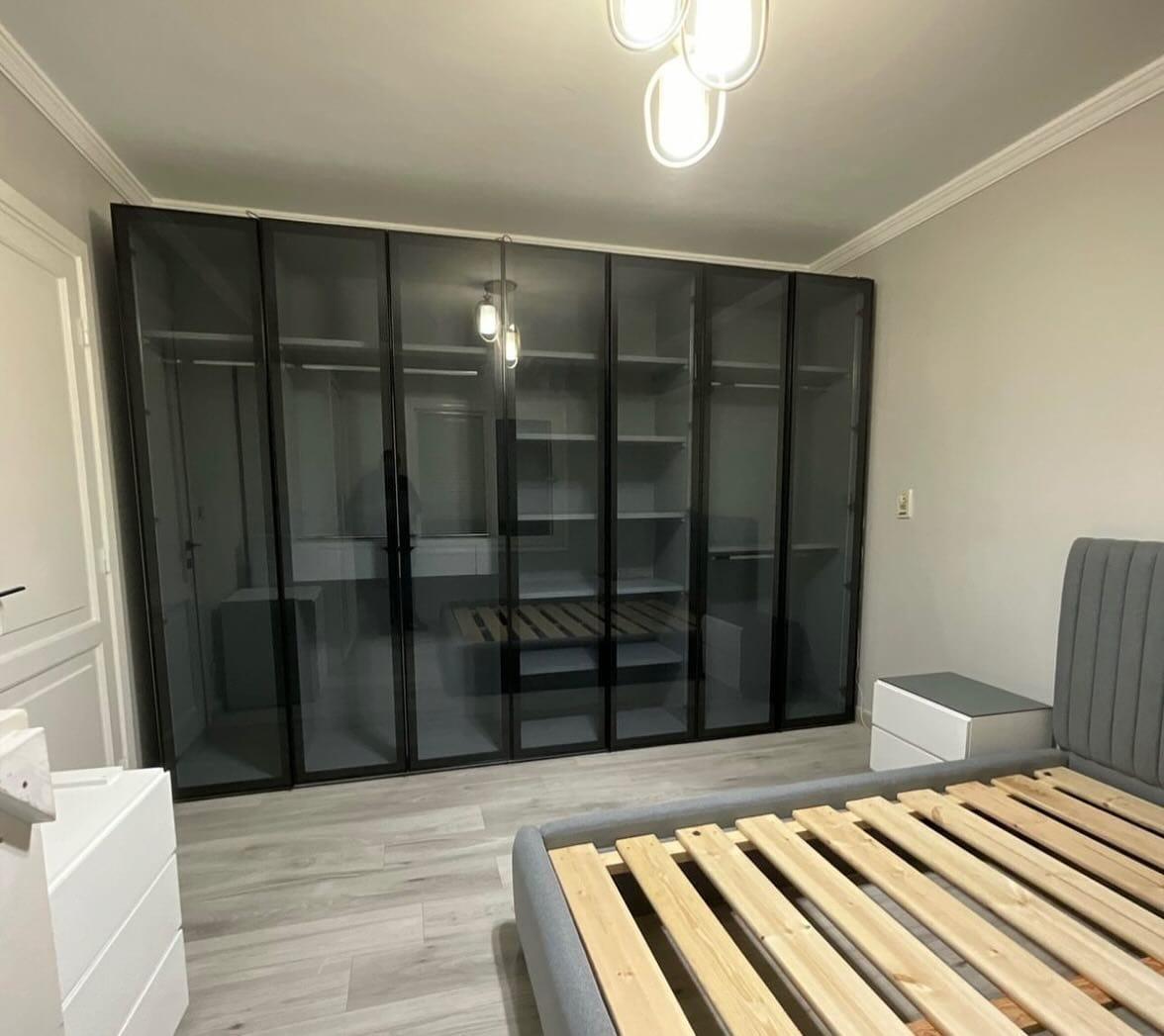
Glass and mirror are finishes too, and they behave unlike a board. Ours are slim anodised aluminium frames holding grey or bronze tinted tempered glass, which lets you see the clothes while keeping dust off them, and mirror doors that double as a full-length mirror. Tinted glass over lit interiors is shown on the lit glass-front wardrobes page, and glass and mirror doors are priced as their own lines; if you would rather leave a section with no door at all, see open wardrobe or closed doors.
What changes the choice is weight. Our wardrobe service page says glass and mirror leaves outweigh laminate panels of the same area by a wide margin, which is why a tall glass or mirror door asks more of its hinges, or of a sliding track, than a board door does. The mirror wardrobe doors guide works through weight per square metre, safety backing and edges, and the sliding door systems guide explains how a track is rated. How many hinges a door needs, and what soft-close adds, is covered in the wardrobe hinges guide.
Care is the shortest of any finish: a soft cloth and a mild cleaner, dampening the cloth and not the glass, then drying. Glass and mirror show fingerprints at once, as the mirror guide notes. If a wall is mostly glass, think about what shows through it, which the wardrobe lighting ideas cover, and about hinged against sliding in the hinged versus sliding guide. The swing of a hinged leaf against the bed or the room door is covered in wardrobe door clearance. If a door already rubs or sags, how to fix a wardrobe door that is sticking has the first checks.
Sunlight, heat and cleaning: the questions every finish shares
Sunlight comes first in the UAE, where big windows are common. Kinnarps says every material is affected by sunlight, and its care page says so most plainly for wood and veneer. Symphony Group says the same for veneered doors and for gloss lacquer. Kronospan lists UV stability among the features of the boards quoted above. These are different statements about different products, with no common test behind them, and none gives a number of years.
So do the simple thing. Stand at the wardrobe wall at the hour the sun is strongest and note where it falls and for how long. If a window faces the wall, plan the curtain or blind with the same care as the finish; the thermal curtains guide and the curtain and blind care guide show what a lined layer does at a window. Then show the sample to your own light at that hour at the measuring visit.
Heat is a separate question and, for a wardrobe, it is mostly small. The heat that reaches a door is from a steamer, an iron or hair tools in a dressing bay; Symphony Group's care page tells kitchen owners to keep kettles and toasters away from cabinet fronts, and the same logic holds beside a dressing bay, covered in the guide to a dressing bay inside the wardrobe. That is general advice, not a maker's rating for a particular door.
Cleaning rules look alike across the pages we read: a soft cloth, mild soap in lukewarm water, a dry cloth after, and no abrasives, solvents or strong chemicals. The exceptions are the ones in each section above, such as the mirror's edges and the lacquer's nail-polish remover. Keep the maker's cleaning advice with your drawing. Our care and maintenance tool collects the habits across our services, and the warranty and aftercare guide says what our warranty covers. A door that has already come off is a different problem from choosing one, and what to do when a sliding wardrobe door is off its track has the first checks.
Wardrobe door finishes side by side
Use the table to line the finishes up on the same questions. Its cells hold only what a maker said, as the column heading says, or advice we label as general. It is not a ranking: read across a row, never down a column. Laminate, veneer, lacquer, glass and mirror are what we publish; the acrylic and PET rows are there because buyers ask, and they are not an offer. If the wardrobe is shared, planning one wardrobe for two people shows how zones, reach heights and doors can be divided so nobody queues.
Laminate, veneer, lacquer, acrylic, PET, glass and mirror doors
Laminate
- What it is
- A printed or coloured decorative layer on a board; our entry finish
- What a maker says (named product)
- Kronospan melamine-faced board: gloss, matt, textured and wood-grain finishes; UV stability, easy upkeep, stain resistance listed
- What to check on a sample (general advice)
- Colour in your own light, the edge and corner, the maker and the reference
- Care
- Soft cloth, mild soap, no abrasives or solvents
Veneer
- What it is
- Real timber cut thin and laid on a board
- What a maker says (named product)
- Kinnarps: direct sun causes permanent colour differences in wood and veneer; wood reacts to season and humidity
- What to check on a sample (general advice)
- How the grain varies between doors, and where the sun will fall on the wall
- Care
- Soft cloth, mild soap, dry at once; never leave a wet cloth on it
Lacquer
- What it is
- A sprayed coating in one colour, matt or gloss
- What a maker says (named product)
- European Panel Federation: smooth, stable MDF and well-closed edges are needed; edges take extra coating
- What to check on a sample (general advice)
- The edge, and a corner, not only the face; gloss level in your light
- Care
- Cloth wrung almost dry, buff dry; no nail-polish remover, vinegar or abrasive pads
Acrylic sheet (not our published line)
- What it is
- A lacquered acrylic layer bonded over the board
- What a maker says (named product)
- Kronospan: scratch-resistant TopX coating, gloss UV stability, matt anti-fingerprint improvement; its own claims
- What to check on a sample (general advice)
- The data sheet and the test method behind any claim you rely on
- Care
- Follow that maker's advice in writing
PET foil (not our published line)
- What it is
- A matt plastic foil faced on the board
- What a maker says (named product)
- Kronospan Ultra Matt PET: UV stability, scrub resistance, soft touch, easy cleaning; non-abrasive cleaners for plastics
- What to check on a sample (general advice)
- The edge detail, and the feel of the surface
- Care
- Non-abrasive cleaners for plastics, per that maker
Glass in a frame
- What it is
- Tinted tempered glass in a slim anodised aluminium frame
- What a maker says (named product)
- Our published fronts use tempered glass in anodised frames; weight is far above laminate's
- What to check on a sample (general advice)
- The tint against your clothes, the frame, and the door weight with the hinge or track rating
- Care
- Damp cloth, mild cleaner, dry; fingerprints show
Mirror
- What it is
- A glass sheet silvered on its back and sealed with protective layers
- What a maker says (named product)
- See our mirror doors guide: weight, safety backing and edges decide the choice
- What to check on a sample (general advice)
- Backing, edge finish and the sunlight patch it throws
- Care
- Damp cloth, edges dried by hand, no spray on the glass
A decision aid, not a ranking or a test result. Maker claims are for the named product only. Sources opened 3 Nov 2026 are listed at the foot of the page; the care and check columns for our own finishes follow our service pages.
How the finish changes your quotation
The finish is one line in the quotation, and it moves the total. Our entry rate of AED 550 per sqm of wardrobe front, installed, is for MDF laminate with hinged doors. Veneer, lacquer, glass and mirror doors, sliding systems, lighting and internal accessories each raise it, and in our quotations each upgrade is a separate line that you can keep or drop. We give no figure beyond the entry rate, because your price is set once the wall is measured and the finish chosen; the custom closets price guide walks through that arithmetic, and the pricing guide turns a front into a number.
A sensible way to use that is to decide where the finish is seen. In a family bedroom, laminate on most doors and one feature section in veneer, lacquer or glass keeps the upgrade lines short. In a master suite or a dressing room, where the wardrobe is on show, more of the wall can carry the finish you like; our walk-in closet range shows what that looks like, and our custom wardrobe range lists the doors. That is a suggestion for how to read a price, not a rule. For a large bedroom shared by two people, see master bedroom wardrobe design. For doors on a hall cabinet, the shoe wardrobe design guide covers pairs per shelf, depth and ventilation.
Whatever you choose, write the finish into the quotation by name: the maker, the reference and the sample you saw, door by door. If you are comparing two quotations, the finish line is the one most often vague, and the quotation checklist shows how to put them next to each other without guessing. If you are replacing doors on a wardrobe you already own, wardrobe door replacement explains what changes. If you are weighing an old wardrobe, renovate or replace an old wardrobe is a decision guide by symptom. How deep the box should be, and why, is set out in our guide to wardrobe depth.
What we do about it
We choose finishes in your room, not from a screen. The measuring visit costs nothing, and the samples we bring are laminate, veneer and glass, so you can hold each one in your own light, at your own wall and next to your own floor. Say at the visit which of the five questions matters most to you, whether that is the sun on one wall, fingerprints, a child's room or weight, and we will note it on the drawing.
Next you receive a drawing and an itemised price, and we begin production only once you have approved both; a veneer, lacquer, glass or mirror door sits on a separate line, so the quotation can be cut back without redrawing. The wardrobe is built in our Sharjah workshop and fitted by our own installers, up to about 10 days after you confirm the order, depending on size and design (the installation day guide says what to expect on the day). Our making and fitting carry a 24-month written workmanship warranty, while bought-in hardware and lighting carry their makers' guarantees. Separately, the wood-based boards carry a 5-year limited warranty, subject to terms; hinges, tracks, runners, rollers and other moving hardware are not covered, and the final terms are in the written warranty. We do not publish which laminate, veneer or lacquer system we use, so ask for the maker and the reference in writing, and ask the same of anyone you compare us with.
Read what to prepare for the measuring visit first, and then use the consultation form to book it. The finish is only the surface; for the inside, see abaya and kandura storage, luggage and seasonal storage, wardrobe drawers and organisers and a studio apartment wardrobe.
We install across the whole UAE. The Sharjah page has the workshop address, and the Dubai wardrobe page covers visits there.
If your space is a corner, read about corner wardrobes and L-shaped runs; if it is tight, small bedroom wardrobe ideas set out the layouts.
Heights, depths and what goes where are in the wardrobe dimensions guide and the wardrobe layout guide. To set each rail from your own longest garment, see wardrobe hanging heights.
If a TV is in the plan, see the bedroom wardrobe with TV unit guide, and the choosing materials tool sets finishes side by side across our services.
For built-in against freestanding, the fitted, built-in or freestanding guide helps, and our sliding door wardrobes page shows finished sliding work. If the wardrobe will back onto a bathroom or outside wall, read what to check first for a wardrobe against a bathroom wall.
The same finishes, applied to a wall instead of a wardrobe, are compared in our media wall panel materials guide, and the kitchen joinery guide shows how the workshop uses them in a kitchen.
For doors and partitions elsewhere in the home, read the architectural joinery guide; for the light that falls on every surface, interior lighting ideas.
Our wardrobe cabinets and organisers page shows what goes inside. When the doors are chosen, the wardrobe service page lists the range and what each upgrade adds to the entry rate. Our guide to reach-in or walk-in wardrobes shows when a walk-in earns its floor area and when a wall of doors is the smarter use of it. If you are comparing made-to-measure doors with an off-the-shelf unit, custom or ready-made wardrobe: where each wins sets out the trade-offs.
To see where the finish fits among the other choices, follow the five-step order for planning a wardrobe.
Common questions
Which wardrobe door finish is best for a UAE home?
There is no best finish. We found no test of laminate, veneer, lacquer, acrylic, glass and mirror under the same UAE conditions, so ask the same five questions of each sample and get the answers in writing. See our wardrobe materials guide.
Is laminate or veneer better for a wardrobe?
They are different things, not a better and a worse. Laminate is a decorative layer and our entry finish; veneer is real timber, so its grain varies and its colour can change in sun; for framed painted fronts, classic and shaker-style wardrobes covers the look. Veneer raises the entry price. See our custom closets price guide.
Do glossy wardrobe doors show fingerprints?
It depends on the product, the colour and the light, so touch the sample and tilt it under a lamp, and wardrobe colour combinations for bedrooms weighs the door colour against light, floor and handles. Makers of matt surfaces claim improved anti-fingerprint behaviour, which is not the same as no marks. See our handleless wardrobe guide.
Will sunlight fade my wardrobe doors?
Makers say sunlight affects surfaces, veneer and gloss lacquer in particular, but none we read gives a figure for the UAE. Note where the sun falls on the wall and plan a blind or curtain with it. See our guide to blackout or sheer curtains.
How do I clean wardrobe doors without damaging the finish?
Use a soft cloth, mild soap in lukewarm water and a dry cloth, and avoid abrasives, solvents and strong chemicals such as vinegar. Mirrors need their edges dried and lacquer keeps away from nail-polish remover. See our care and maintenance tool.
Does the finish change the wardrobe price?
Yes. Our entry price is from AED 550 per sqm of wardrobe front, installed, for MDF laminate with hinged doors; veneer, lacquer, glass and mirror doors raise it as separate lines. Your figure is set after the free measuring visit. See our pricing guide.
Do you make acrylic or PET wardrobe doors?
Our published finishes are MDF laminate, veneer, lacquer, tinted glass in aluminium frames and mirror. We have not published acrylic or PET, so do not assume them; ask at the visit. See the measuring visit guide.

Sources & specifications
Manufacturer information applies to the named products and systems. Sources reviewed on 3 November 2026.
- Kronospan, Melamine Faced PB: a standard board for furniture and interior design; gloss, matt, lightly textured and wood-grain finishes; UV stability, ease of maintenance and stain resistance listed; separate boards for improved moisture resistancekronospan.com(opens in a new tab)
- Kronospan, Acrylic Gloss and Acrylic Matt boards: 0.7 mm lacquered acrylic over MDF, TopX scratch-resistant coating, high UV stability on gloss, improved anti-fingerprint properties on mattkronospan.com(opens in a new tab)
- Kronospan, Ultra Matt PET Laminated MDF: MDF faced with matt PET foil, UV stability, scrub resistance, soft touch, cleaned with non-abrasive cleaners for plasticskronospan.com(opens in a new tab)
- Ekinex, FENIX NTM: extremely matt surface, low light reflectivity, anti-fingerprint and soft touch, thermal repair of micro-scratches, slight colour variation between batchesekinex.com(opens in a new tab)
- Kinnarps, Care recommendations for hard materials: direct sunlight and permanent colour differences in wood and veneer; mild soap, lukewarm water, no solvents or abrasives for wood, veneer, laminate and HPLkinnarps.com(opens in a new tab)
- Symphony Group, Cabinet care: veneered doors vary in tone over time under ultraviolet light; strong sun on gloss lacquer; avoid abrasive cleaners and strong chemicals such as vinegarsymphony-group.co.uk(opens in a new tab)
- European Panel Federation, Lacquer finishes on MDF: pigmented lacquers for single colours, polyurethane or acid-catalysed finishes, high gloss from the spray gun, edges take more coatingmdf-info.eu(opens in a new tab)
Want this planned for your home?
Consultation and measurement are free. Tell us the rooms, location and what you need; we arrange a sample visit and define the measured quotation.