Wardrobes · 15 min read · 31 July 2026
Sprayed wardrobe doors: layers, colour, edges and touch-ups
A sprayed wardrobe door is a stack of layers: board, primer, colour and sometimes a clear coat. What each layer does, colour freedom, edges and joins, the touch-up reality, cleaning and what to ask for in the quotation.

By Ali Haider Basra, Founder, Al Tareeq Decor · Contact our workshop
Key takeaways
- A sprayed door is a stack: board, primer or sealer, one or more colour coats, and in some systems a clear coat. Most trouble traces to the board or preparation, not the colour; classic and shaker-style wardrobes covers painted framed doors.
- Colour is the strength: any shade, matt or gloss, no pattern. Judge it on a full-size sample at your wall, since a large flat door reads stronger than a swatch.
- Cut edges absorb more coating than the face, so check the edge and a corner of the sample first.
- A touch-up is a patch and can differ from an aged door; ask in writing what touch-up or re-spray is offered, and have the colour reference and sheen recorded, and the choice of door colour comes first in wardrobe colour combinations.
- We make spray-painted finishes project by project; the price is a separate line, and the coating system, coats and curing time are asked for in the quotation.
On this page
- Key takeaways
- What a sprayed wardrobe door is
- The layers, one by one
- Colour freedom: any colour, but check it in your room
- Smooth look against laminate and veneer
- Sprayed, laminate and veneer: what to ask of each
- Edges and joins: where a sprayed door is hardest
- Touch-up and repair: the honest picture
- Cleaning a sprayed door
- What decides the result: board, preparation and curing
- What to ask in a quotation for sprayed doors
- Ten questions for a sprayed wardrobe quotation
- What we do about sprayed doors
- Common questions
What a sprayed wardrobe door is
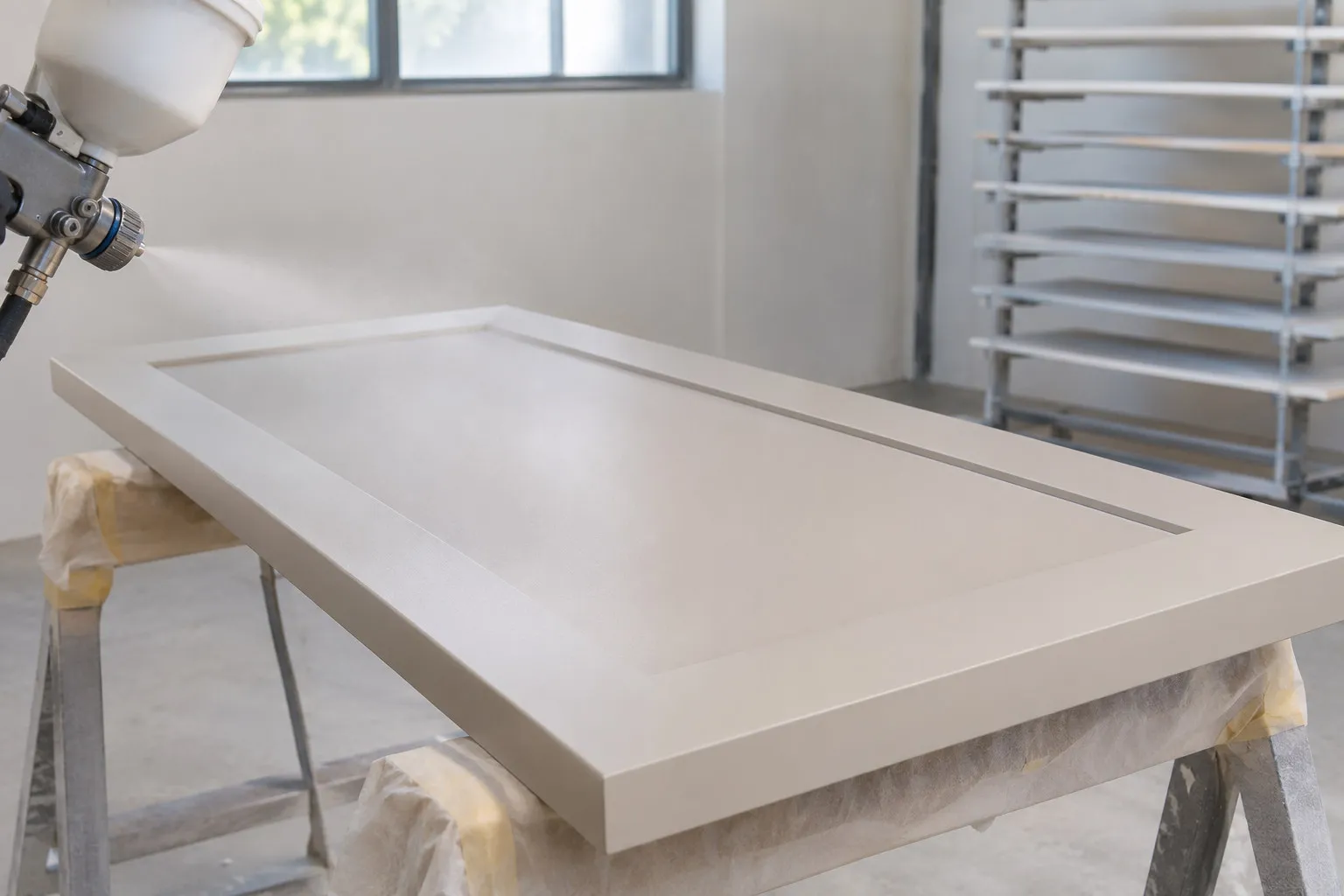
A sprayed door is a board that has been coated in layers of paint by spray gun, so the colour sits in a coating on the surface and not in a printed sheet or a sliced piece of wood stuck onto it. Spray-painted is one of the finishes we make, as a project-by-project option: whether it suits your design, your wall and your budget is settled at the measuring visit, and matt or gloss can both be sprayed. This page is about the sprayed door itself. The comparison of every finish is in our guide to wardrobe door finishes. The sheen choice is in matt or gloss wardrobe doors; neither is repeated here.
The useful way to think about a sprayed door is as a stack. A board at the bottom, then a primer or sealer, then the colour, then in many systems a clear protective coat. Each layer has a job, each depends on the one under it, and most of what goes wrong with a painted finish traces to the board or the preparation and not to the colour. The drawing below shows the stack arriving layer by layer. Its order follows the sources named under the figure; the thicknesses are not to scale, because no source we opened gives one and we do not invent one.
- 1. The board: MDF or another board; its surface and edges decide how smooth the paint can look
- 2. The primer or sealer: goes on first and closes the surface before any colour
- 3. The colour coats: one or more, in almost any colour, matt or gloss
- 4. The clear coat: a protective layer in some systems; ask whether your quotation has one
- 5. The cut edge: soaks up more coating than the face, so it needs its own care
The layers, one by one
Start with what the trade bodies say. The European Panel Federation, a body for wood-based panels, describes lacquering MDF this way: "A typical finishing sequence would start with a sealer applied at a low coating weight." Pigmented lacquer follows, and it adds that pigmented lacquers are widely used to create strong single colour effects, with intense white or strong colours reached by applying two or more coats. That is one body describing lacquer on MDF; it does not describe any one workshop, ours included, and we have not published our own coating system.
The same page gives the order of the work: after denibbing with 320 grit paper, one or more coats of pigmented lacquer complete the finish. Denibbing means rubbing off the tiny raised specks a coat leaves, so the next coat goes on smooth. A clear lacquer can sit over the colour. Its page mentions one or two coats of clear lacquer to protect a stained surface, which is a different case from a painted one, so we do not present it as the recipe for a painted door. Whether your door gets a clear coat is a question for the quotation.
Bob Vila's guide to painting MDF adds a warning about water: it says water-based products are poorly suited to the first coat on MDF because they may cause the wood fibres to swell, and it says to let paint dry thoroughly before a protective sealer. It gives no drying or curing times, and neither does anyone we could verify, so we state none. A fast turnaround is a reason to ask how long the doors rest between coats, which is a fair thing to ask any workshop. Our guide to timelines and the measuring visit explains where the wait sits in our process.
Colour freedom: any colour, but check it in your room
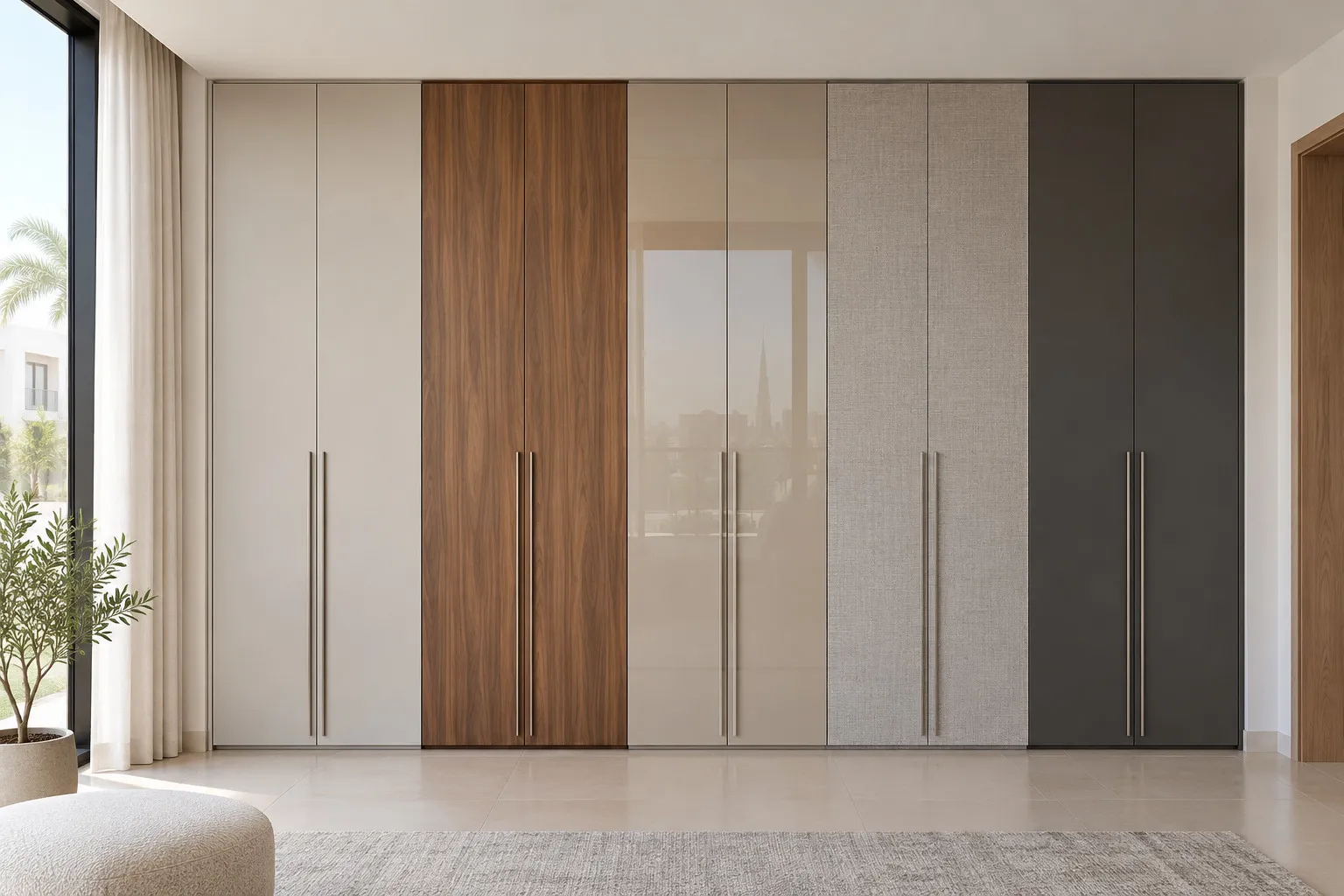
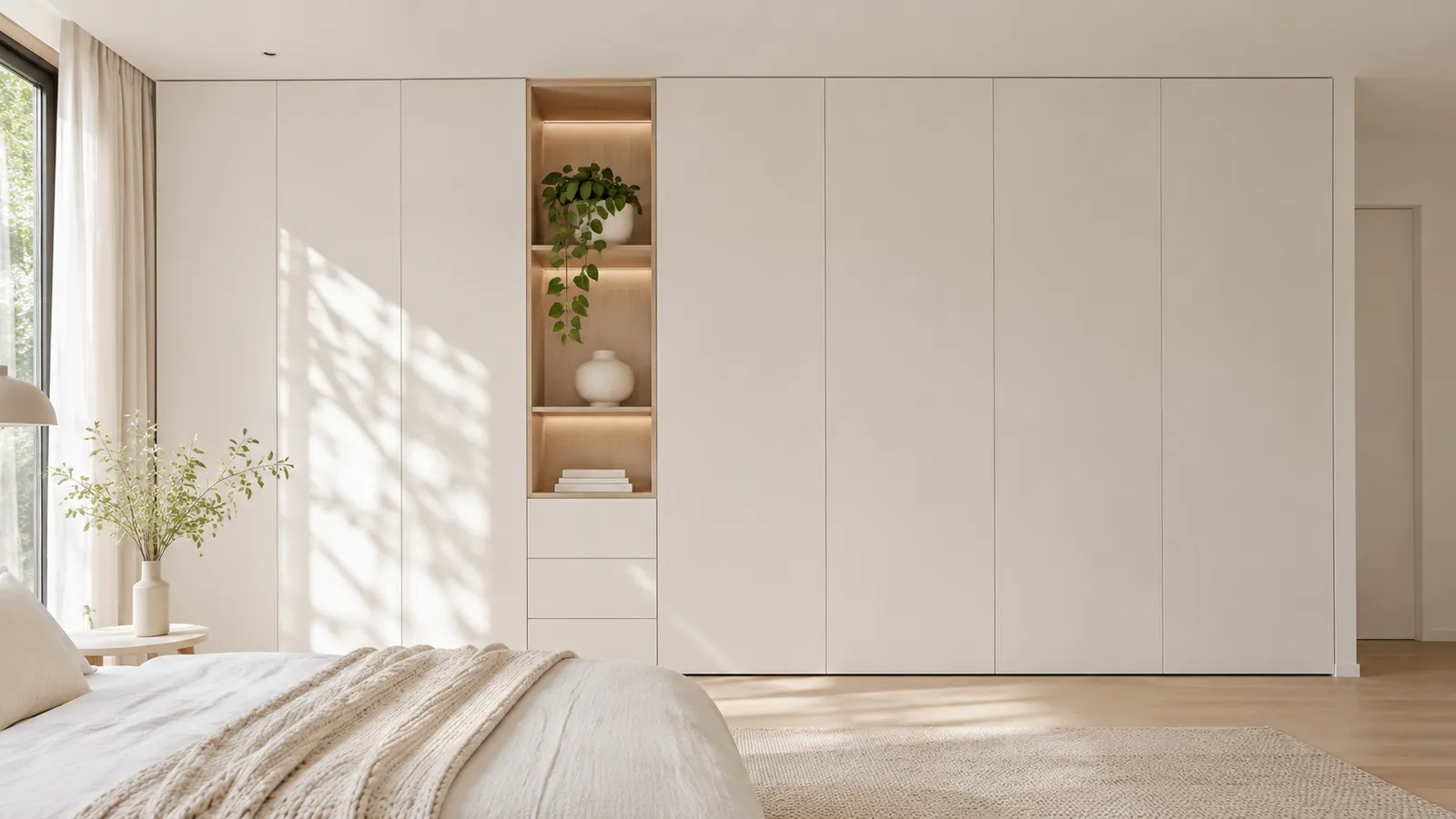
The case for spraying is colour. Because the colour is paint and not a printed pattern, a sprayed door can in principle be made in the shade you choose, in matt or gloss, and the same colour can run across doors, side panels and a top box so the wardrobe reads as one surface. We say "in principle" because the final shade depends on the paint, the coats and your light, and the match is made against a sample, not a screen. The free measuring visit brings samples, and the wardrobe measuring visit guide lists what to look at under your own lamps and daylight.
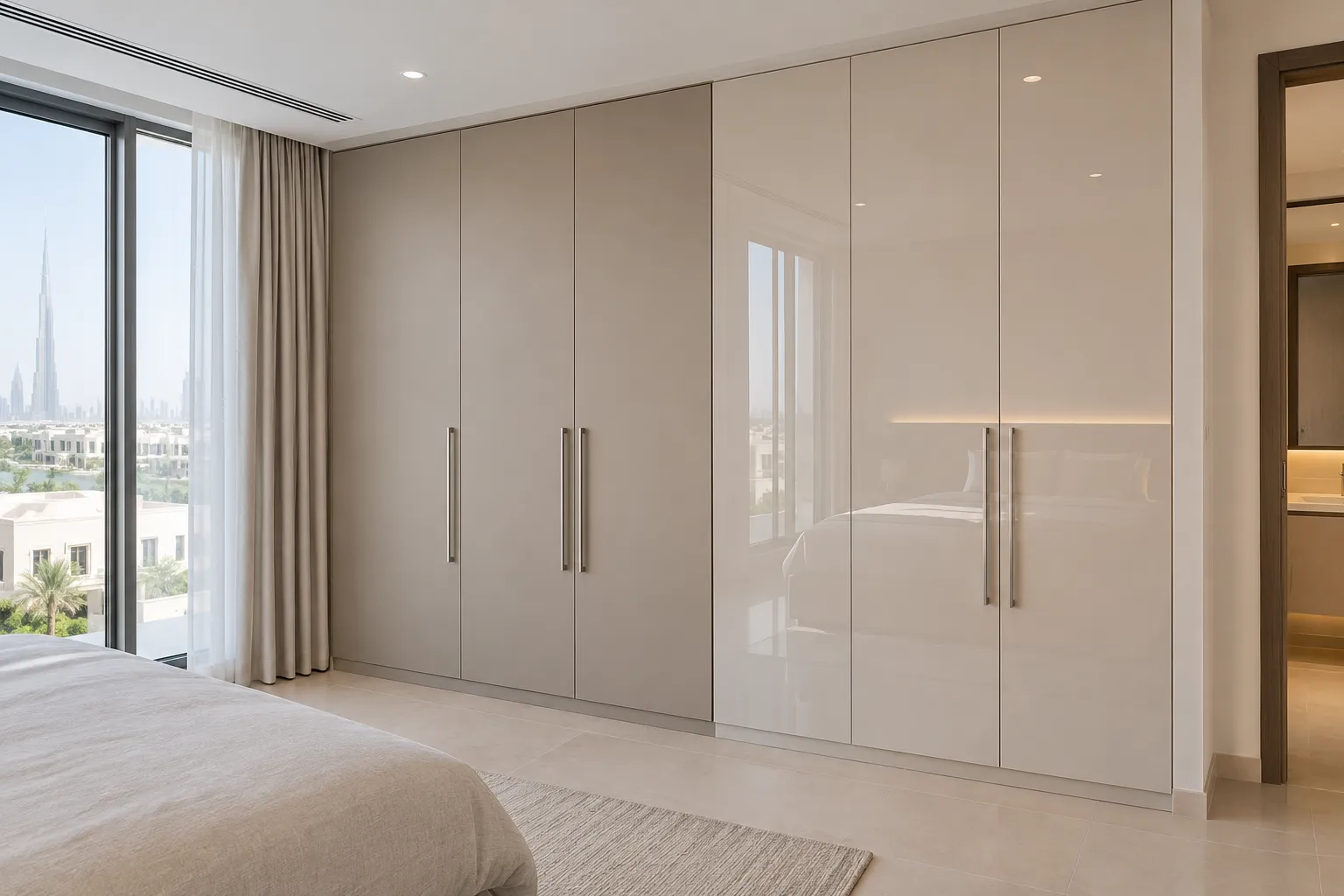
Two cautions. The first is that paint on a large flat door shows its colour more strongly than a small swatch does, so a shade that looked soft on a card can look heavier across a wall; hold the sample against the wall at full height if you can. The second is that colour and sheen travel together: a gloss version of the same colour looks different from the matt one, and the choice is explained in our matt-or-gloss guide. Strong direct sun on a gloss surface can discolour it according to a cabinet maker's care page, so note where the sun falls on the wall before choosing a dark gloss.
Colour also ties into the wider room. A wardrobe the colour of the wall tends to recede; a contrast colour announces itself, and a handleless run in one flat colour looks very different from the same run with grips. Our handleless versus handles guide covers the grip side, and the wardrobe handles guide covers handle styles and heights for painted doors.
Smooth look against laminate and veneer
A sprayed door has no grain, no pattern and no sheet edge on its face: it is one continuous coating of one colour. Laminate and veneer arrive as made sheets, one with a printed or pressed surface, the other a thin slice of wood, and both are fixed to the board. That is a real difference in look, and a sprayed colour is the cleaner choice if you want a plain wall of colour. It is not a statement about toughness, and we make none: we found no test of sprayed doors against laminate or veneer in UAE conditions, so this page ranks nothing.
What differs in practice is how each is made and mended. A laminate or veneer door is a ready sheet on a board, with the sheet's own look. A sprayed door is finished by coating, so the result depends on the preparation and on the person holding the gun, and a repair means matching paint and sheen again. That points to different questions: for laminate you ask which sheet and which edge; for a sprayed door you ask about primer, coats and edges. The custom versus ready-made wardrobe guide shows why a made-to-order colour is one of the things a shop range seldom offers.
Sprayed, laminate and veneer: what to ask of each
Sprayed paint
- What you see
- One continuous colour, no pattern, matt or gloss
- Questions to ask for this finish
- Primer, number of coats, clear coat or not, how edges are finished, how a touch-up is done
Laminate (our entry specification)
- What you see
- A made sheet: plain colours, wood looks and textures
- Questions to ask for this finish
- Which sheet and sample, how the edges are closed, what the quotation says about the board behind it
Veneer
- What you see
- A thin slice of real wood, with grain that varies
- Questions to ask for this finish
- Which wood, how it is finished, how the sample compares to the doors, effect of strong sun
A comparison of what each is and what to ask, not a ranking: we found no test of these finishes under UAE conditions. The full comparison is in the finishes guide.
Edges and joins: where a sprayed door is hardest
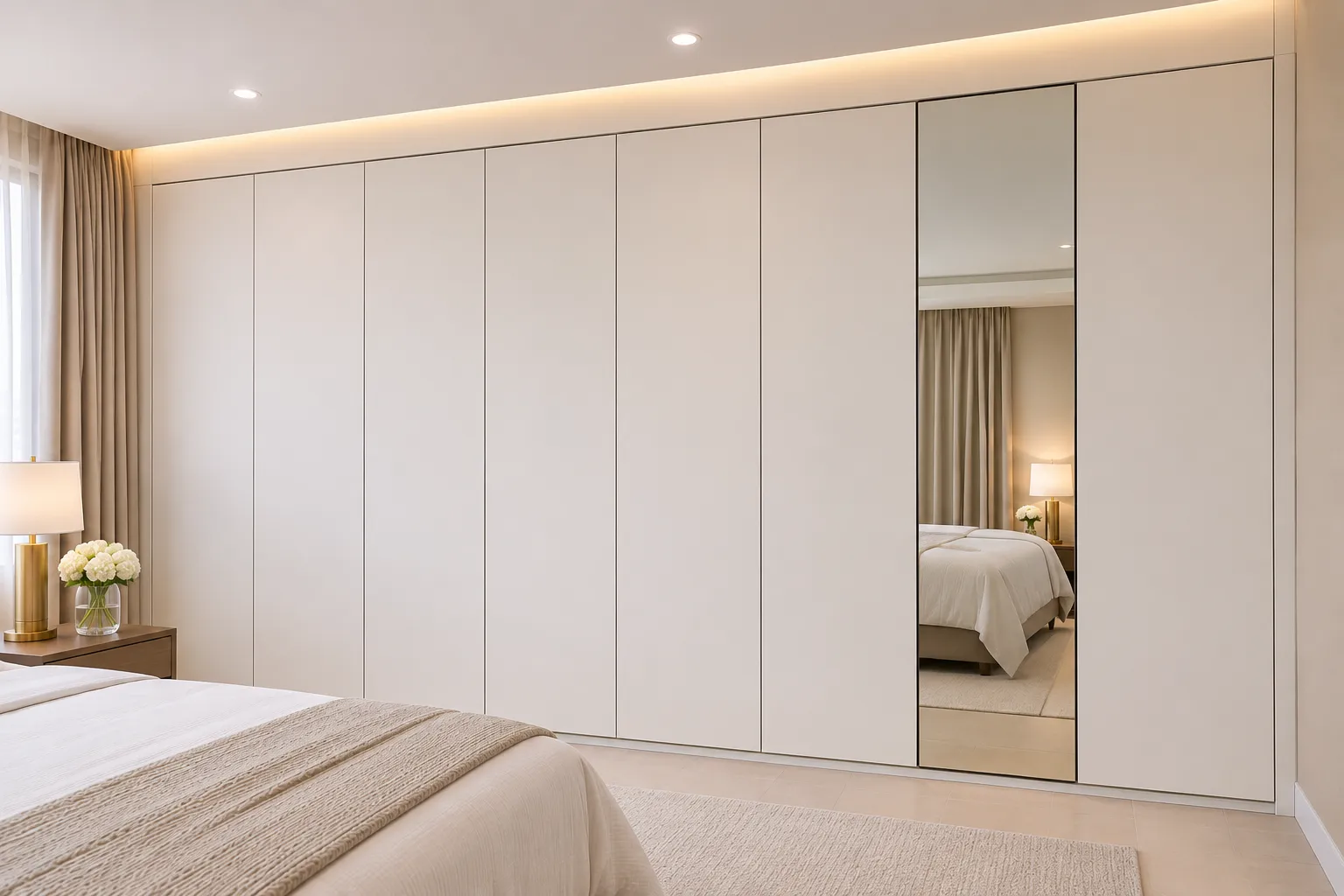
The flat face of a board is the easy part. The cut edge is the hard part. Bob Vila says the edges of MDF are more porous, almost fuzzy, and need prep for a smooth, uniform finish, and the European Panel Federation says that with lacquers a higher coating weight may be required on the edges because they absorb more. In plain terms, an edge drinks paint, and if it is not sealed and built up properly it can look rough or different from the face. That is why the edge is the first place to look at a sample.
Joins are the other place. A sprayed door sits beside the next door with a gap, and where two painted parts meet, such as a frame and a panel, or a door and a side panel, the coating has to carry across the line cleanly. We found no source that quantifies how this behaves, so treat it as a question and not a claim: ask how the door is built, how the edges and corners are finished, and look at a corner of the sample under a raking light. If you are choosing a style with grooves or frames, the fluted wardrobe doors guide explains how a pattern changes what the paint has to reach.
If a door later rubs, sags or sticks, the paint is rarely the cause; the wardrobe door sticking guide covers hinges and alignment first. When you are replacing only the doors, the wardrobe door replacement guide explains what a sprayed front changes about the job.
Touch-up and repair: the honest picture
A scuff or a chip on a painted door can be touched up, and the advice from the touch-up pages we read is consistent. RTI Cabinets, a cabinet maker, says to use manufacturer-matched paint whenever possible, to avoid over-applying paint because thin layers work best, and to lightly blend if needed; it also says deep scratches may require professional refinishing. N-Hance, a refinishing business, says to find the exact shade and finish, matte, satin or glossy, and that larger chips, peeling finishes or colour mismatches often need a professional's eye and tools. Both are advice for cabinets in general, not for any named product of ours.
The reality that follows is that a touch-up is a patch. Even with matching paint, a patch can differ in sheen or shade from a door that has aged in the sun, and the larger the mark the more it shows. A whole door sprayed again in the workshop is a different job from a dab of paint. We have not published whether we touch up or re-spray a door after handover, or how a colour is recorded for later, so ask for that in writing before you order. The warranty guide explains what the 5-year board warranty and the workmanship warranty do and do not cover.
A practical habit costs nothing: ask for the colour reference and sheen to be written on the quotation or the drawing, and keep a spare note of them. A matched touch-up later depends on knowing exactly what was used. If the damage is more than a spot, the renovate or replace guide helps you decide between repairing, re-fronting and replacing.
Cleaning a sprayed door
Care pages for painted and lacquered cabinets agree on the basics. Symphony Group, a cabinet maker, says to clean with a slightly damp soft cloth and a little liquid soap, to dry thoroughly, to avoid abrasive cleaners and strong chemicals such as vinegar, and to dry any spillage immediately. That is general cabinet care, and it is the safe default for a sprayed door until your maker's own advice says otherwise. Ask the workshop for its care note and keep it with the warranty; our guide to cleaning wardrobe surfaces has a section on lacquered and sprayed doors.
A few habits follow. Test any cleaner on a hidden corner first. Wipe the whole door and not one spot, because a spot treated alone can look different. Do not press hard on gloss. Our care and maintenance tool has a general routine, and the way fingerprints show on matt and gloss is covered in the matt-or-gloss guide. We make no claim that a sprayed door resists marks, stains or scratches: that depends on the paint and the use, and nobody has tested it for us.
What decides the result: board, preparation and curing
Three things sit under the colour, and you can ask about each without being a painter. The first is the board. A sprayed finish shows the surface beneath it, and the European Panel Federation says smooth, stable MDF surfaces and well-compacted machined edges are the prerequisites for a lacquered finish. Our confirmed boards are MDF, plywood and other boards at 18 mm standard thickness; which board is sprayed on your doors is a quotation line, and the moisture-resistant boards guide explains the board grades.
The second is preparation: sanding, sealing and filling before any colour goes on. It is the part you never see, and the part that decides whether a gloss door looks flat or rippled. Bob Vila lists filler and sanding on the edges before priming. The third is curing, the time the paint needs before the doors are handled, stacked, wrapped and installed. We found no verifiable time and give none; the question for a quotation is whether the doors are allowed to dry fully before they leave the workshop.
Humidity is the question people ask next, and the honest answer is the one we give for any board. Nothing we could verify tells us how a sprayed door behaves in a particular UAE home, so we make no claim about it. What you can do is ask about the board and the sealing for your wall, particularly if the wardrobe stands against a bathroom or an outside wall; our bathroom wall wardrobe guide covers that wall, and the musty wardrobe guide covers the smell side of the same question.
What to ask in a quotation for sprayed doors
A sprayed door is described by its stack and its colour, so the quotation should say both. Use the table as a short list and keep every answer in writing; the general checks are in our wardrobe quotation checklist. The entry price on our site is AED 550 per sqm for MDF laminate with hinged doors, installed; a sprayed door is not that specification, so it appears as its own line, and we have not published a figure for it.
Ten questions for a sprayed wardrobe quotation
Which board is sprayed, and its thickness
- Why it matters
- The surface under the paint decides the result
- A clear answer looks like
- The board named on the quotation and drawing
Primer or sealer
- Why it matters
- It closes the surface before any colour
- A clear answer looks like
- A named step, not 'painted'
Colour and sheen
- Why it matters
- A later touch-up needs the exact match
- A clear answer looks like
- A colour reference and matt or gloss, written down
Number of coats and a clear coat
- Why it matters
- Describes the stack; we publish none ourselves
- A clear answer looks like
- The coats and whether a clear coat is included, in writing
How the edges are finished
- Why it matters
- Edges soak up more coating than the face
- A clear answer looks like
- How cut edges are sealed and coated, seen on a sample
Joins, corners and gaps
- Why it matters
- The coating must carry across each line
- A clear answer looks like
- Sample corner under a raking light
Drying and curing before delivery
- Why it matters
- No verifiable time exists to quote
- A clear answer looks like
- A statement that doors dry fully before handover
Touch-up and re-spray after handover
- Why it matters
- A patch can differ from an aged door
- A clear answer looks like
- What is offered, who does it and at what charge
Care note
- Why it matters
- Safe default is soft cloth and mild soap
- A clear answer looks like
- The workshop's cleaning advice in writing
Sample in your room
- Why it matters
- Large flat colour reads stronger than a swatch
- A clear answer looks like
- A sample at the free visit, held against the wall
Questions, not figures. Sprayed doors are a project-by-project option for us, and the price is set after measurement; ask for the line in the quotation.
What we do about sprayed doors
Spray-painted finishes are among the finishes we make, matt or gloss, subject to feasibility on your project. At the free measuring visit we bring samples and measure with a laser; then we send a drawing and an itemised price, and nothing is made until you approve them. A sprayed door sits as a separate line, so you can compare it with laminate before you decide.
After the measurements and details are agreed, a 60% advance is paid and production starts once it is received; the remaining stage is agreed with you. Our Sharjah workshop builds the wardrobe and our own team installs it, typically in up to about 10 days depending on size and design, with a 24-month written workmanship warranty (supplied products follow their own terms). Separately, the wood-based boards carry a 5-year limited warranty, subject to terms; hinges, tracks, runners, rollers and other moving hardware are not covered, and the written warranty gives the final terms. We have not published our paint system, coat count, clear-coat policy or curing time, so ask for them and we will write them down.
Start at the custom wardrobes service page, see finished runs on the built-in wardrobes page, and book a consultation to hold the samples. For doors that slide, the sliding door wardrobes page shows the other kind. Installation covers the whole UAE; the Sharjah page gives the workshop address and the Dubai page covers visits there. The pricing guide shows how a quotation is built from a measured wall.
For the other finishes and the steps before choosing one, see how to plan a wardrobe for a UAE home.
Common questions
What is a sprayed wardrobe door?
A board coated in layers of paint by spray gun: primer or sealer, colour coats and in some systems a clear coat. The colour is paint, not a printed sheet or wood slice. Spray-painted is a finish we make, subject to feasibility on your project. See our wardrobe door finishes guide.
Can a sprayed wardrobe door be any colour?
In principle, in matt or gloss, but the final shade depends on the paint, the coats and your light, so match it on a sample at the wall. We have not published a colour range. See our matt versus gloss guide.
Is a sprayed door better than laminate?
Neither is better: sprayed gives one continuous colour with no pattern, laminate is a made sheet and our entry specification. We found no test of the two under UAE conditions, so we rank nothing. Ask the same questions of both samples. See our custom versus ready-made wardrobe guide.
Can a chip on a sprayed door be touched up?
A small chip can be touched up with matching paint in thin coats, and a cabinet maker says deep scratches may need professional refinishing. A patch can still differ in sheen or shade. Ask what touch-up or re-spray is offered before ordering. See our wardrobe warranty guide.
How do I clean a sprayed wardrobe door?
A cabinet maker advises a slightly damp soft cloth with a little liquid soap, then drying, and no abrasive cleaners or strong chemicals such as vinegar. Test on a hidden corner first. See our care and maintenance tool.
Do sprayed doors suit humid rooms?
We found nothing verifiable on how sprayed doors behave in a particular UAE home, so we make no claim. Ask about the board and the sealing for your wall, especially against a bathroom or outside wall. See our moisture-resistant boards guide.
What should a quotation for sprayed doors say?
The board sprayed, the primer, the colour reference and sheen, the coats and any clear coat, how edges are finished, curing before delivery, and touch-up terms. Sprayed doors are a separate line from our AED 550 per sqm entry specification. See our wardrobe quotation checklist.

Sources & specifications
Manufacturer information applies to the named products and systems. Sources reviewed on 4 November 2026.
- European Panel Federation, Lacquer finishes on MDF: typical sequence starts with a sealer, pigmented lacquers for strong single colours, two or more coats for intense colours, denibbing with 320 grit, higher coating weight may be required on the edgesmdf-info.eu(opens in a new tab)
- Bob Vila, How to paint MDF: edges are more porous and need prep; water-based products can swell the fibres; let paint dry thoroughly before a protective sealerbobvila.com(opens in a new tab)
- RTI Cabinets, Touch-Ups & Minor Repairs (3 March 2026): manufacturer-matched paint, thin layers, lightly blend, deep scratches may need professional refinishingrticabinets.ca(opens in a new tab)
- N-Hance, tips for touch-up cabinet painting: find the exact shade and finish, matte, satin or glossy; larger chips or colour mismatches often need a professionalnhance.com(opens in a new tab)
- Symphony Group, Cabinet care: slightly damp soft cloth and liquid soap, dry thoroughly, no abrasive cleaners or vinegar, dry spillages at once, strong sun on gloss may discoloursymphony-group.co.uk(opens in a new tab)
Want this planned for your home?
Consultation and measurement are free. Tell us the rooms, location and what you need; we arrange a sample visit and define the measured quotation.