Wardrobes · 14 min read · 29 July 2026
Fluted wardrobe doors: profile, light, dust and joins
A fluted wardrobe door has vertical grooves; their width and spacing are design choices. Side light makes the shadow, the grooves hold dust, and the gaps between doors should land inside a groove. Ask whether fluted fronts suit your design and budget.

By Ali Haider Basra, Founder, Al Tareeq Decor · Contact our workshop
Key takeaways
- A fluted door has vertical grooves in its front face; the groove width and the spacing between them are design choices, and there is no standard size, so agree them on a drawing and check a sample on your own wall.
- The look comes from the shadow in each groove: side light deepens it, straight-on light flattens it, so decide where the light comes from before you choose the doors; wardrobe colour combinations covers how door colour reads under the same light.
- Grooves hold dust. Vertical grooves at least let it fall, a soft brush or vacuum brush attachment along them is the method the guides give, and harsh chemicals and soaking are out, especially on MDF.
- The gaps between doors should land inside a groove, and the doors must stay flat, or every stripe shows the fault. Ask how that is drawn and checked.
- Fluted fronts are not on our published finish list: ask whether they suit your design and budget, and get the profile, board grade and finish in the quotation.
On this page
- Key takeaways
- What a fluted wardrobe door actually is
- Groove width and spacing are design choices
- Groove choices and what they change
- What fluted doors are made in
- Fluted door materials: what we could and could not confirm
- Light and shadow: why fluted doors change through the day
- Dust in the grooves, and how to clean them
- Flat doors, seams and matching at the joins
- Handleless or slim handles on a fluted door
- Where a fluted wardrobe works, and where to be careful
- What to ask for on a quotation
- Fluted door questions for a quotation
- What we do about fluted doors
- Common questions
What a fluted wardrobe door actually is
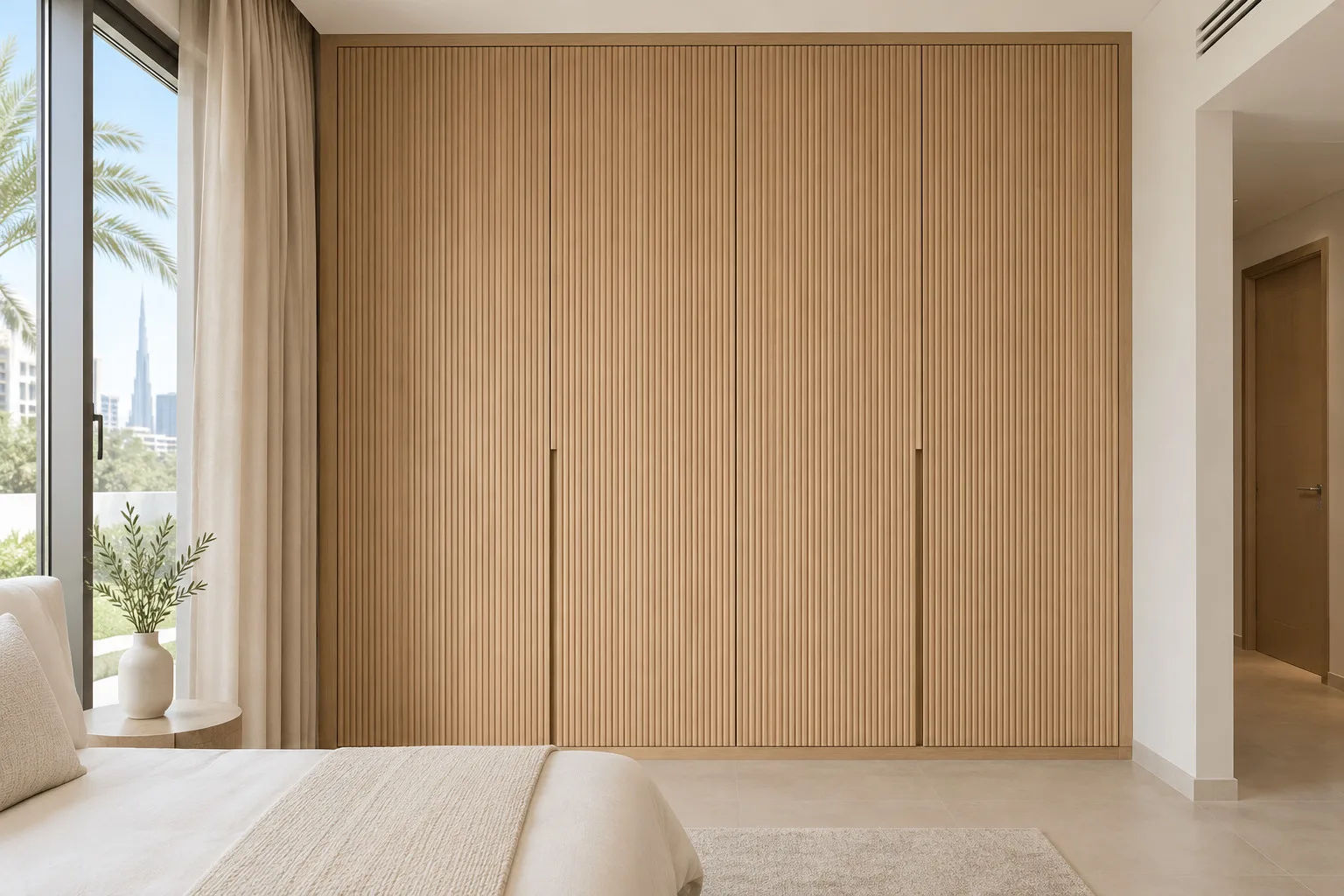
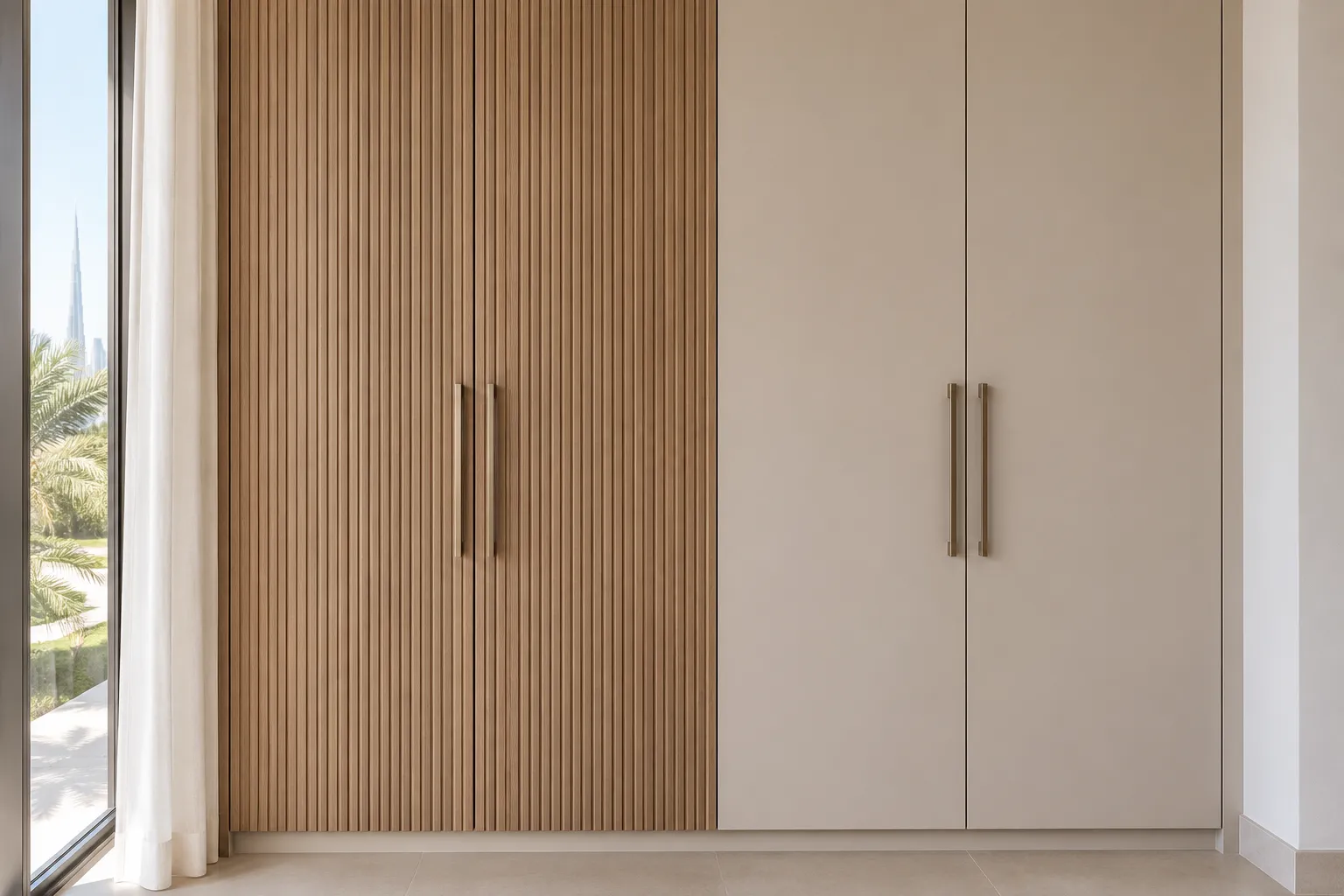
A fluted door is a flat door whose front face carries a row of parallel vertical grooves. One guide describes the grooves as concave channels carved into the surface, and a reeded profile as the opposite, with raised half-round shapes. Shops use both words loosely, and "ribbed" and "grooved" mean the same thing on a quotation, so ask for the profile to be drawn rather than named. The grooves run from the top of the door to the bottom, which is why a wall of doors reads as one tall pleated surface.
The drawing below is a cross-section from above, door face up, in three stages: the grooves, the light and shadow they make, and the dust that settles in them. Every size in it is illustrative; there is no standard groove width for wardrobe doors, and we do not quote one. If you are weighing this against a plain door, our door finishes comparison covers laminate, veneer and lacquer, and this page covers only what the grooves change.
- 1. The flutes: half-round grooves in the front face; their width and the spacing between them are design choices to agree on a drawing
- 2. Light and shadow: light from the side puts a shadow in each groove; light straight on flattens the effect
- 3. Dust: it settles in the groove bottoms, so the cleaning method matters more than on a flat door
Groove width and spacing are design choices
Two decisions make a fluted door look the way it does: how wide each groove is, and how far apart they repeat. One design guide calls the repeat distance "the single most important dimension for visual scale", and warns that a tight repeat on a tall wall can look like fabric instead of joinery. Another guide says wider flutes create deeper shadows and more pronounced vertical lines, while a third says wider flutes give a softer, more subtle sense of dimension. The sources disagree because the effect depends on the light and on how far away you stand, so look at a sample on your own wall before you choose.
That is also why we give no standard size. A narrow, close repeat reads as a fine texture from across the room; a wide, deep groove reads as a strong stripe. In a small room you stand close to the doors and see every groove; in a long hall you see a pattern. Our fluted and slatted TV wall guide works through slat width and gap on a feature wall, and the reasoning carries over, though a door has a hinge side and a handle side that a wall does not.
Groove choices and what they change
Narrow grooves, close together
- What it changes
- A fine texture; the doors read nearly flat from far away; small crevices to clean
- Ask to see
- A sample door on your own wall, viewed from where you stand
Wide grooves, further apart
- What it changes
- A bolder stripe and deeper shadows; the pattern shows from across the room
- Ask to see
- The same sample under your room's light, day and evening
Shallow grooves
- What it changes
- Quieter shadows, a softer look
- Ask to see
- A side view of the profile on the drawing
Deep grooves
- What it changes
- Stronger shadows; more places for dust to sit
- Ask to see
- How the supplier proposes to keep the groove edges clean and sharp
No width, depth or spacing here is a standard or a measurement of our work. The effect depends on the light and the viewing distance; agree the profile on the drawing.
What fluted doors are made in
The usual way to make a fluted door is to start with a flat board and cut the grooves into it. One guide describes precision routers carving uniform vertical grooves into the surface of MDF, which it says provides a smooth, uniform surface that can be painted or finished in different colours. Veneer is the other route that guide names: natural wood and veneer fluted panels bring organic texture and depth. A wood-look laminate or a sprayed finish can also be applied to a grooved face, but we have not found a page we could open that says how a laminate is wrapped round a groove, so that is a question for the supplier, not a claim.
Glass is a different case. Searches do show people asking about fluted and ribbed glass wardrobe doors, but we could not open a source that explains how the effect is made or how heavy the door becomes, so we state nothing about it here beyond a pointer: a glass door needs hinge or track capacity checked against its weight, which our hinges guide explains for hinged doors. Plain mirror doors, heavy in the same way, are covered in mirror wardrobe doors.
Board choice matters more than it seems. The same fluted-panel guide says standard MDF is not a good fit for damp spaces, so a door that will sit near a bathroom, a balcony or an outside wall should be discussed with the board grade in mind: our moisture-resistant boards guide explains what the grades are, and a wardrobe against a bathroom wall lists what to check there. Cutting a groove removes material from the face, so ask the supplier how much board is left at the bottom of a groove and what thickness of door is proposed.
Fluted door materials: what we could and could not confirm
MDF, routed
- What the sources we opened say
- Grooves are carved into the face with precision routers; MDF takes paint and finishes
- What to ask the supplier
- Board grade, door thickness, what is left at the groove bottom
Veneer
- What the sources we opened say
- Natural wood and veneer fluted panels bring organic texture and depth
- What to ask the supplier
- Veneer thickness and how the grain is matched between doors
Wood-look laminate
- What the sources we opened say
- Not confirmed by a page we could open
- What to ask the supplier
- How the laminate covers the groove edges and whether it is bonded after cutting
Spray-painted
- What the sources we opened say
- A painted finish suits MDF, per the guide above; groove edges need care
- What to ask the supplier
- Number of coats, and what a touch-up involves
Glass
- What the sources we opened say
- Not confirmed by a page we could open
- What to ask the supplier
- Whether it is offered, door weight and the hinge or track rating
Our published door finishes are laminate, veneer and lacquer, and we also make wood-look, veneer and spray-painted fronts. Fluted fronts are not on our published list: ask whether they suit your design and budget.
Light and shadow: why fluted doors change through the day
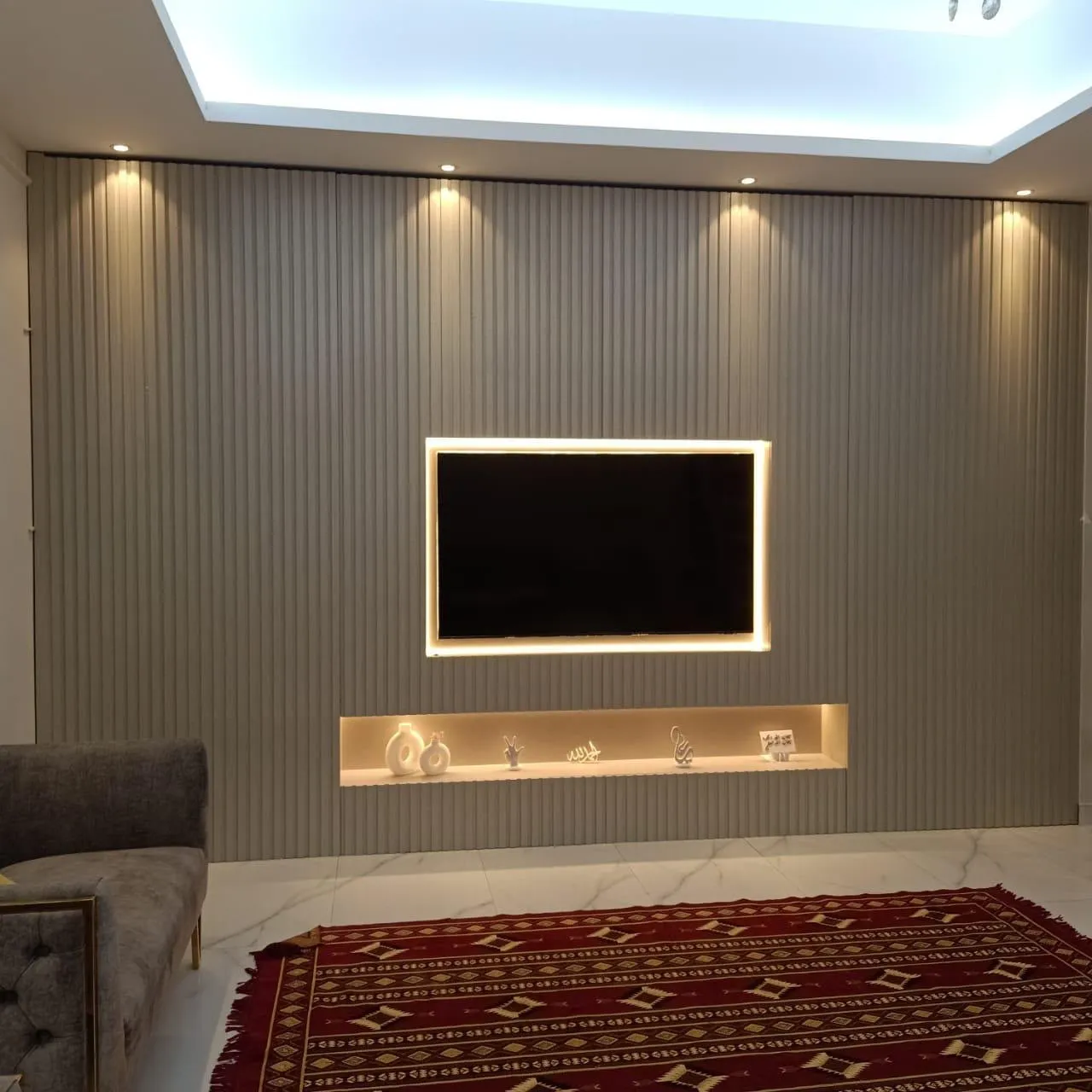
The point of a groove is the shadow inside it. One design guide puts it plainly: the shadows in the groove valleys are what make the panel sculptural. Light that skims across the face, from a window to one side or a strip along the edge of the wardrobe, fills each groove with a shadow and makes the stripes stand out. Light that hits the face straight on, such as a downlight directly above, leaves the grooves with almost nothing to show. The same guide warns that a centre-of-ceiling downlight hits the panel perpendicular and kills all shadow play.
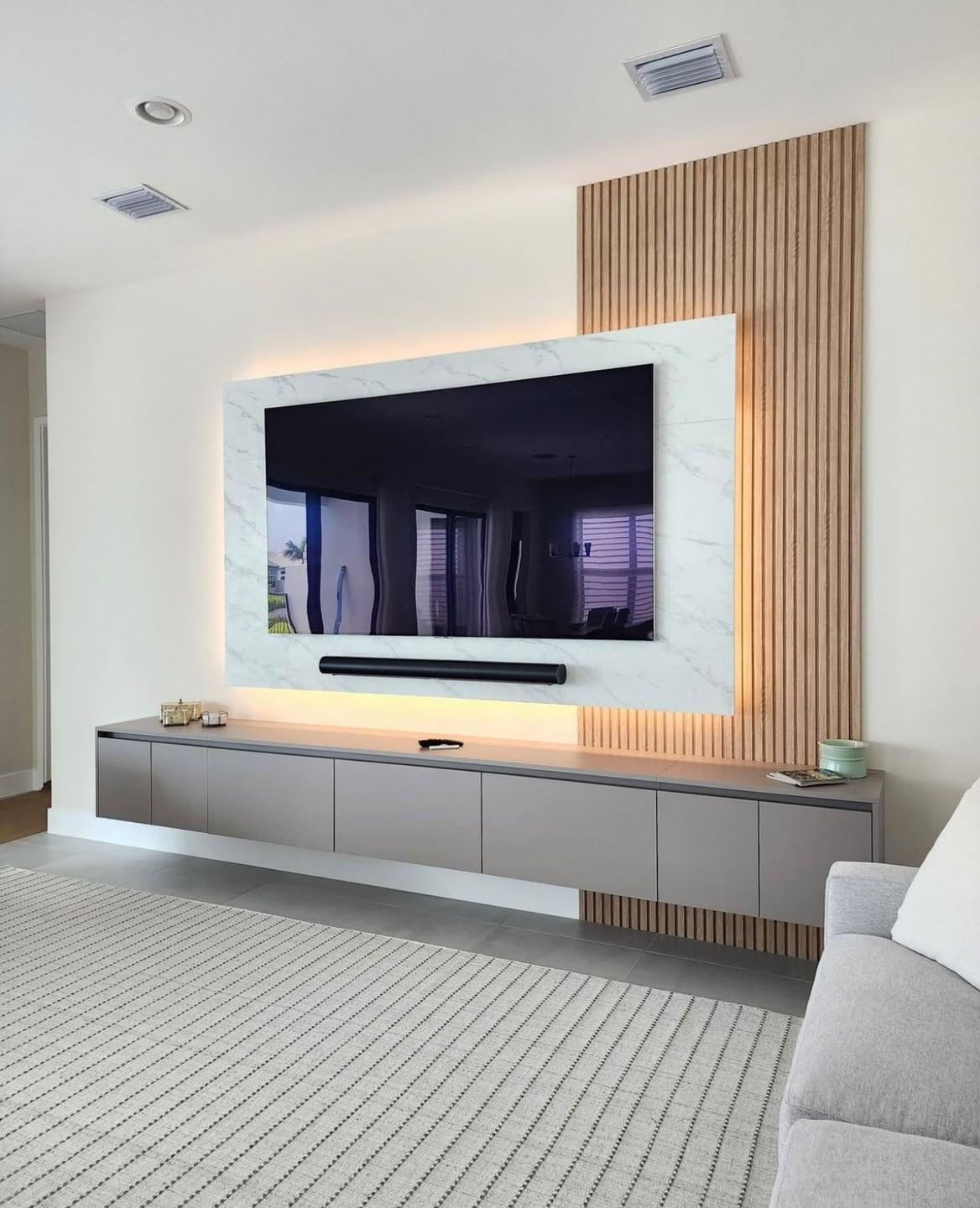
That has a practical meaning for the room. A fluted wardrobe next to a window will look different early in the day and at dusk, and the same doors under an LED strip or a spotlight placed to graze the face look deeper again. If you want the effect, decide where the light comes from before you decide the doors, and see how the wardrobe LED strip and profile comparison places light round a wardrobe. The photo below shows a fluted wall we built, lit from above by downlights set close to the surface; the grooves are deepest where the light grazes them.
Dust in the grooves, and how to clean them
A flat door is wiped in a second; a fluted one holds dust in every groove. The guides agree on this and on the method: the vertical grooves can collect dust, so wipe them regularly with a soft duster or microfibre cloth. Grooves that run vertically at least let dust fall to the bottom of the door and not sit on a shelf of every ridge, which is one reason the profile is almost always vertical.
For routine care, one guide recommends dusting with a soft cloth or a vacuum cleaner with a brush attachment, and another suggests running a brush-attachment vacuum down each groove about monthly. That monthly figure is one guide's suggestion for its own climate, not a rule, so judge by how fast the grooves darken in your home; we do not give a UAE interval because we have no data for one. Harsh chemical cleaners can damage the surface, so use a lightly damp cloth at most (how matt and gloss faces take cleaning is covered in matt versus gloss wardrobe doors), and avoid soaking: that matters most with MDF, which does not like water.
Two choices change how much work this is. Pale doors hide dust longer than dark ones, and a wide, rounded groove is easier to reach than a narrow one. If you rent, think about this before choosing a fine profile for a wardrobe you will clean yourself; our rented apartment wardrobe guide covers what to check in writing. A wardrobe that smells of damp is a separate problem, covered in why a wardrobe smells musty.
- Start high and work down, using a soft brush or microfibre cloth along the grooves, never across them.
- Use the brush attachment of a vacuum along each groove when dust builds up; judge the interval by how the grooves look.
- Wipe the faces with a lightly damp cloth if needed, and dry straight away; no soaking, no harsh chemicals; our guide to cleaning wardrobe surfaces covers the other surfaces.
- Try any cleaner on an out-of-sight spot first, and follow the supplier's finish care sheet.
Flat doors, seams and matching at the joins
A wardrobe is a row of doors, so the place where one door meets the next is where a fluted design succeeds or fails. The aim is that the stripes run on across the gap as if one panel had been cut in two. One design guide advises that on wardrobe shutters the gap between doors must land inside a groove valley, never on a flat between flutes, and that on a wall a seam landed inside a groove is invisible. That is one guide's rule for good-looking joins, and a sound one; it also means the groove spacing and the door width have to be worked out together on the drawing, not left to the fitter.
Flatness matters more on a grooved door than a plain one. A slightly bowed plain door can pass; a bowed fluted door shows a ripple in every stripe, and the gaps between doors drift out of line against the vertical grooves. Ask how the doors are kept flat and how the hinges can be adjusted afterwards.
A fluted door that starts to rub has the same first checks as any other, listed in a door that sticks or rubs. If you are changing existing doors, wardrobe door replacement explains what must be re-measured.
With veneer, matching the grain is a second layer of the same question. A builder in one Fine Homebuilding project took care to line the grain up from the bottom panels to the top ones; a run of veneered fluted doors raises the same point door to door. We could not open a source on veneer matching rules for wardrobe doors, so ask the supplier whether the doors are cut from the same sheet and laid in sequence. A measuring visit also checks level and squareness, because a door cannot line up with a wall that is out of true.
Handleless or slim handles on a fluted door
Fluted doors and handleless doors are often paired, because the grooves can hide the line of a finger pull or a push-to-open door and keep the surface calm. Pairing them has a catch: a handle or a groove cut for a hand must land in the same rhythm as the flutes, and a push-to-open door depends on every gap staying even. Our handleless wardrobe guide lays out the opening methods, and the wardrobe handles guide covers height, finish and the pull types.
A slim handle is the safer choice if the wardrobe will be used roughly, for instance in a children's room: a vertical bar that runs with the grooves disappears into the pattern, while a round knob fights it. Mount height and clearance in the room matter as well, as how much room a wardrobe door needs explains. In every case, ask to see the handle on a sample door and not only on a drawing.
Where a fluted wardrobe works, and where to be careful
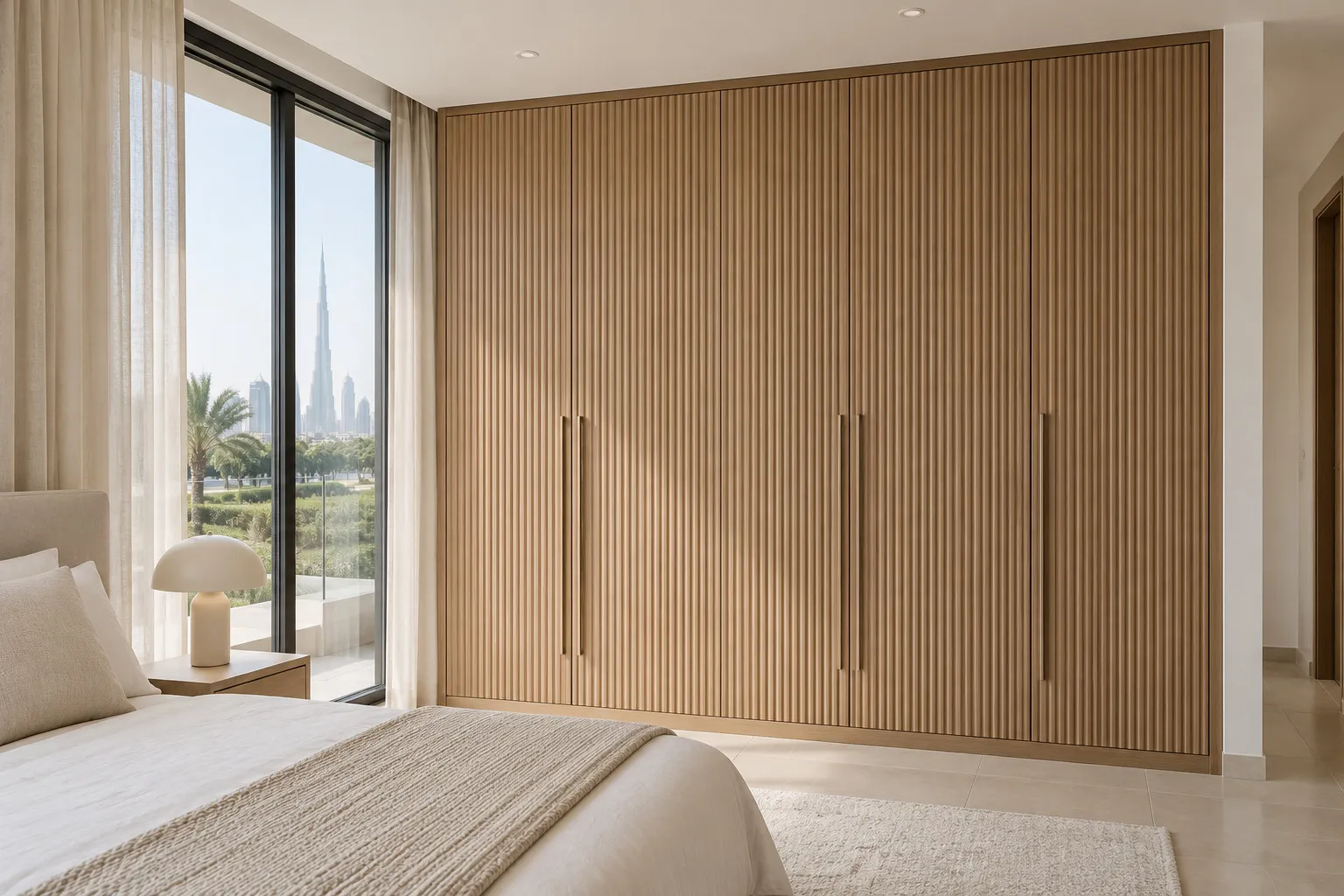
In a bedroom, fluted doors give a long wardrobe wall a texture that flat panels do not, which helps in a large room; the master bedroom wardrobe design guide shows how a run of doors sits against the bed wall. In a small room the grooves add visual busyness at close range, so small bedroom wardrobe ideas is worth reading before you commit.
Beside a TV, the fluted wall and the wardrobe can share one profile so that they read as one surface, which is the idea behind the bedroom wardrobe with TV unit layout.
Finished feature walls are on the media wall with display shelving page. In an entrance or hall, a fluted run can hide a shoe cabinet behind a calm face, and the shoe wardrobe design guide covers pairs per shelf and ventilation.
A floor-to-ceiling run carries the stripes all the way up, so read floor-to-ceiling wardrobes for the gap at the top.
Be careful in a damp room or against a wet wall: the grooves collect moisture and dust together, and standard MDF is not a good fit there, as noted above. For sliding fronts, the rail and rollers set the weight limit, so the sliding door systems guide comes first, followed by the choice between hinged and sliding in the hinged versus sliding guide.
The sliding door wardrobes page shows what we build.
What to ask for on a quotation
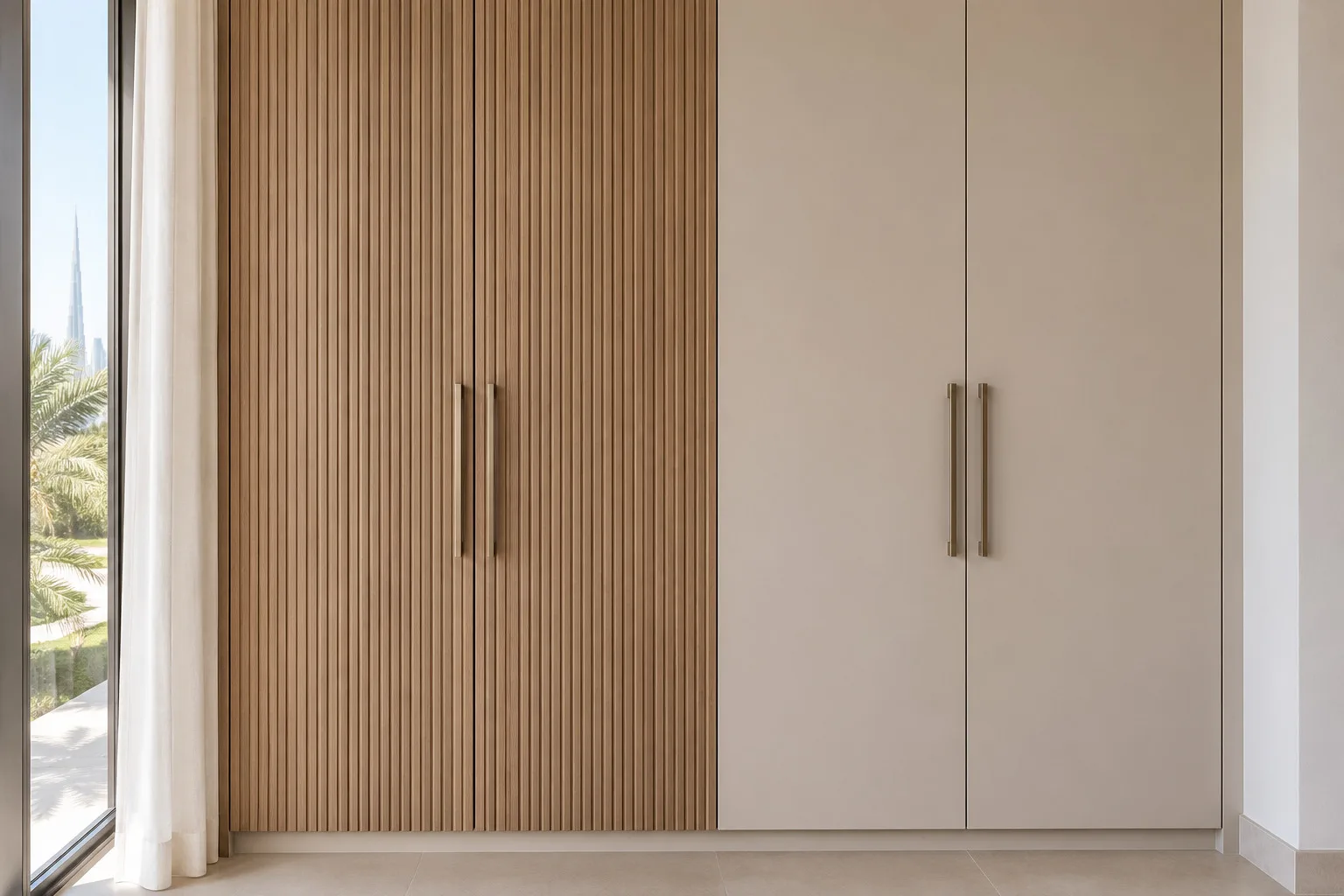
A quotation that says only "fluted doors" has not told you what you are buying. Put the profile on the drawing and the questions below in writing; the general list is in our wardrobe quotation checklist, and the pricing guide shows how a quotation is built. The entry price of AED 550 per sqm is for MDF laminate with hinged doors, installed; a fluted front is not part of that published specification, so ask for it as a separate line.
Fluted door questions for a quotation
Is a fluted front offered, and for which doors
- Why it matters
- It is not on our published finish list
- A clear answer looks like
- A yes or no in writing, with the doors it applies to
Groove width, depth and repeat
- Why it matters
- These set the look and the cleaning
- A clear answer looks like
- Numbers on the drawing, agreed with you
Material and board grade
- Why it matters
- Standard MDF is not a good fit for damp spaces
- A clear answer looks like
- A named board grade and door thickness
Finish and edge treatment
- Why it matters
- Groove edges are where finishes wear first
- A clear answer looks like
- How the finish covers the grooves and how a touch-up is done
Seam position and matching
- Why it matters
- The gap should land inside a groove
- A clear answer looks like
- The drawing shows each gap against the grooves
Flatness and adjustment
- Why it matters
- A bowed door shows in every stripe
- A clear answer looks like
- How doors are checked, and who re-adjusts them later
Cleaning and care
- Why it matters
- Grooves hold dust
- A clear answer looks like
- A written care note for the finish
Our entry price of AED 550 per sqm is for MDF laminate with hinged doors, installed. Other options raise the figure and it is set after measurement.
What we do about fluted doors
Everything starts with a free measuring visit. We bring laminate, veneer and glass samples to your room, measure with a laser, then send a drawing and an itemised price that you approve before anything is made. If you like the fluted look, say so at the visit and ask whether fluted fronts suit your design and budget; we will tell you what is possible for your wardrobe and put it on the drawing and the price. Our custom vs ready-made wardrobe guide explains why a drawn door suits this look better than a stock one.
What we publish and what we do not. Our entry price is from AED 550 per sqm of wardrobe front, installed, for MDF laminate with hinged doors; other options raise it. After the measurements and details are agreed, a 60% advance is paid and production starts once it is received. Our Sharjah workshop builds the wardrobe and our own team installs it up to about 10 days after confirmation, depending on size and design, with a 24-month written workmanship warranty. Separately, the wood-based boards carry a 5-year limited warranty, subject to terms; hinges, tracks, runners, rollers and other moving hardware are not covered, and the written warranty has the final terms, which our warranty guide explains.
Our custom wardrobes service page lists what we make, and the built-in wardrobes page shows finished runs.
For how a measured wall becomes a number, read the wardrobe price guide. Care afterwards is in the warranty and aftercare guide.
The Sharjah page gives the workshop address and the Dubai page covers visits there; installation covers the whole UAE.
When you are ready, book through the consultation form.
To see fluted doors beside every other finish and door choice, use the wardrobe guide index.
Common questions
What are fluted wardrobe doors?
Doors with a row of parallel vertical grooves in the front face. Grooves are concave channels; the raised half-round version is called reeded. Width and spacing are design choices, so agree them on a drawing. See our wardrobe door finishes comparison.
What are fluted wardrobe doors made of?
Commonly MDF with the grooves routed into the face, or veneer; a painted or laminated finish is applied on top. We could not confirm laminate wrapping or glass from a page we opened, so ask the supplier; reeded glass and its privacy are covered in wardrobe glass doors and privacy. See our moisture-resistant boards guide.
Do fluted wardrobe doors collect dust?
Yes, the grooves hold dust. Use a soft brush, or the brush attachment of a vacuum, along the grooves, a lightly damp cloth if needed, no harsh chemicals and no soaking. See our musty wardrobe guide.
Can fluted doors be handleless?
Often yes: the grooves can hide a finger pull or push-to-open line, but handles or cuts must follow the rhythm of the flutes and the gaps must stay even. See our handleless wardrobe guide.
Do you make fluted wardrobe doors?
Fluted fronts are not on our published finish list, so ask whether they suit your design and budget at the free measuring visit and we will put the answer on the drawing and price. See our measuring visit guide.
Where do fluted wardrobe doors work best?
On a long bedroom wall, beside a TV wall in the same profile, or on a calm hall run; be careful in damp rooms. See our master bedroom wardrobe design guide.
What should a quotation say about fluted doors?
The profile on the drawing, board grade and thickness, the finish and edge treatment, where each gap falls against the grooves, and the care note. Our entry price of AED 550 per sqm is for MDF laminate with hinged doors, installed. See our pricing guide.

Sources & specifications
Manufacturer information applies to the named products and systems. Sources reviewed on 4 November 2026.
- USA Builders Depot, fluted MDF panels guide: routers carve uniform vertical grooves into the surface; concave flutes against convex reeding; wider flutes a softer sense of dimension; dust with a soft cloth or brush attachment; standard MDF not a good fit for damp spacesusabuildersdepot.com(opens in a new tab)
- USA Builders Depot, decorative fluted wall panels: wider flutes make deeper shadows; vertical grooves can collect dust; MDF paints well; natural wood and veneer fluted panels bring texture and depthusabuildersdepot.com(opens in a new tab)
- Studio Matrx, fluted panel design guide (written for another country; general design points only): groove shadows make the panel sculptural, a straight-on downlight kills shadow, wardrobe shutter gaps should land inside a groove, pitch sets visual scalestudiomatrx.org(opens in a new tab)
- Fine Homebuilding, That modern look (14 January 2025): a builder lined the grain up across wall panels; used only for the idea of lining grain upfinehomebuilding.com(opens in a new tab)
Want this planned for your home?
Consultation and measurement are free. Tell us the rooms, location and what you need; we arrange a sample visit and define the measured quotation.