Wardrobes · 14 min read · 8 August 2026
Glass wardrobe doors and privacy: clear, tinted, frosted or reeded?
Glass wardrobe doors hide as much as the glass you pick: clear hides nothing, tinted dims the view, frosted gives a soft glow, reeded blurs it into strips. A lit interior shows through all of them. We publish grey or bronze tinted tempered glass; ask for frosted or reeded in the quotation.

By Ali Haider Basra, Founder, Al Tareeq Decor · Contact our workshop
Key takeaways
- Clear glass hides nothing, tinted dims the view to shapes, frosted gives a soft glow and reeded blurs the inside into strips. How tidy and how lit the inside is changes the result as much as the glass.
- We publish grey or bronze tinted tempered glass in slim anodised aluminium frames, and clear glass fronts are offered. Frosted and reeded glass are not published: ask for them in the quotation and ask for a sample.
- Glass is heavy: about 10 kg per sqm at 4 mm, 14.5 at 6 mm and 19.5 at 8 mm, glass only. Tempered glass cannot be cut or drilled afterwards, so the size must be right before it is made.
- A lit interior turns glass into a window. Light only the bays you want to show, and put luggage and bedding behind solid doors.
- Mirror and glass differ: glass shows the inside, mirror shows you. Glass raises the AED 550 per sqm entry price and appears as its own quotation line.
On this page
- Key takeaways
- Glass wardrobe doors and privacy: the short answer
- Clear glass: the interior becomes the display
- Tinted glass, grey or bronze: shapes show, detail softens
- Frosted glass: privacy that depends on how it is made
- Reeded glass: blurred in strips, never fully hidden
- What each glass shows or hides: a comparison
- Clear, tinted, frosted and reeded glass for wardrobe doors
- How tidy the inside needs to be behind glass
- Lit interiors: light changes what the glass hides
- Glass weight and safety: what tempered means and what to ask
- Glass-only weight of one 50 cm by 2.2 m door
- Fingerprints and cleaning glass doors
- Glass or mirror: how to choose
- Glass in sliding doors and in hinged doors
- Privacy on a bedroom wardrobe
- What to ask on the quotation for glass doors
- Glass door questions for a wardrobe quotation
- What we do about glass wardrobe doors
- Common questions
Glass wardrobe doors and privacy: the short answer
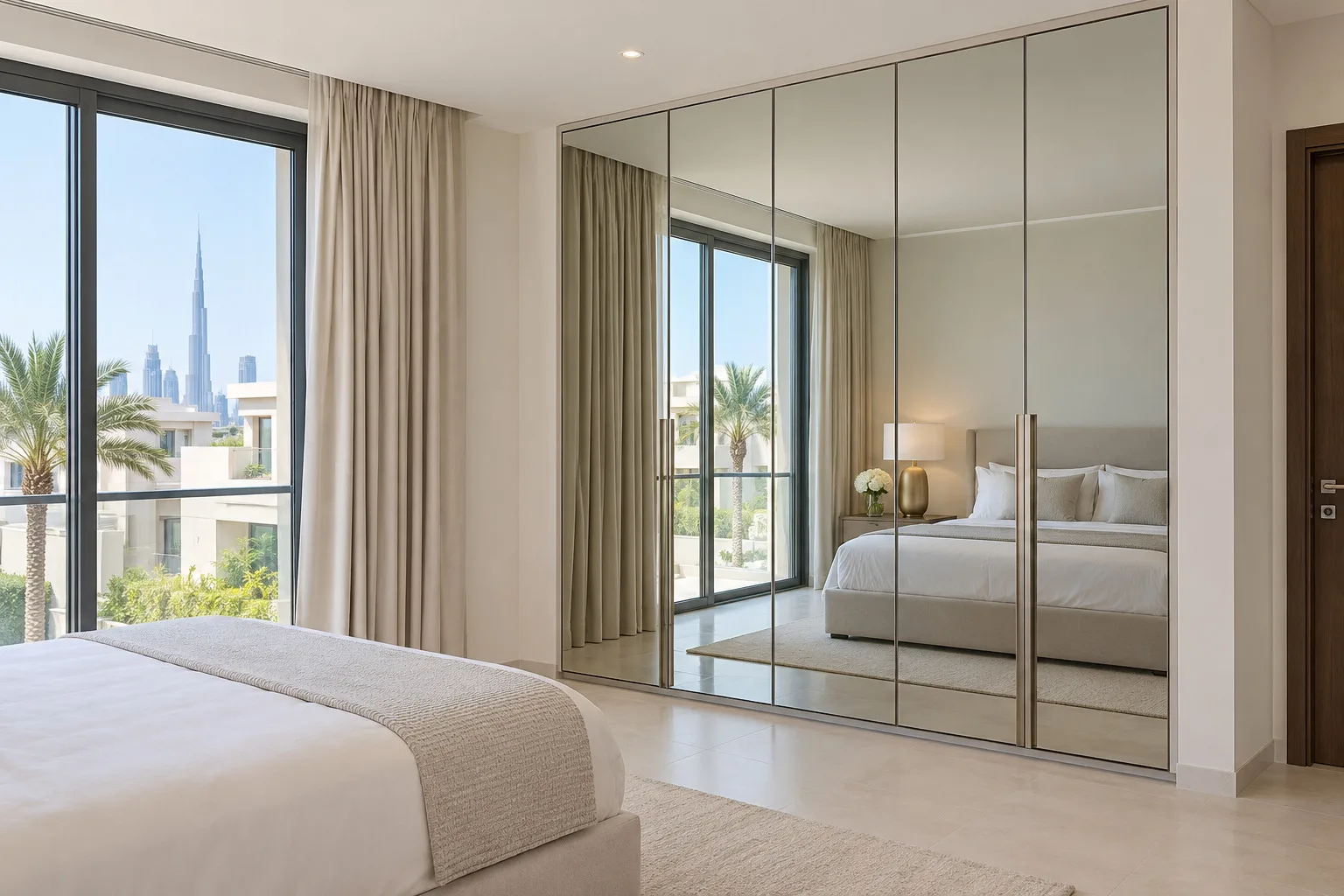
Glass wardrobe doors hide as much or as little as the glass you choose. Clear glass hides nothing, tinted glass dims what is inside and shows shapes, frosted glass turns the inside into a soft glow, and reeded glass blurs it into vertical strips. Two things then change the result more than people expect: how tidy the inside is, and whether the inside is lit.
We publish two of the four. Our glass fronts use grey or bronze tinted tempered glass in slim anodised aluminium frames, and clear glass fronts are offered too. Frosted and reeded glass are not on our published list, so ask for them in the quotation and ask to see a sample before you decide. Mirror doors and glass-fronted designs are both part of our work; the mirror door itself is covered in mirror wardrobe doors, so this page stays with see-through glass.
The drawing below shows the same interior behind four glasses. It is illustrative: real glass differs by sample, and your own light decides the rest.
- 1. Clear: everything inside shows, in sharp focus
- 2. Tinted: shapes and colours show, dimmed by the tint
- 3. Frosted: a soft glow with little detail
- 4. Reeded: blurred in vertical strips; the view depends on distance and angle
- 5. Light on inside: more shows through every glass, so plan the inside too
Clear glass: the interior becomes the display
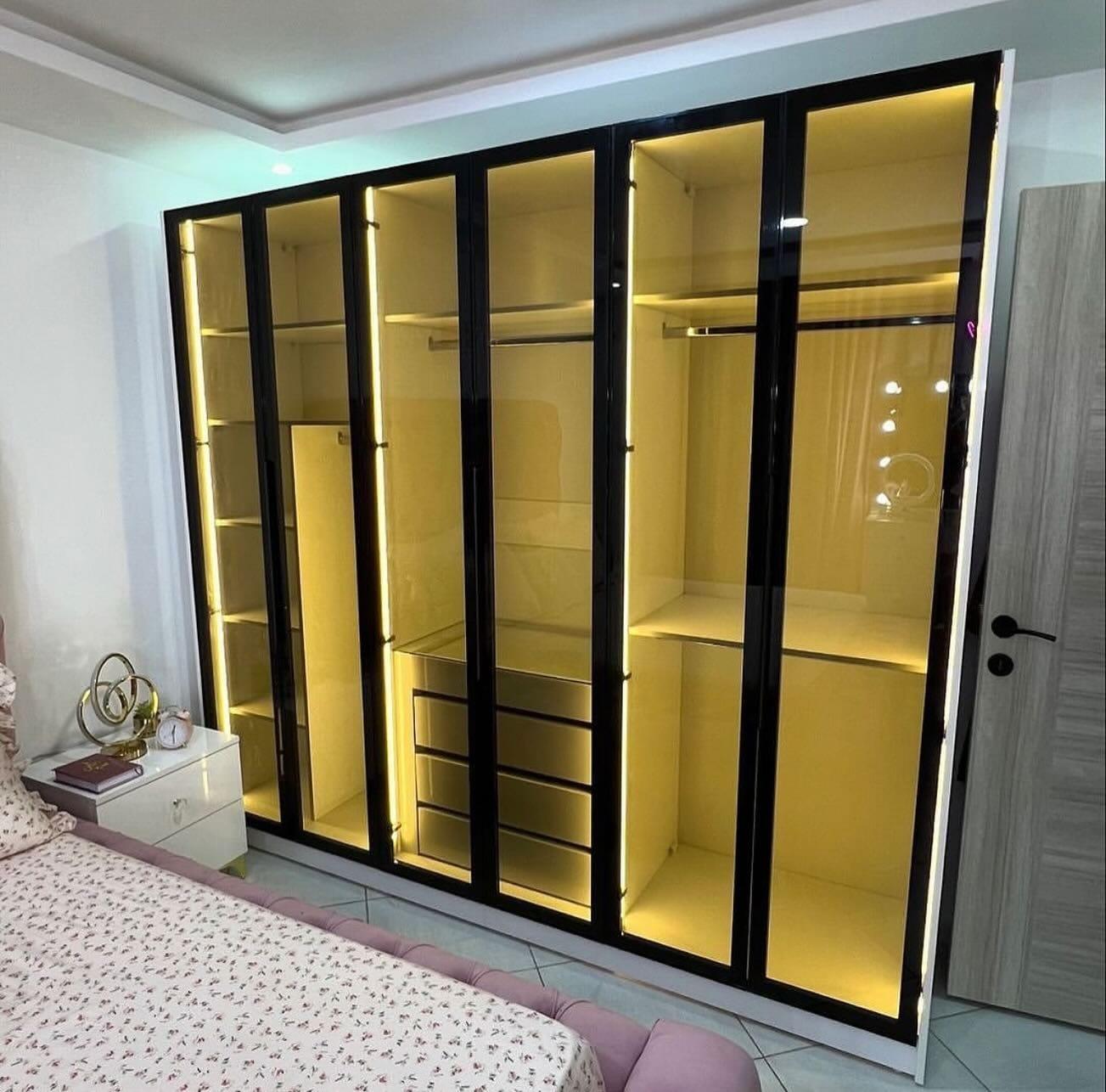
Clear glass is the choice when you want the wardrobe to be seen. Everything behind it is part of the room: hanging rails, folded stacks, shoe boxes and the drawer fronts. Our lit glass-front wardrobes page puts it plainly: clear glass shows every shelf.
That is a good result when the inside is planned for it, and a poor one when it is not. A clear-glass bay suits the things you wear every day, folded in even stacks, with matching hangers; a bay of luggage, spare bedding or the laundry bag does not. The practical answer is to put clear glass on the bays you want to show and a solid door on the bays you do not, which our open or closed wardrobe guide uses to decide what belongs where.
Tinted glass, grey or bronze: shapes show, detail softens
Tinted glass is clear glass with colour in it, so it dims the view without removing it. Pilkington, which makes this kind of glass, lists it in green, bronze, grey and blue and says the "solar control levels and colour density vary according to glass thickness", which means two samples of the same colour can look different. Its page gives no light figure, so we give none: the way to know is to hold a sample against your own clothes.
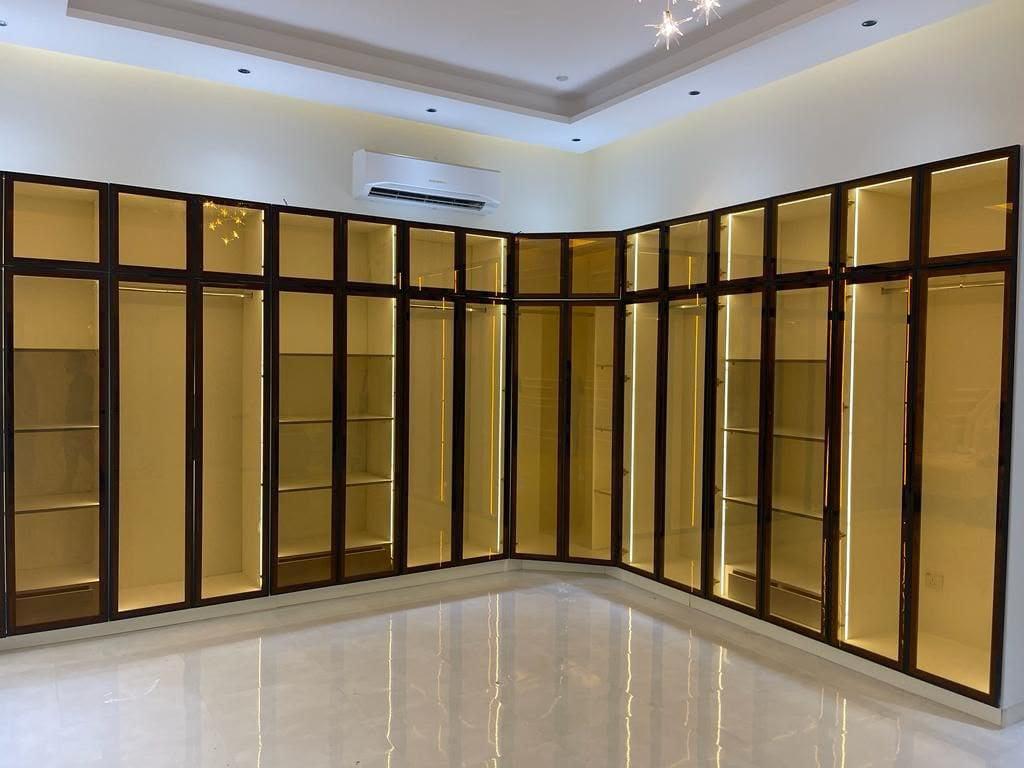
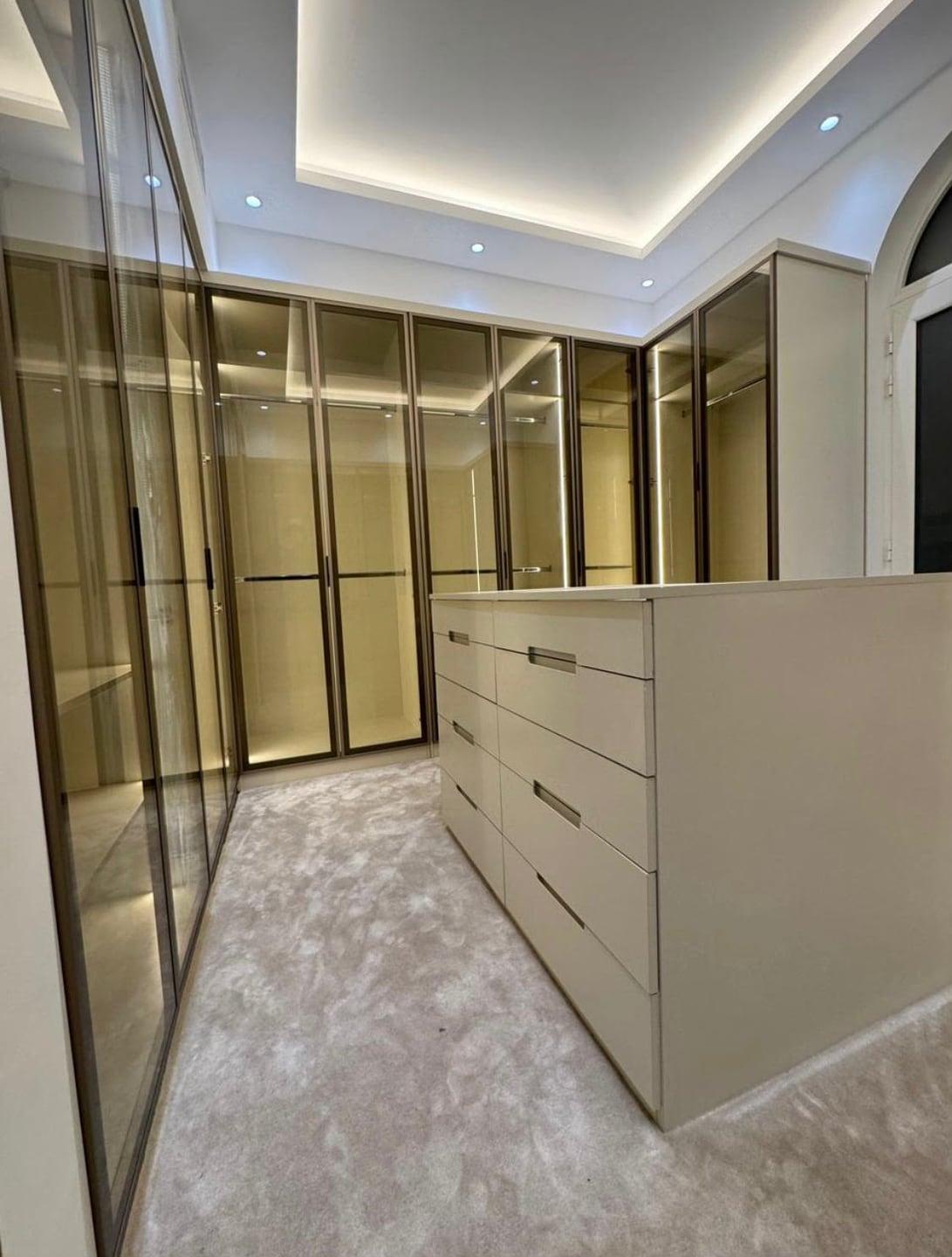
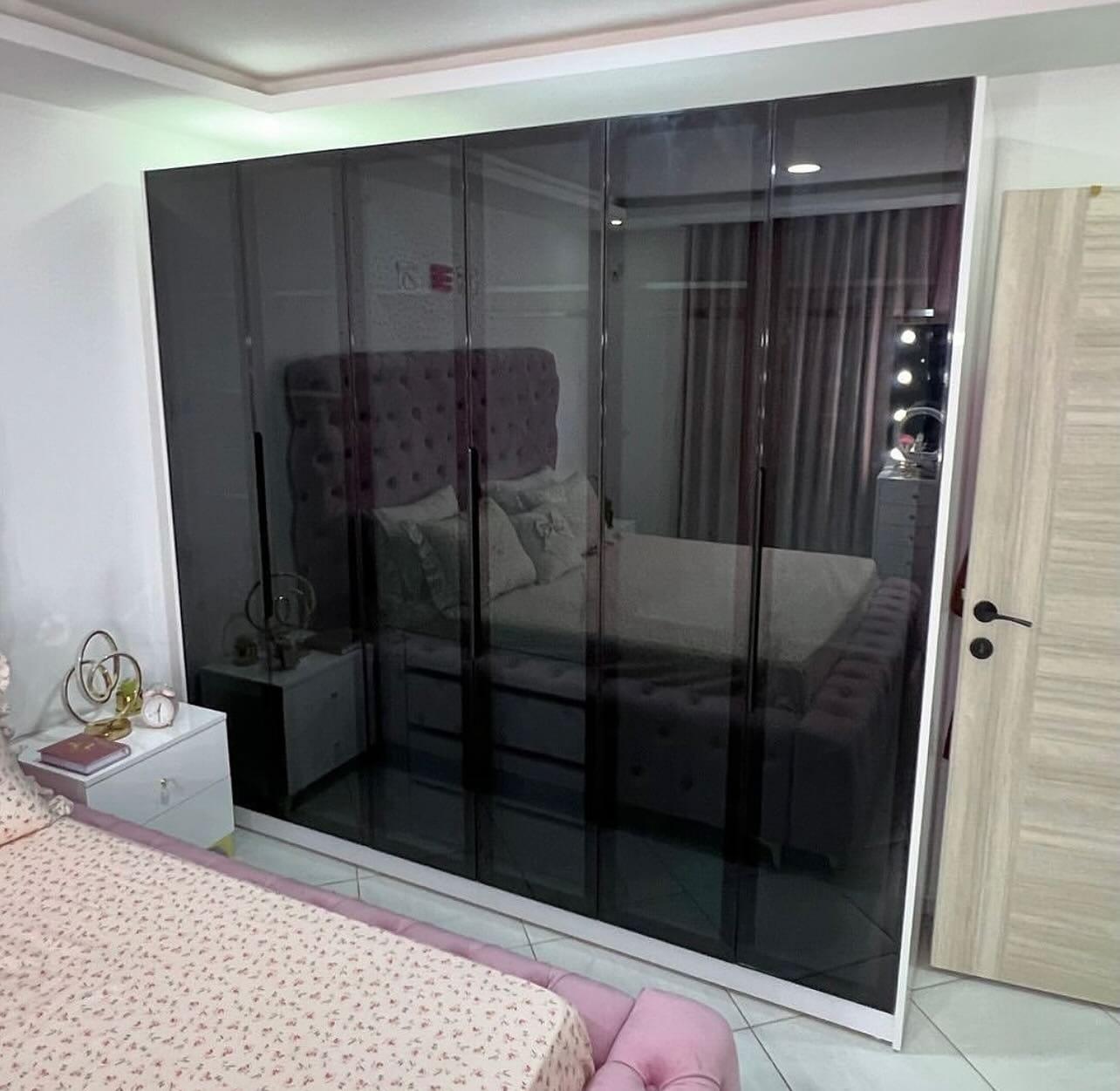
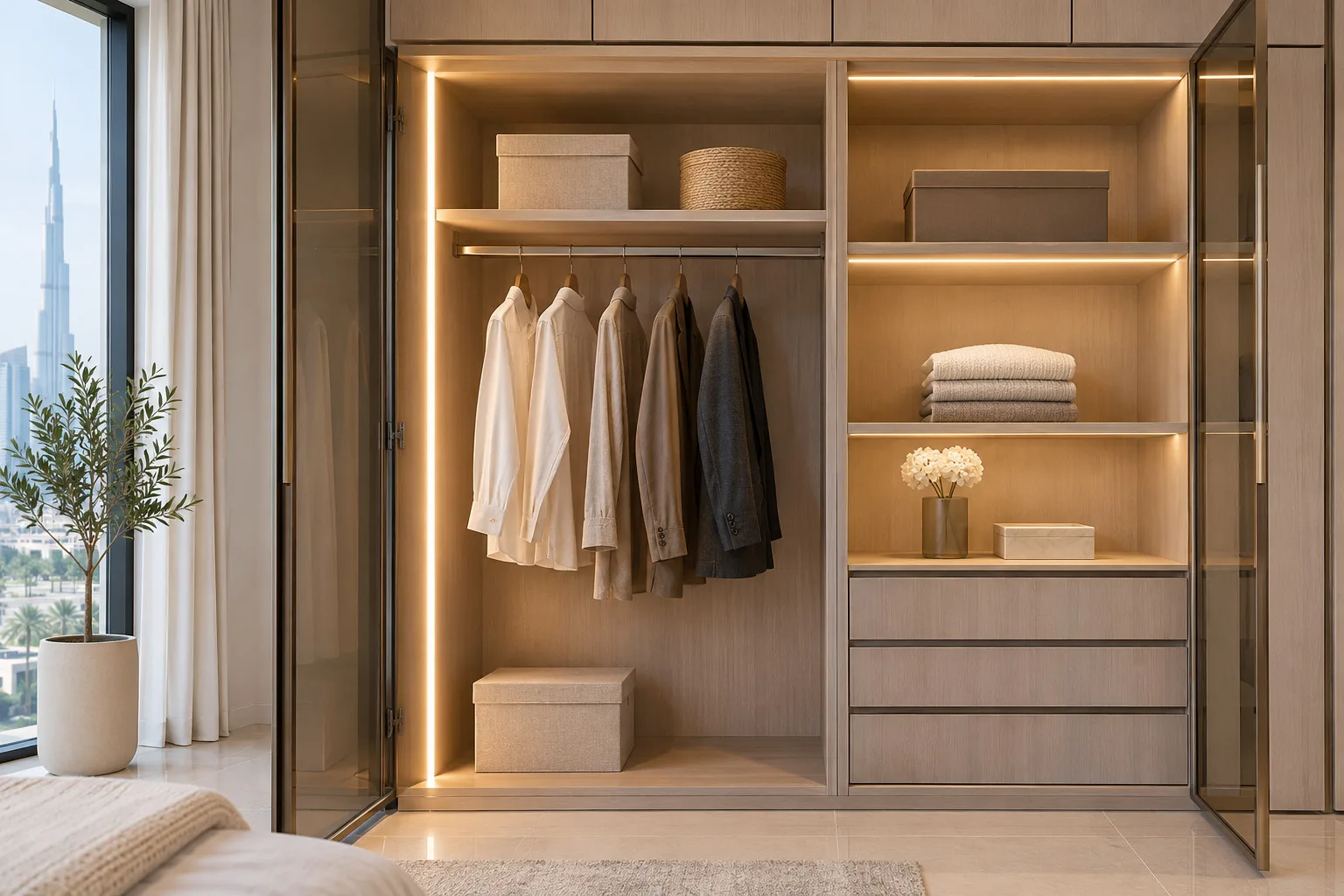
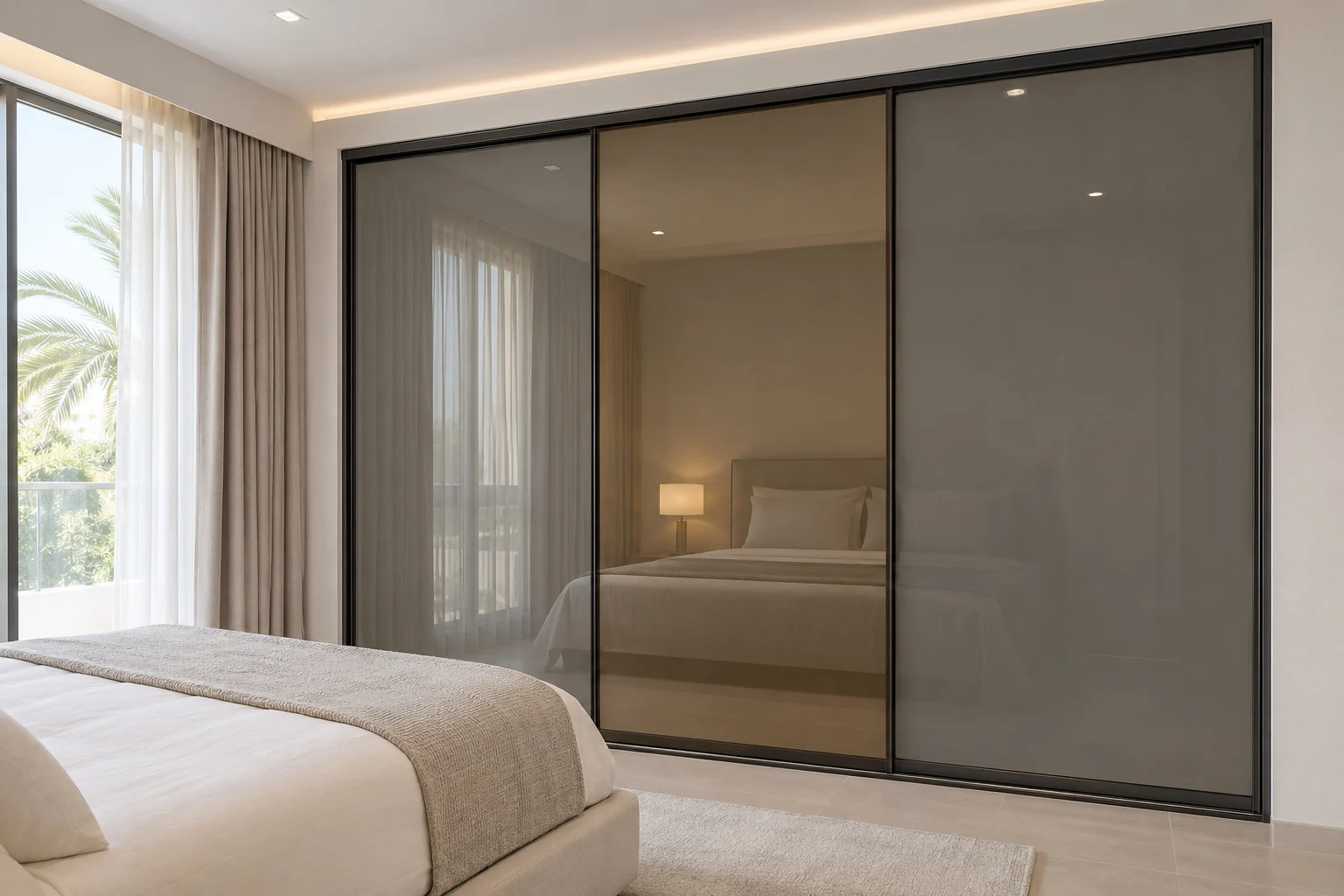
Grey or bronze tinted tempered glass is what our wardrobe fronts use. Our product page says a grey or bronze tint softens the view and forgives a less tidy section, and that matches the photograph below: with the interior unlit, the doors read as dark glass and show the bed and the room more than the clothes. Light the interior and the same glass becomes a window again, as the lit walk-in photo at the top shows.
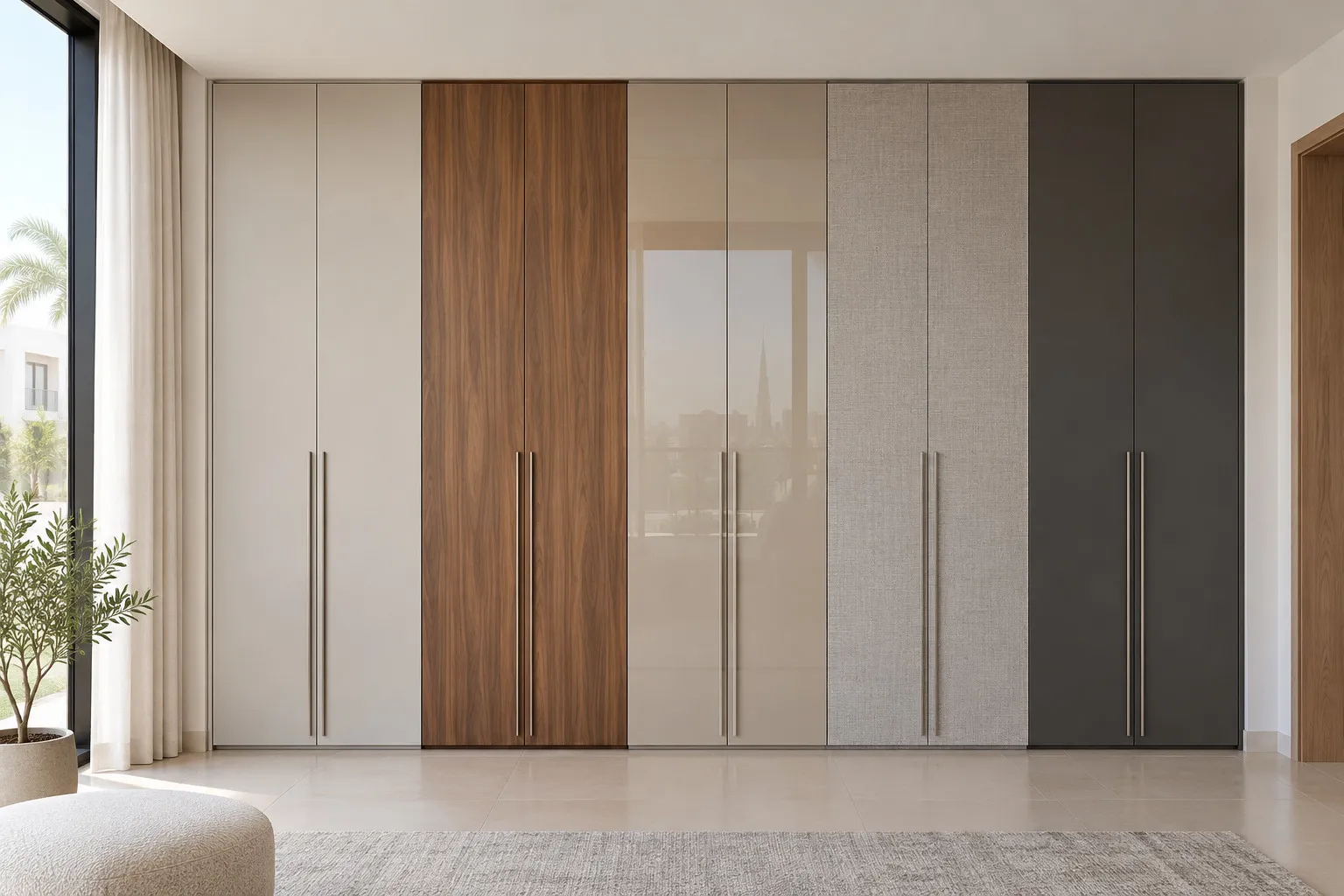
Choose the tint by the room. Grey is neutral and reads cooler; bronze is warmer beside wood and gold tones. The finish of the frame and the colour inside the bay matter as much as the tint, and the door finishes comparison shows how glass sits beside laminate and veneer in one wall.
Frosted glass: privacy that depends on how it is made
Frosted, satin or etched glass has a surface that scatters light, so the inside shows as a soft, even glow with little detail. It is the nearest thing to a solid door that still lets light through, and it is the usual answer when the question is simply "can people see my clothes?".
We do not publish frosted glass, so everything here is general and the details go in your quotation. One thing to ask about is fingerprints: one maker, General Glass, lists its Pearl satin etched glass as "fingerprint and scratch resistant". That is one product, not frosted glass in general, so treat it as a question to put to us, and ask to see and touch a sample, including how it looks with a greasy thumb on it.
Ask which face of the glass is frosted, because the textured face is the one that collects marks and decides how the glass is cleaned, and ask how it will look on your own doors.
Reeded glass: blurred in strips, never fully hidden
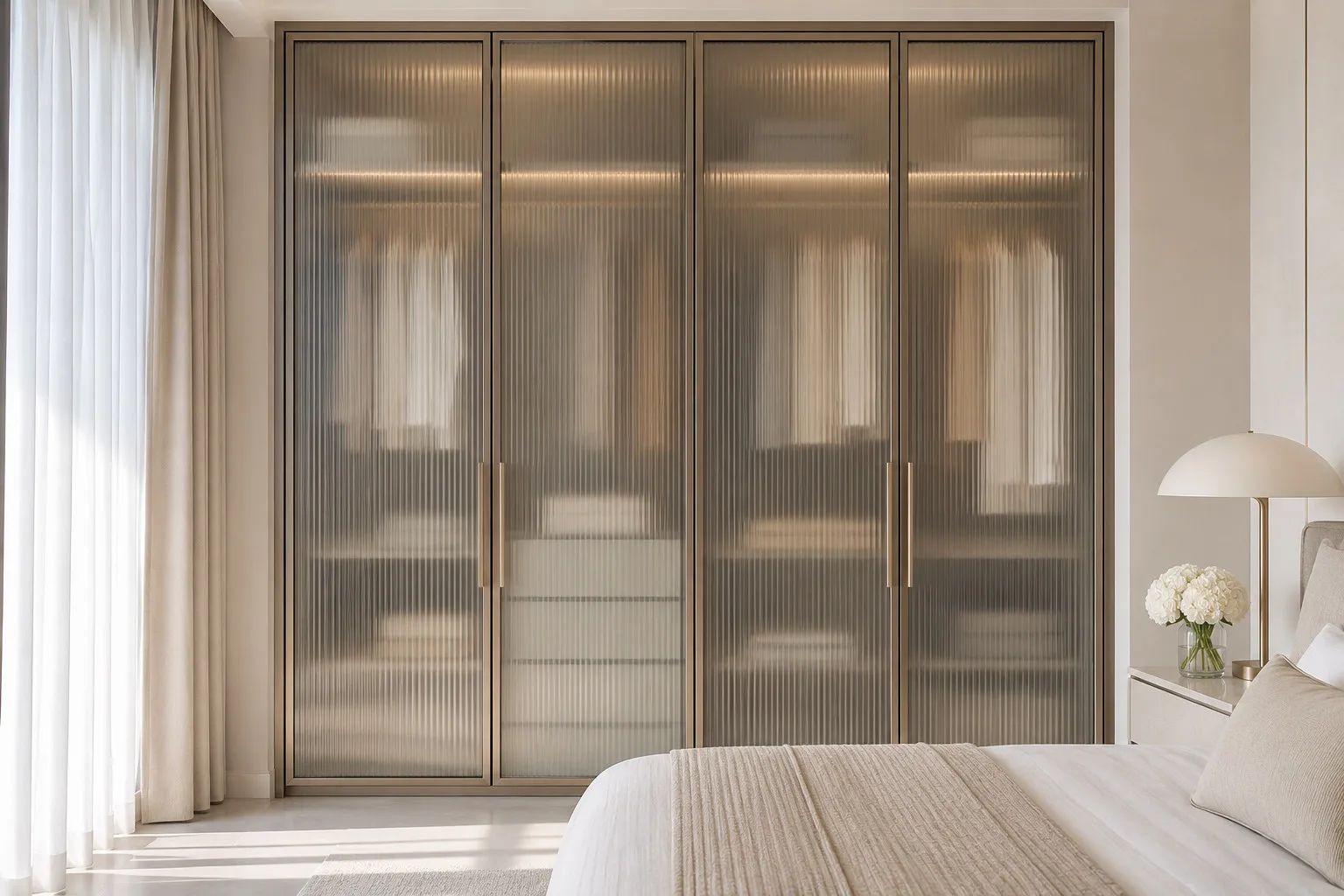
Reeded glass, also called fluted or ribbed glass, has parallel ridges on one face that bend the light and break the view into vertical strips. Stake Glass in New Zealand says its "textured surface helps obscure direct views" and gives "privacy without completely blocking natural light". The key word is "obscure": a reeded bay hides detail and outline, not the fact that something is there.
How much it hides depends on three things we cannot give a number for: the distance of the viewer, the angle, and the light. A lit shelf behind reeded glass shows as glowing bands; an unlit one behind it looks dim and blurred. The same maker lists annealed and toughened options, so a reeded door can be toughened, but whether a given job can be is for the quotation.
Reeded glass is a good partner for a lit interior and a poor one for a shelf of bright, high-contrast things. We do not publish it, so ask for it in writing. If you like the ribbed look but want solid doors, fluted wardrobe doors covers the timber version.
What each glass shows or hides: a comparison
The table puts the four side by side. The first two are what we publish; the last two are the ones to ask for. The privacy column is our own plain-language summary of what the makers say, not a measurement.
Clear, tinted, frosted and reeded glass for wardrobe doors
What you see by day
- Clear
- All of it, sharp
- Tinted (grey or bronze)
- Shapes and colours, dimmed
- Frosted
- A soft glow, little detail
- Reeded
- Blurred in vertical strips
With the light on inside
- Clear
- Everything, brightly
- Tinted (grey or bronze)
- Much more than by day
- Frosted
- A brighter glow, still no detail
- Reeded
- Glowing bands; outline shows
Hides clutter?
- Clear
- No
- Tinted (grey or bronze)
- A little
- Frosted
- Mostly
- Reeded
- Mostly, up close less so
Fingerprints
- Clear
- Show clearly
- Tinted (grey or bronze)
- Show, less on dark glass
- Frosted
- Ask us for a sample
- Reeded
- Ask us for a sample
Do we publish it?
- Clear
- Yes
- Tinted (grey or bronze)
- Yes, grey or bronze
- Frosted
- No, ask in the quotation
- Reeded
- No, ask in the quotation
Best for
- Clear
- A tidy, lit display bay
- Tinted (grey or bronze)
- A dressing wall that should look calm
- Frosted
- Bedrooms where privacy matters most
- Reeded
- A textured look over a lit interior
Our own summary of the makers' pages. Real glass differs by sample and by the light in your room.
How tidy the inside needs to be behind glass
The glass is half of the privacy answer; the inside is the other half. Behind clear glass you need the inside to look as good as the outside: even stacks, one hanger style, matching boxes, shelf edges and rails finished neatly. Behind tinted glass you have more forgiveness, behind frosted or reeded glass a lot more. The honest test is to open your current wardrobe and ask whether you would be happy to see it from the bed.
Plan the inside before the doors. Wardrobe drawers and organisers shows how to give each thing a place, and the hanging heights guide sets the rails. Put the items that cannot look tidy, such as luggage and out-of-season bedding, in solid bays; luggage and seasonal storage shows where. Long garments are better in a solid bay too, as abaya and kandura storage explains.
Lit interiors: light changes what the glass hides
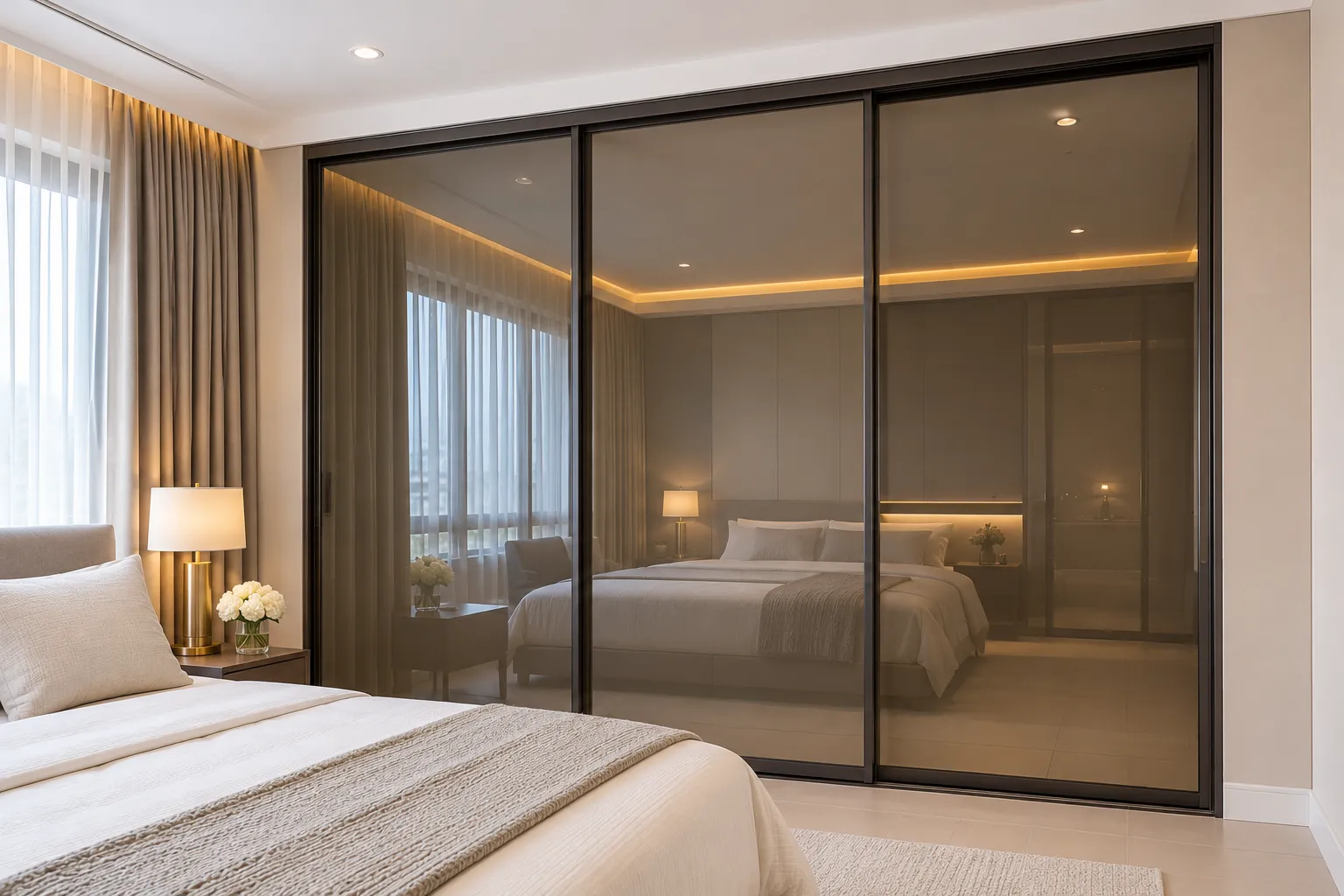
Interior light turns glass from a screen into a window. In daylight, a tinted door mostly shows the room back to you; with a strip lit inside, the same door shows the shelves. So the light is a privacy decision as well as a styling one: light only the bays you want to show, and switch off or leave unlit the ones you do not.
Our own team fits internal LED lighting, and motion-activated lighting is available, so a strip can come on when a door opens rather than glowing all night. How the light is built in, as a surface strip or a recessed profile, changes both the look and what the glass shows, and LED strip or profile in a wardrobe compares the two. For where light goes and how bright, see wardrobe lighting ideas.
Glass weight and safety: what tempered means and what to ask
Glass is heavy. Bendheim gives about 10 kg per square metre at 4 mm, 14.5 kg at 6 mm and 19.5 kg at 8 mm. A door 50 cm wide and 2.2 m tall is 1.1 square metres, so the glass alone is about 11 kg at 4 mm, 16 kg at 6 mm and 21 kg at 8 mm, before the frame and the handle. We do not publish our glass thickness, so ask for it.
Weight decides the hardware, whether hinges or track. For hinged doors, how many hinges a wardrobe door needs sets out the count by weight, and the arithmetic is the same for mirror. Whichever door you choose, ask for the weight of one finished door.
Our glass fronts use tempered glass. GlassOnline, quoting Pilkington, says toughened glass when it breaks "tends to fracture into small, relatively harmless fragments". The other half of the rule is practical: GlassOnWeb says that "once tempered, glass cannot be cut, drilled, or notched". That is why the measurement and the drawing have to be right before the glass is made, and why a wrong size means new glass, not a trim on site.
Glass-only weight of one 50 cm by 2.2 m door
4 mm
- Weight per sqm
- about 10 kg
- One door, glass only
- about 11 kg
6 mm
- Weight per sqm
- about 14.5 kg
- One door, glass only
- about 16 kg
8 mm
- Weight per sqm
- about 19.5 kg
- One door, glass only
- about 21 kg
Bendheim's weights, multiplied by 1.1 sqm and rounded. Glass only: frame, handle and any film are extra. Our own glass thickness is not published; ask in the quotation.
Fingerprints and cleaning glass doors
Clear and tinted glass show fingerprints, especially on dark tint and at handle height. A handle or a pull on the frame, rather than on the glass, keeps most touches off the surface, and the handles guide covers positions. If fingerprints are your main concern with a solid finish, matt or gloss wardrobe doors compares them.
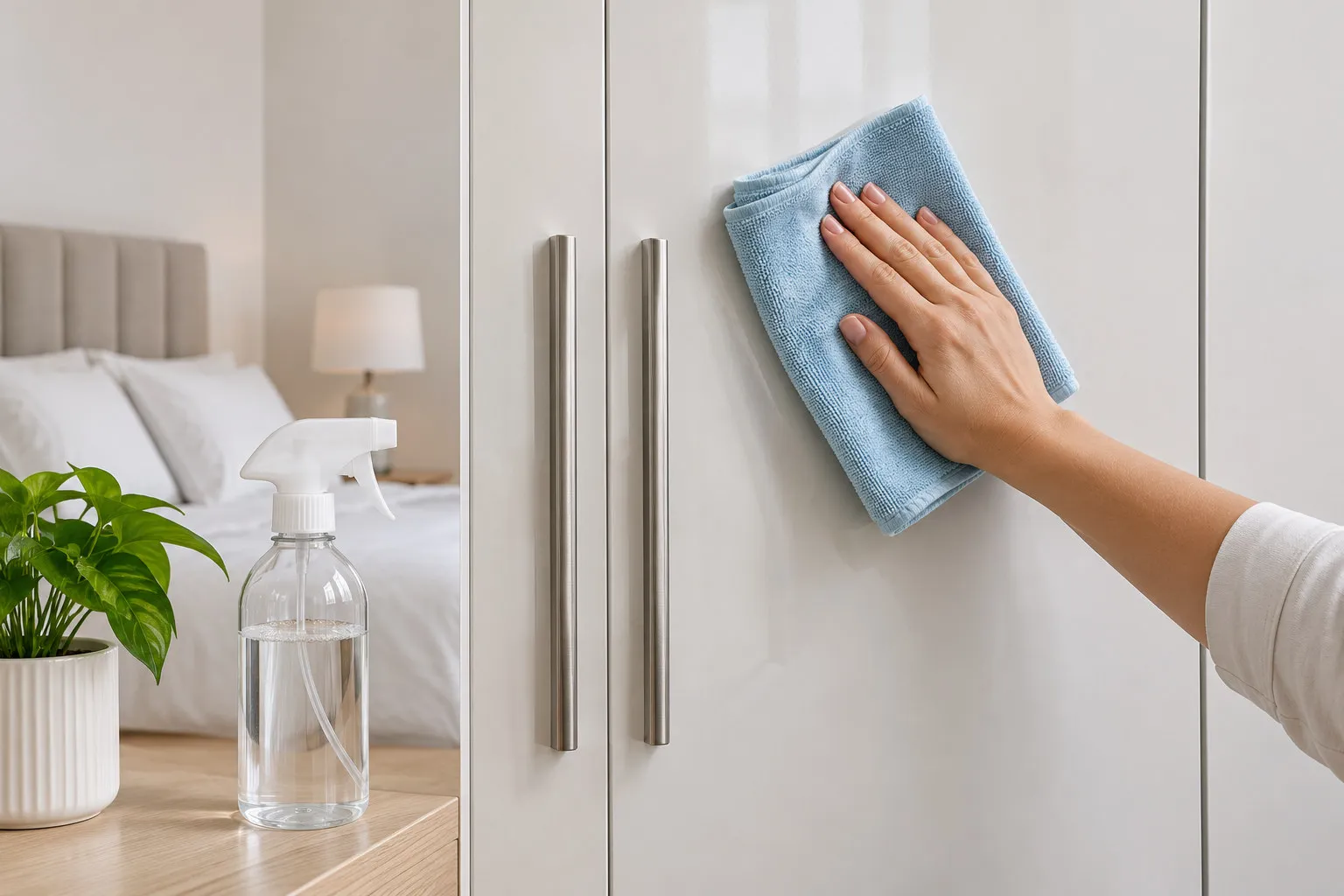
For cleaning, use the method of a cleaning guide written for mirrors, which applies to glass doors in the same way: Kärcher says to moisten the glass lightly, damp not soaked, to avoid rough fibres that can scratch, and to dry with a second cotton or microfibre cloth so no streaks are left (our guide to cleaning wardrobe surfaces has a section on glass, tinted glass and mirror). Its edge warning is about the silvered edge of a mirror, so it does not carry over to clear or tinted glass in a frame, but keeping liquid out of the frame channel is sensible. Ask us for the care advice for the glass you choose, and for frosted or reeded glass ask which face is textured and how to clean it.
Glass or mirror: how to choose
Choose glass when you want to see what is inside, and mirror when you want to see yourself. A mirror door does not show the inside at all, and it sends the room back at you, which is useful for dressing; the weight, safety backing and edge care of mirror are in mirror wardrobe doors. The two can share a run: a mirror leaf where you dress and glass on the bays you want to show.
A mirror is the privacy solution that needs no tidy interior. Glass is the display solution that needs one. In a small bedroom the mirror leaf often does more work; small bedroom wardrobe ideas shows how.
Glass in sliding doors and in hinged doors
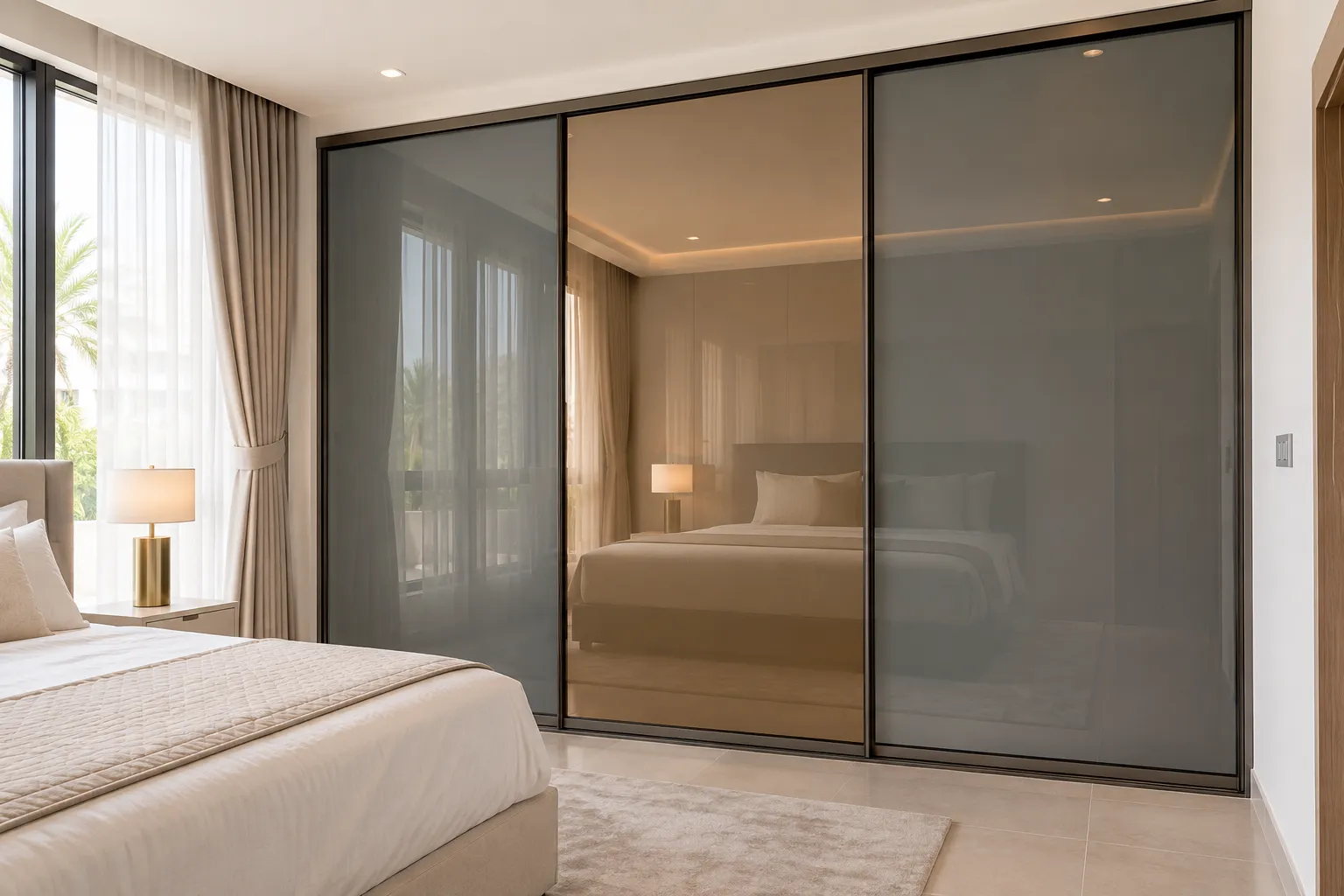
Glass can go in either. A hinged glass door swings on hinges that carry the weight, so it needs its swing space; wardrobe door clearance shows how much. A sliding glass leaf hangs from or runs on a track that has a rated weight per door, so a heavy glass leaf is a track question first, and sliding door systems explains the limits.
Sliding glass leaves overlap, so only part of the wardrobe shows at a time, which is a privacy benefit and a display drawback. How the rails differ is in track types, and hinged or sliding doors compares the two for the room. Our sliding door wardrobes page shows finished examples. Whichever you pick, ask for the weight of one glass door and the rated weight of the hardware in writing.
Privacy on a bedroom wardrobe
In a bedroom the question is usually not strangers but what is seen from the bed, from the doorway and by guests and staff. Pick the glass by who looks. A wardrobe opposite the bed deserves frosted or tinted glass, and clear glass is better in a dressing area that is only seen by you. For a master bedroom wardrobe, a common answer is solid doors in the bedroom and glass in the dressing room beside it, covered in dressing room design.
In a child's room, safety comes first: ask about the glass type and how it is held, and consider solid doors on the lowest bays. Kids wardrobe design covers the room. And in all cases, remember the light: a lit interior behind tinted glass is far less private at night than by day.
What to ask on the quotation for glass doors
Put each of these in writing. The quotation checklist shows what to compare between quotations, and the table covers the glass.
Glass door questions for a wardrobe quotation
Which glass: clear, tinted (grey or bronze), frosted or reeded?
- Why it matters
- Each shows a different amount, and only some are on our published list
Is the glass tempered, and what is its thickness?
- Why it matters
- Sets weight, safety and the hardware
How much does one finished door weigh, and what is the hardware rated for?
- Why it matters
- Decides hinges or track
For frosted or reeded glass, which face is textured and how is it cleaned?
- Why it matters
- Changes how fingerprints and marks show
Which bays are glass and which are solid?
- Why it matters
- Controls what can be seen
Is the interior lit, and does the light come on by motion?
- Why it matters
- Lighting changes privacy at night
Can I see a sample in my own light?
- Why it matters
- A sample settles what a drawing cannot
What happens if a size changes after the glass is made?
- Why it matters
- Tempered glass cannot be cut afterwards
Our own planning questions; the answers go in your quotation, not here.
What we do about glass wardrobe doors
Glass-fronted designs and mirror doors are part of the wardrobe work we do. Our published glass fronts are slim anodised aluminium frames with grey or bronze tinted tempered glass, clear glass fronts are offered, and our own team installs the internal LED lighting. Frosted and reeded glass are not on our published list, so ask for them and ask for a sample.
The measuring visit is free and comes with samples, so you can hold glass against your own clothes in your own light. We send a drawing and an itemised price that you approve before production; after measurements and details are agreed, a 60% advance is paid and production starts once it is received. Our Sharjah workshop in Al Shuwaiheen builds the wardrobe, up to about 10 days depending on size and design, and the workmanship carries a 24-month written workmanship warranty; wood-based boards carry a separate 5-year limited warranty that does not cover hinges, tracks, runners, rollers or other moving hardware, labour, misuse or accidental or deliberate damage. The wardrobe warranty guide explains both.
Our published entry specification is from AED 550 per sqm, installed, for MDF laminate with hinged doors; glass, mirror and lighting raise the figure and we give no number for them, so ask for a quotation after the visit. The wardrobe price guide shows what moves a price. See built-in wardrobes for finished work and our custom wardrobes service, or the Sharjah wardrobe page for the workshop. The pricing guide helps with the budget, and you can book a free measuring visit or read what the wardrobe measuring visit covers.
Glass is one door option; our guide to planning every part of a wardrobe covers the others.
Common questions
Can people see through glass wardrobe doors?
Through clear glass, yes, everything; through tinted glass you see shapes and colours, dimmed; frosted and reeded glass hide most detail. A lit interior shows through all of them. See our lit glass-front wardrobes.
Which glass is best for a bedroom wardrobe where I want privacy?
Frosted or tinted glass, or solid doors on the bays you want hidden; clear glass suits a display bay or a dressing area. We publish grey or bronze tinted glass; ask for frosted in the quotation. See our master bedroom wardrobe design guide.
Do glass wardrobe doors need a tidy wardrobe inside?
Behind clear glass, yes: the inside is on show, so plan stacks, hangers and shelf edges, and keep luggage behind solid doors. Tinted, frosted and reeded glass forgive more. See our wardrobe drawers and organisers guide.
Are glass wardrobe doors safe?
Our glass fronts use tempered glass, which tends to break into small, relatively harmless fragments, according to Pilkington's guidance. Ask for the glass type and thickness in writing. See our wardrobe quotation checklist.
How heavy is a glass wardrobe door?
Glass alone is about 10 kg per sqm at 4 mm and 19.5 kg at 8 mm, so a 50 cm by 2.2 m door is about 11 to 21 kg before the frame and handle. Ask for one finished door's weight. See our wardrobe hinges guide.
How do I clean glass wardrobe doors without streaks?
Use a damp, soft cloth, no rough fibres, and dry with a second clean cloth. For frosted or reeded glass, ask which face is textured and how to clean it. See our wardrobe door finishes comparison.
Is glass or mirror better for a wardrobe door?
Glass shows what is inside and needs a tidy interior; mirror shows you and hides the inside completely. Many wardrobes use mirror where you dress and glass on display bays. See our mirror wardrobe doors guide.

Sources & specifications
Manufacturer information applies to the named products and systems. Sources reviewed on 4 November 2026.
- Pilkington, Optifloat Tint (UK page, March 2026): available in green, bronze, grey and Arctic Blue; solar control levels and colour density vary according to glass thicknesspilkington.com(opens in a new tab)
- Pilkington, Specifying safety and security glass (GlassOnline, 28 February 2022): toughened glass fractures into small, relatively harmless fragmentsglassonline.com(opens in a new tab)
- GlassOnWeb, Architectural glass processing workflow (15 October 2026): once tempered, glass cannot be cut, drilled or notchedglassonweb.com(opens in a new tab)
- Stake Glass, Reeded glass: textured surface helps obscure direct views, privacy without completely blocking natural light, annealed and toughened optionsstakeglass.co.nz(opens in a new tab)
- General Glass International, Pearl satin etched glass: listed as fingerprint and scratch resistant (one product)generalglass.com(opens in a new tab)
- Bendheim: How heavy is glass in relation to its thickness? (about 10 kg per sqm at 4 mm, 14.5 at 6 mm, 19.5 at 8 mm)bendheim.com(opens in a new tab)
- Kärcher, Cleaning mirrors (damp not soaked, no rough fibres, dry with a second cloth)karcher.com(opens in a new tab)
Want this planned for your home?
Consultation and measurement are free. Tell us the rooms, location and what you need; we arrange a sample visit and define the measured quotation.