Wardrobes · 16 min read · 6 July 2026
Wardrobe drawers and organisers: what to plan inside, and what the runners can carry
Plan wardrobe drawers by what goes in them: folded clothes in drawers you look down into, small accessories in one shallow divided drawer. Runners set how far the drawer opens; Hettich lists its Quadro at up to 30 kg and Blum its MOVENTO in 40 kg and 70 kg classes. Ask the quote to name runner, extension, closing and load.

By Ali Haider Basra, Founder, Al Tareeq Decor · Contact our workshop
Key takeaways
- Plan each drawer for one job: deep drawers with loose trays for folded clothes, one shallow divided drawer for watches and small accessories, pull-outs for trousers, ties and belts.
- Runners set how the drawer behaves. Full extension brings the whole drawer out; soft-close slows the last stretch; push-to-open lets a handleless front open at a press.
- Load figures belong to the runner: Hettich lists its Quadro at up to 30 kg and Blum lists its MOVENTO full extension in 40 kg and 70 kg classes. Neither says what any workshop fits.
- Write soft-close hinges and soft-close runners as two quotation lines, each with a brand and a number; a line that says only "soft-close" cannot be compared.
- Entry price is from AED 550 per sqm of wardrobe front; organisers, velvet-lined cells and pull-outs appear as their own lines, priced from the drawing.
On this page
- Key takeaways
- Wardrobe drawers and organisers: the short answer
- Drawers or shelves: decide by how you take clothes out
- Where the drawers sit, and what stands in their way
- Drawer front, drawer box and runner: three parts, three questions
- Full or partial extension, soft-close or push-to-open
- What two makers publish for their runner ranges
- What a runner's load class tells you, and what it does not
- Soft-close hinges on the doors in front of the drawers
- What to put in each drawer
- Drawer jobs and the organiser that suits each
- Dividers and trays: plan them from what you own
- What to ask on the quotation
- Drawer lines to put on the quotation
- What we do about it
- Common questions
Wardrobe drawers and organisers: the short answer
Plan the drawers from what you will put in them, not from the number that fits; if the wardrobe is already built, our guide to adding drawers to an existing wardrobe starts from the box you have. Folded clothes you reach for daily go in drawers you can look down into; small things such as watches, rings and cufflinks go in one shallow drawer divided into cells; and the runners underneath decide how the drawer behaves. A full-extension runner brings the whole drawer out, a soft-close one slows the last stretch, and the load figure a maker prints belongs to that runner, not to the whole drawer.
Two makers show how the numbers differ. Hettich lists its Quadro runner as full or partial extension, with a load capacity of up to 30 kg and soft-close or push-to-open built in. Blum says its MOVENTO full extension has load classes of 40 kg and 70 kg. These are two ranges from two makers, not a rule for all runners, and neither is a statement about what any particular workshop fits. So make the quotation name the runner model and its rated load.
This page covers the inside of the drawer and the hardware under it. The column layout and where drawers sit among the rails are in the wardrobe layout guide, and the widths, depths and clearances are in the wardrobe dimensions guide.
The finished organisers we make are on our custom wardrobe cabinets and organisers page. The drawing below puts reach, rating and tray layout on one sheet; play it through once and the rest of the page reads faster.
- 1. Partial extension: the back of the drawer stays inside the cabinet, so the last part of the drawer is the hardest to see and reach
- 2. Full extension: the whole drawer comes out, so you can look down onto everything in it
- 3. Hettich lists its Quadro runner at up to 30 kg, in full or partial extension, with soft-close or push-to-open built in
- 4. Blum lists its MOVENTO full extension in load classes of 40 kg and 70 kg; each figure is that maker's rating for that runner range, not a rule for all runners
- 5. A shallow accessories drawer works best divided into cells cut to what you own; the cells shown are an example, not a standard layout
Drawers or shelves: decide by how you take clothes out
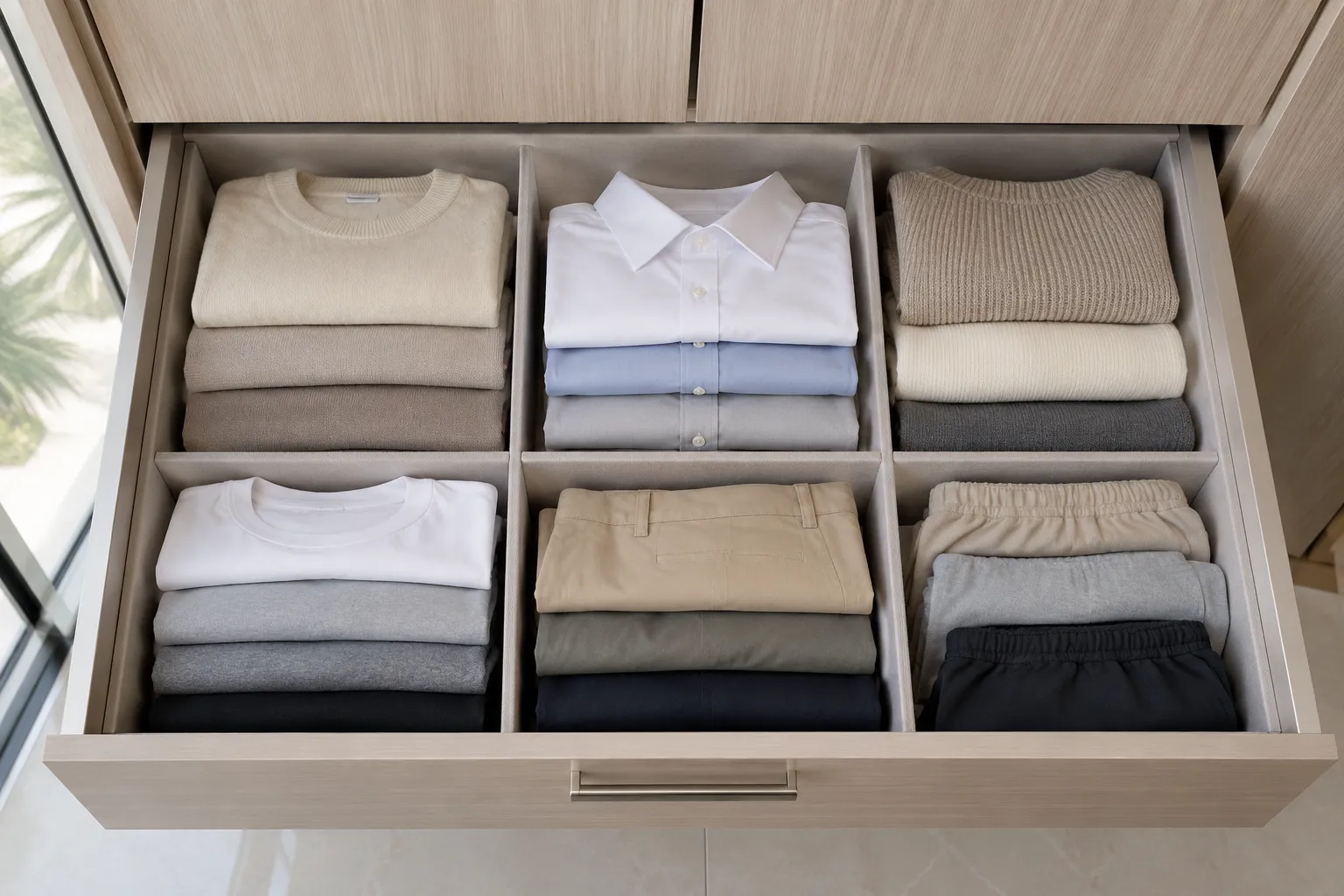
A shelf shows you the front of a pile; a drawer shows you the top of it. That is the whole difference, and it explains most choices. Anything you fold and pick up one piece at a time, such as T-shirts, knitwear and sports kit, is easier to keep tidy in a drawer, because you look down onto the pieces and take one without disturbing the rest. Anything bulky, rarely used or too awkward to fold flat, such as bedding or a handbag you want to see, usually does better on a shelf. The wardrobe layout guide also has a short drawers or shelves section if you want the column-by-column view.
Count before you choose. Lay out the folded things you own, group them by how often you wear them, and the number of drawers follows. A small bedroom with one tall bay can take a short column of drawers under a rail, as the small bedroom wardrobe ideas page shows. To set each rail from your own longest garment, see wardrobe hanging heights. For a large bedroom shared by two people, see master bedroom wardrobe design.
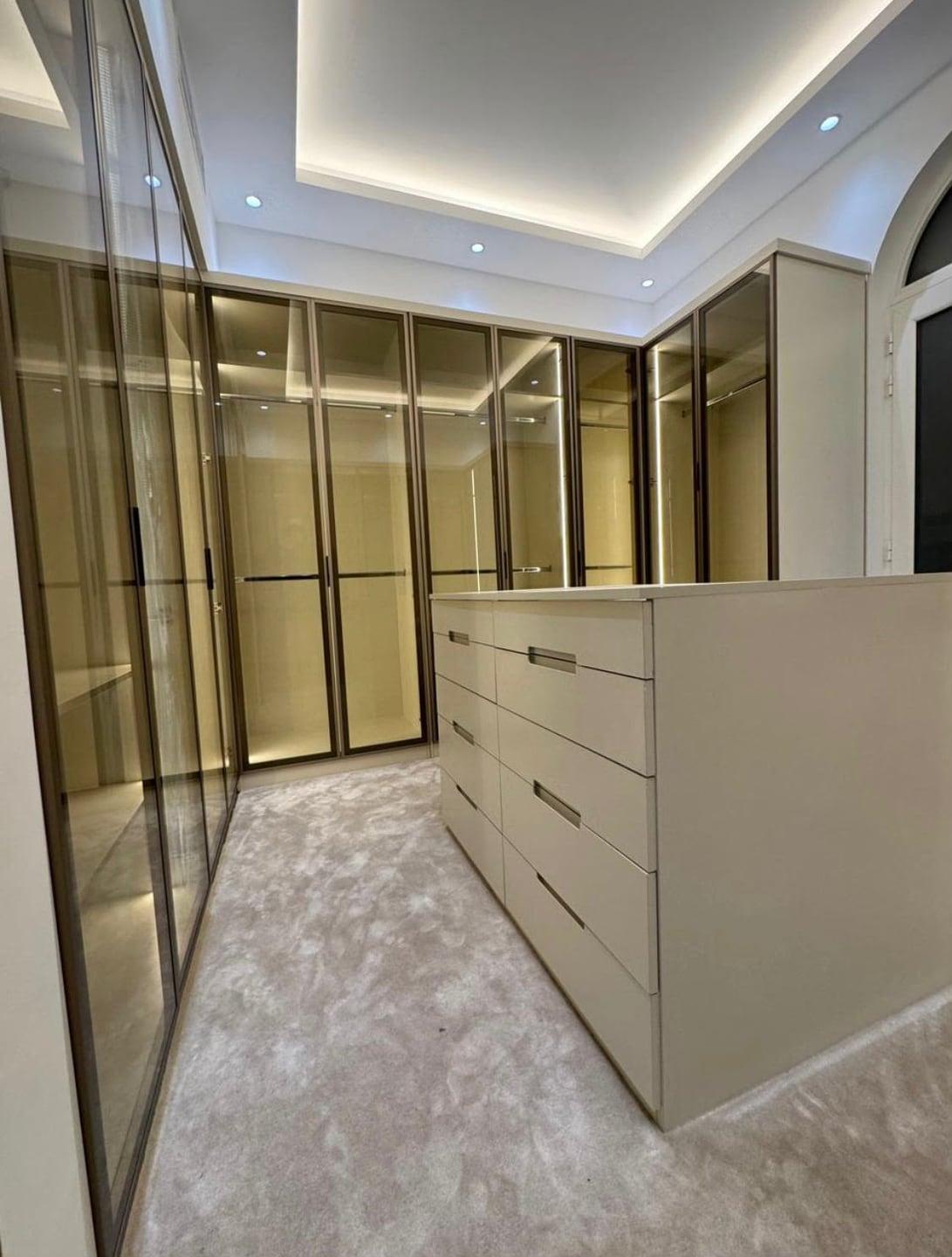
A walk-in closet can hold a freestanding island of drawers, as in the dressing room design guide.
Two households need different answers. A child's wardrobe changes fast, so shelves that can be moved suit it better than a fixed set of drawers; the kids wardrobe design guide explains the growth stages. A shared wardrobe works best with each person's drawers inside their own column, so nobody reaches across the other.
Where the drawers sit, and what stands in their way
Put the drawers you open most where you can see into them without bending far, and keep the very small things nearest the top of the stack, where you look down into them. Heavy or seldom-opened items belong lower. We do not give a single height for every person, because the right one depends on who uses the wardrobe; the knee-to-waist range for folded clothes is explained in the layout guide, and the bay widths and clearances in the dimensions guide.
The door in front of the drawer matters as much as the height. A drawer behind a hinged door can only open once the door is open, and the door must swing clear of the drawer front when both are out, so ask the drawing to show them together; the hinged versus sliding door guide compares the two. Behind sliding doors only the open half of the wardrobe is reachable at once, so a drawer column sits best behind the leaf that stays open or outside the sliding run altogether; wardrobe sliding door systems shows how the leaves travel. If a hinged door rubs the drawer front or sticks, our guide on fixing a wardrobe door that is sticking or sagging has the usual causes.
Three more things get in the way. Handleless fronts need a finger edge or a push-to-open runner so you can open the drawer at all, which the handleless wardrobe guide weighs up. A corner turns drawers into dead space unless the corner is planned, which is the point of the corner and L-shaped wardrobe design page. Pull types, heights and finishes for drawer fronts are covered in our wardrobe handles guide.
A drawer also needs light to be useful, so look at the wardrobe lighting ideas before the interior is fixed, and ask the drawing to show where the light falls when a drawer is open. Our page on wardrobe warranty in the UAE separates the board warranty from the workmanship warranty and explains the usual exclusions.
Drawer front, drawer box and runner: three parts, three questions
A drawer is three things in a row. The front is the visible panel, usually in the same finish as the doors beside it. The box is what holds the clothes, behind the front. The runner is the hardware that lets the box slide, and it sits between the box and the cabinet side. Each one has a different question for the quotation: what the front is made of and whether its gap to the doors is even, what the box is built from, and which runner carries it.
The front is the part you will judge by eye, so the finish choices in the wardrobe door finishes comparison apply to it. The box and the runner are the parts you will never see until the drawer is open, which is why they get left off a quotation that only says "3 drawers". What the box is made from is not something we publish for the workshop, so ask for it in the quotation; the board families and what their labels mean are in moisture-resistant wardrobe boards.
The same three questions apply to drawers elsewhere in the home, such as bedside and sideboard storage or a kitchen joinery run, so the quotation habit carries over.
Runner length comes in steps. Hettich publishes its Quadro in lengths from 250 to 550 mm, so a drawer's depth is set by a runner length that exists, not by an exact figure. If you want a deep drawer or a shallow cabinet, ask which length is fitted and whether it matches the bay behind the front. Taking the wardrobe to the ceiling brings its own checks, listed in floor-to-ceiling wardrobes in the UAE.
Full or partial extension, soft-close or push-to-open
Extension is how far the drawer comes out. A partial-extension runner leaves the back of the drawer inside the cabinet; a full-extension runner brings it all out. For clothes the difference is practical: with partial extension the back of a deep drawer is where things go missing, because you never see it. Blum describes its MOVENTO full extension as giving full access to the very back of the drawer, and Hettich lists both full and partial versions of its Quadro. For a drawer you fill and empty often, ask for full extension.
Soft-close and push-to-open are separate options, and a drawer can have either or both. Soft-close slows the last stretch so the drawer shuts quietly. Push-to-open lets a handleless front spring open when you press it. On Hettich's Quadro the page names a Silent System soft-close or a push-to-open system, integrated in the runner. On Blum's MOVENTO it names BLUMOTION soft-close and TIP-ON single-touch opening, and says TIP-ON BLUMOTION combines the two. Tenants have their own questions, covered in our guide to a wardrobe for a rented apartment, including what to ask the landlord in writing.
What two makers publish for their runner ranges
Hettich Quadro (Hettich DIY page)
- Extension
- Full or partial extension versions
- Load figure published
- Up to 30 kg; lengths 250 to 550 mm
- Closing and opening
- Silent System soft-close, or push-to-open, integrated
Blum MOVENTO (Blum range page)
- Extension
- Full extension
- Load figure published
- Load classes 40 kg and 70 kg; the page's table also lists a further class
- Closing and opening
- BLUMOTION soft-close; TIP-ON single-touch opening; TIP-ON BLUMOTION combines both
Both figures are each maker's own for that runner range, opened 3 Nov 2026. They are not averages for all runners and not a statement about what any workshop fits. Ask the supplier which exact runner and class your quotation means.
What a runner's load class tells you, and what it does not
The load figure is a maker's rating for the runner. It tells you what that runner is designed to carry, and it lets you compare two quotations that name the same range. It says nothing about the drawer box, the way the runner is fixed or the cabinet behind it, and this page gives no advice on those. What you can do is make the quotation specific.
Tell the supplier what each drawer will hold. Underwear and T-shirts are light; a drawer of folded denim, shoes or a boxed watch collection is a different load, and the runner named for it should say so. A quotation that says only "soft-close runners", with no model and no rated load, leaves you nothing to compare; it is the gap the wardrobe quotation checklist closes for hinges. How many hinges a door needs, and what soft-close adds, is covered in the wardrobe hinges guide. Whether your room can afford a walk-in wardrobe instead of a reach-in run is worth settling before the layout is fixed. For shoes, our shoe wardrobe design guide goes into pairs per shelf, depth and ventilation.
Soft-close hinges on the doors in front of the drawers
"Wardrobe hinges soft close" is a different line from a drawer runner, and it is worth asking separately. Blum describes its CLIP top BLUMOTION hinge as having the soft-close mechanism integrated in the hinge boss, adapting to the dynamics of each door, with the function switchable off. That is one maker's hinge, not every soft-close hinge. How many hinges a door needs depends on its weight and height, and the counts per door are in our wardrobe quotation checklist.
Weight changes the count. A glass or mirror door is usually heavier than a board one cut to the same size, as the mirror wardrobe doors guide works out, and a worn or sagging door is the subject of wardrobe door replacement. Write soft-close hinges and soft-close runners as two lines, each with a brand and a number. If you are weighing an old wardrobe, renovate or replace an old wardrobe is a decision guide by symptom. When two people use one wall, our guide to a shared wardrobe for a couple explains how to split hanging length fairly.
What to put in each drawer
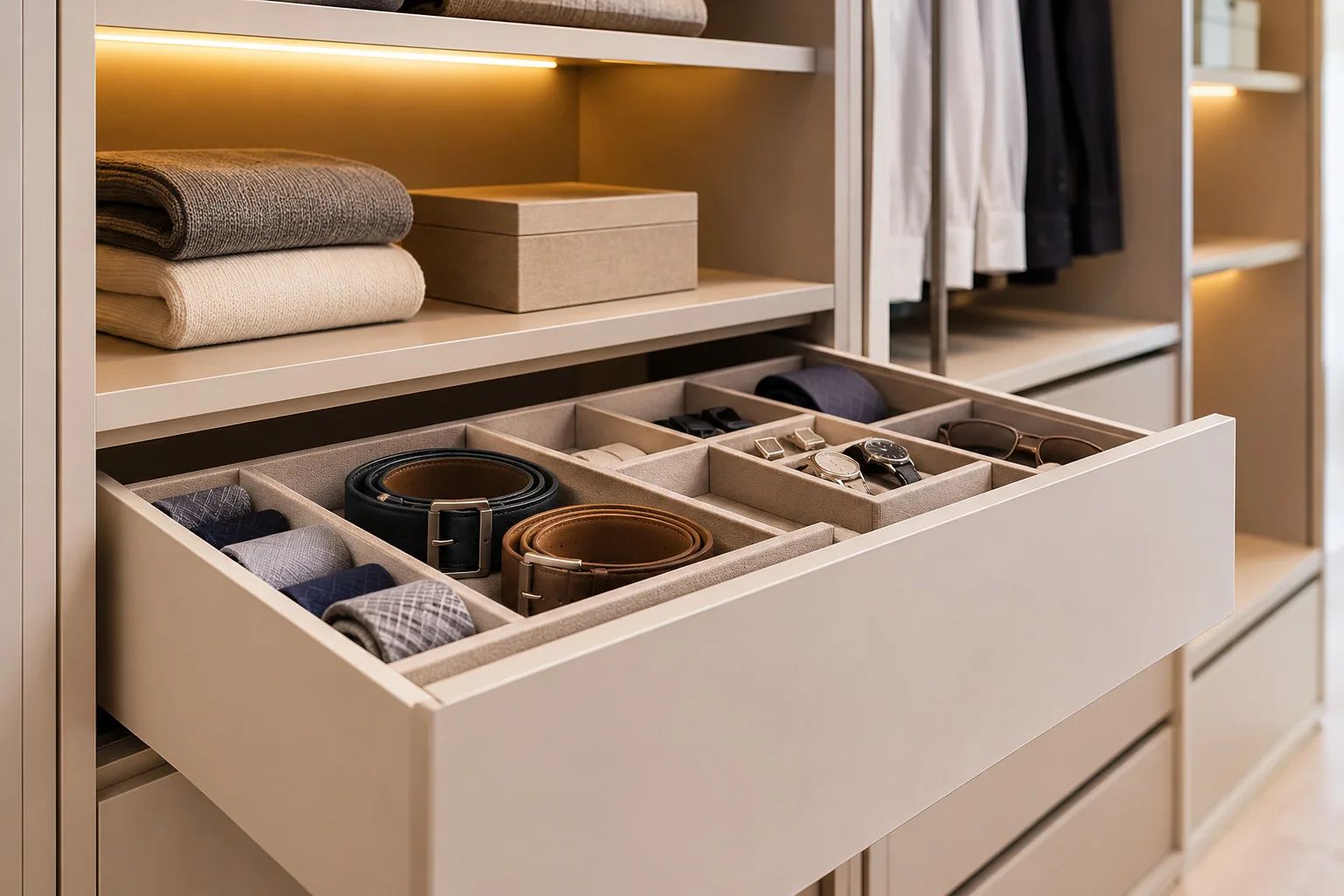
Plan each drawer for one job. A drawer that tries to hold everything ends up holding nothing in order. Folded clothes want a deep drawer with a loose tray to keep piles from sliding. Underwear and socks do best in a shallower drawer where each pair is visible. Accessories, watches and jewellery want one shallow drawer near the top of the stack, with dividers; whether drawers and shelves stay open or sit behind doors is weighed in open wardrobe or closed doors.
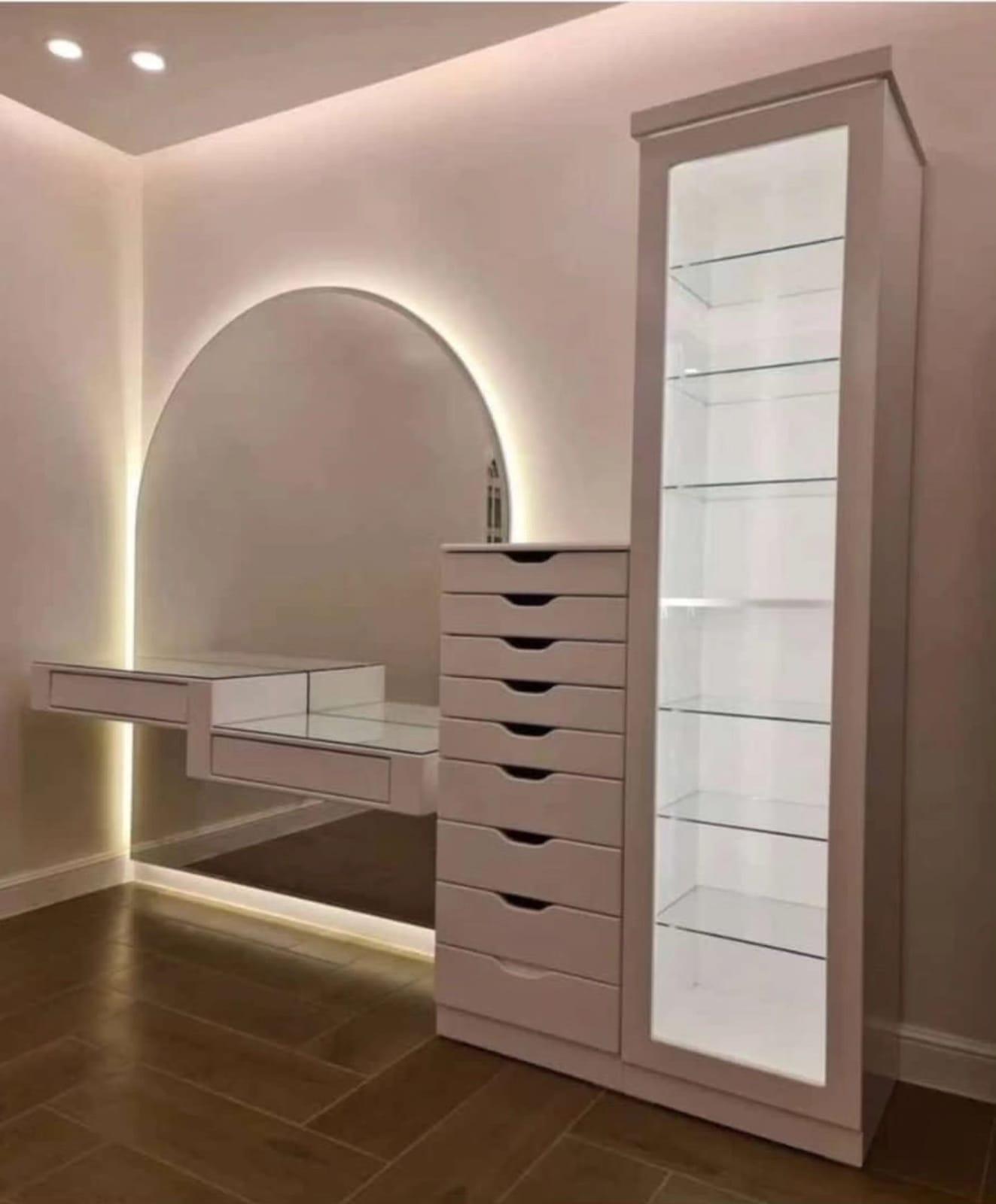
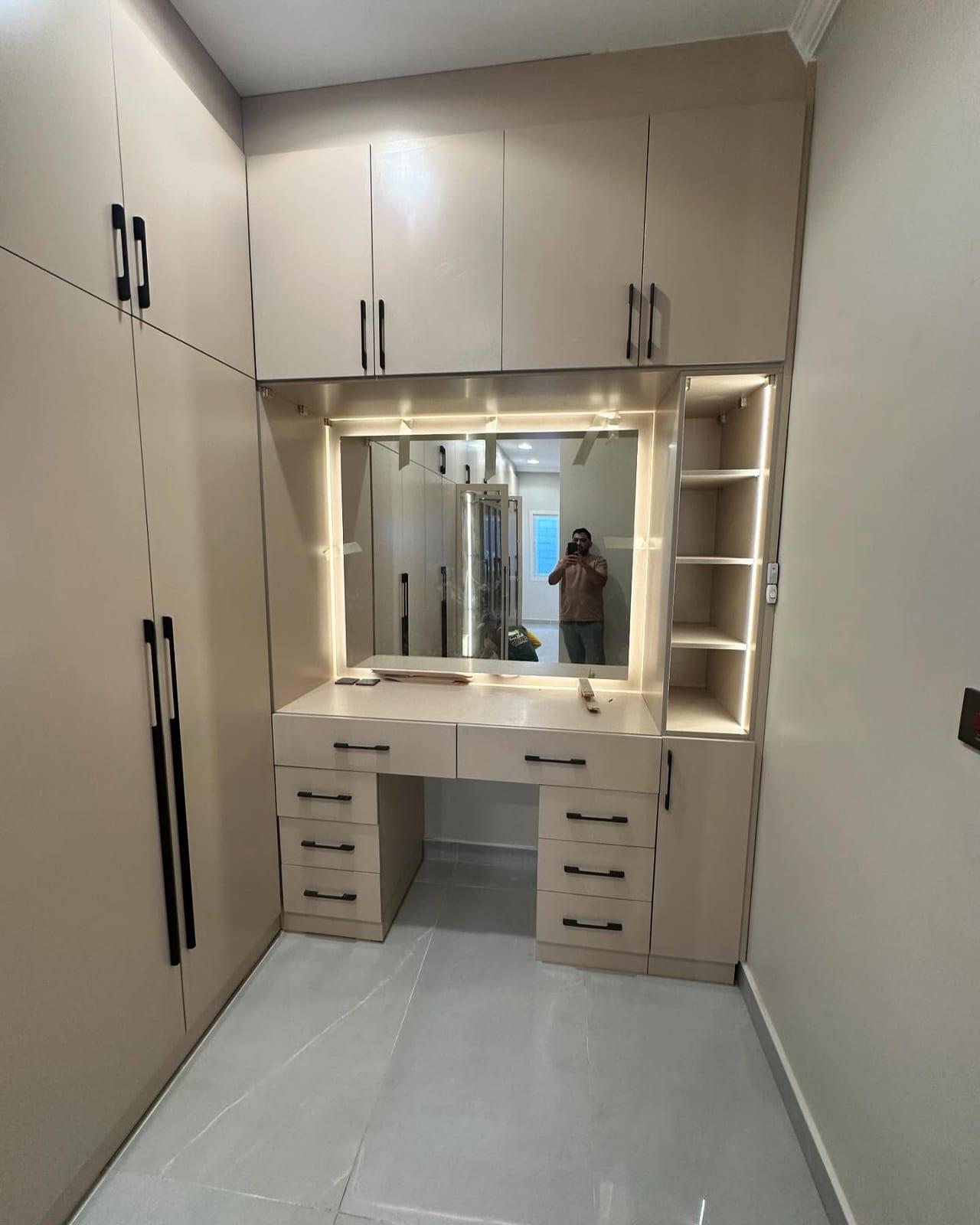
Ties and belts hang or roll in a narrow pull-out; pull-out trouser racks keep every pair visible and uncreased where a drawer would crush them; shoe racks sit low, angled or in pull-out trays. Our published range includes pull-out trouser racks, tie organisers, velvet jewellery drawers and shoe racks, and the shoe storage guide covers the shoe side in more depth. The photo below shows a dressing recess with wide drawers across the top and a column of drawers on each side. Warm or neutral light, strip or profile: our wardrobe LED lighting comparison goes through the choices.
Drawer jobs and the organiser that suits each
Folded T-shirts, knitwear, sports kit
- Organiser that suits
- Loose tray or two dividers across the drawer
- Why
- Piles stay upright and you can rearrange them as the season changes
Underwear and socks
- Organiser that suits
- Small compartments, one per type
- Why
- Each pair visible from above, nothing buried
Watches, rings, earrings, cufflinks
- Organiser that suits
- Shallow drawer, velvet-lined cells cut to each piece
- Why
- Nothing slides or tangles; the lining protects the pieces
Sunglasses
- Organiser that suits
- Long, lined compartment
- Why
- Lenses do not rest on each other
Ties and belts
- Organiser that suits
- Narrow pull-out organiser
- Why
- Each one visible without unrolling a pile
Trousers
- Organiser that suits
- Pull-out trouser rack
- Why
- Every pair reachable, no creasing from a pile
Shoes
- Organiser that suits
- Angled shelves or pull-out trays, low
- Why
- Count the pairs first; keep the everyday ones nearest
These are layouts, not sizes: no drawer inside dimension is a standard, so the cells are cut to your own pieces at the drawing stage.
Dividers and trays: plan them from what you own
Dividers come in two kinds, and the choice is about change. Fixed dividers, cut to your pieces and glued or slotted in, give the best result for small, valuable things: watches, rings, cufflinks. Loose trays and boxes give the most freedom for clothes, because the layout can change the day your wardrobe does. The jewellery side, with a worked example and the cell sizes, is in the dressing table storage layout guide, so it is not repeated here.
A short method works for any drawer. First list what goes in it and how many of each. Then decide which pieces are fixed (watches, rings) and which move (T-shirts, scarves). Then give the fixed ones their own shallow drawer and keep the movable ones in the deeper drawers with loose trays. Bring the list to the visit: a rough tally of watches, jewellery and accessories is exactly what we use to size the cells. If clothes in a closed drawer smell musty, start with the causes in why a wardrobe smells musty. A wardrobe on a bathroom wall has its own first checks in what to check before building against a bathroom wall.
The vanity side is in dressing table inside a wardrobe, and velvet-lined inserts are a separate quotation line, as the dressing unit cost guide shows. Doors that stick or leave the rail are covered in fixing a sliding wardrobe door off its track, including what not to do.
What to ask on the quotation
Two quotations with the same price can contain different insides, and the drawers are where they differ most. Have each line below written out; if something is not yet decided, it should read "to be confirmed", not stay empty. The ten-line check in the wardrobe quotation checklist covers the whole wardrobe; this is its drawer half. Check that the doors have room to open too: our guide on how much room a wardrobe door needs covers the swing against beds, desks and corners.
Drawer lines to put on the quotation
Number of drawers
- Write down
- How many, in which column, at what height
- Why it matters
- The count and position are what you are paying for
Runner brand and model
- Write down
- Named make and range, not "soft-close runner"
- Why it matters
- Gives you something to check against the maker's page
Extension
- Write down
- Full or partial for each drawer
- Why it matters
- Decides whether the back of the drawer is reachable
Closing and opening
- Write down
- Soft-close, push-to-open or both
- Why it matters
- Handleless fronts need one of these
Load class
- Write down
- The maker's rated load for the runner
- Why it matters
- Compare like with like between two quotes
Dividers and trays
- Write down
- What is included, cut to what, in which drawer
- Why it matters
- Velvet-lined cells and loose trays are separate lines
Pull-outs
- Write down
- Trouser racks, tie organisers, shoe racks: each counted
- Why it matters
- A lower total can simply mean fewer pull-outs
Hinges on the doors
- Write down
- Brand, soft-close or not, number per door
- Why it matters
- A separate line from the runners
A line left blank on one quotation is a line to ask about, not a line to assume.
What we do about it
Our wardrobes start from AED 550 per sqm of front for an entry specification (MDF laminate, hinged doors, installed); drawer organisers, velvet-lined cells and pull-outs raise it and appear as their own quotation lines, priced from your drawing. The measuring visit is free and comes with samples, and you approve a drawing and an itemised price before production starts; ask for the drawers, runners and what goes in each to appear on both. Production takes up to about 10 days from order confirmation depending on size and design, and our workmanship carries a 24-month written warranty. Separately, the wood-based boards carry a 5-year limited warranty, subject to terms; hinges, tracks, runners, rollers and other moving hardware are not covered, and the final terms are in the written warranty.
Bought-in parts such as hinges and drawer runners follow their makers' own terms. Which runner or hinge brand we use is not something this page states: ask for it in the quotation, with the extension type, the closing type and the rated load, and read what aftercare covers in the warranty and aftercare guide.
The finished pieces are described on our custom wardrobes service page. Our workshop is in Sharjah, and the custom wardrobes in Sharjah page covers the area; installation is across the UAE.
The measuring visit guide explains what happens when we come to measure, and the pricing guide is the quick estimator before you book. For the rest of the inside, see abaya and kandura storage for long-hang columns, luggage and seasonal storage for a loft and a wardrobe for a studio apartment for one-room plans.
If you want to know where the budget goes, the wardrobe materials cost guide and the custom closets price guide break a quotation down. To see where made-to-measure and ready-made each win, read custom or ready-made wardrobe.
The same inside plan works behind every door type we make: built-in wardrobes and sliding door wardrobes.
A wardrobe that also carries a screen is covered in bedroom wardrobe with TV unit, and the choice between fixed and loose furniture in fitted, built-in and freestanding wardrobes.
Planning a dressing area as well? See custom dressing tables, or browse our made-to-measure wardrobes for the full range. For the depth figures behind this, see our wardrobe depth guide.
Drawers belong to step four of planning; the wardrobe planning overview shows the steps around it.
Common questions
How many drawers should a wardrobe have?
There is no standard number. Count the folded things you own, group them by how often you wear them, and the number follows; one shallow divided drawer for small accessories is the usual extra. See the wardrobe layout guide.
Should I choose drawers or shelves for folded clothes?
Drawers for pieces you fold and take one at a time, because you look down onto them; shelves for bulky or rarely used things. Make shelves adjustable. See small bedroom wardrobe ideas.
What is the difference between full-extension and partial-extension drawer runners?
A full-extension runner brings the whole drawer out; a partial-extension one leaves the back inside the cabinet. Hettich lists both for its Quadro, and Blum describes its MOVENTO as full extension. See the wardrobe quotation checklist.
Do wardrobe drawers and hinges need soft-close?
Not essential, but it keeps drawers and doors from slamming. Soft-close runners and soft-close hinges are separate quotation lines, each with a brand and a number. See handleless wardrobes versus handles.
How much weight can a wardrobe drawer hold?
It depends on the runner and everything else in the drawer. Hettich lists its Quadro at up to 30 kg and Blum its MOVENTO in 40 kg and 70 kg classes; those are the makers' ratings for those runners, not for every drawer. See our warranty and aftercare guide.
How do I organise jewellery and watches in a wardrobe drawer?
In one shallow drawer with velvet-lined cells cut to your pieces, near the top of the stack. Bring a rough list to the visit so the cells are sized to what you own. See the dressing table storage layout guide.
What should I ask on a wardrobe quotation about drawers?
Number and position of drawers, runner brand and model, full or partial extension, soft-close or push-to-open, the rated load, and which dividers and pull-outs are included. See our custom wardrobes service.

Sources & specifications
Manufacturer information applies to the named products and systems. Sources reviewed on 3 November 2026.
- Blum, MOVENTO range: full extension gives full access to the very back of drawers; load bearing capacity of 40 kg and 70 kg (its table also lists a further class); adaptive soft-close BLUMOTION; TIP-ON single-touch openingblum.com(opens in a new tab)
- Hettich DIY, drawer runners: Quadro full or partial extension, load capacity up to 30 kg, lengths 250 to 550 mm, Silent System soft-close or push-to-open integrateddiy.hettich.com(opens in a new tab)
- Blum, CLIP top BLUMOTION hinge: soft-close integrated in the hinge boss, adapts to the dynamics of every door, can be switched offblum.com(opens in a new tab)
Want this planned for your home?
Consultation and measurement are free. Tell us the rooms, location and what you need; we arrange a sample visit and define the measured quotation.