Joinery · 14 min read · 2 June 2026
Shoe storage and entrance cabinets: sizes, ventilation and layouts
How many pairs an entrance cabinet really holds, how deep it must be, tilt-out or shelves, air and smell, a bench and mirror, and narrow halls, with a diagram.

By Ali Haider Basra, Founder, Al Tareeq Decor · Contact our workshop
Key takeaways
- Count your pairs first: a pair takes about 20 cm of shelf, so a 120 cm cabinet holds about 39 pairs in real life, not the 60 on paper.
- Depth sets the shelf: 30 to 35 cm for flat shelves, about 25 cm for angled shelves, about 17 cm outside for tilt-out drawers.
- Use adjustable shelves for at least a third of the cabinet, sized to the tallest shoe plus 3 to 5 cm.
- Give the cabinet air: slots high and low, a raised plinth and sealed edges; never put wet shoes in.
- In a narrow hall subtract a 70 to 90 cm walkway from the width to find the depth, and add a bench, a mirror and a hook bay.
On this page
- Key takeaways
- Shoes arrive at the door, so the storage has to be there too
- Count the pairs before you draw the cabinet
- Pairs by cabinet width, 180 cm of tiers
- How deep: 33, 25 or 17 centimetres
- Tilt-out drawers, angled shelves, flat shelves or open racks
- Ways to store shoes, compared
- Shelf heights: the tallest shoe plus a hand
- Air, smell, sand and summer damp
- A bench, a mirror, hooks and somewhere for the keys
- Narrow hallways and entrance consoles
- Doors and handles for a hall
- Glass fronts and lit cabinets by the door
- Price, the visit and fitting
- Common questions
Shoes arrive at the door, so the storage has to be there too
In most UAE homes shoes come off at the entrance, and they pile up exactly where people walk in. A visit from relatives can add several pairs at a time, and the sandy ones need somewhere to go before they reach the floor tiles. A cabinet right at the door solves that, but only if it is planned for the pairs, the depth of the hall and the way the door swings.
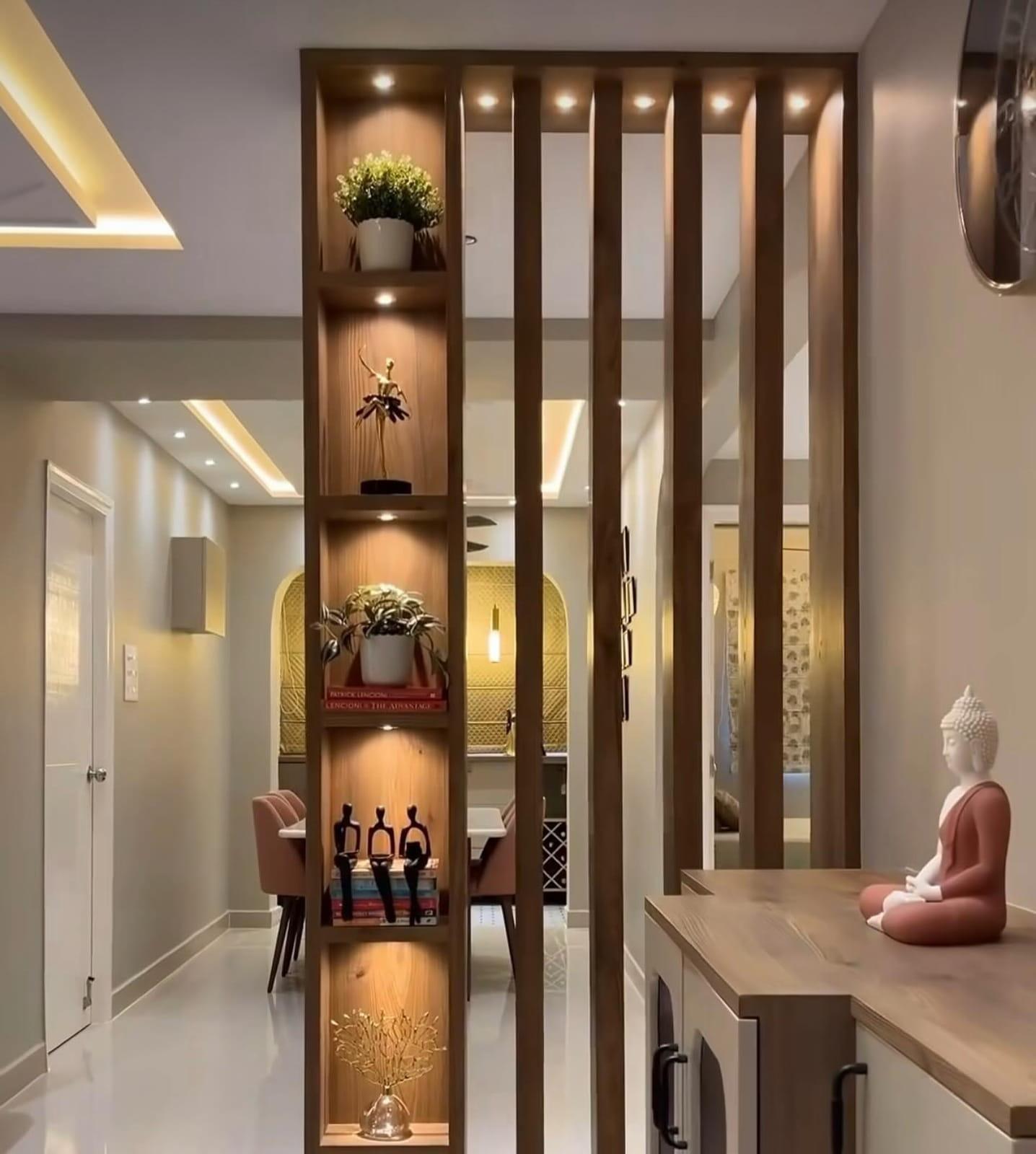
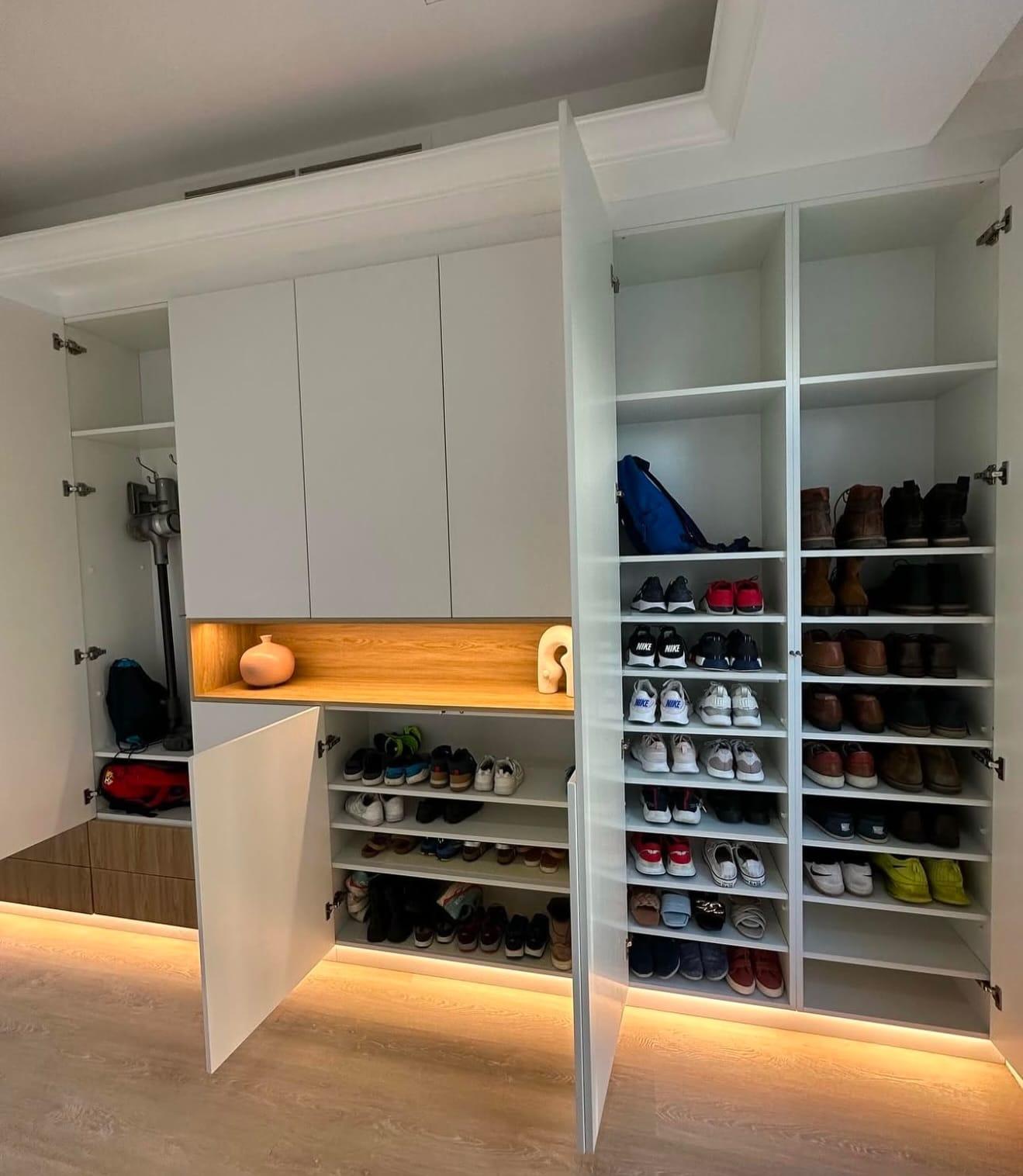
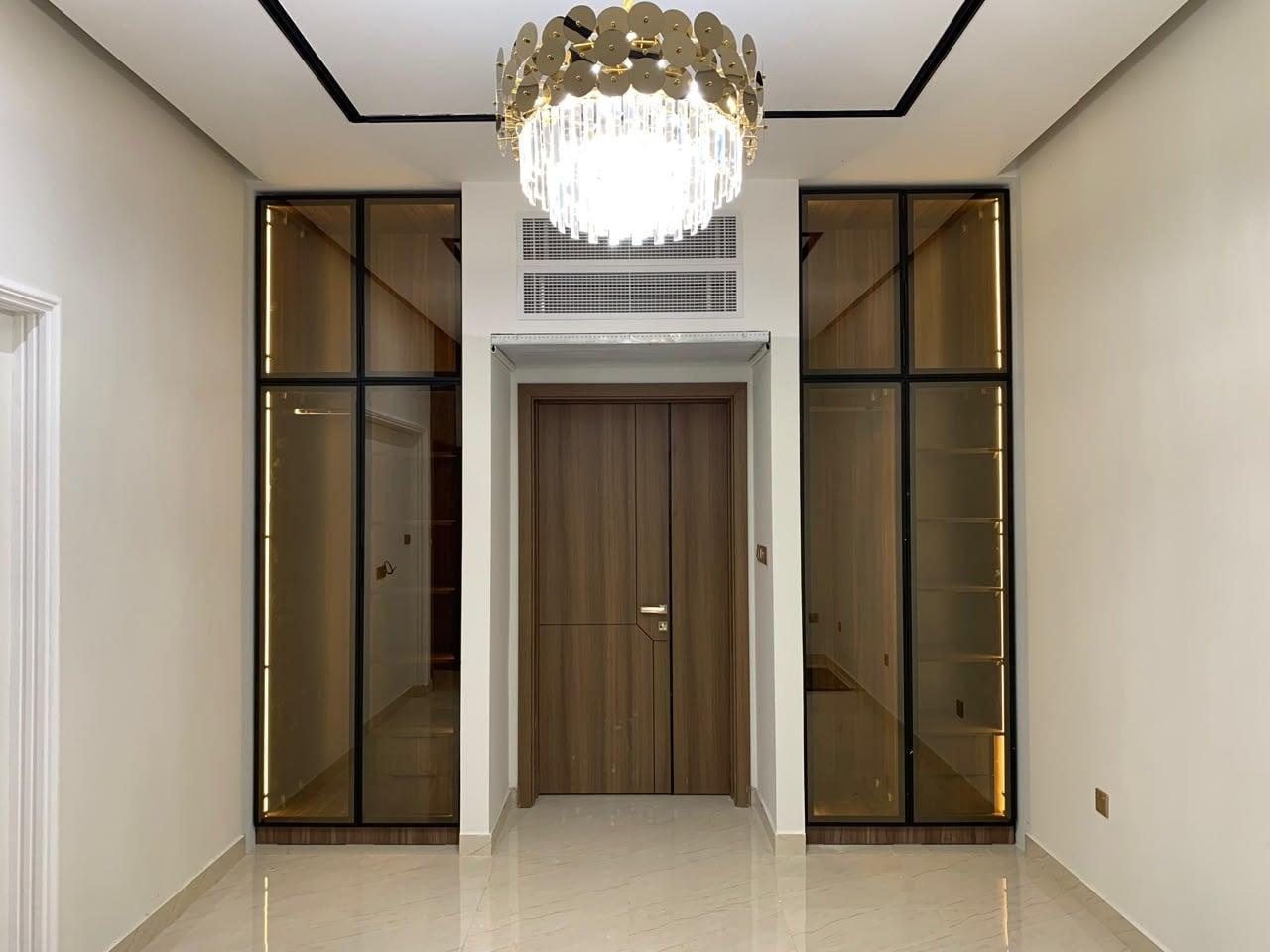
Our shoe storage and entrance cabinets are made at the Sharjah workshop. Two finished entrances show the range: one is a long white wall that hides shoe shelves, a hook bay and a lit niche behind plain doors, the other a pair of tall glass cabinets on either side of the front door. What follows works through the decisions in sequence, from the number of pairs and the depth to ventilation, the bench and mirror, narrow halls, doors, glass fronts and cost. Shoes kept inside a bedroom wardrobe are a different job, dealt with in the wardrobe layout guide.
Count the pairs before you draw the cabinet
Start with a count, not a catalogue. Go through the house and count the pairs each person wears in a normal week at the door: work shoes, trainers, school shoes, slippers, sandals. Then add the pairs that live at the door only part of the year, and leave space for visitors. A cabinet is cheapest to enlarge on the drawing and most expensive to enlarge afterwards, so plan for about a fifth more than you own today.
The arithmetic is simple. A pair takes roughly 20 cm of shelf width, so a cabinet with 120 cm of interior width holds six pairs on each tier. A tier needs the tallest shoe on it plus 3 to 5 cm to get a hand in; for trainers about 14 cm tall that is about 18 cm. In 180 cm of interior height that makes 10 tiers, and 6 × 10 gives 60 pairs on paper. The Singapore retailer Lazada's capacity guide advises cutting any maker's maximum by 30 to 40% for a real household's mix of sizes, and we do the same: about 39 pairs in the drawing below.
That is the number to compare with your own count. If you own 25 pairs and the household has four people, a 120 cm cabinet is generous; if you own 70, you need two units or a second wall.
Pairs by cabinet width, 180 cm of tiers
60 cm
- Pairs a tier
- 3
- 10 tiers on paper
- 30 pairs
- Real life, about a third fewer
- About 20
80 cm
- Pairs a tier
- 4
- 10 tiers on paper
- 40 pairs
- Real life, about a third fewer
- About 26
100 cm
- Pairs a tier
- 5
- 10 tiers on paper
- 50 pairs
- Real life, about a third fewer
- About 33
120 cm
- Pairs a tier
- 6
- 10 tiers on paper
- 60 pairs
- Real life, about a third fewer
- About 39
180 cm
- Pairs a tier
- 9
- 10 tiers on paper
- 90 pairs
- Real life, about a third fewer
- About 59
At 20 cm of width a pair, 18 cm a tier and 65% of the paper count. Larger sizes and boots lower it; our drawing counts your own pairs.
- 1. One pair takes about 20 cm of shelf, so 120 cm holds 6 pairs on a tier
- 2. A tier is the tallest shoe plus 3 to 5 cm to reach in: about 18 cm for trainers, so 10 tiers in 180 cm
- 3. 6 pairs × 10 tiers = 60 pairs on paper
- 4. A household mix of sizes fits about a third fewer: 39 pairs
- 5. A flat shelf needs 30 to 35 cm of depth: a 30 cm shoe plus 3 cm to reach
- 6. An angled shelf, heel down at about 32°, gets the same shoe into about 25 cm; a tilt-out drawer works in 17 cm outside, about 14 cm inside
How deep: 33, 25 or 17 centimetres
Depth decides the kind of shelf you can have, and it is the measurement a hall most often cannot spare. A men's shoe about 30 cm long lies flat and straight on a shelf only when the cabinet is 30 to 35 cm deep inside, according to the Lazada guide. We draw 33 cm: the shoe plus 3 cm so a hand can get past the toe.
Below that, the shoe has to turn. Mega Furniture's guide says angled shelves tilt a pair heel-down at about 30 to 35 degrees, which lets a longer shoe fit into 25 cm of depth. The geometry checks out: a 30 cm shoe leaning at 32 degrees reaches only about 25 cm across. The price is one row of pairs per shelf, so a four-shelf unit holds four pairs in a row, not eight.
The slimmest units are tilt-out drawers. IKEA UAE lists shoe cabinets between 17 and 35 cm deep, and the Lazada guide warns that a 17 cm cabinet usually leaves only 13 to 14 cm inside once the back, the door and the tilt clearance are taken out. Measure the inside, not the catalogue figure, and check it against your longest pair. If the hall is shallower than about 25 cm, a wall rack is a better choice than a cabinet.
Our carcases are made to the drawing, so the depth is yours to set. The usual compromise is a deeper section (33 cm) for the family's everyday shoes and a shallow section (25 cm) with angled shelves beside it. Depths for wardrobe carcases follow the same reasoning in our wardrobe dimensions guide.
Tilt-out drawers, angled shelves, flat shelves or open racks
Each way of storing a pair has a place, and most good entrance walls use two. Flat shelves behind hinged doors are the simplest and hold the most in the least cost; they suit a deep cabinet and fully adjustable shelf heights. Angled shelves face the toe of each pair outwards, so a pair is easy to pick in a hurry, and they work in a shallow unit. Tilt-out drawers hide everything behind one flat front and take little floor, but each holds only about three or four pairs, and heels over about 8 cm do not fit.
An open rack beats all of them for airflow and speed, but it shows every pair and every mark on the wall behind it. Put an open shelf or a bench at the door for the pairs worn today, and keep the rest behind doors. Our hinged and sliding door guide covers how the doors move, which matters more in a hall than in a bedroom.
The video below shows a flip-drawer shoe cabinet being built in a workshop, which makes the mechanism, a hinged front that tips forward on a stop, easy to picture. We make ours as part of the same drawing as the rest of the wall.
Ways to store shoes, compared
Flat shelves, hinged doors
- Inside depth
- 30 to 35 cm
- Capacity
- Highest; about 3 pairs a tier per 60 cm
- Air
- Needs vents in the doors
- Best for
- Deep halls and big households
Angled shelves
- Inside depth
- About 25 cm
- Capacity
- One row a shelf
- Air
- Needs vents
- Best for
- Shallow walls and choosing quickly
Tilt-out drawers
- Inside depth
- About 14 cm inside
- Capacity
- 3 to 4 pairs a drawer; no tall heels
- Air
- Needs vents
- Best for
- Very narrow halls
Open shelves or bench
- Inside depth
- 30 cm or less
- Capacity
- Few pairs
- Air
- Best
- Best for
- Today's pairs and visitors' shoes
Shelf heights: the tallest shoe plus a hand
Fixed shelf spacing is where entrance cabinets disappoint. If every shelf is 18 cm, flat shoes waste height and boots do not fit. Plan on adjustable shelves in at least a third of the cabinet, using the rule the Lazada guide gives: the tallest shoe on a tier plus 3 to 5 cm. Flat sandals and slippers need only a low tier, trainers around 14 cm of height need about 18, ankle boots need roughly 25 to 28, and knee boots need a bay of their own.
Put the pairs used every day between knee and shoulder height, the zone you reach without bending, and keep the occasional pairs higher and the kids' shoes low, where small hands can get them. The photograph shows our approach: tall bays of shelves tuned to the pairs, with a lit open shelf above at hand height for the things that go down on the way in.
Fix every tall unit to the wall. A deep cabinet loaded with shoes is top-heavy, and our kids' wardrobe guide explains why tall furniture is fixed to the wall wherever children live.
Air, smell, sand and summer damp
A closed cabinet is a small box that traps whatever the shoes bring in. Mega Furniture describes smell in a shoe cabinet as mostly a moisture problem first and a bacteria problem second, and in a humid climate the box stays damp. UAE summers are humid near the coast, and sand and dust arrive on every sole, so the cabinet needs to breathe without letting the dust settle on the shoes. If the smell is in a bedroom wardrobe rather than a shoe cabinet, why a wardrobe smells musty covers what to check first.
Do these four things. Cut vent slots near the top and bottom of the doors, or leave a gap behind the plinth, so air can pass through. Keep the cabinet off a wet floor, with a raised plinth or a recessed base. Seal the edges of every board, because a bare MDF edge swells when damp; our wardrobe materials guide explains the boards and edging we use. And never put wet shoes in: leave them on the open shelf or the bench until they have dried. On the boards themselves, moisture-resistant wardrobe boards explains what the MR label does and does not cover.
Inside, a silica gel pack or an activated charcoal bag helps, and Mega Furniture suggests replacing silica every few months. Keep leather and the sandy pairs on separate shelves, and wipe the shelf liner with a damp cloth when you clean the floor. A matt laminate hides marks better than gloss, and a light wipe with a soft cloth is all it needs.
A bench, a mirror, hooks and somewhere for the keys
The entrance needs more than shoe shelves, and the best walls do the whole job in a few metres. The photographed cabinet has a hook bay for bags, abayas and the vacuum cleaner, a lit open shelf for keys and post, and shoe bays beside it. The hook bay is the part people did not ask for and then use most: bags and abayas hang there instead of landing on the floor.
Add a seat. Mega Furniture gives 45 to 50 cm as the height of a shoe bench, and sitting down to put shoes on is much easier for small children and elderly relatives. A bench also doubles as the open shelf for the day's pairs. Where the hall is short, a pull-out seat over a drawer works, or a floating shelf at hand height.
A full-length mirror beside the door lets you check yourself on the way out. Light the mirror from the front so your face is not in shadow, which is the point of the dressing mirror lighting guide. A warm strip in the plinth, as in the photograph, lights the floor and the pairs at the base, and our wardrobe lighting ideas cover sensor strips that switch on when a door opens.
Narrow hallways and entrance consoles
Where the hall is narrow, the sum is a budget of depth. Take the width of the hall, subtract a walkway of 70 to 90 cm (Mega Furniture's range), and what is left is the depth you can give the cabinet. A hall 1.2 m wide leaves 30 to 50 cm, which is enough for flat shelves at the shallow end or angled ones at the deep. Keep the front door's own swing clear too, and put the cabinet on the wall the door opens away from.
Below about 25 cm, a cabinet is a console: a shelf of angled or tilt-out compartments with a top for keys and post. Such a unit can be wall-hung, which keeps the floor visible and makes the hall feel wider, or carried on a plinth. Our entrance consoles are made like the rest of the joinery to the width of the wall, and push-to-open or handleless fronts avoid handles that catch clothes in a tight hall.
The video below shows a way of getting a lot into a 60 cm entrance, with a tall cabinet, drawers topped with a cushion as a seat, and a rotating shoe rack. We would draw the same ideas in our own materials. Narrow shelving also appears in our small bedroom wardrobe ideas, while the comparison of fitted, built-in and freestanding storage shows why a made-to-fit unit wastes less of a tight hall.
Doors and handles for a hall
A hall door is opened with wet hands, school bags and a child on the hip, and it opens into the one place everybody has to pass. Hinged doors are the simplest, but each leaf needs room to swing; in a tight hall a pair of narrower doors, or a push-to-open front, is better than one wide door. Sliding fronts never swing, but they open only half the cabinet at a time, which is a poor trade in a shoe cabinet that is used every few minutes.
Handleless fronts keep a hall clean, with nothing to catch an abaya or a bag strap, and they wipe easily. Pick a grip channel or a touch latch to suit how the family uses the hall; the full comparison is in handleless wardrobes versus handles. A matt surface hides fingerprints better than a gloss one, and a tough laminate face copes best with the daily knocks of bags and trolleys.
Glass fronts and lit cabinets by the door
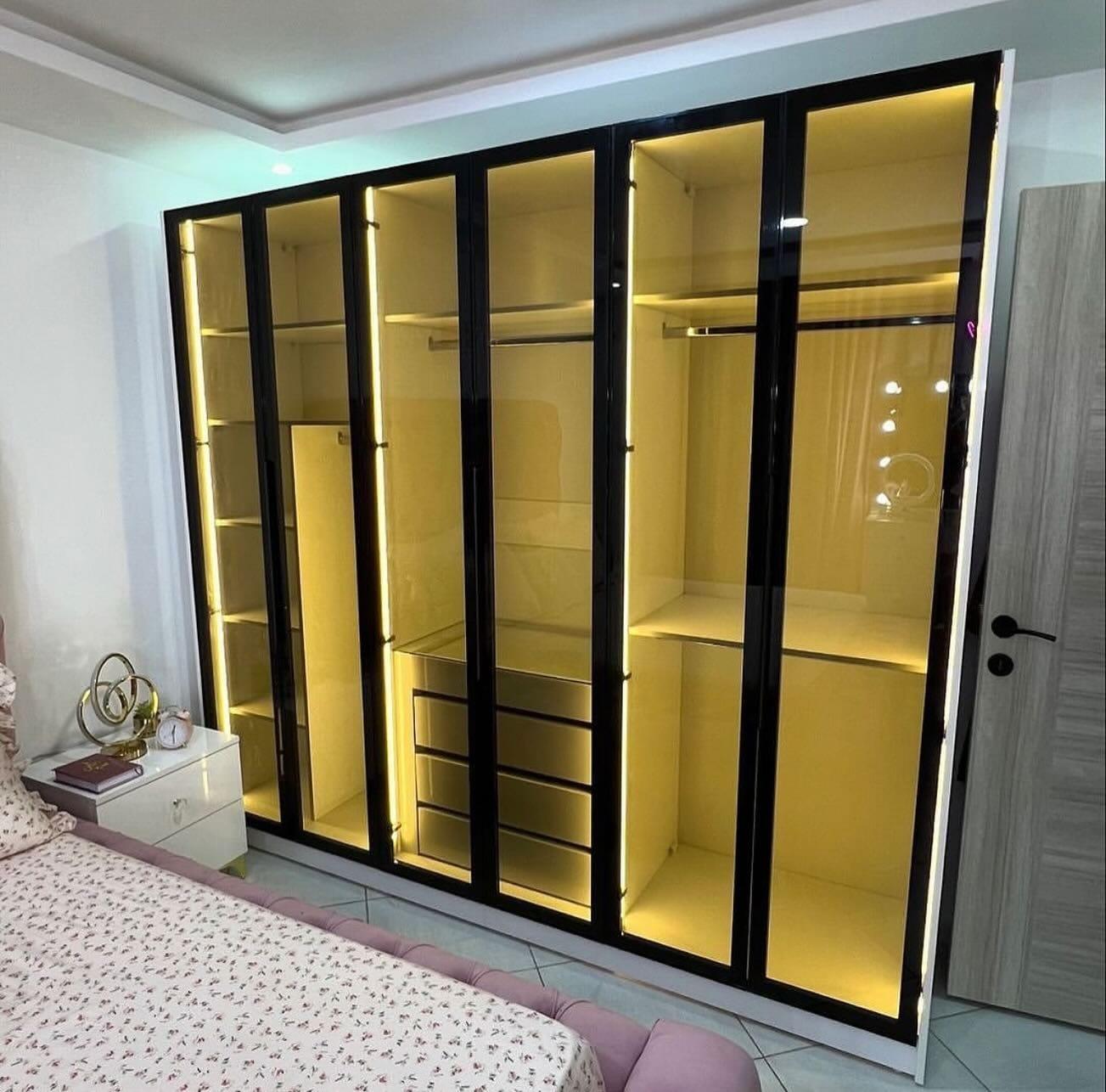
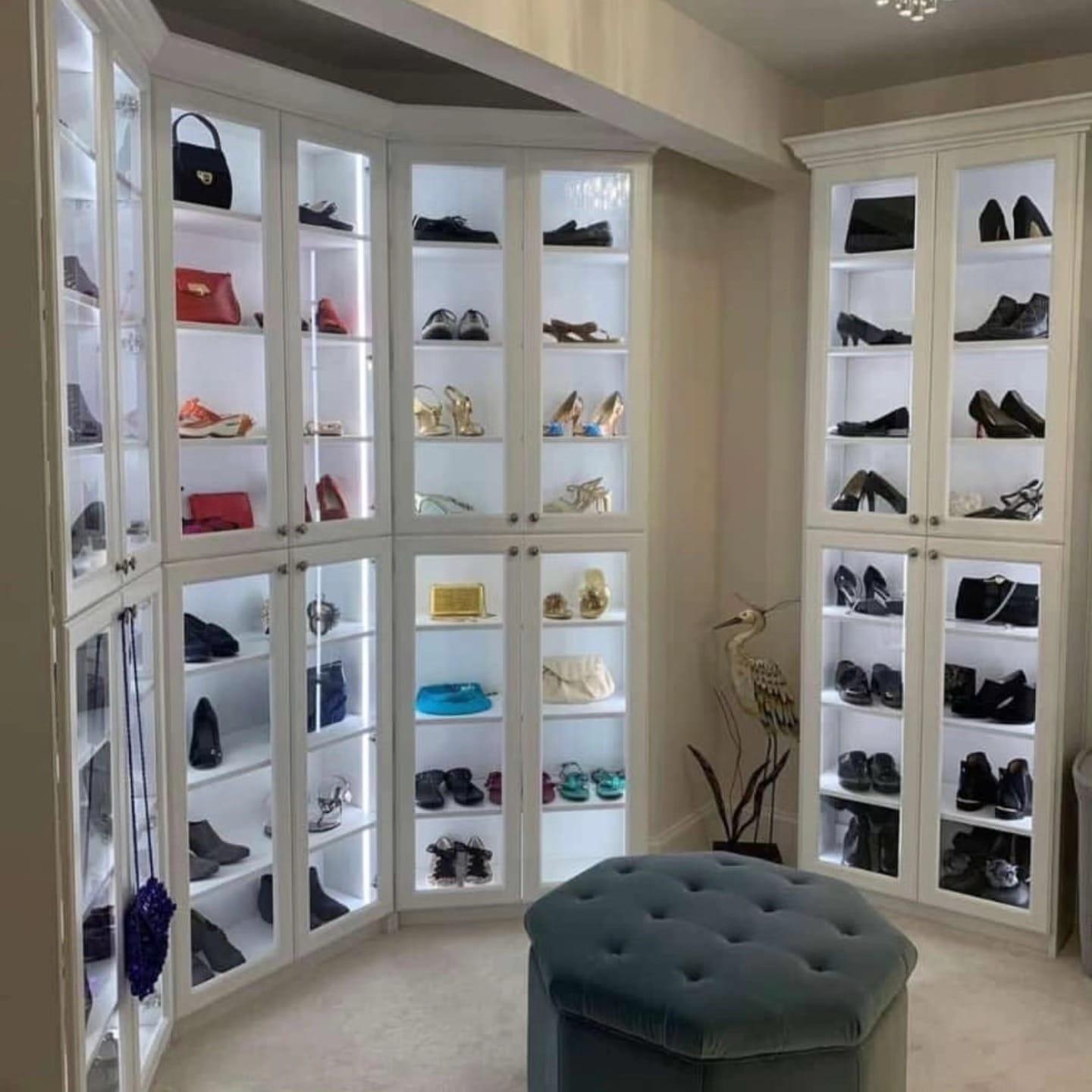
A pair of tall glass cabinets either side of a front door turns the hall into a small gallery. The photograph below shows ours: tinted glass in slim black frames, lit from inside, flanking a wood-look door under a recessed ceiling. Glass keeps dust off what is inside while letting the display show, and it suits a collection you want to be seen, such as good shoes, bags or a few ornaments, and open wardrobe or closed doors weighs open storage against doors for a wardrobe.
It also commits you to tidiness. Use glass for the pairs you like and keep everyday shoes behind solid doors beside them; the logic is the same as in our lit glass-front wardrobes. Choose a tint that hides the back of the shelves, add a light strip at the side, and keep the units out of strong direct sun, which fades leather. If the ceiling is being redone at the same time, the lighting can be drawn with it in our gypsum ceiling work.
Price, the visit and fitting
Shoe cabinets have no listed starting price, because the figure follows the width, the number of bays, the doors, the lighting and the finish. Shoe cabinets are not on a price list, since width, bay count, doors, lighting and finish all move the number. Following the free visit you get a BOQ with one line per board, door and light, which lets you remove a bay or keep the key niche and watch the total change. Read how our prices work, and see the other work of this workshop under joinery and fit-out.
During the visit the hall is measured, the door swing, sockets and AC grille are noted, and the pairs are counted together. Shelf heights, vents, bench and lighting then appear on the drawing. Workshop production happens in Sharjah, our own team does the fitting, and a written warranty of 24 months stands behind the workmanship. Local examples are on the Sharjah joinery page, and installation reaches the rest of the UAE. A built-in desk can be planned in the same visit; see study desks and home offices. Before you approve, tick off this list:
- Your count of pairs, plus visitors and a fifth to grow, fits the drawn tiers.
- The depth suits the hall: 33 cm flat, about 25 cm angled, or a tilt-out.
- Adjustable shelves cover at least a third of the cabinet, with a bay for boots.
- Vents high and low, a raised plinth, sealed edges and a place for wet pairs.
- A bench or a hand-height shelf, a hook bay and a niche for keys and post.
- The doors swing clear of the walkway, and every tall unit is fixed to the wall.
Common questions
How many pairs does a shoe cabinet hold?
About 20 cm of width a pair and 18 cm a tier: a 120 cm cabinet 180 cm tall is 60 pairs on paper and about 39 in real life. Our shoe storage and entrance cabinets.
How deep should a shoe cabinet be?
30 to 35 cm inside for flat shelves, about 25 cm for angled shelves, and about 17 cm outside for tilt-out drawers. Wardrobe depth and clearances.
Does a shoe cabinet need ventilation?
Yes. Cut slots high and low in the doors, raise the plinth, seal the board edges and never store wet shoes. Boards and edging for cabinets.
Are tilt-out drawers better than shelves?
They save depth, but each holds only three or four pairs and not tall heels. Shelves hold more and adjust. Joinery and fit-out.
What can I fit in a narrow hallway?
Subtract a 70 to 90 cm walkway from the hall's width; what is left is your depth. Below about 25 cm use a slim console. Small bedroom wardrobe ideas.
Can I add a bench and a mirror to the cabinet?
Yes: a seat 45 to 50 cm high, a full-length mirror with light on your face, and a hook bay for bags. Dressing mirror lighting.
How much does a built-in shoe cabinet cost?
The number of bays, doors and lights decides it, and each appears in the BOQ that follows a free visit. How we quote.

Sources & specifications
Manufacturer information applies to the named products and systems. Sources reviewed on 28 October 2026.
- Lazada Singapore: how many shoes fit in a slim entrance cabinet (30–35 cm flat depth, pairs-per-shelf formula, tilt-out capacity, usable against external depth)home.lazada.sg(opens in a new tab)
- Mega Furniture: is a shoe storage cabinet worth it (depth ranges, angled shelves, bench height, walkway, vents, sealed edges)megafurniture.sg(opens in a new tab)
- IKEA UAE: shoe cabinets and racks (shallow models with listed depths from 17 to 35 cm)ikea.com(opens in a new tab)
Want this planned for your home?
Consultation and measurement are free. Tell us the rooms, location and what you need; we arrange a sample visit and define the measured quotation.