Wardrobes · 12 min read · Updated 28 October 2026
Wardrobe materials and hardware: what lasts and what to specify
MDF, HDF, plywood or particleboard; laminate, veneer or lacquer; edges, hinges and runners. What each part of a fitted wardrobe does, and what to ask a maker to name.

By Ali Haider Basra, Founder, Al Tareeq Decor · Contact our workshop
Key takeaways
- A wardrobe lasts because of four hidden parts: the core board, the face, the edges and the hardware.
- MDF or HDF with a laminate face is the sound standard for a dry bedroom; plywood suits long spans and edge fixings.
- Use a moisture-resistant grade for panels next to a bathroom or AC drain, and seal every edge.
- Ask for the board's emission class; the EU now limits furniture to 0.062 mg/m³ of formaldehyde.
- Soft-close hinges and full-extension runners are worth it; our wardrobes start from AED 550 per m² of front.
On this page
- Key takeaways
- Four parts decide how a wardrobe lasts
- The core: MDF, HDF, particleboard or plywood
- MDF or plywood? The straight answer
- Damp, bathrooms and AC: moisture-resistant boards
- Formaldehyde and emissions: what the labels mean
- The face: laminate, veneer, lacquer, acrylic or glass
- Edges: the part that fails first
- Hinges, runners and sliding gear
- Inside fittings that earn their place
- Write it into the specification
- What to ask for in a wardrobe quotation
- What it costs, and how long it takes
- Common questions
Four parts decide how a wardrobe lasts
Two wardrobes can look identical on the day they are fitted and be completely different five years later. The difference is almost never the colour. It is the board inside the panels, the surface glued to it, the way the cut edges are sealed and the hardware the doors and drawers run on. A photograph shows none of these, which is why a quotation that names them is worth more than one that only shows a picture.
This guide takes the four parts in turn, in plain terms: what each one is, the choices you will be offered, and which questions get a straight answer from a maker. A checklist to hold any quotation against, ours included, closes the guide. How the cut edge is covered, in PVC, ABS, melamine or veneer, has its own guide on wardrobe edge banding.
The core: MDF, HDF, particleboard or plywood
The core is the board everything else is fixed to. In fitted wardrobes it is usually one of four. Particleboard, also called chipboard, is pressed from wood chips and resin; it is the cheapest and the coarsest. MDF, medium-density fibreboard, is made from fine wood fibres pressed into a dense, even sheet. HDF is the same idea pressed harder. Plywood is built from thin sheets of wood veneer glued with the grain of each layer at right angles to the next (the wardrobe board types guide takes the four boards one by one).
Each has a character. MDF's even, smooth face takes laminate, veneer and paint cleanly, with no grain or voids showing through, which is why most fitted wardrobes are built on it. Wikipedia's summary puts typical MDF at 600 to 800 kg per cubic metre, with high-density board running higher. Its weak point is the edge: screws driven into the edge of a board can split it, so good joinery uses fittings designed for fibreboard rather than wood screws alone; how routed grooves are cut into MDF doors is covered in fluted wardrobe doors.
Plywood's cross-laid layers make it strong in every direction, reduce splitting when it is fixed near the edge and limit how much it swells or shrinks. It is heavier work to finish smoothly, and its quality varies with the veneers inside. Particleboard keeps costs down but is the most sensitive to water and the least forgiving of repeated screwing. We build our carcasses in low-emission HDF and MDF, choosing moisture-resistant grades where the wall calls for them.
- 1. Face: laminate, veneer or lacquer, the surface you see and touch
- 2. Core: the board that holds the fittings and keeps the door flat
- 3. Backing layer on the reverse, so the panel does not bow
- 4. Edge band: seals the cut edge, where water gets in first
- 5. Moisture-resistant MDF, often green, for walls next to a bathroom
MDF or plywood? The straight answer
For a fitted wardrobe in a dry, air-conditioned bedroom, a good MDF or HDF carcass with a factory-applied laminate face is the sensible standard. It is flat, stable and smooth, it takes a huge range of finishes and it costs less than plywood of a similar grade. That is what our entry specification is built on.
Plywood earns its extra cost where a panel carries weight on a long span, where fixings go close to an edge, or where the wardrobe stands somewhere that may see occasional damp and the plywood is bonded with a water-resistant glue. It is also the natural choice when you want a real timber edge on show.
What matters more than the label is the grade and the thickness. A thin, low-grade plywood shelf will sag sooner than a thick MDF one with a support in the middle. Ask the maker which board, which thickness and which grade go into the carcass, the doors and the shelves; they are not always the same.
Damp, bathrooms and AC: moisture-resistant boards
Ordinary MDF does not like water. A low-grade board can swell and break up when it is soaked, and once the fibres at an edge have swollen they do not go back. Moisture-resistant MDF, usually coloured green so it can be recognised, is made to cope much better with humid air and the odd splash.
It is not waterproof. A moisture-resistant board still needs its edges sealed, and no board copes with a leaking pipe behind it or water standing on its base. In UAE homes the risks are specific: a wardrobe that shares a wall with a bathroom or shower, an en-suite where steam drifts into the dressing area, and air-conditioning units or drain lines that can drip. Fix any leak first, then specify the moisture-resistant grade for the panels that face it.
The rest of the wardrobe can usually stay on standard board. Mixing grades this way keeps cost sensible while protecting the parts that need it. The drawing should say which panels are which, and the design approval guide shows what else to check on it. For what the labels on a quotation, such as MR, P2, P3 and MDF.H, really promise, see our guide to moisture-resistant wardrobe boards.
Formaldehyde and emissions: what the labels mean
Most wood-based boards are bonded with resins, and many of those resins release small amounts of formaldehyde, especially when new. Board makers classify their products by emission, and E1 is the long-standing European class most fitted furniture is built from. Stricter classes such as E05 exist, and North America uses its own CARB and TSCA Title VI labels.
The rules have tightened. Under EU Regulation 2023/1464, furniture placed on the market in the European Union after 6 August 2026 must not release formaldehyde above 0.062 mg/m³ under the regulation's test conditions. In the United States, the Environmental Protection Agency requires composite wood products to be certified and labelled as TSCA Title VI compliant. These are not UAE rules, but they are a useful benchmark when you ask what a board is.
Ask for the emission class of the actual board and keep it with your paperwork. Be wary of the phrase 'formaldehyde-free': a low emission class and the absence of formaldehyde are different claims, and only the first is usually what a board's data sheet states. Airing a new wardrobe with the doors open for the first days is sensible with any board. If an existing wardrobe already smells musty, why a wardrobe smells musty covers the causes to check first.
The face: laminate, veneer, lacquer, acrylic or glass
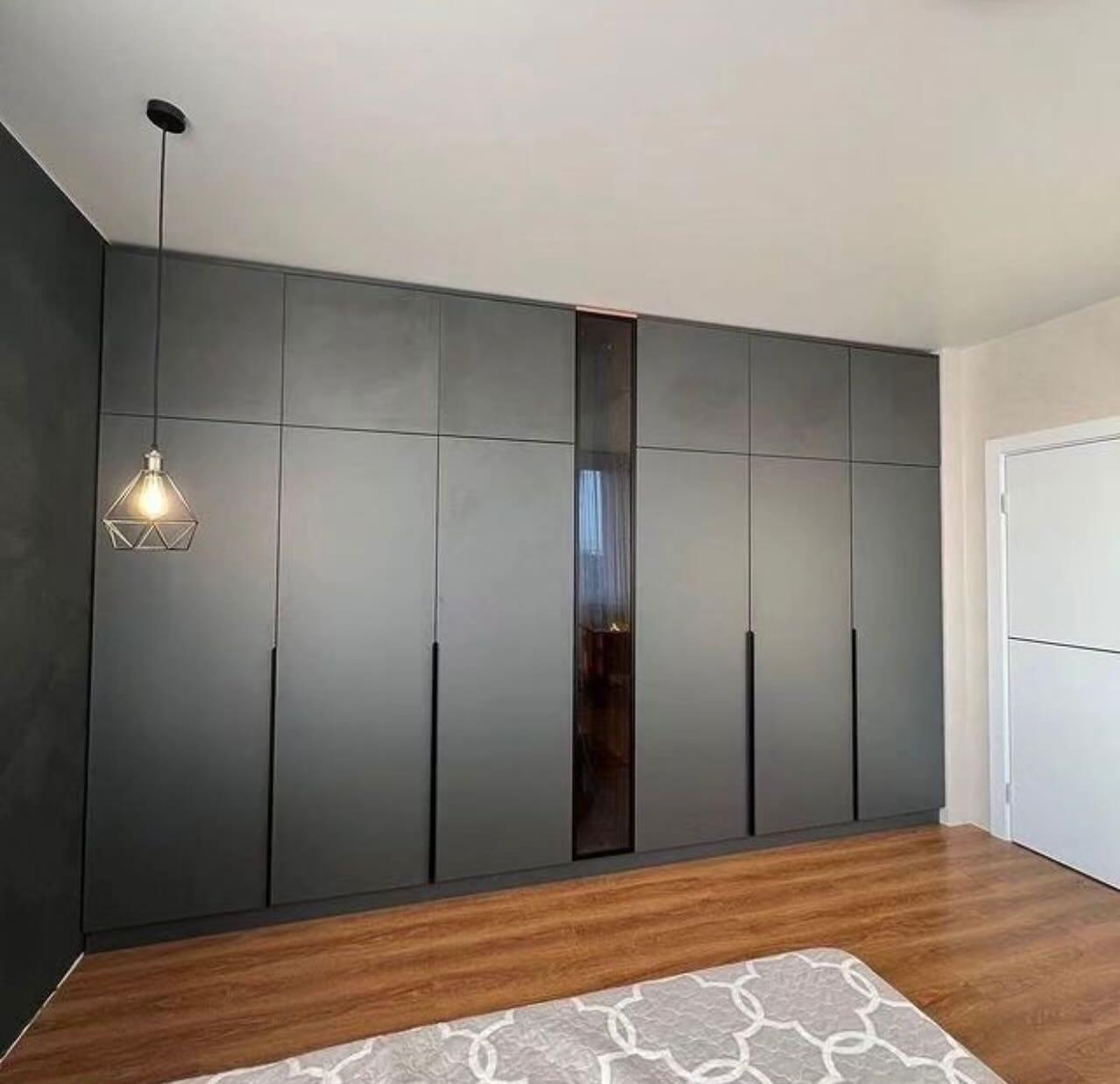
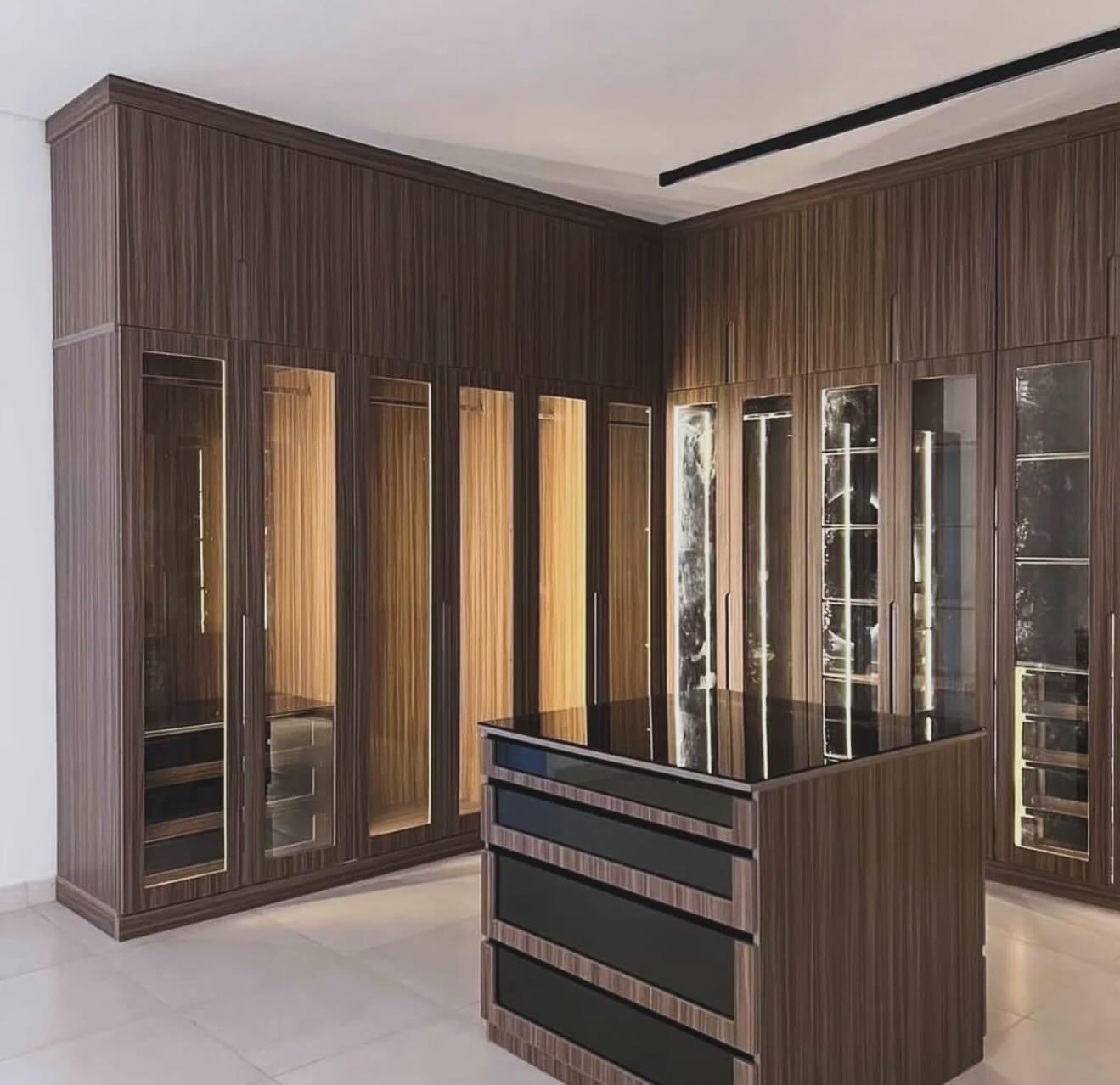
Laminate is a printed decorative layer sealed under a hard, wipeable surface and bonded to the board. It comes in timber, stone and solid-colour designs, resists everyday knocks and is what our entry-level wardrobes use. Matte laminate hides fingerprints and small scratches well; high-gloss laminate looks sharper and reflects light, but shows every smudge and fine scratch, so it suits doors that are not handled constantly; matt or gloss wardrobe doors looks at that choice in more detail. If you would rather have no handles at all, handleless wardrobe doors explains finger grooves, edge profiles and push-to-open.
Veneer is a thin slice of real wood, so each door carries its own grain and can be refinished later. Like any natural timber it can darken or fade where strong sun falls on it, which matters on a wall facing a big west-facing window. Lacquer and paint give a smooth, even colour in almost any shade and can be matte or gloss; they need careful handling during fitting, and a small chip can often be touched up rather than the door replaced. Acrylic sheet gives a deep, mirror-like gloss. Our guide to wardrobe door finishes compared sets laminate, veneer, lacquer, acrylic and glass side by side.
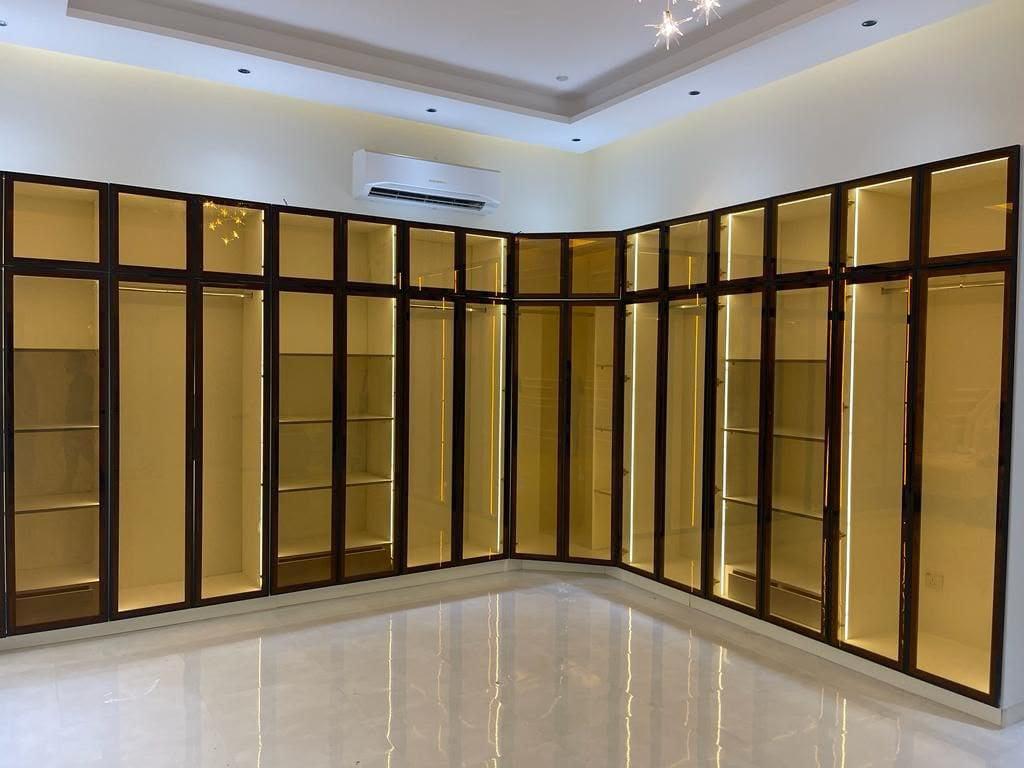
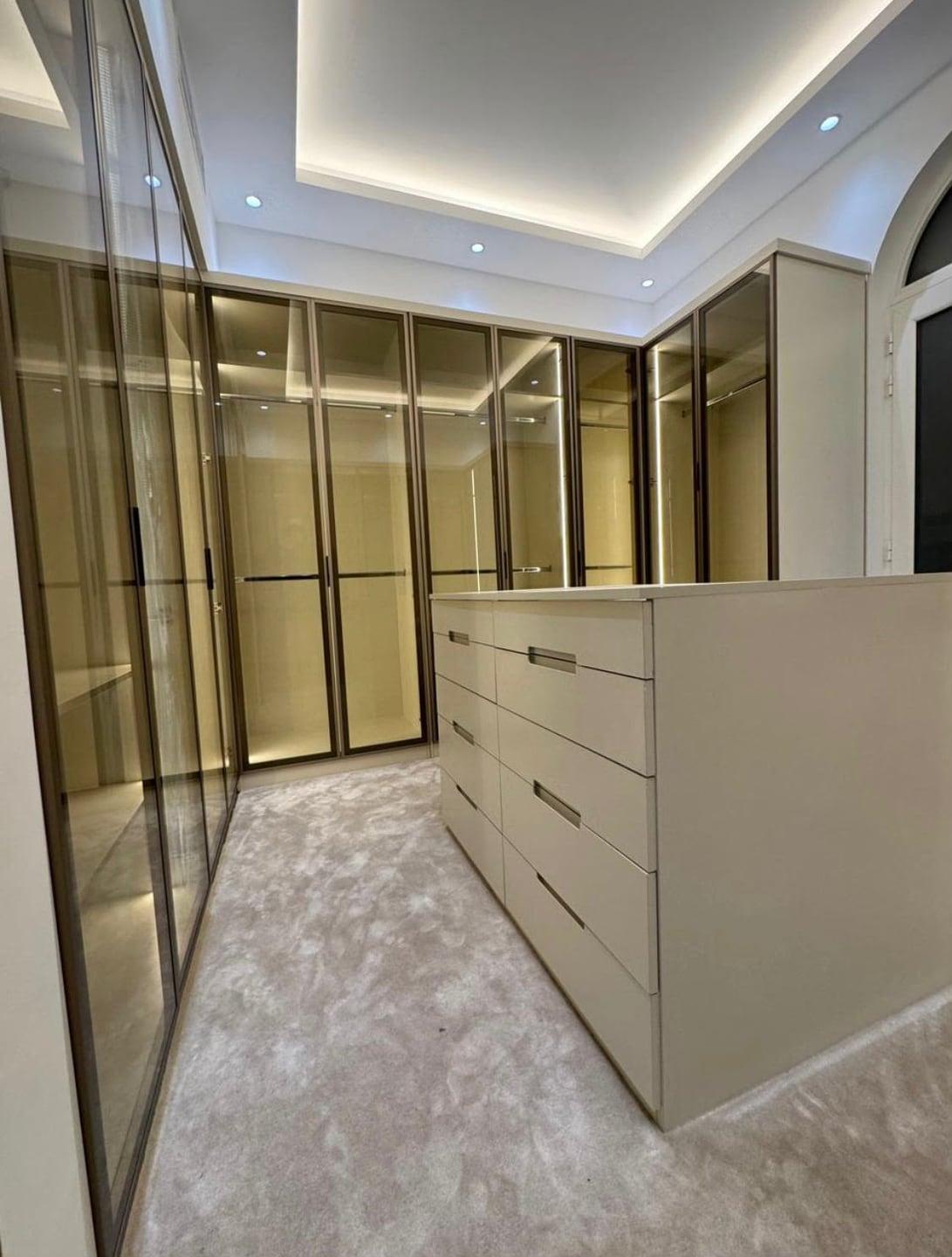
Glass, in a slim aluminium frame, shows what is inside and keeps dust off. Ours is tempered and tinted grey or bronze. How a mirror door is made is covered in our mirror wardrobe doors guide. For a fuller comparison of finishes across the whole home, including kitchens and media walls, see our guide to choosing materials.
Edges: the part that fails first
Every panel is cut from a larger sheet, and each cut exposes the bare core. Edge banding is the strip glued over that cut edge. It does two jobs: it gives the panel a finished look in the same colour or grain as the face, and it seals the core against moisture and knocks. Most problems with an older wardrobe start at an edge: a lifted band, a chipped corner, a swollen bottom edge on a door that stood near damp.
Ask how the edges are banded and on which sides. A well-made door is banded on all four edges, by machine, with the band trimmed flush and the corners rounded slightly so they do not catch. Shelves and the inside edges of the carcass should be banded where they show. The bottom edges of doors and plinths, nearest any spilt water, matter most.
Hinges, runners and sliding gear
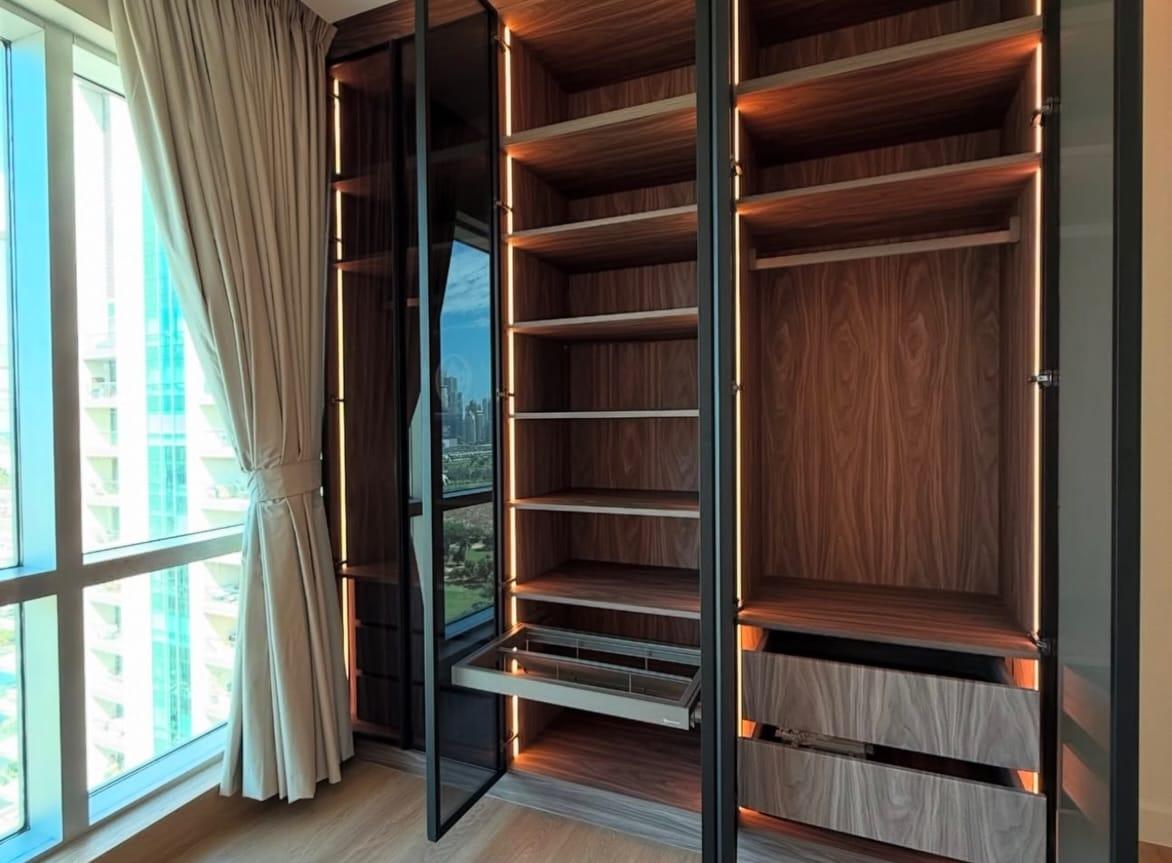
Hardware is what you touch every day, and it decides whether a wardrobe still feels right in ten years. Concealed hinges are chosen by the door. Blum's guidance is two hinges for a 4–6 kg door and three for 6–12 kg at widths to 600 mm, one extra at up to 650 mm, and a third on tall, narrow doors even when they are light. A full-height wardrobe door usually needs more hinges than people expect. The wardrobe hinges guide explains how the hinge count grows with door height and weight.
Are soft-close hinges worth it? On a wardrobe, yes. The damper stops the door from banging, saves the hinge and the carcass from repeated impact and protects fingers. The same goes for drawer runners: full-extension runners with soft-close let you reach the back of a drawer and close it without a slam. Sliding doors run on systems rated by leaf weight; Häfele's range for furniture runs from fittings for 12 kg doors to systems for 55 kg, and heavy-duty systems are available for glass and mirror leaves; ask for the load rating in your quotation. Track types and weight limits are compared in our wardrobe sliding door systems guide.
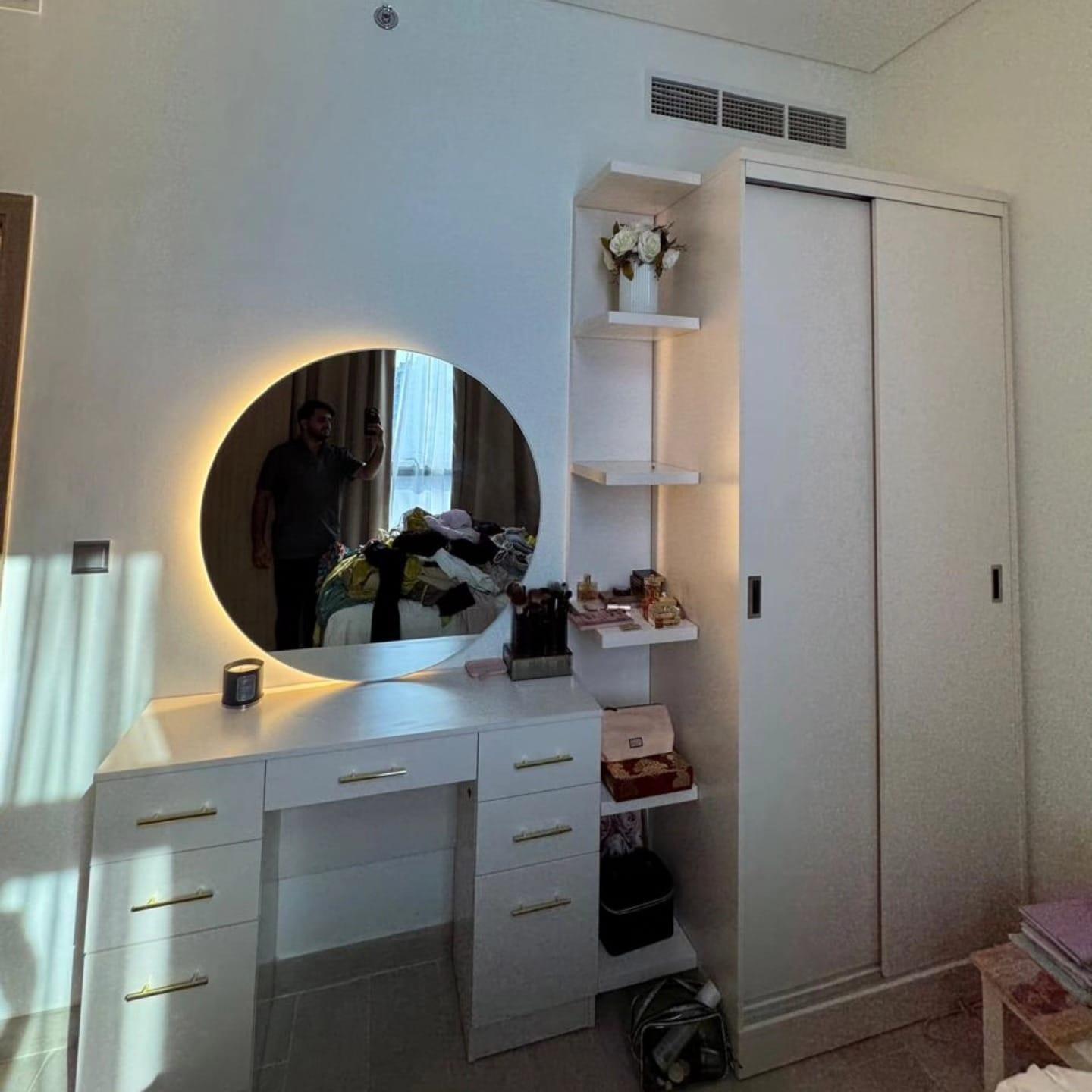
We fit soft-close hardware; confirm the brand and model in the quotation. Whatever brand you are offered, ask for the product line to be named on the quotation, so a part can be matched if it ever needs replacing. If an existing wardrobe only needs new doors, hinges or a new track, our wardrobe door replacement guide shows what can be changed. The door type changes the hardware too; hinged or sliding wardrobe doors compares the two.
Inside fittings that earn their place
The inside is where materials meet daily use. Pull-out trouser racks, tie and belt organisers, velvet-lined jewellery drawers, shoe racks and motion-sensor LED lighting along the rails are among the fittings we offer, and each is worth choosing for a reason rather than because it is available. A pull-out rack is only useful if you own enough trousers to fill it; a lit rail helps most in a deep wardrobe or a room with little daylight, and our wardrobe lighting ideas show how to choose the strips and the switch.
Fittings carry weight and move, so they depend on the same board and hardware quality as the doors. Shelves need the right thickness for their span, or a central support; drawers need runners rated for what goes in them. Our wardrobe interior layout guide explains how to choose fittings from a count of what you own.
Write it into the specification
A wardrobe quotation should show what your money buys. If it only says 'MDF wardrobe with soft-close', ask for the details below. A maker who builds properly will have no trouble naming them. To set two quotes side by side, use the wardrobe quotation checklist.
What to ask for in a wardrobe quotation
Carcass board
- Ask for
- Board type, grade and thickness
- Why it matters
- Decides strength, flatness and how fittings hold.
Moisture resistance
- Ask for
- Which panels use a moisture-resistant grade
- Why it matters
- Protects walls shared with a bathroom or near AC.
Emissions
- Ask for
- The board's declared emission class
- Why it matters
- Lets you compare with E1 and stricter classes.
Door face
- Ask for
- Laminate, veneer, lacquer, acrylic or glass, with the reference
- Why it matters
- Sets look, wear and how repairs are made.
Edges
- Ask for
- Banding on all visible edges, by machine
- Why it matters
- Edges are where damage and damp start.
Hinges
- Ask for
- Brand, line and number per door
- Why it matters
- Heavy, tall doors need more hinges.
Drawer runners
- Ask for
- Full extension, soft-close, load rating
- Why it matters
- Lets drawers open fully and close gently.
Sliding system
- Ask for
- Named system and its leaf weight rating
- Why it matters
- Glass and mirror leaves are heavy.
Lighting
- Ask for
- Type, sensor and where the driver sits
- Why it matters
- Drivers must be reachable for service.
A checklist drawn from the sections above. Ask every maker for the same detail, us included, so two offers can be compared line by line.
What it costs, and how long it takes
Our wardrobes start from AED 550 per m² of front including installation, for laminated MDF with hinged doors. Veneer, lacquer or acrylic faces, glass, sliding systems, moisture-resistant panels, lighting and internal fittings each add their own line, which makes each upgrade's cost visible. Room-by-room sums are in custom closet and wardrobe prices.
We bring board and finish samples to the free measurement visit, so you can see laminate, veneer and glass in your own light. Once the drawing is approved, panels are cut and put together at our workshop in Sharjah, then our installers fit them (our installation day guide says what to expect), up to about 10 days after you confirm. Workmanship carries our 24-month written warranty; hardware is covered by its maker's terms. Separately, the wood-based boards carry a 5-year limited warranty, subject to terms; hinges, tracks, runners, rollers and other moving hardware are not covered, and the final terms are in the written warranty. Start from our custom wardrobes service.
Common questions
Is MDF all right for a wardrobe beside a bathroom?
Yes, if the panels facing the bathroom are a moisture-resistant grade with sealed edges and any leak is fixed first. Dressing rooms next to a bathroom.
Which laminate is best for a wardrobe, glossy or matte?
Matte hides fingerprints and fine scratches; gloss looks sharper but shows every smudge; for a painted front, see sprayed wardrobe doors. Most bedrooms suit matte or a soft sheen. Choosing materials and finishes.
Are soft-close hinges worth paying for?
On a wardrobe, yes: they stop doors banging, protect the hinge and the carcass, and keep fingers safe. Hinges and sliding systems compared.
Do better materials change the wardrobe price?
Yes. Our entry rate is for MDF laminate with hinged doors; veneer, lacquer, glass, sliding doors and fittings each add a line, and clear, tinted, frosted or reeded glass is compared in a separate guide. Custom closet prices by room.
Which inside fittings are worth having?
The ones that match what you own: a trouser pull-out for many trousers, a lined drawer for jewellery, lighting in a deep wardrobe. Wardrobe interior layout.
Are the same boards used for media walls?
Partly. Media walls also use WPC, PVC and solid wood panels, picked to suit the wall's position. MDF, WPC, PVC and wood panels.

Sources & specifications
Manufacturer information applies to the named products and systems. Sources reviewed on 28 October 2026.
- EU Regulation 2023/1464: formaldehyde limit for furniture, 0.062 mg/m³ from 6 August 2026eur-lex.europa.eu(opens in a new tab)
- US EPA: formaldehyde emission standards and TSCA Title VI labelsepa.gov(opens in a new tab)
- Medium-density fibreboard: density, moisture-resistant grades and edges (Wikipedia)en.wikipedia.org(opens in a new tab)
- Plywood: cross-graining, splitting and dimensional stability (Wikipedia)en.wikipedia.org(opens in a new tab)
- US Forest Service, Wood Handbook ch. 11: wood-based composite materialsresearch.fs.usda.gov(opens in a new tab)
- Blum: number of hinges by door weight and widthea.blum.com(opens in a new tab)
- Häfele: Slido sliding systems for furniture, door weights 12 to 55 kghafele.ca(opens in a new tab)
Want this planned for your home?
Consultation and measurement are free. Tell us the rooms, location and what you need; we arrange a sample visit and define the measured quotation.