Wardrobes · 16 min read · 11 August 2026
Pull-out racks, baskets and pull-down rails in a wardrobe: widths, loads and door clash
Pull-out trouser racks, tie racks, wire baskets, shoe racks and pull-down rails: what each is for, the widths, depths and loads makers publish, how doors and corners block them, when a drawer is better, cleaning and what makes them cost more.

By Ali Haider Basra, Founder, Al Tareeq Decor · Contact our workshop
Key takeaways
- Each pull-out is made for a width range and a minimum depth: one Hettich trouser rack needs 457 mm inside width and 475 mm depth, another suits 500 to 600 mm. Those are examples of two products, not a standard.
- Loads differ widely: Hettich lists 10 kg and 30 kg for two trouser racks, Hafele 30 kg for a wire basket and 1.6 to 8 kg for a pull-down rail. Ask for the load rating of each in the quotation.
- A pull-out behind a door that cannot open fully, or in a corner behind a neighbouring door, cannot slide out: check each one against the door on the drawing.
- Drawers are better for folded clothes and small items; baskets suit bulky, light things. Each accessory is its own quotation line.
- We have not published a list of brands or models: ask what is available and its load rating in the quotation.
On this page
- Key takeaways
- Which pull-out does which job
- The five pull-outs in one table
- Trouser racks: width and depth from two Hettich pages
- Tie and belt racks
- Wire baskets: why the cabinet width decides
- Pull-out shoe racks
- Pull-down rails: lowering the high rail
- Door clash: a pull-out in a corner or behind a door
- When drawers are better than baskets
- Cleaning and everyday use
- Cost thinking without numbers
- Quotation lines for pull-out accessories
- What we do about pull-outs
- Common questions
Which pull-out does which job
A pull-out accessory is a frame, rack or basket on runners that slides out of a wardrobe so that you can see and reach everything at once, instead of leaning into the dark. Five kinds turn up in most quotations: the trouser rack, the tie and belt rack, the wire basket, the pull-out shoe rack and the pull-down rail. They solve different problems, and none of them fits every wardrobe. This page covers only these accessories; the drawers, their runners and the dividers inside them are in our wardrobe drawers and organisers guide, which this page does not repeat.
The widths and loads quoted below come from the makers' own product pages, which we opened on 4 November 2026. Each figure belongs to one product; another model of the same maker, or another maker's, has other numbers, so read them as examples of what a sheet looks like and not as a standard for the UAE or for any wardrobe.
The five pull-outs in one table
Trouser rack
- What it is for
- Every pair visible and uncreased, without a pile
- What it asks of the wardrobe
- A cabinet at least as wide as the rack and deep enough for its arms
Tie and belt rack
- What it is for
- Small items seen at a glance instead of rolled in a drawer
- What it asks of the wardrobe
- A narrow slot beside or under something else; the maker's sheet gives the width
Wire basket
- What it is for
- Scarves, caps, gym kit, bags and loose items
- What it asks of the wardrobe
- A cabinet width matched to the basket and a minimum depth
Pull-out shoe rack
- What it is for
- Pairs stored low and seen from above
- What it asks of the wardrobe
- A carcase of the width the rack is made for, and a low position
Pull-down rail
- What it is for
- Brings a high hanging rail to the user
- What it asks of the wardrobe
- A section of the right inside width, a minimum installation height and sturdy side panels
A summary of the kinds, not a promise that every one is available for your wall; ask what is available in the quotation.
Trouser racks: width and depth from two Hettich pages
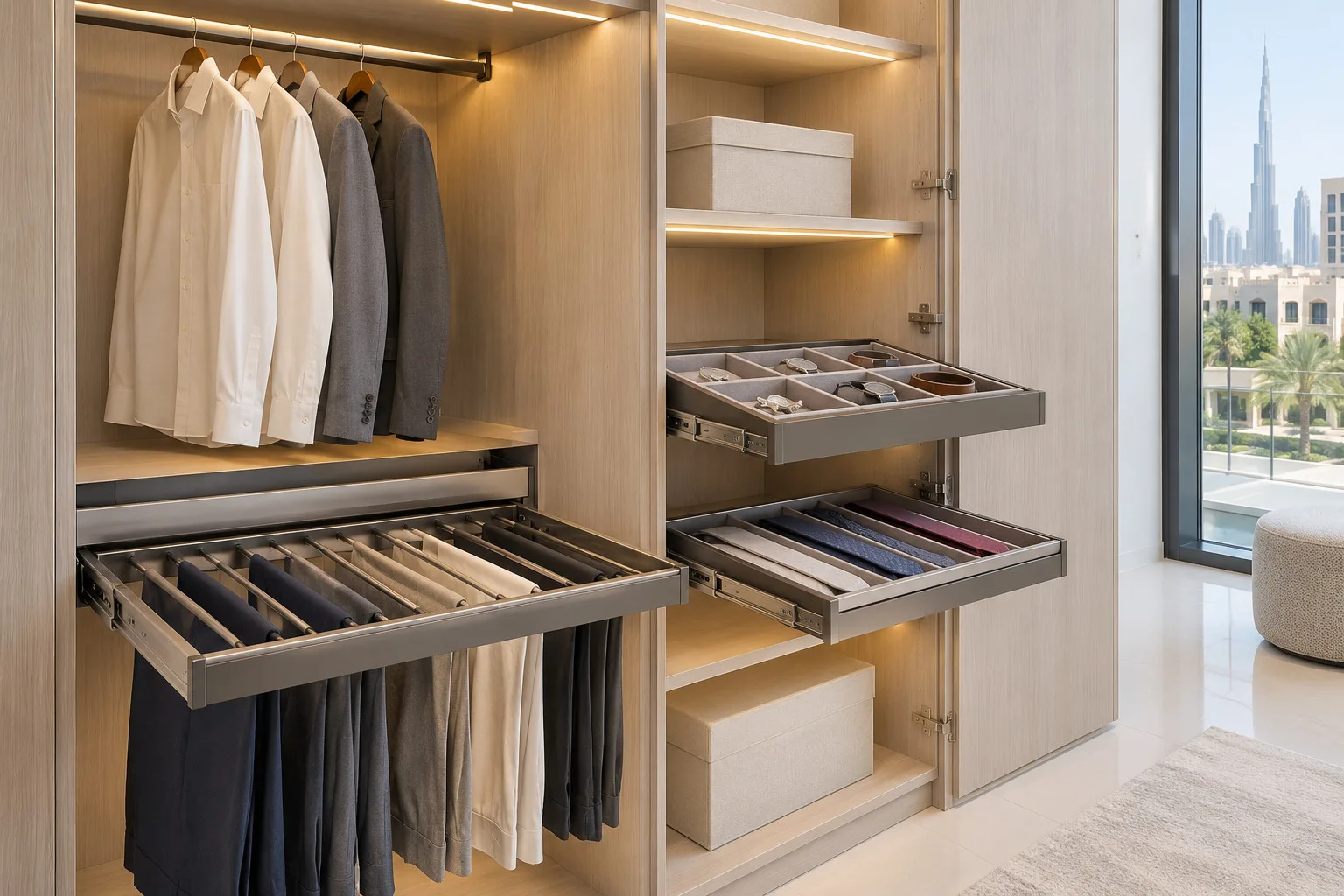
A trouser rack holds each pair on its own bar, so trousers hang straight, can be taken out one at a time and do not end up at the bottom of a stack. The two Hettich racks we opened show how different two products of one maker can be. The Conero pull-out trouser holder is listed with a load capacity of 10 kg, a minimum inside cabinet width of 457 mm and a minimum inside cabinet body depth of 475 mm; it is installed on the side of the cabinet body, can be fitted right or left, and has 7 hangers for 14 pairs of trousers that can be removed from the front.
The Telescopic Amari trouser holder is made for an inside cabinet body width of 500 to 600 mm, carries 30 kg to EN 15338 level 3 and has 8 trouser holders; it is installed between the cabinet body sides. A third page, a telescopic holder of 800 mm for a cabinet of that width, lists 15 kg, 13 holders, a width of 742 mm and a depth of 502 mm, and can be fitted between the sides or below the top panel. So a rack is chosen by the cabinet width first, and the load follows from the model, not the other way round.
What follows for your wardrobe is simple arithmetic, and it is ours, not Hettich's. A section 600 mm wide inside, with a 475 mm minimum depth to clear, fits the Conero or the Amari, but a 400 mm section does not fit either, and a rack in a 600 mm box leaves little space behind it if the wardrobe is a shallow one. The wardrobe depth guide shows how much depth a wardrobe really has once a door and a rail are in it, so check the rack against that number and not against the room. Which trousers go on a rack and which fold over a rail is also a hanging question, and our hanging heights guide covers the rail side of it.
Tie and belt racks
A tie and belt rack is a narrow pull-out with hooks or bars, and it earns its place only if you own enough ties or belts to lose track of them. For a person who wears ten ties it is a convenience; for a person who wears two it is a slot that could have been a shelf. We could not open a maker page for a tie rack, so we quote no width or load for one; the point of this section is the planning question, not a figure.
Where it goes matters more than the rack. A narrow rack sits well beside or under a section that is already there, for example next to the trouser rack, so that one run of pull-outs serves the suits and shirts. Putting it where a door has to open past it is the same clash described further down. Anyone who wears kandura or abaya mostly may need no tie rack at all; the abaya and kandura storage guide is the better starting point for long garments.
Wire baskets: why the cabinet width decides
A wire basket slides out on runners and shows the contents from above, which suits scarves, caps, gym kit, towels and bags of small things. We opened one retailer page for a Hafele chrome wire pull-out basket made for 300, 400, 500 and 600 mm cabinets. It lists baskets of 264, 364, 464 and 564 mm wide for those cabinets, a maximum load of 30 kg per basket, concealed full-extension runners, a basket 180 mm high and 437 mm deep, and a minimum internal cabinet depth of 445 mm. That product is sold for base cabinets, not wardrobes, so we use it only to show the pattern: the basket is narrower than the cabinet by 36 mm, the depth must be at least what the maker says, and the load is a number for one basket.
In a wardrobe the same pattern means three checks. The inside width of the section should match a size the basket is made in, or the section is built around the basket; the inside depth must be more than the basket's minimum with room for the door and the rail; and you should ask what the rated load is for the basket in the quotation, as the figure varies from model to model. A basket full of folded towels weighs more than a basket of caps, which is why the load rating matters more here than in a trouser rack.
Baskets are open, so dust and small items can fall through or lie against the wire. For folded knitwear, underwear and anything that needs a flat bottom, a drawer is usually better, and the next section but one explains the difference. A basket suits the things that are bulky, light and awkward to fold.
- 1. Trouser rack: Hettich Amari, for an inside cabinet width of 500 to 600 mm, 30 kg to EN 15338 level 3, fitted between the cabinet sides
- 2. Wire basket: Hafele, a 564 mm basket in a 600 mm cabinet, up to 30 kg, needing at least 445 mm of inside depth (a base-cabinet product, shown as an example)
- 3. Pull-down rail: Hafele, for an inside width of 620 to 950 mm, 1.6 to 8 kg, screwed to the side panels
Pull-out shoe racks
A pull-out shoe rack lets you see every pair from above, which a fixed shelf at floor level does not. The Hafele Starax pull-out shoe rack, on a retailer page we opened, is sold for carcase widths of 450, 600 or 900 mm with baskets 125 mm deep and 418, 568 or 868 mm wide, a load of 45 kg, and a full-extension action that brings the whole basket forward for easy loading. Notice how little depth a shoe rack needs: it is a shallow tray, not a deep box, and it sits low in the wardrobe.
The practical limit is the length of the shoe, not the rack. A tray that shallow holds shoes lying along it, which suits flats and trainers better than long boots or high heels, and the number of pairs depends on the width. Ask for the count in the quotation and test it against your own shoes. The shoe wardrobe guide covers pairs per shelf, tilted shelves and ventilation for a whole shoe cabinet, and the right choice is often a wardrobe where the everyday pairs live in a pull-out and the rest on a shelf above.
Pull-down rails: lowering the high rail
A pull-down rail is a hanging rail on a mechanism that brings the clothes down to where you can reach them. The Hafele pull-down wardrobe rail on a retailer page we opened lists a minimum load of 1.6 kg, a maximum of 8 kg, an internal wardrobe width of 620 to 950 mm and a minimum installation height of 880 mm; the page says it enables a seated person to manually bring the clothes rail down to a comfortable height, and it is screw-fixed to the side panels, with the fixings included. Hettich lists a Single Lift 12 with a load capacity of 12 kg and a Duo Lift 15 with 15 kg for cabinets 750 to 1150 mm wide, so the loads differ by product.
Two things follow. The side panels carry the whole load, so they must be a board and a thickness that the maker's sheet allows, which is one of the questions for the quotation, and a rail of 8 kg is a rail for a handful of light garments, not a winter coat collection. Our double hanging wardrobe guide places the upper rail in a layout and explains why the person who uses it daily decides the height. Rail heights themselves are a separate question, and a tall floor-to-ceiling wardrobe is where an upper rail is most likely to be out of reach.
Door clash: a pull-out in a corner or behind a door
Every pull-out has to come out of the section, and a hinged door in front of it has to be open first. If the section sits behind a single door, the door opens, the pull-out slides, and nothing hits anything. If the section sits behind a door that opens onto an adjoining door, a wall or a bed, the door may not open far enough for the pull-out to pass. This is our own planning reasoning, not a maker's statement, so check it on the drawing and not in the catalogue.
Corners are where it goes wrong. In an L-shaped run the arm that meets the corner often has a door that opens against its neighbour, and a pull-out placed behind that door cannot slide out past it. Our corner and L-shaped wardrobe design guide shows how a corner is planned; for pull-outs the rule is to keep them away from the first section on each arm unless the door in front is a sliding one. The door clearance guide explains how much floor a door needs to open, and a pull-out needs the same clear floor again once it is out.
Two more cases. A pull-out behind a sliding door opens only through the half of the opening that is free, so a rack wider than that half cannot be used; our sliding door systems guide shows how the two leaves overlap.
A wardrobe in a narrow room has little floor to spare, as the narrow room wardrobe guide shows.
One in a narrow alcove has no spare side, so a rack that needs to come forward at an angle will not work, which the alcove and niche wardrobe guide discusses.
If a door already catches or rubs, what to do when a wardrobe door is sticking comes first, because a pull-out behind it will only make the problem worse.
When drawers are better than baskets
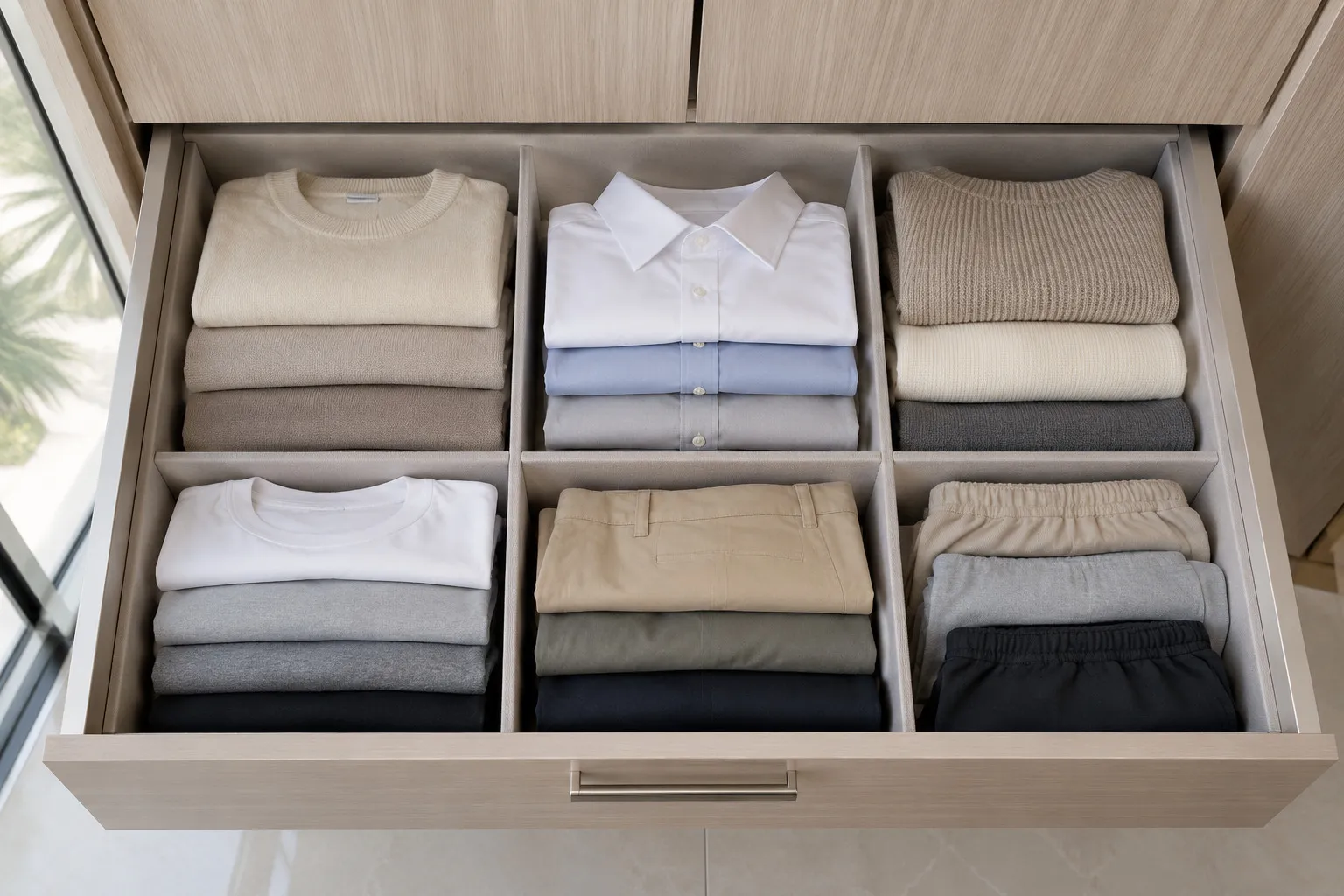
A drawer is closed on four sides and has a front, so dust stays out and small items stay in. A basket is open and light. Choose a drawer for folded clothes, underwear, socks, jewellery and anything that must stay flat or clean, and a basket for bulky, light and loose items that you want to see at a glance. A drawer also has a face that matches the wardrobe doors, which a wire basket does not, so on a visible run the drawer looks like part of the wardrobe and the basket does not.
The cost of a drawer is a front, a box and often a more demanding runner; the cost of a basket is a frame and a rail. The maker's load figure for a basket should be compared with the weight of what you will put in it, just as it should for a drawer. For the runner side of that question, which this page does not repeat, read the wardrobe drawers and organisers guide. The door in front of a pull-out has its own hardware, covered in the wardrobe hinges guide.
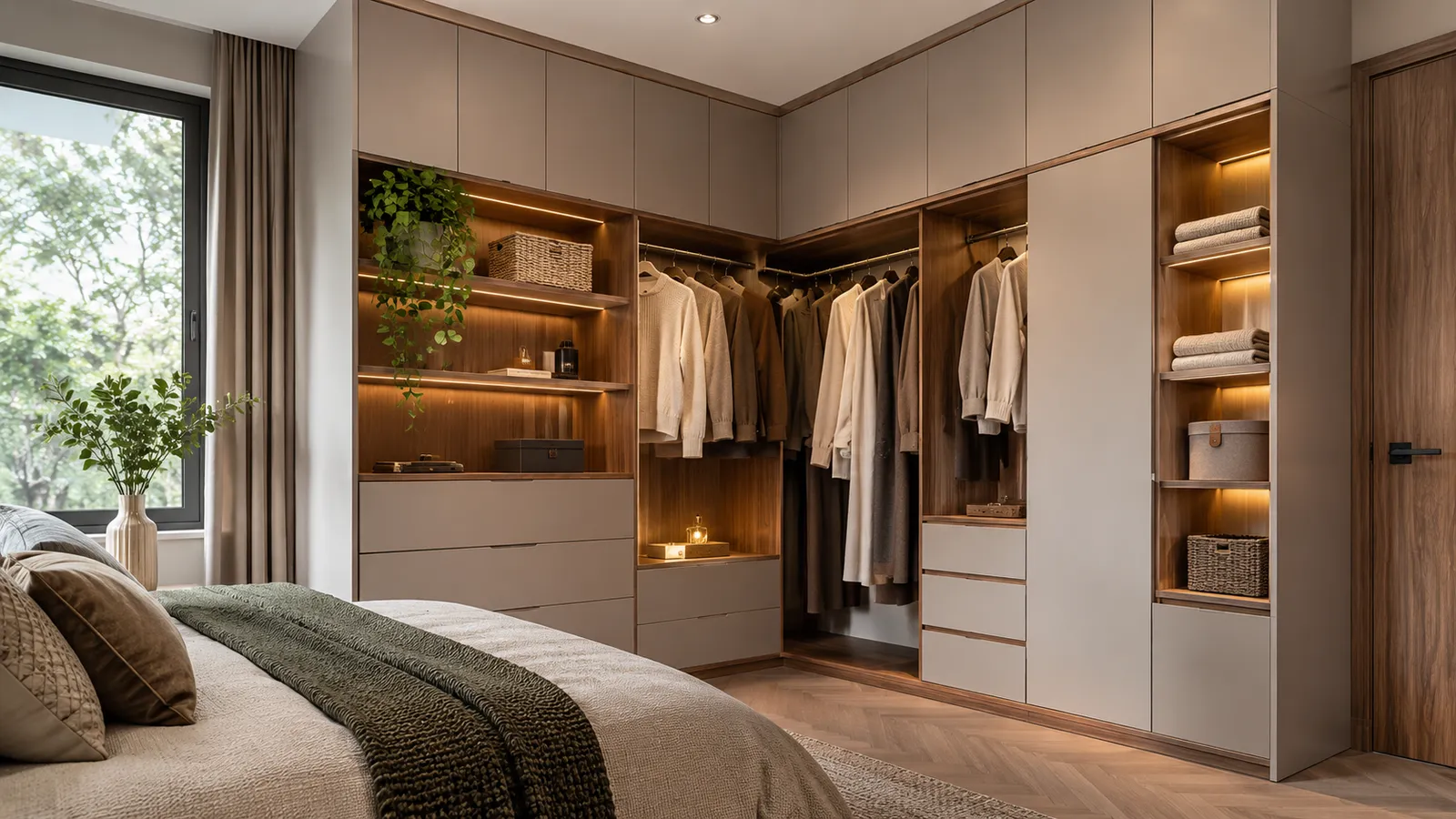
A mixed plan is common: drawers for the daily clothes at hand height, a basket or two low for bulky things, a trouser rack beside the hanging section and a shoe rack at the bottom. The wardrobe layout guide shows how those zones sit on a wall. For children the plan changes with age, which the kids wardrobe design guide explains.
Cleaning and everyday use
This is general advice, not a maker's instruction: check the care sheet of the finish and the accessory you are quoted. Wire and chrome baskets and racks collect dust on the wire and on the shelf beneath, so wipe them with a damp cloth and dry them, and take a basket out of the runner if the maker's sheet says it is removable (the Conero hangers are listed as removable from the front). A trouser rack needs only a dust wipe on its bars. A shoe tray is the one that gets dirty, because shoes bring sand with them, so brush it out and avoid putting damp shoes on it.
Use also affects wear. A rack pulled out hard, loaded past its rating or used as a step will loosen its fixings long before the finish wears; keeping the load below the rating is the best maintenance. For the board the accessory is fixed to, see moisture-resistant wardrobe boards. If a wardrobe smells damp the cause is not the pull-out; see why a wardrobe smells musty.
Cost thinking without numbers
A pull-out accessory is a separate line on a quotation, and the price depends on the model, the width, the load rating, the runner and the finish of the wire or frame. We publish no price for any of them. What you can do is count: the more pull-outs a section has, the more lines the quotation has, and a lower total may simply mean fewer pull-outs or a lighter model. Compare quotations on the same list of accessories, with the width and the load of each written next to it.
A pull-out also changes the box around it. A section built for a rack has a fixed width and depth and cannot be changed later without rebuilding, so decide first and add later only if the section is wide enough (our guide to adding drawers to an existing wardrobe covers what a box allows). Our wardrobe quotation checklist lists the lines to ask for.
The price guide shows how a quotation is built from a measured wall. If you are comparing a made-to-measure wardrobe with a ready-made one, the custom or ready-made wardrobe guide shows where accessories fit into the comparison.
Quotation lines for pull-out accessories
Which accessories are available
- Why it matters
- Not every model suits every width
- A clear answer looks like
- A list: trouser rack, tie rack, basket, shoe rack, pull-down rail, each available or not
Inside width of each section
- Why it matters
- A rack or basket is made for a width range
- A clear answer looks like
- A width in mm per section, matched to the accessory
Inside depth
- Why it matters
- A rack or basket needs a minimum depth
- A clear answer looks like
- The depth in mm and the accessory's minimum
Load rating
- Why it matters
- A basket of towels weighs more than one of caps
- A clear answer looks like
- A rating in kg per accessory, or 'not specified' in writing
Runner and extension
- Why it matters
- Full extension shows everything; partial hides the back
- A clear answer looks like
- Full or partial extension written next to each line
Position and door clash
- Why it matters
- A pull-out behind a blocked door cannot be used
- A clear answer looks like
- Each pull-out marked on the drawing with its door and swing
Pull-down rail fixing
- Why it matters
- The side panels carry the load
- A clear answer looks like
- The board and thickness the maker's sheet requires
Our entry price of AED 550 per sqm is for MDF laminate with hinged doors, installed; other options raise it and no pull-out accessory is part of the published price. Ask for it in the quotation.
What we do about pull-outs
At the free measuring visit we bring samples to the room, measure the wall with a laser and record how the doors will open. Then we send a drawing and an itemised price, and nothing is made until you approve them. Pull-out accessories appear on that drawing as separate lines, so ask what is available and the load rating in the quotation, and we will write the answers down; we have not published a list of brands or models here.
Our entry price is from AED 550 per sqm, installed, for MDF laminate with hinged doors; other options raise it, and the figure for your wall is set after measurement. After you confirm, our Sharjah workshop builds the wardrobe and our own team installs it in up to about 10 days, depending on size and design, with a 24-month written workmanship warranty (supplied products follow their own terms). Separately, the wood-based boards carry a 5-year limited warranty, subject to terms; hinges, tracks, runners, rollers and other moving hardware are not covered, and the final terms are in the written warranty, explained in our wardrobe warranty guide.
Start with the guide to the free wardrobe measuring visit to see what to prepare, then book through the consultation form.
Our custom wardrobes service page lists what we make, and the built-in wardrobes page shows finished runs.
The sliding door wardrobes page covers the other door type, which matters because it decides how a pull-out is reached. Installation covers the whole UAE, and the Sharjah page gives the workshop address.
For handles, see the wardrobe handles guide. For a wardrobe two people share, the shared couple wardrobe guide shows how the accessories divide.
How the whole price is built is in the wardrobe materials and hardware guide.
Pull-outs are fitted last; the wardrobe planning order, from wall to finish shows what to settle first.
Common questions
How wide must a wardrobe be for a pull-out trouser rack?
It depends on the rack. One Hettich page lists a minimum inside cabinet width of 457 mm and a depth of 475 mm; another rack is made for 500 to 600 mm. Ask which model is quoted. See our wardrobe depth guide.
How much weight can a pull-out wardrobe basket carry?
Only the maker's sheet says: one Hafele wire basket page lists a maximum of 30 kg per basket, but that is one product made for base cabinets. Ask the load rating for the model you are quoted. See our wardrobe quotation checklist.
Can I put a pull-out rack in a corner of my wardrobe?
Only if the door in front opens clear of the neighbouring door, which is our planning reasoning, not a maker's statement. Keep pull-outs away from the corner section, or use a sliding door. See our corner and L-shaped wardrobe design guide.
Are drawers better than pull-out baskets?
For folded clothes and small items, yes: a drawer is closed and has a front. Baskets suit bulky, light things such as caps and gym kit. A mixed plan is common. See our wardrobe drawers and organisers guide.
How much weight does a pull-down wardrobe rail carry?
One Hafele page lists 1.6 to 8 kg for an internal width of 620 to 950 mm, so it suits a few light garments. Other makers list other loads. See our double hanging wardrobe guide.
How do I clean a pull-out shoe rack or basket?
Wipe wire and chrome with a damp cloth and dry it, brush sand out of a shoe tray, and keep the load under the rating. Check the maker's care sheet. See our shoe wardrobe guide.
Do you fit pull-out racks and baskets?
Ask what is available and the load rating in the quotation; we have not published a list of accessories. Our entry price is AED 550 per sqm for MDF laminate with hinged doors, installed. See our custom wardrobes service.

Sources & specifications
Manufacturer information applies to the named products and systems. Sources reviewed on 4 November 2026.
- Hettich, Conero pull-out trouser holder (article 9352793): load 10 kg, minimum inside cabinet width 457 mm, minimum depth 475 mm, side-mounted, 7 hangers for 14 pairsshop.hettich.com(opens in a new tab)
- Hettich, Telescopic Amari trouser holder 500 - 600 mm (article 9132916): 30 kg to EN 15338 level 3, 8 holders, installation between cabinet body sidesshop.hettich.com(opens in a new tab)
- Hafele chrome wire pull-out basket for 300-600 mm cabinets (retailer page): baskets 264 to 564 mm wide, max 30 kg per basket, minimum internal depth 445 mm, concealed full-extension runnersindependent4life.co.uk(opens in a new tab)
- Hafele Starax pull-out shoe rack (retailer page): carcase 450, 600 or 900 mm, 45 kg, full extensionkitchenlibrary.au(opens in a new tab)
- Hafele pull-down wardrobe rail 1.6-8 kg (retailer page): internal width 620-950 mm, minimum installation height 880 mm, for a seated person, screw fixing to side panelsindependent4life.co.uk(opens in a new tab)
- Hettich, Single Lift 12 (article 9079872): load capacity 12 kg, telescopic width adjustment 100 mmshop.hettich.com(opens in a new tab)
Want this planned for your home?
Consultation and measurement are free. Tell us the rooms, location and what you need; we arrange a sample visit and define the measured quotation.