Wardrobes · 13 min read · 3 August 2026
Double hanging or long hanging wardrobe? How to choose and mix them
Double hanging (two rails) suits shirts, blouses, blazers and folded trousers; long hanging suits dresses, coats, abayas and kanduras. Room height decides how much of each you can have: two 94 cm drops equal one 188 cm drop. How to pick, mix and plan the bays.

By Ali Haider Basra, Founder, Al Tareeq Decor · Contact our workshop
Key takeaways
- Double hanging suits short clothes (shirts, blouses, blazers, folded trousers); long hanging suits dresses, coats, abayas and kanduras. Most homes need both in separate bays.
- Two short drops equal one long drop: Houzz Singapore allows 94 cm and 188 cm. A double hang needs a tall unit; a 201 cm frame cannot take Bob Vila's 207.6 cm upper rod.
- The upper rail is set by the shortest daily user. A pull-down rail is one answer: one Hafele product page lists 1.6 to 8 kg, so it suits light loads only.
- Plan the mix with your own numbers: half the short rail length plus the whole long length, and a long share of at least about a quarter as a start (Houzz Singapore).
- Ask for each bay, rail heights with their reference point, the gap between rods and the clearance above the upper rod on the drawing.
On this page
- Key takeaways
- Double hanging or long hanging: which one suits your clothes?
- Double hang and long hang side by side
- Which clothes go where, garment by garment
- Garment guide: double hang, long hang or neither
- How the height of the room decides it
- Reach: can everyone use the upper rail? Pull-down rails
- Ideal zones in one wardrobe: double hang, long hang and shelves
- A planner: turn your clothes into bays
- Mix planner: your numbers, our arithmetic
- Common mistakes with double hanging
- Mistakes and how to avoid them
- Kandura and abaya households
- What to ask for on the quotation and the drawing
- Quotation lines for a double-hang wardrobe
- What we do about it
- Common questions
Double hanging or long hanging: which one suits your clothes?
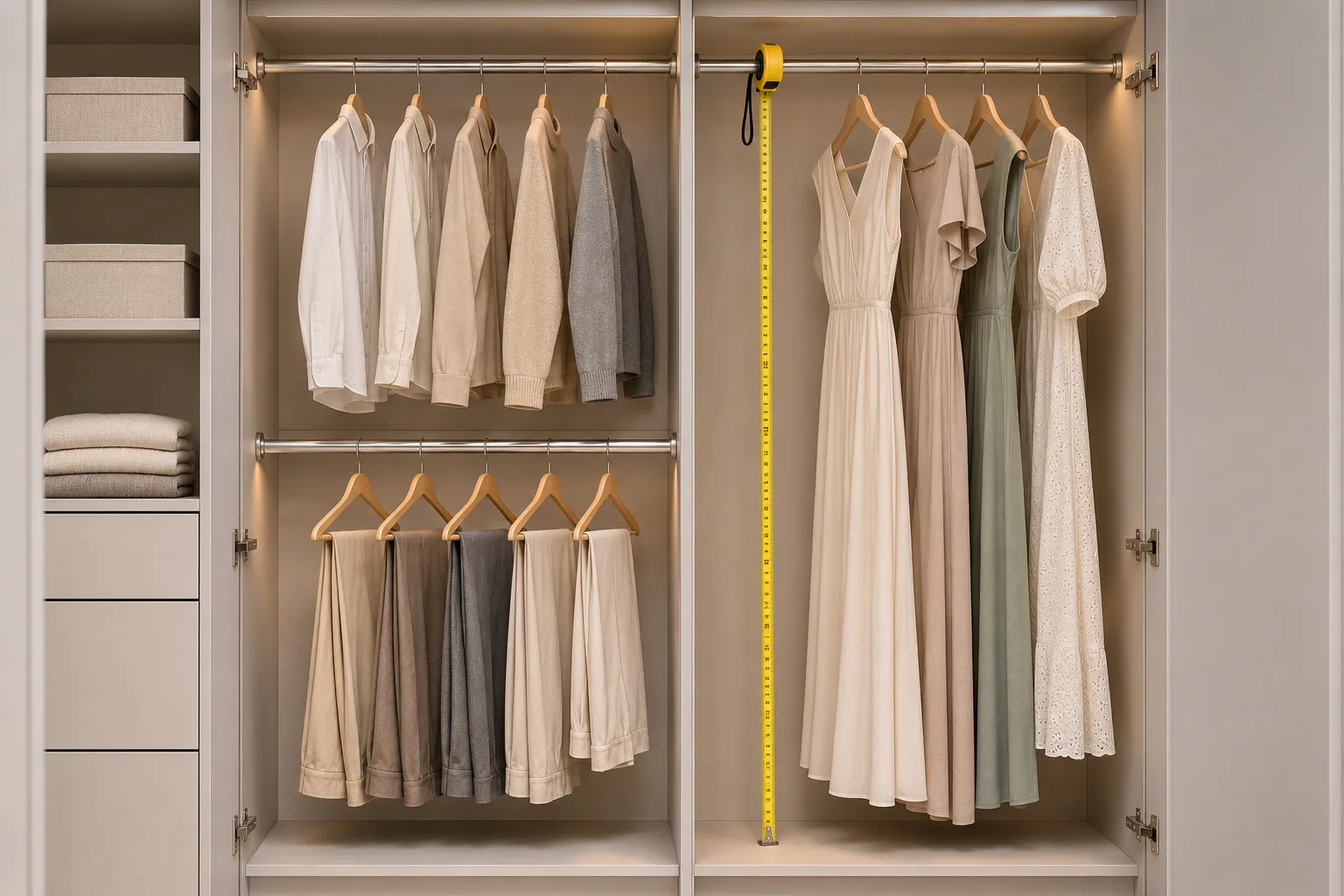
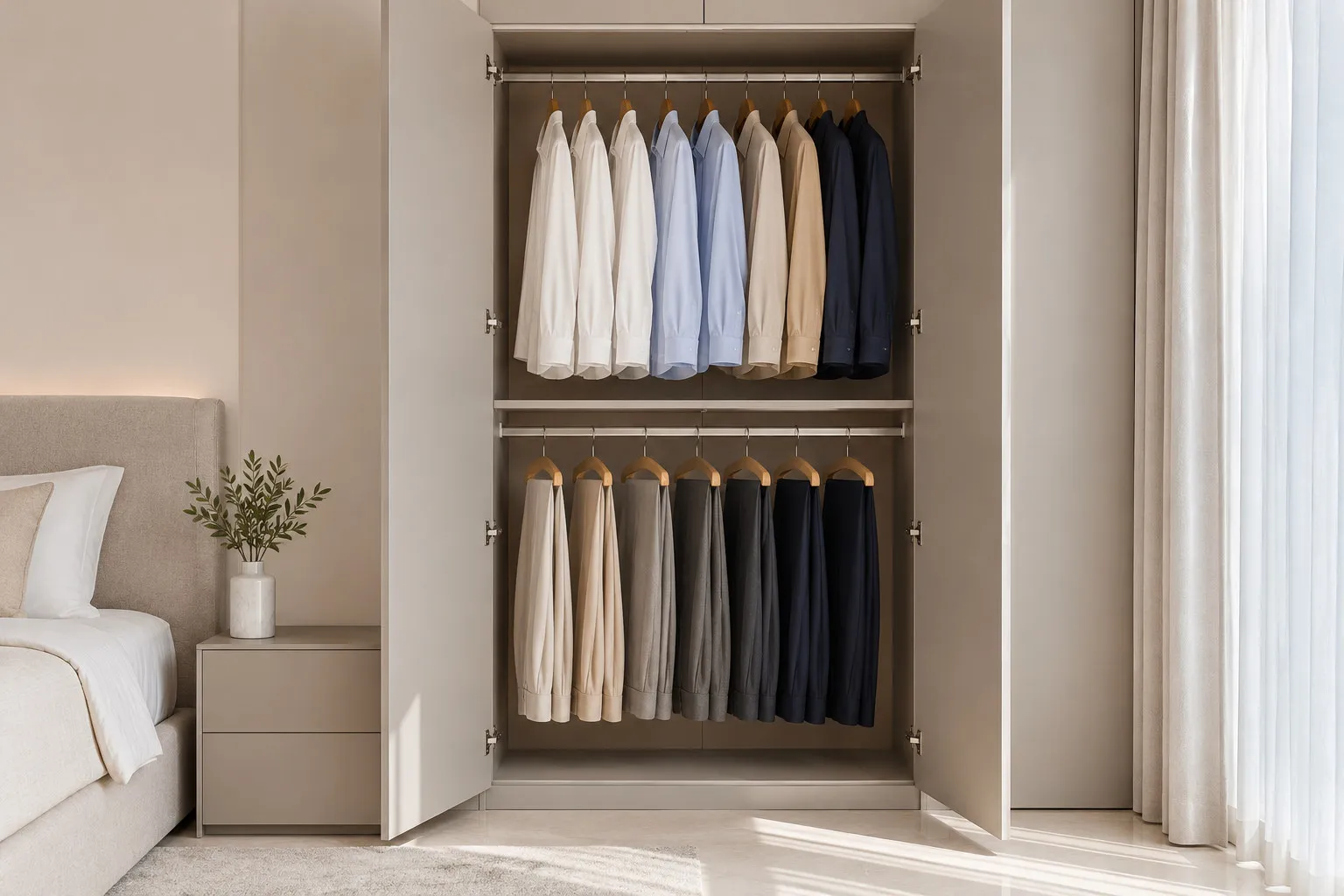
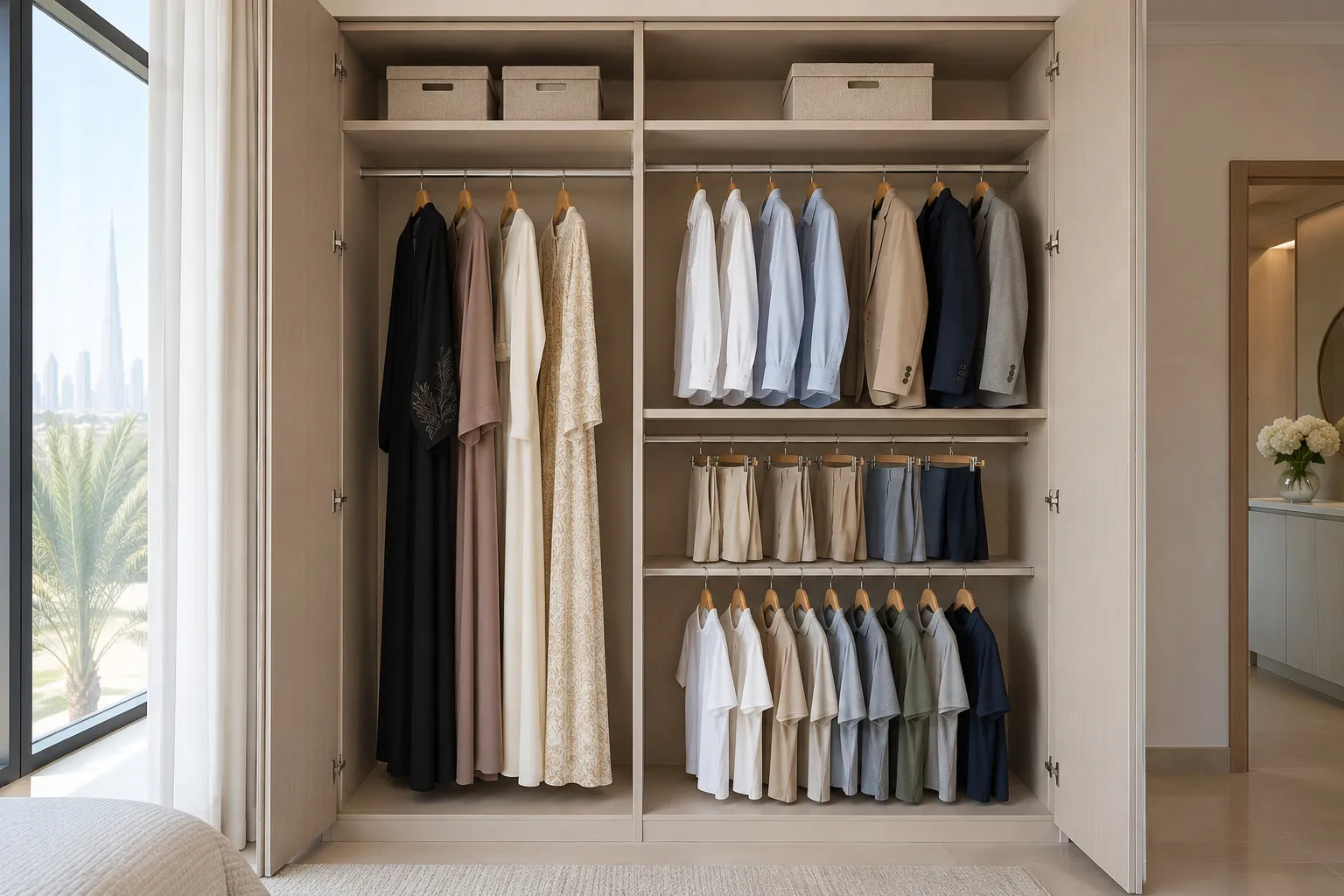
Double hanging suits clothes that are short: shirts, blouses, jackets, and trousers folded over a hanger. Long hanging suits clothes that touch the floor or nearly do: dresses, coats, abayas and kanduras. Most households need both, so the real decision is how much of the wardrobe goes to each, and the room height decides how much a double hang can give you.
The two layouts spend the same column of height differently. A double hang cuts a column into two short drops, so one width of wall holds about twice as many short garments. A long hang keeps the column open from rod to floor, so nothing else can share it. Houzz Singapore allows 94 cm of short hanging space and 188 cm for long; 94 + 94 is 188, which is our arithmetic and the whole reason one column can be either. The rail heights themselves, with each source's reference point, are in our wardrobe hanging heights guide; this page is about choosing between the layouts.
Double hang and long hang side by side
Suits
- Double hang
- Shirts, blouses, blazers, shorts, trousers folded over a hanger
- Long hang
- Dresses, coats, abayas, kanduras, suit bags
Drop per rail
- Double hang
- About 94 cm each (Houzz, short hanging space)
- Long hang
- About 188 cm (Houzz, long hanging space)
What it does to the wall
- Double hang
- About twice the short garments per width of wall (our arithmetic)
- Long hang
- One tall column, nothing else in it
Reach
- Double hang
- The upper rail is the high one: shortest daily user decides it
- Long hang
- One rail at one height, easy to reach
Needs from the room
- Double hang
- A tall unit: two drops plus the gap and clearance
- Long hang
- A tall unit as well: one long drop plus hem clearance
Main risk
- Double hang
- Upper rail set too high to use, or too low for the lower tier
- Long hang
- Long garments sharing a bay that is too short
Drops are Houzz Singapore's planning allowances (retrieved 4 Nov 2026). They are not UAE standards and not a promise for your clothes: measure your own longest garment on its hanger.
Which clothes go where, garment by garment
Bob Vila's double-rod advice puts everyday shirts, blouses, blazers, shorts and folded pants on the lower bar and less frequently worn items on the top one. That is a reach rule as much as a length rule: the rail you use daily sits where you can reach it. We follow the same logic in a custom wardrobe, with one addition: the long garments never go in a double-hang column, however convenient it looks on a drawing.
Jackets and blazers are the borderline case. A short blazer fits a double hang; a long coat, a trench or a heavy winter coat does not, and it belongs in the long bay. If you are unsure, hang the garment on its own hanger and measure from the top of the hook to the hem, as the measure sheet in the hanging heights guide describes. Whatever drop you read is the number the upper tier must clear.
Trousers can hang folded over the lower rod, or live in drawers and on a pull-out rack. Our wardrobe drawers and organisers guide covers the drawer side. Knitwear and T-shirts rarely need a rail at all, and the wardrobe layout guide shows where a shelf column does the job better.
Garment guide: double hang, long hang or neither
Shirts and blouses
- Best place
- Double hang, lower or upper rail
- Why
- Short drop; two tiers fit in one column
Short jackets and blazers
- Best place
- Double hang
- Why
- Named by Bob Vila for the lower bar
Trousers folded over a hanger
- Best place
- Double hang, lower rail
- Why
- Short drop once folded
Dresses and long skirts
- Best place
- Long hang
- Why
- The hem needs the full column
Long coats
- Best place
- Long hang
- Why
- Too long for a short tier
Abayas and kanduras
- Best place
- Long hang, own bay
- Why
- Measure hook to hem; often longer than a coat
Knitwear, T-shirts, scarves
- Best place
- Shelf or drawer
- Why
- They stretch on a hanger and take little height folded
Our reading of the sources, not a standard. Bob Vila names shirts, blouses, blazers, shorts and folded pants for the lower bar; the rest is the drop each garment needs.
How the height of the room decides it
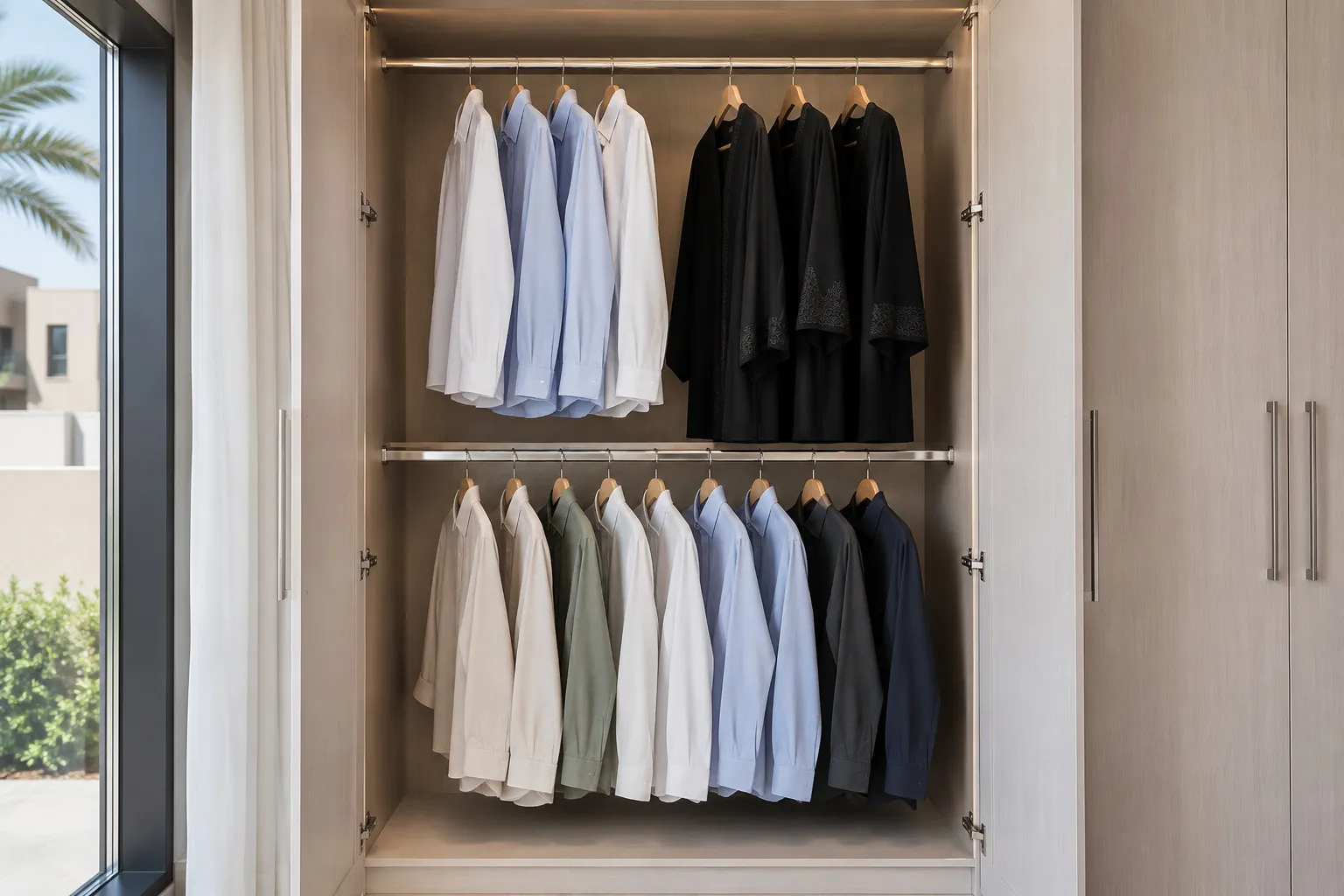
A double hang needs two drops, a gap between them and clearance above the upper rod, so it needs a tall unit. Bob Vila's upper rod sits at 207.6 cm (81¾ inches) and the lower at 102.9 cm (40½ inches), both to the bottom of the rod. A unit whose inside height is 201 cm, a common ready-made frame height at IKEA UAE, cannot hold an upper rod at 207.6 cm at all; the 236 cm frame leaves about 29 cm above it. That is our arithmetic from two published numbers, and it shows why a double hang quietly asks for more than a typical low wardrobe.
Above the upper rod there is also a shelf or the top of the unit. Bob Vila asks for at least 2 inches, about 5 cm, between the underside of a shelf and the top of the rod, so the hanger hook can come off. If the ceiling is low and the unit stops short of it, a double hang may not fit; a floor-to-ceiling wardrobe uses the full wall and gives the second rail room it needs. The gap at the top of the room is measured at the visit, as the wardrobe measuring visit guide explains.
The picture below builds one wardrobe elevation in four steps: a double-hang bay, a long-hang bay, a bay of shelves and drawers, and a pull-down rail on the upper rod. The rods of the double bay are Bob Vila's, the 188 cm long drop is Houzz's, the 236 cm frame is the tall IKEA UAE height, and the shelf and drawer bay is illustrative.
- 1. Double-hang bay: rods at 207.6 and 102.9 cm, Bob Vila's published positions, for short garments
- 2. Long-hang bay: a 188 cm drop (Houzz Singapore's long hanging space), leaving about 20 cm under the hem (our arithmetic)
- 3. Shelves and drawers: for folded clothes, so nothing short or folded takes a rail (zone heights illustrative)
- 4. Pull-down rail: brings the upper rod to the user (Hafele, for a seated person; 1.6 to 8 kg) (the mechanism, not a height)
Reach: can everyone use the upper rail? Pull-down rails
The upper rail of a double hang is the one at the edge of reach, and the reach of the shortest person who will use the wardrobe every day sets it. Bob Vila puts the less frequently worn clothes on the top rod for that reason. Hanging heights for children, who need rails much lower, are covered in our kids wardrobe design guide, and sharing a wardrobe between two adults of different heights in our guide to a wardrobe shared by two.
Where the upper rail is simply too high for daily use, a pull-down rail brings it to you. Houzz Singapore mentions pull-down hanging rods for clothes hung up high, and one product page we opened, for a Hafele manual pull-down wardrobe rail, says it enables a seated person to bring the clothes rail down to a comfortable height. That page lists a minimum load of 1.6 kg and a maximum of 8 kg, a fit for wardrobes with an internal width of 620 to 950 mm, a minimum installation height of 880 mm, and screw fixing to the side panels, with all fixings to be used.
Three honest cautions. First, that is one product from one retailer's page; other makers' rails have other loads and widths, so do not read the 8 kg as a general limit. Second, a rail that holds 8 kg at most carries a few light garments, not a winter coat collection; a heavy upper tier is better lowered by moving the rail than lifted by a mechanism. Third, we have not published whether we fit pull-down rails; ask for it in the quotation and for the load and width in writing.
Ideal zones in one wardrobe: double hang, long hang and shelves
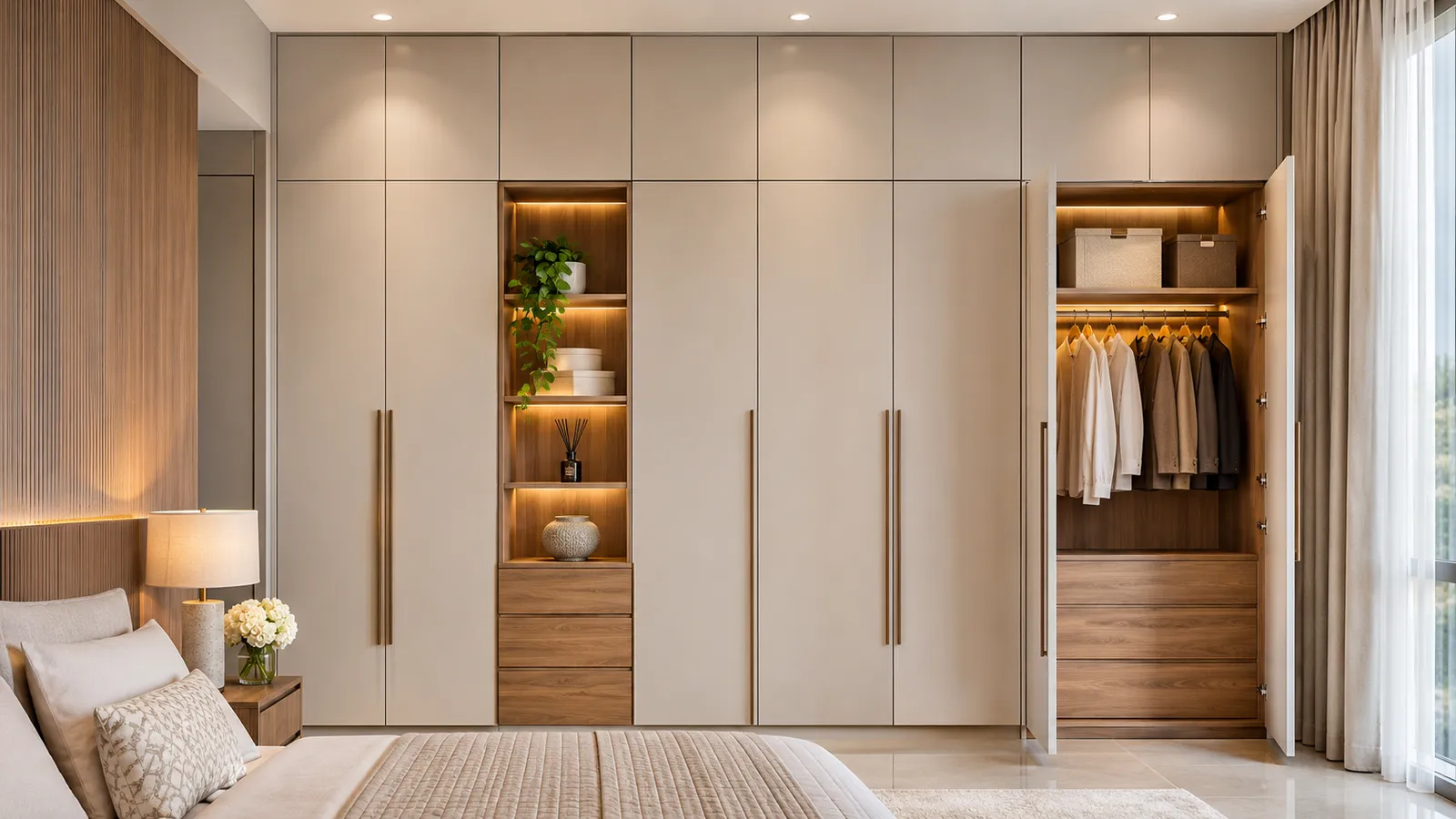
A well-planned wardrobe is rarely one layout. It is three zones side by side: a double-hang bay for the short clothes, a long-hang bay for the long ones, and a column of shelves and drawers for everything that is folded. Houzz Singapore suggests that a minimum of a quarter of all hanging space devoted to long clothing is a good start; that is its figure for walk-in wardrobes, and your clothes will move it up or down.
In practice the long bay goes at the end of the run nearest the door, so the tall column does not block the reach to the others, and the shelf column sits between the two hanging bays so that the dividing panels carry the shelves. This is a layout habit, not a rule from a source. For rooms with an L-shaped or corner run, the corner decides where the long bay can go; see our corner and L-shaped wardrobe design guide. For a household with a large collection of long garments, our abaya and kandura storage guide shows the full method.
Above the rails there is usually a top box for what is used twice a year. Our luggage and seasonal storage guide shows what goes there, and the wardrobe depth guide covers why the box needs about 60 cm of depth for hangers. If the double hang is in a narrow room, remember the clearance in front of the doors; see our wardrobe door clearance guide.
A planner: turn your clothes into bays
The planner needs no catalogue number, only your own wardrobe. Push the short garments together on your current rail and measure how many centimetres they take, and do the same for the long garments. A double hang needs about half the wall width for the short clothes, because two tiers share it. The long clothes need their full rail length. So the wall needed for hanging is about half the short length plus the whole long length, before the panels between bays and any shelf column.
Here is a worked example with illustrative numbers, not a recommendation: 240 cm of short garments and 90 cm of long ones. Double hang for the short clothes: 240 divided by 2 is 120 cm. Long hang: 90 cm. Together 210 cm of wall, before panels. Long clothing is then 90 of 330 cm of rail, about 27 per cent, which is above the quarter Houzz Singapore suggests as a start. Put your own two numbers into the table and see the answer on your wall.
Mix planner: your numbers, our arithmetic
1. Short garments, rail length
- How
- Push your shirts, blouses, blazers and folded trousers together; measure
- Worked example (illustrative)
- 240 cm
2. Long garments, rail length
- How
- Same for dresses, coats, abayas, kanduras
- Worked example (illustrative)
- 90 cm
3. Double-hang bay width
- How
- Step 1 divided by 2
- Worked example (illustrative)
- 120 cm
4. Long-hang bay width
- How
- Step 2 as it is
- Worked example (illustrative)
- 90 cm
5. Hanging wall needed
- How
- Step 3 plus step 4, before panels
- Worked example (illustrative)
- 210 cm
6. Long share of rail
- How
- Step 2 divided by (step 1 plus step 2)
- Worked example (illustrative)
- About 27 per cent
7. Add folded clothes
- How
- Shelf and drawer column beside the bays
- Worked example (illustrative)
- Width from your folded stock
A planning method, not a standard. Real bays are limited by rail lengths, panel thickness and the room; the drawing for your wall sets the final widths.
Common mistakes with double hanging
The commonest mistake is an upper rail set too high to use. A rail nobody can reach holds clothes that are never worn, so check the upper rail against the shortest daily user, and where it is out of reach consider a lower layout or a pull-down rail. The second is clearance: with the shelf directly over the upper rod, the hangers cannot be lifted off, which is why Bob Vila asks for at least 2 inches from the shelf to the top of the rod. A hanger has height too, so measure it before the drawing is drawn.
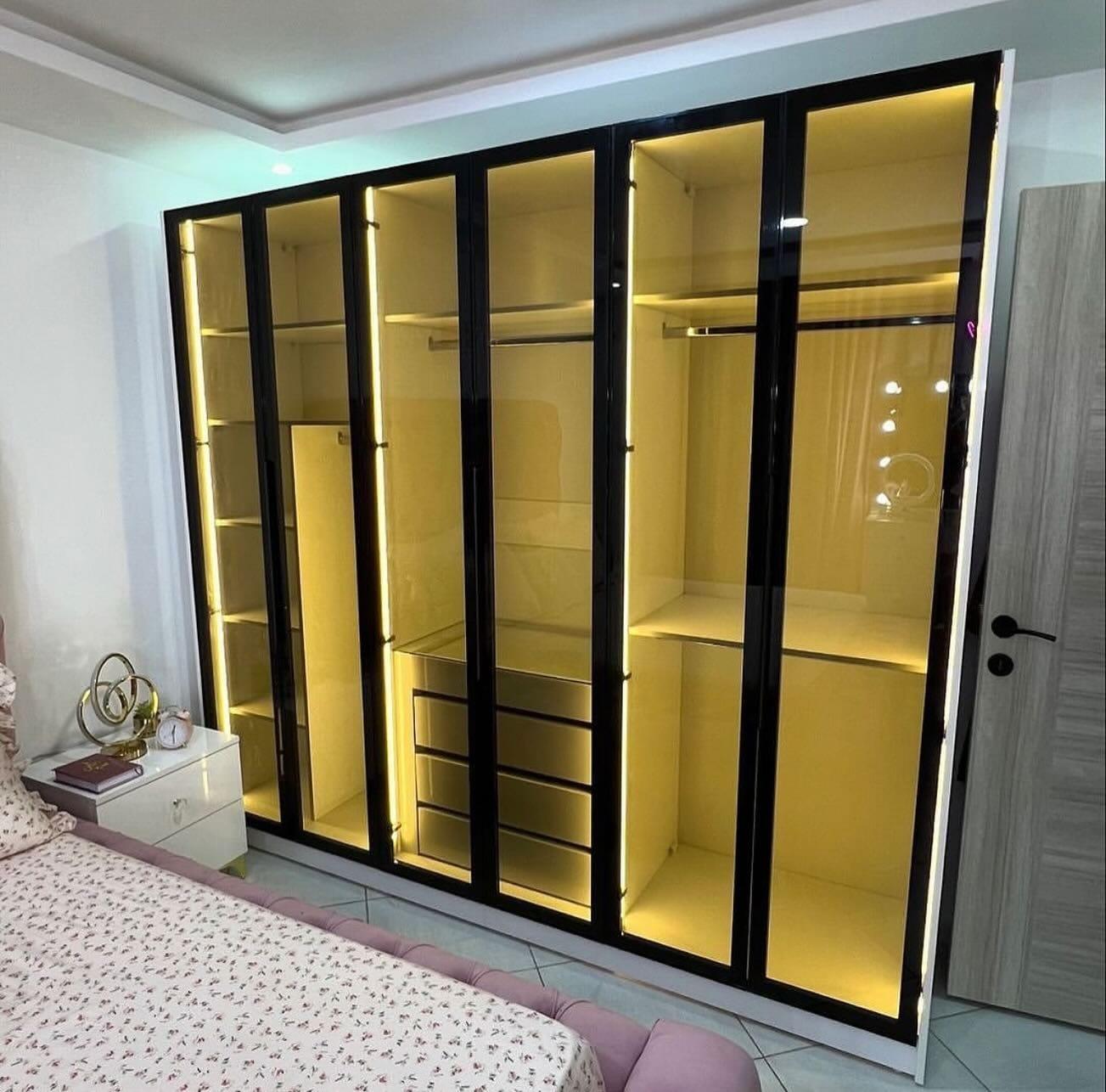
The third is putting a long garment in a short tier, which drags the hem across the lower rail. The fourth is the opposite: building a long-hang bay for clothes that are mostly short, and wasting half the column. And one more that is easy to miss: if the unit has a mirror or glass door, the clothes inside are visible all day, so the upper tier is better used for items that look tidy.
Mistakes and how to avoid them
Upper rail too high
- What goes wrong
- Never used; clothes stay unworn
- Fix
- Set it from the shortest daily user's reach, or use a pull-down rail
No clearance above the upper rod
- What goes wrong
- Hangers cannot be lifted off
- Fix
- At least 2 in (about 5 cm) from shelf to rod top (Bob Vila)
Long garments in a short tier
- What goes wrong
- Hems drag on the lower rail
- Fix
- Move them to a long-hang bay
Gap between rods too small
- What goes wrong
- Upper garments touch the lower tier
- Fix
- Measure the longest short garment plus the lower hanger
Lower rail too low
- What goes wrong
- Lower tier hems touch shelves or base
- Fix
- Leave hem clearance; check the lowest drop
One mix for the whole wall
- What goes wrong
- Wasted column or crowded rail
- Fix
- Use the planner: double, long and shelves
The 2 inch figure is Bob Vila's (retrieved 4 Nov 2026); the other rows are our reading of the geometry.
Kandura and abaya households
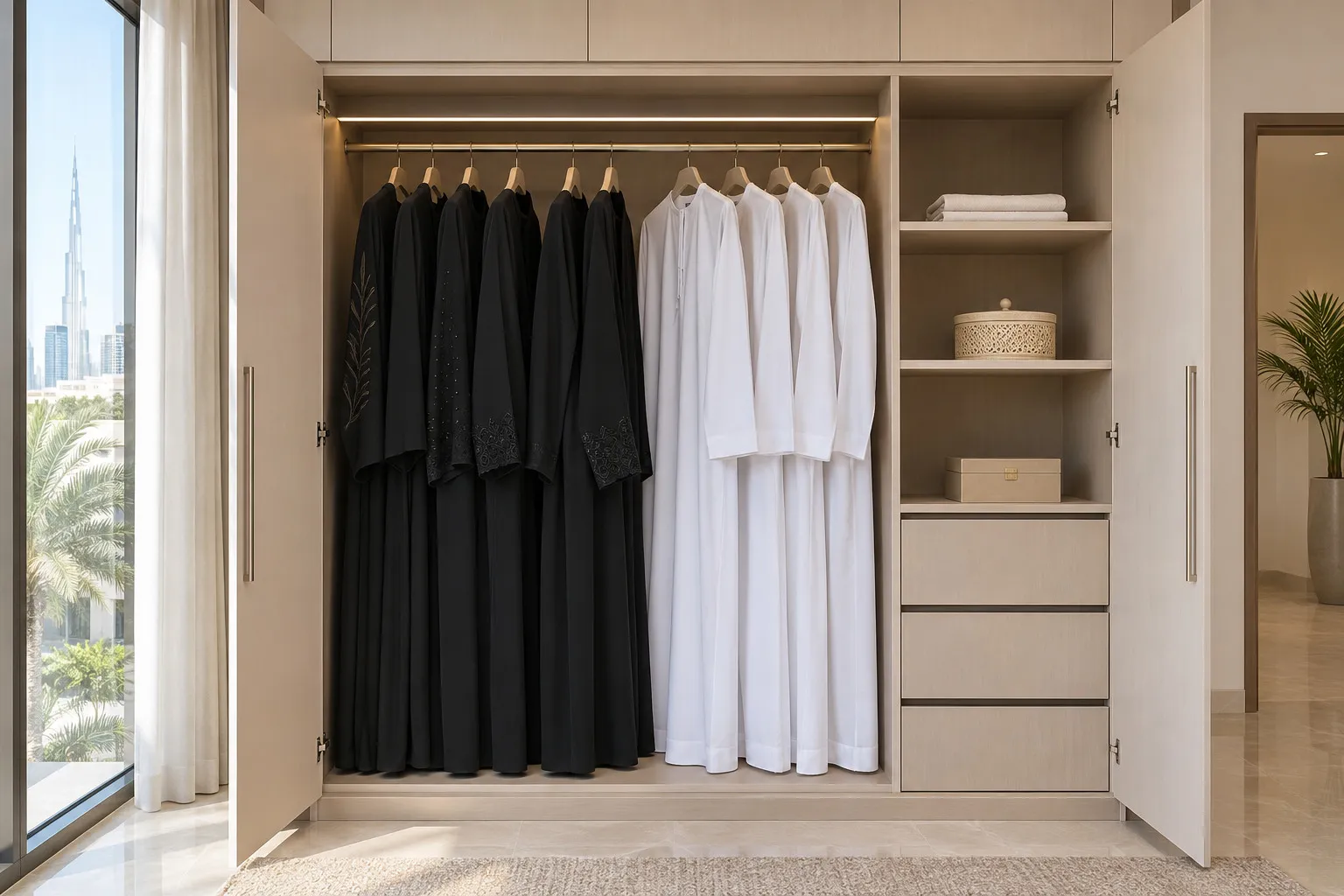
A kandura or an abaya rarely suits the standard 188 cm allowance, because a garment's length depends on its owner; measure yours rather than copying a number. The honest planning rule is that these garments take a long bay of their own, with nothing hanging beneath them, and a household that also keeps shirts needs a double-hang bay beside it. Our abaya and kandura storage guide shows how to measure them and which retailer lengths exist.
For a master bedroom with several people sharing one wall, our master bedroom wardrobe design guide shows how to give each person a bay; a dressing room gives the room for two long bays and a double. In a small flat the same mix has to fit in less wall, as in our studio apartment wardrobe guide and our guide to apartment wardrobe ideas.
What to ask for on the quotation and the drawing
A quotation that says only 'hanging rails' tells you nothing about the mix. Ask the surveyor to put each bay on the drawing with its rail heights and its drop, and write down what each bay is meant to hold. Our wardrobe quotation checklist gives the general list, and the pricing guide shows how a quotation is built from a measured wall.
Quotation lines for a double-hang wardrobe
Each bay and what it holds
- Why
- A mix on paper avoids a rail in the wrong place
- A clear answer looks like
- A drawing with 'double', 'long' and 'shelves' labelled
Rail heights and the reference point
- Why
- Bottom or centre of the rod changes the number
- A clear answer looks like
- Each height with 'to bottom of rod' written next to it
Gap between the two rods
- Why
- It limits the longest short garment
- A clear answer looks like
- A gap in cm on the drawing
Clearance above the upper rod
- Why
- Hangers must come off
- A clear answer looks like
- A cm figure from shelf or top to rod
Pull-down rail
- Why
- Not published as something we fit
- A clear answer looks like
- 'Fitted: yes/no', its load and width in writing
Total unit height
- Why
- A double hang needs a tall unit
- A clear answer looks like
- Inside height and the gap to the ceiling
Our entry price of AED 550 per sqm is for MDF laminate with hinged doors, installed; other options raise it and no rail layout is part of the published price. Ask for it in the quotation.
What we do about it
At the free measuring visit we bring samples to your room, measure the wall and the height with a laser, and ask which of your clothes are long. Then we send a drawing and an itemised price, and nothing is made until you approve them. Bay widths and rail heights are on that drawing, so you can compare them with the planner on this page before anything is cut.
Our entry price is from AED 550 per sqm of wardrobe front, installed, for MDF laminate with hinged doors; other options raise it, and the figure for your wall is set after measurement. After you confirm, our Sharjah workshop builds the wardrobe and our own team installs it up to about 10 days later, depending on size and design, with a 24-month written workmanship warranty (supplied products follow their own terms). Separately, the wood-based boards carry a 5-year limited warranty, subject to terms; hinges, tracks, runners, rollers and other moving hardware are not covered. We have not published our standard rail heights or hardware, so ask for them in the quotation.
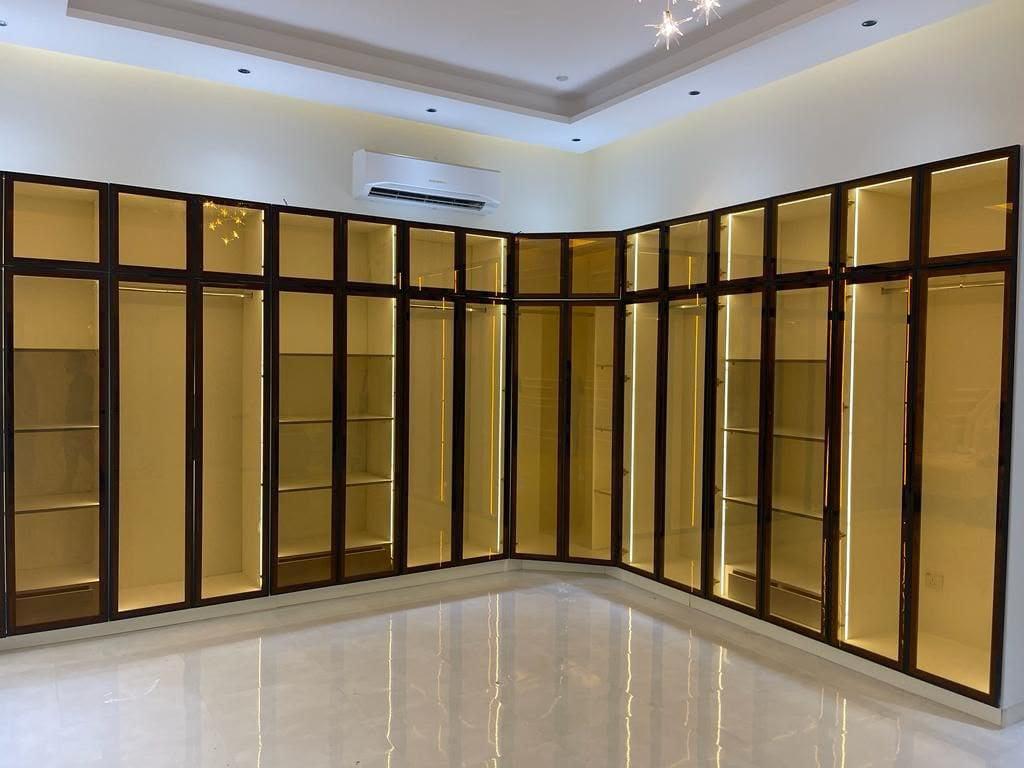
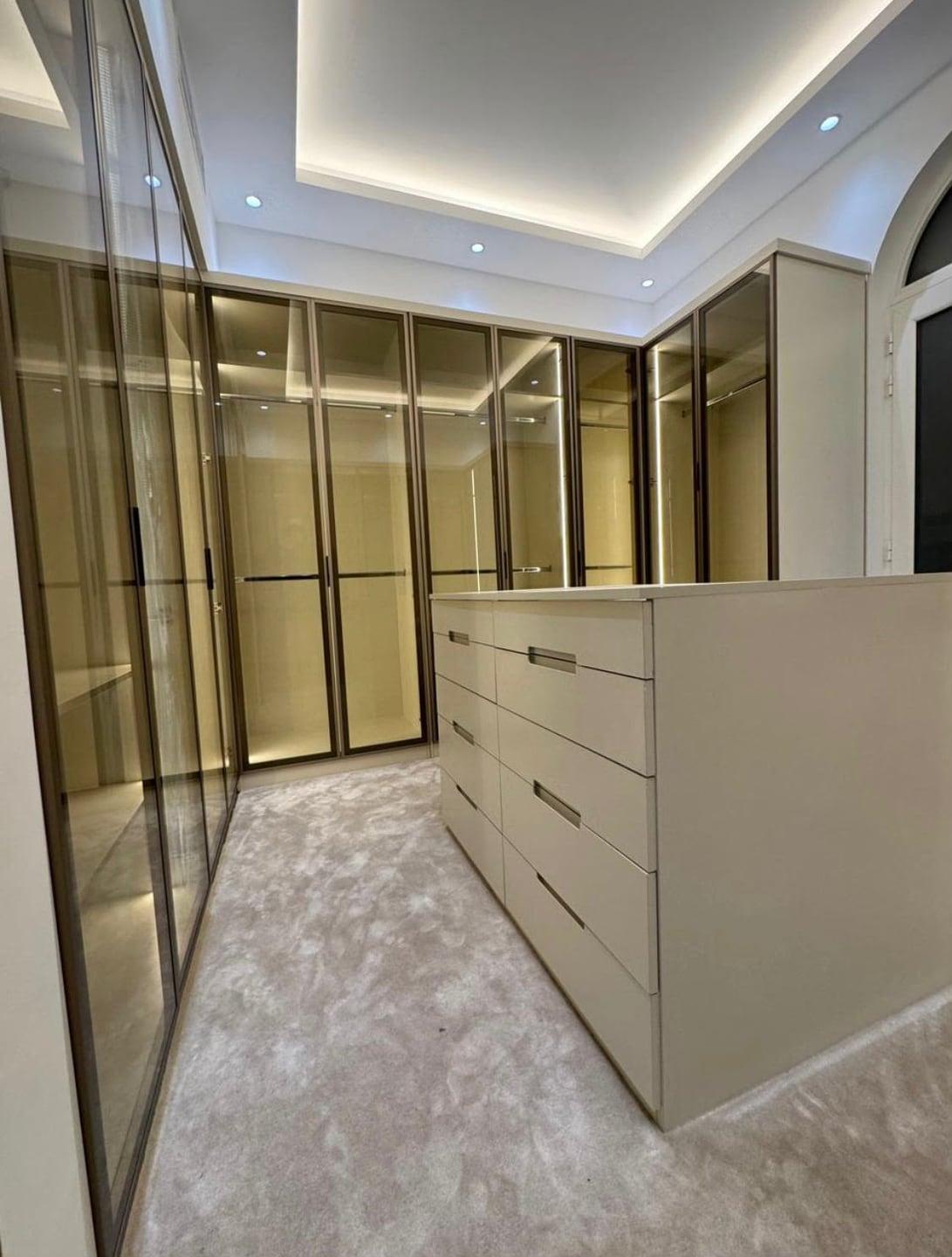
Start with the free wardrobe measuring visit guide to see what to prepare, then book through the consultation form. Our custom wardrobes service page lists what we make, the built-in wardrobes page shows finished runs, and the walk-in closets and dressing rooms page shows rails at several heights. For a glass-front wardrobe with light inside, see the lit glass-front wardrobes page.
To see how a measured wall becomes a number, read the wardrobe price guide and the wardrobe dimensions guide. If you are comparing a made-to-measure wardrobe with a ready-made frame, see custom or ready-made wardrobe. Installation covers the whole UAE: the Sharjah page gives the workshop address and the Dubai page covers visits there.
For drawers, shoes and the doors in front, the wardrobe planning page that links every guide is the place to start.
Common questions
What is a double hanging wardrobe?
It is a bay with two rails, one above the other, so that short clothes such as shirts, blouses and folded trousers hang in two tiers. Bob Vila's published positions are 207.6 cm and 102.9 cm to the bottom of each rod. See our wardrobe hanging heights guide.
Is double hanging or long hanging better?
Neither is better for everything: double hanging holds more short clothes per width of wall, long hanging is needed for dresses, coats, abayas and kanduras. Most wardrobes combine them, with at least about a quarter for long clothing as a start (Houzz Singapore). See our wardrobe layout guide.
How high should the upper rail of a double hang be?
Bob Vila gives 207.6 cm (81¾ in) to the bottom of the rod, with the lower rod at 102.9 cm (40½ in). Check it against your shortest daily user and keep at least 2 in (about 5 cm) above the rod for the hangers. See our floor-to-ceiling wardrobe guide.
Can I hang abayas and kanduras on a double rail?
Not on a short tier: they are long garments and need their own long-hang bay with nothing below. Measure the longest from hook to hem and add clearance. See our abaya and kandura storage guide.
What if the upper rail is too high to reach?
Lower the layout, put rarely worn items up there, or ask about a pull-down rail. One Hafele product page lists a 1.6 to 8 kg load for a manual rail for a seated person; ask us in the quotation whether we fit one. See our wardrobe door clearance guide.
How much of my wardrobe should be long hanging?
Measure your long and short garments and use the planner: half the short rail length plus the whole long length. Houzz Singapore suggests a quarter of hanging space for long clothing as a start. See our shared couple wardrobe guide.
What do I write on the quotation for double hanging?
Ask for each bay on the drawing, its rail heights with the reference point, the gap between rods and the clearance above the upper rod. Our entry price is AED 550 per sqm for MDF laminate with hinged doors, installed. See our wardrobe quotation checklist.

Sources & specifications
Manufacturer information applies to the named products and systems. Sources reviewed on 4 November 2026.
- Bob Vila, closet rod height: top rod 81¾ in and lower rod 40½ in above the floor, to the bottom of the rod; shirts, blouses, blazers and folded pants on the lower bar; at least 2 inches from shelf to top of rodbobvila.com(opens in a new tab)
- Houzz Singapore, essential walk-in wardrobe measurements: 94 cm short hanging space, 188 cm long; a quarter of hanging space for long clothing as a start; pull-down rods for clothes hung up highhouzz.com.sg(opens in a new tab)
- Hafele pull-down wardrobe rail (retailer page): for a seated person; 1.6 to 8 kg; internal width 620 to 950 mm; minimum installation height 880 mm; screw fixing to side panelsindependent4life.co.uk(opens in a new tab)
- IKEA UAE, PAX wardrobe frame: 201 cm and 236 cm heightsikea.com(opens in a new tab)
Want this planned for your home?
Consultation and measurement are free. Tell us the rooms, location and what you need; we arrange a sample visit and define the measured quotation.