Wardrobes · 14 min read · 27 August 2026
Adding drawers, shelves and a new interior to an existing wardrobe: what can be added and what cannot
Can drawers, shelves or a drawer tower be added to a wardrobe you already own? What can be added, the limits (carcass, depth, back panel, door clash, screw holding), when a drawer bank cannot fit, what drives the cost, doing it with new doors and when to rebuild.

By Ali Haider Basra, Founder, Al Tareeq Decor · Contact our workshop
Key takeaways
- Four changes are common: drawers in place of hanging space, extra shelves, a drawer tower and pull-out racks. Each can be possible in one wardrobe and impossible in the next.
- The limits are the carcass condition, the depth and width, the back panel, door clash, and whether the old boards can take screws and the load. They are judged on a visit, not from a photo.
- A drawer bank cannot fit in a shallow wardrobe, or where you need the full rail height for long garments; a shelf or a pull-out may be the realistic change.
- Doing the doors at the same time lets the doors be planned for the drawers; and when most of the inside changes, rebuilding or replacing may be smarter.
- We assess requests for wardrobe modifications and the scope depends on the existing unit. Send photos and measurements; we assess on the free measuring visit.
On this page
- Key takeaways
- What can be added to a wardrobe you already own
- The four additions and what each depends on
- The first check: the condition of the carcass
- Depth, width and the back panel
- Door clash: the drawer has to come out
- When a drawer bank cannot fit
- Shelves, a drawer tower or pull-out racks
- Which addition suits which problem
- What drives the cost, without numbers
- Doing it together with door replacement
- When rebuilding the inside is smarter, or replacing
- What we do about it
- Common questions
What can be added to a wardrobe you already own
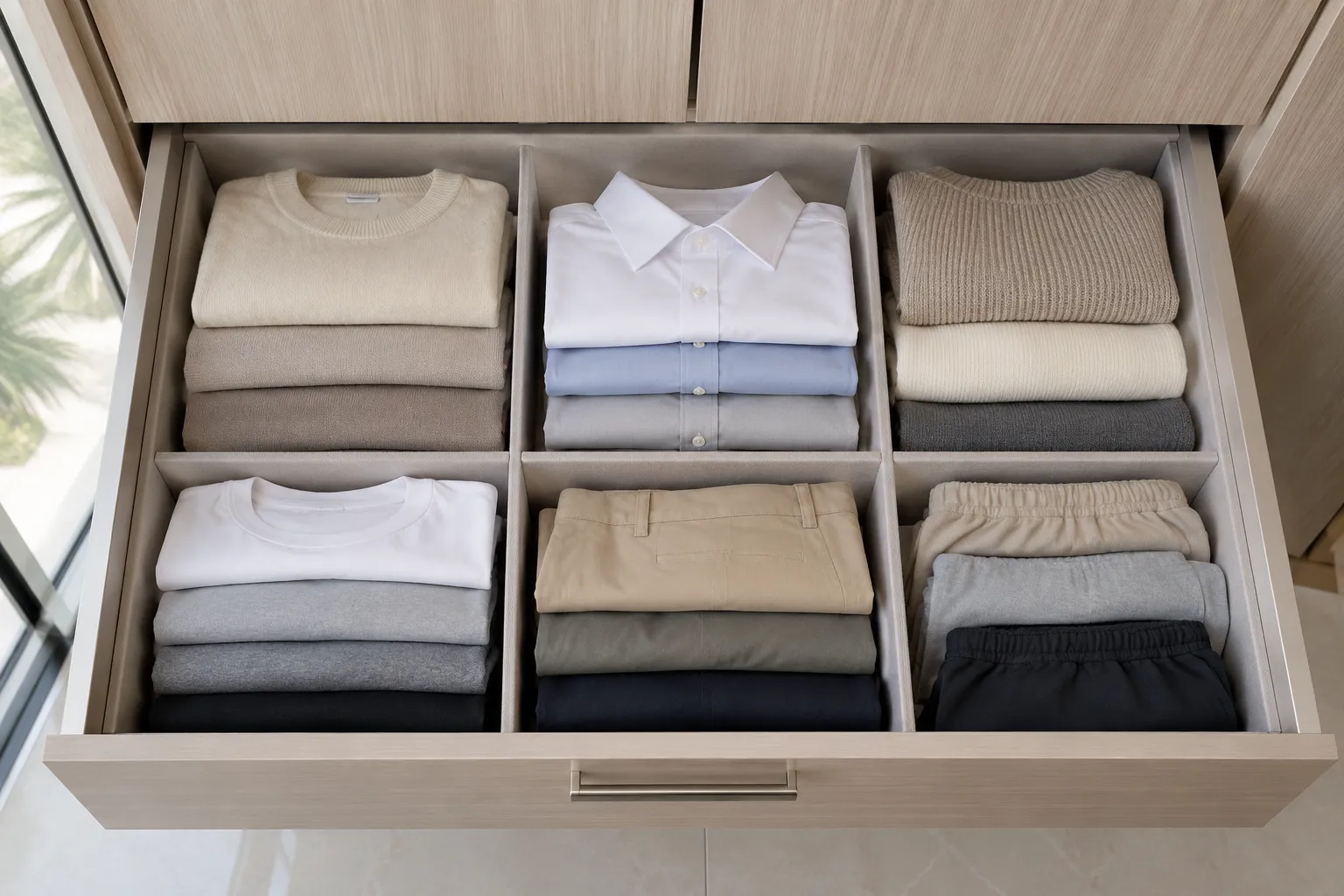
Most people who ask this have a wardrobe that works from the outside but not from the inside: one long rail, two shelves, and everything else in piles. The usual wish is to turn part of that into drawers. Four changes come up again and again: drawers in place of some hanging space, extra shelves, a drawer tower (a stack of drawers built as one unit that stands inside a section), and pull-out racks. Each can be possible in one wardrobe and impossible in the next.
We do not promise that every wardrobe can be changed. We assess requests for additional wardrobe modifications or refurbishment, and the scope depends on the condition of the existing unit. The honest answer to "can you add drawers to mine" is therefore: send photos and measurements, and we assess it on the free measuring visit. This page explains what that assessment looks at, so that you can judge your own wardrobe before the visit.
It is not a guide to planning drawers in a new wardrobe: for the heights, dividers and runner choices there, read our wardrobe drawers and organisers guide. The pull-out accessories are compared one by one in the pull-out racks guide. Here the question is narrower: what the wardrobe you have will allow.
The four additions and what each depends on
Drawers instead of hanging space
- What it replaces or uses
- Part of a hanging section, lower down
- What decides whether it fits
- The rail you still need, the section's inside width and depth, and whether the sides can carry runners
Extra shelves
- What it replaces or uses
- Empty height inside a section
- What decides whether it fits
- Whether the sides take shelf supports or fixed shelves, and the load you plan to put on them
A drawer tower
- What it replaces or uses
- A section or half of a section
- What decides whether it fits
- Floor, width, depth and the door in front of it; a tower is a separate box, so it needs less from the old sides but more floor
Pull-out racks
- What it replaces or uses
- A section beside the rail
- What decides whether it fits
- Inside width and depth, the load rating and the door clash, as in the pull-out racks guide
A summary of the possibilities, not a promise that any of them can be fitted to your wardrobe: each is decided by looking at the unit.
The first check: the condition of the carcass
Every addition is screwed or fixed to the old wardrobe, so the old wardrobe has to be sound enough to take it. The carcass is the box: the two sides, the top, the base, the fixed shelves and the back. If it is solid, square and dry, almost any addition is worth discussing. If it has swollen at the bottom, sagged in the middle or shows soft board where screws were pulled out before, adding weight to it adds the problem.
Two things matter most, and both can only be judged by touch and sight. The first is whether the existing boards can take screws and hold them. A board that is soft, swollen or crumbling around old holes does not give a runner or a shelf support anything to grip, and a drawer full of folded clothes is heavy. The second is the load: a drawer that is fully loaded pulls forward and down on its sides every time it opens. We say plainly that we cannot judge either from a photograph; it is assessed on a visit.
Water is the usual cause of soft board. If the bottom of the wardrobe is swollen, or there is a musty smell, find out why before adding anything; our guide to a musty wardrobe covers the likely causes, and the guide to moisture-resistant wardrobe boards explains what a rebuild would use instead. If the doors already rub or hang crooked, the carcass may have moved: start with what to do when a wardrobe door is sticking.
Depth, width and the back panel
Depth is the limit people notice last. A drawer box needs the runner's length plus clearance, and a hanging section needs the width of a hanger across it. A wardrobe that is shallow for hanging may also be shallow for drawers, because a drawer box that is too short holds little. Our wardrobe depth guide shows how much room hangers and doors take, and the same arithmetic applies when you turn the question around and ask how much room is left for a drawer.
Width matters in two ways. A drawer or rack is built for a range of inside widths: the Hettich pull-out trouser holders we opened on 4 November 2026 illustrate it, with the Conero listed for a minimum inside cabinet width of 457 mm and a minimum inside cabinet body depth of 475 mm, and the Telescopic Amari made for an inside body width of 500 to 600 mm. Those are two products, not a standard, but they show the pattern: a section narrower than the minimum cannot take that product at all. And if a section is wide and its shelf is not supported in the middle, the shelf may sag under folded clothes whatever you add below it.
The back panel is the third limit. Many wardrobes have a thin back, held by small nails or pins; it is not meant to carry anything. A tower or a set of drawers is better fixed to the sides, the floor and the top, but if the sides are no use, an addition may have to stand on its own and be fixed to the walls through the back. That is another reason to look at the unit: what the back is, and what is behind it, is part of the assessment.
Door clash: the drawer has to come out
A drawer pulls out into the room, so the door in front of it has to be open first, and it has to open wide enough. In a hinged wardrobe, a drawer behind a door that opens only 90 degrees against a wall or neighbouring door may open only partly; that is our planning reasoning, not a maker's statement, and the drawing should show it. The door clearance guide explains how much floor a door needs.
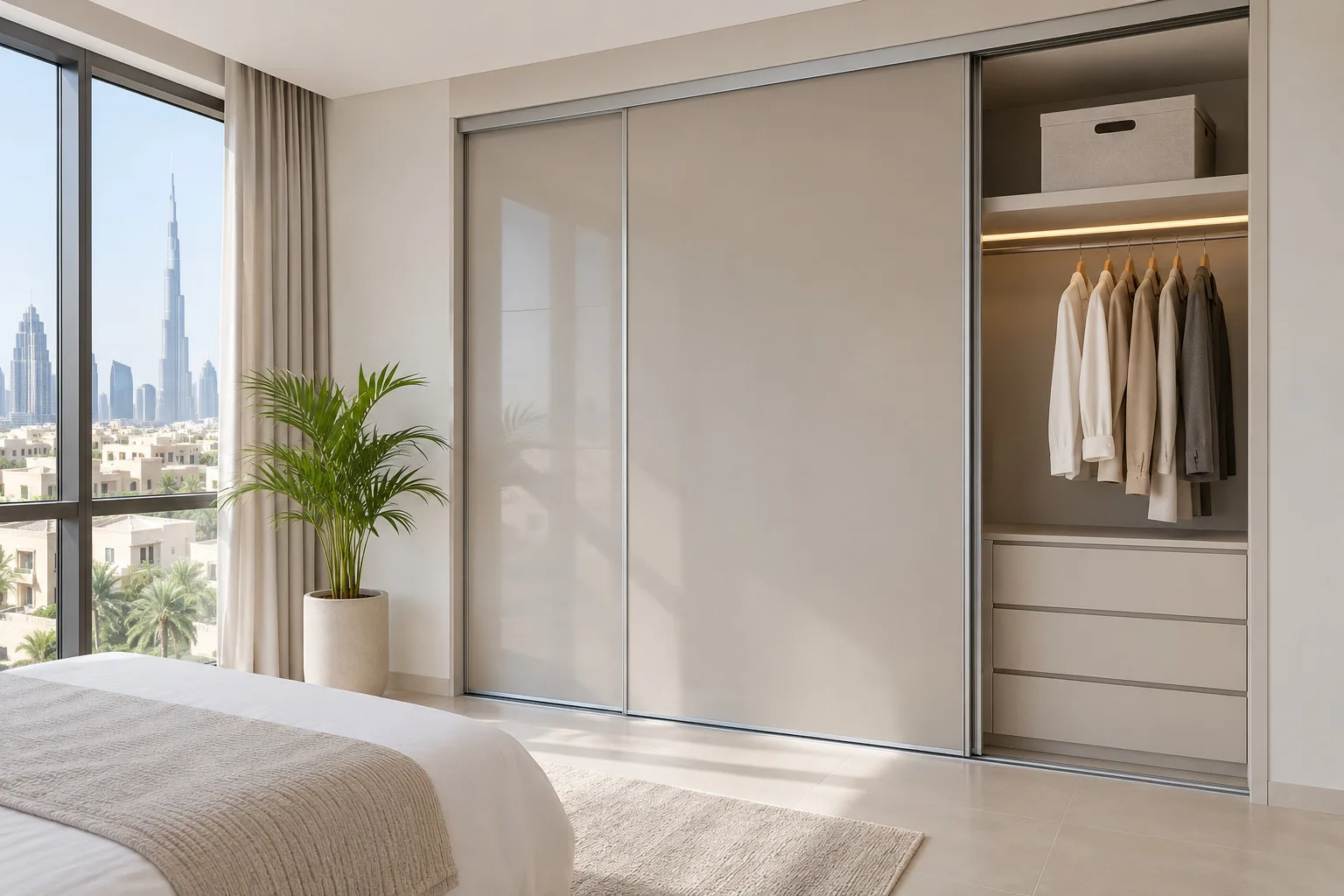
Sliding doors add a different limit: the drawer can only come out through the opening that is free, which is one leaf wide at a time. A bank of wide drawers behind a sliding door may need a narrower design, or the doors may have to change. The sliding door systems guide shows how the leaves overlap. This is also where replacing the doors can help, which is covered below.
When a drawer bank cannot fit
Some wardrobes cannot take a drawer bank, and it is better to know before paying for one. Three cases are common. The first is a shallow wardrobe: if the inside depth is below what a drawer box and its runner need, no drawer will fit properly, and a pull-out rack or an open shelf may be the realistic alternative. The second is the rail you cannot give up: if you hang long garments, such as a dress, an abaya or a kandura, the rail needs the whole height of the section. Turning the lower part into drawers would leave the garments dragging on the drawer tops.
The third is a section that is too narrow, or a carcass that is too weak to carry weight. In each case the better answer may be a smaller change: a shelf or two in place of a drawer bank, or a pull-out basket. Our guides to long garments such as abaya and kandura and to how high a rail should hang show how much height a rail needs before anything else goes under it.
A useful rule is to decide what must stay hanging first, then see what room is left. If the answer is almost none, adding drawers means adding a second unit beside the wardrobe or replacing the wardrobe, and the decision moves to the last section of this page.
- 1. The carcass: sound, square and dry enough to take screws and weight
- 2. The depth: room for a drawer box and its runner, behind the door
- 3. The back panel: often thin and not meant to carry anything
- 4. The door clash: the door must open wide enough for the drawer
- 5. The rail to keep: long garments need the full height; the drawer tower goes in what is left
Shelves, a drawer tower or pull-out racks
Extra shelves are the simplest addition. They need supports on the sides or a shelf that stands on a post, and they suit folded knitwear, bags and boxes. The check is the shelf span: a long shelf that is thin sags, and a shelf over a wide section may need a vertical divider underneath to stay flat. A shelf is the right answer when a rail has too much empty height above it.
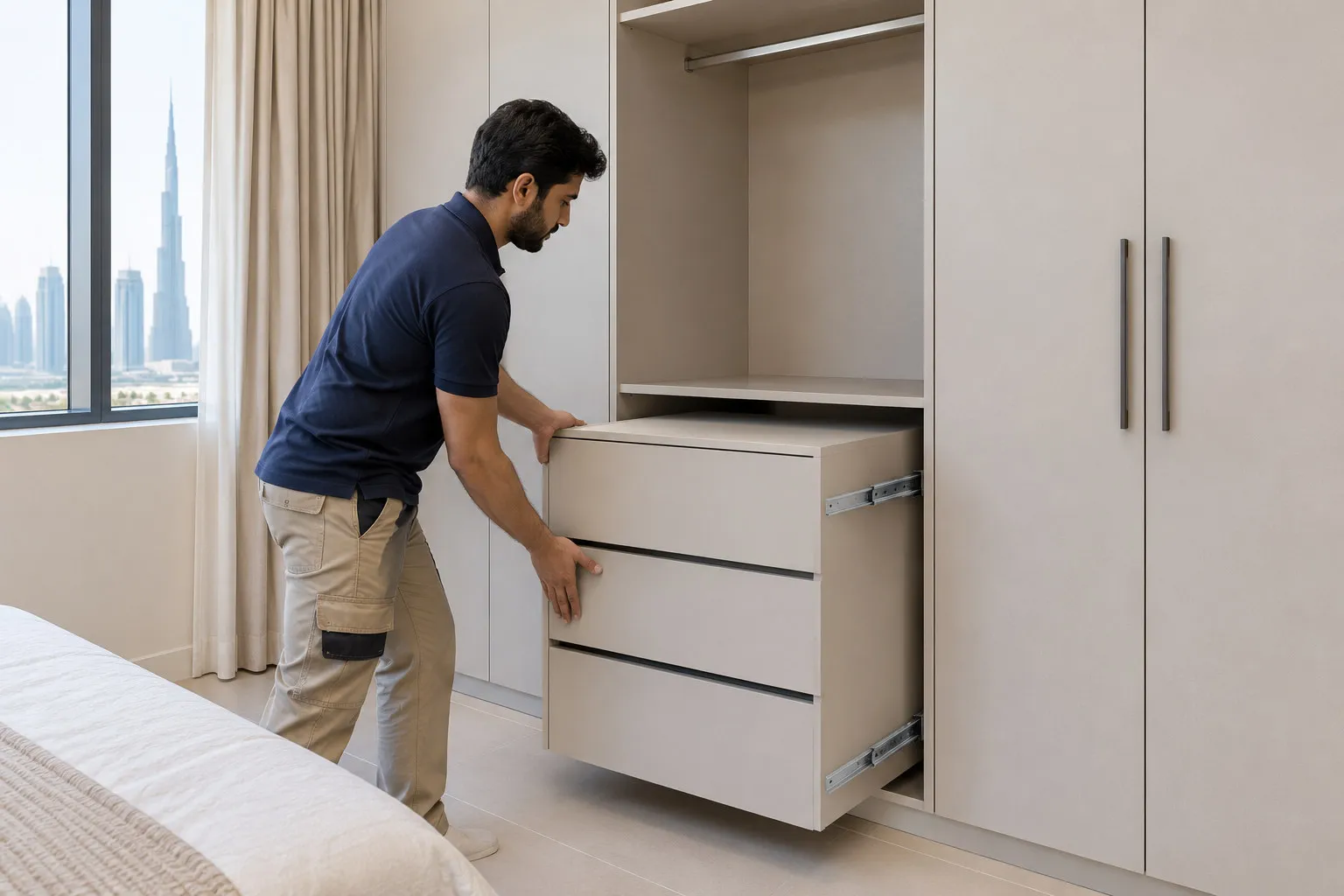
A drawer tower is a separate box of drawers that stands on the floor of the wardrobe, or sits on a plinth, and is fixed to the sides or to the wall. Because it is a box in its own right, it asks less of the old carcass than drawers hung from the old sides, though it takes up floor and width, and it needs the door in front of it to open. It suits a section where you can give up the whole height. It also lets us choose where the drawers sit, which matters for jewellery and watch drawers and for handbag storage, where the depth of each drawer matters more than the number.
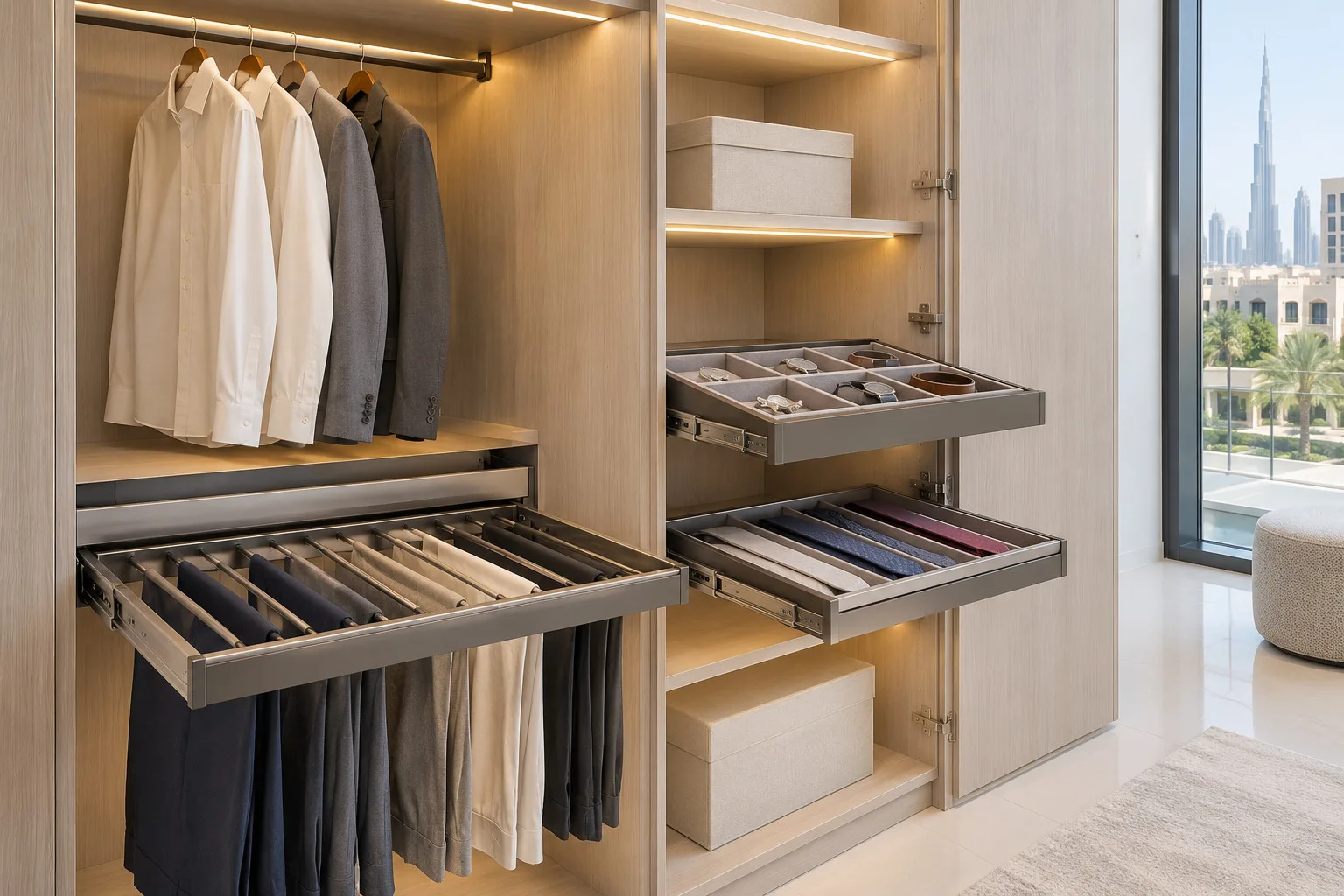
Pull-out racks, such as trouser racks and baskets, use a section beside the rail and are made for a width range. The two Hettich trouser holders we opened are a useful example: one is fitted on the cabinet body side (Conero, 10 kg listed), the other between the body sides (Amari, 30 kg to EN 15338 level 3 listed). The Hafele pull-down rail we opened is made for an internal width of 620 to 950 mm, has a minimum installation height of 880 mm and is screw-fixed to the side panels, which is a reminder that every rack depends on the sides being able to carry it. Ask what is available and the load rating in the quotation; we have not published a list of accessories.
Which addition suits which problem
Too much empty height above a rail
- A change worth discussing
- Extra shelves or a shelf above
- What to check first
- How the sides take supports and the span of the shelf
Folded clothes in piles
- A change worth discussing
- A drawer tower or drawers
- What to check first
- Depth, width, the door in front and the floor
Trousers and small items lost
- A change worth discussing
- A pull-out rack or basket
- What to check first
- Inside width, depth, load rating and door clash
Long garments and no room
- A change worth discussing
- Keep the rail; add a unit beside the wardrobe
- What to check first
- Whether a unit beside it fits the wall
A wardrobe that is damaged or swollen
- A change worth discussing
- Rebuild the inside, or replace
- What to check first
- The cause of the damage and the board it is made of
These are options to discuss, not a promise that each can be made for your wardrobe. We assess it on the free measuring visit.
What drives the cost, without numbers
We publish no price for modifying an existing wardrobe, because the scope depends on the condition of the unit and cannot be known from a photo. What we can say is what moves the cost. The number of drawers and the size of each, the runners (full extension or not, soft-close or not), the board and the finish of the drawer fronts, and whether the fronts must match an existing finish all raise or lower it. So does the amount of work done to the old carcass first: repairing a swollen bottom or adding support costs more than a unit that goes into a sound section.
Matching an old finish is a cost of its own. An existing finish may no longer be available, and a new front beside an old one can look different, which is why some customers choose to change all the fronts together. For how finishes compare, see our guide to wardrobe door finishes. Our entry price of AED 550 per sqm is for a new MDF laminate wardrobe with hinged doors, installed; it is not a price for modifying an existing one, and other options raise it.
To compare quotations, ask for each change as a separate line, with the width, depth and load of each drawer or rack written next to it. The wardrobe quotation checklist lists the lines to ask for, and the pricing guide shows how a quotation is built from measured sizes.
Doing it together with door replacement
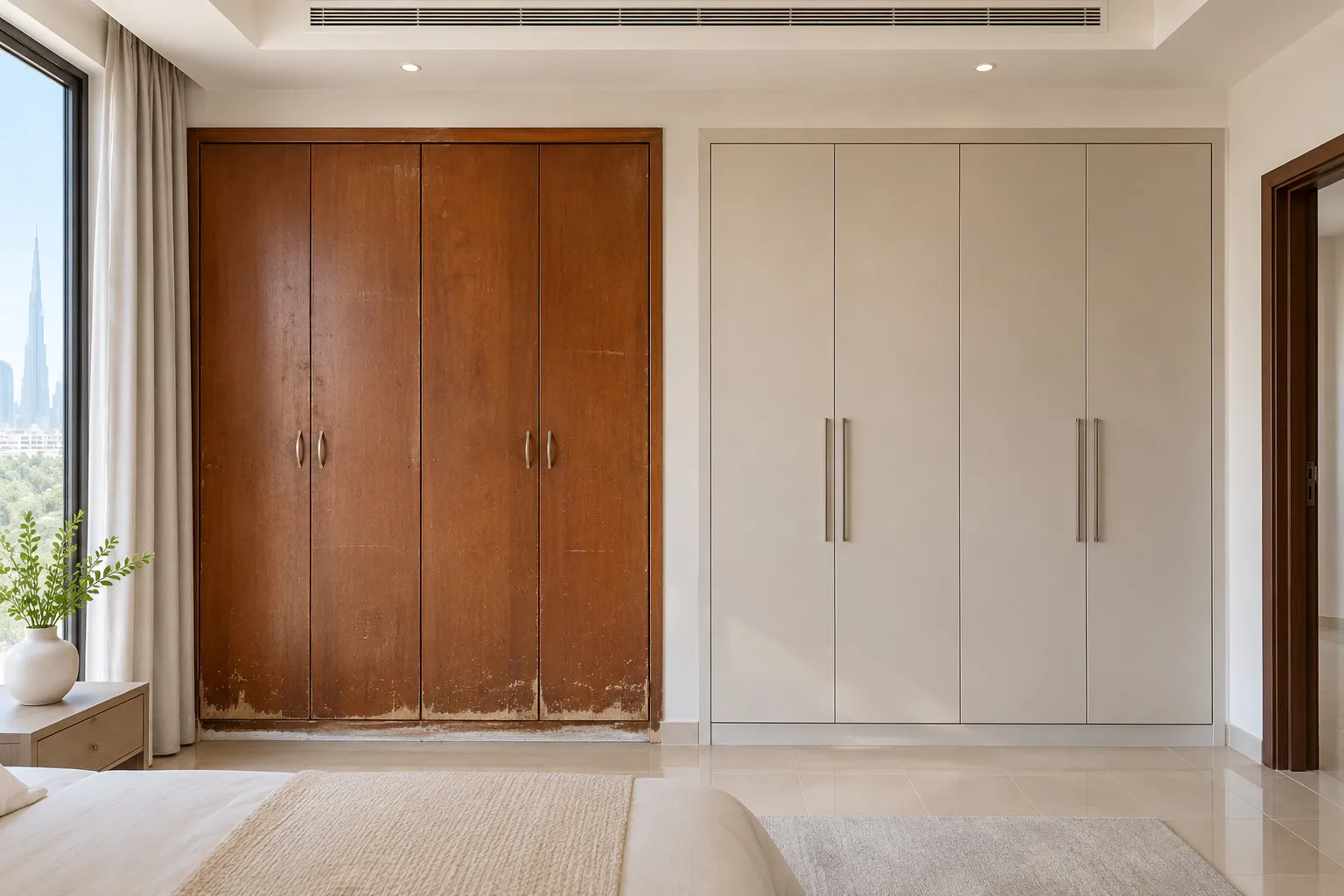
If you are changing the inside, the doors are worth deciding at the same time. Door replacement is offered, and doing both together has practical reasons. The doors have to open in front of the drawers, so a new set can be planned for the drawers instead of the other way round. A new hinge or track can be chosen to give the clearance a drawer needs. And fronts that are new, side by side with new drawer fronts, match each other, which an old door and a new drawer front will not.
The check on the existing unit is the same for both: squareness, damp, the condition of the hinge holes and the level. We explain what we look at, and when replacing only the doors makes sense, in our guide to wardrobe door replacement. For hinged doors, how many hinges a door needs is worth reading before you choose.
When rebuilding the inside is smarter, or replacing
Sometimes the right answer is not an addition. If the carcass is damaged, if every section is too shallow, or if the changes you want cover most of the inside, a new interior, or a new wardrobe, is the cleaner answer, because you pay once for a design planned as a whole instead of for a series of patches. Our renovate or replace guide sets out how to decide, and the questions are the same ones as here: what is sound, what cannot be fixed and what the changes would add up to.
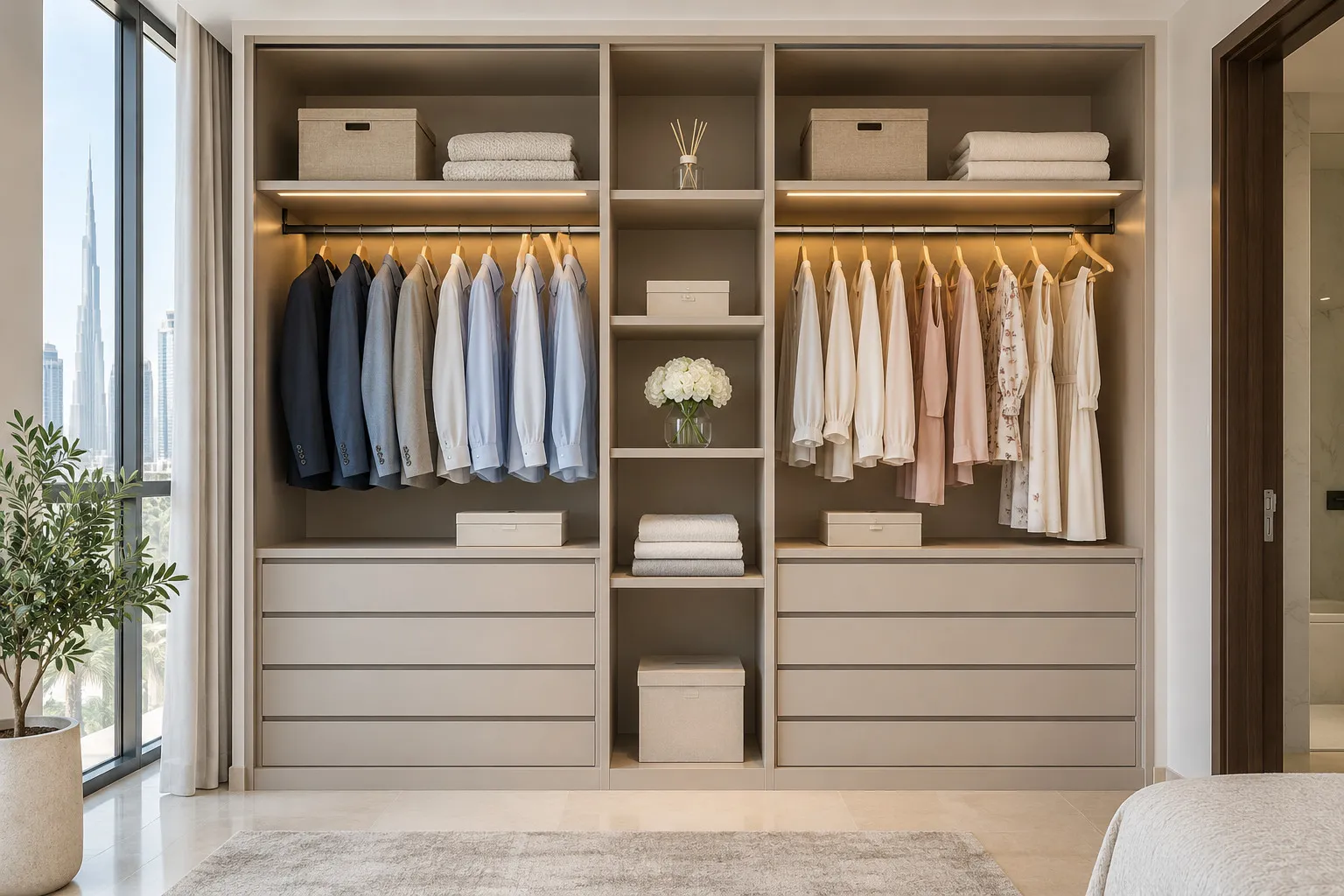
A middle path is to keep the outer box, which is sound, and rebuild the inside as one design, with new drawers, shelves, rails and perhaps new doors. That is a larger job than adding one drawer unit, and we assess it on the same visit. We do not say it is always cheaper or better; it depends on the unit.
What we do about it
Send photos of the inside and the outside of the wardrobe, with its width, height and depth, and say what you want to add. We assess requests for additional wardrobe modifications or refurbishment, and the scope depends on the condition of the existing unit; we do not say we can modify every brand or type of wardrobe, and we do not give a price or timeline from photos. The next step is the free measuring visit, where we look at the carcass, the depth and the doors, and say what is and is not possible. Our guide to the free wardrobe measuring visit shows what to prepare, and you can book through the consultation form.
If we agree a scope, we send a drawing and an itemised price, and nothing is made until you approve them. Our custom wardrobes service page lists what we make, the built-in wardrobes page shows finished runs, and the Sharjah page gives the workshop address. New work carries a 24-month written workmanship warranty, with supplied products under their own terms; the wood-based boards carry a 5-year limited warranty on separate terms that exclude hinges, runners and other moving hardware, set out in our wardrobe warranty guide. How it applies to a change made to an existing wardrobe is written into the quotation.
If most of the inside must change, the step-by-step guide to planning a whole wardrobe helps you decide the new design in order.
Common questions
Can you add drawers to a wardrobe I already have?
Sometimes. It depends on the condition of the wardrobe, its depth and width, the back panel and the doors, and we do not say we modify every type. Send photos and measurements and we assess it on the free measuring visit. See our measuring visit guide.
Can I swap some hanging space for drawers?
Often, if you can give up the height and the depth is enough for a drawer box. Keep the full rail if you hang long garments. See our guide to how high a rail should hang.
Why might a drawer bank not fit my wardrobe?
The usual reasons are a shallow inside, a section that is too narrow, a door that does not open wide enough or a carcass too weak to carry weight. A shelf or a pull-out rack may fit instead. See our wardrobe depth guide.
Can I add drawers and change the doors together?
Yes, door replacement is offered, and doing both lets the doors be planned for the drawers and the fronts match. See our wardrobe door replacement guide.
How much does it cost to add drawers to a wardrobe?
We give no price from photos, because the scope depends on the existing unit. Drawer count and size, runners, fronts and any repair to the old boards drive the cost. See our quotation checklist.
When is it better to rebuild the inside or replace the wardrobe?
When the carcass is damaged, every section is too shallow or the changes cover most of the inside. See our renovate or replace guide.
What should I send to get an assessment?
Photos of the inside and outside, the width, height and depth, and what you want to add. We assess on the free visit; book through our consultation form.

Sources & specifications
Manufacturer information applies to the named products and systems. Sources reviewed on 4 November 2026.
- Hettich, Conero pull-out trouser holder (article 9352793): load 10 kg, minimum inside cabinet width 457 mm, minimum inside body depth 475 mm, installation on the cabinet body sideshop.hettich.com(opens in a new tab)
- Hettich, Telescopic Amari trouser holder 500 - 600 mm (article 9132916): 30 kg to EN 15338 level 3, installation between cabinet body sidesshop.hettich.com(opens in a new tab)
- Hafele pull-down wardrobe rail 1.6-8 kg (retailer page): internal width 620-950 mm, minimum installation height 880 mm, screw fixing to side panelsindependent4life.co.uk(opens in a new tab)
Want this planned for your home?
Consultation and measurement are free. Tell us the rooms, location and what you need; we arrange a sample visit and define the measured quotation.