Wardrobes · 12 min read · 16 August 2026
Wardrobe edge banding: PVC, ABS, melamine, veneer and what to check
Edge banding is the strip that covers a wardrobe board's cut edge. PVC, ABS, melamine paper and veneer compared as makers describe them, why the edge matters, glued against laser-fused bands, colour and corners, and how to check an edge on a quotation and on delivery.

By Ali Haider Basra, Founder, Al Tareeq Decor · Contact our workshop
Key takeaways
- Edge banding is the thin strip that covers a board's cut edge: PVC, ABS, melamine paper and wood veneer are the four materials makers describe, and none is ranked here because we found no neutral test.
- The edge is where moisture, wear and looks meet: the open core takes water faster than the sealed face, and the edge takes the knocks.
- Bands are fixed with hot-melt glue, the long-standing standard with a visible joint line, or fused with laser or hot air, which aims at a joint you cannot see; the claims are the makers' own.
- Door edges, drawer fronts and shelf fronts show; back and against-the-wall edges usually do not, and whether they are banded is a choice written in the quotation.
- Ask for the band material, the edges that carry it, the colour match, the fixing method and the corner finish in writing, and check each edge in daylight on delivery.
On this page
- Key takeaways
- What edge banding is, in one page
- The four edge materials side by side
- Why a raw edge matters: moisture, wear and looks
- How a band is fixed: glued, hot-melt and fused
- Colour matching and corners
- Where edges show and where they do not
- Where the edges of a wardrobe show
- Checking an edge in a quotation and on delivery
- Edge banding questions for a quotation and a delivery check
- What we do about edge banding
- Common questions
What edge banding is, in one page
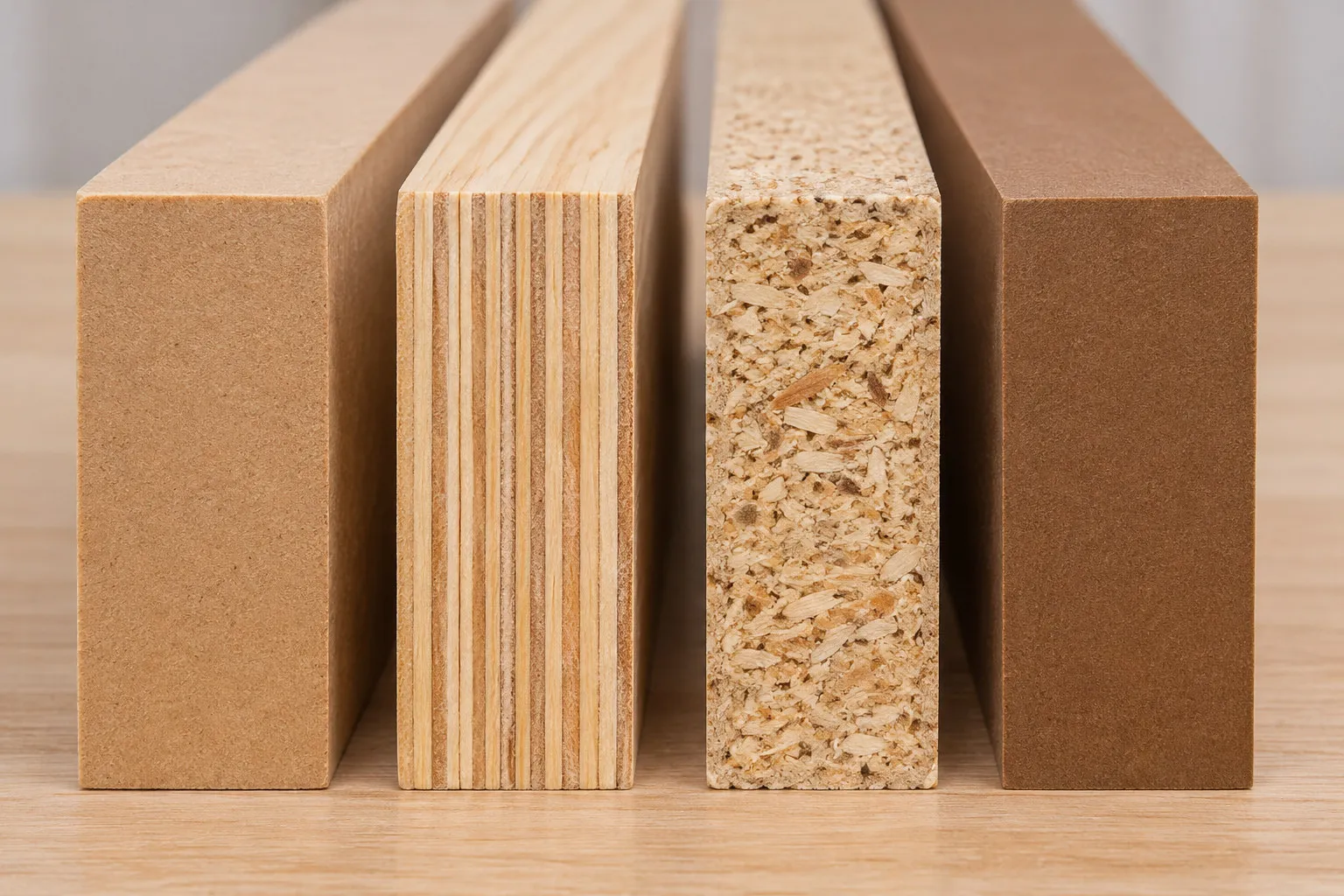
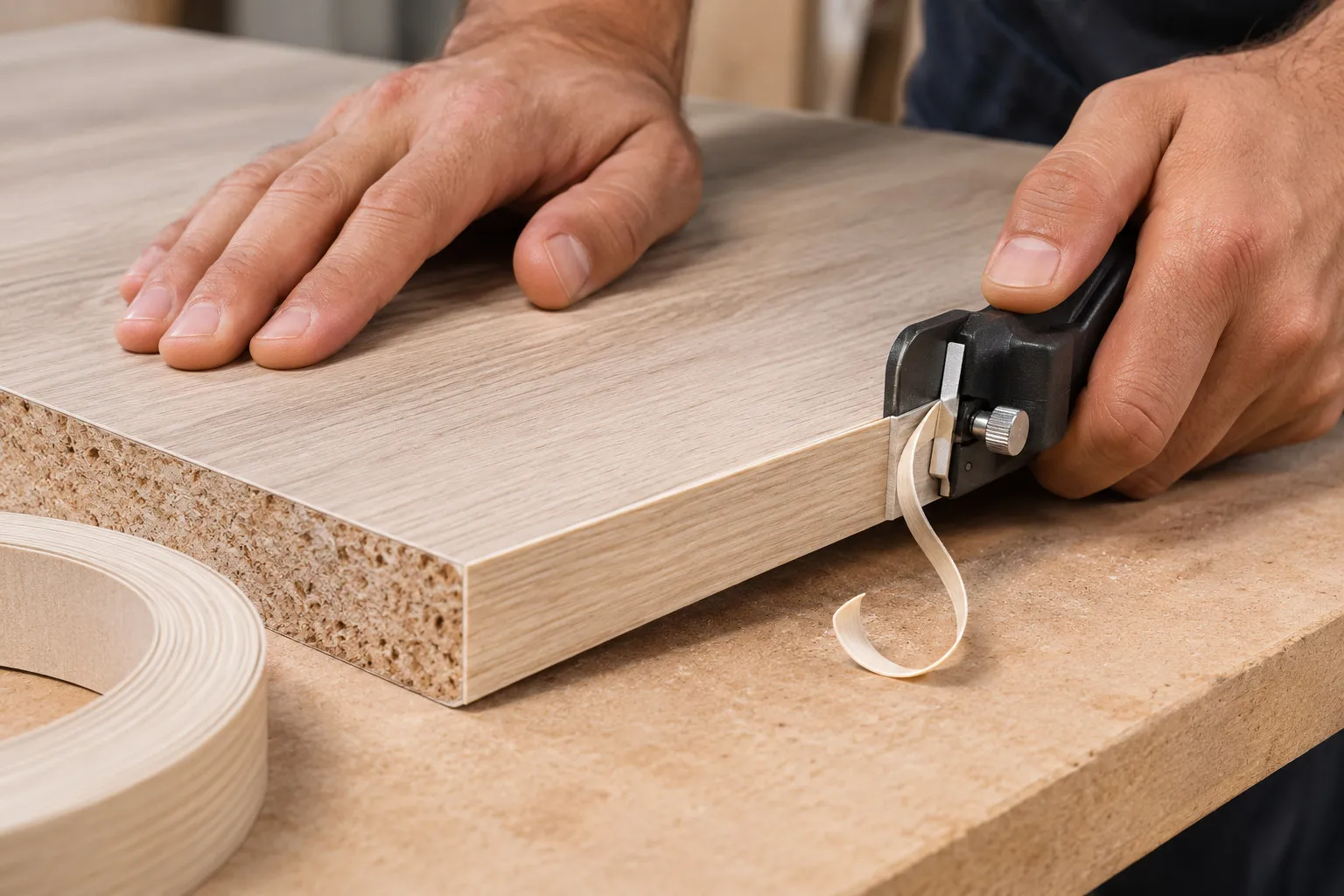
A wardrobe board is cut from a large sheet, and the cut leaves the core of the board open along its edge. Edge banding is the thin strip that covers that cut edge, so the board looks finished and the open core is not left exposed. One maker of veneer edging describes its roll in the same terms: a "time-saving way to conceal the exposed core of sheet goods". For the board, the surface and the hardware as one specification, see our guide to wardrobe materials and hardware.
The strip can be made of different materials, and each has its own character: PVC, ABS, melamine paper and wood veneer. This page explains the four, why the edge matters at all, how a band is fixed to the board, how its colour and corners are judged, and how to check an edge on a quotation and on delivery. Board grades are covered in our moisture-resistant wardrobe boards guide, and the face finish in our wardrobe door finishes comparison; this guide is only about the edge.
The drawing below builds one board corner in the order a workshop builds it: the core, the band, the glue line and the finished edge. It is an illustration of the idea; no sizes are drawn, because the thickness of a band is something to ask for in your quotation and not a number we can give you here.
The four edge materials side by side
PVC
- What the maker says it is
- EGGER: used "for edging coated wood-based materials and provide the matching decorative finish", for furniture fronts, bodies and tabletops
- What to ask in a quotation
- Which band material, and whether it is the same for every door and shelf
ABS
- What the maker says it is
- EGGER PerfectSense ABS: made to finish matt and high-gloss lacquered boards and laminates, in matching decor and texture
- What to ask in a quotation
- Whether the band is matched to the face for colour, texture and gloss
Melamine paper
- What the maker says it is
- TECE: "a special paper that is first impregnated and then covered with lacquer"; its pre-glued rolls are "the most common and least expensive" of that kind
- What to ask in a quotation
- Which edges carry it, and that it is named separately from the face
Wood veneer
- What the maker says it is
- Sauers: "all-natural wood veneer", pre-sanded and pre-glued with a clear topcoat; TECE: applied with iron or hot air
- What to ask in a quotation
- That the species and finish match the face veneer, and who finishes the corner
Descriptions are each maker's or trade page's own product sentences, not a ranking: we opened no neutral test comparing the four, and we do not say which one is best or which one we use. Ask for it in the quotation.
- 1. The core: the board's own material, open along the cut
- 2. The edge band: a strip that covers the cut and matches the face
- 3. The glue line: the join between band and core (laser-fused bands have no separate glue)
- 4. The finished edge: trimmed flush, with the corner softened
Why a raw edge matters: moisture, wear and looks
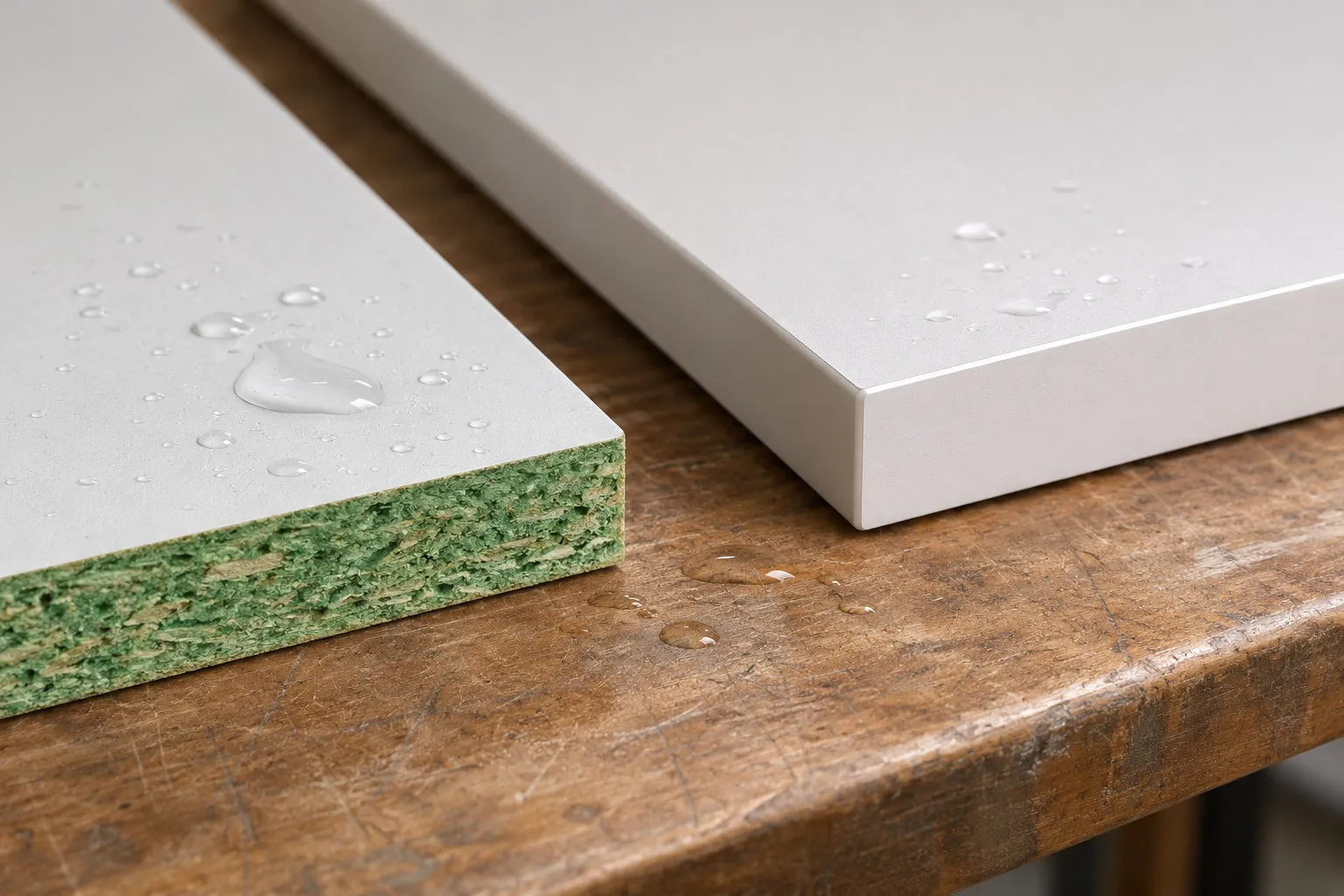
Three things happen at an edge that do not happen on the face. First, the open core takes in water faster than a sealed face does. The face of a laminated board is a closed layer; the cut is not, so a splash, mop water or a damp wall reaches the core through the edge before it reaches it through the face. That is why the bottom edge of a door or the plinth, nearest a mopped floor, is the first place to look for swelling. How a board resists humidity is a different question, which our moisture-resistant boards guide answers; the edge is the part of that answer you can see.
Second, an edge takes the knocks. Door edges meet a hand, a bag or a vacuum cleaner; a drawer front is pulled and pushed all day; a shelf front is brushed by every hanger and basket. A band does not make a board indestructible, and a hard knock can chip a corner whatever it is made of, but a covered edge is hit as a surface and an open core is hit as a crumbly material. If a door already rubs or catches, our guide to a wardrobe door that sticks, rubs or sags has the first checks, and the edge is one of the places it shows.
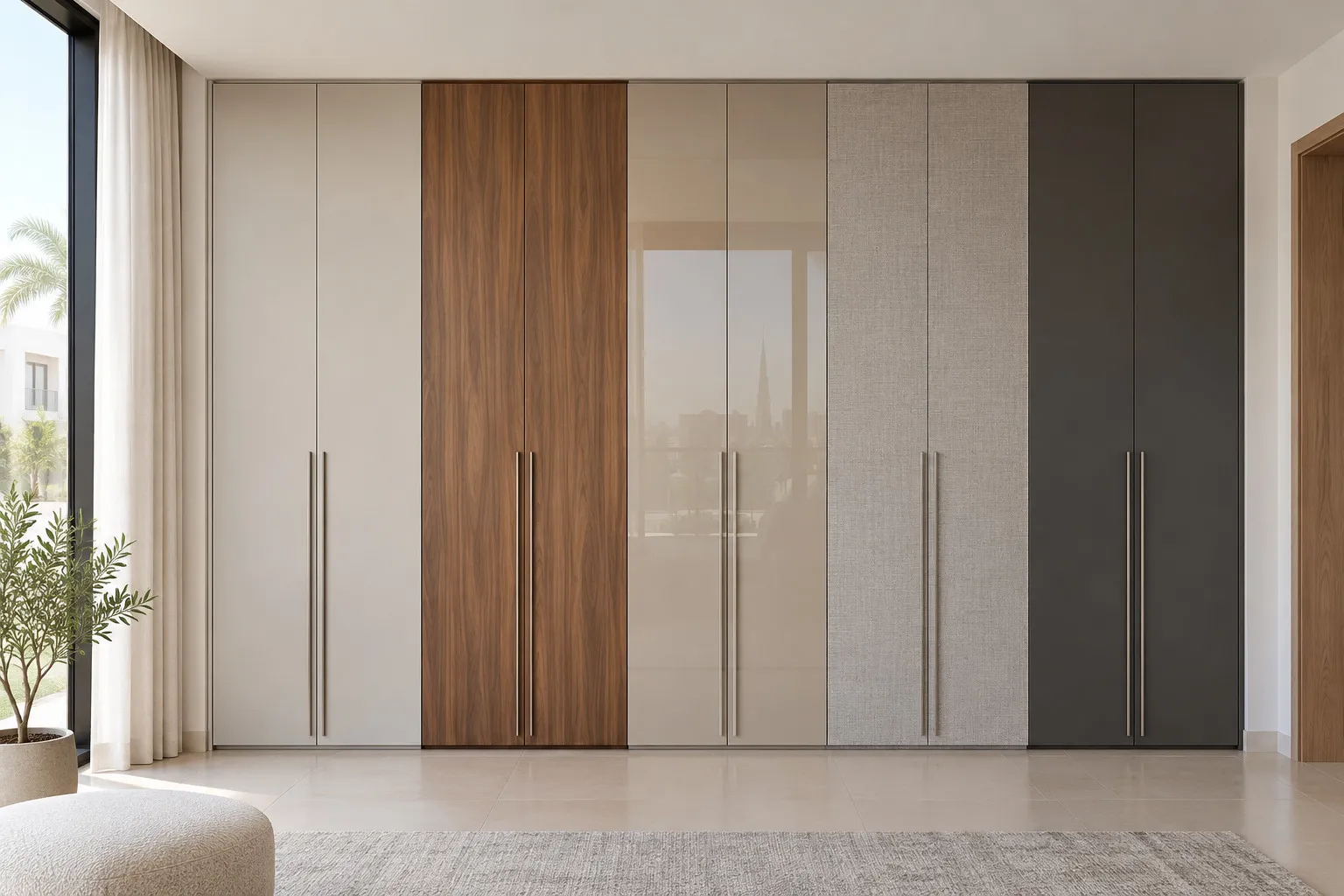
Third, looks. On a door with no handle, with only a recessed pull, the edge is the visible seam of the whole wall, as our guide to handleless wardrobes against handles explains. A mismatched or lifting edge is the first thing the eye finds on a plain flat front, while on a panelled or fluted door the shadows hide more. Moisture, wear and looks are three separate reasons, and a given edge can pass two and fail the third, which is why it helps to ask about all three.
How a band is fixed: glued, hot-melt and fused
The commonest method, as the trade describes it, is glue. One edgebanding-machine dealer's guide says that "EVA hot-melt adhesive has long been the industry standard for edgebanding": the machine melts the adhesive, presses the band on, and trims it. The same page says EVA has "lower heat and moisture resistance compared to PUR", another adhesive, and a more visible glue joint, especially on darker panels. A glued joint is therefore a real, visible and permanent line between band and board, however fine.
A second family fuses the band instead. REHAU, a maker of edgebands, describes its LaserEdge as a band with "a pre-applied, co-extruded polymer functional layer that replaces the traditional glue": a laser, hot air or similar heat source melts that layer so it bonds to the board, and the maker lists a "permanently invisible joint" as the benefit. REHAU also says hot air is favoured by commercial and smaller fabricators "as it is less expensive than laser technology". These are one maker's claims about its own product, and its page gives no test data; the same company's other page says only that its band can be "highly resistant to heat, moisture and water vapour" depending on the requirements.
So the honest general picture is this: hot-melt glue is the long-standing standard and leaves a visible joint line; laser and hot-air fusing are newer, aim at a joint you cannot see, and need a band made for them. We make no claim that one holds longer than the other, because we found no neutral comparison, and we do not say here which method our workshop uses. What you can ask, and write down, is the method named on the quotation. A wardrobe quotation checklist covers the other lines to compare with it.
Colour matching and corners
An edge is only as good as its match to the face. EGGER says plainly that decors on its pages are reproductions and tells the reader to order a sample of the product itself, and the same advice holds for a quotation: look at the real band beside the real board, in the light of the room, before you agree. REHAU claims "100%-exact color matching of functional and decorative layers" for its RAUKANTEX pro, which is a claim about the band's own two layers; it does not promise that a band and a different maker's board match.
Matching has three parts: colour, texture and gloss. A matt lacquer board with a glossy band reads as a different material at the edge. A wood-look face with a plain-coloured band shows the cut as a stripe. A veneer door needs the band to carry the same species and finish, and our guide to matt and gloss wardrobe doors explains how a gloss level changes what you see at the edge, as the face finish does the rest of the door.
Corners are the other test. The corner where two banded edges meet is where a band is trimmed, where a gap can open, and where a knock lands. Run a fingertip along it: it should feel smooth, with no step between face and band and no sharp lip. Look at the band along a door's long side and at the points where a shelf front meets the side panel. On a handleless door, the edge doubles as the grip, so it should feel finished where a hand actually goes.
Where edges show and where they do not
Not every edge of a wardrobe is seen, and that is useful to know before comparing two quotations, because a banded edge that nobody sees is a different matter from one that everybody touches. Door edges, the front edge of every shelf, drawer fronts and the exposed side of an end panel are the visible ones. Edges on the back, against the wall, on the underside of a shelf at eye level or hidden behind a door are usually hidden when the wardrobe is closed, though not always: a deep shelf seen from below, or a gap beside a column, can reveal them.
Whether those hidden edges are banded or not is a choice that depends on the material, the design and the quotation, which is why we write it down and do not assume. If you want every relevant edge covered, including the ones that are not obvious, say so; it can be accommodated according to your requirements and the agreed design. If the design puts a panel against a bathroom or outside wall, the edges nearest the wall and the floor deserve the most attention.
Where the edges of a wardrobe show
Door edges, all four
- Edge seen?
- Always, on a closed door
- Why to ask about it
- Hands, bags and cleaning tools meet the door edges every day
Drawer fronts
- Edge seen?
- Always
- Why to ask about it
- Pulled and pushed constantly; the edge is also the top and bottom line
Shelf fronts
- Edge seen?
- When the door is open
- Why to ask about it
- Hangers, baskets and folded stacks rub the front edge
End or side panel next to a room
- Edge seen?
- If the panel is exposed
- Why to ask about it
- The full side face and its edges are on view from the room
Plinth and bottom edges
- Edge seen?
- Close to the floor
- Why to ask about it
- Nearest to mopping water
Back and against-the-wall edges
- Edge seen?
- Usually not
- Why to ask about it
- A choice, written in the quotation, not an assumption
A guide to what is usually visible, not a statement of what we band on a given job. The edges on your wardrobe depend on the material, the design and the quotation.
Checking an edge in a quotation and on delivery
Edge banding is easy to leave out of a quotation because it is one small line, and easy to dispute later because it is on every edge. Ask each supplier for the answers below in writing and compare them side by side. A wardrobe door replacement quotation needs the same lines for the new doors, since their edges are the first thing you will touch.
On the day the wardrobe is delivered, check the edges before the installers leave, in daylight. Look along each door edge, drawer front and shelf front for a lifting band, a gap at a corner, a chip, a glue smear or a visible stripe where the colour changes. Press a thumbnail lightly along the join: a band that moves has not bonded. Anything you find is easier to put right on the day than months later, and your notes belong beside the signed drawing. Our wardrobe measuring visit guide explains what is agreed before production, and the warranty guide explains what the cover does and does not include, so read both before you rely on an edge claim.
Edge banding questions for a quotation and a delivery check
Which band material?
- Why it matters
- PVC, ABS, melamine paper and veneer behave differently
- A clear answer looks like
- The material named, door by door and shelf by shelf
Which edges carry it?
- Why it matters
- Some edges may be banded and others not
- A clear answer looks like
- A list or drawing mark of banded edges, including bottom and shelf-front edges
Does the band match the face?
- Why it matters
- Colour, texture and gloss must agree at the edge
- A clear answer looks like
- A sample of band beside board, seen in the room's light
How is the band fixed?
- Why it matters
- Glued and fused joints look and age differently
- A clear answer looks like
- The method named, not 'standard'
How are corners finished?
- Why it matters
- Corners take the knocks and show the join
- A clear answer looks like
- A finished corner on the sample or in a photograph
On delivery: any lift, gap, chip or stripe?
- Why it matters
- Easier to correct on the day than later
- A clear answer looks like
- Notes with photographs, shared the same day
Our entry price of AED 550 per sqm is for MDF laminate with hinged doors, installed; other options raise it and no edge detail is part of the published price. Ask for it in the quotation.
What we do about edge banding
Edge banding is available according to your requirements and the agreed design. If you want all the relevant edges covered, tell us and we can accommodate it; the exact application depends on the material, the design and the quotation. We do not publish a band thickness, a band material or a fixed method here, so ask for them in the quotation and we will write them down. And we do not claim that every edge is banded on every job: that is decided with you, per piece, on the drawing.
At the free measuring visit we bring samples of boards and finishes to your room, measure the wall with a laser, then send a drawing and an itemised price, and nothing is made until you approve them. After you confirm, our Sharjah workshop builds the wardrobe and our own team installs it, up to about 10 days from confirmation depending on size and design. The wood-based boards carry a 5-year limited warranty, subject to terms; hinges, tracks, runners, rollers and other moving hardware are not covered, and the final terms are in the written warranty. A separate 24-month written workmanship warranty covers our installation.
To start, book a free measuring visit through the consultation form, or read our custom wardrobes service page first. The built-in wardrobes page shows finished runs, and the sliding door wardrobes page covers the other door type. Boards and hardware are compared in the wardrobe materials guide; a custom or ready-made wardrobe comparison shows what changes in what you are given. If you have a smell problem, read why a wardrobe smells musty. Our wardrobe price guide shows how a quotation is built, and the pricing guide tool lets you try figures.
Rooms with small or special wardrobes need their own edge checks: a nursery wardrobe gets handled by small hands at a low height, and a guest room wardrobe has drawers that visitors open and close. Where a design wraps around a column, the cut panels of a wardrobe around beams and columns add edges of their own. Installation covers the whole UAE; the Sharjah page gives the workshop address, and our warranty and aftercare guide explains what the 24 months cover.
Edges are a detail of step five; the wardrobe guide for UAE homes, step by step shows the whole order.
Common questions
What is edge banding on a wardrobe?
It is the thin strip fixed over the cut edge of a board so that the open core is covered and the edge matches the face. PVC, ABS, melamine paper and wood veneer are the materials makers describe. See our wardrobe materials guide.
Is PVC or ABS edge banding better?
We found no neutral test that ranks them, so we do not. EGGER describes PVC as an edging for coated wood-based boards and its PerfectSense ABS as made for matt and high-gloss lacquered boards and laminates. Ask which one is quoted. See our wardrobe door finishes comparison.
What is the difference between glued and laser edge banding?
Glued bands are fixed with hot-melt adhesive, the long-standing standard, which leaves a joint line. Laser or hot-air bands carry a layer that melts onto the board and aim at a joint you cannot see; that is the makers' claim. Ask which method is quoted. See our wardrobe quotation checklist.
Are all the edges of a wardrobe banded?
Not always, and we do not say so. Edge banding is available according to your requirements and the agreed design, and if you ask for all relevant edges we can accommodate it; the exact application depends on the material, the design and the quotation. See our wardrobe measuring visit guide.
How thick is the edge banding on your wardrobes?
We do not publish a thickness, so ask for it in the quotation and we will write it down. A published thickness would also depend on the material and design. See our custom wardrobes service for what we make.
Does edge banding protect a wardrobe from moisture?
It covers the cut edge, which is where an open core takes in water first, but it is one part of the answer with the board itself. Makers' moisture claims are about their own products. See our moisture-resistant wardrobe boards guide.
How do I check an edge when the wardrobe is delivered?
In daylight, look along each door, drawer and shelf edge for a lifting band, a gap at a corner, a chip, a glue smear or a colour stripe, and press a thumbnail along the join. Note any problem with a photograph the same day. See what the wardrobe warranty covers.

Sources & specifications
Manufacturer information applies to the named products and systems. Sources reviewed on 4 November 2026.
- EGGER, PVC Edging: used for edging coated wood-based materials and provide the matching decorative finish; for an accurate colour order a sampleegger.com(opens in a new tab)
- EGGER, PerfectSense ABS Edging: the finish for matt and high-gloss PerfectSense lacquered boards and laminates; decor and texture combinationegger.com(opens in a new tab)
- TECE, melamine edgebanding: melamine is a special paper that is first impregnated and then covered with lacquertece.com.tr(opens in a new tab)
- TECE, edgebandings in pre-glued rolls: melamine the most common and least expensive; veneer applied with an iron or hot air blowertece.com.tr(opens in a new tab)
- Sauers via Woodcraft, pre-finished pre-glued veneer edge banding: all-natural wood veneer, pre-sanded, pre-glued with a clear topcoat; conceals the exposed core of sheet goodswoodcraft.com(opens in a new tab)
- REHAU, LaserEdge: a pre-applied polymer functional layer replaces the glue; zero-joint claim; hot air less expensive than laser (vendor claims)rehau.com(opens in a new tab)
- REHAU, RAUKANTEX pro edgeband: 100% exact colour matching of functional and decorative layers; laser, hot air and NIR processing (vendor claims)interior.rehau.com(opens in a new tab)
- WSI Machinery, edgebander adhesives: EVA hot-melt the long-standing standard, lower heat and moisture resistance than PUR, a more visible joint on darker panelswsimachinery.com(opens in a new tab)
Want this planned for your home?
Consultation and measurement are free. Tell us the rooms, location and what you need; we arrange a sample visit and define the measured quotation.